
Discarded life jackets used by artists to raise awareness of refugee crisis

Last month the six front columns of Berlin’s historic Konzerthaus were decked out with fourteen thousand bright orange life jackets—an installation by Chinese artist Ai Weiwei, titled Safe Passage. A tribute to those who have risked their lives on the Mediterranean Sea to escape persecution in the Middle East and North Africa, the work was made to coincide with Cinema for Peace’s annual award gala on February 15, part of the Berlin International Film Festival. The money raised at this year’s gala was used to purchase five thousand rescue blankets and one thousand emergency baby kits (for births that have taken place at sea), which the Cinema for Peace Foundation delivered this past week to the Greek island of Lesbos, the most popular port of entry for people fleeing to Europe through Turkey.

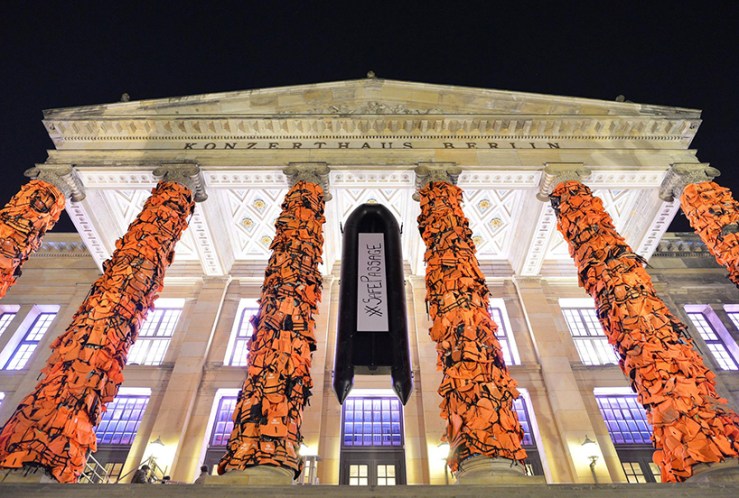
Safe Passage installation
Ai Weiwei’s crew finishes hanging life jackets on the sixth column of Berlin’s Konzerthaus, just before putting up an inflatable dinghy with the title of the installation: Safe Passage. Photo: Markus Winninghoff.
Safe Passage installation
Safe Passage: installation of fourteen thousand life jackets by Ai Weiwei, Konzerthaus, Berlin, February 14–17, 2016. Photo: Oliver Lang.

Weiwei visited Lesbos in December to see for himself the human faces of the current refugee crisis. He shared on Instagram photos and videos he took inside a refugee camp, to show the world what’s going on in Lesbos, and has opened an additional studio there.

One thing that visually struck Weiwei were the giant mounds of life jackets heaped up on the beaches. Refugees shed them as soon as they disembark their boats, setting foot, at last, on land, and ready to start their new lives. Seeing in them a poignant symbol of the crisis, he asked the mayor of the island if he could take a small portion—and yes, fourteen thousand is only a small portion—with him to Europe to use for an art installation. His request was granted. Wrapped around the grand facade of Berlin’s nineteenth-century concert house, they bear witness to the scale of the crisis and even allude to its human cost: last year, a reported 3,770-plus refugees died while attempting to cross the Mediterranean, and the death toll for this year has already exceeded 400. Some of these deaths were due to defective life jackets sold to migrants by a Turkish company looking to cut down on production costs.

While some have questioned the efficacy of staging such a large awareness raiser in Germany, a country that has taken in more refugees than any other European Union member state, others point out that several antirefugee organizations have emerged there, such as Patriotic Europeans Against the Islamization of the West (PEGIDA), which calls on the German government to enact stricter asylum laws. Not all the German people are proud of the measures its country has taken to invite in Syrians, Afghans, and other huddled masses yearning to breathe free. Instead they fear the repercussions. Weiwei’s Safe Passage protests against that fear-based mentality that denies and excludes.

Weiwei has not been the first person to recycle used life jackets into art. Last December British artist Arabella Dorman incorporated three life jackets into her installation Flight in St. James’s Church in Piccadilly, London, which has them tumbling out of a capsized dinghy hanging from the ceiling. She also filled the Christmas crèche at the front of the church with a few dozen more: they cushion the ground where the sculpted figures kneel in adoration of the newborn Christ child.   Continue reading “Discarded life jackets used by artists to raise awareness of refugee crisis”

Flamenco-style devotional singing in southern Spain

Noted for its dramatic intensity and tragic beauty, the saeta is a type of devotional song performed during Holy Week processions in the Andalusia region of Spain, inspired by images of the suffering Christ and Virgin. It is sung during pauses in the procession, usually without accompaniment: a loud, melismatic wail of praise and lament. Sometimes such performances are planned, with a professional singer standing on a balcony; other times they are improvised by someone in the crowd, as he or she feels moved. Either way, the performances are typically quite emotional.

Here’s a spontaneous male duet performance that took place in the village of San Fernando in the Andalusian province of Cádiz in 2011:

The word saeta means “arrow” in Spanish, referring to the way in which the song soars through the air, piercing the hearts of its listeners.

Music historians locate the origins of the saeta in late medieval monastic canticles. According to Doreen Carvajal in The Forgetting River: A Modern Tale of Survival, Identity, and the Inquisition,

Most experts agree that the early primitive form of saeta was composed of Gregorian psalms sung by friars and monks during missions. Later the musical structure broke free and was adapted for singing in the street, reshaped by converso Jews [Jewish converts to Catholicism] in the sixteenth century.

While some of these Jewish Catholic songs may have expressed genuine devotion to a newly embraced Christ, most of them—one theory notes—were coded expressions of the singer’s own sorrow at having been forced to renounce his or her former faith by threat of exile or death. This was the time of the Spanish Inquisition, after all.

The saeta was also developed early on by the Andalusian gypsies (gitanos), who have adopted the Catholicism of their host country and who remain the saeta’s most popular interpreters today. They brought to it the elements of flamenco, such that the saeta is now regarded as a subset of that art form and is a part of every flamenco singer’s cante jondo (“deep song”) repertoire.

Saeta for the blind and imprisoned
Julio Romero de Torres (Spanish, 1874–1930), La Saeta, 1918. Oil on canvas. Painted in response to the following saeta lyrics: “¡Oh Santo Cristo de Gracia! / Volved la cara atrás. / Dadle a los ciegos vista / y a los presos libertad.” (Oh Holy Christ of Grace! / Turn your face upon us. / Give sight to the blind / and liberty to the prisoners.)

Even though the saeta has made its way into concert halls, it is still best known as a song of the people, an integral part of Andalusian folk culture, especially among gypsy communities. Sometimes gypsy saeteros (saeta singers) incorporate into the lyrics expressions of ethnic pride—for example, identifying Jesus and his mother, Mary, as one of their own:   Continue reading “Flamenco-style devotional singing in southern Spain”