Roundup: “Kyrie / Oh Death” medley, preaching Chagall, Isaiah 35-inspired chamber work, and more

SONGS: The following two songs appear on the Art & Theology Lent Playlist on Spotify. (Note: I’ve also integrated some Lovkn, Sarah Juers, and a few others into the list since originally publishing it.)

>> “Kyrie / Oh Death,” performed by Susanne Rosenberg: March 11 marks one year since the coronavirus outbreak was officially declared a pandemic, and the tremendous number of lives lost is staggering. (A friend from Japan reminded me that it’s also the ten-year anniversary of the Great Tōhoku earthquake and tsunami that killed some 16,000 people; 3/11, he says, is as important in Japan as 9/11 is in the United States.) This lament by Susanne Rosenberg, one of Sweden’s foremost folk singers, seems appropriate. It combines a twelfth-century Kyrie chant with the Appalachian folk song “Oh Death,” the latter made famous by Ralph Stanley. Kyrie eleison, Christe eleison, Greek for “Lord, have mercy, Christ, have mercy,” is a short, repeated invocation used in many Christian liturgies, and Rosenberg seamlessly integrates it with these few lines: “Oh Death, oh Death, won’t you spare me over till another year?” The video recording is from a February 2010 concert in Dublin, and a similar version of the medley, in a different key, appears on Rosenberg’s album of the same year, ReBoot/OmStart.

>> “Washed in the Blood,” performed by Pokey LaFarge and Harry Melling: The Devil All the Time (2020) isn’t a great movie, but it has a great soundtrack. Harry Melling—known for his roles as Dudley Dursley in the Harry Potter series and, more recently, Harry Beltik in The Queen’s Gambit—plays a spider-handling preacher named Roy, and singer-songwriter Pokey LaFarge (whose style pulls from ragtime, jazz, country, and blues) plays his guitar-playing sidekick, Theodore. The two actors sing as their characters in the film, this classic hymn by Elisha Hoffman. Love it!

+++

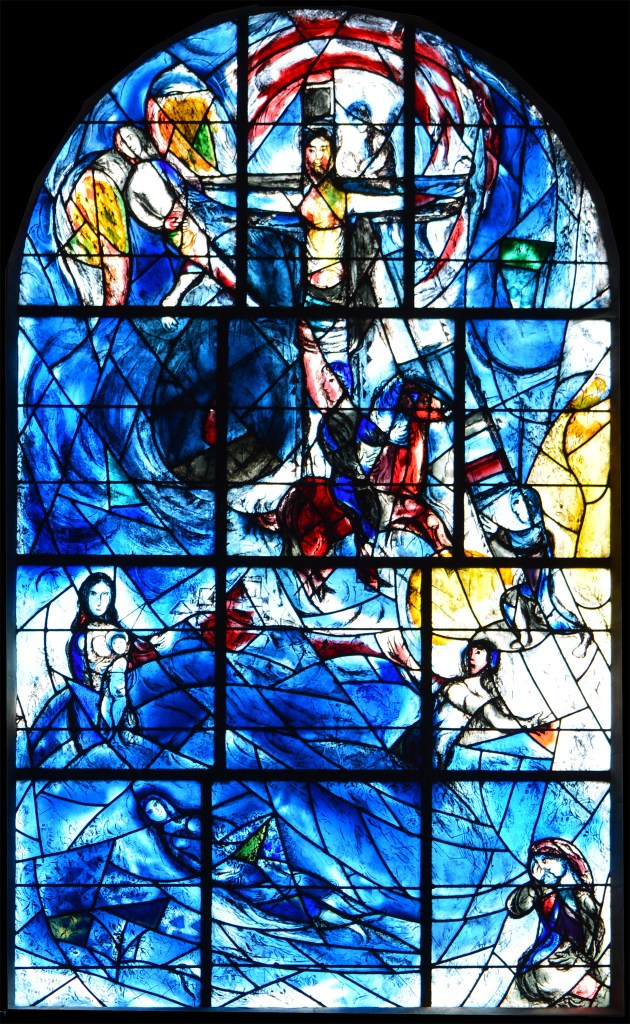
SERMON: “Chagall at Tudeley” by Rev. James Crockford, University Church, Oxford, April 7, 2019: This sermon, preached on Passion (Palm) Sunday two years ago, is an excellent example of how pastors can draw on visual art as a theological and homiletical resource—not to merely illustrate a point already made or to add some pretty dressing to a sermon, but taking it on its own terms and allowing it to generate insight and guide the congregation someplace new. Crockford uses the East Window in All Saints’ Church in Tudeley, Kent, England, designed by the Russian Jewish artist Marc Chagall, to open up profound discussion on human loss, hope, renewal, and the cross. [HT: Jonathan Evens]

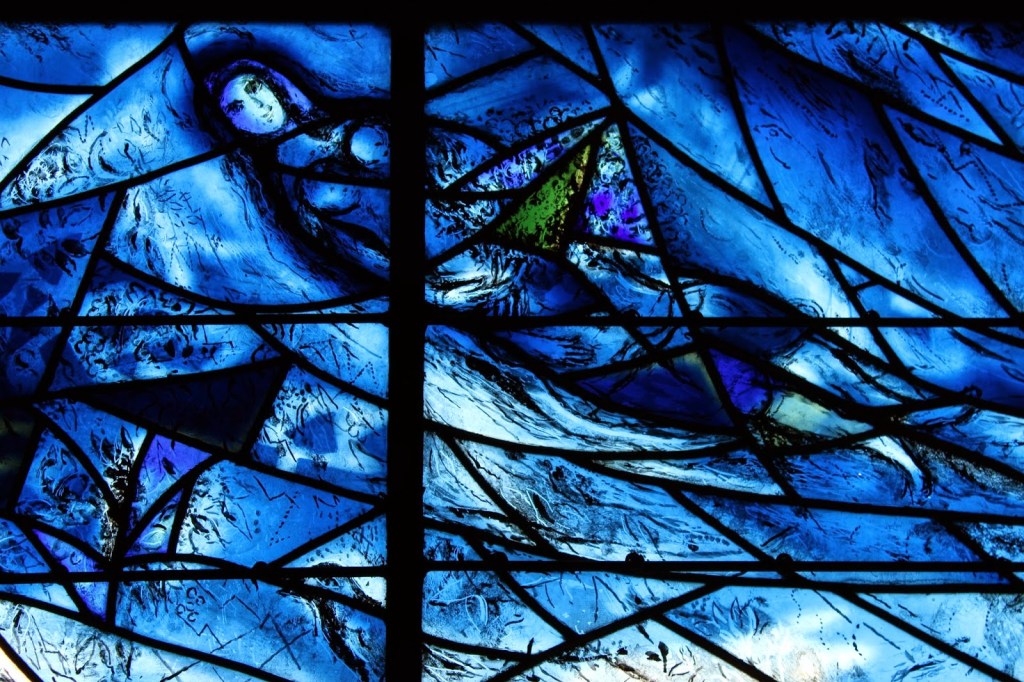
The window was commissioned by the parents of twenty-one-year-old Sarah d’Avigdor-Goldsmid, who in 1963 drowned off the coast of Sussex in a boating accident. “What I see in that East Window,” Crockford says, “is a remarkable exercise in the nature of suffering, and the interaction of human tragedy with the reality of Christ’s death and victory on the cross. It is a carefully composed centrepiece that asks us to face the depths of an abiding experience of grief, and to be faced with that grief each time we remember the grief of God, in broken bread and wine outpoured. But the window also shows a bigger picture – one that does not shut out the pains of our past, and the wounds in our hearts – and you’ll notice, when we come to it, that the scene of Sarah’s death still takes up over half of the window – but the bigger picture asks us to frame our grief and suffering on the centrality and promise of a God who, in Christ, is both suffering and victorious, broken and yet glorious, wounded but risen and standing among us to breathe Peace.” You can read the full transcript, or listen to an audio recording, at the link above.
East Window, Tudeley (Marc Chagall)
East Window, All Saints’ Church, Tudeley, Kent, designed by Marc Chagall and executed by Charles Marq. Installed 1967. Photo: George Rex.

Chagall, Marc_East Window, Tudeley (detail)
Detail photo by Jonathan Evens

+++

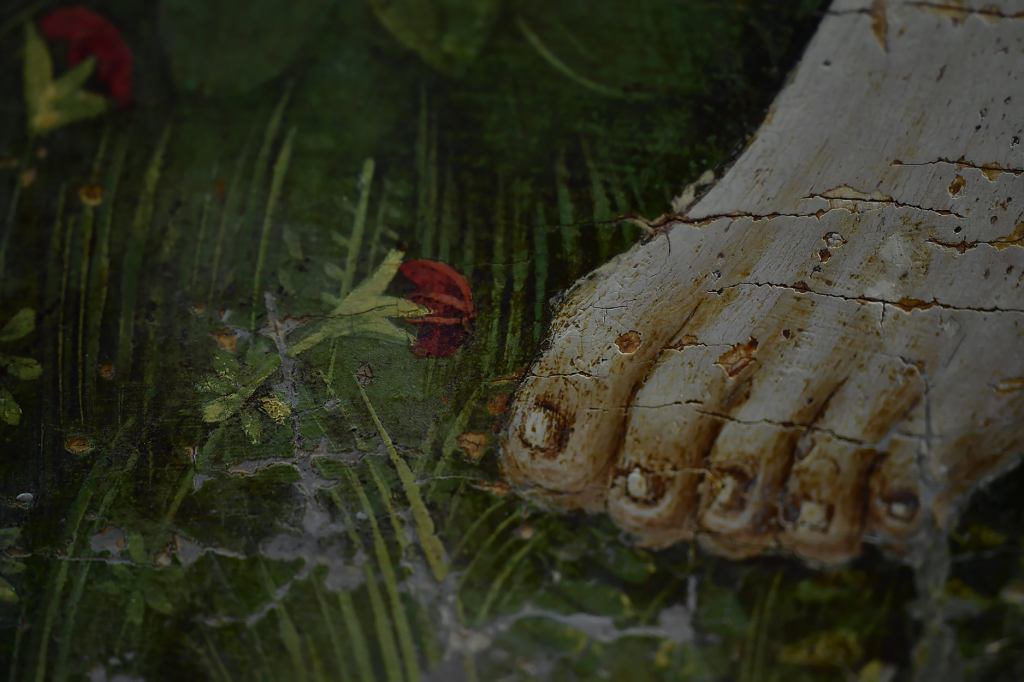
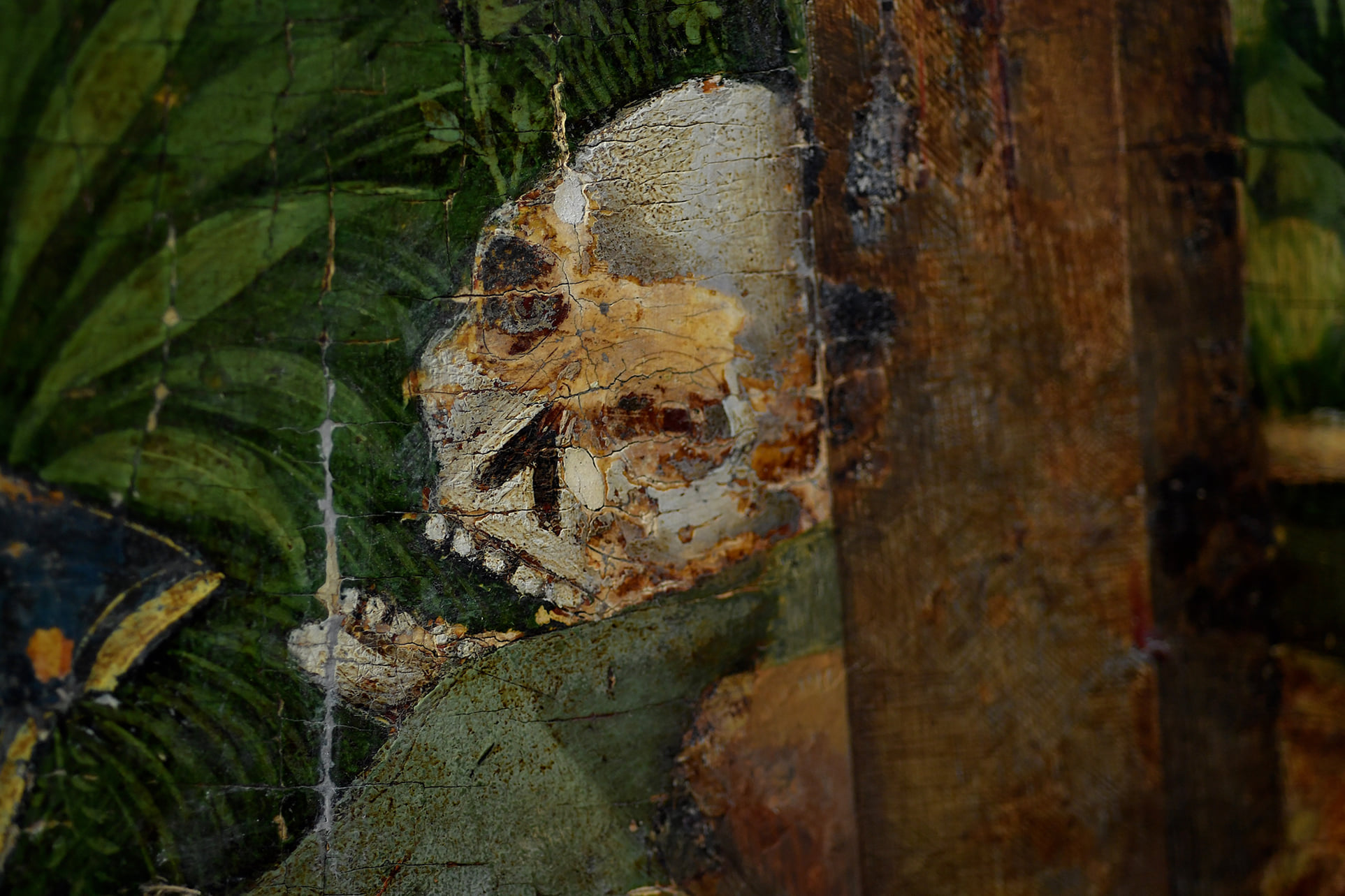
ART RESTORATION: “Hidden Gem: The Crucifixion by the Master of the Lindau Lamentation”: A Crucifixion painting from around 1425 by the Master of the Lindau Lamentation was recently restored by conservator Caroline van der Elst, and this short video documents part of that process. The Museum Catharijneconvent in Utrecht, the Netherlands, acquired the painting in 1875, but since then it had lain mostly forgotten in storage until being rediscovered by a staff member a few years ago, who recognized it as a masterpiece worthy of restoration efforts and public display. After the surface dust and discolored varnish were removed, in addition to other treatments, it was unveiled last year as the centerpiece of the Body Language exhibition (check out that link!), which ran from September 25, 2020, to January 17, 2021.

Curators Micha Leeflang and Annabel Dijkema discuss how the painting was made, how it was originally used, and its theological significance, and van der Elst explains some of the conundrums she faced while restoring the work—when it came to light, for example, that the azurite background was added in the sixteenth century. View the full painting here.

Lindau Crucifixion detail
Master of the Lamentation of Christ in Lindau, Crucifixion (detail), ca. 1425. Tempera on panel, 125 × 89 cm. Catharijneconvent Museum, Utrecht, the Netherlands. Photo: Marco Sweering.

Crucifixion detail (1425)

+++

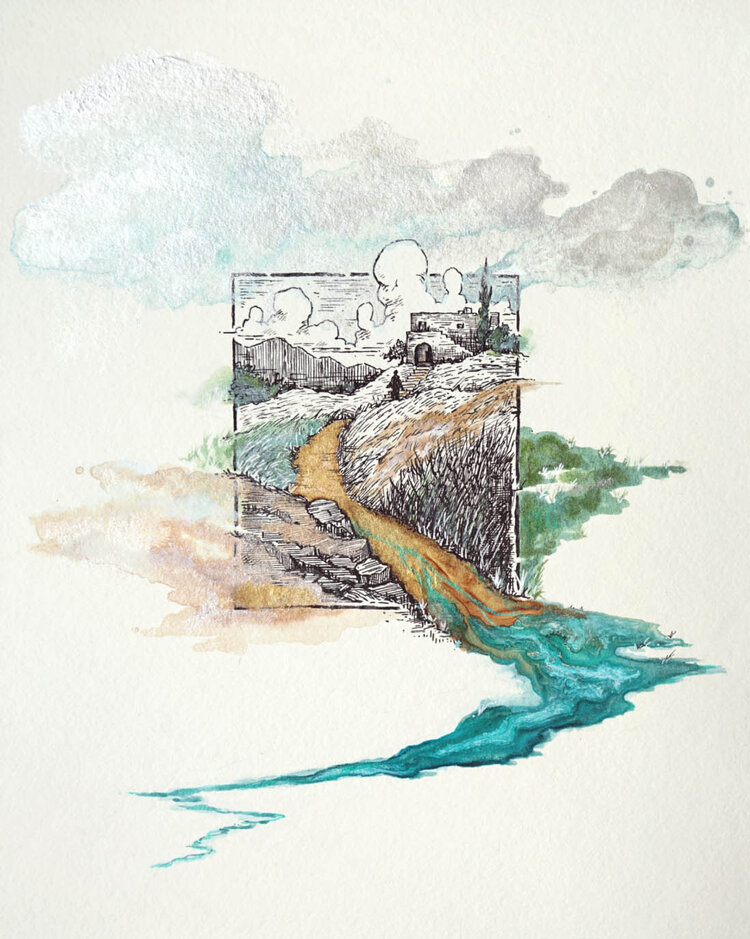
CALL FOR ARTISTS: Pass the Piece: A Collaborative Mail Art Project: A neat opportunity for artistic collaboration, organized by Sojourn Arts [previously] and open to US artists ages 13+. “Pass the Piece is a collaborative mail art project to be exhibited at Sojourn Arts in June 2021. Deadline for participating artists to sign up is March 31, 2021. Project is limited to 100 participants. We’re mailing out up to one hundred 8″ × 10″ panels, one to each participating artist. Each artist will start a panel that another artist will complete. Each artist will finish a panel that someone else started. Each artist will have their work exhibited and have a printed zine-style catalog of each piece from the exhibit. Artworks will be auctioned online with 50% going to the artists and 50% going towards Sojourn Arts interns’ travel expenses for the upcoming CIVA conference.”

Pass the Piece (Sojourn Arts)
Begun with an illustration by Stephen Crotts and finished with a painting by Kyra Hinton

+++

NEW ALBUM: for / waters by Joshua Stamper: Joshua Stamper [previously] composed this four-movement instrumental piece about marriage for pianist Bethany Danel Brooks and violinist David Danel, who are themselves married and perform on the recordings. Its title and that of each movement is taken from Isaiah 35, which was read at the couple’s wedding.

Stamper writes,

Marriage, ideally, is about two people in a state of mutual belonging. But marriage is more than a state of belonging: it includes an ongoing journey toward and into belonging. It encompasses the trajectories and momentum of individuals towards each other, even before an initial connection takes place. People are therefore in relationship with each other before they are “in relationship” with each other. From this perspective, marriage might be understood as another mystical manifestation of the inscrutable and unknowable fault line between free will and providence. Two lives are always in reference to one another before the initial “hello,” because though individual trajectories have not yet crossed, they will. This interweaving begins early: each life is conditioned, shaped, sensitized to see, hear, feel the other. Home is created in each for each.

Stamper goes on to describe how he reflects these ideas through the structure, melodic and rhythmic motifs, harmonies, and other musical elements of for / waters. Read more and stream/purchase at Bandcamp.

“Joshua Stamper has been a restless composer and collaborator for over twenty-five years. His work reflects a deep interest in the intersection points between seemingly disparate musics, and a profound love for the intimacy, charm, and potency of chamber music. Equally at home in the jazz, classical, avant-garde, and indie/alternative worlds, his work ranges from large-scale choral and instrumental works to art-pop song cycles to chamber jazz suites. Joshua has worked as an orchestral arranger and session musician for Columbia / Sony BMG and Concord Records, and for independent labels Domino, Dead Oceans, Important Records, Sounds Familyre, Smalltown Supersound, and Mason Jar Music, collaborating with such luminaries as Todd Rundgren, Robyn Hitchcock, Sufjan Stevens, Danielson, and Emil Nikolaisen.” [source]

Michael Wright on Keith Haring’s “Jesus freak” connection

Michael Wright is the creator of Still Life, a free weekly letter on art and spirit that I look forward to receiving in my inbox every Monday. On March 8 he wrote about Keith Haring (1958–1990), an artist whose work I first encountered as a child on the cover of the compilation album A Very Special Christmas, which we pulled out from the CD shelf in the family room every December. As an adult I came across Haring’s Life of Christ triptych inside Saint John the Divine in Manhattan (I instantly recognized the style), and one of his anti-apartheid paintings at the Stedelijk Museum Amsterdam. Wright discusses Haring’s connection to the Jesus People movement, which I, too, was unaware of! I share this excerpt from the latest edition of Still Life with Wright’s permission. Subscribe here.

+++

Haring, Keith_Untitled (1981)
Keith Haring (American, 1958–1990), Untitled, 1981. Acrylic on vinyl, 96 × 96 in. (244 × 244 cm). © Estate of Keith Haring

Friends,

This week I discovered that the famous street artist Keith Haring was part of the Jesus People before moving to New York City. He grew up in a Christian home in Kutztown, PA, went to church every Sunday and church camp every summer, and read the Bible voraciously. He even carefully read and rated each of the 150 Psalms. In his youth he found his way to the Jesus People movement, most likely through communes local in the area, and his early journals are filled with Christian symbols and apocalyptic ideas: “We must repent now and devote our lives to Jesus Christ! The time is now, time is running out, It can happen at any time! Be prepared for God!” Whew. I had no idea.

The Jesus People movement was a counter-cultural Christian movement of people who were anti-establishment (including church), highly critical of materialism, and committed to living with and supporting the poor. They shared their convictions through the Hollywood Free Paper, a free mailing that featured cartoons lampooning politicians, new age hucksters, and lukewarm Christians. While Haring no longer officially participated as an adult, American Art writer Natalie Phillips says there’s a “direct iconographic connection” between his style and the imagery of the paper. The Jesus People left an indelible mark on his “visual memory,” and once you know it, it’s hard to miss.

In his early subway drawings, Haring often drew the Radiant Child, a small crawling baby surrounded by beams of light. In one of the earliest versions, the baby is the central figure of a nativity scene: the Christ Child. Here’s his own description: “lines radiate from the baby indicating spiritual light glowing from within, as though the baby were a holy figure from a religious painting, only the glow is rendered in the visual vocabulary of a cartoon.” Another common image Haring used was the figure with a chest-sized hole. Sometimes filled with dollar signs, other times broken open by packs of wolves, the imagery evokes unfilled (or wrongly filled) longings and desire. And do you know what was common throughout the Hollywood Free Paper? Chest-sized holes in cartoon after cartoon, an image of spiritual voids filled by Christ himself.

On top of this, some of his late works were explicitly religious. He created a monumental series of the Ten Commandments, he created a mural for a church in Pisa, and, most poignantly, his final work was an altarpiece of the Last Judgment, on view at both New York’s Cathedral of St John the Divine and San Francisco’s Grace Cathedral. That’s not to say “Gotcha! He’s a Christian artist!” As a gay man dying of AIDS, Haring was vocally critical of the institutional church and kept his distance during his adult life. Nor should we say this is his “religious art” and everything else is the popular stuff. His compassion for the weak and vulnerable, his critical eye to unjust systems, his celebration of the body and human dignity—this was all part of Haring’s sensibility, and it’s deeply Christ-like too, even if it’s harder to trace in work without obvious religious subject matter.

I guess I’m bringing all this up because I want you to be surprised with me. When I say “Jesus Freak,” the first thing that comes to mind is dc Talk—not a sex-positive, ambiguously spiritual, gay street artist. And yet as a teen, that’s what he called himself. Keith Haring wrote about it in his journals, and he talked openly about the influence of his Christian background. Uncovering this history doesn’t burden the artwork or the artist—it gives me renewed interest in his work. Granted, I write about these topics in Still Life all the time, but I don’t think we have to be afraid of letting religion be one of the many interpretive lenses we use to enjoy the arts. At their best, art and religion can be exactly what Haring hoped for in his own creative work: “It should be something that liberates the soul, provokes the imagination and encourages people to go further. It should celebrate humanity instead of manipulating it.”

Take care, 
Michael

P.S. Many of the quotes above come from Natalie E. Phillips’ “The Radiant (Christ) Child: Keith Haring and the Jesus Movement,” published in American Art.

Roundup: (Virtual) Arts conference, Psalm 129 jazz-hip-hop-folk fusion, and more

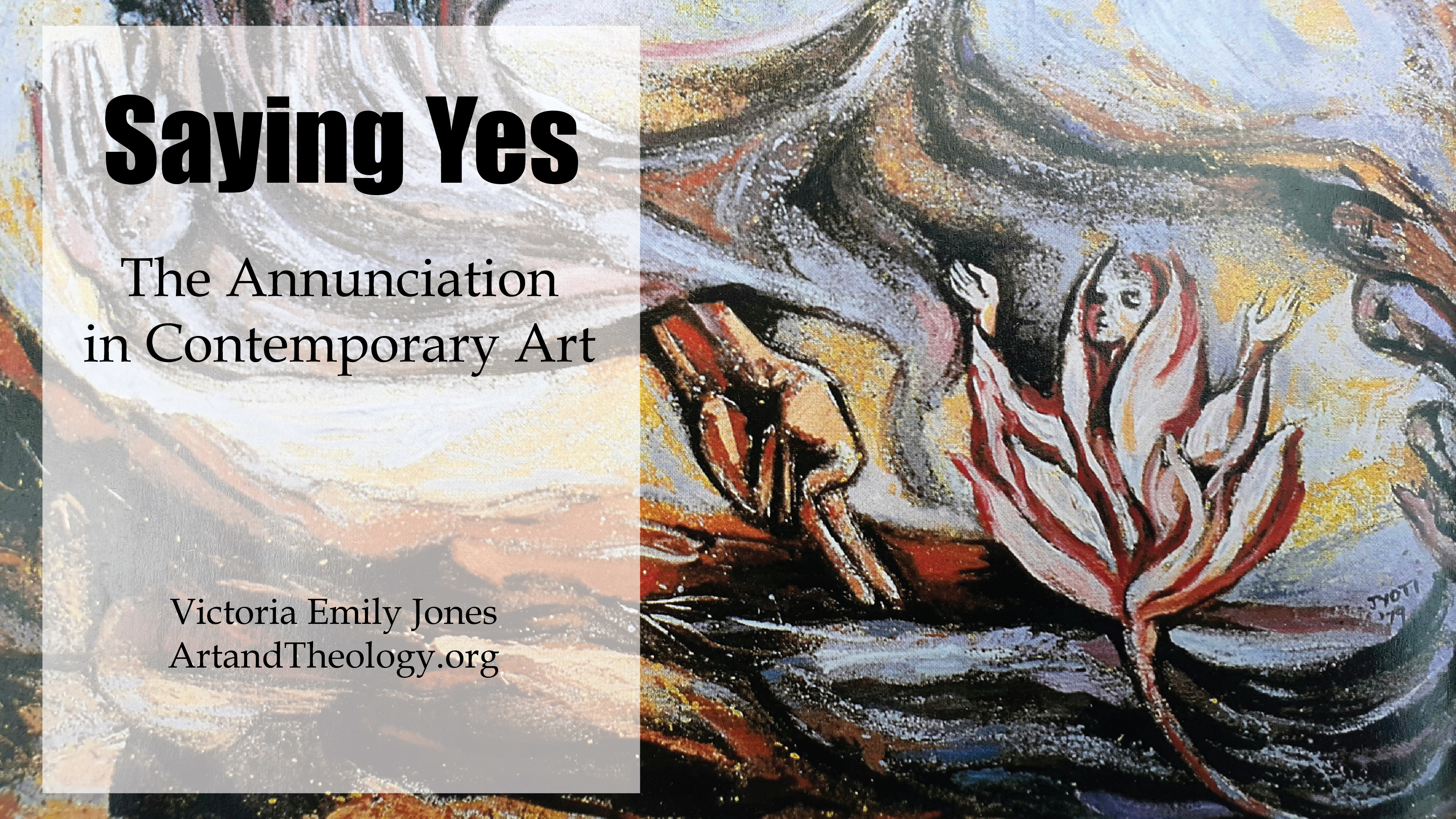
This year’s The Breath and the Clay creative arts gathering, on the theme of “Reenchantment,” is taking place March 17–21, with both in-person (in Winston-Salem, North Carolina) and virtual options. Registration for virtual attendees is pay-what-you-wish. Presenters include theologian Jeremy Begbie, poet Pádraig Ó Tuama, singer-songwriter Joy Ike, contemplative author Christine Valters Paintner, dancer Camille D.C. Sutton, and many more . . . including me! On the evening of March 18 I’ll be giving a twenty-minute talk titled “Saying Yes: The Annunciation in Contemporary Art,” which will be archived online afterward. (The global church celebrates the feast of the Annunciation the following week, on March 25.) (Update: Watch here.) Here’s the description:

The story of Jesus’s miraculous conception in the womb of Mary, a first-century Galilean peasant girl, told in Luke 1 has activated the imaginations of artists since the early Christian era. When an angelic messenger came and told Mary she had been chosen to bear God’s Son, she cycled through a range of emotions before ultimately accepting the call, stepping onto a path that, though scary, would be life-giving not only for her but also for her religious and ethnic community and for the whole world.

God invites us to participate in his work in the world and gives us the grace to do it. When his voice breaks through our safe, predictable routines, calling us to something big, do we respond with brave obedience? In this talk Victoria Emily Jones will share a handful of contemporary artworks that visualize that pivotal moment in salvation history when Mary said yes and set in motion the incarnation. These works show us the wild beauty of God’s plans and can help us tune our ears to the annunciations in our own lives.

(The title slide image is a detail of an Annunciation painting by Jyoti Sahi.)

I’m always impressed by the variety of artists, arts professionals, and art lovers that director Stephen Roach manages to bring together for The Breath and the Clay. Click here to learn more and to register.

+++

ONLINE LENT SERIES:

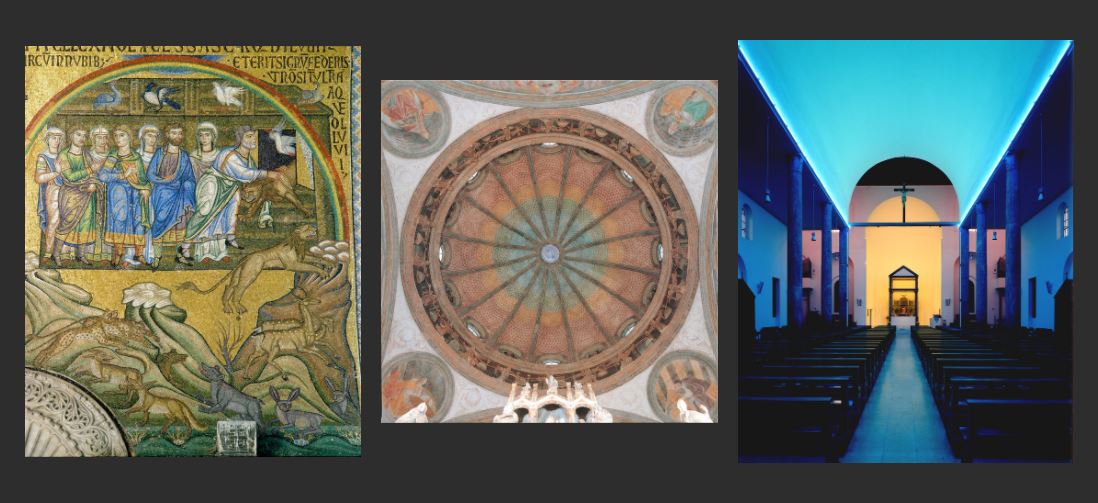
>> VCS Lent 2021: The Visual Commentary on Scripture is highlighting a different exhibition from its archives for each week of Lent, with new content including a video introduction to the week by Ben Quash and an audio reading of each of the three constituent commentaries.

The first week was on the theme of Covenant and covers Genesis 8:20–9:17. Stefania Gerevini curated three artworks from Italy that convey some aspect of the rainbow as divine promise: a thirteenth-century mosaic from the Basilica di San Marco in Venice, a colorful dome fresco (fifteenth century) from the Cappella Portinari in Milan, and a contemporary light installation by Dan Flavin at Santa Maria Annunciata in Chiesa Rossa, also in Milan.

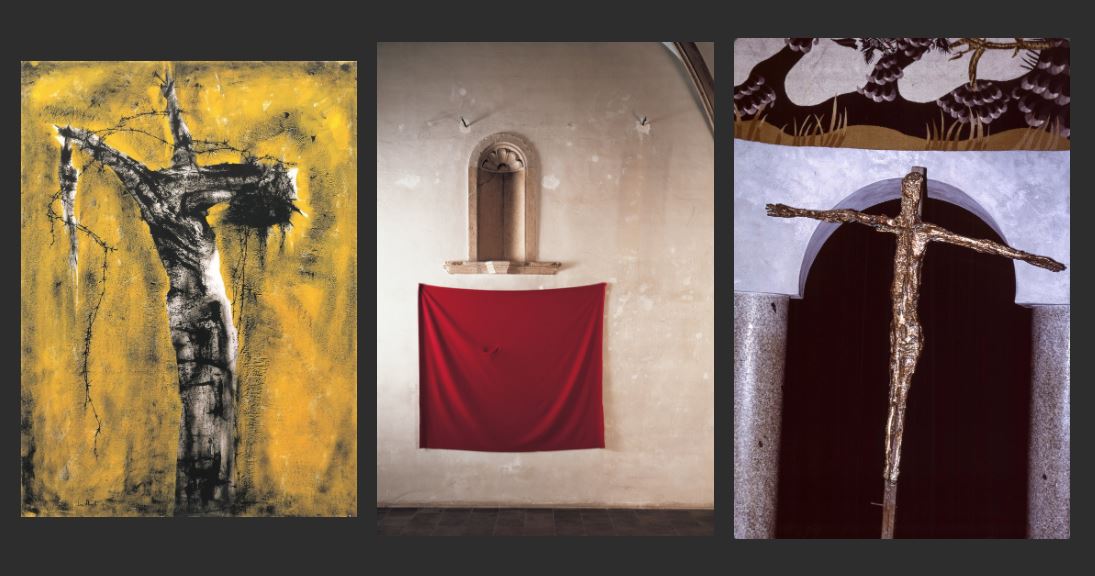
Week 2, on Prophecy, explores the Suffering Servant of Isaiah 53. Jonathan Koestlé-Cate comments on three modern artworks: Crucified Tree Form by Theyre Lee-Elliott, a crucifix by Germaine Richier (which sparked outrage when it was unveiled at Notre-Dame de Toute Grâce, Assy, in 1950), and an installation by postminimalist artist Anish Kapoor at the church of Saint Peter, Cologne.

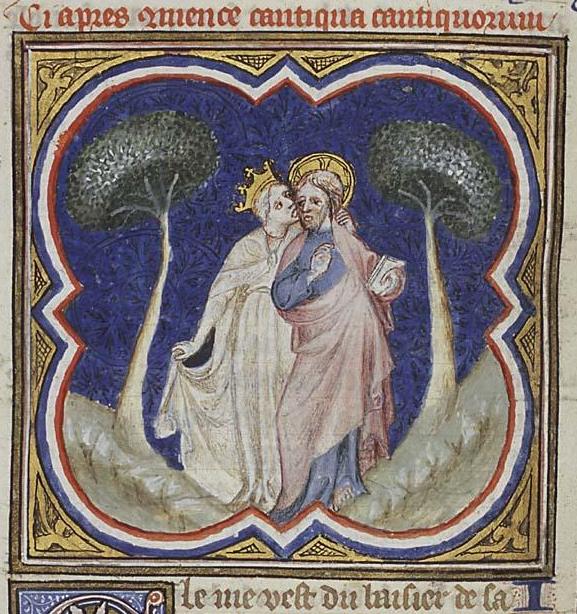
>> “The Many Faces of Jesus”: I’ve been enjoying this Lenten series (on blog and podcast) by medievalist Dr. Grace Hamman, who makes medieval lit super accessible. “For Lent, Old Books With Grace will share and explore some medieval representations of Jesus in art and literature—the versions of Jesus that dominate the medieval church’s imagination. These medieval portrayals of Jesus may strike us as odd, threatening, charming, creative, stupid, or inspiring. In attending to these versions of Jesus, I hope for a few end goals: the first is that we may expand our Christian imagination. Perhaps a side of Jesus that has never occurred to you, or been sideswept by our contemporary culture, will suddenly illuminate an aspect of the Jesus of scripture. The second is that we may better identify the ways that we ourselves have culturally contained and portrayed Jesus, in positive and negative ways. Often the strangeness of the past helps us recognize the weird or damaging things we believe in order to make Jesus more palatable, understandable, or like us.”

Christ and his bride
Jean Bondol, “The bride (Ecclesia) and bridegroom (Christ),” from a Bible Historiale made in Paris, 1371–72. The Hague, MMW, 10 B 23, fol. 330v.

So far she has covered Jesus as judge, lover, and knight.

+++

RETUNED HYMNS:

>> “Up from My Youth (Psalm 129)” by Advent Birmingham, feat. CashBack and Terence June Gray: This is such a strange and compelling fusion! “An 1806 hymn by Isaac Watts meets hip-hop meets Johnny Cash meets folk meets New Orleans jazz meets industrial steel factory.”

Led by Zac Hicks, Advent Birmingham [previously] is a group of worship musicians from the Cathedral Church of the Advent in downtown Birmingham, Alabama. Hicks wrote this new tune for Isaac Watts’s metrical paraphrase of Psalm 129 and integrated a rap by guest artist Terence June Gray from Memphis. Singing lead (and playing drums) is Leif Bondarenko, the front man of the Johnny Cash tribute band CashBack. The video was filmed at Birmingham’s historic Sloss Furnaces. Available on iTunes, Amazon, and Spotify.

You can read the lyrics here, which include a slight revision of Watts’s verse 6.

>> “Thy Mercy, My God”: Words by John Stocker, 1776; music by Sandra McCracken, 2005; performed by Ellen Petersen Haygood (of The Petersens bluegrass band), 2018.

+++

POETRY READING: “Phase One” by Dilruba Ahmed, read, with commentary, by Pádraig Ó Tuama, Poetry Unbound: What do you find hard to forgive in yourself? What might help? In this poem, the poet makes a list of all the things she holds against herself: opening fridge doors, fantasies, wilted seedlings, unkempt plants, lost bags, feeling awkward, treating someone poorly. Dilruba Ahmed repeats the line ‘I forgive you’ over and over, like a litany, in a hope to deepen what it means to be in the world, and be a person of love.”

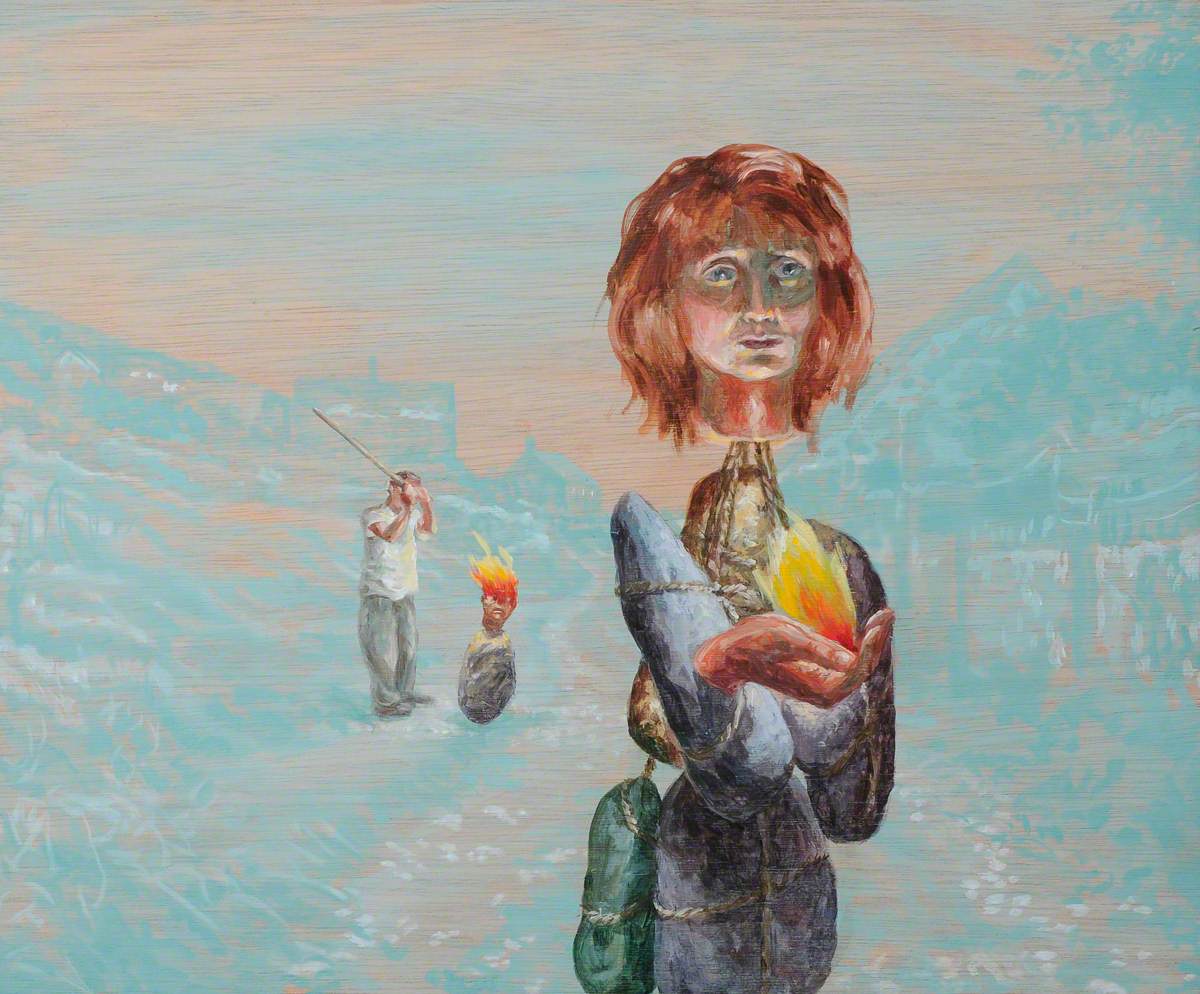
“What Love Is This” by Edward Taylor

Adams, Susan_Waiting for Something
Susan Adams (British, 1966–), Waiting for Something, 2002. Oil on panel, 36 × 58 cm. Gwynedd Museum and Art Gallery, Bangor, Wales.

What love is this of thine, that cannot be
In thine infinity, O Lord, confined,
Unless it in thy very person see
Infinity and finity conjoin’d?
What! hath thy Godhead, as not satisfied,
Married our manhood, making it its bride?

Oh matchless love! filling heaven to the brim!
O’errunning it: all running o’er beside
This world! Nay, overflowing hell, wherein,
For thine elect, there rose a mighty tide!
That there our veins might through thy person bleed,
To quench those flames that else would on us feed.

Oh! that thy love might overflow my heart!
To fire the same with love: for love I would.
But oh! my straight’ned breast! my lifeless spark!
My fireless flame! What chilly love, and cold?
In measure small! In manner chilly! See.
Lord, blow the coal: thy love enflame in me.

Edward Taylor (1642–1729) was an American Puritan poet and minister of the Congregational church in Westfield, Massachusetts, for over fifty years. This is Meditation 1 in his Preparatory Meditations, a collection of over two hundred poems divided into two series. A private spiritual diary written from 1682 to 1725, the collection was unpublished until the twentieth century.