Shower, O heavens, from above, and let the skies rain down righteousness; let the earth open, that salvation may spring up, and let it cause righteousness to sprout up also; I the LORD have created it.
—Isaiah 45:8
Let us know, let us press on to know the LORD; his appearing is as sure as the dawn; he will come to us like the showers, like the spring rains that water the earth.
—Hosea 6:3
LOOK: Appalachian Rhapsody in Blues: or, He Will Come to Us Like the Spring Rains by Grace Carol Bomer
LISTEN: “Rorate caeli” by William Byrd, 1605 | Performed by The Gesualdo Six, directed by Owain Park, 2020
Rorate caeli desuper, et nubes pluant justum: aperiatur terra, et germinet salvatorem.
Benedixisti, Domine, terram tuam: avertisti captivitatem Jacob.
Gloria Patri, et Filio, et Spiritui Sancto. Sicut erat in principio, et nunc, et semper, et in saecula saeculorum. Amen.
English translation:
Drop down, ye heavens, from above, and let the skies pour down righteousness: let the earth open and bring forth a Savior.
Lord, thou hast blessed thy land: thou hast turned away the captivity of Jacob.
Glory be to the Father, and to the Son, and to the Holy Ghost. As it was in the beginning, is now, and ever shall be, world without end. Amen.
The text of “Rorate caeli” (Let the heavens) is taken from the Vulgate translation of Isaiah 45:8. It “is frequently sung to plainsong at Mass and in the Divine Office during Advent, where it gives expression to the longings of Patriarchs and Prophets, and symbolically of the Church, for the coming of the Messiah. Throughout Advent it occurs daily as the versicle and response after the hymn at Vespers” [source].
William Byrd’s five-voice motet adds an additional verse from Psalm 85:1 (84:1–2 in the Vulgate), followed by the Gloria Patri.
This video performance is part of the Gesualdo Six’s 2020 Advent Sessions YouTube series.
It is you who light my lamp; the LORD, my God, lights up my darkness.
—Psalm 18:28
“I have come as light into the world, so that everyone who believes in me should not remain in the darkness.”
—John 12:46
LOOK: Self-Portrait by Stamatis Laskos
Stamatis Laskos (Greek, 1985–), Self-Portrait, 2021. Oil on canvas, 110 × 80 cm.
LISTEN: “Lighten the Darkness” | Words by Frances Mary Owen (1842–1883) | Music by Sam Connour, 2017 | Performed by Lowana Wallace with Matt Froese, 2017
Lighten the darkness of our life’s long night, Through which we blindly stumble to the day. Shadows mislead us; Father, send Thy light To set our footsteps in the homeward way.
Lighten the darkness of our self-conceit, The darkness that we love so well, Which shrouds the path of wisdom from our feet, And lulls our spirits with its baneful spell.
Lighten our darkness when we bow the knee To all the gods we ignorantly make And worship, dreaming that we worship Thee, Till clearer light our slumbering souls awake.
Lighten our darkness when we fail at last, And in the midnight lay us down to die; We trust to find Thee when the night is past, And daylight breaks across the morning sky.
For more Advent songs by Sam Connour, see the album St Fleming of Advent, released under the moniker Lo Sy Lo.
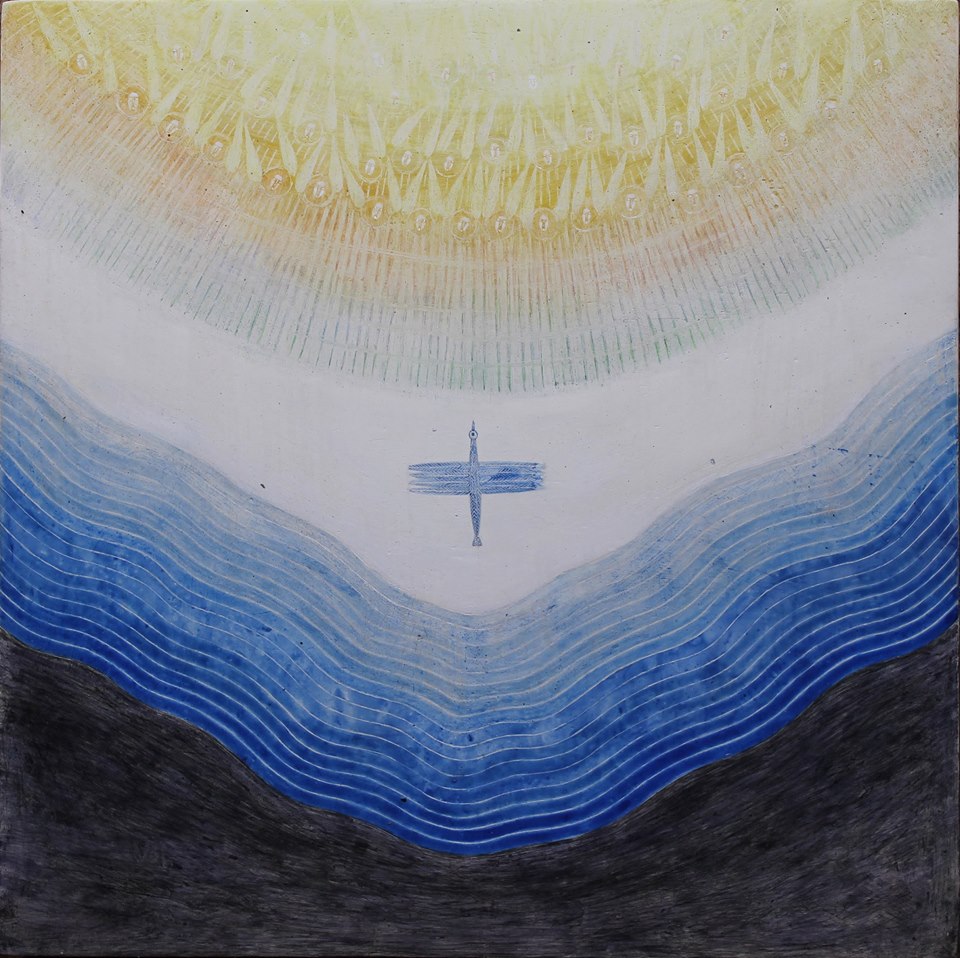
Natalya Rusetska (Ukrainian, 1984–), First Day of Creation, 2017. Egg tempera on gessoed wood board, 30 × 30 cm.
LISTEN: “Let There Be” by Michael and Lisa Gungor, on Ghosts Upon the Earth (2011)
Darkness hovering Grasping everything it sees Void, empty Absent life and absent dream
Let there be Let there be Let there be Let there be
Angels toil and crack open scrolls of ancient dreams Countless worlds of his Brilliant stars and breath and stream
Let there be Let there be Let there be Let there be Let there be Let there be Let there be light
Let there be light Where there is darkness Let there be light Where there is nothing Let there be light
The opening track on Gungor’s Ghosts Upon the Earth, “Let There Be” narrates God’s creation of the universe. What starts out as ethereal becomes increasingly more solid as the floating notes on piano and guitar coalesce into chords and meld with the cellos. Represented by a small choir, the Triune community voices its fiat: “Let there be . . .” A synthesized xylophone and tremolos from the strings suggest lively activity—“angels toil”—as the cosmos begins to take shape. In the second refrain the voices crescendo to a thunderous climax, a drum beating loud and steady as if laying down a foundation.
While this song is most fundamentally about the Genesis 1 creation story, it can also be read in light of John’s Gospel prologue, where he describes Jesus as light coming into the world, and similarly, Luke’s Annunciation narrative, where “ancient dreams” put down in prophetic scrolls are fulfilled in the conception of Christ in Mary’s womb, initiating a new epoch.
The Advent season begins in darkness. Taking stock of this darkness, we ask for God’s light to break in once again—into our hearts and lives, our communities, our world.
In the beginning the Spirit hovered over the void and breathed life into it. Millennia later the Spirit hovered over a virgin’s empty womb and did it again, making the Word flesh. And into our present lack, into our chaos, the Spirit still is coming, re-creating, so that Christ, the light, might be born in us.
Here’s a recent cover of “Let There Be” by IAMSON, which he combines with another Gungor song, “Crags and Clay”:
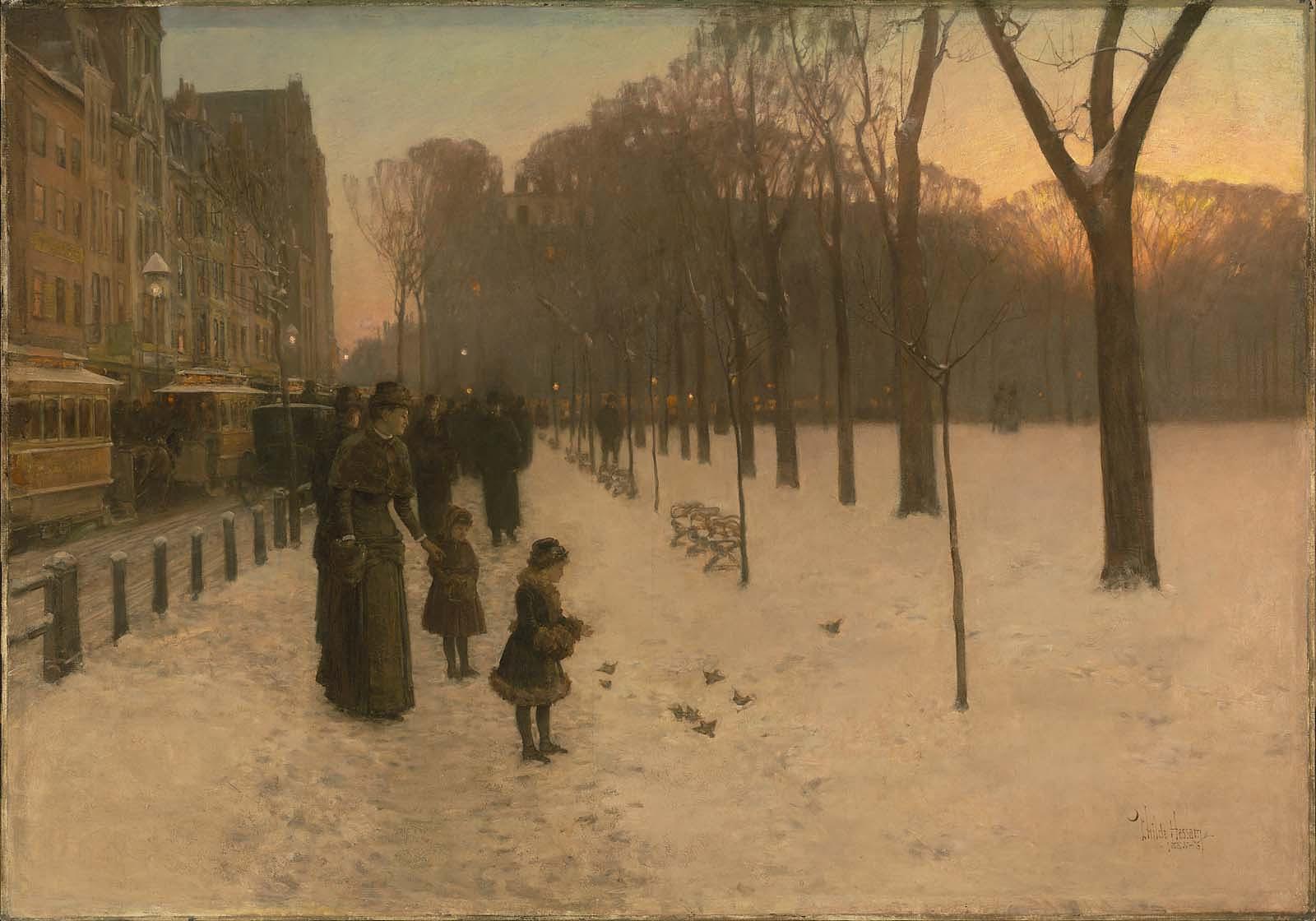
LOOK: At Dusk (Boston Common at Twilight) by Childe Hassam
Childe Hassam (American, 1859–1935), At Dusk (Boston Common at Twilight), 1885–86. Oil on canvas, 42 × 60 in. (106.9 × 152.4 cm). Museum of Fine Arts, Boston.
LISTEN: “Psalm 25” by Poor Bishop Hooper, 2020 [free download]
Nobody who waits for you will see disgrace Teach me all your righteous paths Make known your ways to me, Lord
Lead me by your truth, my God And teach me now I’ll wait for you the whole day long You are the God of my salvation
You’ve shown your love from ages past It existed from antiquity through history Forgotten of my sinful youth For your goodness, God My eyes are always on you
Jesse and Leah Roberts, whose musical alias is Poor Bishop Hooper, adapted Psalm 25:3–7, 15 last year as part of their EveryPsalm project, an initiative to release one original psalm-based song every Wednesday. They are currently up to Psalm 100.
I’ve paired the song with a painting by turn-of-the-century American Impressionist Childe Hassam, of a rosy dusk on the outskirts of the central park in downtown Boston. The sun is descending behind the elm trees, the gaslights have been lit, and the ground is blanketed in snow. On Tremont Street on the left, trolley cars and carriages wheel busily past, while on the adjacent walkway a mother and her two young daughters have stopped to feed the birds.
Moodwise, the painting and song complement each other, the twinkling of Roberts’s piano corresponding to the play of pink light on Hassam’s canvas—and both bespeaking God’s goodness. I present the image here as an invitation to, like this family, find moments of quiet enjoyment and reflection amid the bustle of December.
The scene evokes warm memories for me, as my husband and I, then newlyweds, walked this path every Sunday to church for the five years we lived in Boston. Ten minutes from Park Street Station to the hotel where our congregation met, crunching through the snow in our insulated boots in wintertime, the natural sights and sounds of the Common preparing us for worship.
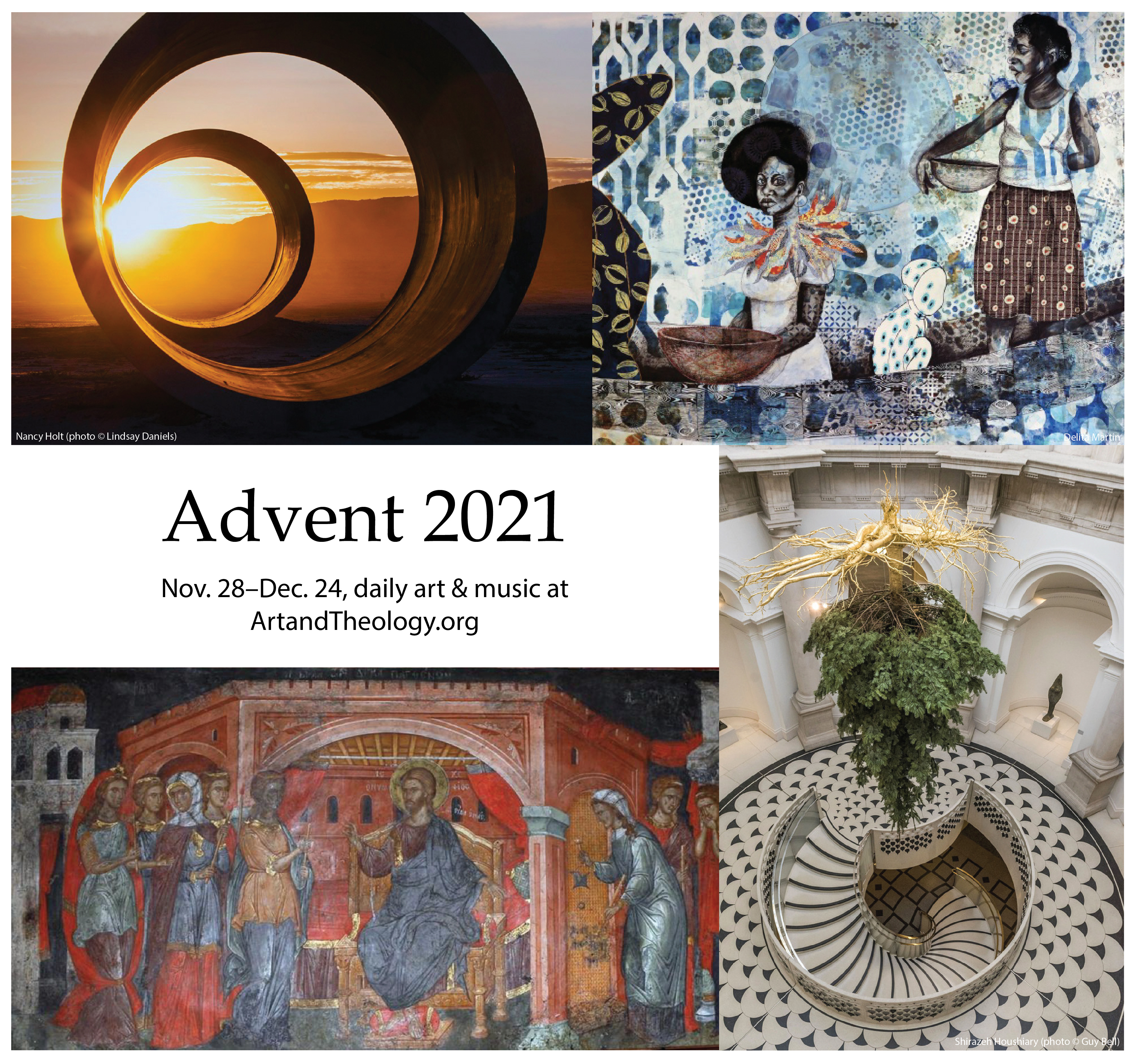
Advent begins November 28, and this year I will be publishing short daily posts that pair a visual artwork with a piece of music, most accompanied by brief commentary. (I did a trial run last Advent.) The primary purpose is to invite spiritual contemplation on the season’s themes, allowing artists to be our guide. I’ve been planning out the series since August—and ended up procuring ideas to last for three Advents!—and I’m really looking forward to presenting it. The daily posts in this format will extend through the twelve days of Christmas as well.
Contemporary singer-songwriters are heavily represented in the music selections, but there is also a Shaker hymn, an Appalachian spiritual, a Renaissance motet, a Byzantine troparion, a South African freedom song, sixties electronica, and a Victorian carol from Sussex. Many of these songs can be found on the Advent playlist I compiled. For the artworks, in addition to paintings there are a few installations, photographs, collages, a lithograph, a serigraph, a stencil print, a quilt, and a mosaic.
The recurring theme throughout, sometimes inherent to the artwork and in other cases brought about by a particular reading of it, is looking forward with hope and readiness to the coming of Christ, to the Light who will dispel darkness and bring justice and peace. “A new world is coming, and it’s just around the bend,” sings Nina Simone. May we welcome it with eager longing.
If you’d like to receive each post in your inbox, subscribe to the blog by entering your email address where prompted in the sidebar. I will also link to the posts on Facebook and Twitter. (Update: If you’re on your computer and you don’t see a sidebar, it’s probably because you’re viewing this post from the homepage; click on the post’s URL, and you should see the Subscribe button at the right. If you’re viewing this on your phone, the Subscribe button is at the bottom of the page, below the comments. Because this website is not self-hosted, WordPress does not allow me to manually add email addresses to the subscription list, nor to create a dedicated subscription tab—sorry!)
Art credits: In the poster above, clockwise from top left, are Sun Tunnels by Nancy Holt, a detail of Night Travelers by Delita Martin, Christmas Tree by Shirazeh Houshiary, and a fresco from the Monastery of Saint John the Theologian in Chora on the island of Patmos.
Advent is just around the corner, and here is some topical content for the season. (Much more to come!)
PODCAST EPISODES:
>>“On Journeying: Travel, Traditions, and Turning to the Psalms with Tsh Oxenreider,”Sacred Ordinary Days, December 22, 2020: Host Jenn Giles Kemper interviews author, travel guide, and fellow podcaster Tsh Oxenreider about her book Shadow and Light: A Journey into Advent. The liturgical calendar is a gift, not a burden, Oxenreider says; it provides scaffolding for our year and connects Christians to one another across time and place, in addition, of course, to promoting encounters with God and God’s story. Oxenreider provides book and music recommendations for the Advent season and shares one of her family’s favorite simple Advent traditions.
>>“The Annunciation and Art with Victoria Emily Jones,”Old Books with Grace, November 17, 2021:Old Books with Grace, hosted by Dr. Grace Hamman [previously], a specialist in medieval literature, is one of my favorite podcasts, so I was beyond excited to be invited on as a guest! In this conversation, Grace and I discuss four paintings and three poems that respond to the momentous event known as the Annunciation, where Gabriel tells Mary that she has been chosen to bear God’s Son. While the feast of the Annunciation is celebrated on March 25, we thought it nonetheless appropriate at this time just before Advent to consider how Mary welcomes Jesus, since we are preparing to welcome him ourselves. Available on YouTube and on all podcast streaming platforms.
Grace just wrapped up a fascinating series on Sir Gawain and the Green Knight, and for the four weeks of Advent she will be taking a closer look at four familiar Christmas carols from different eras, examining their history, theology, and language and recommending an Advent practice inspired by each carol. Follow Old Books with Grace on Instagram or Twitter.
NEW ALBUM: Advent Songs by the Porter’s Gate:The Porter’s Gate [previously] released a new album on November 12, a collection of ten original songs for Advent. The contributing songwriters are Nicholas Chambers, Paul Zach, Kate Bluett, Isaac Wardell, Liz Vice, Latifah Alattas (Page CXVI), and Tenielle Neda. Chambers, Zach, Vice, Alattas, and Neda are also featured as vocalists, as are Molly Parden, Jonathan Ogden, and Lauren Plank Goans. My favorites: “The Reign of Mercy,” “Mary’s Lullaby (Black Haired Boy),” “Simeon’s Song.”
+++
PAINTING + SHORT FILM: In 2017 Holy Family HTX, a church in Houston, commissioned artist-in-residence Lanecia Rouse Tinsley to create nine liturgical paintings, one for each major season of the church year. Called the Parament Collection, these six-by-six-foot pieces rotate throughout the year, signaling the change of season and inviting the congregation into a space of contemplation around seasonal themes.
The first painting in the cycle, Advent, is a minimalist composition predominantly in ultramarine, evoking Yves Klein’s blue monochromes; Tinsley says that, like Klein, she wants to “impregnate” the viewer with blue, which for her signifies hope. Blue (or alternatively, purple) is the primary color of Advent, but pink and white (for Gaudete Sunday and Christmas Eve, respectively) are also associated with it, which Tinsley makes reference to in her painting. At the white bar at the top, you can see a faint mark left by Hurricane Harvey; her studio flooded when the storm hit in August 2017, and this then-blank canvas suffered some water damage, but Tinsley made the conscious decision to use it to further press into the Advent theme of suffering. She lined the canvas in black, inspired by a line from Andy Warhol’s film Sunset: “Black means infinity.” All our longings, Tinsley says, are held within infinity.
The nine-minute film posted above is one of nine in a series by Chap Edmonson, titled Decoded, in which Tinsley discusses her Parament Collection piece by piece. View all nine films here.
+++
I also wanted to remind you about the Art & Theology Advent playlist I compiled on Spotify. Besides the ones mentioned above, here are the songs I’ve added to the mix since last Advent:
“Wonder” by MaMuse
“Better Days” by Chrisinti
“Peace Train” by Cat Stevens
“Peace” by Peter Bruun (a setting of a Gerard Manley Hopkins poem)
“Magnificat primi toni” by Palestrina
“From This Wicked Fall” (Cum erubuerint) and “The Flower Gleams” (Hodie aperuit) by Hildegard of Bingen, arr. Richard Souther
“Mary” by Buffy Sainte-Marie
“Like Mary” by Jess Ray and Langdon
“Restoration Song (Hold On)” by Son of Cloud
Nine songs by Tom Wuest
“Lighten Our Darkness” by Joel Clarkson
“For the Long Night” by Dan + Claudia Zanes
“La Luz” by Brother Isaiah
“Sunrise Song” and “Clouds of Waiting, Clouds of Returning” by Jacob Goins
“Break of Dawn” and “You Always” by Antoine Bradford
I’ve compiled a playlist of songs of thanks to God for life, beauty, family, salvation, fruitful harvests, and countless other blessings, and for God’s very self. To make a list on this theme is difficult, as every praise song, of which there are millions, is essentially a song of thanksgiving. So many songs and other musical pieces, including those from outside the Judeo-Christian tradition, testify to experiences of goodness. Perhaps I’m being too literal, but I focus (though not exclusively) on songs that explicitly say “Thanks.” I also want to make clear that God deserves thanks not just for what he’s done but for who he is.
To save the playlist to your Spotify account, click the ellipsis and select “Add to Your Library.”
The list is bookended by the seventeenth-century Trinitarian doxology written by Thomas Ken (“Praise God from whom all blessings flow . . .”), which many churches sing weekly to the tune of OLD 100TH. While the first on the list is in English, the last is in Hawaiian.
Several of the songs are settings of the biblical psalms. The Abayudaya community of Jews in eastern Uganda, for example, sings the call-and-response Psalm 136 in Luganda; led by J. J. Keki, the congregation responds after each line with “His steadfast love endures forever!” Banjoist Béla Fleck [previously] and mandolinist Chris Thile use this melody from Abayudaya as the basis of their “Psalm 136” duet, which appears on Fleck’s new album, Bluegrass Heart.
There’s also Psalm 92 (“It is good to give thanks to the Lord . . .”) from Poor Bishop Hooper’s EveryPsalm project, Wendell Kimbrough’s Psalm 107, and a classical guitar rendition of Jewish singer-songwriter Debbie Friedman’s “Hodu” [previously], a setting of Psalm 118:1–4. Rebekah Osborn also sets Psalm 118, in English.
“We Thank You” is by Broken Walls, a musical group comprising followers of the Jesus Way who seek to build bridges between the church and the First Nations people of North America. Founded by Jonathan Maracle, a Mohawk from Tyendinaga Territory in Ontario, Canada, the band uses indigenous instruments and sounds to share the Creator’s love.
Across the Atlantic, the monks of Keur Moussa Abbey [previously] in Senegal sing “Nous Te Louons, Père Invisible” (“We Praise You, Invisible Father”), accompanied by balafon (a gourd-resonated xylophone). The French lyrics translate as follows:
Lord of immortality We praise you, invisible Father You are the source of life We praise you, invisible Father The source of all light We praise you, invisible Father You are the source of grace We praise you, invisible Father Friend of mankind, friend of the poor, you draw everything unto yourself through the coming of your beloved Son! We praise you, invisible Father
I’ve also included a dedicatory instrumental piece played on kora and oboe for the inauguration and consecration of the abbey.
Praise be to God, too, for natural wonders large and small. You’ll want to be sure to check out Alanna Boudreau’s setting of “Pied Beauty” by the poet-priest Gerard Manley Hopkins. (For you Hopkins lovers, Boudreau also set “My own heart let me more have pity on” and “God’s Grandeur,” the latter appearing on Spotify as “Wb / Bw.”) There are also classics like “This Is My Father’s World” and, retuned and retitled by Ben Thomas, “I Sing the Mighty Power of God” [previously].
“For the Beauty of the Earth,” which opens with gratitude for creation and then expands into other areas of thanks, is one of my all-time favorite hymns. Andrew Laparra’s straightforward rendition is so lovely, even though it does omit two of the verses—on the wonders of the human body (“. . . the mystic harmony linking sense and sound to sight”) and “the joy of human love . . .”
For the provision of food, there’s a delightful little song that Kim Gannon and Walter Kent wrote for the 1948 Disney short The Legend of Johnny Appleseed, the American nurseryman, conservationist, and folk hero. The song became popular in primary schools and children’s camps and at grace before meals, and in 2003 Mary Thienes Schünemann included an adaptation in the songbook and accompanying album This Is the Way We Wash-a-Day, which is what I’ve put on the list.
For another prayer appropriate for mealtime, see “Multilingual Grace” by Jaewoo Kim, Grace Funderburgh, Abraham Deng, and Josh Davis of Proskuneo Ministries [previously]. “Here in our community, we eat together a lot . . . and that means Koreans, Latinos, Americans, Burmese, and Sudanese and more coming together around the table,” Davis writes on the Proskuneo blog. “We wanted something we could sing to thank God together. And so we wrote this.” The chorus says “Thank you” in Arabic, Korean, Spanish, and Swahili:
Relishing simply being alive is a common theme that comes across especially in songs like “So Glad I’m Here” by Bessie Jones, covered by Dan Zanes [previously] and Elizabeth Mitchell [previously], and “It’s Such a Good Feeling” by the Mister Rogers(!), charmingly jazzified by Holly Yarbrough.
Michael and Lisa Gungor sing of the gift of their second daughter, Lucette, in their song “Light.” Lucie, as they call her, whose name means “light,” was born in 2014 with Down syndrome and heart complications. Seven years and multiple heart surgeries later, she continues to fill the Gungors’ lives, and others’, with brightness.
Gratitude in all circumstances is another theme that comes up, in such songs as “Hallelujah” by the Sons of Rainer, “Sing” by Jon Batiste, and the traditional hymn “How Can I Keep from Singing.” And India Arie’s gorgeous “Give Thanks,” which expresses an attitude of welcome and embrace for all that life brings. In the refrain “Give thanks for all that is,” “Give thanks” is substituted in repeats with the words “Selah” (an untranslatable Hebrew word from the Psalms that probably indicates a reflective pause in the music), “Hallelujah” (Hebrew for “Praise the Lord”), “Namaste” (Sanskrit for “I bow to you”), and “Ashé” (a multivalent concept in Yoruba religion that carries the meaning, in one sense, of “So be it,” similar to “Amen” in Christianity).
Recited daily upon waking up, “Modeh Ani” by Nefesh Mountain is a Jewish prayer of thanks that translates to “I give thanks before you, King living and eternal, for You have returned within me my soul with compassion; abundant is Your faithfulness!” It’s based on the belief that every morning, God renews every person as a new creation.
There are also gospel songs aplenty by artists including Shirley Ann Lee, Mahalia Jackson, Beyoncé [previously], Regina Belle, Roberta Martin, Janice Gaines (covering Andraé Crouch), and others from the Black church tradition.
Bob Marley’s “Thank You, Lord” from 1967 isn’t on Spotify, but an admirable cover by his fellow Jamaican reggae artist Max Romeo is. Sam Cooke’s recording of “I Thank God” by Jack Hoffman, Elliott Lewis, and Bebe Blake is also missing from the streaming service, but I love what the Avett Brothers do with the song, so I’ve featured them instead.
Our gratitude for God’s love and hospitality should overflow into our relationships with other people, animals, and the earth, and our trust in God’s goodness means we should receive with openness what comes from his hand, even if it’s not what we asked for. In the playlist’s penultimate song, “The Welcome,” David Benjamin Blower sings, “Just as Love has welcomed you, my friends / Welcome one another and all things.”
+++
This blog site and the thematic playlists that accompany it take an enormous amount of time to put together. If you have been blessed by either this year, please consider making a financial contribution to support me so that I can continue doing this work. And thank you, all, for engaging with and sharing the content!
Created, written, and hosted by Robert Lawrence Kuhn, Closer To Truth is a public television series that explores fundamental questions relating to the cosmos, consciousness, religion, and the search for ultimate reality and purpose. The program boasts a robust website featuring over four thousand video interviews with scientists, philosophers, theologians, artists, and other scholars and practitioners.
I am particularly interested in the seven hours’ worth of interviews on art and religion/God that fall under the “Art Seeking Understanding” rubric. They are separated into three- to twelve-minute segments spread across these eight topical series:
Art and the Philosophy of Religion: “Can art inform topics in philosophy of religion? Can the existence and varieties of art address or affect theological questions about God, faith, belief, worship?”
Arguing God from the Arts?: “Is it possible to infer something of the nonphysical, divine existence of God from the physical, human existence of art? Can one argue for God from art?”
Can the Arts Reveal God’s Traits?: “If God is the Creator of human beings and art is a feature of human sentience, then can examining the arts help discern characteristics of God? Can one infer from various aspects of art various traits of God?”
Arts and Religious Experience: “What is the relationship between experiencing art and experiencing God? Can the arts generate or trigger religious experience? If so, can it be validated?”
Arts and Religious Belief: “Is there a relationship between diverse arts and belief in God? Can the arts express or encourage religious belief? If so, can it be validated?” (*This is my favorite.)
Arts and Religious Practice (Liturgy): “Why are the arts so deeply embedded in religious settings and services? How do the arts work in religious spaces and activities? What are differences among the arts, say music and painting, in the liturgy?” (*This is my second favorite!)
Arts and Religious Reality: “Art is deeply involved in the practice of religion, embedded in the rituals and liturgy of almost every religion. But how could the ubiquity of the arts in religion affect whether or not religion is real?”
Co-Evolution of Art and Religion: “Did art and religion co-evolve in parallel as archeology and anthropology suggest, and if so, what would be the significance? What do art and religion have in common that could enable their common, co-temporal development?”
Interviewees include Nicholas Wolterstorff, Matthew Milliner, Jonathan A. Anderson, Judith Wolfe, Aaron Rosen, Alfonse Borysewicz, John Witvliet, and others. I’m disappointed by the lack of diversity among interviewees—the program is very heavy on white male Christians—but I am nevertheless grateful for the wisdom these individuals share, and for the efforts of the Closer To Truth team to coax it out, capture it onscreen, and present it freely to the public.
Here are a few interviews I’ll call your attention to:
Art historian Matthew Milliner on the formative power of art in sacred spaces, and the concreteness of images as a risk but one that can be worthwhile. He describes the art commissioned for his own church, All Souls Anglican in Wheaton, Illinois, which includes a mural on the west wall by Joel Sheesley and a black-tar crucifix that they use as their processional cross every year during Lent.
Theologian Stephan van Erp on the whole of creation as God’s liturgy. Art in the liturgy isn’t making the world more beautiful than it actually is, van Erp says; rather, it is recognizing the beauty that is already there and reflecting it back. It’s participating in the beauty.
E. Thomas Lawson, a scholar of the cognitive science of religion, says, “I am convinced that the arts are a form of discovery. I think that the arts actually develop forms of knowledge for us. They show us surprising aspects of the world. They show us possible worlds. In fact, they can humble us.” Art, he continues, enables our intuition, describes our intuition, sometimes even fights our intuition.
ALBUM REVIEW:“Let’s Go Down: Joy and Humility in Psallos’s Philippians Album” by Victoria Emily Jones: Psallos’s latest album, a musical adaptation of Paul’s letter to the church at Philippi, released on Thursday, and, as I’ve come to expect from the collective, it’s a brilliant work of art, with much to discover! In this review I wrote for the Gospel Coalition, I of course couldn’t address all the album’s intricacies, but I trace a few main themes and motifs. This is the New Testament epistle that gives us such memorable lines, phrases, and passages as “Rejoice in the Lord always!,” “Be anxious for nothing,” “the peace of God that passes all understanding,” “I can do all things through Christ who strengthens me,” and the glorious Christ Hymn (“Let this mind be in you, which was also in Christ Jesus, who, being in the form of God . . .”). It’s delightful to hear what Psallos does with these oft-quoted verses and, even more, to be guided in understanding the larger context in which they appear.
It’s near impossible to choose favorite tracks, as they gain impact from being heard all together and in order, but if Ihad to choose, I’d say “Complete My Joy,” “Hymnos Christou,” “I Am Better Than You” (feat. Shai Linne), and “Will You Go Down?” (feat. Taylor Leonhardt).
+++
POETS’ PANEL:“Surprised by Joy: Poetry about Happiness,” recorded at the Festival of Faith and Writing, April 2018: In Rewrite Radio Episode 29 (a production of the Calvin Center for Faith and Writing), poets Anya Silver, Tania Runyan, Barbara Crooker, and Julie Moore “discuss the landscape of joy amidst suffering in their personal and public lives. Joy, distinct from happiness, can be a form of religious practice. They explore questions regarding what cheapens joy, how Christians view joy, and how to ‘balance the scale’ of joy and pain in writing.” Zora Neale Hurston, Ælfric of Eynsham, Ralph Waldo Emerson, Christian Wiman, Jane Kenyon, John Milton, Dietrich Bonhoeffer, Thornton Wilder, and the apostle Paul are just some of the additional voices they draw into their conversation. They each read three to four of their own poems, and there is an audience Q&A starting at 57:54. A transcript is provided.
Silver and Runyan are two of my favorite poets, and this is such a rich hour spent with them and two of their colleagues.
+++
INTERVIEW: “It’s Not a Poem Until You Discover Something: An Interview with Scott Cairns” by Andy Patton: In this conversation, poet Scott Cairns talks about writing as a discipline, the writer as reader (“The writing life is primarily the reading life”), staying conversant with tradition, the fallacy of originality, the one quality shared most between prayer and poetry, and writing not as giving, serving, but as getting, receiving.
+++
LECTURE: “What Did Jesus Look Like?” by Joan E. Taylor, St. Paul’s Cathedral, London, June 2, 2019: Historian Joan E. Taylor, a professor of Christian origins and Second Temple Judaism at King’s College London, discusses the influences on early depictions of Jesus in art and what they tell us about what he did, or definitely didn’t, look like. This talk is a great intro to her research on the topic, but if you want to learn more, I recommend her full-color book What Did Jesus Look Like? (T&T Clark, 2018), which goes into much more detail, examining artistic, literary, and archaeological evidence, including first- and second-century coins, textiles, skulls, and Egyptian mummy portraits. She also dedicates two chapters to the three most famous acheropitae (images “made without [human] hands”): the Veil of Veronica, the Mandylion, and the Shroud of Turin.
In her talk, Taylor shows how most of the visual representations of Jesus in the Early Christian era were based on Greco-Roman imagery of Zeus Olympus or Zeus Serapis (strong, powerful, seated on a throne; this image came after Constantine), Dionysus (young, curly-haired, beardless), or philosophers. These images aim to show us the meaning of Jesus but not necessarily his physical reality.
Interestingly, Taylor points out that while it’s common to picture Jesus in a long robe (stolē, plural stolai) with baggy sleeves, such clothing indicated social privilege in Jesus’s time, and in Mark 12:38, Jesus explicitly denounces those who parade around in such dress! Jesus would have worn a short, simple tunic, probably undyed—which is how he is depicted in the frescoes from the ancient Dura-Europos house church in present-day Syria.
She also identifies a common strain in early Christian and non-Christian writings that describes Jesus as “little and ugly and undistinguished” (Celsus), probably owing largely to the messianic interpretation of Isaiah 53:2: “he had no form or majesty that we should look at him, nothing in his appearance that we should desire him.” However, there were some claims to the contrary—for example, from Origen—that stated that Jesus was the epitome of physical beauty; after all, divinity must be beautiful, right? We often find throughout art history an attempt to backfill the earthly life of Jesus with his resurrected, ascended, glorified form.
Taylor is not suggesting, as far as I can tell, that all artistic representations of Jesus must be historically authentic to have validity. Rather, she says that if we are going to imagine Jesus humanly doing things—healing the paralytic, for example, or preaching the Sermon on the Mount—we will inevitably have to picture him in our mind, and we might as well have as accurate a picture as possible. She reminds us that if we imagine Jesus as supremely beautiful and well kept and richly arrayed instead of as the poor, bedraggled itinerant that he was, there’s a dissonance with his message; he becomes no longer one of the people but apart from them.
+++
ARTICLE: “Are Images of Jesus a Violation of the Commandments?” by Chad Bird: “Different groups within Christianity disagree as to whether Jesus should be depicted in icons, crucifixes, paintings, or other visual media. In this article, Chad Bird [scholar in residence at 1517] approaches the question from the angle of both the commandments and the incarnation.”
The most pushback I receive on my blogging ministry comes from those who believe it is inherently wrong, even “idolatrous,” to represent Jesus visually. Bird addresses this concern in much the same way I do when asked, and in such a succinct way!
The following four poets/pray-ers express awe and gratitude for God’s bountiful heart as conveyed through nature, a gift given freely to everyone—new every morning. Each attributes to God an exceeding liberality, even prodigality (wastefulness), in such daily bestowals, which, as the Brazilian Catholic archbishopHélder Pessoa Câmara (1909–1999) suggests below, ought to inform our own giving.
Jan Sluijters (Dutch, 1881–1957), October Sun, Laren, 1910. Oil on canvas, 48.3 × 52.7 cm. Frans Hals Museum, Haarlem, Netherlands. Photo: Victoria Emily Jones.
Untitled poem by Emily Dickinson
As if I asked a common Alms—
And in my wondering hand
A Stranger pressed a Kingdom,
And I, bewildered, stand—
As if I asked the Orient
Had it for me a Morn—
And it should lift its purple Dikes,
And shatter Me with Dawn!
Written in 1858; source: The Complete Poems of Emily Dickinson, ed. Thomas H. Johnson (Cambridge, MA: The Belknap Press of Harvard University Press, 1955)
+++
Untitled poem by George MacDonald
Gloriously wasteful, O my Lord, art thou!
Sunset faints after sunset into the night,
Splendorously dying from thy window-sill—
For ever. Sad our poverty doth bow
Before the riches of thy making might:
Sweep from thy space thy systems at thy will—
In thee the sun sets every sunset still.
Source: A Book of Strife in the Form of the Diary of an Old Soul (self-pub., 1880)
+++
“The Excesses of God”by Robinson Jeffers
Is it not by his high superfluousness we know
Our God? For to equal a need
Is natural, animal, mineral: but to fling
Rainbows over the rain
And beauty above the moon, and secret rainbows
On the domes of deep sea-shells,
And make the necessary embrace of breeding
Beautiful also as fire,
Not even the weeds to multiply without blossom
Nor the birds without music:
There is the great humaneness at the heart of things,
The extravagant kindness, the fountain
Humanity can understand, and would flow likewise
If power and desire were perch-mates.
Source: Be Angry at the Sun and Other Poems (New York: Random House, 1941)
+++
Untitled prayer by Hélder Pessoa Câmara, OFS
Lord,
isn’t your creation wasteful?
Fruits never equal
the seedlings’ abundance.
Springs scatter water.
The sun gives out
enormous light.
May your bounty teach me
greatness of heart.
May your magnificence
stop me being mean.
Seeing you a prodigal
and open-handed giver,
let me give unstintingly
like a king’s child,
like God’s own.
Source: The Hodder Book of Christian Prayers, compiled by Tony Castle (London: Hodder and Stoughton, 1986)





 Art & Theology