Phoenix, from the Aberdeen Bestiary (Aberdeen University Library MS 24, fol. 56r), England, ca. 1200
Solstice of the dark, the absolute
Zero of the year. Praise God
Who comes for us again, our lives
Pulled to their fisted knot,
Cinched tight with cold, drawn
To the heart’s constriction; our faces
Seamed like clinkers in the grate,
Hands like tongs—Praise God
That Christ, phoenix immortal,
Springs up again from solstice ash,
Drives his equatorial ray
Into our cloud, emblazons
Our stiff brow, fries
Our chill tears. Come Christ,
Most gentle and throat-pulsing Bird!
O come, sweet Child! Be gladness
In our church! Waken with anthems
Our bare rafters! O phoenix
Forever! Virgin-wombed
And burning in the dark,
Be born! Be born!
William Everson (1912–1994) was an American poet who gained fame in the San Francisco literary renaissance of the 1950s, being classified as part of the Beat movement. Deeply influenced by the poetry of Robinson Jeffers, he wrote about the California landscape, nonviolence, the biblical narrative, and erotic love. He was married twice before converting to Catholicism in 1948, and in 1951 he entered the Dominican Order as Brother Antoninus. However, to pursue a romantic relationship with the woman who would become his third wife, he renounced his monastic vows in 1969, returning to secular life but maintaining his Christian faith and his poetic vocation. He also wrote literary criticism, taught at university, and founded a small press. His collected poems are published in three volumes.
Pablo Picasso (Spanish, 1881–1973), Ronde au Soleil (Sun Circle), 1959. Color lithograph on Arches wove paper, 19 1/2 × 17 1/2 in. (49.5 × 44.5 cm).
In this color lithograph, writes the Masterworks Fine Art gallery in San Francisco,
figures frolic happily in a circle, reminiscent of the sardana, a traditional Catalonian dance that appears in Picasso’s body of work. Some figures clutch flowers in their hands, others hold hands, signifying the strong bonds that can exist between people, and many also throw their hands over their heads with joy. Flowers fill the center of the circle as well, as if those dancing have been tossing them into the middle. None of the people are detailed with any facial features, but Picasso has done an inspiring job of bringing intense feeling through simple lines. The dancers abound with feeling, from their joyfully moving feet, to their hands opened wide towards the sky. Above the circle of youths is a glowing yellow sun, emblazoned with the outline of a white dove . . . [that] encapsulates the feeling of the dancers – both the hope that bursts forth from them, and also the freedom that the hope implies.
LISTEN: “But for You Who Fear My Name” by Lenny Smith, 1975 | Arranged and performed by The Welcome Wagon on Welcome to The Welcome Wagon, 2008
But for you who fear my name The sun of righteousness will rise With healing in his wings And you shall go forth again And skip about like calves Coming from their stalls at last
You shall be my very own On the day that I Caused you to be my special home I shall spare you as a man Has compassion on his son Who does the best he can
Written in God’s voice by way of the prophet Malachi, this song is by Leonard Earl Smith Jr. of Philadelphia; it appears on his 2000 album Deep Calls to Deep with the title “But For You.” Vito and Monique Aiuto, who comprise the Brooklyn-based duo The Welcome Wagon, recorded their own homespun arrangement, replete with stomps and claps, for their 2008 debut album Welcome to The Welcome Wagon.
The song is based on Malachi 4:2 and 3:17:
But for you who revere my name the sun of righteousness shall rise, with healing in its wings. You shall go out leaping like calves from the stall. . . .
They shall be mine, says the LORD of hosts, my special possession on the day when I act, and I will spare them as parents spare their children who serve them.
“Fear” in the song’s first verse is used in the archaic sense of to give reverence to or to be in awe of. God records the names of those who fear him in a “book of remembrance,” states Malachi 3:16.
I love the image in Malachi of baby cows being released from their pens to frolic freely in the fields, to skip and to play, which are likened in their joy to God’s redeemed on the last day when the “sun of righteousness” arises on them at last—when they are liberated.
The English language makes possible a wordplay on “sun” that is not in the original Hebrew, such that we can identify the bright solar orb with God’s Son, Jesus, who sheds his light upon us. (Get it? Sun/Son.) The “wings” of the sun are its rays.
You may recognize this poetic image from “Hark, the Herald Angels Sing”:
Hail the heaven-born Prince of Peace! Hail the Sun of Righteousness! Light and life to all He brings, risen with healing in His wings.
The second verse of “But for You Who Fear My Name” opens by celebrating how God has made his home among us—in the flesh in the person of Jesus, and then by sending his Spirit to reside in those who believe. Malachi is referring specifically to Israel as God’s people, his treasured possession, but the New Testament writers apply those epithets more broadly to the new people God was forming through the work of Christ—that is, the church (e.g., 1 Pet. 2:4–10).
The song then references God’s parental mercy and grace in fully embracing us children who want to please him but who fail so many times.
Larain Briggs (British, 1960–), Alpha and Omega, 2019. Oil over acrylic underpainting on stretched canvas, 100 × 100 cm.
“Behold, I am coming soon. . . . I am the Alpha and the Omega, the first and the last, the beginning and the end.”
—Revelation 22:12–13
This apocalyptic landscape painting by British artist Larain Briggs was on display at London’s gallery@oxo as part of the 2021 Chaiya Art Awards exhibition “God Is . . .” Briggs’s creative practice is centered on Jungian theory, and in Alpha and Omega she addresses the current “metacrisis,” the complexity of global issues (ecological, cultural, economic, etc.) that interrelate and present an existential threat of unknown magnitude. “The archetypal imagery in the book of Revelation offers the means to understand and process the dark times in which we live,” Briggs told me.
In the exhibition catalog Briggs explains, “Although I perceived the painting to be a vision of the end, it is full of light and hope. The end can equally be viewed as a beginning.”
When I saw this work, I was intrigued. Its title evokes Jesus’s self-declaration in the book of Revelation as the first and the last, and visually, it appears that something significant is in process.
In the center of the composition a faint circular form rests on a heavily textured, curved platform of cloud and smoke (“Behold, he is coming with the clouds . . .” [Rev. 1:7]). At this focal point, turbulence resolves into tranquility and darkness gives way to light. I see the image as the earth being transfigured by the arrival of the King.
The body of water at the bottom may be a reference to the “sea of glass mingled with fire” in Revelation 15:2.
LISTEN: “The King Shall Come” | Words by John Brownlie, based on miscellaneous Greek sources, 1907 | Music: American folk tune from Kentucky Harmony, 1816; arr. Minna Choi, 2020 | Performed by Tiffany Austin, 2020
The King shall come when morning dawns And light triumphant breaks; When beauty gilds the eastern hills And life to joy awakes.
Not as of old, a little child To bear, and fight, and die, But crowned with glory like the sun That lights the morning sky.
O brighter than the rising morn, When He victorious rose, And left the lonesome place of death, Despite the rage of foes;—
O brighter than that glorious morn Shall this fair morning be, When Christ, our King, in beauty comes, And we His face shall see.
The King shall come when morning dawns And earth’s dark night is past;— O haste the rising of that morn, That day that aye shall last.
And let the endless bliss begin, By weary saints foretold, When right shall triumph over wrong, And truth shall be extolled.
The King shall come when morning dawns, And light and beauty brings;— Hail! Christ the Lord; Thy people pray, ‘Come quickly, King of kings.’
“The King Shall Come” expresses hopeful longing for the return of Christ, which will bring about a new and lasting morn and the final passing of “earth’s dark night.” Stanza 2 contrasts Jesus’s first coming in suffering and struggle and sacrifice, his glory mostly veiled, with his second, when his glory will be unmistakable, his rule uncontested. The victory of that day, the hymnist writes, will be even more exhilarating than that of Christ’s resurrection, because it is total.
This hymn was written in the early twentieth century by the Scottish Presbyterian minister John Brownlie (1859–1925), who cites inspiration from the hymns of the Greek Orthodox Church. It was originally published in 1907 in Hymns from the East. In the introduction Brownlie writes, “The hymns are less translations or renderings, and more centos and suggestions. . . . The Greek has been used as a basis, a theme, a motive.” He differentiates this approach from that used in his previous volumes, which contain “truthfully rendered translations from the originals.”
Though the hymn is often attributed to an anonymous ancient Greek writer, most scholars consider it an original text by Brownlie that reflects his wide knowledge of Greek hymnody, as no Greek original has ever been found. It’s possible that the lines are a composite and expansion of fragments found in the Greek, but really, it’s a pastiche that nods to the centrality of light in Orthodox theology.
This wistful arrangement by City Church San Francisco worship arts assistant Minna Choi is performed by guest artist Tiffany Austin, a Bay Area jazz vocalist. The other musicians are Adam Shulman on piano, Jeff Marrs on drums, Jason Muscat on bass, and Wil Blades on organ. Their version omits stanzas 5–6, as do several hymnals.
LECTURE: “Light in Sacred Space: Light from the Cave” by Matthew J. Milliner and Alexei Lidov, December 19, 2019, Bridge Projects, Los Angeles: This double lecture about the role of light in Christian spirituality and theology was organized to coincide with the premiere of 10 Columns, an immersive light installation by Phillip K. Smith III that Bridge Projects commissioned for their inaugural exhibition.
While the Light & Space movement was born in Southern California in the 1960s, in many ways it participates in a much longer history of artists in dialogue with the phenomena of light. This presentation by two art historians, Matthew Milliner and Alexei Lidov, will begin with Milliner exploring the unexpected resonance of Phillip K. Smith III’s work with Byzantine and Gothic traditions. Lidov will then expand on these ideas with his scholarship in the Eastern Orthodox tradition and its long history of engaging light and mysticism. What kinds of insights might come when Light and Space artists, including Phillip K. Smith III, are put in conversation with ancient Orthodox Christian concepts of the nativity and uncreated light? [source]
Milliner speaks for the first forty minutes, discussing Nativity and Transfiguration icons and their correlatives in the West and making, as always, fascinating connections between art of the past and present. For example, he overlays Olafur Eliasson’s Ephemeral Afterimage Star (2008) on Rublev’s Transfiguration icon (19:19), and Ann Veronica Janssens’s Yellow Rose on an Adoration of the Magi illumination from a fifteenth-century book of hours at the Getty (26:32). He also introduced me to a fascinating medieval manuscript illumination from Germany (which he in turn learned about through Solrunn Nes) that combines the light of Bethlehem and Tabor—two Gospel scenes in one. Don’t miss the quote by Gregory of Nazianzus.
Ann Veronica Janssens (Belgian, 1956–), Yellow Rose, 2007. Projectors, dichroic filters, and artificial mist, dimensions variable (min. 360 cm diameter, min. 250 cm depth). Museum Morsbroich, Leverkusen, Germany. Photo: Philippe De Gobert.The Nativity and the Transfiguration, from an Ottonian Gospel-book made in Cologne, 1025–50. Bamberg State Library, Msc.Bibl.94, fol. 155r.
Combining art history and theology (he has advanced degrees in both), Milliner’s talk is organized as follows:
Thessaloniki | Gregory Palamas (d. 1337)
Constantinople | Pseudo-Dionysius the Areopagite (d. ca. 500)
Paris | Abbot Suger (d. 1151)
Los Angeles | Phillip K. Smith III (b. 1972)
+++
ART VIDEOS:
>> “A 60-second introduction to ‘The Nativity at Night’”: One of my favorite Nativity paintings! By fifteenth-century Dutch artist Geertgen tot Sint Jans, a lay brother in the religious order of St. John. In this video from the National Gallery in London, a camera scans over the painting as an atmospheric soundscape plays and captions guide us in looking at the details.
Geertgen tot Sint Jans (Dutch, ca. 1455/65–ca. 1485/95), The Nativity at Night, ca. 1490. Oil on oak, 34 × 25.3 cm. National Gallery, London.
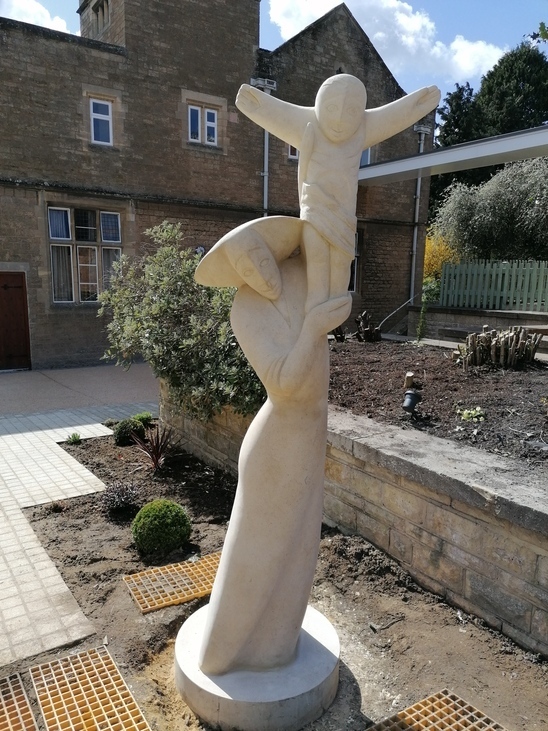
>> “Mother and Child Commission”: In this twelve-minute “making of” video, filmmaker Nick Clarke talks to artist Nicholas Mynheer over the first half of 2020, tracing his progress on the life-size Mother and Child sculpture that was commissioned by the Community of St Mary the Virgin, Wantage, an Anglican convent in Oxfordshire. I was struck by, from the looks of it, the physical demands of the sculpting process—the strength and endurance required to chip away daily at blocks of stone outside in winter, until they yield the shape you desire, then the logistics of attaching the blocks with steel, which weigh nearly a ton collectively, and disassembling, transporting, and reassembling them for installation. I was also interested to hear Mynheer discuss the expressive capabilities of English limestone—how you can convey emotional and sartorial subtleties, for example, through the precise angling of the chisel.
Nicholas Mynheer (British, 1958–), Mother and Child, 2020–21. English limestone, height 230 cm.
Mother and Child was installed in the outdoor reception area of St Mary’s on April 12, 2021; you can watch a video of the installation here. “In very, apparently, simplified form, there is so much tenderness, energy, and something new,” says Sister Stella, the sister in charge, about the sculpture. “Jesus isn’t going to be held back. Her son’s going to go places.”
>> “Corazón Pesebre” (Heart Manger) by Rescate: A follower of the blog introduced me to this Christmas song from Argentina, and I dig it! Released as a single in 2017, it’s about turning our hearts into a manger to receive Christ. Read the Spanish lyrics in the YouTube video description.
The song is by the highly popular Argentinian Christian rock band Rescate, active from 1987 to 2020. Their lead singer and main songwriter, Ulises Eyherabide, died of cancer in July.
>> “Hallelujah, What a Savior!” (Christmas Version), performed by Providence Church, Austin, Texas: In 2012 Austin Stone Worship songwriters Aaron Ivey, Halim Suh, and Matt Carter rewrote the lyrics to Philip P. Bliss’s classic “Hallelujah, What a Savior!” to make them more Christmas-centered and added a new refrain; their version was released that year on A Day of Glory (Songs for Christmas). Here the song is performed by another Austin worship team—Jordan Hurst, Jaleesa McCreary, and Brian Douglas Phillips from Providence Church—for a virtual worship service on November 29, 2020. Instead of using the Austin Stone refrain, they quote Leonard Cohen’s “Hallelujah” between verses.
When the Son of Man comes in his glory and all the angels with him, then he will sit on the throne of his glory. All the nations will be gathered before him, and he will separate people one from another as a shepherd separates the sheep from the goats, and he will put the sheep at his right hand and the goats at the left.
Then the king will say to those at his right hand, “Come, you who are blessed by my Father, inherit the kingdom prepared for you from the foundation of the world, for I was hungry and you gave me food, I was thirsty and you gave me something to drink, I was a stranger and you welcomed me, I was naked and you gave me clothing, I was sick and you took care of me, I was in prison and you visited me.”
Then the righteous will answer him, “Lord, when was it that we saw you hungry and gave you food or thirsty and gave you something to drink? And when was it that we saw you a stranger and welcomed you or naked and gave you clothing? And when was it that we saw you sick or in prison and visited you?”
And the king will answer them, “Truly I tell you, just as you did it to one of the least of these brothers and sisters of mine, you did it to me.” Then he will say to those at his left hand, “You who are accursed, depart from me into the eternal fire prepared for the devil and his angels, for I was hungry and you gave me no food, I was thirsty and you gave me nothing to drink, I was a stranger and you did not welcome me, naked and you did not give me clothing, sick and in prison and you did not visit me.”
Then they also will answer, “Lord, when was it that we saw you hungry or thirsty or a stranger or naked or sick or in prison and did not take care of you?”
Then he will answer them, “Truly I tell you, just as you did not do it to one of the least of these, you did not do it to me.” And these will go away into eternal punishment but the righteous into eternal life.
—Matthew 25:31–46
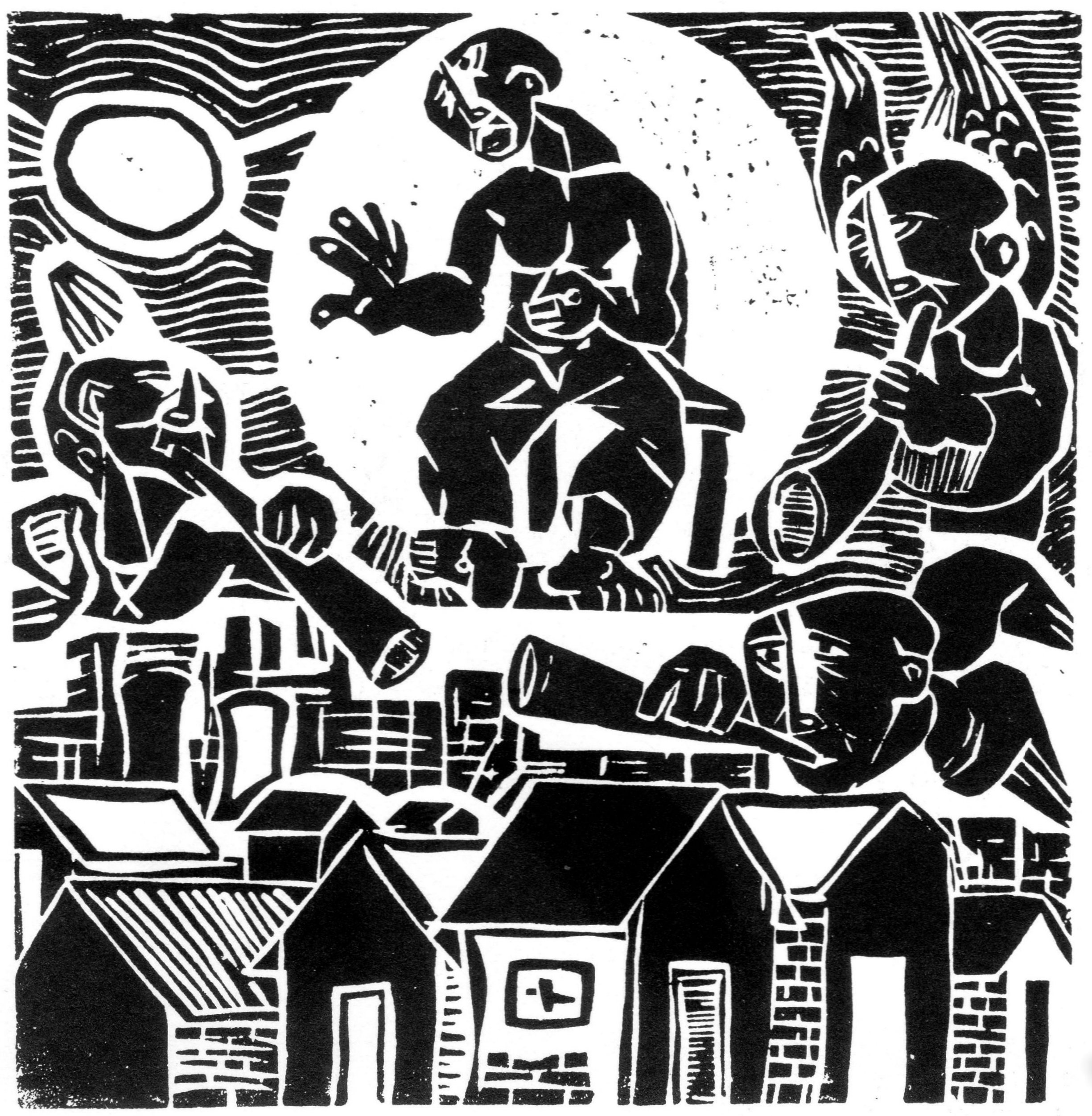
LOOK: The Last Judgment by Nathaniel Mokgosi
Nathaniel Mokgosi (South African, 1946–2016), The Last Judgment, 1980. Linocut. Source: Christliche Kunst in Afrika, p. 274
There’s a great day coming, A great day coming, There’s a great day coming by and by, When the saints and the sinners shall Be parted right and left— Are you ready for that day to come?
Refrain: Are you ready? Are you ready? Are you ready for the judgment day? Are you ready? Are you ready? For the judgment day?
There’s a bright day coming, A bright day coming, There’s a bright day coming by and by. But its brightness shall only come To them that love the Lord— Are you ready for that day to come? [Refrain]
There’s a sad day coming, A sad day coming, There’s a sad day coming by and by, When the sinner shall hear his doom, “Depart, I know ye not!” Are you ready for that day to come? [Refrain]
Texas-bred and New York–based, Snarky Puppy is a jazz-soul-funk music collective consisting of some twenty-five members in regular rotation. “At its core, the band represents the convergence of both black and white American music culture with various accents from around the world. Japan, Argentina, Canada, the United Kingdom, and Puerto Rico all have representation in the group’s membership.” The trumpeters for this song are Michael “Maz” Maher, Jon Lampley, Justin Stanton, Yay Yennings, Kyla Moscovich, and John Culbreth.
Then I saw a new heaven and a new earth, for the first heaven and the first earth had passed away, and the sea was no more. And I saw the holy city, the new Jerusalem, coming down out of heaven from God . . .
It has a great, high wall with twelve gates, and at the gates twelve angels, . . . and the twelve gates are twelve pearls. . . .
I saw no temple in the city, for its temple is the Lord God the Almighty and the Lamb. And the city has no need of sun or moon to shine on it, for the glory of God is its light, and its lamp is the Lamb. The nations will walk by its light, and the kings of the earth will bring their glory into it. Its gates will never be shut by day—and there will be no night there. . . .
Then the angel showed me the river of the water of life, bright as crystal, flowing from the throne of God and of the Lamb through the middle of the street of the city. On either side of the river is the tree of life with its twelve kinds of fruit, producing its fruit each month, and the leaves of the tree are for the healing of the nations. Nothing accursed will be found there any more. But the throne of God and of the Lamb will be in it, and his servants will worship him; they will see his face, and his name will be on their foreheads. And there will be no more night; they need no light of lamp or sun, for the Lord God will be their light, and they will reign forever and ever.
—Revelation 21:1–2, 12, 21–25; 22:1–5
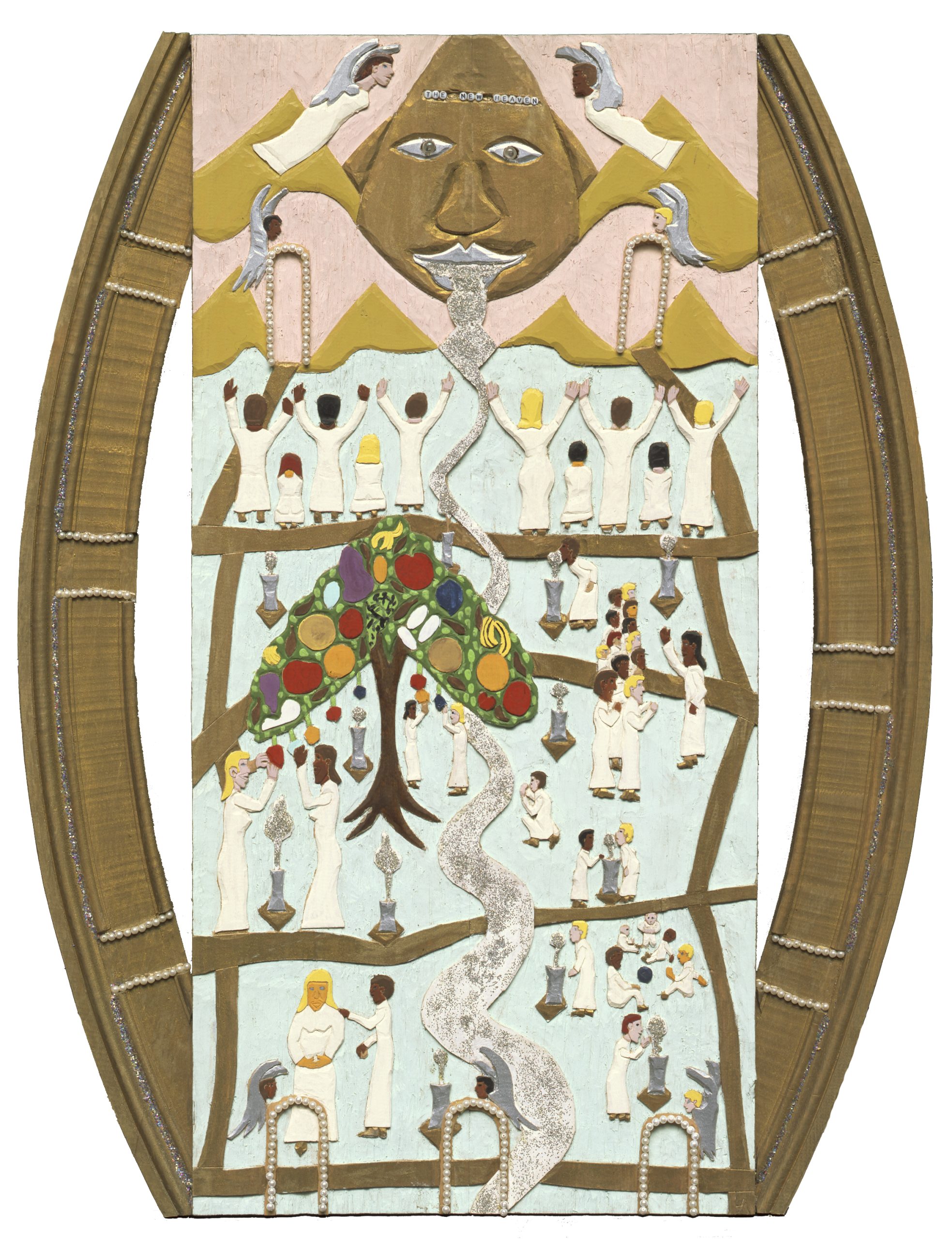
LOOK: The New Heaven by Leroy Almon
Leroy Almon (American, 1938–1997), The New Heaven, 1984. Carved wood, light bulbs, artificial pearls, glue, glitter, plastic letters, paint, 36 × 28 in. (91.4 × 71.1 cm). Toledo Museum of Art, Ohio. [object record]
This mixed-media depiction of heaven by African American folk artist Leroy Almon draws on imagery from the book of Revelation, showing centrally a crystal-bright river, the water of life, flowing forth from the mouth of God (Rev. 22:1–2). It courses through the paradisal scene, past the tree with its twelve fruits and healing leaves, and is pumped into twelve fountains, from which Black and white people drink together. Across lines of race, the new-city dwellers unite in worship, fellowship, and play. Notice the group of children with the ball in the bottom register!
For a framing device, Almon has used two wooden doors that bow out, as if the scene in all its fullness cannot be contained; as if the borders of the new city must bend to embrace the multitudes and their joy. The shape communicates an expansiveness that is the heart of God.
God is shown as majestic, mountain-like, and yet bearing a tender expression. The plastic beads on his forehead are printed with letters that read, “THE NEW HEAVEN,” and his eyes (not lit in this photo) are battery-powered light bulbs! He is, as John the Revelator tells us, the unending light dispelling all darkness.
Almon was born in 1938, so for about the first three decades of his life, he lived in a country where racial segregation was enforced legally in many states and socially in others. By and large, Blacks and whites were made to live in separate neighborhoods, attend separate schools, swim in separate pools, eat at separate restaurants, drink from separate water fountains, pass through separate public building entrances, wait in separate waiting rooms, sit in separate sections of the bus and the theater and even (woe is us) the church, and so on. Even after the passage of the Civil Rights Act in 1964, mandating desegregation, racial prejudices and hostilities continued to persist, as they do today. And because sinful human beings create and run systems (criminal legal, economic, educational, medical, etc.), it’s no surprise that the sin of racism can be found there as well.
Almon longed to see racial justice and (re)conciliation, and he knew Jesus has the power to make it happen. Almon’s preaching ministry went hand-in-hand with his art making. Through both, he shared the good news that Jesus, through his life, death, and resurrection, calls us to a new way of being in the world, which involves repentance of sin and turning to the divine light of love that knows no bounds. His New Heaven envisions a world saved and transformed by Christ’s love, where power is shared equally, forgiveness sought and granted, and friendship is the order of the day, as is a shared rejoicing in the greatness of God. In The New Heaven, Black and white praise Jesus side-by-side, eat at the tree of life together, and put their lips to the same bubbling fount of living water.
And not only are relationships healed and humanity restored to its original harmony in the new heaven, but also personal sorrows and hardships are no more. Physically, mentally, emotionally, spiritually, socially, we flourish in the light of God that never dims.
LISTEN: “Great Rejoicing” by Thad Cockrell, on To Be Loved (2009) | Performed by Rain for Roots, feat. Sandra McCracken and Skye Peterson, on Waiting Songs (2015)
There’s gonna be a great rejoicing (2×)
The troubles of this world Will wither up and die That river of tears made by the lonely Someday will be dry There’s gonna be a great rejoicing
There’s gonna be a great joy river (2×)
Questions of this world Someday will be known Who’s robbing you of peace And who’s the giver
There’s gonna be a great joy river
Someday you will find me Guarded in His fortress Open heart and wings That never touch the ground Someday we will gather In a grand reunion Debts of this old world Are nowhere to be found Nowhere to be found
There’s gonna be a great rejoicing (5×)
We are now halfway through Advent! Many of the songs featured in this Advent series, including today’s, appear on my Advent Playlist. I also have a companion Christmastide Playlist, which has been revised and expanded since last year to include some choral selections.
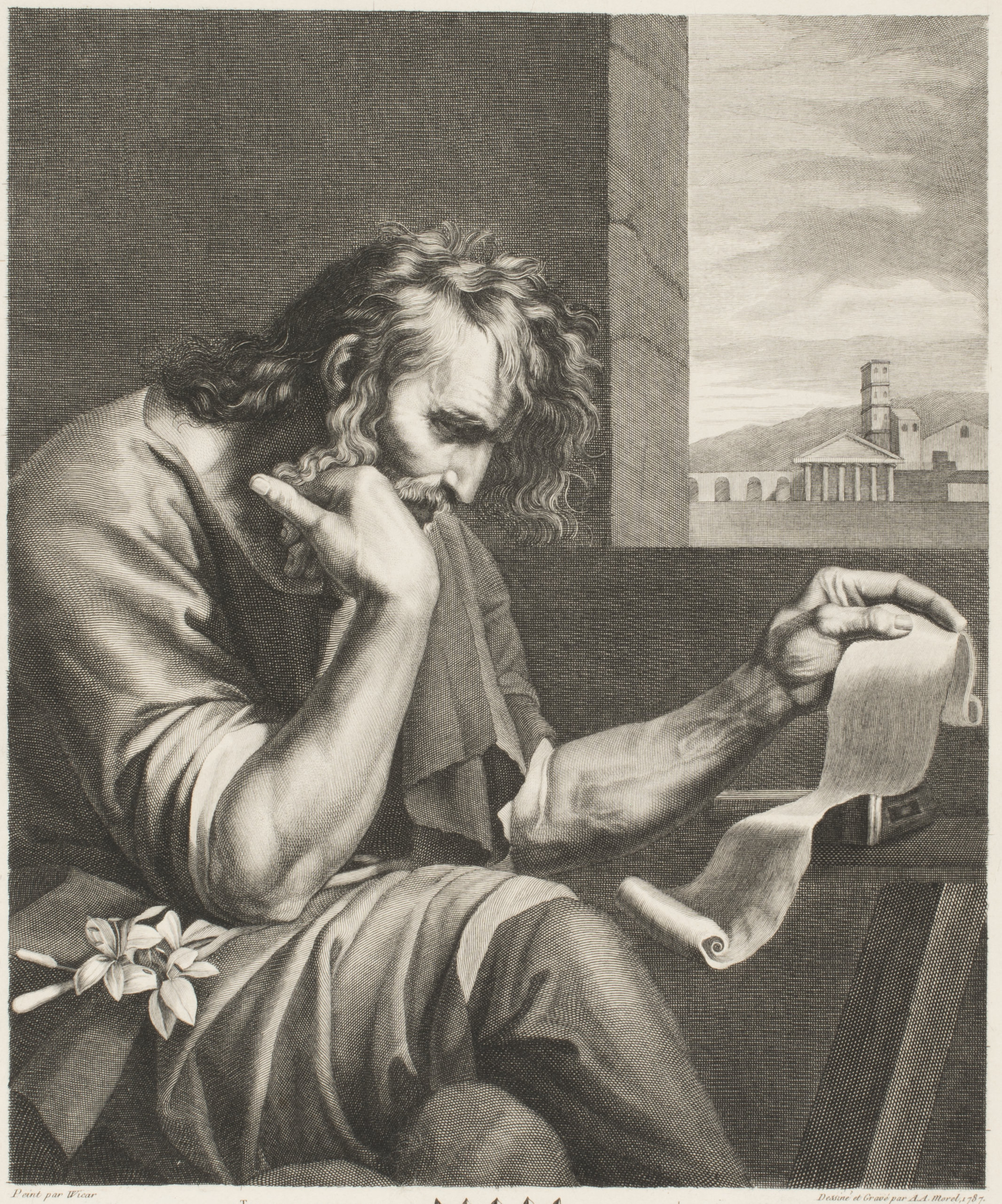
Antoine Alexandre Morel (French, 1765–1829), Saint Joseph (after Jean Baptiste Joseph Wicar), 1787. Etching and engraving, 12 5/16 × 9 1/4 in. (31.2 × 23.5 cm). Philadelphia Museum of Art.
Poor Joseph. His fiancée is pregnant, and the baby’s not his. What else is a man to think, but that she was unfaithful? The news cuts him like a knife. Why is Mary making up this ridiculous story about an angel and an overshadowing and divine seed? I mean, really. A complex stew of emotions simmers within him—anger, frustration, confusion, disappointment, embarrassment, sadness, disgust, fear.
In a rare type of iconography, the eighteenth-century French printmaker Antoine Alexandre Morel, copying a painting by Jean-Baptiste Wicar (which I’ve not been able to locate), shows Joseph in this distressed state of mind, cogitating over next steps. He’s seated at an open window in his woodshop, a cityscape visible in the background, holding a blank scroll. I’m assuming this is the writ of divorce he’s considering drawing up against Mary (Matt. 1:19). Rather than bring her to court on the charge of adultery and subject her to (potentially capital) punishment (Deut. 22:21 prescribes death by stoning for adulterers), the Gospel-writer tells us, Joseph opts to “put [Mary] away privily,” discreetly ending their betrothal with the legal paperwork. Joseph doesn’t want a spectacle, and he doesn’t want retribution. Though Mary hurt him deeply, he still cares for her.
A sprig of lilies lies across Joseph’s lap, alluding to an ancient legend that he was chosen from among other men to wed Mary by the miraculous blossoming of his staff. That the Roman Catholic Church assigns Hosea 14:5—“The just man shall blossom like the lily”—as one of the readings for Joseph’s feast day, March 19, further establishes the lily as his emblem.
This scene takes place shortly before Joseph receives an angelic visit of his own, corroborating Mary’s account.
Rumors are flying All over Galilee these days And Mary, I’m trying to be cool When my friends walk by ’em They cannot look at me in the eye Baby, I’m trying
You’re asking me to believe in too many things You’re asking me to believe in too many things
I know this child Was sent here to heal our broken time And some things are bigger than we know When somehow you find out That you are stepfather to a god Well, Mary, that’s life
But you’re asking me to believe in so many things You’re asking me to believe in so many things
Oh Mary, is he mine? (Mary, is he mine?) Mary, is he mine? (Mary, is he mine?) Oh Mary, is he mine? (Mary, is he mine?) Tell me, is he?
You’re asking me to believe in too many things You’re asking me to believe in too many things
Now, Mary, he is mine (Mary, he is mine) Mary, he is mine (Mary, is he mine?) Yeah, Mary, he is mine (Mary, he is mine)
You’re asking me to believe in so many things You’re asking me to believe in so many things
This song by the Canadian indie-rock band The New Pornographers (despite their unsavory name, their website is clean!) explores Joseph’s internal conflict in the weeks after learning of Mary’s pregnancy and her wild story of how it happened. The second stanza suggests that the angel has already appeared to him to affirm Mary’s integrity and that he has committed to staying the course with her. Yet still, he wavers between doubt and belief and continues to battle the shame of being publicly perceived as the cuckolded husband.
He asks repeatedly, “Is he [the baby] mine?” He eventually gets to the point where he takes ownership of his role as father, even though he didn’t contribute his genetic material. This isn’t how he wanted to build his family, but like Mary, he accepts the strange and terrifying calling.
The refrain (“You’re asking me to believe in too many things”) is voiced to Mary, but it also extends out to God. Joseph is asked to believe that the child inside his fiancée’s womb was conceived by the Holy Spirit, that the child is the long-awaited Messiah who will deliver Israel, that the child is in fact God enfleshed, that he and Mary are capable of parenting this God-boy, and that through all this newly charted territory, God will guide and sustain them, and everything will work out just fine. The magnitude of these asks is overwhelming! No wonder Joseph is reeling.
But thanks be to God that Joseph stepped forward in faith, bolstered, no doubt, by the faith of his partner and by the work of the Spirit in him. He didn’t understand it all, but he was willing to learn as he went, and to let God direct. What he did understand was that something bigger than his own dreams and life plans was at play here, and that something was worth following.
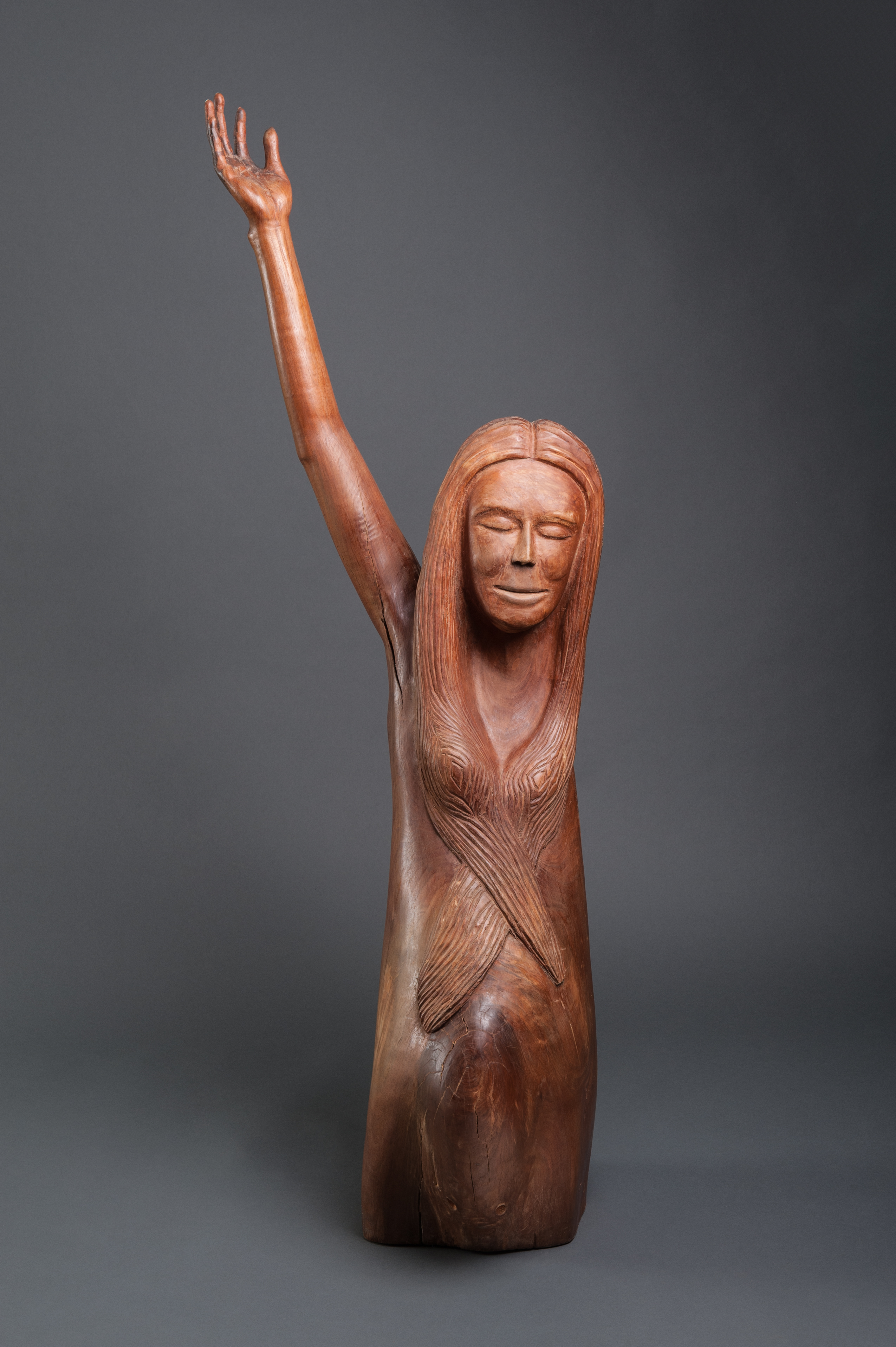
Fred J. Carter (American, 1911–1992), Behold My Miracle, 1980. Walnut, 55 × 20 in. Collection of Mary Carter Owens and Vel-Holly Fleming. Photo: Dan Meyers, courtesy of the American Visionary Art Museum.
Born in 1911 in the mountains of southwestern Virginia, Fred Jerome Carter spent the first few decades of his adulthood as a hardware merchant. In 1938 he married Eloise Davis, and in 1950 they adopted their first and only son, Ross.
In his late forties, Carter began to pursue art making, taking a beginner’s painting class, his only formal artistic training. But wood sculpting is the medium for which he became best known. Writer and documentary filmmaker Jack Wright classifies Carter’s art as “Appalachian art brut,”art brut (“raw art”) being a French term coined by modern artist Jean Dubuffet to describe art made outside the academic tradition.
In 1970 Carter was devastated when his son, having returned as a Marine from Vietnam, hanged himself. He and Eloise divorced shortly after, and Carter opened the Ross Carter Gallery, named in his son’s honor, where he started showing his own work. Below the gallery he established the Cumberland Museum to exhibit a large collection of pioneer tools and artifacts (having to do, for example, with farming, mining, spinning, and moonshining) that provided a window into Appalachian culture and history. It’s there that he met Vickie Hill, whom he later married. Vickie gave birth to Carter’s first biological child, Holly, in 1983, when Carter was seventy-two. Their daughter Mary was born two years later.
Carter created Behold My Miracle two years before Vickie’s first pregnancy, but he retroactively identified the figure with her. In a 1980 interview with Wright for Headwaters Television, he describes how the sculpture came about:
I was back, at Easter [1980], in the mountains, and a fellow was sawing up firewood. Now this was part of a walnut log . . . cut down forty or fifty years ago. . . . There was a limb going up through here about ten feet long. I said, “Don’t cut that up for wood. . . . I see something in this that I want to make. . . . I see a pregnant woman.” . . . So I brought it home and began to look at it. . . . The wood began to talk to me and tell me what it is. . . .
So, I will probably call this Behold My Miracle. That’s what the mother is saying and I am trying to get her to say, in the position of her hand and the look on her face, that this is truly the great miracle. . . . As though she is saying, “Behold me, in my greatest moment of the miracle!”
LISTEN: “The Glory of Jah” by Sinéad O’Connor and Ronald Tomlinson, on Theology (2007) – The acoustic version in the video below, which appears on disc 1 of the album, was recorded live at The Sugar Club in Dublin.
There is no Holy One like you You install kings and take them down Truly there is no one beside you You made all of creation with wisdom
Refrain: May the glory of Jah endure forever The boughs of the mighty are broken And the weak are clothed with strength
There is the sea, vast and wide With all its creatures beyond number There go the ships, they all look to you You lift up the poor into a place of honor [Refrain]
Jah makes poor or he makes rich The pillars of the earth belong to him And he has set his world upon them To raise us up from the dunghill [Refrain]
The eighth full-length album by Irish singer-songwriter Sinéad O’Connor, Theology is a collection of mostly original spiritual songs in the Judeo-Christian tradition. It’s saturated with scripture. It contains:
The opening (and my favorite) “Something Beautiful,” which starts out in O’Connor’s own voice and ends with quotations of Jeremiah 6:14 and 2:32, where God expresses compassion and longing for his people
“Out of the Depths,” a lament for the ways in which organized religion binds God and makes him hard to access, bookended by verses from Psalm 130
O’Connor grew up Catholic and, until converting to Islam in 2018, identified as such, though she has always been unorthodox. Frustrated by the spiritual vapidness of the pop music industry in which she had found fame, in the early 2000s she studied theology at a college in Dublin, looking to connect more deeply with her religious heritage. Her favorite instructor, the Irish Dominican priest Wilfred Harrington, taught a course on the Prophets, reviving her interest in the biblical material that had so fascinated her as a youth. During this time, she was considering leaving her music career, but Fr. Harrington suggested that she set some scripture texts to music and see what happens. She took his advice, and the result is Theology, which she dedicated to Fr. Harrington. Listen to a ten-minute interview with O’Connor about the album, from the limited-edition Theology DVD released in 2008.
When I first heard “The Glory of Jah,” I thought it was a condensation of Mary’s Magnificat, which she voiced upon visiting her cousin Elizabeth following their mutual unexpected pregnancies—Elizabeth with John the Baptist, and Mary with the Christ:
My soul magnifies the Lord, and my spirit rejoices in God my Savior, for he has looked with favor on the lowly state of his servant. Surely from now on all generations will call me blessed, for the Mighty One has done great things for me, and holy is his name; indeed, his mercy is for those who fear him from generation to generation. He has shown strength with his arm; he has scattered the proud in the imagination of their hearts. He has brought down the powerful from their thrones and lifted up the lowly; he has filled the hungry with good things and sent the rich away empty. He has come to the aid of his child Israel, in remembrance of his mercy, according to the promise he made to our ancestors, to Abraham and to his descendants forever. (Luke 1:46–55)
But as I listened more closely and flipped through my Bible to match phrases, I realized that O’Connor’s song is actually a pastiche of Old Testament verses from 1 Samuel, Daniel, and the Psalms, the primary source text being Hannah’s song of thanksgiving:
My heart exults in the LORD; my strength is exalted in my God. My mouth derides my enemies because I rejoice in your victory.
There is no Holy One like the Lord, no one besides you; there is no Rock like our God. Talk no more so very proudly; let not arrogance come from your mouth, for the LORD is a God of knowledge, and by him actions are weighed. The bows of the mighty are broken, but the feeble gird on strength. Those who were full have hired themselves out for bread, but those who were hungry are fat with spoil. The barren has borne seven, but she who has many children is forlorn. The LORD kills and brings to life; he brings down to Sheol and raises up. The LORD makes poor and makes rich; he brings low; he also exalts. He raises up the poor from the dust; he lifts the needy from the ash heap to make them sit with princes and inherit a seat of honor. For the pillars of the earth are the LORD’s, and on them he has set the world.
He will guard the feet of his faithful ones, but the wicked will perish in darkness, for not by might does one prevail. The LORD! His adversaries will be shattered; the Most High will thunder in heaven. The LORD will judge the ends of the earth; he will give strength to his king and exalt the power of his anointed. (1 Sam. 2:1–10)
Hannah, an ancient Jew, prayed these words at the tabernacle at Shiloh upon dedicating her firstborn son, Samuel, to God’s service, as he was conceived after many hard years of infertility and anguished prayer. Mary’s song, which came some ten centuries later, picks up themes from Hannah’s, so it’s no wonder I originally misidentified O’Connor’s source. Mary would have known Hannah’s song from having heard it read in synagogue, and, as Mary’s son would also be set apart for divine service, perhaps she found a special kinship with this ancestral sister. Mary was also spiritually formed by the Psalms, another influence on her Magnificat composition; their words were deep in her bones, naturally coming out in effusions of praise.
Both Hannah and Mary praise God’s kindness, authority, and eternal plan, emphasizing his mercy toward the poor and the humble. Both songs are thematically linked to Psalm 113:5–8:
Who is like the LORD our God, who is seated on high, who looks far down on the heavens and the earth? He raises the poor from the dust and lifts the needy from the ash heap, to make them sit with princes, with the princes of his people.
Now returning to O’Connor’s song: Line 2 has a corollary in Daniel 2:21, “he . . . deposes kings and sets up kings.” And the second verse seems inspired by Psalm 104:24–26, 31:
O LORD, how manifold are your works! In wisdom you have made them all; the earth is full of your creatures. There is the sea, great and wide; creeping things innumerable are there, living things both small and great. There go the ships and Leviathan that you formed to sport in it.
May the glory of the LORD endure forever; may the LORD rejoice in his works . . .
When referring to God, O’Connor uses the Rastafari name for him, “Jah,” a shortened form of “Jehovah.” She had recorded her previous album, Throw Down Your Arms, in Jamaica, a collection of roots reggae song covers, and her spirituality was impacted by her encounters with the Rastafari there. “They use music to reassure people that God is actually with them and watches them, can be called upon,” she said.
So “The Glory of Jah” is a highly intertextual song, rooted in Hannah’s song but weaving in strands from other biblical books—and the result sounds an awful lot like something Mother Mary would sing!
In careful hands
God held the molten world—
fragile filigree
of unfinished blown glass.

Then Mary’s word: Yes!
rose like a pillar of fire,
and Breath blew creation
into Christed crystal.
Sister Irene Zimmerman, OSF, is a Franciscan nun living in Milwaukee, Wisconsin. Born in 1932 into a large Catholic family on a farm near Westphalia, Iowa, she knew from an early age that she wanted to enter the religious life. She joined the School Sisters of St. Francis in 1954 and spent her career in various ministry roles, including high school English and French teacher, secretary, house mother in a German boarding school for girls, and music minister, along the way developing a keen interest in writing poetry. Now in her retirement, she continues to write and to sing in church choirs. She has published five original poetry collections.








 Art & Theology