O magnum mysterium, et admirabile sacramentum, ut animalia viderent Dominum natum, iacentem in praesepio! Beata Virgo, cujus viscera meruerunt portare Dominum Iesum Christum. Alleluia!
English translation:
O great mystery, and wonderful sacrament, that animals should see the newborn Lord, lying in a manger! Blessed is the virgin whose womb was worthy to bear the Lord, Jesus Christ. Alleluia!
This text, a responsorial chant from the Matins of Christmas, has been set by many composers over the centuries, including Palestrina, Poulenc, Victoria, Morales, and La Rocca. Morten Lauridsen’s setting—a motet for a cappella choir—is the most popular.
Note the discordant G# sung by the altos on the first syllable of “Virgo” (3:20 in the video), which alludes to the future suffering of Jesus and, by extension, his mother. This vulnerability, this self-giving, of God that results in death on a cross is a key aspect of the Incarnation.
In the second half of the piece, “the chords, the melody, and the range of voices broaden into an open and exhilarating space,” writes Amy Baik Lee, building up to the climax: “alleluia.” The release of that final word of praise “is sheer joy; it is the sound of creation made well and reveling in its freedom from the fathoms-deep trenches of sin, finally awestruck by the intricacy of its long rescue. . . . It is as a cup of cold water that sparkles with the air of a distant, beloved country.”
PHOTO COMPILATION: “Alternative Advent 2022” by Kezia M’Clelland: Kezia M’Clelland [previously] is the children in emergencies specialist and people care director for Viva and a child protection consultant for MERATH, the Lebanese Society for Educational and Social Development’s community development and relief arm. She is a British citizen, but her work brings her around the world, seeking to safeguard the rights and well-being of children globally.
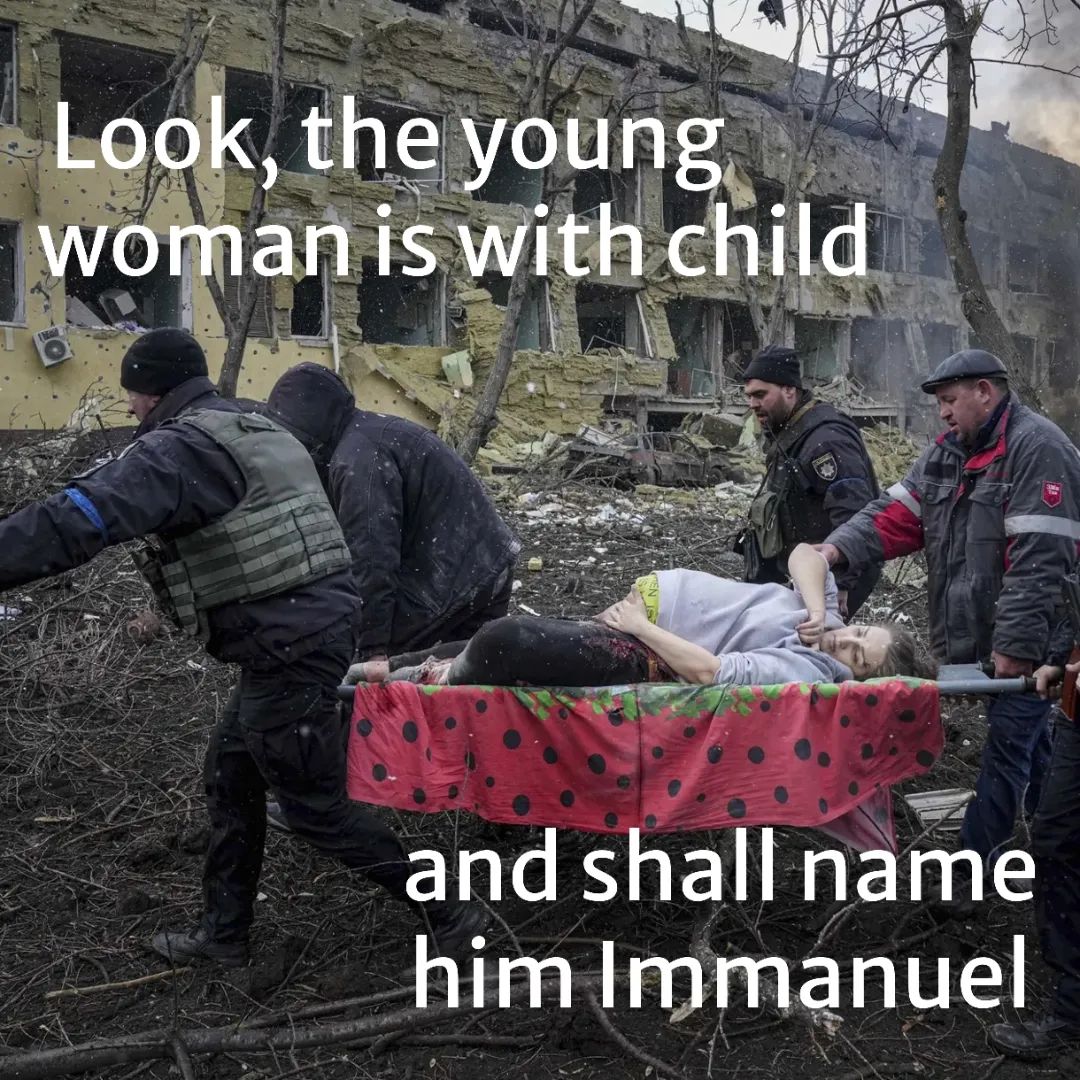
Every December M’Clelland compiles photos from that year’s news, showing people affected by natural disasters, violence, and injustice, and overlays them with Advent promises. There’s sometimes a disjunction between image and text that’s grievous and challenging, a reminder that our long-looked-for deliverance is not yet fully here, even though we receive foretastes. The twenty-eight photos M’Clelland gathered from 2022 include throngs of people making their way to Aichi cemetery in Saqqez, Iran, to attend a memorial for twenty-two-year-old Mahsa Amini, allegedly beaten to death by the country’s religious morality police for not wearing her hijab properly; a police officer helping a child flee artillery on the outskirts of Kyiv, and a baby being born in a bomb shelter; women carrying pans of granite up the side of a mine in Ouagadougou, Burkina Faso, for meager wages; a woman comforting a neighbor who lost her home to flooding in Tejerias, Venezuela; children playing in a sandstorm at the Sahlah al-Banat camp for displaced people in the countryside of Raqa in northern Syria; children clearing trash from a river in Tonlé Sap, Cambodia; and more.
March 9, 2022: An injured pregnant woman is rescued from a maternity hospital in Mariupol, Ukraine, that was bombed by Russian forces. The following week it was reported that she and her child, delivered in an emergency C-section, did not survive. Photo: Evgeniy Maloletka/AP. Scripture: Isaiah 7:14.January 26, 2022: A young woman looks on from her house destroyed by tropical storm Ana in the village of Kanjedza in Malawi. Photo: Eldson Chagara/Reuters. Scripture: Isaiah 58:12.June 7, 2022: A man and child, part of a migrant caravan consisting mostly of Central Americans, are blocked by members of the Mexican National Guard on a Huixtla road in Chiapas state, Mexico. They seek transit visas from the National Migration Institute so that they can continue their thousand-plus-mile journey north to the US. Photo: Marco Ugarte/AP. Scripture: Isaiah 35:9 MSG.
The sequence of images is a visual prayer of lament and intercession. I appreciate how M’Clelland—via the work of photojournalists, and her sensitive curation—raises awareness about these places of suffering, putting faces to the headlines, but also spotlights moments of empowerment and joy amid that suffering. We are encouraged to seek God’s coming into these situations of distress and to see the subtle ways he does come—for example, through the consoling embrace of a friend, the nurturance of an elder sibling, the protective aid of an officer, a jug of clean water, a child’s glee, or acts of protest.
For photo credits and descriptions, see the Instagram page @alternative_advent. (Start here and scroll left if you’re on your computer, or up if you’re on your phone.) Follow the page to receive new posts in your feed starting next Advent.
+++
SONGS by Rev Simpkins, an Anglican priest and singer-songwriter from Essex previously featured here:
>> “Hallelu! (Love the Outcast)”: This song was originally released on The Antigen Christmas Album (2014) with the byline “Ordinand Simpkins & Brother De’Ath”; it was reissued in 2016 on Rev Simpkins’s album Love Unknown, “a cornucopia of non-LP tracks, studio experiments, ingenious live re-workings, radio sessions, off-the-wall demos, obscure b-sides, & pissings about.” The music video was recorded on an iPhone 4 in the Edward King Chapel at Ripon College Cuddesdon in Oxford. [Listen on Bandcamp]
>> “Poor Jesus” (Traditional): Here the Rev. Matt Simpkins performs the African American spiritual “Oh, Po’ Little Jesus” with a soft banjo accompaniment. Harmonizing vocals are supplied by his daughter, Martha Simpkins. It’s the opening track of his EP Poor Child for Thee: 4 Songs for Christmastide(all four songs are wonderful!), released December 11, 2020, to support St Leonard’s Church, Lexden, where he serves as priest-in-charge. [Listen on Bandcamp]
+++
NEW PAINTING: Tent City Nativity by Kelly Latimore:Kelly Latimore is an Episcopalian artist from St. Louis, Missouri, who “rewonders” traditional iconography, especially with an eye to social justice. This Christmas he painted an icon called Tent City Nativity, which shows the Christ child being born in a homeless encampment. A streetlight shines directly over the Holy Family’s tent, like the star of Bethlehem, and neighbors bring gifts for warmth and sustenance: coffees, a blanket, a cup of chili. View close-ups on Instagram, and read the artist’s statement on his website. Proceeds from print and digital sales of the icon will support organizations serving the unhoused in St. Louis.
Kelly Latimore (American, 1986–), Tent City Nativity, 2022. Acrylic, Flashe, and golf leaf on birch board, 27 × 32 in.
SONG MEDLEY: YouTube user African Beats spliced together excerpts from three songs performed at a church in Germany at Christmastime by South African singer Siyabonga Cele and an unnamed woman, including “Akekho ofana no Jesu” (There’s No One like Jesus) and “He’s Got the Whole World in His Hands.” I couldn’t find the name of the last song, and attempts to contact the singer for information were unsuccessful, but it’s in Zulu, as is the first one. Lyrics to the first song, sourced from here, are below.
Akekho ofana no Jesu (There’s no one like Jesus) Akekho ofana naye (There’s no one like him) Akekho ofana no Jesu (There’s no one like Jesus) Akekho ofana naye (There’s no one like him)
Sahamba, hamba, lutho, lutho (I’m walking, walking, nothing, nothing) Safuna, funa, lutho, lutho (I’m searching, searching, nothing, nothing) Sajika, jika, lutho, lutho (I’m turning, turning, nothing, nothing) Akekho afana naye (There is no one like him)
Julius Shumpert (American, 1997–), The Word Made Flesh, 2017. Digital artwork.
This digital artwork by Julius Shumpert shows a silhouette of Christ Pantocrator that’s filled in with stars and planets, emphasizing his eternal preexistence. This is the cosmic Christ. With his left hand he holds a Gospel-book, and with his right he gestures blessing. His halo bears the roman letters A and O for “Alpha” and “Omega” (Rev. 1:8; 21:6; 22:13), as well as the Greek letter X, chi, which is the first letter in ΧΡΙΣΤΟΣ (Christos) and thus ancient shorthand for Jesus the Messiah.
Shumpert writes,
This icon means a lot to me. During Christmas 2016, I dove into the true meaning of Christmas. Past all of the traditional “baby Jesus” storytelling to the bare symbolism of what happened. God, who created everything, and is bigger than infinity, the expanding universe, and all that there is to be, saw us struggling along and squeezed down into the form of precious ordinary baby just to be with us. . . . This icon presents who Jesus is: simply the Word made flesh.
LISTEN: “Of the Father’s Love Begotten” | Original Latin words by Aurelius C. Prudentius, late 4th century; trans. John M. Neale, 1851, and Henry W. Baker, 1861 | Plainchant melody, 13th century | Arranged and performed by Sam P. Bush and Kathryn Caine on A Very Love and Mercy Christmas by Christ Episcopal Church, Charlottesville, Virginia, 2014
I’ve provided the full nine stanzas from the 1861 English version of the hymn by Henry Baker. Christ Episcopal Church sings his stanzas 1, 2, 5, and 9 (in boldface)—wise to omit 7 and 8, as these translations are icky (Roby Furley Davis’s are better), but I quite like the others!
Of the Father’s love begotten Ere the worlds began to be, He is Alpha and Omega; He the source, the ending He, Of the things that are, that have been, And that future years shall see Evermore and evermore!
O that birth forever blessèd, When the Virgin, full of grace, By the Holy Ghost conceiving, Bore the Savior of our race; And the Babe, the world’s Redeemer, First revealed his sacred face, Evermore and evermore!
At His word the worlds were framèd; He commanded; it was done: Heav’n and earth and depths of ocean In their threefold order one; All that grows beneath the shining Of the moon and burning sun, Evermore and evermore!
He is found in human fashion, Death and sorrow here to know, That the race of Adam’s children, Doomed by law to endless woe, May not henceforth die and perish In the dreadful gulf below, Evermore and evermore!
O ye heights of heaven, adore Him, Angel hosts, His praises sing, Pow’rs, dominions, bow before Him, And extol our God and King; Let no tongue on earth be silent, Ev’ry voice in concert ring Evermore and evermore!
This is He whom seers in old time Chanted of with one accord; Whom the voices of the prophets Promised in their faithful word; Now He shines, the long expected, Let creation praise its Lord, Evermore and evermore!
Righteous Judge of souls departed, Righteous King of them that live, On the Father’s throne exalted None in might with Thee may strive, Who at last in vengeance coming Sinners from Thy face shalt drive, Evermore and evermore!
Thee let old men, Thee let young men, Thee let boys in chorus sing; Matrons, virgins, little maidens, With glad voices answering: Let their guileless songs re-echo, And the heart its music bring, Evermore and evermore!
Christ, to Thee with God the Father And, O Holy Ghost, to Thee, Hymn and chant and high thanksgiving And unwearied praises be: Honor, glory, and dominion, And eternal victory Evermore and evermore!
“Of the Father’s Love Begotten” (Lat. Corde natus ex parentis) is one of the oldest Christmas hymns, and it has gone through many translations, additions, revisions, fusions, arrangements, and abridgements to reach the form that’s in our hymnals today.
Its source is a thirty-eight-stanza Latin poem by Prudentius titled “Hymnus Omnis Horae” (Hymn for All Hours), published around 405 CE in his Liber Cathemerinon (Book of Daily Hymns) but written earlier. The poem traces Christ’s ministry from birth to death to resurrection and ascension, with a heavy focus on his miracles. It’s a remarkable poem, and worthy of study, especially as an example of early Christian theology. You can read the original Latin, presented beside a fine English translation by Roby Furley Davis from 1905, here.
Aurelius Clemens Prudentius (ca. 348–ca. 413) was a Roman Christian poet born in what is today northern Spain. After spending decades in law and government, he retired from public life to dedicate himself fully to God’s service, mainly through writing. He was the most significant hymn-writer of the early church.
Prudentius continued to be highly read throughout the Middle Ages, and “Hymnus Omnis Horae” circulated throughout Europe in multiple manuscripts. An eleventh-century manuscript added the refrain “saeculorum saeculi” (evermore and evermore) and a doxology, the Trinitarian final stanza.
The abbreviated form of the hymn (“Corde natus ex parentis,” etc.) entered English hymnody through the six-stanza translation by John Mason Neale, first published in the 1851 edition of Hymnal Noted; Neale renders the first line “Of the Father sole begotten.” Music editor Thomas Helmore presented Neale’s text with the thirteenth-century plainchant melody DIVINUM MYSTERIUM, which he sourced from the 1582 Finnish songbook Piae Cantiones. The pairing has since proven inseparable. Here’s Helmore’s arrangement from the 1852 edition of Hymnal Noted:
An extensive revision of Neale’s translation by Henry W. Baker, which includes three additional, newly translated stanzas, was published in the best-selling Hymns Ancient and Modern in 1861 under the title “Of the Father’s Love Begotten.” This is the version reproduced above, and that has had the most staying power.
The hymn is a praise-filled meditation on how Christ, the second person of the Godhead, who is before all things, entered human time in the person of Jesus. It’s a fairly difficult hymn to sing congregationally—the meter is a bear—but here’s a modern arrangement that I think works well: https://gracemusic.us/sheet_music/of-the-fathers-love-begotten/.
For more about the history, content, meter, transmission, and significance of “Hymnus Omnis Horae,” see the scholarly article by Chris Fenner from the Hymnology Archive: https://www.hymnologyarchive.com/hymnus-omnis-horae.
Solomon Raj (Indian, 1921–2019), Avatharana (Incarnation), late 1980s, batik. Source: Living Flame and Springing Fountain (Indian Society for Promoting Christian Knowledge, 1993).
Avataraṇa (अवतरण), from which we get the word “avatar,” is a Sanskrit word that means stepping down from a higher position. It’s the word used in Hinduism to refer to the incarnation of a deity, to his or her descending to earth. The late Indian Lutheran pastor, artist, and theologian Solomon Raj, from Andhra Pradesh, used the word, with nuance, to refer to the incarnation of Christ.
In this batik—a type of dyed cloth artwork made using a wax-resist method—Raj shows Jesus diving through the ether, surrounded by angels. He hurtles headfirst from heaven to earth to be with humanity. Reproduced in the book Living Flame and Springing Fountain (1993), the image is accompanied by this verse-style reflection by Raj:
When God became man and came to us, the heavens donned a new robe of light. When the son of man came to this earth, the whole creation became renewed. The universe now is redeemed and kept for a glory yet greater than the first because the unknown and the unknowable One became man to live with mankind.
For more on the concept of Jesus as avatar from Christian perspectives, see:
Michael Amaladoss, “Jesus, the Avatar,” in The Asian Jesus (Maryknoll, NY: Orbis, 2006), 105–21






 Art & Theology