Easter, Day 5: Glory to the Risen Lamb!

Then I saw in the right hand of the one seated on the throne a scroll written on the inside and on the back, sealed with seven seals, and I saw a mighty angel proclaiming with a loud voice, “Who is worthy to open the scroll and break its seals?” And no one in heaven or on earth or under the earth was able to open the scroll or to look into it. And I began to weep bitterly because no one was found worthy to open the scroll or to look into it. Then one of the elders said to me, “Do not weep. See, the Lion of the tribe of Judah, the Root of David, has conquered, so that he can open the scroll and its seven seals.”

Then I saw between the throne and the four living creatures and among the elders a Lamb standing as if it had been slaughtered, with seven horns and seven eyes, which are the seven spirits of God sent out into all the earth. He went and took the scroll from the right hand of the one who was seated on the throne. When he had taken the scroll, the four living creatures and the twenty-four elders fell before the Lamb, each holding a harp and golden bowls full of incense, which are the prayers of the saints. They sing a new song:

You are worthy to take the scroll
    and to break its seals,
for you were slaughtered and by your blood you ransomed for God
    saints from every tribe and language and people and nation;
you have made them a kingdom and priests serving our God,
    and they will reign on earth.

Then I looked, and I heard the voice of many angels surrounding the throne and the living creatures and the elders; they numbered myriads of myriads and thousands of thousands, singing with full voice,

Worthy is the Lamb that was slaughtered
to receive power and wealth and wisdom and might
and honor and glory and blessing!

Then I heard every creature in heaven and on earth and under the earth and in the sea and all that is in them, singing,

To the one seated on the throne and to the Lamb
be blessing and honor and glory and might
forever and ever!

And the four living creatures said, “Amen!” And the elders fell down and worshiped.

—Revelation 5 (NRSV)

LOOK: The Vision of the Lamb in the Midst of the Four Living Creatures, from a medieval English apocalypse

Lamb Upon the Throne (Getty)
The Vision of the Lamb in the Midst of the Four Living Creatures and the Twenty-Four Elders, made in London, ca. 1255–60. Tempera, gold leaf, colored washes, and pen and ink on parchment, 12 9/16 × 8 7/8 in. (31.9 × 22.5 cm). J. Paul Getty Museum, Los Angeles, Ms. Ludwig III 1 (83.MC.72), fol. 5.

LISTEN: “Glory to the Risen Lamb!” | Words compiled by Jean Anne Shafferman, 2007, from traditional sources (William Saunders and Hugh Bourne, 1821; Job Hupton, 1805; F. R. Warren, 1878) | Tune: INVITATION (New), from William Walker’s Southern Harmony, 1854 | Performed by musicians at Byford Parish Church, Georgetown, Massachusetts, 2020

Hear the gospel news resounding: “Christ has suffered on the tree;
streams of mercy are abounding; grace for all is rich and free.”

Refrain:
Hallelujah, hallelujah! Glory to the Risen Lamb!
Hallelujah, hallelujah! Glory to the great I AM!

Grace is flowing like a river from the Savior’s wounded side.
Still it flows as fresh as ever; all may live, for Christ has died. [Refrain]

On the cross for our redemption, see him all his lifeblood pour!
There he wins our full salvation, dies that we may die no more. [Refrain]
Easter, Day 4: “I come to my garden”

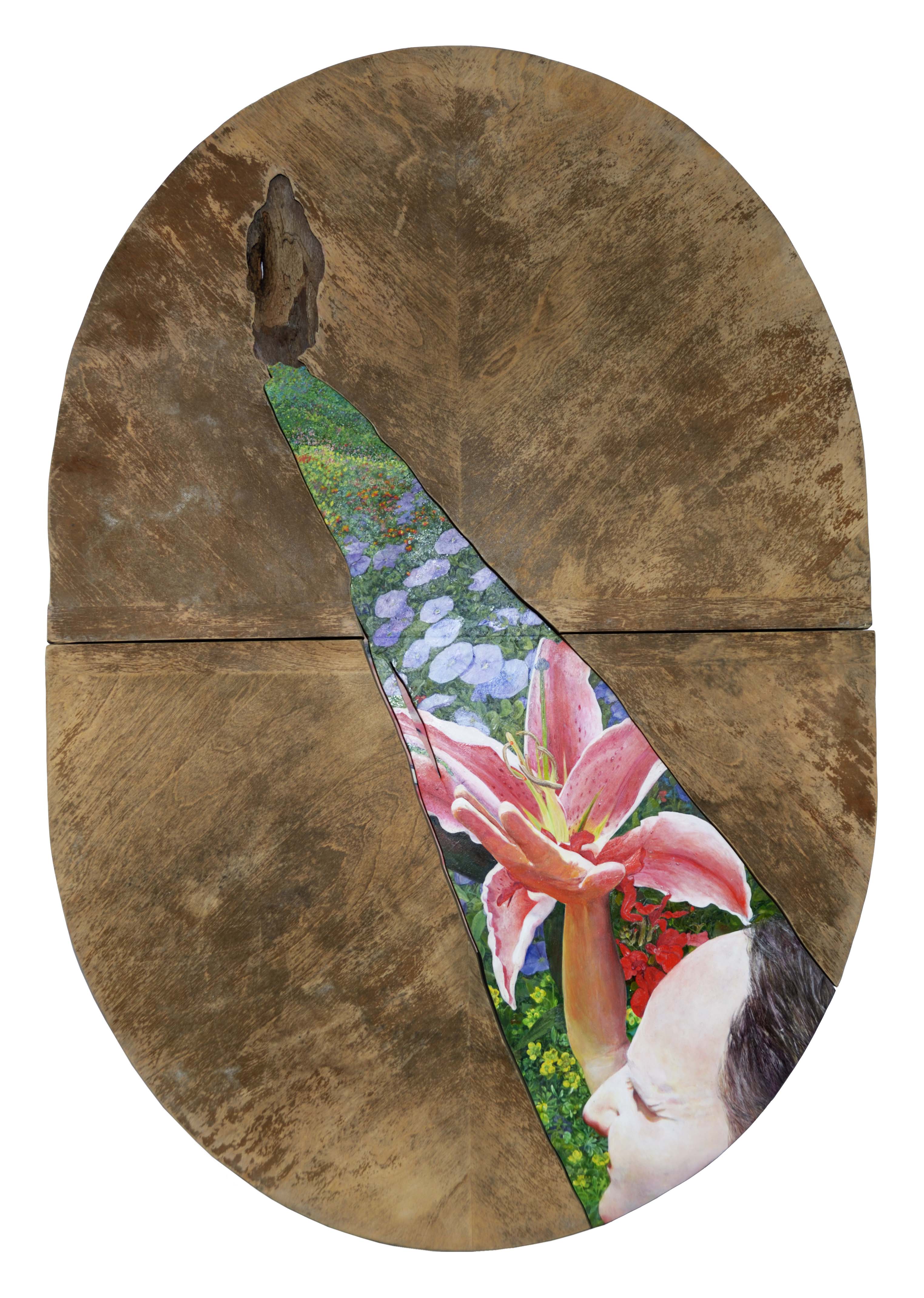
LOOK: (She thought he was) The Gardener by Helen Sherriff

Sheriff, Helen_The Gardener
Helen Sherriff (Australian, 1951–), (She thought he was) The Gardener, 2013. Acrylic and oil on found medium-density fiberboard tabletop with parquetry veneer and bark insert, 15 × 10.7 cm.

This painting by Helen Sherriff, which won the Needham Religious Art Prize in 2013, shows Christ appearing to the forlorn Mary Magdalene after his resurrection. Sheriff cut the figure of Christ out of the MDF substrate and “inserted a piece of thick tree bark which had a scar in an appropriate place suggesting a wound,” she writes at ArtWay.eu.

The colorful flowering cast forth from his form is such a unique way to visually interpret the significance of this moment of encounter. “Normally there would be a shadow stretching forward,” Sherriff says, “but this darkness is light.”

Sherriff also notes how the shape of the Stargazer lily is echoed by Mary’s hand held up to shield her face from the brightness.

LISTEN: “J’entre dans mon jardin” (I Come to My Garden) by the Choeur des Moines de l’abbaye de Keur Moussa au Sénégal, on L’heure vient (2007)

This instrumental piece, an air for kora (traditional calabash harp-lute) and recorder, is part of the Liturgy of the Resurrection at Keur Moussa Abbey in Senegal. Its title is taken from Song of Songs 5:1:

I come to my garden, my sister, my bride;
    I gather my myrrh with my spice;
    I eat my honeycomb with my honey;
    I drink my wine with my milk.

Eat, friends, drink,
    and be drunk with love.

The liner notes for this track on the CD sleeve, which are all in French, say, “Christ, in the Christian tradition, is the Bridegroom. He comes, resurrected on Easter morning, to meet Mary Magdalene, seated at the entrance to the tomb. The kora and the flute convey the joy of this Easter reunion with freshness and brightness.”

On Saturday I shared an example of another Christian musician who has linked the Song of Songs to the Easter story.

To learn more about the music making of the Keur Moussa community of brothers, read the 2022 New Yorker profile “The Monks Who Took the Kora to Church” by Julian Lucas, or the blog feature I published in 2017. I also shared their musical setting of the “Vidi aquam” in Wolof last Easter, along with a wood-carved candlestand by Thomas Mpira of Malawi.

Easter, Day 3: Why Are You Weeping?

Early on the first day of the week, while it was still dark, Mary Magdalene came to the tomb and saw that the stone had been removed from the tomb. . . . [She] stood weeping. . . .

As she wept, she bent over to look into the tomb, and she saw two angels in white sitting where the body of Jesus had been lying, one at the head and the other at the feet. They said to her, “Woman, why are you weeping?”

She said to them, “They have taken away my Lord, and I do not know where they have laid him.” When she had said this, she turned around and saw Jesus standing there, but she did not know that it was Jesus.

Jesus said to her, “Woman, why are you weeping? Whom are you looking for?”

Supposing him to be the gardener, she said to him, “Sir, if you have carried him away, tell me where you have laid him, and I will take him away.”

Jesus said to her, “Mary!”

She turned and said to him in Hebrew, “Rabbouni!” (which means Teacher).

Jesus said to her, “. . . Go to my brothers and say to them, ‘I am ascending to my Father and your Father, to my God and your God.’”

Mary Magdalene went and announced to the disciples, “I have seen the Lord,” and she told them that he had said these things to her.

—John 20:1, 11–18

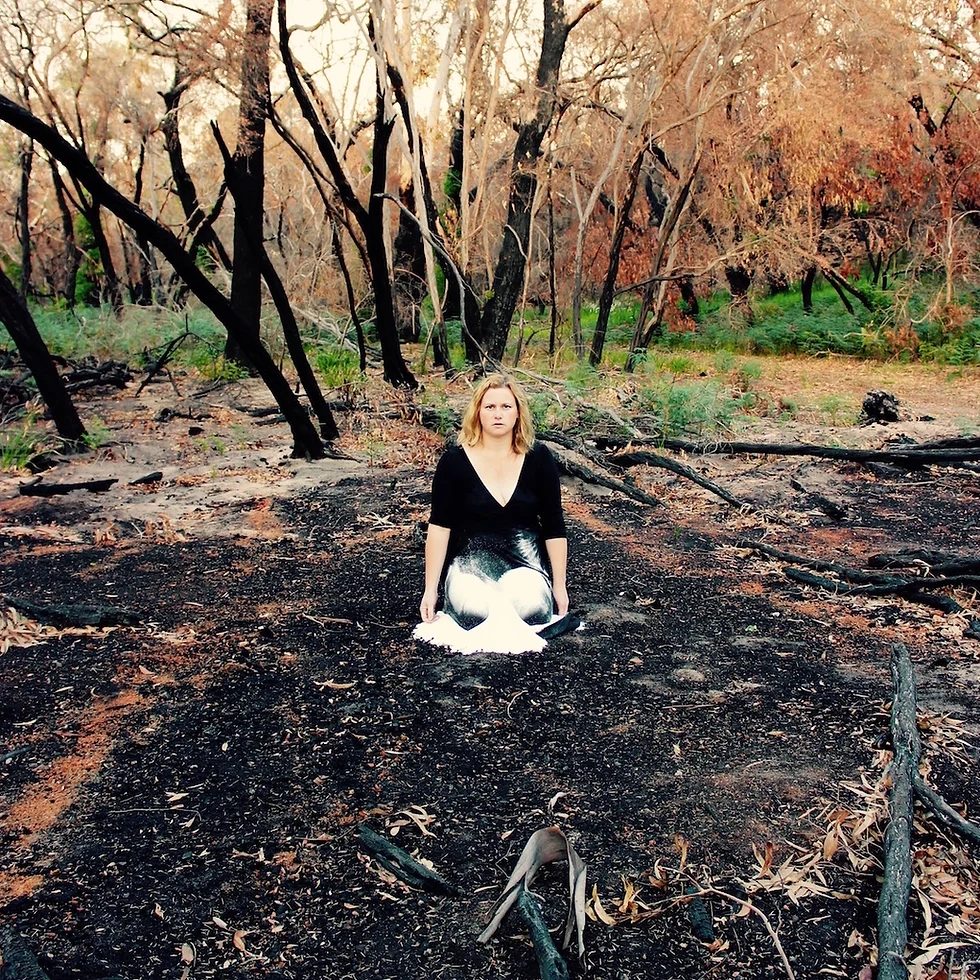
LOOK: ‘Woman, Why Are You Weeping?’ by Rebekah Pryor

Pryor, Rebekah_Woman, Why Are You Weeping
Rebekah Pryor, ‘Woman, Why Are You Weeping?’, 2016. Pigment on archival cotton rag, 60 × 59 cm.

Dr. Rebekah Pryor [previously] is a visual artist, curator, scholar, and member of Australian Collaborators in Feminist Theologies. In this photograph of hers, she poses as Mary Magdalene in the garden of the resurrection at the moment when the risen Christ appears to her. Having wept copious tears, represented by the mounds of salt in front of her, Mary kneels in the soil as she converses with this man whom she at first supposes to be the gardener. Pryor writes that “dawn light and the horizon of regrowth suggest the possibility of ‘a new heaven and a new earth’ in which death, dying, mourning and crying will be no more (Revelation 21:1-5).”

LISTEN: “Still Thy Sorrow, Magdalena!” | Original Latin words (title: “Pone luctum Magdalena”) attributed to Adam of St. Victor, 12th century; English translation by Edward A. Washburn, 1868 | Music by Jon Green, 2023 | Performed on Resurrect, vol. 2, a Cardiphonia Music compilation

Still thy sorrow, Magdalena!
Wipe the teardrops from thine eyes;
Not at Simon’s board thou kneelest,
Pouring thy repentant sighs.
All with thy glad heart rejoices;
All things sing, with happy voices,
Hallelujah! Hallelujah! Hallelujah!

Laugh with rapture, Magdalena!
Be thy drooping forehead bright:
Banished now is every anguish,
Breaks anew thy morning light.
Christ from death the world hath freed;
He is risen, is risen indeed:
Hallelujah! Hallelujah! Hallelujah!

Joy! exult, O Magdalena!
For he hath burst the rocky prison.
Ended are the days of darkness:
Conqueror hath he arisen.
Mourn no more the Christ departed;
Run to welcome him, glad-hearted:
Hallelujah! Hallelujah! Hallelujah!

Lift thine eyes, O Magdalena!
See! thy living Master stands;
See his face, as ever, smiling;
See those wounds upon his hands,
On his feet, his sacred side—
Gems that deck the Glorified:
Hallelujah! Hallelujah! Hallelujah!
Live, now live, O Magdalena!

This medieval Easter hymn was retuned by Jon Green, a Texan living in Edinburgh, Scotland, as part of a Cardiphonia project spearheaded by Bruce Benedict to bring new life to some of the old texts found in Resurgit: A Collection of Hymns and Songs of the Resurrection (Boston, 1879). The lyrics follow a longstanding tradition in the church of conflating the identities of two Marys in the Gospels (Mary of Magdala and Mary of Bethany) and that of the “sinful woman” in Luke 7; all three women become Mary Magdalene, characterized as a penitent who scandalously anoints Christ’s feet with expensive perfume and her own tears during a supper at the house of Simon the Pharisee.

None of the Gospels indicates that this anointer was Mary Magdalene. (Matthew, Mark, and Luke do not name her at all, and John identifies her as the sister of Lazarus and Martha.) But popular tradition ascribes to Mary Magdalene this role—hence the references in the first stanza of the hymn.

What we do know, though, is that Mary Magdalene came early Sunday morning to Jesus’s tomb with the intention of anointing his body, only to find the tomb empty. John 20 is, I think, one of the most glorious chapters in all of scripture. John’s is the only Gospel that recounts Mary’s intimate encounter with the postresurrection Jesus. He tells us that she is distraught over the absence of Jesus’s body, which she presumes someone moved to some unknown location. She had wanted to say her proper goodbyes—he had been taken so suddenly—and, as a gesture of honor, to finish the job of treating his corpse with myrrh and aloes that had been hastily performed by Joseph and Nicodemus on Friday. Now unable to do either, she weeps.

It’s then that Jesus comes to her, alive and in the flesh, revealing himself as her Lord and as conqueror of the grave. He bids her to weep no more.

The gladness of this moment is palpable in the hymn text by Adam of St. Victor. “Laugh with rapture, Magdalena! . . . Joy! exult . . . ! . . . Live, now live.” We are called to do the same.

Roundup: Multilingual Easter song, modern performance of medieval mystery play, and more

SONGS:

>> “He Is Lord (In Every People),” adapt. Gregory Kay: In this video from 2021, members of Spring Garden Church in Toronto take turns singing the popular twentieth-century worship song (of unknown authorship) “He Is Lord” in their native languages: English, Portuguese, Arabic, Korean, and Chinese. Greg Kay, one of the church’s copastors, added a fun refrain that highlights the global character of Christianity and the lordship of Christ over all creation, which everyone joins in on. Love this idea! [HT: Liturgy Fellowship]

>> Easter Medley performed by Infinity Song, feat. Victory Boyd: Infinity Song is a sibling band from New York City that was led for years by Victory Boyd, who is now focusing on her solo music career; its current members, represented in this video from 2021, are Abraham, Angel, Israel, and Thalia “Momo” Boyd. (Victory is singing lead.) The group combines the songs “In the Name of Jesus” by David Billingsley, “Jesus Is Alive” by Ron Kenoly [previously], and “Redeemer” by Nicole C. Mullen into an Easter medley at Fount Church in New York.

>> “Yessu Jee Utheya” (یسوع جی اُٹھیا) (Jesus Is Risen), performed by Tehmina Tariq: Tehmina Tariq is a prolific gospel singer from Islamabad, Pakistan. Here she performs a song in Urdu by Nadir Shamir Khan (words) and Michael Daniel (music). Press the “CC” button on the YouTube video player to follow along with the lyrics. For a more recent Easter song that Tariq recorded, see “Zinda Huwa Hai Masih” (The Messiah Is Risen). [HT: Global Christian Worship]

+++

MEDIEVAL MYSTERY PLAY: The Harrowing of Hell from the York cycle, produced by the YMPST (York Mystery Plays Supporters Trust): From the mid-fourteenth to mid-sixteenth century in England, during the feast of Corpus Christi in early summer, villagers used to enact stories from the Bible on moveable stages called pageant wagons, which would wheel through town making various stops for performance. Playing the roles of sacred personages were not professional actors but members of the trade guilds. Such plays were banned in Tudor times but since the mid-twentieth century have enjoyed a revival.

One of the few complete surviving English mystery play cycles, consisting of forty-eight individual verse dramas of about twenty minutes each, is the York Mystery Plays, named after the historic town where they originated. One of the plays, assigned to the town saddlers, is The Harrowing of Hell. The following video is a 2018 performance sponsored by the York Mystery Plays Supporters Trust, also available on DVD. You can follow along with the script at TEAMS Middle English Texts, though note that the players do adapt it lightly. Learn more at https://ympst.co.uk/.

York Mystery Play (Harrowing of Hell)
A soul writhes in Hades, awaiting rescue by Christ, in the 2018 YMPST wagon play performance of The Harrowing of Hell

For a preview of the language, here’s Adam’s speech toward the end, after Christ binds Satan and casts him into a fiery pit (I love the alliterative phrase “mickle is thy might”!):

A, Jesu Lorde, mekill is thi myght
That mekis thiselffe in this manere
Us for to helpe as thou has hight
Whanne both forfette, I and my feere.
Here have we levyd withouten light
Foure thousand and six hundreth yere;
Now se I be this solempne sight
Howe thy mercy hath made us clene.

Modern English translation:

Ah, Lord Jesus, mickle [great] is thy might
That makest thyself in this manner
To help us as thou hast said
When both of us offended thee, I and my companion [Eve].
Here have we lived without light
For four thousand six hundred years;
Now see I by this solemn sight
How thy mercy hath made us clean.

The YMPST performance incorporates modern elements in the music and costuming, including an electric guitar–driven rendition of the American gospel song “Ain’t No Grave” at the opening and closing.

+++

ART COMMENTARIES:

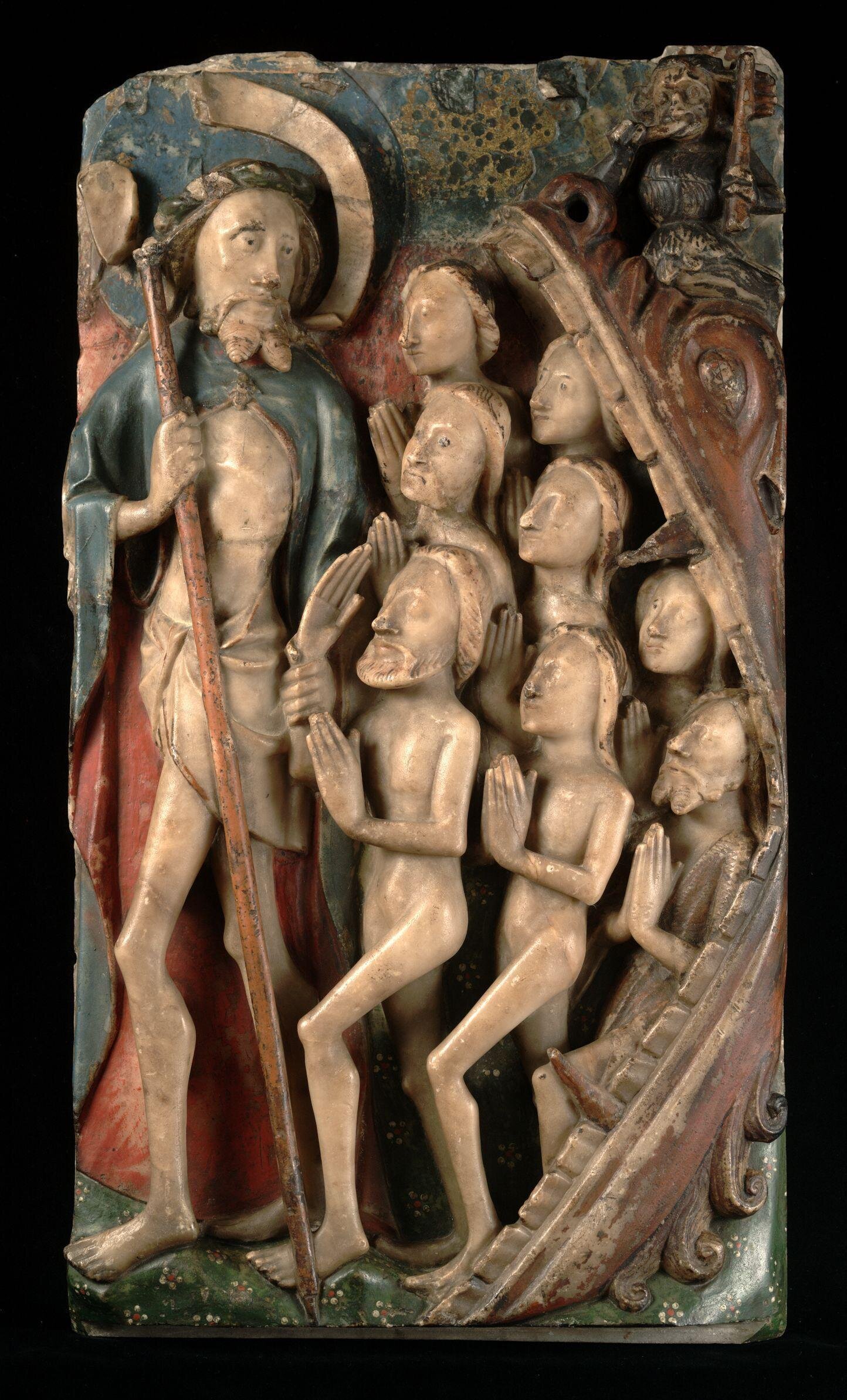
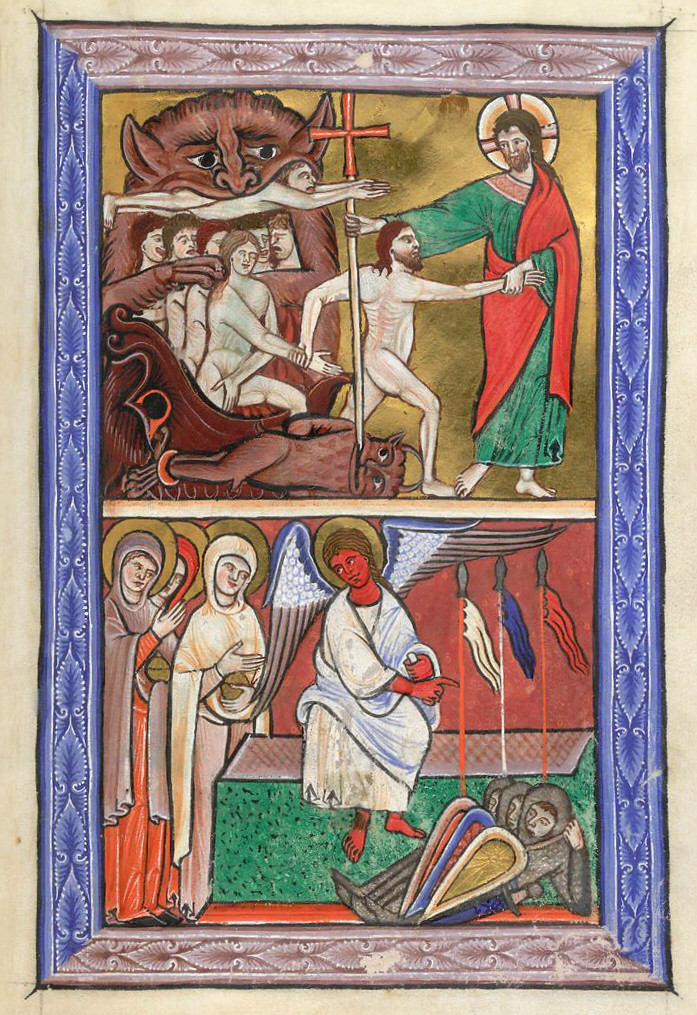
Below are discussions of two medieval English artworks of the Harrowing of Hell, one of my favorite religious subjects. In modern-day parlance, the word “hell” (an English translation of the Greek “Tartarus” or “Hades” or the Hebrew “Sheol”) typically connotes a place of eternal torment where the damned go, but in Christian theology it was long used more broadly to refer to the compartmentalized netherworld where both righteous and unrighteous souls go after death to await the general resurrection that will take place at Christ’s return.

>> “The Harrowing of Hell” (Smarthistory video): Drs. Nancy Ross and Paul Binski discuss a fifteenth-century alabaster that’s in the collection of the Victoria and Albert Museum in London. What sticks out to me—the commentators mention it only briefly—is that Christ stands on a green, flowery lawn! The artist is probably alluding to the springtime, the new life, that Jesus’s resurrection ushered in: the redeemed exit the hellmouth, barefoot like their Lord, onto this lush grass. This detail reminds me a bit of Fra Angelico’s Noli me tangere fresco at San Marco in Florence.

Harrowing of Hell alabaster
The Harrowing of Hell, England, 15th century. Carved, painted, and gilt alabaster, 58 × 32 cm. Victoria and Albert Museum, London.

>> “Under the Earth” by Joanna Collicutt: The Visual Commentary on Scripture is a free online resource that provides material for teaching, preaching, researching, and reflecting on the Bible, art, and theology. For one of her three VCS-commissioned “visual commentaries” on Philippians 2:1–11, Rev. Dr. Joanna Collicut has selected an illumination of the Harrowing of Hell from a thirteenth-century psalter. The Christ Hymn that forms the meat of this passage celebrates Jesus’s descent and ascent, and in verse 10 it says that at his name, every knee will bow in heaven, on earth, and “under the earth.” This phrase had never stood out to me until now.

Resurrection (Arudel 157)
The Harrowing of Hell and The Holy Women at the Tomb, from an English psalter (BL Arundel 157, fol. 110), ca. 1220–40. Ink, tempera, and gold leaf on vellum, 29.5 × 20 cm. British Library, London.

Easter, Day 2: Lift Up Your Heads, O Gates!

Lift up your heads, O gates!
    and be lifted up, O ancient doors,
    that the King of glory may come in!
Who is the King of glory?
    The LORD, strong and mighty,
    the LORD, mighty in battle.
Lift up your heads, O gates!
    and be lifted up, O ancient doors,
    that the King of glory may come in!
Who is this King of glory?
    The LORD of hosts,
    he is the King of glory. Selah

—Psalm 24:7–10

LOOK: Christ’s Descent into Hell from the Stuttgart Psalter [HT]

Harrowing of Hell (Stuttgart Psalter, fol. 29v)
Christ’s Descent into Hell, from the Stuttgart Psalter, made at the scriptorium at St. Germain-des-Prés in Paris, ca. 820–30. Cod.bib.lat.fol.23, fol. 29v, Württembergische Landesbibliothek, Stuttgart, Germany. Click on image to see full page and explore further.

The above psalm passage is read at several times during the church year, depending on your tradition: during Advent, in relation to Christ’s coming into the world (see, e.g., here); on Palm Sunday, where the gates are those of Jerusalem; and on Ascension Day, when Christ (re)enters heaven. But in some illuminated psalters—such as the Stuttgart Psalter from ninth-century France—it is connected with Jesus’s descent into hell between his death and resurrection.

On the Psalm 24 page of the Stuttgart Psalter, the manuscript’s anonymous artist has depicted Christ storming the gates of hell, which are guarded by two winged, fire-spitting demons. Satan or Hades (Death) cowers in the bottom left corner, licked by flames and fearful of his imminent end. Encompassed in a green mandorla and accompanied by an angel, Christ breaches enemy territory, using a long slender cross to break down the doors behind which Satan has kept souls imprisoned. He is here to strike Death dead and gain back his beloveds in an awesome display of glory, power, and love.

(Related post: “Crucifixion, Harrowing, and Transfiguration”)

LISTEN: “Lift Up Your Heads” | Text: Psalm 24:7–10 | Music by Joseph M. Martin and Jon Paige, 1996 | Performed by CMS College Choir Kottayam, dir. Vimal Kurian, 2015

Lift up your heads, you everlasting doors;
open up and let the King of glory come in.
Let the King of glory come in.
(Repeat)

Who is the King of glory?
The Lord of hosts!
He is the King of glory.
The Lord of hosts!
He is the King of glory.

Lift up your heads, you everlasting doors;
open up and let the King of glory come in.
Let the King of glory come in.

Alleluia, let us sing
To the one eternal King;
Alleluia evermore
To the King and Lord of lords.

Who is the King of glory?
The Lord of hosts!
He is the King of glory.
The Lord of hosts!
He is the King of glory.

Lift up your heads, you everlasting doors;
open up and let the King of glory come in.
Let the King of glory come in.
(Repeat)

You can purchase the sheet music for this choral piece at J.W. Pepper. For an album recording available on Spotify and elsewhere, see Written in Red (2011) by the East Valley Chorale.