
Out of the living word
Come flower, serpent and bird.

All things that swim or fly
Or go upon the ground,
All shapes that breath can cry
Into the sinews of sound,
That growth can make abound
In the river of the eye
Till speech is three-ply
And the truth triply wound.

Out of the living word
Come flower, serpent and bird.
This poem is from The Next Room of the Dream (University of Chicago Press, 1962) and is compiled in The Collected Poems of Howard Nemerov (University of Chicago Press, 1977). Used by permission of the Estate of Howard Nemerov.
Howard Nemerov (1920–1991) was a major figure in midcentury American poetry, whose Collected Poems won the Pulitzer Prize, the National Book Award, and the Bollingen Prize. He served as US poet laureate from 1963 to 1964 and again from 1988 to 1990, and he also wrote fiction and essays. “Romantic, realist, comedian, satirist, relentless and indefatigable brooder upon the most ancient mysteries—Nemerov is not to be classified,” Joyce Carol Oates remarked in the New Republic. From an artistic family, Nemerov was the older brother of the photographer Diane Arbus.
The exuberantly decorated Book of Kells is widely agreed to be the most beautiful book ever made. The crown jewel of Celtic art, it is a manuscript copy of the Four Holy Gospels in Latin, with ten surviving full-page illuminations and many more marginal illuminations and decorated initials throughout the other 670 pages—the work of three artists and four scribes.
Most art historians believe the book was created on the Scottish island of Iona by a group of monks sometime around 800. Viking raids at that time forced the monks to flee to the monastery of Kells in Ireland; they were able to save the book, but it was left unfinished.
The most famous page from the Book of Kells is folio 34r, often referred to as the Christi autem or Chi-Rho page.
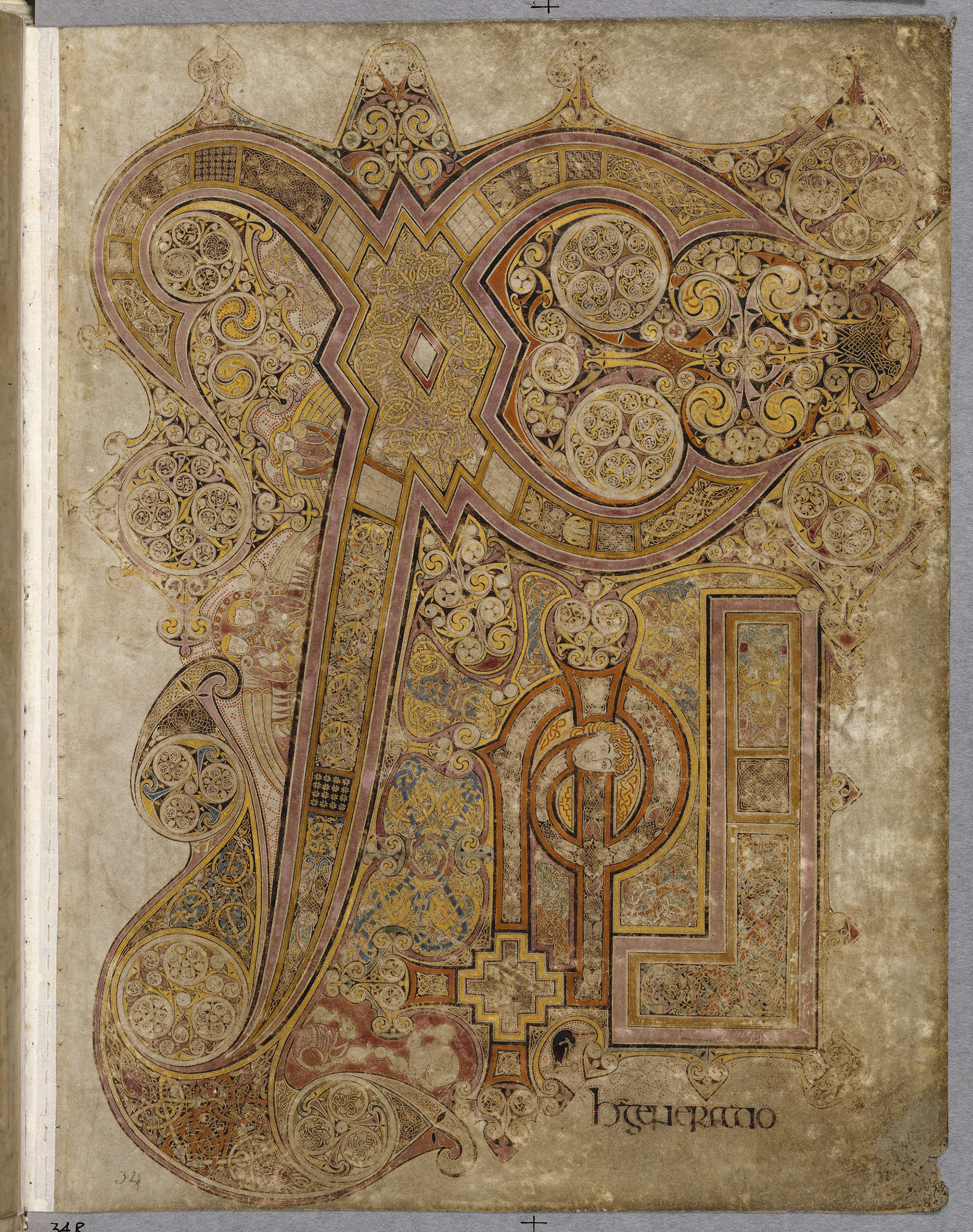
The page illuminates the “second beginning” of the Gospel of Matthew, following the genealogy and opening the narrative of the life of Christ: Christi autem generatio (“Now the birth of Christ . . .”) (Matt. 1:18). The anonymous artist represents the Holy Name of Jesus with a monogram, enlarged and embellished, consisting of the Greek letters chi (Χ) (pronounced “kai”), rho (ρ), and iota (ι), the first three letters in the word Χριστός, Christos. H generatio (where h is shorthand for autem) is written in Latin in Insular majuscule script at the bottom right of the page.
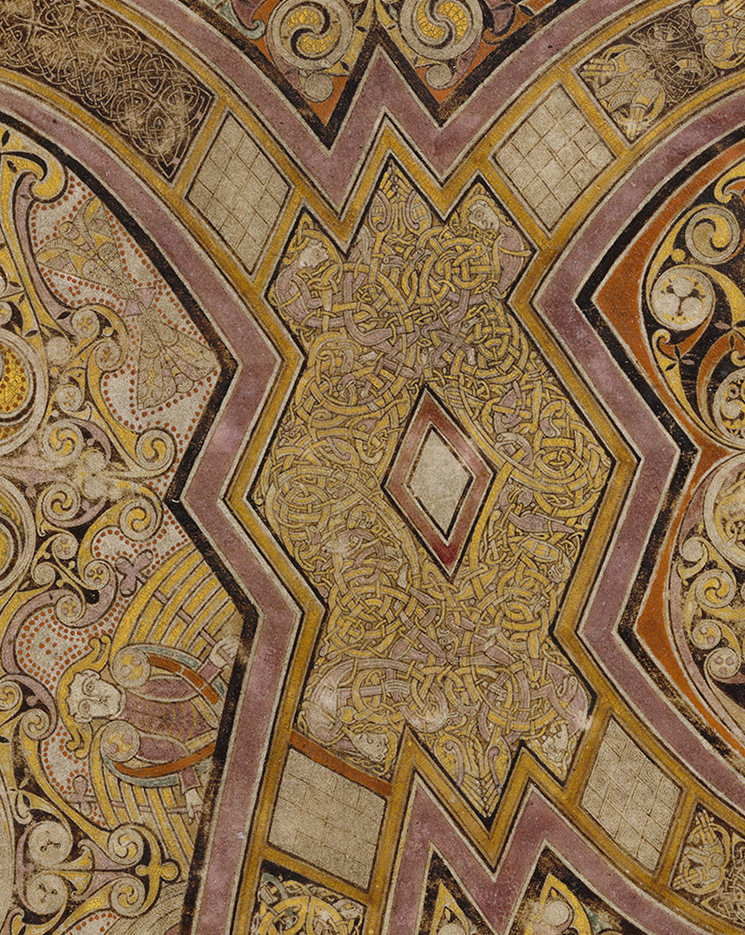
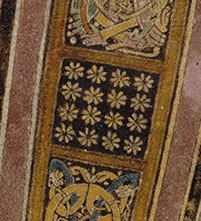
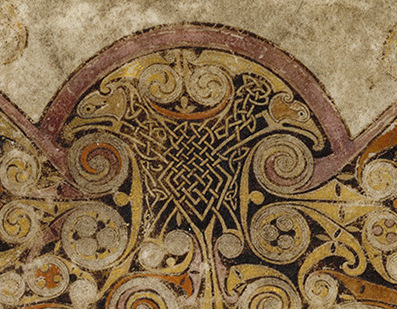
The chi-rho monogram is accorded special dignity in Christian art. Here the chi takes up nearly the whole page, its arms and legs extending to the four corners, exuding a kinetic energy. It reaches, it leaps; it blossoms and enfolds. It is beautified with intricate interlaces, spirals, and lozenges, and it’s teeming with life! Creatures of the land, air, and sea dwell within and around—cats and mice (nibbling on a eucharistic wafer!), birds and moths, an otter and a fish, humans and angels. There are vines and flowers too, and the whirling gears of the cosmos—all of it spilling out of the precious name of Christ.

Peering out from the inner tip of the rho is a red-haired man. Might this represent Jesus? Scholars tend to think so.
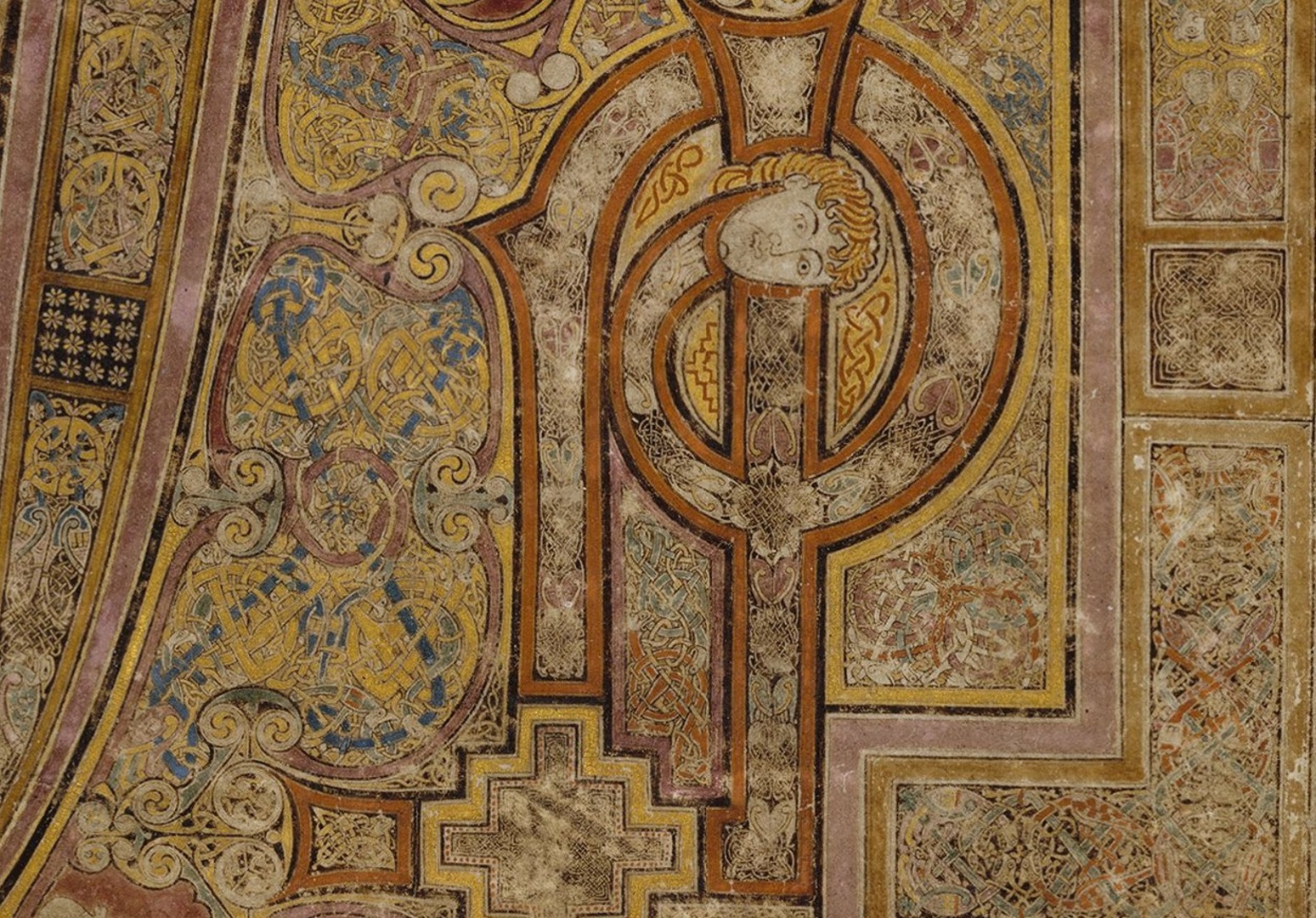
This illuminated page combines word (speech) and Word (Logos) with glorious liveliness. “The decoration of the text of Christ’s birth suggests the identification of Christ incarnate with Christ the Creator-Logos,” writes art historian Jennifer O’Reilly. “Christ as the divine Word is here revealed in a word, a single letter, concealed within the design. Similarly, commentators meditating on the name at this point in Matthew’s gospel, described his divinity as lying hidden in his creation, beneath his human flesh at his Incarnation and beneath the literal letter of the scriptural text.”
(Related posts: “What the Body Knows” by Jean Janzen, poem; “Standing Together in Prayer,” a commentary on Christ on the Mount of Olives from the Book of Kells)
In his ekphrastic poem “The Book of Kells,” Howard Nemerov subtly draws out this theology—Christ as the Creator of the universe in and by whom all things consist (Col. 1:17). Bearing a rhyme scheme of aa bcbccbbc aa, the poem opens and closes with the same couplet: “Out of the living word / Come flower, serpent and bird.” Again, the word “word” is multivalent, referring to the written word “Christ” that fills the Book of Kells page in the form of a stylized monogram, as well as to Christ the person, the living Word of God, the source of all life. It can also refer to the Bible, which is “living and active” (Heb. 4:12) and which reveals Christ.
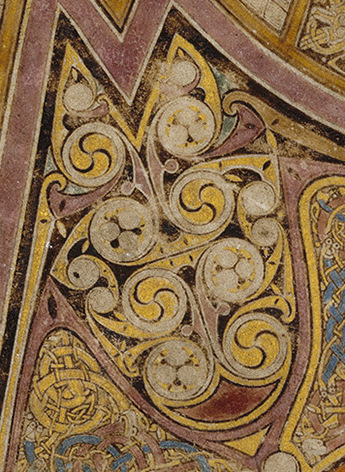
Nemerov alludes to the Chi-Rho page’s knotwork, its geometric shapes, its zoomorphic interlaces, and its triskeles (triple spirals), glorying in the sacred beauty and abundance they signify, which some unnamed early medieval monk laboriously sketched and painted over the course of who knows how long, to honor the story of the birth of Jesus Christ.
The Book of Kells’ Chi-Rho page is a phenomenal work of art. The symbol of Christ is all-encompassing, and all of creation is united in harmony with it.
The 2009 animated fantasy drama The Secret of Kells, made by the Irish studio Cartoon Salon, features a wondrous animation of the Chi-Rho page at the end, bringing to life some of its many details:
Explore the full Book of Kells on the Digital Collections page of the Library of Trinity College Dublin.
 Art & Theology
[…] (Related post: “The Book of Kells,” a poem by Howard Nemerov) […]
LikeLike