
LOOK: Ang Kahulugan ng Pasko by Kristoffer Ardeña
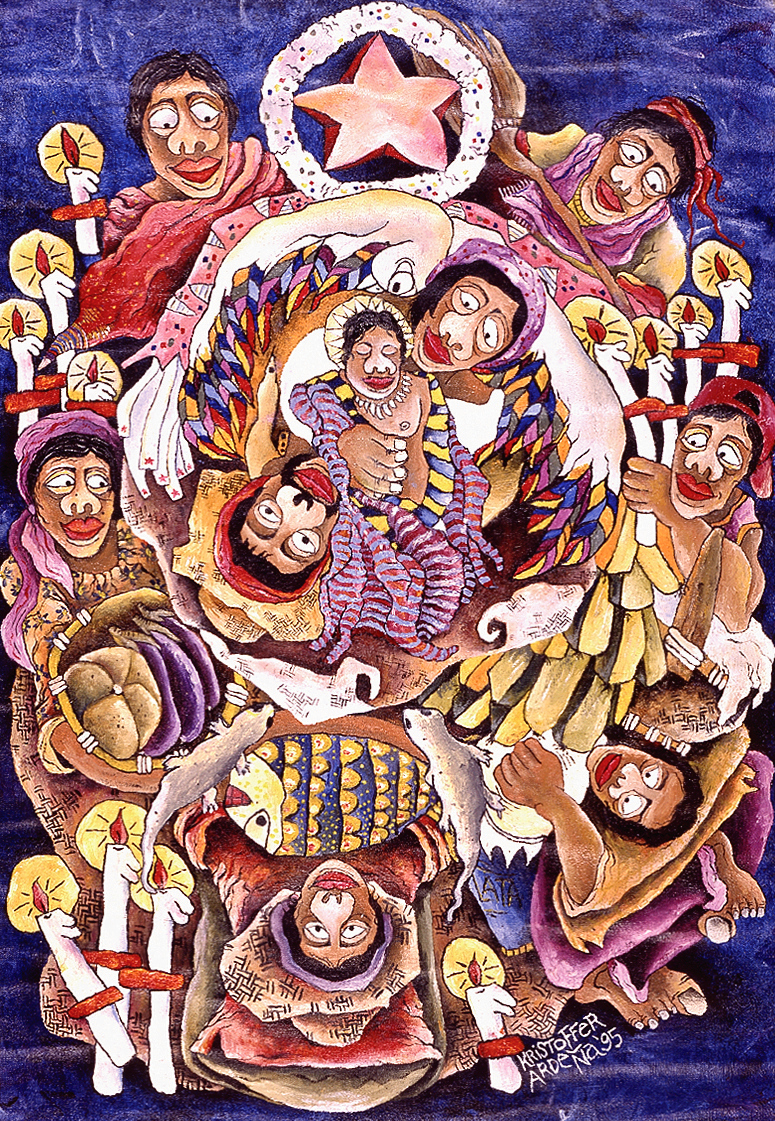
About 88 percent of the population of the Philippines is Christian—it’s the only Asian country where Christianity predominates—and Christmas is the most festive holiday of the year.
Filipino artist Kristoffer Ardeña celebrates the Christmas story and its ongoing impact in his painting Ang Kahulugan ng Pasko, which translates to “The Meaning of Christmas.” He wrote the following extended statement about it for the December 1996 issue of Image: Christ and Art in Asia, a publication of the Asian Christian Art Association. From what I can tell, this organization is no longer active.
Christmas—what does it really mean to us? Parties, extravagant decorations, frivolous gifts and all those materialistic things—do they manifest the true meaning of Christmas?
Sometimes we get so used to celebrating Christmas that we forget the truth behind it. In my painting Ang Kahulugan ng Pasko I want to express what Christmas means to me and to the ordinary people whom we hardly notice.
The Christmas lantern
The most popular Philippines Christmas symbol is the star lantern, or parol (see top of artwork). All that is needed to make a star lantern are ten long and five short bamboo sticks, string, starch and paper.
Although rice paper was traditionally used to cover the lantern, nowadays Japanese paper, foils or plastics are used and bulb lights have replaced the traditional candle inside the lantern.
The star lantern is a Filipino innovation of the Mexican piñata which was introduced to our country during the Spanish colonial period.
The five-pointed star lantern represents the star of Bethlehem. Stars produce the elements that make life possible, and in death they sow the seeds of new stars and planets across the heavens. The earth is built in part from the ashes of dead stars, and I think human beings are literally star children. We and all other life forms are collections of atoms forged in stellar furnaces.
It was through this star that the shepherds and the magi were guided, and it may well be the same star that calls us to remember and beckons us to search for the child in the manger—for he is the truth behind Christmas.
By living and dying, a star generates new worlds; the life and death of the infant that the star of Bethlehem symbolises created a new spiritual world.
The banig, or native handwoven mat
The banig is made from abacca, buri or other dried plant fibres woven together. Motifs and designs differ regionally. The banig is where gatherings happen. It is placed on the ground so that rituals, dialogues, recreation or mere eating sessions may occur. It calls us together, it draws us to gather.
The candles
The use of votive candles most probably came from the Roman practice of burning candles as a mark of respect to a person, and in this painting the candles symbolise respect for Christ. But there is more to a candle. It is believed that candles are also a form of prayer.
During fiestas and other holy occasions we offer candles, and we light candles during birthdays or when we visit our dear departed loved ones.
The bananas
During Christmas our front doors are adorned with three bunches of bananas still attached to their stalks. They are placed there during the Advent season and are not taken down before Epiphany. These bananas represent the Holy Family.
Whenever the visitors come to our home we offer them some of these bananas because we believe that these bananas have been blessed by God and that we should share His blessings with others.
I included these bananas as well as the star lantern in this painting because, just like my ancestors, I believe they add meaning to Christmas.
The people surrounding the Holy Family
(1) The northern tribesman of Luzon and the Metro Aide worker (the one who sweeps and keeps our streets clean). These two represent the people both near (the Metro Aide worker) and far (the tribesman) who have been guided by the star to bear witness to the birth of Jesus, just as the shepherds were led to the manger to pay homage to the king.
I chose the Metro Aide worker because I feel that we get used to his presence when he cleans our streets and we hardly take notice of him or thank him for what he does; yet here he is with his broom, giving praise and thanks.
(2) The fisherman, the vegetable vendor and the balut (duck egg) vendor. The Magi brought gold, incense and myrrh, and here are the fisherman with his best catch, the vegetable vendor with her freshest and best vegetables and the balut vendor with the best duck eggs to offer Jesus.
I placed these people in the painting rather than the rich and extravagantly dressed because I believe that Christmas is universal and for everybody. It is not only for the rich but for the modest poor people as well.
The offering we give to Jesus is not merely an act of human generosity; it is a religious act. It is an act which is sacramental and sacrificial. We have worked on these gifts, and we bring them to Jesus and offer them and offer ourselves.
(3) The comanchero. He is the “marine” of Christmas, the first to welcome and the last to go. He is the caroller. He sings and plays his instruments to the tune of Christmas songs to announce Christmas.
He uses ethnic as well as indigenous instruments—tambourines made of beer bottle caps, drums made of cans and cloth, maracas made of coconut shell with mango seeds inside. Just as the vendors offer their goods, he offers his songs to Jesus.
The dove and house lizards
Just as there were cows, horses and many farm animals, the dove and house lizards in this painting represent more than that. They are there to bear witness to this glorious event. The dove, which is the universal symbol of peace, unveils yet embraces the Holy Family.
With regard to the house lizards, I adhere to the superstition that every day at six in the evening they come down from the ceiling to kiss the floor in reverence to God. This belief tells me that we human beings, stewards of God’s creation, must do more than that.
La Sagrada Familia (The Holy Family)
In this painting I represented Joseph as a farmer and Mary as his wife. Jesus is wrapped in striped layette cloth distinctive to the Igorot tribe of Luzon, and as a sign of kingship he wears a necklace made of animal bones, which is characteristic of an Igorot chieftain.
This is one of nine artworks featured in an article I wrote last Christmas for Christianity Today, “How Asian Artists Picture Jesus’ Birth from 1240 to Today.”
LISTEN: “Ang Pasko Ay Sumapit” (Christmas Has Arrived) | Tagalog words by Levi Celerio, 1950, based loosely on a 1933 Cebuano carol text, “Kasadya Ning Takna-a,” by Mariano Vestil | Music by Vicente Rubi, 1933 | Performed by the Bayanihan Philippine Dance Company on A Philippine Christmas, 1964, reissued 1991
Ang Pasko ay sumapit
Tayo ay mangagsiawit
Ng magagandáng himig
Dahil sa ang Diyos ay pag-ibig

Nang si Kristo’y isilang
May tatlóng haring nagsidalaw
At ang bawat isá ay nagsipaghandóg
Ng tanging alay

Koro:
Bagong Taón ay magbagong-buhay
Nang lumigayà ang ating Bayan
Tayo'y magsikap upang makamtán
Natin ang kasaganaan!

Tayo’y mangagsiawit
Habang ang mundó'y tahimik
Ang araw ay sumapit
Ng Sanggól na dulot ng langit

Tayo ay magmahalan
Ating sundín ang Gintóng Aral
At magbuhát ngayon
Kahit hindî Paskô ay magbigayan!
Christmas has come
Come, let us go forth singing
Beautiful hymns
For God is love

When Christ was born
There were three kings who did visit
And each one did present
A unique offering

Refrain:
’Tis New Year, so we must reform our lives
That our nation might be joyful
Let us strive that we might achieve
Prosperity

Come, let us go forth singing
While the world is silent
The day has arrived
Of the Infant sent from heaven

Let us love one another
May we follow the Golden Rule
And from now on
Though it not be Christmas, let us keep giving [source]
I really like the recording above, which has rollicking instrumentation to back the voices, but here’s an a cappella performance that’s also good, from 2006, by the Philippine Madrigal Singers:
 Art & Theology