New albums: “Confessions” by the Anachronists, “Though It Be a Cross” by Weston Skaggs, and more

Here’s my new Spotify playlist for July:

Every month I curate a mix of old and new Christian (or Christian-resonant) song releases. For this coming month, some of the new songs come from the following five albums that were released this spring or early summer, which I’ve really been enjoying. I list them here chronologically and encourage you to listen to them each in full!

New albums 2025

1. Jesus by Jon Guerra, released April 4, 2025: An album of original songs in conversation with the words of Christ. Guerra says that a few years ago, to reacquaint himself with Jesus, he began reading cyclically through the Gospels, and as he did, “little song fragments started coming. I was trying to really hear the words, to feel the stories again, and so I’d write little tunes around certain phrases—‘do not lay up for yourselves treasures on earth,’ ‘if anyone would come after me,’ ‘give to everyone who asks of you,’ ‘take this cup from me,’” etc. He then developed those into the twelve fully fledged songs that made it onto the album.

Favorite tracks: “Reckoner (An Axe Laid to the Root),” “Where Your Treasure Is” (above), “Love Your Enemies”

2. Sermon on the Mount: Bible Memory Collection by The Soil and The Seed Project, released May 16, 2025: The Soil and The Seed Project is a ministry that provides intergenerational resources for people as they follow Jesus, read scripture, and talk about their faith together. One of those resources is new music, written and recorded by an expanding collective of folks. All twenty-five songs on this new double album of theirs are based on the Sermon on the Mount in Matthew 5–7, which contains the Beatitudes, the Lord’s Prayer, warnings against hypocrisy, the call to be salt and light, the command to love one’s enemies, the parable of the wise and foolish builders, assurances of God’s care, and the promise that those who seek will find. For the first disc, the Project set 48 of the 111 sermon verses to music, and for the second, they invited a handful of singer-songwriters to write songs in response to what they encountered as they dwelt in the text.

The album is accompanied by a “Little Liturgies” booklet of litanies, reflection prompts, and line drawings covering eleven weeks. Both the music and the booklet (digital or physical, while supplies last) are FREE from their website!

Favorite tracks: “Come and Eat” (above), “Mountains of Treasure,” “God of Mercy, God of Peace,” “Take What You’ve Given”

3. Though It Be a Cross by Weston Skaggs, released June 20, 2025: An EP of six hymns, freshly arranged and performed by Weston Skaggs of Ohio. The album title comes from a line from “Nearer, My God, to Thee” (video below). “Sarah Fuller Flower Adams wrote the lyrics from the perspective of Jacob and his received revelation of God’s nearness. A nearness that only occurred when he felt most hopeless and alone,” Skaggs explains. “In meditating on that narrative, she determined to be like Saint Peter: who became the most like Christ his master when he was raised on his own cross.” This song and others feature backing vocals by Katy Martin.

The most stylistically daring is “For the Beauty of the Earth,” whose verses Skaggs transposed to a minor key—to allude to the beauty and brokenness of creation and relationships, Skaggs said, “invit[ing] listeners to hold both gratitude and longing in the same breath.”

Favorite tracks: “No, Not One,” “Nearer, My God, to Thee” (above)

4. Confessions by the Anachronists, released June 26, 2025: The Anachronists are Andrés Pérez González, Corey Janz, and Jonathan Lipps, three musician friends who met while studying theology at Regent College in Vancouver and who have formed a group to give renewed voice, through modern indie music, to theologians and mystics from ages past. Confessions is their debut EP, with six songs rooted in Augustine’s spiritual autobiography from the late fourth century. The songs address grief over the death of a dear friend, and God’s merciful pursuit of those who wander; a preconversion sense of dissatisfaction but as yet unwillingness to make any changes; God as the One who is fully at rest in his own self, and how we might share in that rest; struggles with distraction and pride in the spiritual life; and the promise of renewal both personal and universal.

The still life colored-pencil drawing commissioned for the album cover is by the Finnish artist Minni Havas; it portrays Easter lilies growing out of a compost heap. It was especially inspired by the concluding song, “All of Our Decayed Parts,” which is itself based on an excerpt from Book IV.16 of the Confessions:

Do not be vain, my soul. Do not deafen your heart’s ear with the tumult of your vanity. Even you have to listen. The Word himself cries to you to return. There is the place of undisturbed quietness where love is not deserted if it does not itself depart. See how these things pass away to give place to others, and how the universe in this lower order is constituted out of all its parts. “Surely I shall never go anywhere else,” says the word of God. Fix your dwelling there. Put in trust there whatever you have from him, my soul, at least now that you are wearied of deceptions. Entrust to the truth whatever has come to you from the truth. You will lose nothing. The decayed parts of you will receive a new flowering, and all your sicknesses will be healed. All that is ebbing away from you will be given fresh form and renewed. (trans. Henry Chadwick)

This album comprises just six of the thirty-some Confessions-based songs the trio has written; they are testing the waters with it to see if there is more interest and funding to record more, and then to apply this approach to other ancient and medieval theological and spiritual writings by such luminaries as Athanasius and Julian of Norwich. Some laypeople feel daunted to read centuries-old works, or assume that they’re mostly irrelevant. But the Anachronists seek to mine the riches of historical Christian thought and provide an easy access point through music, hopefully encouraging folks to seek out the sources. I’m excited to see what they do next! Follow them on Instagram @anachronists.music.

Favorite tracks: “God of the Runaways,” “All of Our Decayed Parts” (above)

5. All Shall Be Well by the Good Shepherd Collective, released June 27, 2025: This album consists mainly of gospel and hymn covers. The artists in this collective, whom I’ve mentioned many times before, are top-notch, and I’m always excited to see what they put out.

Favorite tracks: “Lift Every Voice” (James Weldon Johnson and J. Rosamond Johnson), “Ancient of Days” (Ron Kenoly) (this appears to be a re-release from the collective’s Gospel Songs, vol. 1; above), “My Jesus Is All” (the Staples Singers), “I Saw the Light” (Hank Williams)
“Dialogue at Midnight: Elizabeth to John” by Sister Maura Eichner, SSND (poem)

Degas, Edgar_Pregnant Woman
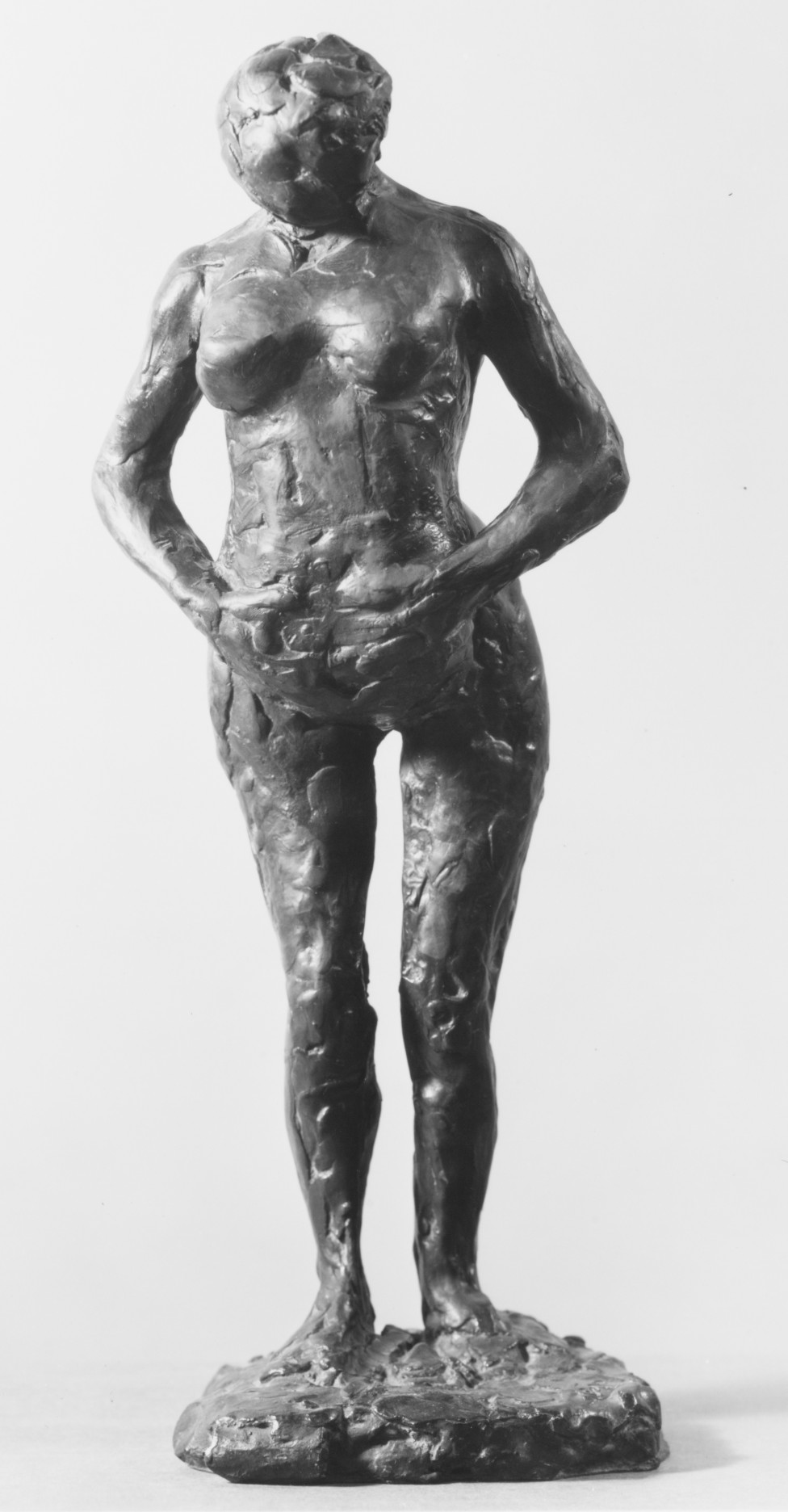
Edgar Degas (French, 1834–1917), Pregnant Woman, modeled ca. 1896–1910, cast 1920. Bronze, 16 3/4 × 5 3/4 × 5 5/8 in. (42.5 × 14.6 × 14.3 cm). Metropolitan Museum of Art, New York.

My son, from the chalk
hills of this old flesh
how you have sailed
beyond the waters of
your father’s doubt.

I feel the small skiff
of your body. Yesterday
you leaped (rapids or
waterfall) when young
Mary walked into my arms.

What we women know.
And how much we keep
within the heart, secret
as the honeycomb that is
your skull growing in me.

My son John, trust this
first solitude. Here in the
ancient cave of my body,
sail inland water
safe from followers,

kings and dancing girls.

This poem appears in After Silence: Selected Poems of Sister Maura Eichner, SSND (Notre Dame of Maryland University, 2011), copyright © the Atlantic-Midwest Province of the School Sisters of Notre Dame. 


In anticipation of the Feast of the Nativity of John the Baptist on June 24, I offer this tender poem by Sister Maura Eichner in which the elderly Elizabeth speaks to her son, John, while he’s still in utero. She senses his life will end early and wishes to keep him safe forever, away from the burdens and perils of a prophetic vocation, away from Herod’s order of imprisonment, away from the lethal spite of Herodias and her daughter-pawn, Salome, whose dancing trophy of choice is John’s head on a platter.

Elizabeth is faithful to God and God’s will—just yesterday, in the company of her also-pregnant cousin Mary, she praised God for the coming Messiah whom even the fetal John recognized, leaping. But as great an honor as it is that her son has been chosen to herald the Messiah, her maternal instinct is to shield and protect him. In the dark of midnight, while her husband, Zechariah, is asleep, she whispers her fears rolled up in a charge, instructing John to savor the shelter of her womb while he still can, as soon he will enter the world’s wilderness and eventually preach himself to a martyr’s death.

For scripture texts that inform Sister Maura’s “Dialogue at Midnight,” see Luke 1 and Matthew 14:1–12.


Sister Maura Eichner, SSND (1915–2009), was a Catholic nun, poet, and professor of literature and creative writing. Born Catherine Alice Eichner in Brooklyn, New York, she took vows with the School Sisters of Notre Dame in 1933 at age eighteen. In 1943 she was assigned to teach in the English Department at the College of Notre Dame of Maryland (now Notre Dame of Maryland University) in Baltimore, where she continued until 1992, serving also as department chair. She published ten books of poetry during her lifetime, including The Word Is Love (1958) and Hope Is a Blind Bard (1989), and maintained correspondence with such writers as Flannery O’Connor, Richard Wilbur, Katherine Anne Porter, and Eudora Welty. She experimented with a diversity of poetic forms and subject matter and disliked religious poetry that is redolent of “thin piety” and “decoratively sweet nosegays,” she told The New York Times in a 1959 interview.

Affirmation of Faith from the Iona Community

Hobbs, Paul_Three In One
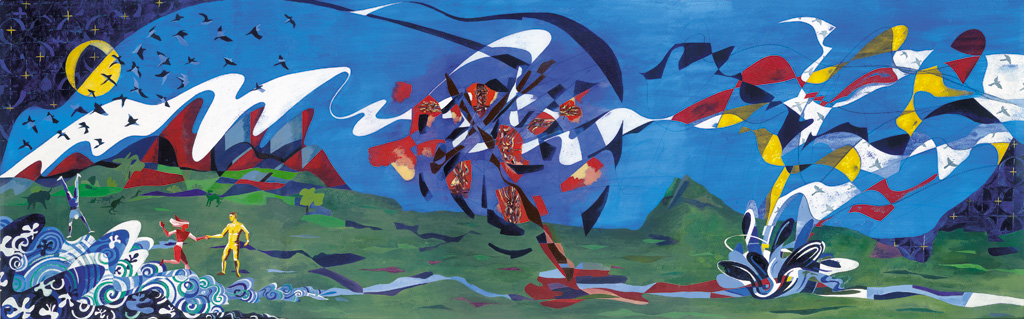
Paul Hobbs (British, 1964–), Three in One, 2000. Acrylic on paper, 55 × 177 cm.

We believe in God above us,
Maker and Sustainer of all life,
of sun and moon,
of water and earth,
of male and female.

We believe in God beside us,
Jesus Christ, the Word made flesh,
born of a woman, servant of the poor,
tortured and nailed to a tree.
A man of compassion, he died forsaken;
he descended into the earth
to the place of death.
On the third day he rose from the tomb;
he ascended into heaven
to be everywhere present;
and his kingdom will come on earth.

We believe in God within us,
the Holy Spirit of Pentecostal fire,
life-giving breath of the church,
spirit of healing and forgiveness,
source of resurrection and eternal life.

Amen.

The Iona Community is an international, ecumenical Christian movement working for justice and peace, the rebuilding of community, and the renewal of worship. This Affirmation of Faith, one of several they use in their liturgies, is found in the Sunday Morning Communion Service A in the Iona Abbey Worship Book (Wild Goose Publications, 2017), pp. 27–28.

Roundup: The body as sacred offering; rest as resistance; “Amazing Grace”

I’m late in notifying you about my June 2025 playlist (a random compilation of faith-inspired songs I’ve been enjoying lately), but be sure to check it out on Spotify.

See also my Juneteenth Playlist, which I’ve added six new songs to since originally releasing it two years ago, including a cover of Roberta Slavitt’s protest song “Freedom Is a Constant Struggle,” “Black Gold” by Esperanza Spalding, and “The Block” by Carlos Simon, a short orchestral work based on a six-panel collage by Romare Bearden celebrating Harlem street life.

Romare Bearden, The Block
Romare Bearden (American, 1911–1988), The Block, 1971. Cut-and-pasted printed, colored, and metallic papers, photostats, graphite, ink marker, gouache, watercolor, and ink on Masonite, 4 × 18 ft. (121.9 × 548.6 cm). Metropolitan Museum of Art, New York. Photo: Victoria Emily Jones.

+++

PODCAST EPISODE: “The Body as Sacred Offering: Ballet and Embodied Faith” with Silas Farley, For the Life of the World, April 30, 2025: An excellent interview! “Silas Farley, former New York City Ballet dancer and current Dean of the Colburn School’s Trudl Zipper Dance Institute, explores the profound connections between classical ballet, Christian worship, and embodied spirituality. From his early exposure to liturgical dance in a charismatic Lutheran church to his career as a professional dancer and choreographer, Farley illuminates how the physicality of ballet can express deep spiritual truths and serve as an act of worship.”

I was especially compelled by Farley’s discussion of turnout, the rotation of the leg at the hips—foundational to ballet technique. It gives the body an “exalted carriage” and allows for “a more complete revelation of the body,” he says, because you see more of the leg’s musculature that way. This physical positioning, he says, reflects the correlative “spiritual turnout” that’s also happening in dance, and that Christians are called to in life—a posture of openness and giving. He cites the theological concept of incurvatus in se, coined by Augustine and further developed by Martin Luther, which refers to how sin curves one in on oneself instead of turning one outward toward God and others.

Farley also discusses how liturgical dance is like and unlike more performative modes of dance (“liturgical dance . . . is a kind of embodied prayer . . . a movement that goes up to God out of the body”); how discipline and freedom go together; the body as instrument, and how dancers cultivate a hyperawareness of their bodies; the two basic design elements of ballet, the plié and the tendu, and their significance; his formation, from ages fourteen to twenty-six, under the teaching of Rev. Dr. Tim Keller at Redeemer Presbyterian Church; the Four Loves ballet he choreographed on commission for the Houston Ballet, based on a C. S. Lewis book (see promo video below, and his and composer Kyle Werner’s recent in-depth discussion about it for the C. S. Lewis Foundation); Songs from the Spirit, a ballet commissioned from him by the Metropolitan Museum of Art (see next roundup item); Jewels by George Balanchine, a three-act ballet featuring three distinct neoclassical styles; “Hear the Dance” episodes of City Ballet the Podcast, which he hosts; and book recommendations for kids and adults.

+++

SITE-SPECIFIC BALLET: Songs from the Spirit, choreographed by Silas Farley: Commissioned by MetLiveArts [previously], Songs from the Spirit by Silas Farley is a three-part ballet for seven dancers that interprets old and new Christian spirituals, having grown out of an offertory Farley gave at Redeemer Presbyterian Church based on the song “Guide My Feet, Lord.” Staged in the museum’s Assyrian Sculpture Court, the Astor Chinese Garden Court, and the glass-covered Charles Engelhard Court of the American Wing, the ballet progresses from “Lamentation” to “Contemplation” to “Celebration.” Here’s a full recording of the March 8, 2019, premiere:

For the project, Farley solicited new “songs (and spoken word poetry) from the spirit” from men who were currently or formerly incarcerated at San Quentin State Prison in California, whose creative talent he learned about through the Ear Hustle podcast. Recordings of these contributions form about half the score, while the other half consists of traditional spirituals sung live by soprano Kelly Griffin and tenor Robert May. My favorite section is probably “Deep River” at 26:54, a duet danced by Farley and Taylor Stanley, picturing a soul’s “crossing over” to the other side, supported by an angelic or divine presence, or perhaps one who’s gone before.  

In his artistic statement, Farley says he wanted to invite viewers “to accompany us [dancers] on this journey: from darkness to light, bondage to freedom, exile to home.”

I am struck by how a contemporary work that is, in Farley’s words, so “unequivocally Christ-focused and Christ-exalting” was welcomed, even made financially possible, by a prestigious secular institution. I find apt Farley’s response when asked by Macie Bridge from the Yale Center for Faith & Culture about his consideration of his audiences (see previous roundup item):

All the people coming to the performance are hungry in different ways. Some are longing for beauty. Some are longing for a prophetic image of a better world. Some are longing to see something reflected back to them from their own lives. And I’m just trusting that as I offer the artwork as an act hospitality, and as I offer the artwork as an act of adoration and worship back to God, that in his own beautiful, winsome, totally personalized way, he’ll meet each of the audience members in the way they need to be met.

+++

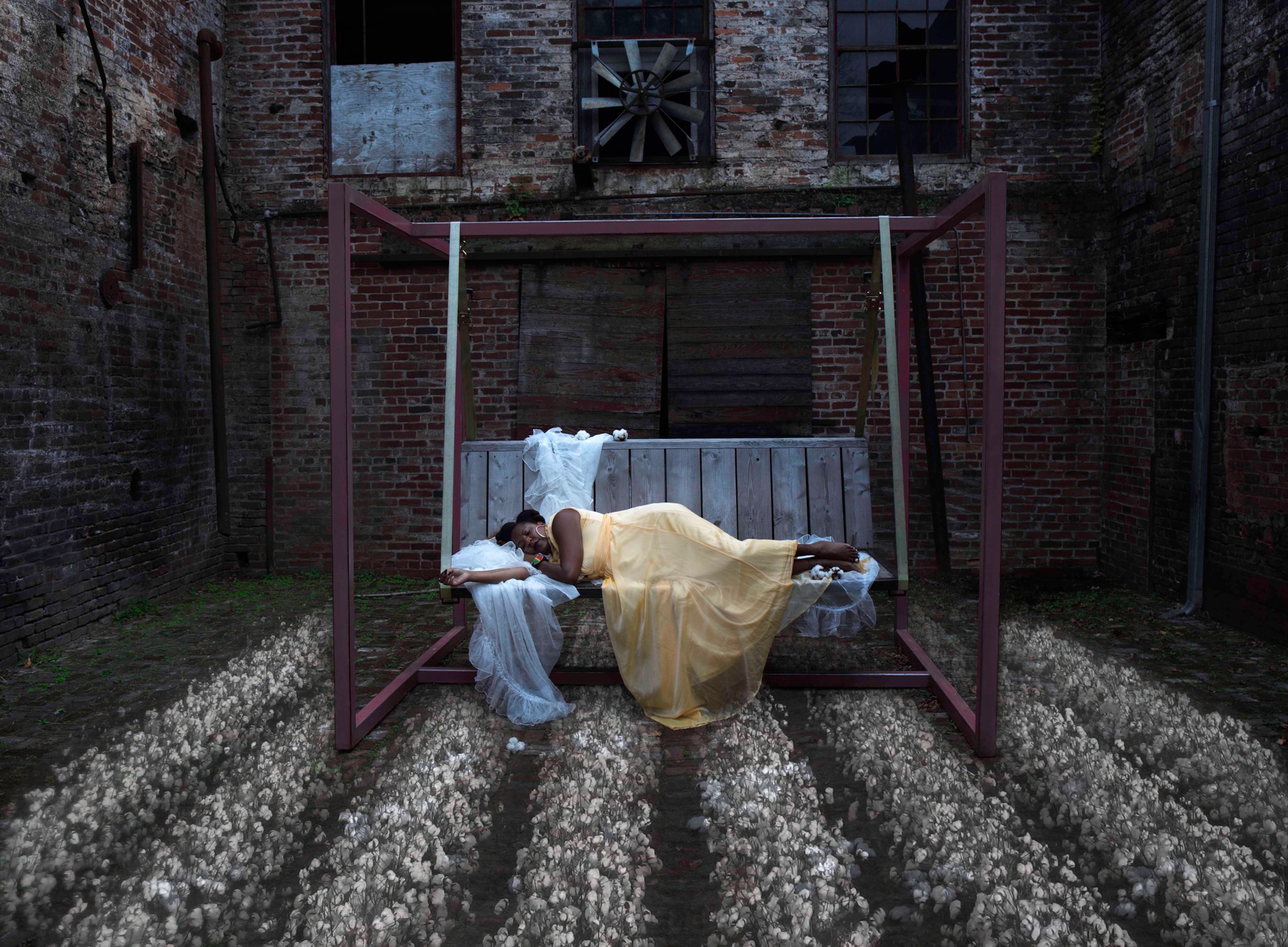
ARTWORK: Dreaming with the Ancestors by Charlie Watts and Tricia Hersey [HT: Visual Commentary on Scripture]: Tricia Hersey is a poet, performance artist, spiritual director, and community organizer living in Atlanta, Georgia. She is the founder of The Nap Ministry, an organization that promotes rest as a form of resistance against capitalism (which fuels contemporary grind culture) and white supremacy, and the author of the New York Times best-selling Rest Is Resistance: A Manifesto (2022) and We Will Rest! The Art of Escape (2024). She pursued graduate research in Black liberation theology, womanism, somatics, and cultural trauma, earning a master of divinity degree from Candler School of Theology at Emory University.

Watts, Charlie_Dreaming with the Ancestors
Charlie Watts and Tricia Hersey, Dreaming with the Ancestors, 2017. Archival digital print photograph, 76.2 × 101.6 cm.

The photograph Dreaming with the Ancestors, taken by Charlie Watts, portrays Hersey reclining on a wooden bench inside an open brick enclosure and above rows of cotton plants. Dressed in a soft yellow gown, she closes her eyes in rest, practicing what she calls “the art of escape”—from the incessant demand of productivity and overwork, from oppression of body and spirit, from noise that drowns out voices of wisdom.

In We Will Rest!, Hersey advises:

Every day, morning or night, or whenever you can steal away, find silence. Even if for only a few minutes. Look for quiet time, quiet breathing, quiet wind, quiet air. It is there. Even if it’s cultivated in your body by syncing with your own heart beating. Guilt and shame will be a formidable and likely opponent in your resistance. We expect guilt and shame to surface. Let them come. We rest through it. We commit to our subversive stunts of silence, truth, daydreaming, community care, naps, sleep, play, leisure, boundaries, and space. Be passionate about escape. (107)

+++

ALBUM: Grace Will Lead Me Home by Invisible Folk (2024) [HT: Jonathan Evens]: An Arts Council England grant awarded to singer-songwriter Jon Bickley in 2022 enabled him to conduct a research and songwriting project that culminated in the album Grace Will Lead Me Home, which engages with the hymn “Amazing Grace,” its author’s biography, and its legacy. Bickley partnered with the Cowper and Newton Museum in Olney and enlisted the collaboration of fellow folk musicians Angeline Morrison (The Sorrow Songs: Folk Songs of Black British Experience) and Cohen Braithwaite-Kilcoyne (creator of the “Black Singers and Folk Ballads” resource for secondary educators, and concertina player on Reg Meuross’s Stolen from God). Here’s the title track, written and sung by Morrison:

The album also includes a cover of Zoe Mulford’s “The President Sang Amazing Grace,” written in response to the racially motivated mass shooting at Mother Emanuel AME Church in Charleston, South Carolina, on June 17, 2015 (its ten-year anniversary is next Tuesday). In his eulogy at the funeral of one of the nine victims, Rev. Clementa Pinckney, President Barack Obama chose “the power of God’s grace” as his theme, and he closed by singing the first stanza of “Amazing Grace,” a moving gesture that Mulford’s song remembers.

Other songs on Grace Will Lead Me Home address John Newton’s love for his wife Polly, his impressment into naval service, and his friendship with William Cowper. There are also songs that grapple with the harm and suffering Newton inflicted on others through his involvement in the slave trade, and that wonder at his hymn’s being so mightily embraced not only by the Black church, many of whose members are descendants of enslaved Africans, but also by other traumatized communities, who insist amid all the wrongs and afflictions they’ve suffered that God is amazingly gracious.

It’s a myth that John Newton (1725–1807), who converted to Christianity in 1748 after surviving a turbulent sea voyage, immediately gave up his employment as a slave trader upon embracing Christ. In fact, he was soon after promoted from slave ship crew member to captain and sailed three more voyages to Africa as such, trafficking human beings for profit until 1754, when his ill health forced him to retire. But he continued to invest in slaving operations for another decade, until becoming a priest in the Church of England. It wasn’t until 1788, in the pamphlet Thoughts Upon the African Slave Trade, that he publicly denounced slavery and confessed his sin of having participated in that evil institution, and this was the start of his abolitionism.

+++

SONG: “Amazing Grace,” performed by the Good Shepherd Collective: This adaptation of “Amazing Grace” premiered at Good Shepherd New York’s digital worship service on June 1. Listen via the Instagram video below, or cued up on YouTube. The vocalists are, from right to left, Charles Jones on lead, Solomon Dorsey (also on bass), Jon Seale, Dee Wilson, and Aaron Wesley. James McAlister is on drums, Michael Gungor is on electric guitar, and Tyler Chester is on keys.

Pentecost roundup: Invocations; Holy Spirit as “lodes-mon”; organ improv; tongues of fire in a flower patch

SONGS:

Here are three sung invocations of the Holy Spirit, seeking his power, liberation, comfort, light, and renewal.

>> “Holy Spirit, Come with Power”: This hymn was written by Anne Neufeld Rupp in 1970, who set it to a Sacred Harp tune from 1844 attributed to B. F. White. It’s performed here by the Bel Canto Singers from Hesston College in Kansas, featuring Gretchen Priest-May on fiddle and Tim May on acoustic guitar.

I was introduced to this hymn through the Voices Together Mennonite hymnal, where it appears in both English and Spanish as no. 57.

>> “Mweya Mutsvene” (Holy Spirit, Take Your Place) by Joshua Mtima and The Unveiled: The Unveiled is a collective of Christian musicians from Harare, Zimbabwe, founded by Joshua Mtima in 2020. Here they sing one of their songs in Shona. An English translation is provided onscreen. [HT: Global Christian Worship]

>> “Ven Espíritu Divino (Secuencia de Pentecostés)” (Come, Spirit Divine) by Pablo Coloma, performed by Chiara Bellucci: The Spanish lyrics of this contemporary Christian song from the Latin American Catholic tradition are in the YouTube video description. They ask the Holy Spirit, “sweet guest of our souls,” to come bringing healing, regeneration, growth, joy, and charisms.

+++

SUBSTACK POST: “Veni Creator Spiritus: A Lush Middle English Hymn” by Grace Hamman, Medievalish: Dr. Grace Hamman shares Friar William Herebert’s (ca. 1270–ca. 1333) Middle English translation of the classic Latin Pentecost hymn attributed to Rabanus Maurus (ca. 780–856), “Veni Creator Spiritus” [previously]. Herebert uses words like vor-speker (for-speaker; i.e., intercessor), lodes-mon (lodesman; i.e., journeyman or navigator), and shuppere (shaper) as titles for the Holy Spirit.

+++

ORGAN WORK: “Improvisation on Veni Creator Spiritus” by Alfred V. Fedak: “Your congregation will hear the rushing of the Holy Spirit in this improvisatory prelude (taken from Fedak’s and Carl P. Daw’s oratorio The Glories of God’s Grace),” writes Selah Publishing. “Fedak effectively uses sweeping whole-tone scale passages and arpeggios to indicate the Spirit’s presence, while the pedal plays phrases of the hymn tune,” a medieval plainchant. The publisher has posted the following performance of the piece (audio only), by the composer himself, along with a selection of Pentecost art from the thirteenth to eighteenth centuries. [HT: Global Christian Worship]

There are many other works on organ (fantasias, partitas, fugues) based on the “Veni Creator Spiritus” tune; view a select list on Wikipedia.

+++

POEM: “Book of Hours” by Kimberly Johnson: “A pentecost of bloom: all the furred tongues / awag in the iris patch, windrush through the fireflower.” So opens the poem “Book of Hours” by Kimberly Johnson [previously], from her collection Uncommon Prayer (Persea, 2014). A book of hours is a genre of medieval prayer-book used by laypeople, which arranges prayers, scripture, and other devotional texts for reading at prescribed times of the day. Johnson’s “Book of Hours” draws on the fields of codicology (the study of manuscripts as physical objects) and botany to consider how God’s Spirit moves through and enlivens the material world, be it the irises, fire lilies, alyssum, and paperwhite narcissus in her garden, or the ink and natural pigments on calfskin—green verdigris, red cochineal, yellow curcumin—in the rare manuscripts library where she examines a book of hours whose embellished Latin text she can’t quite make out but whose beauty enraptures her nonetheless. These are but two untranslatable experiences of sensual, embodied communion with God that Johnson narrates in the collection, the paint flakes on her lips and the pollen on her wrist a chrism and a prayer.