This November near where I live in Maryland there are at least two concerts by Christian artists I’d like to invite you to:
>> Matthew Clark, November 1, 2025, Crownsville, MD: The Eliot Society, an organization I volunteer with, is hosting Matthew Clark, a singer-songwriter from Mississippi, for an evening of music and stories this Saturday. Tickets are $10; wine, coffee, and refreshments will be served. Here’s Clark’s song “Ordinary Artists”:
>> Ordinary Time, November 22, 2025, St. Moses Church, Baltimore: Longtime friends Peter La Grand (Vancouver), Jill McFadden (Baltimore), and Ben Keyes (Southborough, Massachusetts) make up the acoustic folk trio Ordinary Time. They’re performing a free concert at McFadden’s church in a few weeks, which will be followed by Q&A around the role of music in the communal life of the church. Here’s their song “I Will Trust (Isaiah 12)”:
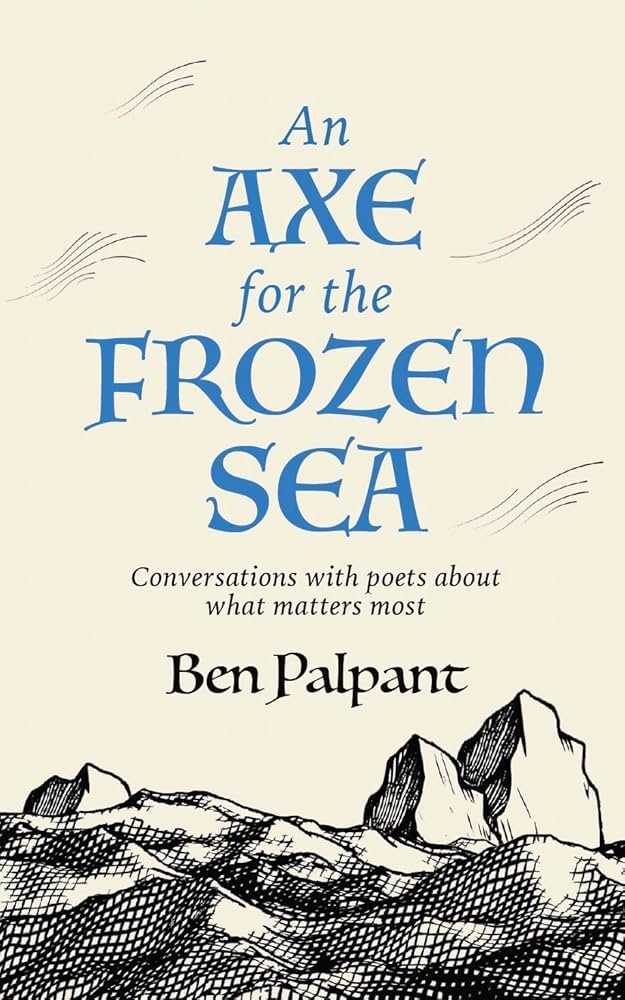
FREE AUDIOBOOK: An Axe for the Frozen Sea: Conversations with Poets about What Matters Most by Bel Palpant: “A book must be the axe for the frozen sea within us,” Franz Kafka wrote in a letter to his friend Oskar Pollak in 1904. That quote is the source of the title of Ben Palpant’s new book, one of my favorites of this year. An Axe for the Frozen Sea is a collection of one-on-one interviews Palpant conducted with seventeen acclaimed poets of faith, exploring the human experience, especially everyday joys and struggles, and the writing life. Featured poets include Scott Cairns, Marilyn Nelson, Robert Cording, Li-Young Lee, and Jeanne Murray Walker. I was really compelled by the conversations.
An Axe for the Frozen Sea is available for purchase in print, but it also kicked off the new podcast Rabbit Room Press Presents, serialized audiobooks of select titles from the publisher. All the book’s content, read by the author, can be listened to for free in this format. Highly recommended!
+++
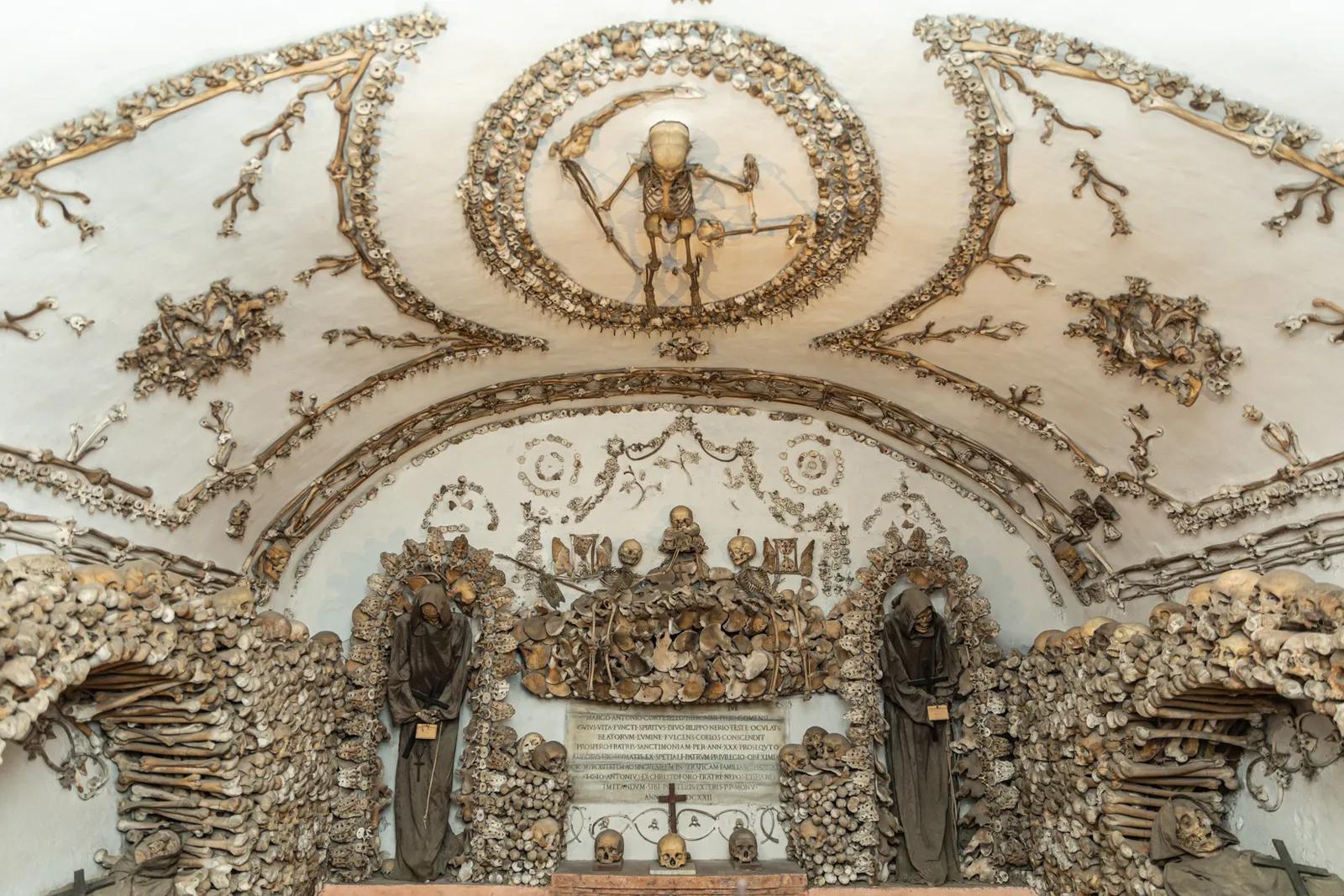
ARTICLE: “Bone chapels and their strange art” by Lanta Davis, Christian Century: If my last blog post piqued your interest in Christian bone chapels, you’ll want to read this article Lanta Davis wrote last November about her visit to the crypt of Santa Maria della Concezione dei Cappuccini in Rome. With a scythe-wielding skeleton overhead and arches, garlands, chandeliers, and mock clocks made of human bones, you’d be forgiven for thinking you mistakenly wandered into a haunted house. But in fact this is a sacred space, its unusual decoration the devotional labor of a seventeenth-century friar. Davis reflects on how the bone installations transform the ugliness of death into something beautiful, rearranging death into surprising forms—such as a skull with butterfly wings made from shoulder blades—that culminate in the Crypt of the Resurrection.
SONG: “Bones” by Mark Shiiba: The title track of Mark Shiiba’s debut album from last year references the placard that greets visitors to Rome’s Crypt of the Three Skeletons (see previous roundup item): “What you are now we used to be; what we are you will be.” This saying was a common memento mori, which I first learned when studying Renaissance art in Florence as a junior in college: Io fu già quel che voi siete, e quel chi son voi ancor sarete, reads the inscription above the fictive cadaver tomb that Masaccio painted inside Santa Maria Novella.
Shiiba’s song is jaunty in tone, and when he shared an excerpt on Instagram, he set it to the similarly sprightly animated short The Skeleton Dance (1929) by Walt Disney, which is based on medieval “danse macabre” imagery. Perhaps that seems to you unbefitting of such a serious subject as death—but since its inception, the church has proclaimed Christ’s ultimate defeat of death. “Where, O death, is your victory?” the apostle Paul taunts. “Where, O death, is your sting?” Death is lamentable, but it’s not the end of the story. The playfully arranged “bones at the bottom of a church in Rome” anticipate the resurrection of our bodies on the last day.
(All photos in this article are my own, taken either by me or my husband.)
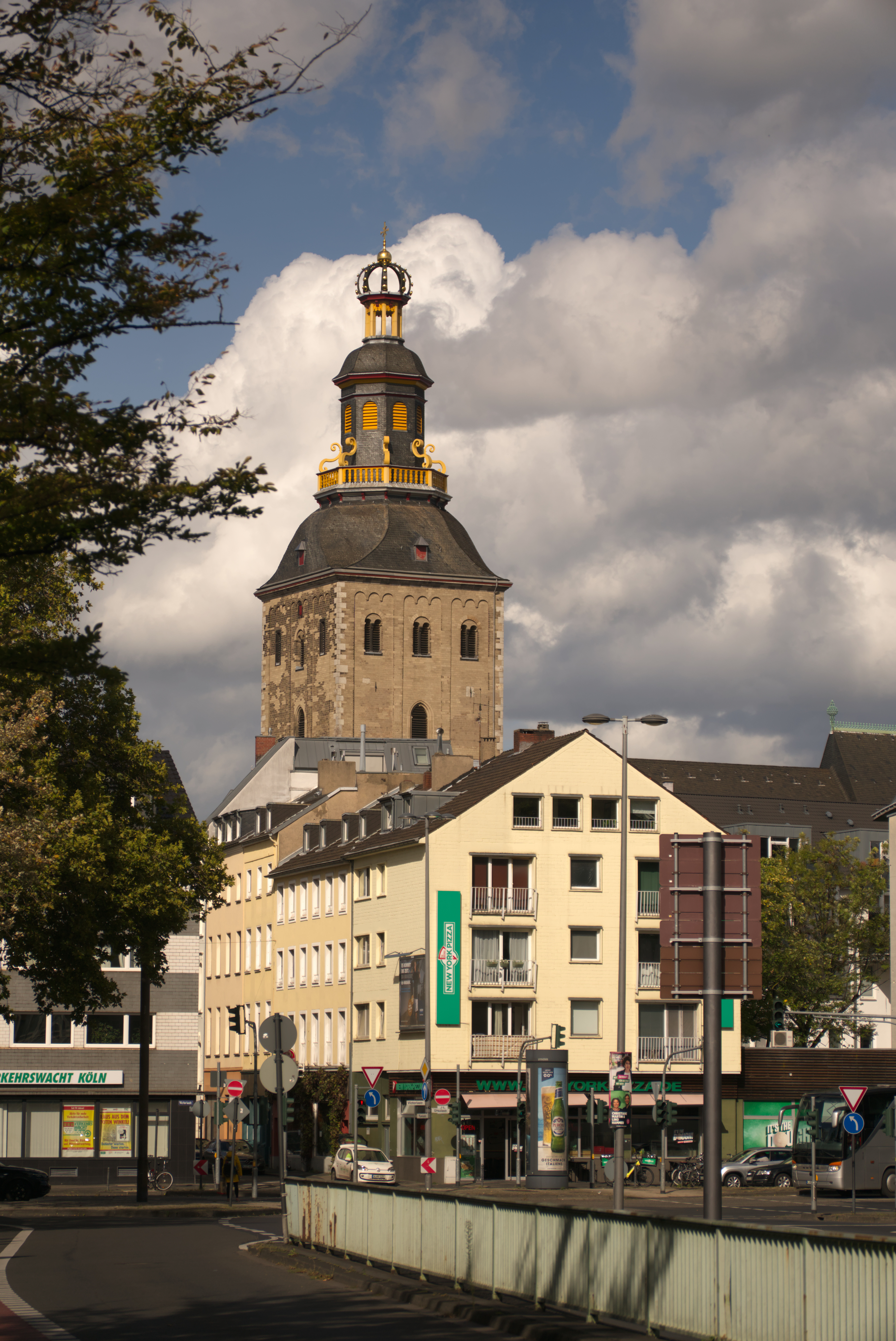
I knew very little about the virgin martyr St. Ursula before visiting the basilica dedicated to her in Cologne, Germany, last month. She’s the patron saint of the city, where, according to hagiography, she was murdered sometime in the fourth century.
There’s no historical veracity to her story, which is why her name was removed from the Catholic calendar of saints when it was revised in 1969. But her feast day is still observed by many on October 21.
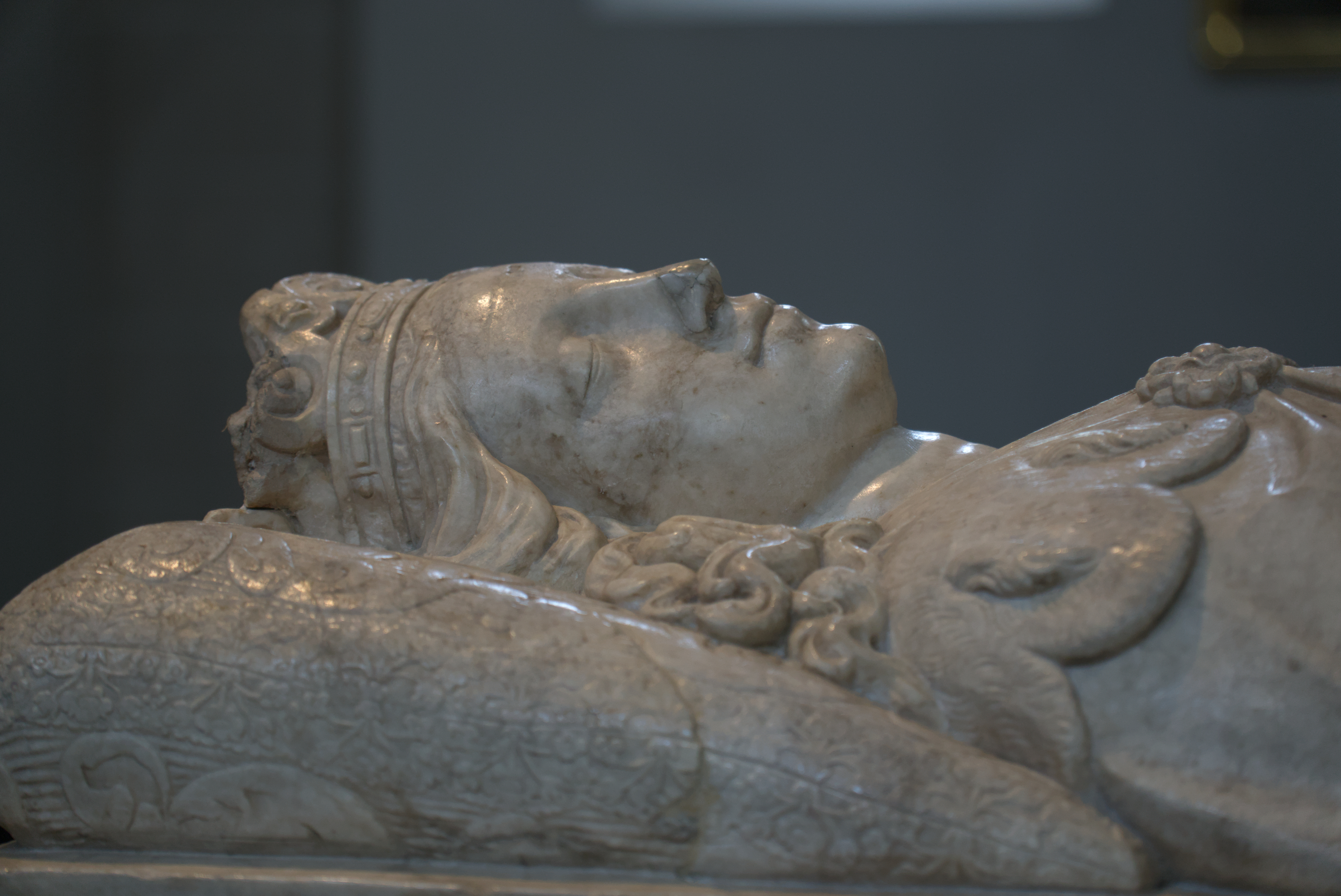
Johann T.W. Lentz, St. Ursula (detail), 1659. Alabaster. North transept, Basilica of St. Ursula, Cologne. This reclining figure of the saint lies over her Baroque tomb made of black marble.
As legend has it, Ursula was a Romano-British princess and a Christian. She was engaged to be married to a pagan prince. To delay the wedding, she successfully requested that she first be allowed to take a three-year pilgrimage to Rome, and that she be accompanied by eleven thousand virgins (a ridiculous number that was likely embellished from what was originally eleven). On their voyage, she converted all eleven thousand to the faith.
On their way back to Britain from Rome, they were traveling through Cologne when it was besieged by the Huns, a group of nomadic warriors from Central Asia. Ursula and her companions refused the soldiers’ sexual advances and were slaughtered as a result. One version of the legend says the women’s souls then formed a celestial army that drove out the Huns, saving Cologne.
The earliest possible reference to Ursula and company—though they are unnamed and unnumbered—is a stone plaque dated to 400. Now incorporated into the choir wall of the present Basilica of St. Ursula, it mentions a basilica restored on this site by the Roman senator Clematius to commemorate the “martyred virgins coming from the east, in fulfillment of a vow, . . . holy virgins [who] spilled their blood in the name of Christ.” This inscription not only provides the seed of what would become the Ursula legend; it’s also the earliest evidence of Christianity in Cologne, attesting to the presence of a church there in the fourth century.
It wasn’t until the tenth century that the name Ursula emerged, identified as the leader of the group of virgins, and that their number, which had previously ranged from two to thousands, became fixed at eleven thousand. The women were never officially canonized, but their veneration as saints grew immensely in the twelfth century after a large, late antique Roman cemetery was discovered in 1106 near the aforementioned Church of the Holy Virgins in Cologne during an excavation project to expand the city’s fortifications. The skeletal remains in the hundreds of graves were purported to be those of the martyred women (notwithstanding the presence of many men’s and children’s bones among them).
The discovery of these putative relics called for the rebuilding of the predecessor church to house them. Construction began in the second quarter of the twelfth century, and it’s that structure, with later renovations, refurbishments, additions, and (post–World War II) restorations and repairs, that stands today. The church was elevated to the status of minor basilica in 1920.
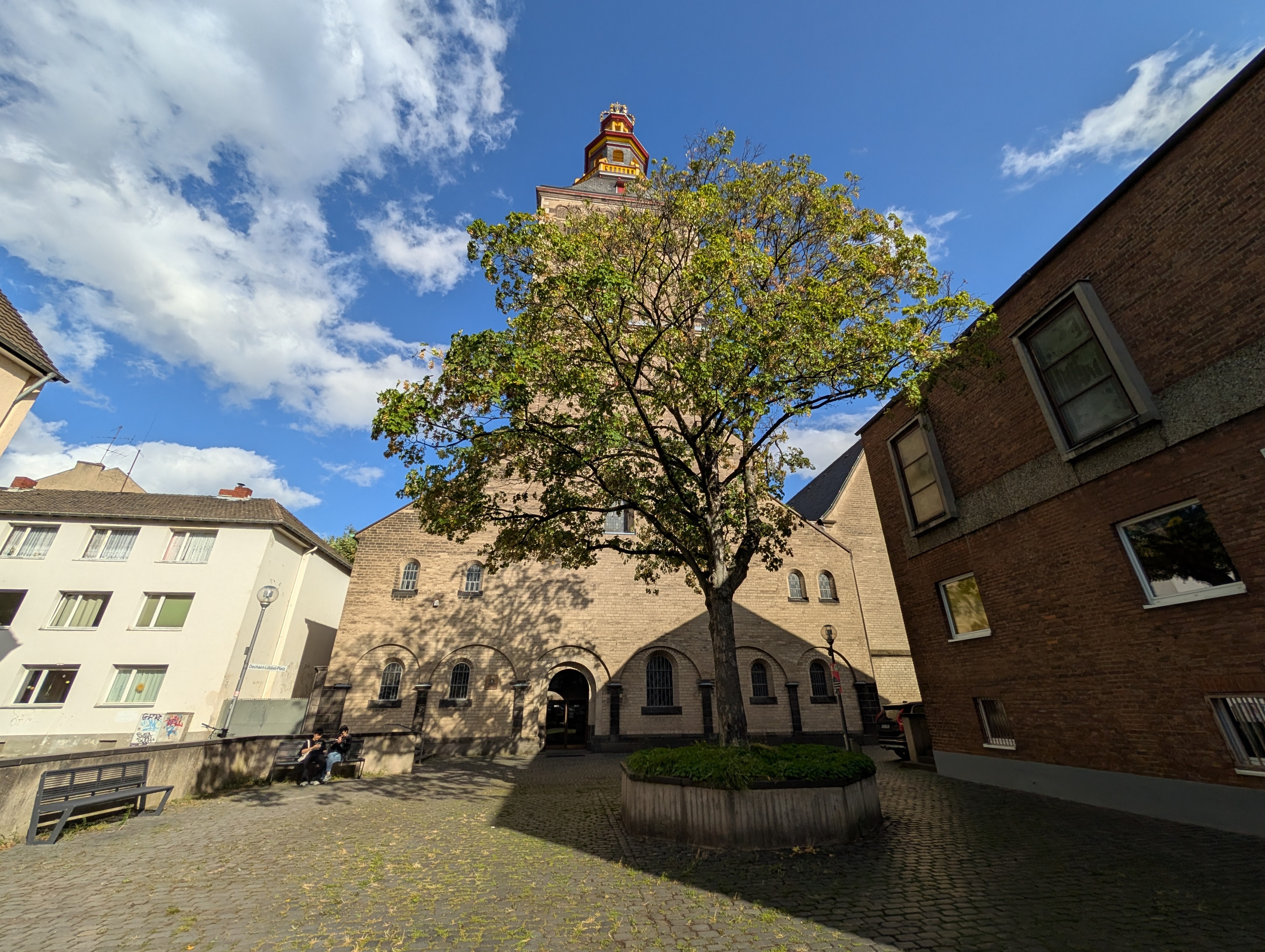
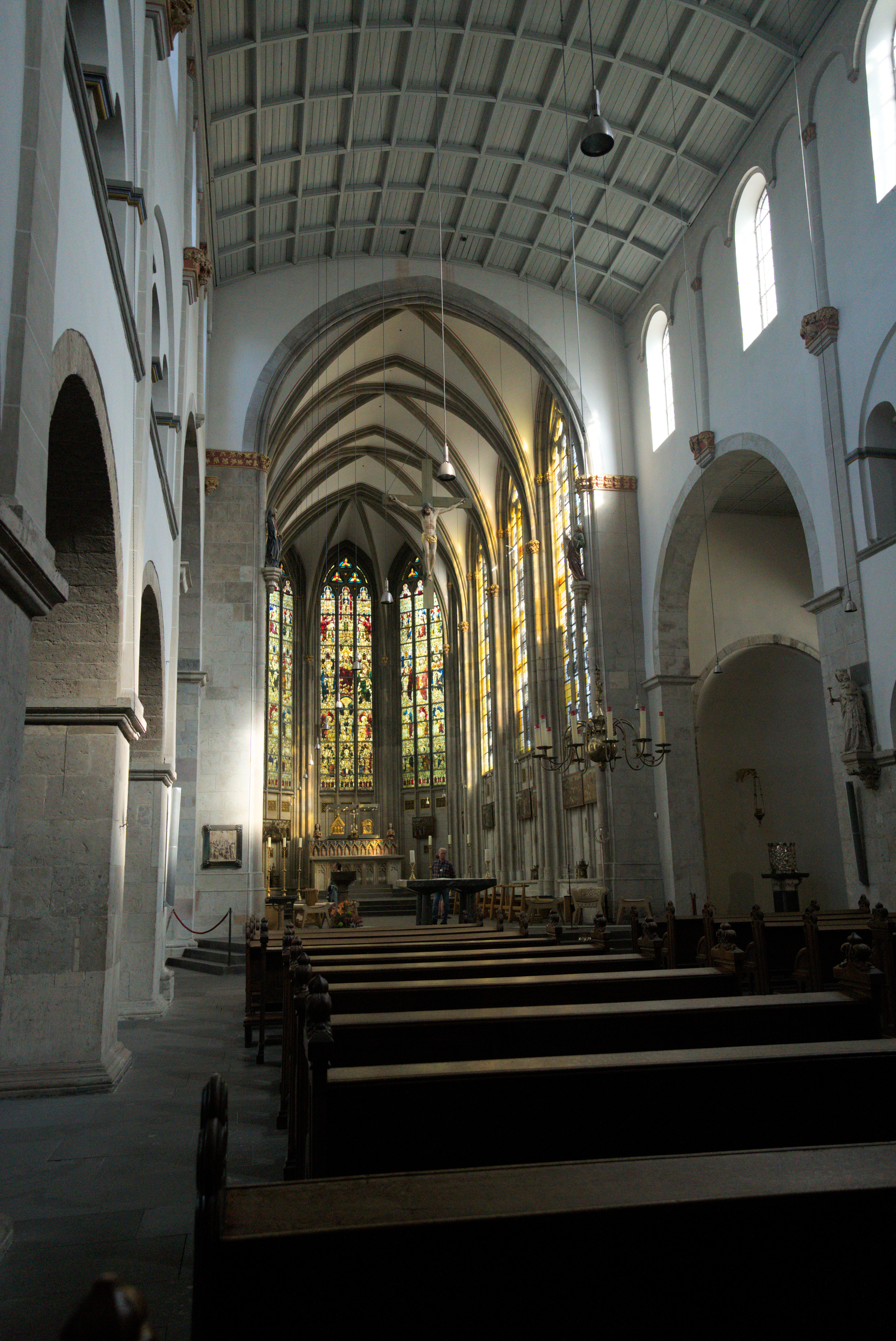
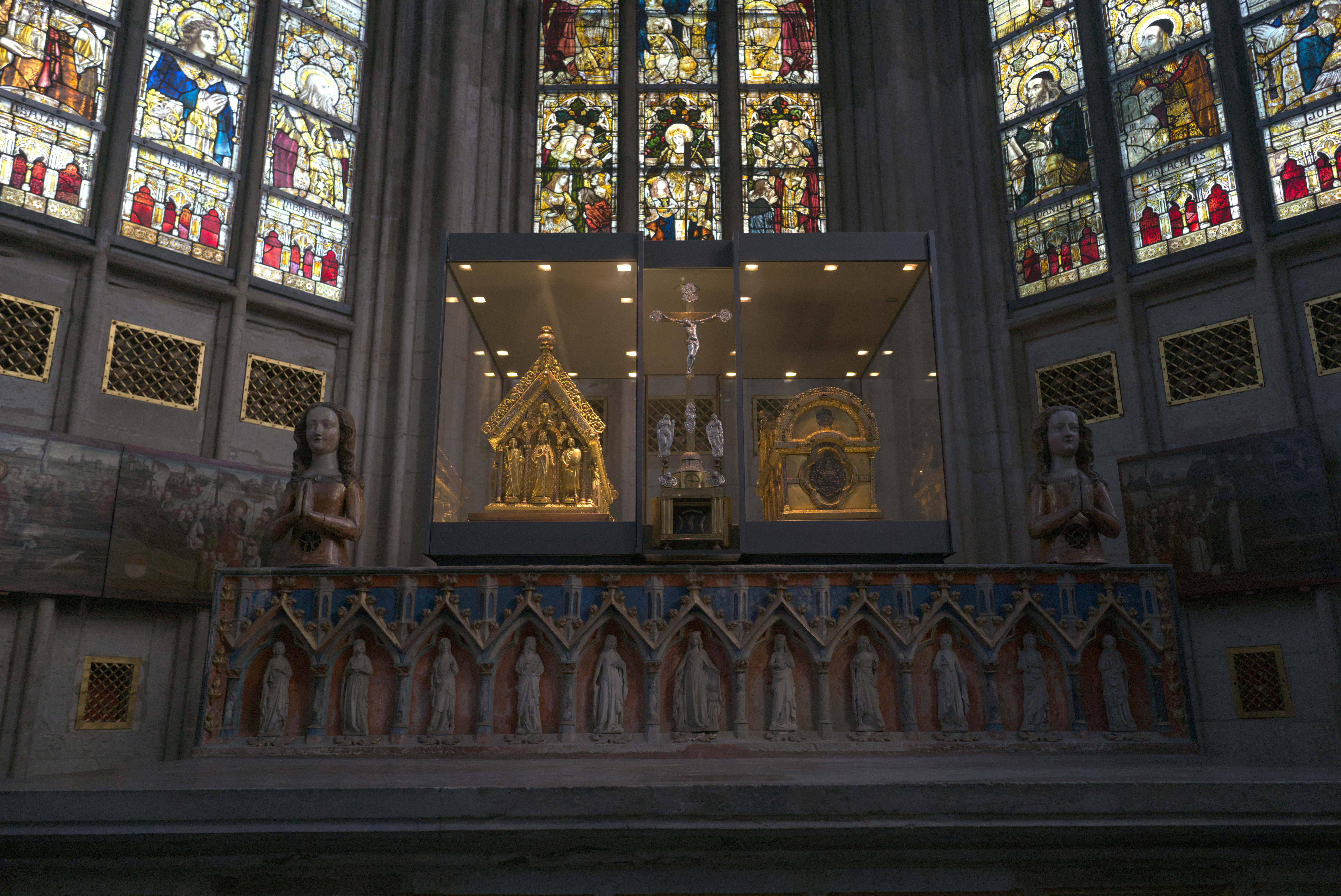
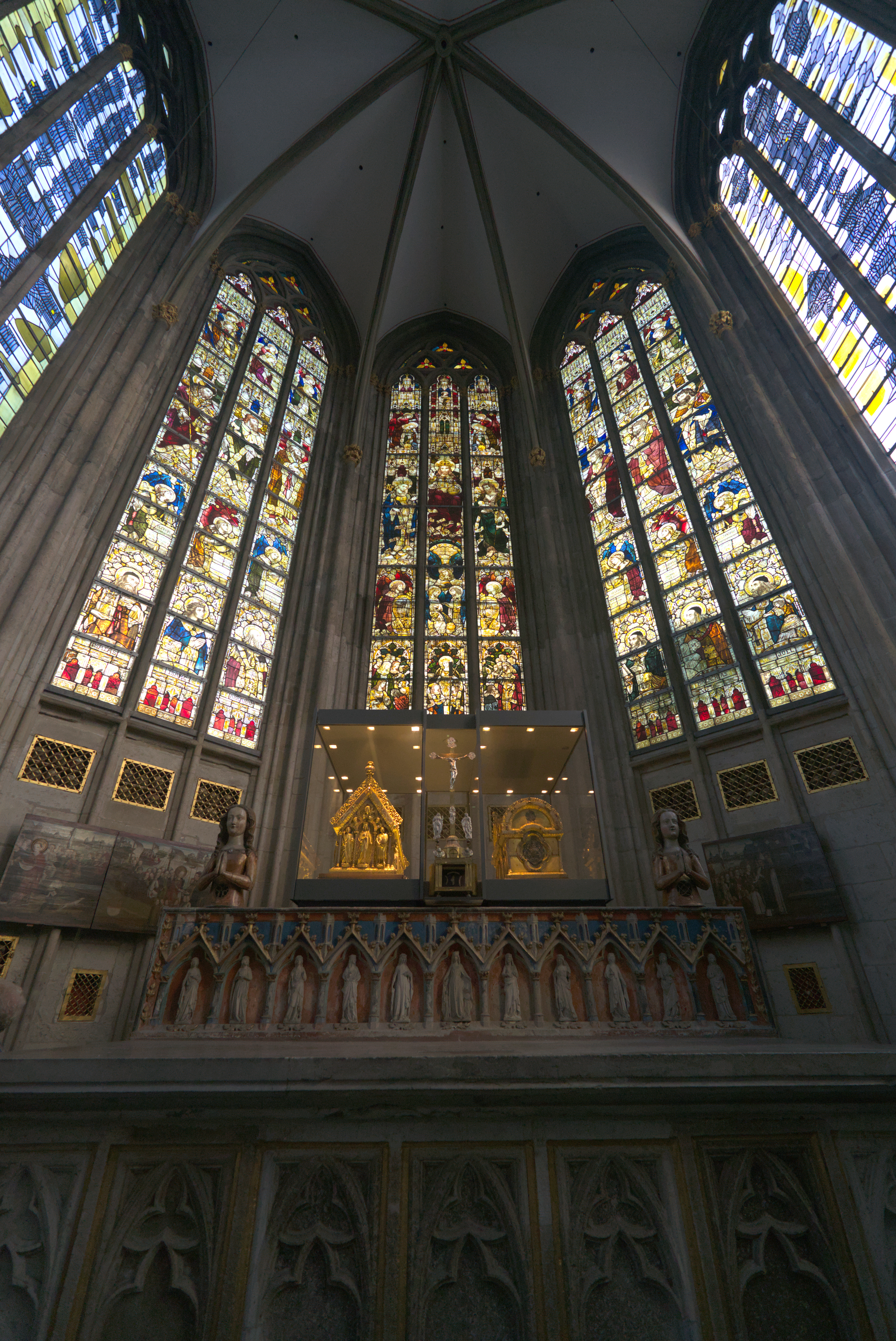
West facade, where you enterThe nave and the main tower of the Basilica of St. Ursula are Romanesque, but the choir was rebuilt in the Gothic style.Shrine altar in the choir apse, containing the relics of Ursula, Etherius, and Hippolytus. Behind it are grilled reliquary niches and paintings of the Legend of St. Ursula from from the “long cycle” of 1456.Chancel windows by Francis William Dixon, 1892. Left: St. James the Greater, St. Andrew, and St. Peter, accompanied by angels; lower register: Isaiah, Isaac, and Abraham. Center: Christ enthroned, with Mary and St. John the Baptist (Deesis) at his side; lower register: St. Ursula of Cologne with her companions. Right: St. James the Lesser, St. Matthew, and St. Thomas, accompanied by angels; lower register: Daniel, Malachi, and Joel.
The reason the Basilica of St. Ursula was on my list of stops was I wanted to see its so-called Golden Chamber.
The Golden Chamber
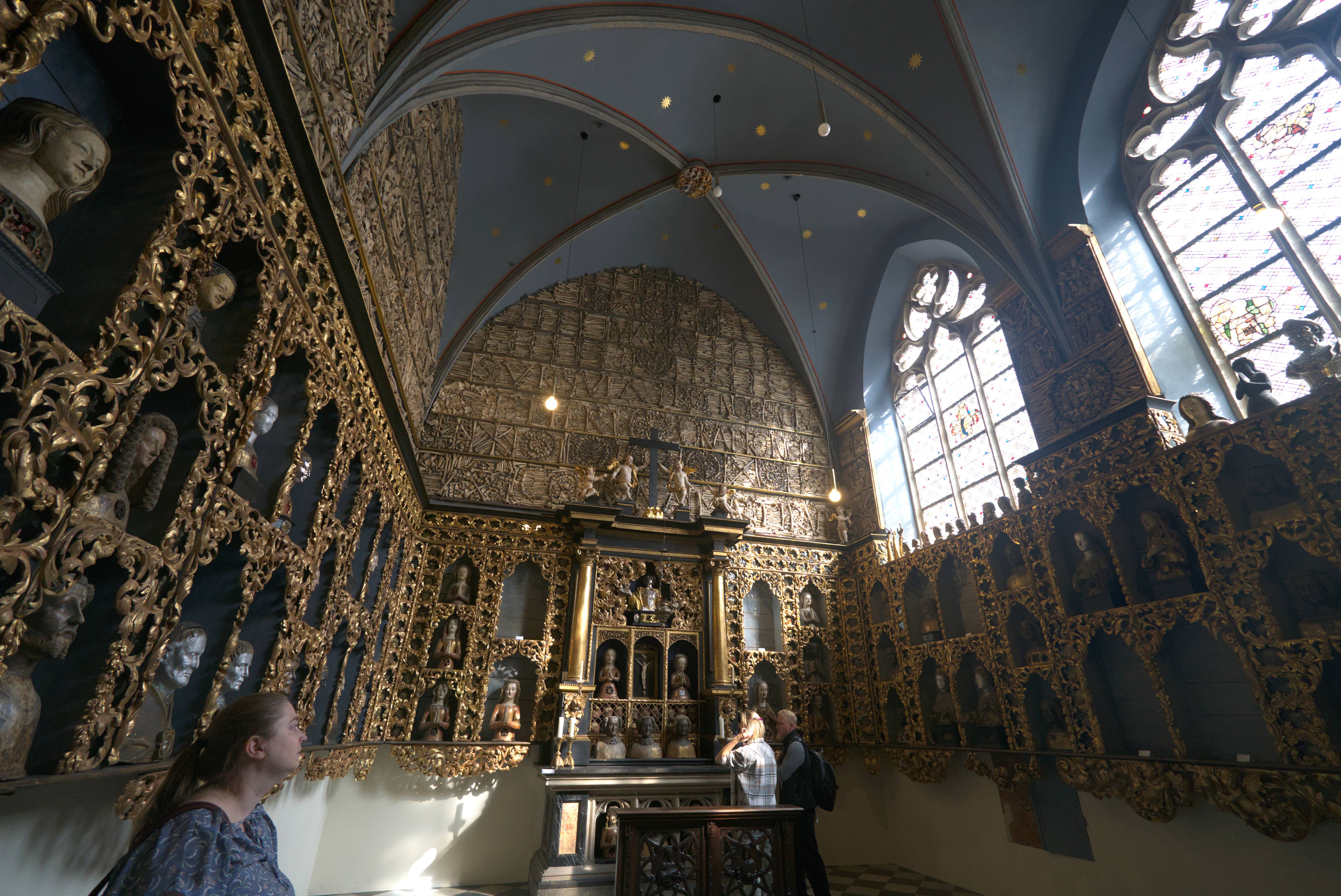
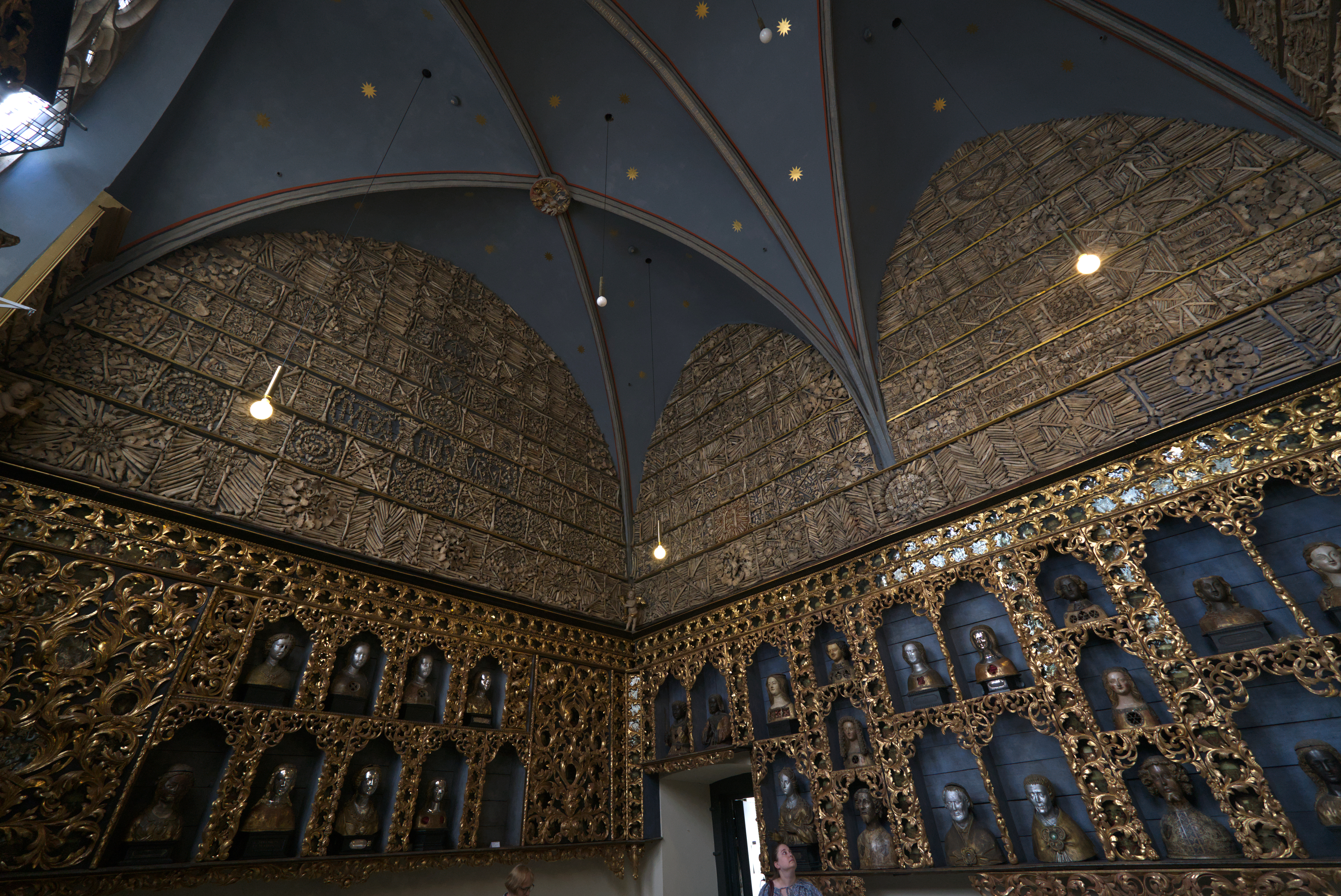
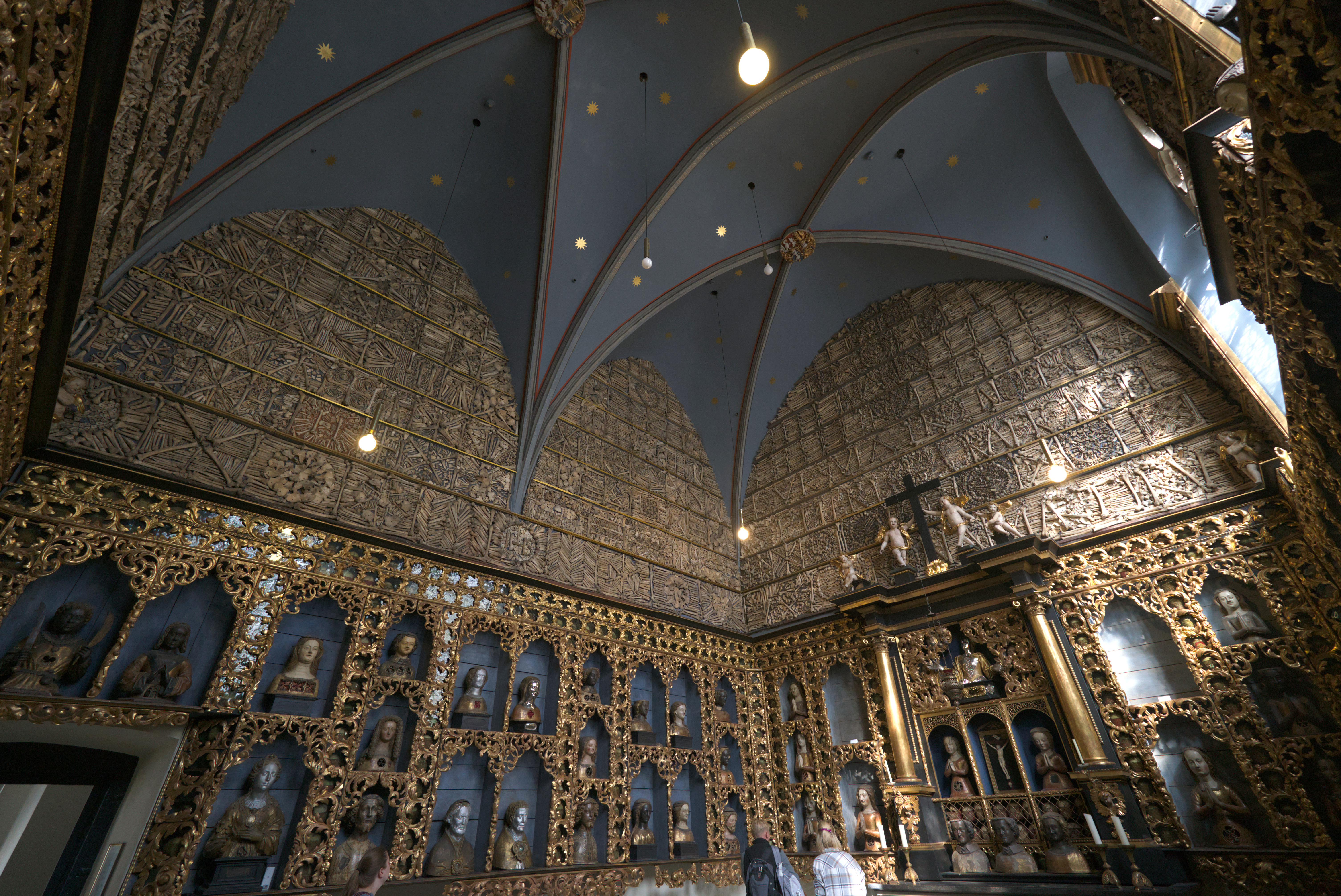
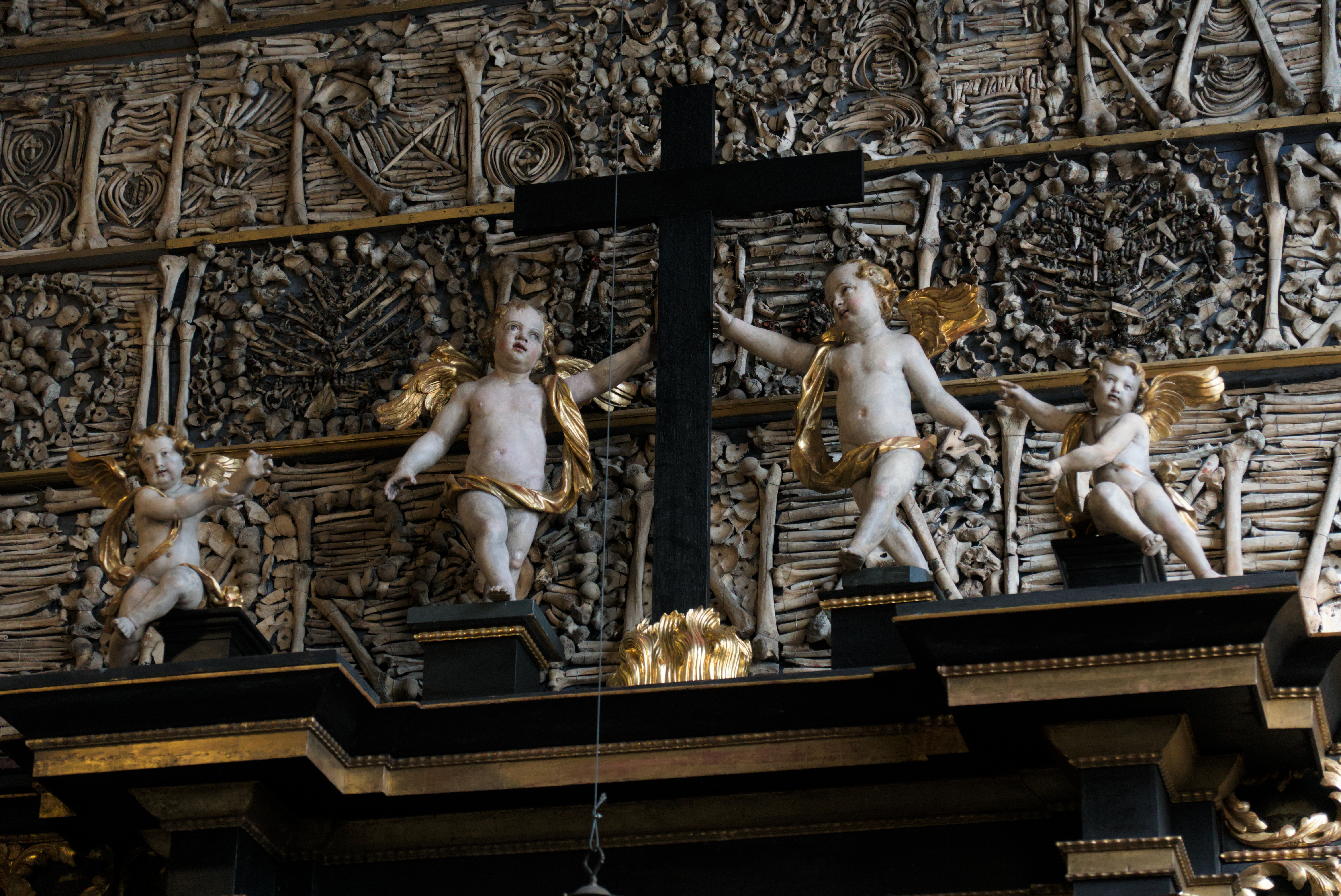
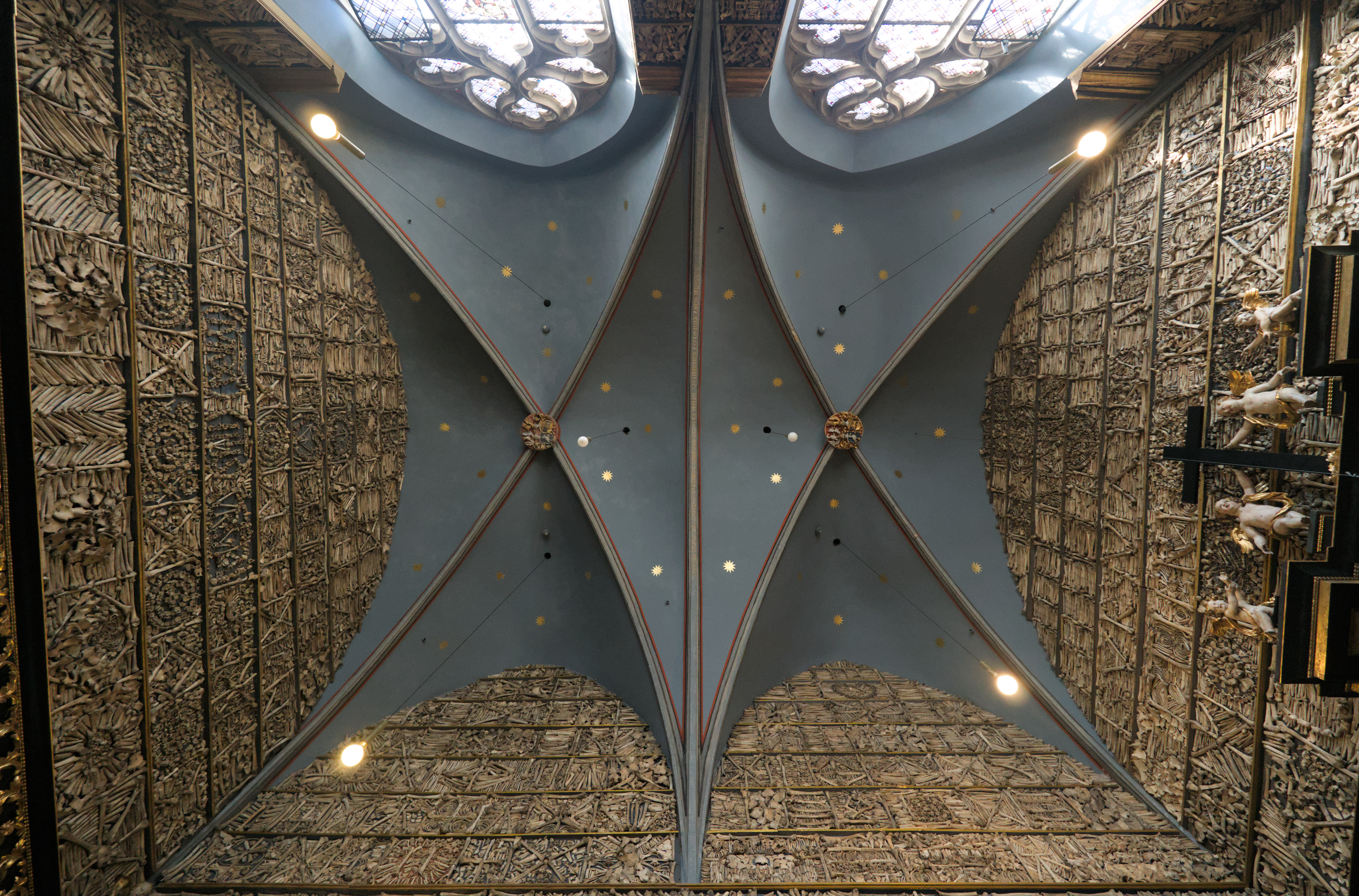
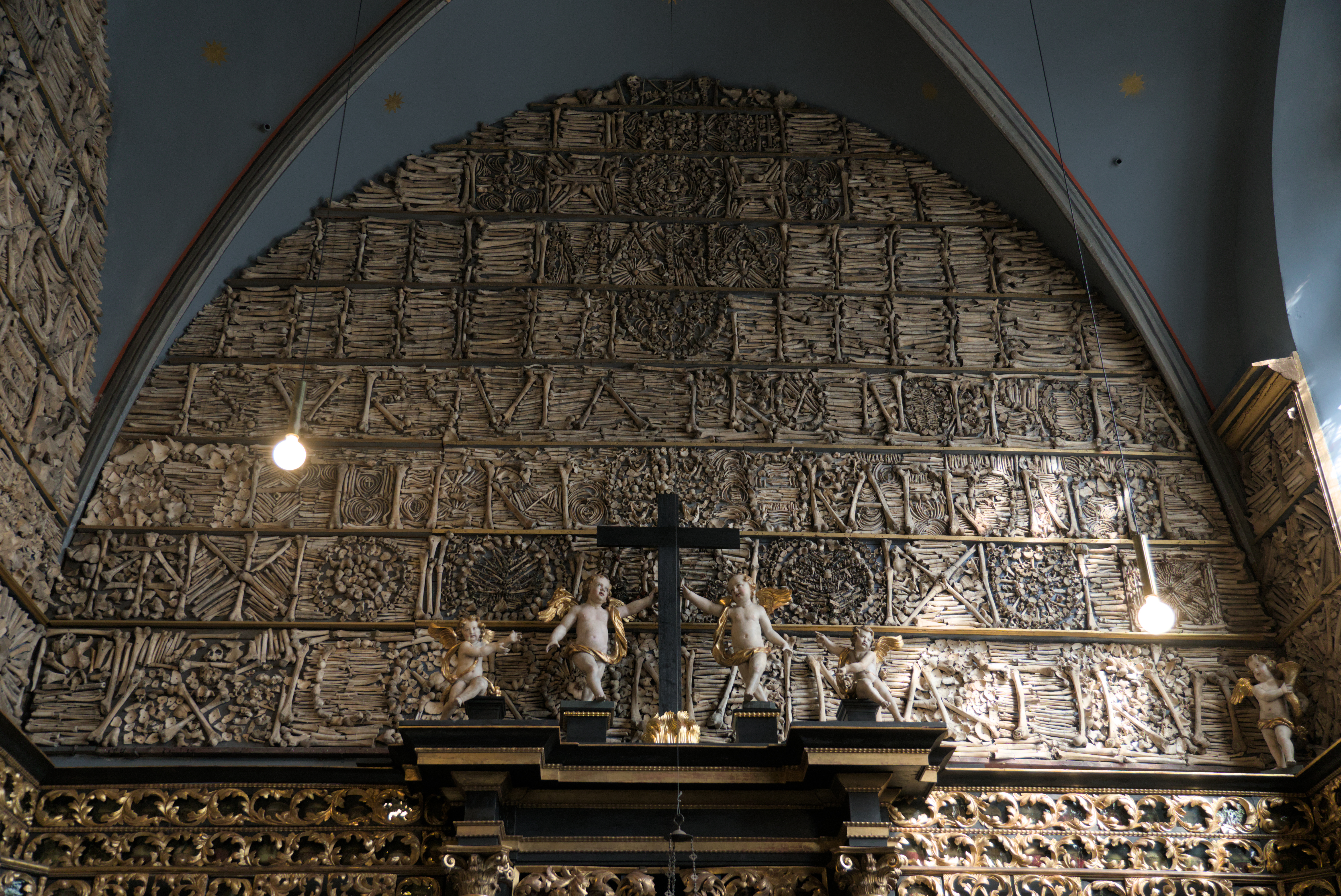
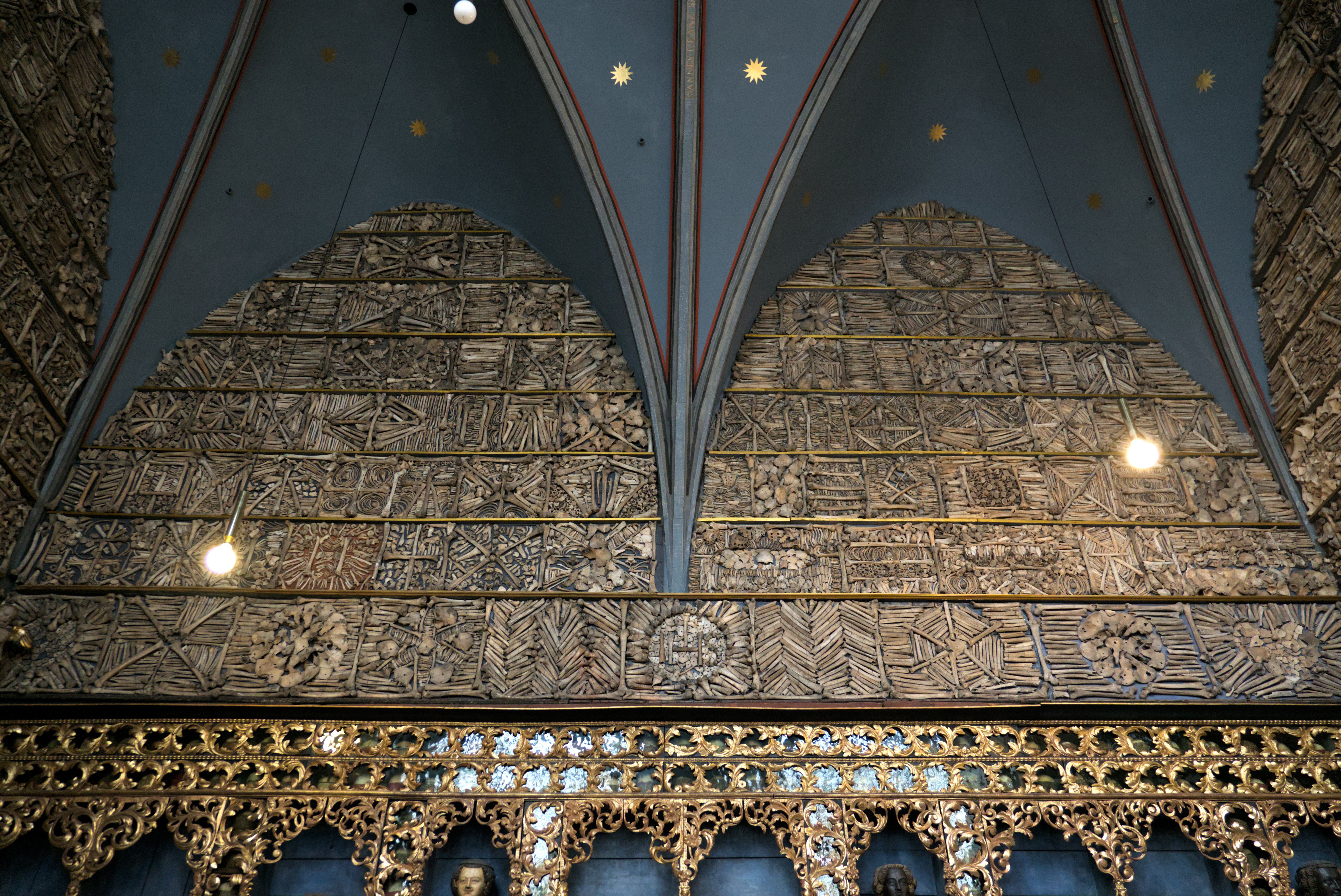
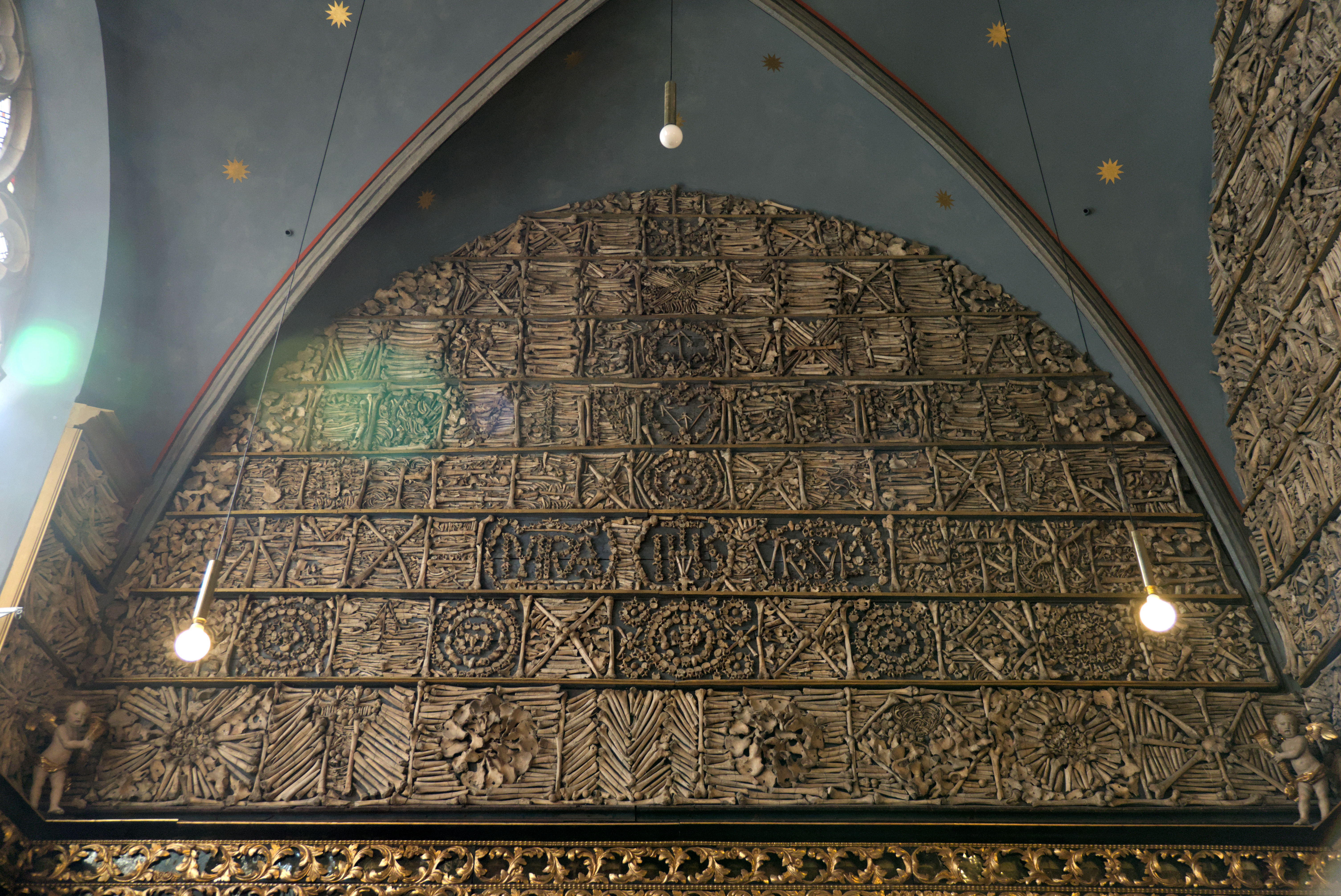
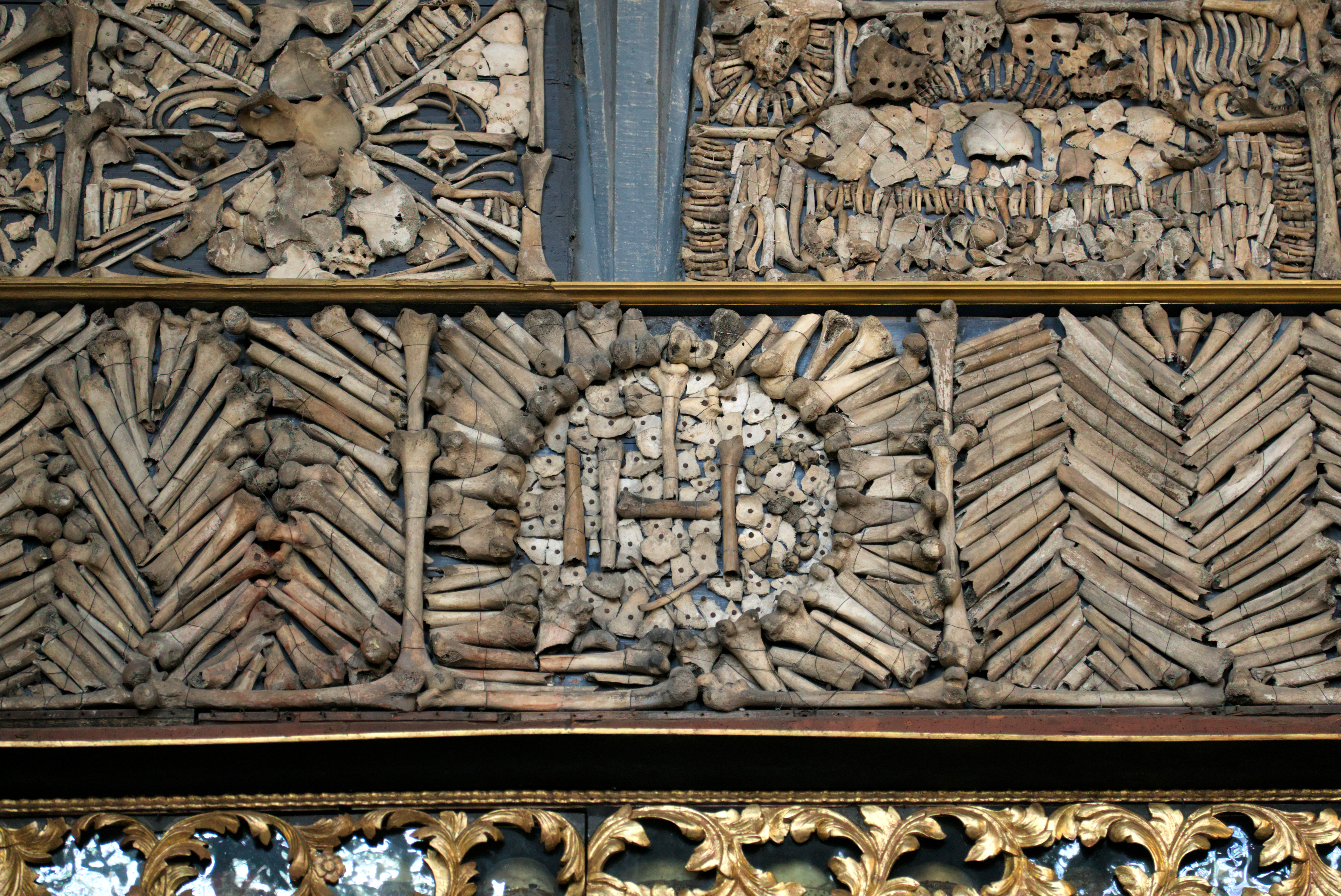
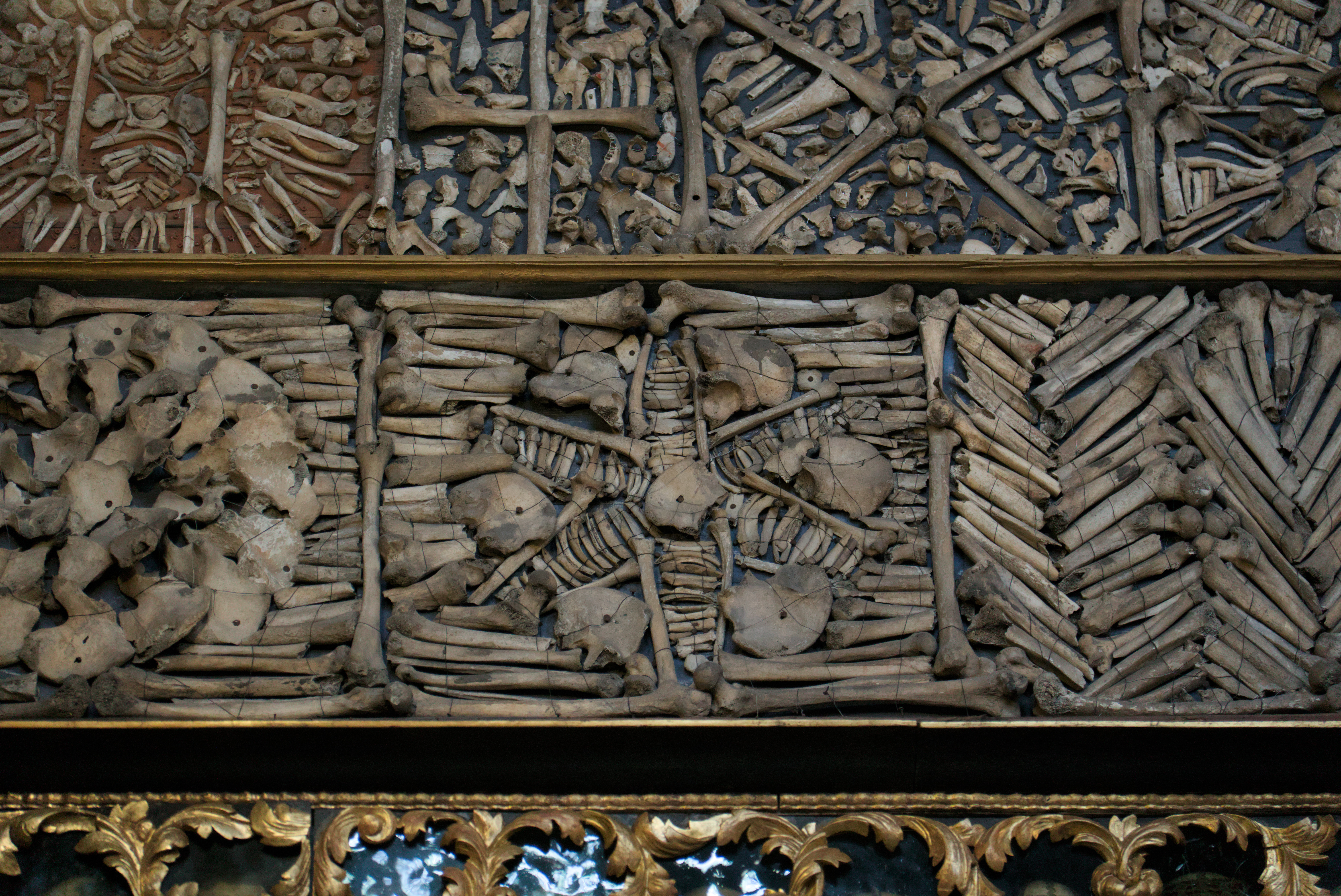
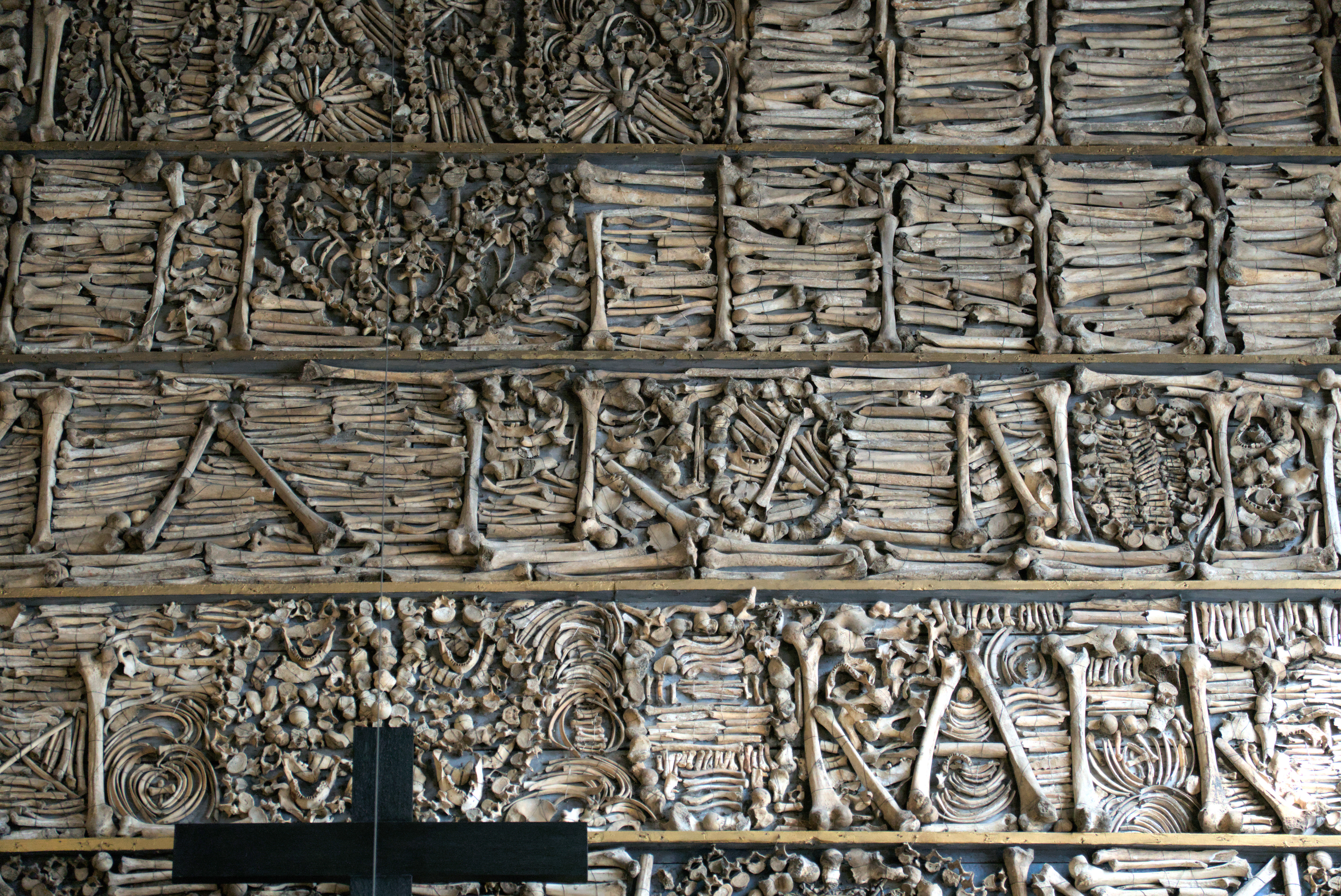
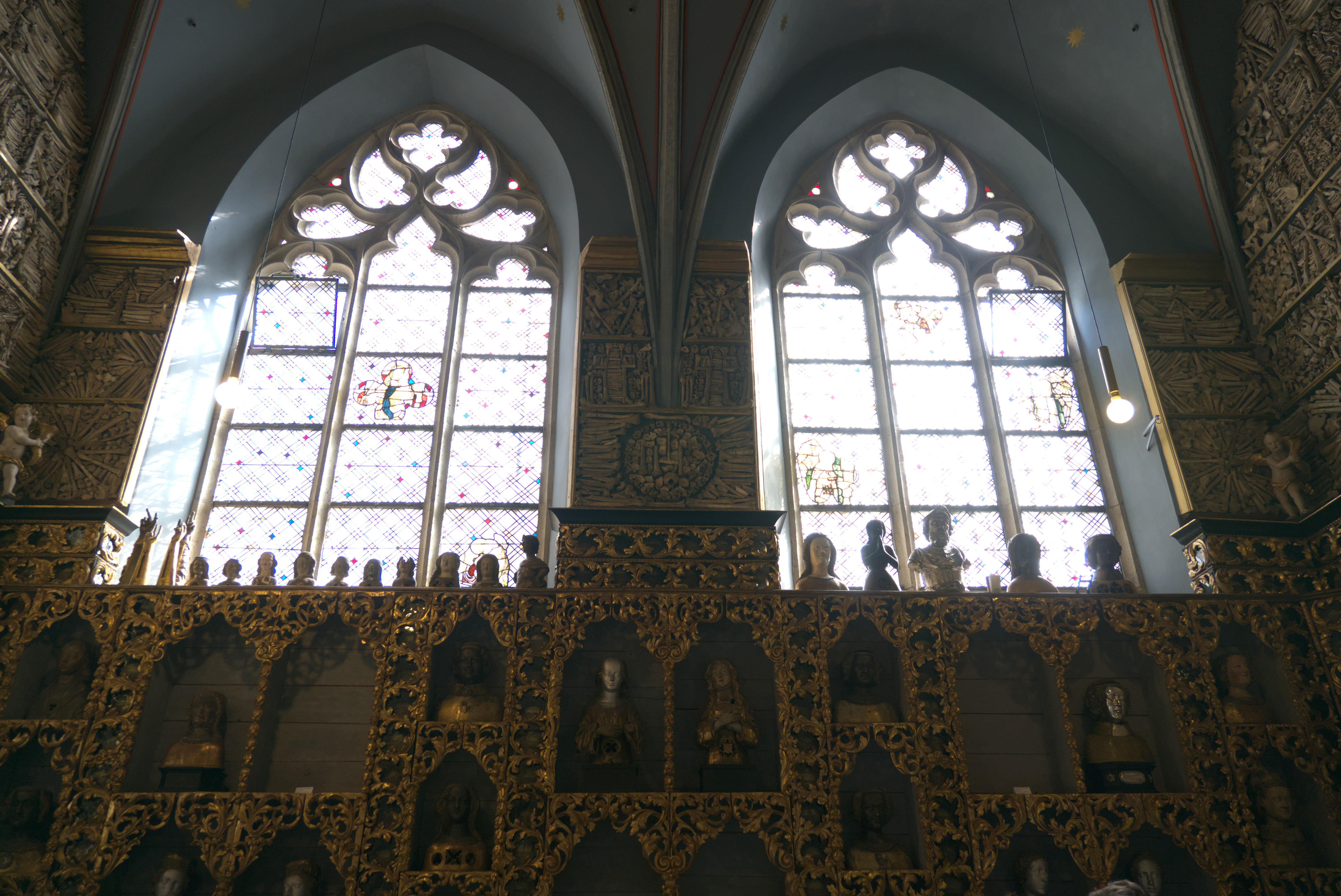
The largest ossuary north of the Alps, the Goldene Kammer (Golden Chamber) is decorated with the bones of, allegedly, St. Ursula and her eleven thousand travel mates, which are artfully arranged across the walls in geometric patterns, rosettes, and even words! Unlike most other relic displays I had seen before, where the relics are kept in some kind of encasement and usually only partially visible, this one puts many of the bones right out in the open, making the whole room a walk-in reliquary.
That’s me at the left, taking it in.
A Baroque marvel, the Golden Chamber was established on the south side of the church in 1643 through a donation by the imperial court councilor of the Holy Roman Empire Johann von Crane and his wife, Verena Hegemihler. It replaced a smaller medieval camera aurea (treasury and relic chamber), where the bones had previously been displayed. Crane and Hegemihler oversaw the design and construction of the space, with its ribbed, star-studded, sky-blue vault, and the arrangement of the bones into their present form.
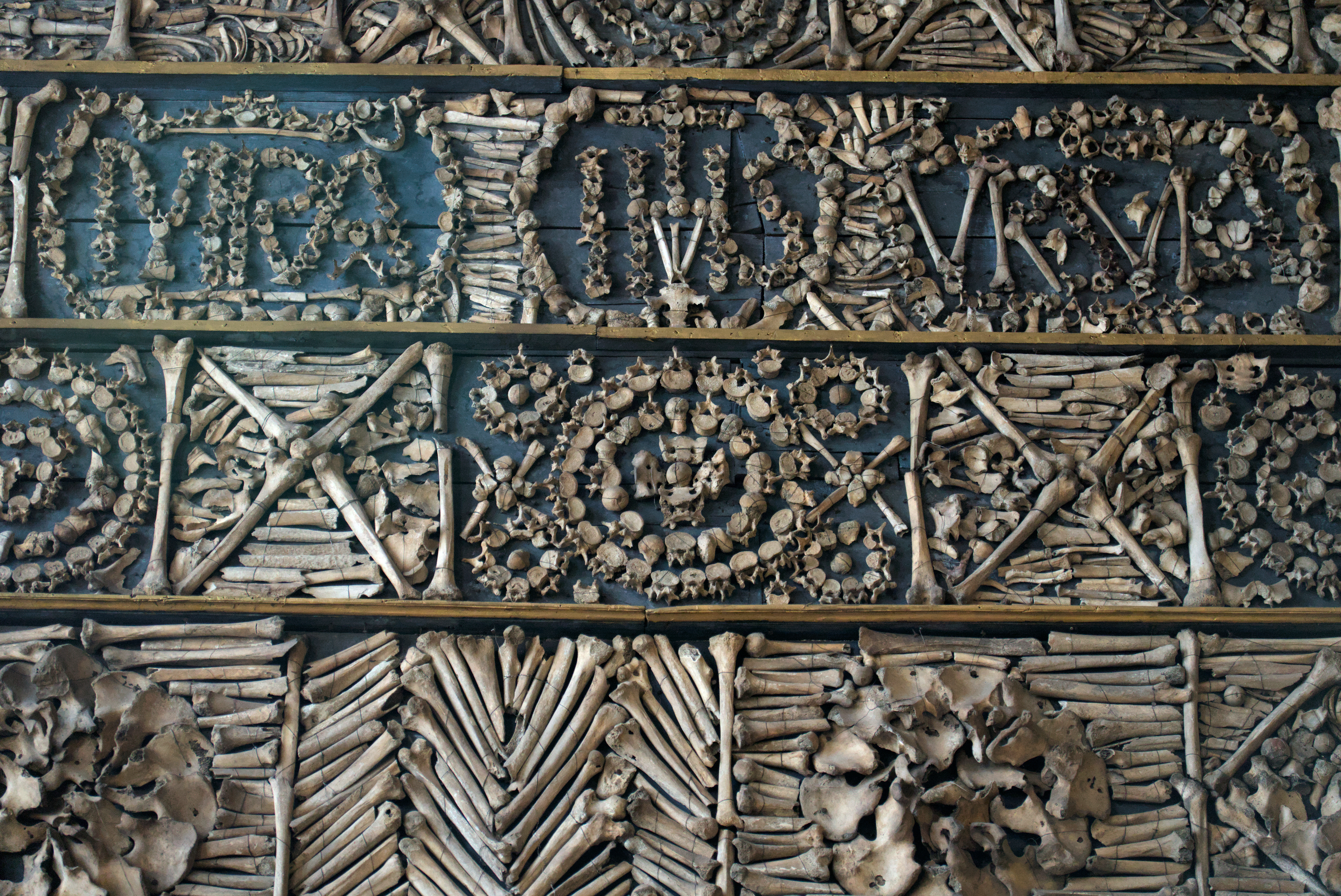
Above the altar, tibias, fibulas, femurs, humeri, and other bones spell out “Sancta Ursula Ora Pro Nobis” (Saint Ursula, pray for us). Also rendered in bones are the name Etherius—Ursula’s fiancé, who converted to Christianity at her insistence and met her in Cologne to die with her—and a mention of the holy virgins.
Other sections of the wall use vertebrae, pelvic bones, ribs, shoulder blades, and so on to create ornamental designs like hearts, spirals, webs, flowers, and crosses.
“IHS” is a popular Latin acronym for “Iesus Hominum Salvator” (Jesus, Savior of Humankind).
Similar visual displays of bones in charnel houses, writes art historian Jackie Mann, had become increasingly common in Europe by the late fourteenth century.
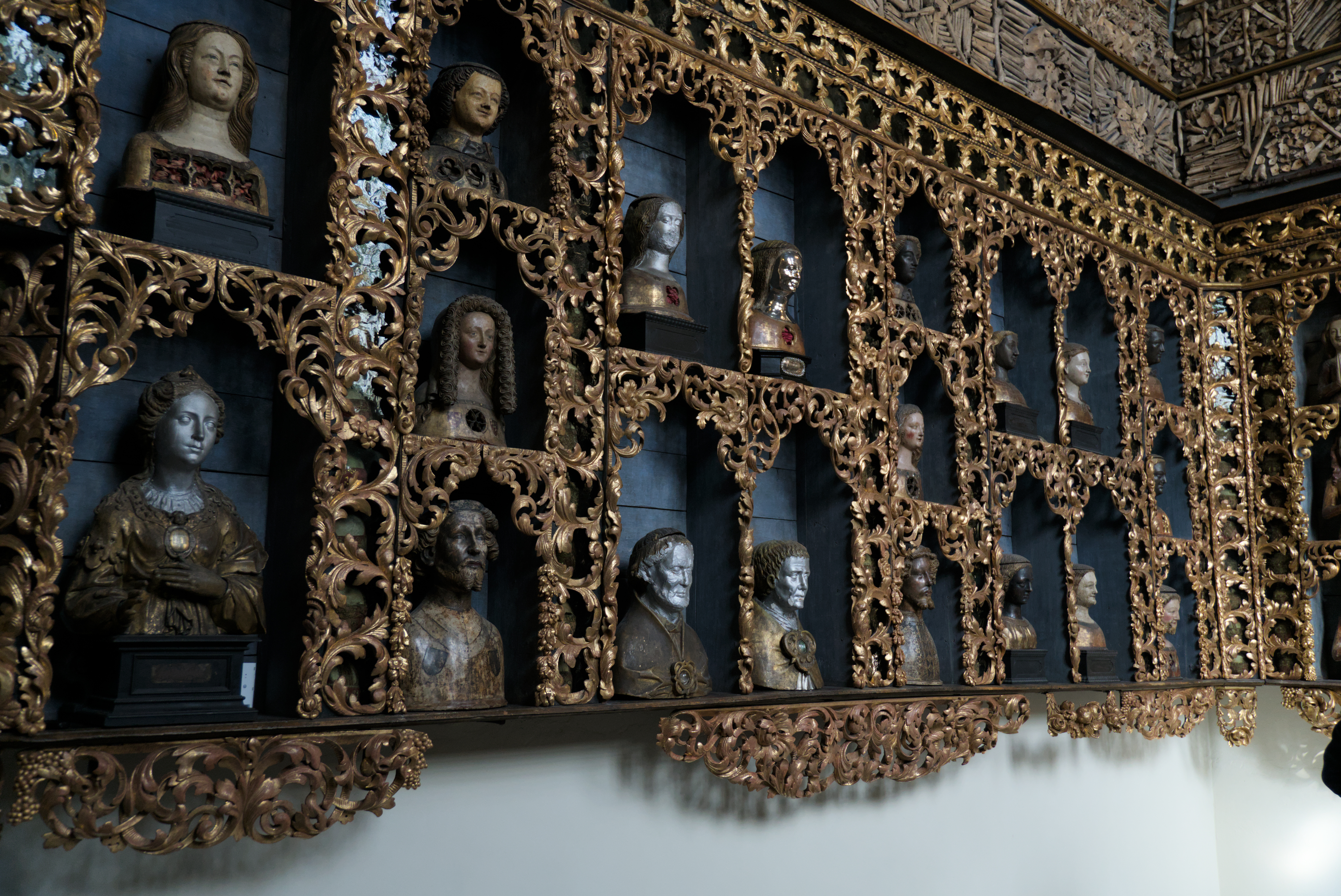
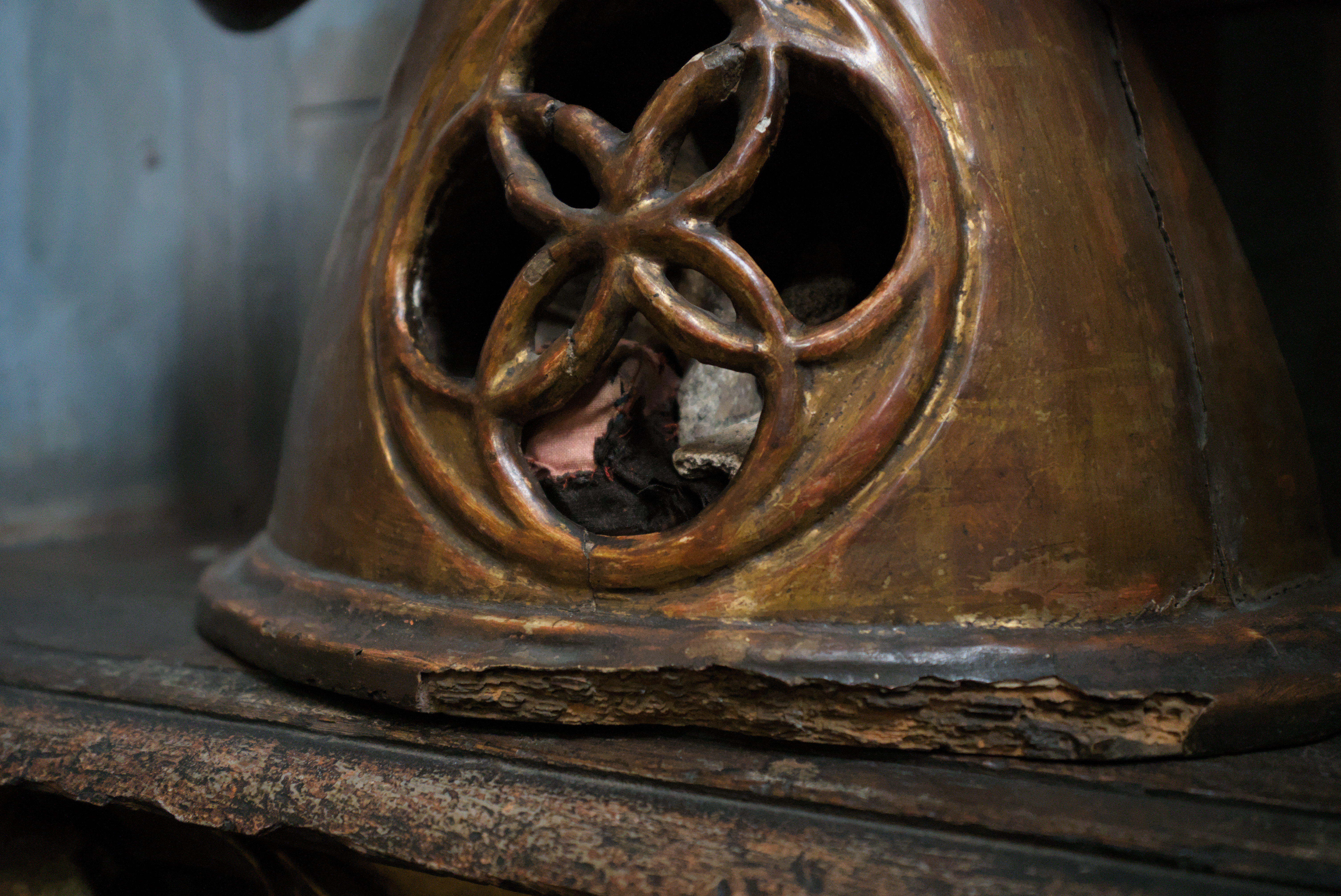
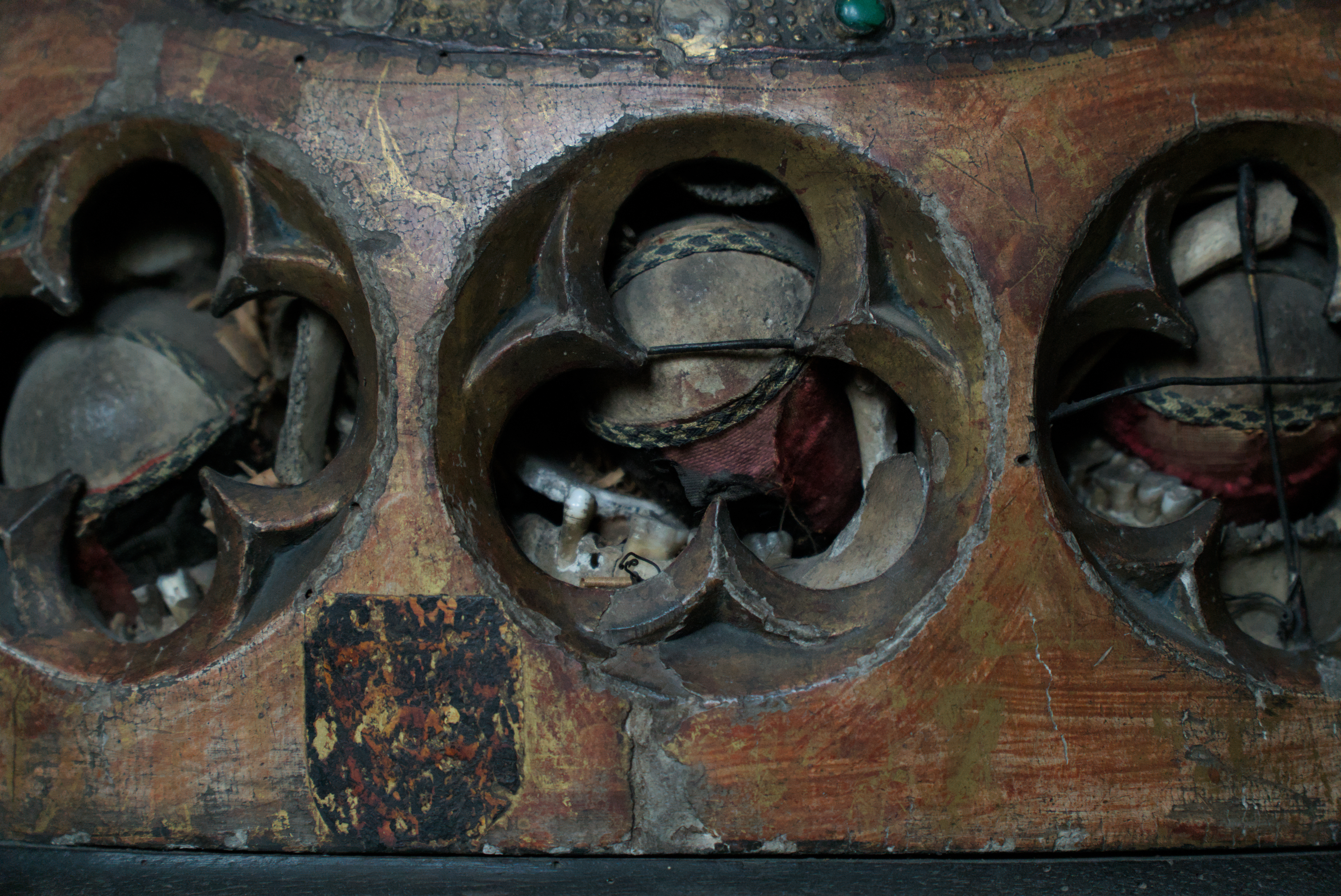
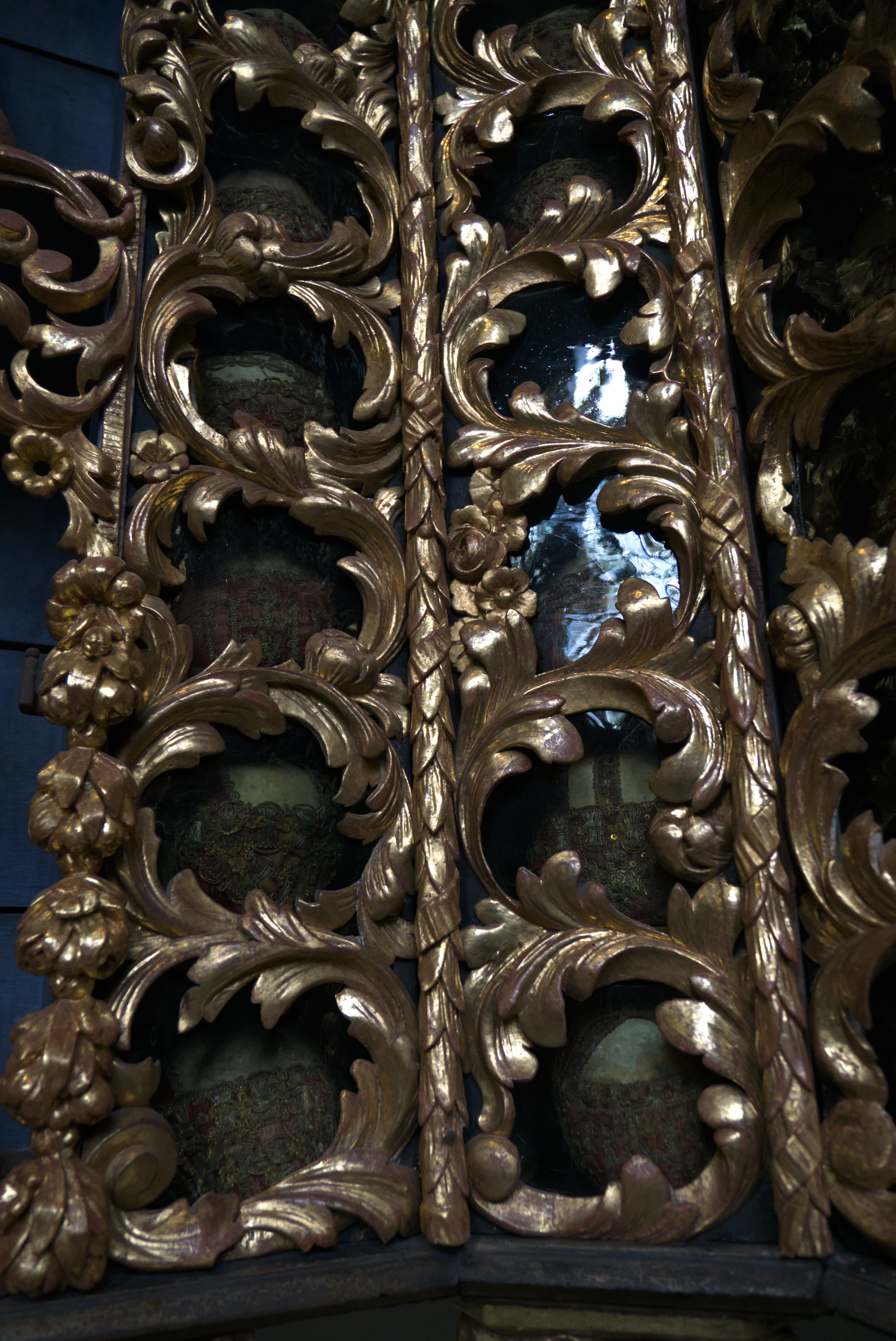
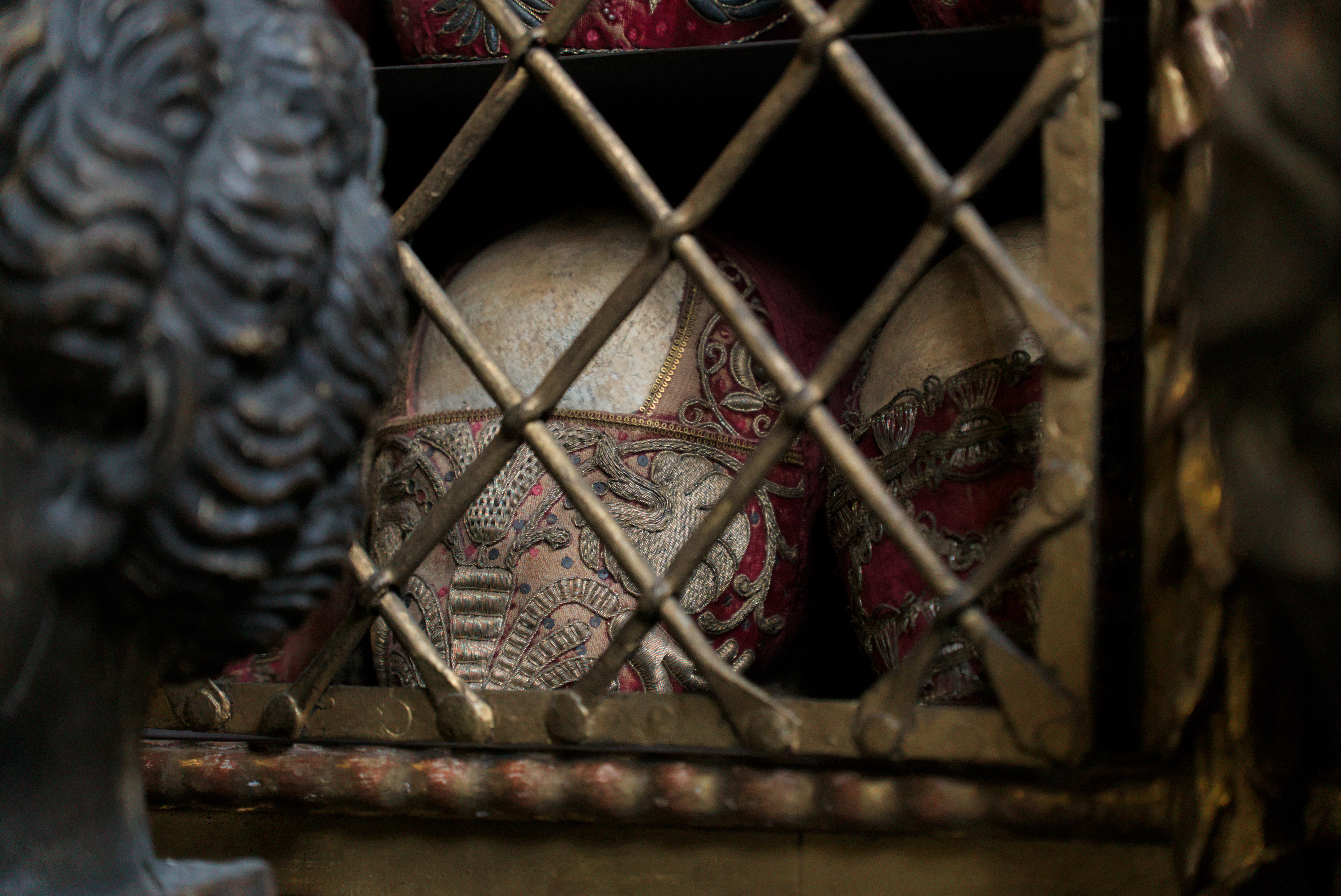
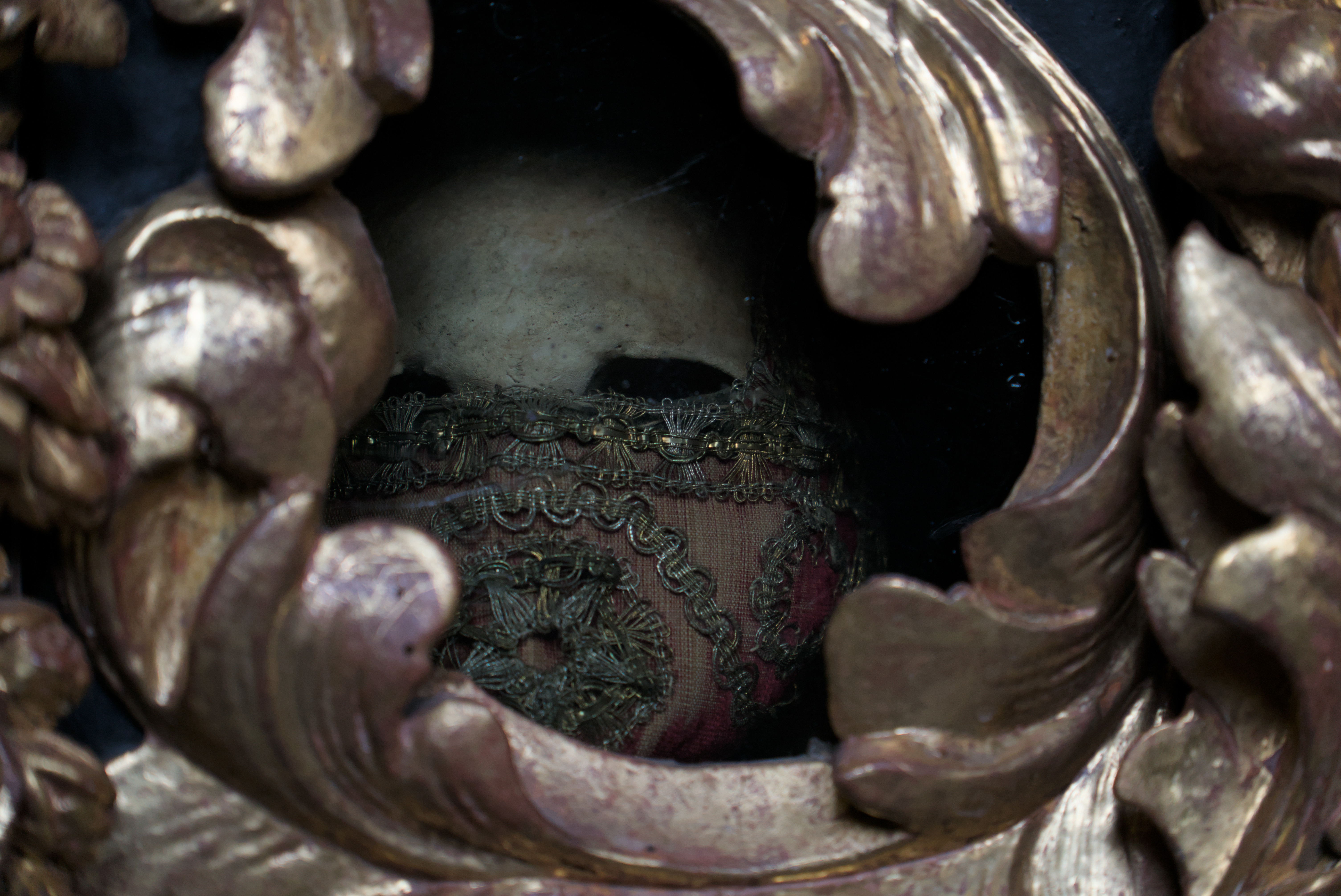
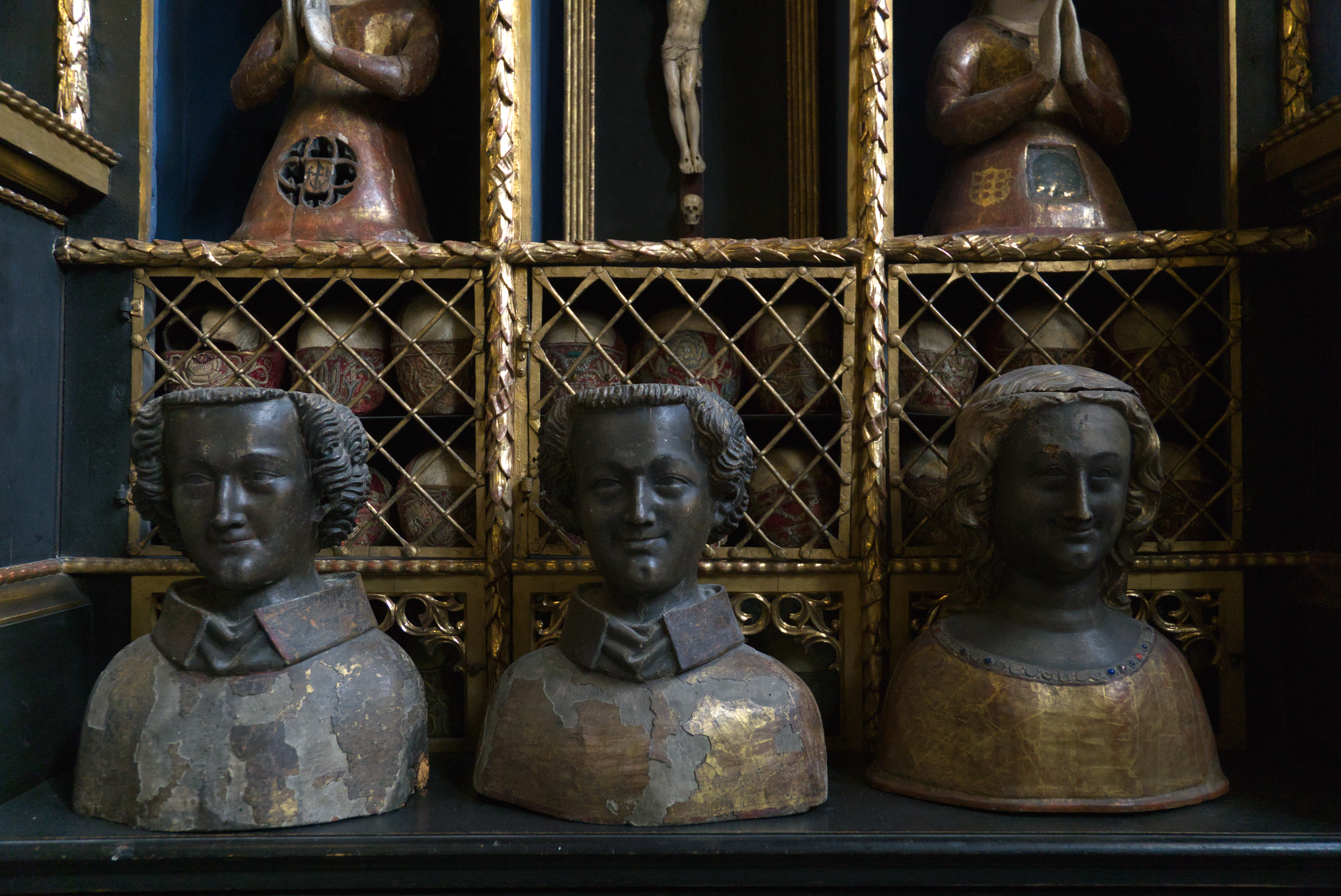
The shelving cabinets below the bone decor belong to the second phase of furnishings around 1700. They contain niches that house 112 reliquary busts (most of them produced between 1260 and 1400 and made of polychromed wood), as well as gilded acanthus tendrils that encompass some 600 skulls. Out of reverence, many of the skulls are at least partially wrapped in red velvet with gold and silver embroidery made by the nuns of the nearby Ursuline convent.
Occasionally, where the wrapping has slipped, you’ll see an eye hole staring back at you.
To account for the presence of men’s bones in the ancient Roman churchyard, the legend of St. Ursula was adapted in the twelfth century to include male martyrs—namely, Etherius and his retinue. That’s why the Golden Chamber contains several male busts alongside the female.
To the average person, the Golden Chamber is a weird, macabre spectacle. But for Catholics, displaying human bones is not meant to be creepy or horror-inducing. Rather, by bringing remnants of the dead into spaces of the living, we are reminded of: (1) our own mortality, (2) the community of saints that transcends time, and (3) the promise of universal, bodily resurrection (dem bones gonna rise again!).
Memento mori (“remember you will die”) was a common trope in seventeenth-century art and devotion, meant to increase one’s awareness of the fleetingness of life and to encourage one to live in light of heaven. Mann calls the Golden Chamber an “immersive memento mori.” Again, the traditional Christian summons to remember our mortality is not meant to frighten. It’s meant to inspire us to live whole and holy lives.
While death is an ending in one sense, it’s also an entry into life immortal. The Golden Chamber gathers together the fragments of local saints that had been scattered in ancient burial ruins, preserving them for the saints of later generations as a witness that our bodies will never be finally lost; they will be raised and renewed by God on the last day and reunited with our souls. Christians treat the remains of the deceased with honor in recognition that our bodies—including the framework of bones that support our soft tissues, protect our organs, enable our movement, store minerals for our use, and produce our blood cells—are not just temporary shells encasing who we really are, but rather are a part of who we are. Hence why we proclaim, in the Apostles’ Creed, that “we believe . . . in the resurrection of the body.”
Memorial for the Martyrs of Today
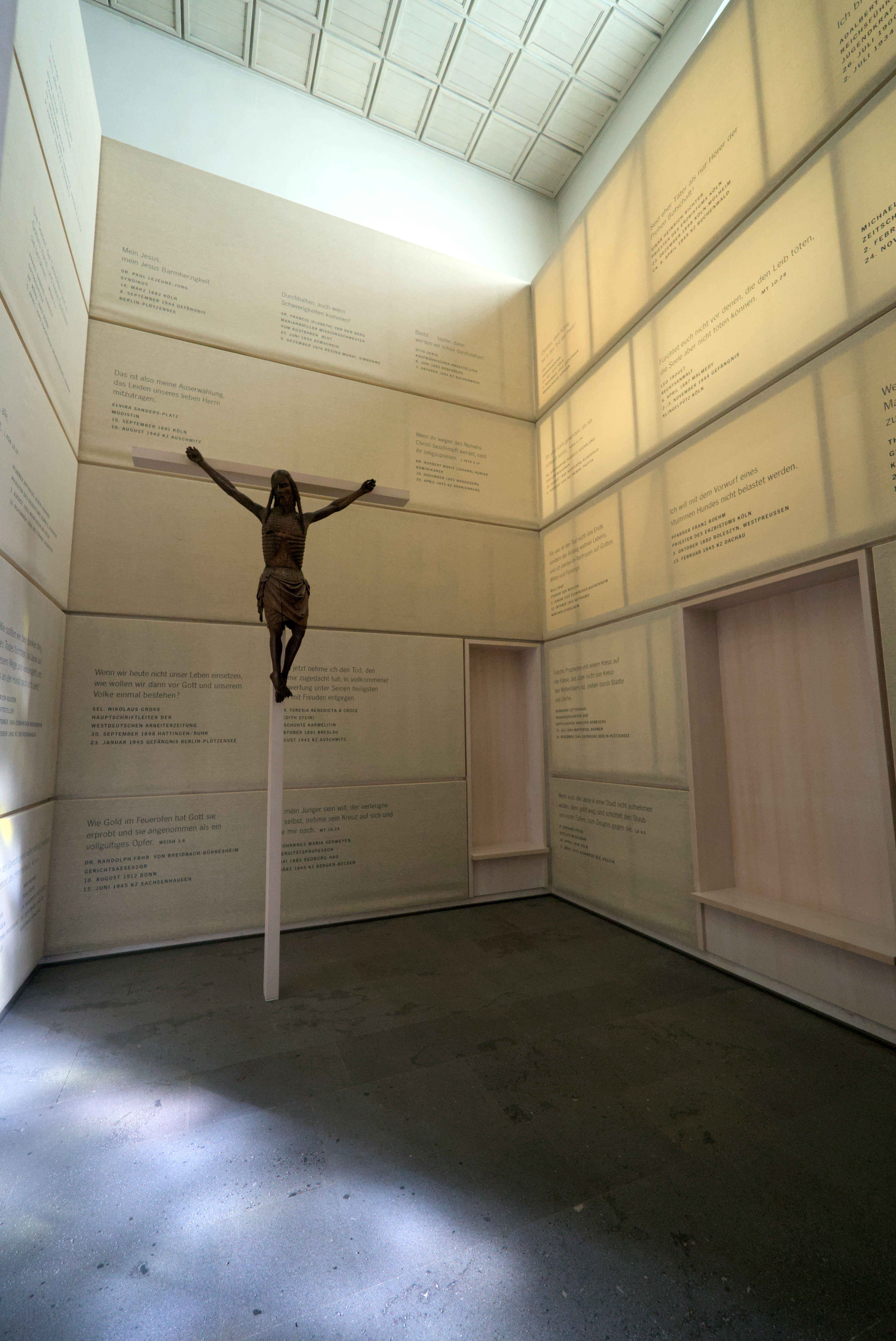
While the Golden Chamber is the primary draw for visitors to the Basilica of St. Ursula, there are other sights in the church worth spending time with, ones I was not expecting. One of them is the Gedenkstätte für die Märtyrer der Gegenwart (Memorial for the Martyrs of Today), a chapel in the south transept that commemorates the Christians in Cologne, both religious and lay, who were killed for resisting the Nazi regime—or, in the case of Sr. Teresa Benedicta of the Cross (Edith Stein) and Elvira Sanders-Platz, for being ethnically Jewish.
Gedenkstätte für die Märtyrer der Gegenwart (Memorial for the Martyrs of Today), designed and built by the firm Kister Scheithauer Gross, 2003–5. South transept, Basilica of St. Ursula, Cologne.
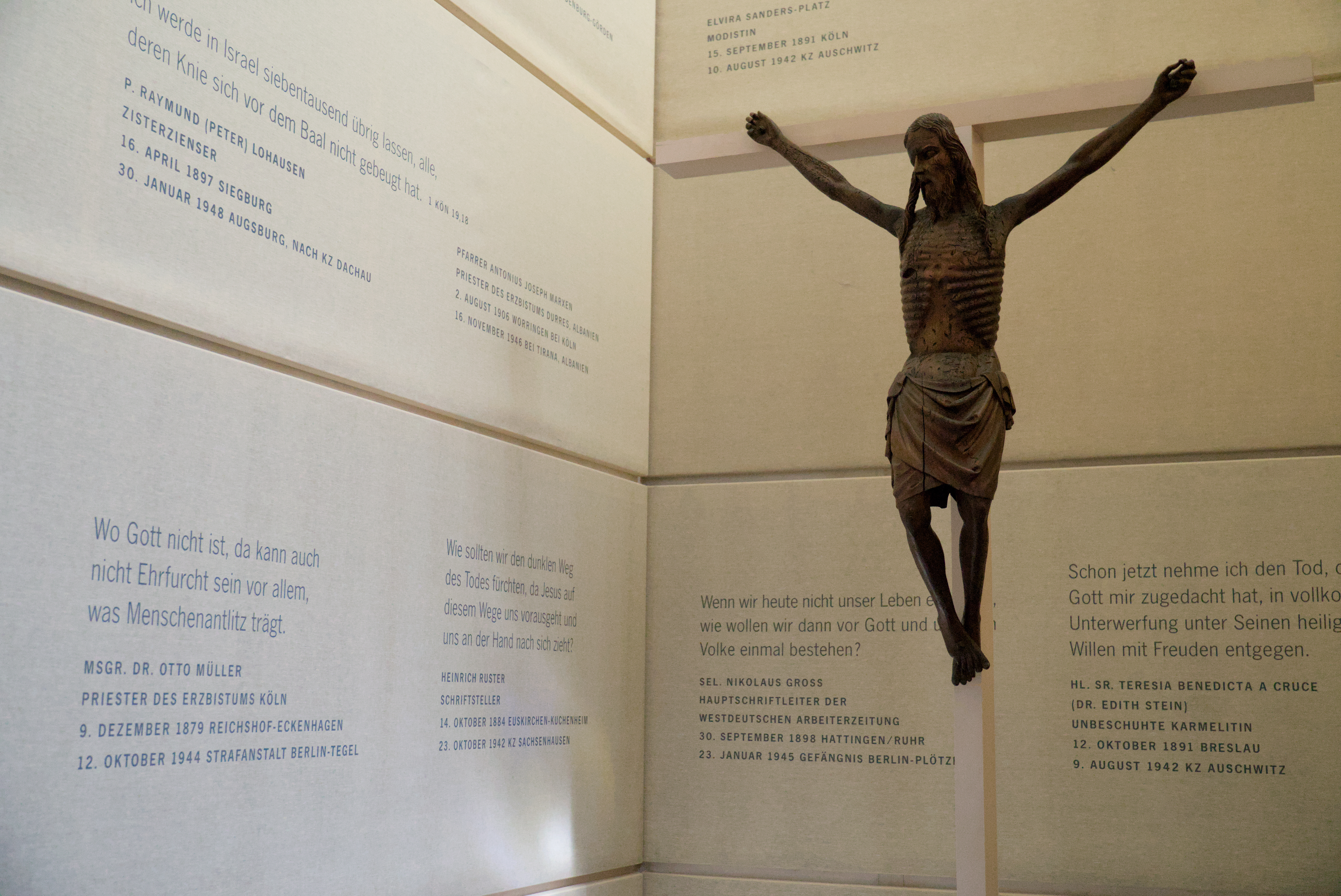
Made by the architectural and design firm Kister Scheithauer Gross, the chapel consists of a double-shelled, slightly transparent canvas construction printed on the inside with the names and dates of the martyrs, as well as quotes they gave before their deaths. Sunlight enters from the window to the right of the chapel, causing the space to glow. There’s a small bench on each of the three sides, for people to sit and pray or reflect.
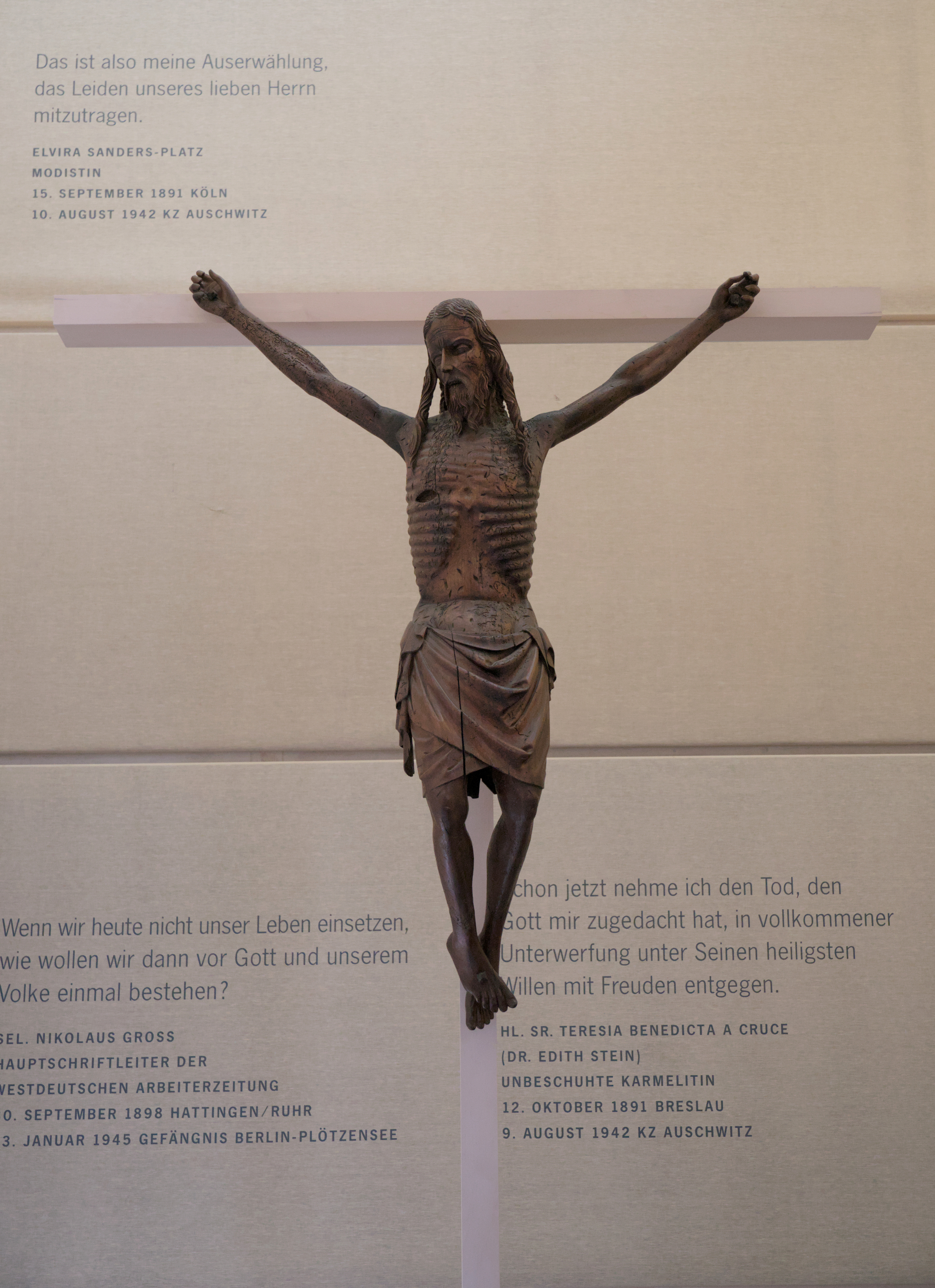
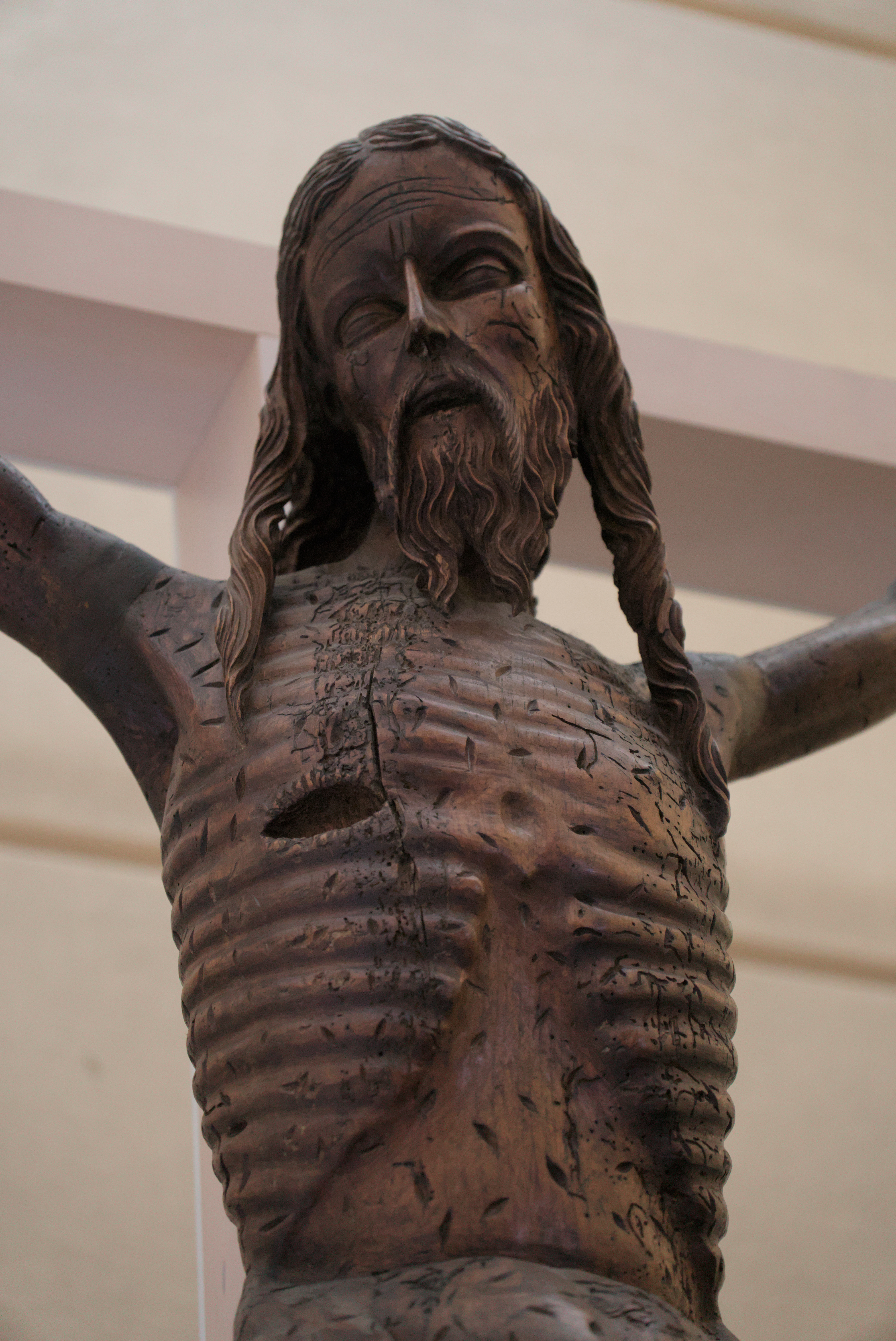
In the center is a life-size wood crucifix. The gaunt Christ figure is pierced all over and bears a deep wound in his side where the centurion’s spear went through. Like those whose names surround him, Jesus preached and pursued love and justice, ultimately laying down his life—a loss that God turned to gain in the Resurrection and in the redemption of the world.
A language barrier prevented me from effectively asking the staff person, or understanding the answer, whether the crucifix was carved in the early 2000s specifically for the chapel, or if it’s medieval. There’s no info inside the church about this chapel.
The Memorial for the Martyrs of Today is an example of what Christian martyrdom looked like in Cologne in the twentieth century. Fr. Otto Müller, Br. Norbert Maria Kubiak, writer Heinrich Ruster, medical student Willi Graf, Catholic Youth leader Adalbert Probst . . . The stories of the many individuals who were executed for subverting Hitler, for calling out his evils, in the name of Christ are far more compelling to me than the fabulous and convoluted story of an ancient princess killed in a land invasion and then heroized—for her virginity?
Contemporary Stained Glass
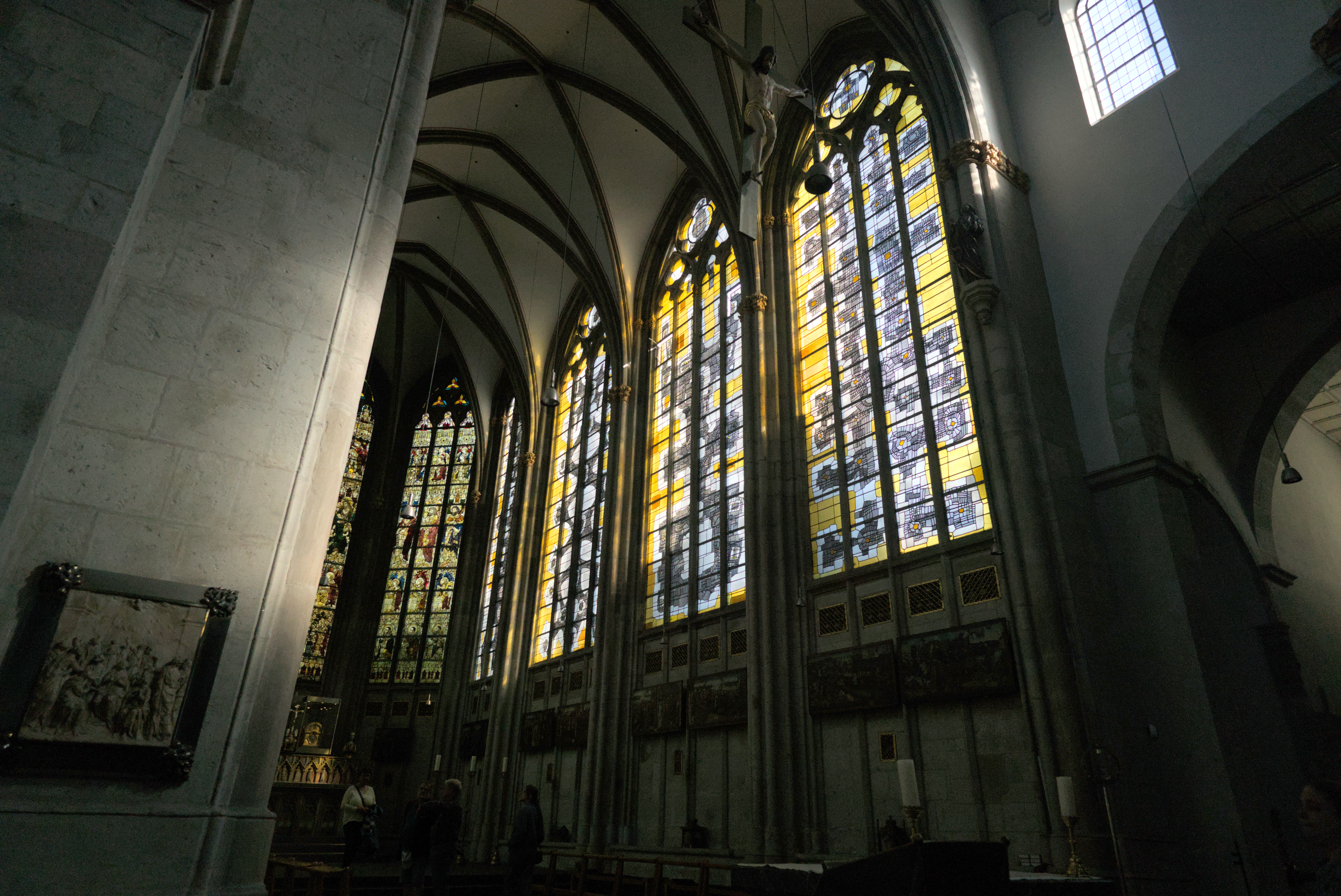
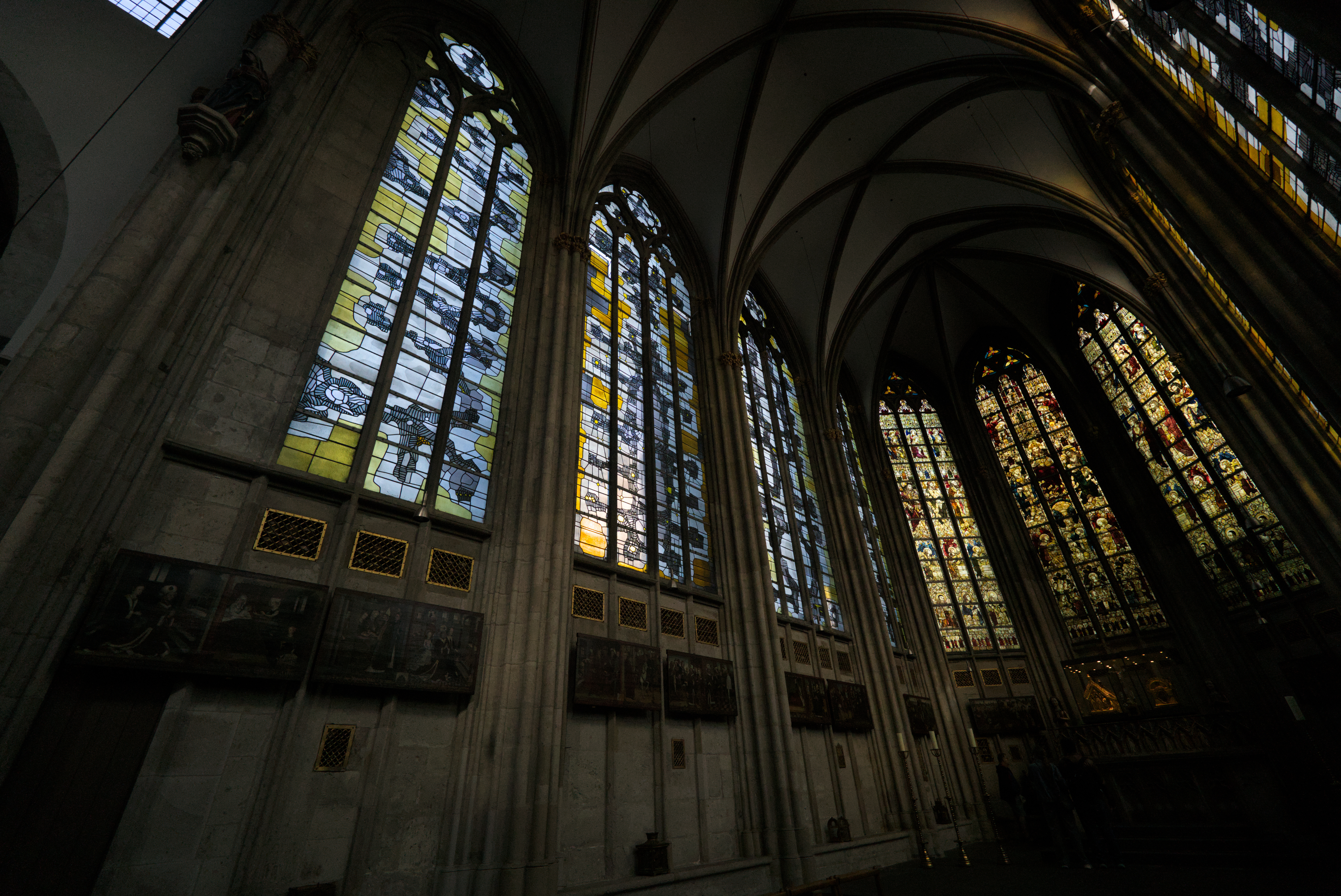
I also liked the contemporary stained glass in the church. In the choir, there’s a set of eight windows by Wilhelm Buschulte—abstract compositions in yellow, white, and gray.
Stained glass windows by Wilhelm Buschulte (German, 1923–2013), 1962, choir, Basilica of St. Ursula, Cologne
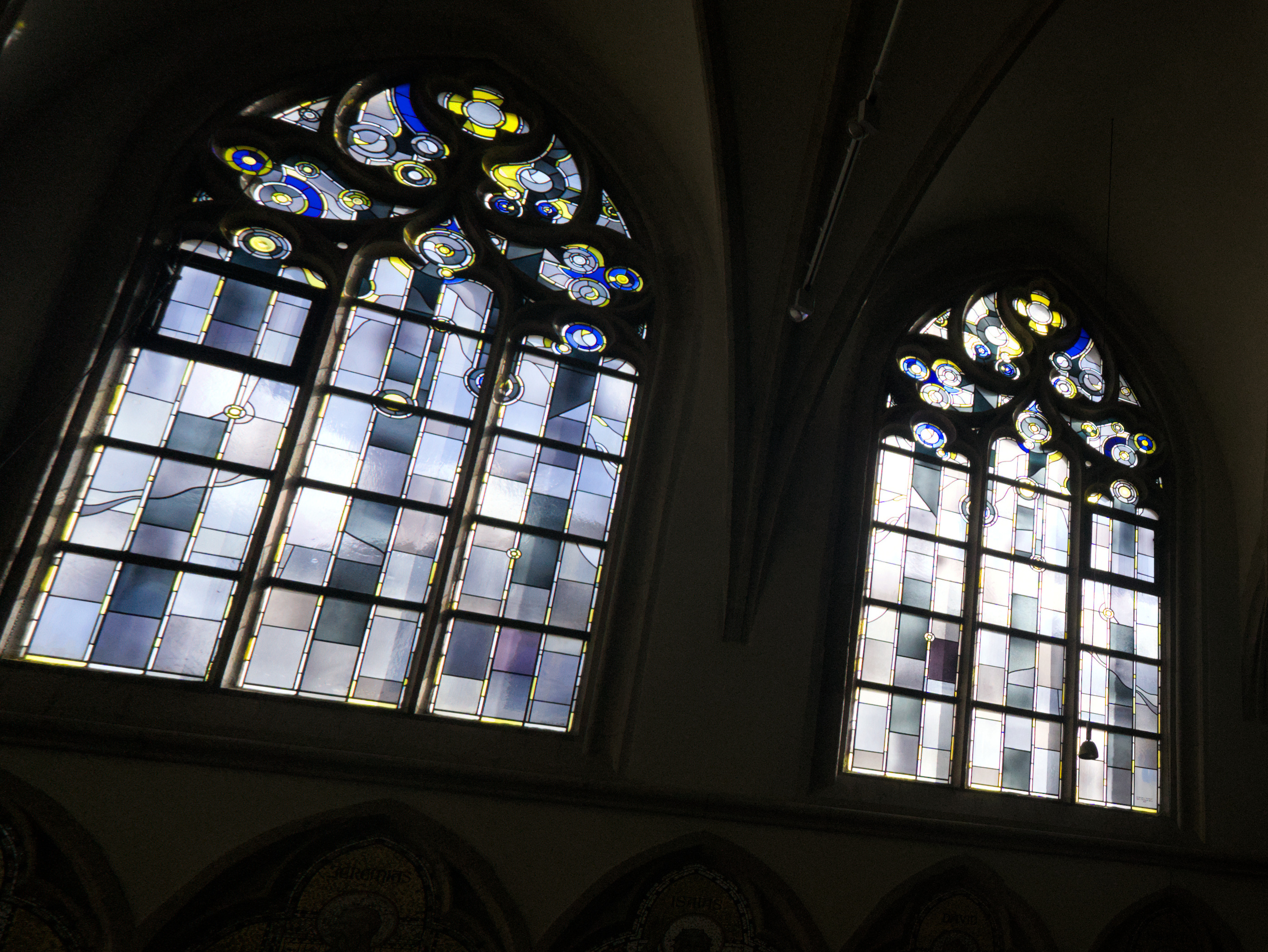
In the south aisle are two round-arched windows by Will Thonett, also abstract: a grid of blues, grays, and lavender, with yellow circles and thin vertical bands.
Stained glass windows by Will Thonett (1931–1973), 1967, south aisle, Basilica of St. Ursula, Cologne
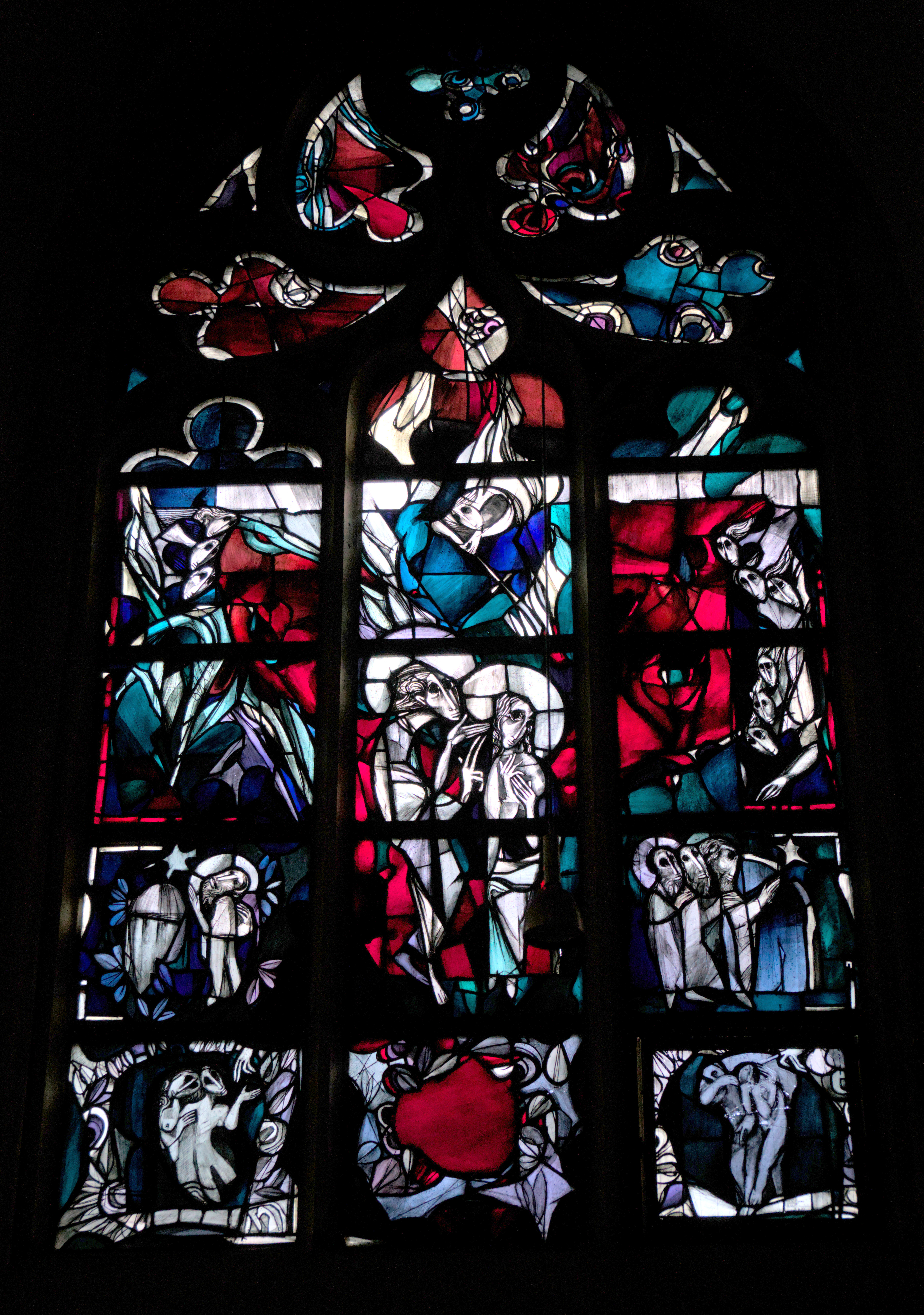
To the right of these are three Mary-themed windows by Hermann Gottfried. The primary scene of the first one is the Annunciation. A giant red rose appears in the background, probably a reference to Mary as the Rosa Mystica. Below this scene, to the left, is the Creation of Adam and Eve, and to the right, the Expulsion from Paradise; these contextualize Christ’s conception in the greater narrative of scripture. The peripheral scenes in the middle register show the magi following the star to Bethlehem.
Stained glass window by Hermann Gottfried (German, 1929–), 1984, south aisle, Basilica of St. Ursula, Cologne
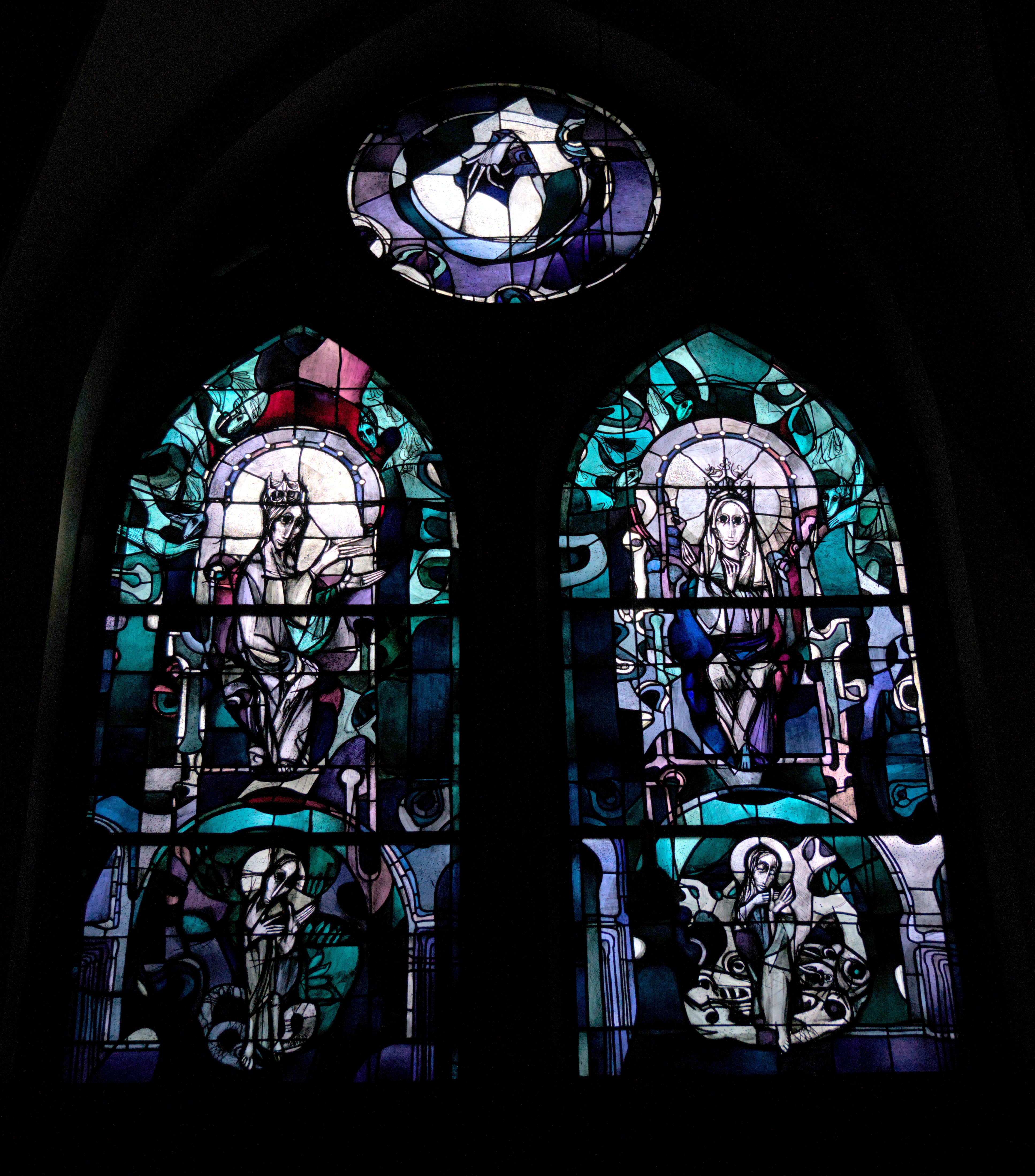
The central window portrays the Coronation of Mary. I believe both figures in the left lancet are Christ—crowning his mother as Queen of Heaven, and at the bottom, crushing the serpent, as the protoevangelium in Genesis 3:15 prophesied. Beneath the enthroned Mary on the right is a smaller vignette, which I think may be Mary again, also stepping on the serpent’s head, since by her cooperation with God’s plan, she shares in the victory over Satan. This imagery is also related to Woman of the Apocalypse described in Revelation 12, whom Catholics interpret as Mary. The hand of God dispenses blessing from above.
Stained glass window by Hermann Gottfried (German, 1929–), 1984, south aisle, Basilica of St. Ursula, Cologne
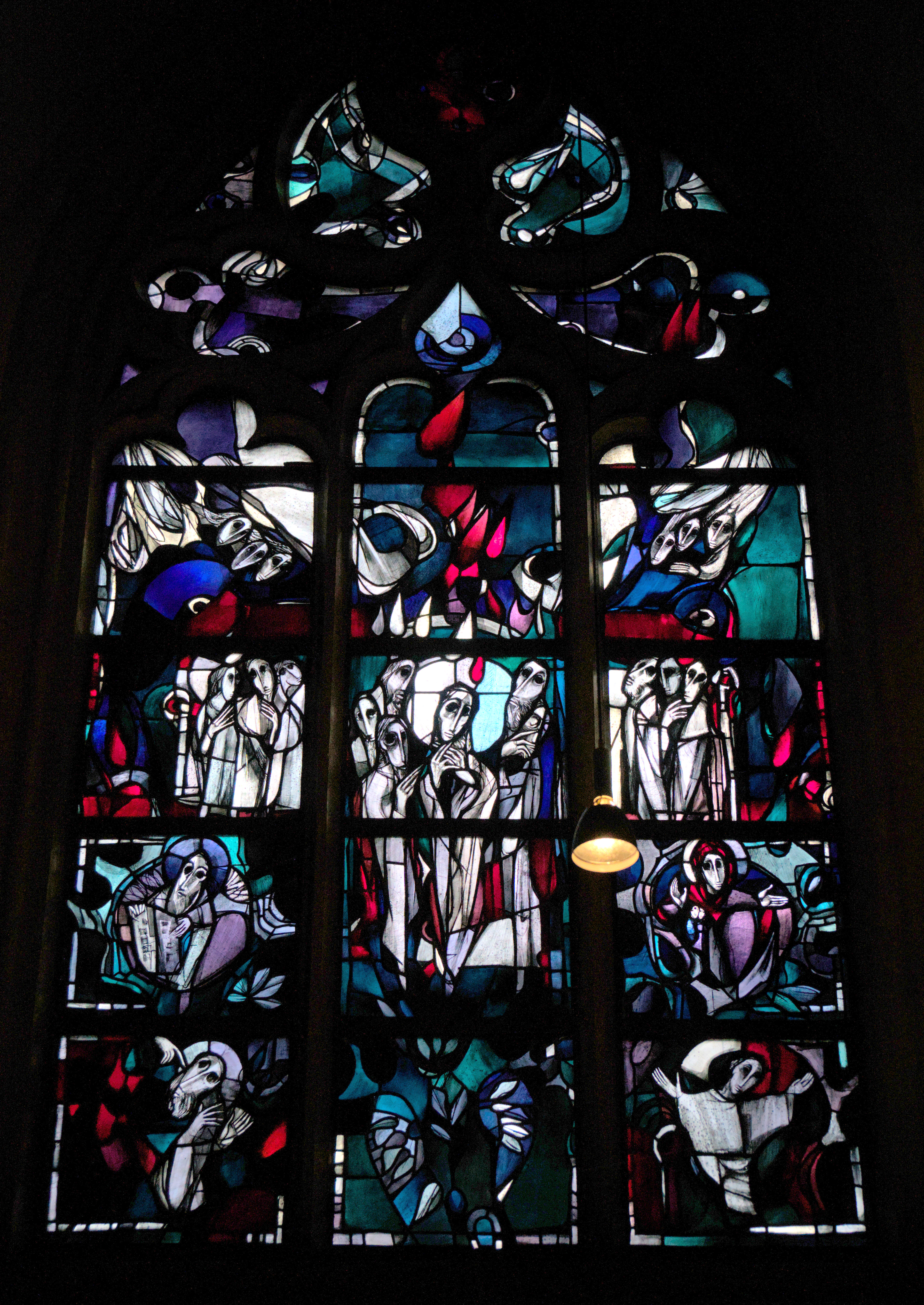
The final window in this trio portrays the Descent of the Holy Spirit at Pentecost. The two quadrants at the bottom right show Moses before the burning bush, in which Mary appears; Catholic teaching compares Mary to the burning bush of Exodus because for nine months she held the fire of divinity within her womb (God incarnate) and was not consumed. On the left Moses is receiving the tablets of the law on Mount Sinai, an event often read in parallel with the story of Pentecost in Acts 2, where God writes his word not on stone but on people’s hearts by giving his Spirit to dwell within them.
Stained glass window by Hermann Gottfried (German, 1929–), 1984, south aisle, Basilica of St. Ursula, Cologne
If you’re ever in Cologne, I encourage you to include the Basilica of St. Ursula on your itinerary. Entry to the church is free, but the Golden Chamber costs €2 (only cash is accepted, I believe). There are six large standing posters in the narthex that provide a timeline, in German, of the church’s history, and when I was there, there were two attendants who were available to answer questions, one of whom spoke some English.
This a continuation of yesterday’s article.In part 1 I shared three room highlights from my visit to Kolumba museum in Cologne, Germany, run by the city’s Catholic archdiocese; in this final part I will do the same for KMSKA in Antwerp, Belgium, whose Old Masters galleries received a “contemporary injection” in an exhibition that wrapped this week.All photos are my own.
[Content warning: This article contains female nudity: a controversial Renaissance painting of the Virgin Mary, and three photographs of women who have just given birth.]
KMSKA, Antwerp
The Royal Museum of Fine Arts Antwerp, or KMSKA for short, is a world-famous museum whose collection spans seven centuries, from the Flemish Primitives to the Expressionists.
When I was there last month, the featured exhibition was Collected with Vision: Private Collections in Dialogue with the Old Masters, which ran from April 4 to October 12, 2025. Organized in conjunction with Geukens & De Vil Projects, it interwove postwar and contemporary works by internationally renowned artists from Belgian private collections with the existing museum collection, “expanding the transhistorical approach already in place. The exhibition offers a reflection on the history of art collecting and asks probing questions about social issues such as gender, power and identity. The role of museums and collectors is the focal point. Do the interventions create a harmonious dialogue with 700 years of art history, or do they give rise to challenging contrasts?” Featured artists included Cindy Sherman, Olafur Eliasson, David Claerbout, Francis Alys, Christian Boltanksi, Tracey Emin, Marlene Dumas, Luc Tuymans, and Louise Bourgeois.
The galleries of the exhibition were organized by theme: Holy, Impotence, Horizon, Image, Entertainment, Profusion, Lessons for Life, Fame, The Salon, Heroes, Evil, The Madonna, Suffering, Redemption, Prayer, Heavens, and Power.
I’ll spotlight what I consider the most successful and intriguing pairings.
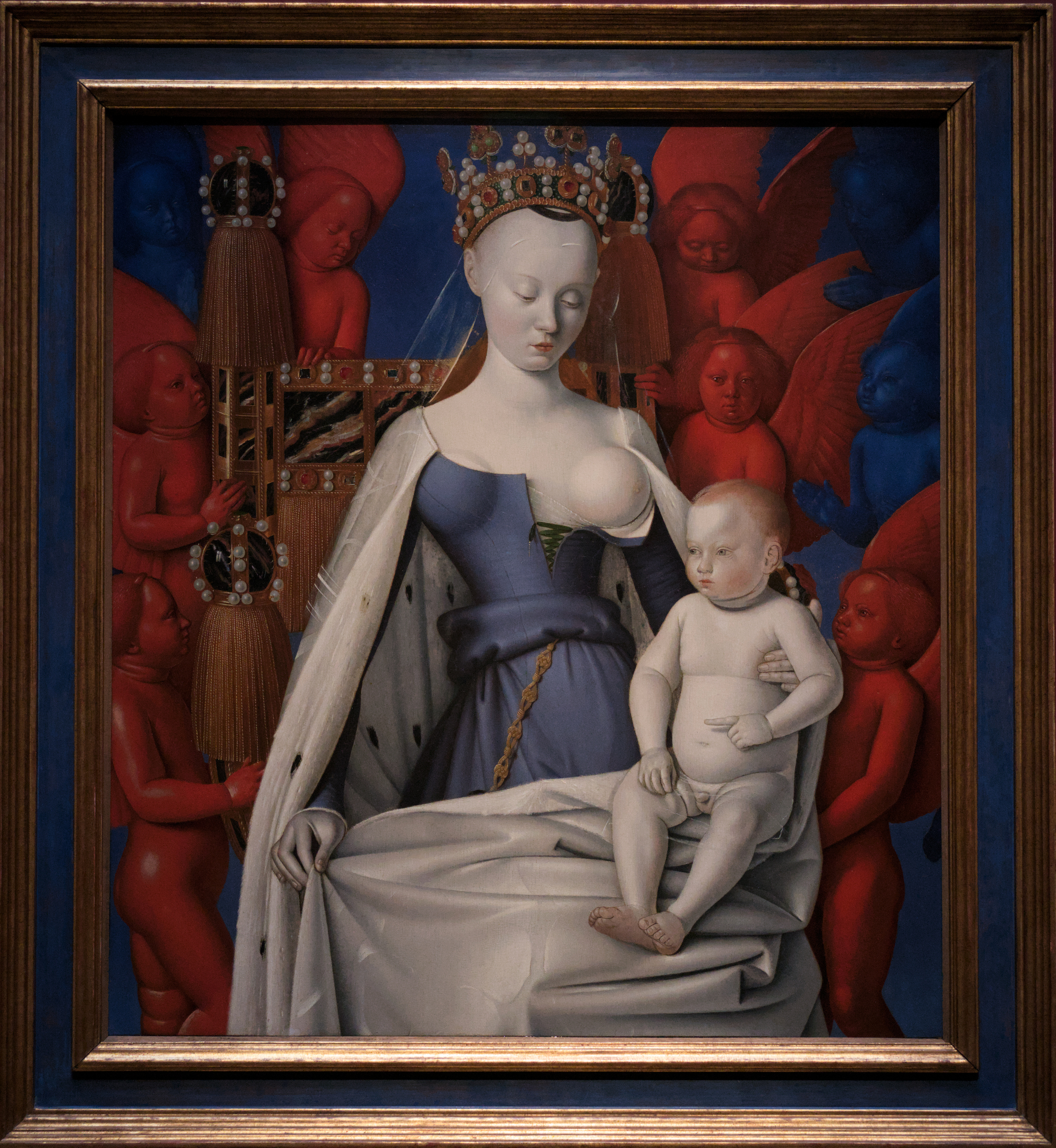
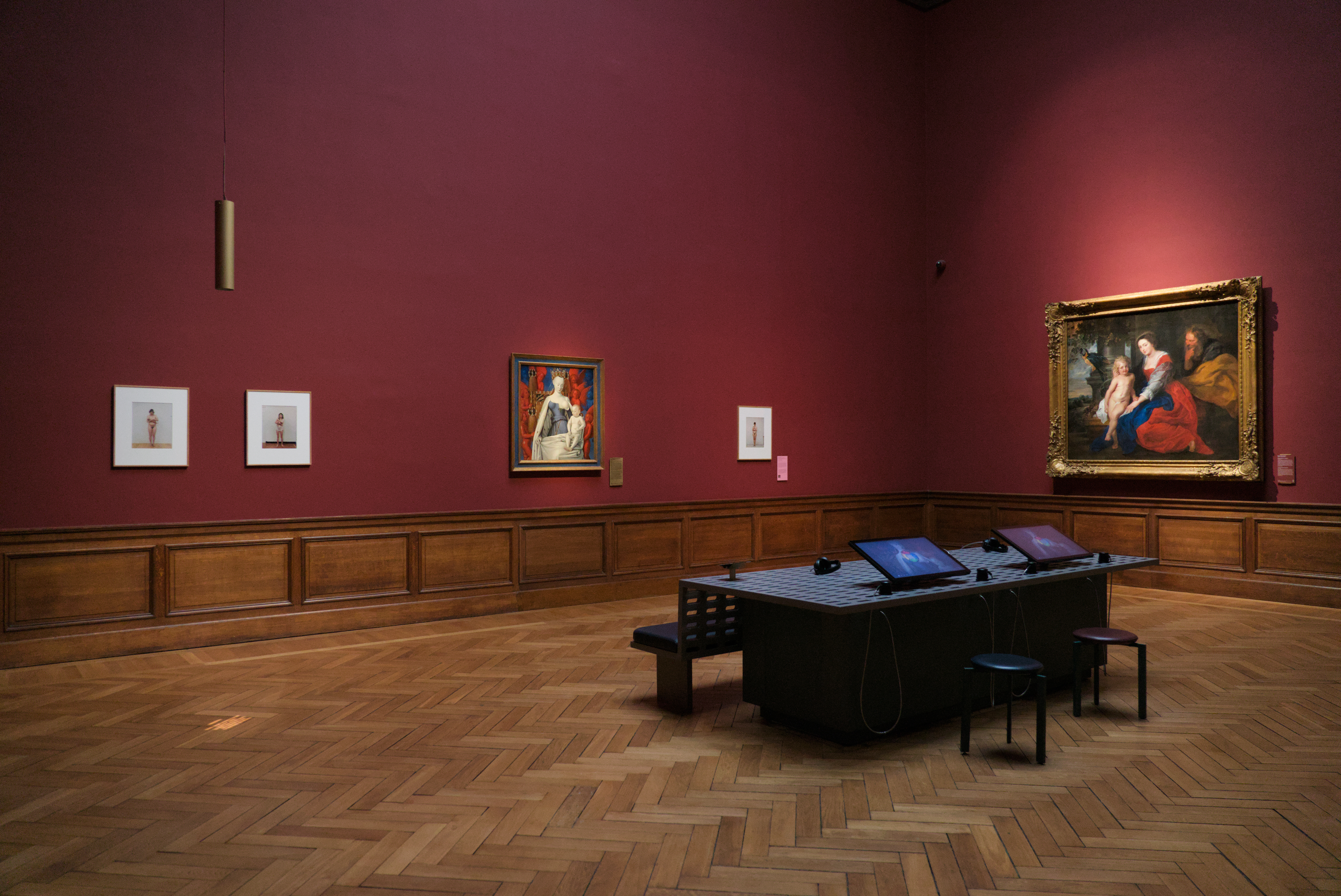
First, the “Madonna” room, anchored by the famous Madonna Surrounded by Seraphim and Cherubim by the late medieval French court painter Jean Fouquet. It’s the right wing of a diptych that originally hung above an altar at the Collegiate Church of Notre-Dame in Melun.
Jean Fouquet (French, 1410/30–1477/81), Madonna Surrounded by Seraphim and Cherubim, ca. 1450. Oil on panel, 92 × 83.5 cm. Koninklijk Museum voor Schone Kunsten Antwerpen (KMSKA, Royal Museum of Fine Arts Antwerp).
The painting is historically significant—I first encountered it in a college art history course. Commissioned by Etienne Chevalier, treasurer to King Charles VII of France, it portrays the Virgin Mary as the Queen of Heaven, baring her breast ostensibly to nourish the Christ child with her milk. She was probably modeled after Agnès Sorel, the king’s recently deceased mistress and mother of three of his daughters, considered the ideal of feminine beauty at that time in western Europe: pale-skinned, with a high forehead, and fashionable in her ermine cloak.
Though I can appreciate the technical excellence of this painting and the intense reds and blues of the angels, I don’t really like it. Mary seems cold, not very maternal. There’s also an eroticization of her body—not because her breast is exposed, which was common in Marian art, but because it seems to be on display for the viewer; her son’s not interested in feeding—that’s wholly inappropriate for the subject. Why you’d want to memorialize your boss’s sex partner in such a way is beyond me. I’m no prude, but I much prefer Jan van Eyck’s Madonna at the Fountain, on display in the same room:
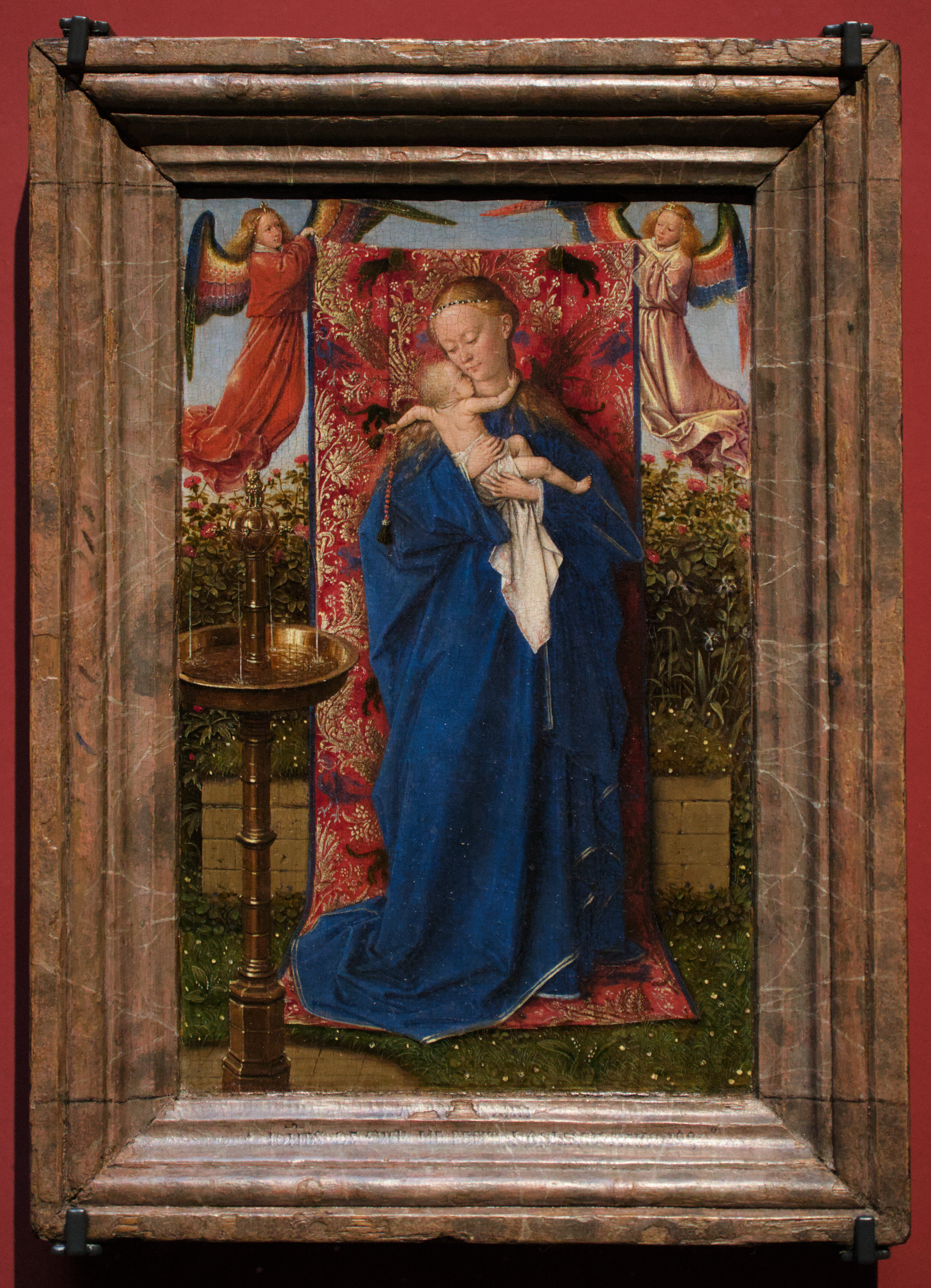
Jan van Eyck (Flemish, 1390/99–1441), Madonna at the Fountain, 1439. Oil on panel, 19 × 12 cm. Koninklijk Museum voor Schone Kunsten Antwerpen (KMSKA, Royal Museum of Fine Arts Antwerp).
This small painting originally hung not in a church but in someone’s house. Though there’s still an air of formality, it has all the tenderness and connection that the other one lacks. Mother and son embrace in a garden of roses, irises, and lilies of the valley, he reaching round her neck and holding a string of prayer beads, she gazing adoringly at him. They stand beside a fountain, recalling Jesus’s discussion in John 4 about the “living water” he gives to those who thirst. The original wood frame bears the artist’s motto: “As well as I can.”
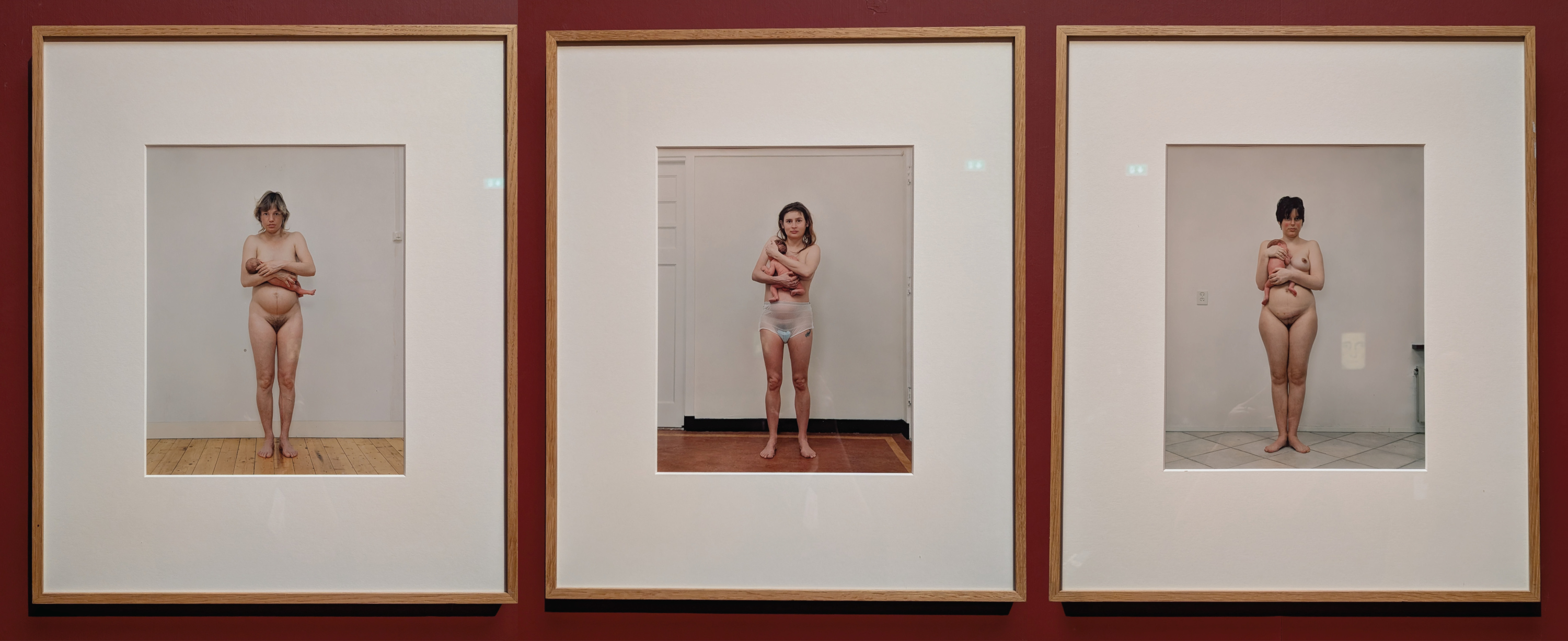
The deeply engrained portrait of motherhood embodied by the Virgin Mary is juxtaposed most potently with a series of three black-and-white portraits of new mothers by the Dutch photographer Rineke Dijkstra.
Gallery 2.17 (“The Madonna”) from the KMSKA exhibition Collected with Vision: Private Collections in Dialogue with the Old Masters
The accompanying text read:
Jean Fouquet portrays motherhood as something sacred. Mary as a symbol of purity and devotion is richly dressed in cool colours. Rineke Dijkstra homes in on the vulnerable reality. Her mothers are scantily clad and marked by childbirth. Both works are innovative: Fouquet may have painted his Mary for the first time from a real person, and in its day the painting was regarded as ‘modern’. Dijkstra shows motherhood in all its rawness, a taboo usually withheld from view.
Julie wears hospital pads and mesh underwear, which women often do for several weeks after giving birth to manage postpartum bleeding and urinary incontinence. As for Tecla, blood is running down her leg. And Saskia bears a scar from her cesarean section. A linea nigra (dark line) zips down the abdomen of all three, a temporary pigmentation increase caused by increased hormone levels. I love this triptych that shows motherhood’s glorious, messy, alterative impact on the body—the real physicality of the vocation of bearing children into the world.
I wish there were more imagery of Mary like this, as it would, I think, deepen the wonder of the Incarnation and enhance women’s ability to identify with Mary and thus further enliven her story.
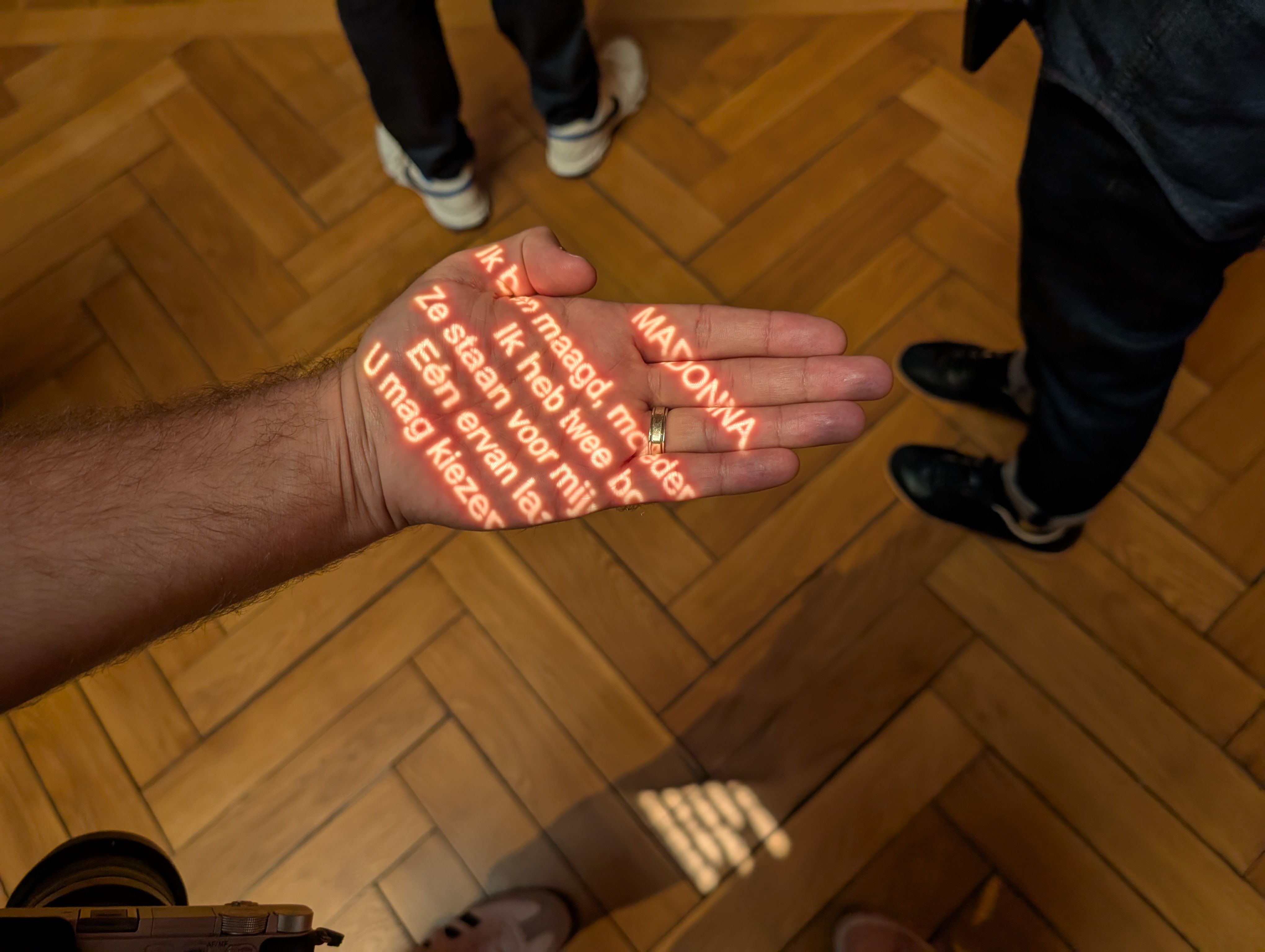
Also in the Madonna gallery was a unique “light poetry” installation by Nick Mattan and Angelo Tijssens—one of seventeen spread throughout the second floor, collectively titled Licht dat naar ons tast (Light that reaches for us). KMSKA had commissioned this couple to bring to life the short verses the museum’s late writer-in-residence Bernard Dewulf had written in response to the galleries’ stated themes.
“Inspired by the museum’s many reading and praying figures, as well as James Ensor’s expressive hand sketches, [Mattan and Tijssens] sought a subtle way to make [Dewulf’s] words tangible,” the museum writes. Their solution was to project them onto the gallery floors from brass cylinders suspended from the ceiling. The words shine like faint specks of light, becoming legible only when a visitor holds their hands, a sweater, or something else up to the light.
Here my husband “holds” a poem written in the voice of Mary:
Nick Mattan (Belgian, 1987–) and Angelo Tijssens (Belgian, 1986–), Licht dat naar ons tast (Light that reaches for us), 2023, featuring seventeen poems by Bernard Dewulf. Commissioned by and permanently installed at the Koninklijk Museum voor Schone Kunsten Antwerpen (KMSKA, Royal Museum of Fine Arts Antwerp).
“Madonna” by Bernard Dewulf
Virgin, mother, wife – I have two breasts that stand for my three souls. I show you one of them, and whose it is is yours to choose.
Translated from the original Dutch by David Colmer
Kind of cheeky! Dewulf speaks of Mary’s three identities and lets us decide if the breast she bares in Fouquet’s painting represents her naked innocence, her nurturing impulse, or her desire to please her husband. (Traditionally in art, it has always stood for the second.)
The next gallery I entered was themed “Suffering.”
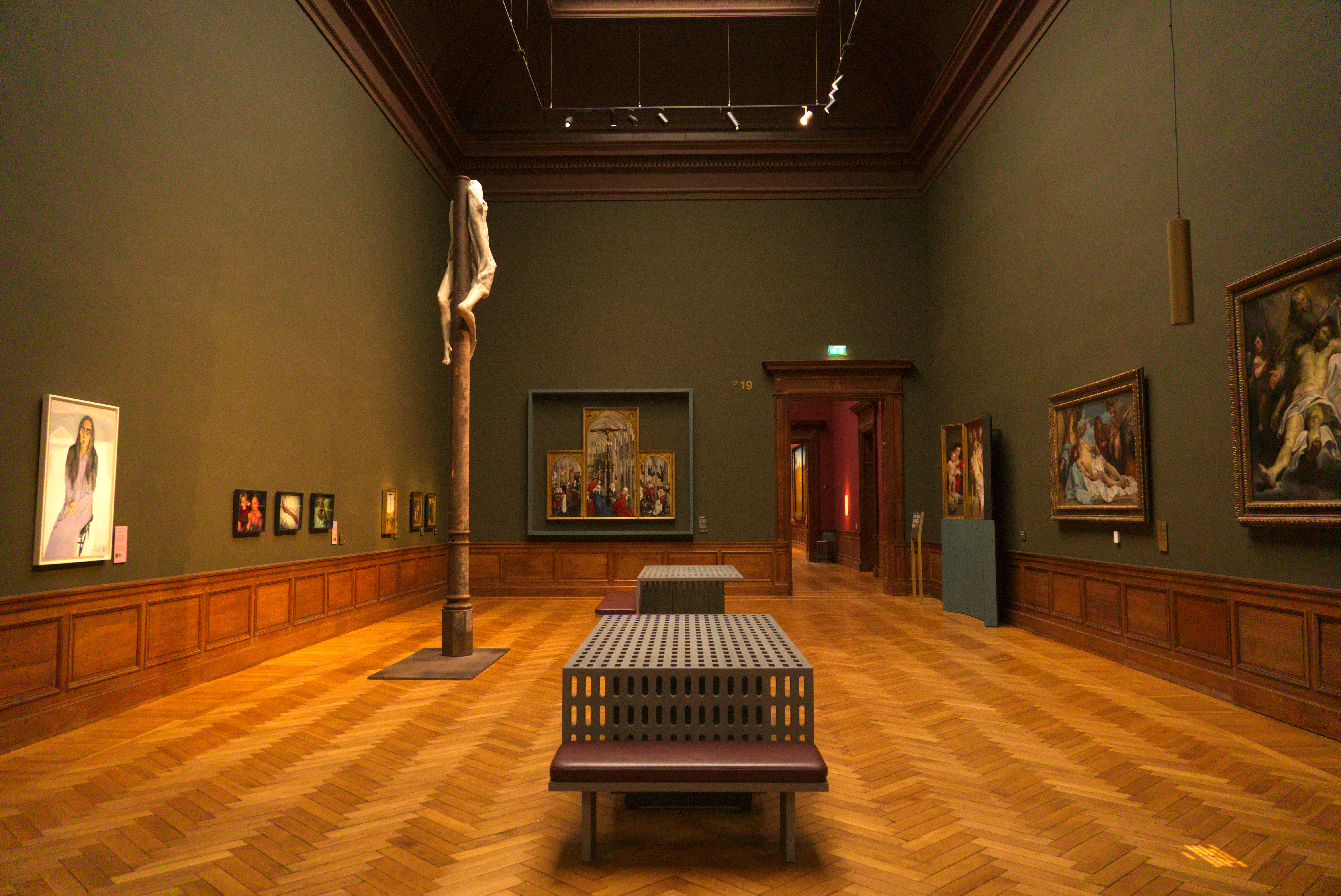
Gallery 2.19 (“Suffering”) from the KMSKA exhibition Collected with Vision: Private Collections in Dialogue with the Old Masters
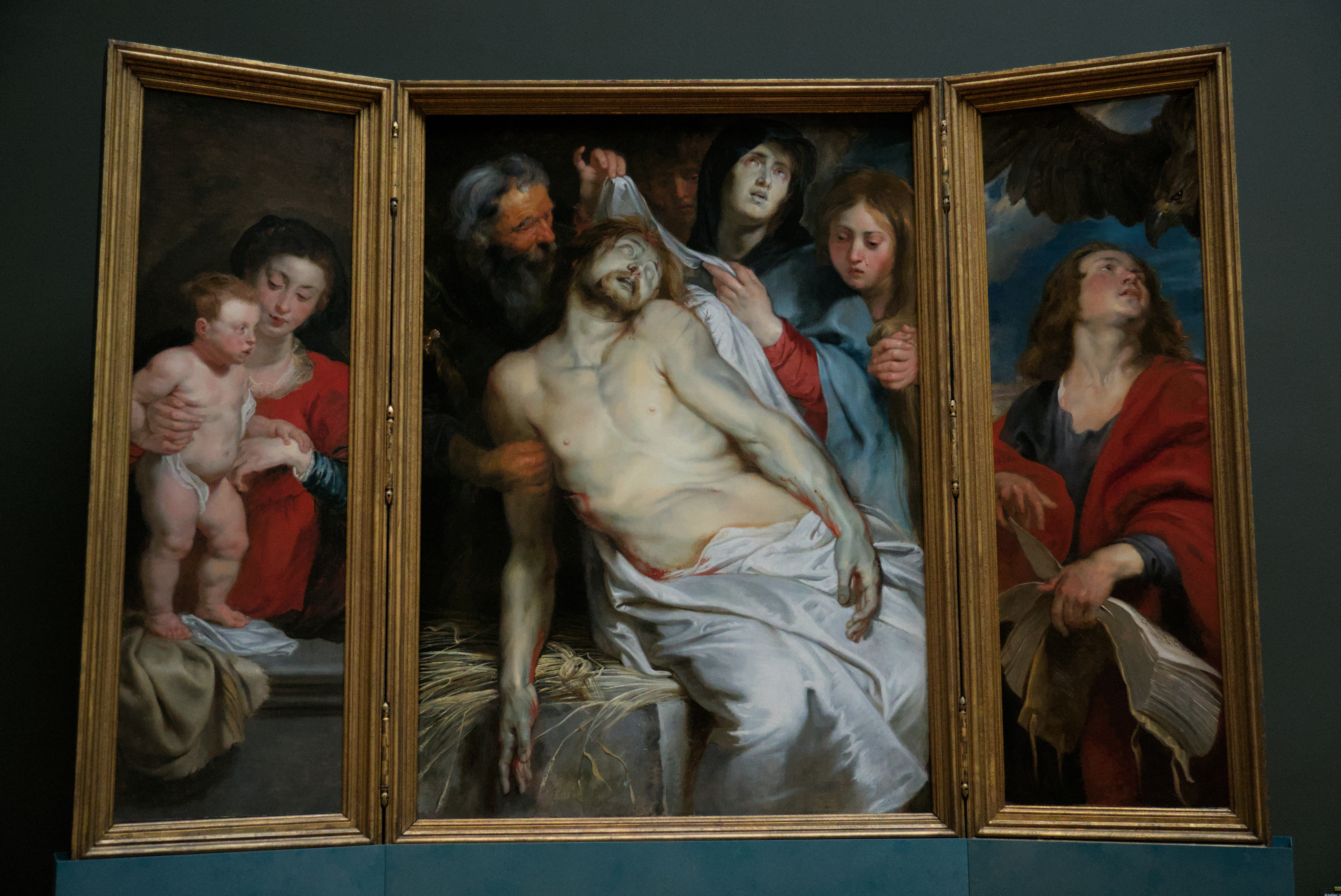
As one would expect, it’s inhabited by several Old Master paintings of Christ’s passion, most notably a triptych by the Flemish Baroque artist Peter Paul Rubens.
Peter Paul Rubens (Flemish, 1577–1640), Epitaph of Jan Michielsen and His Wife Maria Maes (aka Christ on the Straw, Madonna, and Saint John), 1618. Oil on panel, 138 × 178 cm. Koninklijk Museum voor Schone Kunsten Antwerpen (KMSKA, Royal Museum of Fine Arts Antwerp).
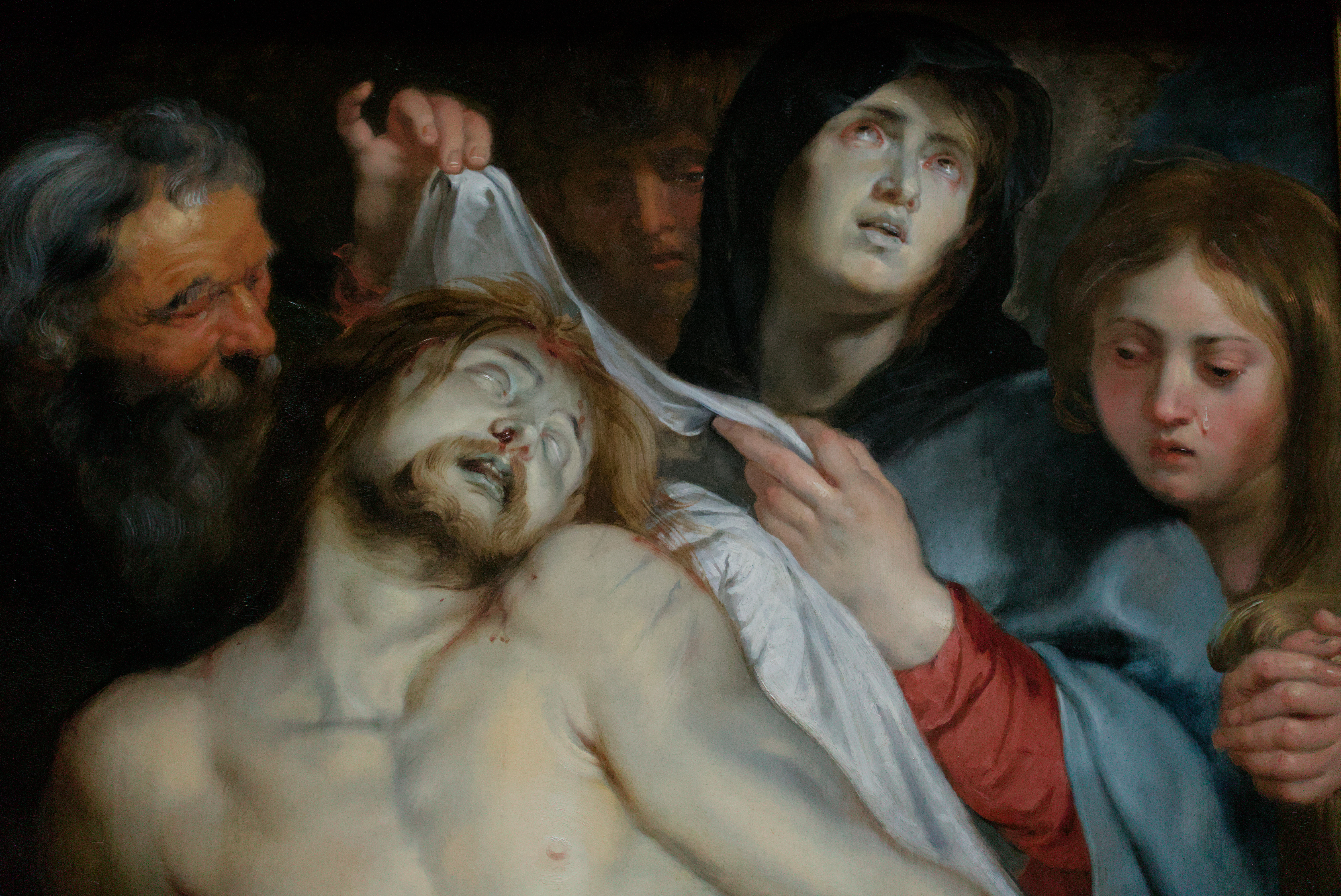
The central panel shows the dead Christ being laid out on a marble slab and wrapped in a shroud by Joseph of Arimathea, while his mother and Mary Magdalene (and the apostle John in the background) mourn him. The left wing shows Mary supporting the pudgy little baby Jesus as he takes some of his first steps, while the right wing shows John, whose symbol is the eagle, writing his Gospel that will place Jesus’s death in the context of the larger story of his life of ministry and his resurrection.
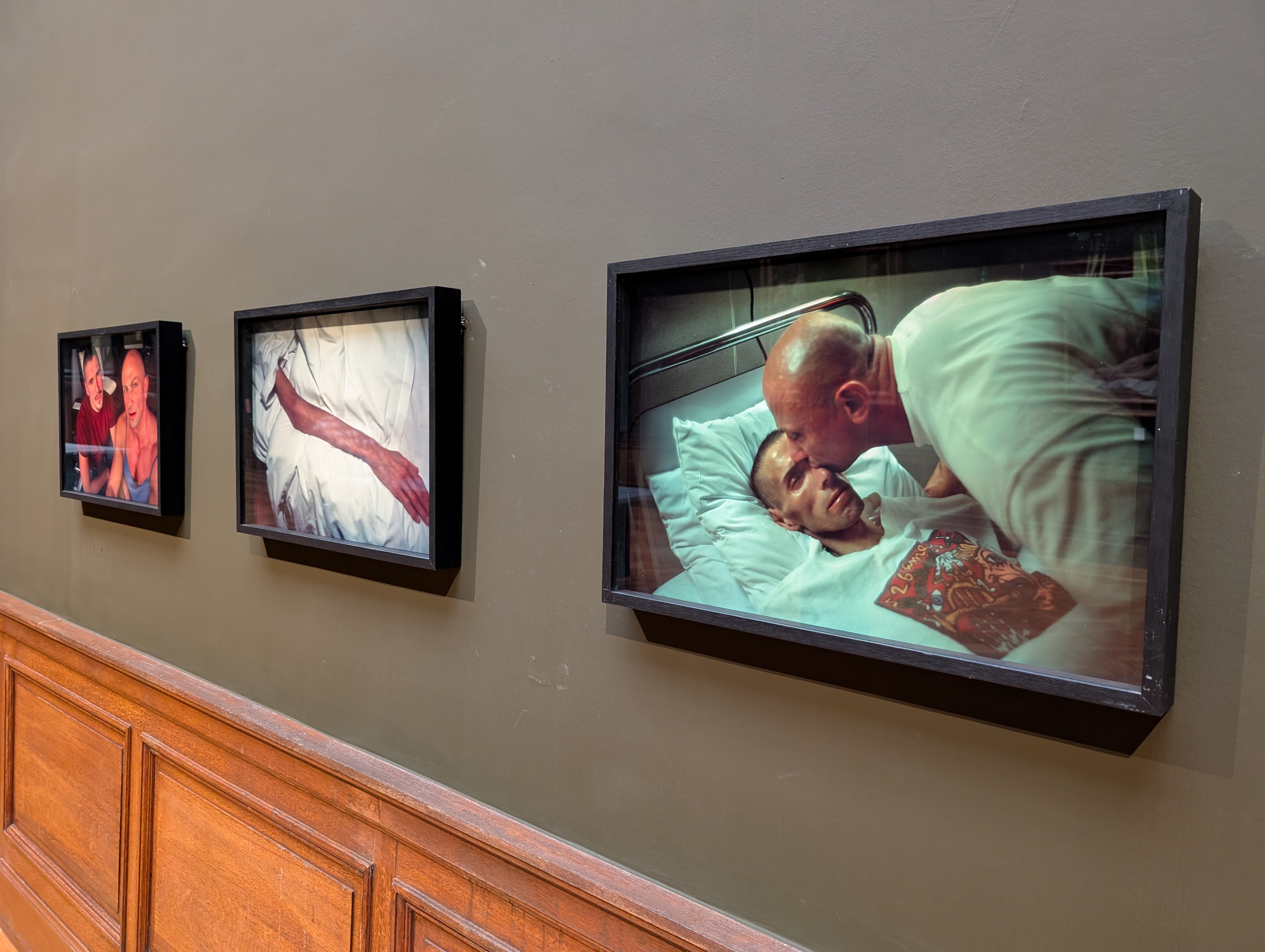
This painting, along with Anthony van Dyck’s Lamentation over the Dead Christ and The Holy Trinity by a follower of Rubens’s (which shows God the Father cradling the dead body of God the Son in an image type sometimes referred to as the Mystic Pietà), are juxtaposed with three photographs by Nan Goldin that show the impact of AIDS on her friend, the Parisian gallery owner Gilles Dusein, and his partner, the artist Gotscho.
Nan Goldin (American, 1953–), Gilles in Hospital, Gilles’ Arm, and Gotscho Kissing Gilles, 1993. C-prints. Private collection.
Dusein’s emaciated arm, resting weakly on a hospital sheet, recalls the limp arm of Christ in paintings of the Deposition and Entombment; and Gotscho’s kiss, the love and grief of Jesus’s mother and friends as they watched their loved one suffer and succumb to death.
By displaying these disparate artworks from vastly different contexts across from each other, we are encouraged to draw connections between the suffering of Christ and that of the LGBTQ+ community. While Christians in Rubens’s day would sit before images of Jesus in pain or sorrow or having died a torturous and untimely death, and deepen their empathy and love, so too might we do well to sit prayerfully, humbly, empathetically, with contemporary images of suffering, seeking to enter the stories they tell.
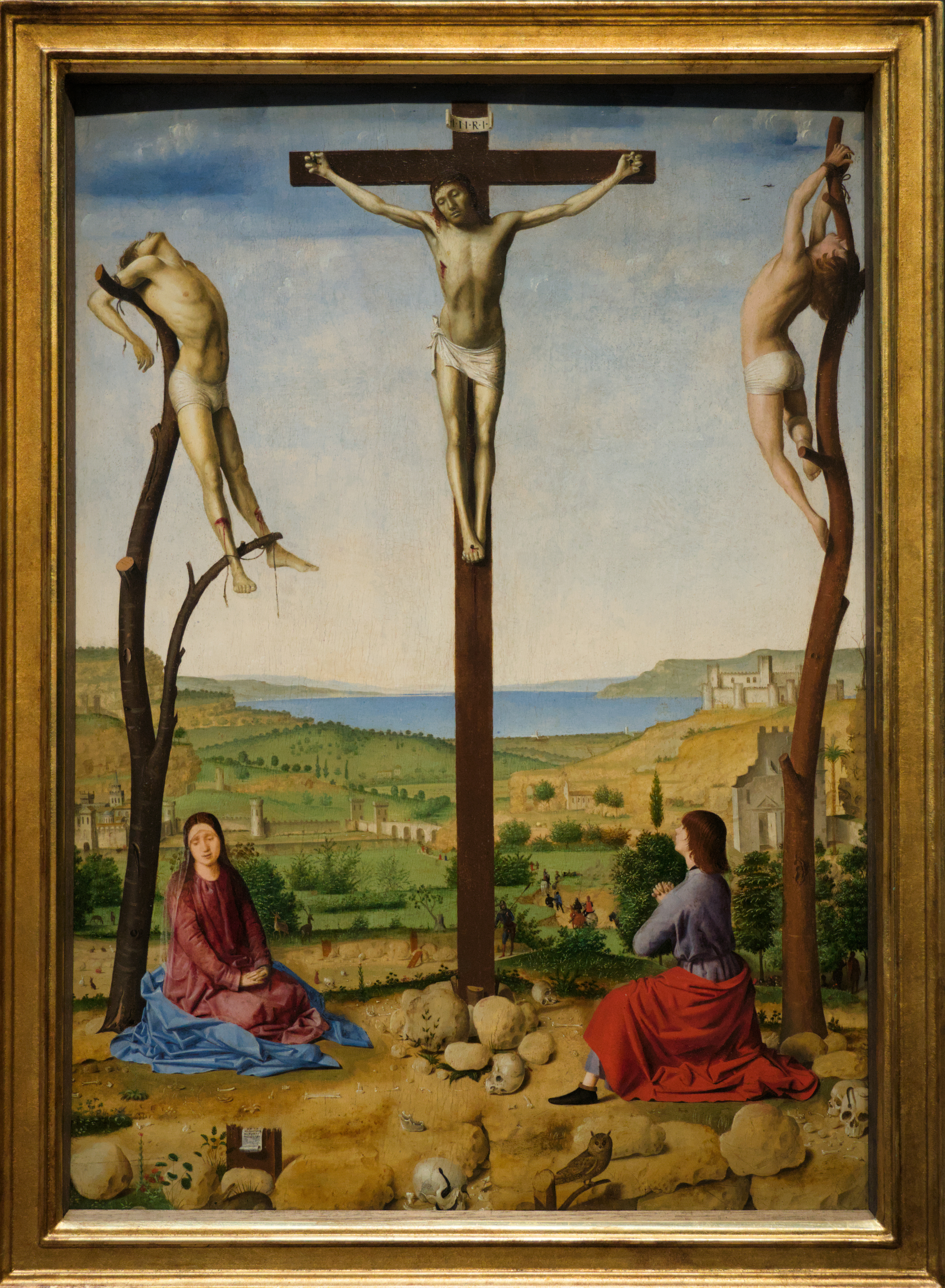
Antonello da Messina (Italian, 1430–1479), Calvary, 1475. Oil on panel, 52.5 × 42.5 cm. Koninklijk Museum voor Schone Kunsten Antwerpen (KMSKA, Royal Museum of Fine Arts Antwerp).
Compare these figures to contemporary Belgian artist Berlinde de Bruyckere’s Schmerzensmann (Man of Sorrows), on loan from the collection of David and Indré Roberts (see wide-view photo above). The piece consists of a wax and resin mold of a contorted human form, its skin stretched and broken, its legs wrapped around a tall rusty pole.
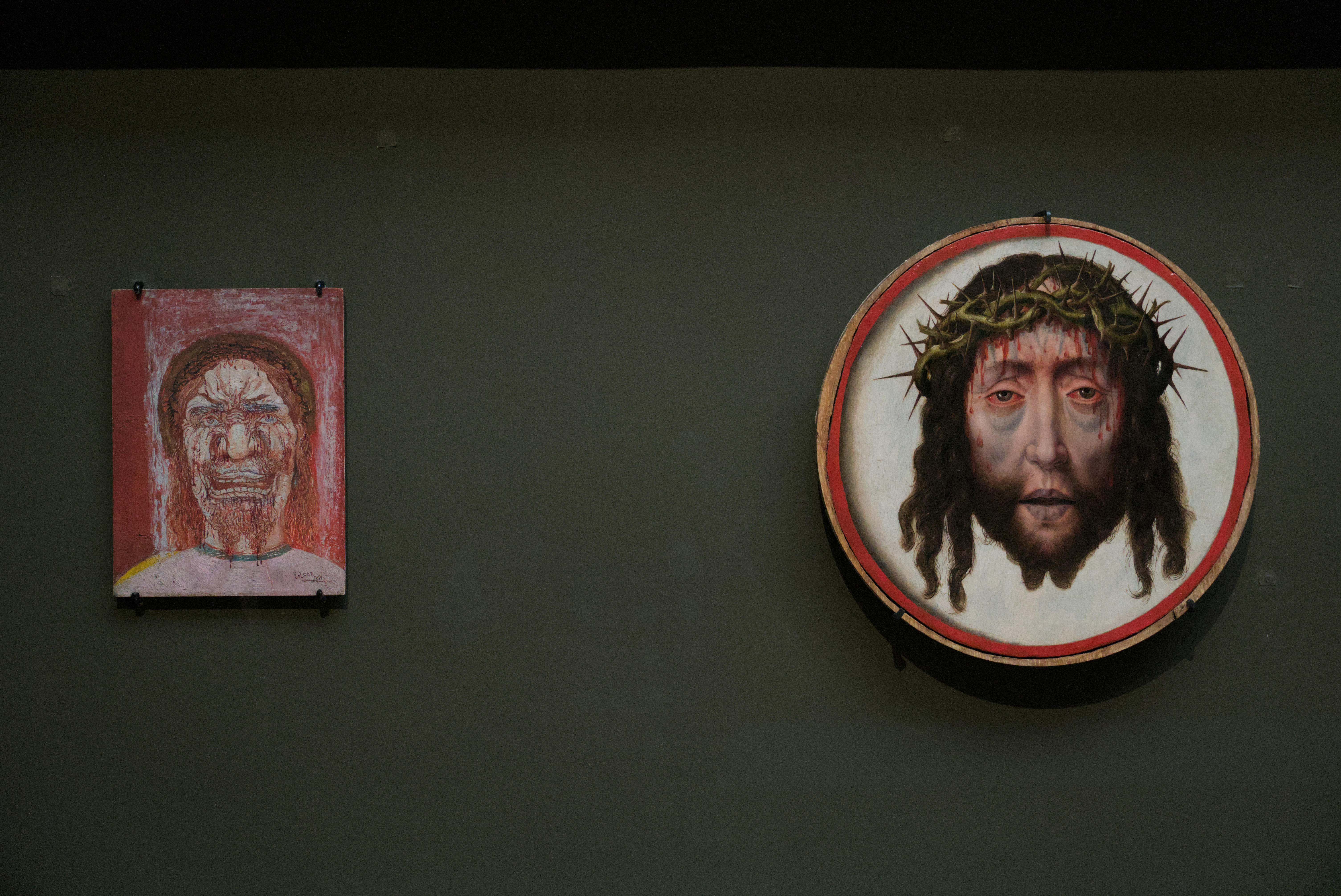
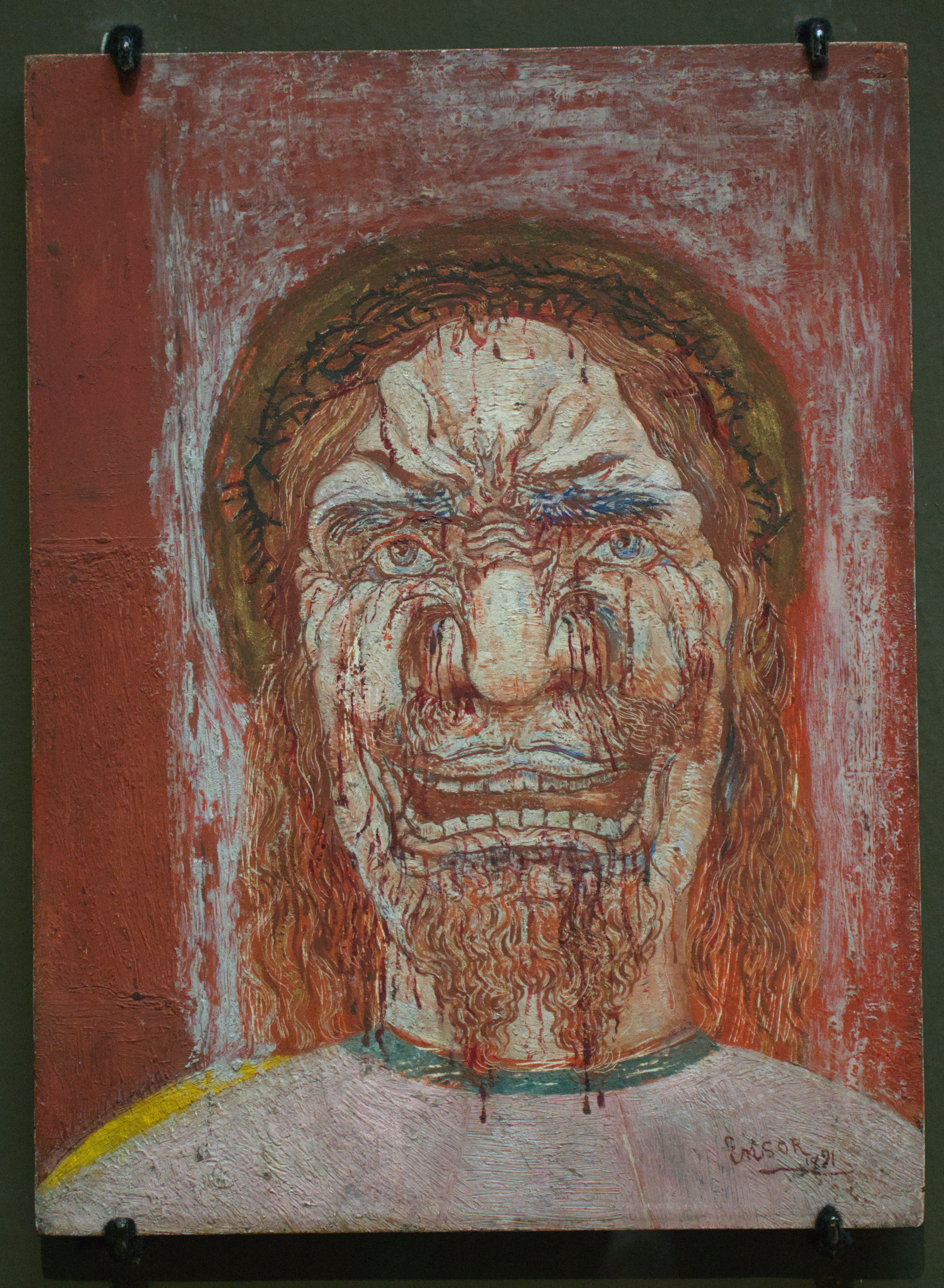
“Man of Sorrows” is also the title of an Early Netherlandish painting by Albrecht Bouts and a modern painting by James Ensor, which KMSKA displays side-by-side.
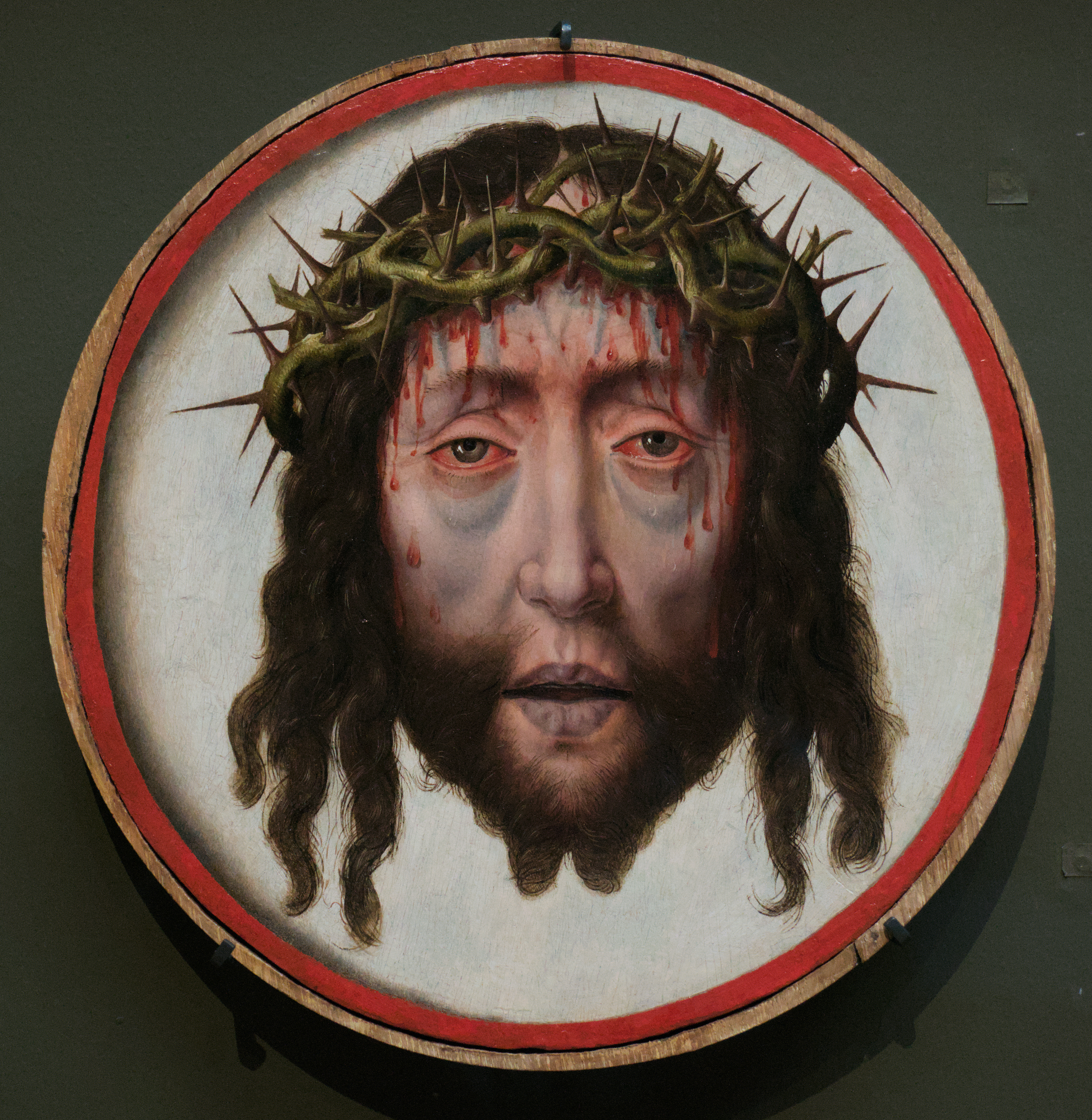
Albrecht Bouts (Flemish, 1451/55–1549), Man of Sorrows, 1500–1525. Oil on panel, diameter 29 cm. Koninklijk Museum voor Schone Kunsten Antwerpen (KMSKA, Royal Museum of Fine Arts Antwerp).
The earlier one is an incredibly moving image of pathos. Christ wears a thick, twisted, mock crown whose thorns dig holes into his forehead and draw blood. His eyes are red with tears and sunken in, and his lips are turning blue with the pallor of death. I find it quite beautiful, insofar as an image of suffering can be beautiful. (That’s a topic for another day.)
James Ensor (Belgian, 1860–1949), Man of Sorrows, 1891. Oil on panel, 20 × 15.5 cm. Koninklijk Museum voor Schone Kunsten Antwerpen (KMSKA, Royal Museum of Fine Arts Antwerp).
The Ensor painting, on the other hand, is decidedly not beautiful. In fact, I think it’s the ugliest image of Christ I’ve ever seen, with his crumpled face, scraggly hair, and bared teeth. There’s something very unsettling about his expression, and no wonder, as the curatorial text informs that Ensor drew inspiration from the masks of demon characters in Japanese theater. “His [Ensor’s] Jesus screams with rage about the injustice inflicted on him,” the label says. Is that what that expression is? To me he looks sinister. Like he’s growling at us. And I dislike his dinky crown that he wears like a headband; give me Bouts’s gnarly one instead.
I’m in favor of Christ images that show the rage he must have felt, but I don’t think Ensor is successful if that was his aim. To name a few modern artists who were: Guido Rocha (Tortured Christ, 1975) and David Mach (Die Harder, 2011), both of whom capture Jesus’s cry of dereliction on the cross.
The final themed gallery I’ll call out is “Heavens.”
Gallery 2.22 (“Heavens”) from the KMSKA exhibition Collected with Vision: Private Collections in Dialogue with the Old Masters
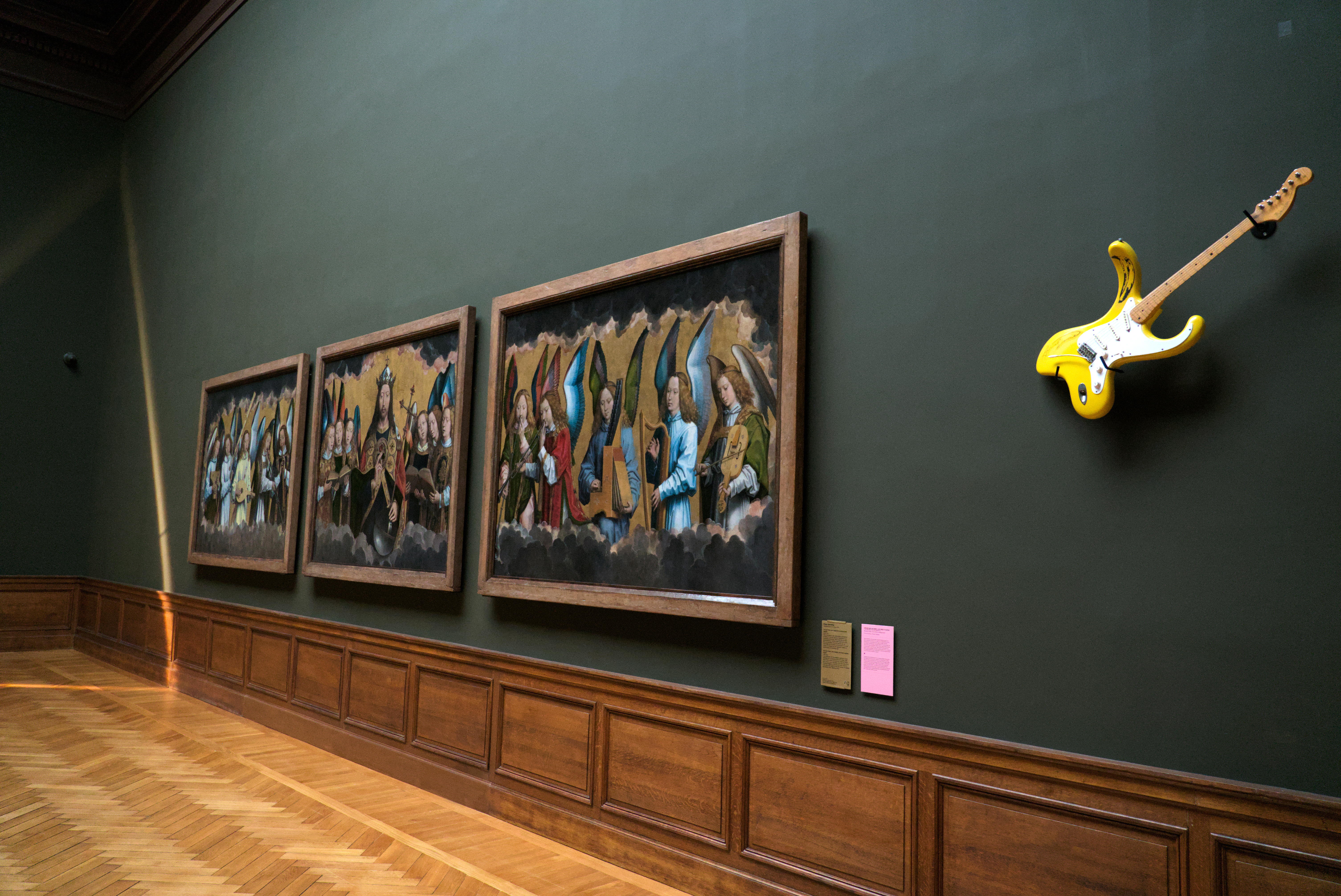
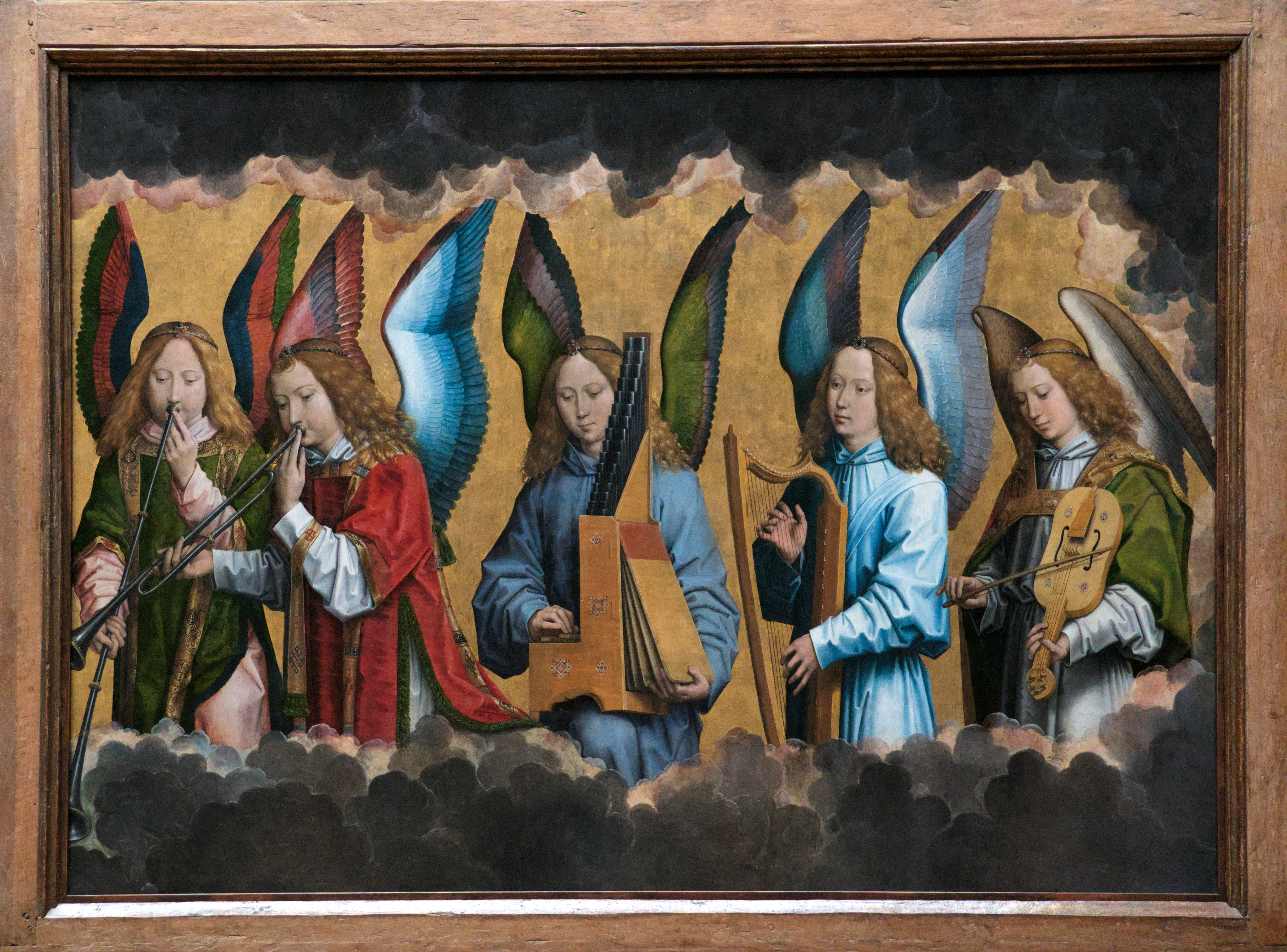
The dominant Old Master work is a set of three panels from the upper tier of a colossal altarpiece that Hans Memling painted for the church at the Benedictine Abbey of Santa Maria la Real in Najera in northern Spain. All the other panels are lost.
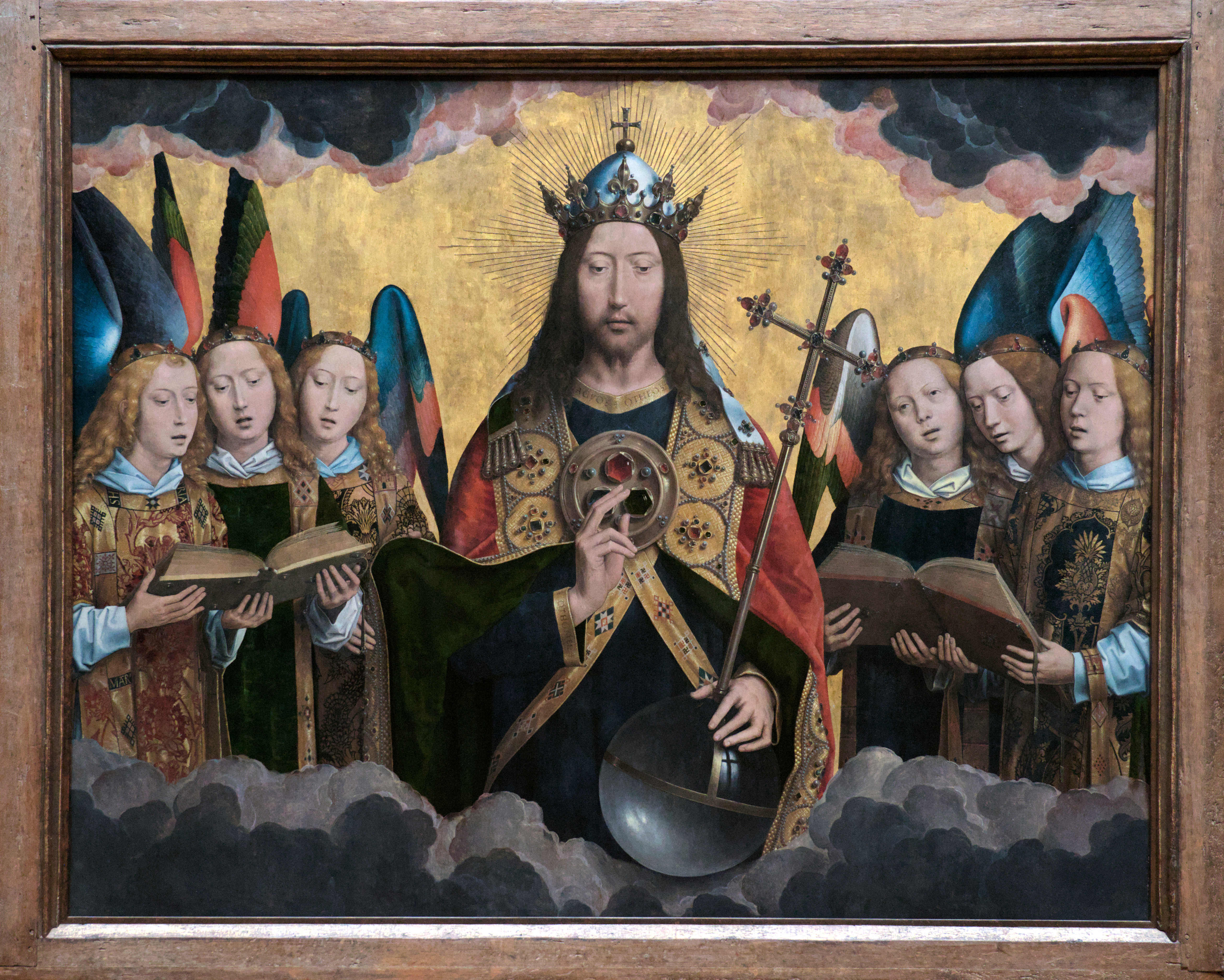
The museum titles the central panel God the Father with Singing Angels—but I think the figure is more properly God the Son, Jesus Christ, portrayed as Salvator Mundi (Savior of the World). In his left hand he holds a cross-surmounted crystal globe, signifying his dominion over the earth, and with the other hand he gestures blessing. He wears a tiara and a red cope decorated with gold-thread embroidery, pearls, and precious stones, and his collar bears the words Agyos Otheos (Holy God).
Hans Memling (German Flemish, ca. 1430–1494), God the Father with Singing Angels, 1483–94. Oil on panel, 164 × 212 cm. Koninklijk Museum voor Schone Kunsten Antwerpen (KMSKA, Royal Museum of Fine Arts Antwerp).
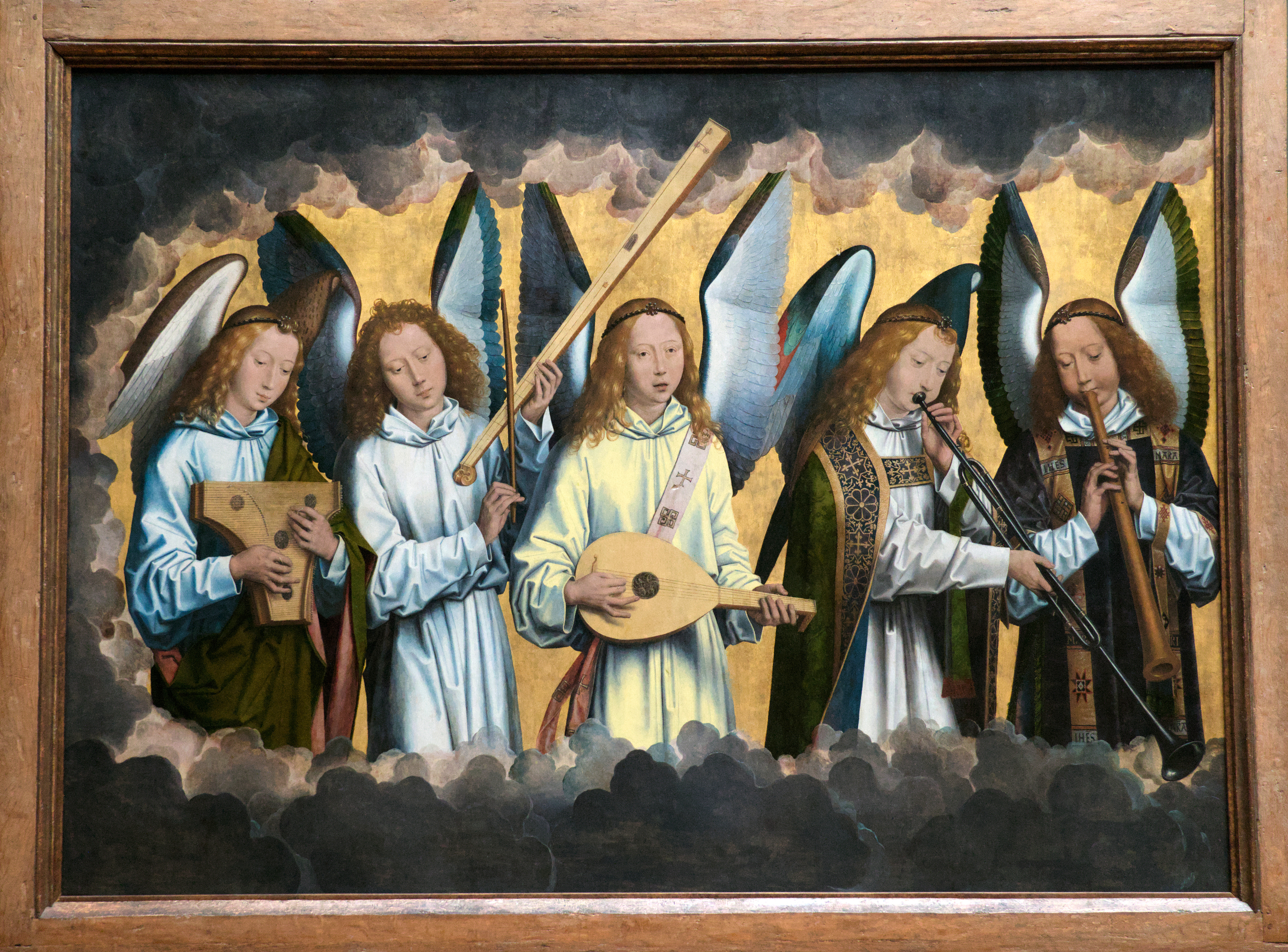
Surrounding him is a musical band of angels, singing his praises from songbooks and, in the flanking panels, playing a variety of wind and string instruments: (from left to right) a psaltery, a tromba marina, a lute, a trumpet, a shawm, a straight trumpet, a looped trumpet, a portative organ, a harp, and a fiddle.
Hans Memling (German Flemish, ca. 1430–1494), Music-Making Angels (left), 1483–94. Oil on panel, 165 × 230 cm. Koninklijk Museum voor Schone Kunsten Antwerpen (KMSKA, Royal Museum of Fine Arts Antwerp).Hans Memling (German Flemish, ca. 1430–1494), Music-Making Angels (right), 1483–94. Oil on panel, 165 × 230 cm. Koninklijk Museum voor Schone Kunsten Antwerpen (KMSKA, Royal Museum of Fine Arts Antwerp).
This ensemble probably evokes for you a particular sound—something like Tallis or Palestrina—soaring polyphonic vocals, a gentle yet majestic accompaniment. But instead, a different soundtrack played, audibly, in the room: songs from the 1967 debut album of the American rock band the Velvet Underground, several of which use religious language to describe the experience of doing drugs. “Heroin” opens like this:
I don’t know just where I’m going But I’m gonna try for the kingdom, if I can ’Cause it makes me feel like I’m a man When I put a spike into my vein
And I’ll tell you things aren’t quite the same When I’m rushing on my run And I feel just like Jesus’ son
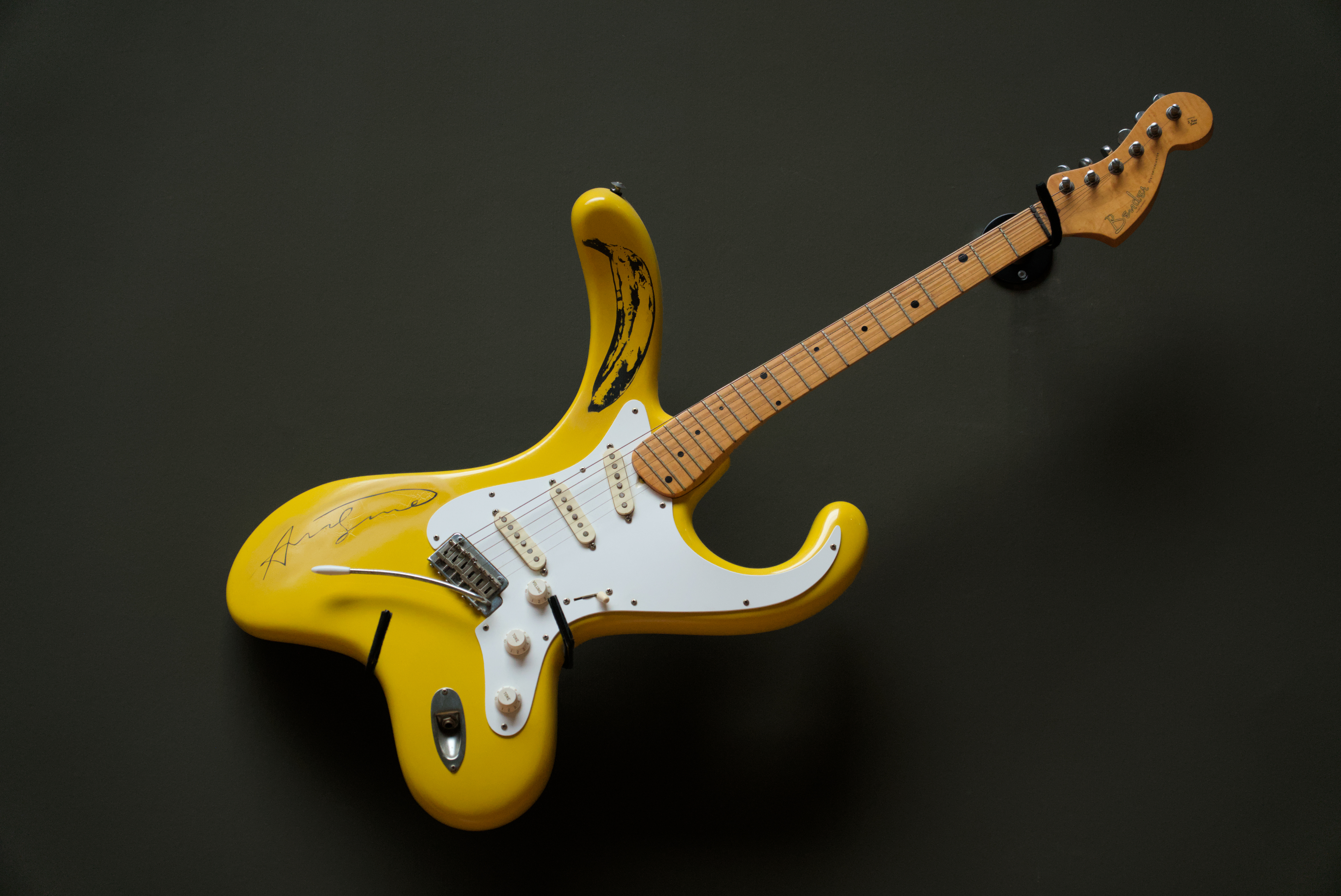
This aural element was complemented, on the gallery wall, by the guitar of Lou Reed, the band’s lead singer and songwriter. It’s signed by Andy Warhol, who produced and championed the Velvet Underground & Nico album and made its banana cover art, replicated on the instrument.
Lou Reed’s “Banana Guitar,” from a private collection
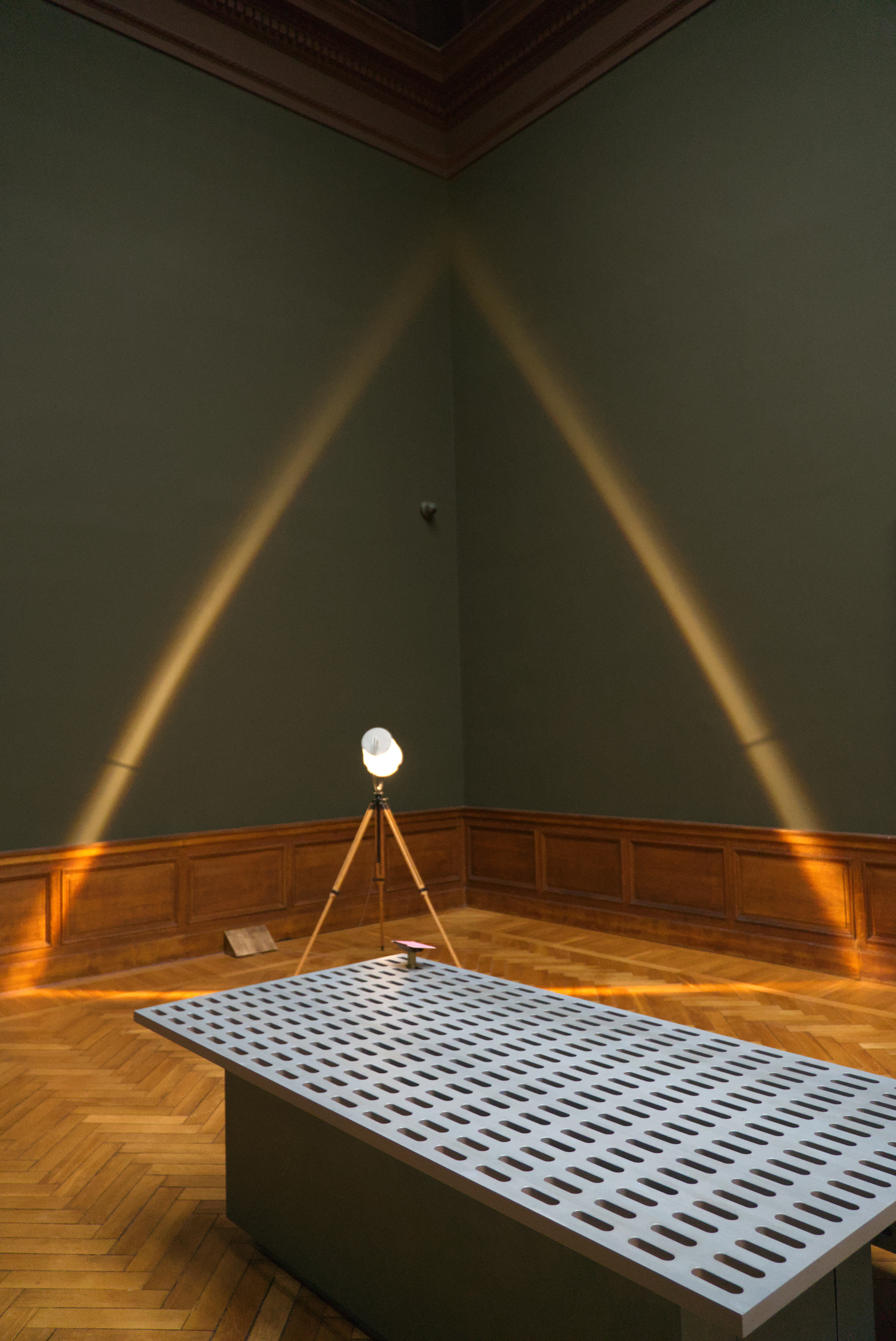
Adding to the mix, in the corner of the room was an installation by the Copenhagen-born and -based artist Olafur Eliasson, called Lighthouse Lamp. “Affixed to a tripod, a lamp situated within a Fresnel lens—a compact lens which was developed for lighthouses—emits a band of white light in 360 degrees,” the artist’s website explains. In this space, the beam takes on a triangular shape.
Olafur Eliasson (Icelandic Danish, 1967–), Lighthouse Lamp, 2004. Mixed media. Collection of Filiep and Mimi Libeert.
There was also an altarpiece of The Last Judgment and the Seven Acts of Mercy by Bernard van Orley, which references Jesus’s teaching in Matthew 25 about one’s entry into heaven being contingent on whether, in this life, you feed the hungry, give shelter to the homeless, visit the prisoner, and so on.
The “Heavens” gallery begs the question: How does one define “heaven”? Is it a physical place? A state of mind? An encounter? I think of related words like bliss, beatitude, communion, the sublime.
The celestial scene painted by Memling—and remember, it’s only partial, as the rest is missing—is beautifully rendered, but it also encapsulates what has become the popular cliché of heaven: angels on clouds, strumming harps, and a regal God swaying his scepter. Music-making, angelic beings, and the reign of God are all certainly a part of how the Bible describes heaven. But it’s also so much more. It’s a garden and a city. It’s healing and restoration. It’s the righting of wrongs. It’s all things made new. It’s jubilee. It’s a wedding—deep and lasting union between God and humanity. It’s an eternal interlocking of God’s space and ours (earth). It’s a global, transhistorical community of faith, gathered together around Christ their head, worshipping him in diverse languages, musical styles, dances, and other cultural expressions. It’s the culmination of the greatest story ever told.
Today, Memling’s vision of heaven probably fails to captivate most people, even Christians. So it’s an interesting experiment to compare it to how others conceive of the concept.
Eliasson’s Lighthouse Lamp wasn’t a commission on or explicit treatment of the theme, but the curator saw fit to place it beside Memling, because heaven is often conceived of as a light-filled space, and light can evoke the divine. For this reason, Memling painted his background gold. What’s more, the three-sidedness of Eliasson’s light beam may, for some, evoke the Trinity, the classical Christian doctrine of Father, Son, and Holy Ghost that Memling alludes to with the three precious stones on the fibula of Christ’s mantle.
Still, other folks experience what could be termed “heavenly” transcendence through the use of mind-altering substances, as did the members of the Velvet Underground, whose drug trips gave birth to their experimental music—which, in turn, has taken others to a transcendent place.
Whether in special exhibitions or displays of their permanent collections, I want to see more of this in museums: bringing old and new artworks into conversation with one another around universal themes, in the same room. (In some museums, the labels sometimes cross-reference works in other galleries, but that’s not the same.) Although there are benefits to the traditional approach of laying out art chronologically to give you discrete pictures of different historical eras and allow you to progress by time period, a thematic approach that compiles works from across time also has its benefits.
I’ve found cross-temporal art displays to be especially vitalizing, because instead of trying to tell history, they more naturally invite personal reflection and tend to be less academic in tone. Such an approach makes the art accessible to a larger number of people, especially those who don’t frequent museums. It helps us see the relevance of the Old Masters (or whatever the museum’s collection focus) for today—how the subjects they depicted often address topics or questions we still ask or wonder about or that reflect aspects of the common human experience, such as joy, suffering, family, death, betrayal, or festivity. Creating relationships between works made centuries apart, highlighting similarities and differences, can give us a broader perspective.
And for this museumgoer (pointing at myself) who is attracted to medieval and early Renaissance art and sometimes bypasses the contemporary galleries, the integrative approach is more engaging. Giving contemporary works a point of connection with the works I’m already inclined to like helps me enter into them more easily and fruitfully, and I’m more likely to spend time with them than if they were segregated.
New and old don’t have to be equally represented—Kolumba skews heavily contemporary, whereas KMSKA lets its strengths shine with the Old Masters, and yet the occasional unexpected intervention from years past or future always caused me to pause and be curious. Over the last several years I’ve been noticing other museums engaging in similar playful exchange—plopping a contemporary work into the medieval section, or vice versa, in a way that provides some kind of illumination.
This was my first and only visit to KMSKA, and as I understand, there’s not the same degree of intermixing of old and new year-round; this was a special exhibition that brought in contemporary works from outside, as the institution itself owns very few. But they did do something similar last year with the exhibition What’s the Story?, and the dangling light poems by Bernard Dewulf are a permanent fixture in the Old Masters galleries.
Have you been to a museum where works from different time periods were displayed side-by-side to create a discourse, and if so, did that choice enhance your engagement, insight, or appreciation? I’d love to hear what other museums are doing this!
This article took me some forty hours to write and to select and edit photos for. If you appreciate learning about my museum experiences and having access to high-resolution, downloadable art images, would you please consider adding to my “tip jar” (PayPal), or sponsoring a book from my Amazon wish list? Thank you!
One of the delightful surprises of my recent trip to Germany and Belgium was to find, in two of the museums I visited, an integration of the old and new in the curated galleries. Typically, art museums choose to arrange their collections chronologically, grouping together artworks from a particular era, and within each era, like styles. But in Kolumba museum in Cologne and the Koninklijk Museum voor Schone Kunsten Antwerpen (KMSKA) in Antwerp, medieval art from each museum’s collection (and in the case of KMSKA, Renaissance and Baroque art too) is displayed alongside contemporary pieces, creating a vibrant dialogue.
With the exception of the exterior shot of Kolumba, all photos in this post are my own.
Kolumba Kunstmuseum, Cologne
Originally called the Diözesanmuseum (Diocesan Museum), Kolumba was founded in 1853 by the fledgling Christlicher Kunstverein für das Erzbisthum Köln (Christian Art Association for the Archbishopric of Cologne), making it the city’s second oldest museum after the Wallraf-Richartz-Museum. Its collection focus for the majority of its history was late medieval art from Cologne and the Lower Rhine.
Kolumba’s first permanent home, just south of Cologne Cathedral, was a former sugar factory, but the building was destroyed in World War II, though much of the art had been safely evacuated beforehand. After the war, Kolumba relocated its art to a grammar school, then to rented rooms in the Gereonstraße, then to the Curia building at Roncalliplatz 2. But the limited space was an issue.
In 1989, ownership of the museum was transferred to the Archdiocese of Cologne, who decided to expand the collection to include modern and contemporary art, not only by German artists but by international artists as well. The museum shifted its approach from displaying traditional sacred works only, to placing those works in juxtaposition with newer ones by artists who aren’t necessarily Christian but whose works can converse fruitfully with their core collection. They also secured funding to construct a new permanent building.
In 2004, the museum’s name was changed to Kolumba in honor of the history of the site on which the new (and current) building would stand: atop the ruins of the medieval St. Kolumba church, destroyed in an air raid in 1943. St. Columba of Sens was a third-century virgin martyr who was born in Spain but lived mostly in France. The church dedicated to her in Cologne once housed Rogier van der Weyden’s St. Columba Altarpiece (now at the Alte Pinakothek in Munich), a triptych with scenes of the Annunciation, the Adoration of the Magi, and the Presentation in the Temple.
Kolumba museum, Cologne. Photo: HP Schaefer / Wikimedia Commons.
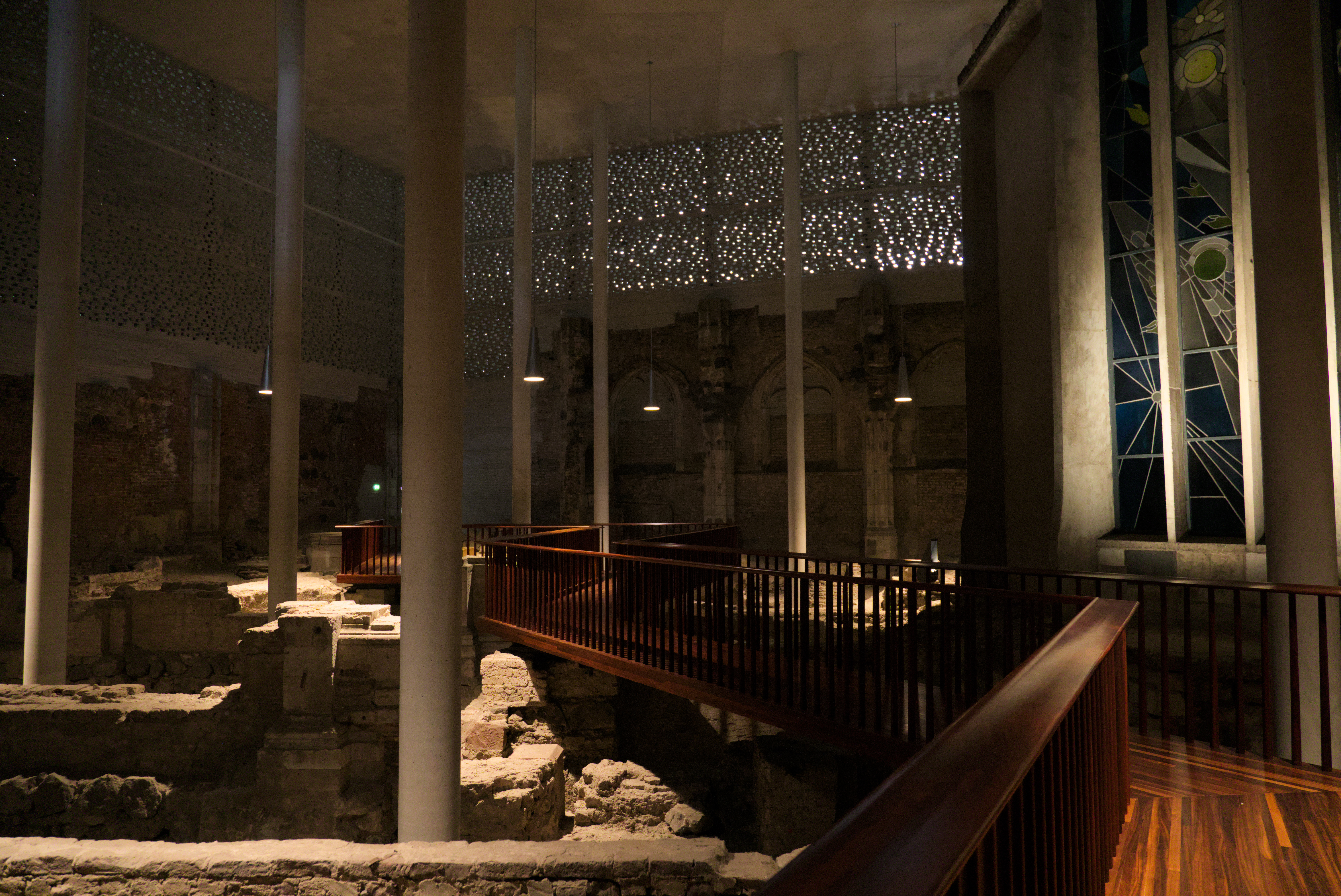
Kolumba museum’s permanent home opened in 2007 at Kolumbastraße 4. Designed by the Swiss architect Peter Zumthor (view more architectural photos here), the building encapsulates the bombed-out Gothic ruins of St. Kolumba with forty-foot-high, porous concrete walls, above which sit the floors of the museum.
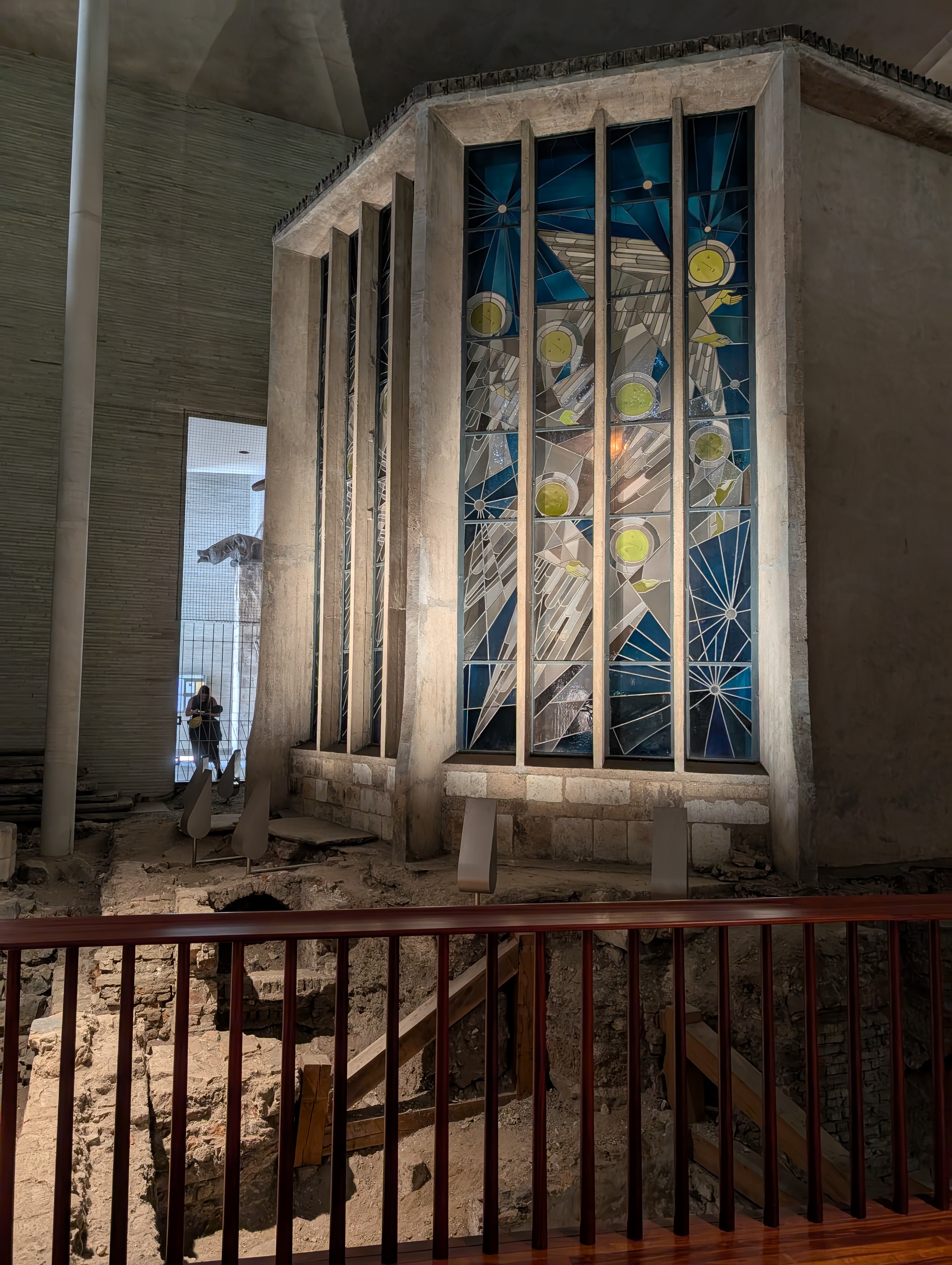
The ruins of St. Kolumba church, which dates back to the tenth century (with subsequent expansions and a Gothic-style rebuilding), are integrated into the architecture of Kolumba museum.Exterior of the “Madonna in the Ruins” chapel, dedicated 1950, underneath Kolumba museum in Cologne, with stained glass designed by Ludwig Gies (1887–1966), installed 1954.
The postwar chapel is not accessible from inside the museum; it has its own separate entrance, which, as I found out after I had already left, is on the south side of the building, along Brückenstraße.
But I did cross over the excavation site of St. Kolumba to which the written museum guide directs visitors (it’s labeled “room 3”), and through which a walkway has been constructed. As I took in the war-wrought devastation, I wondered about the sounds I was hearing from an audio system. Turns out it was a sound installation called Pigeon Soundings by the American artist Bill Fontana. In 1994, he made a series of eight-channel sound map recordings of the pigeons that were inhabiting the St. Kolumba ruins at the time, particularly the rafters of the temporary wooden roof that had been erected. The recordings picked up not just the birds’ cooing and flapping, but also the ambient sounds outside.
Above this darkened space, Kolumba has sixteen exhibition rooms. The museum reinstalls its collection annually, each fall opening a new exhibition. I was there for the first day of “make the secrets productive!” Art in Times of Unreason, which runs from September 15, 2025, to August 14, 2026. The lack of art signage throughout is deliberate, to promote a more meditative experience; instead, visitors are given a (German-language) booklet, organized by room, that identifies the pieces on display and provides commentary for some.
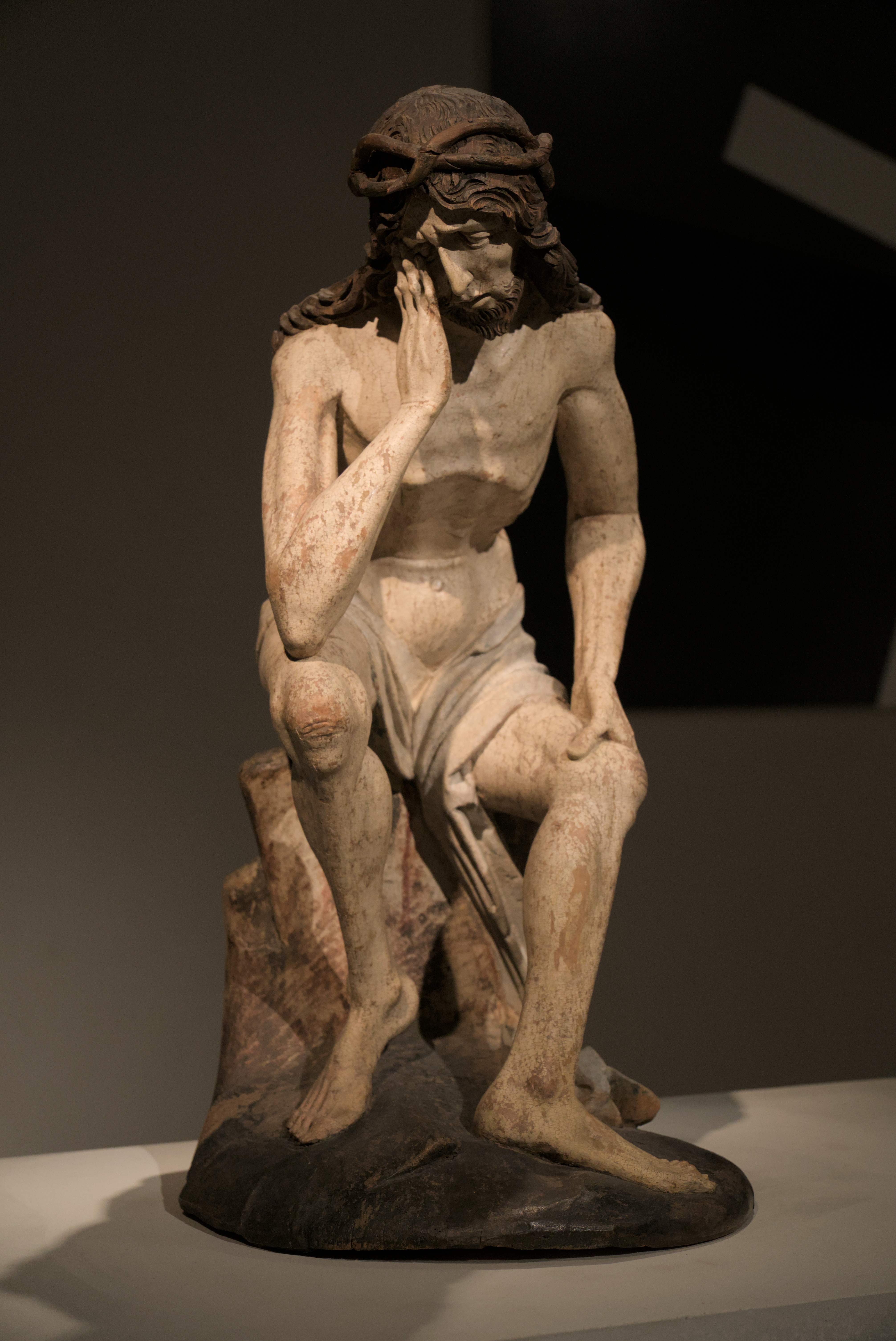
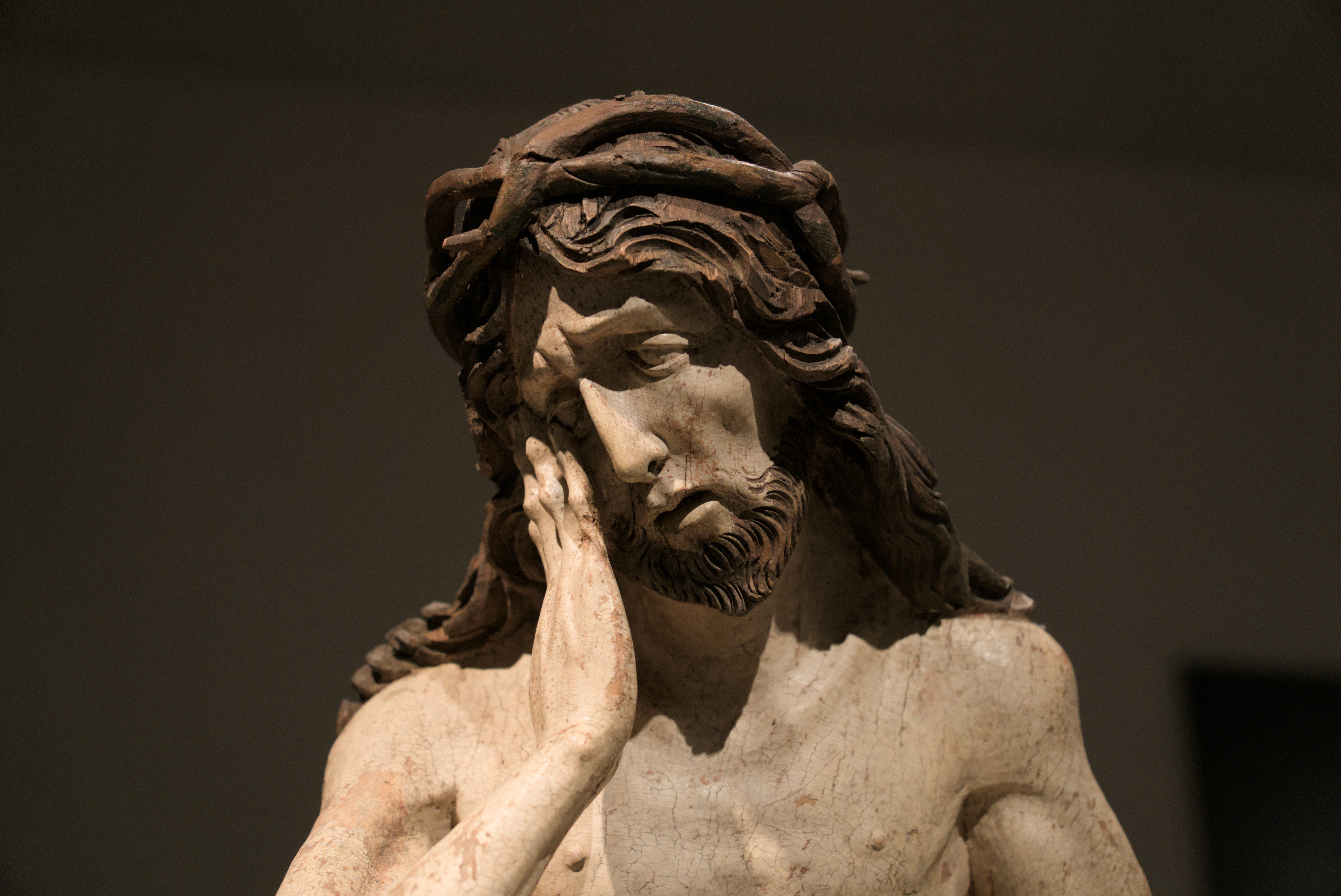
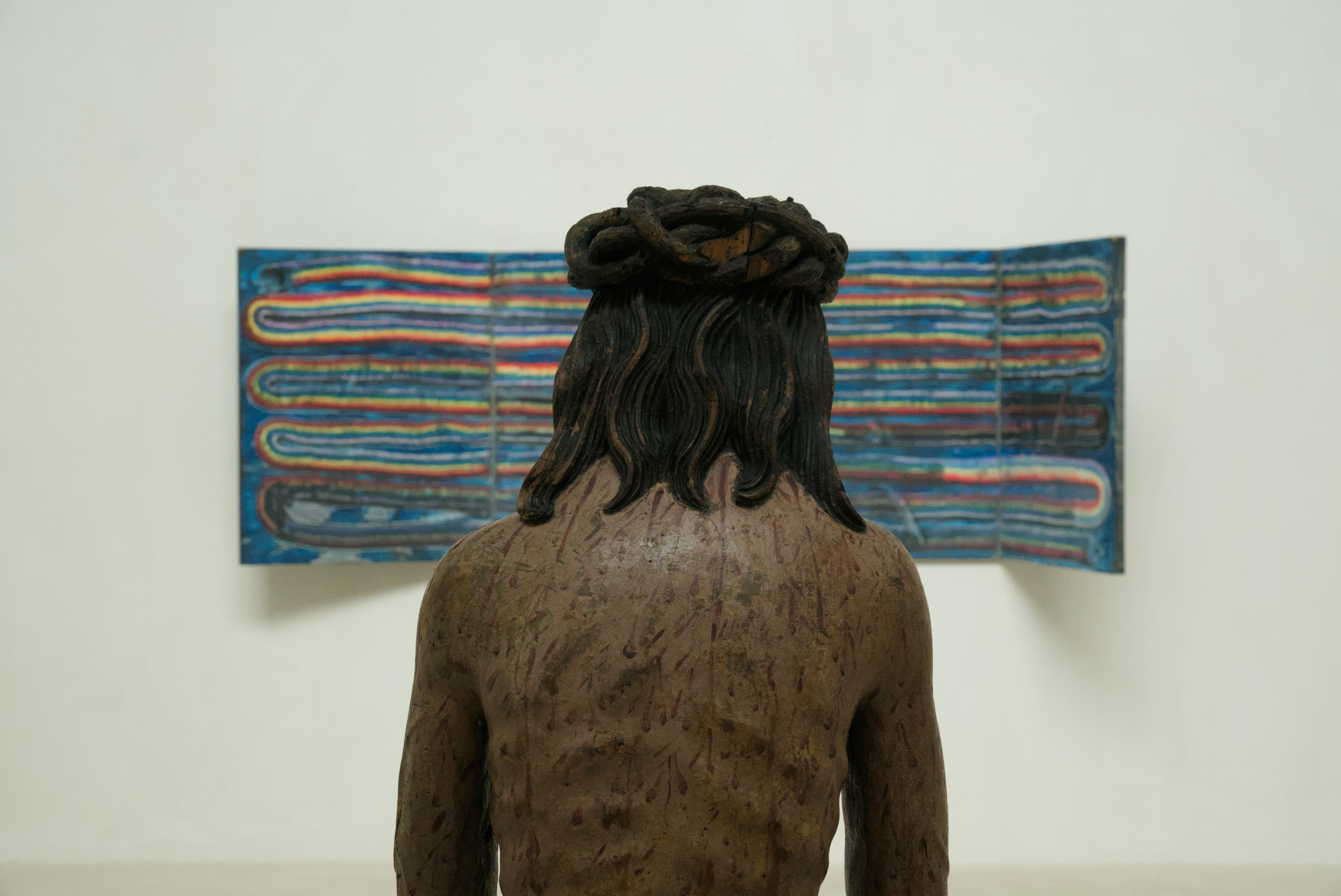
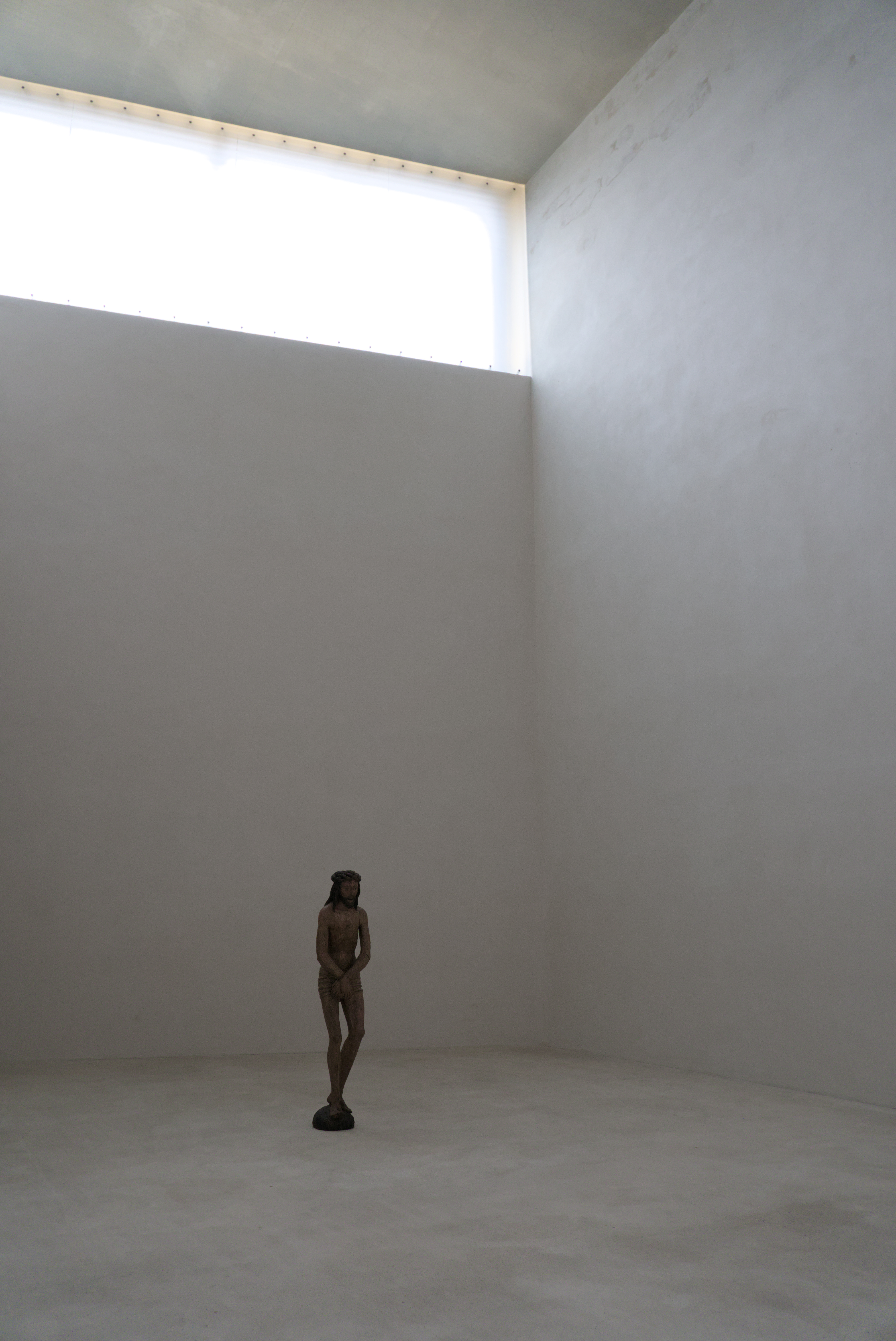
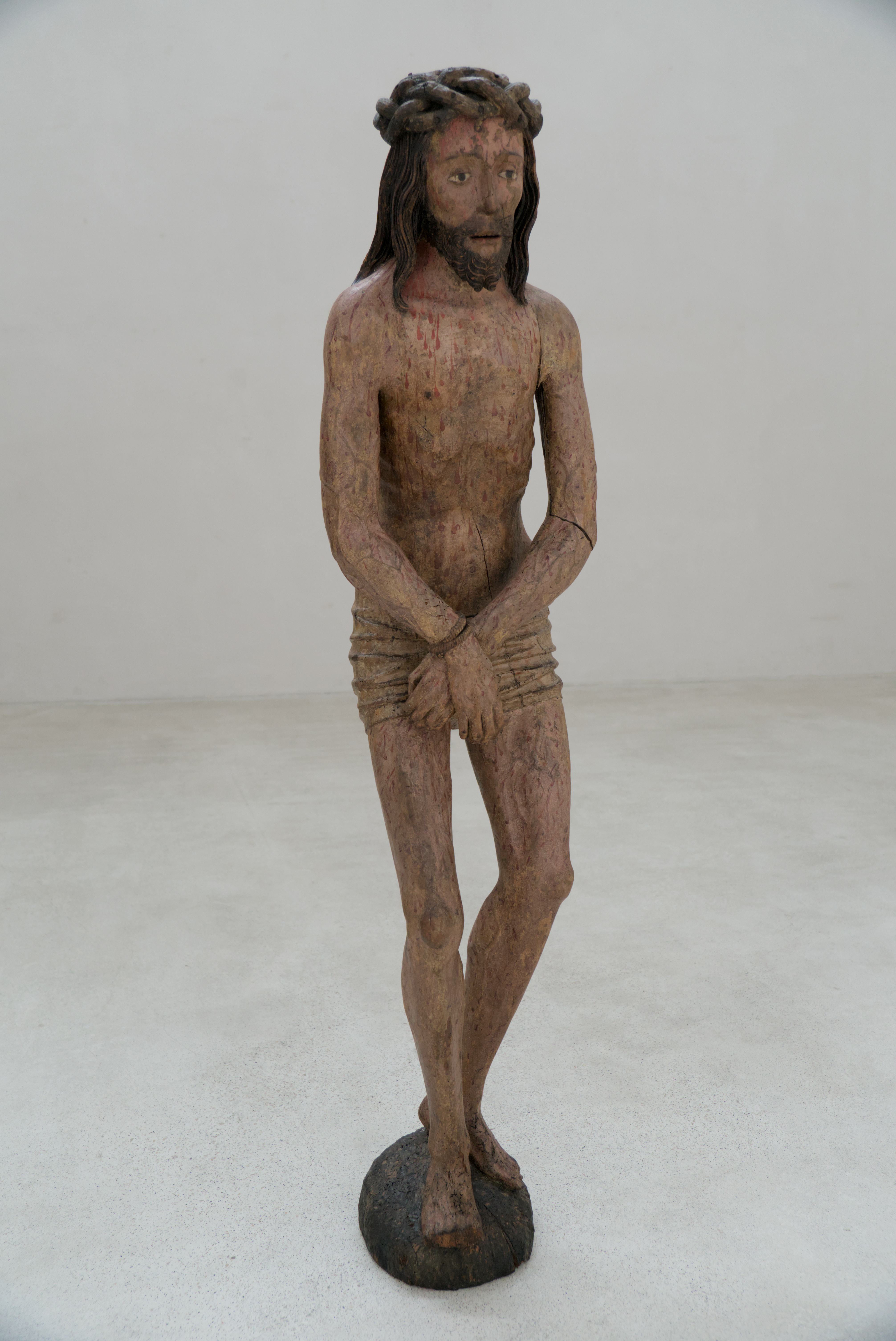
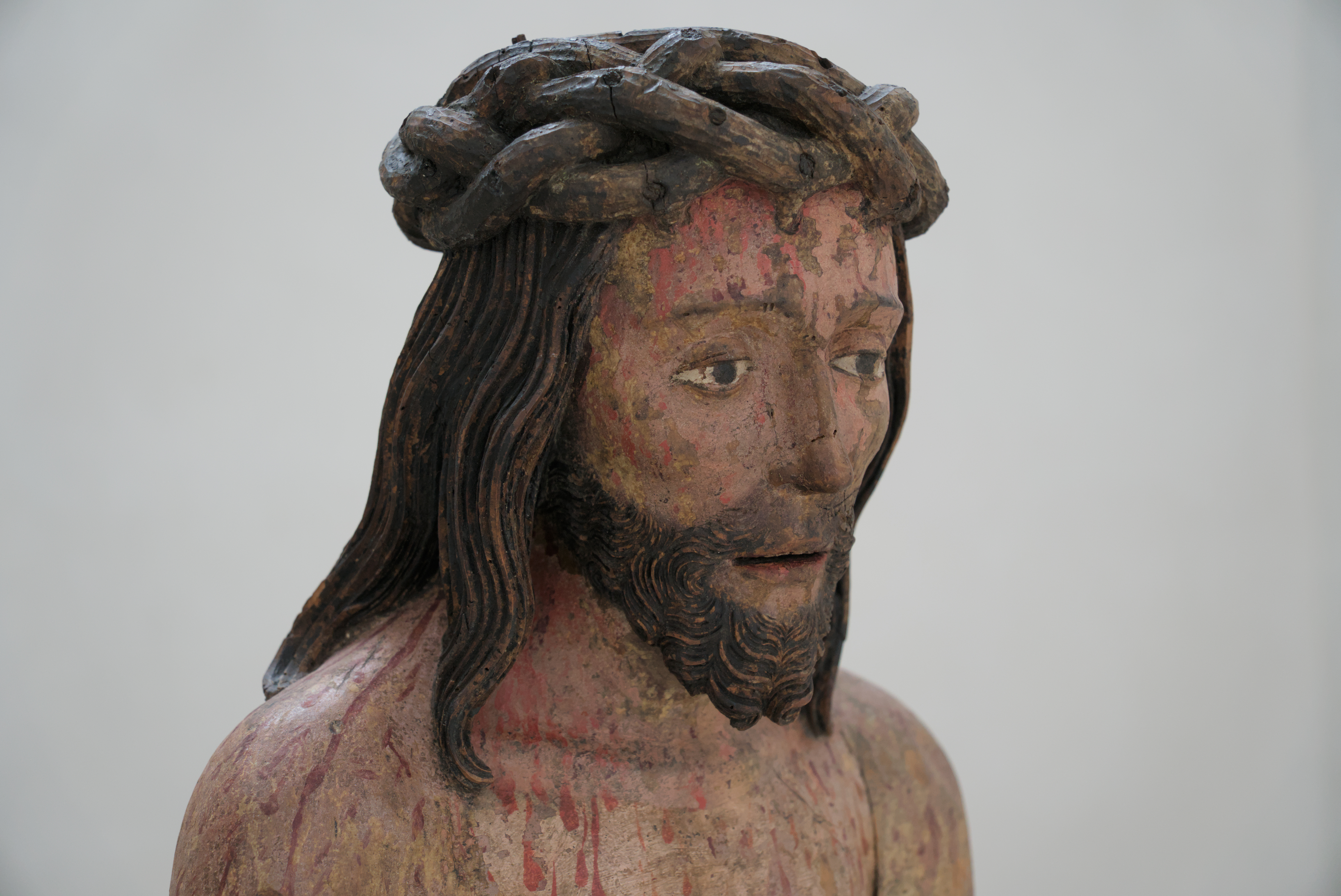
Room 8 features a fifteenth-century sculpture of Christ at Rest—“at rest” not in the sense of being at peace in mind or spirit (he is visibly troubled), but rather in a bodily state of motionlessness or inactivity. Sometimes also called Christ in Distress, Christ on the Cold Stone, or Pensive Christ, the iconography shows an interior moment during Christ’s passion in which, having just been flogged, he sits awaiting his final torture: crucifixion.
Christus in der Rast (Christ at Rest), Upper Rhine, ca. 1480. Linden wood with visible primer and remnants of colored paint. Kolumba museum, Cologne.
Though the Gospels don’t mention a moment of seated pause in the narrative, artists were influenced by the figure of Job, an innocent sufferer who in that way prefigured Christ, and in particular the description in Job 2:8 of him sitting on a dung heap. The image of Jesus preparing to meet his death was meant to inspire feelings of pity. Isolated from the action and from all the other characters, the lone figure invites viewers to enter empathetically into the emotional anguish he suffered on his way to the cross.
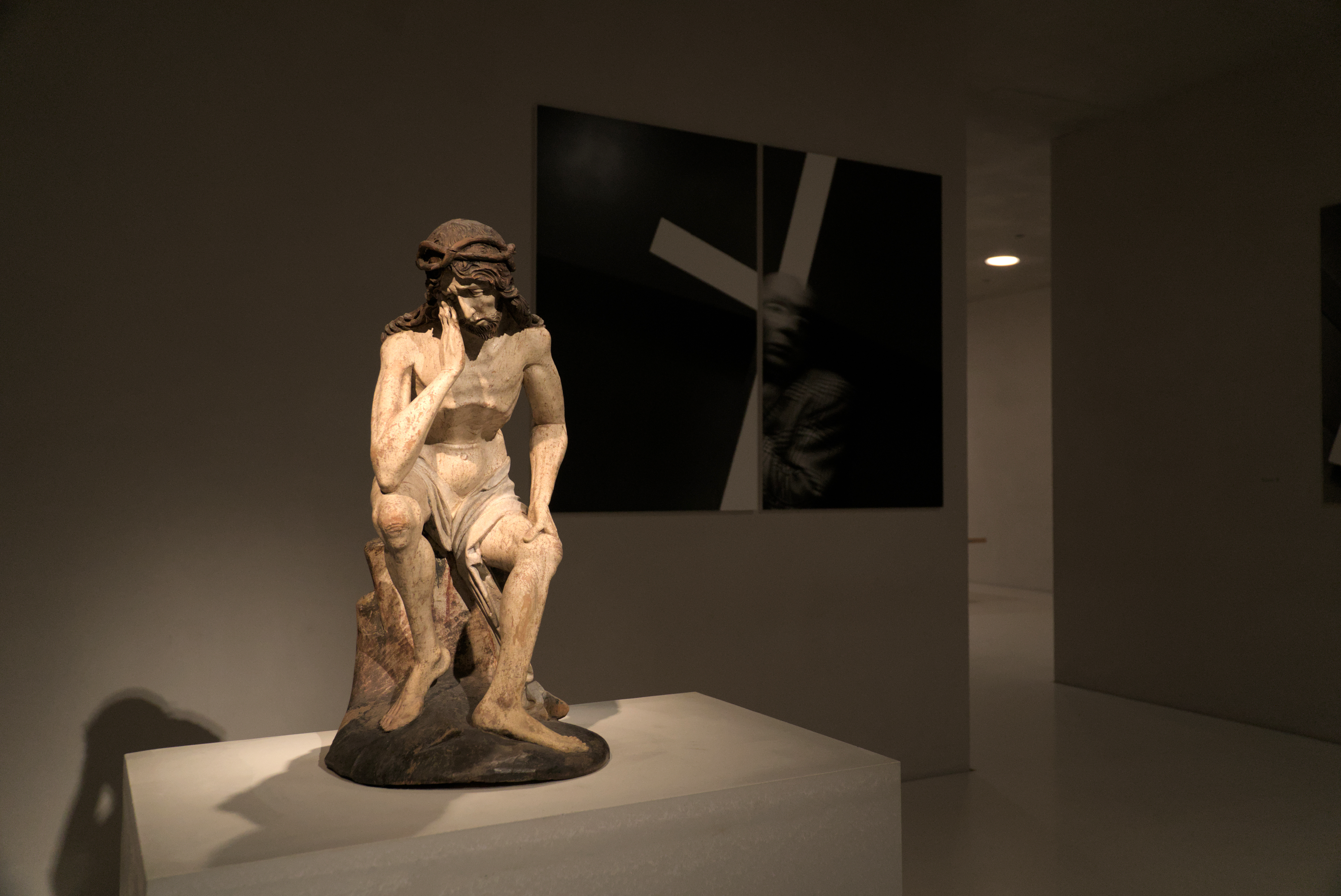
At Kolumba, this sculpture is surrounded by large-scale, black-and-white photographs from the Transzendentaler Konstruktivismus (Transcendental Constructivism) series by the collaborative duo of German neo-dadaist artists Anna and Bernhard Blume. In the series the couple is threatened by white geometric objects that are unleashed on them in a blur of motion.
Foreground: Christ at Rest, Upper Rhine, ca. 1480. Background: Anna Blume (1936–2020) and Bernhard Blume (1937–2011), photograph from the Transcendental Constructivism series, 1992–94.
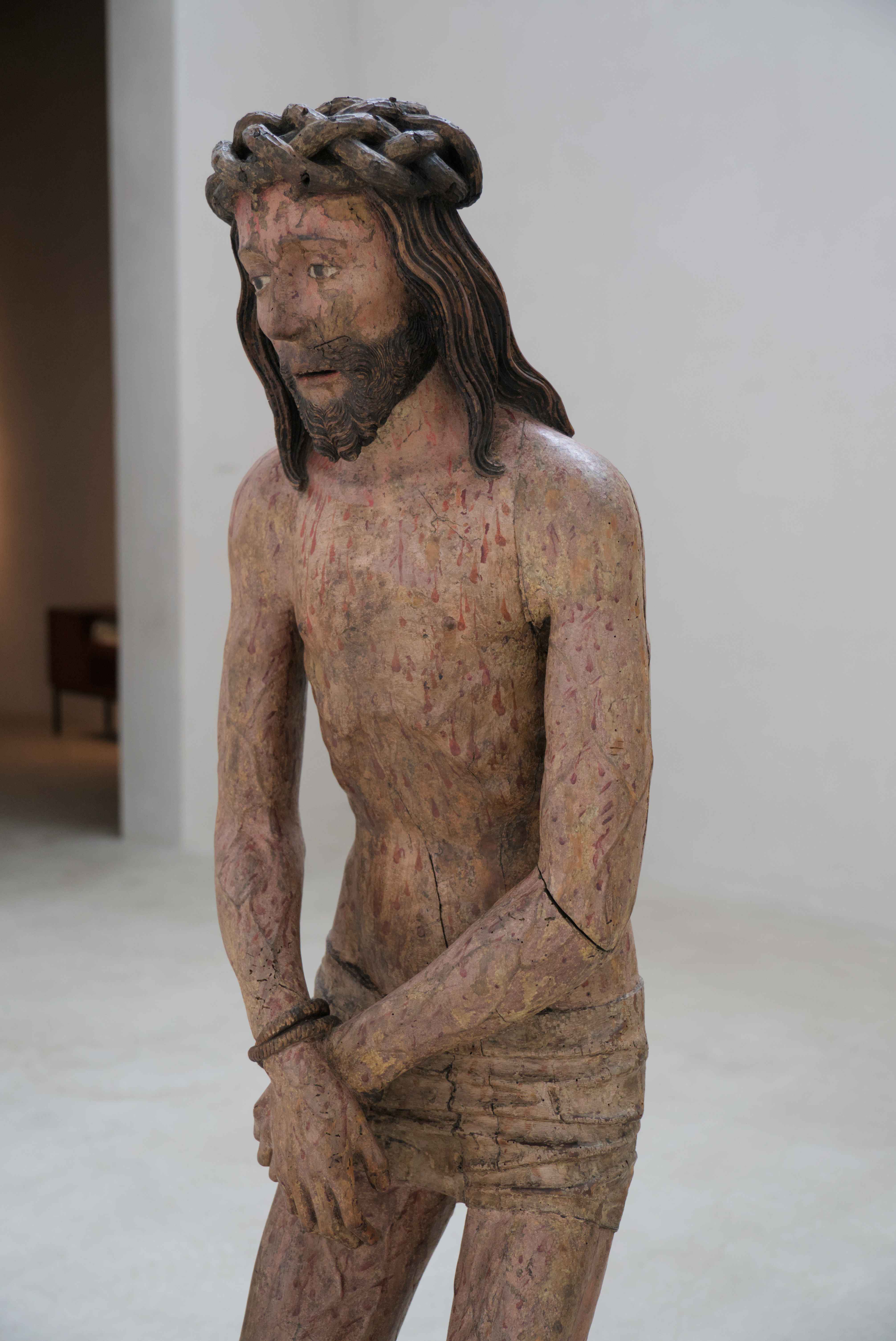
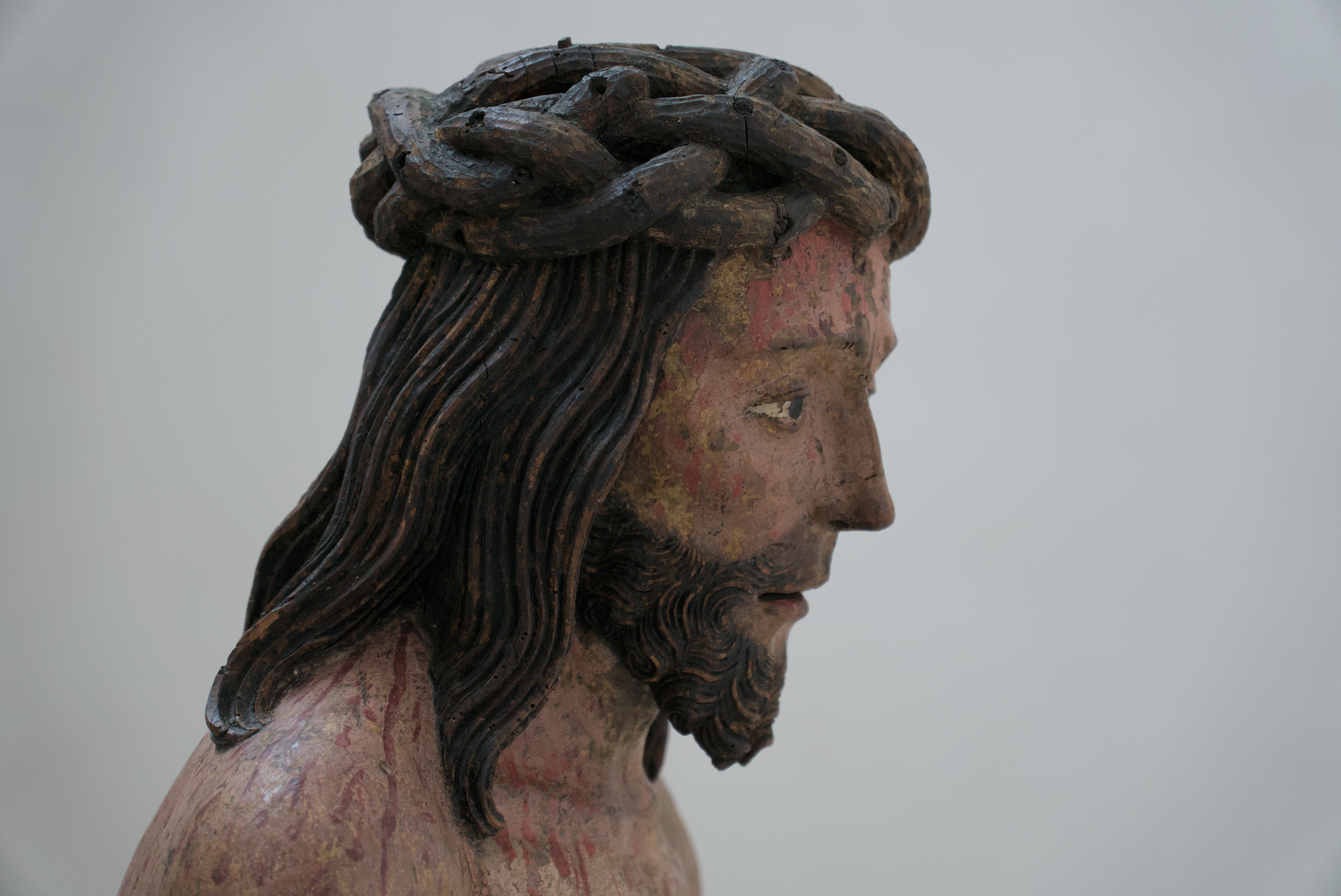
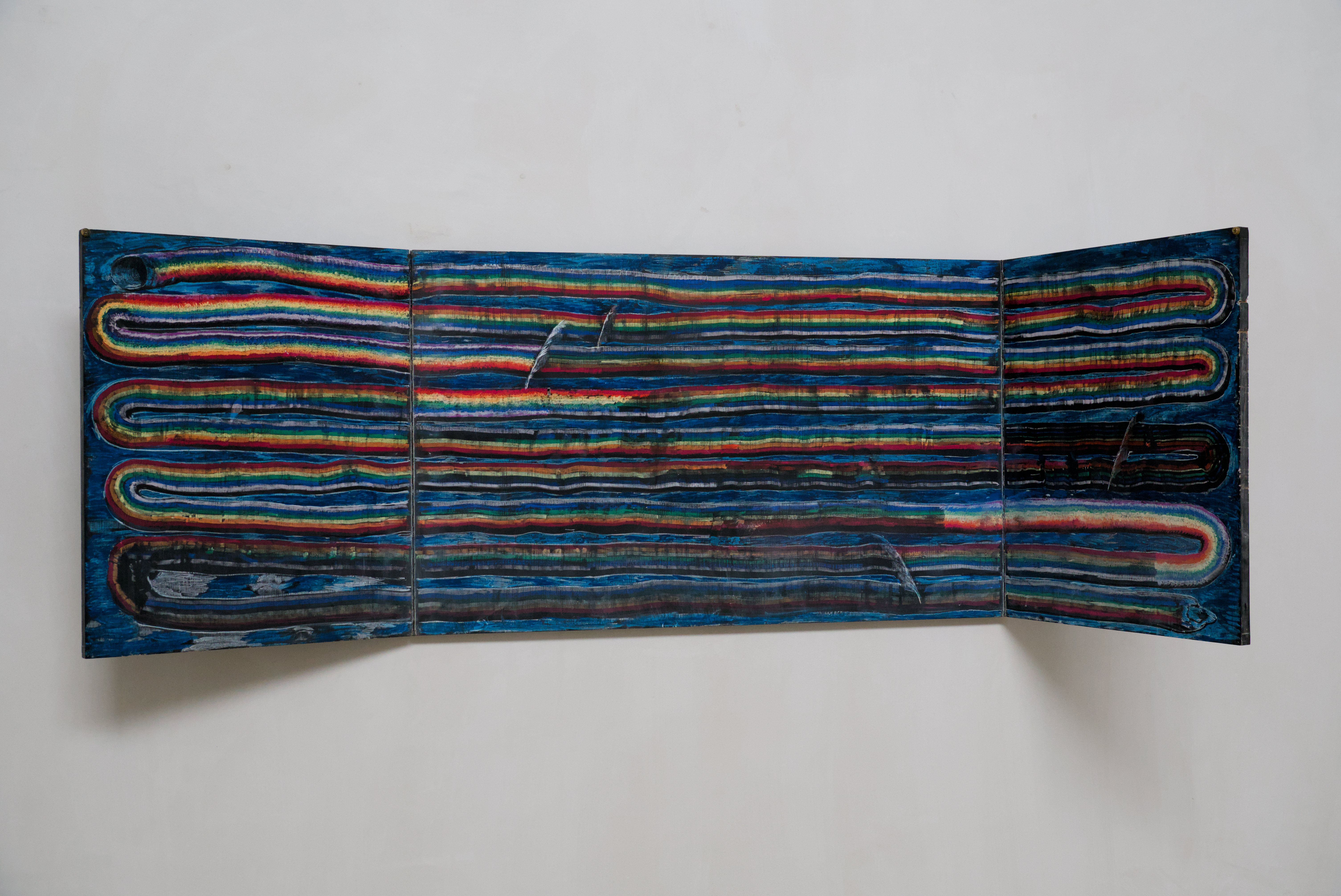
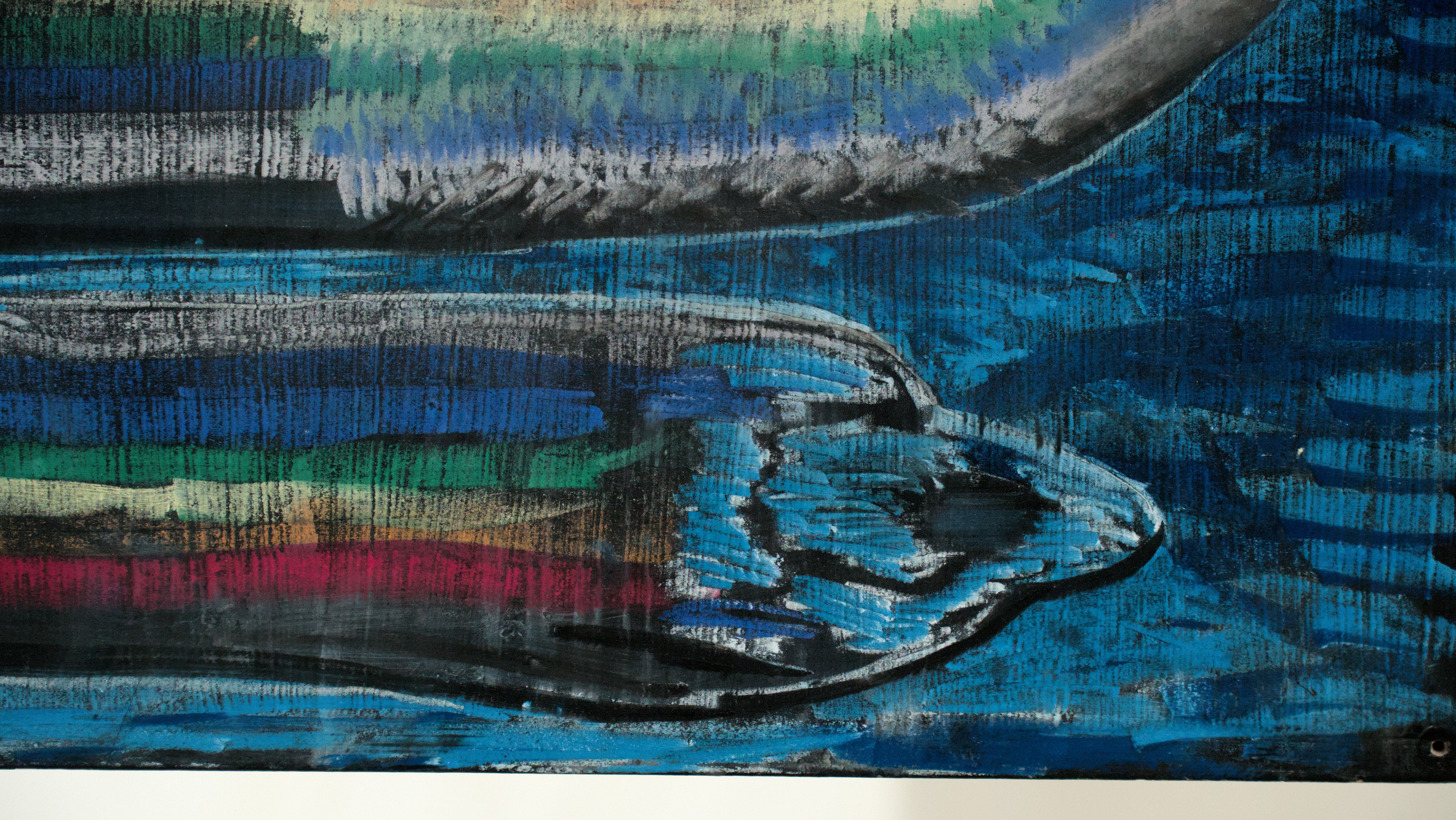
One of the other resonant pairings at Kolumba is in room 21, which stages a fifteenth-century Ecce homo sculpture across from a colored chalk drawing on a three-paneled blackboard.
The title Ecce homo, Latin for “Behold the man,” comes from John 19:5, where the Roman governor Pilate presents a scourged, thorn-crowned Jesus to a mob that demands his execution. Like Christ on the Cold Stone, this too is a devotional image intended to stir the affections of the viewer, who is called, like the crowds on that fateful day, to gaze upon the wounded God-man. His hands are bound in front of him, evoking a sacrificial sheep tied up for slaughter. What have we done?
Ecce Homo, Cologne, ca. 1460–1500. Linden wood. Kolumba museum, Cologne.
While I instantly recognized this subject, the drawing was more of a mystery.
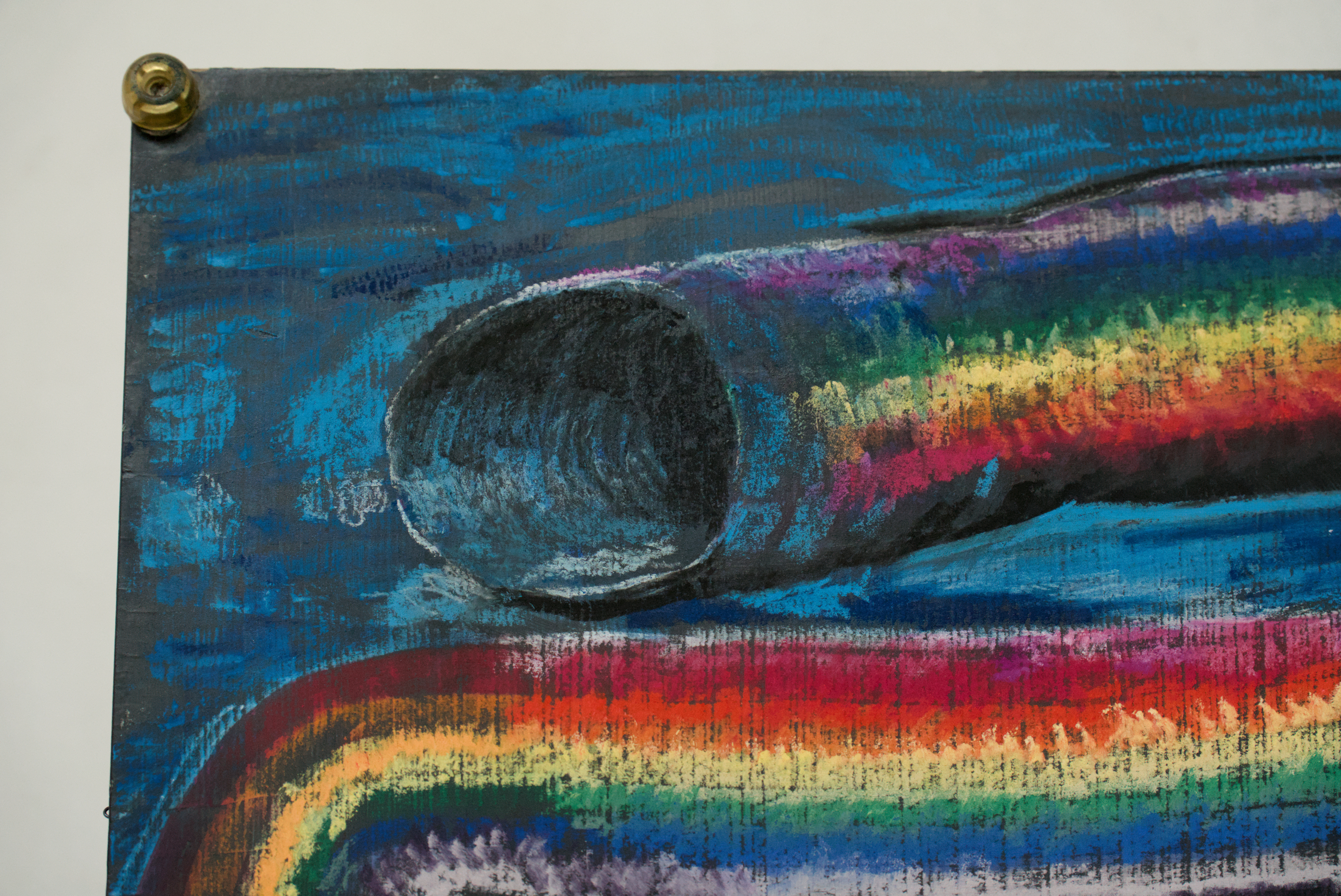
Paul Thek (American, 1933–1988), Plumed Serpent, 1969. Colored chalk on blackboard, 110 × 358 cm. Kolumba museum, Cologne.
Not having any wall text to clue me in, I had to simply observe and intuit. I saw a winding chute, rainbow-colored, with a few white feathers sticking out of it. And is that water in the background?
I noticed, too, that it’s a triptych, a common format for altarpieces.
Water, birds, rainbows—those all play into the story of Noah’s flood, in which the rainbow signifies God’s promise to never again destroy the earth and all its inhabitants. It’s a symbol of grace and reconciliation.
There are also two prophetic texts in scripture that associate the rainbow with Christ and his glory: Ezekiel’s and John’s recorded visions of the divine throne (Ezek. 1:28; Rev. 4:3).
The curator has positioned Jesus facing the rainbow road, across a fairly large gap. Since, as the museum states, the artworks are arranged to interpret each other, at least in part, then it’s possible this room conveys Jesus following the path of promise, even as it takes dark turns. Or choosing to endure the judgment of the cross to secure a glorious inheritance for his beloveds.
After these ruminations, I looked up the work in the booklet: Plumed Serpent by Paul Thek.
Hmm. In the Christian tradition serpents are often associated with the devil. However, in Numbers 21:1–9, Moses lifts one up on his staff in the wilderness and it becomes an agent of healing and even a symbol of Christ himself, lifted up on the cross for the salvation of the world (John 3:14–15).
The description in the booklet informed me that “plumed serpent” is the English translation of the Nahuatl name Quetzalcoatl, an Aztec creator-god. I don’t know much about pre-Columbian mythologies, so I looked him up when I got home. Apparently he represents the union of earth (reptile) and sky (feathers), and he is also known as the god of the morning star. (Jesus also calls himself the bright morning star!) Although he was initially portrayed as a large snake covered in quetzal feathers, from 1200 onward, he often appeared in human form, wearing shell jewelry and a conical hat. What I find most striking about his story is that he gave new life to humankind by gathering their bones from the land of the dead, grinding them down, and mixing them with his own blood from self-inflicted wounds.
I also did some research on the artist, of whose work Kolumba has the most comprehensive holdings. Paul Thek was a devout Catholic, an identity complicated by the fact that he was also gay. He rose to fame in the 1960s with his “Technological Reliquaries,” hyperrealistic wax sculptures depicting severed body parts and chunks of flesh in vitrines, inspired by his visit to the Capuchin catacombs in Palermo. Much of his art deals with death and rebirth, divinity and decay, mystical transformation.
Feathers feature in another piece of his from the same year as Plumed Serpent: Feathered Cross. (See it against the wall in a photo from the 2021 exhibition Paul Thek: Interior/Landscape at the Watermill Center in Water Mill, New York.) The feathers’ softness, their weightlessness, seem to contradict the reality of crucifixion. But I think it’s Thek’s way of conveying the transcendent meaning of that act of self-giving. I also think of how down feathers fill pillows on which we rest. “Come to me, all you who are weary,” Christ says (Matt. 11:28); we can rest on his finished work.
But back to Plumed Serpent. Chalk is its material—its ephemerality must be a nightmare for conservators, and indeed it seems like some of the drawing has partially rubbed away. But this choice of material plays into the artist’s interest in the enduring versus the perishable, and the transitory dimensions of death.
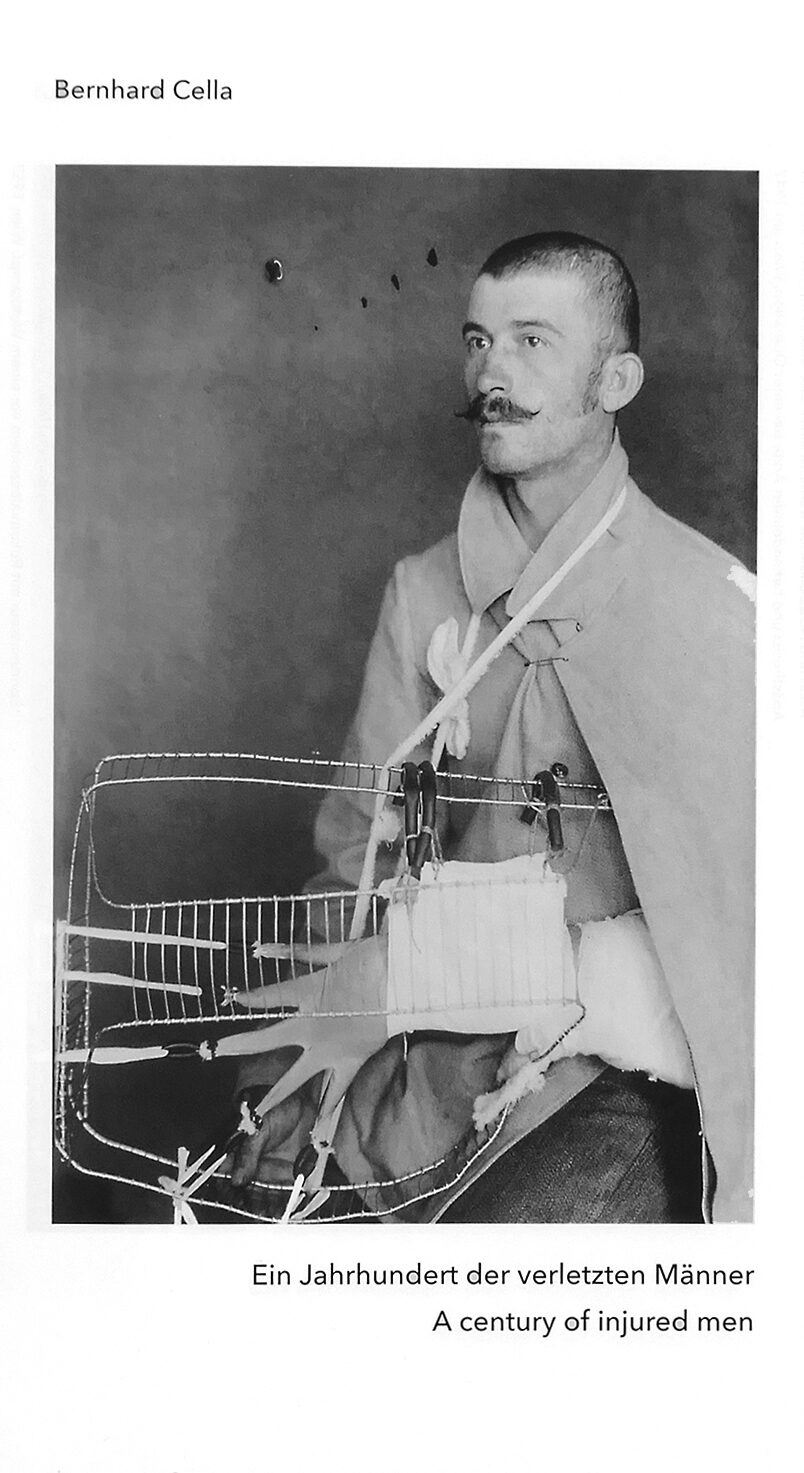
On the right side of room 21, against the wall, are three identical offset-printed artist’s books by Bernhard Cella titled Ein Jahrhundert der verletzten Männer (A Century of Injured Men). Published in 2022, the 152-page book contains photographs of convalescent men over the course of the twentieth century, questioning heroic images of masculinity. I’m assuming many of the injuries were caused by the two world wars.
Vulnerability, injury, sacrifice, healing, the transmutation of pain, new life—these are the themes I gathered from this room.
The current Kolumba exhibition features much more contemporary art than medieval—there are some 175 contemporary works on display, compared to six from the Middle Ages—and I suspect that is now their modus operandi. So, the cross-temporal dialogue isn’t happening in every room, at least not explicitly.
I appreciate the uniqueness of this ecclesiastically run museum, acquiring and showing contemporary works by artists from a range of backgrounds while not shunning its own history as collectors and preservers of medieval German religious art.
As a Christian, I found myself latching on to the imagery that was familiar to me, like Jesus as the Man of Sorrows, and interpreting the surrounding works in light of that. But it seems to me the interpretive process could also move in the other direction, and I wonder how a visitor who doesn’t share my Christian vantage point would respond to the two rooms I’ve highlighted.
For two additional artworks I photographed at Kolumba, an ivory crucifix and an installation with coat, hat, and oil lamp, see my Instagram shares here and here.
Part 2, my reflections on my KMSKA visit, will be published tomorrow.
I woke, and all the kingless world was bleak.
I slept, and earth was governed by the meek.

I woke, and there was roaring from the south.
I slept, and children stopped the lion’s mouth.

I woke, and saw the locust eat the wheat.
I slept, and wept before the mercy seat.

I know I sojourn in the land of seem.
But which is real, my God? And which the dream?
From The Locust Years (Wiseblood, 2025). Used by permission of the publisher.
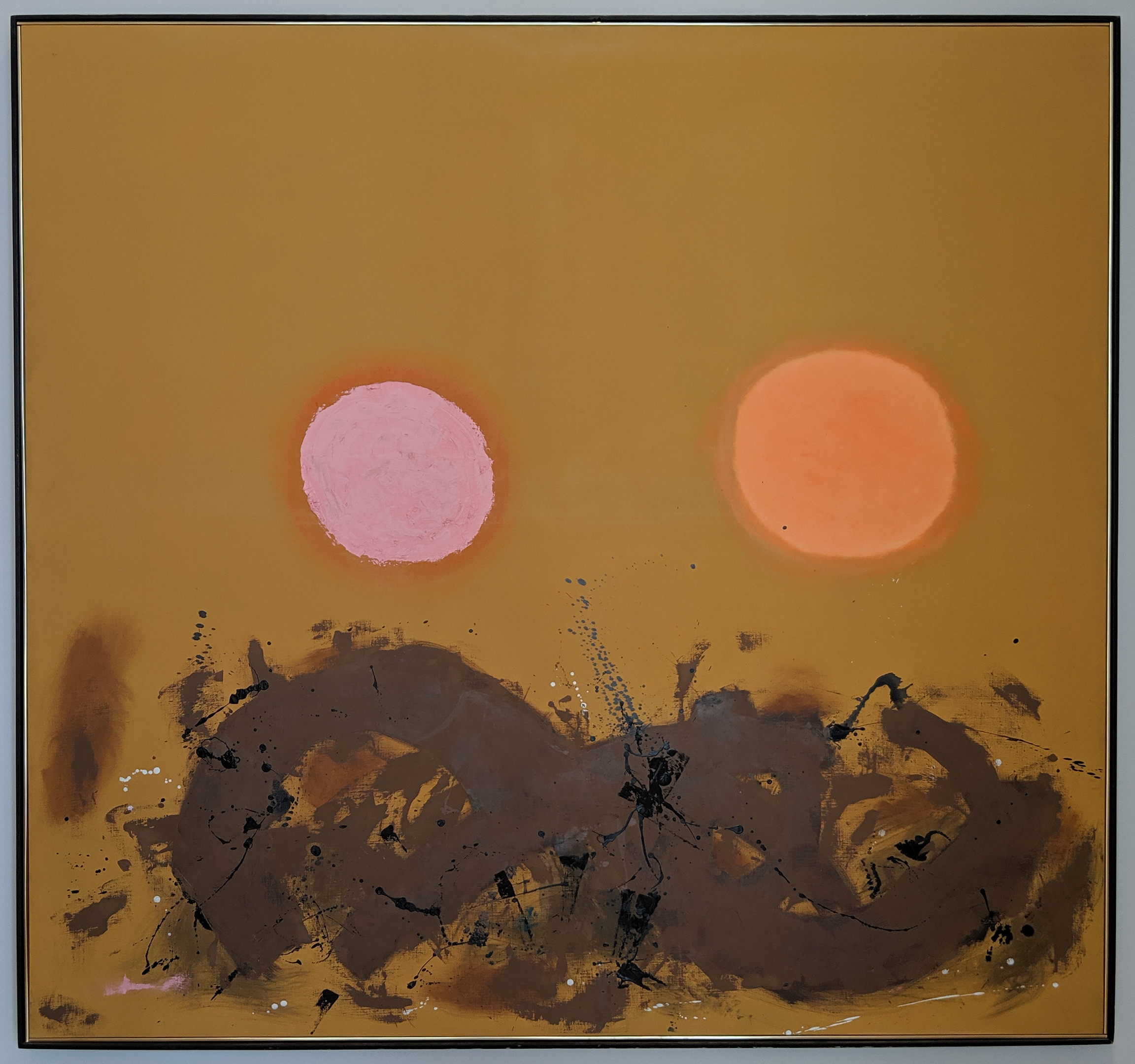
Adolph Gottlieb (American, 1903–1974), Duet, 1962. Oil on canvas, 84 × 90 in. High Museum of Art, Atlanta, Georgia. Photo: Victoria Emily Jones.
In his succinct poem “The Dream,” Paul J. Pastor reflects on the dissonance between our earthbound reality—marked by misrule, violence, and famine—and the new-earthly reality that awaits us when Christ returns. Which is truer, more ultimately solid? This present bleakness, or the long-dreamt-of future that we see glimpses of throughout the scriptures, in the visions of prophets and the words and deeds of Jesus?
The poem reminds me of these lines from George MacDonald’s Diary of an Old Soul:
Lord, in the land of things that swell and seem, Help me to walk by the other light supreme, Which shows thy facts behind man’s vaguely hinting dream.
And Samwise Gamgee’s oft-quoted question from Tolkien’s Return of the King, which Christian eschatology answers in the affirmative: “Is everything sad going to come untrue?”
“The Dream” comes from Pastor’s latest collection, The Locust Years, most of which was written from 2020 to 2024, a time of pandemic, increasingly intense political polarization in the US, and, as Pastor mentions in the opening, for him, personal grief. The book’s title is a reference to Joel 2:25, where God promises his people, “I will restore to you the years that the locust hath eaten . . .”
Paul J. Pastor is a poet, writer, and editor whose work uncovers the inner life of the world as experienced in nature, literature, and the rich traditions of historic Christian spirituality. In addition to two volumes of poetry—The Locust Years and Bower Lodge—he is also the author of A Kids Book About God, The Listening Day, and The Face of the Deep. He is an executive editor for Nelson Books, an imprint of HarperCollins, and he lives in Oregon’s Columbia River Gorge with his wife and three children.
PODCAST: Poetry for All, hosted by Joanne Diaz and Abram Van Engen:Poetry for All “is for those who already love poetry and for those who know very little about it. In this podcast, we read a poem, discuss it, see what makes it tick, learn how it works, grow from it, and then read it one more time.” I’ve consistently enjoyed this podcast since its launch in 2020, having learned about it through cohost Abram Van Engen [previously], an academic who often writes and speaks about poetry for general Christian audiences. Here are some of my favorite episodes of the ninety-seven that have been released to date:
Three haiku by Kobayashi Issa, translated from the Japanese by Robert Hass: The first: “The snow is melting / and the village is flooded / with children.” Learn the characteristics of what Joanne Diaz calls “the perfect poetic form.”
“spring song” by Lucille Clifton: One of my favorite poems by one of my favorite poets. “This joyful poem caps a sequence of sixteen poems called ‘some jesus,’ which walks through biblical characters (beginning with Adam and Eve) and ends on four poems for Holy Week and Easter. [Clifton] wrote other poems on the Bible as well, including ‘john’ and ‘my dream about the second coming,’ which reimagine a way into biblical characters to make their stories fresh.”
“Elegy for My Mother’s Mind” by Laura Van Prooyen: This episode is unique in that it has the poet herself on to read and discuss the poem, which in this case navigates the complexities of memory, loss, and familial relationships.
“View but This Tulip” by Hester Pulter: Ashamedly, I had never heard of this seventeenth-century female poet before listening to this episode, so I’m grateful to guest Wendy Wall, cocreator of the award-winning Pulter Project website, for introducing me to her! “In this episode we discuss [Pulter’s] work with emblems, her scientific chemistry experiment with flowers, and her wonderment (both worried and confident, doubtful and awestruck) about the resurrection of the body and its reunification with the soul after death.”
“From Blossoms” by Li-Young Lee: A much-anthologized poem ostensibly about eating summer peaches, but more deeply, it’s about joy. “One of the things that draws me to this poem,” says Van Engen, “is that joy is actually very hard to write about . . . without it sounding naive or sentimental or withdrawn or unaware.”
“Primary Care” by Rafael Campo: Dr. Rafael Campo is both a poet and a practicing physician. Here he uses blank verse to explore the experience of illness and suffering.
+++
POEMS:
>> “For V. the Bag Lady, Great in the Kingdom of Heaven,” “Damascus Road,” “The Sower,” and “Crosses” by Paul J. Pastor: The Rabbit Room received permission to reproduce four poems from Paul J. Pastor’s [previously] new poetry collection, The Locust Years, which “explores a world of mystery and sorrow, desolation and love. Rooted in the Pacific Northwest, these poems offer readers an invitation to walk along a path pebbled with profound joy and deep loss.” I’ll be sharing another on the blog next week, courtesy of Wiseblood Books.
>>“Undone”by Michael Stalcup: The rise of blogging in the aughts and its descendant, Substacking, in the last few years has meant that poets and other writers can share their work directly with their reading publics and give them insight into their creative process if they wish. On his Substack, the Thai American poet Michael Stalcup [previously] recently shared one of his new poems that’s based on the story of the woman caught in adultery in John 8:1–11. He explains how the poem’s form, a blend of the Petrarchan sonnet and the chiasmus, contributes to its meaning.
Nalini Jayasuriya (Sri Lankan, 1927–2014), Go, Sin No More, 2004. Mixed media on cloth, 23 × 19 in. Published in The Christian Story: Five Asian Artists Today, ed. Patricia C. Pongracz, Volker Küster, and John W. Cook (Museum of Biblical Art, 2007), p. 119.
Blessed be the paps which Thou hast sucked. —Luke 11:27
Suppose he had been Tabled at thy Teats, Thy hunger feels not what he eats: He’ll have his Teat ere long (a bloody one). The Mother then must suck the Son.
Scholar Kimberly Johnson [previously] unpacks these four lines about the body of Christ, who as an infant drank milk from his mother’s breast, and whose sacrificial death opened up his own breast whence flows the blood that nourishes us all. Johnson teases out the overlap of physical and spiritual in the poem, highlighting the maternal sharing of one’s own substance that links both couplets. At the eucharistic table, we are bidden to come and eat; or, in the stark metaphorical language of Crashaw, come and suck Christ’s bloody teat.
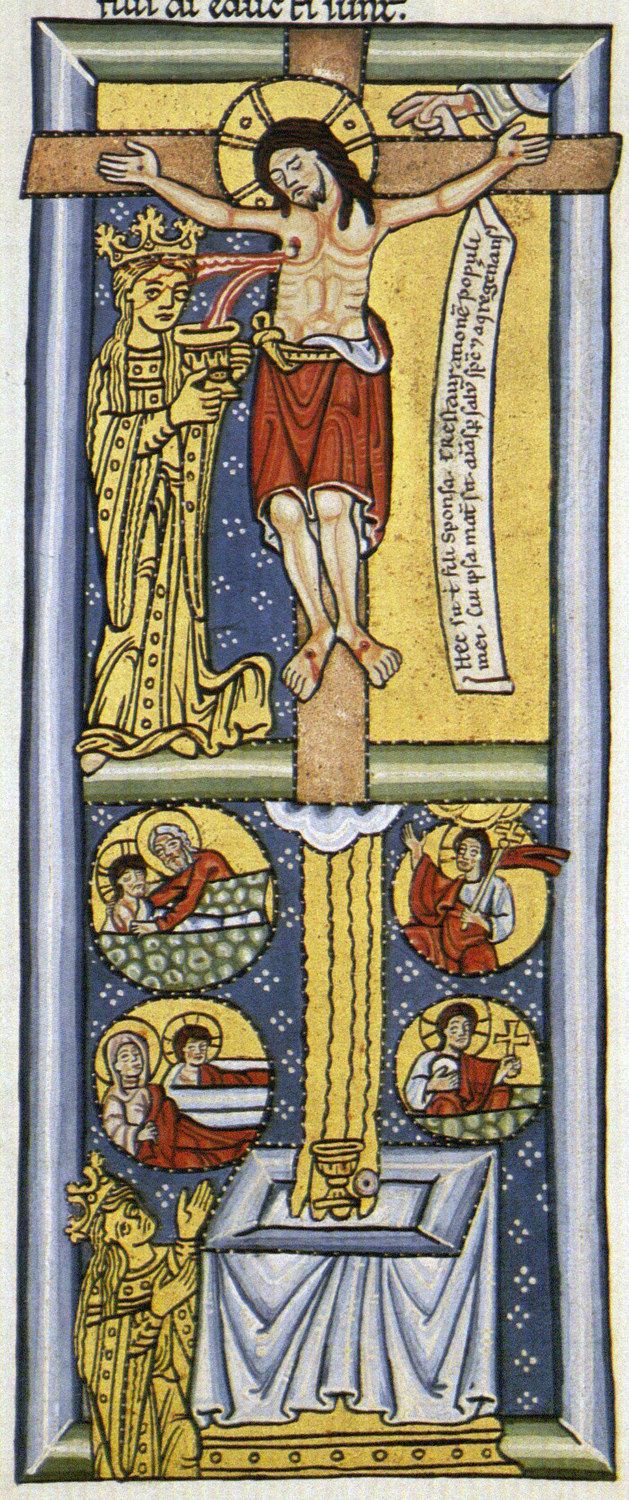
I plan to write an essay sometime about Christ as a nursing mother, as I’ve seen the image pop up in medieval writings and some visual art, including from Kongo and Ethiopia. In the meantime, here’s an illumination of the sixth vision in part 2 of Hildegard of Bingen’s Scivias (Know the Ways), painted under the supervision of Hildy herself. It shows the crucified Christ feeding Ecclesia (his bride, the church) with blood from his breast.
“The Crucifixion and the Eucharist,” from Scivias (Know the Ways) II.6, Rupertsberg Abbey, Germany, before 1179. Rupertsberg Codex, fol. 86r, Hildegard Abbey, Eibingen, Germany. The original manuscript from Hildegard’s lifetime was lost in 1945, but a faithful copy was made in 1927–33, which is the source of the color reproductions now available.
+++
ESSAY: “Only One Heart: The Poetry of Franz Wright as Emblem of God’s Grace” by Bonnie Rubrecht, Curator: “Are You / just a word? // Are we beheld, or am I all alone?” These three lines typify the poetry of Franz Wright (1953–2015), the Pulitzer Prize–winning author of Walking to Martha’s Vineyard, God’s Silence, and other collections. “Wright’s work is often described as confessional, colored by irony and humor. His irreverence, juxtaposed with honesty and humility, make his poetic voice unique in addressing God. Writers and poets often traffic in spiritual themes, but few modern poets echo the prophetic Old Testament tradition of crying out, approaching God with the concision and raw emotion that Wright does. He excels in voicing the concerns and ruminations of the human experience of suffering, while simultaneously shifting towards his own embodiment of grace.”

.jpg)
 Art & Theology
