
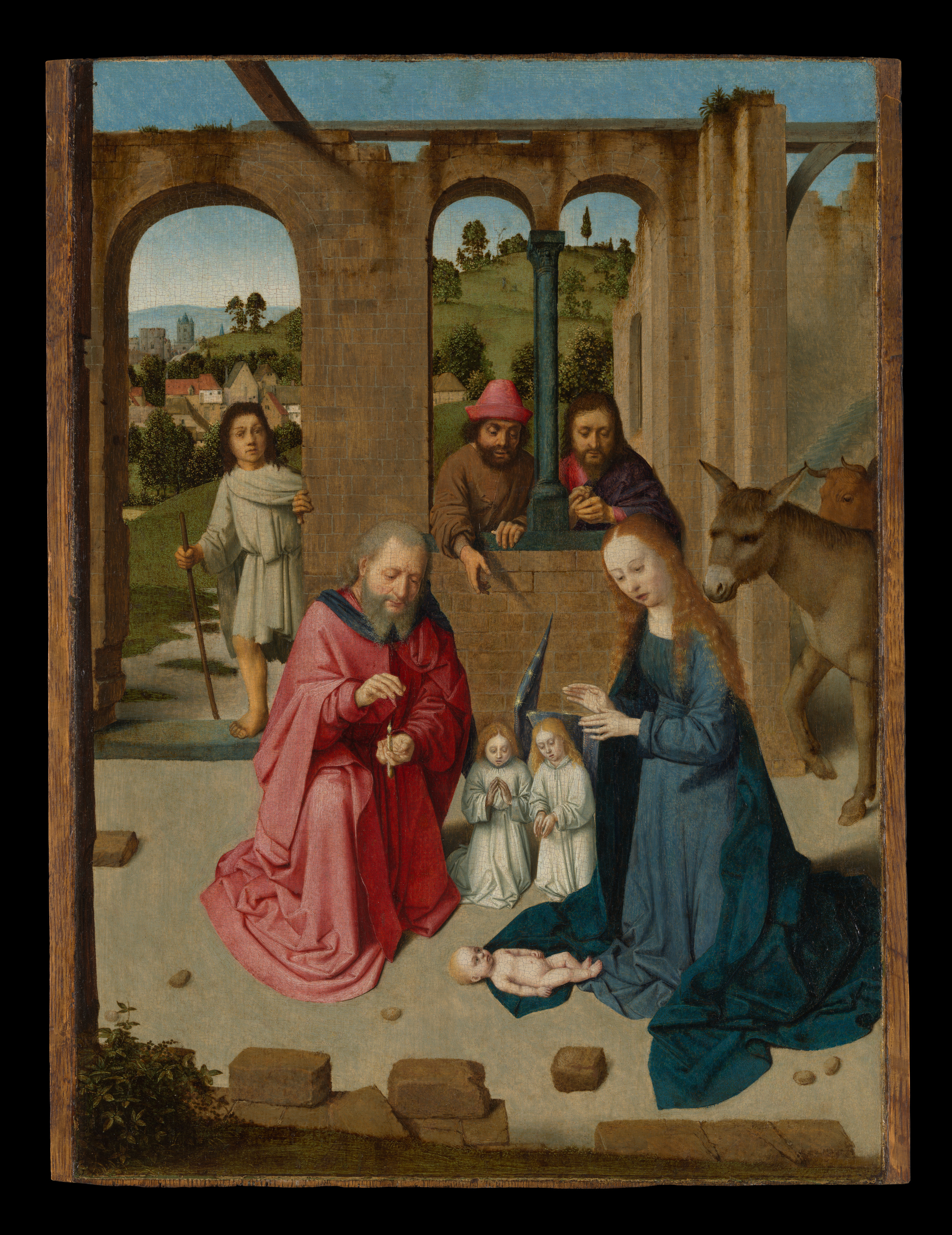
LOOK: The Nativity by Gerard David
LISTEN: “Where Is This Stupendous Stranger” | Words by Christopher Smart, 1765 | Music by Linda L. Hanson, 2012 | Performed by Fire (women’s a cappella chamber ensemble), 2020
Where is this stupendous Stranger?
Prophets, shepherds, kings, advise!
Lead me to my Master’s manger,
Show me where my Savior lies.O most mighty, O most holy,
Far beyond the seraph’s thought,
Are you then so mean and lowly
As unheeded prophets taught?O the magnitude of meekness,
Worth from worth immortal sprung!
O the strength of infant weakness,
If eternal is so young!God all-bounteous, all-creative,
Whom no ills from good dissuade,
You have come to be a native
Of the very world you made.
The four verses of this Christmas hymn are excerpted from a nine-stanza poem by Christopher Smart [previously] published in Hymns and Spiritual Songs for the Fasts and Festivals of the Church of England (London, 1765). The poem was recovered in the twentieth century and since then has received multiple new musical settings—by composers such as I-to Loh, Charles Heaton, Conrad Susa, Joan A. Fyock, Leo Nestor, Alec Wyton, Thomas Gibbs Jr., Scott M. Hyslop, and Jacques Cohen—as well as pairings with older tunes.
My favorite setting of the text is by Linda L. Hanson, the founding director of Fire, a women’s a cappella chamber ensemble in Charlottesville, Virginia. The group performs the hymn in the video above, which Fire member Mary Welby von Thelen spliced together from thirteen solitary recordings during the COVID-19 pandemic. Hanson is in the top row, the third from the left.
The alliterative opening line of the hymn asks where the “stupendous Stranger” can be found—the divine one sent from heaven. Stupendous isn’t an adjective we use often. It means “causing astonishment or wonder: awesome, marvelous.” The poetic speaker begs the prophets, shepherds, and magi to divulge the location of the Christ child so that he can go and worship him.
The next two stanzas marvel at the paradoxes of the Incarnation—how Christ is “mighty” and “holy,” beyond the comprehension of even the angels, and yet “mean” (humble) and “lowly,” lying here in the dirt before us, visible, tangible, vulnerable, no longer far above us but in our very midst. What “magnitude of meekness,” what “strength of infant weakness.” The eternal one is born in time.
The omnibenevolent Creator has deigned to become part of his creation. No potential ill that he will suffer as a result—and he will suffer many and grievous ills, culminating in death by crucifixion—can deter him from making his beloved earth his home.
Hanson has generously allowed me to share the sheet music of “Where Is This Stupendous Stranger,” and says the hymn can be freely used by local church congregations. Anything outside that context will require her permission.
 Art & Theology