
Today’s art and music selections are not a cultural match—the painting comes from the United States, bears Nigerian, Chinese, and Persian influences, and features a famous Dutch modernist in the corner, while the piano composition, written by a Hungarian based on a Romanian folk tune, comes from Central and Eastern Europe. But I find them to be a great match tonally—they’re both vibrant and spirited—not to mention the subject matter they share.
Tomorrow will be the final post in the daily Christmas series for this liturgical year.
LOOK: The Magi and Mondrian by Tanja Butler
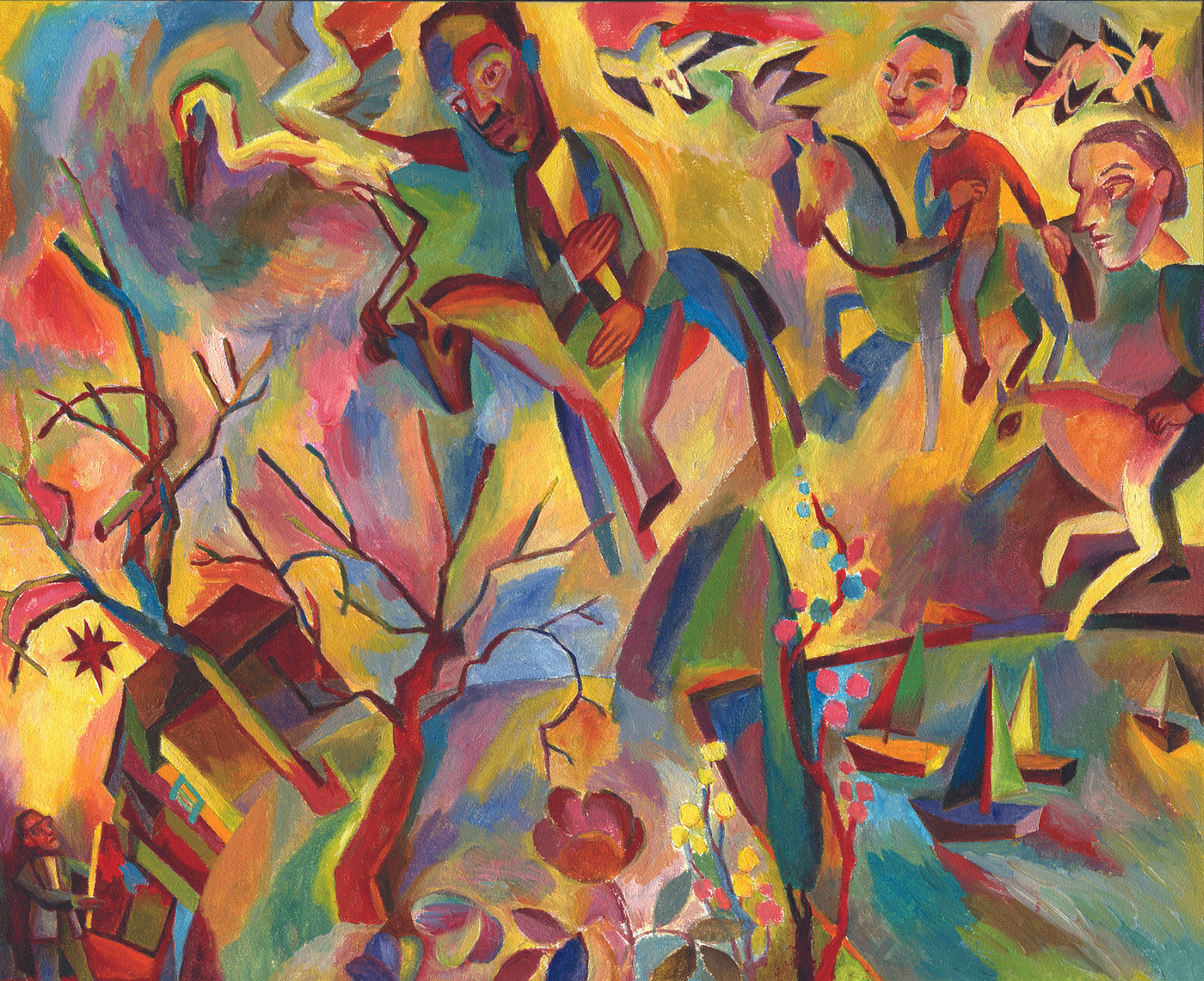
Artist’s statement by Tanja Butler [previously], via ArtWay: “The magi represent the cultures of the world, coming from the four corners of the earth to bring homage to the newborn King. The poses are drawn from royal Nigerian sculpture, Chinese paintings, and Persian manuscripts. The magi are forerunners of generations to come; all nations will bring the gifts of their unique cultures. In the bottom left corner Piet Mondrian offers his painting of chrysanthemums, an image reflecting natural order and creative stasis, the single-minded goal for which he sacrificed all nonessentials – a reminder of the determined search of the magi.”
LISTEN: “Trei crai de la Răsărit” (Three Kings from the East), series 1, no. 10 from Romanian Christmas Carols (Sz. 57, BB 67) by Béla Bartók, 1915 | Performed by György Sándor, 1962
“Trei crai de la Răsărit” (Three Kings from the East) is from a suite of twenty very short piano compositions in two series by the Hungarian composer Béla Bartók, which he based on Romanian colinde he had collected throughout the Transylvanian region. This one comes from the village of Rogoz in Bihor County.
Colinde (sing. colindă) are Romanian folk songs sung at Christmastime, typically by small groups of young men who after some rehearsal walk from house to house on Christmas Eve, caroling at each door. As Bartók himself noted, not all the colinde texts relate to Christmas; many regale folktales, ancient battles yarns, and pagan myths about nature and spirits. Christianity in Romania has absorbed and transformed some elements of the region’s pre-Christian past, integrating winter solstice traditions into a repertoire of Christmas song that also, of course, includes stories of Jesus’s birth.
“Trei crai de la Răsărit,” about the visit of the three wise men, is one of the explicitly Christian colinde. As the piano prances, I can picture the travelers riding with excitement toward Bethlehem.
Though I’ve found a few slow, somber Romanian songs with this same title, I’ve been unable to find the particular tune Bartók adapted for this più allegro (more lively, faster) movement that concludes the first series of his Romanian Christmas Carols. I’m curious to hear a vocal version and to know the lyrics—which Bartók had suggested be printed above the right hand in the score, an idea his publisher decided against.
To listen to the full suite as performed by Dezső Ránki and to follow along with the sheet music, see this video (“Trei crai de la Răsărit” occurs at 4:39–4:54):
 Art & Theology