
Christmas, Day 9: Word Made Flesh

LOOK: Chr. Geb. by Jörg Länger
Länger, Jörg_Chr. Geb.
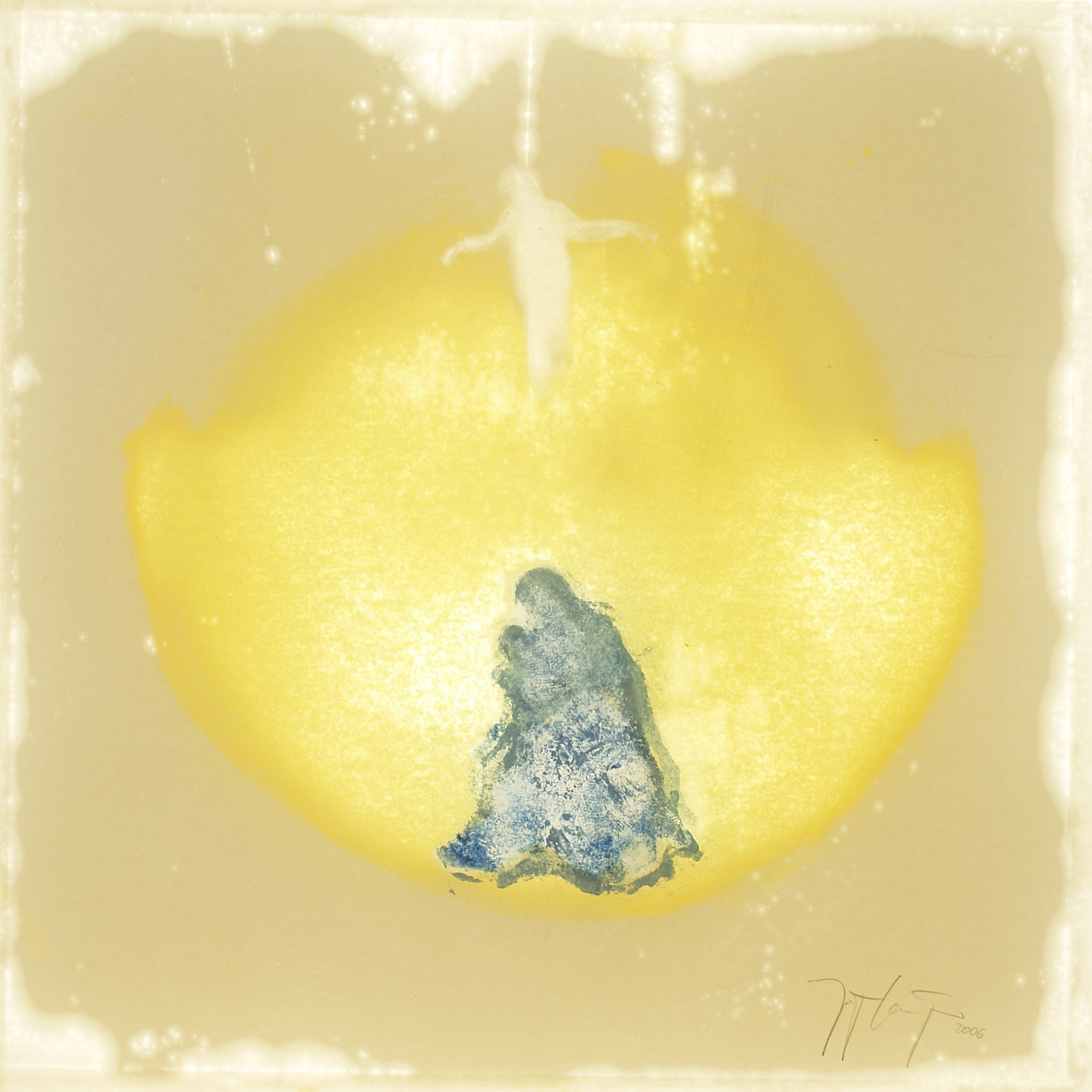
Jörg Länger (German, 1964–), Chr. Geb., 2006. Linocut, wax, oil, and graphite pencil on paper, 33 × 33 cm, cast with resin between two Optiwhite sheets of glass, 38 × 38 cm.

The contemporary German artist Jörg Länger creates extraordinary mixed-media works, many of which are in dialogue with Christian art history. In addition to earning an advanced degree in art, Länger has also done university coursework in theology and philosophy, so it’s no wonder his pieces demonstrate a keen theological awareness and spiritual sensibility.

After some fifteen years of working in photography, installation art, performance art, and conceptual art, in 1998 Länger shifted gears to focus on drawing, painting, and printmaking. He developed a series, still ongoing, that he calls “Protagonisten aus 23.000 Jahren Kulturgeschichte” (Protagonists from 23,000 Years of Cultural History), in which he takes figures from prehistoric petroglyphs and bas-reliefs, ancient Greek vases, medieval manuscripts, European Renaissance paintings, and contemporary art, simplifies them, and puts them into a new pictorial context. He copies the figure’s outline onto a linoleum block, inks and prints it to produce a sort of silhouette, and builds out from there using oil paint, pastels, wax, and/or gold leaf, while still retaining a minimalist aesthetic.

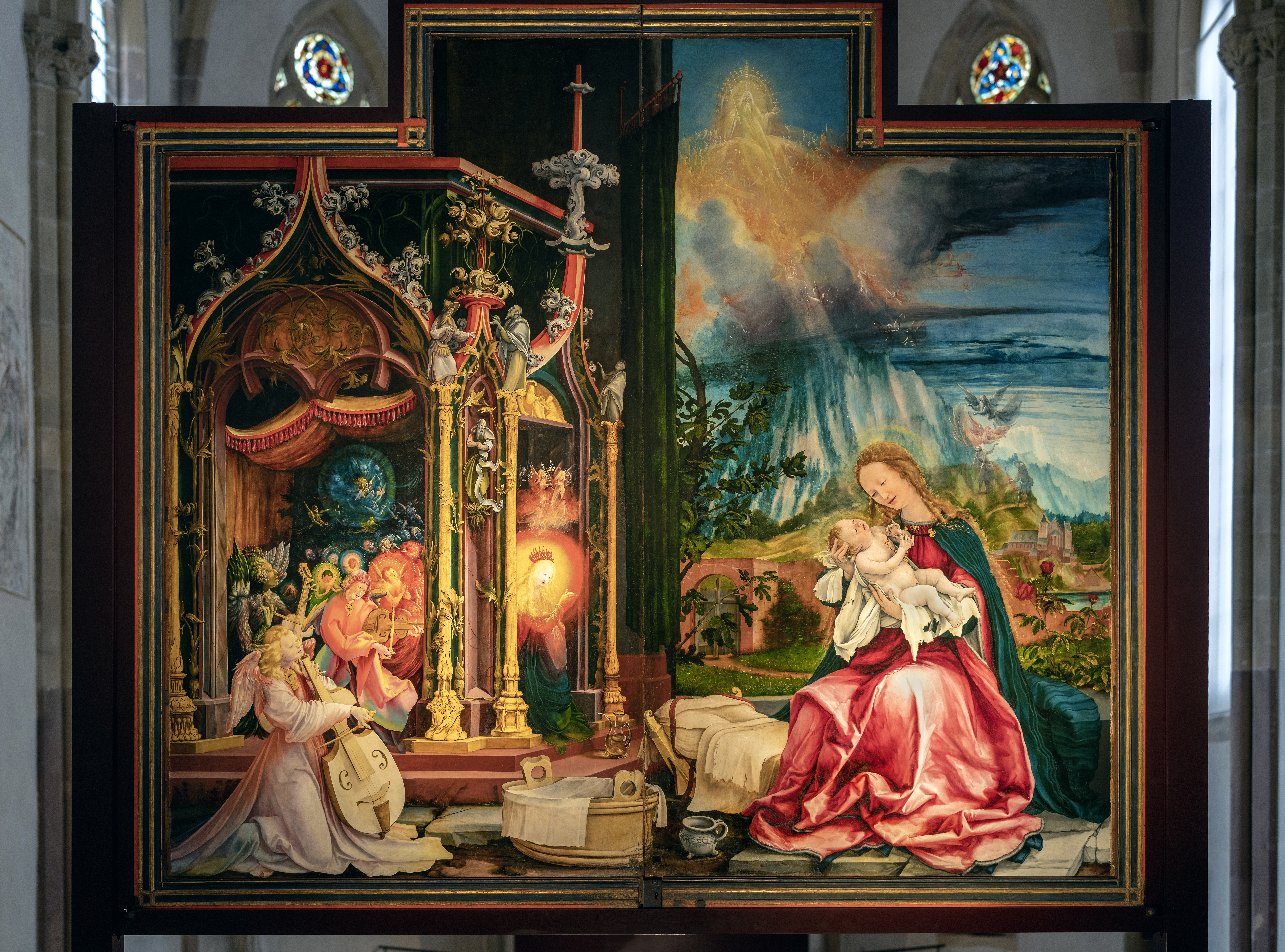
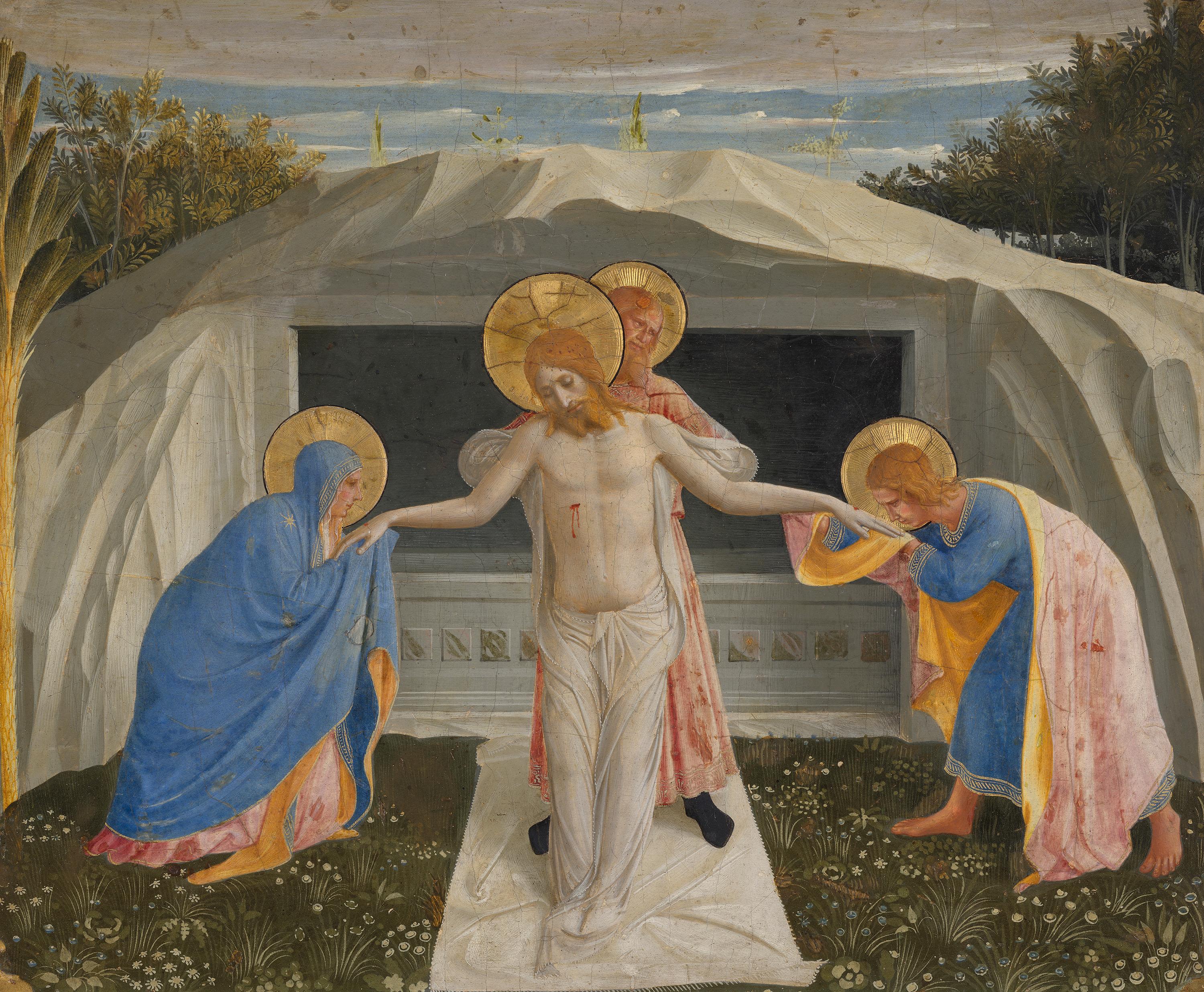
In his 2006 piece Chr. Geb. (short for Geburt Christi, “Birth of Christ”), the silhouetted figures are taken from Matthias Grünewald’s Isenheim Altarpiece and Fra Angelico’s Entombment of Christ.
Grünewald, Matthais_The Nativity
Matthais Grünewald (German, ca. 1475/80–1528), The Nativity, central panel (first open view) of the Isenheim Altarpiece, 1515. Oil on wood, 269 × 307 cm. Unterlinden Museum, Colmar, France. Photo: Steven Zucker.

Fra Angelico_Entombment of Christ
Fra Angelico (Italian, ca. 1400–1455), Entombment of Christ, 1438–40. Tempera on wood, 37.9 × 46.6 cm. Alte Pinakothek, Munich.

With the shadowy blue central pair of Mother and Child, the ghostly impression of Christ’s crucified body (being dragged into a tomb in the scene it’s excised from), the expanding puddle of gold that holds together both birth and death, and the light that presses in from the edges, the work has a mystical feel. It shows the Eternal One entering time, born of a woman, to live and die and rise and so bring humanity back to God and back to their truest selves.  

LISTEN: “O Vis Aeternitatis” by Hildegard of Bingen, ca. 1140–60 | Performed by Azam Ali, 2020

V. O vis aeternitatis
que omnia ordinasti in corde tuo,
per Verbum tuum omnia creata sunt
sicut voluisti,
et ipsum Verbum tuum
induit carnem
in formatione illa
que educta est de Adam.

R. Et sic indumenta ipsius
a maximo dolore
abstersa sunt.

V. O quam magna est benignitas Salvatoris,
qui omnia liberavit
per incarnationem suam,
quam divinitas exspiravit
sine vinculo peccati.

R. Et sic indumenta ipsius
a maximo dolore
abstersa sunt.

V. Gloria Patri et Filio
et Spiritui sancto.

R. Et sic indumenta ipsius
a maximo dolore
abstersa sunt.
V. O power within Eternity:
All things you held in order in your heart,
and through your Word were all created
according to your will.
And then your very Word
was clothed within
that form of flesh
from Adam born.

R. And so his garments
were washed and cleansed
from greatest suffering.

V. How great the Savior’s goodness is!
For he has freed all things
by his own Incarnation,
which divinity breathed forth
unchained by any sin.

R. And so his garments
were washed and cleansed
by greatest suffering.

V. Glory be to the Father and to the Son
and to the Holy Spirit.

R. And so his garments
were washed and cleansed
by greatest suffering.

Trans. Nathaniel M. Campbell

Hildegard of Bingen [previously] was a twelfth-century German nun and polymath who wrote works on theology, medicine, and natural history; hymns, antiphons, and a drama for the liturgy (all with original music); and one of the largest bodies of letters to survive from the Middle Ages. In 1136 she was unanimously elected to lead her Benedictine community as abbess, which she did until her death in 1179.

“O vis aeternitatis” is the first entry in Hildegard’s Symphonia armonie celestium revelationum (Symphony of the Harmony of Celestial Revelations), a compilation of her liturgical songs that she made during her lifetime. It is labeled a “Responsory to the Creator.” “The responsory, one of several compositional forms Hildegard used,” explains medievalist Nathaniel M. Campbell, “is a series of solo verses [marked V] alternating with choral responses [marked R] sung at the first office of the day, vigils (matins), in the monastic liturgy.” It’s basically a call-and-response song.

This responsory, Campbell continues, “contemplate[s] the Incarnation . . . as the pivotal moment in which creation reached its perfect and predestined trajectory.” He notes how the refrain meditates on the cleansing of Adam’s flesh both from suffering and by (Christ’s) suffering. God put on our humanity and redeemed it.

Here’s how the medievalist Barbara Newman translates the responsory on page 99 of the critical edition of the Symphonia published by Cornell University Press:

Strength of the everlasting!
In your heart you invented
order.
Then you spoke the word and
all that you ordered
was,
just as you wished.

And your word put on vestments
woven of flesh
cut from a woman
born of Adam
to bleach the agony out of his clothes.

The Savior is grand and kind!
From the breath of God he took flesh
unfettered
(for sin was not in it)
to set everything free
and bleach the agony out of his clothes.

Glorify the Father,
the Spirit, and the Son.

He bleached the agony out of his clothes.

In the video above, “O vis aeternitatis” is performed by Azam Ali, an internationally acclaimed singer, producer, and composer who was born in Iran and raised in India and is now based in Los Angeles. She writes in the video’s YouTube description that Hildegard is part of the canon of universal spirituality and mysticism and that she is attracted to her cosmology, especially her articulation of the ancient philosophical concept of “the music of the spheres.”

In addition to her solo work, Ali is part of the musical group Niyaz, who blend medieval Sufi poetry and ancient Middle Eastern folk songs with modern electronic and trance music.
Excerpt from Within and Without by George MacDonald (poem)

Stella, Joseph_Nativity
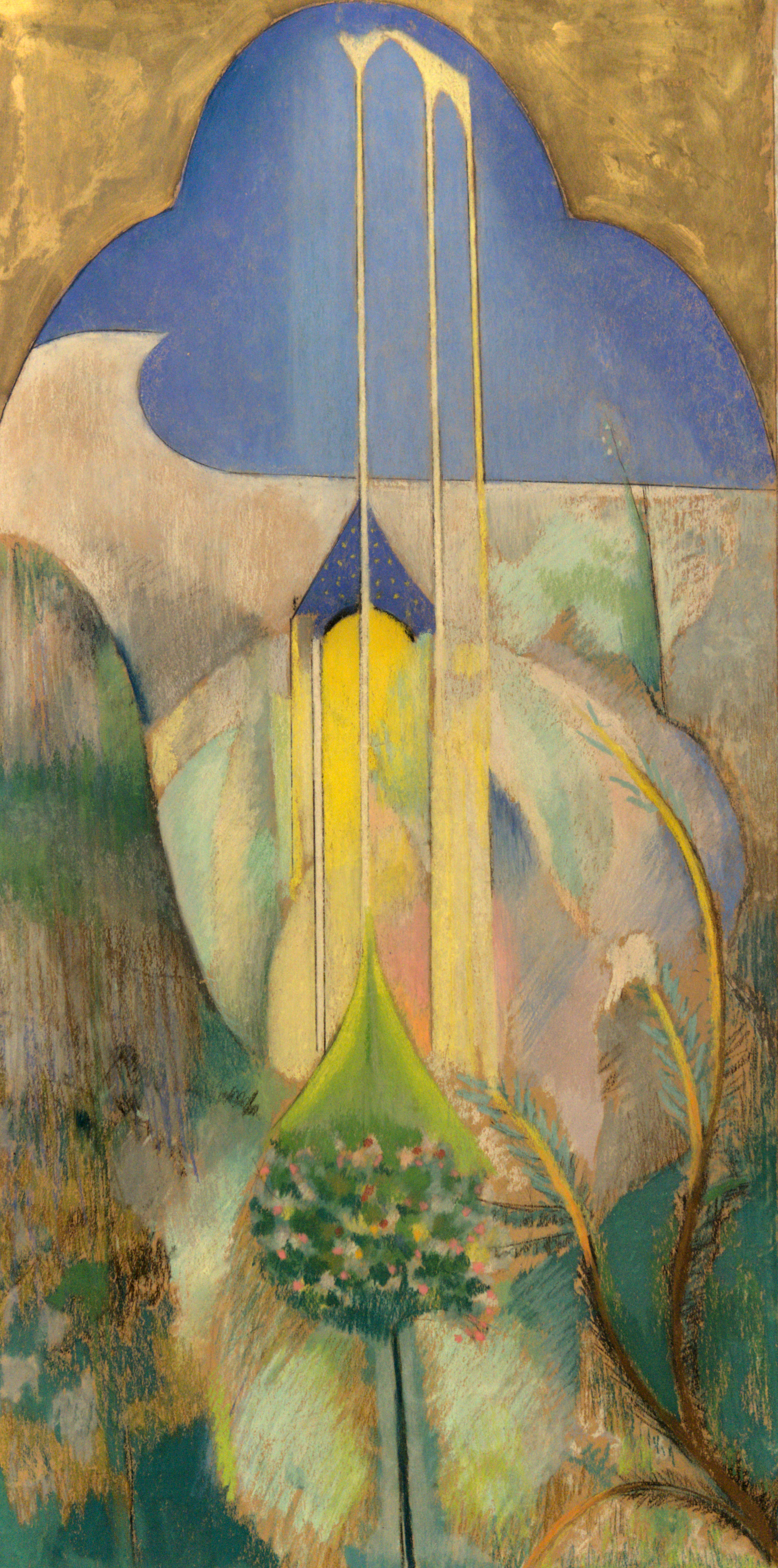
Joseph Stella (American, 1877–1946), Nativity, 1919–20. Oil pastel and oil on paper, 37 × 19 5/16 in. (94 × 49.1 cm). Whitney Museum of American Art, New York. Photo: Victoria Emily Jones. [object record]

Julian’s room. Christmas Day; early morn.

JULIAN. The light comes feebly, slowly, to the world
On this one day that blesses all the year,
Just as it comes on any other day:
A feeble child He came, yet not the less
Brought godlike childhood to the aged earth,
Where nothing now is common anymore.
All things hitherto proclaimed God:
The wide-spread air; the luminous mist that hid
The far horizon of the fading sea;
The low persistent music evermore
Flung down upon the sands, and at the base
Of the great rocks that hold it as a cup . . .
. . . . . . . . . . . . . . . . . . . . . . . . . . . . . . . . . . . . . .
But men heard not, they knew not God in these[.]
. . . . . . . . . . . . . . . . . . . . . . . . . . . . . . . . . . . . . . . . . . . . .
But when He came in poverty, and low,
A real man to half-unreal men,
A man whose human thoughts were all divine,
The head and upturned face of humankind—
Then God shone forth from all the lowly earth,
And men began to read their Maker there.
Now the Divine descends, pervading all.
Earth is no more a banishment from heaven,
But a lone field among the distant hills,
Well ploughed and sown, whence corn is gathered home.
Now, now we feel the holy mystery
That permeates all being: all is God’s;
And my poor life is terribly sublime.
Where’er I look, I am alone in God,
As this round world is wrapt in folding space;
Behind, before, begin and end in Him:
So all beginnings and all ends are hid;
And He is hid in me, and I in Him.
. . . . . . . . . . . . . . . . . . . . . . . . . . . . . . . .
O centre of all forms! O concord’s home!
O world alive in one condensèd world!
O face of Him, in whose heart lay concealed
The fountain thought of all this kingdom of heaven!
Lord, Thou art infinite, and I am Thine!
I sought my God; I pressed importunate;
I spoke to Him, I cried, and in my heart
It seemed He answered me. I said, “O, take
Me nigh to Thee, Thou mighty life of life!
I faint, I die; I am a child alone
’Mid the wild storm, the brooding desert night.”
“Go thou, poor child, to Him who once, like thee,
Trod the highways and deserts of the world.”
“Thou sendest me then, wretched, from Thy sight!
Thou wilt not have me—I am not worth Thy care!”
“I send thee not away; child, think not so;
From the cloud resting on the mountain peak,
I call to guide thee in the path by which
Thou mayst come soonest home unto my heart.
I, I am leading thee. Think not of Him
As He were one and I were one; in Him
Thou wilt find me, for He and I are one.
Learn thou to worship at his lowly shrine,
And see that God dwelleth in lowliness.”

This passage is excerpted from part 3, scene 10 of Within and Without: A Dramatic Poem by George MacDonald, a verse play that, in 1855, was the author’s first published work.

George MacDonald (1824–1905) was a prolific Scottish writer across the genres of adult and children’s fantasy, realistic fiction, theology, poetry, and literary essay. He was the founding father of modern fantasy literature (Phantastes, The Princess and the Goblin, At the Back of the North Wind, and Lilith and his best-known works), a mentor to fellow writer Lewis Carroll (he was a catalyst to Carroll’s publishing Alice’s Adventures in Wonderland), and a great influence on C. S. Lewis (who cites his writings as instrumental in his conversion to Christianity). MacDonald served for a few years as a Congregational minister, but his preaching about God’s universal love and the ultimate salvation of all (apokatastasis) rubbed against the staunchly Calvinist grain of his time and place; after resigning his pastoral post in Arundel, England, he continued preaching without pay as a layman, as well as weaving his theological views into his fiction.

Christmas, Day 8: Welcome

In today’s Christmas devotional, there’s a convergence of three Native cultures of Turtle Island (North America): Jemez, Dakelh, and Kwakwaka’wakw.

LOOK: Jemez Nativity by Maxine Toya

Toya, Maxine_Jemez Nativity
Maxine Toya (Jemez Pueblo, 1948–), Jemez Nativity, 2014. Polychrome pottery figures, red micaceous slip, tallest figure 8 1/2 inches high. Photo: Blair Clark, courtesy of Susan’s Christmas Shop, Santa Fe.

A granddaughter of Persingula Gachupin and a daughter of Marie Romero (both eminent Jemez Pueblo potters), Maxine Toya grew up assisting her family with pottery chores and painting. She began making her own pottery in 1974 and is one of the most renowned living potters from Jemez Pueblo, a census-designated place in Sandoval County, New Mexico. She has won numerous awards at the prestigious Santa Fe Indian Market, which every August brings together a thousand-plus Indigenous artists from more than two hundred tribal nations to exhibit and sell their work.

I learned about this artist from the wonderful book Nativities of the Southwest by Susan Topp Weber, the owner and operator of Susan’s Christmas Shop in Santa Fe. The book compiles dozens of nativities made with local clays and other materials by Pueblo Indians, Navajo Indians, and Spanish and Anglo artists of New Mexico and Arizona. Maxine Toya’s nativity appears on page 47. Weber writes,

Maxine’s donkey in this nativity has a blanket painted with a fringe similar to the one made by her mother, Marie [see page 46]. . . . She sometimes combines her figures into groups. Her standing figures all have closed eyes. The carefully painted detail distinguishes this nativity, as well as the sweet little Pueblo drummer boy with his drumstick raised in the air. The angel’s wings have a lovely feather design.

You can watch Maxine Toya give a pottery demonstration with her daughter Domnique Toya, also a potter, in this 2022 video from the Museum of Indian Arts and Culture. (I cued it up to Maxine’s first section.)

LISTEN: “Welcome Our Creator” by Cheryl Bear, from The Good Road (2007)

Gilakas’la Gikumi!

Welcome our Creator!

Cheryl Bear (DMin, The King’s University) is an award-winning singer-songwriter, speaker, and workshop leader from Nadleh Whut’en First Nation in central British Columbia, whose work explores the intersection of Christian faith and First Nations cultures. She is a founding board member of NAIITS: An Indigenous Learning Community (formerly the North American Institute for Indigenous Theological Studies), an organization that addresses biblical, theological, and ethical issues from Indigenous perspectives. She travels throughout North America telling the Great Story of Jesus both within and outside Indigenous communities, bringing to bear her Indigenous worldview and values.

Bear’s song “Welcome Our Creator” is from her sophomore album, The Good Road. It opens with a drumbeat and then her singing a series of vocables (small nonlexical “words” without semantic meaning). “The song is played to the drum beat of my people,” the Dakelh (Carrier), she writes in the liner notes. “I use the words ‘Gilakas’la Gikumi’ from the Kwakwaka’wakw Nation,” which translate to “Welcome our Creator.”

The song’s title on the CD sleeve and in online metadata does not have a comma, suggesting that the phrase, if interpreted in relation to Christmas, is an exhortation to give Jesus welcome, to gladly and hospitably receive him. But it could also be sung as a greeting to the incarnate God himself: “Welcome, our Creator!”

Outside the Christmas context, the song might be sung during an assembly as an acknowledgment of Creator’s presence.