Advent Materials

Advent begins December 2, and Christian resource providers have already started releasing content for the season so that you can start adapting and programming it into your church services or family devotional practices, if desired. Here are three sets plus a Kickstarter campaign that caught my eye.

from SALT PROJECT

SALT Project Advent
Photo by SALT Project

SALT Project is a faith-based media company dedicated to creating beautiful visual content, especially video, for churches and other clients. Below are three of the five videos they’ve put together for Advent, which can be purchased and customized for church use. The videos feature a few products, like illustrated Advent calendar notecards (with daily tasks like “Deliver sweets to a neighbor” or “Write a thank-you letter to God”) and coloring pages and posters inspired by Mary’s Magnificat, available for download from SALT’s online shop.

I love their aesthetic! (These videos make me really excited for Advent.) I also appreciate how the devotional activities can be done either as an individual, a family, or a congregation. Click here to see a roundup of all five videos, and be sure to also check out Advent in Full Color, a devotional booklet that features poetry by Mary Oliver and Howard Thurman, daily practices, scripture texts, meditations on the season’s key theological themes, and coloring pages.

To subscribe to SALT’s weekly e-newsletter (which I highly recommend!), scroll to the bottom of this webpage; you can also follow them on Facebook @SALTyProject.

+++

from REFORMED WORSHIP

The cover story of the September 2018 issue of Reformed Worship magazine is “Advent in Narnia: An Invitation to Biblical Explorations Beyond the Wardrobe” by Cindy de Jong, which chronicles how seven different churches, including the author’s, used The Chronicles of Narnia last year to draw out some of the themes of Advent. In most cases this involved a six-week sermon series, or a service of lessons and carols, that integrated references to C. S. Lewis’s classic tale. At first I was skeptical of keying sermon series to a work of fiction, allegorical though it may be, but it turns out the worship service plans (reproduced in the article) were intelligently done, letting scripture drive and Narnia serve as a supplement to amplify God’s truth. One contributor even mentioned the need to be careful to not let Narnia be the focus; it can provide structural support but should not constitute the core of the sermon nor the worship service.

Reformed Worship cover

“The whole of Advent is this,” de Jong writes: “awaiting the birth of the Christ child in the same way we wait for the return of Christ’s kingdom. The whole of The Lion, the Witch, and the Wardrobe covers the same: waiting for Aslan and waiting for the triumph of Narnia.” Service plans, including songs, sermon titles and notes, Narnia references, and confessions, are included in the article with varying specificity. Though all drawing on the same text, there is a surprising diversity of approaches. Also included are ideas for how to decorate the sanctuary, how to engage children, and how to introduce the book and the sermon series to the congregation. Two additional books that are recommended are Advent in Narnia: Reflections for the Season by Heidi Haverkamp and The Lion’s World: A Journey into the Heart of Narnia by Rowan Williams.

Besides this eleven-page article, this month’s issue also includes an Advent reading for three voices by Joyce Borger, titled “What If . . . ?,” that reflects on the Flight to Egypt in light of today’s immigration debates, as well as an Advent worship service series that includes calls to worship, Advent readings, scripture texts, sermon themes and outlines, and song suggestions for five weeks’ worth of Sundays.

+++

from ADAM FARBIARZ via KICKSTARTER

Designed for daily use during December, One Night: An Advent Calendar is a large foldout storybook that reimagines Luke’s nativity narrative through the eyes of a shepherd. Printed on heavyweight paper wrapped around millboard, the product takes the form of a freestanding triptych with twenty-four numbered doors that open to reveal snippets of story. I’ve seen the mock-up, and it looks like a really quality endeavor, something for the whole family to enjoy (it’s pitched to adults but accessible to children). Help the creative team fund printing costs by contributing to their Kickstarter campaign in exchange for your own calendar in the mail by the end of November. Text and direction by Adam Farbiarz, illustrations by Rachael Clarke Hendel, hand lettering by Rachel Farbiarz, and design by Lizzie Stone.
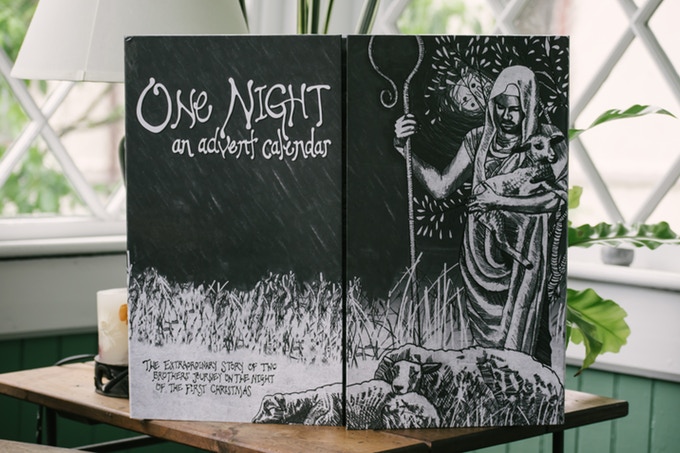
One Night Advent calendar

One Night Advent calendar

+++

from THE HOMELY HOURS

These resources were published over the last few years, but I just found out about them this summer. Run by churchwomen from Christ the King Anglican Church in Dayton, Ohio, The Homely Hours is a website created out of a desire to encourage a deeper integration of the life of the church into the life of the home. It’s treated not so much as a blog (it’s not continually updated) as it is a repository, so search through the tabs and archives for creative ideas to celebrate the liturgical seasons in the domestic sphere.

Advent plans include Advent-wreath prayers, Jesus-tree ornaments, St. Nicholas Day treat bags, Advent Saints and Life of Mary coloring pages, a printable St. Lucy’s crown, poems, and more—all free. As a reminder that the observance of Advent with one’s family does not necessitate perfect planning or novelty or “lots of” (quite the contrary), see “If I handcraft artisan shoes for St. Nicholas Day but have not love . . .”

St. Nicholas treat bag
St. Nicholas Day treat bag by Bley Hack/The Homely Hours
Life of Mary coloring page
Life of Mary coloring page (detail) by Michelle Abernathy/The Homely Hours

Resist (Artful Devotion)

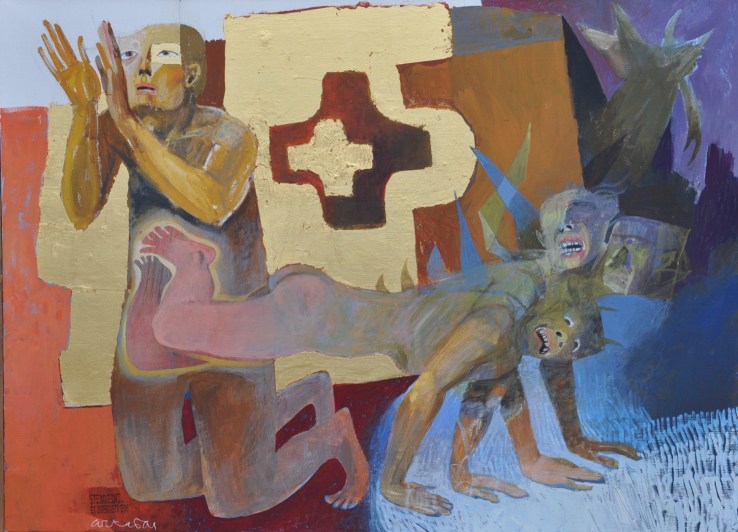
Prayer by Arcabas
Painting by Arcabas (French, 1926–2018)

Submit yourselves therefore to God. Resist the devil, and he will flee from you.

—James 4:7

+++

SONG: “Way Down in the Hole” by Tom Waits, on Franks Wild Years (1987)


This post belongs to the weekly series Artful Devotion. If you can’t view the music player in your email or RSS reader, try opening the post in your browser.

To view all the Revised Common Lectionary scripture readings for Proper 20, cycle B, click here.

Preaching Skies (Artful Devotion)

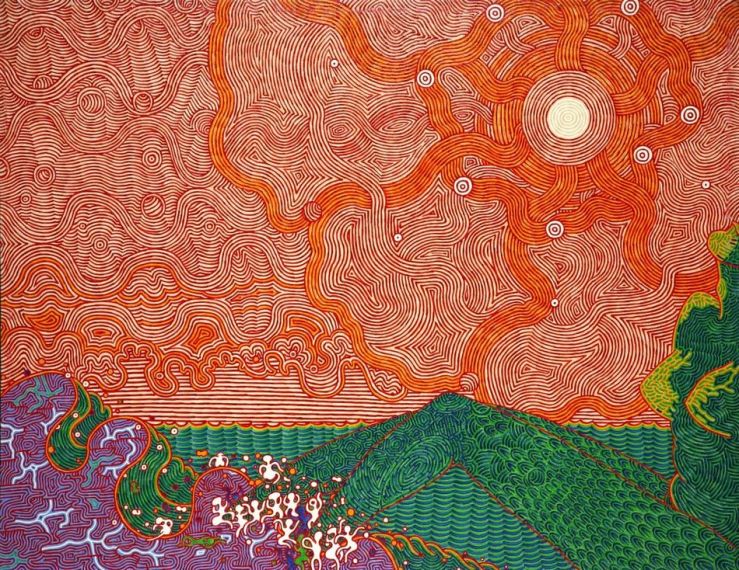
Untitled (No. 29) by Fumihiro Kato
Fumihiro Kato (Japanese, 1958–), Untitled (No. 29). Oil on canvas, 91 × 116.7 cm.

The heavens declare the glory of God,
and the sky above proclaims his handiwork.
Day to day pours out speech,
and night to night reveals knowledge.
There is no speech, nor are there words,
whose voice is not heard.
Their voice goes out through all the earth,
and their words to the end of the world.

In them he has set a tent for the sun,
which comes out like a bridegroom leaving his chamber,
and, like a strong man, runs its course with joy.
Its rising is from the end of the heavens,
and its circuit to the end of them,
and there is nothing hidden from its heat.

—Psalm 19:1–6 (ESV)

God’s glory is on tour in the skies,
God-craft on exhibit across the horizon.
Madame Day holds classes every morning,
Professor Night lectures each evening.

Their words aren’t heard,
their voices aren’t recorded,
But their silence fills the earth:
unspoken truth is everywhere.

God makes a huge dome
for the sun—a superdome!
The morning sun’s a new husband
leaping from his honeymoon bed,
The daybreaking sun an athlete
racing to the tape.

That’s how God’s Word vaults across the skies
from sunrise to sunset,
Melting ice, scorching deserts,
warming hearts to faith.

—Psalm 19:1–6 (The Message)

+++

SONG: “The Spacious Firmament” | Words by Joseph Addison, 18th century | Music by Herbert Sumsion, 20th century | Performed by the Ecclesium Choir, 2005

The spacious firmament on high,
With all the blue ethereal sky,
And spangled heavens, a shining frame,
Their great Original proclaim.

The unwearied sun from day to day
Does his Creator’s power display,
And publishes to every land
The work of an almighty hand.

Soon as the evening shades prevail,
The moon takes up the wondrous tale,
And nightly to the listening earth
Repeats the story of her birth:

Whilst all the stars that round her burn,
And all the planets in their turn,
Confirm the tidings, as they roll,
And spread the truth from pole to pole.

What though in solemn silence all
Move round the dark terrestrial ball?
What though no real voice nor sound
Amid their radiant orbs be found?

In reason’s ear they shall rejoice,
And utter forth a glorious voice,
Forever singing as they shine,
“The hand that made us is divine.”

Sumsion’s setting of Addison’s hymn text for SATB and organ is beautiful, but it’s too complex for congregational singing. For those of you who want to introduce this hymn to your church with a more singable melody, there are two precedents: you could use either LONDON by John Sheeles, composed around 1720 (listen here), or CREATION, taken from the chorus “The Heavens Are Telling” in Haydn’s 1798 oratorio The Creation (adapted, e.g., in The Hymnal 1982 #409).


This post belongs to the weekly series Artful Devotion. If you can’t view the music player in your email or RSS reader, try opening the post in your browser.

To view all the Revised Common Lectionary scripture readings for Proper 19, cycle B, click here.

Roundup: Aretha Franklin, Berenice Rarig, and more

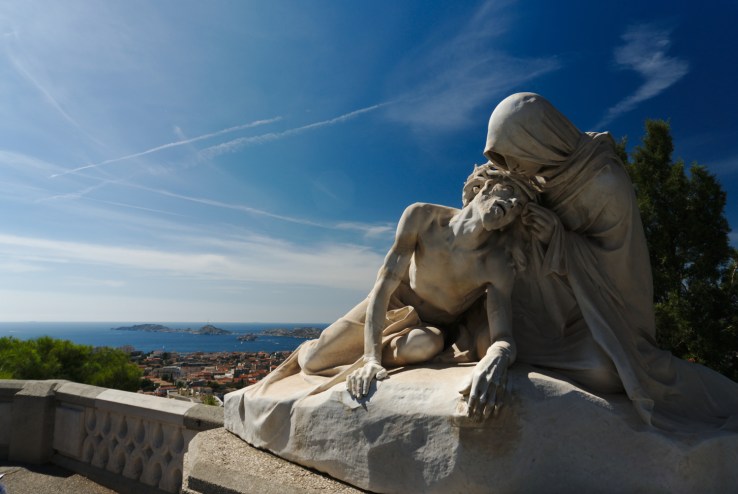
Last week I returned from a two-week trip to western Europe, where my husband and I spent time in Spain (Madrid, Barcelona, and Porto Cristo), southern France (Aix-en-Provence and Marseilles), and Italy (Florence, Rome, Pompeii, and Amalfi). We had only a little time in each city, but wow, what beauty! I’ll be going through our photos soon and sharing some on the blog. In the meantime, here’s one Eric took outside Notre-Dame de la Garde in Marseilles, a basilica built atop a 489-foot-high limestone outcropping that overlooks the Old Port.

Veronica and Christ (Marseilles)
Veronica and Christ, Notre-Dame de la Garde, Marseilles, France. Photo: Eric James Jones.

The stone sculpture, from the twentieth century, shows Veronica (an apocryphal saint) wiping Christ’s brow on his way to Calvary. Her gesture of compassion is meant to symbolize the action of missionaries, to whom the sculpture is dedicated.

+++

While I was gone, Aretha Franklin, the Queen of Soul, passed away. Like many soul singers, she got her start singing gospel, and her 1972 album Amazing Grace, recorded live from New Temple Missionary Baptist Church in Los Angeles, is the highest-selling live gospel music album of all time. Below you can watch her perform the title track, a hymn classic, in 2014.

Many famous singers and musicians paid tribute to Franklin at her eight-hour-long funeral on August 31. One of my favorite performances was Stevie Wonder’s rendition of “The Lord’s Prayer” on harmonica.

+++

NEW ON ARTWAY: ArtWay is a web publication I contribute to that seeks to connect Christians to the rich history and contemporary practice of visual art. Last Sunday I wrote a visual meditation for the site on Bill Viola’s video piece Emergence, which references a Man of Sorrows painting by Masolino.

Emergence by Bill Viola
Bill Viola (American, 1951–), Emergence (still frame), 2002, from The Passions series. High-definition video master tape. J. Paul Getty Museum, Los Angeles, California.

Along with the other editors, I also curate items for ArtWay’s Poetry section. Most recently I selected a poem by Abigail Carroll titled “Dear Wounded Saint,” based on a Caravaggio painting of St. Francis of Assisi. Carroll is a brilliant poet, and I heartily recommend her two collections, Habitation of Wonder (2018) and A Gathering of Larks (2017).

Saint Francis of Assisi in Ecstasy by Caravaggio
Caravaggio (Italian, 1571–1610), Saint Francis of Assisi in Ecstasy, ca. 1595. Oil on canvas, 92.5 × 127.8 cm (36.4 × 50.3 in.). Wadsworth Atheneum, Hartford, Connecticut.

+++

ARTIST INTRO: A chain of connections brought me into contact with Berenice Rarig, an Australian artist whose work comprises installation, performance, sculpture, and photography. In addition, she is the founder of MAKE Collective, an initiative of the Presbyterian Church in America’s missionary arm that helps creatives become part of international church-planting movements through cultural engagement, creative thinking, and artistic excellence. As she was visiting the Baltimore area last week, we got lunch together and shared our visions for our respective ministries.

I loved learning about Berenice’s unique approach to art as mission. “My role as an artist is to point to what’s already pointing,” she says. “I join St. Augustine who said, ‘Everything in creation points to the Creator.’”

> Read an interview with Berenice Rarig from 2006, published in The Creative Spirit: A Journal of Faith and the Arts.

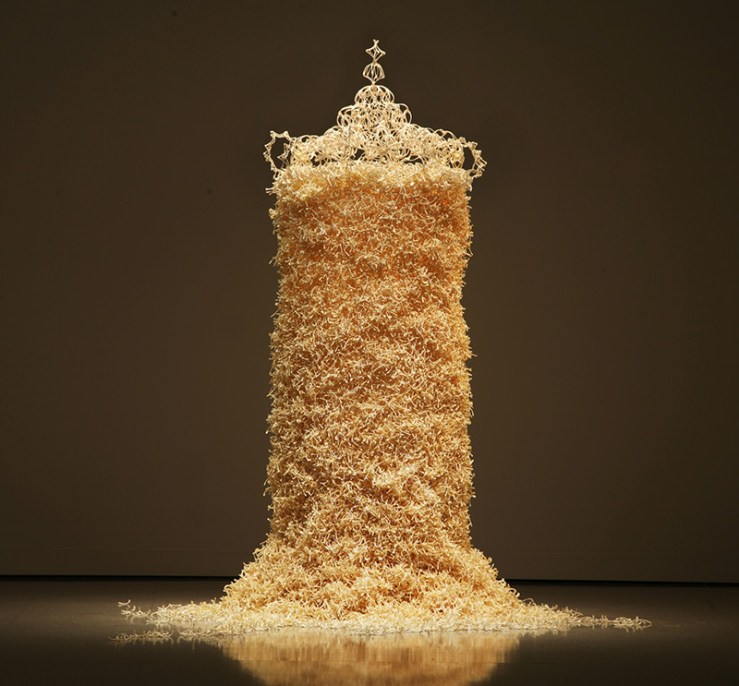
Here is a video-recorded lecture she gave at the Mumbai Arts Conference in 2015; it’s titled “Imaging Grace.” In it she explains the three works of hers pictured below, and others. Wishbones, quail eggs, and coffee filters—that gives you a sense of the kinds of materials she likes to work with. She had a load of donated clock parts in her trunk when I was riding with her, which she is excited to tinker with for her next art project.

Cathedral de St. Icarus the Wishful by Berenice Rarig
Berenice Rarig (Australian, 1959–), Cathedral de St. Icarus the Wishful, 2012. 50,000+ wishbones, wire frame, and lights, 9 ft. high.
A Tiny Hum by Berenice Rarig
Berenice Rarig (Australian, 1959–), A Tiny Hum (Humanity) 3, 2012. Quail eggs and wire.
Whispered Prayers by Berenice Rarig
Berenice Rarig (Australian, 1959–), Whispered Prayers, 2001. Folded coffee filters.

+++

PATRONAGE OPP: Monthly worship services by Liturgy Fellowship: I just became a patron of Liturgy Fellowship and am excited to see what they turn out! “We are starting a new project. Every month we are going to invite a guest liturgical artist to write a worship service for us. The themes will vary from biblical themes, to the church calendar, to under-served topics. If things go well we will also try to invite others to write original songs and create art to go along with the service theme. This will (hopefully) grow into a fantastic resource for the church!”

Ephphatha (Artful Devotion)

Healing of the Deaf (9th c)
Healing of the Deaf Man, ca. 830. Fresco, north wall of nave, Church of St. John, Müstair, Switzerland.

Then he returned from the region of Tyre and went through Sidon to the Sea of Galilee, in the region of the Decapolis. And they brought to him a man who was deaf and had a speech impediment, and they begged him to lay his hand on him. And taking him aside from the crowd privately, he put his fingers into his ears, and after spitting touched his tongue. And looking up to heaven, he sighed and said to him, “Ephphatha,” that is, “Be opened.” And his ears were opened, his tongue was released, and he spoke plainly. And Jesus charged them to tell no one. But the more he charged them, the more zealously they proclaimed it. And they were astonished beyond measure, saying, “He has done all things well. He even makes the deaf hear and the mute speak.”

—Mark 7:31–37

+++

Deaf people represent one of the largest groups worldwide that is unreached and unengaged with the gospel, with an estimated 2 percent of the world’s seventy million being followers of Christ. Thankfully, in Kenya, Deaf Christian leaders are bucking this statistic, translating scripture into Kenyan Sign Language and accessible art forms, like drama, dance, and drumming.

In the video below, Pastor Benard Mburu Mwangi Thuku presents four works he commissioned from Deaf friends, all rooted in Sunday’s Gospel lectionary reading. (Thanks to Paul Neeley at Global Christian Worship for bringing this video to my attention!) Created by and for the Kenyan Deaf community, the song at 5:41 consists of loud drum beats—whose vibrations can be felt by Deaf people—that accentuate three men’s rhythmic signings of the story of Jesus’s healing of the deaf man of Decapolis; you can hear the emotional responses of the offscreen audience. This performance is followed by a brief lesson in dialogue format.


This video, posted on Facebook by Michelle Petersen, is excerpted from a class on scripture engagement that was held July 25, 2016, at the Canada Institute of Linguistics, originally a department of Wycliffe Bible Translators. To adjust the volume, click the megaphone icon on the far right.


This post belongs to the weekly series Artful Devotion. If you can’t view the music player in your email or RSS reader, try opening the post in your browser.

To view all the Revised Common Lectionary scripture readings for Proper 18, cycle B, click here.

Welcome the Word (Artful Devotion)

Rays by Denis Sarazhin
Denis Sarazhin (Ukrainian, 1982–), Rays, 2012. Oil on canvas, 150 × 90 cm.

Rid yourselves of all sordidness and rank growth of wickedness, and welcome with meekness the implanted word that has the power to save your souls.

—James 1:21

+++

SONG: “He Is Able” by Josh White, on Achor (2010)


This post belongs to the weekly series Artful Devotion. If you can’t view the music player in your email or RSS reader, try opening the post in your browser.

To view all the Revised Common Lectionary scripture readings for Proper 17, cycle B, click here.

Siyahamba (Artful Devotion)

Zionists by Charles B. S. Nkosi
Watercolor by Charles B. S. Nkosi (South African, 1949–), 1979. Source: Christliche Kunst in Afrika, p. 260

Finally, be strong in the Lord and in the strength of his might. Put on the whole armor of God, that you may be able to stand against the schemes of the devil. For we do not wrestle against flesh and blood, but against the rulers, against the authorities, against the cosmic powers over this present darkness, against the spiritual forces of evil in the heavenly places. Therefore take up the whole armor of God, that you may be able to withstand in the evil day, and having done all, to stand firm. Stand therefore, having fastened on the belt of truth, and having put on the breastplate of righteousness, and, as shoes for your feet, having put on the readiness given by the gospel of peace. In all circumstances take up the shield of faith, with which you can extinguish all the flaming darts of the evil one; and take the helmet of salvation, and the sword of the Spirit, which is the word of God . . .

—Ephesians 6:10–17

+++

SONG: “Siyahamba” (We Are Marching) | South African folk song | Arrangement by Walt Whitman performed by the Soul Children of Chicago, July 21, 2008, as the finale of “Hope in Action,” a celebration of Nelson Mandela’s ninetieth birthday | For a congregational hymn arrangement, see African American Heritage Hymnal #164

This exultant hymn, which likely originated during South Africa’s apartheid era, consists of permutations of the Zulu phrase Siyahamb’ ekukhanyen’ kwen khos’ (“We are marching in the light of God”), with subsequent verses substituting alternate verbs like “dancing,” “singing,” and “praying.” In 2008 Walt Whitman arranged the song for Soul Children of Chicago, a choir he formed as a means of “encouraging our youth and providing hope and inspiration in a world filled with challenges and despair.” His version is a lot of fun, albeit busier than others, with a more densely textured, orchestral sound. For a more straightforward rendition with clear vocals and simple percussion, check out the University of Notre Dame Folk Choir’s Crossroads of Praise album from 1999.

To learn more about “Siyahamba,” see “History of Hymns: ‘Siyahamba’” by C. Michael Hawn.


This post belongs to the weekly series Artful Devotion. If you can’t view the music player in your email or RSS reader, try opening the post in your browser.

To view all the Revised Common Lectionary scripture readings for Proper 16, cycle B, click here.

Lady Wisdom, Lady Love (Artful Devotion)

Sophia by Lyuba Yatskiv
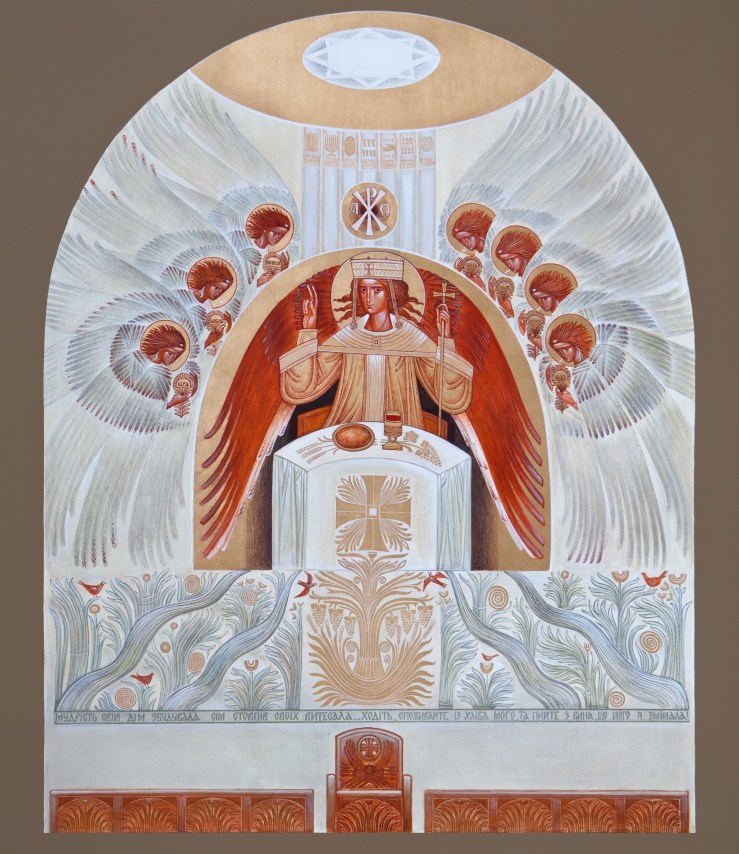
Lyuba Yatskiv (Ukrainian, 1977–), Sophia (Holy Wisdom), 2015. Design for the apse of the Church of Sophia, Wisdom of God, Ukrainian Catholic University, Lviv, Ukraine.

Wisdom has built her house;
she has hewn her seven pillars.
She has slaughtered her beasts; she has mixed her wine;
she has also set her table.
She has sent out her young women to call
from the highest places in the town,
“Whoever is simple, let him turn in here!”
To him who lacks sense she says,
“Come, eat of my bread
and drink of the wine I have mixed.
Leave your simple ways, and live,
and walk in the way of insight.”

—Proverbs 9:1–6

+++

Lady Wisdom, or Holy Wisdom (Hagia Sophia), is a female allegorical figure from the book of Proverbs (1:20–33, 2:13–18, 8:1–36, 9:1–6). I enjoyed searching for songs about her; the pool is ampler than I expected. I found a few that directly reference Sunday’s lectionary passage—“Wisdom (Has Built Her House)” by Angela Lashley, “Wisdom’s Table” by John L. Bell and Doug Gay, and “God’s Wisdom Spreads Her Table Well” by Kevin Keil—but didn’t find them as compelling as the two I settled on, below.

(Update, 11/28/20: I’ve just come across “How Long?” by Ordinary Time, based on the Call of Wisdom in Proverbs 1. It’s quite good!)

LATIN JAZZ INSTRUMENTAL: “Lady Wisdom” by Lannie Battistini, on Nomenclatura (2014)

FOLK ROCK: “Lady Wisdom” by PureFusion, on Elegy (2010)

+++

In Divine Wisdom: The Wisdom Writings of Vladimir Solovyov, Judith Deutsch Kornblatt writes,

The symbolism of icons of the Divine Sophia is far from standardized and is decidedly ambiguous. . . . Images of wisdom remain the most abstract of all holy pictures, for the Divine Sophia never existed as a real being. Even the gender of Sophia in Russian icons is ambiguous, as in different centuries and locations the personified figure is sometimes associated with Christ or Mary or depicted as an androgynous angel with “feminized” features otherwise attributed to Gabriel. (56)

In 2015 contemporary Ukrainian Greek Catholic iconographer Lyuba Yatskiv secured a major commission to decorate the interior of the newly built Church of Sophia, Wisdom of God, on the campus of Ukrainian Catholic University in Lviv. Her design for the apse (the semicircular recess behind the church’s main altar), reproduced above, shows Wisdom as a winged bishop holding a cross-shaped crozier in her left hand while raising her right hand in a gesture of blessing. At her table are the wine and bread of the Eucharist, which she invites all to come and partake of. The chi-rho monogram above her, with an alpha and omega on either side, is a reference to Christ, while the seven pillars bear symbols of the seven gifts of the Holy Spirit, and the bright star of the Father sheds light from above. Below Wisdom, there blossoms the tree of life in the Garden of Eden, with its four rivers flowing, and flanking her are personifications of the seven virtues.

To learn more about the project, including design proposals from other artists, click here.


This post belongs to the weekly series Artful Devotion. If you can’t view the music player in your email or RSS reader, try opening the post in your browser.

To view all the Revised Common Lectionary scripture readings for Proper 15, cycle B, click here.

Roundup: Jewish mosaics; New Psalm Contest; revising hymns; tree-inspired chapel; and more

I will be going on vacation soon and will be mostly unplugged, so you will notice less frequent blog posts for a few weeks. I’ll cue up some Artful Devotions to be published automatically each Tuesday I’m gone but won’t be posting the links to the blog’s Twitter and Facebook pages as I usually do—so be sure to check the site instead! (Or subscribe by email by clicking the “Follow” link, located in the sidebar if viewing from your computer or at the bottom if viewing from your phone.) My regular publishing schedule will resume in September.

ARCHAEOLOGICAL FIND: “Discovery of Jewish Mosaics in Israel Bring Color to Biblical Accounts” by Sarah E. Bond: “At the ancient site of Huqoq, near the Sea of Galilee in modern Israel, a number of stunning mosaics depicting biblical, astrological, and historical narratives have been uncovered in a Jewish village that flourished during the late Roman empire. The colorful and large number of mosaics found in a synagogue challenge traditional views about Jewish art of the period as symbolic rather than representational of biblical texts, bland, and in decline during the period.”

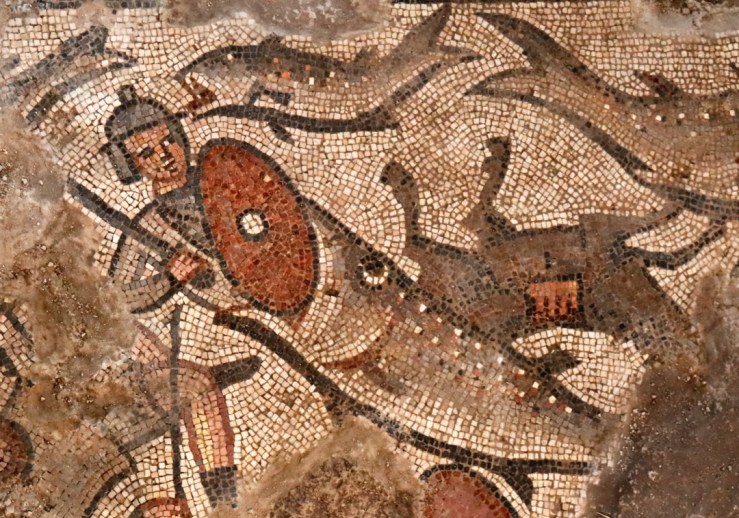
Fish swallowing Pharoah's soldier
A giant Red Sea fish swallows one of Pharaoh’s soldiers in this mosaic detail from the late Roman (ca. 5th century) synagogue at Huqoq, Israel. Photo: Jim Haberman, via UNC-Chapel Hill.

+++

SONGWRITING CONTEST: “In an effort to encourage Psalm-singing, Church of the Servant [in Grand Rapids, Michigan] invites congregational songwriters to submit a Psalm-based song to its 2018 COS New Psalm Contest. The winner will receive a $500 award. There is no entry fee and the contest is open to all. Submissions must be emailed or postmarked by October 1, 2018. The song will be premiered in worship on January 27, 2019. Church of the Servant is a Christian Reformed Church with a rich history of encouraging the arts in worship. Its worship is Reformed, liturgical, participatory, eclectic, and open to creative new worship expressions.”   Continue reading “Roundup: Jewish mosaics; New Psalm Contest; revising hymns; tree-inspired chapel; and more”

An On-Time God (Artful Devotion)

Waiting by Susanne Mitchell
Susanne Mitchell (American, 1973–), Waiting (from the series Silence of the Ordinary), 2015. Oil and mixed media on canvas, 162.6 × 149.9 cm (64 × 59 in.).

I wait for the LORD, my soul waits,
and in his word I hope.

—Psalm 130:5

+++

SONG: “Wait on the Lord” by Ben Keyes, on Were You There? Are You Here? (2007)

+++

O Master, my desires to work, to know,
To be aware that I do live and grow—
All restless wish for anything not thee
I yield, and on thy altar offer me.
Let me no more from out thy presence go,
But keep me waiting watchful for thy will—
Even while I do it, waiting watchful still.

—George MacDonald, from A Book of Strife in the Form of the Diary of an Old Soul (1880)


This post belongs to the weekly series Artful Devotion. If you can’t view the music player in your email or RSS reader, try opening the post in your browser.

To view all the Revised Common Lectionary scripture readings for Proper 14, cycle B, click here.