All who are led by the Spirit of God are sons of God. For you did not receive the spirit of slavery to fall back into fear, but you have received the Spirit of adoption as sons, by whom we cry, “Abba! Father!” The Spirit himself bears witness with our spirit that we are children of God, and if children, then heirs—heirs of God and fellow heirs with Christ, provided we suffer with him in order that we may also be glorified with him.
Artist John Ndevasia Muafangejo was born around 1943 in southern Angola, a member of the Kwanyama tribe of the Owambo people. He moved to Namibia as a teenager and was educated at an Anglican mission school, then spent 1967–69 in training at the Evangelical Lutheran Church Art and Craft Centre in Rorke’s Drift, South Africa, an art school that scholars credit as integral to the development of modern African printmaking. Muafangejo is one of the most famous alumni of the school, gaining international recognition for his linocuts, which have been exhibited throughout Europe and America. But his career was cut short in 1987 when he died suddenly of a heart attack, just three years before Namibia gained its independence.
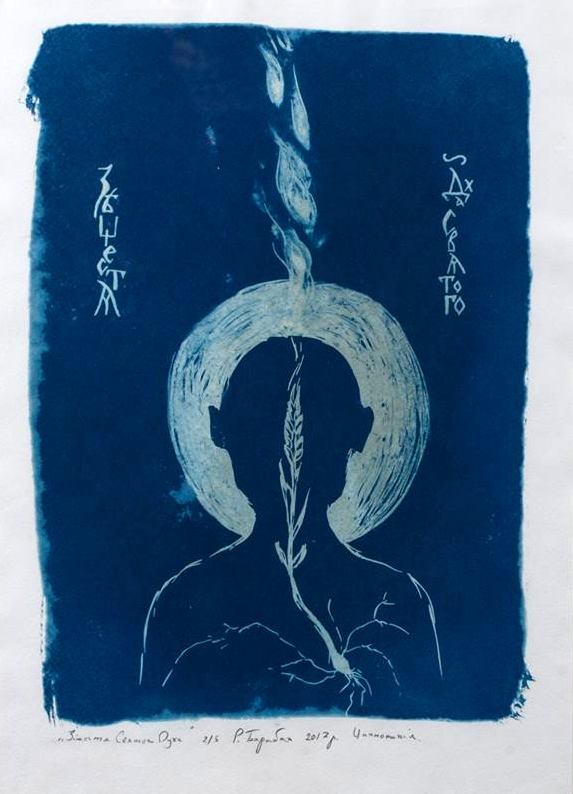
The artwork pictured above is somewhat uncharacteristic of Muafangejo, being an etching (he was much more prolific with and is better known for his linocuts) and excluding the political and autobiographical content that mark much of his other work. Church life and biblical narratives, however, did regularly find expression in his prints. He thought highly of the church, whose local leaders fought against apartheid, supported his art, and (through Father C. S. Mallory) cared for him during bouts of mental illness.
How God loves his People all over the World shows God the Father embracing all his children, who tenderly place their hands over their hearts. A family portrait! What Muafangejo visualizes in anthropomorphic terms, Mike Crawford, in his music video for “You Are the Lover of Our Souls,” suggests through images of sun, sea, sky, and breeze, which feel like a hug from on high. “God, you are so good / You are beautiful / So mysterious / How you’re calling us into your family / You’ve invited us into your family / We’re your sons and daughters now. / . . . / Yes, you have adopted me.”
This post belongs to the weekly series Artful Devotion. If you can’t view the music player in your email or RSS reader, try opening the post in your browser.
To view all the Revised Common Lectionary scripture readings for Trinity Sunday, cycle B, click here.
I grew up in North Carolina, so bluegrass music feels like home to me. Its acoustic strings (strummed, picked, and bowed), its stacked vocal harmonies—this “mountain music” from the southern US sounds sweet to my ears.
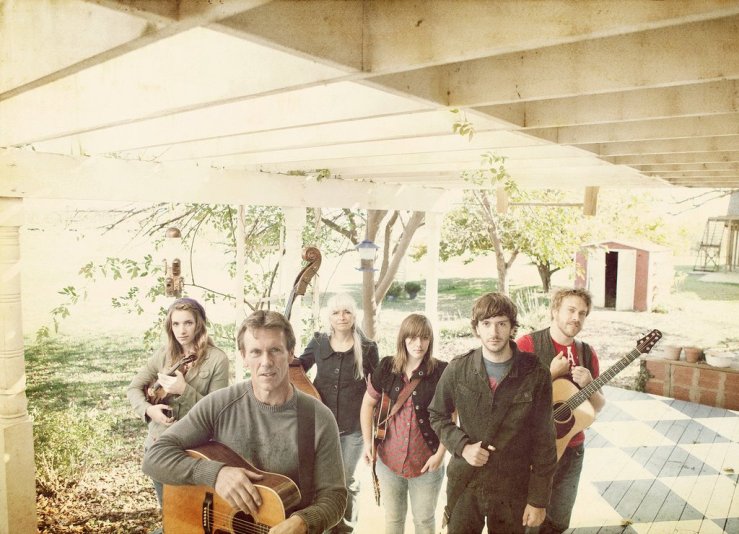
The Franz Family, 2012
Lately I’ve been enjoying some video-archived bluegrass performances by the Franz Family from Berryville, Arkansas, a family of seven—Mom, Dad, three sons,* and two daughters—who toured together as a bluegrass gospel band continuously from 1991 to 2011, performing at churches, camps, prisons, and parties. (*The second oldest son, Hadley, left the group in 2004 when he got married and moved to Kansas.) Click here to watch a short documentary on the Franz Family, produced in 2010.
Everyone in the group sings and plays multiple instruments, but here are the instruments you’ll most commonly see them on:
Randy Franz: Guitar Ruth Ann Franz: Guitar, double bass Caleb Franz: Guitar, mandolin, banjo Audra (Franz) Mohnkern: Double bass Emmett Franz: Dobro Olivia (Franz) Jahnke: Fiddle
So many songs from the traditional bluegrass repertoire were written as Christian testimony. Most celebrate the personal redemption from sin wrought through Christ and eagerly anticipate heaven, inviting others onto that glory train. They also proclaim the loving aid God provides through the storms of life, which the family experienced when Ruth Ann passed away from cancer in 2016. Her death renders even truer the lyrics she sang again and again:
I’m just a pilgrim here
Soon I’ll be gone
Nothing can hold me here
I’m headed home
And:
Somewhere in glory you’ll find me
Singing and shouting in eternity
Here are three studio recordings of the Franz Family from December 2009 in Denver, Colorado: “Hold to God’s Unchanging Hand,” “Somewhere in Glory,” and “Getting Ready to Go.”
You can hear this song—and twelve others—on “Anonymous 4: The Sacred Harp,” a Saint Paul Sunday radio broadcast that aired on American Public Media in September 2006. The entire concert-interview is worth a listen, or you can skip to 7:49.
Come, Holy Spirit, come,
With energy divine,
And on this poor, benighted soul,
With beams of mercy shine.
From the celestial hills,
Light, life, and joy dispense;
And may I daily, hourly feel
Thy quick’ning influence.
Melt, melt this frozen heart;
This stubborn will subdue;
Each evil passion overcome,
And form me all anew.
Mine will the profit be,
But Thine shall be the praise;
And unto Thee will I devote
The remnant of my days.
This post belongs to the weekly series Artful Devotion. If you can’t view the music player in your email or RSS reader, try opening the post in your browser.
To view all the Revised Common Lectionary scripture readings for Pentecost Sunday, cycle B, click here.
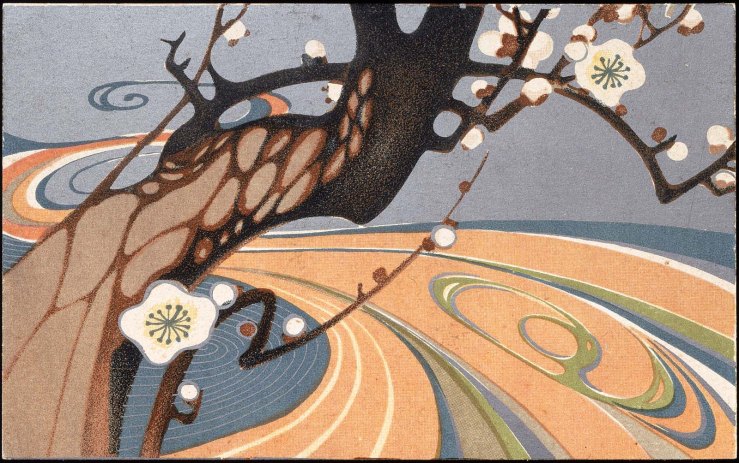
Blossoming Plum Tree by a River, Japan, early 20th century. Color lithograph, 8.8 × 13.8 cm (3 7/16 × 5 7/16 in.). Museum of Fine Arts, Boston.
Blessed is the man
who walks not in the counsel of the wicked,
nor stands in the way of sinners,
nor sits in the seat of scoffers;
but his delight is in the law of the LORD,
and on his law he meditates day and night.
He is like a tree
planted by streams of water
that yields its fruit in its season,
and its leaf does not wither.
In all that he does, he prospers.
—Psalm 1:1–3
Blessed is the man who trusts in the LORD,
whose trust is the LORD.
He is like a tree planted by water,
that sends out its roots by the stream,
and does not fear when heat comes,
for its leaves remain green,
and is not anxious in the year of drought,
for it does not cease to bear fruit.
—Jeremiah 17:7–8
+++
SONG: “I Shall Not Be Moved” | Negro spiritual, performed by Mississippi John Hurt (1892–1966), on The Best of Mississippi John Hurt | For a congregational hymn arrangement, see the African American Heritage Hymnal #479
Instead of the rough extroverted singing style and aggressive guitar playing that typified the other Delta legends, Hurt sang in a gentle, quiet voice and played intricate and often delicate guitar patterns. With a particular fondness for songsters that had blues leanings in their repertoires, like Leadbelly and Josh White, Hurt developed into an extraordinarily lyrical guitarist with a refined finger-picking style. His tender singing exuded a warmth unique to the blues genre, and the gospel influence so prominent in his music gave his songs a depth and reflective quality . . . [excerpted from a Paste magazine feature by Alan Bershaw]
For an even earlier recording of this song, from 1926, listen to the Taskiana Four.
This post belongs to the weekly series Artful Devotion. If you can’t view the music player in your email or RSS reader, try opening the post in your browser.
To view all the Revised Common Lectionary scripture readings for the Seventh Sunday of Easter, cycle B, click here.
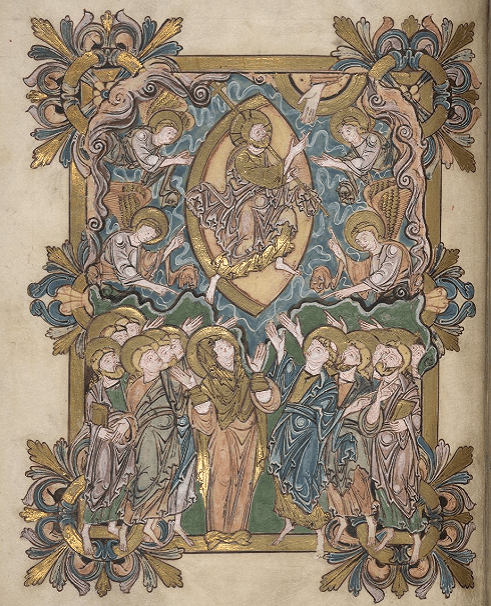
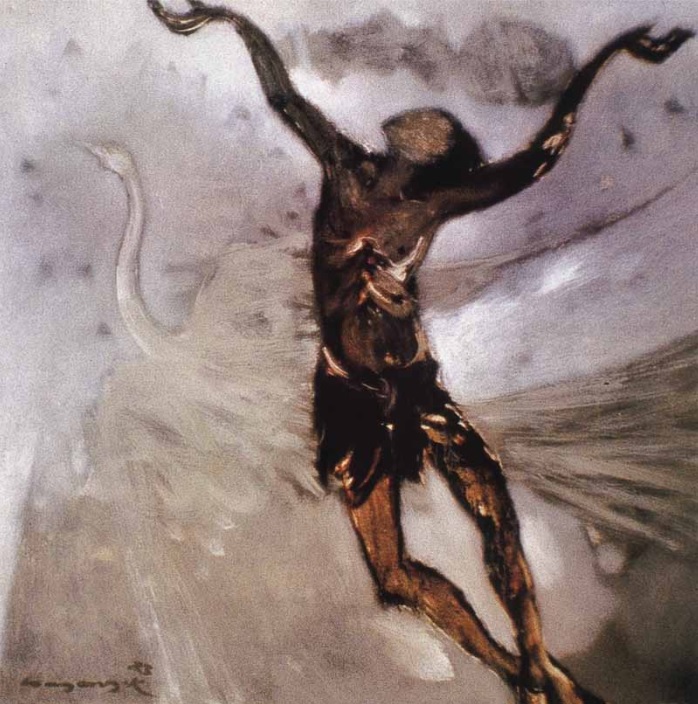
ANGLO-SAXON ASCENSION POEM: Excerpts from “Christ II” by Cynewulf, probably ninth century, translated from Old English by Eleanor Parker: Dr. Eleanor Parker lectures on medieval literature at Oxford University and runs the excellent blog A Clerk at Oxford, where she often shares her translations of Anglo-Saxon poetry, with commentary. The poem she shares here reflects on Christ’s ascension—the disciples’ grief, the angels’ joy. To me the most remarkable section is the one that, indirectly referencing a sermon of Gregory the Great, describes Christ “leaping” up to heaven, taking an active bound toward his homeland, a movement read in light of Song of Solomon 2:8: “Behold, he comes, leaping over the mountains, bounding over the hills.” This leap is one of six he took: from heaven (1) into Mary’s womb, (2) into a manger, (3) onto the cross, (4) into the tomb, (5) into hell, and finally, (6) back into heaven. “Prince’s play”! Parker pairs the poem with an exquisite, near-contemporary manuscript illumination, also from England; there’s also a lot of resonance between the poem and the Ascension image I published Tuesday by Bagong Kussudiardja, which shows a more balletic ascent.
The Ascension, from the Benedictional of St. Æthelwold (BL Additional MS. 49598), f. 64v, England, 963–984 CE. British Library, London.
+++
UNDERWATER DANCE:“AMA,” a short film by Julie Gautier: This wonderfully expressive silent film shows French free diver and underwater artist Julie Gautier dancing in a single breath for several minutes inside the world’s deepest swimming pool, Y-40 Deep Joy in Montegrotto Terme, Padua, Italy, to a minimalist piano piece. The final shot shows Gautier slowly rising to the water’s surface while releasing a giant air bubble, her pose evocative of the crucified Christ (and her upward movement an Ascension of sorts!). Titled “Ama” (Japanese for “sea woman,” the name given to Japan’s pearl divers), the film is “dedicated to all the women of the world,” Gautier says. The choreography is by Ophélie Longuet.
Gautier and her husband, Guillaume Néry, a free-diving champion, own the underwater filmmaking company Les Films Engloutis. Their most well-known project has been a music video featuring Beyoncé, codirected by Gautier and starring Néry.
+++
KICKSTARTER CAMPAIGN:Help Andy Squyres finance his next album: Andy Squyres is a super-talented singer-songwriter whose lyrics don’t stay in the shallows but, rather, dive into the depths of the faith experience. They are also supremely hope-filled. Below is a video of Squyres performing “Labor in Vain” at a house concert; the song is from his last album, Cherry Blossoms, which I reviewed here. Click on the boldface link above to hear Squyres discuss his new album project and to donate toward it.
+++
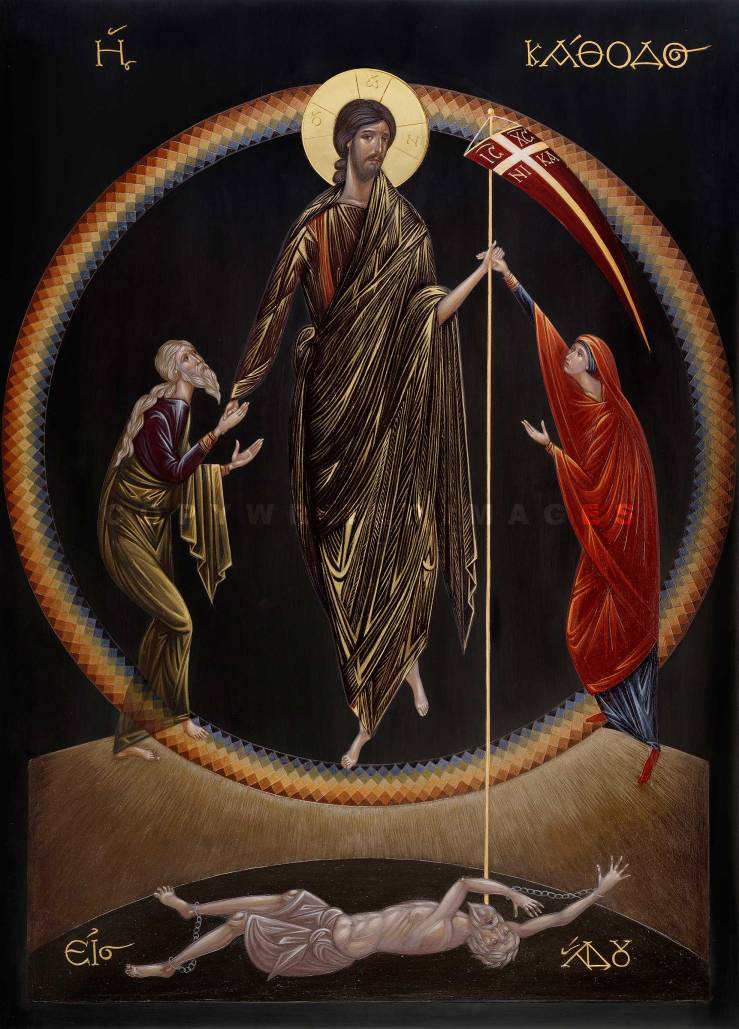
ICON PAINTING COMPETITION: The Interparliamentary Assembly of Orthodoxy (IAO) is hosting an international icon painting competition on the subject of Christ’s Resurrection. “Our purpose is to explore and bring to the foreground the numerous stylistic trends in existence today, enabling the visualization of a creative dialogue with tradition and, at the same time, the personal artistic expressions of artists who reframe tradition without, however, digressing from the doctrinal framework of Christian icon painting set by the 7th Ecumenical Council.” The submission window is closed—there are sixty-three great entries!—and now it’s time to cast your vote. Five winners will be selected to receive cash prizes, the topmost being €3,000, and other honors. Popular votes will be taken into account by the twelve jury members, among whom are esteemed iconographers George Kordis from Greece and Todor Mitrovic from Serbia.
Dimosthenis Avramidis (Greek, 1965–), Christ’s Descent into Hades, 2017. Egg tempera on wood, 91.5 × 61.5 cm.
+++
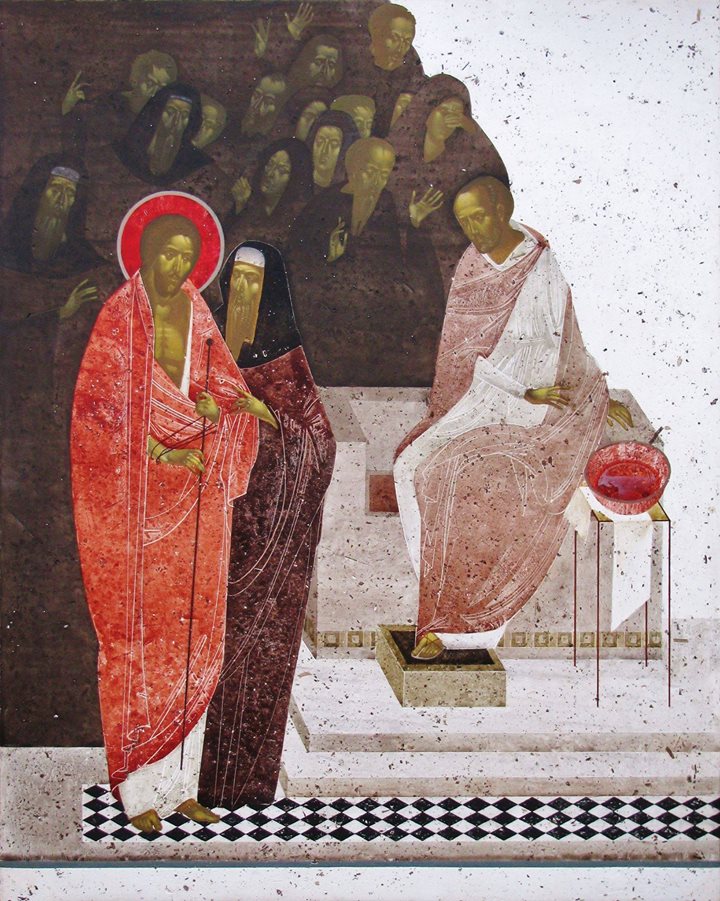
ESSAY: “On the Border of East and West: Searching for Icons in Lviv” by John A. Kohan: The latest issue of Image journal features a wonderful essay on the Lviv school of iconography (represented in entries #4, #10, and #20 of the above contest), a movement by young Ukrainian Greek Catholic artists to contemporize the Byzantine visual tradition. Written by John A. Kohan, an avid religious art collector and former Time bureau chief in Moscow (1988–1996), it discusses the political history of the city; the role of Metropolitan Andrey Sheptytsky (r. 1901–1944) in preserving and supporting art for future generations; the opening of the Iconart gallery in 2010 to nurture and promote the new style; the broad training these icon makers receive at the Lviv National Academy of Arts; and the uneven reception by others in the denomination (especially official church bodies), who tend to prefer their sacred art in the Radruzh School style or as contemporary Catholic kitsch. Kohan writes from his firsthand experiences meeting the artists and visiting their studios, churches, and exhibition spaces. The essay is available to subscribers only; click here to subscribe.
Natalya Rusetska (Ukrainian, 1984–), Crucifixion, 2017. Egg tempera on gessoed wood, 11 3/4 × 8 1/4 in.Ivanka Demchuk (Ukrainian, 1990–), Christ before Pilate, 2017. Mixed media on gessoed wood, 19 3/4 × 15 3/4 in.
I’m enthralled by the contemporary icons being produced in Lviv—I saw a bunch from Kohan’s collection last summer, and I featured some in a Baptism of Christ roundup earlier this year. The best way to keep abreast of the output from the Lviv school is to follow Iconart on Facebook, and for an even wider breadth of innovative eastern European icons, follow Międzynarodowe Warsztaty Ikonopisów w Nowicy (International Iconography Workshop in Nowica, Poland).
+++
MET GALA + EXHIBITION: “Heavenly Bodies: Fashion and the Catholic Imagination,” May 10–October 8, 2018, Metropolitan Museum of Art, New York City: The largest exhibition ever mounted by the Met’s Costume Institute, “Heavenly Bodies” features both religious vestments from the Vatican and runway fashions by famous designers inspired by Catholicism. AFashionista reviewer who attended a preview reports on the integrated displays:
A reliquary arm of Saint Valentine is displayed alongside a breastplate and crown of thorns from Alexander McQueen’s Givenchy days; sacred music serves as the auditory backdrop for a Rodarte collection that features a dress inspired by Bernini’s famous sculpture Ecstasy of Saint Teresa. Rows of mannequins wearing Dolce & Gabbana, Moschino and Raf Simons show the ways that the silhouettes of the cassock and nun’s habit have been explored on the runway time and again. There are even vestments by the likes of Yves Saint Laurent and Riccardo Tisci that were expressly designed to dress statues of the Virgin Mary in chapels in Italy and France.
Each year since 1948, the opening of the Costume Institute’s spring exhibition has been celebrated with a huge fundraising gala attended by celebrities who dress to the theme; this year’s took place May 7. There were lots of crosses and haloes, but also some more particularized outfits. Ariana Grande’s gown was inspired by Michelangelo’s Last Judgment; Gigi Hadid’s, by stained glass. Selena Gomez carried a Coach handbag embroidered with Proverbs 31:30b: “A woman who fears the Lord is a woman who shall be praised.” The most brazenly dressed was Rihanna, who wore a gem-encrusted bishop’s miter (not a papal tiara, as has been commonly reported). Another standout headpiece was Sarah Jessica Parker’s, which featured a Neapolitan Nativity scene set inside a mini baldachin. (The making of elaborate presepi, or Christmas crèches, is a longstanding tradition in Naples, reaching its height during the eighteenth century.)
The white Margiela minidress, cape, and headpiece Rihanna wore to Monday’s Met gala were inspired by Catholic pontifical vestments. Photo: John Shearer/Getty.Sarah Jessica Parker wore a regal gold, long-trained Dolce & Gabbana gown, but the pièce de résistance of her ensemble was the Nativity headpiece.
Lana Del Rey went as Our Lady of Sorrows, wearing an immaculate-heart chest plate pierced through with seven daggers; it was comical to hear religiously illiterate reporters trying to interpret the symbolism, saying things like the daggers are a “reminder to repent your sins or suffer damnation!” (Wrong. The swords symbolize the Virgin’s seven sorrows, beginning with Simeon’s prophecy.)
The ascension is so central [to Christianity] because it assures us that the Incarnation continues. Christ didn’t just come among us for thirty-three years, slumming, as it were, and then when his work was done, say, “Phew! I’m glad that’s over! I’m going to unzip this skin suit and get back to heavenly living,” leaving us here on our own. He went into heaven with a pledge of all that we are going to become. Tertullian, I think, was the first one to put it that way. The Spirit, in scripture, is the pledge of Christ’s presence in us, but Christ’s continuing body is the pledge of what we’re going to have in heaven. So the ascension tells us that Christ has not let go of our humanity. He truly wants to take human beings where we’ve never gone before: into the very life of the triune God.
This post belongs to the weekly series Artful Devotion. If you can’t view the music player in your email or RSS reader, try opening the post in your browser.
To view all the Revised Common Lectionary scripture readings for Ascension Day, cycle B, click here.
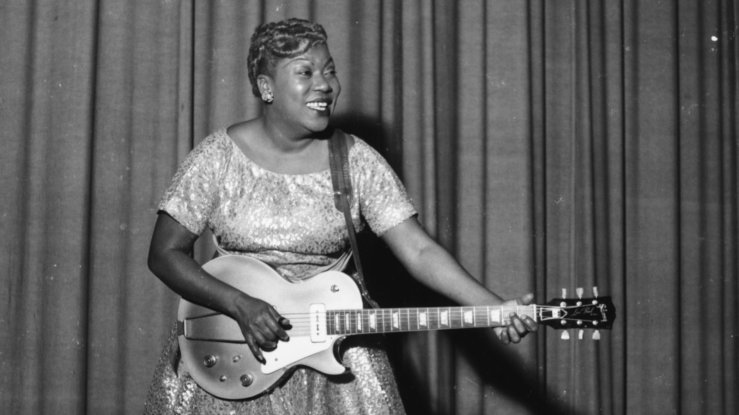
Last month Sister Rosetta Tharpe (1915–1973), one of the few female guitar evangelists of the ’30s and ’40s and the first gospel superstar, was inducted into the Rock and Roll Hall of Fame. She was named an “Early Influence” for her electric sound and original guitar picking, which influenced the likes of Chuck Berry, Jerry Lee Lewis, Elvis, and Johnny Cash, among many others. (“Tharpe’s unique guitar style blended melody-driven urban blues with traditional folk arrangements and incorporated a pulsating swing sound that is one of the first clear precursors of rock and roll.”) Performing (controversially) both sacred and secular music, in churches and nightclubs, Tharpe collaborated with heavy-hitting artists of the time, including Duke Ellington, Cab Calloway, and the Dixie Hummingbirds, and she even hired a white group, the Jordanaires, to sing backup during one of her tours.
In 2011 BBC Four premiered Sister Rosetta Tharpe: The Godmother of Rock and Roll, a documentary written and directed by UK filmmaker Mick Csaky. Its US television premiere was in 2013, part of PBS’s American Masters series. Watch the trailer below, or watch the full documentary online.
Another April Rock and Roll Hall of Fame inductee, who’s more of a household name, is Nina Simone (1933–2003). One of her most famous songs (certainly her most sampled) is “Sinnerman,” a Negro spiritual inspired by Revelation 6:12–17:
When he opened the sixth seal, I looked, and behold, there was a great earthquake, and the sun became black as sackcloth, the full moon became like blood, and the stars of the sky fell to the earth as the fig tree sheds its winter fruit when shaken by a gale. The sky vanished like a scroll that is being rolled up, and every mountain and island was removed from its place. Then the kings of the earth and the great ones and the generals and the rich and the powerful, and everyone, slave and free, hid themselves in the caves and among the rocks of the mountains, calling to the mountains and rocks, “Fall on us and hide us from the face of him who is seated on the throne, and from the wrath of the Lamb, for the great day of their wrath has come, and who can stand?”
When Simone (then Eunice Waymon) was a young girl, her mother, a Methodist minister, had her play the song on the piano at revival and prayer meetings as a means of compelling sinners to the altar. (Before pursuing her career as a singer and recording artist, she wanted to be a classical concert pianist. She plays the piano on “Sinnerman” and many other tracks.) Because she recorded her version of “Sinnerman” at the height of her civil rights activism, in 1965, some have speculated that the song is a veiled condemnation of the sins of white America. Continue reading “Roundup: Rock Hall inductions; James Cone; lynching memorial; “Christ in Alabama””→
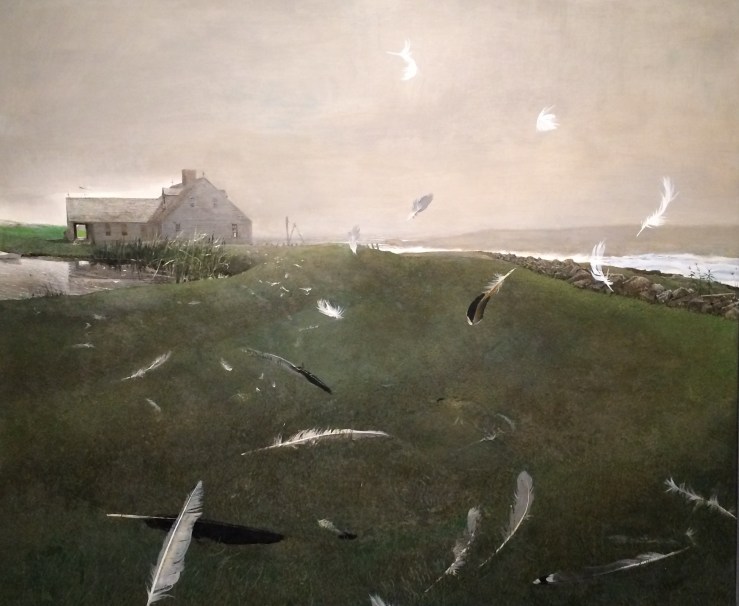
Andrew Wyeth (American, 1917–2009), Airborne, 1996. Tempera on hardboard panel. Crystal Bridges Museum of American Art, Bentonville, Arkansas.
For this is the love of God, that we keep his commandments. And his commandments are not burdensome. For everyone who has been born of God overcomes the world.
—1 John 5:3–4a
+++
SONG: “How Gentle God’s Commands” | Words by Philip Doddridge (1702–1751) | Music by Hans Georg Nägeli (1773–1836) | Performed by Ordinary Time, on At the Table (2009)
How gentle God’s commands!
How kind his precepts are!
Come, cast your burdens on the Lord
And trust his constant care.
Beneath his watchful eye,
His saints securely dwell;
That hand which bears all nature up
Shall guard his children well.
Why should this anxious load
Press down your weary mind?
Haste to your heav’nly Father’s throne
And sweet refreshment find.
His goodness stands approved,
Unchanged from day to day;
I’ll drop my burden at his feet
And bear a song away.
+++
I cannot see, my God, a reason why
From morn to night I go not gladsome, free;
For, if thou art what my soul thinketh thee,
There is no burden but should lightly lie,
No duty but a joy at heart must be:
Love’s perfect will can be nor sore nor small,
For God is light—in him no darkness is at all.
This post belongs to the weekly series Artful Devotion. If you can’t view the music player in your email or RSS reader, try opening the post in your browser.
To view all the Revised Common Lectionary scripture readings for the Sixth Sunday of Easter, cycle B, click here.
UPCOMING CONFERENCE / CALL FOR PAPERS: “Visual Theology I: Transformative Looking Between the Visual Arts and Christian Doctrine (1850–Now),” October 19–20, 2018, The Palace, Chichester, Sussex, England: The inaugural conference of the Visual Theology Symposium will take place this fall, and paper proposals are now being accepted (deadline June 15). “The divide between confessional and critical positions has long impoverished and polarised the academic analysis of the arts,” and this conference seeks to help bridge that divide. Click on the link to learn more, including eight possible paper approaches. Not only are scholars of art history, visual culture, and theology encouraged to submit but also clergy and artists. Jonathan A. Anderson and Ayla Lepine are among the several confirmed speakers so far.
+++
ALBUM: the rain is a handsome animal by Tin Hat (2012): I’ve really been enjoying these seventeen “classical gypsy jazz” settings of the poetry of E. E. Cummings. They’re so dreamsome. Tin Hat consists of violinist and vocalist Carla Kihlstedt, guitarist Mark Orton, clarinetist Ben Goldberg, and accordionist and pianist Rob Reich, and all four are involved in composing. Below is Kihlstedt’s “sweet spring.” For a PDF of the album lyrics, click here. To further engage with Cummings, check out my analysis of his poem “i thank You God for most this amazing,” which also features a musical setting and happens to be the most visited post on this blog.
+++
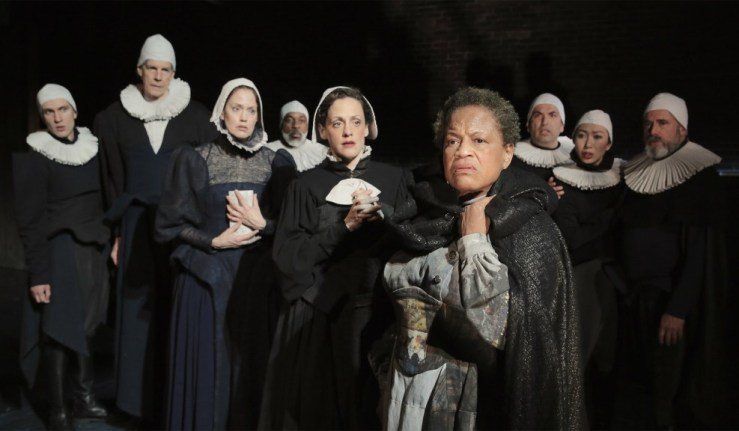
PLAY: Babette’s Feast, Theatre at St. Clement’s, New York City: I’ve heard Babette’s Feast cited many times in Christian literature and addresses, and now it’s been adapted into a stage play, currently running off-Broadway and starring Michelle Hurst (Orange Is the New Black) in the titular role. “Based on Isak Dinesen’s short story made famous by the 1987 Academy Award-winning [Danish] film, this new stage adaptation of Babette’s Feast premiered in January 2018 in Portland, Maine to rave reviews. The play tells the story of Babette, a French refugee, who finds asylum in a pious Norwegian village. With boundless generosity, she throws a lavish feast that becomes an agent of transformative grace, healing a fractured community.” (Update 5/1: Just after I published this post, Image journal published a great interview with director Karin Coonrod.)
Photo: Carol Rosegg/National Review
+++
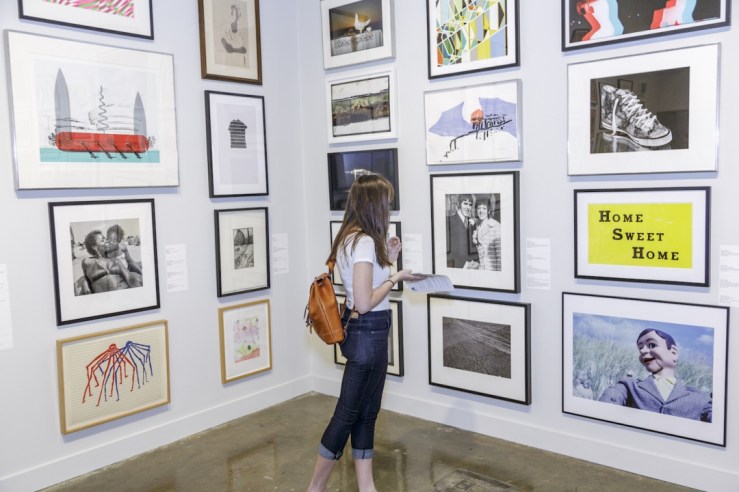
ARTICLE: “Can Art Lending Libraries Empower a New Generation of Collectors?” by Kealey Boyd: “For centuries, those who lacked the space or resources to collect artworks really only had one option—experiencing whatever fine art they could find in public spaces like museums. But in many cities, it’s now possible to borrow art for free. All you need is a local ‘art lending library’—an innovation in art sharing that could, just maybe, help democratize an activity that was once considered inaccessible.”
An MIT student peruses some of the 600 works available for free borrowing through the school’s Student Loan Art Program, established in 1969 and including pieces by Louise Bourgeois, Cindy Sherman, and others. Photo: John Kennard, courtesy MIT List Visual Arts Center.
+++
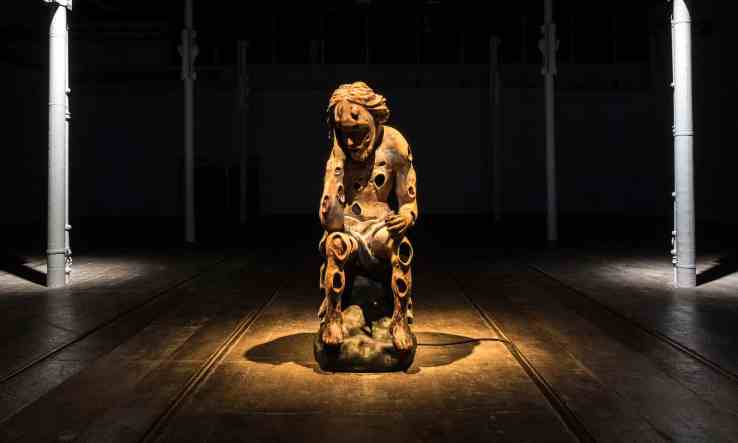
INSTALLATION: “Nobodaddy” by Mark Leckey, Tramway, Glasgow, Scotland, April 20–July 1, 2018: The wounds of Job speak in this solo exhibition by Turner Prize-winning artist Mark Leckey, part of the Glasgow International contemporary art festival. “Nobodaddy”—the title a reference to a William Blake poem about God’s seeming absence—features a spotlit, oversize Job figure that’s based on an eighteenth-century wooden statuette from Germany; he is covered in boils and excrescences and sitting in melancholy contemplation. The open wounds of the figure are embedded with speakers, and they broadcast a monologue of grief, voiced by Leckey and accompanied by horrible gurglings and rumblings. A video screen opposite Job projects a CGI apparition of the same figure and images of his hollowed-out insides. [HT: Jonathan Evens]
Mark Leckey (British, 1964–), Nobodaddy, 2018. Installation view at Tramway in Glasgow. Photo: Keith Hunter.
+++
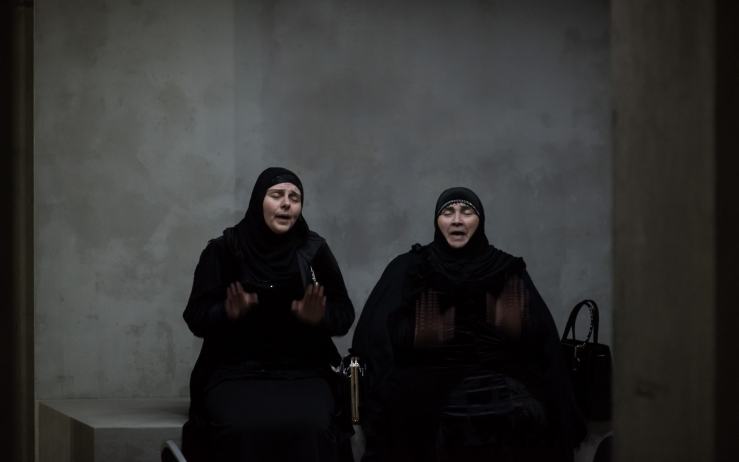
PERFORMANCE ART:An Occupation of Loss by Taryn Simon, Corner of Islington Green, Essex Road, London, April 17–28, 2018, co-commissioned by Park Avenue Armory and Artangel: I’m late on this one, unfortunately. For this work, reprised from its 2016 premiere in New York City, artist Taryn Simon brought together professional mourners from around the world (Albania, Armenia, Azerbaijan, Bhutan, Burkina Faso, Cambodia, China, Ecuador, Ghana, Greece, India, Kyrgyzstan, Romania, Russia, and Venezuela) to simultaneously enact their rituals of grief over the course of a half hour. The result is a cacophony of culturally diverse lamentations that reach a sustained climax and then fall away to a single voice and, eventually, a deep silence. Performed inside an underground concrete auditorium in Central London, balconied and three levels deep, the work is concerned not with the mourning of any one event or person in particular but with the phenomenon of loss itself.
Haji Rahila Jafarova and Lala Ismayilova are professional Yezidi mourners from Azerbaijan. Photo: Hugo Glendinning, courtesy Artangel and Taryn Simon Projects.
In a New York Timesreview, William L. Hamilton explains that
traditionally, professional mourners are hired by families of the deceased to mark the occasion and to guide the dead to the place where they will lead their afterlife. Mourners are [also] called upon to mark larger losses within their communities, like displacement or exile, in a cultural role that is part witness, part historian and part poet. . . . Their laments, wails and cries are also testament to their own bereavements. They can be political testimony, too.
Simon describes the purpose of professional mourners this way: “The bereaved solicit the authority of professional mourners to occupy, negotiate, and shape their loss. The mourners control a psychological experience by directing and embodying the emotion of others.” An Occupation of Loss is the culmination of her seven years of research into professional mourning, which relied heavily on interviews with anthropologists, historians, linguists, musicologists, and other experts. Finding these performers, and then securing visas for them, was itself a herculean task. Listen to the artist discuss the project at more length in this Channel 4 news segment. [HT: Jonathan Evens]
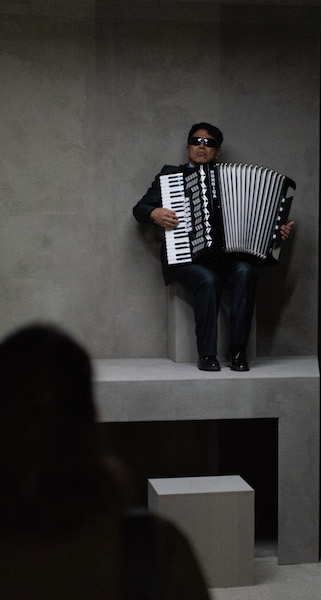
Hugo Aníbal González Jiménez is an Ecuadorian mourner who sings accordion-accompanied laments known as yaravíes and who is blind.
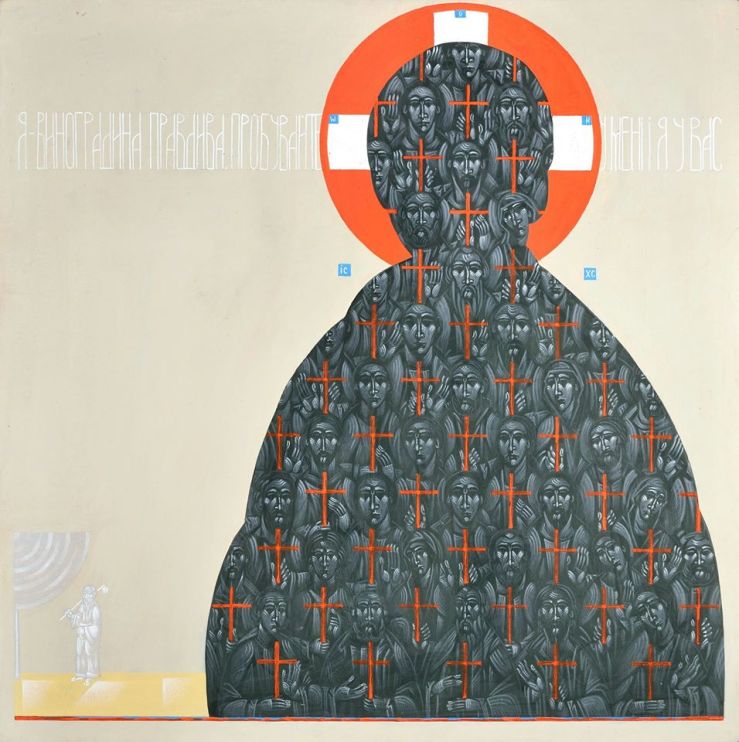
Ostap Lozynsky (Ukrainian, 1983–), I Am the True Vine, 2015
I am the vine; you are the branches. Whoever abides in me and I in him, he it is that bears much fruit, for apart from me you can do nothing. If anyone does not abide in me he is thrown away like a branch and withers; and the branches are gathered, thrown into the fire, and burned. If you abide in me, and my words abide in you, ask whatever you wish, and it will be done for you. By this my Father is glorified, that you bear much fruit and so prove to be my disciples.
—John 15:5–8
+++
SONG: “Make of Our Hearts” by Hiram Ring, on Songs for Liturgy (2012)
This post belongs to the weekly series Artful Devotion. If you can’t view the music player in your email or RSS reader, try opening the post in your browser.
To view all the Revised Common Lectionary scripture readings for the Fifth Sunday of Easter, cycle B, click here.






 Art & Theology