Mahalia Jackson’s bluesy rendition of the traditional song “Calvary” provides a perfect space in which to dwell with the sorrow of the cross. The performance below was recorded live from the concert she gave on March 26, 1967, in Lincoln Center’s Philharmonic Hall in New York City and is available on the CD Gospels, Spirituals, and Hymns. According to the liner notes, the names of the piano, organ, and guitar accompanists are unknown.
The lyrics are simple:
Calvary, Calvary, Lord!
Calvary, Calvary, Lord!
Calvary, Calvary, Lord!
Surely he died on Calvary.
Can’t you hear him callin’ his Father? Can’t you hear him callin’ his Father? Can’t you hear him callin’ his Father? Surely, oh surely, Surely, oh surely, He died on Calvary.
But when Jackson sings them, her mournful passion gives them depth, delivers their sting.
“Calvary” invites us to sit in the silence that is the death of God the Son.
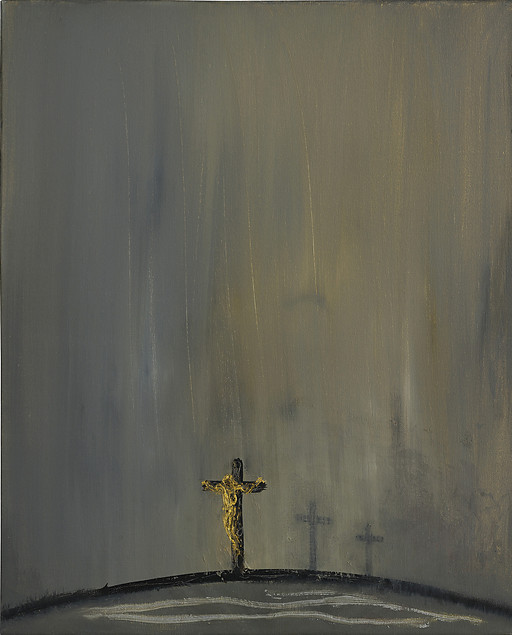
Maggi Hambling (British, 1945–), Good Friday, 2002. Oil on canvas, 55.5 × 45.5 cm.
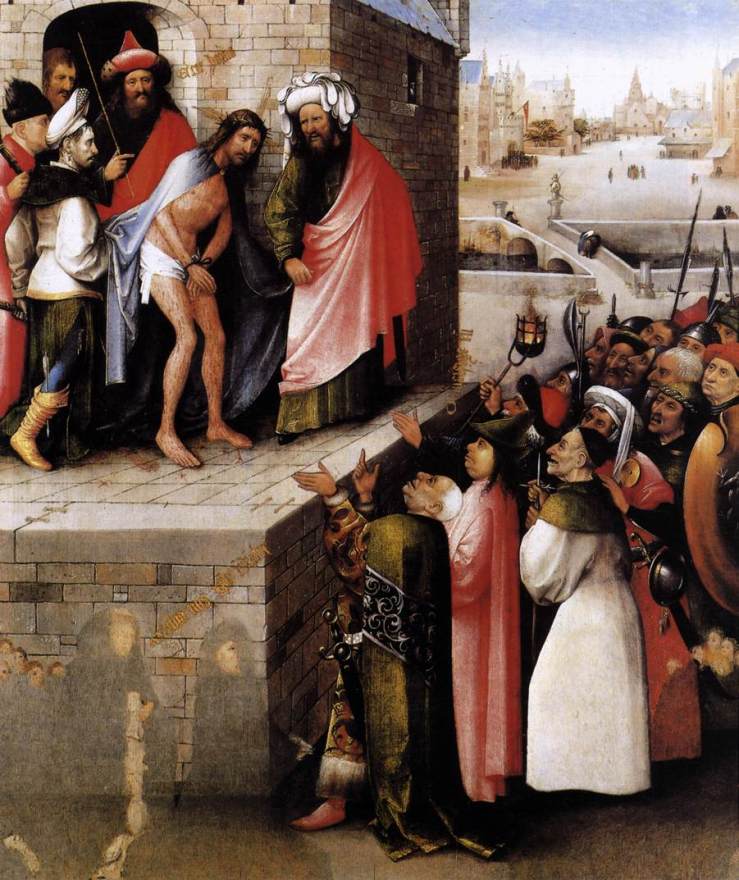
Hieronymus Bosch (Dutch, ca. 1450–1516), Ecce Homo, ca. 1500. Tempera and oil on oak panel, 71 × 61 cm. Städel Museum, Frankfurt, Germany.
Christ bends, protects his groin. Thorns gouge
his forehead, and his legs
are stippled with dried blood. The part of us
that’s Pilate says, Behold the man.
We glare at that bound, lashed,
and bloody part of us that’s Christ. We laugh, we howl,
we shout. Give us Barabbas,
not knowing who Barabbas is, not caring.
A thief? We’ll take him anyway. A drunk?
A murderer? Who cares? It’s better him
Than this pale ravaged thing, this god. Bosch knows.
His humans waver, laugh, then change to demons
as if they’re seized by epilepsy. It spreads
from eye to eye, from laugh to laugh until,
incited by the ease of going mad,
they go. How easy evil is! Dark voices sing, You can be evil or you can be good, but good is dull, my darling, good is dull.
And we’re convinced: How lovely evil is!
How lovely hell must be! Give us Barabbas!
Lord Pilate clears his throat and tries again: I find no fault in this just man.
It’s more than we can bear. In gothic script
our answer floats above our upturned eyes. O crucify, we sing. O crucify him!
French painter, printmaker, and draftsman Odilon Redon (1840–1916) belonged to the Symbolist movement of the late nineteenth century. A reaction against Realism, Symbolism emphasizes the spiritual reality that underlies the physical world and therefore favors dreamlike imagery and mysterious figures. The Gothic stories and poems of Edgar Allan Poe were a major influence.
Redon is perhaps best known for his “noirs”: visionary works of charcoal or lithography done in shades of black, which include subjects like smiling spiders, eyeball balloons, and disembodied heads. But in addition to these, he also worked with vivid pastels and oil paints.
Although he wasn’t a Christian, Redon was attracted to the figure of Christ, especially because of the dual essence ascribed to him: both human and divine. Several of his works dwell on this mystery, among them his noir drawing Head of Christ wearing the Crown of Thorns—one of my favorite all-time images of Jesus.
Odilon Redon (French, 1840–1916), Head of Christ wearing the Crown of Thorns, 1895. Charcoal, black pastel, and black crayon heightened with white on buff paper, 52.2 × 37.9 cm. British Museum, London.
Here Jesus’s pathos-filled gaze confronts the viewer directly from underneath a thicket of thorns. Whereas traditionally the crown his mockers gave him is depicted as a thinly woven band of evenly spaced prickles, here the crown is vast, unwieldy, chaotic—anything but dainty. In her excellent article “Tears, Veils, Thickets: Odilon Redon’s Representations of Christ,” Sedona Heidinger describes the thorns in this drawing as “gratuitous, unnecessarily vicious. . . . [The crown is] threatening and animate, snaking down to cover [Christ’s] chest with its barbs.”
Redon’s multiple treatments of this classic subject—Christ Crowned with Thorns—are haunting and mystical in a way that was unprecedented. In his interpretations, the thorns maintain an active presence. They are not a passive ornament.
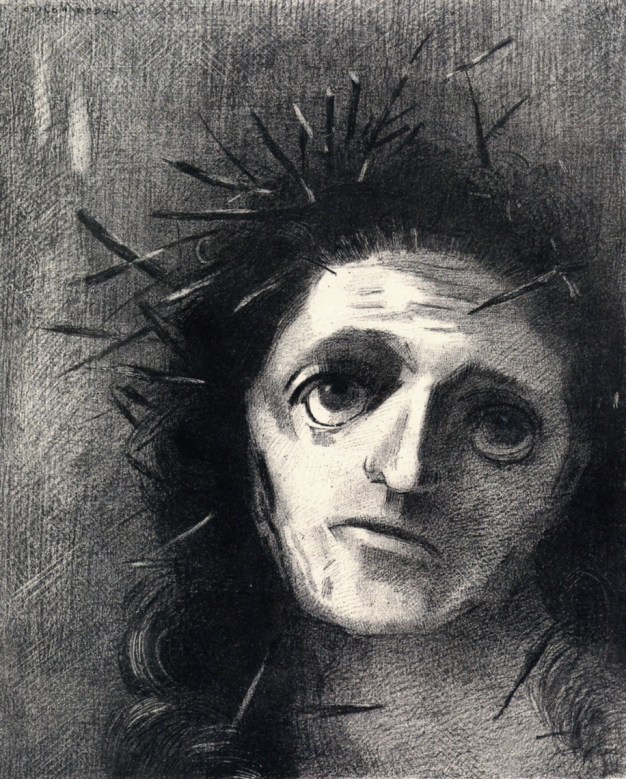
Odilon Redon (French, 1840–1916), Christ, 1887. Lithograph, 33 × 27 cm. Bibliothèque Nationale de France, Paris.
Take, for example, his Christ lithograph of 1887. The thorns—“glinting like so many blades,” in Heidinger’s words—attack Christ from various angles. The most dynamic element of the portrait, Heidinger notes, is the diagonal that seems to spear the left side of Christ’s forehead and exit underneath his right ear, giving the impression that he is being skewered. As in the previously discussed Head of Christ, the eyes are extraordinarily expressive, deep wells of emotion. Here, though, they gaze upward, not outward. This could indicate a silent plea to the Father to make it stop, or else an anticipation of being reunited with him. Continue reading “Christ Crowned with Thorns interpreted by Symbolist artist Odilon Redon”→
The following dance, choreographed by Travis Wall, premiered August 4, 2010, on So You Think You Can Dance. It is performed by season 7 runner-up Kent Boyd and season 3’s Neil Haskell to DeVotchKa’s “How It Ends.”
I’ve never personally experienced a betrayal of this magnitude, so when I watch the dance, I think of that supremely infamous act of disloyalty recorded in scripture: Judas’s handing over his friend Jesus to the religious authorities in exchange for thirty pieces of silver.
The two men in Wall’s piece start out as buddies—they provide support for each other, and catch the other when he’s on his way down. But then one of them stabs the other in the back. Confusion, hurt, and anger ensue; pleas for restoration are made, and the two briefly rehearse their nostalgia for what used to be. But the betrayer will not relent: he proceeds to crush his former friend underfoot. In one last effort to repair the broken friendship, the betrayed chases down and clutches his friend but ultimately realizes he has to release him, for he has chosen his path. The end of the dance shows the betrayer remorseful in the shadows as his victim moves on toward his own separate destiny. Continue reading “Betrayal danced out”→
When Jesus rode into Jerusalem the week of his death—a day that the church commemorates each year as Palm Sunday—he entered to a throng of people shouting “Hosanna!” (“Hooray for salvation!”) and carpeting his path with their cloaks and with palm branches. The Pharisees, still not seeing Jesus for who he was, told him to rebuke the crowds for their blasphemy. To give high praise to anyone other than God, they insisted, is a grievous sin. That’s true enough, but the disciples’ praises were not misplaced. Jesus defends their hosannas and their postures of worship, retorting that “if these [my disciples] were silent, the very stones would cry out” (Luke 19:40). This is one of several times throughout his ministry in which he equates himself with God.
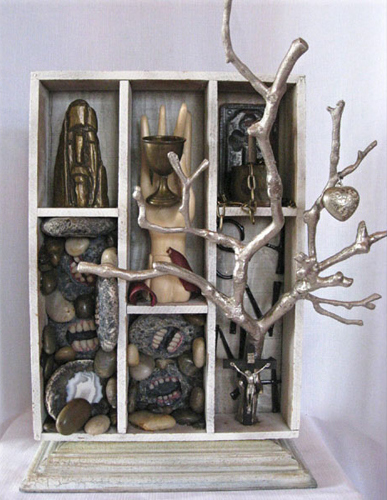
Roberta Karstetter (American, 1953–), Even the Stones Will Cry Out, 2010. Assemblage.
The Westbound Rangers, a bluegrass band from Nashville, has a song inspired by this episode: “Rocks Cry Out,” from their 2013 album Gone for Way Too Long. It was written by Graham Sherrill, an old high school friend of mine, who also does vocals and banjo for it. Fellow bandmates—Mike Walker on mandolin, Read Davis on guitar, and Wes Burkhart on bass—helped write the instrumental bridge. I’ve embedded the song here with the band’s permission. Continue reading “Don’t let the rocks cry out”→
Christ on the Mount of Olives, from the Book of Kells (fol. 114v), early 9th century.
The framed lunette above Christ’s head contains a Latin inscription of Matthew 26:30: Et hymo dicto exierunt in montem Oliveti (“After a hymn had been said they left for Mount Olivet”). But the artist gives us a very atypical depiction of that scene, one that cross-references the Old Testament story of Israel’s battle against the Amalekites—in particular, the figures Aaron, Moses, and Hur. Click on the link above to learn more.
As I prepared commentary on the painting, meditating on its significance, I thought of Wayne Forte’s Community of Prayer—a beautiful image that, like the one from Kells, invokes an ancient battle story as a metaphor for bearing one another up in prayer.
Wayne Forte (American, 1950–), Community of Prayer, 2009. Oil and acrylic on canvas, 24 × 30 in.
(This is a subject Forte has turned to often. See on his website, for example, And the Battle Was Won; Arms of Prayer; Exodus 17:12 Medallion; Moses [Sun Radiating]; Moses on a Rock; Moses with Staff; Moses, Aaron, and Hur; Succour; and Until the Sun Set.)
Gustave Doré (French, 1832–1883), The Entry of Christ into Jerusalem, 1876. Oil on canvas, 38-1/4 × 51 in.
Unaccustomed to her burden, she knows not
That never beast bore such a Man as this,
Who meekly rides to His appointed lot,
A crown of thorns and a betrayer’s kiss.
And never man will carry such a weight
As He bears now in this, His day of power,
Ascending toward a strait and narrow gate,
His agonizing last and finest hour.
She bravely struggles on, despite her fear
Of cheering men, whom He as gravely views
As an admiral watching distant storms draw near
To lash bright waves to dark and deadly hues;
He knows the death decreed in ancient psalms,
The Tree that looms beyond these scattered palms.
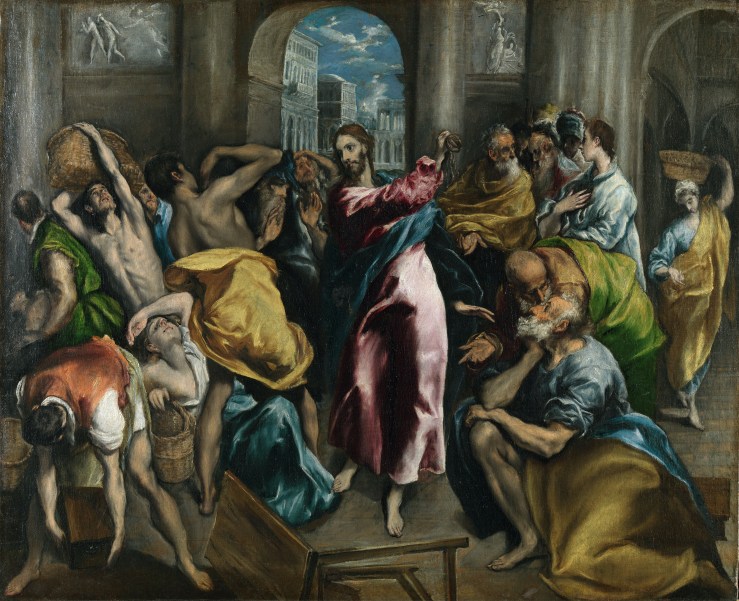
“Inspired to Follow: Art and the Bible Story,” St.-Martin-in-the-Fields, London: This program comprises a series of weekly noontime gatherings that use famous local paintings as a springboard into discussion of the biblical narrative and its implications for us today. I’ve enjoyed reading the few presentations given by associate vicar Jonathan Evens, posted on his blog: first, on J. M. W. Turner’s two paintings of Noah’s flood, and more recently, on El Greco’s Christ Driving the Money Changers from the Temple.
El Greco (Greek, active Spain, 1541–1614), Christ Driving the Money Changers from the Temple, 1600. Oil on canvas, 106 × 130 cm (42 × 51 in.). National Gallery, London.
+++
VIBRANT music and arts festival, Cahaba Park Church, Birmingham, Alabama: On November 1, 2015, Cahaba Park Church held a Psalms-inspired music and arts festival. Eight visual artists from the church were selected to display their paintings, which were auctioned off to raise money for four nonprofits. The Corner Room performed songs from their new album, Psalm Songs, Volume 1; “Psalm 23” (music by Adam Wright) is the soundtrack for the recap video above. This next VIBRANT festival will be held on July 22.
+++
“Art and Spirit” exhibition, First Congregational Church, Los Angeles: Through April 24, the works of over fifty artists will be on display in the Neo-Gothic Shatto Chapel of the First Congregational Church of Los Angeles. Most of the works are by emerging LA artists from Art Division, an organization that provides art training to young adults who lack the resources to attend university but who want to pursue a career in the visual arts; they were asked to respond to the theme “art and spirit.” A few of the works in the exhibition are by well-known artists such as Rembrandt, Albrecht Dürer, Corita Kent, and Ed Ruscha.
+++
Portraits of Resurrection, 2015 Easter initiative, Saddleback Church, Lake Forest, California: Ex Creatis, the arts ministry at Saddleback, is always coming up with unique ways to incorporate art into the life of its church. Last Easter twenty-three volunteer artists sketched portraits of church attendees onto one of three floral prints (of the sitter’s choosing) made by three different artists in the church. These personalized works of art were meant to remind those who took them home of the new life they have in Christ.
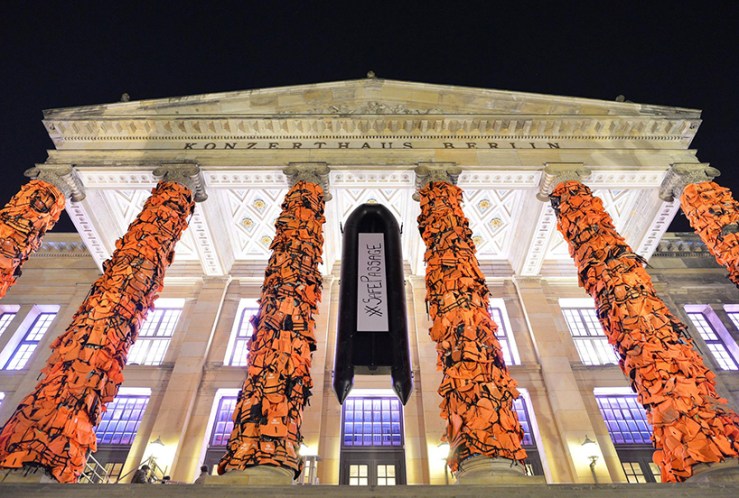
Last month the six front columns of Berlin’s historic Konzerthaus were decked out with fourteen thousand bright orange life jackets—an installation by Chinese artist Ai Weiwei, titled Safe Passage. A tribute to those who have risked their lives on the Mediterranean Sea to escape persecution in the Middle East and North Africa, the work was made to coincide with Cinema for Peace’s annual award gala on February 15, part of the Berlin International Film Festival. The money raised at this year’s gala was used to purchase five thousand rescue blankets and one thousand emergency baby kits (for births that have taken place at sea), which the Cinema for Peace Foundation delivered this past week to the Greek island of Lesbos, the most popular port of entry for people fleeing to Europe through Turkey.
Ai Weiwei’s crew finishes hanging life jackets on the sixth column of Berlin’s Konzerthaus, just before putting up an inflatable dinghy with the title of the installation: Safe Passage. Photo: Markus Winninghoff.Safe Passage: installation of fourteen thousand life jackets by Ai Weiwei, Konzerthaus, Berlin, February 14–17, 2016. Photo: Oliver Lang.
Weiwei visited Lesbos in December to see for himself the human faces of the current refugee crisis. He shared on Instagram photos and videos he took inside a refugee camp, to show the world what’s going on in Lesbos, and has opened an additional studio there.
One thing that visually struck Weiwei were the giant mounds of life jackets heaped up on the beaches. Refugees shed them as soon as they disembark their boats, setting foot, at last, on land, and ready to start their new lives. Seeing in them a poignant symbol of the crisis, he asked the mayor of the island if he could take a small portion—and yes, fourteen thousand is only a small portion—with him to Europe to use for an art installation. His request was granted. Wrapped around the grand facade of Berlin’s nineteenth-century concert house, they bear witness to the scale of the crisis and even allude to its human cost: last year, a reported 3,770-plus refugees died while attempting to cross the Mediterranean, and the death toll for this year has already exceeded 400. Some of these deaths were due to defective life jackets sold to migrants by a Turkish company looking to cut down on production costs.
While some have questioned the efficacy of staging such a large awareness raiser in Germany, a country that has taken in more refugees than any other European Union member state, others point out that several antirefugee organizations have emerged there, such as Patriotic Europeans Against the Islamization of the West (PEGIDA), which calls on the German government to enact stricter asylum laws. Not all the German people are proud of the measures its country has taken to invite in Syrians, Afghans, and other huddled masses yearning to breathe free. Instead they fear the repercussions. Weiwei’s Safe Passage protests against that fear-based mentality that denies and excludes.
Weiwei has not been the first person to recycle used life jackets into art. Last December British artist Arabella Dorman incorporated three life jackets into her installation Flight in St. James’s Church in Piccadilly, London, which has them tumbling out of a capsized dinghy hanging from the ceiling. She also filled the Christmas crèche at the front of the church with a few dozen more: they cushion the ground where the sculpted figures kneel in adoration of the newborn Christ child. Continue reading “Discarded life jackets used by artists to raise awareness of refugee crisis”→
Noted for its dramatic intensity and tragic beauty, the saeta is a type of devotional song performed during Holy Week processions in the Andalusia region of Spain, inspired by images of the suffering Christ and Virgin. It is sung during pauses in the procession, usually without accompaniment: a loud, melismatic wail of praise and lament. Sometimes such performances are planned, with a professional singer standing on a balcony; other times they are improvised by someone in the crowd, as he or she feels moved. Either way, the performances are typically quite emotional.
Here’s a spontaneous male duet performance that took place in the village of San Fernando in the Andalusian province of Cádiz in 2011:
The word saeta means “arrow” in Spanish, referring to the way in which the song soars through the air, piercing the hearts of its listeners.
Most experts agree that the early primitive form of saeta was composed of Gregorian psalms sung by friars and monks during missions. Later the musical structure broke free and was adapted for singing in the street, reshaped by converso Jews [Jewish converts to Catholicism] in the sixteenth century.
While some of these Jewish Catholic songs may have expressed genuine devotion to a newly embraced Christ, most of them—one theory notes—were coded expressions of the singer’s own sorrow at having been forced to renounce his or her former faith by threat of exile or death. This was the time of the Spanish Inquisition, after all.
The saeta was also developed early on by the Andalusian gypsies (gitanos), who have adopted the Catholicism of their host country and who remain the saeta’s most popular interpreters today. They brought to it the elements of flamenco, such that the saeta is now regarded as a subset of that art form and is a part of every flamenco singer’s cante jondo (“deep song”) repertoire.
Julio Romero de Torres (Spanish, 1874–1930), La Saeta, 1918. Oil on canvas. Painted in response to the following saeta lyrics: “¡Oh Santo Cristo de Gracia! / Volved la cara atrás. / Dadle a los ciegos vista / y a los presos libertad.” (Oh Holy Christ of Grace! / Turn your face upon us. / Give sight to the blind / and liberty to the prisoners.)
Even though the saeta has made its way into concert halls, it is still best known as a song of the people, an integral part of Andalusian folk culture, especially among gypsy communities. Sometimes gypsy saeteros (saeta singers) incorporate into the lyrics expressions of ethnic pride—for example, identifying Jesus and his mother, Mary, as one of their own: Continue reading “Flamenco-style devotional singing in southern Spain”→






 Art & Theology