The sanctification of time in the church year

Other than celebrating the two high holy days of Christmas and Easter, I did not follow the liturgical calendar growing up; it was never highlighted in my church. It wasn’t really until after college, when I became involved in a denominationally diverse Christian community, that I realized what I was missing out on, and since then the liturgical calendar is something I’ve learned to appreciate and observe—at least its main seasons: Advent, Christmas, Lent, and Easter, which concludes with the feast of Pentecost. The observance of these seasons is not mandated in scripture, but the church has devised them as a way to help us relive the story of God together throughout the year and to encourage us to meditate over an extended period on key mysteries of the faith.

12 feast days
Russian icon depicting the twelve great feasts of the Orthodox Church, plus the “feast of feasts,” the Resurrection, in the center, ca. 1903.

Wendy M. Wright has aided me greatly in my understanding of the set-apart days and seasons of the church year—their history, significance, and how they can be used as tools for spiritual growth. In her introduction to The Rising: Living the Mysteries of Lent, Easter, and Pentecost (part of an excellent trilogy of books written from an ecumenical perspective), she describes how and why the church has structured time. This passage is quoted here with her permission:   Continue reading “The sanctification of time in the church year”
Excerpts from “The Everlasting Mercy” by John Masefield

The poet laureate of the United Kingdom from 1930 until his death in 1967, John Masefield occasionally turned to Christian themes in his writing. In 1911 he wrote “The Everlasting Mercy,” a long poem that tells the tale of a man’s conversion from a life of sin to life in Christ. Masefield takes us down into the darkness felt by the poem’s antihero and speaker, Saul Kane—a belligerent drunk and a womanizer—and then up into the light he experiences when, in his own words, “the Lord took pity on me” and “brought me into grace.”

The bulk of the poem takes place during one of Saul’s drinking binges: he has just clobbered one of his friends in a boxing match, defending his (knowingly false) claim to a piece of land, and is celebrating at the Lion, a local pub. As is his custom, he starts flirting with a barmaid and then makes a sexual pact with her. He feels a sting of moral conviction about this—

And while we whispered there together
I give her silver for a feather
And felt a drunkenness like wine
And shut out Christ in husks and swine.
I felt the dart strike through my liver.
God punish me for’t and forgive her.

—but not enough to stop him from carrying out the deed. To ease his conscience, he issues a direct address to his fellow males, urging them away from such behavior:

O young men, pray to be kept whole
From bringing down a weaker soul.
Your minute’s joy so meet in doin’
May be the woman’s door to ruin;
The door to wandering up and down,
A painted whore at half a crown.
The bright mind fouled, the beauty gay
All eaten out and fallen away,
By drunken days and weary tramps
From pub to pub by city lamps
Till men despise the game they started
Till health and beauty are departed,
And in a slum the reeking hag
Mumbles a crust with toothy jag,
Or gets the river’s help to end
The life too wrecked for man to mend.

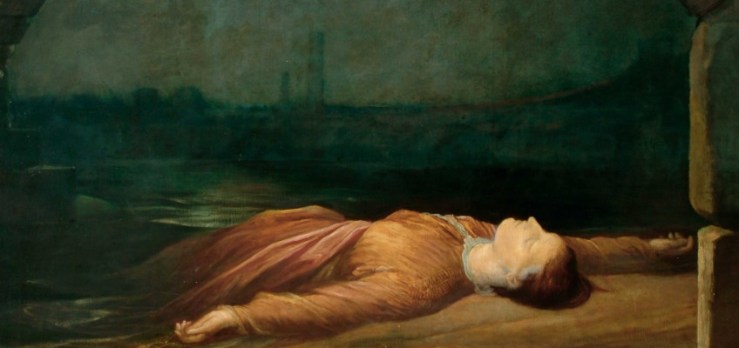
Found Drowned by G. F. Watts
George Frederic Watts (British, 1817–1904), Found Drowned, 1850. Oil on canvas. Watts Gallery, Guildford, Surrey, England.

Throughout the poem Saul’s narration is shot through with this sort of guilty awareness of his own depravity. It disgusts him, but he represses that disgust while he’s in the act of perpetrating whatever sin is at hand, whether it be lying, stealing, poaching, punching, speaking irreverently, or taking sexual advantage of young women.   Continue reading “Excerpts from “The Everlasting Mercy” by John Masefield”

Wilcote altarpiece by Nicholas Mynheer

Oxford painter, sculptor, and glass designer Nicholas Mynheer works almost exclusively on religious themes, fulfilling commissions for churches throughout the UK (he’s working on two right now). His style is instantly recognizable—a distinctive blend of medieval, expressionist, and primitive influences resulting in simplified figures with exaggerated features and compositions full of color and movement.

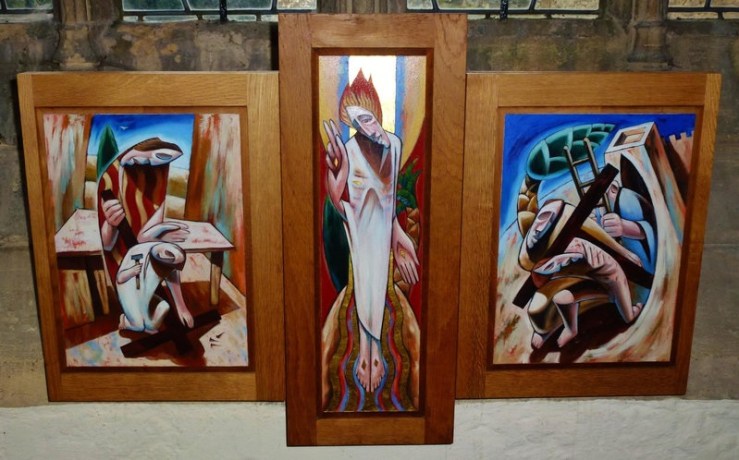
In 1999 Mynheer was commissioned by St. Mary’s Church in North Leigh, Oxfordshire, to create an altarpiece for its fifteenth-century Wilcote Chapel. He decided to create a hinged polyptych (multipanel painting) that shows three Christ-based scenes in its closed view and then opens to reveal four additional scenes on the wings. (The center panel remains fixed.)

Wilcote Chapel, St. Mary's, North Leigh, Oxfordshire
Wilcote Chapel, St. Mary’s Church, North Leigh, Oxfordshire.
Wilcote altarpiece
Wilcote Chapel polyptych (open view) by Nicholas Mynheer (British, 1958–), 1999. Oil on oak panels. St. Mary’s Church, North Leigh, Oxfordshire, England.
Wilcote altarpiece (closed)
Wilcote Chapel polyptych (closed view) by Nicholas Mynheer (British, 1958–), 1999. Oil on oak panels. St. Mary’s Church, North Leigh, Oxfordshire, England.

One of the challenges of painting a polyptych is figuring out how to arrange various episodes into one unified story, or, if portraiture is used instead of narrative, how to draw multiple figures into thematic coherence. The panels should not be isolated pictures but should speak to one another, aiding the viewer in worship. Mynheer achieves this unity brilliantly by establishing visual links through symmetry, which suggest associations of contrast between an earlier event and a later one: the expulsion versus the resurrection of the saints (sin and redemption), the nativity versus the pietà (birth and death), Jesus in Joseph’s workshop versus Jesus carrying his cross (wood as an innocent building material, wood as a horrendous instrument of execution).

Expulsion

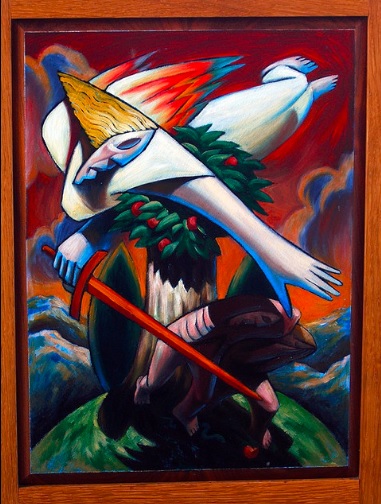
When the wings of the altarpiece are open, the leftmost panel depicts the expulsion of Adam and Eve from the Garden of Eden after they had broken fellowship with God. Miserable and ashamed, the couple departs under the shadow of sin’s curse while a cherub enforces the banishment with a red-hot sword. As they go, though, they step—seemingly unawares—on a snake, foreshadowing the Second Adam who would come to crush Satan, as prophesied in Genesis 3:15.   Continue reading “Wilcote altarpiece by Nicholas Mynheer”

“Divine Beauty” exhibition of modern religious art

Today the Palazzo Strozzi in Florence is wrapping up a four-month-long exhibition titled “Divine Beauty: From Van Gogh to Chagall and Fontana,” which features over one hundred works of religious art from 1850 to 1950. Organized jointly by the Fondazione Palazzo Strozzi and the Archdiocese of Florence with the collaboration of the Vatican Museums, the exhibition shows that sacred themes were still being developed in the modern period.

The works featured in the promotional video above provide a sense of the range of styles and subjects represented: they are, in order, Pietà by Vincent Van Gogh; Saint Sebastian by Gustave Moreau; The Angelus by Jean-François Millet; Crucifixion by Renato Guttoso; White Crucifixion by Marc Chagall; Prayer by Felice Casorati; Madonna II by Edvard Munch; a 1947 study for the Crucifixion by Graham Sutherland; The Holy Family by Fillia; Flagellation of Jesus Christ by William-Adolphe Bouguereau; and The Annunciation by Vittorio Corcos.

Also included in the exhibition are works by Pablo Picasso, Henri Matisse, Odilon Redon, Max Ernst, and Stanley Spencer—masters of international renown.

One fact of note is that in almost all cases, these artists were working autonomously—that is, not by church commission—and yet they chose to take up Christian subject matter, presumably because there’s something in it they found compelling.

To view a full list of works (with thumbnail images) as well as commentary on the three most famous ones, download the press kit.

Here’s some coverage from the Lorenzo de’Medici Institute—a school I attended for a semester back in 2009! I walked by the Palazzo Strozzi every day on my way to class.

The art of contemplative seeing (as modeled by Moses)

“Open my eyes, that I may behold wondrous things . . .”—Psalm 119:18

“My own eyes are not enough for me, I will see through those of others.”—C. S. Lewis

Images have revelatory power. God spoke through them in ancient times: a ladder (Jacob); sheaves of wheat (Joseph); a ripe grapevine (pharaoh’s cupbearer); birds eating cake (pharaoh’s baker); cattle eating cattle (pharaoh); a wheel inside a wheel (Ezekiel); dry bones reconstituting into living human beings (Ezekiel); a broken statue (Nebuchadnezzar); four beasts (Daniel); a sheet filled with animals (Peter); and fantastical creatures doing battle (John). Some of these images were received during sleep, while others were waking dreams—visions—and while verbal statements by God sometimes accompanied them, the images left definite impressions that plunged the seer into a deeper awareness of God’s nature and/or will.

Moses and the Burning Bush by Edward Knippers
Edward Knippers (American, 1946–), Moses and the Burning Bush, 2008. Oil on panel, 6 × 4 ft.

Another famous image through which God spoke was the burning bush on Mount Horeb, which interrupted Moses during his workday. Notice his double take:

Now Moses was keeping the flock of his father-in-law, Jethro, the priest of Midian, and he led his flock to the west side of the wilderness and came to Horeb, the mountain of God. And the angel of the Lord appeared to him in a flame of fire out of the midst of a bush. He looked, and behold, the bush was burning, yet it was not consumed. And Moses said, “I will turn aside to see this great sight, why the bush is not burned.” When the Lord saw that he turned aside to see, God called to him out of the bush, “Moses, Moses!” And he said, “Here I am.” (Exodus 3:1–4)

In Abiding: The Archbishop of Canterbury’s Lent Book 2013, Ben Quash notes that when Moses first sees the bush, he simply receives the visual data: bush on fire. But then as he starts to compute what he sees he realizes that hey, the flames are engulfing it, but it’s not being consumed; this is a “great sight” that deserves a closer look. So he turns aside from his intended path to dwell more consciously and deliberately with the strange bush. It is only then—when Moses has stood still long enough—that the voice of God addresses him. And he is utterly transformed by the encounter that follows, whereby he is called to liberate his people from slavery in Egypt and lead them in settling a new land.   Continue reading “The art of contemplative seeing (as modeled by Moses)”