Those who had arrested Jesus took him to Caiaphas the high priest, where the scribes and the elders had gathered. . . .
Now the chief priests and the whole council were looking for false testimony against Jesus so that they might put him to death, but they found none, though many false witnesses came forward. At last two came forward and said, “This fellow said, ‘I am able to destroy the temple of God and to build it in three days.’”
The high priest stood up and said, “Have you no answer? What is it that they testify against you?”
But Jesus was silent. Then the high priest said to him, “I put you under oath before the living God, tell us if you are the Messiah, the Son of God.”
Jesus said to him, “You have said so. But I tell you,
From now on you will see the Son of Man seated at the right hand of Power and coming on the clouds of heaven.”
—Matthew 26:57–64
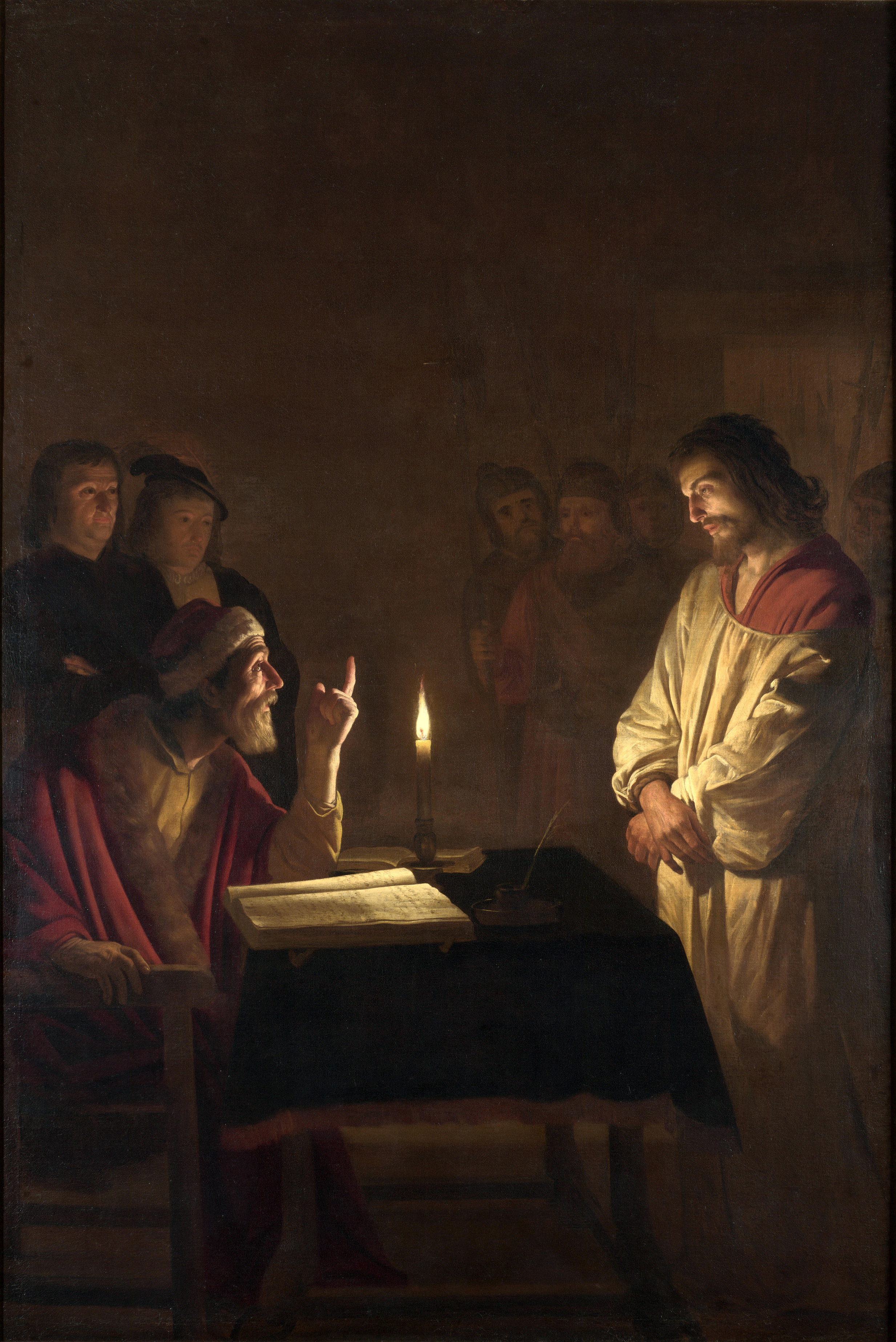
LOOK: Christ before the High Priest by Gerrit van Honthorst
Gerrit van Honthorst (Dutch, 1590–1656), Christ before the High Priest, ca. 1617. Oil on canvas, 272 × 183 cm. National Gallery, London.
Rev. Katherine Hedderly, associate vicar for ministry at St Martin-in-the-Fields, reflected on this painting as part of the online course “Inspired to Follow: Art and the Bible Story”:
Jesus places himself totally in the place of light and truth. But we see here, and will see again as we journey to the cross, that it is a lonely place. I wonder if we’re prepared to stand in the lonely place for the sake of the truth. . . .
Opposite Jesus in the painting we find Caiaphas, seated. And in front of Caiaphas, on the table, the books of the Mosaic Law are open. All the power of the religious authority is being brought to bear. Caiaphas has all the weight and authority in the scene, the two witnesses standing arms folded behind him in cowardly judgement. Caiaphas’s finger is very prominent. He is accusing, judgmental. . . .
Jesus’ silence condemns the judge and the witnesses; and by his silence he refuses to accept the authority of the trial. In the face of this onslaught from the religious hierarchy Jesus is the one with real authority.
LISTEN:“Sanhedrin” by Nicholas Andrew Barber, on Stations (2020)
When the day had come When the dreadful day had come All the people gathered round They were the powers that be
The priests, the scribes, and the elders Took their counsel, all eyes on this king Of a different kind Oh, he was a king of a different kind
They asked him plain and simple Oh, but their intentions were far more complicated Minds and hearts are so complicated Minds and hearts are so complicated
You are the Christ Oh, you are the Son of Man You are seated at the right hand of the power of God Over all the powers that be
You needed to say no more They’d heard enough They heard his words But not what he said
El Greco (Domenikos Theotocopoulos) (Spanish, 1541–1614), El Espolio (The Disrobing of Christ), 1577–79. Oil on panel, 55.7 × 34.7 cm. National Trust, Upton House, Warwickshire, England. Photo: National Trust Photo Library / John Hammond. [object record]
The carpenter is intent on the pressure of his hand
on the awl, and the trick of pinpointing his strength
through the awl to the wood, which is tough.
He has no effort to spare for despoilings
nor to worry if he’ll be cut in on the dice.
His skill is vital to the scene, and the safety of the state.
Anyone can perform the indignities; it is his hard arms
and craft that hold the eyes of the convict’s women.
There is the problem of getting the holes straight
(in the middle of this shoving crowd)
and deep enough to hold the spikes
after they’ve sunk through those soft feet
and wrists waiting behind him.

The carpenter isn’t aware that one of the hands
is held in a curious beseechment over him—
but what is besought, forgiveness or blessing?—
nor if he saw would he take the time to be puzzled.
Criminals come in all sorts, as anyone knows who makes crosses,
are as mad or sane as those who decide on their killings.
Our one at least has been quiet so far,
though they say he has talked himself into this trouble—
a carpenter’s son who got notions of preaching.
Well here’s a carpenter’s son who’ll have carpenter’s sons,
God willing, and build what’s wanted, temples or tables,
mangers or crosses, and shape them decently,
working alone in that firm and profound abstraction
which blots out the bawling of rag-snatchers.
To construct with hands, knee-weight, braced thigh,
keeps the back turned from death.
But it’s too late now for the other carpenter’s boy
to return to this peace before the nails are hammered.
Earle Birney (1904–1995) is regarded as one of Canada’s finest poets. He is the author of twenty-five poetry collections, including David and Other Poems (1942), Now Is Time (1945), and Near False Creek Mouth (1964). He taught English at the University of British Columbia, where he founded and directed the first Canadian creative writing program. He was also a novelist, essayist, literary critic, and radio playwright.
When they had sung the hymn, they went out to the Mount of Olives.
Then Jesus said to [his disciples], “You will all fall away because of me this night, for it is written, ‘I will strike the shepherd, and the sheep of the flock will be scattered.’ But after I am raised up, I will go ahead of you to Galilee.”
Peter said to him, “Even if all fall away because of you, I will never fall away.”
Jesus said to him, “Truly I tell you, this very night, before the cock crows, you will deny me three times.”
Peter said to him, “Even though I must die with you, I will not deny you.” And so said all the disciples.
Then Jesus went with them to a place called Gethsemane, and he said to his disciples, “Sit here while I go over there and pray.” He took with him Peter and the two sons of Zebedee and began to be grieved and agitated. Then he said to them, “My soul is deeply grieved, even to death; remain here, and stay awake with me.” And going a little farther, he threw himself on the ground and prayed, “My Father, if it is possible, let this cup pass from me, yet not what I want but what you want.”
Then he came to the disciples and found them sleeping, and he said to Peter, “So, could you not stay awake with me one hour? Stay awake and pray that you may not come into the time of trial; the spirit indeed is willing, but the flesh is weak.”
Again he went away for the second time and prayed, “My Father, if this cannot pass unless I drink it, your will be done.” Again he came and found them sleeping, for their eyes were heavy.
So leaving them again, he went away and prayed for the third time, saying the same words. Then he came to the disciples and said to them, “Are you still sleeping and taking your rest? Now the hour is at hand, and the Son of Man is betrayed into the hands of sinners. Get up, let us be going. Look, my betrayer is at hand.”
—Matthew 26:30–46
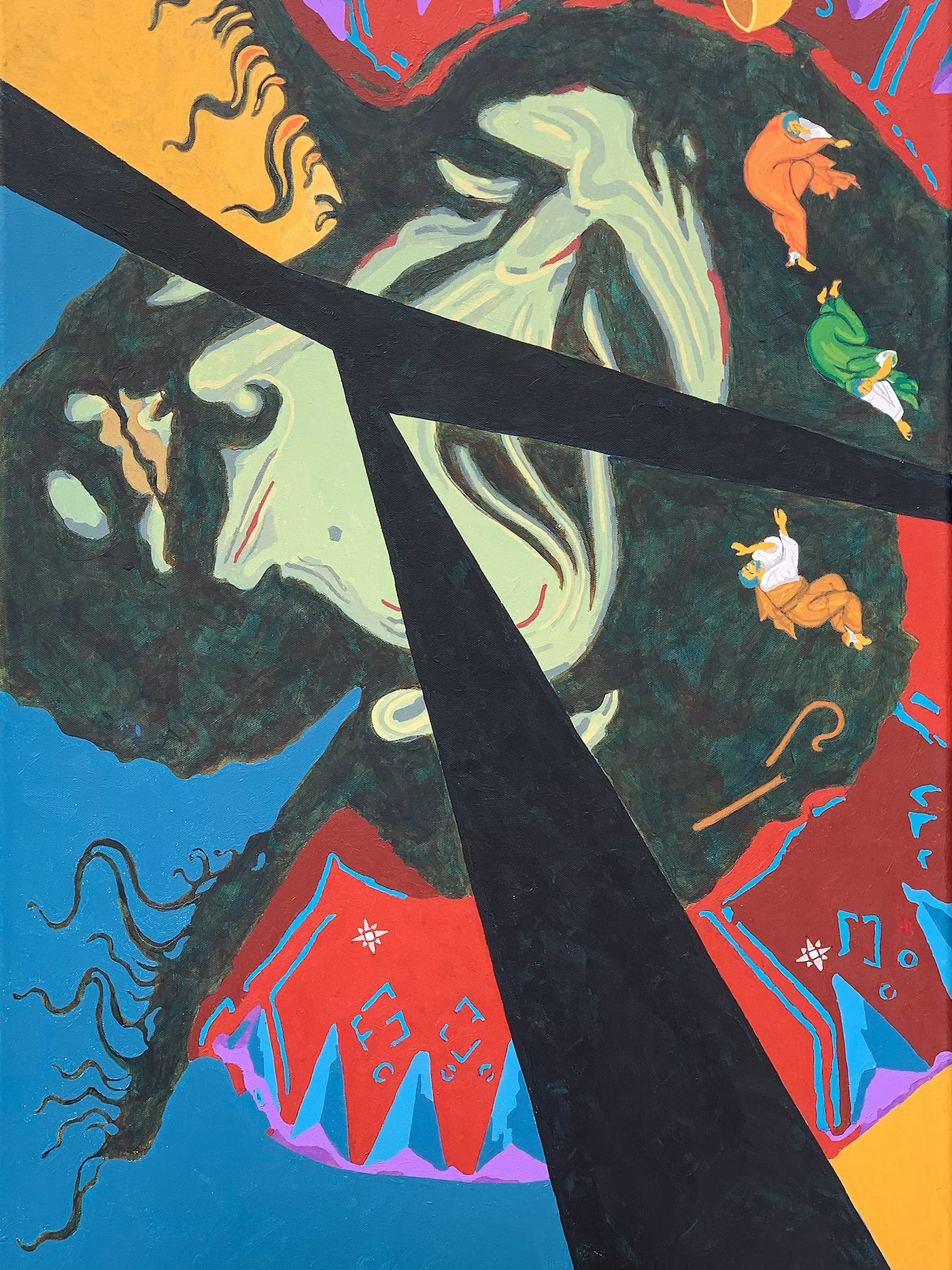
LOOK: Exceeding Sorrowful by Douglas Porter
Douglas Porter (Canadian, 1949–), Exceeding Sorrowful, 2023. Acrylic on canvas, 36 × 24 in.
Doug Porter is a painter, video artist and editor, and graphic designer from Orillia, Ontario. His painting Exceeding Sorrowful portrays the religious subject known as the Agony in the Garden. The painting’s title comes from the King James Version of Matthew 26:38, where Jesus tells his inner circle of disciples (Peter, James, and John), “My soul is exceeding sorrowful, even unto death: tarry ye here, and watch with me.”
He had just eaten the Passover seder with them and the rest of the Twelve, pronouncing some strange words at the table: “Take, eat; this is my body,” he said as he broke the bread. And as he raised the wineglass, he commanded them, “Drink from it, all of you, for this is my blood of the covenant, which is poured out for many for the forgiveness of sins . . .”
Singing a hymn and going out to the Mount of Olives, he then foretold his disciples’ desertion of him. Adapting God’s words from Zechariah 13:7, he told them that he, their shepherd, would be struck, and they, his sheep, would be scattered. They all protested, but their faithlessness would soon be revealed.
Using rich hues reminiscent of stained glass, Porter shows Christ with his eyes closed as if a wave of pain is passing over him, and his brow anxiously furrowed. (The head of Christ is based on a painted wood crucifix by Coppo di Marcovaldo of Italy, from around 1260.) He is broken, shattered; the three jagged shards of him pull away to reveal a dark void. At the top the rim of the cup of suffering is just visible, which he pleads with God to remove. But as he communes with the Father, he becomes increasingly bolstered in his resolve to carry out his mission to the very end.
On the right is a shepherd’s staff, also broken, representing Christ’s words about his being struck. Three of his “sheep” are sprawled out on the ground. The figures of Peter, James, and John are based on a fifteenth-century icon of the Transfiguration by Theophanes the Greek. These three disciples on the Mount of Olives had been privileged earlier to see their Lord gloriously transfigured on another mount: Tabor. And yet despite having received that divine vision, in Gethsemane they fall asleep, failing to support Jesus in his final hours.
In a few days, Jesus’s exceeding sorrow and pain would be transfigured. But on that Thursday and Friday, he drank that cup to its dregs.
LISTEN: “Miracle” by Dave Von Bieker, on Bridge Songs ONE by Urban Bridge Church (2007) | MP3 provided by permission of the artist
Update, 3/28/24: Von Bieker told me my interest in the song has spurred him on to remake it! Here’s his new recording from this week:
This garden grows death And it’s damp and it’s dark Your three closest friends Are asleep on the bark Of a tree that once grew tall Offering its shade But it’s dead and it’s mourning It’s black and decayed
And you search for a place That is far enough out So your voice won’t be heard When you cry and you shout Have you come here to bargain? Have you come to ask why? Is that fear or pure sorrow Buried in your eyes?
And isn’t it time To turn water into wine? To drink a different cup? To forget what’s on your mind? It seems a good time To take up Satan’s deal To leap from tall buildings Without bruising a heel
But now’s not the time for miracles Now’s not the time for trap doors and way outs Oh, now’s not the time for miracles Everything comes in its time
It’s a strange sort of prayer More a fight to the death You walk back to your watchmen There isn’t one left They’ve all slept through this spiritual Solar eclipse They don’t get it, how could they Who would have guessed this?
And you drop to your knees There’s no way out, not yet And your pores are still dripping With blood, oh, with sweat Jacob left with a limp Moses’ tongue couldn’t find An excuse, Paul be blinded Why fight him when you know it’s no use? When you know, well
That now’s not the time for miracles Now’s not the time for trap doors and way outs No, now’s not the time for miracles Everything comes in its time
You sit at her bedside And cry to the roof I don’t know why I hold on When I have no proof But there’s something in knowing You knew how this felt Yeah, there’s something in sharing This hand that we’re dealt
And isn’t it time to say, “Wake up, arise! Come on, Take up your mat! Come on And open your eyes!” Isn’t it time now? He’s sick, close to death He’s been in the grave for four days Why not yet?
But now’s not the time for miracles Now’s not the time for trap doors and way outs No, now’s not the time for miracles And everything comes in its time And everything comes in its time
Dave Von Bieker is a singer-songwriter from Edmonton, Alberta, Canada, who performs and records under the artist name “Von Bieker.” He wrote “Miracle” while part of a songwriting group connected to Urban Bridge Church, a Pentecostal Assemblies of Canada church plant in downtown Edmonton that existed from 2006 to 2015. “We [were] writing songs that dance around the edges of the sacred and songs that wade right through it,” he said. “We [were] questioning and shouting with our songs.”
Starting in 2007, each year the collective shared some of their work at a live concert event they dubbed Bridge Songs and released an album. “Miracle” is from the first such album, Bridge Songs ONE. This album is no longer available, but Von Bieker gave me permission to share this song from it, which I learned about last year as a subscriber to his newsletter, Von Bieker Backstage.
The narrator of the song observes Christ’s distress in the garden of Gethsemane and questions why he doesn’t work a miracle to avoid the cross. Then the refrain comes in—perhaps in Christ’s voice, perhaps in the voice of the concessionary narrator—saying that “now’s not the time for miracles” but suggesting that the miracle of resurrection will come in its time.
A bloody crucifixion is probably not the path to victory we would have imagined, but it’s the path God in his wisdom laid out and took and by doing so showed com-passion (literally “suffering with”) on humanity. The physical, mental, and spiritual anguish that God in Christ endured speaks to God’s awesome love, which comes alongside us in our own suffering.
In the third verse “Miracle” appears to shift to a contemporary scene of a loved one (daughter? wife? mother? friend?) lying gravely ill in bed. Why doesn’t God intervene to miraculously heal? It then moves back again in time to the story of Lazarus, who died. His sister Martha chastises Jesus for his delayed arrival to Lazarus’s bedside. Upon seeing the four-days-dead body of his friend in the tomb, “Jesus began to weep” and was “greatly disturbed” (John 11:35, 38). Then, after giving space to his grief, he calls into the dark cavern, “Lazarus, come out!”—and wouldn’t you know, Lazarus comes stumbling out alive! A delayed miracle.
I love how this song enfolds the story of Christ into our own and that of the Old and New Testament saints, who wrestled with God and stammered their doubts and had their obstinacy obliterated by blinding light, or their fervent belief validated by a brother’s sudden awakening from the grave.
In addition to writing songs, in September 2011 Von Bieker founded Bleeding Heart Art Space, a community space dedicated to exploring art, faith, and justice. He served as director, or “arts chaplain,” until June 2018. Bleeding Heart started as a ministry of Urban Bridge Church, and when that church closed, Bleeding Heart was grafted into St. Faith’s Anglican Church, under whose aegis it remains active today, organizing pop-up solo and group exhibitions and hosting ArtLucks for local artists to share what they’ve been working on.
If I, your Lord and Teacher, have washed your feet, you also ought to wash one another’s feet. For I have set you an example, that you also should do as I have done to you. . . .
I give you a new commandment, that you love one another. Just as I have loved you, you also should love one another. By this everyone will know that you are my disciples, if you have love for one another.
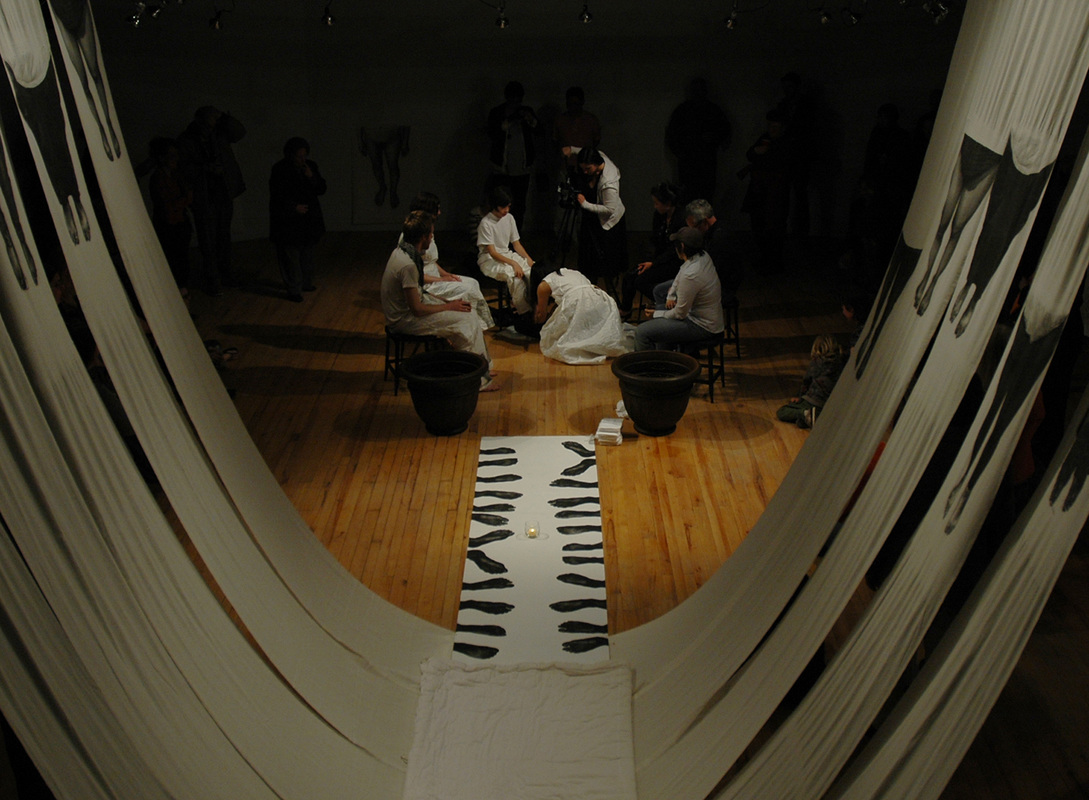
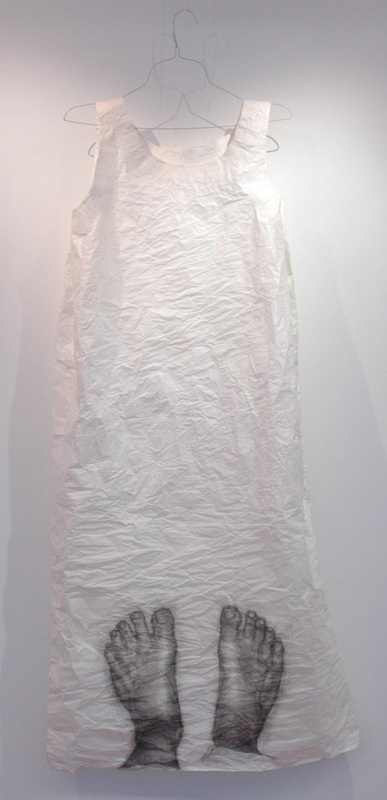
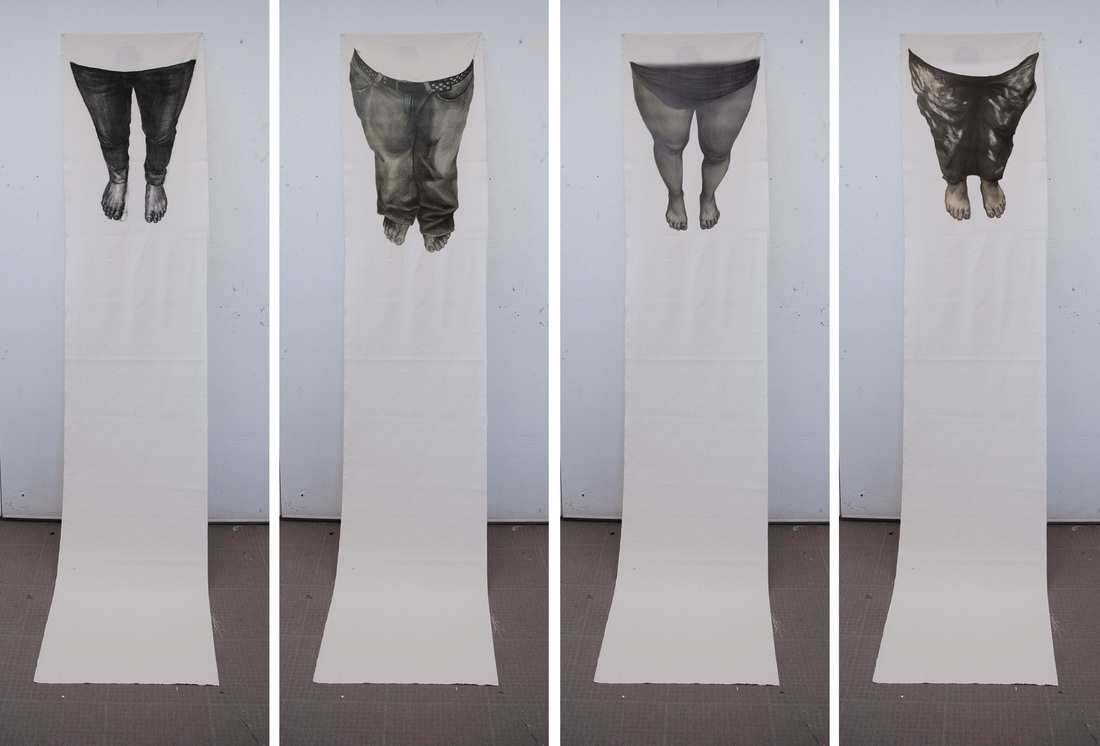
Hyeyoung Shin (Korean American, 1974–), We Are, 2010. Performance, graphite drawings on paper and paper garments, and lithographs on muslin. Big Orbit Gallery, Buffalo, New York.Foot-washing performance by Hyeyoung Shin at the opening of We Are, April 23, 2010, Big Orbit Gallery, Buffalo, New York.
Hyeyoung Shin is a South Korean–born, Kansas City–based artist whose work explores human vulnerability, humility, intimacy, empathy, interpersonal relationships, and belonging.
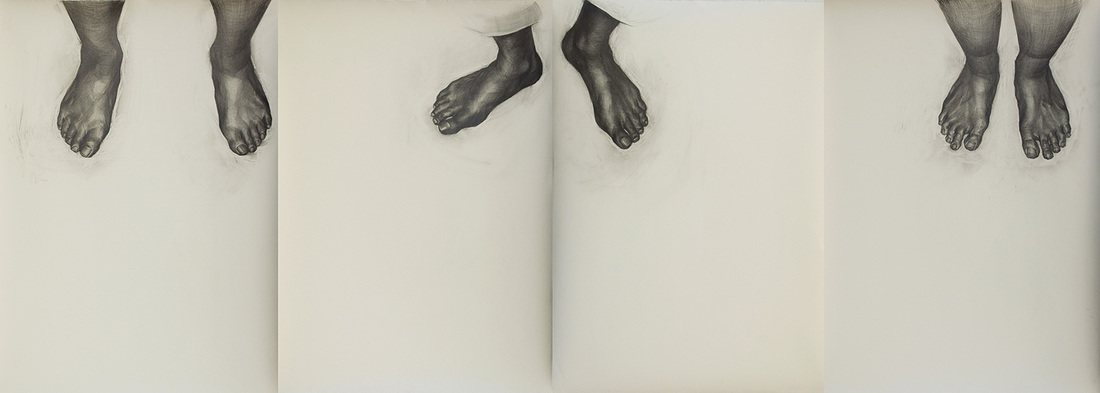
We Are is the name of a solo exhibition of hers from 2010 consisting of life-size drawings and lithographs of human feet and a foot-washing performance. Shin executed thirty-four graphite drawings on paper as well as on paper garments that she custom-made. The structural anchor of the installation was five muslin panels, each ten yards long, suspended from the ceiling and draped like a hammock. On the upper reaches of each were lithographs of two pairs of legs, and in the bed of the hammock lay a mat, a pillow, and a paper dress. Leading up to the hammock was a long sheet of paper with twelve sets of footprints arranged in two rows, evoking Jesus’s twelve disciples.
Graphite drawing on handmade paper garment with hanji, 2009Lithographs on muslin, approx. 288 × 30 in., 2009–10Graphite drawings on paper, 42 × 64 in., 2009
Shin enacted the foot washings herself. She said that “through the experiences, I began to learn again how to practice love akin to holding my mother’s feet” as she lay dying of a terminal illness. The physical proximity and tender touch at that gallery event opened up channels of empathy between the artist and participants.
LISTEN: “Reverie: This is my will,” arr. Anne-Marie O’Farrell, on Easter in Ireland: Music for the Paschal Season (2020)
Rev. Dr. Anne-Marie O’Farrell, a harpist, composer, and Church of Ireland minister from Dublin, wrote this reverie on the Maundy Thursday hymn “This Is My Will” for solo lever harp in 2019. (A reverie is an instrumental piece suggesting a dreamy or musing state.) The Jesuit priest James Quinn (1918–2010) of Scotland wrote the hymn text, reproduced below, in 1969, a paraphrase of John 15:11–17, pairing it with a traditional Irish suantraí (lullaby) melody. It is that melody—which in Ireland has come to be associated with Holy Week, thanks to Quinn—that O’Farrell has arranged here. Purchase sheet music for O’Farrell’s harp reverie, or an arrangement for SATB voices and solo.
This is my will, my one command, that love should dwell among you all. This is my will, that you should love as I have shown that I love you.
No greater love a man can have than that he die to save his friends. You are my friends if you obey all I command that you should do.
I call you now no longer slaves; no slave knows all his master does. I call you friends, for all I hear my Father say you hear from me.
You chose not me, but I chose you, that you should go and bear much fruit. I called you out that you in me should bear much fruit that will abide.
All that you ask my Father dear for my name’s sake you shall receive. This is my will, my one command, that love should dwell in each, in all.
Jesus speaks this discourse after washing his disciples’ feet the day before his death. The name traditionally accorded to Thursday of Holy Week—Maundy Thursday—comes from the Latin word mandatum, “command,” referencing this passage.
When they were approaching Jerusalem . . . they brought the colt to Jesus and threw their cloaks on it, and he sat on it. Many people spread their cloaks on the road, and others spread leafy branches that they had cut in the fields. Then those who went ahead and those who followed were shouting,
Hosanna! Blessed is the one who comes in the name of the Lord! Blessed is the coming kingdom of our ancestor David! Hosanna in the highest heaven!
Then he entered Jerusalem and went into the temple . . .
—Mark 11:1, 7–11
LOOK: Palm Sunday by Kai Althoff
Kai Althoff (German, 1966–), Palmsonntag (Palm Sunday), 2002. Boat varnish, watercolor, and tinted paper on canvas, 70 × 90 cm. Private collection, Berlin.
In Kai Althoff’s painting of Jesus entering Jerusalem on a donkey, the background pulsates with color and people from all walks of life lay down their garments to carpet his path. There’s a nun and a monk in their habits; two bishops in dalmatics, one of whom casts his mozzetta at Christ’s feet; a choirboy; folks in a coat and tails and party dresses; and others in overalls, sweaters, and wool skirts. On the left, a backpacker passes by, looking behind him with curiosity at the hubbub, while at the bottom right a crowd of haloed people point and gaze—one man even yanks the collar of a friend, trying to pull him closer to the front for a better view.
Several of those present wave palm branches and shout, “Hosanna!,” meaning “Save us!” They quote Psalm 118:25–26: “Save us, we beseech you, O LORD! O LORD, we beseech you, give us success! Blessed is the one who comes in the name of the LORD.” The people recognize Jesus as their delivering Messiah and celebrate.
LISTEN: “Hosanna” by Jacques Berthier, 1978 | Performed by the Paul Leddington Wright Singers on Songs of Taizé, vol. 4 (2006)
Hosanna, hosanna! Hosanna in excelsis!
This Palm Sunday canon (round) is from Taizé, a community of lay brothers in southern France who welcome pilgrims, especially young ones, from all over the world. The Latin in excelsis means “in the highest.”
Though the Hebrew expression that “Hosanna” transliterates was used by Jews as a supplication, a plea, today Christians often use “Hosanna” as a shout of jubilation, an acclamation of praise, in recognition of the salvation Jesus has wrought—so instead of the imperative “Save!,” it’s the exclamative “Salvation!” I think both meanings can hold simultaneously.
This is the first post in a daily series (running through Saturday) in which I’ll highlight a handful of events from Holy Week by choosing a visual artwork and a piece of music that engage with that event. The posts will all be short like this one—I imagine people spending ten minutes or so with each—and are an invitation to prayer and contemplation. For additional music, see the Art & Theology Holy Week Playlist on Spotify.
Heads up: For each day of Holy Week (March 24–30) and the Easter Octave (March 31–April 7), I will be publishing a short post that pairs a visual artwork with a piece of music as a way of inviting you into the narrative. Here are examples from previous years:
VIDEO: “How Jesus Became the King of the World (That He Always Was)”by BibleProject: Written and directed by Jon Collins and Tim Mackie with art direction by Robert Perez, this six-minute animated video explores how Jesus brought God’s kingdom to earth and how we can live under God’s reign today.
+++
SONGS:
>> “Lead On, O King Eternal” (second verse), retuned by John Hatfield: This Palm Sunday hymn was originally written by Ernest W. Shurtleff in 1887 and paired with an older tune by Henry T. Smart. It has largely fallen out of favor due to its cringey first verse, with its militant language of battle and conquest. However, John Hatfield, a singer-songwriter from Houston, calls our attention to the second verse, which reframes what comes before, turning the martial imagery on its head. Our battle, Shurtleff writes in verse 2, is waged not with weapons but with holiness, peace, and deeds of love and mercy. “Let’s be about that, my friends,” Hatfield urges. In this Instagram video he sings “the better verse” of “Lead On, O King Eternal” to a new tune he wrote for it, self-accompanied on ukulele:
>> “Anointed One of God” by Tom Fisher: Written around 2004, Tom Fisher revisited this hymn of his in 2022, updating some of the lyrics. Where he hums, he originally had the word “Hallelujah,” but he wanted to experiment with something more subdued and to honor the tradition, observed in Roman Catholicism, Episcopalianism, and other denominations, of removing the “Alleluias” from worship services during Lent in recognition of the solemnity of the season. The song exalts Jesus as the Christ, literally “Anointed One” (messiah in Hebrew), who, contrary to expectations, fulfilled this identity by being crucified. According to Matthew’s and Mark’s Gospel accounts, an unnamed woman recognized Jesus’s messiahship at a house in Bethany two days before his death, pouring oil on his head—a prophetic act that named him king. The scent probably lingered in his hair and on his body as he went to the cross. [HT: Liturgy Fellowship]
>> “傷跡 (Scars)” by Takafumi Nagasawa, performed by Ruah Worship: A sibling group from Japan covers this contemporary worship song about Jesus taking up his cross and with it the weight of humanity’s sin. “The scars on your hands are the sign of your love for me,” goes the refrain. Turn on Closed Captioning for English subtitles.
+++
VIDEO: “The mystical brilliance of Grünewald’s Isenheim Altarpiece” by Smarthistory: This is one of my all-time favorite artworks—I’ve given talks on it, with a focus on its matchless Crucifixion panel—though I admit I’ve only seen it in books and on screens; it’s on my list of things to see before I die (it’s at the Unterlinden Museum in Colmar, France). Drs. Beth Harris and Steven Zucker have created this excellent video introduction to it, featuring wonderful photography and commentary and an animation that shows the altarpiece’s multiple configurations.
Matthias Grünewald (German, ca. 1470–1528), Crucifixion (detail) from the Isenheim Altarpiece, 1515
+++
INSTRUMENTAL INTERLUDE: “Varsha” by Reena Esmail, for cello or viola, from The Seven Last Words Project: Commissioned by Juilliard Historical Performance to compose an interlude between the “I Thirst” and “It Is Finished” movements of Haydn’s Seven Last Words of Christ, Reena Esmail wrote “Varsha” for cello, drawing on Hindustani raags that evoke rain. (She is one of seven composers who worked on the project, each contributing their own interlude.) In this video it’s performed by Madeleine Bouissou, who premiered it April 16, 2019, at the Cathedral of Saint John the Divine in New York City as part of The Seven Last Words Project.
Describing her artistic vision, Esmail writes, “Christ thirsts. Rain comes from the distance (Megh Malhaar). There is a downpour around him (Miyan ki Malhaar), but he grows slowly weaker. His next words make clear that even the rain is not enough: his thirst is of another sort, which cannot be quenched by water. And so, it is finished.”
Esmail is an Indian American composer living in Los Angeles, known for combining the worlds of Indian and Western classical music in her work.
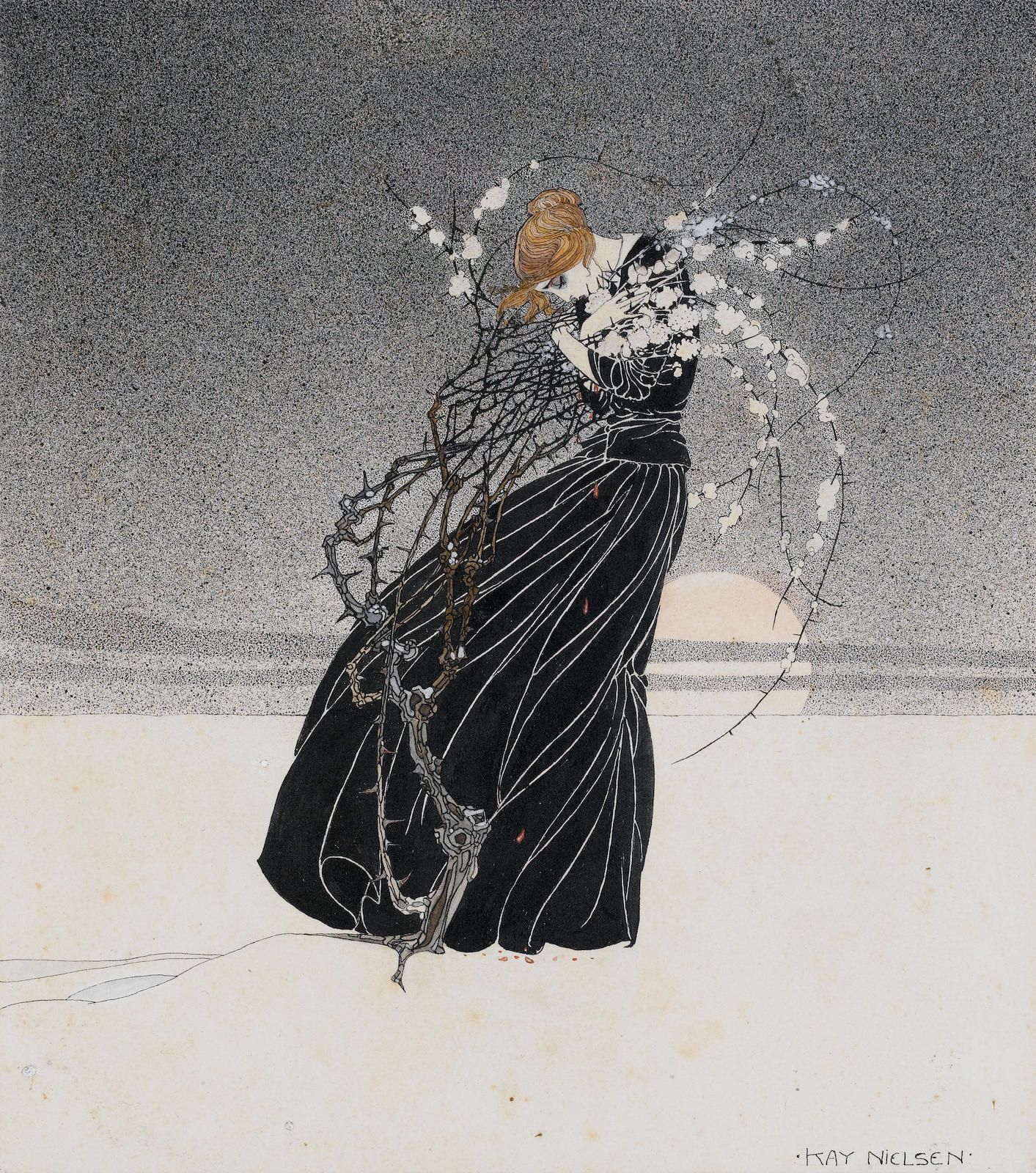
Kay Nielsen (Danish, 1886–1957), illustration for “The Story of a Mother,” ca. 1910. Pen and black ink and watercolor, heightened with bodycolor and gum arabic, 9 7/16 × 8 1/4 in. (24 × 21 cm).
When I saw this watercolor drawing of a woman embracing a thorny shrub till she drips blood come up in my Instagram feed, I immediately thought of Christ’s passion.
The caption reveals that it’s an illustration by Kay Nielsen for Hans Christian Andersen’s “The Story of a Mother,” a fairy tale written in 1848 and published around 1910 that shows the beauty and intensity of a mother’s love for her child.
The story is about a woman whose young son is gravely ill. One evening, old man Death enters her house and takes the child. Utterly distraught, she runs out after him, seeking to save the boy from Death’s clutches. As she crosses the snowy landscape in search of her son, she is stopped by various beings who request things of her in exchange for help. Night asks her for lullabies. The blackthorn bush asks for warmth. The lake asks for her eyes, clear as pearls, so “she wept till her eyes dropped down to the bottom of the lake.” An old woman who keeps Death’s greenhouse asks for her long black hair. (Oddly, she’s a redhead in Nielsen’s drawing!) Here is the exchange with the blackthorn bush, as translated from the Danish by Jean Hersholt:
At the crossroad grew a blackthorn bush, without leaf or flower, for it was wintertime and its branches were glazed with ice.
“Did you see Death go by with my little child?”
“Yes,” said the blackthorn bush. “But I shall not tell you which way he went unless you warm me against your heart. I am freezing to death. I am stiff with ice.”
She pressed the blackthorn bush against her heart to warm it, and the thorns stabbed so deep into her flesh that great drops of red blood flowed. So warm was the mother’s heart that the blackthorn bush blossomed and put forth green leaves on that dark winter’s night. And it told her the way to go.
The mother fulfills all the demands she encounters in her quest and finally meets Death, who explains that he merely carries out God’s will, which she ought not to disrupt. She ultimately resigns herself in humility to divine providence and lets the child go.
I’m not suggesting that this fairy tale is an allegory of God’s love. That wouldn’t quite make sense, as God is invoked at the end as a character in the story—and, à la the book of Job, as one who sometimes wills death (“The LORD gives and takes away,” Job 1:21).
But the mother’s love in the story is reflective, I find, of the fierce love of God, who is willing to go to any extreme to save his children from Death. He became incarnate and embraced the way of the cross. He took unto himself the crown of thorns, the nails, the humiliation. He sacrificed not just parts of himself but his whole self.
In Nielsen’s illustration, I see a picture of Christ our mother who willingly endured pain to rescue us, the warmth of whose love reverses the curse and brings life.
As an English major in college, I was required to take a course on medieval literature. I had not been looking forward to it—Romantic and Victorian lit were more my thing. I worried that working through Old English and Middle English texts would be a slog. But boy were my expectations upended! I was enthralled by all the imaginative theology I encountered in verse, drama, and sermons, from the Dream of the Rood on down. I went to a public university, but the saturation in Christian thought is unavoidable for students of the history of English literature. After overcoming some hang-ups I had acquired from my fundamentalist Baptist upbringing, I found my faith opened up, strengthened, and inspired by my study of medieval writers. The same has held true in my studies of medieval art.
If you missed the opportunity to study the creative outputs of the Middle Ages in school but want to wade into those waters, you must follow the work of Dr. Grace Hamman, a medieval scholar from Denver who writes and teaches on the great works of that era through her newsletter, podcast, and more recently her first book, Jesus through Medieval Eyes: Beholding Christ with the Artists, Mystics, and Theologians of the Middle Ages (Zondervan, 2023). The book explores seven identities of Jesus—Judge, Lover, Knight, Word, Mother, Good Medieval Christian, and Wounded God—engaging art and literature that develop these tropes, some more familiar to us as moderns than others. Mechthild of Magdeburg, Julian of Norwich, Margery Kempe, Gregory the Great, Fra Angelico, Petrus Christus, Thomas Aquinas, Anselm of Canterbury, and Richard Rolle are among the folks we meet.
The church’s writings and images from the past, Hamman says, are a gift to us in the present that can help us see beyond our time- and culture-bound limitations. “In reading these exploring, adoring, faithful witnesses from the past, we can come to know Jesus—and ourselves—better,” she writes. “What we find strange or beautiful in these medieval witnesses can reveal our concerns, hidden biases, and even new truths. They also teach us new and profound ways to love him” (6).
She continues,
I began reading medieval texts because, to my joyful surprise, I learned that medieval Christians loved Jesus. They wrote about Jesus incessantly, compulsively, athirst with love, devotion, and creativity. They possessed vast Christian imaginations, often more expansive and interesting than many of the Christians who preceded or followed them. I discovered that writers of this period were far more comfortable than we today in thinking about Jesus metaphorically, highlighting particular and peculiar attributes, and crafting new stories about him. Their narrative freedom, delight in allegory and metaphor as paths to truth, and cultural difference offer us the gift of strange new insights—the gift of surprise. (10)
To receive that gift of surprise, Hamman advises, we must approach the texts with a spirit of openness—a willingness to sit with them quietly, attentively, and humbly before making judgments, acknowledging that our own views are not necessarily superior. Then we can welcome in the discernment process, weighing the validity of the picture at hand, determining whether we want to graft it into our understanding of Christ and his work.
I appreciate how Hamman regards the medieval era with neither nostalgia nor negativity. She’s not suggesting we simply embrace medieval theology wholesale, as if it represents some kind of golden age we ought to return to. No, we can and should be critical of certain aspects—but we should first come to these works with a genuine readiness to receive and to learn, not instantly writing them off because they come from a time or tradition we’re not a part of.
Some of the pictures of Jesus that Hamman addresses are
a barefoot knight who jousts with the devil and storms the gates of hell, wearing human nature as his armor
a mother who gestates, gives birth, and breastfeeds
a lover who “forms us in blooming beauty through his tender desire” (53)
In chapter 3, “The Lover,” Hamman includes a woodcut illustration of one of the couplets from the late medieval verse dialogue Christus und die minnende Seele (Christ and the Loving Soul), showing the soul making herself naked before Christ her bridegroom so that they can join in spiritual union. Each gives themselves to the other in vulnerability.
“Christus beraubt die Seele ihrer Kleider, so daß sie nackt ist” (Christ strips the soul of its garments so that it is naked), Germany, ca. 1460. Woodcut illustration from a broadsheet of Christus und die minnende Seele (Christ and the Loving Soul). Albertina Museum, Vienna, Inv. DG1930/197/3.
She also walks us through the anonymous fifteenth-century poem “Quia Amore Langueo,” which brings together the language of romance with imagery of the crucifixion; its Latin refrain, taken from Song of Songs 2:5, translates to “Because I swoon with love.”
It’s important to pay attention to the places in these ancient texts and images that cause discomfort or confusion, as they are often places that helpfully challenge our assumptions today of who God is or what Christianity should look like.
—Grace Hamman, Jesus through Medieval Eyes, pp. 53–54
Jesus through Medieval Eyes introduces the reader to several important medieval texts, including the Old English poem Christ III, concerned with the second coming of Christ; Piers Plowman by William Langland, an allegorical poem in which the narrator, Will, is on a quest for the true Christian life; and the enormously influential Meditationes Vitae Christi (Meditations on the Life of Christ) and its derivative The Mirror of the Blessed Life of JesusChrist by Nicholas Love, who encourages us to exercise our “devout imagination” by envisioning the events of the Gospels. The latter includes charming, homey little narrative details, like Mary using her kerchief as a swaddle for the newborn Jesus, and after his forty-day fast in the desert, Jesus craving his mama’s home cooking.
I admire how Hamman takes art seriously as a theological medium, recognizing how historically, the church has expounded its theology not only through the written word but also through painting and other visual expressions. And so she integrates art images throughout the book, weaving them into her discussion. There are sixteen total, reproduced in black-and-white near the text that refers to them, for convenience, as well as in a color insert, where they can be enjoyed more fully. I wish more theologians and church historians would follow Hamman’s example of drawing on art as a resource for understanding the development of, and for inquiring into and articulating, religious ideas.
But what really sets Hamman apart from other medievalists, in my opinion, is the balance in tone she manages to achieve between academic, devotional, and personal. (It’s something I struggle to achieve as a writer.) She writes with authority but also with an intimacy that is inviting and refreshing. She lets us into her own background and experiences and feelings and is transparent about her enthusiasms and distastes. I feel like she’s a wise old friend conversing with me over a cup of tea. Whether it’s an audio commentary she’s published on her podcast, a Substack missive, or this book, I always come away from her content having learned something, been given something to reflect on or explore further, and been drawn closer to God. She’s a wonderful teacher!
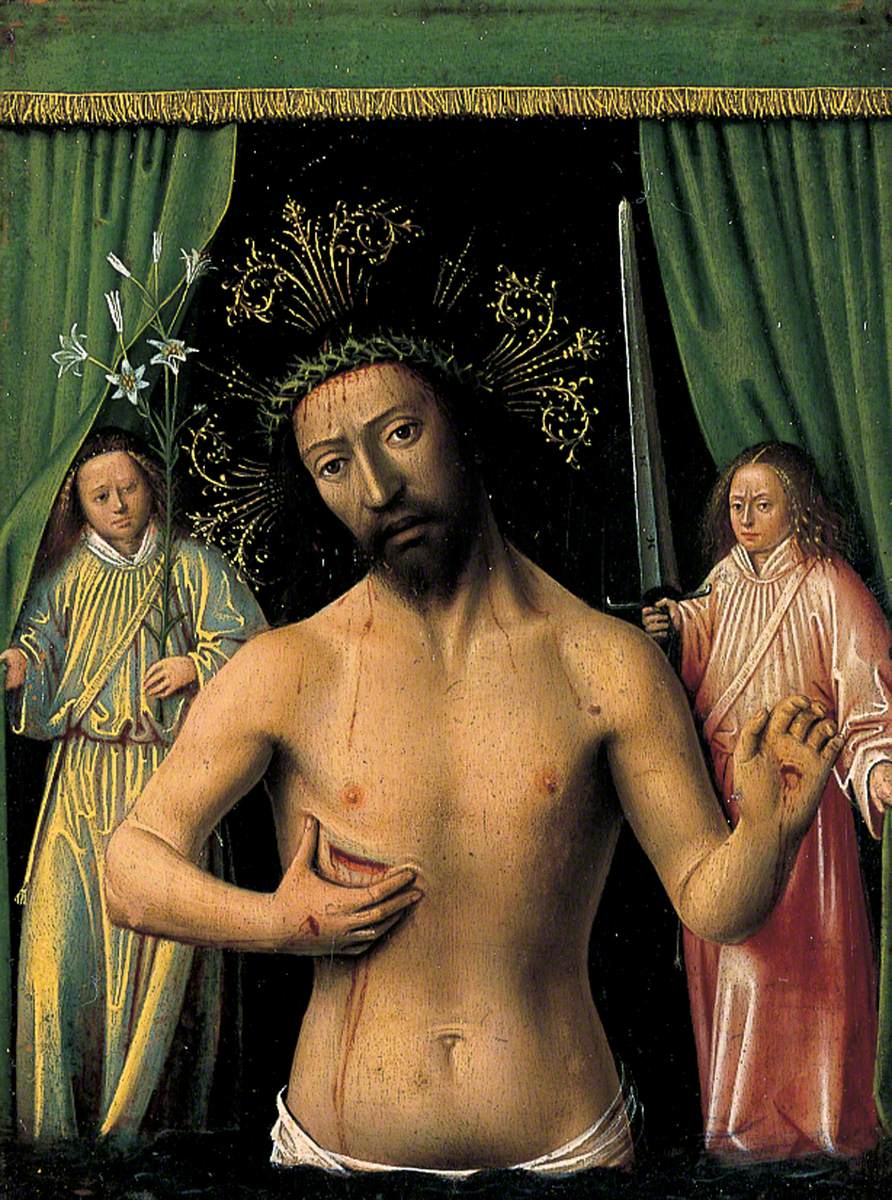
Petrus Christus (Netherlandish, ca. 1410–ca. 1475), Christ as the Man of Sorrows, ca. 1450. Oil on panel, 11.2 × 8.5 cm. Birmingham Museum and Art Gallery, Birmingham, England.
In Jesus through Medieval Eyes, each chapter ends with a scripture, reflection questions, one or two suggested exercises, and a prayer—some sourced from medieval authors, others original.
Each chapter opens with a whimsical line drawing based on medieval manuscript marginalia, which often feature humorous scenarios, like a knight fighting a snail or a rabbit hunting a human! (Role reversals were a favorite form of play for medieval artists.) This design element further immerses the reader in that world. The cover too, its art taken from a French book of hours illuminated by Jean Colombe, gives a sense of the shine of medieval manuscripts with its gilt lettering and halos of the saints.
Hamman has revitalized my interest in medieval literature, in all its wild beauty and strangeness. You may have noticed her influence on my blog over the past few years I’ve been following her. I encourage you to follow her on Twitter @GraceHammanPhD and Instagram @oldbookswithgrace, subscribe to her Medievalish newsletter, and BUY HER BOOK! It would be great material for a Christian book club, and would also make a great gift.
You may also want to check out the recent interview Hamman sat for on The Habit Podcast, part of the Rabbit Room Podcast Network. It’s a terrific introduction to her work:
This book is the first time Hildegard’s writings appeared in English. In selecting, translating, and adapting the material for it, Uhlein worked from the German critical editions of De Operatione Dei (1965), Liber Vitae Meritorum (1972), and Hildegard’s letters (Briefweschel) (1965) and songs (Lieder) (1969), all published by Otto Müller Verlag in Salzburg.
For the original Latin of the above hymn and a more straightforward translation by Nathaniel M. Campbell, see here. This link also includes a musical performance of the Latin (Hildegard wrote her own lyrics and music!).
Hildegard of Bingen, OSB, (ca. 1098–1179) was a German Benedictine abbess, theologian, preacher, poet, composer, playwright, and medical writer and practitioner. She founded the monasteries of Rupertsberg and Eibingen and was named a “doctor of the church” by Pope Benedict XVI in recognition of “her holiness of life and the originality of her teaching.” Hildegard’s most significant works are her three volumes of visionary theology: Scivias (Know the Ways) (for which she also supervised miniature illuminations), the Liber Vitae Meritorum (Book of Life’s Merits), and the Liber Divinorum Operum (Book of Divine Works). But she is also well known for her liturgical hymns and antiphons, as well as the many letters she wrote to popes, emperors, abbots, abbesses, fellow mystics, and layfolk, dispensing wisdom and advice.
Gabriele Uhlein, OSF, (born 1952) is a retreat guide, workshop leader, and artist dedicated to the recovery of the Christian mystical tradition and the honoring of intuition and creativity in spiritual deepening. Born in Klingenberg, Germany, she emigrated to the US at age two. She has a PhD in process theology and Jungian-oriented psychology from Chicago Theological Seminary and is a member of the core staff at the Christine Center, a natural sanctuary in Willard, Wisconsin, rooted in the Franciscan principles of contemplation, hospitality, compassion, simplicity, transformation, and care for the earth.
WORLD PREMIERE: “Yr Oedd Gardd / There Was a Garden” by Alex Mills, March 29, 2024, Saint Deiniol’s Cathedral, Bangor, Wales: On Good Friday this year, a new setting of seven unpublished R. S. Thomas poems, curated from the archives of the R. S. Thomas Research Centre, will be performed for the first time by Saint Deiniol’s Cathedral Choir under the direction of Joe Cooper, accompanied by devotional readings. The choral composition is by Alex Mills [previously], and it was commissioned by Saint Deiniol’s for Holy Week. The title comes from John 19:41–42: “Now there was a garden in the place where he was crucified, and in the garden there was a new tomb in which no one had ever been laid. And so, because it was the Jewish day of Preparation, and the tomb was nearby, they laid Jesus there.”
Thomas was a priest in the Church of Wales and one of the twentieth century’s greatest poets, his works exploring the cross, the presence and absence of God, forgiveness, and redemption.
This is the second commission Mills has fulfilled for the cathedral; last year he wrote “Saith Air y Groes / Seven Last Words from the Cross,” a choral setting of the seven short phrases uttered by Jesus from the cross, according to the Gospel writers, but in Welsh.
+++
CONTEMPORARY HYMNS/GOSPEL SONGS BY WOMEN:
I try to be intentional about featuring the work of women throughout the year, but as March is Women’s History Month, I wanted to call attention to these three sacred songs by Christian women from the generation or two before me.
>> “Christ Jesus Knew a Wilderness” by Jane Parker Huber (1986): Born in China to American Presbyterian missionaries, Jane Parker Huber (1926–2008) is best known as a hymn writer and an advocate for women in the church. This hymn—which can be found in A Singing Faith (1987), among other songbooks—is particularly suitable for Lent. Huber wrote the words, pairing them with an older tune by George J. Elvey. Lucas Gillan, a drummer, educator, church music director, composer, and occasional singer-songwriter from Chicago and founding member of the jazz quartet Many Blessings, arranged the hymn and performs it here with his wife, Anna Gillan, a project commissioned by Saint Matthew Lutheran Church in Walnut Creek, California. What a great violin part!
Christ Jesus knew a wilderness Of noonday heat and nighttime cold Of doubts and hungers new and old Temptation waiting to take hold
Christ Jesus knew uncertainty Would all forsake, deny, betray? Would crowds that followed turn away? Would pow’rs of evil hold their sway?
Christ Jesus knew an upper room An olive grove, a judgment hall A skull-like hill, a drink of gall An airless tomb bereft of all
Christ Jesus in our wilderness You are our bread, our drink, our light Your death and rising set things right Your presence puts our fears to flight
>> “For Those Tears I Died (Come to the Water)” by Marsha Stevens-Pino (1969): I grew up in an independent Baptist church in the southern US, and though the worship music consisted almost entirely of traditional hymns, I have a faint recollection of a woman singing this song as an offertory one Sunday. (Or maybe I heard it on a Gaithers’ television special at my grandma’s house?) It is an early CCM (contemporary Christian music) song that was popular with the emerging Jesus Movement. Marsha Stevens-Pino (née Carter) (born 1952) of Southern California wrote it in 1969 when she was sixteen and a brand-new Christian, and it was recorded by Children of the Day in 1971.
In the video below, excerpted from the DVD Stories and Songs, vol. 1, it is sung by Callie DeSoto and Maggie Beth Phelps with their father, David Phelps.
>> “The First One Ever” by Linda Wilberger Egan (1980): An alumna of the Union Theological Seminary School of Sacred Music with a background in voice and organ, Linda Wilberger Egan (born 1946) has served Lutheran, United Methodist, and Presbyterian congregations as music director throughout her career. Based on Luke 1:26–38, John 4:7–30, and Luke 24:1–11, her hymn “The First One Ever” honors the gospel witness of biblical women: Mother Mary, who said yes to God’s plan for her life, bearing the Messiah into the world; the unnamed woman of Samaria, who, after Jesus personally revealed his messianic identity to her, evangelized her whole village; and Mary Magdalene, Joanna, and Mary the mother of James, the first people to receive the news of Jesus’s resurrection and to preach it to the apostles.
The hymn is sung in the following video by Lauren Gagnon at St. Mark’s Episcopal Church in Chenango Bridge, New York, accompanied by her husband, Jacob Gagnon, on guitar.
+++
SUBSTACK POST: “St. Gabriel to Mary flies / this is the end of snow & ice” by Kristin Haakenson: Kristin Haakenson, creator of Hearthstone Fables, is an artist, farmer, and mom from the Pacific Northwest who shares art and reflections inspired by the sacred and the seasonal, place and past. In this most recent post of hers, she discusses the yearly intersection of Lent and the Feast of the Annunciation. “In a time when the Annunciation isn’t celebrated as universally within the Church as it once was, it may feel somewhat disjointed to stumble upon this joyful feast – celebrating the conception of Jesus – during the penitential season of Lent,” she writes. “This timing, though, is part of a revelatory harmony within the Christian calendar. When we step back to see it in the context of the rest of the liturgical year – and also in the context of the natural, astronomical seasons – the theology embedded in this system of sacred time begins to absolutely bloom.”
+++
LITURGICAL POEM: “Annunciation 2022” by Kate Bluett:Kate Bluett from Indiana writes metrical verse around the liturgical calendar and is also one of the lyricists of the Porter’s Gate music collective. In this poem (which she said was inspired in part by the timing of this blog post!) she brings the Annunciation into conversation with the Song of Solomon in such resonant ways.
Toros Taronatsi (Armenian, 1276–ca. 1346), The Annunciation to the Virgin Mary, 1323, from a Gospel-book made at Gladzor Monastery, Siunik, Armenia. MS 6289, fol. 143, Matenadaran Collection (Mesrop Mashtots Institute of Ancient Manuscripts), Yerevan.
On Holy Saturday I’m planning to feature a song that connects the Song of Solomon to the women at Jesus’s tomb! If you haven’t read that Old Testament book or it’s been a while, I’d encourage you to do so, as then you’ll be able to more easily identify the references in Bluett’s poem and the upcoming song I’ve scheduled for the Paschal Triduum.









 Art & Theology