Christ as Sun, Bridegroom, and Runner: Psalm 19, Revelation 12, and Advent

“Glory Glory / Psalm 19” by Daniel Berrigan

The heavens bespeak the glory of God.
The firmament ablaze, a text of his works.
Dawn whispers to sunset.
Dark to dark the word passes: glory glory.

All in a great silence,
no tongue’s clamor—
yet the web of the world trembles
conscious, as of great winds passing.

The bridegroom’s tent is raised,
a cry goes up: He comes! a radiant sun
rejoicing, presiding, his wedding day.
From end to end of the universe his progress.
No creature, no least being but catches fire from him.

This paraphrase of Psalm 19:1–6 by Daniel Berrigan is from Uncommon Prayer: A Book of Psalms (University of Michigan Press, 1978; Orbis, 1998). Used by permission of the Daniel Berrigan Literary Trust. www.danielberrigan.org


The first section of Psalm 19 is about how the natural world declares the glories of its Maker. The night sky, the psalmist describes, is like a tent that spreads its cover over the sun, parting open every morning to release it on the world. The sun is compared to a bright-eyed, handsome, and happy bridegroom emerging from his chamber, and to a vigorous runner who tracks a massive course.

I like to read Psalm 19:1–6 for Advent, especially the poet-priest Fr. Daniel Berrigan’s paraphrase of it, as his use of he/him/his pronouns instead of it/its draws out a Christological connection I hadn’t seen before in this text, made even more pronounced by the apocalyptic tone Berrigan adopts and the sense of excitement he conveys. The poem can, of course, be read as simply the glorious waking of a day, as the psalmist intended. But there’s another layer I want to explore: signs in the heavens, and the coming of Christ.

In the Christian tradition, Jesus is compared to both a sun and a bridegroom, and he, too, like the skies, “bespeak[s] the glory of God.” “Oriens”—Dawn or Dayspring—is one of the traditional titles of Christ, typically invoked in liturgies on December 21 as part of the O Antiphons cycle. From the Church of England’s Common Worship: “O Morning Star, splendor of light eternal and sun of righteousness: come and enlighten those who dwell in darkness and the shadow of death” (cf. Luke 1:78–79; John 8:12; Mal. 4:2). The coming of Jesus—in Bethlehem, in human hearts, and on the last day—illuminates and sets ablaze, revealing who God is and who we ourselves most truly are and exciting the world, flinging abroad the divine light.

As for the bridegroom, Jesus uses this metaphor for himself in his parable of the ten bridesmaids (Matt. 25), as God does in Isaiah 62:5, and indeed one of the major motifs in the book of Revelation is a wedding between Christ and his people. Christ will return to us, scripture suggests, like a husband coming to bring home his new bride.

One of the antiphons for First Vespers of Christmas, I’ve just learned, sung the evening of December 24, connects the bridegroom of Psalm 19 with Jesus. Cum ortus fuerit sol de caelo, the church chants, videbitis Regem regum procedentem a Patre, tanquam sponsum de thalamo suo. (“When the sun shall have risen in the heavens, ye shall see the King of kings coming from the Father, as a Bridegroom from his bride-chamber.”)

Butler, Tanja_Woman Clothed with the Sun
Tanja Butler (American, 1955–), Woman Clothed with the Sun, 2008. Acrylic paint, collaged painted paper, and cotton fabric on gessoed acid-free paper, 14 × 5 in. Collection of Victoria Emily Jones.

Artist Tanja Butler further extends Psalm 19’s fittingness for Advent by drawing the passage into conversation with Revelation 12:1–6. This section of John’s Apocalypse introduces us to “a woman clothed with the sun, with the moon under her feet, and on her head a crown of twelve stars”; she gives birth to a baby boy “who is to rule all the nations” but whom a great dragon seeks to devour. In most Christian interpretations, this Woman of the Apocalypse is associated with the Virgin Mary, and there’s a robust iconographic tradition in this vein.

Butler innovates on that tradition with her mixed-media work Woman Clothed with the Sun by showing the infant Jesus busting out of his mother’s womb like the strong athlete of Psalm 19:5. (Ready. Set. Go!) He has a race to run, a mission to fulfill. He is also shown as the sun that clothes his mother and that emerges from a dark (uterine) tent. He is the source and center point of the explosive rays of colorful light in the painting.

In an ArtWay profile, Butler describes her piece as follows:

Mary is represented with the unborn Christ, Light of the World, ready to “come forth from his pavilion, like a champion rejoicing to run his course” (Psalm 19:5). She holds a ladder, referencing both Jacob’s vision and the cross, the ladder of ascent between earth and heaven.

This is a cosmic birth necessitated by a cosmic struggle that will resolve in a cosmic victory: the reunion of God and humanity.


Daniel Joseph Berrigan, SJ, (1921–2016) was an American Jesuit priest, peace activist, award-winning poet, and professor of theology and biblical studies. Through his writings and public witness, he endorsed a consistent life ethic, opposing war, nuclear armament, abortion, capital punishment, and the causes of poverty in the name of Jesus Christ and his holy gospel. Fr. Berrigan, along with his brother Philip, was one of the Catonsville Nine, imprisoned in 1968 for destroying draft files in a protest against the Vietnam War. Later, he spent much of the eighties ministering to AIDS patients in New York City. He is the author of some fifty books.

Tanja Butler (born 1955) is a painter and liturgical artist based in the Albany, New York, area. Her subjects are devotional in character, and her sources of inspiration include Byzantine icons, medieval art, and folk art. Her work is included in the collections of the Vatican Museums, the Hammer Museum in Los Angeles, the Portland Museum of Art in Maine, and the Boston Public Library. “My aim is to develop imagery that has the simplicity and clarity of a child-like vision,” she says, “required, we’re told, if we are to see the kingdom of God.”

Advent, Day 18: New World a-Comin’

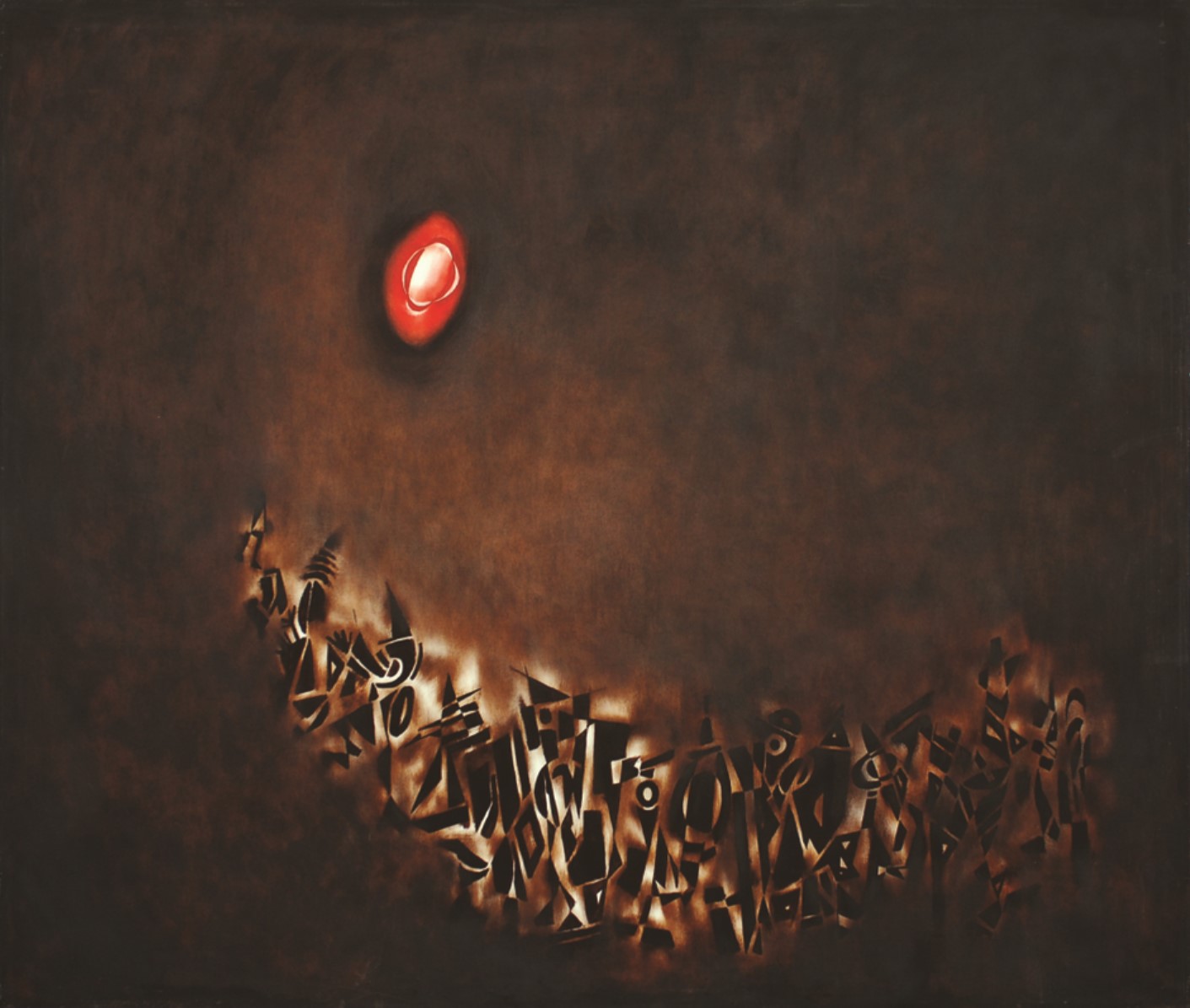
LOOK: New World A’Coming by Norman Lewis

Lewis, Norman_New World A'Coming
Norman Lewis (American, 1909–1979), New World A’Coming, 1971. Oil on canvas, 73 × 87 in. © Estate of Norman Lewis; courtesy of Michael Rosenfeld Gallery LLC, New York.

Born in Harlem to Black Bermudian immigrants, Norman Lewis began his art career making social realist paintings but after World War II turned increasingly to abstraction. He is known for his rhythmic lines and shapes.

New World A’Coming is one of his later works. In it “a crowd of figures, abstracted in geometric frenzy, gather in processional unity under the glow of a crimson sun,” the Bill Hodges Gallery writes. “Enveloped in a burnt-umber haze, the dark silhouette of the congregation is accented by a bright white glow that seems to emanate from within the crowd”—they are a holy people. The upward curve suggests movement, ascent. It’s as if the people are dancing their way to a new dawn.

LISTEN: “New World a-Comin’” by Duke Ellington, 1943

“New World a-Comin’” by the famous African American jazz pianist, composer, and bandleader Duke Ellington is a single-movement work for piano and ensemble. Ellington premiered the earliest version with his eponymous jazz orchestra at Carnegie Hall on December 11, 1943, with himself on piano. He edited and reprised the piece throughout the years, orchestrating it for symphony orchestra in 1966 (the score is lost) and sometimes performing it as a piano solo without accompaniment. He never made a definitive studio recording of “New World a-Comin’” in its original form, and he never wrote down the piano part.

Above is a recording of the live premiere performance. But here it is, below, with the symphony orchestration, recorded in 1970 with the Cincinnati Symphony Orchestra, directed by Erich Kunzel, and again featuring Ellington as soloist. This recording appears on the album Duke Ellington: Orchestral Works (released on CD in 1989):

Of all the renditions, though, Harvey G. Cohen writes in his book Duke Ellington’s America that Ellington’s unaccompanied solo performance at the Whitney Museum of Art in 1972 may be the most poignant; it’s “searching and delicate,” Cohen says (239).

If you want to see a video recording, here’s Ellington soloing it up at a sacred music concert at Grace Cathedral in San Francisco on September 16, 1965 (view the full concert):

The title of this piece comes from the Peabody Award–winning book New World A-Coming: Inside Black America by the prominent Black journalist Roi Ottley, which documents the daily lives of African Americans in Harlem during the 1920s and ’30s as well as their hope for a better future.

In his 1976 memoir Music Is My Mistress, Ellington wrote, “I visualized this new world as a place in the distant future where there would be no war, no greed, no categorization, no non-believers, where love was unconditional, and no pronoun was good enough for God” (183).

“Musically,” writes Los Angeles Philharmonic content director Ricky O’Bannon, “that hope takes the form of a virtuoso showpiece for Ellington at the piano—unusual for the bandleader and a more-than-capable pianist who preferred showing off his skills as a composer. The beautiful theme and variations are supported with rich overtones and chords that Ellington scholar Mark Tucker describes as reminiscent of Ravel to the point it ‘might be called Fox-Trots Nobles et Sentimentales’ and is first-rate Ellington. Other parts might be evocative of the Romantic sweetness of Rachmaninoff.”


This post is part of a daily Advent series from December 2 to 24, 2023 (with Christmas to follow through January 6, 2024). View all the posts here, and the accompanying Spotify playlist here.
Advent, Day 17: Yonder Come Day

Be attentive to this [God’s message] as to a lamp shining in a dark place, until the day dawns and the morning star rises in your hearts.

—2 Peter 1:19b

LOOK: Bridge of Glory by Nicholas Roerich

Roerich, Nicholas_Bridge of Glory
Nicholas Roerich (Russian, 1874–1947), Bridge of Glory, 1923. Tempera on canvas, 82 × 163 cm. Nicholas Roerich Museum, New York.

LISTEN: “Yonder Come Day,” African American spiritual | Performed by the Schola Cantorum of St. Peter’s in the Loop, dir. J. Michael Thompson, on Music for Advent II (2005)

Yonder come day, day is a-breakin’
Yonder come day, O my soul
Yonder come day, day is a-breakin’
Sun is a-risin’ in my soul

This spiritual originated in the nineteenth century in the enslaved Black communities of St. Simons Island off the coast of Georgia. Daybreak here can be read as a metaphor for salvation, happiness, death/beatification, or possibility. The latter was an especially common application, as the song was typically sung at Watch Night services, a New Year’s Eve tradition of Christian prayer, worship, song, and dance lasting from around 7 p.m. until midnight.

Recorded in 1963 in Los Angeles, the performance below is from the short film Georgia Sea Island Singers (1964), available on the DVD The Films of Bess Lomax Hawes (2003) and streaming on Kanopy:

The singers are, from left to right, John Davis, Bessie Jones, Emma Ramsay, Henry Morrison, and Mabel Hillary. They sing these lyrics:

Yonder come day
(O day)
Yonder come day
(O day)
Yonder come day
Day done broke
Into my soul

Yonder come day
(I was on my knees)
Yonder come day
(I was on my knees)
Yonder come day
(I was on my knees)
Yonder come day
Day done broke
Into my soul

. . . I heard him say . . .

. . . It’s a New Year’s day . . .

. . . Come on, child . . .

In 2016, Paul John Rudoi arranged “Yonder Come Day” together with “Hush, Hush,” “Steal Away,” and “Swing Low, Sweet Chariot,” creating a medley of spirituals in which “Yonder” is the through line. The medley is performed in the following video by the University of Oregon Chamber Choir, featuring soloist Alexa McCuen:

The coming of Christ is often described as the rising of a new day. That goes for his first advent in Bethlehem; his second, future advent; and his advent in the human heart, as people receive him and are flooded with spiritual light. “Yonder Come Day” is an apt song for remembering with gratitude one’s own conversion, that moment when Christ came to you and transformed you from the inside out.


This post is part of a daily Advent series from December 2 to 24, 2023 (with Christmas to follow through January 6, 2024). View all the posts here, and the accompanying Spotify playlist here.
Advent, Day 16: Et incarnatus est

LOOK: Yoruba Madonna and Child

Madonna and Child (Nigerian)
Wood scuplture of the Madonna and Child, Yorubaland, Nigeria, mid-20th century. Photo: Lee Boltin.

This sculpture by a Yoruba artist from Nigeria shows the Christ child seated on the lap of his mother, Mary, who wears a traditional Yoruba hairstyle and dress. If I had to guess, I’d say it’s probably by George Bandele Areogun (1908–1995), as it is commensurate in quality and style with his other work.

The image appears as figure 27 in the 1974 book The Faces of Jesus by Frederick Buechner (which contains an excellent selection of full-color art from around the globe!) with the vague caption “Madonna and Child, wood, Africa, contemporary.” At the time of publication, the sculpture was in the private collection of Maurice Lavanoux (1894–1974), a specialist in church art living in New York, but I don’t know its current whereabouts.

It probably came out of the Oye-Ekiti workshop, established by the Society of African Missions (a Roman Catholic organization) and active from 1947 to 1954. If not, it is indebted to that initiative, which was key in establishing a Yoruba Christian style of art and cultivating patrons for such art. For more on the Oye-Ekiti workshop, see my review of the 2014 exhibition Africanizing Christian Art. For a more recent article, see “The Oye-Ekiti Christian Art Workshop and the Fusion of the European Catholic Tradition and Nigerian Indigenous Art in Three Lagos Churches” by Chinyere Ndubuisi, from Art in Translation 14, no. 3 (2022): 230–54.

LISTEN: “Et incarnatus est” (And was incarnate) by J. S. Bach, from his Mass in B minor, BWV 232, completed 1749 | Performed by Robin Johannsen, Marie-Claude Chappuis, Helena Rasker, Sebastian Kohlhepp, Christian Immler, and the Akademie für Alte Musik Berlin, dir. René Jacobs, 2022

Et incarnatus est de Spiritu Sancto,
ex Maria virgine; et homo factus est.

English translation:
And [he] was incarnate by the Holy Spirit,
of the Virgin Mary; and was made man.

Comprising twenty-seven movements in four parts, Bach’s B minor setting of the Latin Mass is widely regarded as one of the highest achievements of classical music. “Et incarnatus est” is the fourth movement of part 2, “Symbolum Nicenum” (Nicene Creed).


This post is part of a daily Advent series from December 2 to 24, 2023 (with Christmas to follow through January 6, 2024). View all the posts here, and the accompanying Spotify playlist here.

Ten Songs of Joy for Gaudete Sunday

The third Sunday of Advent is known as Gaudete Sunday, gaudete (pronounced GOW-deh-tay) (Latin for “rejoice”) being the first word of the introit of the day’s Mass, taken from Philippians 4:4–6 and Psalm 85:1:

Gaudete in Domino semper íterum díco, gaudéte: modéstia véstra nóta sit ómnibus homínibus: Dóminus prope est. Nihil sollíciti sítis: sed in ómni oratióne petitiónes véstrae innotéscant apud Déum. Benedixísti, Dómine, térram túam: avertísti captivitátem Jácob.

Rejoice in the Lord always; again I say, rejoice. Let your forbearance be known to all men. The Lord is at hand. Do not be anxious over anything; but in all manner of prayer, let your requests be made known unto God. Lord, you have blessed your land; you have put an end to Jacob’s captivity.

It is customary for priests to swap out their purple vestments for pink today, and for those who use an Advent wreath to light not a purple candle but a pink one. Some churches favor a spare aesthetic in their sanctuaries for the first two weeks of Advent but break out the flowers for this the third. The approximate halfway point of the penitential Advent season, Gaudete Sunday is a special time to rejoice in the nearness of God’s coming as well as God’s presence with us here even now in the waiting, and to receive a foretaste of the bigger celebration to come on Christmas Day.

Here are ten songs for you to enjoy this Gaudete Sunday. If you’d rather listen to them as a YouTube playlist, click here.

Richardson, Jan_Visitation
The Hour of Lauds: Visitation by Jan Richardson [for sale]

1. “Songs of Joy” by Garrison Doles, written late 1990s, on A Songmaker’s Christmas, 2012: “Songs of joy we hopefully sing, expanding our spirits, the season to know . . .” So opens this song by the late singer-songwriter Garrison Doles (d. 2013) [previously]. In 2009 his wife, the artist Jan Richardson, created a video combining the song with five of the seven collages from her Advent Hours cycle (which can be purchased as reproductions). Read the lyrics and songwriter’s statement here.

2. “My Soul Doth Magnify the Lord” by O’Landa Draper and the Associates, on Live…A Celebration of Praise, 1994: A trailblazing gospel choir director, O’Landa Draper was one of the top gospel artists of the nineties. This song of his is based on the Magnificat, the praise song Mary sings in the company of her cousin Elizabeth following the conception of Christ (see Luke 1).

3. “El burrito de Belén” (The Little Donkey of Bethlehem) by Hugo Cesar Blanco, 1972, performed by the band Matute, 2020: This is a Venezuelan carol about a person riding their donkey, with hurried excitement, from the sabanero (savanna) to Bethlehem to see the newborn Christ. Read the lyrics and translation here.

4. “Ecce mundi gaudium” (Behold the Joy of the World), England, 13th century, arranged and performed by the Mediæval Bæbes on Worldes Blysse, 1998: Written in Latin, this thirteenth-century carol is about the Virgin giving birth to the Son, our joy—announced to the shepherds by an angel and to the magi by a star. Despite the upbeat tempo throughout, the last two verses are about Herod’s raging and the Massacre of the Innocents. The soloist is Katharine Blake, the founder and musical director of Mediæval Bæbes. Read the original lyrics here, clicking on individual lines for the English translation.

5. “Kya Din Khushi Ka Aaya” (क्या दिन खुशी का आया) (What a Happy Day), performed by Akshay Mathews, 2021: A Hindi Christmas carol from India. Read the lyrics here.

6. “Repeat the Sounding Joy,” a fragment from “Joy to the World” arranged by Craig Courtney, performed by the Capital University Chapel Choir, 2019: A super-fun, one-minute choral work.

7. “Now Let Us Sing,” traditional, adapt. John L. Bell, 1995, performed by Katarina Ridderstedt, 2015: Katarina Ridderstedt (née Lundberg) is a rhythm teacher, musician, cantor, and choir director from Gotland, Sweden, who records music under the name Musikat. This video of hers introduced me to a charming little quatrain whose origins I don’t know (it’s credited as “Traditional”), but this version comes from Scotland’s Iona Community [previously]: “Now let us sing with joy and mirth, / praising the one who gave us birth. / Let every voice rise and attend / to God whose love shall never end.”

(Update, 1/6/25: “Now let us sing” is of Scottish origin, first appearing during the Protestant Reformation in the congregational song collection The Gude and Godlie Ballatis; the earliest extant edition of this book is from 1567, but it is thought to have been originally published in 1540. The tune was originally a drinking tune. For his rendition, published in Come All You People: Shorter Songs for Worship, John L. Bell essentially rewrote the first stanza, retaining only the first line of the original.)

8. “Brother” by Jorge Ben Jor, on A Tábua de Esmeralda, 1974: Known by the stage name Jorge Ben or (since the 1980s) Jorge Ben Jor, Jorge Duílio Lima Menezes (b. 1939) is a Brazilian singer-songwriter and musician whose characteristic style fuses elements of samba, funk, rock, and bossa nova. In this song he enjoins us to prepare a joyful path for the coming Christ—who is both Lord and friend—with love, flowers, and music.

9. “Alleluia, He Is Coming (I Looked Up)” by Martha E. Butler, 1979: This song is sometimes used in church services for Palm Sunday or Easter, but I think it makes a fitting Advent song as well—especially with the newer last verse that is sometimes used, as in the first video below. “Alleluia, he [Christ] is coming! Alleluia, he is here,” the refrain proclaims. Read about the inspiration behind the song, in the words of the songwriter, here. Allow me to sneak in two different performances. The first is by Donna Rutledge, Becky Buller, and Todd Green of First Baptist Church of Manchester, Tennessee, from 2020; theirs is a lovely rendition with strong vocals and a poignant violin part, but I do prefer a brisker pace (listening to the video at a playback speed of 1.25 is perfect, in my estimation):

The second is by the South African group Worship House, from their 2016 album Project 5 (Live in Johannesburg):

10. “Joy Will Come” by Paul Zach: The refrain of this song by Paul Zach of Virginia is based on Psalm 30:5b: “Weeping may linger for the night, but joy comes with the morning.” I also hear echoes of Psalms 18 and 121 throughout. The song is a reminder that through the dark nights we experience, we have hope; we have a Savior who will not abandon us.

Advent, Day 15: Praise

In those days Mary set out and went with haste to a Judean town in the hill country, where she entered the house of Zechariah and greeted Elizabeth. When Elizabeth heard Mary’s greeting, the child leaped in her womb. And Elizabeth was filled with the Holy Spirit and exclaimed with a loud cry, “Blessed are you among women, and blessed is the fruit of your womb. And why has this happened to me, that the mother of my Lord comes to me? For as soon as I heard the sound of your greeting, the child in my womb leaped for joy. And blessed is she who believed that there would be a fulfillment of what was spoken to her by the Lord.”

—Luke 1:39–45

LOOK: Mary and Elizabeth by Kate Green

Green, Kate_Mary and Elizabeth
Kate Green (British, 1965–), Mary and Elizabeth, 2018. Watercolor and ink on paper.

LISTEN: “Praise the Lord” by Phillip A. Peterson, written for and performed by Grace Seattle Experimental Orchestra on Oratorio of Prayers: Supplication, 2007

(The original German words are verse 4 of the 1680 hymn “Lobe den Herren, den mächtigen König der Ehren!” by Joachim Neander.)

Praise to the Lord
Who has visibly blessed your state
Who has rained streams of love from the heavens

Consider
What the Almighty can do
He who meets you with such love


This post is part of a daily Advent series from December 2 to 24, 2023 (with Christmas to follow through January 6, 2024). View all the posts here, and the accompanying Spotify playlist here.
Advent, Day 14: Annunciation

LOOK: Ustyug Annunciation icon

Ustyug Annunciation
Ustyug Annunciation, Novgorod, ca. 1120–30. Tempera on wood, 23.8 × 16.8 cm. State Tretyakov Gallery, Moscow.

This icon is among the oldest extant Russian icons, being one of the few to have survived the Mongol invasion of Russia in the thirteenth century. Even though it was produced in the Novgorod region, it is called “Ustyug” because of its association with that village in local histories and hagiographies.

The icon shows the angel Gabriel approaching Mary with the news that she has been chosen to bear the Son of God into the world. In Mary’s left hand she holds a skein of scarlet thread, as tradition says she was one of the women responsible for weaving the veil of the temple in Jerusalem. Following the thread upward to her right hand, we see a remarkable detail in her midsection: a shadowy figure of Christ Emmanuel, fully formed within her and gesturing blessing. The iconographer has compressed together the moments of announcement and conception, suggesting that Mary’s miraculous pregnancy has already been effected.

Ustyug Annunciation

At the top center, in a blue semicircle representing the heavens, sits the Ancient of Days, a symbolic depiction of God the Father. Fiery red cherubim and seraphim surround his throne. He holds a scroll in his right hand, while his left is raised in benediction. Earlier descriptions of the icon mention a ray of light emanating from God’s throne to Mary, traveled by the Holy Spirit in the form of a dove, but time has worn away this detail.

LISTEN: “Annunciation” piano quintet by Philip Glass, based on the Greek Orthodox communion hymn for the Feast of the Annunciation, 2018

>> Performed by Paul Barnes, Laurie Hamilton, Maria Newman, Scott Hosfeld, and David Geber at Symphony Space, New York, 2019:

>> Performed by Paul Barnes and Brooklyn Rider for Philip Glass: Annunciation, 2019:

Sharing a love of ancient chant traditions, pianist and Greek Orthodox chanter Paul Barnes [previously] and composer Philip Glass have engaged in collaborative projects ever since they first met on an airplane in March 1995. Most recently, Barnes facilitated the commission of a piano quintet by Glass—his first—based on the melody of the Greek Orthodox communion hymn for the Feast of the Annunciation, whose text is Psalm 132:13: “The Lord has chosen Zion, he has desired her for his dwelling place.” (Hear Barnes chant the hymn here.)

A piano quintet is a work of chamber music written for piano and four other instruments, usually a string quartet (two violins, one viola, one cello).

Glass’s “Annunciation” piano quintet premiered April 17, 2018, at the Lied Center for Performing Arts in Lincoln, Nebraska, with the Chiara String Quartet and Barnes on piano.

In the program notes for the piece, Barnes writes:

The work is in two parts. Part One opens with a meditative chromatic chord progression which eventually leads to the first entrance of the chant first stated in the piano. Glass develops this beautiful theme as it is shared by the various members of the quintet, culminating in an opulent neo-romantic closing section recapping the introductory chromatic chord progression. A partial restatement of the theme ends the movement with a brooding D minor coda.

Part Two is a poignant musical meditation on Part One revealing Glass’s innate ability to connect the transcendental ethos of the original chant with his own spacious approach to musical time. A particularly expressive section features the piano in soaring sparse octave melody over undulating eighth notes in the violin and cello. The work ends with an increasingly energetic and ecstatic 7/8 coda based on the opening chant transformed into scale passages that ascend and dissipate into a pianissimo chromatic flourish evocative of incense rising.

I studied Philip Glass’s experimental opera Einstein on the Beach in my Western music history survey course in college—Glass is one of the twentieth century’s most influential composers—and I was delighted to encounter this newer, religiously inspired work of his that Barnes planted the seeds for and is active in promoting and performing.


This post is part of a daily Advent series from December 2 to 24, 2023 (with Christmas to follow through January 6, 2024). View all the posts here, and the accompanying Spotify playlist here.

Roundup: Pregnancy prints, “Hearth” by Janine Antoni, and more

ARTICLES:

>> “Picturing Pregnancy in Early Modern Europe” by Rebecca Whiteley, Public Domain Review: Adapted from the book Birth Figures: Early Modern Prints and the Pregnant Body by Dr. Rebecca Whiteley (University of Chicago Press, 2023), this article explores how the womb and fetuses were depicted in medical book illustrations in Europe during the sixteenth and seventeenth centuries. Pregnancy is such a potent image for Advent, as we await the birth of Jesus—who, fully God and fully human, dwelled for nine months in his mother Mary’s uterus before emerging from her birth canal!

Child in uterus
Woodcut illustration of a baby in the womb from De conceptu et generatione hominis (Zurich, 1554), the first Latin edition of a midwifery handbook by Jacob Rueff

Woodcut illustration of an open uterus from La commare o raccoglitrice . . . (Verona, 1642), a manual about pregnancy and childbirth by Girolamo Mercurio

>> “Rupy C. Tut’s Landscapes of Belonging” by Bridget Quinn, Hyperallergic: Bridget Quinn reviews Rupy C. Tut’s solo exhibition Out of Place that’s running at the Institute of Contemporary Art San Francisco through January 7. I love, love, love her art! It’s inspired by traditional Indian miniature painting and “is an effort to belong, to feel in place,” Tut says. Tut is a first-generation immigrant from India’s Punjab region who settled in California with her Sikh family at age twelve. Her Searching for Ancestors reminds me, visually but not thematically, of Jyoti Sahi’s Incarnation within the Anthill, and her Portrait of a Woman gives me some serious Marian vibes—as it did too the reviewer, who refers to this pregnant woman as “a kind of cross-cultural Madonna, reminiscent of the central mother figure, mandorla, and sun rays of Our Lady of Guadalupe so familiar across California via Mexico.”

Tut, Rupy C._Portrait of a Woman
Rupy C. Tut (Indian American, 1985–), Portrait of a Woman, 2023. Handmade pigments and shell gold on hemp paper, 57 × 37 in.

+++

INSTAGRAM POST: “Birthing // Love” by Elissa Yukiko Weichbrodt: Last Advent, art historian and educator Elissa Yukiko Weichbrodt (@elissabrodt) reflected on Janine Antoni’s Hearth ceramics, part of the artist’s Pelvic Vessels series, and on the biological reality that during the act of childbirth, both the mother’s and baby’s bodies are changed by one another. What might this mean for Advent?

Antoni, Janine_Hearth
Janine Antoni (Bahamian American, 1964–), Hearth, 2014. Set of three pit-fired ceramic vessels, 4 3/4 × 6 1/2 in., 4 3/4 × 7 7/8 in., 5 1/8 × 8 in.

+++

DEVOTIONAL COLUMN: “Jesus’ Bloody Birth” by Lauren F. Winner, Christian Century: “Jesus . . . is bloody in many senses,” writes Rev. Dr. Lauren Winner [previously]. One of those senses is that he came into this world covered in his mother’s blood. Something is lost in the Christmas story when we evade the details of childbirth, Winner says. I was alerted to this short reflection of hers from 2015 by its inclusion in the new book A Radiant Birth: Advent Readings for a Bright Season.

+++

PODCAST EPISODE: “The Incarnation and Health Care as Ministry” with Denise Hess, Hear Me Now Podcast, December 24, 2020: “There is a long tradition of faith-based healthcare. On this Christmas episode—filled with music, poetry, and conversation—we ask: How has the belief that God became human in the flesh inspire care for people and their bodies? Rev. Denise Hess [MDiv, BCC-PCHAC] of the Supportive Care Coalition (now part of the Catholic Health Association) joins host Seán Collins in a reflection on the Christian doctrine of the Incarnation and the ways it has inspired centuries of healthcare. They talk about the example of Jesus-as-healer, the crucial role women have served in promoting healthcare ministries, and the place suffering plays in our understanding of caring for the whole person.”

The conversation is interspersed with poetry readings and performances of carols by a violin-guitar-bass trio. Hess mentions this wonderfully shocking sentence from Chris Abani’s poem “The New Religion”: “what was Christ if not God’s desire / to smell his own armpit?” She also shares Brian Wren’s beautiful hymn text “Good Is the Flesh.” The podcast is a production of the Providence Institute for Human Caring.

Advent, Day 13: A star shall rise out of Jacob

LOOK: Virgin and Child with a Prophet catacomb fresco

Mary breastfeeding (Catacomb of Priscilla)
Virgin and Child with a Prophet, 3rd century. Fresco in the Catacomb of Priscilla on the Via Saleria, Rome. Photo: Scala / Art Resource. [view wider shot]

Deep in the Catacomb of Priscilla in Rome, one of the early Christian underground burial places (named after the donor of the land), is an arched ceiling fresco of a woman breastfeeding her child under an apple tree. Beside her a man points up to a star that’s resting over their heads among the fruit.

Dating to the third century, this image is the earliest known depiction of the Virgin Mary, and one of the oldest of Christ. The identity of the third figure is less sure, but it’s most likely the Gentile prophet Balaam, who, in the power of God’s Spirit, prophesied to King Balak of Moab that “a star shall come out of Jacob, and a scepter shall rise out of Israel” (Num. 24:17).

Although this prophecy had a more immediate fulfillment in King David, it has also been interpreted in a messianic sense since as early as Justin Martyr (ca. 100–165), who wrote, “And that he [Christ] should arise like a star from the seed of Abraham, Moses showed beforehand when he said, ‘A star shall arise from Jacob, and a leader from Israel’” (Dialogue with Trypho, chap. 106).

Irenaeus (ca. 130–200) wrote that the star the magi followed to seek out the newborn Christ was the one prophesied by Balaam (Against Heresies, bk. 3, chap. 9.2), and Origen (ca. 185–254) maintained that Numbers 24:17 was the Hebrew Bible verse the magi found that instigated their journey (Against Celsus, bk. 1, chap. 60).

Priscilla Catacomb arch
Arched ceiling detail from Gallery 3 of the Catacomb of Priscilla, Rome. The central image, in stucco, portrays a shepherd and two sheep, while at the far right, oriented in a different direction, is a fresco of the Virgin and Child. The artworks are damaged by age.

Other suggestions put forward as to the identity of the pointing figure in this catacomb fresco have been a magus; the Hebrew prophet Isaiah, who declared that “a virgin shall conceive” (Isa. 7:14) and enjoined his people to “arise, shine; for thy light is come, and the glory of the Lord is risen upon thee” (Isa. 60:1); and, from Hans-Ruedi Weber, John the Baptist, who “came as a witness to testify to the light, so that all might believe. . . . The true light, which enlightens everyone, was coming into the world” (John 1:6–9).

To explore more of the Catacomb of Priscilla, see the following Smarthistory video by Beth Harris and Steven Zucker. Today’s featured image is introduced at 3:35:

LISTEN: “There Shall a Star from Jacob Come Forth” (original title: “Es wird ein Stern aus Jacob aufgeh’n”), from Christus, Op. 97 | Original German text compiled by Christian Charles Josias von Bunsen, 1846, from Numbers 24:17 and the hymn “Wie schön leuchtet der Morgenstern” by Philipp Nicolai, 1599; English translation of lines 4–10 by Catherine Winkworth, 1863 | Music by Felix Mendelssohn, 1846–47, based on Nicolai’s hymn tune | Performed by the St. Olaf Choir, the St. Olaf Cantorei, the St. Olaf Chapel Choir, the Manitou Singers, Viking Chorus, and the St. Olaf Orchestra, dir. Robert Scholz, on Love Divine, Illumine Our Darkness: Christmas at St. Olaf, 2002

There shall a star from Jacob rise up,
And a sceptre from Israel come forth,
To dash in pieces princes and nations.

How brightly beams the morning star!
With sudden radiance from afar,
With light and comfort glowing!
Thy word, Jesus, inly feeds us,
Rightly leads us,
Life bestowing.
Praise, oh praise such love o’erflowing.

The musical work “Es wird ein Stern aus Jacob aufgeh’n” (There Shall a Star from Jacob Come Forth) is from an unfinished oratorio by Felix Mendelssohn (1809–1847), which the composer’s brother Paul gave the name Christus and published posthumously as Opus 97. The first performance took place in 1852.

The first three lines are taken from Numbers 24:17, while the latter portion is from the Lutheran hymn “Wie schön leuchtet der Morgenstern” (How Brightly Beams the Morning Star) by Philipp Nicolai, written in 1597 and first published in 1599 with the title “Ein geistlich Brautlied der gläubigen Seelen von Jesu Christo ihrem himmlischen Bräutigam, gestellet über den 45. Psalm des Propheten David” (A spiritual wedding song of the faithful soul about Jesus Christ, her heavenly groom, made over the 45th psalm of the Prophet David). The tune it was published with was adapted by Nicolai, it appears, from an older tune found in the Strasbourg Psalter of 1538—which is further adapted here by Mendelssohn.

In Mendelssohn’s piece, the first two lines about an emerging luminary from the lineage of Jacob are lovely and lofty, repeated in different and overlapping voices over the course of a minute-plus. But then the third line cuts in with emphatic force: “To dash in pieces princes and nations.” Its violence is jarring, very far from the peaceful sentiments we’re used to associating with this time of year! Even as it adds drama and interest to the composition, its militant language is unsettling.

But it does honor the larger context of Balaam’s prophecy:

So he [Balaam] uttered his oracle, saying,

“The oracle of Balaam son of Beor,
    the oracle of the man whose eye is clear,
the oracle of one who hears the words of God
    and knows the knowledge of the Most High,
who sees the vision of the Almighty,
    who falls down but with eyes uncovered:
I see him but not now;
    I behold him but not near—
a star shall come out of Jacob,
    and a scepter shall rise out of Israel;
it shall crush the foreheads of Moab
    and the heads of all the Shethites [a Moabite tribe].
Edom will become a possession,
    Seir [an alternative name for Edom] a possession of its enemies,
    while Israel does valiantly.
One out of Jacob shall rule
    and destroy the survivors of Ir [‘City’].”

(Num. 24:15–19)

The mercenary prophet Balaam had been hired by Balak, king of Moab, to curse Israel. See, the Israelites had escaped slavery in Egypt some forty years prior and were looking for land to settle. Having been refused passage through, they had just conquered Amorite country, which used to belong to Moab, and Balak feared Moab would be next.

Despite being a non-Israelite, Balaam heard words from Yahweh, Israel’s God. Balak recognized Balaam as an authority, as did others, and thought he might be persuaded for a fee to issue a prophecy in Moab’s favor. But Balaam told him he would speak only the words of Yahweh.

The passage above is the fourth and final oracle Balaam pronounced on this mission to Moab. In it he says that Moab and Edom would be conquered—a prophecy that came to pass with King David (2 Sam. 8:2–12; cf. Ps. 60:8).

Christians, as we have seen, often extract verses from longer Old Testament passages, prophetic or otherwise, and read into them messianic significance—pointers to Jesus Christ. Even the New Testament authors, and Jesus himself, did this. Did the Old Testament authors intend such meanings? Probably not in most places, not to the extent that premodern Christian interpreters suggested. (That’s not to say Jesus didn’t fulfill biblical prophecies. Quite the contrary!)

But many Christian biblical scholars acknowledge what’s been called the sensus plenior, or “fuller sense,” of scripture—a term popularized by Raymond E. Brown in his book The Sensus Plenior of Sacred Scripture (1955). Sensus plenior, Brown writes, is “that additional, deeper meaning, intended by God but not clearly intended by the human author, which is seen to exist in the words of a biblical text (or group of texts, or even a whole book) when they are studied in the light of further revelation or development in the understanding of revelation.”

Some people consider this kind of reading to be distortive. But others, including myself, consider it creative. Rabbinical literature often does the same thing: finds meaning in and beyond a scripture passage’s strict historical context that the original authors likely did not intend but that open up the text in new ways. Sensus plenior says that studying a book of the Bible only in its historical and immediate textual context and for what it would have meant to its original audience is limiting, incomplete. Of course, the opposite approach, which does run rampant in many Christian communities, is also problematic: divesting scripture passages of their contexts, reflexively backfilling all the Old Testament with “Jesus” at the expense of understanding the texts on their own terms.

I think the application of “To dash in pieces princes and nations” (a paraphrase from Balaam’s prophecy) to Jesus’s birth is confusing, as Jesus was nonviolent, rejecting conquest. Perhaps you could say that Christ’s rule would (rhetorically) dash Herod’s kingdom to pieces, as it challenged the modus operandi of empire. There’s a new caesar in town, a new king on the throne, and his law of love, his gospel of peace, trumps the laws and proclamations of all earthly rulers.

The last six lines of Mendelssohn’s song return to the sweet, gentle tones of the song’s opening, exulting in the radiant glory of Christ, the Morning Star (Rev. 22:16), who shines forth from the pages of God’s word.


This post is part of a daily Advent series from December 2 to 24, 2023 (with Christmas to follow through January 6, 2024). View all the posts here, and the accompanying Spotify playlist here

Advent, Day 12: Come, My Way

LOOK: Colored light in a Missouri chapel

Marianist Retreat Center Chapel
Arcade, Main Chapel, Marianist Retreat and Conference Center, Eureka, Missouri. The chapel was designed by Br. Mel Meyer, SM. Photo: Kelly Kruse.

Behold the natural light filtered through the stained glass windows of this Marianist chapel in Eureka, Missouri, bathing the walls and flat arches in color.

LISTEN: “Come, My Way” | Words by George Herbert, 1633 | Music by Ralph Vaughan Williams, 1911; arr. Edward A. David, 2013 | Performed by Fr. Austin Dominic Litke, OP; Fr. Bob Koopman, OSB; and Leah Sedlacek of Blackfriar Music, 2013

Come, my Way, my Truth, my Life:
such a way as gives us breath,
such a truth as ends all strife,
such a life as killeth death.

Come, my Light, my Feast, my Strength:
such a light as shows a feast,
such a feast as mends in length,
such a strength as makes his guest.

Come, my Joy, my Love, my Heart:
such a joy as none can move,
such a love as none can part,
such a heart as joys in love.

This phenomenal poem, “The Call,” is from The Temple by George Herbert (1633), a posthumously published collection of all his English-language poems. The famous British composer Ralph Vaughan Williams (1872–1958) set it to music in 1911, along with three of Herbert’s other religious poems (“Easter,” split into two parts, “Love [III],” and “Antiphon [I]”) for his composition Five Mystical Songs. Williams’s setting can be found in dozens of hymnals, usually under the title “Come, My Way, My Truth, My Life.”

In 2013, the media division of the Dominican Province of St. Joseph—one of four Dominican provinces in the United States, extending from New England to Virginia to Ohio—produced a music video featuring a new arrangement of the hymn by Edward A. David, who has a bachelor of music degree in classical piano performance from New York University. (He later went on to earn a master’s and doctorate in theology at Oxford and is now an ethicist.)

The project was inspired by Pope Francis’s call during the World Youth Day festivities in Rio de Janeiro in July 2013 to “take to the streets” in sharing the gospel. Scenes were filmed throughout New York City: at Brooklyn Bridge, Our Lady of Good Counsel Roman Catholic Church, Grand Central Station, Columbus Circle, and on the Staten Island ferry.

The filmmakers are graduates of NYU’s film school: A. Joshua Vargas, John S. Fisher, and Michael Crommett.

The singer in the video is Father Austin Litke, who at the time served as chaplain of NYU’s Catholic Center. He is currently an adjunct instructor at The Saint Paul Seminary and a visiting professor of Catholic studies at the University of St. Thomas.

For an acoustic performance by Ryan Flanigan, an Anglican church music director and the founder of Liturgical Folk, see here:


This post is part of a daily Advent series from December 2 to 24, 2023 (with Christmas to follow through January 6, 2024). View all the posts here, and the accompanying Spotify playlist here. Blackfriar Music’s and Ryan Flanigan’s recordings of “Come, My Way” are not on Spotify.