“Cologne Cathedral” by Vassar Miller (poem)

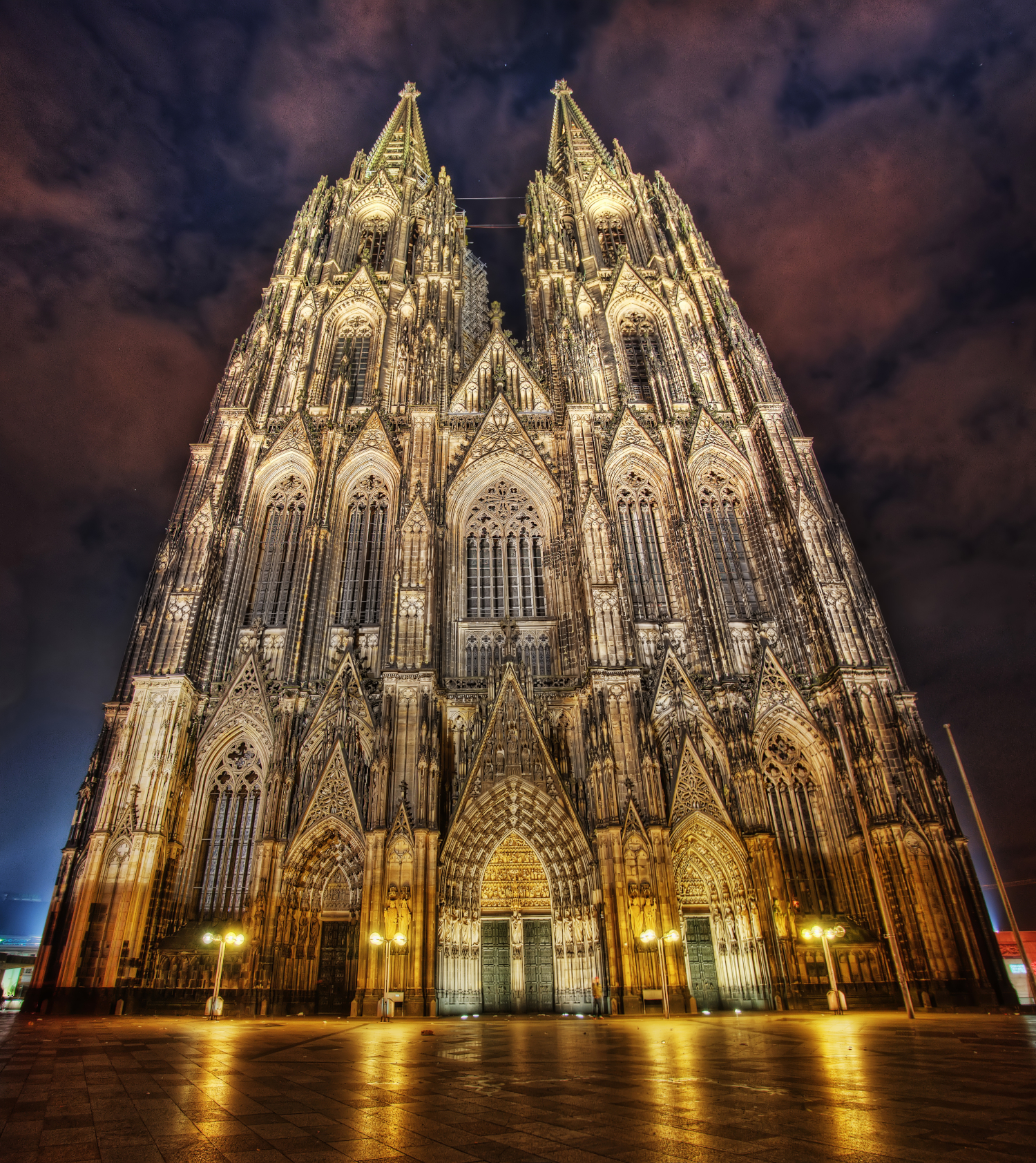
Cologne Cathedral at night
I came upon it stretched against the starlight,
a black lace
of stone. What need to enter and kneel down?
It said my prayers for me,

lifted in a sculptured moment of imploring
God in granite,
rock knees rooted in depths where all men
ferment their dreams in secret. 

Teach marble prayers to us who know no longer
what to pray,
like the dumb worship’s lovely gesture carven 
from midnight’s sweated dews.

This poem was originally published in Onions and Roses (Middletown, CT: Wesleyan University Press, 1968) and is compiled in If I Had Wheels or Love: Collected Poems of Vassar Miller (Dallas: Southern Methodist University Press, 1991). Used by permission of Wesleyan University Press.

Vassar Miller (1924–1998) was a poet and creative writing instructor from Houston who lived with cerebral palsy. Over a literary career that spanned almost forty years, she published ten volumes of poetry, of which Wage War on Silence (1960) was nominated for a Pulitzer Prize, and she was twice named poet laureate of Texas. Her poems explore religious faith, social isolation, and physical disability. When asked to describe the meaning of her life, she said, “To write. And to serve God.”

Roundup: Ambai praise medley, ArtStories, Visually Sacred, and more

Each item in a roundup represents hours of combing through and evaluating other possibilities to feature, to find that one I deem will be of most value to readers of Art & Theology. None of these spots are ever bought or coerced, but rather represent sincere recommendations on my part. If you appreciate the resources I curate, would you consider making a donation to make this continued work possible? Or buying me a book from my Amazon wish list (to support my research)? Regardless, I really appreciate you being here!

+++

SONGS:

>> Ambai Praise Medley: This summer Palmer Keen, an American ethnomusicologist based in Yogyakarta who runs the online repository Aural Archipelago, visited the Christian village of Kawipi in the Ambai Islands of Papua, Indonesia, to learn more about songgeri, a worship music tradition indigenous to that area. When he arrived, the villagers formed a welcome party to greet him at the church steps with much music making! That is what this clip is from:

Palmer writes,

Songgeri is a gospel string band tradition from the Ambai archipelago of Papua. The Ambai people, fervent Pentecostals since mass conversion in the mid-20th century, have taken the string band format popular across Melanesia . . . and embraced it as a vehicle for a unique gospel sound unlike anything else in Indonesia.

The name songgeri itself means “joy” in the Ambai language, and every bit of the music is designed to channel a particularly Pentecostal religious ecstasy: handmade lutes (four-string “ukulele” and five string “gitar”) stick to just three easy chords, while giant double bass-like stembas are turned towards the players and plucked with both hands and hand-carved wooden picks to get a thunderous sound. Musicians play a non-stop medley of “praise and worship” verses sung in Ambai and Indonesian—in one piece, “Nemunu Doana Kamia Wowong,” for example, they sing: “His house is built on coral / The gates of heaven are open / He awaits us!”

For more on the history, form, and instruments of songgeri, including additional videos, see Palmer’s recent blog post. (Shout-out to Sam Connour for alerting me to this fantastic music!)

>> “Campfire Coritos,” performed by Israel and New Breed: This corito [previously] medley features the songs “Con mis manos y mi vida” (With My Hands and My Life), “Alabaré” (Oh, Come and Sing), “Te alabarán oh Jehová” (They Will Praise You, O Jehovah), “Quién como tú” (Who Is Like You?), “Hay poder” (There Is Power), and “Ven, ven, ven, Espíritu Divino” (Come, Come, Come, Holy Spirit). The first female soloist is Israel Houghton’s wife, Adrienne Bailon-Houghton, and the second female soloist (with dark hair) is Adrienne’s sister, Claudette Bailon.

And here’s another corito medley sung by the same group:

+++

ART: 44 Plates from a Christian illuminated album, Ethiopia: When I was at the Minneapolis Institute of Art a few years ago, I saw on display three paintings on vellum from seventeenth-century Ethiopia, in the First Gondarene style, featuring Ethiopian saints and Bible stories. They are from a set of forty-four pages that were at one time sewn together and used as a prayerbook. The inscriptions are in Ge‘ez, an ancient language that originated in northern Ethiopia and is now only used in religious ceremonies.

Ethiopian album
Ethiopian saints and scenes from the Hebrew scriptures and the Christian Bible, from a disbound album, Ethiopia, late 17th century. Collection of the Minneapolis Institute of Art, Minneapolis, Minnesota.

Learn more about this illuminated album through ArtStories, an interactive multimedia feature on MIA’s website that allows for in-depth exploration of select objects from the museum’s collection. On the “More” tab is a video on “Connecting with World Religions,” a photo of each individual page with accompanying descriptions, and a behind-the-scenes video with Ethiopian manuscript cataloger Getatchew Haile.

I encourage you to further peruse ArtStories, which spotlights art objects from around the world in all sorts of media, including an ancient Egyptian instrument, an Islamic prayer mat, a Somali wedding basket, an Osage friendship blanket, a snake jug that pokes fun of the Confederacy, a brass leopard-shaped water pitcher from Nigeria, a pair of folding screens from Japan, an illusionistic marble sculpture, El Greco’s Expulsion of the Money-Changers, Rembrandt’s Lucretia, one of Monet’s grain stacks, and more. The interface directs you to specific details of the work and teaches about content, context, technique, and influences.

+++

PODCAST EPISODES: The first season of the podcast Visually Sacred: Conversations on the Power of Images, hosted by Arthur Aghajanian, wrapped this summer, altogether featuring conversations with thirteen luminaries in the field of religion and the arts. These were two of my favorite episodes:

>> “William Dyrness: Protestant Aesthetics, Modernism, and Theopoetics”: Theologian William Dyrness from Fuller Theological Seminary discusses the importance of art to spirituality, and the history and theology of images in Protestantism versus Catholicism. He also shares how Christianity influenced many canonical modern artists, and introduces theopoetics, a Christian movement that seeks to broaden our understanding of orthodoxy by bridging art forms and connecting art to daily life.

>> “Natalie Carnes: Iconoclasm, Beauty, and Aesthetics”: Theologian Natalie Carnes [previously], a professor at Baylor University, discusses iconoclasm, particularly the controversy around public monuments; the ambivalence of images as mediators of the Divine (giving us access and blocking access); suffering and beauty; feminist theology; and Christian asceticism as a form of abundance.

“Her Stations of the Cross” by Marjorie Maddox (poem)

Kazanivska, Solomia_Mother of God
Solomia Kazanivska (Соломія Казанівська) (Ukrainian, 1996–), Mother of God, 2019. Acrylic and soil on wood, 60 × 40 cm.

I.
Here mothers move more than others
into Mary’s mourning, each chorus
a soul full of crosses, weighted
with her child dying
continuously in the contemplation 
of our contrition.

II. 
That once-upon-a-time angel’s voice
stretching anew her middle-aged womb,
she who once sang Magnify, O Magnify,
when all she screams for now
is mercy in her urgent rebirth
of sorrow.

III.
When he stumbles,
she cannot fix his fall,
cannot cradle the boyhood
scrapes and bruises bleeding
into crowd-sanctioned murder.
No cock crows; she hears his groans
as if the world’s bones
are splintering within her.

IV.
Besides the tree, he carries
the tears of the one who carried him
beneath her Eve ribs, lifted him
into a world he breathed as good,
gone now into this God-crucified-
as-her-son catastrophe
for salvation’s sake.

V. 
Simon of Cyrene stands close.
Understanding too well the two sorrows—
mother and son helpless to comfort the other—
he heaves up and shoulders
the burdens of both,
his back the black tablet
of Moses’ commandments fulfilled
to the jot and tittle.

VI. 
Veronica—eyes swollen
for the Madonna and Child
wrenched from their rightful honor—
lifts her veil to cool the Savior’s pain,
alleviate, however slightly, a mother’s anguish.

VII.
Thorns gouge the brow she stroked. 
The sweat-caked man that came out of her 
stumbles again. Already,
the sharp nails gnaw her own palms.

VIII.
Oh, daughters of Jerusalem,
your tears sweep the streets,
wet the weary soles of Mary.
Weep for your own children
forever dashing away from Yahweh.

IX.
Wretched stones that tip her sinless child,
dirt that drives down the innocent son.
His own earth hurts him more each tumble.
Three times he trips,
crashes to the dust we are,
mortal muscles turning their backs
on Man and his Mother.

X. 
Threads twisted by her own fingers,
tugged carefully through cloth:
this is the tunic they rip from him,
fabric tattooed with red;
she remembers his baby body
blood-splattered and matted.

XI. 
Her soul stabbed by the tree
that slays her son. Her heart nailed.
She swears his life spurts
from her barely breathing body.

XII.
Death is indigo and indelible, 
the Roman sky collapsed and re-scribbled
on the shreds of her memories.
She cannot bear to look upon his face
when breath forgets its maker.

XIII.
Ten thousand stillborns better
than this: his torso in her arms, 
icon of the inconsolable,
the flesh Pietà with its nails of pain, 
pounding, pounding. 

XIV.
The hewn tomb seals her grief.
She remembers his first words,
his final prayer. All else rots
within her. They swaddle him,
implant him quickly behind stone.

This poem is from Weeknights at the Cathedral (Cincinnati: WordTech Communications, 2006) and is anthologized in slightly revised form, as here, in Poems of Devotion: An Anthology of Recent Poets, ed. Luke Hankins (Eugene, OR: Wipf & Stock, 2012). Used by permission of the author.

Note: The Stations of the Cross are a form of Catholic devotion organized around the events of Christ’s passion, from his condemnation by Pilate to his crucifixion and burial.

Marjorie Maddox (born 1959) is the author of fourteen poetry collections, including Begin with a Question (Paraclete, 2022); Transplant, Transport, Transubstantiation from the Poiema Poetry Series (Wipf & Stock, 2018); and True, False, None of the Above (Wipf & Stock, 2016). She has also published a short story collection, four children’s and YA books, and 650-plus stories, essays, and poems in journals and anthologies. Living in Central Pennsylvania, she is a professor of English and creative writing at Lock Haven University and is the assistant editor of Presence: A Journal of Catholic Poetry.

Roundup: Yom Kippur tune, DITA concert, Lilias Trotter, and more

SPOTIFY PLAYLIST: September 2023 (Art & Theology): Another monthly gathering of good, true, and beautiful music of a spiritual bent from a variety of sources, ranging from a Victorian lullaby to a hymn revamp by Ike and Tina Turner to a traditional Yom Kippur melodic motif reimagined to a bluesy saxophone prayer to an old-time song about Noah from the southern US to a Christian praise song sung by a Miskito church community in their native tongue. Two selections from the playlist are below.

>> “Abodah” by Ernest Bloch, performed by Sheku Kanneh-Mason: Ernest Bloch was a Swiss-born American composer who drew heavily on his Jewish heritage in his work. Abodah (עֲבוֹדָה) (more commonly transliterated avodah) is Hebrew for “service,” “work,” or “worship,” a word often used in relation to the ritual service that used to be performed by the Jewish high priest in Jerusalem each year on Yom Kippur (the Day of Atonement), before the temple was destroyed; described in Leviticus 16, it involved confession of sin and animal sacrifices.

“May the offering of our lips be accepted as a replacement for the sacrifice of bulls,” the rabbis now say—and thus present-day Yom Kippur liturgies feature poetic recitations from Leviticus 16 and related Mishnah texts, “an expression of the Jewish people’s yearning both for spiritual liberation and redemption,” writes Neil W. Levin. More conservative congregations will vocalize prayers for a rebuilding of the temple and the restoration of sacrificial worship. But for an example of a seder avodah from the Reform tradition, see here. Yom Kippur is celebrated on September 24–25 this year.

Bloch’s Abodah composition is based on a tune, part of a canon of tunes known as the missinai (lit. “from Sinai”), that originated in the Ashkenazi communities of medieval Germany and that is still used today in Ashkenazi synagogues on Yom Kippur. Bloch composed the piece for piano and violin, but it’s arranged here for solo cello and performed by the internationally acclaimed Sheku Kanneh-Mason [previously].

For Christians, the atonement rituals from Leviticus find their fulfillment in the once-for-all self-sacrifice of Jesus, and though this solemn tune has its roots in the Jewish faith tradition, its meditation on human sin and divine forgiveness can cross religious boundaries.  

>> “I’ll Fly Away” (Yo volaré) from We the Animals: This spare, a cappella performance of a 1929 southern gospel song by Albert E. Brumley plays during the opening credits of the film We the Animals (2018), sung by Josiah Gabriel, one of the three main child actors. I’m interested in how and why religious songs are employed in nonreligious films, and this one was really effective in establishing not only the tone of the movie but also its theme of freedom.

Based on a semiautobiographical novel of the same name by Justin Torres, We the Animals follows three Puerto Rican brothers ages seven and up navigating a volatile family life in rural upstate New York. There’s violence and tenderness, depression and joy, and I appreciate its exploration of complicated masculinity, and how nuanced the character of the father is. (Torres has said that the process of writing the book was partly about finding empathy for his father who was abusive, and that the story is really about love and grace in a family.) In the film, flying is used as a visual metaphor for the youngest son’s, the narrator’s, rising above captivity (mainly psychological) and coming to a place of existential flourishing. The film is excellent, as is the book, though beware the R rating. Streaming on Netflix and Hulu.

+++

UPCOMING CONCERT: “Beyond Measure: An Evening of Music in Celebration of Abundantly More,” dir. Jeremy Begbie, September 8, 2023, Duke Divinity School, Durham, NC: To celebrate the release of Dr. Jeremy Begbie’s book Abundantly More: The Theological Promise of the Arts in a Reductionist World, Duke Initiatives in Theology and the Arts is presenting a special concert with the New Caritas Orchestra, conducted by Begbie. It will take place next Friday at 7:30 p.m. at Goodson Chapel on the campus of Duke Divinity School, and no tickets or registration are required. The program will explore the power of music—along with words and images—to expand our theological imagination, and it will be followed by a reception and book signing.

I suspect it will be similar in format to Begbie’s “Home, Away, and Home Again: The Rhythm of the Gospel in Music” event, which I attended in 2017 and was wonderful. (View the video recording below.) In his lecture-concerts, Begbie interweaves composer biography, musical analysis, theological commentary, storytelling, and performance to help audiences truly hear and appreciate the music. In “Home, Away, and Home Again,” he discusses the technical term “tonic” (the note upon which all other notes of a piece of music are hierarchically referenced, the one that gives the piece its sense of stability), demonstrating with various examples how 90 percent of Western music starts at home, goes places, then arrives back home but changed. Along the way he discusses themes of war, despotism, (up)rootedness, loss, hope, the resurrection, and new creation. Featured composers include Béla Bartók, Antonín Dvořák, Aaron Copland, Ennio Morricone, Leonard Cohen, and Benny Goodman.

+++

UPCOMING CONFERENCE: “Poets of Presence: Faith, Form, and Forging Community,” October 27–28, 2023, Loyola University, Chicago: Sponsored by Presence: A Journal of Catholic Poetry and The Francis and Ann Curran Center for American Catholic Studies at Fordham University, this poetry conference will feature the keynotes “The Art of Faith and the Faith of Art” by Christian Wiman and “The Forge and the Fire: God in the Blacksmith Shop” by Angela Alaimo O’Donnell. There will be workshops on writing formal poetry, translating poetry, and an editor’s secrets for successful submissions, among others, and poetry readings. I was excited to see Paul J. Pastor [previously] on the list of presenters! Cost: $60.

+++

DOCUMENTARY: Many Beautiful Things: The Life and Vision of Lilias Trotter, dir. Laura Waters Hinson (2015): Available for free on YouTube, this seventy-minute documentary shines a light on Lilias Trotter (1853–1928), an English painter and protégé of the leading Victorian tastemaker John Ruskin who, instead of pursuing an art career as Ruskin had urged her to do, became a Christian missionary in Algiers for forty years—as a single woman, self-funded (all the missions agencies rejected her because she had a heart condition that made her physically vulnerable). Her ministry centered on the women in the kasbah—teaching them to read, helping them attain economic independence. She also befriended a Sufi brotherhood whose members were eager to hear her talk about God. In Many Beautiful Things, Michelle Dockery of Downton Abbey voices words from Trotter’s books, journals, and correspondence, and art director Austin Daniel Blasingame has deliciously animated her art! (See behind the scenes of that process.) Sleeping at Last supplied the original soundtrack.

While in North Africa, Trotter continued making sketches and watercolors, documenting the everyday life that surrounded her—people, bees, flowers, sunsets. These are minor works/studies, not intended for the art market, but they were for Trotter a major way of delighting in God’s creation. I don’t like how the marketing of the film leans heavily into the narrative of “Oh, look at Lilias, so selfless and heroic, sacrificing artistic fame for service, she really could have been tops if she hadn’t given it up,” as it wrongly suggests that evangelistic or nonprofit work is more God-honoring than art making, or that recognition in one’s field is not something a Christian should desire. The film itself mostly avoids that way of looking at it, focusing instead on Trotter’s faithfulness in responding to a call that was particular to her and then finding ways to integrate art, as an avocation, into her new life in Algiers. “Her art . . . wasn’t lost in Algeria. If anything, it was fed,” says biographer Miriam Rockness. As viewers, we’re asked to reexamine our conception of success.

Trotter, Lilias_Desultory bee
Watercolor by Lilias Trotter, July 9, 1907

I had never heard of Lilias Trotter before watching this documentary (thanks for the recommendation, Sarah!), but now I’m glad to know about her. Learn more at https://liliastrotter.com/, and follow the Lilias Trotter Legacy on Instagram, Facebook, and/or Twitter. Also, the current issue of Christian History magazine (no. 148) is devoted entirely to Trotter; you can download a free copy (or purchase a physical one) here.

“We Alone” by Alice Walker (poem)

Cairn by James Brunt
Cairn by James Brunt, Filey Beach, East Yorkshire, England, 2018

We alone can devalue gold 
by not caring
if it falls or rises 
in the marketplace.
Wherever there is gold
there is a chain, you know,
and if your chain
is gold
so much the worse
for you.

Feathers, shells 
and sea-shaped stones 
are all as rare.

This could be our revolution: 
to love what is plentiful 
as much as 
what is scarce.

This poem was originally published in Horses Make a Landscape Look More Beautiful (Harcourt Brace & Company, 1984) and is compiled in Her Blue Body Everything We Know: Earthling Poems 1965–1990, Complete (Harcourt Brace Jovanovich, 1991).

Alice Walker is an American novelist, short story writer, poet, and social activist. Born in 1944 in Eatonton, Georgia, the eighth and last child of sharecroppers, in 1982 she became the first African American woman to win the Pulitzer Prize for Fiction, which she was awarded for her novel The Color Purple. Over the span of her career, Walker has published numerous best-selling works of fiction, poetry collections, essays, and children’s books. She lives in Mendocino, California.


At first glance this poem may seem naive or flippant about economic realities. In the world we’ve created, money is a necessity. My country, the United States, has suffered two recessions in recent memory: in 2007–9, when the subprime mortgage crisis led to the collapse of the US housing bubble, and during the first two months of the COVID-19 pandemic in March and April 2020, when more than twenty-four million Americans lost their jobs. Lack of money can have disastrous effects.

But “We Alone” is not denigrating those who stress about not having a paycheck or not being able to afford basic provisions. Rather, it is critiquing a system that creates those conditions, a system in which money has been elevated to godlike status, and wealth is consolidated in the banking and corporate institutions headquartered on Wall Street, which engage in predatory activities that harm and debase. Capitalism is built on self-interest, profit, and acquisitiveness, and therefore it can easily breed greed, a voraciousness for more and more, which often comes at the expense of others.

Alice Walker has said elsewhere that “capitalism is a big problem, because with capitalism you’re just going to keep buying and selling things until there’s nothing else to buy and sell, which means gobbling up the planet.”[1] In her essay “All Praises to the Pause,” she writes,

Capitalism . . . cannot possibly sustain itself without gobbling up the world. That is what we see all around us. Women and children in Bangladesh, India, the Philippines, Haiti, Mexico, China and elsewhere in the world forced into starvation and slavery as they turn out the tennis balls and cheap sneakers for the affluent. Ancient trees leveled to make more housing while housing that could be saved and reused is torn down and communities heartlessly displaced. Mining of the earth for every saleable substance she has. Fouling of the waters that is her blood. Murdering innocents, whether people, animals or plants, in pursuit of oil.[2]

(Related reading: report from “Can Capitalism Be Ethical?,” a lecture by Dr. Rowan Williams, former archbishop of Canterbury, Murray Edwards College Cambridge, November 2, 2016)

My purpose here is not to argue for or against specific economic systems, nor is that the point of this poem. What Walker challenges in “We Alone” is the pervasive notion that people and things are worth only what the market says they are. Have you, too, bought in to that lie? Do you fail to value the things that are free and plentiful in life, like shells on the beach, or birdsong, or a refreshing rain? Ordinary gifts like that operate outside the laws of supply and demand and suggest the beautiful abundance of God’s economy.

On a few occasions the Bible uses the term “mammon” to refer to riches and their pernicious influence. Jesus preached against mammon in his Sermon on the Mount, famously warning the crowds, “You cannot serve both God and mammon” (Matt. 6:24). The church fathers personified mammon as an evil master who enslaves, and medieval Christian writers named it a demon. Walker, too, acknowledges how wealth can hold us captive, the word “chain” in her poem pulling double duty, referencing on the one hand a metal-link ornament holding a jewel or a watch, and on the other hand a shackle.

To not care about filling our coffers is a countercultural stance. To not be constantly checking the rise and fall of stock prices, or obsessing about our investment portfolio.

Those who overvalue material assets will miss out on the more satisfying riches that abound in the natural world, which don’t have to be worked for or taken from others to be enjoyed.


NOTES

1. Alice Walker, quoted in Fernanda Sayão, “Capitalism” (Rio de Janeiro: Animal Farm Research, 2012), 14.

2. Alice Walker, “All Praises to the Pause; The Universal Moment of Reflection,” commencement address, California Institute of Integral Studies, San Francisco, May 19, 2002, in We Are the Ones We Have Been Waiting For: Inner Light in a Time of Darkness (New York: The New Press, 2006), 77–78.

Roundup: Sermons by Nadia Bolz-Weber, Jewish graffiti, four-word poem by Giuseppe Ungaretti, and more

SERMONS by Rev. Nadia Bolz-Weber: Nadia Bolz-Weber [previously] is an ordained Lutheran pastor who founded the House for All Sinners and Saints in Denver and now guest-preaches around the city. Here are two of her sermons from the past year or so that I’ve come across and appreciate, just twelve minutes each.

>> “Sinking,” Montview Boulevard Presbyterian Church, Denver, August 13, 2023: Preaching on Matthew 14:22–33, Bolz-Weber critiques the idea that our ability to do great things relies on the quality of our faith instead of on the power of God: “I’ve often heard this walking-on-water story from Matthew preached as like The Little Disciple Who Almost Could. Like Peter could have kept walking on water if he just thought ‘I think I can, I think I can’ enough. The message being that with enough faith, you too can walk on water all the way to Jesus. Which, on the surface, sounds inspiring. But taken to its logical conclusion, it also means that if you are not God-like in your ability to overcome all your fears and failings as a human, if you are not God-like in your ability to defy the forces of nature, then the problem isn’t the limits of human potential, the problem is the limits of your faith, and you should probably muster up some more . . .” [Read the transcript]

>> “The Lord Is My Shepherd, (but) I Shall Not Want (a Shepherd, Thank You Very Much),” Saint John’s Cathedral, Denver, May 8, 2022: No matter how much we fancy ourselves “anti-shepherdarian,” wanting to make our own choices and go our own way, we are all shepherded by someone or something, says Bolz-Weber in this sermon on Psalm 23. Perhaps it’s by the “wellness” industry, or by the angriest voices on Twitter. And the thing is, “not one single shepherd-shaped wolf that I have followed has ever actually fulfilled my wants and desires,” she confesses; “they have only ever increased them. They have only ever led me to waters with a high salt content, only ever led me to waters that create thirst and never ever quench it. They leave me feeling insecure and insufficient.” She contrasts the shepherds of this world to the one true Good Shepherd. The preaching starts at 23:20. [Read the transcript]

+++

BOOK REVIEW: The Beauty of the Hebrew Letter: From Sacred Scrolls to Graffiti by Izzy Pludwinski, reviewed by Sarah Rose Sharp: In this new book from Brandeis University Press, certified Jewish scribe and calligrapher Izzy Pludwinski looks at the evolution of Hebrew calligraphy from sacred scrolls through modern art and graffiti. “Font enthusiasts, lovers of Judaica, and those passionate about the minutiae and range of the written form” will find much to appreciate here, writes Sarah Rose Sharp, whose review includes a handful of images from the book. For example, below is a mural painted by Hillel Smith on the alley-side exterior of a kosher bakery in the Pico-Robertson neighborhood of Los Angeles, which reads in bright yellow letters, “בָּרוּך אַתָּה אַדָנָי אֱלהֵינוּ מֶלֶך הָעוֹלָם הָמוֹציא לֶחם מן הַארץ” (Hamotzi lechem min ha-aretz) (Who brings forth bread from the earth), part of the traditional Hebrew blessing over bread before a meal: “Blessed are You, Lord our God, King of the Universe, Who brings forth bread from the earth.” [purchase on Amazon]

Smith, Hillel_Hamotzi Mural
Hillel Smith (American, 1984–), Hamotzi Mural, Bibi’s Bakery and Café, Los Angeles, 2016. Photo courtesy of the artist.

+++

SONGS:

>> “Be Alright” by God’s Children: Having amassed over four million collective views, this video was posted August 1 by Shirika “ReRe” Flowers across multiple social media platforms, showing four of her six kids singing a gospel song she wrote for them, “Be Alright,” at her home in Memphis. It’s led by Demeriauna “Sugar Mama” Harper, with the other three parts sung by Thedrick “Preacher” Webb (in orange Crocs), Dedric “Chunky” Trice (seated at left), and Cornbread.

The family performs and records together under the name God’s Children, and this song can be heard on their 2018 album It’s So Amazing.

>> “Aakhaima Rakhchhu Mero Yeshu” (आँखैमा राख्छु मेरो येशू) (Keep My Eyes on Jesus): In this 2016 video, a group of teens from New Life Church in Nepal sing a popular Nepali Christian worship song. I haven’t been able to find who the songwriter is, but from a search on YouTube, I can see that it’s a very popular song to dance to in Nepal! There are dozens of videos, mainly of children or youth, dancing to it with hand motions and a bounce, often in church.

From what I can tell through Google Translate, the lyrics translate roughly to “I keep my eyes on Jesus. I keep him in my heart. He shadows me with his love.”

+++

POEMS:

>> “Mattina” (Morning) by Giuseppe Ungaretti: This week reading the book Poetry and Revelation: For a Phenomenology of Religious Poetry by Kevin Hart, I came across this beautiful four-word poem in Italian from 1917 that stopped me in my tracks: “M’illumino / d’immenso.” (Those euphonic m’s!) Hart didn’t translate it, and though I could recognize the two keywords (they’re English cognates), I wasn’t sure of the words connecting them or the verb tense. In googling the poem, I was sent to the blog Parallel Texts: Words Reflected, run by Canadian literary translator Matilda Colarossi, who lives in Florence. It’s fascinating to hear her describe the complicated process of translating these two spare lines. Click on the link to read her translation and to learn what considerations informed her.

Part of the poem’s brilliance is its openness to various readings. For me, it’s about being known warmly and intimately by an immensity I call God.

>> “What He Did in Solitary” by Amit Majmudar: A second book I read this week was the poetry collection What He Did in Solitary by Amit Majmudar, Ohio’s first poet laureate. The titular poem, the first in a suite of three that conclude the book, made me cry. You can read all three on the website of Shenandoah journal, where they were originally published in 2019.

Other favorites: “Altarpiece,” “Ode to a Jellyfish,” “Elegy with van Gogh’s Ear.”

Book Review: Redeeming Vision: A Christian Guide to Looking at and Learning from Art by Elissa Yukiko Weichbrodt

Let’s say you’re visiting London. You buy a ticket to the Tate Modern, because hey, the tourist guides call it a must-see. You enter the enormous Turbine Hall and witness, across the five-hundred-foot downward concrete ramp that is the floor, a giant crack. No, it’s not a foundation problem. It’s a contemporary art installation by Doris Salcedo.* What in the world does this artwork have to offer? How do you engage meaningfully with it?

Dr. Elissa Yukiko Weichbrodt’s book Redeeming Vision: A Christian Guide to Looking at and Learning from Art (Baker Academic, 2023) equips Christians to look closely and well—with a posture of humility and generosity—at works from across the spectrum of art history, including ones like Salcedo’s Shibboleth that may initially evoke only puzzlement or an eye roll, and others that may at first glance seem run-of-the-mill and uninteresting (a marble head, a vase of flowers, an old family photograph). When we close ourselves off to art that doesn’t immediately touch us, we reject potential opportunities for transformation, transformation of how we see and how we love. Regardless of the personal faith commitments of its makers, Weichbrodt says, art can grow our love for both God and neighbor.

In order to love, we must first look. Weichbrodt gives examples of God’s looking in scripture to establish a “model of redemptive looking,” which “is utterly different from the objectifying gaze that is so common in our contemporary culture. Too often we look to consume, to surveil, to control, and to condemn. But as the beloved of God, we are called to mimic his gaze” (19). What if instead of letting personal judgments, stylistic, moral, or otherwise, dominate our approach to art, we were to adopt a primary posture of love?

When it comes to viewing art and visual culture, our faith doesn’t offer us a fence. It provides a path.

Elissa Yukiko Weichbrodt, Redeeming Vision, p. 10

Weichbrodt wants to move us beyond a facile thumbs-up or thumbs-down approach to looking at art, encouraging us to press in to unfamiliar (and too-familiar!) or even off-putting works with curiosity and openness, asking questions of them and allowing them to interrogate us as well. What stories, and whose stories, do the images tell and not tell?

She introduces the notion of “the archive,” the mental collection of images we have seen, which we subconsciously file into categories and access to help us interpret new images. Some examples of categories are “Mother,” “Poor,” “Black,” “Beautiful,” “Villain.” The problem is, our archives are inherently limited. For example,

Why do we have so many mental images of mothers in Africa living in poverty and so few mental images of successful, smiling African women who are business owners and community leaders? Why do we have so many images in our archive of good white mothers and so few of loving, strong, generous Latina mothers? A richly textured, robust, and varied archive is necessary if we are going to learn to see others—of all races, ethnicities, genders, and social classes—as God sees them. (62)

Expand your archive, Weichbrodt urges.

She demonstrates how archives work through a brilliant engagement with Dorothea Lange’s Migrant Mother (1936), an iconic photograph that I remember studying in a high school American history class but which Weichbrodt really opened up for me.

Weichbrodt is an associate professor of art and art history at Covenant College in Lookout Mountain, Georgia. Besides an intro-level Western art survey course, she also teaches courses such as “Race in American Art and Visual Culture,” “Women, Art, and Culture,” “Art and the Church,” “Grace in American Art,” “History and Theory of Photography,” “Global Modernisms,” and “Contemporary Art and Theory.” The facility with which she’s able to guide nonspecialists deeper into her subject is amply evidenced in this book, which is low-shelf academic, geared toward educated readers who may or may not have an art background.

Blue Room (Suzanne Valadon)
In chapter 9 of Redeeming Vision, on the mundane, Weichbrodt discusses how Suzanne Valadon’s Blue Room (1923) complicates a familiar art historical trope.

The most illuminating analyses in Redeeming Vision have to do with race, gender, and/or class; those are the topics where Weichbrodt’s primary research interests lie, and it’s where she really shines. She complexifies images that we might be inclined to take at face value, not think much about.

A highlight of the book is how Weichbrodt joins together fine art and contemporary visual culture more broadly, drawing Instagram selfies, memes, advertisements, news photos, propaganda posters, and such into conversation with paintings, sculptures, and other artworks that you’re likely to find in a museum. The tools she provides for performing visual analysis—chapter 1 unpacks that toolbox, giving us language (and a handy chart!) for describing an image’s visual qualities—can be applied just as well to a friend’s iPhone photo as to a multimillion-dollar oil painting that’s been the subject of multiple monographs.  

As would any art historian, Weichbrodt emphasizes the importance of understanding artworks within their historical contexts; “even if we can’t find all the answers, we should remember to ask questions about the image or object’s original audience and purpose” (62). But where she differs from some academics in the field is that she also acknowledges that our backgrounds—who we are, what we aspire to be, what experiences we carry with us, our cultural conditioning—are not irrelevant to the process of looking at art. She invites us to take stock of associations that come up for us in response to certain images, not to make them an authoritative lens but to prompt queries that bring us closer to truth. We need to recognize the limitations of how we see, but we need not get ourselves entirely out of the way when it comes to art, as if pure objectivity were even possible.

In Weichbrodt’s discussion of specific artworks, I appreciate the balance of attention between the work’s formal qualities, content, historical situatedness, and meaning. She also reminds us to consider a work’s physical context. In chapter 3, for example, she uses Caravaggio’s Deposition to discuss the differences between experiencing an artwork in situ (that is, in the place for which it was created; in this case, a chapel), in a museum, and online—and what questions to ask in each situation.

Caravaggio chapter opener

Chapters 4–10 each conclude with a “For Further Looking” page that lists artworks related to the theme of the chapter and offers guided questions. For example, in chapter 9, “Allowing for Complexity: Art of the Everyday,” the “For Further Looking” section includes the headings “Nineteenth-Century American Genre Painting” (How do these works reinforce certain gender roles or racial hierarchies?), “Genre Works by Black American Artists” (How do these works celebrate the normalcy of Black life and achievement?), and “The History of the Female Nude in Western Art” (How have artists borrowed, developed, and critiqued this trope?). I found these end-of-chapter sidebars to be incredibly helpful, quenching my desire for wider exploration and deeper reflection.

Some of the topics Weichbrodt covers in the book include:

God’s Transcendence. In chapter 5 she contrasts a medieval church mosaic, with its golden resplendence, placed above the head to an abstract expressionist painting by Kandinsky, an explosion of color and movement and indefinable forms—two very different ways, and over a millennium apart, to convey the same idea.

Portraiture. In chapter 7 she addresses the possibilities and pitfalls of the portrait genre. From a Spanish count-duke to a Kuba nyim (king) from Central Africa to the anguished Vincent van Gogh to a mourning Missouri father with his two daughters and nurse, Weichbrodt discusses the physical self, the symbolic self, the public self, the private self, and the relational self. She also comments on how the portraits we see of others on social media shape our self-perception and self-representation.

Landscape. In chapter 8 she considers humanity’s relationship to nature by looking at two mountain views: a Chinese ink on silk from the Northern Song Dynasty, influenced by the principles of Confucianism, and a painting of the American West made during the era of westward expansion.

Weichbrodt encourages us to think critically about the stories we tell through images. Take, for example, this before-and-after photograph of Hastiin To’Haali, a resident of the federally funded Carlisle Indian Industrial School (1879–1918) in Carlisle, Pennsylvania, which gutted me:

Choate, John_Tom Torlino
John Choate, “Tom Torlino—Navajo. As he entered the school in 1882. As he appeared three years later,” in Souvenir of the Carlisle Indian School (Carlisle, PA: J. N. Choate, 1902)

Founder Richard Henry Pratt hired the commercial photographer John Choate to document the residential school’s so-called success in “kill[ing] the Indian, . . . sav[ing] the man,” as Pratt put it, and these are two of the hundreds of photos he took of the students. What do we do when images lie?

One of my favorite chapters in the book is chapter 10, “Learning to Lament: The Art of History.” Here Weichbrodt discusses an ancient Assyrian stone relief carving of a soldier conducting captives across a river, a widely distributed revolutionary-era engraving of the Boston Massacre by Paul Revere, and From Here I Saw What Happened and I Cried by Carrie Mae Weems (1995).

“History is not simply a documentation of the past,” Weichbrodt writes. “It is the story we tell about past events. What do we include? What gets left out? Who has our empathy? Who can be vilified?” (215). She continues:

What stories do we weave about who we are and who we are not? Does our telling of history—and the images we use to support it—ignore brokenness in favor of self-congratulation? What are the images and objects that direct us to lament? We lament not to wallow in despair or guilt or recriminations but because we have the freedom to weep as children of God. Ours can be a productive grief. (232–33)

Hospitable, expansive, and full of insight, Redeeming Vision helps Christians identify the ways in which images form us and teaches us how to skillfully analyze them. Art viewing, Weichbrodt writes, is not necessarily a passive activity; it requires something of us and can be generative. “Our gaze,” she says, “can open up something new” (11), leading to doxology, confession, empathy, understanding, lament, shared delight, or love.

Visit the book’s website at https://www.redeemingvision.com/. You can order a copy from Amazon or Baker Publishing Group, and sign up to participate in the guided chapter-by-chapter reading community that Weichbrodt is leading from August 28 to November 17, 2023. Follow her on Instagram @elissabrodt.

* This artwork is no longer on display; the crack was filled in in 2008.


Note: On November 11, 2023, the Eliot Society in Annapolis, Maryland, is hosting a lecture by Elissa Yukiko Weichbrodt titled “Rupture as Invitation: Generosity and Contemporary Art,” and I’ll be moderating the Q&A. I hope you can come out! Register here. (Update: Listen to the talk.)

Elissa Yukiko Weichbrodt

Roundup: Peter Howson retrospective, “Strange Stories of the Bible” with Pádraig Ó Tuama, and more

ART EXHIBITION: When the Apple Ripens: Peter Howson at 65, May 27–October 1, 2023, City Art Centre, Edinburgh: City Art Centre in Edinburgh is hosting a major retrospective of one of the UK’s leading figurative painters, Peter Howson, who first emerged during the mid-1980s as one of the New Glasgow Boys and whom the art critic Donald Kuspit dubbed the “Scottish Bosch.” Curated by David Patterson, the exhibition brings together some one hundred works spanning the artist’s career, many never seen before in Scotland, with subjects ranging from working-class Glasgow men to the Bosnian War (into which Howson was sent as official war artist) to biblical stories. His work deals with themes of aggression, struggle, and faith.

Artist and art educator Tessa Asquith-Lamb discusses five key works from the exhibition in this twenty-minute video:

Howson, Peter_Job
Peter Howson (Scottish, 1958–), Job, 2011. Oil on canvas, 182 × 152 cm. Collection of Alan and Karen Turner.

“I like to bring the Bible into this world we live in today,” says Howson, who is a Christian. (He made headlines when he went public with the story of his religious conversion while undergoing treatment for alcohol and drug abuse in 2001.) Reflecting on the reception of and motivation behind his biblical works, he said in a recent video interview (30:31ff.):

There’s two camps of people. There’s the people that groan whenever they see a religious painting of mine, and they say, “Why can’t he stay away from religion?” It’s that kind of embarrassment about religion. They don’t like my religious art, but I continue to do it. . . . And then there’s the other people that actually are religious, but they don’t like it because it’s too frightening for their gentle, staid, normal religiousness. They don’t want anything nasty happening in their lives or anything that’s going to cause a stir. So to them it’s a big danger as well, the stuff I do, because it’s violent, it’s real. It’s like the consuming fire of God.

The Bible is an incredible book. It’s a book that’s got everything in it, really. It’s got so much tragedy, violence, disaster, despair. It’s also got incredible revelation in it. It’s got incredible acts of love and kindness. . . .

All I know is that . . . the work I do on the Bible and on the teachings of Jesus, or on the events in Jesus’s life—which have in fact fascinated artists for centuries—I don’t know why it shouldn’t continue with me. For me to paint these things, it’s made a big difference to a lot of people’s lives. It helps people. It’s a therapy that takes them through a door into a different universe altogether. It takes them into a new world, a new discovery. They realize they are not a person that’s just flesh and blood, an animal. It means that there’s a spiritual side that they’ve missed out on. And that’s the most important thing they can ever understand or realize. And it’s salvation, really, for them, for people to go through that door. That’s the door I want to lead them through.

In conjunction with the exhibition, on June 23 the City Art Centre hosted a panel with writer and art critic Susan Mansfield and other experts on the subject of religious art today, including what place it has in an increasingly secular world. Unfortunately there appears to be no recording of the event offered online. But there are still other related events coming up; learn more here. And you still have about a month and a half to see the exhibition!

+++

ONLINE COURSE: “Strange Stories of the Bible,” taught by Pádraig Ó Tuama, October 8–November 5, 2023: Over the course of five Zoom-mediated classes, poet-theologian Pádraig Ó Tuama will lead a literary exploration of peculiar stories from the extraordinary library of world stories that is the Bible, focusing on the lives of five figures: Noah, Isaac, Ruth, Mary of Bethlehem, and Judas. Their stories are not so foreign as one might think, as they “depict very familiar aspects of human behaviour: jealousies, rivalries, rages, desires, ambitions, schemes, travels, courage, challenges, archetypes, addictions, misunderstandings and machinations.” Each class will involve a close reading of a scripture text, bringing to bear literary analysis, contemporary poetry, and art, and will leave participants with questions for self-reflection. Cost: $250 USD.

+++

POETRY-WRITING RETREAT: “Ideas Everywhere! Inspirations for Poetry,” led by Marjorie Maddox, September 22–24, 2023 (update: the date has been rescheduled to October 2729, 2023), Bethany Retreat Center, Frenchville, PA: “The everyday, the eternal, and everything in between—ideas for poems are everywhere! During this retreat, we’ll focus on generating poems from both the mundane and the miraculous, using—as time permits—the arts (paintings, photographs, movies, music), sacred texts and rituals, nature, news, place, sports, and the medical as springboards. By drafting, revising, and discussing poems in a supportive community, we’ll consider how one poetic choice leads to another, each contributing to the work’s overall effect. Arrive ready to engage, experiment, write, laugh. Leave with new ideas and strategies for future poems.” Cost: $275 (includes meals and lodging).

I have a poem by Marjorie Maddox queued up to publish here next month. I really appreciate her work!

+++

CALL FOR POETRY: Presence: A Journal of Catholic Poetry is accepting poetry submissions through October 1, 2023, for its eighth annual issue, to be published in April 2024. “We publish poems on the basis of their artistic excellence, rather than on the basis of the author’s professed creed or because the subject matter is explicitly Catholic. The poems in this journal convey God’s presence in any number of ways—by exploring the intersection of matter and spirit, by depicting the struggle between belief and doubt, by questioning the faith, being surprised by it, taking joy in it, even finding humor in it.” Learn more at https://www.catholicpoetryjournal.com/poems.

Poets who have contributed to past issues include Marilyn Nelson, Julia Alvarez, Dana Gioia, Robert Cording, and Paul Mariani.

+++

PROGRAM: The Brehm Residency: The Brehm Center at Fuller Theological Seminary is looking for artists and Christian ministry leaders in the US to join their remote residency program for spring 2024. The cost to participate is $495. “How do artists experience the world? How do creative hearts respond to the story of God? We believe these questions matter. The mission of the Brehm Residency is to cultivate generative relationships between artists and ministry leaders who are mutually dedicated to the artistic renewal of our communities and their churches.” Registration deadline: October 31, 2023.

The program consists of (1) a curriculum of readings and resources that cover historical, theological, and psychological perspectives on the arts, and (2) ten biweekly, ninety-minute online gatherings from January through May 2024, which include guided discussions, fellowship, and periodic guest speakers. There is also an optional, seven-day in-person add-on.

+++

NEW WEBSITE + EVENTS + FUNDING CALL: The Leighton Ford Initiative in Theology, the Arts, and Gospel Witness at Gordon-Conwell Theological Seminary: Gordon-Conwell is a multidenominational, evangelical seminary based in Hamilton, Massachusetts, with other campuses in Boston; Charlotte, North Carolina; and Jacksonville, Florida. In 2022 under the direction of Dr. Wes Vander Lugt, the seminary launched the Leighton Ford Initiative in Theology, the Arts, and Gospel Witness, which “embraces and engages with God’s gift of artistry through impactful teaching, relevant scholarship, and catalytic events that form students, enrich the church, and propel participation in God’s mission to make all things new.” The initiative offers academic courses; pursues arts and theology research and publications; hosts symposia, gallery exhibitions, concerts, film screenings, conversations with writers and artists, and other events; and plans arts-integrated chapel services. I attended the excellent Georges Rouault symposium they organized last fall—which I publicized here. Here’s what’s upcoming on their calendar:

Once enough money is raised for an endowed chair, the initiative will become an official center within the Gordon-Conwell Institute and programming will expand. There are plans to offer a Certificate in Theology, the Arts, and Gospel Witness, host pilgrimages to sites of global arts influence, assist faculty in integrating the arts into their teaching, and host creative residencies.

“Mused Mary in Old Age” by George M. P. Baird (poem)

Widoff, Anders_Maria (The Return)
Anders Widoff (Swedish, 1953–), Maria (The Return), 2005. Polyester, silicone, fabric, glass, hair, and oils. Uppsala Cathedral, Sweden. Photo: Lieke Wijnia.

The lengthening shadows of the cedar trees
Have blended into twilight, and the sun
Has plunged in glorious gold precipitance
Beyond the dim crest of the western hills,
Bearing with it the day’s disquietudes;
And now the stars, that lamp the feet of God,
Are lighted, and night’s purple silences
Steal gently round me fraught with memories.

’Twas such an hour as this—long, long ago
Yet seeming yesterday—he came to me,
My little son, in joyous travail born
Out there across the hills in Bethlehem,
Where we who journeyed southward to be taxed—
Strangers in our own father’s land—had found
No shelter in the crowded khan, and shared,
Perforce, a grotto with the stabled kine.

Ah, how it all comes back again to me!
The courtyard, in the flickering torchlight, filled
With huddled trav’lers sleeping ’neath the sky,
The kneeling camels of a caravan,
The patient asses dozing by the wall,
A smell of roasting meat at little fires,
The shouts of melon-sellers, the low drone
Of reverend elders bending at their prayers,
Barking of street-dogs, porters’ blasphemies,
The laughter of a girl, the mellow flute
Of some rapt lover, and the tinkling tune
Of sheep-bells forward moving through the dark.
And then the hour supreme, wherein my soul
Clomb the dark pinnacles of pain, and death
Grappled with life through whirling aeoned years,
But fled at length and left the Miracle.

They laid him there beside me on the hay,
A wee pink being in his world’s first sleep;
My arm was round about him and his breath
Was warm with life on my exultant breast,
And they whose winged watch is set to keep
Ward in the valley lands of heaven looked down,
Not up, that night to find their paradise.
All weak with labor and soul’s happiness,
I lay beneath the sapphire tent of skies,
And in my heart I made a little prayer
Of thanks that flew up to the throne of God
On swift dove pinions of unuttered song;
And as I prayed, lo, upon loops of stars
Night’s velvet curtainings were lifted up,
A wondrous light turned all the world to rose,
And down the skies swept singing seraphim
In mighty echoes of my little prayer.

Oh, can it be that threescore years have marched
In troubled caravan across the waste
Of desert life since then, and can it be
That I, who sit here in mine eventide,
White with the snows of sorrow and of time,
Was once a bright tressed girl who heard the choirs
Of heaven rejoice that she had borne a son?
Why, I can feel that little heart beat still
Close to my own, the touch of little hands
Warm and caressing on this withered breast;
Still I can hear the first low wail that marked
His woe’s beginning and the tortured path
That he should tread in mighty gentleness,
With pain and anguish, ’til his love supreme
And terrible meekness, overcoming death,
Should lead him conqueror to sit with God,
Pleading for sinful men in paradise.

Today I stole into the synagogue
And heard a rabbi read the sacred scroll:
How that my lord, Isaiah, said of old,
Thy Maker is thy husband, he hath called thee
As a forsaken woman, spirit grieved;
God, for a little moment, hides his face
From thee, but with his loving kindness soon
And tender mercies shall he gather thee.
Then was I comforted, and peace displaced
The turmoil in my heart, and minded me
Of that great promise Gabriel bore from God
And the immeasurable fruitage of his word,
The life and death and glory of my son.

So in the shades of life and night I sit,
Under the sheltering arbor of the dark
That curves above, vined o’er with trellised stars,
Waiting my spirit bridegroom, and the sound
Of that loved voice—long silent save in dreams—
Calling across the vibrant firmament,
O Mary, Mother Mary, come to Me.

This poem is from ’Prentice Songs (Pittsburgh: Aldine Press, 1913) and is in the public domain.

Widoff, Anders_Maria (The Return)

George Mahaffey Patterson (M. P.) Baird (1887–1970) was a lifelong resident of Pittsburgh, Pennsylvania, who worked in theater and city government. He graduated from the University of Pittsburgh in 1909 and then taught in the Department of English as a professor of theater history and production. He formed the student group the Pitt Players, financing, writing, and directing several of their early plays. While on the faculty, he also locally published three collections of poetry: ’Prentice Songs (1913), Loaves for Hyacinths (1914), and Rune and Rann (1916). In 1917 Baird joined the US Army, serving as a lieutenant in the Sanitary Corps during World War I. Upon his return to civilian life he began a career in government service for the city of Pittsburgh, serving as executive secretary of the Art Commission and chief examiner and later president of the Civil Service Commission. He was senior research analyst for the Department of City Planning when he retired in 1961.

Prayer-poems by George MacDonald

George MacDonald (1824–1905) was a Scottish preacher, poet, essayist, and writer of both realist and fantasy fiction. He was a great influence on J. R. R. Tolkien and C. S. Lewis, the latter of whom published, in 1946, a compilation of MacDonald’s theological writings excerpted from his sermons, novels, and other sources. “I know of hardly any other writer who seems to be closer, or more continually close, to the Spirit of Christ Himself,” Lewis wrote in the preface to George MacDonald: An Anthology.

MacDonald is best known for his fairy tales, such as The Princess and the Goblin (my entrée to the author as a child, via a 1991 animated film adaptation from Wales) and Phantastes. But more recently I have been appreciating his devotional poetry.

George MacDonald
George MacDonald, as photographed by his friend and fellow writer Lewis Carroll, 1863

While in his fifties, MacDonald published A Book of Strife in the Form of the Diary of an Old Soul (1880), a collection of 366 short, original, untitled devotional poems, one for each day of the year. (Read it for free online.) Addressed to God, these poems voice discouragement, weariness, restlessness, desire, doubt, and trust. MacDonald asks God for healing and refreshment; for a vulnerable, stripped-down soul, clothed anew in Christ; for salvation from his stubbornness and folly; for guidance through his dark night of the soul; for rightly ordered loves; for Christian growth. He searches for God, confesses his sinful tendencies, praises God for God’s love and faithfulness, and prays for words when words fail him.

Below are my favorite selections—some full poems, some just single lines or excerpts—from MacDonald’s Diary of an Old Soul, which is in the public domain. The headings are my own, to aid in navigating more easily to different topics, and the trifold dividers mark separate entries.

When the book was printed privately in 1880, all the left-hand pages were left blank to encourage thoughtful reader responses; “Let your white page be ground, my print be seed,” MacDonald wrote in the dedication. I’d encourage you, too, to grab a journal and record your own prayers and reflections prompted by any of these verses, or simply to copy out the lines that resonate. And songwriters and composers: I can see potential for musical settings here!

A New Song

Barb thou my words with light, make my song new.

Seeing with the Inner Eye

That thou art nowhere to be found, agree
Wise men, whose eyes are but for surfaces;
Men with eyes opened by the second birth,
To whom the seen, husk of the unseen is,
Descry thee soul of everything on earth.
Who know thy ends, thy means and motions see:
Eyes made for glory soon discover thee.

+++

Lord, in the land of things that swell and seem,
Help me to walk by the other light supreme,
Which shows thy facts behind man’s vaguely hinting dream.

God Transcends All Imagining

What the heart’s dear imagination dares,
Thou dost transcend in measureless majesty
All prayers in one—my God, be unto me
Thy own eternal self, absolutely.

+++

Oh, let me live in thy realities,
Nor substitute my notions for thy facts,
Notion with notion making leagues and pacts;
They are to truth but as dream-deeds to acts,
And questioned, make me doubt of everything.—
“O Lord, my God,” my heart gets up and cries,
“Come thy own self, and with thee my faith bring.”

Be My All

Be thou the well by which I lie and rest;
Be thou my tree of life, my garden ground;
Be thou my home, my fire, my chamber blest,
My book of wisdom, loved of all the best;
Oh, be my friend, each day still newer found,
As the eternal days and nights go round!
Nay, nay—thou art my God, in whom all loves are bound!

In Him and by Him All Things Consist

Thy fishes breathe but where thy waters roll;
Thy birds fly but within thy airy sea;
My soul breathes only in thy infinite soul;
I breathe, I think, I love, I live but thee.
Oh breathe, oh think,—O Love, live into me;
Unworthy is my life till all divine,
Till thou see in me only what is thine.

Practicing the Presence of God at Work

Two things at once, thou know’st I cannot think.
When busy with the work thou givest me,
I cannot consciously think then of thee.
. . . . . . . . . . . . . . . . . . . . . . . . . . . . . . . . . .

Therefore I make provision, ere I begin
To do the thing thou givest me to do,
Praying,—Lord, wake me oftener, lest I sin.
Amidst my work, open thine eyes on me,
That I may wake and laugh, and know and see,
Then with healed heart afresh catch up the clue,
And singing drop into my work anew.

“The life is more than meat, the body more than raiment”

Thy will be done. I yield up everything.
“The life is more than meat”—then more than health;
“The body more than raiment”—then than wealth;
The hairs I made not, thou art numbering.
Thou art my life—I the brook, thou the spring.
Because thine eyes are open, I can see;
Because thou art thyself, ’tis therefore I am me.

On Prayer

Sometimes, hard-trying, it seems I cannot pray—
For doubt, and pain, and anger, and all strife.
Yet some poor half-fledged prayer-bird from the nest
May fall, flit, fly, perch—crouch in the bowery breast
Of the large, nation-healing tree of life;—
Moveless there sit through all the burning day,
And on my heart at night a fresh leaf cooling lay.

+++

In my dead moments, master, stir the prayers.

+++

My prayer-bird was cold—would not away,
Although I set it on the edge of the nest.
Then I bethought me of the story old—
Love-fact or loving fable, thou know’st best—
How, when the children had made sparrows of clay,
Thou mad’st them birds, with wings to flutter and fold:
Take, Lord, my prayer in thy hand, and make it pray.

Prayers in Times of Spiritual Destitution

When I no more can stir my soul to move, 
And life is but the ashes of a fire;
When I can but remember that my heart
Once used to live and love, long and aspire,—
Oh, be thou then the first, the one thou art;
Be thou the calling, before all answering love,
And in me wake hope, fear, boundless desire.

+++

There is a misty twilight of the soul,
A sickly eclipse, low brooding o’er a man,
When the poor brain is as an empty bowl,
And the thought-spirit, weariful and wan,
Turning from that which yet it loves the best,
Sinks moveless, with life-poverty opprest:—
Watch then, O Lord, thy feebly glimmering coal.

A Prayer for Joy in All Circumstances

Do thou, my God, my spirit’s weather control;
And as I do not gloom though the day be dun,
Let me not gloom when earth-born vapours roll
Across the infinite zenith of my soul.
Should sudden brain-frost through the heart’s summer run,
Cold, weary, joyless, waste of air and sun,
Thou art my south, my summer-wind, my all, my one.

A Prayer for Victory over Temptation

Haste to me, Lord, when this fool-heart of mine
Begins to gnaw itself with selfish craving;
Or, like a foul thing scarcely worth the saving,
Swoln up with wrath, desireth vengeance fine.
Haste, Lord, to help, when reason favours wrong;
Haste when thy soul, the high-born thing divine,
Is torn by passion’s raving, maniac throng.

Fair freshness of the God-breathed spirit air,
Pass through my soul, and make it strong to love;
Wither with gracious cold what demons dare
Shoot from my hell into my world above;
Let them drop down, like leaves the sun doth sear,
And flutter far into the inane and bare,
Leaving my middle-earth calm, wise, and clear.

A Prayer for Endurance through Trials

Thou wouldst not have thy man crushed back to clay;
It must be, God, thou hast a strength to give
To him that fain would do what thou dost say;
Else how shall any soul repentant live,
Old griefs and new fears hurrying on dismay?
Let pain be what thou wilt, kind and degree,
Only in pain calm thou my heart with thee.

A Prayer for Sanctification

Lord, in my silver is much metal base,
Else should my being by this time have shown
Thee thy own self therein. Therefore do I
Wake in the furnace. I know thou sittest by,
Refining—look, keep looking in to try
Thy silver; master, look and see thy face,
Else here I lie for ever, blank as any stone.

But when in the dim silver thou dost look,
I do behold thy face, though blurred and faint.
Oh joy! no flaw in me thy grace will brook,
But still refine: slow shall the silver pass
From bright to brighter, till, sans spot or taint,
Love, well content, shall see no speck of brass,
And I his perfect face shall hold as in a glass.

A Prayer against Workaholism

Help me to yield my will, in labour even,
Nor toil on toil, greedy of doing, heap.

“My yoke is easy, and my burden is light”

I cannot see, my God, a reason why
From morn to night I go not gladsome, free;
For, if thou art what my soul thinketh thee,
There is no burden but should lightly lie,
No duty but a joy at heart must be:
Love’s perfect will can be nor sore nor small,
For God is light—in him no darkness is at all.

God Our Mother

. . . Weary and worn,
Why not to thee run straight, and be at rest?
Motherward, with toy new, or garment torn,
The child that late forsook her changeless breast,
Runs to home’s heart, the heaven that’s heavenliest . . .

Faith and Doubt

Doubt swells and surges, with swelling doubt behind!
My soul in storm is but a tattered sail,
Streaming its ribbons on the torrent gale;
In calm, ’tis but a limp and flapping thing:
Oh! swell it with thy breath; make it a wing,—
To sweep through thee the ocean, with thee the wind
Nor rest until in thee its haven it shall find.

+++

Ever above my coldness and my doubt
Rises up something, reaching forth a hand:
This thing I know, but cannot understand.
Is it the God in me that rises out
Beyond my self, trailing it up with him,
Towards the spirit-home, the freedom-land,
Beyond my conscious ken, my near horizon’s brim?

New Life

If thou hadst closed my life in seed and husk,
And cast me into soft, warm, damp, dark mould,
All unaware of light come through the dusk,
I yet should feel the split of each shelly fold,
Should feel the growing of my prisoned heart,
And dully dream of being slow unrolled,
And in some other vagueness taking part.

And little as the world I should foreknow
Up into which I was about to rise—
Its rains, its radiance, airs, and warmth, and skies,
How it would greet me, how its wind would blow—
As little, it may be, I do know the good
Which I for years half darkling have pursued—
The second birth for which my nature cries.

+++

“Wake, thou that sleepest; rise up from the dead,
And Christ will give thee light.” I do not know
What sleep is, what is death, or what is light;
But I am waked enough to feel a woe,
To rise and leave death. Stumbling through the night,
To my dim lattice, O calling Christ! I go,
And out into the dark look for thy star-crowned head.

+++

Lord, wake me up; rend swift my coffin-planks;
I pray thee, let me live—alive and free.

Rooted in Christ

Thou in my heart hast planted, gardener divine,
A scion of the tree of life: it grows;
But not in every wind or weather it blows;
The leaves fall sometimes from the baby tree,
And the life-power seems melting into pine;
Yet still the sap keeps struggling to the shine,
And the unseen root clings cramplike unto thee.

Dying to Self

Lord, I have fallen again—a human clod!
Selfish I was, and heedless to offend;
Stood on my rights. Thy own child would not send
Away his shreds of nothing for the whole God!
Wretched, to thee who savest, low I bend:
Give me the power to let my rag-rights go
In the great wind that from thy gulf doth blow.

+++

Lord of essential life, help me to die.
To will to die is one with highest life,
The mightiest act that to Will’s hand doth lie—
Born of God’s essence, and of man’s hard strife:
God, give me strength my evil self to kill,
And die into the heaven of thy pure will.—
Then shall this body’s death be very tolerable.

+++

With every morn my life afresh must break
The crust of self, gathered about me fresh;
That thy wind-spirit may rush in and shake
The darkness out of me, and rend the mesh
The spider-devils spin out of the flesh—
Eager to net the soul before it wake,
That it may slumberous lie, and listen to the snake.

Lost Sheep

Things go not wrong when sudden I fall prone,
But when I snatch my upheld hand from thine,
And, proud or careless, think to walk alone.
Then things go wrong, when I, poor, silly sheep,
To shelves and pits from the good pasture creep;
Not when the shepherd leaves the ninety and nine,
And to the mountains goes, after the foolish one.

“Forgive us our debts, as we forgive our debtors”

Keep me from wrath, let it seem ever so right:
My wrath will never work thy righteousness.
Up, up the hill, to the whiter than snow-shine,
Help me to climb, and dwell in pardon’s light.
I must be pure as thou, or ever less
Than thy design of me—therefore incline
My heart to take men’s wrongs as thou tak’st mine.

Spiritual Riches

Lord, in thy spirit’s hurricane, I pray,
Strip my soul naked—dress it then thy way.
Change for me all my rags to cloth of gold.
Who would not poverty for riches yield?
A hovel sell to buy a treasure-field?
Who would a mess of porridge careful hold
Against the universe’s birthright old?

The Prodigal God

Gloriously wasteful, O my Lord, art thou!
Sunset faints after sunset into the night,
Splendorously dying from thy window-sill—
For ever. Sad our poverty doth bow
Before the riches of thy making might:
Sweep from thy space thy systems at thy will—
In thee the sun sets every sunset still.

God’s Stability

Father of me, thou art my bliss secure.
Make of me, maker, whatsoe’er thou wilt.
Let fancy’s wings hang moulting, hope grow poor,
And doubt steam up from where a joy was spilt—
I lose no time to reason it plain and clear,
But fly to thee, my life’s perfection dear:—
Not what I think, but what thou art, makes sure.

God’s Universality

Where should the unknown treasures of the truth
Lie, but there whence the truth comes out the most—
In the Son of man, folded in love and ruth?
Fair shore we see, fair ocean; but behind
Lie infinite reaches bathing many a coast—
The human thought of the eternal mind,
Pulsed by a living tide, blown by a living wind.

Searching for Pleasure

Ah, me, my God! in thee lies every bliss
Whose shadow men go hunting wearily amiss.

+++

I see a little child whose eager hands
Search the thick stream that drains the crowded street
For possible things hid in its current slow.
Near by, behind him, a great palace stands,
Where kings might welcome nobles to their feet.
Soft sounds, sweet scents, fair sights there only go—
There the child’s father lives, but the child does not know.

Perfect Love

Thou dost demand our love, holy Lord Christ,
And batest nothing of thy modesty;—
Thou know’st no other way to bliss the highest
Than loving thee, the loving, perfectly.
Thou lovest perfectly—that is thy bliss:
We must love like thee, or our being miss—
So, to love perfectly, love perfect Love, love thee.

+++

Lord, with thy breath blow on my being’s fires,
Until, even to the soul with self-love wan,
I yield the primal love, that no return desires.

Surrender

O Christ, my life, possess me utterly.
Take me and make a little Christ of me.

+++

O Master, my desires to work, to know,
To be aware that I do live and grow—
All restless wish for anything not thee
I yield, and on thy altar offer me.
Let me no more from out thy presence go,
But keep me waiting watchful for thy will—
Even while I do it, waiting watchful still.

+++

My Lord, I have no clothes to come to thee;
My shoes are pierced and broken with the road;
I am torn and weathered, wounded with the goad,
And soiled with tugging at my weary load:
The more I need thee! A very prodigal
I stagger into thy presence, Lord of me:
One look, my Christ, and at thy feet I fall!

Freedom

So bound in selfishness am I, so chained,
I know it must be glorious to be free
But know not what, full-fraught, the word doth mean.
By loss on loss I have severely gained
Wisdom enough my slavery to see;
But liberty, pure, absolute, serene,
No freest-visioned slave has ever seen.

+++

So shall abundant entrance me be given
Into the truth, my life’s inheritance.
Lo! as the sun shoots straight from out his tomb,
God-floated, casting round a lordly glance
Into the corners of his endless room,
So, through the rent which thou, O Christ, hast riven,
I enter liberty’s divine expanse.

Receptivity to the Spirit

Faith opens all the windows to God’s wind.

Aging

O Life, why dost thou close me up in death?
O Health, why make me inhabit heaviness?—
I ask, yet know: the sum of this distress,
Pang-haunted body, sore-dismayed mind,
Is but the egg that rounds the winged faith;
When that its path into the air shall find,
My heart will follow, high above cold, rain, and wind.

+++

Thou, healthful Father, art the Ancient of Days,
And Jesus is the eternal youth of thee.
Our old age is the scorching of the bush
By life’s indwelling, incorruptible blaze.
O Life, burn at this feeble shell of me,
Till I the sore singed garment off shall push,
Flap out my Psyche wings, and to thee rush.

+++

My harvest withers. Health, my means to live—
All things seem rushing straight into the dark.
But the dark still is God. I would not give
The smallest silver-piece to turn the rush
Backward or sideways. Am I not a spark
Of him who is the light?—Fair hope doth flush
My east.—Divine success—Oh, hush and hark!

Death

God, thou from death dost lift me. As I rise,
Its Lethe from my garment drips and flows.
Ere long I shall be safe in upper air,
With thee, my life—with thee, my answered prayer,
Where thou art God in every wind that blows,
And self alone, and ever, softly dies,
There shall my being blossom, and I know it fair.

+++

I was like Peter when he began to sink.
To thee a new prayer therefore I have got—
That, when Death comes in earnest to my door,
Thou wouldst thyself go, when the latch doth clink,
And lead him to my room, up to my cot;
Then hold thy child’s hand, hold and leave him not,
Till Death has done with him for evermore.

The Diary of an Old Soul represents only a fraction of the poetry George MacDonald wrote. To explore more, see The Poetical Works of George MacDonald, vols. 1 and 2 (1893). Seeing as next year is the bicentenary of his birth, I expect to be hearing his name a lot more!