The people who walked in darkness have seen a great light; those who lived in a land of deep darkness— on them light has shined. . . . . . . . . . . . . . . . . . . . . . . . . . . For a child has been born for us, a son given to us; authority rests upon his shoulders, and he is named Wonderful Counselor, Mighty God, Everlasting Father, Prince of Peace. Great will be his authority, and there shall be endless peace for the throne of David and his kingdom. He will establish and uphold it with justice and with righteousness from this time onward and forevermore. The zeal of the LORD of hosts will do this.
—Isaiah 9:2, 6–7
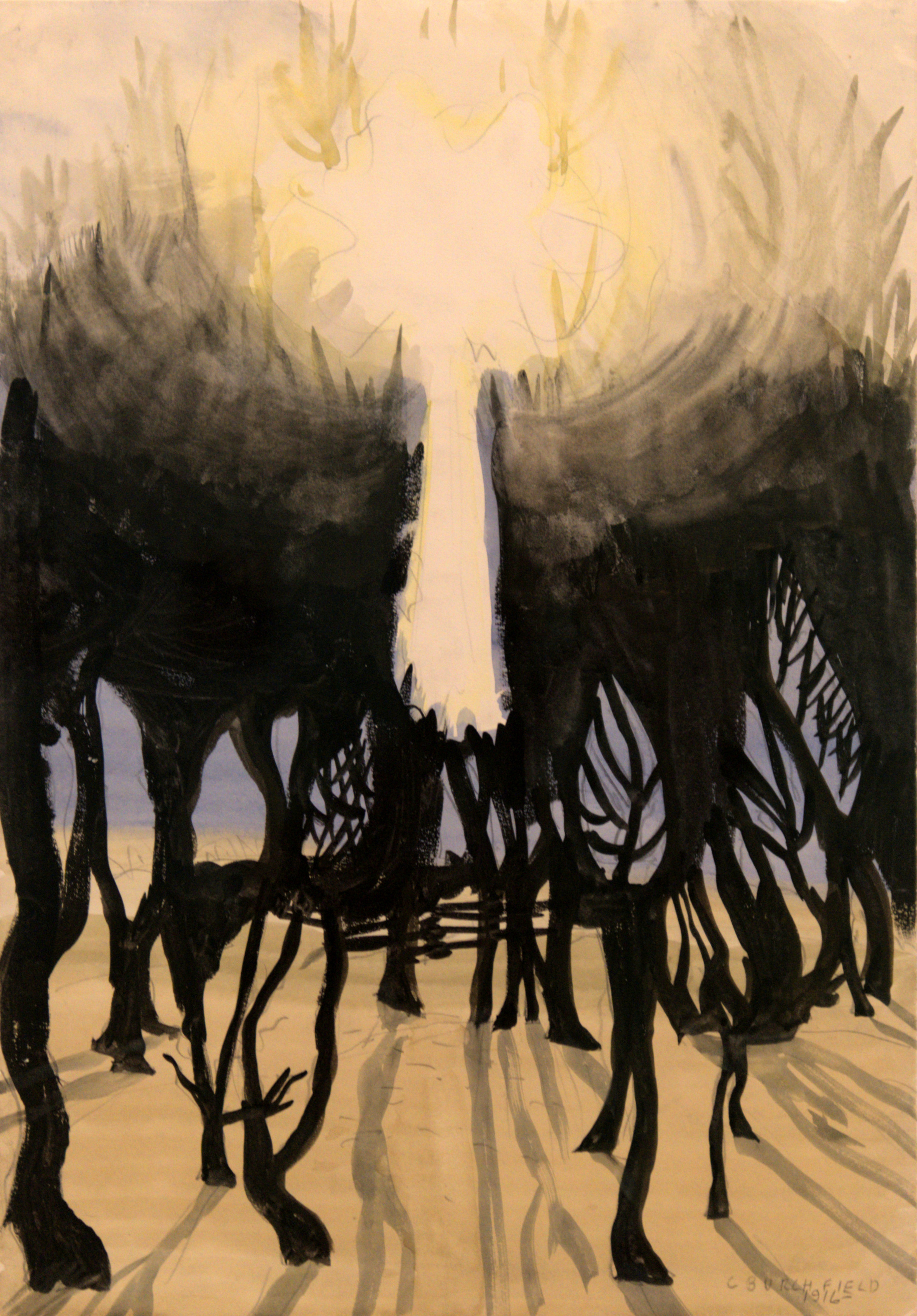
LOOK:Sunlight in Forest by Charles Burchfield
Charles Burchfield (American, 1893–1967), Sunlight in Forest, 1916. Watercolor and graphite pencil on paper, 20 × 13 15/16 in. (50.8 × 35.4 cm). Whitney Museum of American Art, New York Photo: Victoria Emily Jones. [object record]
LISTEN: “Isaiah’s Prophecy” | Words by Joanna Forbes L’Estrange, after Isaiah 9:2, 6–7 | Music by Alexander L’Estrange | Performed by London Voices, dir. Ben Parry, with Richard Gowers on organ, on Winter Light (2024)
The people who walked in darkness, who live in a land of dark, the people who walked in darkness, have seen a great light.
Refrain: And all because a child is born! And all because a child is born! To us a son is given.
He’ll be the Wonderful Counselor, the Everlasting Father. He’ll be the Wonderful Counselor, he’ll be the Prince of Peace. [Refrain]
He’ll reign on the throne of David, establishing and upholding it. He’ll reign on the throne of David from then and evermore.
Ending: And all because a child is born! And all because a son is giv’n! The people who walked in darkness will walk, will walk in the light— walk in the light!
This work by the British choral composer Alexander L’Estrange has a steady, funky groove, with a time signature that alternates between 7/8, 4/4, and 3/4.
“The contrast between ‘the people who walked in darkness’ and the ‘child is born’ is highlighted by the shift from the harmonic minor tonality of the verses to the major tonality of the refrain,” L’Estrange writes in his composer’s note. “Enjoy the moment at the end of each refrain where the organist stops playing and the choir sings ‘to us a son is given,’ taking us back to the minor for the next verse.”
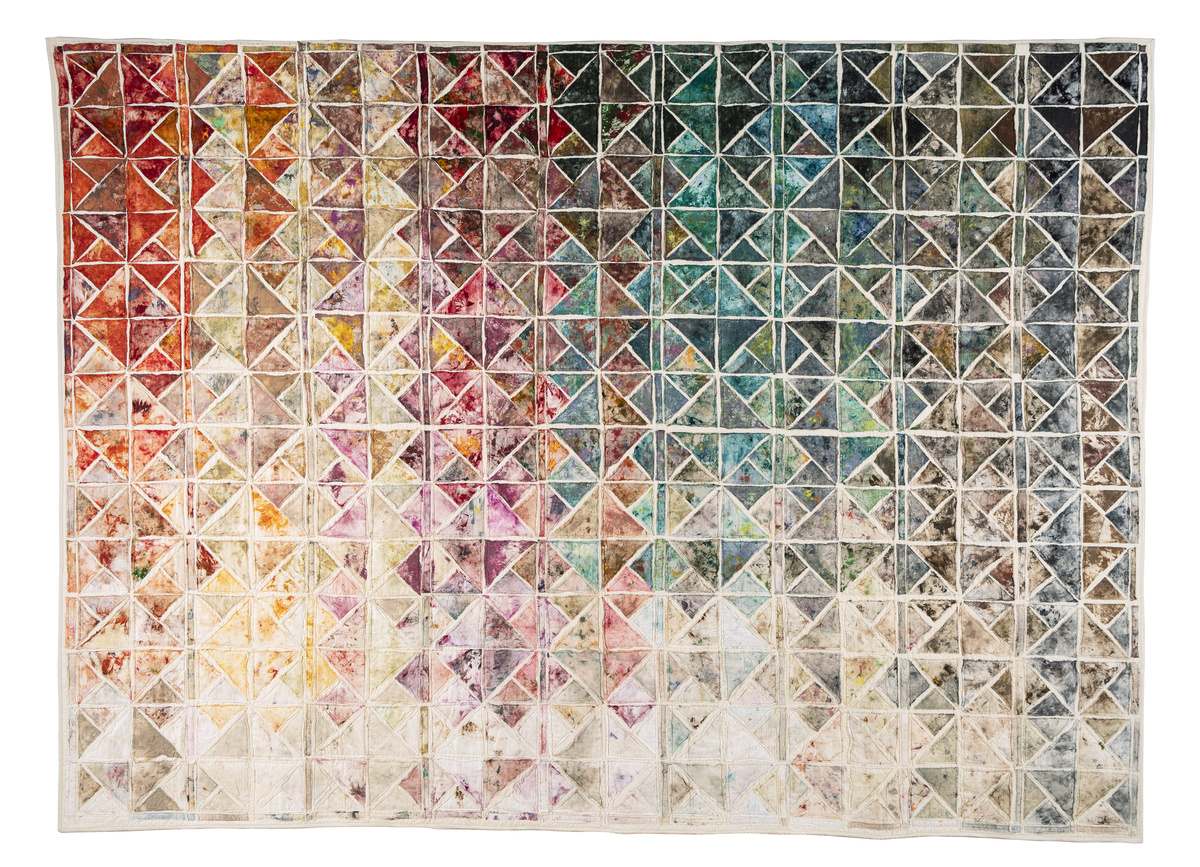
LOOK: the rain bows and the rainbows by Katy Mixon
Katy Mixon (American, 1984–), The rain bows and the rainbows (one day we will switch sides), 2018. Oil paint and used hand rags on muslin, 100 × 138 in.
I saw this quilt by Katy Mixon in December 2021 at the exhibition Break the Mold: New Takes on Traditional Art Making at the North Carolina Museum of Art. I was struck first by its prismatic color, and then by its title—which, the artist told me, comes from a dream she had after her close friend died. To bow, long o, is to bend into a curve; as a noun, a bow is a weapon used to propel an arrow, or a knotted ribbon typically worn by young girls. To bow, short o (as in “ow”), is to incline in respect or submission. The multiple meanings of this homograph open the title to different readings.
But the overall meaning points to the multihued arc that appears in the sky after a rainfall, as sunlight refracts through water vapor.
In the Judeo-Christian tradition, the rainbow is a sign of God’s covenant with Noah and has come to symbolize divine promise more generally, or hope—after the bleakness, beauty.
Mixon’s making process involves upcycling rags, which is itself a kind of redemptive act, saving used scraps and piecing them together into a new whole.
“Katy Mixon’s ‘quilts’ began as an outgrowth of her painting process,” the NCMA exhibition text read. “She routinely wipes her hands, palette knives, and other tools with baby wipes, which she then tosses into her studio’s garbage can. ‘One day [I] looked at the trash and realized it was full of all this hastily discarded color,’ she notes. She began saving the vibrant detritus with no specific purpose in mind, but after remembering her grandmother’s homemade quilts and discovering the famed African American quiltmakers of Gee’s Bend, Alabama, Mixon had a plan for her colorful scraps. ‘For me, the quilted works are alternate endings in the painting’s life cycle,’ Mixon says. ‘Painting as a practice, with the used rags as kaleidoscopic evidence.’”
Describing her technique, Mixon told me: “I compose the pieced tops and work with local longarm quilters to add the batting and backing. I finish each piece with hand stitching, often using crewel embroidery to define brush marks and tonal variations.”
LISTEN: “Joyful” | Words by Kate Bluett | Music by Paul Zach | Performed by Paul Zach with Taylor Leonhardt and Nick Dahlquist, on Christmas Hymns (2022)
The MP3 file of the song is embedded here with Paul Zach’s permission.
Come, O Lord, and make us joyful as you came to Mary’s womb; buried deep beneath our sorrows, where our hopes take root and bloom. Be the promise that sustains us through the seasons of the years, ’til at last we see your radiance when you shine beyond our tears.
Come, O Lord, and show your mercy as you came in Bethlehem; let us see the sunlight bursting through the shadows once again. Let us hear the song of glory where the silence held us fast. We will come to you rejoicing from the shackles of the past.
Come, O Lord, as living water; make our deserts green again, where the wellspring of our laughter will refresh us like the rain. After all the years of waiting for the promise long foretold, come at last, and let the day break in the morning of your joy!
Mary’s response to this announcement [of Jesus’s forthcoming birth]—her Magnificat—is even more overtly revolutionary. Her song in Luke’s Gospel is not a lullaby; it is a manifesto. She declares that the mighty will be cast down from their thrones, the lowly lifted, the hungry filled with good things, and the rich sent away empty. This is the language of redistribution, the language of a world reordered by justice rather than domination. It is no surprise that tyrants have feared this text; throughout modern history, the Magnificat has been prohibited and/or discouraged in public worship in places like Guatemala, Argentina, and India because oppressed communities used it as a rallying cry for liberation. Mary’s theology is insurgent.
What I love about Hannah and Mary is they step into God’s eternal streams of justice and of righteousness and of what it means to live as a faithful follower of Yahweh. They step into this expansive world of what God is going to do and has promised to do in the world, instead of the smaller space of their own need—which again, is OK and understandable. But they take us to places where, if we’re honest, most of our prayers don’t regularly go.
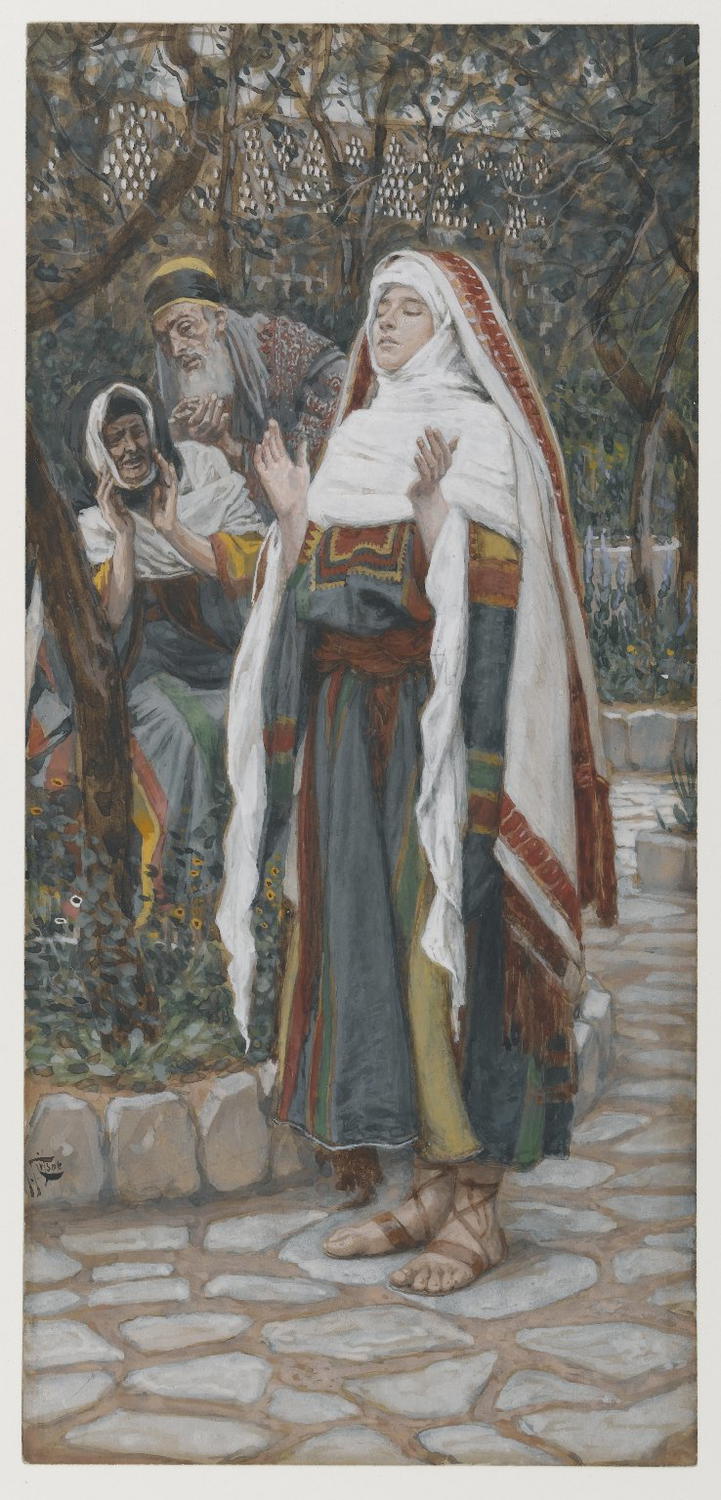
VIDEO DEVOTION:“Beholding the Magnificat with Mary Gardner”: In this “Space for God” video devotion from Coracle, Rev. Mary Amendolia Gardner, an Anglican priest with a bachelor’s degree in art history and a master’s in Christian spirituality, guides us in lectio divina (sacred reading) with Luke 1:46–55 and visio divina (sacred seeing) with James Tissot’s Magnificat.
James Tissot (French, 1836–1902), The Magnificat, 1886–94. Opaque watercolor over graphite on gray wove paper, 9 15/16 × 4 5/8 in. (25.2 × 11.7 cm). Brooklyn Museum, New York.
I typically don’t care for Tissot’s biblical watercolors, because of their illustrative quality—they remind me of pictures from the Sunday school curriculum I followed as a child. But I do like this one, which shows Mary in a position of wisdom and authority, absorbed in prayer, preparing to preach and prophesy. Elizabeth and Zechariah stand in attentive awe on the sidelines, their eyes directed toward the divine child she carries in her body while they await her words. The priest’s tongue had been tied, but Mary’s has been loosed. The Cuban American theologian Kat Armas, in the post quoted above, calls Mary “the first theologian of the Gospel,” as she boldly proclaims the messianic deliverance God has set in motion.
+++
SONGS:
>> “For Ages Women Hoped and Prayed” by Jane Parker Huber: “We join the song that Mary sings, an earthly, heavenly theme.” Performed at Wheaton Bible Church in Illinois.
>> “Mary, Did You Know”with alternative lyrics by Jennifer Henry: The original lyrics of this Gaither Vocal Band song were written by Mark Lowry in 1985, and they were set to music by Buddy Greene in 1991; the song became a popular hit. However, some Christians take issue with the rhetorical device that implies Mary did not know her son was God, that he would deliver Israel, and that he would reign forever, when that’s precisely what Gabriel told her from the beginning and what she alludes to in her Magnificat. (Defenders say these questions are most likely voiced by people in Mary’s life who didn’t know all that God had conveyed to her; or that it’s legitimate to wonder whether Mary knew the specifics that would unfold, and to suppose that even if she knew theoretically who Jesus was, she may have struggled to grasp the full scope and significance of his messiahship.)
In 2017, the Canadian theologian and activist Jennifer Henry rewrote the lyrics to center on the Magnificat and its mobilizing influence on justice movements across the globe. That song is sung here by Eric Lige, who is accompanied by Vahagn Stepanyan on piano.
>> “Magnificat” by Simon de Voil, feat. Alexa Sunshine Rose: This adaptation of the Magnificat is by Simon de Voil, a sacred musician, “interspiritual minister,” and retreat leader originally from Scotland now living in Vermont. The imagery in the video is not what I would have expected: It’s footage of bears in the woods. Perhaps it alludes to how all of creation will be redeemed in “the world that is to come”? The bears here, though, seem at peace, so maybe it’s a picture of blessedness, or of creation’s praise alongside Mary’s.
+++
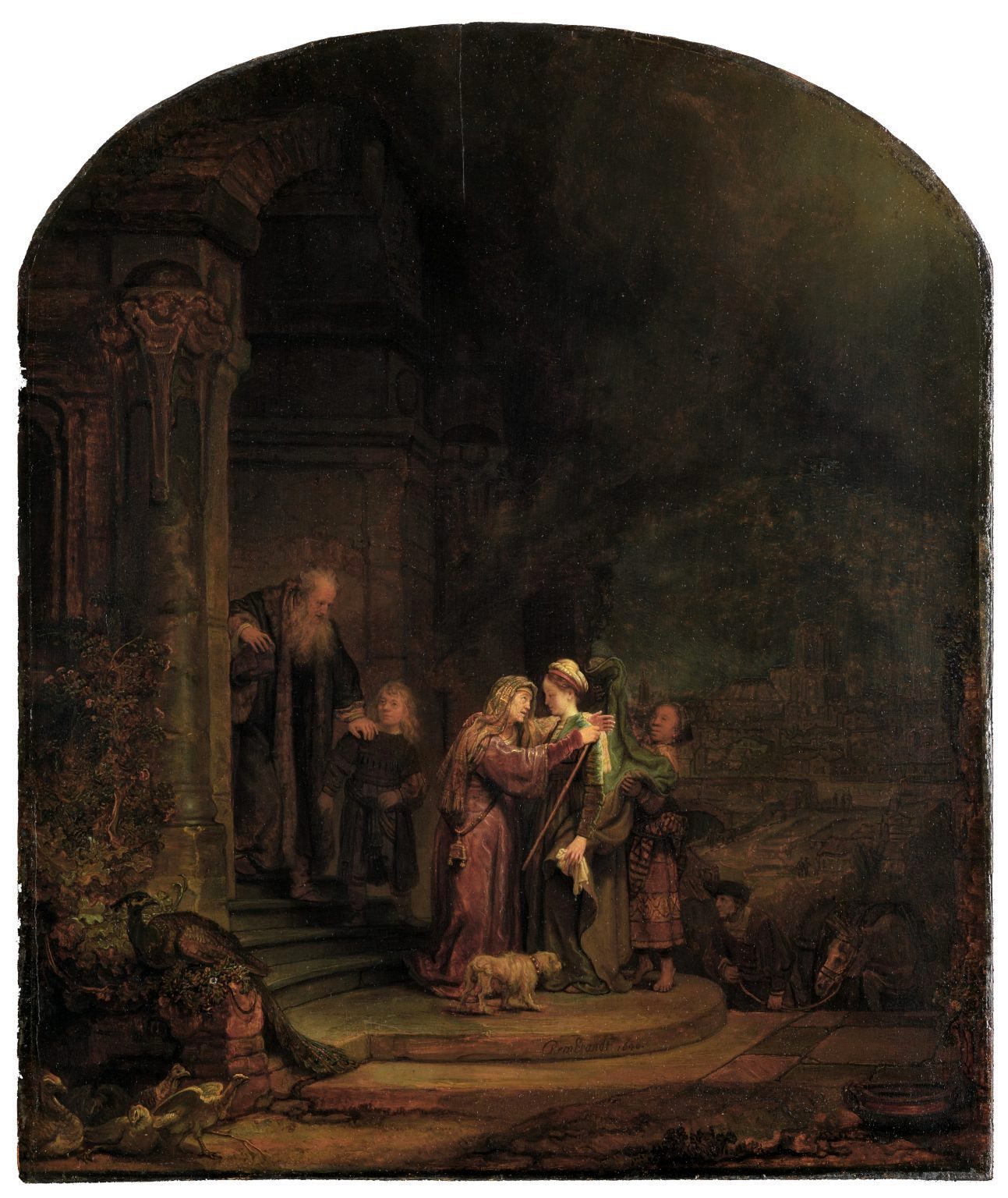
SERMON:“Liberated to See by the God Who Sees” by Wes Vander Lugt, Trinity Forest Church, Concord, North Carolina, December 7, 2025: I’m always pleased when preachers, as part of their biblical exegesis, skillfully integrate art into their sermons—not as mere illustration or decoration but as itself interpreting scripture and/or doing theological work. In the sermon he gave for the Second Sunday of Advent this year, Rev. Dr. Wes Vander Lugt [previously], an ordained Presbyterian minister and director of the Leighton Ford Initiative in Theology, the Arts, and Gospel Witness at Gordon-Conwell Theological Seminary, preached on Luke 1:5–25, 39–45, about how God sees us and liberates us to see him and others. He discusses Rembrandt’s Visitation painting, especially the artist’s use of light and shadow—Mary and Elizabeth step out of the shadows, out of a place of feeling unseen, into the light of God’s grace, says Vander Lugt, where they are known and knowing.
Rembrandt Harmensz van Rijn (Dutch, 1606–1669), The Visitation, 1640. Oil on cedar panel, 22 1/4 × 18 7/8 in. (56.5 × 47.9 cm). Detroit Institute of Arts, Michigan. [object record]
He also touches on, very briefly, James B. Janknegt’s 2008 Visitation, which shows how John the Baptist has been liberated to see Jesus, even as the two are still in utero. See 17:49–20:05.
+++
FROM THE ARCHIVE: The Magnificat is a topic I’ve covered on the blog several times over the past ten years. Here are some examples:
I feel the flames, oh Madonna I feel the heat of your child Birthing from all heaven’s glory Clothed in the brown skin of God I see a light in the desert I see it blazing on high Burning down all preconceived Notions of who you would be
Refrain: Call it a sweet, oh, a sweet premonition We saw no defeat as we labored the weight of the fire Curious woman, the revolution is your joy
I’ve kept my hopes locked away I’ve kept my scars in a jar I thought that love had a limit Careful not to reach too far Flipping that table of lies Breached but I’m breathing just fine Dear woman, please recognize Divinity held inside [Refrain]
I feel the flames, oh Madonna I feel the heat of your child Birthing from all heaven’s glory Clothed in the brown skin of God
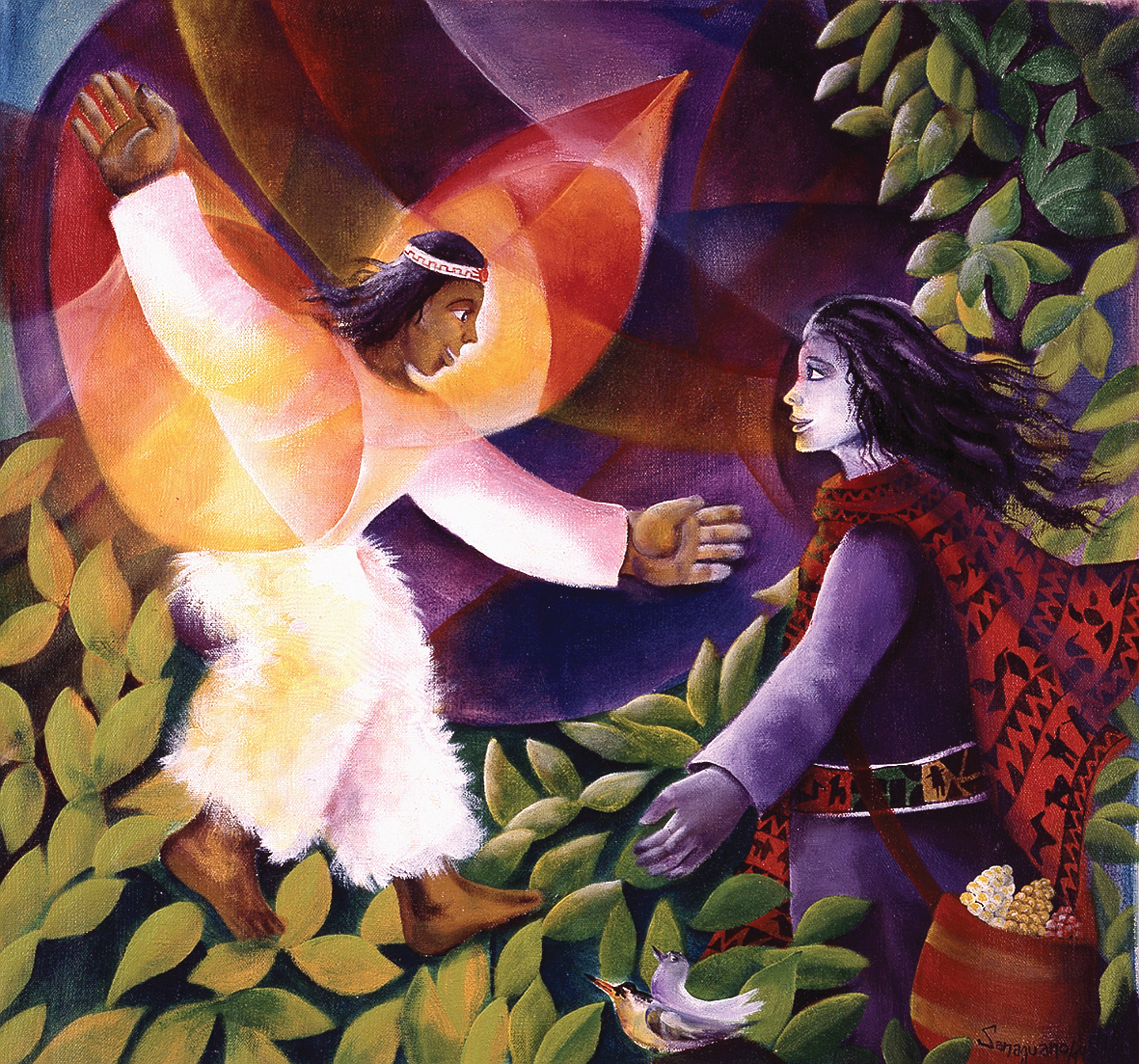
In this outdoor Andean Annunciation scene, the angel Gabriel arrives with a gust of wind before Mary, who has a satchel of freshly harvested corn slung over her shoulders. He wears llama or alpaca pants, part of the traditional male dress in the highlands of Ecuador. With his right hand he gestures toward the heavens, and with his left he gestures toward her, as if to say, “Heaven’s coming down to earth—God wants to be made human in you.”
He smiles. She smiles. Her face is illumined by beams of divine grace. She extends her arms to embrace her new vocation as Mother of God.
LISTEN: “Bendita seas, María” (Blessed Are You, Mary) by Ariel Glaser, on Tercer Milenio, 1997 | Performed by Jimena Muñoz with Brother Alex, 2020
En un silencio profundo tejías plegarias a un Dios que escuchaba tus simples palabras, pequeña María entregada a su amor. Y en una tarde tranquila rompiendo el silencio, las alas de un ángel, sonaban al tiempo que te saludaba de parte de Dios.
Estribillo 1: ¡Bendita seas, María, entre toda mujer! ¡Has encontrado gracia a los ojos de Dios! María, Madre suplicante, ayúdame también a escucharlo a Él.
Fue la palabra más dulce que tocó la tierra, la que te propuso cumplir la promesa de que nacería nuestro Salvador. «Hágase en mí como has dicho;» respondiste al ángel, y el Santo Espíritu descendió al instante. Te habías convertido en Madre de Dios.
Estribillo 2: Bendita seas María, hija del Padre, Esposa del Espíritu, Madre del Emanuel. María, Madre de Jesús, ayúdame, también a decir amén.
ENGLISH TRANSLATION (my own):
In profound silence you wove prayers to a God who heard your simple words, little Mary, surrendered as you were to his love. And on a quiet afternoon, breaking the silence, the wings of an angel sounded as he greeted you on behalf of God.
Refrain 1: Blessed are you, Mary, among all women! You have found favor in the eyes of God! Mary, supplicating mother, help me to listen to him too.
It was the sweetest word that touched the earth, the one that offered you the promise of the birth of our Savior. “Let it be done to me according to your word,” you replied to the angel, and the Holy Spirit descended instantly. You had become the Mother of God.
Refrain 2: Blessed are you, Mary, daughter of the Father, wife of the Spirit, mother of Emmanuel. Mary, mother of Jesus, help me also to say amen.
This song marvels at Mary’s unique calling while recognizing that we, too, are called to say yes and amen (“let it be”) to God’s will in our lives, which includes being filled with Christ.
The first two lines of the first refrain combine Elizabeth’s exclamation to Mary in Luke 1:42 (“Blessed are you among women!”) with Gabriel’s declaration in Luke 1:30 (“You have found favor with God”).
The epithets in the second refrain highlight Mary’s relationship to the three persons of the Trinity. She is a child of God the Father, as we all are. But she was also wed to God’s Spirit, experiencing a unique and nonsexual union that resulted in the conception of Jesus, the Son of God. Jesus received his flesh from Mary, and she mothered him from his birth to his death. The title Theotokos—God-bearer, or Mother of God—was formally affirmed for Mary at the Council of Ephesus in 431 and is held true by all three branches of Christianity.
The songwriter, Ariel Glaser, is from Argentina. He describes himself as “a catechist who sings,” teaching Catholic doctrines in schools and churches through traditional methods and song. He and his wife are members of the Convivencia con Dios (CcD), a charismatic Catholic movement made up of both laypeople and religious, both men and women, responding to Jesus’s call in John 17: “Father, may they all be one as you and I are one!” Follow Glaser on Facebook.
The singer, Jimena Muñoz, has been singing and playing guitar since age twelve. In addition to making gospel-centered music, she is also a professor of sacred sciences (a field in Catholic institutions that includes theology, canon law, philosophy, biblical studies, church history, and liturgy), and a pastoral coordinator for CEF (Centro Educativo Franciscano) La Rioja.
Mark Cazalet (b. 1964) is a contemporary artist based in London whose work centers on color and balances empiricism and lyricism. He works across media—painting, drawing, printmaking, and (in collaboration with fabricators) stained glass, etched and engraved glass, printed enamel on glass, tapestries, and mosaics. A major part of his career has been fulfilling ecclesiastical commissions and making sacred art. But all of his work, regardless of subject matter, is shot through with a sacramental impulse.
Last year Cazalet made a series of twelve “Advent Stations” that move circuitously through the story of Jesus’s first coming, marked as it was by mystery, vulnerability, risk, and glory. These include modernized versions of scenes you’d find in traditional Infancy of Christ cycles, such as the Annunciation to Mary, the Annunciation to the Shepherds, the Dream of the Magi, and the Flight to Egypt, but also new ones, drawing us into the grand sweep—sometimes rushing, sometimes quiet—of gospel hope. “The overarching theme,” he told me, “is pregnancy, birth, nurturing, waiting, escape, migration, and finally, in the mistle thrush’s morning song, the greeting of the new day’s limitless potential.”
The artist’s choice of substrate is unique: He painted his stations in oil on domestic wooden objects, such as bread boards, meat and cheese boards, children’s lunch trays, washboards, chapati rolling boards, and a baker’s peel. By using these ordinary boards mainly from home kitchens, Cazalet further situates the biblical Advent story in the everyday. That many of the boards are used for preparing or serving bread underscores Jesus’s self-declaration as “the living bread that came down from heaven,” whose flesh Christians eat ritually as a means of interabiding (John 6).
Cazalet’s Advent Stations debuted last December at his home church, St Martin’s in Kensal Rise, London, where they were installed one per week from Advent through Candlemas. The project was a collaboration with fellow parishioners Richard Leaf, who wrote a poem for each station, and Pansy Cambell, who calligraphed the poems.
That exhibition spawned interest from Chelmsford Cathedral in Essex, where all the artworks and poems are on display from December 1, 2025, through February 2, 2026. The cathedral is already home to two commissioned works of Cazalet’s: the monumental multipanel painting The Tree of Life and an engraved and etched glass window depicting St. Cedd.
The word “station” in the title of Cazalet’s recent series refers to a stopping place along a route. In the Middle Ages, the Roman Catholic Church developed a devotional practice known as the Stations of the Cross, which breaks down the passion of Christ into fourteen distinct episodes fit for contemplation. The idea was that those who could not travel physically to Jerusalem for Lent to walk the Via Dolorosa (the processional route Jesus took to Golgotha) could at least walk the path in spirit, using a series of images as prompts to pause, pray, and reflect.
Used by Christians in various denominations, this practice has been adapted for other seasons of the church year. While there are no official Advent Stations or Stations of the Nativity, Cazalet has come up with twelve.
All photos in this article are by the artist and are used with his permission.
Advent Station 1: The Breath of God
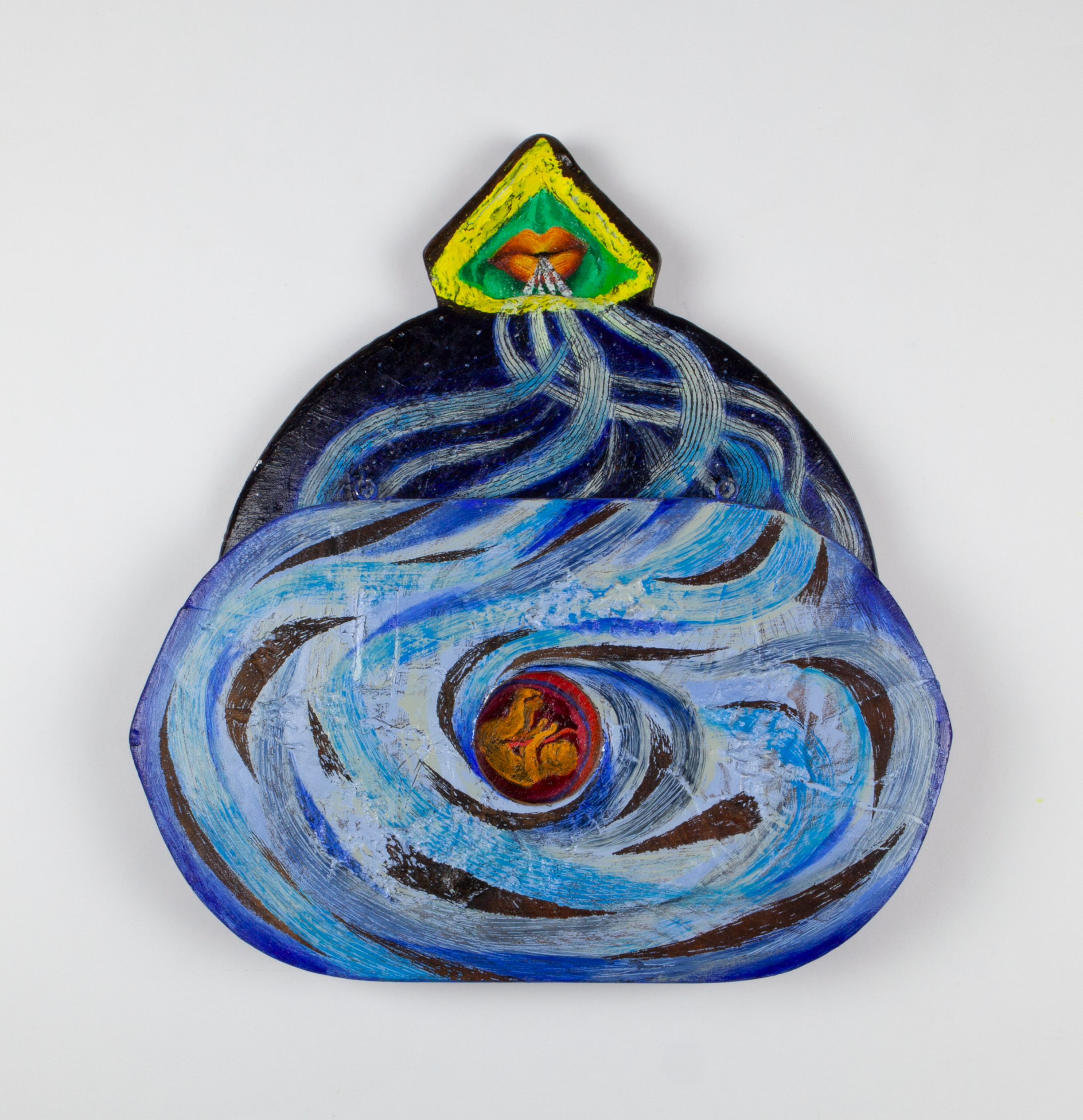
Mark Cazalet, Advent Station 1: The Breath of God (closed), 2024
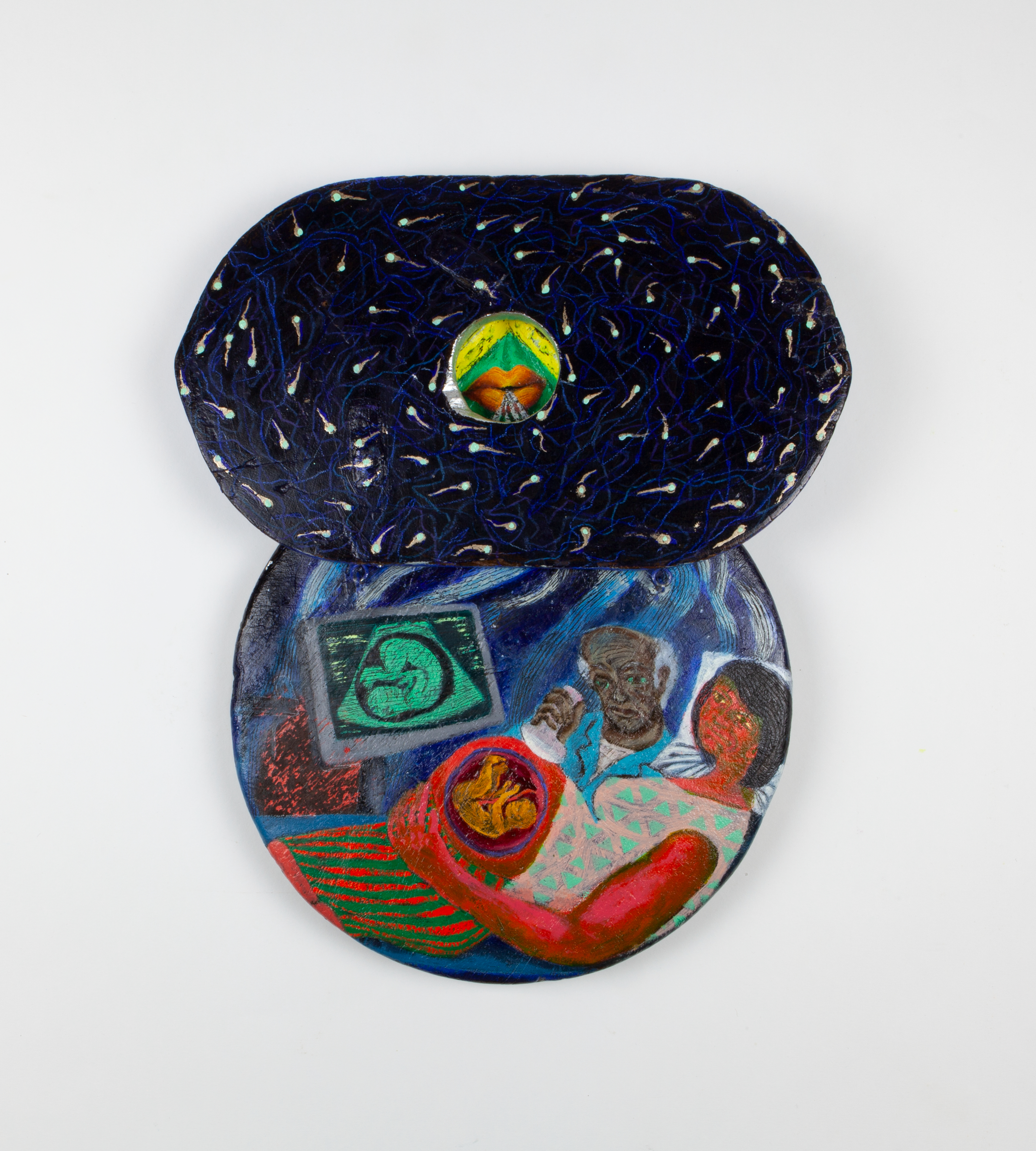
A mystical visualization of the Word becoming flesh, the first station has two configurations. In its closed form, it shows the mouth of God blowing through space, the divine breath coalescing around a woman’s uterus to form an embryo, the child who will be called Jesus. Wisps of blue swirl dynamically around this firstborn of new creation.
The triangular shape evokes the Trinity, as the Incarnation was an act involving Father (initiator), Son (enfleshed one), and Holy Spirit (overshadower / inseminating agent).
Mark Cazalet, Advent Station 1: The Breath of God (open), 2024
In the exhibition, an attached ribbon instructs viewers, “Lift me.” When you do, the bottom board flips up to reveal a pool of swimming sperm cells, as God created the male gamete needed to make a male child and supernaturally (nonsexually) deposited it into Mary, where it fertilized one of her eggs.
The virginal conception of Christ is a mystery beyond knowing; no amount of scientific head-scratching will bring us closer to understanding the mechanics, nor do we need to. But I like the reminder from this unusual artistic interpretation that all the necessary human genetic material was present—Mary supplying hers, and God supplying the rest. Jesus was not some kind of alien transplanted into a human womb, but rather was made up of all the human stuff we are, and grew by stages inside his mother over a period of nine months. And yet, while fully human, he’s also—marvel of marvels—fully God.
On the round board below, we see that the isolated uterus from the first view belongs to Mary, who lies in bed while Joseph serves as ultrasound technician, shining a light that discloses the still-developing Christ child on a video monitor.
Advent Station 2: John the Baptist on the Beach
Mark Cazalet, Advent Station 2: John the Baptist on the Beach, 2024
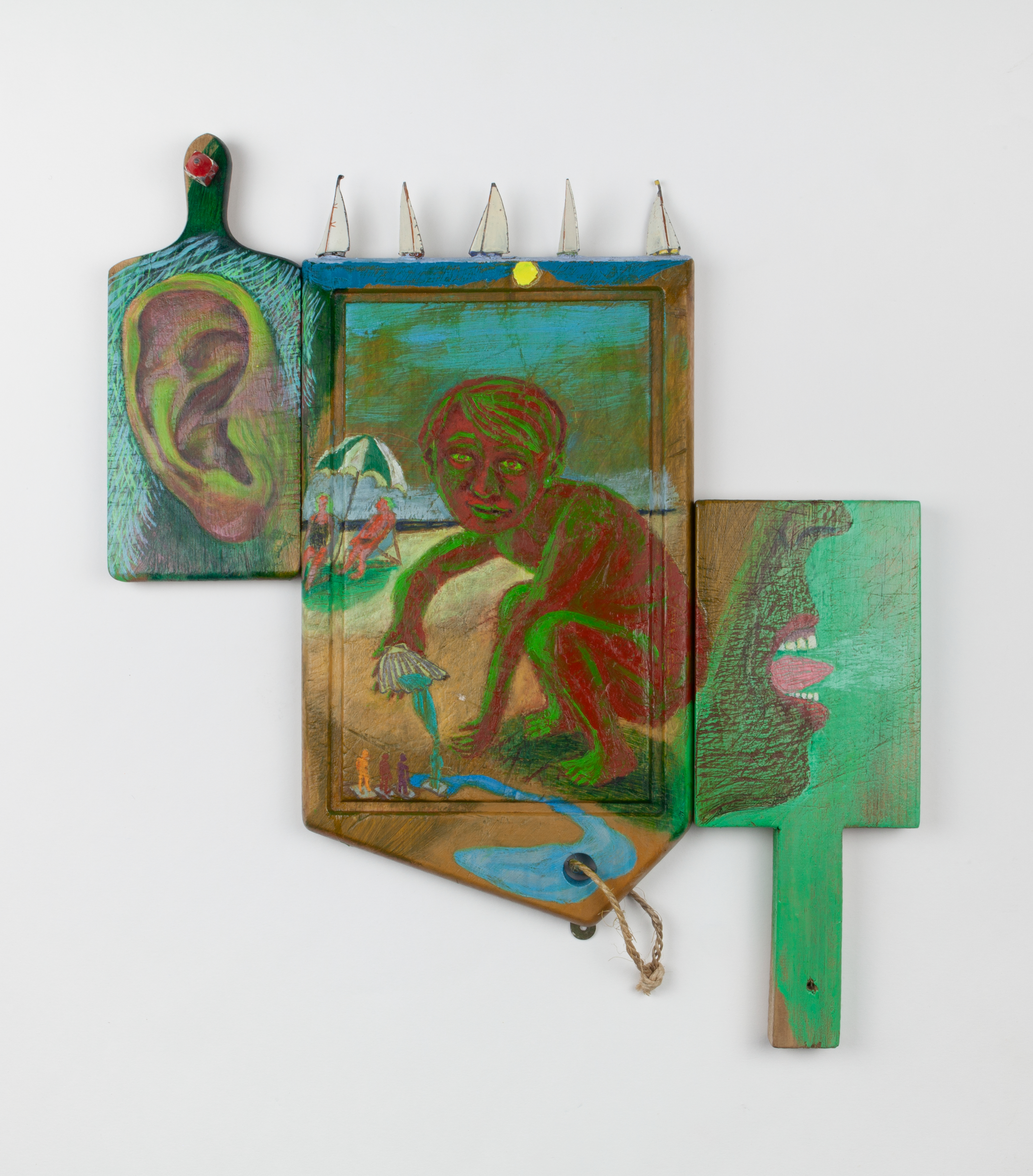
The breath/wind motif is subtly carried over into this second Advent station, with sailboats lining the top of the center board.
This scene shows a young John the Baptist playing on the beach, with his parents, Zechariah and Elizabeth, lounging in swimsuits under a nearby umbrella. John crouches in the sand, pouring water from a seashell (the implement he uses to baptize Jesus in many traditional paintings, most famously Piero della Francesca’s) onto toy figurines who have queued up for the affusion. The water cuts a mini river through the sand, alluding to the Jordan.
The two side panels, which show a close-up of an open ear and an open mouth, likely refer to, in his prophetic ministry as an adult, John’s hearing the word of God and proclaiming it. His is “the voice of one crying out in the wilderness: ‘Prepare the way of the Lord; make his paths straight’” (Mark 1:3). John is regarded as an Advent figure because, by preaching repentance from sin, he prepared the people for the coming of the Messiah.
Advent Station 3: The Annunciation
Mark Cazalet, Advent Station 3: The Annunciation, 2024
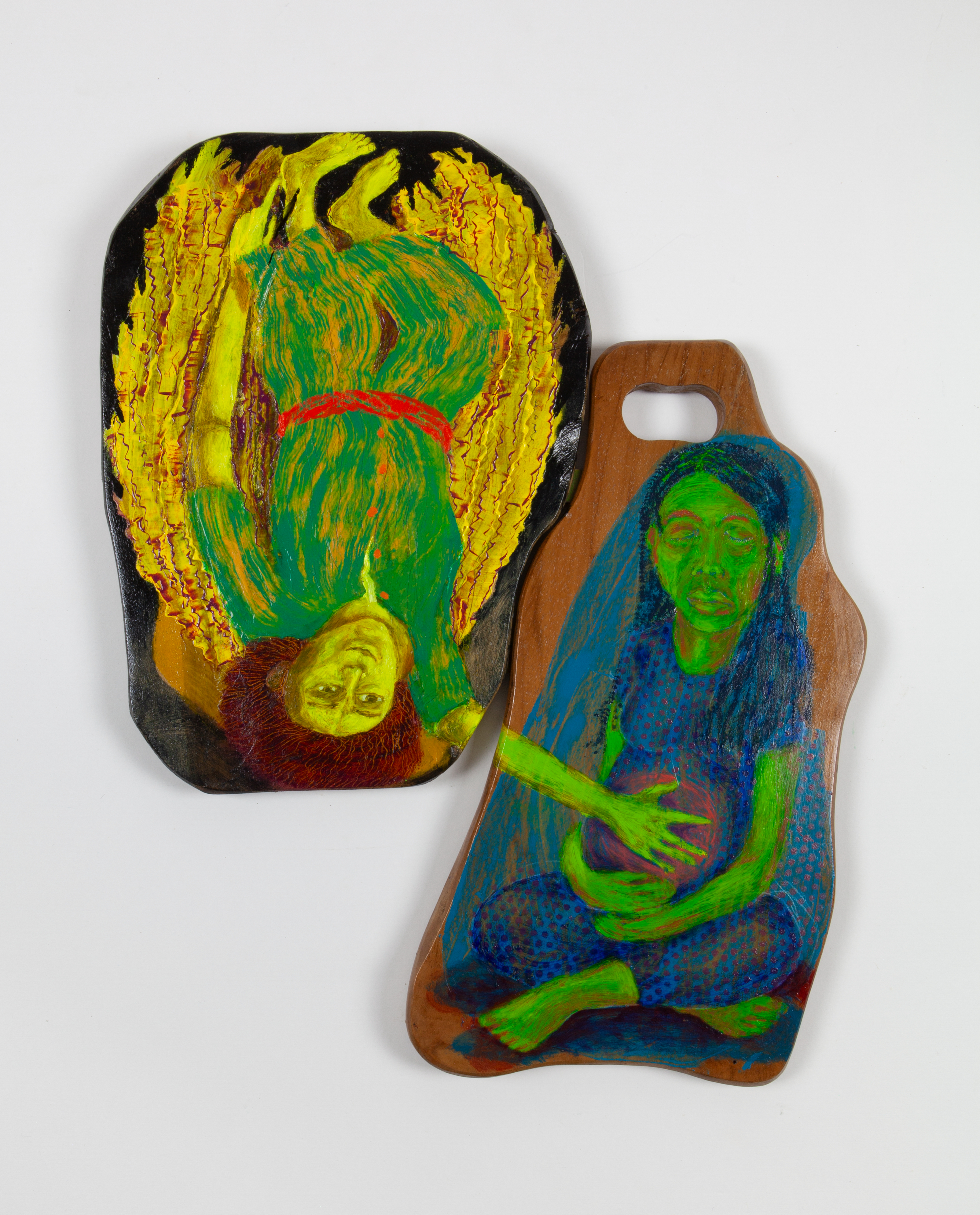
The Annunciation, portraying the angel Gabriel’s message to Mary that she has been chosen to bear God’s Son, is one of the most frequently depicted biblical scenes of all time. How could any artist possibly make it new?
Cazalet refreshes the encounter by showing Gabriel dipping down headfirst from the heavens, the unconventional orientation perhaps a playful allusion to the topsy-turvy nature of Christ’s kingdom. He reaches across the gap to touch the belly of Mary, a young Black woman in a polka-dot dress who is seated on the floor with her eyes closed, rapt in prayer. This consensual touch is what effects the Incarnation.
Mary wears blue and even exudes a blue aura, blue being her traditional color, associated with heaven (the sky realm) and hope. Gabriel’s skin has a golden sheen—the color of divinity, purity, holiness. The coming together of blue and yellow creates green, symbolizing life, growth, and renewal.
Advent Station 4: Bethlehem Motel
Mark Cazalet, Advent Station 4: Bethlehem Motel, 2024
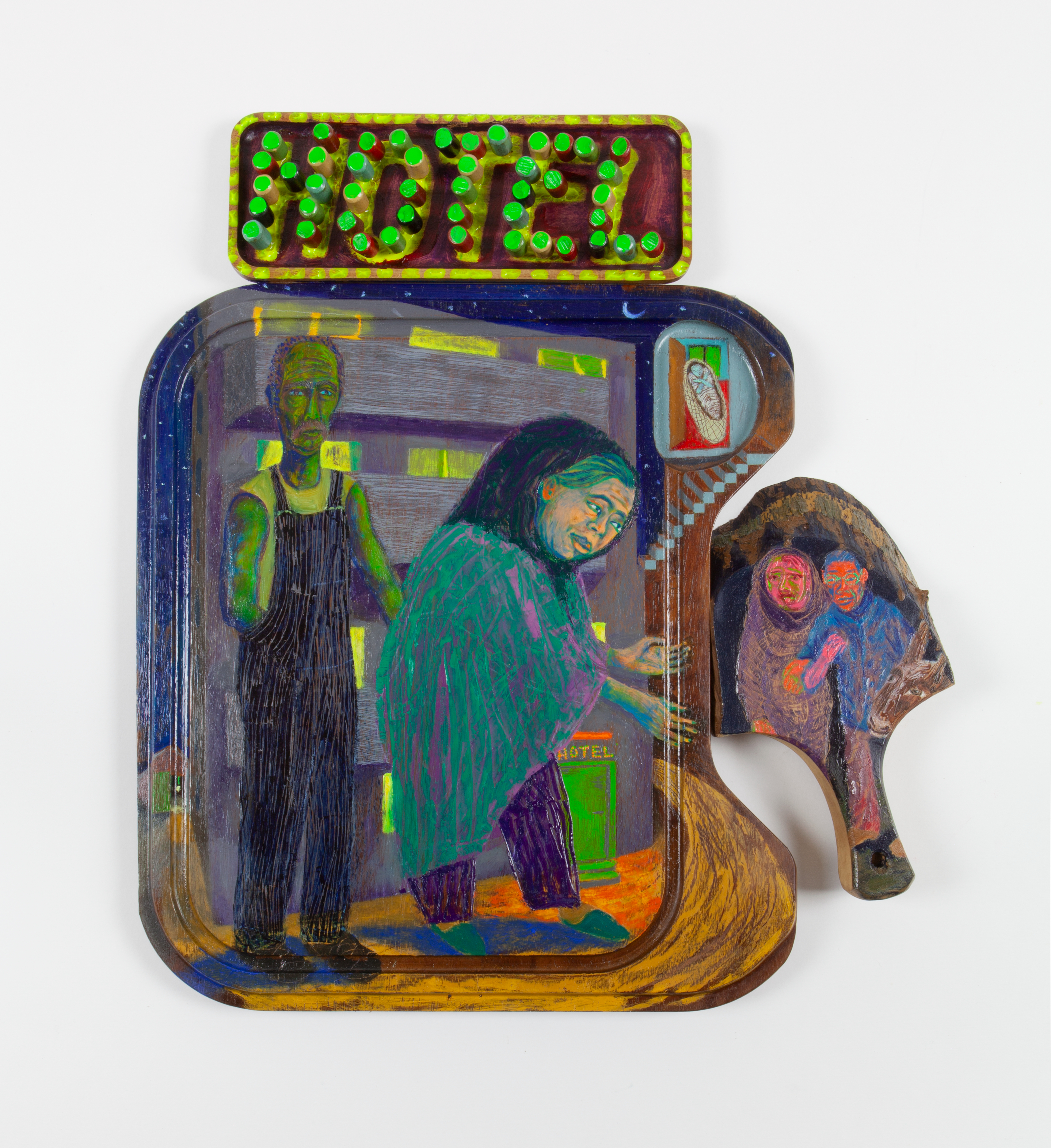
The innkeeper couple in Bethlehem are a cultural invention, biblical scholars tell us, spawned by a misleading English translation of Luke 2:7, which says “there was no room for them [Mary and Joseph] in the inn” (KJV). The Greek word translated “inn,” kataluma, more properly means “guest room”: Because the census had brought many out-of-towners to the area, the guest rooms of Joseph’s relatives were full, but they made space for the pregnant couple in the lower room of the house where animals were kept for the night.
Despite the lack of an innkeeper character in scripture, it has become a popular element in storytelling about the Nativity in art, song, and sermons, as it prompts us to consider whether we are making room for Christ in our busy, overcrowded lives. And not just Christ, but anyone in need—of shelter or other forms of care.
Cazalet shows Mary and Joseph approaching a motel door as the female owner, sympathetic, comes out to greet them. A niche above their heads, hovering like a thought bubble, shows what the couple desires: a place to give birth and to lay their son.
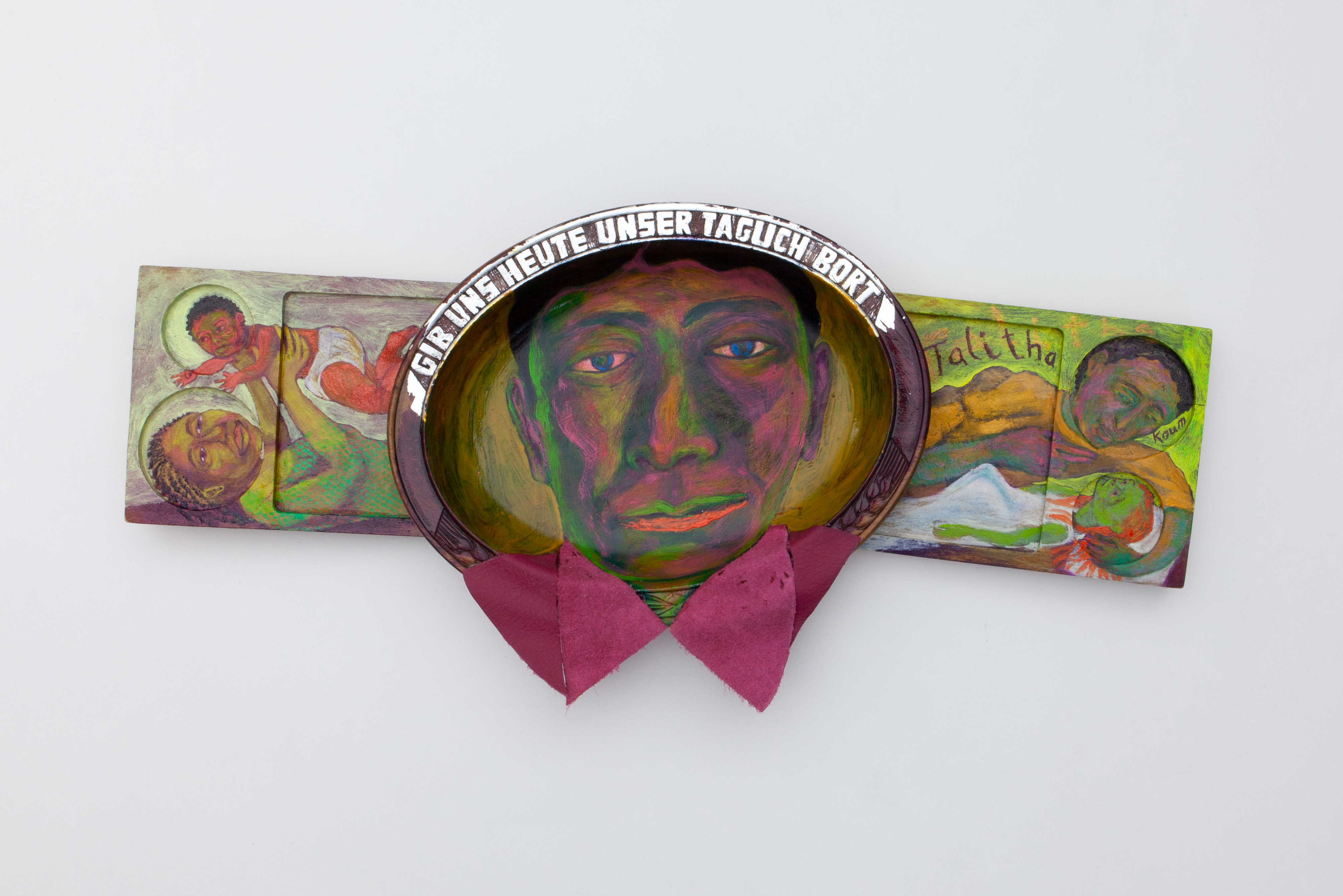
Advent Station 5: The Incarnation (A Blessing Conferred)
Mark Cazalet, Advent Station 5: The Incarnation (A Blessing Conferred), 2024
The fifth station features an unconventional combination of images. The left board shows Mary lying on her back, holding the wiggly infant Christ above her. She beams with maternal love.
On the right board, an adult Christ, similarly positioned, leans over the dead daughter of the synagogue leader Jairus. “Talitha koum,” Jesus gently instructs, cradling the girl’s head—Aramaic for “Little girl, get up” (Mark 5:41). With his words, she rises back to life.
The central image, a Head of Christ, is painted on a wooden bread plate from Germany—these plates were sometimes also used as church collection plates—whose rim reads, “Gib uns heute unser täglich brot” (Give us this day our daily bread). Carved sheaves of wheat poke out from under Jesus’s pink cloth collar.
“My intention is that Mary’s love for her son as she raised him taught him the care and compassion to want to help a child in extremis,” Cazalet told me. “The man is formed by the mother’s love, and our childhoods set the pattern of our response to others.”
Notice how, from behind the Christ head, the two adjoining boards emerge like wings, suggesting freedom.
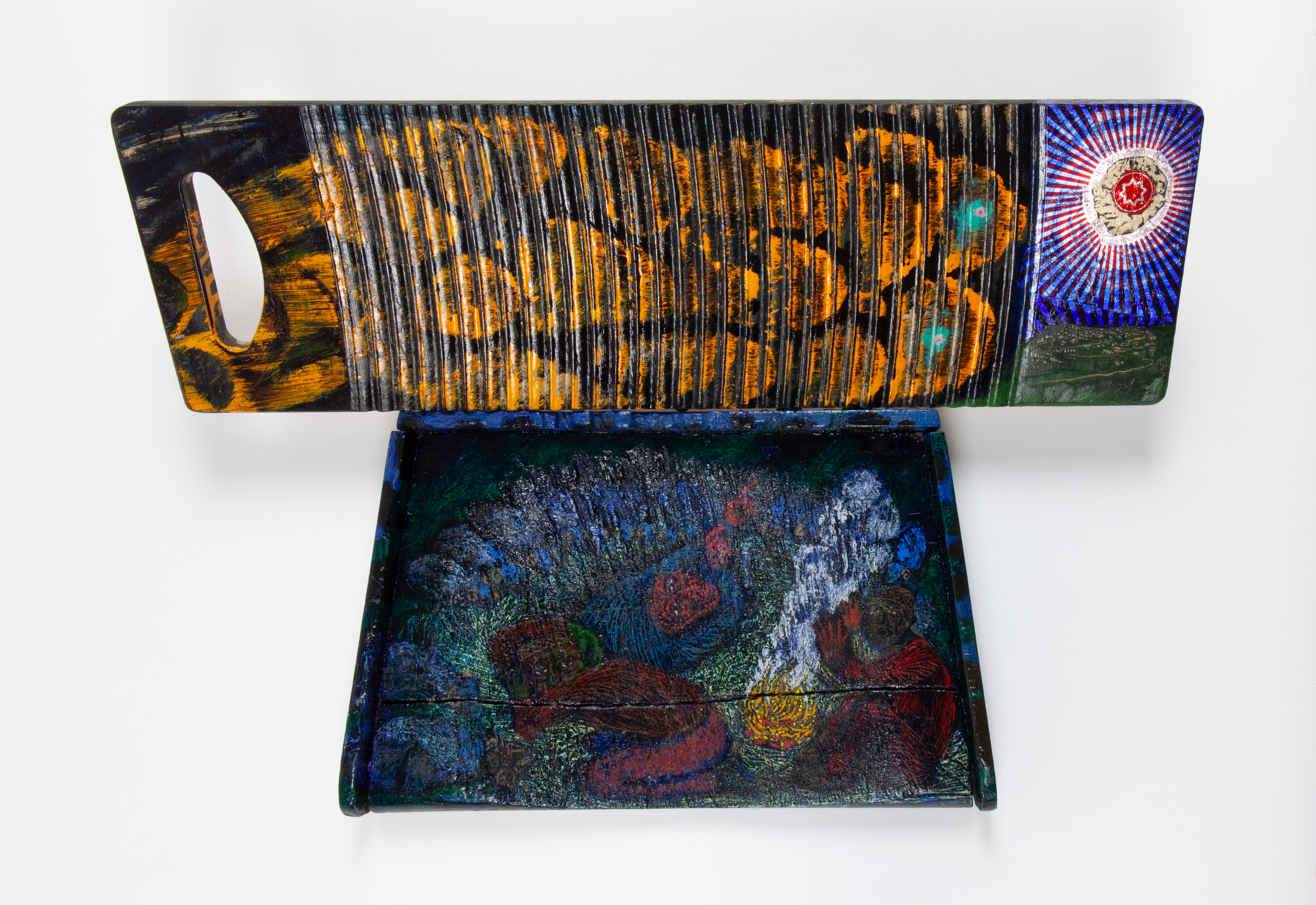
Advent Station 6: The Shepherds See the Star
Mark Cazalet, Advent Station 6: The Shepherds See the Star, 2024
The sixth station portrays the glory of the Lord rippling across the night sky above three shepherds tending their flocks. Content and unassuming, they are gathered round a warm fire when suddenly, an angel appears to announce to them the birth of Christ. One of the shepherds cowers in fear while another gesticulates toward a brightly beaming star in the near distance—rendered with a Tunnock’s milk chocolate tea cake wrapper.
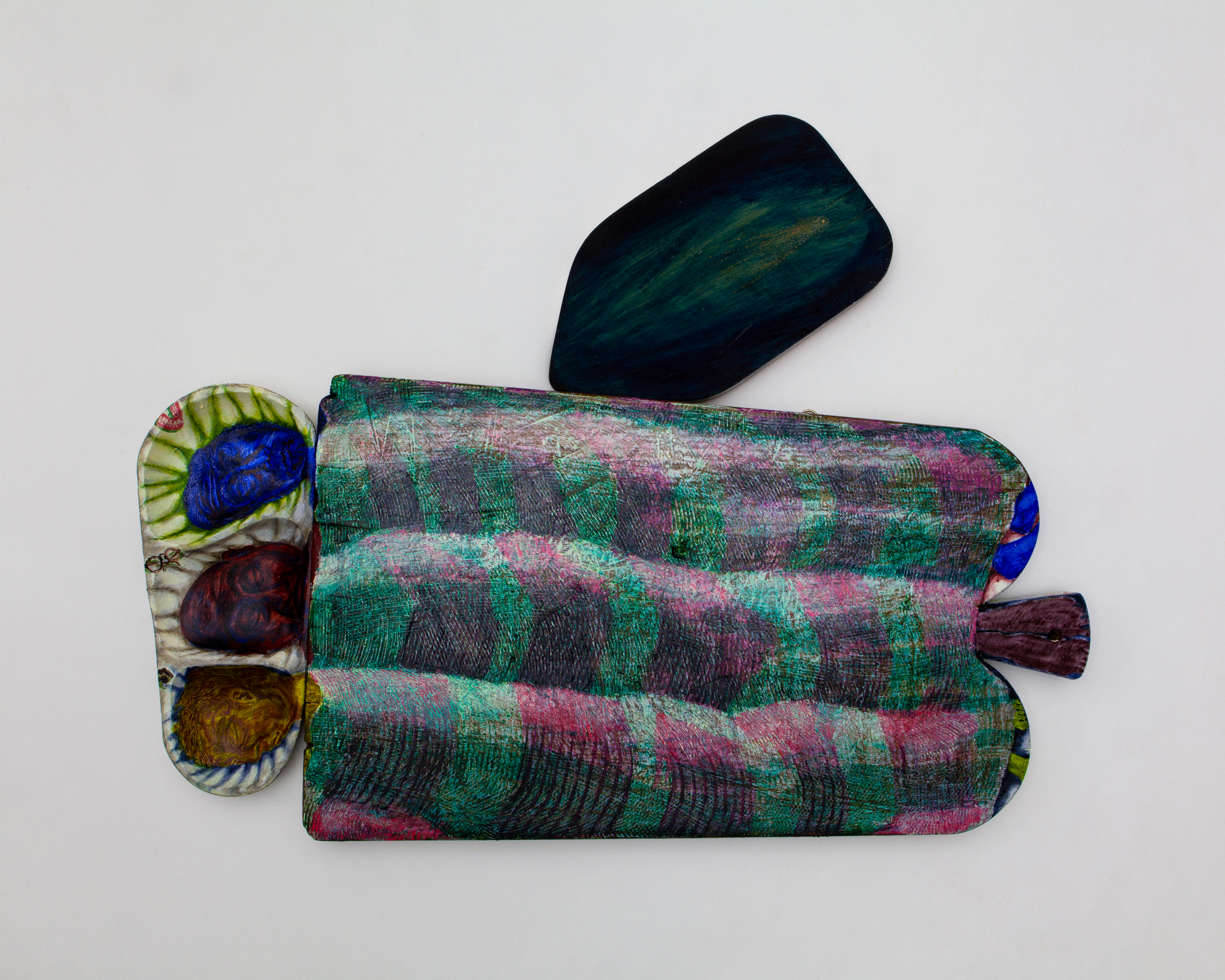
Advent Station 7: The Magi Dreaming
Mark Cazalet, Advent Station 7: The Magi Dreaming, 2024
Having followed a star to Jerusalem from their home back east, the magi enter the court of Herod to inquire where they can find the newborn king of the Jews whom the star heralds, to pay him homage. Herod hadn’t heard of such a king, but immediately he feels threatened—“king of the Jews” is his title—and, unbeknown to the visiting dignitaries, decides to crush this young rival. After consulting with Jewish scholars, he discerns Bethlehem as the birthplace. He divulges this information to the magi and asks them to report back once they’ve found the child so that he, too, can honor him. He hides his true motive under a lie.
The magi have a transformative encounter with Jesus in Bethlehem. Falling asleep after that momentous day, they receive a warning from God not to return to Herod. So they avoid him on their way back home.
As in medieval visual treatments of the Dream of the Magi, Cazalet has the magi sharing a bed. (There’s nothing salacious about it—it’s just a compositional practicality, to show the three men in one space, having the same dream at the same time.) Their toes peep out from under the covers. That surface, by the way, is flat—Cazalet skillfully creates the illusion of convexity through painting, suggesting bodies underneath.
Beside the magi’s heads are three small personal objects: earbuds, glasses, and dentures, which allude to the proverbial principle “See no evil, hear no evil, speak no evil.” “I was musing if this trinity of pilgrim searchers were perhaps aspects of the one true pilgrim, parts of a single whole disciple,” the artist told me.
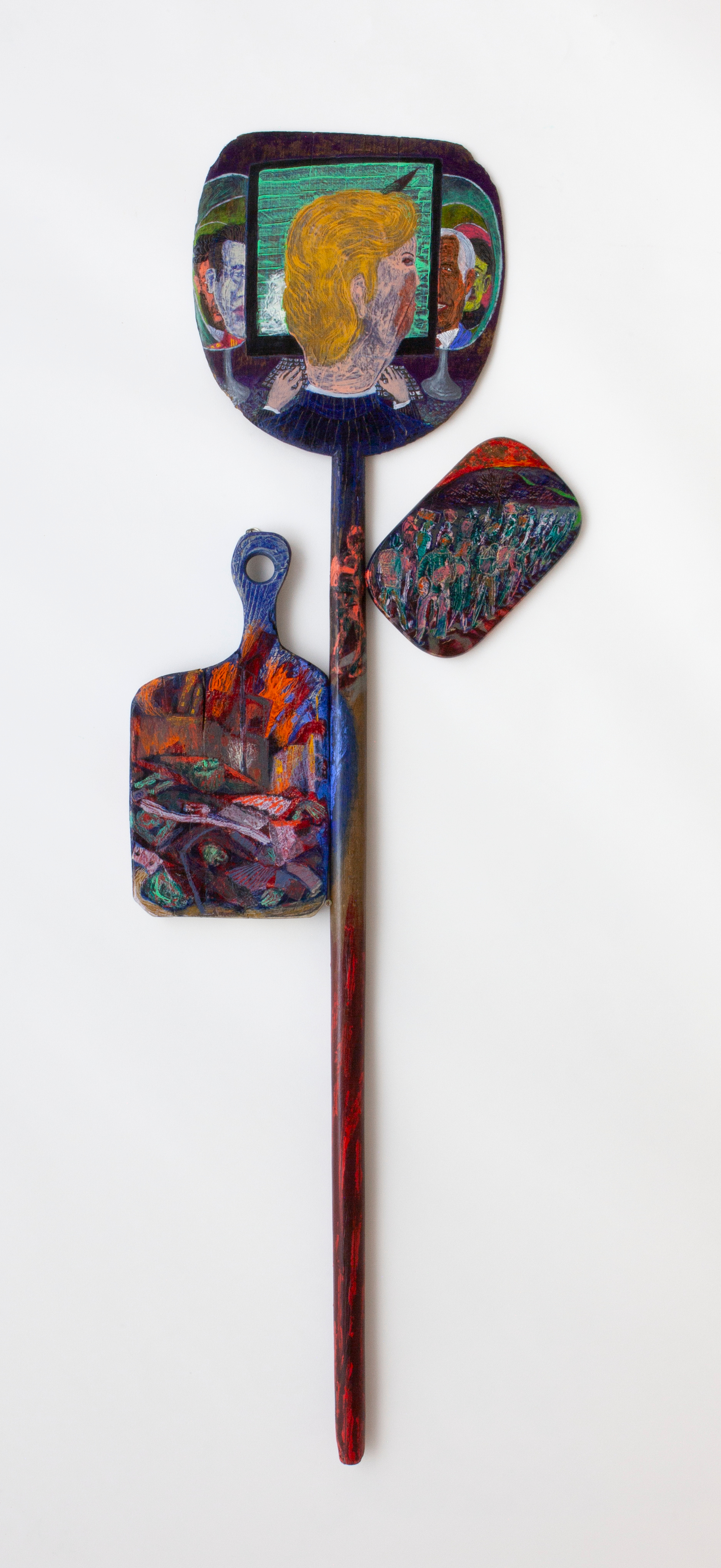
Advent Station 8: Herod Syndrome
Mark Cazalet, Advent Station 8: Herod Syndrome, 2024
Thwarted by the magi, Herod fumes with rage. He will not be dethroned by this so-called messiah. So he orders his soldiers to kill all the boys in Bethlehem aged two and under, thinking that Jesus will be among them. In his self-obsession, he cares nothing for the good of the people; he cares only for the consolidation of his own power.
Station 8 is Cazalet’s modern take on the Massacre of the Innocents. At the helm of a computer keyboard is a presidential figure launching a missile on whomever he has deemed the enemy, while other likeminded autocrats—I believe that’s Saddam Hussein, Kim Jong Un, Vladimir Putin, and Adolf Hitler—look over his shoulder approvingly, their faces reflected endlessly in mirrors using a technique called mis en abyme (“put in the abyss”). This panel, the transferring surface of a baker’s peel, sits at a height to emphasize the pompousness of rulers like Herod, who see themselves as above others and above the law.
Such an attitude can have dire consequences. “Below we see the devastation of a civilian population, defenceless against the technological onslaught,” Cazalet describes, “and the perpetual streams of migrants fleeing who knows where to be vilified as more foreign mouths to feed.”
The power mania that gripped Herod, that led to his lashing out in violence, is still alive and well today in national and global politics.
Advent Station 9: The Flight to Egypt (Forced Migration)
Mark Cazalet, Advent Station 9: The Flight to Egypt (Forced Migration), 2024
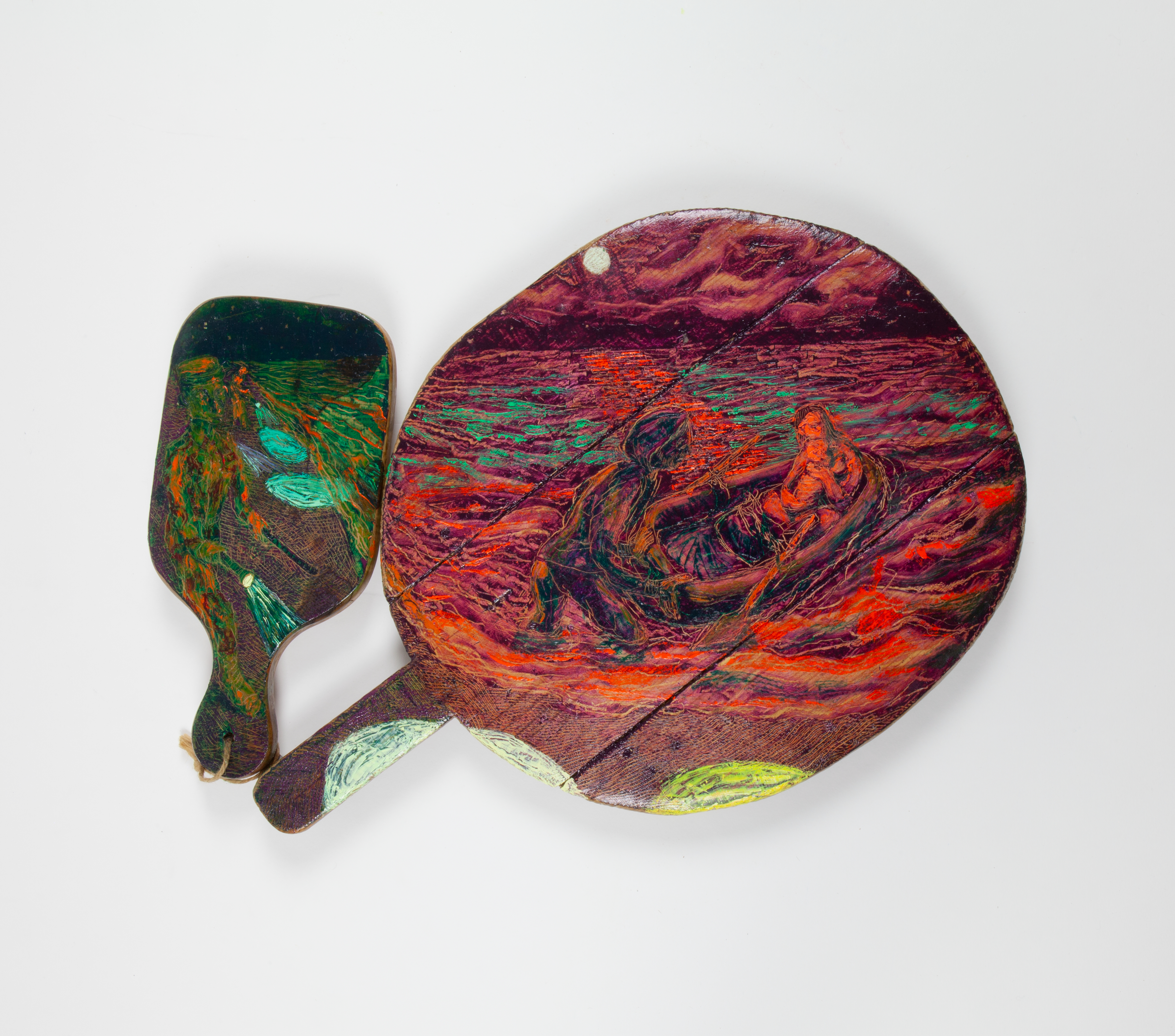
To protect their son from Herod’s murder decree, Mary and Joseph flee with him across the border to Egypt. Cazalet reimagines their flight through the lens of today’s refugee crisis. In station 9, the Holy Family boards an inflatable raft, braving choppy seawaters in search of asylum. They’re bathed in a menacing red.
On the adjoining panel, border patrol officers, with flashlights and batons, stand on the shore, seeking to bar the entry of strangers into their land.
Advent Station 10: The Exiles Return
Mark Cazalet, Advent Station 10: The Exiles Return, 2024
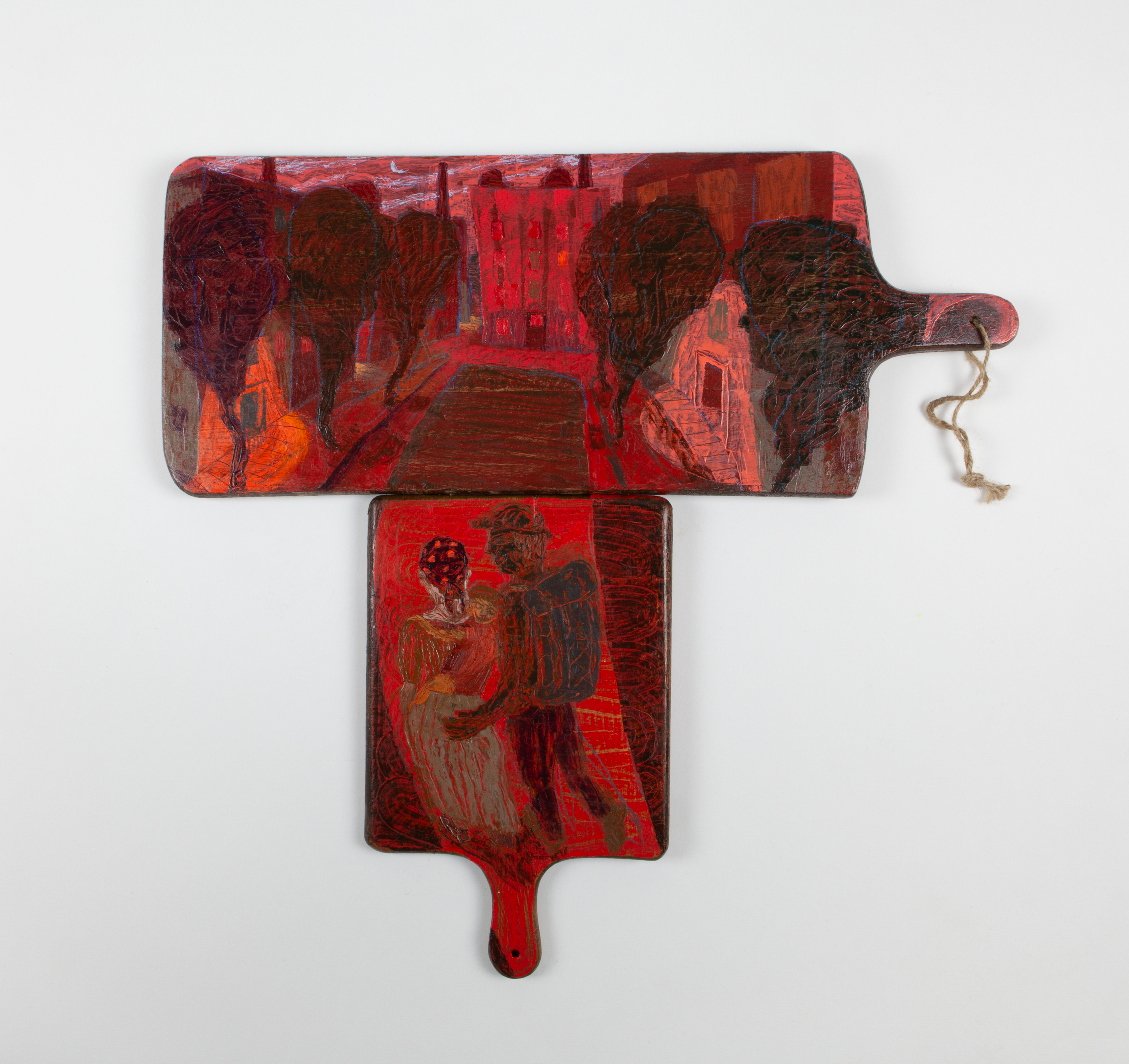
Egypt grants refuge to the Holy Family, and they settle there for an undisclosed period of time—until Joseph receives word from an angel that it’s safe to return to their homeland.
Station 10 shows the family arriving at sunset in their beloved Nazareth, all their belongings reduced to what could fit in a single backpack. As they approach a tree-lined boulevard, Jesus clings to his mother’s back, looking behind at where they’ve come from. He has not yet known this town but will come to love it. He will call it home until his ministry beckons him beyond it more than two decades later.
Advent Station 11: Faithful Waiting and Watching (Anna and Simeon)
Mark Cazalet, Advent Station 11: Faithful Waiting and Watching (Anna and Simeon), 2024
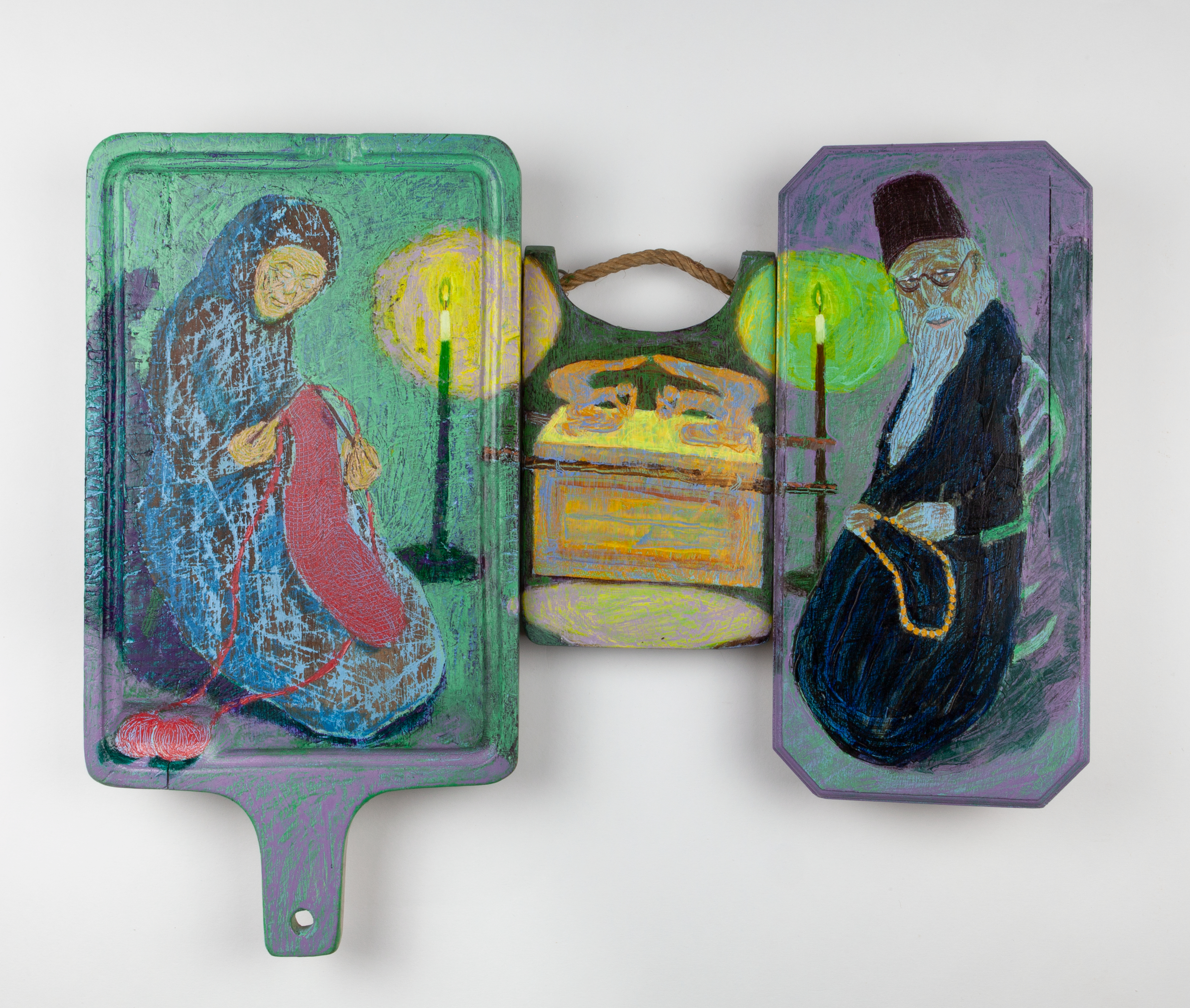
This is my favorite of all the stations. While the Presentation of Christ in the Temple is standard fare in Christian art—showing Mary handing Jesus to Simeon, a devout Jew interpreted by most artists as a priest, forty days after Jesus’s birth, with Joseph and the prophet Anna standing off to the side—Cazalet isolates the elderly Anna and Simeon, zeroing in on their faithful act of waiting for the Messiah.
Illuminated by candlelight, Anna knits a scarf, communing with God in the solitude, while Simeon fingers a string of prayer beads. Their eyes are weary and downcast, and yet they possess a steadfast hope that their Savior is on his way.
Linking their two spaces is the ark of the covenant, a sacred wooden storage chest plated in gold and topped by two hammered-gold cherubim. Containing the tablets of the law, Aaron’s rod, and a pot of manna, the ark was kept in the holy of holies, the innermost sanctum of the temple, where it signified God’s presence.
Waiting can often feel useless—like nothing’s happening or will ever happen. But Anna and Simeon continued to wait on the Lord, to count on his promise. And finally, before they died, they were granted the grace to see and to hold the One they had so fervently longed for: the Christ, Emmanuel, “God with us.”
Advent Station 12: The Mistle Thrush Greets the New Day
Mark Cazalet, Advent Station 12: The Mistle Thrush Greets the New Day, 2024
The Advent path we’ve just walked has included an unplanned pregnancy, persecution, and displacement but also miracles, play, and surprise.
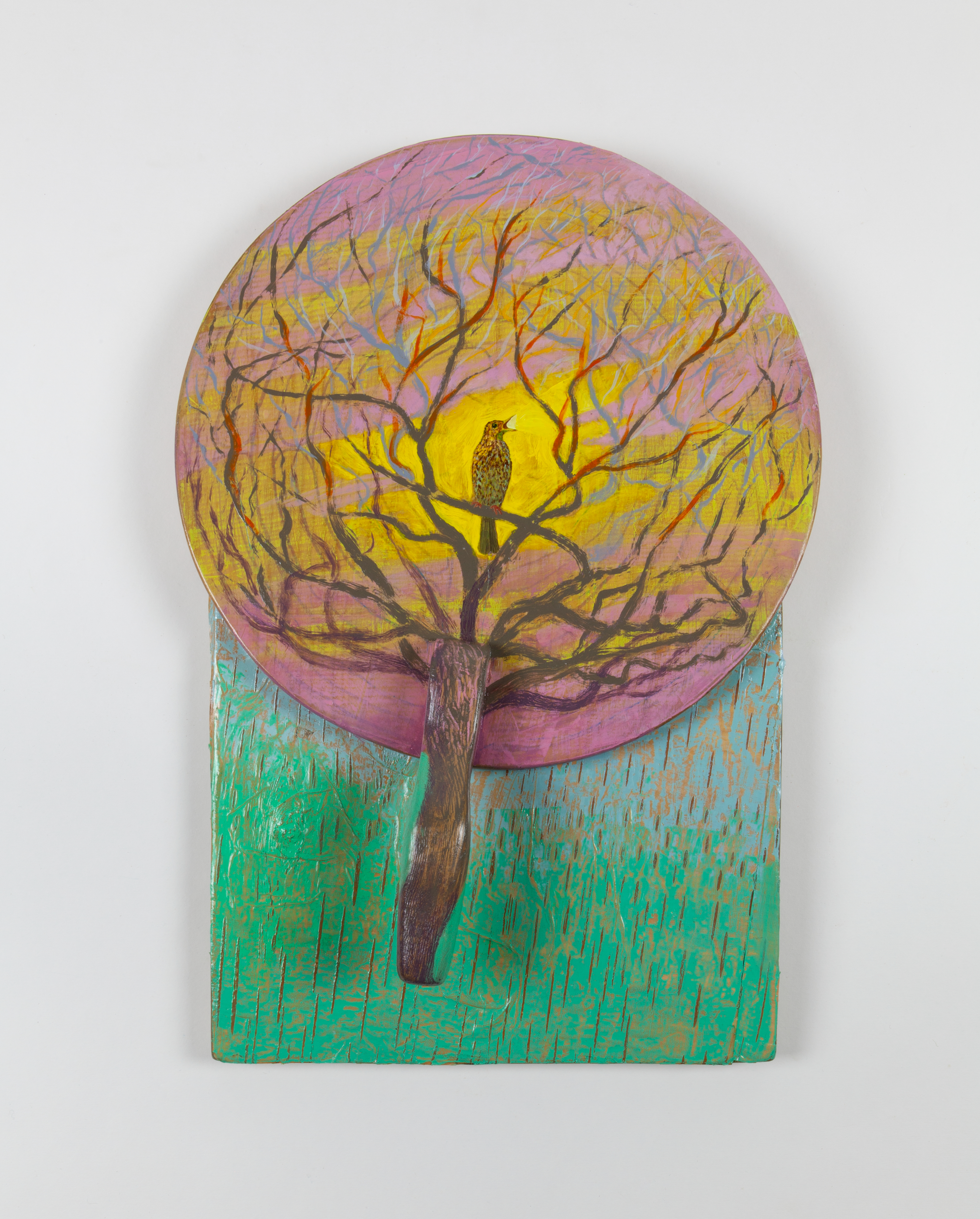
Cazalet’s Advent Stations end with a bird in a tree, singing its heart out as a pink and yellow dawn spreads across the sky. The twisted branches become streamers, blowing as if in celebration. (There’s that breath of God again!) Out of the bird’s beak shoots light.
The board that forms the grassy ground is incised with knife marks, perhaps suggesting woundedness—although maybe it’s a turning over of the soil to promote new growth.
The flame-like hues in and around the tree evoke the burning bush of Exodus 3, from which God spoke his name: I AM THAT I AM.
This Advent tree, bare yet lively, calls us to embrace each new day as a gift from the One who is and was and is to come, remembering how Christ came to show us who God is and to feel and heal our brokenness, and he will come again to make all things new.
The Advent Stations by Mark Cazalet, with accompanying poems by Richard Leaf rendered in calligraphy by Pansy Cambell, are on display at Chelmsford Cathedral in eastern England through February 2, 2026. They are available for sale, but until they’re purchased, Cazalet wants to show them in other churches and cathedrals. They’re tentatively scheduled for exhibition in Southwark Cathedral in London during Advent 2026.
LOOK: The Wise and Foolish Virgins, Norwegian tapestry
The Wise and Foolish Virgins, Norway, 17th century. Wool, bast fiber, 83 1/2 × 61 in. (212.1 × 154.9 cm). Minneapolis Institute of Art, Minneapolis, Minnesota.
The golden age of Norwegian tapestry (billedvev) spans roughly 1550 to 1800. Of all the woven subjects during this period, the Wise and Foolish Virgins was the most popular. The art historian Thor B. Kielland registered a total of seventy-five such tapestries from the seventeenth century alone. Draped over a bed, they would have provided warmth, decoration, and moral instruction. I love their aesthetic!
Jesus’s parable of the wise and foolish virgins comes from Matthew 25. Ten young women are members of a bridal party, and they’re awaiting the arrival of the bridegroom so that the celebration can start. In the tapestry pictured here, the top figures represent the wise virgins, whose oil-filled lamps indicate their readiness to accompany the bridegroom to the wedding feast. Those in the lower register, however, foolishly allowed their lamps to burn out; they weep into their handkerchiefs because the feasting started when they were out replenishing their oil supply, and now they’re too late.
That’s Christ the bridegroom in the upper right.
If I’m honest, this parable is uncomfortable for me. I don’t like that the neglectful women are locked out of the party. I don’t want anyone who wants in to be turned away. I want the bridegroom to show them grace, as the landowner did the day laborers who worked the vineyard for only one hour, giving them the same wage as those who worked for nine. But the parable of the virgins, with its stark sense of finality, is one of Christ’s teachings, so I want to grapple with it, not simply ignore it to suit my own proclivities.
I learned much about the existing body of Ten Virgins tapestries from rural Norway from Laura Berlage’s webinar “Dressing the Wise and Foolish Virgins: What Tapestry Can Teach Us About Women, Dress, and Culture in 16th and 17th Century Norway,” presented on July 17, 2023. She says the tapestries were made by women (unlike those produced by the guilds in Flanders and Paris), for women (they were used as bridal coverlets and included in dowries). They preached preparedness for young wives. “Good comes to those who are prepared,” Berlage elaborates; “you can’t get to heaven by borrowing someone else’s spiritual work.”
Regarding the headwear, Berlage clarifies: “The crowns the virgins wear are not because they’re princesses. There is a special tradition in Norway of wearing a crown at your wedding, which is an ancient nod to the Norse goddess Freja (later said to be an emblem of the Virgin Mary).”
Over time, Berlage says, the original meaning of the parable got lost, such that weavers no longer differentiated between the two sets of virgins, for example. She calls this phenomenon “image decay” and compares it to the telephone game.
For a shorter, less academic lesson on the ten virgins in Norwegian tapestry, see the six-minute video “Woven Wise and Foolish Virgins” by Robbie LaFleur:
LISTEN: “Himmelriket Liknas Vid Tio Jungfrur” (The Kingdom of Heaven Is Like Unto Ten Virgins) | Words from Then Swenska Psalmboken (The Swedish Hymnbook), 1697 | Traditional melody from Mockfjärd, collected by Nils Andersson in 1907 from Anders Frisell | Performed by Margareta Jonth on the album Religious Folk-Songs from Dalecarlia, 1977, reissued 1994
Himnelriket liknas vid tio jungfrur
som voro av olika kynne.
Fem månde oss visa vår tröga natur
Vårt sömnig och syndiga sinne.
Gud nåde oss syndare arma.

Vår brudgum drog bort uti främmande land
Och månde de jungfrur befalla
Sig möta med ljus och lampor i hand
Enär som han ville dem kalla.
De fävitske dröjde för länge.

De ropa: O Herre, o Herre låt opp,
Låt oss icke bliva utslutna!
Men ute var nåden, all väntan, allt hopp
Ty bliva de arma förskjutna
Till helvetets jämmer och pina.

Så låter oss vaka och hava det nit
Att tron och vår kärlek må brinna.
Vi måge här följa vår brudgum med flit
Och eviga salighet finna.
Det himmelska bröllopet. Amen.
The kingdom of heaven is like unto ten virgins Who were of different character. Five showed us our slothful nature, Our sleepy and sinful selves. God have mercy on us poor sinners.
Our bridegroom traveled in foreign lands And ordered the virgins To meet him with lighted lamp in hand Whenever he called them. The foolish ones waited too long.
They cry, “O Lord, O Lord, open up, Let us not be locked out!” But it was too late for mercy, for waiting, for hope, For the poor souls were cast Into hell’s wailing and torment.
So let us watch and show zeal That faith and our love may burn. Let us follow our bridegroom diligently And find eternal bliss, The heavenly wedding. Amen.
His face was like the sun shining with full force.
—Revelation 1:16
[. . .] make ready for the Face that speaks like lightning, Uttering the new name of your exultation Deep in the vitals of your soul. Make ready for the Christ, Whose smile, like lightning, Sets free the song of everlasting glory That now sleeps, in your paper flesh, like dynamite.
—Thomas Merton, from “The Victory” (1946)
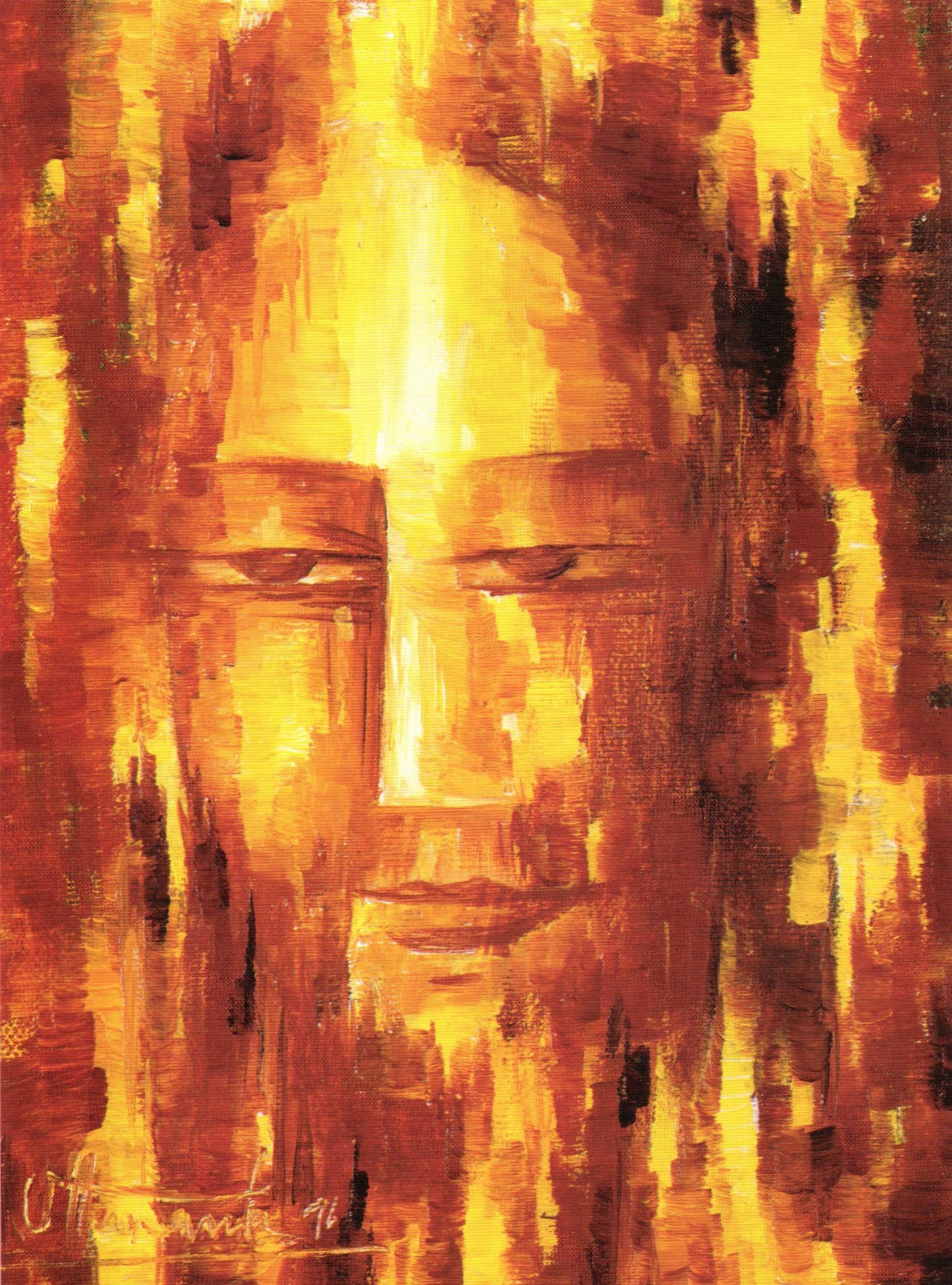
LOOK: Portrait of Jesus by Hatigammana Uttarananda
Hatigammana Uttarananda is a Sri Lankan Buddhist monk, artist, and scholar. His friendship with Fr. Aloysius Pieris, SJ—a Jesuit priest, liberation theologian, and founding director of the Tulana Research Centre for Encounter and Dialogue in Kelaniya—led him to study the Christian Gospels and to portray some of its stories in his paintings.
In his semiabstract Portrait of Jesus, Christ’s face gives off a deep radiance. He is both enlightened and enlightening.
“Bikku Uttarananda portrays Jesus with lowered eyelids, the enlightened one who has found the true meaning of life and is united in compassion with the suffering of all beings,” writes the Christian theologian Wesley Ariarajah in Christ for All People: Celebrating a World of Christian Art. “The rays of the light of life burst through his forehead; the colours are those of the saffron robes of the Buddhist monk and the fire of self-giving.”
LISTEN: “When Jesus Comes,” African American spiritual | Arranged by Alice Parker, 1988, and performed by The Musicians of Melodious Accord on Listen, Lord: A Cantata, Two Suites, and Eight Spirituals, 2010
When Jesus comes, he’ll outshine the sun Outshine the sun Outshine the sun When Jesus comes, he’ll outshine the sun Look away beyond the moon
When Jesus comes, we’ll sing Hosiana! . . .
When Jesus comes, we’ll shout Hallelujah! . . .
If you want to see King Jesus, keep prayin’ on . . .
Alice Parker (1925–2023) was an American composer, arranger, conductor, and teacher whose arrangements of hymns, spirituals, and folk songs of American, French, Spanish, Hebrew, and Ladino origin have become part of the repertoire of choirs around the world. In addition to arrangements, she also wrote original works, including operas, song cycles, cantatas, choral suites, and hymns. In 1985 she founded the professional choir Melodious Accord, with whom she released fourteen albums.
For the African American spiritual “When Jesus Comes,” she cites her source as The Negro Sings a New Heaven, a collection compiled by Mary Allen Grissom (University of North Carolina Press, 1930).
I saw one like a son of man coming with the clouds of heaven. And he came to the Ancient One and was presented before him.
—Daniel 7:13
“Immediately after the suffering of those days
the sun will be darkened, and the moon will not give its light; the stars will fall from heaven, and the powers of heaven will be shaken.
“Then the sign of the Son of Man will appear in heaven, and then all the tribes of the earth will mourn, and they will see ‘the Son of Man coming on the clouds of heaven’ with power and great glory. And he will send out his angels with a loud trumpet call, and they will gather his elect from the four winds, from one end of heaven to the other.”
—Matthew 24:29–31
“. . . you will see the Son of Man seated at the right hand of Power and coming on the clouds of heaven.”
—Matthew 26:64
Look! He is coming with the clouds; every eye will see him, even those who pierced him, and all the tribes of the earth will wail on account of him.
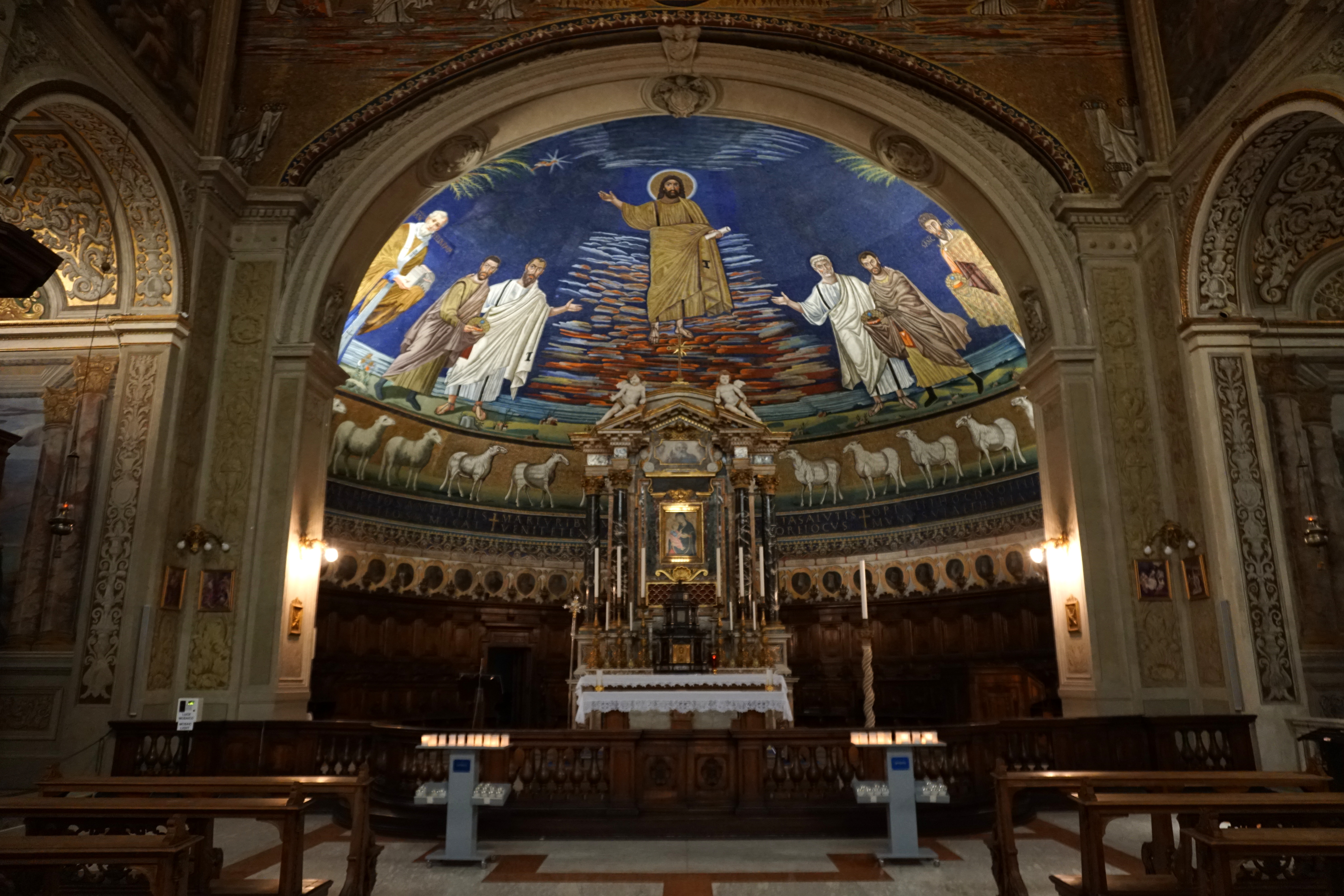
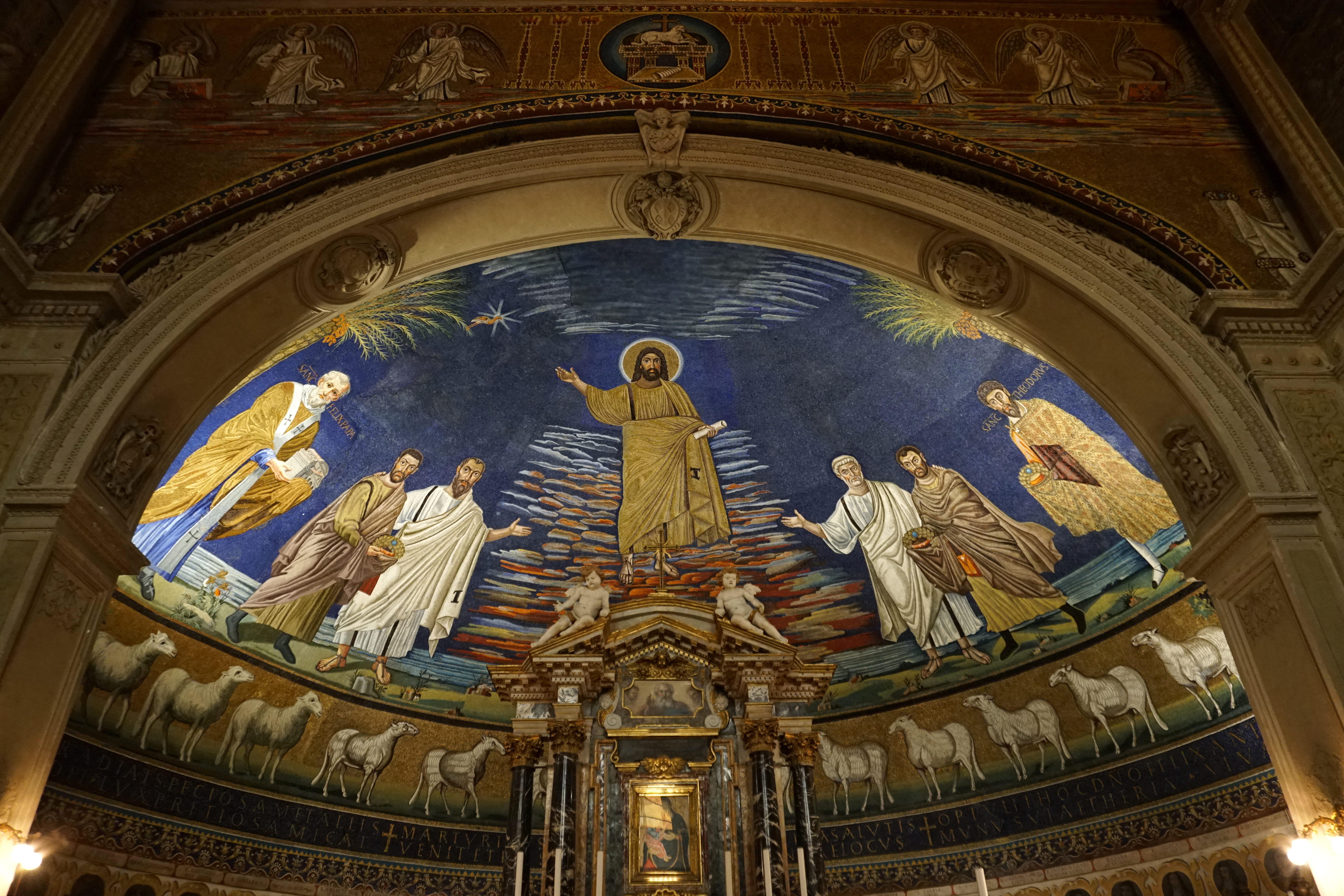
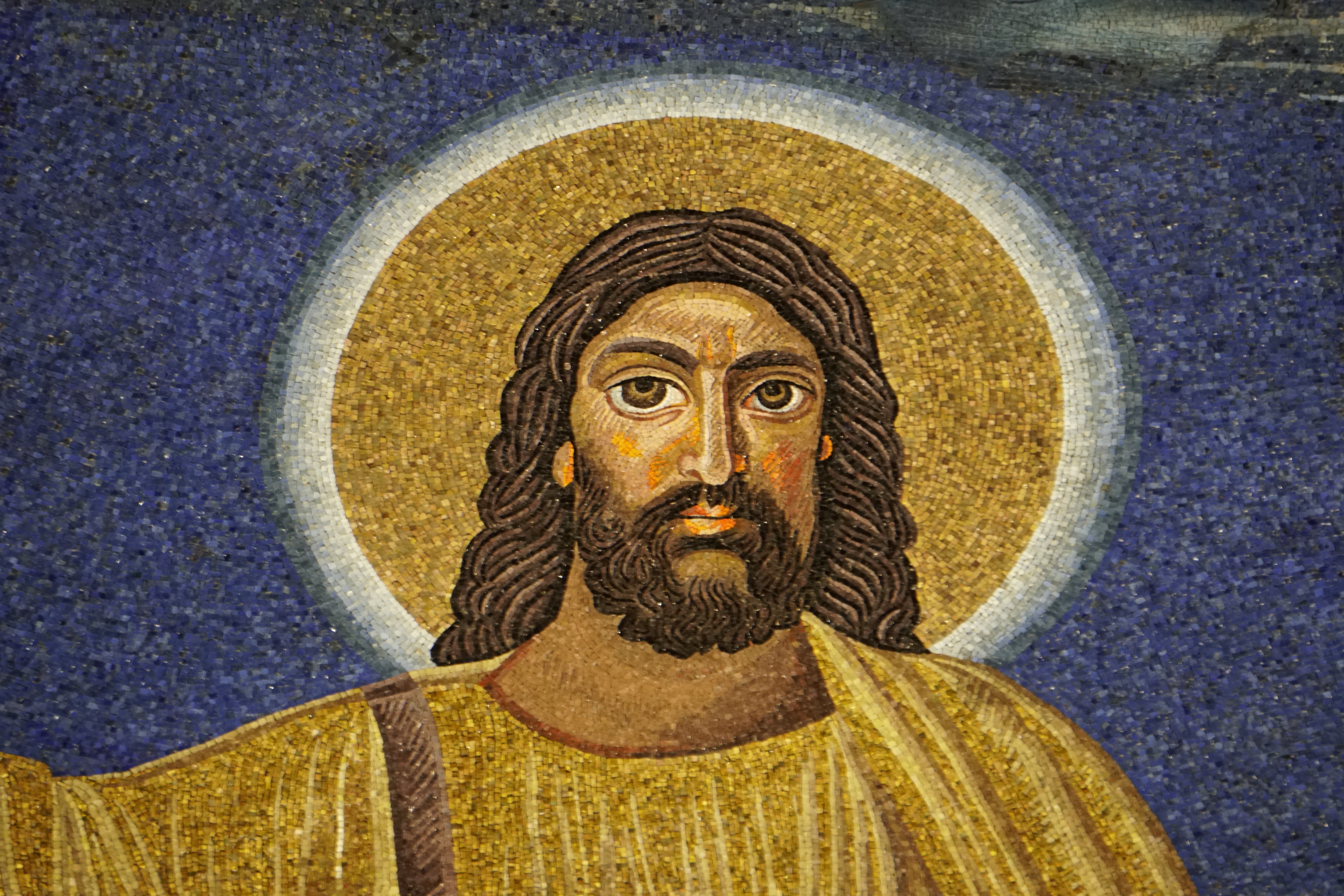
LOOK: Apse mosaic, Basilica of Saints Cosmas and Damian, Rome
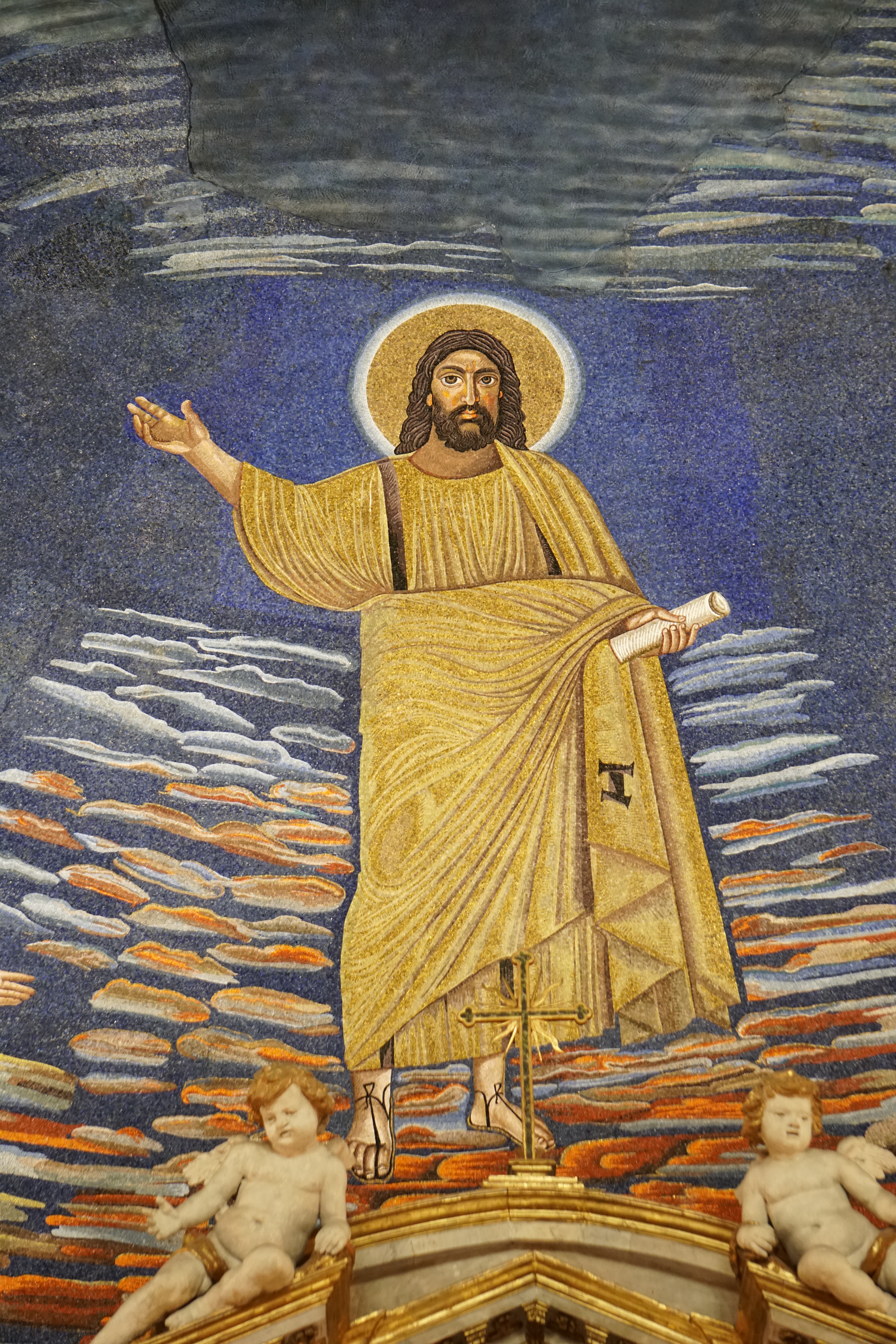
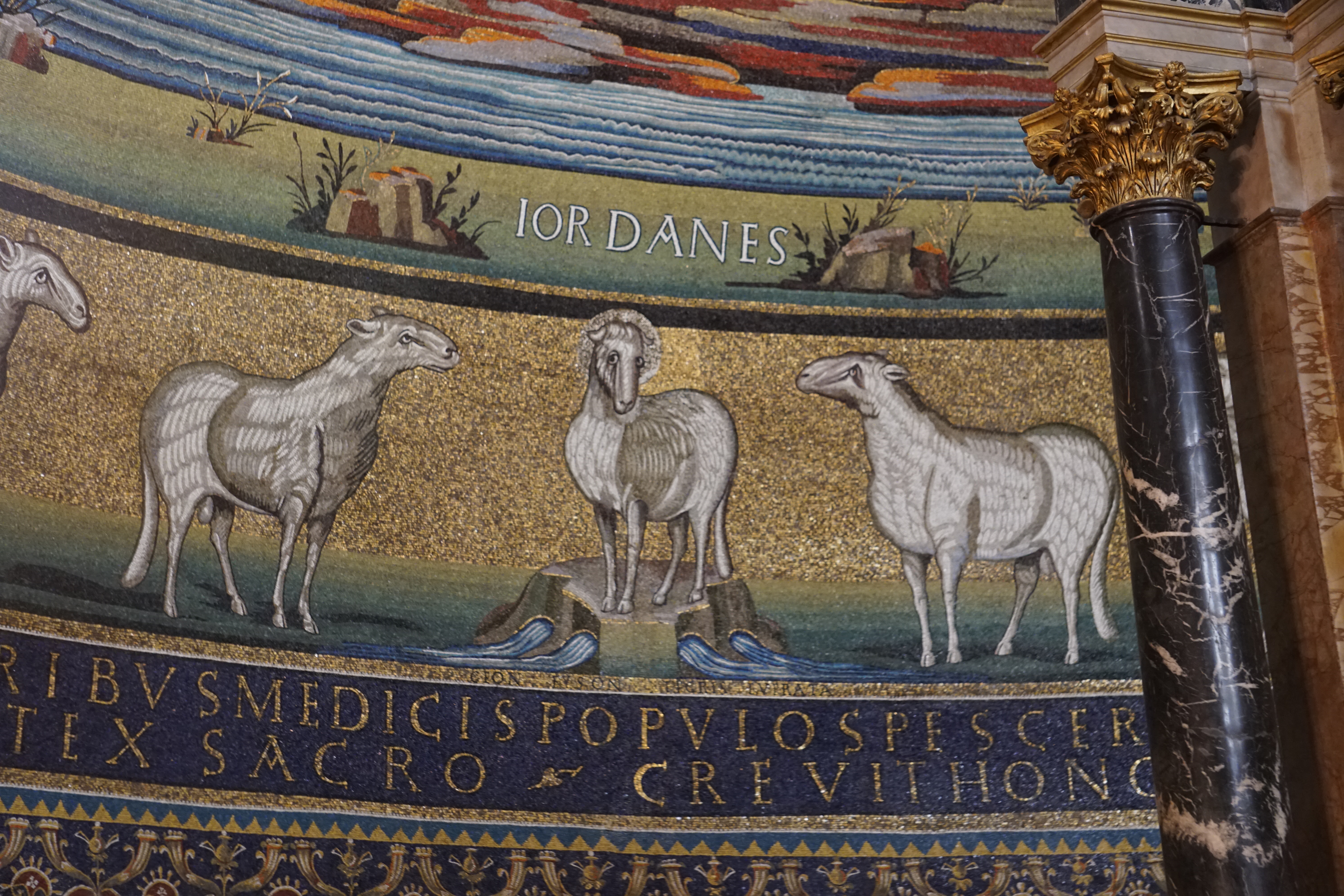
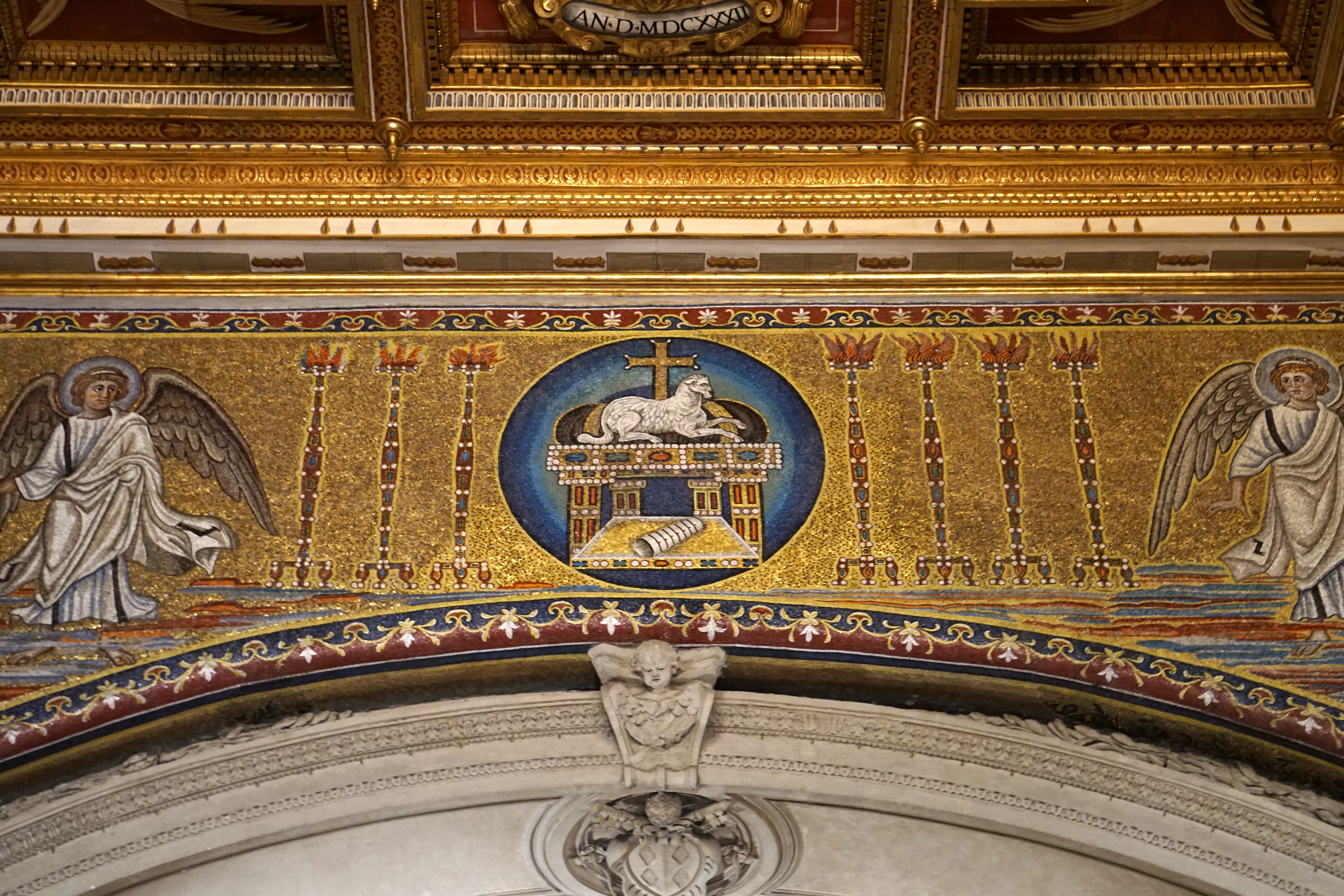
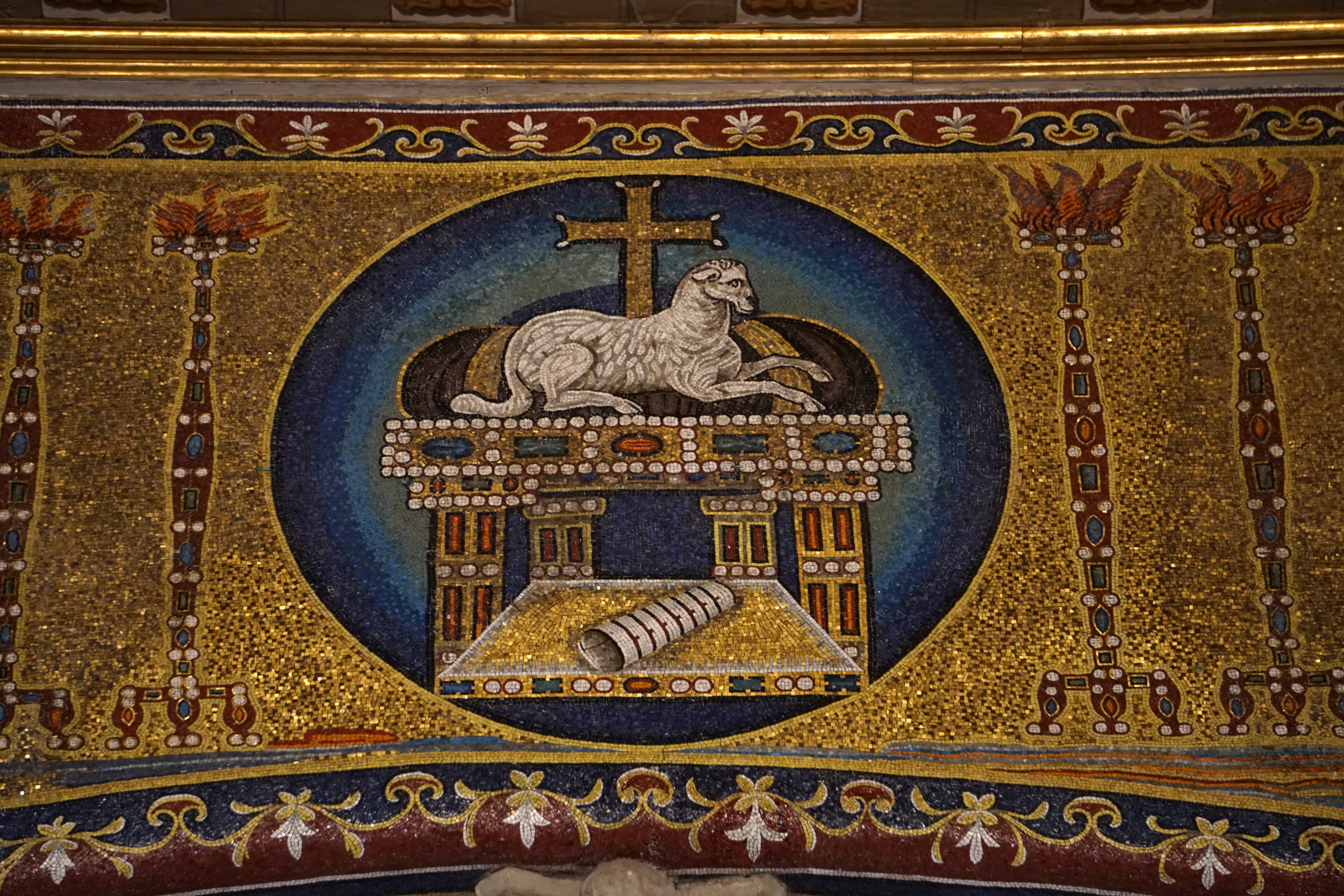
The Second Coming of Christ, ca. 526–30. Mosaic, Basilica of Santi Cosma e Damiano (Saints Cosmas and Damian), Rome. All photos by Victoria Emily Jones.
This Roman-Byzantine mosaic decorates the apse (large semicircular recess at the east end of a church) of a basilica in Rome dedicated to the Christian martyr-saints Cosmas and Damian, twin brothers from third-century Arabia. Cosmas and Damian (Cosma and Damiano in Italian) were physicians who, out of love for Christ and humanity, treated their patients free of charge. They were killed in the Diocletian persecution, one of the Roman Empire’s attempts to squelch Christianity.
Situated behind the altar—and partially obscured by a hideous Baroque altarpiece with putti that was added in the seventeenth century—the mosaic depicts the parousia, the second coming of Christ. Christ is bearded and notably dark-skinned, and he wears a golden toga edged with purple. In his left hand he holds a rolled-up scroll, and his right hand he raises to indicate a phoenix in a palm tree—a mythological bird that rose from its own ashes, a potent symbol of resurrection that was adopted by the early Christians.
Descending from the heavens on dramatically colored clouds, Christ is portrayed as a triumphant ruler worthy of worship.
He is flanked by Peter and Paul, who present Cosmas and Damian. The figures on the extreme left and right are Pope Felix IV (r. 526–30), who paid to convert a pagan temple into the present church and to have it decorated with mosaics, and Theodore, another martyr under Diocletian. Cosmas, Damian, and Theodore lay down the crowns of their martyrdom before Christ, and Felix does the same with a model of the church he built.
The inscription at the base of the mosaic tells us that “Felix has offered this gift worthy of the lord bishop so that he may live in the highest vault of the airy heavens.” (If you balk at that, I do too; that you can buy your way to heaven, that you can earn favor with God or remit your punishment for sin through expensive gifts, is a false belief that still persists today in some corners of popular culture and even the church. I’m grateful for wealthy donors to the church throughout history, whose funds have enabled, among other things, the creation of beautiful art—but I must reckon with the fact that sometimes their motives were misguided and self-serving.)
Below the primary scene is a band of twelve sheep, which represent the apostles, or the Christian flock more generally. They process toward the Agnus Dei (Lamb of God), who stands on a rock from which flow the four rivers of paradise.
Based on further imagery from the book of Revelation, the arch that frames the apse depicts the Lamb seated upon the throne, a scroll with seven seals laid before him. He is flanked by seven lampstands, angels, and (not pictured) symbols of the Four Evangelists.
Refrain: God is coming on the clouds Yes, he said God is coming on the clouds Yes, he said May be morning, noon, or night Better get all your business right God is coming on the clouds Yes, he said
When the clouds turn dark as night And there ain’t no light in sight When the world begins to tremble Won’t that be an awful night You better get in a hurry My Lord is coming soon Oh, he’s coming on the clouds Yes, he said [Refrain]
Oh Lord, please give me power Stay with me every hour I just been waiting here praying For your Holy Ghost power God, you been my friend I know you freed me from sin Yeah, you coming on the clouds Yes, he said [Refrain]
“See, I am sending my messenger ahead of you, who will prepare your way, the voice of one crying out in the wilderness: ‘Prepare the way of the Lord; make his paths straight,’”
so John the baptizer appeared in the wilderness, proclaiming a baptism of repentance for the forgiveness of sins. And the whole Judean region and all the people of Jerusalem were going out to him and were baptized by him in the River Jordan, confessing their sins. Now John was clothed with camel’s hair, with a leather belt around his waist, and he ate locusts and wild honey. He proclaimed, “The one who is more powerful than I is coming after me; I am not worthy to stoop down and untie the strap of his sandals.I have baptized you with water, but he will baptize you with the Holy Spirit.”
—Mark 1:1–8
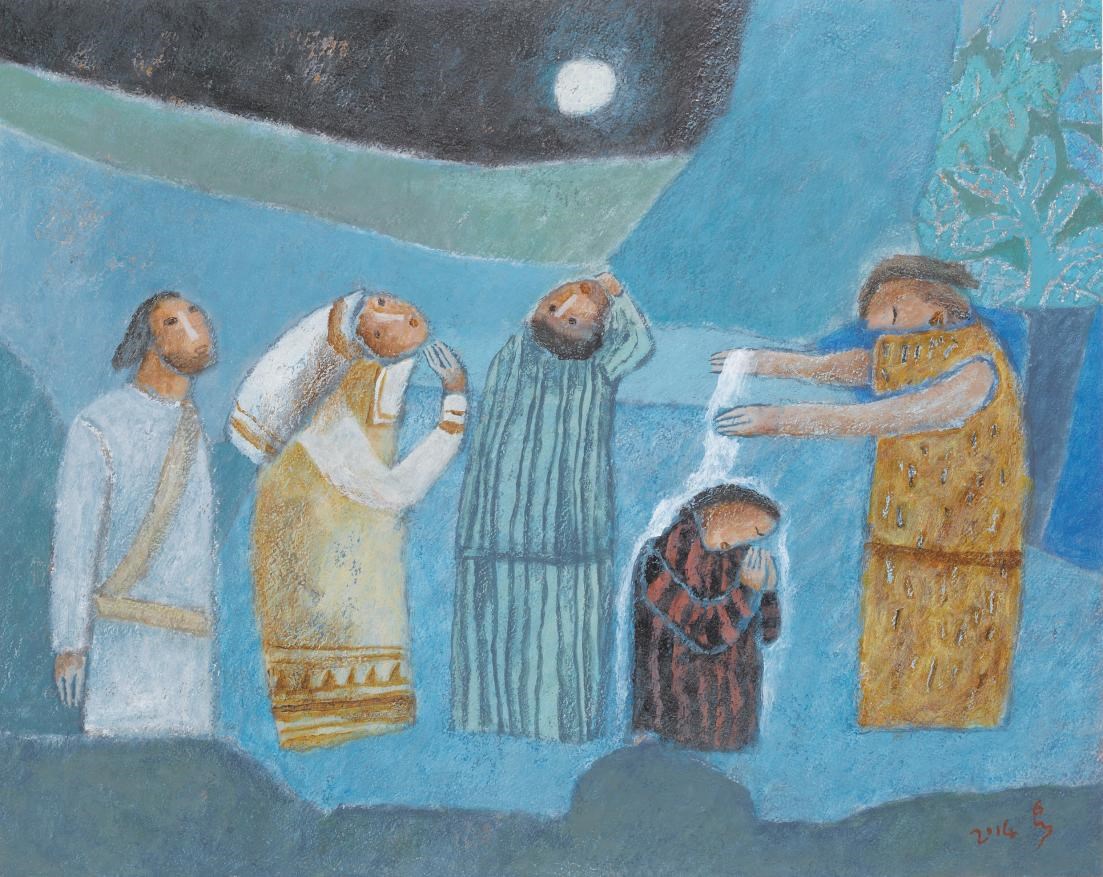
LOOK: Waiting for the Messiah by Sister Kim Ok-soon
LISTEN:“Hallelujah Sang the People” by Bruce Spelman, on You Don’t Know What You’re Paddling In (1972); reissued on the anthology album All God’s Children: Songs from the British Jesus Rock Revolution, 1967–1974 (2023)
John the Baptist came onto the earth He came by natural birth Though his parents, they were old and they were gray John the Baptist called unto the crowds: “There’s gonna come a day When Christ the Savior comes down from the clouds!”
John the Baptist went down to the stream His thoughts were like a dream Yet he was sure that Christ was soon to come The people gathered round at Jordan’s side Where they could be baptized And no one who came there would be denied
Refrain: “Hallelujah!” sang the people God the Son is coming down “Hallelujah!” sang the people Our Savior’s coming down
Jesus Christ will come down to the earth A lowly man by birth And yet he truly is the Son of God He will come to earth to set us free From sin and misery Oh, and still his life will end in tragedy
But his message will be heard abroad The teaching of the Lord And the people will believe the words he speaks He must surely be the holy Son The prophet said he’d come The Father, Son, and Spirit, all are one [Refrain ×2]


 Art & Theology