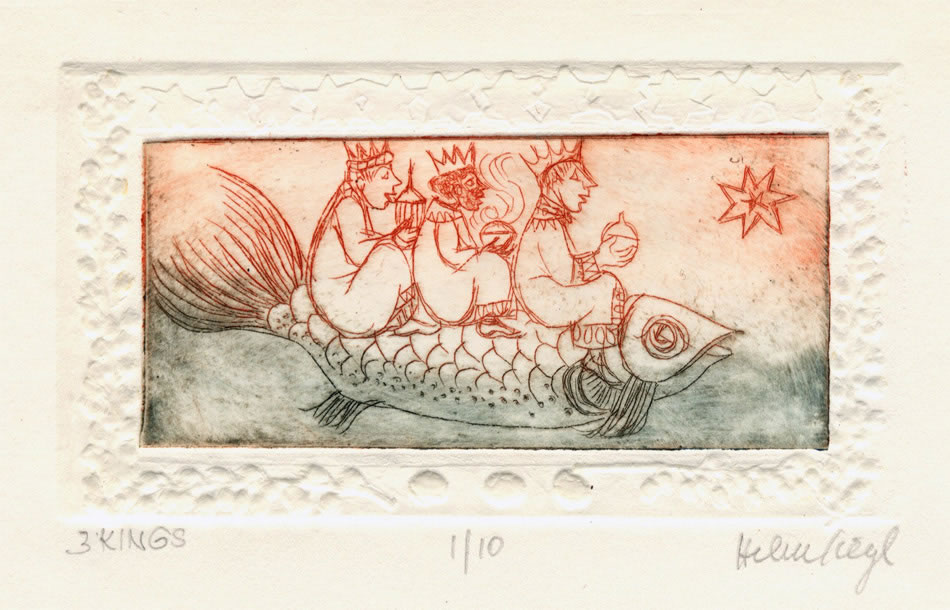
Helen Siegl (Austrian American, 1924–2009), 3 Kings, n.d. Etching and collagraph, 3 × 5 in. (7.6 × 12.7 cm).
Ah, such whimsy!
LISTEN: “We Three Cool Kings” | Words and music by John H. Hopkins, 1857 | Arranged by Eugene Gwozdz, 2015 | Sung by Alan H. Green, Mykal Kilgore, Dennis Stowe, Nili Bassman, Josh Davis, Kevin Smith Kirkwood, Linda Mugleston, Brian O’Brien, Mary Michael Patterson, Mike Schwitter, and Rashidra Scoti on Broadway’s Carols for a Cure, vol. 17, 2015
We three kings of Orient are; bearing gifts, we traverse afar, field and fountain, moor and mountain, following yonder star.
O star of wonder, star of light, star with royal beauty bright, westward leading, still proceeding, guide us to thy perfect light.
Born a king on Bethlehem’s plain, gold I bring to crown him again, King forever, ceasing never, over us all to reign.
Frankincense to offer have I; incense owns a Deity nigh; prayer and praising, voices raising, worshipping God most high.
Myrrh is mine; its bitter perfume breathes a life of gathering gloom; sorrowing, sighing, bleeding, dying, sealed in the stone-cold tomb.
Glorious now behold him arise, King and God and Sacrifice: Alleluia, Alleluia, sounds through the earth and skies.
This jazzified version of the Christmas classic “We Three Kings” is performed by the Broadway cast of At This Performance… Written in the voices of the magi (whose traditional names are Caspar, Melchior, and Balthazar), it propounds the symbolic significance of the three gifts they give to the Christ child. I love how the arranger has layered those middle three verses!
Launched in 1999, Carols for a Cure is an annual collection of seasonal songs sung by members of the Broadway and Off-Broadway theater community to raise money for the charity Broadway Cares / Equity Fights AIDS. Its latest volume, number 21, was released in 2019.
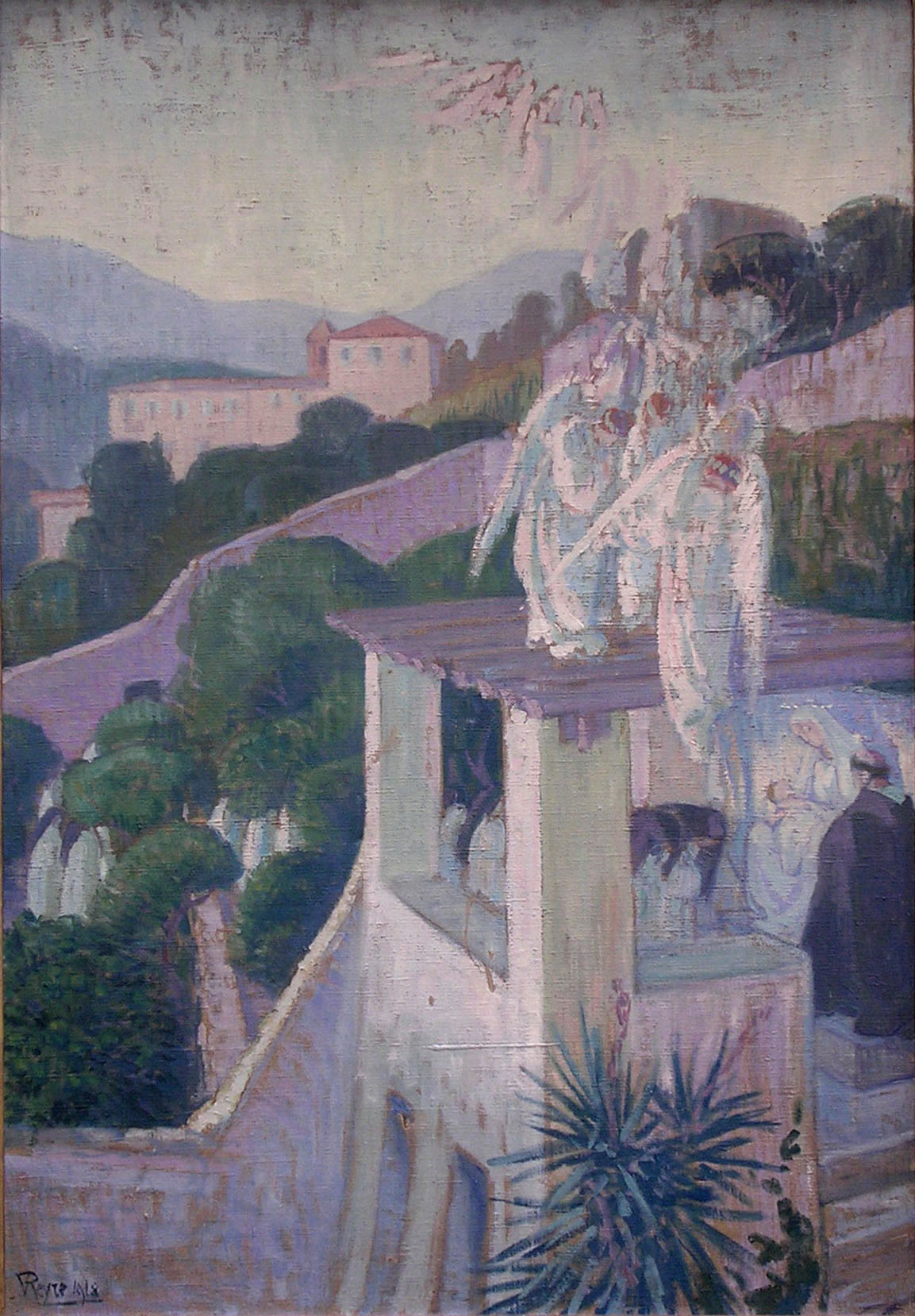
Valentine Reyre was a French artist who participated in the revival of religious art in the first half of the twentieth century. She was the cofounder, with Maurice Storez and Henri Charlier, of L’Arche, a group of Catholic artists and architects active from 1919 to 1934. She also participated in the Ateliers d’art sacré, a movement that sought to reconcile tradition and modernity, art and craft, in the decoration of church interiors, especially those devastated by World War I. Members of the Ateliers—the most famous of which were Maurice Denis and George Desvallières—rejected academism on the one hand and the avant-garde (e.g., futurism, cubism) on the other, seeking a third way forward for religious art.
Reyre’s Dominican Nativity is set outside a Dominican convent in the hills of France. The focal point is the Virgin Mary and the infant Jesus, clothed in white and seated under a small, open, roofed structure. It’s deliberately ambiguous as to whether these figures are meant to be present in the flesh in this space or are a statue; in other words, is this the holy birth transplanted to another time and place, occurring as if for the first time, or is it the birth memorialized? Either way, a procession of nuns winds through the tree-studded landscape to offer their worship and devotion to Christ, their shaping mirrored by the ribbon of angels that unfurls from distant sky to the foregrounded rooftop. The adult male figure at the right is probably Saint Dominic, the medieval Castilian priest who founded the Dominican order, as he is tonsured and wears a habit.
I love the intersection of time and eternity in this image—heaven breaking into the everyday. A community of sisters bows in prayer and re-members Christ’s Nativity.
LISTEN: Hymns and Sacred Songs, FS 83: No. 1. Förunderligt at sige | Words by Nikolai F. S. Grundtvig, 1845 (reworked from “Mit hierte altid vanker” [“My Heart Always Wanders”] by Hans Adolph Brorson, 1732) | Music by Carl Nielsen, 1919 | Performed by the Svanholm Singers, dir. Sofia Söderberg Eberhard, on December, 2010
Forunderligt at sige, Og sært at tænke paa, At Kongen til Guds Rige I Stalden fødes maa, At Himlens Lys og Ære, Det levende Guds Ord, Skal huusvild blandt os være, Som Armods Søn paa Jord!
Selv Spurven har sin Rede, Kan bygge der og boe; En Svale ei tør lede Om Nattely og Ro; De vilde Dyr i Hule Har hver sin egen Vraa: Skal sig min Frelser skjule I fremmed Stald paa Straa?
Nei, kom! jeg vil oplukke Mit Hjerte, Sjæl og Sind, Ja, bede, synge, sukke: Kom, Jesus, kom herind! Det er ei fremmed Bolig, Du den har dyrekiøbt! Her skal du hvile rolig, I Kiærligheden svøbt!
How wonderful to sing of, And strange to think at all, The sovereign of God’s kingdom Is born within a stall, All heaven’s light and honour, God’s living word, e’en he, On earth shall homeless wander, The son of poverty.
The sparrow, with her nesting, Can build herself a home; We find the swallow resting, At night she needn’t roam. The wild beasts abide in The burrows where they stay. Shall then my Saviour hide in An unknown stall on hay?
No, come, I’ll open to thee My heart, my soul, my mind. I’ll pray and sing and sue thee, “Come, Jesus, come inside!” For here thou art no stranger; This home thou dearly bought. Rest now within this manger In swaddling love has wrought.
Jenny Rebecca Rytting describes this Danish carol’s complex textual history, starting with its origins in an eighteenth-century carol by the Danish bishop and hymn-writer Hans Adolph Brorson. Brorson’s text has eleven verses; Nikolai F. S. Grundtvig cut it down to six in 1837, adapting these verses but following Brorson’s wording fairly closely. In 1845 Grundtvig made “extensive changes” to his initial reworking of the carol and published it in a booklet of his hymns. Much later, in 1939, the editors of Højskolesangbogen (The Folk High School Songbook) published Grundtvig’s text with only three verses (verses 1, 5, and 6 of his 1845 version). That’s the version that’s most often used today. Rytting has produced an English translation, posted above. For a translation of all six verses, albeit one that’s a bit clumsy, see here (scroll down to #50, “How wonderful to ponder”).
Carl Nielson, widely recognized as Denmark’s most prominent composer, wrote a musical setting for “Förunderligt at sige” in 1914 (in a letter to his wife at the time, he described it as “the most beautiful I have yet composed”), and it was first published in 1919. Cataloged as CNW 165, it is now considered the standard tune for the carol.
The text is inspired in part by Jesus’s words in Matthew 8:20: “Foxes have holes, and birds of the air have nests; but the Son of Man has nowhere to lay his head.” He was born in an out-of-town stable, lived as a stranger in Egypt, and spent years as an itinerant preacher, never staying for too long in any one place. The speaker invites the wandering Christ to take up permanent residence within her, as he has already bought her (Gal. 3:13; 1 Cor. 6:20). Her love, she says, will provide the swaddling, a cozy warmth.
LOOK: The Passion of Mary by Katherine Kenny Bayly
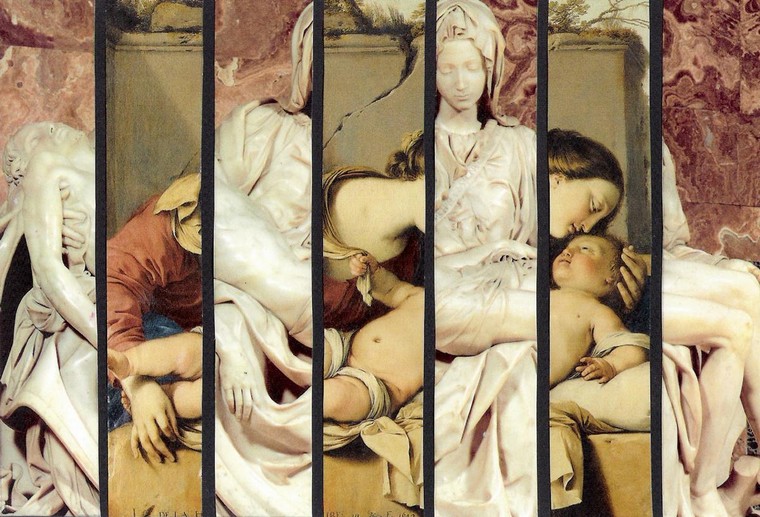
Katherine Kenny Bayly (American, 1945–), The Passion of Mary, before 2006. Collage on paper, 8 × 12 in.
This collage by Katherine Bayly is from the 2006 CIVA traveling exhibition Highly Favored: Contemporary Images of the Virgin Mary. In seven alternating vertical bands, it combines Michelangelo’s Pietà from St. Peter’s Basilica with a Virgin and Child painting by Laurent de La Hyre, showing Christ’s birth and death as two sides of the Incarnation coin. One can hear echoes of Simeon’s prophecy to Mary, that “a sword will pierce your own soul too” (Luke 2:35)—a veiled reference to the Crucifixion.
Since the Middle Ages artists have often embedded symbolic or other visual references to Christ’s passion in Nativity paintings—a goldfinch, a coral rosary, a bunch of grapes, a cave that recalls the tomb, swaddling bands that look like burial wrappings, a manger that looks like a sarcophagus or altar, or, more explicitly, angels holding the arma Christi (instruments of the passion). Sometimes artists would use a diptych format to juxtapose images of Mary holding Jesus as a vibrant young infant with her holding him as a pale adult corpse deposed from the cross, a pairing that strikes an emotional tenor, as there’s perhaps no deeper grief than a mother’s loss of a child. Bayly draws on this tradition in The Passion of Mary, foreshadowing a future sorrow and reminding us that Christ came to earth not only to live but also to die.
LISTEN: “Baby Boy” by Rhiannon Giddens, on Freedom Highway (2017)
Baby boy, baby boy, don’t you weep Baby boy, baby boy, don’t you weep You will be our savior But until then, go to sleep
Young man, young man, I’ll watch over you Young man, young man, I’ll watch over you While you lead our people to the promised land I will shelter you
Baby boy (Young man) Baby boy (Young man) Don’t you weep (I will watch over you) Baby boy (Young man) Baby boy (Young man) Don’t you weep (I will watch over you) You will be (You will be) Our savior But until then, go to sleep
Beloved, beloved, I will stand by you Beloved, beloved, I will stand by you When you leave this place to do what you must I will always love you
Baby boy (Young man) (Beloved) Baby boy (Young man) (Beloved) Don’t you weep (I will watch over you) (I will stand by you) Baby boy (Young man) (Beloved) Baby boy (Young man) (Beloved) Don’t you weep (I will watch over you) (I will stand by you) You will be (You will be) Our savior But until then, go to sleep
Poignantly performed by Rhiannon Giddens [previously], Lalenja Harrington, and Leyla McCalla, “Baby Boy” is a lullaby written in the voice of a mother to her son, her salvation, whom she sings to sleep. She pledges to always watch over, shelter, and support him to the best of her ability.
The subject of the song could be Moses and the speaker his birth mother, Jochebed, as there’s mention of him leading his people to the promised land. This boy will grow up to shepherd a nation into its rest.
Or it could be Jesus, the New Moses, who liberated humanity at large, breaking their bondage to the powers of evil. Remembering the angel’s promise, Mary whispers her grand hopes to this cuddly little bundle she holds who will be their fulfillment, even as she shushes his cries.
Note, though, how there are three voices singing—a trio of women, a sisterhood united in their love of this child and their eager expectation of deliverance. Think of the women who, against all odds, ensured Moses’s protection as a young one and those who later walked alongside him in his difficult calling. Think, too, of all the women who supported Christ throughout his ministry, materially and spiritually, standing by him until the end, mourning his death, and spreading the news of his resurrection. One might imagine this song being sung by the three Marys, for example. They have a faint sense of the danger ahead and know the hero Jesus will become, but for now, they simply wish him sound slumber and sweet dreams. “Until then . . .”
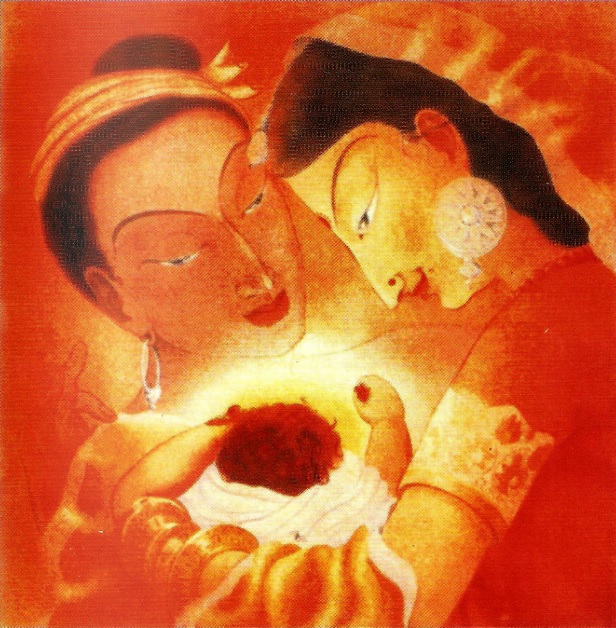
Frank Wesley (Indian, 1923–2002), Holy Family in Saffron, ca. 1950. Watercolor, 21 × 16 cm. Gould Collection. Photo courtesy of the Asian Christian Art Association.
Frank Wesley [previously] was a fifth-generation Christian from North India who began painting biblical subjects in 1947 when the Christian Home Committee of the National Christian Council of India began licensing original images from him for their magazine, a relationship that lasted for decades. His initial training had been in commercial art, but from 1950 to 1952 he studied as a postgraduate at the School of Art in Lucknow under the Hindu artist Bireshwar Sen, kickstarting his fine-art career. The Lucknow school of watercolor painting, developed during the Bengal Renaissance in the first half of the twentieth century, is the style with which he is most associated, and which the above painting is representative of, with its graceful, calligraphic lines.
With the aid of an American patron, Wesley continued his art education at Kyoto Art University from 1954 to 1958, where he learned traditional and modern Japanese painting techniques, lacquer work, textile design, woodblock printing, and ink drawing, and in Chicago from 1958 to 1960, which included coursework at the Art Institute, where he learned about modern abstraction and how to work with oil paint.
Wesley returned to India in 1960 and, after a four-year courtship, married Athalie Brown, an Australian nurse working in a mission hospital in Azamgarh. They had two children. Seeking better opportunities, he emigrated to Australia with his family in 1973 and lived there until his death in 2002. Even in his new adopted country, he continued painting biblical scenes in an Indian style.
You can view thumbnails of other paintings by Frank Wesley at www.frankwesleyart.com. For better-quality reproductions along with more detailed biographical information, there’s the book Frank Wesley: Exploring Faith with a Brush by Naomi Wray (Auckland: Pace Publishing, 1993), but it’s out of print and difficult to find.
“Joseph dearest, Joseph mine, Help me cradle the Child divine. God reward thee and all that’s thine, In paradise,” so prays the mother Mary.
He came among us at Christmastide, At Christmastide, in Bethlehem; Men shall bring him from far and wide Love’s diadem: Jesus, Jesus, Lo, he comes, and loves, and saves, and frees us!
“Gladly, dear one, Lady mine, Help I cradle this Child of thine.” “God’s own light on us both shall shine, In paradise,” as prays the mother Mary.
All shall come and bow the knee; Wise and happy their souls shall be, Loving such a divinity as all may see In Jesus, son of Mary.
Sweet and lovely, little one, Princely, beautiful, God’s own Son, Without thee all of us were undone; Our love is won by thine, O son of Mary.
* Some sources cite Neville S. Talbot as the translator; I’m going with The Oxford Book of Carols, whose original 1928 edition, and subsequent ones, name Dearmer.
RESONET IN LAUDIBUS (Let the voice of praise resound) is a fourteenth-century German carol tune associated with a carol text of the same name as well as with “Josef lieber, Joseph mein.” The latter carol is from a medieval mystery play from Leipzig that survives in multiple manuscripts. It spotlights Joseph’s faithful presence and loving support during Christ’s infancy.
The original carol did not have a refrain; an unknown editor spliced that in from a different fourteenth-century German carol at some point, but it still often circulated with the verses only, including in the earliest English translations. In 1958, however, the American pastor Edward Traill Horn III (1909–1994) translated the refrain from German into English for incorporation into a new Christmas carol he wrote, “Long Ago and Far Away.” Blue Water Highway uses verses and refrain for their recording “Joseph Dearest, Joseph Mine.”
If you prefer choral music, I really like Kirke Mechem’s arrangement of the carol, from his Seven Joys of Christmas suite, as performed by the Stanford University Chamber Chorale and Orchestra under the direction of Stephen M. Sano.
See also the recording on Vaughan Williams: An Oxford Christmas (2021), where it appears under the title “Song of the Crib.”
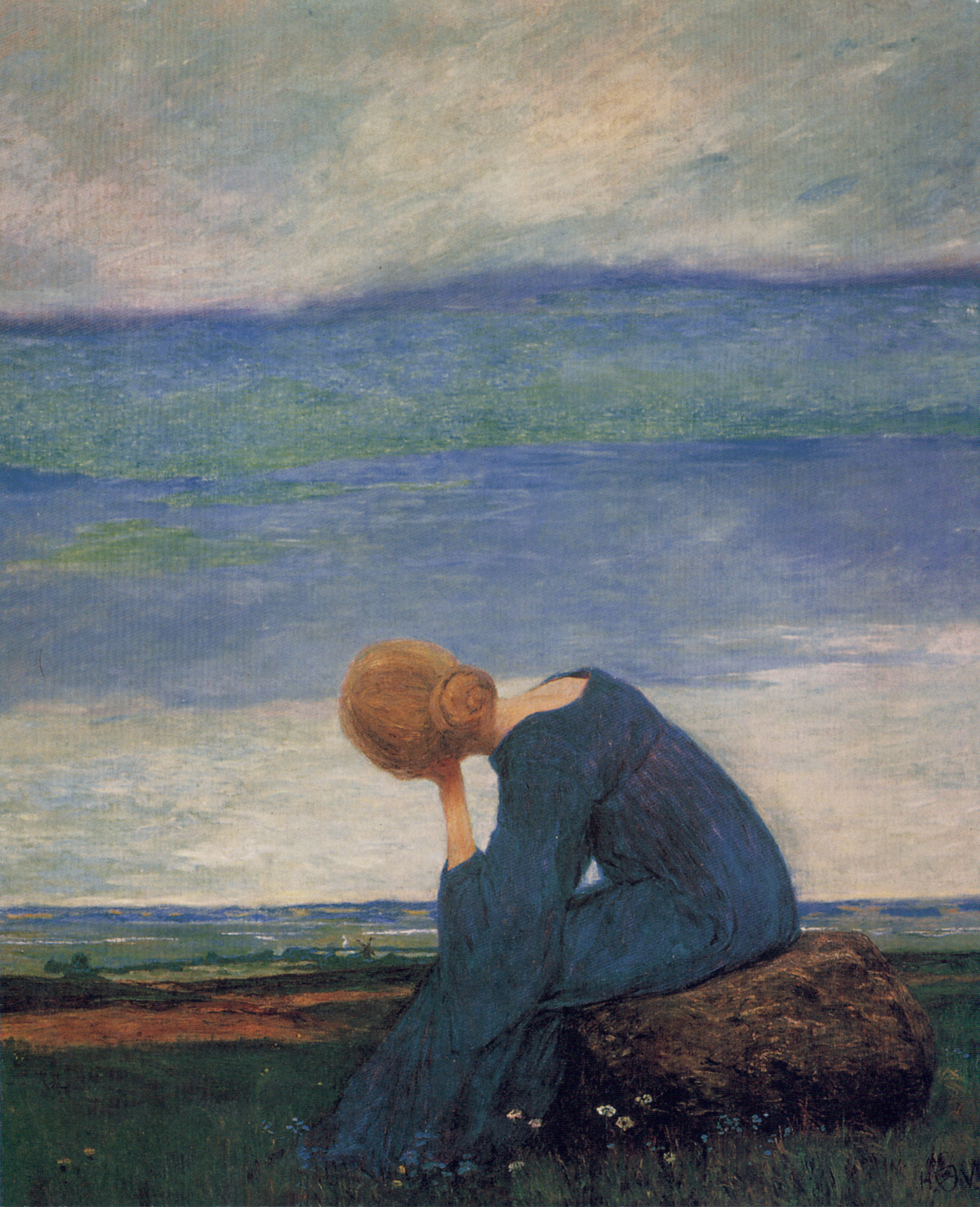
Heinrich Vogeler (German, 1872–1942), Reverie, ca. 1900. Oil on canvas.
               1.
New Year met me somewhat sad:
     Old Year leaves me tired,
Stripped of favourite things I had,
Baulked of much desired:
     Yet farther on my road today
God willing, farther on my way.

New Year coming on apace,
     What have you to give me?
Bring you scathe, or bring you grace,
Face me with an honest face;
     You shall not deceive me:
Be it good or ill, be it what you will,
It needs shall help me on my road,
My rugged way to heaven, please God.

               2.
Watch with me, men, women, and children dear,
You whom I love, for whom I hope and fear,
Watch with me this last vigil of the year.
Some hug their business, some their pleasure scheme;
Some seize the vacant hour to sleep or dream;
Heart locked in heart some kneel and watch apart.

Watch with me, blessed spirits, who delight
All thro’ the holy night to walk in white,
Or take your ease after the long-drawn fight.
I know not if they watch with me: I know
They count this eve of resurrection slow,
And cry, “How long?” with urgent utterance strong.

Watch with me, Jesus, in my loneliness:
Tho’ others say me nay, yet say Thou yes;
Tho’ others pass me by, stop Thou to bless.
Yea, Thou dost stop with me this vigil night;
Tonight of pain, tomorrow of delight:
I, Love, am Thine; Thou, Lord my God, art mine.

               3.
Passing away, saith the World, passing away:
Chances, beauty and youth sapped day by day:
Thy life never continueth in one stay.
Is the eye waxen dim, is the dark hair changing to grey
That hath won neither laurel nor bay?
I shall clothe myself in Spring and bud in May:
Thou, root-stricken, shalt not rebuild thy decay
On my bosom for aye.
Then I answered: Yea.

Passing away, saith my Soul, passing away:
With its burden of fear and hope, of labour and play;
Hearken what the past doth witness and say:
Rust in thy gold, a moth is in thine array,
A canker is in thy bud, thy leaf must decay.
At midnight, at cockcrow, at morning, one certain day
Lo the bridegroom shall come and shall not delay:
Watch thou and pray.
Then I answered: Yea.

Passing away, saith my God, passing away:
Winter passeth after the long delay:
New grapes on the vine, new figs on the tender spray,
Turtle calleth turtle in Heaven’s May.
Tho’ I tarry, wait for Me, trust Me, watch and pray.
Arise, come away, night is past and lo it is day,
My love, My sister, My spouse, thou shalt hear Me say.
Then I answered: Yea.
This poem was originally published in Goblin Market and Other Poems (Macmillan, 1862) and appears inThe Complete Poemsby Christina Rossetti (Penguin, 2001). It is in the public domain.
For another devotion featuring a song from this album, see “Now I’ve Seen It All,” centered on Simeon’s encounter with the Christ child. And for one featuring a different painting by Piriankov, see “Radiant.”
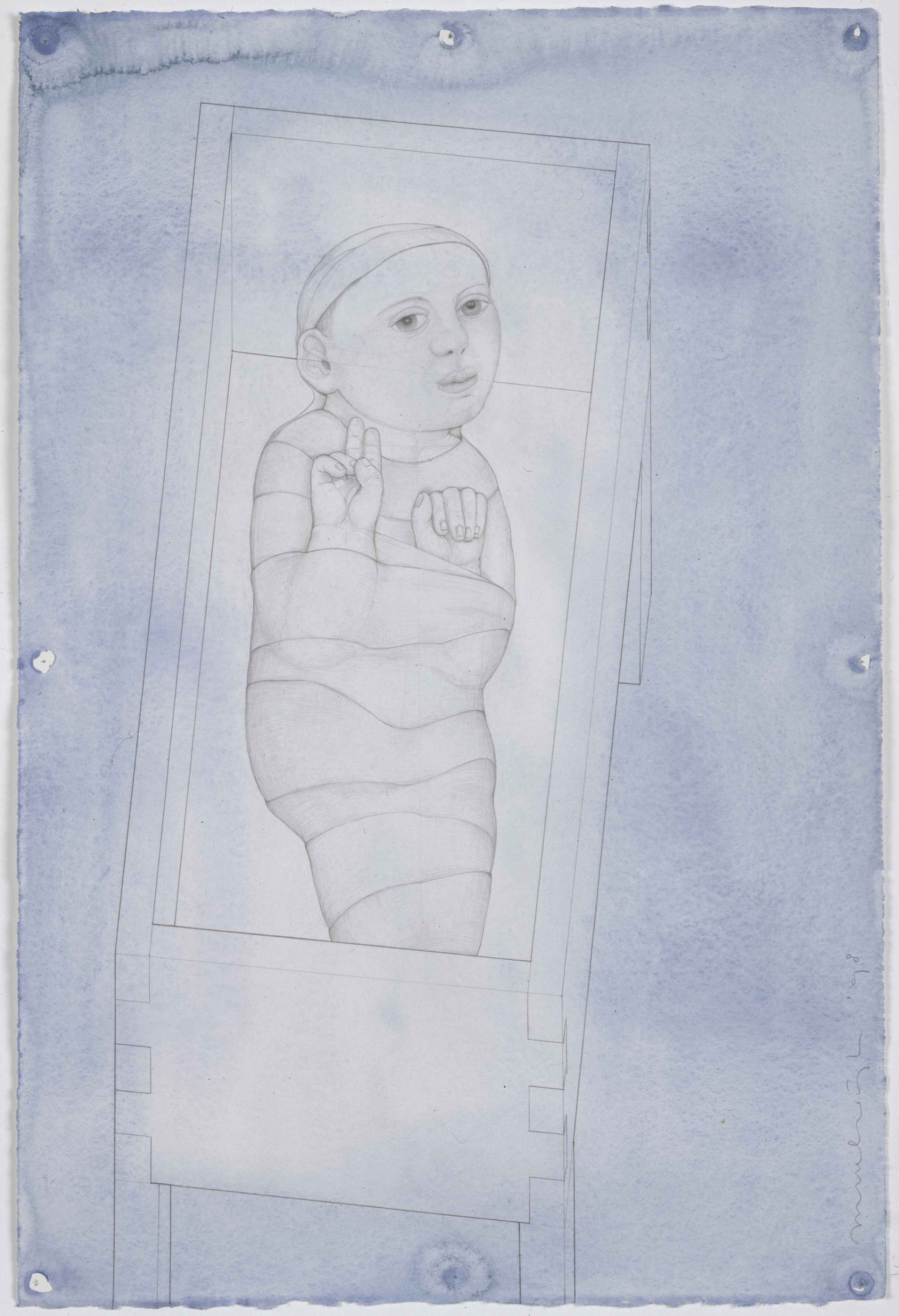
Janpeter Muilwijk (Dutch, 1960–), Kind in Bakje (Babe in a Manger), 1999. Watercolor and pencil on paper, 58 × 38 cm. Private collection, Netherlands.
LISTEN: “Dona Nobis Pacem (Give Us Peace) / Auld Lang Syne” | Arranged and performed by Yo-Yo Ma (cello) and Chris Botti (trumpet), on Songs of Joy & Peace (2008)
The three-word Latin prayer “Dona nobis pacem,” which translates to “Grant us peace,” is part of the Agnus Dei section of the Catholic mass. The traditional melody associated with it likely originated in the sixteenth century.
“Auld Lang Syne” (Old Long Since) uses a traditional Scots folk melody.
In this final track on Yo-Yo Ma and friends’ 2008 holiday album, Ma plays the “Dona Nobis Pacem” theme alone on cello and then is joined by trumpeter Chris Botti playing “Auld Lang Syne” as a countermelody. The two are cozily layered together in an expression of warm wishes for the new year.
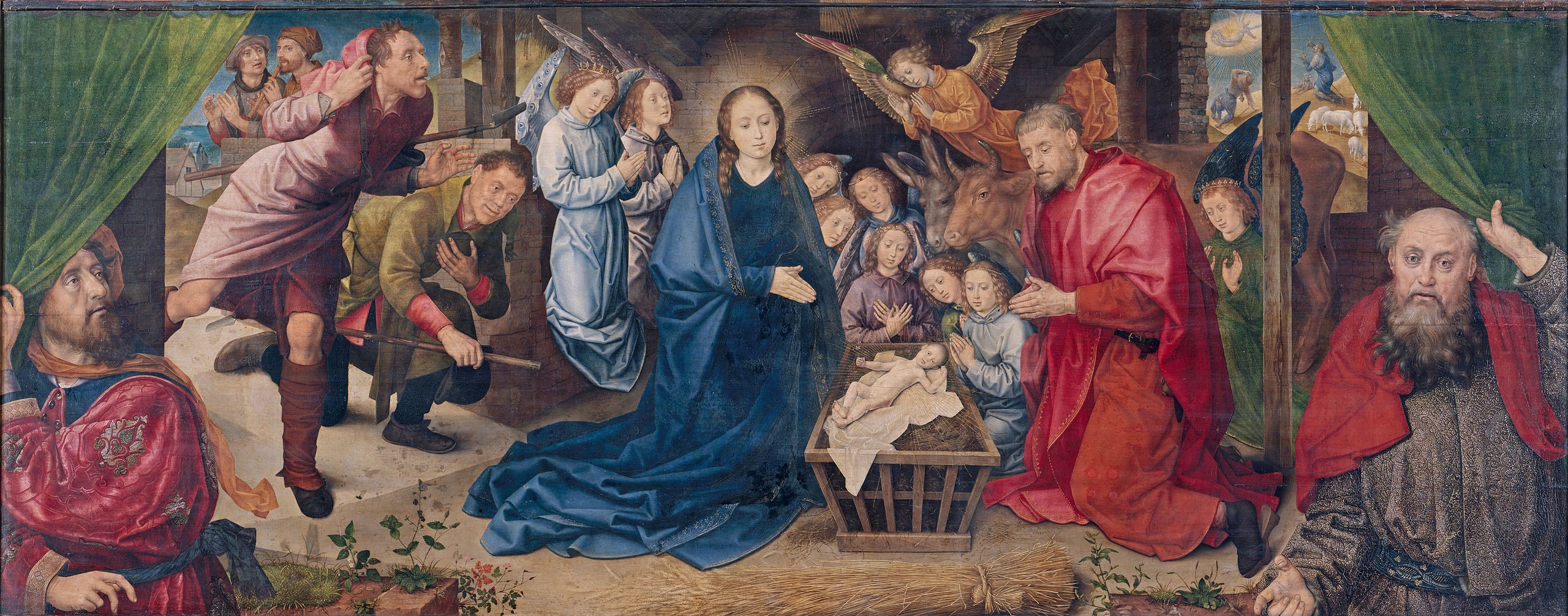
LOOK: Adoration of the Shepherds by Hugo van der Goes
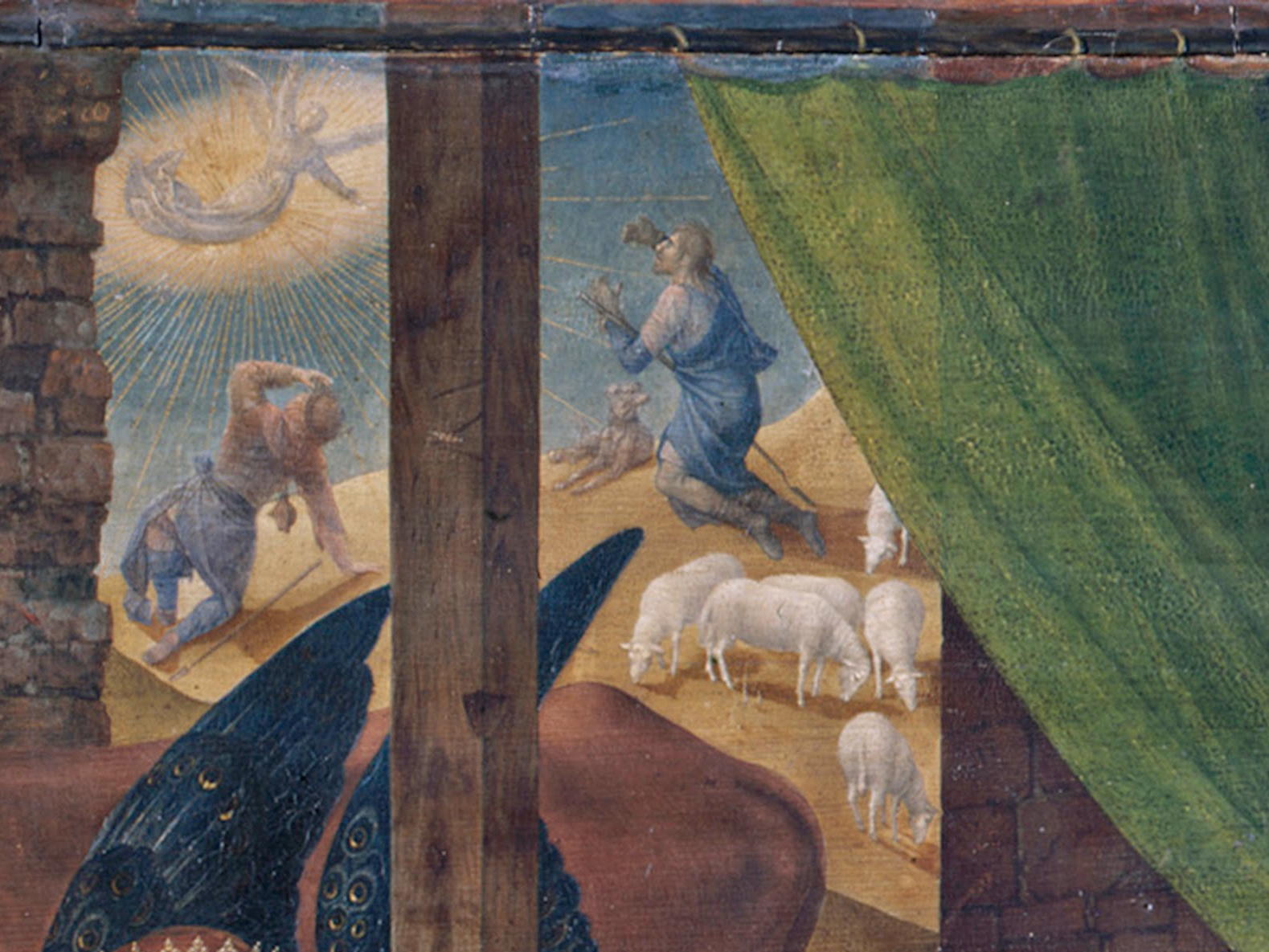
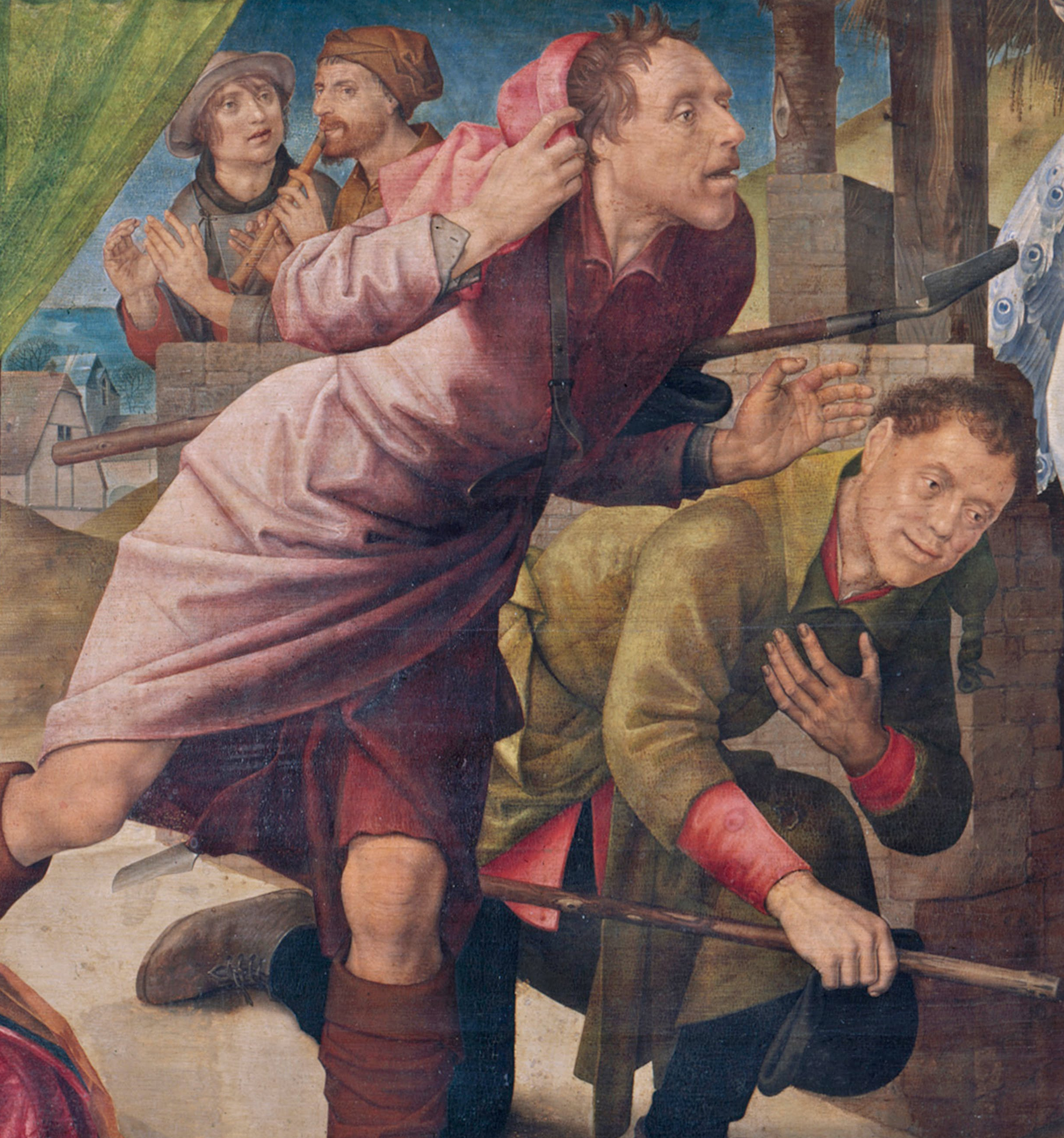
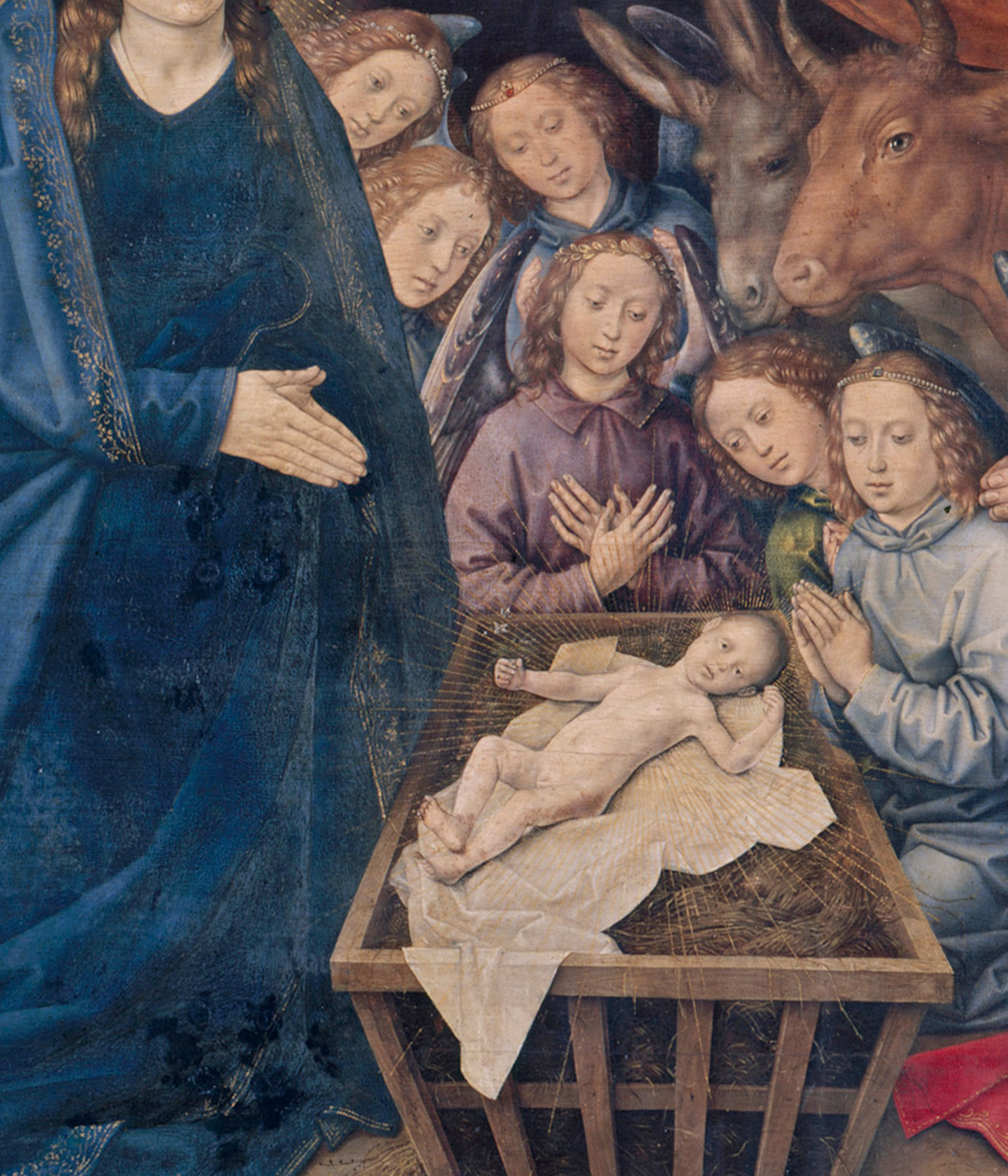
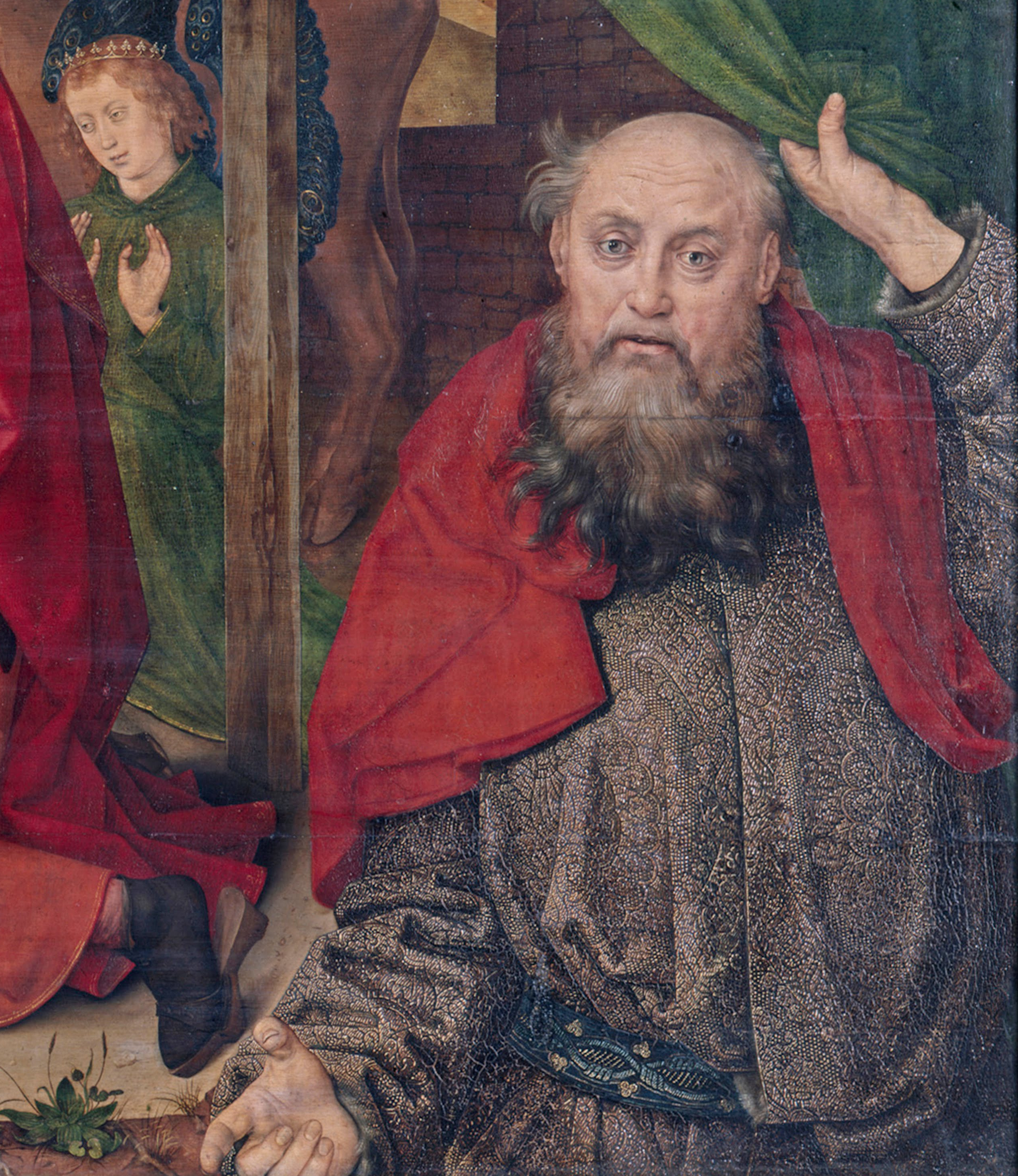
Hugo van der Goes (Flemish, ca. 1440–1482), Adoration of the Shepherds, ca. 1480. Oil on oak wood, 99.9 × 248.6 cm. Gemäldegalerie, Berlin.
After the angel of the Lord announced the birth of the Messiah to a band of shepherds, “they went with haste” to the place where he lay (Luke 2:16). The Flemish artist Hugo van der Goes shows the shepherds’ hurried arrival at the manger. One of them gallops through the door panting, having run from the scene in the upper right corner, and another removes his hat and kneels. Two more stand behind them just outside the shed—one playing a recorder, the other in midclap.
In the center of the composition, the Christ child squirms in his makeshift bed, surrounded by his parents, an ox and ass, and a coterie of angels. At the foot of the manger is a sheaf of wheat, an allusion to Jesus as “the living bread that came down from heaven” (John 6:51) and, by extension, to the Eucharist. This painting, after all, was originally made, most likely, to hang over an altar.
In the foreground two men draw open a set of curtains, revealing God made flesh. An actual wooden rod is attached to the panel and painted with rings, enhancing the illusion. Most scholars agree that the men represent Isaiah (left) and Jeremiah (right), Old Testament prophets who foretold Christ (see, e.g., Isa. 7:14; Jer. 23:5–6)—though John Moffitt suggests they are the apostles Mark and Paul, two New Testament personages who specifically associate themselves with a veil as a sign of divine manifestation. Either way, these figures act as intermediaries between the viewer and the depicted narrative, inviting us, like the shepherds, to bear witness to the wondrous mystery of the Incarnation and to respond in adoration.
This Adoration, sometimes referred to as van der Goes’s Berlin Nativity, is not the artist’s most famous painting on the subject. That would be the central panel of the Portinari Altarpiece, painted a few years earlier.
Where shepherds lately knelt and kept the angel’s word, I come in half-belief, a pilgrim strangely stirred; but there is room and welcome there for me, but there is room and welcome there for me.
In that unlikely place I find him as they said: sweet newborn babe, how frail! and in a manger bed, a still small voice to cry one day for me, a still small voice to cry one day for me.
How should I not have known Isaiah would be there, his prophecies fulfilled? With pounding heart I stare: a child, a son, the Prince of Peace for me, a child, a son, the Prince of Peace for me.
Can I, will I forget how Love was born, and burned its way into my heart, unasked, unforced, unearned, to die, to live, and not alone for me, to die, to live, and not alone for me?
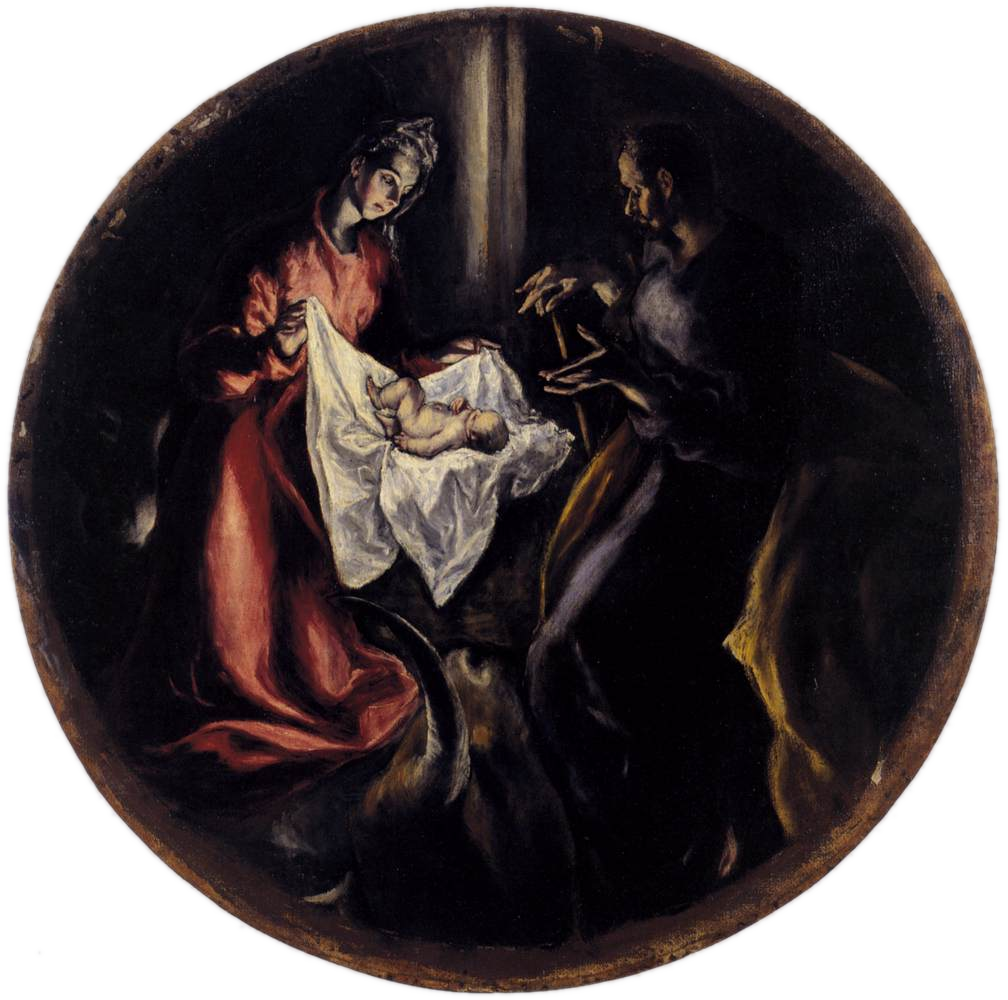
El Greco (Doménikos Theotokópoulos) (Greek Spanish, 1541–1614), The Nativity, 1603–5. Oil on canvas, diameter 128 cm. Church vestry, Hospital de la Caridad de Illescas, Villarrobledo, Spain.
We are being shown here [in the Incarnation] something profoundly significant about human life—“God speaks in a Son,” a baby son, and reverses all our pet values. He speaks in our language and shows us his secret beauty on our scale. We have got to begin not by an arrogant other-worldliness, but by a humble recognition that human things can be holy, very full of God, and that high-minded speculations about his nature need not be holy at all; that all life is engulfed in him and he can reach out to us anywhere at any level.
As the Christmas Day gospel takes us back to the mystery of the divine nature—In the beginning was the Word . . .—so let us begin by thinking of what St. Catherine called the “Ocean Pacific of the Godhead” enveloping all life. The depth and richness of his being are entirely unknown to us, poor little scraps as we are! And yet the unlimited life who is Love right through—who loves and is wholly present where he loves, on every plane and at every point—so loved the world as to desire to give his essential thought, the deepest secrets of his heart to this small, fugitive, imperfect creation—to us. That seems immense.
And then the heavens open and what is disclosed? A baby, God manifest in the flesh. The stable, the manger, the straw; poverty, cold, darkness—these form the setting of the divine gift. In this child God gives his supreme message to the soul—Spirit to spirit—but in a human way. Outside in the fields the heavens open and the shepherds look up astonished to find the music and radiance of reality all around them. But inside, our closest contact with that same reality is being offered to us in the very simplest, homeliest way—emerging right into our ordinary life. A baby—just that. We are not told that the Blessed Virgin Mary saw the angels or heard the Gloria in the air. Her initiation had been quite different, like the quiet voice speaking in our deepest prayer—“The Lord is with thee!” “Behold the handmaid of the Lord.” Humble self-abandonment is quite enough to give us God.
—Evelyn Underhill, from an address given at the Chelmsford Diocesan Retreat House at Pleshey in May 1932 (published in Light of Christ by Evelyn Underhill, 1945, 2004)
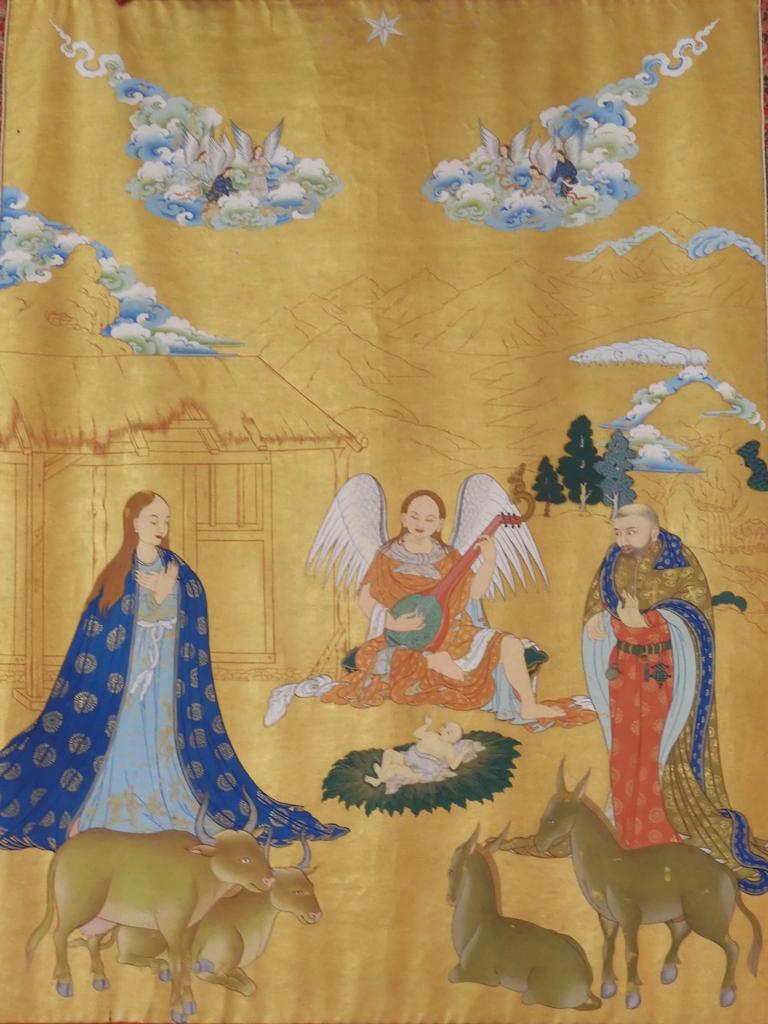
Nativity Thangka, 1998. Painting on silk, 17 × 12 cm. Presented by H.H. the Dalai Lama to the World Community for Christian Meditation and housed at the Bonnevaux Centre for Peace, Marçay, France. Photo: Fr. Laurence Freeman, OSB. https://wccm.org/
A traditional Tibetan art form, a thangka (roughly pronounced tonka; literally “recorded message”) is a painting on a portable fabric scroll of silk or cotton. Traditionally they depict Tibetan Buddhist deities or influential leaders and are used for personal meditation or instruction of monastic students.
This thangka, however, portrays a Christian narrative: the birth of Jesus Christ. He lies on a leafy bed on the ground, surrounded by Mary, Joseph, two yaks, two horses, and an angel who is seated much like a bodhisattva and who plays the dramnyen (a Himalayan six-stringed lute, roughly pronounced dra-nyen). The stylization of the clouds and mountains is clearly Tibetan, whereas the angels seated on the clouds bear Western influence, as does Mary’s gesture of hands crossed reverently over the chest.
The Nativity Thangka was presented by the Dalai Lama in 1998 to the World Community for Christian Meditation, “a global spiritual community united in the practice of meditation in the Christian tradition . . . shar[ing] the fruits of this practice widely and inclusively . . . and building understanding between faiths and cultures.” It is on display at WCCM’s Bonnevaux outside Poitiers, France, a retreat center that is home to a residential community living in the spirit of Saint Benedict.
LISTEN: “Gawala! Gibala!” (O what joy! O what happiness!), a Tibetan Christmas carol | Composer and lyricist unknown | Performed by the WEC UK Resonance band, 2020 [HT: Global Christian Worship]
Ian Collinge, the man leading this song in the video above, is an ethnomusicologist who trains people in cross-cultural and multicultural music at All Nations Christian College and London School of Theology. In addition, he and his wife, Helen, lead Arts Release, a ministry of WEC International that they founded in 2008. One of its initiatives is Resonance [previously], a multicultural collective of Christian musicians formed in the UK in 2011 with the aim of integrating songs from the global church into the Western worship repertoire. The Resonance band raises awareness of the beautifully rich diversity of musical expressions that exist around the world to praise the Triune God of the Bible.
Collinge learned “Gawala! Gibala!” while living in Nepal in the 1990s doing music research, which is also when he learned to play the dramnyen. Besides the dramnyen, the recording also uses a Tibetan instrument called the erkha, small pellet-bells that are sometimes attached to the legs and used in dancing or are otherwise played unattached to clothing, as here.
“I can easily imagine this song being done as a dance song, especially as a circle dance,” Collinge tells me. “I am playing it in the Southern Tibetan dramnyen style, distinguished by this tuning and introduction/ending and links patterns, and I have arranged it in the typical slow then fast section format.”
Addendum, 12/30/21: After reading this post, a friend of mine sent me a video of one of her friends, Migmar Dondup Sherpa, playing the same song on the dramnyen! I post it here with his permission. Sherpa is a worship leader at his church in Nepal, and he also writes original worship songs in Nepali and Tibetan.

 Art & Theology