MAVCORJournal is an open-access, peer-reviewed digital publication published by the Center for the Study of Material and Visual Cultures of Religion at Yale University. Its “Object Narrative” division is for explicating religious images, objects, monuments, buildings, spaces, performances, or sounds in 1500 words or less.
Visual culture encompasses not just “art” but also ephemera and what we might call “kitsch.” Because my field is art, I gravitate more to research in that vein, which is reflected in the five object narratives I’ve selected to highlight below. In addition to describing the object’s content, each writer also addresses, if applicable, its liturgical or devotional uses and includes relevant historical or cultural context. Click on the links to read more, and spend some time perusing the other offerings on MAVCOR’S website, https://mavcor.yale.edu.
“Christ Crucified in the Gellone Sacramentary” by Lawrence Nees: This eighth-century manuscript illumination from the Frankish kingdom of Charlemagne is one of the earliest surviving images of Jesus on the cross, its viewership restricted to clergy. “He is . . . shown as if nailed to a cross, but this is no wooden cross and indeed no cross at all. It is colored deep blue, studded with white and red flower-like shapes suggesting stars, and indeed it actually is the letter T of the opening words of the Canon of the Mass, the consecration of bread and wine as the body and blood of Christ, in the Latin version here ‘Te igitur clementissime Pater . . . rogamus’ (‘Therefore we beseech Thee, most merciful Father’) . . .”
Crucifixion from the Gellone Sacramentary (Latin 12048, fol. 143v), made in France, ca. 790. Housed at the Bibliothèque nationale de France, Paris.
+++
“Kongo Triple Crucifix” by Cécile Fromont: The west central African kingdom of Kongo, which emerged in the fourteenth century, declared Christianity its official religion in 1509. Kongo participated in the commercial, political, and religious networks of the early modern Atlantic world, and its artists reformulated Christian figures from Europe into objects that are distinctly African—including the many brass crucifixes produced from the sixteenth through nineteenth centuries. (Read more in Fromont’s 2014 book The Art of Conversion: Christian Visual Culture in the Kingdom of Kongo, which I reviewed here.)
Triple Crucifix, central figure 16th–17th century; top and bottom figures 18th–19th century. Brass, iron nails, copper, wood, ultramarine pigment, 10 1/4 × 5 3/4 × 1 in. (26 × 14.5 × 2.5 cm). Metropolitan Museum of Art, New York.
+++
“Death Cart (La Muerte en su Carreta)” by Miguel de Baca: “Death carts” were instruments of penance used by the Penitente brotherhood of northern New Mexico and southern Colorado in the second half of the nineteenth century and the first half of the twentieth; this is the earliest known one. They were built in the style of an old oxcart, and seated inside was Doña Sebastiana, an allegorical figure of Death, wielding her bow and arrow. Each Good Friday, “an elected brother attached the heavy chassis to his torso with a horsehair rope and dragged it from the morada (meetinghouse) along the path to the calvario (Calvary site), inflicting abrasions upon his body as a demonstration of his faith and desire for closer union with God.” I must say, this skeletal figure with the close-set eyes and large forehead (and is that human hair and teeth?) terrifies me!
Nasario López, Death Cart (La Muerte en su Carreta), ca. 1860. Gesso, leather, cottonwood, pine, 51 × 24 × 32 in. (129.5 × 61 × 81.3 cm). Colorado Springs Fine Arts Center, Colorado Springs, Colorado.
“Georgia O’Keeffe, Black Cross with Stars and Blue”by Jeffrey Richmond-Moll: During a four-month stay in Taos, New Mexico, in the summer of 1929—her first visit to the Southwest—Georgia O’Keeffe painted four canvases of Penitente crosses with Taos Mountain visible in the distance. The Penitentes were a lay Catholic brotherhood whose rituals centered on the remembrance of Christ’s passion. They erected crosses all over the region, outside their moradas (meetinghouses) and along roadsides, which they picked up and carried on holy days.
Georgia O’Keeffe (American, 1887–1986), Black Cross with Stars and Blue, 1929. Oil on canvas, 40 × 30 in. (101.6 × 76.2 cm). Private collection.
+++
“James Latimer Allen, Madonna and Child” by Camara Dia Holloway: “Allen operated a studio in Harlem between 1926 and 1943, producing artistic and commercial photographs. . . . By contributing to the development of a new racial iconography, Allen’s Madonna and Child and other black Madonnas offered positive visual and material rejoinders to widely reproduced images that represented black women’s failure to parent their own children. The Mammy stereotype, the legend of Margaret Garner (known as the Black Medea), and portraits of white children held by their black nannies belong to this latter and negative set of portrayals.” This is a religious icon by and for African Americans, Latimer writes—one that reflects and affirms their own self-image.
James L. Allen (American, 1907–1977), Madonna and Child, 1930s. Photograph, 24.4 × 18.7 cm. New York Public Library.
Alberto Giacometti (Swiss, 1901–1966), Dog, 1951 (cast 1957). Bronze, 18 × 39 × 6 1/8 in. (45.7 × 99 × 15.5 cm). Museum of Modern Art, New York.
lopes in bronze:
scruffy,
then. In
the Museum of Modern Art
head
down, neck long as sadness
lowering to hanging ears
(he’s eyeless)
that hear
nothing, and the sausage
muzzle
that leads him as
surely as eyes:
he might
be
dead, dried webs or clots of flesh
and fur
on the thin, long bones—but
isn’t, obviously,
is obviously
traveling intent on his
own aim: legs
lofting
with a gaiety the dead aren’t known
for. Going
onward in one place,
he doesn’t so much ignore
as not recognize
the well-
dressed Sunday hun-
dreds who passing, pausing make
his bronze
road
move. Why
do they come to admire
him,
who wouldn’t care for real dogs
less raggy
than he
is? It’s his tragic
insouciance
bugs them? or is
it that art can make us
cherish
anything—this command
of shaping and abutting space—
that makes us love
even mutts,
even the world, having
rocks
and the wind for comrades?
It’s not this starved hound,
but Giacometti seeing
him we see.
We’ll stand in line all day
to see one man
love anything enough.
“Giacometti’s Dog” by Robert Wallace was originally published in Ungainly Things (Dutton, 1968) and is included in the collection The Common Summer: New and Selected Poems (Carnegie Mellon University Press, 1989). Used by permission.
+++
When artists take the time to sculpt (or paint, film, lyricize, etc.) a subject, they inevitably give their careful attention to that person, place, or thing. And attention is a form of love. The best artworks succeed in conveying that love.
In his poem “Giacometti’s Dog,” Robert Wallace muses on how modernist sculptor Alberto Giacometti poured heart, mind, body, and soul into portraying something so “unworthy” and unattractive as a stray dog. Why dignify the malnourished, matted canine with a bronze cast and prominent display in a world-class museum? And why do all the gallery visitors crowd around to see him?
Wallace determines that it is the artist’s love for the dog that attracts people to it. If Giacometti thought him a fitting subject for a sculpture, then he must matter. He is worth attending to. “Art can make us cherish anything,” Wallace writes. Artists show us where to look and teach us what to love.
NEW PLAYLIST: August 2021 (Art & Theology): This month’s thirty-song roundup opens with a 1936 recording by blues guitarist and singer Blind Roosevelt Graves and goes on to include “Amazing Grace” sung to the tune of HOUSE OF THE RISISNG SUN; “Amaholo,” a song in Luganda performed by a youth choir from Kkindu Village, Uganda (its first line is “God’s blessing can’t be blocked by the devil!”); some Joan Baez and Johnny Cash; “Pretty Home,” a Shaker hymn by Patsy Roberts Williamson, an enslaved African American woman whose freedom was purchased by the Pleasant Hill Shaker community in the early 1800s; Psalm 118:1–4 in Hebrew, set by one of the most popular contemporary singer-songwriters of Jewish religious songs, Debbie Friedman, and sung by a trio of brothers; a gospel song from one of my favorite films of 2019, Peanut Butter Falcon; and “God Yu Takem Laef Blong Mi,” a Melanesian choir rendition of “Take My Life and Let it Be” from Terrence Malick’s The Thin Red Line.
+++
CALL FOR PITCHES: Geez 63 Jubilee: “What would the biblical practice of Jubilee look like today? Geez magazine is looking for submissions that reimagine ideas of debt forgiveness, reparations, trumpets singing, and a whole lot of radical rest. Deadline for pitches: August 12.” [HT: ImageUpdate]
Creative nonfiction essays, investigative articles, “flash nonfiction” (short insights, as few as fifty words), photographs, and poems are among the forms accepted. To get you started, Geez provides a whole host of questions for pondering, as well as specific prompts, such as:
Rewrite Isaiah 61, “The year of the Lord’s favor,” in the context of today’s struggles for justice.
Take a nap. Write a poem about it.
Write a street liturgy for the front steps of Navient, American Educational Services, or other student loan debt collectors.
Explore global social movements that have employed practices of Jubilee, implicitly or explicitly.
Describe the sounds of a great Jubilee party.
If you want to stay apprised of what the quarterly is up to in the future, sign up for their newsletter (there’s an option to receive contributor pitch emails) and/or follow them on Facebook and Twitter.
+++
THE GESUALDO SIX:
The Gesualdo Six is an award-winning British vocal ensemble directed by Owain Park. I’ve really been enjoying all the content on their YouTube channel, which includes original performances of sacred motets, hymns, carols, chansons, and contemporary pieces—like the two below, both written specifically for the group. Be sure to check out their website for information about live concerts!
>> “The Blue Bird” by Andrew Maxfield: The composer writes, “The text [see below]—a beloved poem by Mary Elizabeth Coleridge—evokes ‘blueness’ not just in its title; every image is blue: the lake, the bird’s wings, the sky above and beneath. Far from being monochromatic, though, this poetic meditation reveals a multiplicity within the narrow spectrum we label ‘blue.’ Royal. Navy. Cobalt. Tiffany. Sky. Midnight. All of these flash, but only briefly, as our winged protagonist catches his fleeting reflection in the lake’s glassy surface. Blue, then, is the subject and substance of my musical setting. Harmonically, the piece hovers, as the bird does, in what feels to me like a cool, gentle, blue sound—little variations and reflections on the wings and water here and there, but the piece attempts to remain ‘blue in blue’ (or what Miles Davis might have called ‘Kind of Blue’) and, after not too long, disappears, as the birds shifts, glides, and vanishes. Melodically, this bird nods to another: to William Byrd, one of the great composers of the English Renaissance, whose contrapuntal inventiveness inspires me. And—I couldn’t help myself—my setting alludes to Joni Mitchell’s song ‘Blue,’ but I leave it to you to locate the reference.”
The lake lay blue below the hill. O’er it, as I looked, there flew Across the waters, cold and still, A bird whose wings were palest blue.
The sky above was blue at last, The sky beneath me blue in blue. A moment, ere the bird had passed, It caught his image as he flew.
ONLINE EVENTS: “Origin, an Art House Dallas program, seeks to establish a wholeness and connectedness between spiritual formation, imagination, and the arts with the ultimate intent to establish a sacred perspective on how we individually and collectively live and create. We believe that beauty shown through the arts, culture, and creation holds a powerful ability to form the way we see ourselves, the world, and our interaction with both.”
This summer’s iteration of the program consists of a series of online Thursday night talks by artists or pastors, followed by facilitated discussions. Two of these have already passed, but two are still upcoming: “Embodiment” with Guy Delcambre on August 12, and “Beauty” with Kelly Kruse on August 26. RSVP at Eventbrite.
In addition to the free events, there’s an accompanying anthology of articles, poems, visual art, scripture, and questions for prayerful reflection, which is on sale for $8.
+++
MOVIE OPENING: I’m working my way through all the Best Picture Oscar winners since the award’s inception in 1928 and have come upon 1980’s Ordinary People, Robert Redford’s directorial debut. Based on the novel by Judith Guest, it’s about the fragmentation of an upper middle-class family, the Jarretts, following the death of the eldest son, Buck, in a sailing accident and a subsequent suicide attempt by the other son, Conrad (played by Timothy Hutton).
I was really struck by its opening, which features a sacred choral version of Pachelbel’s Canon in D by Noel Goemanne. Although the film is not a religious one, the choice to open it with a prayer from the lips of Conrad, albeit one assigned by his high school choir teacher, is very fitting, as it voices the character’s longings. Throughout the film Conrad will struggle to find that peace, joy, and love he sings about in class—learning over time to assert with sincerity, in spite of grave tragedy, “Alleluia.”
The full lyrics by Goemanne are below, and you can watch a performance of the full song by the Meridian Community College Chorus and Guitar Ensemble here.
In the silence of our souls O Lord, we contemplate Thy peace Free from all the world’s desires Free of fear and all anxiety
O Lord our God Wisdom, joy, and peace and love divine O Lord our God Glory, praise, and honor be always thine
O dearest Lord, come to us now Have mercy on us, stay with us and protect us all
O Lord our God Wisdom, truth, and love and peace and joy O Lord our King Thy praises we will always sing
>> (Virtual) Christian Fellowship of Art Music Composers, October 23, 2021: The CFAMC is soliciting videos of live musical performances (or works designed with videography), original hymns, and papers. Twelve art music pieces will be chosen to be shown at the conference, followed by conversations about each, as will three hymns, to be sung during a time of worship.
>> (In Person) Transcend, CIVA Biennale, November 4–6, 2021, Austin, Texas: I’ll be attending! “Beauty is compelling. It binds itself to the Truth and the Good in such a way that, as Dante said, ‘Beauty awakens the soul to act.’ It moves us from the rooted realities of canvas, clay, notes, or language into the transcendental nature of God Himself, our Beautiful, True, and Good Creator. Join CIVA [Christians in the Visual Arts] as artists, pastors, curators, and cultural leaders explore the divine spark of the image of God in each of us that initiates and propels our journey to perceiving anew an intuitive, expressive, and fulfilling reality.” The conference will include a juried art show, plenary talks, paper presentations, times of worship, workshops, portfolio reviews and mentoring sessions, author signings, “explore groups” around the city (I signed up for the Blanton Museum of Art and Ellsworth Kelly’s Austin), and artists’ show and tell.
+++
ARTIST PRESENTATIONS:
It can be so illuminating to hear an artist discuss their work—their influences, their process, how particular artworks came about. Below are two virtual talks I attended last month and really enjoyed, both by artists who are Catholic.
>> Jyoti Sahi, June 19, 2021: In this virtual talk organized by the UK organization Christians Aware, my friend Jyoti Sahi [previously] shares several of the paintings he has produced during the past year in quarantine in and around his home in Silvepura Village in Karnataka, South India, inspired by the local landscapes and vegetation. Over the years Jyoti has developed a Christian spirituality that is very earthy, one that sees the natural world as reflective of, and even participating in, the divine mysteries. His Jesus is in and of the land. Images start at 11:20.
Jyoti Sahi (Indian, 1944–), Flight of the Holy Family, 2021. Oil and acrylic on canvas.
In his recent body of work, Jyoti shows, among other things:
Jesus being born in a makeshift encampment beside a kere (manmade lake), among the brick kilns, a child of migrant laborers.
Jesus giving a sermon in a sacred grove underneath a yellow bodhi tree, where herdsmen graze their flocks. The snake-stones, erected by the Adivasi (tribal peoples of India), allude to healing and to Jesus’s being lifted up on the cross like the serpent on Moses’s staff (John 3:14–15; cf. Num. 21:4–9).
Jesus entering Jerusalem, his face gloriously framed by palm fronds. He’s reminiscent of the leafy-headed Green Man present in the mythologies of many ancient cultures but found particularly in medieval English church carvings.
Christ crucified in the palash tree, the “flame of the forest.” (Jyoti notes that in the Sanskrit epic poem the Mahabharata, the hero’s wounds are compared to the flowers of the palash tree.)
Jesus in the garden of the resurrection, standing in front of a flowering datura tree, which is poisonous but also medicinal. (“Poison can be a way of discovering healing,” Jyoti says—a truth that has implications for a theology of the cross.)
The journey to Emmaus, showing two of Jesus’s disciples entering the garden, a metaphor for wholeness or home.
>> “Gift Paintings: The Invitation to See Anew” with Patty Wickman, June 24, 2021: As part of its Art & Faith series, Holy Family Church in South Pasadena, California, hosted a virtual talk by one of its members, Patty Wickman [previously], a nationally exhibited artist and longtime professor in UCLA’s art department. Her paintings are figural, and she describes several of them as “gifts,” sparked by things like the discovery of one of her mother’s unusual rest rituals, encounters with unhoused persons in San Jose, a cut-paper environment inside a Disney World ride, flea market finds, a plate of dirt her young daughter served her, and a little boy’s eating apples stark naked on a hot summer day in her backyard.
Among her influences are Shaker gift drawings and worship spaces; Victorian hair wreaths; the illuminations of Hildegard of Bingen; performance art pieces by Joseph Beuys, Chris Burden, and Ana Mendieta; Cindy Sherman’s photographic self-portraits; and historical religious paintings by Fra Angelico, Piero della Francesca, Georges de La Tour, Geertgen tot Sint Jans, Caravaggio, and others.
At twenty-four minutes in she starts discussing her own work, with reference to specific artworks that informed her. Compare her Entheos, for example, to Caravaggio’s Crucifixion of Saint Peter; her Struggle Garden to frescoes by Giotto of Anne and Joachim at the golden gate, and Judas betraying Jesus in Gethsemane; and her A Thief in the Night to Peter Menzel’s Material World project. When her early days of motherhood prevented her from having the time to plan and execute large-scale paintings like these, she painted smaller, quicker works—daily during Lent—with subjects including dust bunnies, daddy longlegs, a stick of incense, and a birdbath with the first blooms from her camellia tree having fallen inside. Her work has a sacramental quality to it that’s really compelling.
Patty Wickman (American, 1959–), Passion Painting, 1997. Oil on canvas, 60 × 90 in.Patty Wickman (American, 1959–), Circumscribe, 2017–19. Oil on linen, 84 × 104 in.
The last half-hour of the video is Q&A.
+++
ARTICLE: “Artful Discipleship: The Role of the Arts in Spiritual Formation” by Carolyn Arends: Singer-songwriter Carolyn Arends discusses four ways the arts are important in our training to follow Jesus: (1) the arts help us train to pay attention; (2) the arts help us train in longing; (3) the arts help us train for the renewing of our minds; and (4) the arts help us train to appreciate things (and especially people) for more than their “usefulness.” She closes with a list of suggestions for practicing intentional engagement with the arts.
The arts don’t just fill our time with uplifting stories and pretty pictures. They don’t just distract us with things to look at; they teach us how to look. They train our vision, down to the level of our souls.
Art can teach us to see the tiny gradations in a field of green—or how to see a suffering world in the context of grace. How to recognize the humanity of a character who seems like an irredeemable villain. How to slow down. How to pay attention not just to the notes but the silences between the notes. How to hear the echo of divine music in human speech. How to look at our own failures and successes with perspective, even laughter. The arts ask us to use the full range of our senses. And they can restore us to our full, God-given humanity.
—Greg Pennoyer, executive director of Image journal [source]
VISUAL MEDITATION: “Mary’s Fecund Yes” by Victoria Emily Jones, on Annunciation by Mats Rehnman: My latest ArtWay reflection was published Sunday. It’s on a whimsical Annunciation painting by touring storyteller, author, and visual artist Mats Rehnman, influenced in part by the Annunciation design woven into several nineteenth-century carriage cushions from Scania, Sweden.
ART TALK:“Saying Yes: The Annunciation in Contemporary Art” by Victoria Emily Jones: Speaking of the Annunciation . . . my March 18 presentation from the Breath and the Clay creative arts gathering is now online! (The aforementioned Rehnman piece is one of six I discuss.) With permission from the conference organizers, I have uploaded it to my YouTube channel for public viewing.
It’s an act of vulnerability for me to share it with you, as I’m aware of the ways in which it is deficient (in terms of speech delivery and production values). I lack technical prowess and a charismatic personality and am self-conscious about being on camera—but hopefully with practice, I will improve. The main thing is, I want the work of these artists to be known and shared. I hope to demonstrate how art can pull us deeper into the biblical story, revealing new and sometimes surprising angles or simply helping us dwell there with love and intent, and also how it’s possible to do “theology through art,” relying not exclusively on academic writings or sermons (great as they both are) to do that important work.
While I have created a video for a scholar friend’s art history channel, this is the first on my own channel—which I invite you to subscribe to. (I need at least 100 subscribers to create a custom URL for the channel.) I don’t have imminent plans for more videos, but I am starting to brainstorm ideas and will probably send out a survey to my blog subscribers to get a better sense of what you all would want to see. Several of you have requested that I get into video making, but I’ve been slow to move on it, wanting to better figure out my niche and what I could uniquely bring to such a dense market. I realize that video is a content format that is overwhelmingly preferred to blog posts these days, so I want to make use of it. But videos are much more time-consuming and difficult to produce without having a budget or a team behind me, and also not having the direct access to artworks that museums and other entities have. Please pray for this upcoming venture!
+++
CROSS-CONTINENTAL MUSIC VIDEO: “Song of Hope” by Praveen Francis and friends: This Afro-pop music video is a collaboration between musicians, dancers, and technicians in India, Guatemala, the UK, Republic of the Congo, Cameroon, and the United States. The project was initiated by Praveen Francis, a music producer and sound engineer from Coimbatore in Tamilnadu, India, who wrote the original composition. The languages are English, French, and Lingala, but the hook is a series of nonlexical vocables: “Na na na . . .” [HT: Global Christian Worship]
The video was released April 10, 2021, shortly before the second COVID wave hit India. “This Pandemic has ravaged all our lives,” Francis says. “But we will not give up. We will fight back because there is still HOPE.”
+++
EXHIBITION: Constructed Mysteries: Spirituality and Creative Practice, February 8–April 18, 2021, Olson Gallery, Bethel University: Curated by Kenneth Steinbach and Michelle Westmark Wingard, Constructed Mysteries showcased the art of nine mid-career artists or artist teams whose work engages Christian spirituality: Heather Nameth Bren, Shin-hee Chin, Caroline Kent, Scott Kolbo, Joyce Yu-Jean Lee, Nery Gabriel Lemus, Marianne Lettieri, Cherith Lundin, and Justin Randolph Thompson and Bradly Dever Treadaway. The exhibition has come to a close, but there’s a wonderful twenty-minute video tour of it that’s archived on YouTube, with artist commentaries starting at 2:44:
In addition to the video, there’s an exhibition catalog available for online viewing. It features a series of artist interviews, which address topics such as silence, the importance of process, and the nature of parable. And of course it includes photos of all the works in the exhibition. Let me highlight just two.
Marianne Lettieri, Fenêtre de Réparateurs (Window of Repairers), 2020. Vintage pincushions, wood, paper, 33 × 18 × 3 1/2 in.
The first is by my friend Marianne Lettieri [previously], whose work is informed by her “increased awareness of the enchantment of everyday actions and moments—the sequences of ordinary human existence.
I would hate to think that life is just the important events. You get married, you get an award, have a baby. These are big things, and some are what we call sacraments in the church, but I’ve realized that peeling potatoes, fixing the faucet, and other common tasks make up most of our daily living. The big moments are a part of it, but it’s the string of these small moments that are present and sacred acts we need to pay attention to.
Much of her art illuminates the value of domestic labor, such as Fenêtre de Réparateurs, which sets forty-one used pincushions, still bearing the threads put there by their previous owners, into a wooden framework, evoking a stained glass window. “This work speaks about a culture of menders—people who choose to save, repair, and transform damaged things,” says Lettieri.
Justin Randolph Thompson and Bradly Dever Treadaway, Baby Needs New Shoes, 2021. Photographic transfer on wood with antenna and rag, 20 × 13 × 2 in.
Second, Traveling Shoes is a performative sound work by longtime collaborators Justin Randolph Thompson and Bradly Dever Treadaway, from 2013’s Flux Night in Atlanta. It involved a two-seat shoe-shine “chariot” being dragged through the crowds, stopping to gold-leaf the shoes of anyone who was interested. All the while, on the back of the chariot, a three-piece jazz band played the traditional African American song “Traveling Shoes,” which is about getting ready for Jesus’s return. The original performance, which lasted around three hours and has been re-created in several different contexts since then, is archived in a twelve-minute video, which is what was on display at Bethel. To go alongside, the curators asked the duo to submit a photograph from the performance series; they went the extra mile and used a photo as the basis of a new mixed-media work that incorporates objects used in the performance, such as a mechanic’s rag and an antenna, which is what I’ve posted here.
+++
RELIGIOUS POEMS SAMPLER: “Original and unorthodox poems about theology,” compiled by Mark Jarman: An excellent selection of ten poems, all but one available for reading from the Poetry Foundation. Jarman is a leading poet of the twenty-first century and a Christian. He was too humble to include one of his own poems on the list, but his poetry is much in this vein, so for number 11 I would add Jarman’s “Five Psalms,” from his collection To the Green Man (2004).
Launched in April 2018, HENI Talks is a growing catalogue of short films on art, narrated by experts. The project was prompted by the 2016 announcement by the AQA exam board in England that they would be dropping art history A-levels, meaning that the subject would no longer be taught in high schools. Although the course was saved at the last minute, it rang alarm bells for the international art services business HENI, who decided they wanted to help bring art history more fully into the digital age, to make it accessible to a wider public. They assembled a dedicated team of producers, researchers, editors, and camera operators and shot twenty-five videos on location on a range of art history topics, interviewing leading artists, curators, and academics. For these efforts HENI Talks won Apollo Magazine’s 2018 Digital Innovation Award.
I first encountered them through their video “Van Gogh’s Olive Trees” and was super-impressed by the high production values. That close-up photography! Makes a huge difference in experiencing art online.
Since then they have been steadily adding new videos, which average about ten minutes each. These include breakdowns of movements/styles, like abstract expressionism, brutalism, and land art, as well as videos focused on single artists or artworks or even themes, such as “The Bed in Art: From Titian to Emin.”
The emphasis is on modern and contemporary art—Marcel Duchamp, Henry Moore, Francis Bacon, Jean-Michel Basquiat, Gerhard Richter, Maurizio Cattelan, Paula Rego, Louise Bourgeois, Glenn Ligon, and so on. And art in British collections. I, of course, am particularly drawn to the videos that feature biblical or liturgical art. My favorites are below.
“Pisa Pulpit: ‘Judge by the correct law!’,” presented by Jules Lubbock: This video examines the seven-hundred-year-old marble relief sculptures of the life of Christ carved by Italian Gothic artist Giovanni Pisano into the pulpit of Pisa Cathedral. (The piece Lubbock looks at is actually a plaster cast of the pulpit, at the Victoria and Albert Museum.)
“Emotional Enigma in the Sculpture of Michelangelo,” presented by Alison Cole: “Michelangelo’s most well-known works exist on a colossal scale, from his formidable statue of David to the High Renaissance frescoes of the Sistine Chapel. Yet, his art could also be tender and lyrical, dwelling upon the inherent tensions of the human condition. Art Historian Alison Cole examines one such example, the Taddei Tondo (c.1504-1505) – the only marble sculpture by Michelangelo in a British collection. Cole provides a rich insight into the artist’s life, influences and unique approach to sculpture.” The tondo portrays the Virgin and Child with Saint John the Baptist.
“Ely Cathedral’s Lady Chapel: Devotion and Destruction,” presented by Paul Binski: “Ely Cathedral’s Lady Chapel was one of the most splendid artistic and architectural achievements of medieval England. The Catholic chapel’s lavishly painted sculpture and stained glass, devoted to the Virgin Mary, moved pilgrims to a religious frenzy. But when Protestants began to call for a ‘purer’ vision of the Christian faith in the 16th and 17th centuries, this same quality triggered repulsion. During the hundred years of the English Reformation, the chapel was scraped, scrubbed and smashed of its extravagance.
“Art historian Paul Binski believes it is possible to recover the Lady Chapel’s former opulence in the imagination. His talk gives an insight into the psychology behind Ely’s splendour, and the idea that art can be so powerful as to provoke violence – something we still see in headlines today.”
“Art & Soul at St Paul’s Cathedral,” presented by Sandy Nairne: “How does art ‘wake up the soul’? There is perhaps no better place to explore this theme than St Paul’s Cathedral in the City of London. Art historian Sandy Nairne walks through the architecture of Sir Christopher Wren’s masterpiece, pointing out how artists have responded to the sanctity of this historic space. He describes how early commissions by the Cathedral aimed to sustain belief in Christian worshippers, and how modern and contemporary artists including Henry Moore, Bill Viola and Mark Wallinger, have tried to express spirituality in a more secular age.”
+++
There’s also a HENI Talk written and narrated by the art critic Julian Spalding, called “Faith and Doubt in Art” and released in May 2019, but I feel it doesn’t do justice to its title, and it advances an overly simplistic narrative that is misleading in places and confusing in others. I know it’s difficult to bring nuance to such a vast topic in just twelve minutes, and that under such constraints, generalizations are inevitable. The video is mainly about representational art versus abstract art, and in particular the effect of modernity on Western art. Spalding posits that the age of scientific discovery that we call “the Enlightenment” was actually a time of spiritual darkening, where people ceased believing that the world was beautiful or had meaning, and this in turn produced an art of doubt and worry—“a nightmare vision of the world” exemplified by Goya and culminating in Munch’s The Scream (“the very end of the Christian tradition,” Spalding says).
The Enlightenment did, of course, cause faith crises for many, and this shaken worldview was reflected in the work of some artists. But I want to note that doubt is not incompatible with Christian faith, nor is an awareness of the world’s horrors or a dedication to science. In fact, many Enlightenment scientists were devout Christians who were impelled further in their research by their very belief in God and that the universe is ordered and contains mysteries to be discovered. And artists, even within the Christian tradition, have always been attuned to the darker aspects of life and had fears and anxieties surrounding sickness, violence, and sex, for example, which in medieval Europe could be expressed through portrayals of particular biblical narratives and saints’ lives. Some of the most gruesome artistic imaginings of hell were inspired by real-life tortures that were taking place at the time. Distorted forms and the grotesque are not unique to modern art, and their use was and is not a sure indicator of a nihilistic attitude or a rejection of a good creator-God.
So while Spalding’s account of art history as relates to the Christian faith is widely accepted, it’s important to remember that things weren’t quite so linear or across-the-board. And art can be “dark,” hold tensions, or pose questions and still be faithful to Christianity.
Puzzlingly, Spalding uses Rembrandt as an early example of religious doubt, noting that the tonality of his works got darker and darker, as if that signified a dissolving faith. Spalding reads into Rembrandt’s late self-portraits, in which he portrays himself in a nonidealized manner, a questioning whether God really created him, imperfect as he is. I, on the other hand, see in these portraits a man owning his own brokenness and frailties, bringing them into the light.
Spalding also makes a few inaccurate statements in the video, like that all Islamic art is abstract (what about the magnificent traditions of Persian [Iranian], Ottoman [Turkish], and Mughal [Indian] miniature painting?) and that Piero della Francesca’s Baptism of Christ represents “a man turning into a god” (no, Christians believe Jesus has always been both fully man and fully God; his anointing in the Jordan signified the start of his earthly ministry).
He ends by stating that in the modern period, as more and more people rejected the idea of a Creator, representation ceased to have meaning and Western art became abstract, much like that in the rest of the world. He compares, for example, an abstract expressionist painting with Islamic architecture, noting how they both express transcendence and mystery (he doesn’t have time to discuss their foundational differences, however). I would argue that while abstraction is a perfectly valid approach, representation in its own way can also express mystery. Take, for example, icons.
I would also add that there’s a huge difference between believing that life has no meaning and believing that that meaning cannot be represented. I think Spalding would agree—the video just doesn’t make that clear.
Spalding makes a very important point when he says that in Hinduism, Buddhism, Confucianism, etc., the “source of spirituality” (Truth) is invisible, and similarly, Judaism and Islam say you can’t visualize God, whereas Christianity says that the source and object of our faith, Jesus Christ, God the Son, did make himself visible and is therefore representable, and that belief very much influenced the trajectory of Western art.
My biggest concern with Spalding’s talk is that it doesn’t come full circle to acknowledge the “return of religion” in contemporary art—as Jonathan Anderson (see here), among other art historians and critics, have shown—nor does it address the comeback that representational art has been making in recent years, and in fact among Black artists by and large, it never really went away.
JULY PLAYLIST: The songs I’ve compiled this month on Spotify include Audrey Assad’s rewrite of a classic patriotic hymn [previously], a Bach partita with added words by Alanna Boudreau inspired by Dante’s Inferno, a Sotho interpretation of Psalm 23 by the Soweto Gospel Choir, a celebration of God as artist written and sung by a Franciscan friar from the Bronx, a song of testimony performed by blues musician Elizabeth Cotten and her great-granddaughter Brenda Evans, a multilingual song setting of Matthew 5:9 (“Blessed are the peacemakers . . .”) (again, with multigenerational participation!), Psalm 103 sung in Hebrew with ancient Middle Eastern instruments, and more.
+++
KICKSTARTER CAMPAIGN: Great Cloud by Nick Chambers: This is one of the creative projects I donated to this week. Chambers writes, “For over a decade, I have written music for the Church without much concern for the songs reaching beyond the particular place and people to which I belong. Now I want to release and share this music more widely. And you can help.
“I write songs to help give voice for people to pray, question, confess, doubt, lament, give thanks, and praise. Because I owe so much in this to the many faithful voices of history of the Church, this first record will be a collection of prayers of the saints—faithful voices such as Ephrem the Syrian, Teresa of Avila, Howard Thurman, and more.
“I have been planning with producer Isaac Wardell (The Porter’s Gate, Bifrost Arts) to record in early September in Paris near where he is currently based. The Porter’s Gate will be recording the same week, which means your support toward my $15k goal will go toward my record and travel costs, as well as allowing me to contribute in person to the next Porter’s Gate project.”
Here’s an example of Chambers’s singing-songwriting—a setting of Psalm 22:
+++
TED TALK: “Give yourself permission to be creative” by Ethan Hawke: I could listen to actor Ethan Hawke talk about any subject; he’s so interesting and passionate. (His recent conversation with the American Cinematheque on his new limited series The Good Lord Bird, for example, about abolitionist John Brown, was fascinating!) In this video he was asked to talk about creativity and the arts. He says,
There’s a thing that worries me sometimes whenever you talk about creativity, ’cause it can have the feel that it’s just nice, you know; or it’s warm or it’s something pleasant. It’s not. It’s vital. It’s the way we heal each other. In singing our song, in telling our story, . . . we’re starting a dialogue. And when you do that, healing happens. And we come out of our corners. And we start to witness each other’s common humanity. We start to assert it. And when we do that, really good things happen.
+++
TRANSPOSITIONS ESSAYS:
>> “‘Stop Working Me’: Jesse Pinkman as Child-Prophet in Vince Gilligan’s Breaking Bad” by Mary McCampbell: Jesse Pinkman from Breaking Bad, played by Aaron Paul, is one of my favorite TV characters of all time; I think I can truly say I’ve never been more emotionally invested in, or rooted harder for, any other. Mary McCampbell, author of the forthcoming book Imagining Our Neighbors as Ourselves: Empathy, the Arts, and the Religious Imagination (Fortress, 2021), writes about Jesse’s role as “child-prophet,” who sees and exposes with increasing clarity and conviction the amoral decay of the empire he helped Walt build. (Note: the article contains some series spoilers.)
>> “Revealing the Father: L. M. Montgomery, Dorothy L. Sayers, and Doctrine in Art” by Alicia Pollard: This article examines how the doctrine of God the Father shows up in Lucy Maud Montgomery’s novel Anne of Green Gables and Dorothy Sayers’s play The EmperorConstantine. The former chooses “the way of whimsical unorthodoxy”; the latter, “the way of passionate orthodoxy and reenchanted dogma as a living agent of truth.”
+++
SONG: “My Country ’Tis of Thee” (abolitionist version by A. G. Duncan, 1843): I wanted to post this for Juneteenth, but alas, I’m two weeks late. Just twelve years after Samuel Francis Smith wrote “My Country ’Tis of Thee,” a scathing rewrite by abolitionist A. G. Duncan was published in Massachusetts in the book Anti-Slavery Melodies. Exposing the hypocrisy of a nation that proclaimed life and liberty for all and yet perpetuated the evil institution of race-based chattel slavery, it’s a call to lament—“let wailing swell the breeze”—as well as an anticipation of coming liberation, God be praised. (Again, this was 1843, almost two decades before the Civil War.) This vocal arrangement and performance using Duncan’s alt lyrics is by Chase Holfelder, who sings the song in a minor key. [HT: Global Christian Worship]
My country, ’tis of thee, Stronghold of slavery, of thee I sing; Land where my fathers died, Where men man’s rights deride, From every mountainside thy deeds shall ring.
My native country, thee, Where all men are born free, if white’s their skin; I love thy hills and dales, Thy mounts and pleasant vales, But hate thy negro sales, as foulest sin.
Let wailing swell the breeze, And ring from all the trees the black man’s wrong; Let every tongue awake; Let bond and free partake; Let rocks their silence break, the sound prolong.
Our father’s God! to thee, Author of Liberty, to thee we sing; Soon may our land be bright, With holy freedom’s right, Protect us by thy might, great God, our King.
It comes, the joyful day, When tyranny’s proud sway, stern as the grave, Shall to the ground be hurl’d, And freedom’s flag, unfurl’d, Shall wave throughout the world o’er every slave.
Trump of glad jubilee! Echo o’er land and sea freedom for all. Let the glad tidings fly, And every tribe reply, “Glory to God on high,” at Slavery’s fall!
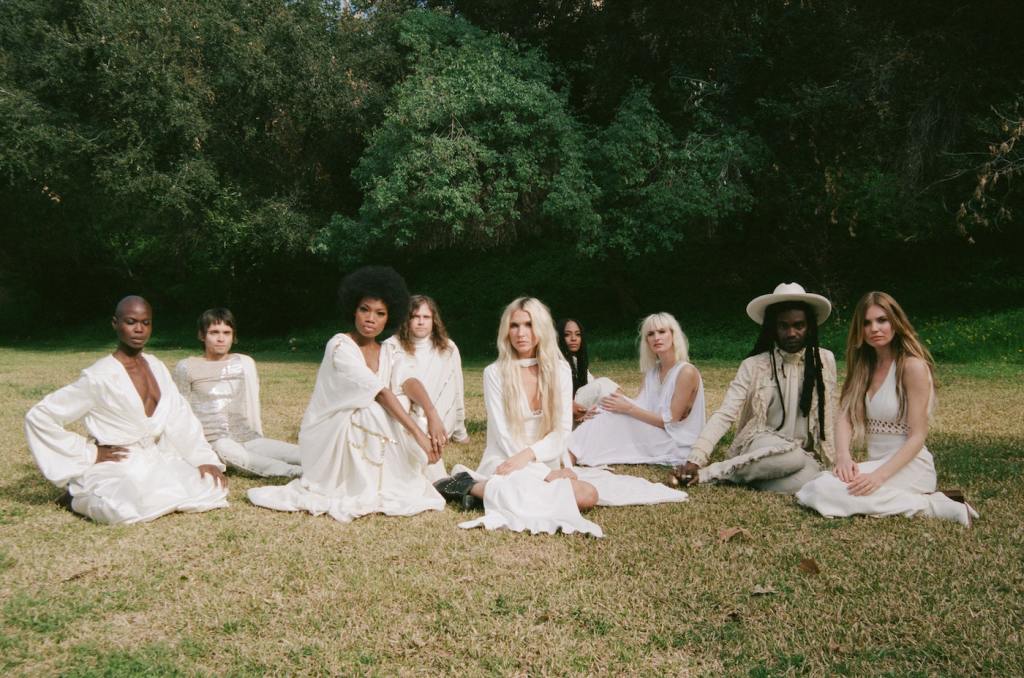
Ears to the Ground Family is a group of friends in their early thirties, making music together in and around their hometown of Harrisonburg, Virginia. Minimalist and totally acoustic, they sing songs of hope, sustaining faith, and resistance to oppression and empire. Their stylistic influences include the spirituals, soul, hip-hop, R&B, folk/Americana, chant, Taizé, and Anabaptist hymns, especially from the Mennonite tradition, to which they belong.
The core members of Ears to the Ground Family are, from left to right, Jake Cochran, percussionist; Matt Dog, trumpeter; Nichole Barrows, lead vocalist; Hannah Win, vocalist; and Dimitris Campos, lead vocalist, classical guitarist, and multi-instrumentalist.
The band formed in 2010 and has “always preferred the outdated and peculiar model of the elusive traveling troubadour,” sharing their music in small settings, unplugged, locally or regionally. Its members first met during the Petrol-Free Jubilee, an annual two-week bicycle-powered music and art tour of the mid-Atlantic, which they went on to participate in as a group for seven years. Its purpose was “to promote peace, social justice, and a healthy planet.”
“We biked two hundred to three hundred miles with ten to twenty people on average, often several bands or musicians with us at a time, and our regular stops and show locations included a lot of farms, community centers, and Catholic Worker houses,” band member Nichole Barrows told me. “Just imagine twenty people rolling down Main Street in your city in the middle of a hot summer afternoon on their bikes, with drums and guitars in tow, ringing their bike bells and singing at the top of their voices! I mean, it was like summer camp on wheels; we brought the show with us!”
This small-scale approach and casual touring schedule, Barrows said, “enables us to root ourselves deeply within our home community and invest in the valuable work that inspires our music.” That valuable work includes church ministry, community organizing, farming, and outdoor education.
In June 2017 Ears to the Ground Family recorded eight original songs (written between 2007 and 2013) plus a traditional African American spiritual, but jobs, family, and other projects prevented them from being able to mix, master, and self-release until recently. Finally, on December 18, 2020, their debut album, Full Moon in June, came into the world, making their music available to a much wider audience for the first time.
“It’s funny,” Barrows said, “some people talk about ‘slow music’ (you know, slow food, etc.) to describe homegrown, independently released local music. But we’re so ‘slow’ that it takes us about ten years to release our first album!”
Infused with prophetic imagination, Full Moon in June denounces the forces of evil at work in the world on a grand scale—things like war, environmental exploitation, predatory lending practices, and the prison industrial complex—and casts a beautiful vision of all things new under Christ. Stop participating in that which is destructive, the album invites, and join instead with the creative work of the Spirit, which is love, joy, peace, patience, kindness, generosity, faithfulness, gentleness, and self-control (Gal. 5:22–23). These songs awaken my enthusiasm for the promised future of all that is and for our journey toward it, sowing seeds of Christ’s kingdom all along the way.
An exploration of “Almond Blossom”
My favorite song on Full Moon in June is the first one, “Almond Blossom” by Dimitris Campos, which uses the image of a tree to signal abundance and renewal. “There’s an almond blossoming in Jerusalem,” it opens. Almond blossoms are a harbinger of springtime, and in fact Israel’s almond trees are the first to bloom each year. The song’s second line, “The buds on a fig tree becoming tender again,” evoke the recurring comparison of God’s people to a fig tree in the Hebrew Bible (e.g., Hosea 9:10; Jer. 8:13; Jer. 24) as well as the story of Jesus cursing a fig tree for failing to bear fruit, a symbolic act of judgment against those who reject his ways. The image here, though, is of a withered fig tree becoming healthy and vibrant once again.
The lyrics go on to note how the trees and other parts of the natural world appear to worship God; the “mountains are clapping their hands” (cf. Psa. 98:8; Isa. 55:12), and the trees reach toward the heavens. Humanity, by contrast, turns in on itself, and rather than living into the flourishing it was created for, invents new means of destruction—bombs dropped from drones, for example, leaving orphans in their wake.
In the song, Campos recalls a visit to the National Air and Space Museum in Washington, DC, the horror of families posing happily for photos in front of bombers, fighter jets, missiles, military avionics, and other tools of combat, celebrating national might. Campos contrasts the heaviness of those metal death-traps with the light feeling of floating on the “river of life” (cf. Rev. 22:1), and their sterility with a fructifying olive vine, delicately tended (cf. Rom. 11:11–24).
Empires fall—Egypt, Rome; America one day will too, and another will rise in its place. “I proclaim that Jesus, he will decide / If it is that Rome is on I-95”—the highway that the US capital is located off of. Earthly kingdoms that put their trust in arsenals and that deal in death rather than life may be in for a divine toppling. The same goes for corrupt systems.
Jesus himself said as much. For example, in Mark 13:2, he says regarding the Jewish temple complex, “Do you see these great buildings? Not one stone will be left here upon another; all will be thrown down.” It’s because the religious establishment at the time had become oppressive and was rejecting Jesus as the Christ. They were trusting in all their rules and learned interpretations of scripture while failing to see the plain revelation of God right in front of them.
The penultimate stanza of “Almond Blossom” is excerpted from “Canticle of the Turning” by Rory Cooney, a paraphrase of Mary’s Magnificat, which is one of the Bible’s most radical songs:
From the halls of the power to the fortress tower Not a stone will be left upon a stone Let the king beware, for your justice tears Every tyrant from his throne
The song concludes with a reprise of the first two lines, circling back to the image of trees and their eschatological (end times) resonances. In Matthew 24:32–33, Jesus tells his disciples, “From the fig tree learn its lesson: as soon as its branch becomes tender and puts forth its leaves, you know that summer is near. So also, when you see all these things, you know that [the Son of Man] is near, at the very gates.”
“Almond Blossom” is a clever interweaving of biblical allusions, spanning Genesis to Revelation, that calls America to account for its warmongering while inviting her citizens into the beautiful, lasting, life-giving way of Christ.
The following poem from the book of Isaiah, about the messianic age, was resounding in my mind as I listened to this song:
For you shall go out in joy and be led back in peace; the mountains and the hills before you shall burst into song, and all the trees of the field shall clap their hands. Instead of the thorn shall come up the cypress; instead of the brier shall come up the myrtle; and it shall be to the Lord for a memorial, for an everlasting sign that shall not be cut off.
—Isaiah 55:12–13
Other songs
All but two of the songs on Full Moon in June were written (or cowritten) by Dimitris Campos. Half Greek and half Peruvian, he was raised in a Latino culture in the United States, which itself has mixed Spanish, Indigenous, and African influences. His musical compositions are informed by this background.
“Recession Don’t Bother Me,” subtitled “No te compliques la vida” (Don’t complicate your life), reflects on a mother’s words of advice regarding not staking your identity on material things, and not climbing over others to get ahead. It was released with this statement:
We are releasing this album in the midst of the historic COVID-19 pandemic. The virus has left record numbers of people without work and we realize that in this moment, working-class people are suffering. With that in mind, we want to note that our song “Recession Don’t Bother Me” (which was written during the Great Recession of 2007 and 2008) is not saying “the recession don’t affect me,” because as the current pandemic has shown us, the circumstances and effects of the current situation do indeed have profound consequences for us all. Nor is this song saying that we are insulated from the economic effects of recession because of our wealth or privilege—although we acknowledge that in this current context, many people have had it much harder than we have. What this song is saying is that our current destructive and dehumanizing economy must, one day, collapse. And that we hope to be among those who welcome and rejoice at an exodus from an Egypt to a promised land, even if it means a journey through the desert to get there. We are praying for providence for all those suffering during these deeply trying times.
In downtown Harrisonburg, amidst hip college-town cafés, sits the Rockingham County Jail, right across the street from the courthouse. At certain times of day, men in jumpsuits and chains are very visibly marched to and from these locations. Disgusted by this flagrancy and following the arrest of one of his undocumented friends, Campos wrote “Prison Cells.” It’s a condemnation of America’s for-profit prison system and retributive (as opposed to restorative) model of justice. How does our lust for punishment cohere with Jesus’s blessing on the merciful (Matt. 5:7) and the apostle Paul’s insistence that “love keeps no record of wrongs” (1 Cor. 13:5)? We teach our kids to forgive offenses and to let go of grudges, and yet our criminal law teaches the opposite. Lord, have mercy.
Fourth up on the album is a new interpretation of the spiritual “Sheep, Sheep, Don’t You Know the Road?” from the Georgia Sea Islands, popularized in the 1960s by folk singer and African American music preservationist Bessie Jones, who learned it from her formerly enslaved grandfather. Ears to the Ground Family has expressed the indebtedness of their work to “centuries of creative Black resistance against slavery and oppression,” of which this song is just one example. Its lyrics describe the road of faith as one of pain but also bridges, a road where “there’s no price tag” (cf. Isa. 55:1) and “the sword’s beat down” (cf. Isa. 2:3–4).
On this track the djembe and shekere are played by Jay Beck and Tevyn East, two of the lead organizers of the Carnival de Resistance. “A traveling carnival, village, and school for social change bridging the worlds of art, activism and faith,” this organization seeks to throw off sanitized pieties and “provide a raucous expression of grief and longing and hope for Creation.”
“Painter” is a parable that shows how indulging in sin cuts us off from ourselves and can inhibit us from showcasing God’s glory.
“Moneditas” (Coins), which Campos wrote with Ana Maria Febres, is a Spanish-language song about the emptiness of riches. It echoes Matthew 6:19–20: “Do not store up for yourselves treasures on earth, where moth and rust consume and where thieves break in and steal; but store up for yourselves treasures in heaven, where neither moth nor rust consumes and where thieves do not break in and steal.”
The whimsical “Time, Time, Time,” with its coffee-mug and glass-bottle percussion, seems to me to be a celebration of the unfolding of time just as it is. May we not wish for time to move any faster or slower, but instead appreciate the now and live with an openness to whatever’s next.
“Walnut Textures,” by Campos and Lightning Lucas, encourages a closer relationship with the natural world. It remarks with regret how we have such a strong desire to explore the far reaches of the universe, and yet many of us hardly know the beauty and wonders of our own planet, or even our immediate environs—or if we do, we don’t care enough to protect them. Instead of stewarding nature we squander and abuse it, building highways (dirty paved “rivers”) through forests and then packing cars onto them, increasing air pollution and contributing to global warming. This dominating stance over God’s creation is vanity, and God urges us toward a better way—one of friendship with creation, in which we recognize our mutual groaning for redemption (Rom. 8:22–23) and take up our responsibility as caretakers, which includes adopting sustainable environmental practices.
Spending time in nature is refreshing and even liberating, a chance to experience the givenness of life. Living in right relationship with her now is great practice for the age to come, when all will be reconciled.
The last song, “Shade of the Most High,” was written by Nichole Barrows amid her grief following the death of her mother. It was inspired by the promise in Psalm 91 that we will find rest in the “shadow” of the Almighty God. She says,
I found great comfort in this image of grief as a dark place where God can still find us and bring us rest, because although we feel that we don’t deserve the bad things that are happening to us, we can trust that we are still in his “shade.” And this gift of trust in God’s faithfulness helps us not to fear disease or darkness or even death. I sang these words over myself that year [of my mother’s decline] and I sing them over you now: “With a hope like this, we are fearless, and with a love like this, I will not despair.”
Loss is wrenching and often unexplainable, but it can also be an occasion “to find new life, to find new eyes,” and to lean all the more firmly on the One who bears our sorrows in love.
Already and not yet
When I was talking to Barrows, she expressed emphatically one of the great paradoxes in Christian teaching: “that the kingdom of God is not yet here and that we are together longing for Christ to come make all things new, and also that he is already here, now, on this earth, in this place.” She mentioned how Ears to the Ground Family wishes to affirm not just the spiritual elements of faith (which, I will add, are the central preoccupation of the vast majority of faith-based music) but the physical elements as well, “such as care for the earth and the peace witness and the works of mercy.” This commitment is certainly reflected on their album, which is centered on holistic liberation. I love how it so joyously embraces the broadness of the good news of Jesus Christ, which is not just for individual souls but also for bodies and communities and for the whole created world—presently as well as futurely!
Full Moon in Juneis available for digital download or as a CD in a cardboard sleeve with handprinted letters (produced by Campos’s vintage, treadle-powered letterpress) and stamped with handmade rubber stamp art. The latter option is a limited edition of 200.
XXII
[. . .] you’ve got yourself
a common name but a name I can’t
forget a name like honey Boss
you pour it in my ear you pour
it in my mouth you make me say
it Boss your name it’s like a bird
that’s come to roost upon my lips
no matter what it will not stir
it sings a single note sometimes
it’s just a whisper others it’s
a shout [. . .]
*
XXXV
is that you Boss is that
you hooting in the hollow
are you a night bird Boss
is that your face behind
the moon is that your hand
cupped to the cricket’s ear
do you tell the cricket how
to sing do you say that’s it
now softer softer now
you little bug do you
pour moonlight on the river
do you say river let
this silver ride on you
you’re up to something Boss
you’re like a treetop there
against the sky a wave
you’re like a neighbor Boss
is your favorite game a game
of peep-eye Boss are you
as sweet as you can be
you cutie-pie I can’t
keep track of you Boss you’re just
too many things at once
you’re like a lullaby
that never ends a breath
that makes the moment last
again again again
*
LVIII
[. . .] that’s what
I do when I can’t sleep a wink I think
about you Boss I wonder all those yellow
fireflies even though they never make
a peep do they still call you Boss
Excerpts from Bucolics: Poems by Maurice Manning (New York: Houghton Mifflin Harcourt, 2007), used by permission of the author. A new twist on the traditional genre of pastoral poetry, this Pulitzer Prize–nominated collection comprises seventy-eight unpunctuated, untitled poems about the natural world, all addressed to a higher power called “Boss.”