
The arts don’t just fill our time with uplifting stories and pretty pictures. They don’t just distract us with things to look at; they teach us how to look. They train our vision, down to the level of our souls.
Art can teach us to see the tiny gradations in a field of green—or how to see a suffering world in the context of grace. How to recognize the humanity of a character who seems like an irredeemable villain. How to slow down. How to pay attention not just to the notes but the silences between the notes. How to hear the echo of divine music in human speech. How to look at our own failures and successes with perspective, even laughter. The arts ask us to use the full range of our senses. And they can restore us to our full, God-given humanity.
—Greg Pennoyer, executive director of Image journal [source]
Author: Victoria Emily Jones
Roundup: My new YouTube channel, “Constructed Mysteries” exhibition, and more
VISUAL MEDITATION: “Mary’s Fecund Yes” by Victoria Emily Jones, on Annunciation by Mats Rehnman: My latest ArtWay reflection was published Sunday. It’s on a whimsical Annunciation painting by touring storyteller, author, and visual artist Mats Rehnman, influenced in part by the Annunciation design woven into several nineteenth-century carriage cushions from Scania, Sweden.


+++
ART TALK: “Saying Yes: The Annunciation in Contemporary Art” by Victoria Emily Jones: Speaking of the Annunciation . . . my March 18 presentation from the Breath and the Clay creative arts gathering is now online! (The aforementioned Rehnman piece is one of six I discuss.) With permission from the conference organizers, I have uploaded it to my YouTube channel for public viewing.
It’s an act of vulnerability for me to share it with you, as I’m aware of the ways in which it is deficient (in terms of speech delivery and production values). I lack technical prowess and a charismatic personality and am self-conscious about being on camera—but hopefully with practice, I will improve. The main thing is, I want the work of these artists to be known and shared. I hope to demonstrate how art can pull us deeper into the biblical story, revealing new and sometimes surprising angles or simply helping us dwell there with love and intent, and also how it’s possible to do “theology through art,” relying not exclusively on academic writings or sermons (great as they both are) to do that important work.
While I have created a video for a scholar friend’s art history channel, this is the first on my own channel—which I invite you to subscribe to. (I need at least 100 subscribers to create a custom URL for the channel.) I don’t have imminent plans for more videos, but I am starting to brainstorm ideas and will probably send out a survey to my blog subscribers to get a better sense of what you all would want to see. Several of you have requested that I get into video making, but I’ve been slow to move on it, wanting to better figure out my niche and what I could uniquely bring to such a dense market. I realize that video is a content format that is overwhelmingly preferred to blog posts these days, so I want to make use of it. But videos are much more time-consuming and difficult to produce without having a budget or a team behind me, and also not having the direct access to artworks that museums and other entities have. Please pray for this upcoming venture!
+++
CROSS-CONTINENTAL MUSIC VIDEO: “Song of Hope” by Praveen Francis and friends: This Afro-pop music video is a collaboration between musicians, dancers, and technicians in India, Guatemala, the UK, Republic of the Congo, Cameroon, and the United States. The project was initiated by Praveen Francis, a music producer and sound engineer from Coimbatore in Tamilnadu, India, who wrote the original composition. The languages are English, French, and Lingala, but the hook is a series of nonlexical vocables: “Na na na . . .” [HT: Global Christian Worship]
The video was released April 10, 2021, shortly before the second COVID wave hit India. “This Pandemic has ravaged all our lives,” Francis says. “But we will not give up. We will fight back because there is still HOPE.”
+++
EXHIBITION: Constructed Mysteries: Spirituality and Creative Practice, February 8–April 18, 2021, Olson Gallery, Bethel University: Curated by Kenneth Steinbach and Michelle Westmark Wingard, Constructed Mysteries showcased the art of nine mid-career artists or artist teams whose work engages Christian spirituality: Heather Nameth Bren, Shin-hee Chin, Caroline Kent, Scott Kolbo, Joyce Yu-Jean Lee, Nery Gabriel Lemus, Marianne Lettieri, Cherith Lundin, and Justin Randolph Thompson and Bradly Dever Treadaway. The exhibition has come to a close, but there’s a wonderful twenty-minute video tour of it that’s archived on YouTube, with artist commentaries starting at 2:44:
In addition to the video, there’s an exhibition catalog available for online viewing. It features a series of artist interviews, which address topics such as silence, the importance of process, and the nature of parable. And of course it includes photos of all the works in the exhibition. Let me highlight just two.

The first is by my friend Marianne Lettieri [previously], whose work is informed by her “increased awareness of the enchantment of everyday actions and moments—the sequences of ordinary human existence.
I would hate to think that life is just the important events. You get married, you get an award, have a baby. These are big things, and some are what we call sacraments in the church, but I’ve realized that peeling potatoes, fixing the faucet, and other common tasks make up most of our daily living. The big moments are a part of it, but it’s the string of these small moments that are present and sacred acts we need to pay attention to.
Much of her art illuminates the value of domestic labor, such as Fenêtre de Réparateurs, which sets forty-one used pincushions, still bearing the threads put there by their previous owners, into a wooden framework, evoking a stained glass window. “This work speaks about a culture of menders—people who choose to save, repair, and transform damaged things,” says Lettieri.
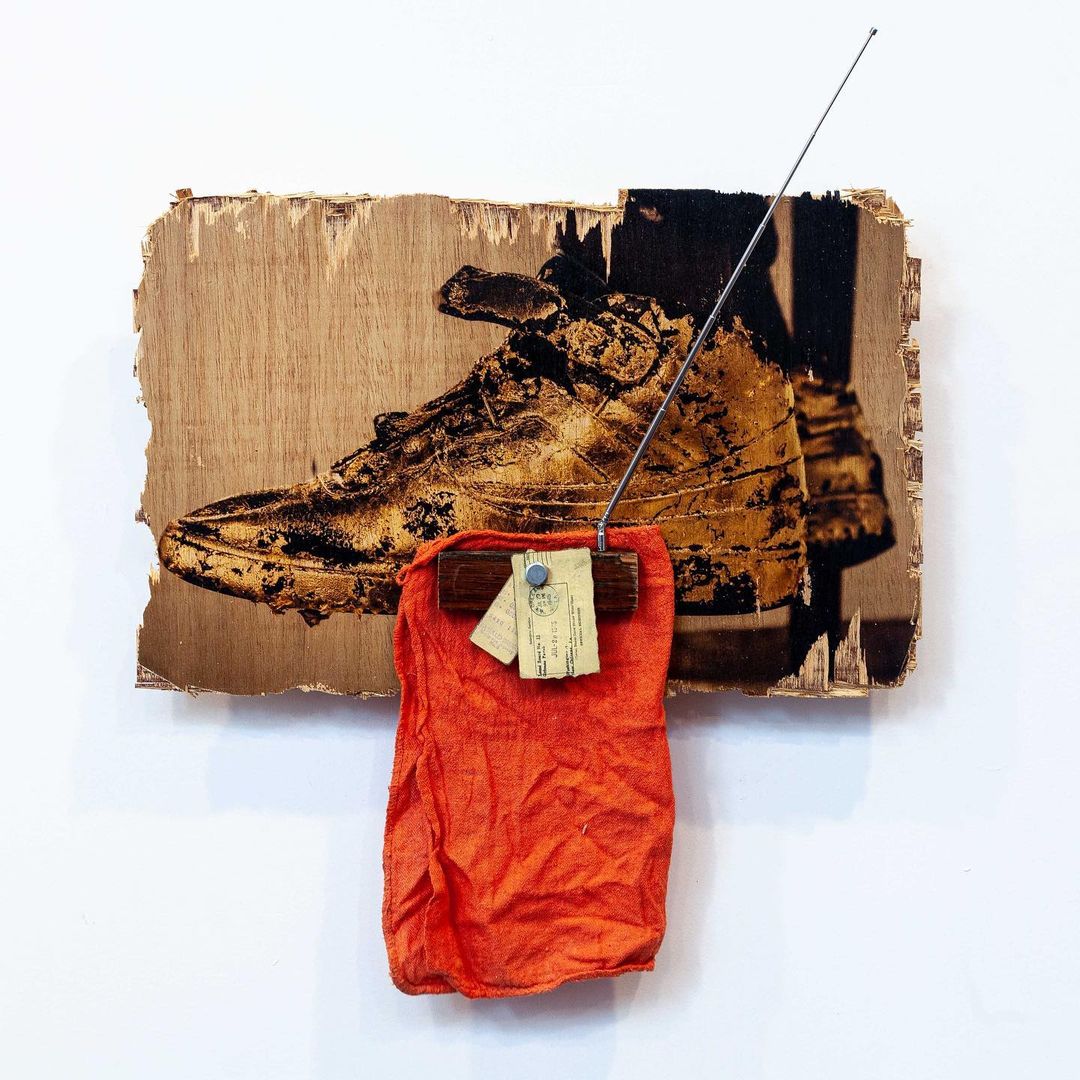
Second, Traveling Shoes is a performative sound work by longtime collaborators Justin Randolph Thompson and Bradly Dever Treadaway, from 2013’s Flux Night in Atlanta. It involved a two-seat shoe-shine “chariot” being dragged through the crowds, stopping to gold-leaf the shoes of anyone who was interested. All the while, on the back of the chariot, a three-piece jazz band played the traditional African American song “Traveling Shoes,” which is about getting ready for Jesus’s return. The original performance, which lasted around three hours and has been re-created in several different contexts since then, is archived in a twelve-minute video, which is what was on display at Bethel. To go alongside, the curators asked the duo to submit a photograph from the performance series; they went the extra mile and used a photo as the basis of a new mixed-media work that incorporates objects used in the performance, such as a mechanic’s rag and an antenna, which is what I’ve posted here.
+++
RELIGIOUS POEMS SAMPLER: “Original and unorthodox poems about theology,” compiled by Mark Jarman: An excellent selection of ten poems, all but one available for reading from the Poetry Foundation. Jarman is a leading poet of the twenty-first century and a Christian. He was too humble to include one of his own poems on the list, but his poetry is much in this vein, so for number 11 I would add Jarman’s “Five Psalms,” from his collection To the Green Man (2004).
HENI Talks (short art history videos)
Launched in April 2018, HENI Talks is a growing catalogue of short films on art, narrated by experts. The project was prompted by the 2016 announcement by the AQA exam board in England that they would be dropping art history A-levels, meaning that the subject would no longer be taught in high schools. Although the course was saved at the last minute, it rang alarm bells for the international art services business HENI, who decided they wanted to help bring art history more fully into the digital age, to make it accessible to a wider public. They assembled a dedicated team of producers, researchers, editors, and camera operators and shot twenty-five videos on location on a range of art history topics, interviewing leading artists, curators, and academics. For these efforts HENI Talks won Apollo Magazine’s 2018 Digital Innovation Award.
I first encountered them through their video “Van Gogh’s Olive Trees” and was super-impressed by the high production values. That close-up photography! Makes a huge difference in experiencing art online.
Since then they have been steadily adding new videos, which average about ten minutes each. These include breakdowns of movements/styles, like abstract expressionism, brutalism, and land art, as well as videos focused on single artists or artworks or even themes, such as “The Bed in Art: From Titian to Emin.”
The emphasis is on modern and contemporary art—Marcel Duchamp, Henry Moore, Francis Bacon, Jean-Michel Basquiat, Gerhard Richter, Maurizio Cattelan, Paula Rego, Louise Bourgeois, Glenn Ligon, and so on. And art in British collections. I, of course, am particularly drawn to the videos that feature biblical or liturgical art. My favorites are below.
“Pisa Pulpit: ‘Judge by the correct law!’,” presented by Jules Lubbock: This video examines the seven-hundred-year-old marble relief sculptures of the life of Christ carved by Italian Gothic artist Giovanni Pisano into the pulpit of Pisa Cathedral. (The piece Lubbock looks at is actually a plaster cast of the pulpit, at the Victoria and Albert Museum.)
“Emotional Enigma in the Sculpture of Michelangelo,” presented by Alison Cole: “Michelangelo’s most well-known works exist on a colossal scale, from his formidable statue of David to the High Renaissance frescoes of the Sistine Chapel. Yet, his art could also be tender and lyrical, dwelling upon the inherent tensions of the human condition. Art Historian Alison Cole examines one such example, the Taddei Tondo (c.1504-1505) – the only marble sculpture by Michelangelo in a British collection. Cole provides a rich insight into the artist’s life, influences and unique approach to sculpture.” The tondo portrays the Virgin and Child with Saint John the Baptist.
“Ely Cathedral’s Lady Chapel: Devotion and Destruction,” presented by Paul Binski: “Ely Cathedral’s Lady Chapel was one of the most splendid artistic and architectural achievements of medieval England. The Catholic chapel’s lavishly painted sculpture and stained glass, devoted to the Virgin Mary, moved pilgrims to a religious frenzy. But when Protestants began to call for a ‘purer’ vision of the Christian faith in the 16th and 17th centuries, this same quality triggered repulsion. During the hundred years of the English Reformation, the chapel was scraped, scrubbed and smashed of its extravagance.
“Art historian Paul Binski believes it is possible to recover the Lady Chapel’s former opulence in the imagination. His talk gives an insight into the psychology behind Ely’s splendour, and the idea that art can be so powerful as to provoke violence – something we still see in headlines today.”
“Art & Soul at St Paul’s Cathedral,” presented by Sandy Nairne: “How does art ‘wake up the soul’? There is perhaps no better place to explore this theme than St Paul’s Cathedral in the City of London. Art historian Sandy Nairne walks through the architecture of Sir Christopher Wren’s masterpiece, pointing out how artists have responded to the sanctity of this historic space. He describes how early commissions by the Cathedral aimed to sustain belief in Christian worshippers, and how modern and contemporary artists including Henry Moore, Bill Viola and Mark Wallinger, have tried to express spirituality in a more secular age.”
+++
There’s also a HENI Talk written and narrated by the art critic Julian Spalding, called “Faith and Doubt in Art” and released in May 2019, but I feel it doesn’t do justice to its title, and it advances an overly simplistic narrative that is misleading in places and confusing in others. I know it’s difficult to bring nuance to such a vast topic in just twelve minutes, and that under such constraints, generalizations are inevitable. The video is mainly about representational art versus abstract art, and in particular the effect of modernity on Western art. Spalding posits that the age of scientific discovery that we call “the Enlightenment” was actually a time of spiritual darkening, where people ceased believing that the world was beautiful or had meaning, and this in turn produced an art of doubt and worry—“a nightmare vision of the world” exemplified by Goya and culminating in Munch’s The Scream (“the very end of the Christian tradition,” Spalding says).
The Enlightenment did, of course, cause faith crises for many, and this shaken worldview was reflected in the work of some artists. But I want to note that doubt is not incompatible with Christian faith, nor is an awareness of the world’s horrors or a dedication to science. In fact, many Enlightenment scientists were devout Christians who were impelled further in their research by their very belief in God and that the universe is ordered and contains mysteries to be discovered. And artists, even within the Christian tradition, have always been attuned to the darker aspects of life and had fears and anxieties surrounding sickness, violence, and sex, for example, which in medieval Europe could be expressed through portrayals of particular biblical narratives and saints’ lives. Some of the most gruesome artistic imaginings of hell were inspired by real-life tortures that were taking place at the time. Distorted forms and the grotesque are not unique to modern art, and their use was and is not a sure indicator of a nihilistic attitude or a rejection of a good creator-God.
So while Spalding’s account of art history as relates to the Christian faith is widely accepted, it’s important to remember that things weren’t quite so linear or across-the-board. And art can be “dark,” hold tensions, or pose questions and still be faithful to Christianity.
Puzzlingly, Spalding uses Rembrandt as an early example of religious doubt, noting that the tonality of his works got darker and darker, as if that signified a dissolving faith. Spalding reads into Rembrandt’s late self-portraits, in which he portrays himself in a nonidealized manner, a questioning whether God really created him, imperfect as he is. I, on the other hand, see in these portraits a man owning his own brokenness and frailties, bringing them into the light.
Spalding also makes a few inaccurate statements in the video, like that all Islamic art is abstract (what about the magnificent traditions of Persian [Iranian], Ottoman [Turkish], and Mughal [Indian] miniature painting?) and that Piero della Francesca’s Baptism of Christ represents “a man turning into a god” (no, Christians believe Jesus has always been both fully man and fully God; his anointing in the Jordan signified the start of his earthly ministry).
He ends by stating that in the modern period, as more and more people rejected the idea of a Creator, representation ceased to have meaning and Western art became abstract, much like that in the rest of the world. He compares, for example, an abstract expressionist painting with Islamic architecture, noting how they both express transcendence and mystery (he doesn’t have time to discuss their foundational differences, however). I would argue that while abstraction is a perfectly valid approach, representation in its own way can also express mystery. Take, for example, icons.
I would also add that there’s a huge difference between believing that life has no meaning and believing that that meaning cannot be represented. I think Spalding would agree—the video just doesn’t make that clear.
Spalding makes a very important point when he says that in Hinduism, Buddhism, Confucianism, etc., the “source of spirituality” (Truth) is invisible, and similarly, Judaism and Islam say you can’t visualize God, whereas Christianity says that the source and object of our faith, Jesus Christ, God the Son, did make himself visible and is therefore representable, and that belief very much influenced the trajectory of Western art.
My biggest concern with Spalding’s talk is that it doesn’t come full circle to acknowledge the “return of religion” in contemporary art—as Jonathan Anderson (see here), among other art historians and critics, have shown—nor does it address the comeback that representational art has been making in recent years, and in fact among Black artists by and large, it never really went away.
Roundup: Ethan Hawke on creativity; Jesse Pinkman as child-prophet; 1843 abolitionist hymn; and more
JULY PLAYLIST: The songs I’ve compiled this month on Spotify include Audrey Assad’s rewrite of a classic patriotic hymn [previously], a Bach partita with added words by Alanna Boudreau inspired by Dante’s Inferno, a Sotho interpretation of Psalm 23 by the Soweto Gospel Choir, a celebration of God as artist written and sung by a Franciscan friar from the Bronx, a song of testimony performed by blues musician Elizabeth Cotten and her great-granddaughter Brenda Evans, a multilingual song setting of Matthew 5:9 (“Blessed are the peacemakers . . .”) (again, with multigenerational participation!), Psalm 103 sung in Hebrew with ancient Middle Eastern instruments, and more.
+++
KICKSTARTER CAMPAIGN: Great Cloud by Nick Chambers: This is one of the creative projects I donated to this week. Chambers writes, “For over a decade, I have written music for the Church without much concern for the songs reaching beyond the particular place and people to which I belong. Now I want to release and share this music more widely. And you can help.
“I write songs to help give voice for people to pray, question, confess, doubt, lament, give thanks, and praise. Because I owe so much in this to the many faithful voices of history of the Church, this first record will be a collection of prayers of the saints—faithful voices such as Ephrem the Syrian, Teresa of Avila, Howard Thurman, and more.
“I have been planning with producer Isaac Wardell (The Porter’s Gate, Bifrost Arts) to record in early September in Paris near where he is currently based. The Porter’s Gate will be recording the same week, which means your support toward my $15k goal will go toward my record and travel costs, as well as allowing me to contribute in person to the next Porter’s Gate project.”
Here’s an example of Chambers’s singing-songwriting—a setting of Psalm 22:
+++
TED TALK: “Give yourself permission to be creative” by Ethan Hawke: I could listen to actor Ethan Hawke talk about any subject; he’s so interesting and passionate. (His recent conversation with the American Cinematheque on his new limited series The Good Lord Bird, for example, about abolitionist John Brown, was fascinating!) In this video he was asked to talk about creativity and the arts. He says,
There’s a thing that worries me sometimes whenever you talk about creativity, ’cause it can have the feel that it’s just nice, you know; or it’s warm or it’s something pleasant. It’s not. It’s vital. It’s the way we heal each other. In singing our song, in telling our story, . . . we’re starting a dialogue. And when you do that, healing happens. And we come out of our corners. And we start to witness each other’s common humanity. We start to assert it. And when we do that, really good things happen.
+++
TRANSPOSITIONS ESSAYS:
>> “‘Stop Working Me’: Jesse Pinkman as Child-Prophet in Vince Gilligan’s Breaking Bad” by Mary McCampbell: Jesse Pinkman from Breaking Bad, played by Aaron Paul, is one of my favorite TV characters of all time; I think I can truly say I’ve never been more emotionally invested in, or rooted harder for, any other. Mary McCampbell, author of the forthcoming book Imagining Our Neighbors as Ourselves: Empathy, the Arts, and the Religious Imagination (Fortress, 2021), writes about Jesse’s role as “child-prophet,” who sees and exposes with increasing clarity and conviction the amoral decay of the empire he helped Walt build. (Note: the article contains some series spoilers.)
>> “Revealing the Father: L. M. Montgomery, Dorothy L. Sayers, and Doctrine in Art” by Alicia Pollard: This article examines how the doctrine of God the Father shows up in Lucy Maud Montgomery’s novel Anne of Green Gables and Dorothy Sayers’s play The Emperor Constantine. The former chooses “the way of whimsical unorthodoxy”; the latter, “the way of passionate orthodoxy and reenchanted dogma as a living agent of truth.”
+++
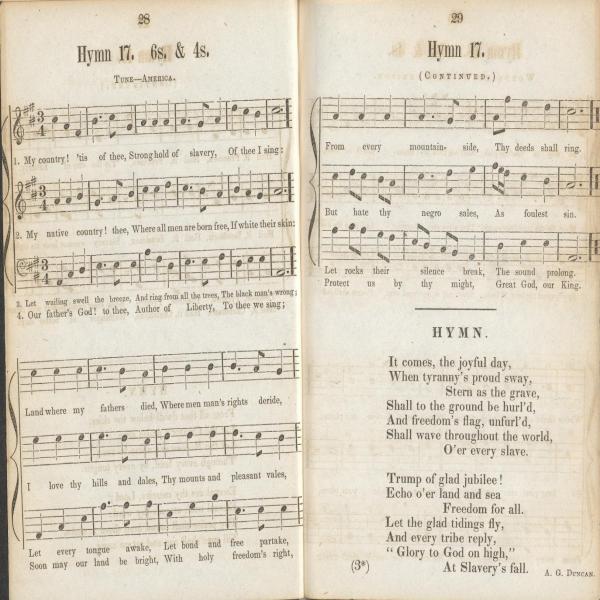
SONG: “My Country ’Tis of Thee” (abolitionist version by A. G. Duncan, 1843): I wanted to post this for Juneteenth, but alas, I’m two weeks late. Just twelve years after Samuel Francis Smith wrote “My Country ’Tis of Thee,” a scathing rewrite by abolitionist A. G. Duncan was published in Massachusetts in the book Anti-Slavery Melodies. Exposing the hypocrisy of a nation that proclaimed life and liberty for all and yet perpetuated the evil institution of race-based chattel slavery, it’s a call to lament—“let wailing swell the breeze”—as well as an anticipation of coming liberation, God be praised. (Again, this was 1843, almost two decades before the Civil War.) This vocal arrangement and performance using Duncan’s alt lyrics is by Chase Holfelder, who sings the song in a minor key. [HT: Global Christian Worship]
My country, ’tis of thee,
Stronghold of slavery, of thee I sing;
Land where my fathers died,
Where men man’s rights deride,
From every mountainside thy deeds shall ring.My native country, thee,
Where all men are born free, if white’s their skin;
I love thy hills and dales,
Thy mounts and pleasant vales,
But hate thy negro sales, as foulest sin.Let wailing swell the breeze,
And ring from all the trees the black man’s wrong;
Let every tongue awake;
Let bond and free partake;
Let rocks their silence break, the sound prolong.Our father’s God! to thee,
Author of Liberty, to thee we sing;
Soon may our land be bright,
With holy freedom’s right,
Protect us by thy might, great God, our King.It comes, the joyful day,
When tyranny’s proud sway, stern as the grave,
Shall to the ground be hurl’d,
And freedom’s flag, unfurl’d,
Shall wave throughout the world o’er every slave.Trump of glad jubilee!
Echo o’er land and sea freedom for all.
Let the glad tidings fly,
And every tribe reply,
“Glory to God on high,” at Slavery’s fall!
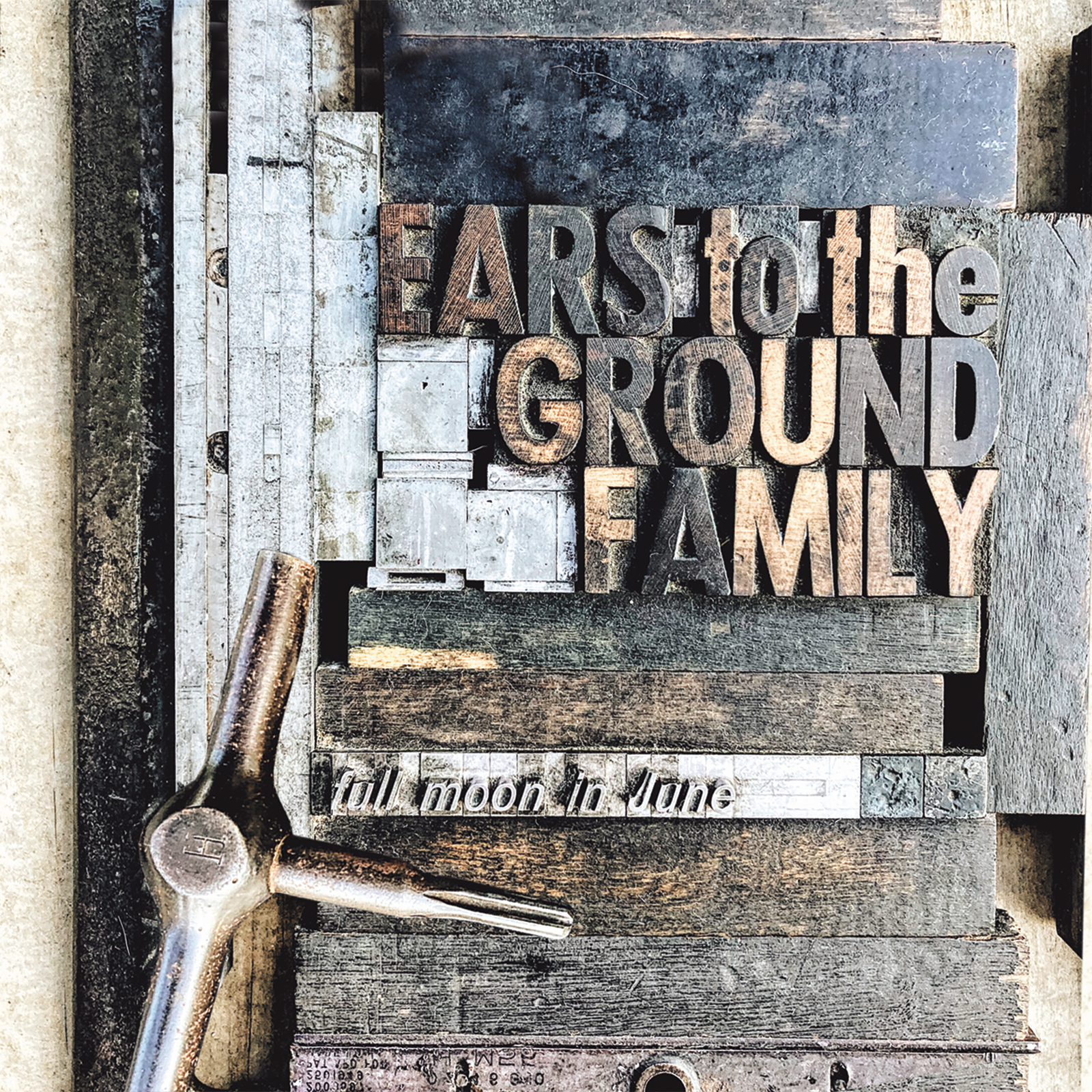
Album Review: Full Moon in June by Ears to the Ground Family
Ears to the Ground Family is a group of friends in their early thirties, making music together in and around their hometown of Harrisonburg, Virginia. Minimalist and totally acoustic, they sing songs of hope, sustaining faith, and resistance to oppression and empire. Their stylistic influences include the spirituals, soul, hip-hop, R&B, folk/Americana, chant, Taizé, and Anabaptist hymns, especially from the Mennonite tradition, to which they belong.

The band formed in 2010 and has “always preferred the outdated and peculiar model of the elusive traveling troubadour,” sharing their music in small settings, unplugged, locally or regionally. Its members first met during the Petrol-Free Jubilee, an annual two-week bicycle-powered music and art tour of the mid-Atlantic, which they went on to participate in as a group for seven years. Its purpose was “to promote peace, social justice, and a healthy planet.”
“We biked two hundred to three hundred miles with ten to twenty people on average, often several bands or musicians with us at a time, and our regular stops and show locations included a lot of farms, community centers, and Catholic Worker houses,” band member Nichole Barrows told me. “Just imagine twenty people rolling down Main Street in your city in the middle of a hot summer afternoon on their bikes, with drums and guitars in tow, ringing their bike bells and singing at the top of their voices! I mean, it was like summer camp on wheels; we brought the show with us!”
This small-scale approach and casual touring schedule, Barrows said, “enables us to root ourselves deeply within our home community and invest in the valuable work that inspires our music.” That valuable work includes church ministry, community organizing, farming, and outdoor education.
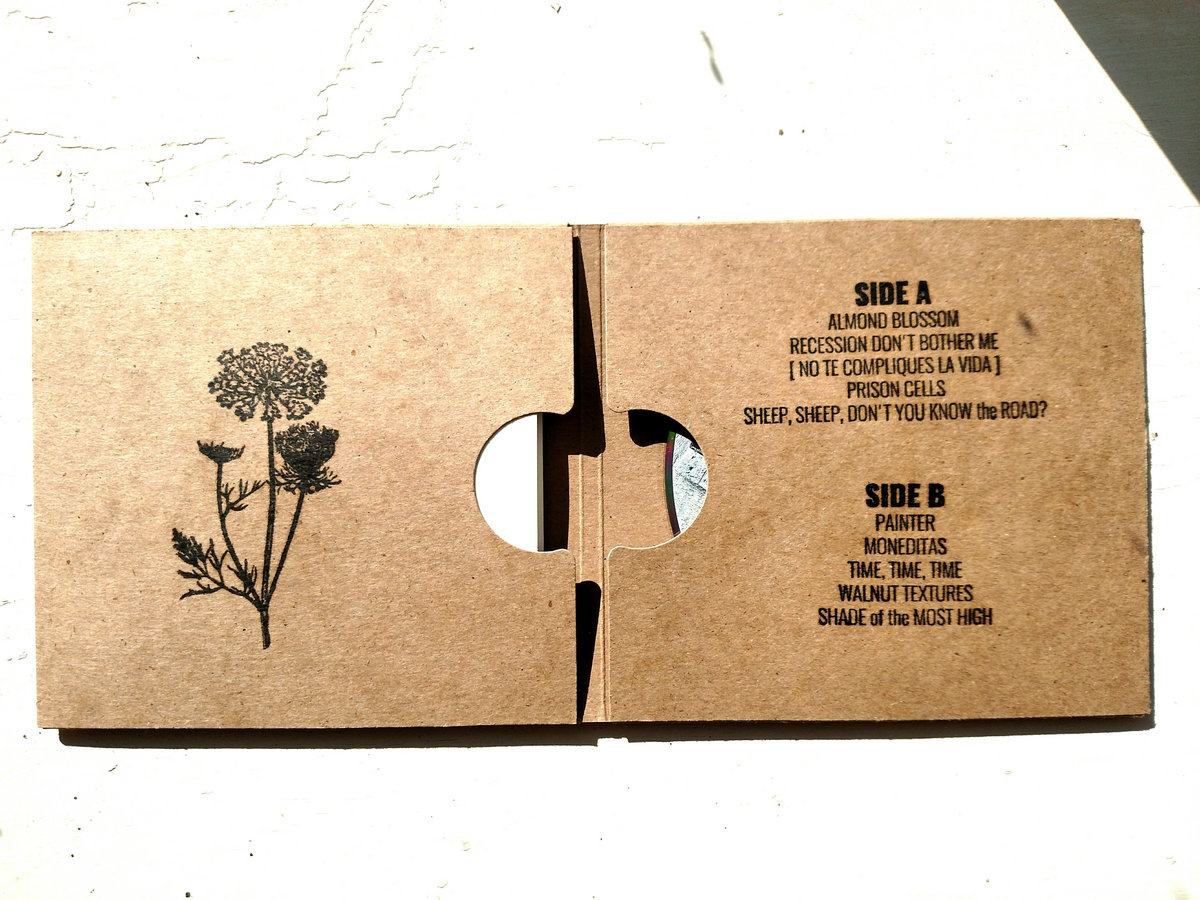
In June 2017 Ears to the Ground Family recorded eight original songs (written between 2007 and 2013) plus a traditional African American spiritual, but jobs, family, and other projects prevented them from being able to mix, master, and self-release until recently. Finally, on December 18, 2020, their debut album, Full Moon in June, came into the world, making their music available to a much wider audience for the first time.
“It’s funny,” Barrows said, “some people talk about ‘slow music’ (you know, slow food, etc.) to describe homegrown, independently released local music. But we’re so ‘slow’ that it takes us about ten years to release our first album!”
Infused with prophetic imagination, Full Moon in June denounces the forces of evil at work in the world on a grand scale—things like war, environmental exploitation, predatory lending practices, and the prison industrial complex—and casts a beautiful vision of all things new under Christ. Stop participating in that which is destructive, the album invites, and join instead with the creative work of the Spirit, which is love, joy, peace, patience, kindness, generosity, faithfulness, gentleness, and self-control (Gal. 5:22–23). These songs awaken my enthusiasm for the promised future of all that is and for our journey toward it, sowing seeds of Christ’s kingdom all along the way.
An exploration of “Almond Blossom”
My favorite song on Full Moon in June is the first one, “Almond Blossom” by Dimitris Campos, which uses the image of a tree to signal abundance and renewal. “There’s an almond blossoming in Jerusalem,” it opens. Almond blossoms are a harbinger of springtime, and in fact Israel’s almond trees are the first to bloom each year. The song’s second line, “The buds on a fig tree becoming tender again,” evoke the recurring comparison of God’s people to a fig tree in the Hebrew Bible (e.g., Hosea 9:10; Jer. 8:13; Jer. 24) as well as the story of Jesus cursing a fig tree for failing to bear fruit, a symbolic act of judgment against those who reject his ways. The image here, though, is of a withered fig tree becoming healthy and vibrant once again.
The lyrics go on to note how the trees and other parts of the natural world appear to worship God; the “mountains are clapping their hands” (cf. Psa. 98:8; Isa. 55:12), and the trees reach toward the heavens. Humanity, by contrast, turns in on itself, and rather than living into the flourishing it was created for, invents new means of destruction—bombs dropped from drones, for example, leaving orphans in their wake.
(Related posts: “Songs of Lament and Justice by The Porter’s Gate”; 1798 essay, “A Plan of a Peace-Office for the United States” by Benjamin Rush)
In the song, Campos recalls a visit to the National Air and Space Museum in Washington, DC, the horror of families posing happily for photos in front of bombers, fighter jets, missiles, military avionics, and other tools of combat, celebrating national might. Campos contrasts the heaviness of those metal death-traps with the light feeling of floating on the “river of life” (cf. Rev. 22:1), and their sterility with a fructifying olive vine, delicately tended (cf. Rom. 11:11–24).
Empires fall—Egypt, Rome; America one day will too, and another will rise in its place. “I proclaim that Jesus, he will decide / If it is that Rome is on I-95”—the highway that the US capital is located off of. Earthly kingdoms that put their trust in arsenals and that deal in death rather than life may be in for a divine toppling. The same goes for corrupt systems.
Jesus himself said as much. For example, in Mark 13:2, he says regarding the Jewish temple complex, “Do you see these great buildings? Not one stone will be left here upon another; all will be thrown down.” It’s because the religious establishment at the time had become oppressive and was rejecting Jesus as the Christ. They were trusting in all their rules and learned interpretations of scripture while failing to see the plain revelation of God right in front of them.
The penultimate stanza of “Almond Blossom” is excerpted from “Canticle of the Turning” by Rory Cooney, a paraphrase of Mary’s Magnificat, which is one of the Bible’s most radical songs:
From the halls of the power to the fortress tower
Not a stone will be left upon a stone
Let the king beware, for your justice tears
Every tyrant from his throne
The song concludes with a reprise of the first two lines, circling back to the image of trees and their eschatological (end times) resonances. In Matthew 24:32–33, Jesus tells his disciples, “From the fig tree learn its lesson: as soon as its branch becomes tender and puts forth its leaves, you know that summer is near. So also, when you see all these things, you know that [the Son of Man] is near, at the very gates.”
“Almond Blossom” is a clever interweaving of biblical allusions, spanning Genesis to Revelation, that calls America to account for its warmongering while inviting her citizens into the beautiful, lasting, life-giving way of Christ.
The following poem from the book of Isaiah, about the messianic age, was resounding in my mind as I listened to this song:
For you shall go out in joy
and be led back in peace;
the mountains and the hills before you
shall burst into song,
and all the trees of the field shall clap their hands.
Instead of the thorn shall come up the cypress;
instead of the brier shall come up the myrtle;
and it shall be to the Lord for a memorial,
for an everlasting sign that shall not be cut off.—Isaiah 55:12–13
Other songs
All but two of the songs on Full Moon in June were written (or cowritten) by Dimitris Campos. Half Greek and half Peruvian, he was raised in a Latino culture in the United States, which itself has mixed Spanish, Indigenous, and African influences. His musical compositions are informed by this background.
“Recession Don’t Bother Me,” subtitled “No te compliques la vida” (Don’t complicate your life), reflects on a mother’s words of advice regarding not staking your identity on material things, and not climbing over others to get ahead. It was released with this statement:
We are releasing this album in the midst of the historic COVID-19 pandemic. The virus has left record numbers of people without work and we realize that in this moment, working-class people are suffering. With that in mind, we want to note that our song “Recession Don’t Bother Me” (which was written during the Great Recession of 2007 and 2008) is not saying “the recession don’t affect me,” because as the current pandemic has shown us, the circumstances and effects of the current situation do indeed have profound consequences for us all. Nor is this song saying that we are insulated from the economic effects of recession because of our wealth or privilege—although we acknowledge that in this current context, many people have had it much harder than we have. What this song is saying is that our current destructive and dehumanizing economy must, one day, collapse. And that we hope to be among those who welcome and rejoice at an exodus from an Egypt to a promised land, even if it means a journey through the desert to get there. We are praying for providence for all those suffering during these deeply trying times.
In downtown Harrisonburg, amidst hip college-town cafés, sits the Rockingham County Jail, right across the street from the courthouse. At certain times of day, men in jumpsuits and chains are very visibly marched to and from these locations. Disgusted by this flagrancy and following the arrest of one of his undocumented friends, Campos wrote “Prison Cells.” It’s a condemnation of America’s for-profit prison system and retributive (as opposed to restorative) model of justice. How does our lust for punishment cohere with Jesus’s blessing on the merciful (Matt. 5:7) and the apostle Paul’s insistence that “love keeps no record of wrongs” (1 Cor. 13:5)? We teach our kids to forgive offenses and to let go of grudges, and yet our criminal law teaches the opposite. Lord, have mercy.
Fourth up on the album is a new interpretation of the spiritual “Sheep, Sheep, Don’t You Know the Road?” from the Georgia Sea Islands, popularized in the 1960s by folk singer and African American music preservationist Bessie Jones, who learned it from her formerly enslaved grandfather. Ears to the Ground Family has expressed the indebtedness of their work to “centuries of creative Black resistance against slavery and oppression,” of which this song is just one example. Its lyrics describe the road of faith as one of pain but also bridges, a road where “there’s no price tag” (cf. Isa. 55:1) and “the sword’s beat down” (cf. Isa. 2:3–4).
On this track the djembe and shekere are played by Jay Beck and Tevyn East, two of the lead organizers of the Carnival de Resistance. “A traveling carnival, village, and school for social change bridging the worlds of art, activism and faith,” this organization seeks to throw off sanitized pieties and “provide a raucous expression of grief and longing and hope for Creation.”
“Painter” is a parable that shows how indulging in sin cuts us off from ourselves and can inhibit us from showcasing God’s glory.
“Moneditas” (Coins), which Campos wrote with Ana Maria Febres, is a Spanish-language song about the emptiness of riches. It echoes Matthew 6:19–20: “Do not store up for yourselves treasures on earth, where moth and rust consume and where thieves break in and steal; but store up for yourselves treasures in heaven, where neither moth nor rust consumes and where thieves do not break in and steal.”
The whimsical “Time, Time, Time,” with its coffee-mug and glass-bottle percussion, seems to me to be a celebration of the unfolding of time just as it is. May we not wish for time to move any faster or slower, but instead appreciate the now and live with an openness to whatever’s next.
“Walnut Textures,” by Campos and Lightning Lucas, encourages a closer relationship with the natural world. It remarks with regret how we have such a strong desire to explore the far reaches of the universe, and yet many of us hardly know the beauty and wonders of our own planet, or even our immediate environs—or if we do, we don’t care enough to protect them. Instead of stewarding nature we squander and abuse it, building highways (dirty paved “rivers”) through forests and then packing cars onto them, increasing air pollution and contributing to global warming. This dominating stance over God’s creation is vanity, and God urges us toward a better way—one of friendship with creation, in which we recognize our mutual groaning for redemption (Rom. 8:22–23) and take up our responsibility as caretakers, which includes adopting sustainable environmental practices.
Spending time in nature is refreshing and even liberating, a chance to experience the givenness of life. Living in right relationship with her now is great practice for the age to come, when all will be reconciled.
The last song, “Shade of the Most High,” was written by Nichole Barrows amid her grief following the death of her mother. It was inspired by the promise in Psalm 91 that we will find rest in the “shadow” of the Almighty God. She says,
I found great comfort in this image of grief as a dark place where God can still find us and bring us rest, because although we feel that we don’t deserve the bad things that are happening to us, we can trust that we are still in his “shade.” And this gift of trust in God’s faithfulness helps us not to fear disease or darkness or even death. I sang these words over myself that year [of my mother’s decline] and I sing them over you now: “With a hope like this, we are fearless, and with a love like this, I will not despair.”
Loss is wrenching and often unexplainable, but it can also be an occasion “to find new life, to find new eyes,” and to lean all the more firmly on the One who bears our sorrows in love.
Already and not yet
When I was talking to Barrows, she expressed emphatically one of the great paradoxes in Christian teaching: “that the kingdom of God is not yet here and that we are together longing for Christ to come make all things new, and also that he is already here, now, on this earth, in this place.” She mentioned how Ears to the Ground Family wishes to affirm not just the spiritual elements of faith (which, I will add, are the central preoccupation of the vast majority of faith-based music) but the physical elements as well, “such as care for the earth and the peace witness and the works of mercy.” This commitment is certainly reflected on their album, which is centered on holistic liberation. I love how it so joyously embraces the broadness of the good news of Jesus Christ, which is not just for individual souls but also for bodies and communities and for the whole created world—presently as well as futurely!
Full Moon in June is available for digital download or as a CD in a cardboard sleeve with handprinted letters (produced by Campos’s vintage, treadle-powered letterpress) and stamped with handmade rubber stamp art. The latter option is a limited edition of 200.
From Bucolics by Maurice Manning

XXII

[. . .] you’ve got yourself
a common name but a name I can’t
forget a name like honey Boss
you pour it in my ear you pour
it in my mouth you make me say
it Boss your name it’s like a bird
that’s come to roost upon my lips
no matter what it will not stir
it sings a single note sometimes
it’s just a whisper others it’s
a shout [. . .]

*

XXXV

is that you Boss is that
you hooting in the hollow
are you a night bird Boss
is that your face behind
the moon is that your hand
cupped to the cricket’s ear
do you tell the cricket how
to sing do you say that’s it
now softer softer now
you little bug do you
pour moonlight on the river
do you say river let
this silver ride on you
you’re up to something Boss
you’re like a treetop there
against the sky a wave
you’re like a neighbor Boss
is your favorite game a game
of peep-eye Boss are you
as sweet as you can be
you cutie-pie I can’t
keep track of you Boss you’re just
too many things at once
you’re like a lullaby
that never ends a breath
that makes the moment last
again again again

*

LVIII

[. . .] that’s what
I do when I can’t sleep a wink I think
about you Boss I wonder all those yellow
fireflies even though they never make
a peep do they still call you Boss
Excerpts from Bucolics: Poems by Maurice Manning (New York: Houghton Mifflin Harcourt, 2007), used by permission of the author. A new twist on the traditional genre of pastoral poetry, this Pulitzer Prize–nominated collection comprises seventy-eight unpunctuated, untitled poems about the natural world, all addressed to a higher power called “Boss.”
Alfred Conteh’s “Float” and other recent CAUAM acquisitions
In September 2019 I visited Atlanta, Georgia, and one of the two art stops I made was the Clark Atlanta University Art Museum, whose purpose is “to collect, preserve, research, and exhibit fine art works that document the role of African Americans in American history and culture.” When I got there I was bummed to see that the museum was closed in preparation for three exhibitions that were to open that Sunday. But graciously, even though the signage and lighting hadn’t been installed and some of the objects were still being moved around, the curator allowed me in for a little glimpse.
I was stopped in my tracks by a mixed media sculpture in the gallery of recent acquisitions: Float by Alfred Conteh.


It shows a Black female Christ figure rising up in a whirl of energy, her hat blown aloft. Wounds are visible on her hands and feet, but these are taken up into new, greening life. At the bottom is a broken chain, indicating that she has been set free. The piece expresses the exhilaration of emancipation, of being shackled no more.
(Related posts: “Contemporary Black artists at the Baltimore Museum of Art”; “Christ figure in Justin Dingwall’s Albus series”)
I would classify Float as a resurrection image, which its staging reinforces. To its far left is a wooden crucifix by Dilmus Hall, followed by The Mourners by Frederick C. Flemister, from 1942. (Note that the two crucifix photos in this post are courtesy of the Souls Grown Deep Foundation, who donated the pieces to the museum.)


Drawing on iconography of the Lamentation over the Dead Christ, Flemister’s The Mourners shows a mother holding the corpse of her grown son, who has just been deposed from a lynching tree. Behind her a woman in a pink dress throws up her arms in grief, and a preteen boy runs into his own mother’s arms for comfort. Like many artists before and after him, Flemister connects the killings of innocent Black men to the killing of Jesus—not because their deaths are salvific but because both they and Jesus were unjustly “crucified,” and because Black men bear God’s image, which the visual conflation reminds us of. As Jesus told his disciples, “Truly, I say to you, as you did it to one of the least of these my brothers, you did it to me” (Matt. 25:40).
Death and resurrection, suffering and hope, are the theme of this temporary exhibition. A second wooden crucifix, by Thornton Dial Jr., adorns the opposite wall. It’s titled I’ll Be Back, which, as the sculpture was made a few years after The Terminator came out, may be a playful reference to Arnold Schwarzenegger’s famous line, but it is first and foremost an affirmation that Jesus will return to earth, as promised, to fully set things right. (By the way, I wonder if Conteh, in making Float, was inspired by the hubcap component of another of Dial’s crucifixes . . .)

The last piece in the room is Ceres by John W. Arterbery. Ceres was the Roman goddess of agriculture, grain crops, and fertility, the equivalent of the Greek mother-goddess Demeter. In Arterbery’s painting she wears a crown of sprouting wheat stalks and holds a pitchfork in one hand and a leafless plant with buds and berries in the other. I think the flowers may be poppies, as Ceres is associated with those.
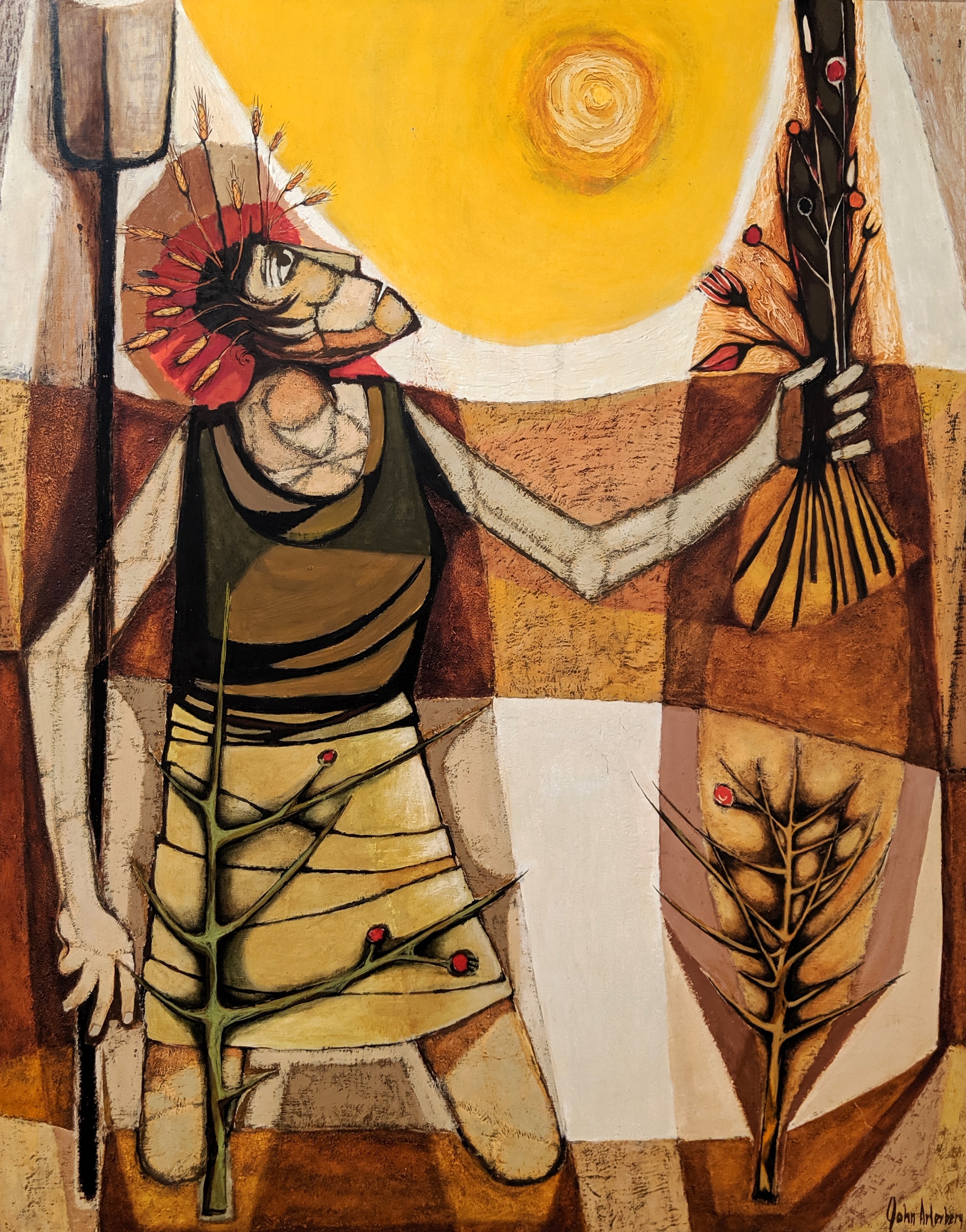
It appears as though Arterbery is depicting the imminence of spring, when Ceres will be reunited with her daughter Proserpine (Persephone) and life will grow and flourish. It shows Ceres looking toward the sun in anticipation of such a time. Read in conjunction with the other pieces in the room, Ceres could be interpreted as an Advent image—a waiting for the final fulfillment of God’s good purposes for his creation, which includes a definitive end to suffering and oppression and a universal thriving.
The Clark Atlanta University Art Museum is typically open Tuesday through Friday from 11 a.m. to 4 p.m., as well as by appointment, but you may want to email ahead of time (cauArtMuseum@gmail.com) to confirm. It’s definitely worth a visit, though I can’t guarantee that the works featured here will be on display. If you wish to browse photos of pieces from the museum’s collection, see In the Eye of the Muses: Selections from the Clark Atlanta University Art Collection (2012).
Online Glen Workshop: July 25–31, 2021
Organized by Image journal every summer, the Glen is equal parts craft workshop, arts festival, and spiritual retreat. It’s framed by the Christian tradition but welcomes spiritual wayfarers of all stripes. This year, due to the pandemic, it’s entirely online, with twelve different classes on offer, taught by renowned artists, writers, and critics. Visit https://imagejournal.org/the-glen-workshop-2021/ for more information.
“The last year has invited many of us into a thicker relationship with place: with the homes where we quarantine, the public spaces we navigate with new caution, the vacation destinations we dream about, and the neighborhood streets we walk to avoid going stir-crazy in the meantime. Even our computers have transformed from objects to places, ushering us into the homes of loved ones, yoga studios, concert halls, museums, and countless other virtual gatherings, including the 2021 Glen Workshop! This year we’ll be exploring the ways in which our surroundings feed our creative vision. And we’ll also consider how art—both making it and sitting with it—sharpens our capacity for attention to the places we live and move and have our being.”
Each class costs $950 and is open to all experience levels. The schedule is such that attendees can choose just one. Registration to any class gives you full access not only to five days (about three hours each) of expert instruction, in-depth conversation, and practice, but also to additional programming that includes faculty presentations, “experiments with poetry and place” with artist in residence Billy Mark, chapel services led by musician Charles Jones and chaplain Marilyn McEntyre, coffee hours, open-mic nights, centering prayer sessions, and yoga sessions. Again, it’s all online.
If you don’t want to register for a class but want access to the other content or just a sneak peek, there are “retreat registration” and “festival pass” options. Click here to view registration options. You can get a 25% off discount if you register in a group of three or more.
What follows is a full list of the workshops (hands-on, craft-based classes) and seminars (immersive, discussion-based classes). I’m considering registering for either the Rosen seminar on contemporary biblical art or the Overstreet seminar on film. The cost is reasonable, but it’s still high, so I have to see if I can make it work.
Workshops
“Poetic Text as Provocation” with Scott Cairns: “We will embrace an approach to poetry that privileges poetic text as a scene of meaning-making, distinct from any approach that would understand the poem as a site of meaning already made. We will begin most days with a reading of a great and provocative poem and discuss the provocations each of us registers in response to that poem. Then, we will share our works-in-progress, and each of us will offer our ideas about what might make each draft a richer, more suggestive, provocative occasion for the reader.”
“The Attention We Owe Each Other” with Shane McCrae: “It is important to almost every poet to find a community of fellow poets with whom they can share their work, and from whom they can expect serious and good-humored attention, and honest and direct critiques. Together, we will make that community. Our poetry workshop will not operate according to any particular idea save the idea that poetry is serious—that it is, in fact, among the most serious things in our lives—and that, consequentially, we owe each other seriousness, and intelligence, and sensitivity when we workshop each other’s poems. We will read and critique each other’s poems closely; we will prioritize whatever particular issues each poem asks us to prioritize while keeping in mind the issues its author has asked us to consider; and we will have fun together, the highest seriousness being joy.”
“Writing the Moveable Feast” with Alissa Wilkinson: “Food is what binds us together as humans. We all eat it. We all make it, or someone makes it for us. We all have opinions about it and preferences for it, which often come from the things that make us, well, us: our families of origin, our nationalities and ethnicities, our individual tastes, our beliefs about God and ethics, and our access to it. Food is the gateway to every aspect of human life; when we eat it, we’re participating in history, culture, and the economy.
“Feasting is one of the most important activities we can do as people. It’s an act of community-building, celebration, and even resistance to the forces that try to tear us apart. Many religious and spiritual traditions are built around feasting; the Bible ends at a wedding feast.
“So in this class, we’re going to talk about food, think about food, make food, and eat food. We’ll talk about how writers have interacted with food and food writing. We will try to understand what it might mean to feast together even when we can’t actually be together. And then we’ll do our own food writing, with the goal of exploring that common experience through our writing (in any genre).”
“Strange Countries: Writing the Inner and Outer Journey” with Fred Bahnson: “In sixth-century Ireland, groups of monks began the practice of peregrinatio, “going forth into strange countries.” The peregrini set off alone or in small groups in tiny coracles made of willow and animal hide, abandoning themselves to the winds and currents of the North Atlantic. A journey into the unknown.
“We moderns find it difficult to grasp the enormity of such an undertaking. Given how frequently we travel, we barely notice the existential threshold crossed upon leaving home. The peregrini remind us that we go on pilgrimage not to consume experience, but to be consumed. To feel again the porous borders between our inner and outer lives. If our rational age has obscured what Seamus Heaney called ‘a marvelous or magical view of the world,’ pilgrimage helps us find it again.
“In this class we will take a very ancient metaphor—the journey—and use it to explore our lives in the age of climate change, pandemics, and fragile democracies. We’ve all gone forth into a strange country, a journey in which we measure distance in time and cortisol levels rather than miles. Setting off in our coracles of narrative—essay, memoir, literary journalism, travel writing, nature writing—we’ll use our peregrinations to map our inner lives against the great stories of our age. We will write our physical journeys (working from memory), and we will write about shelter, intimacy with place, our yearning to be at home. As we traverse the continuum between pilgrimage and place-making, we will discuss various craft topics of literary nonfiction: form, character development (including place-as-character), narrative arc, and, perhaps most important, how to create the fictional ‘I’ that is your nonfiction narrator.”
“The Landscape of the Lyric Essay” with Molly McCully Brown: “The lyric essay combines the density, muscle, and music of the poem with the expansiveness, narrative momentum, and overt desire to engage with information of the essay form. Tied to the original notion of an essay as an effort, a trying, an attempt at making sense, its combined allegiances to the fragment and the whole, the actual and the imaginative, the image and the story, make it the perfect form for exploring and charting the landscapes—both exterior and interior—that make and mark our lives.
“Designed as an opportunity for poets craving a little space to move around, for essayists hungry to drill down to the core of language, or for any writer longing for a chance to experiment, investigate, and attempt, this generative workshop will serve as an introduction to the associative logic of the lyric essay and a chance to try your own hand at the form.
“In class we’ll read and unpack lyric essays from a variety of writers; work together to identify some unique features and possibilities of the form; write in response to prompts designed to help us explore a variety of geographical, sociological, emotional, and intellectual landscapes; and share and discuss our work as it develops. My hope is that you leave the workshop with many attempts and beginnings which might prove fertile ground for later work, and with at least one piece that feels more complete, or further along in its development.”
“Writing Research-Based Narratives for Young Adults” with Marilyn Nelson: “Our curiosity can nourish our reading and our writing, which can nourish the curiosity of our young readers and encourage them to ask questions and follow their own research paths. In this class we will examine some books recently published for middle-grade and young adult readers and based to varying degrees on historical events, asking what questions led to the necessary research, how the research was conducted, and how the material was organized and presented so it is appropriate for younger readers. How do we write for younger readers? How might an author write over their heads? How might an author write down to them? What questions does an author allow to linger? How much information is too much? How does an author find the right voice?”
“Developing Your Authentic Voice” with Charles Jones: “This workshop will focus on teaching artists how to bring their authentic selves to the craft of songwriting and successfully communicate what they want their audiences to hear and feel. We will listen to the music of some of the greatest songwriters of all time and examine what we feel when we listen back. We will explore why we connect deeply with some music, look at the connective tissue these masters created in their songs, and learn how we apply these techniques and tools to our own craft in service of our own unique stories and voices.”
“The Creative and Spiritual Practice of Calligraphy” with David Chang: “From the practical to the ethereal, writing a letter by hand offers a deeper connection to the text and to the viewer. We will cover both aspects of the art form of calligraphy as we learn the basics—including developing your own personal handwriting style—and learn to use handwriting as a creative practice that can also forge a deeper spiritual practice. Through meditational writing we will explore the art of handwriting as a tool for personal expression and as a means to connect with ourselves and also with others.”
“Landscapes and the Art of Seeing” with Suzanne Dittenberg: “In Sargy Mann’s article ‘On Cezanne’ he opposes the popular notion that Paul Cezanne was intentionally distorting the landscape through superimposed affectated abstraction, re-tooling visual information to titillating effect. Instead, Mann makes the case that Cezanne’s painting practice was more straightforward. He describes Cezanne as a relatively unremarkable draftsman who gave himself intensely to the act of looking. ‘As dedicated a realist as you could ever find.’ In Cezanne’s letters, we are given a window into his motivations when painting. He writes, ‘Now the theme to develop is that, whatever our temperaments or power in the presence of nature may be, we must render the image of what we see, forgetting every-thing that existed before us. Which, I believe, must permit the artist to give his entire personality whether great or small.’
“This is a class about seeing. Observational painting serves as a means to explore one’s individual spirit when encountering nature. Each day we will gather together on Zoom and also venture out to work en plein air in our own vicinities. Painting and drawing will serve as a mechanism for finding a new lens with which to view the natural world. A better understanding of nature’s underlying frameworks will result.
“Through daily discussion of drawing and painting techniques, we will cover basic strategies for seeing relative proportions, identifying values structure and understanding color in context. We will also address the use of limited palettes, strategies for achieving harmonious color and methods of paint application. Each afternoon will include time for reflection on the day’s process, experience and results.”
Seminars
“Contemporary Visual Artists Read the Bible” with Aaron Rosen: “The mere mention of a contemporary artist reading the Bible summons competing stereotypes. On one side stands the artist as clamoring missionary, producing pious kitsch. On the other sits the talented but godless iconoclast, scorning the Bible to the applause of intellectuals. It’s high time to get beyond these stereotypes, rooted in the culture wars of the 1980s, yet sadly back in fashion. There are brilliant artists of faith working with the Bible who have the power to challenge even the most ardent atheists, aesthetically and theologically. And there are artists without a spiritual bone in their bodies who engage scripture in ways that can teach devout viewers a thing or two about faith.
“In this seminar, we will see the Bible with fresh eyes, with the help of cutting-edge art across multiple media, from painting to video to virtual reality. Not only will they look at art, they’ll talk to top-notch artists themselves, who will join us by video from their studios around the world, from Los Angeles to London to Lahore. As one of the world’s foremost experts on religion and art, as well as a practicing curator, Dr. Rosen brings together scholarly and practical insights. And as a Jew married to an Episcopal priest, he has a special interest in how art can help us see difference more clearly and creatively at the same time.”
“How Place Becomes Poetry in Cinema” with Jeffrey Overstreet: “For most filmmakers, place is just a backdrop. But great artists of cinema know that place is as influential and as eloquent as any character. Whether he’s in the heat of Texas or the despair of a divided Berlin, director Wim Wenders is listening to what his location has to say. Martin Scorsese and Spike Lee both read New York City closely, but they see very different cities and zones defined by differing forms of prejudice. We’ll consider how one story, told by both Yasujiro Ozu and Claire Denis in different locations, is transformed by the context in which it is told. And we’ll watch the world opened up by the cinematographers of Terrence Malick as well as the animators Tomm Moore and Martin Rosen. A variety of special guests—filmmakers, film critics, and scholars—will join us for these journeys as we watch how human beings are shaped by the ground beneath their feet. The current guest list [subject to change] includes Scott Derrickson (Doctor Strange, Sinister), Justin Chang (film critic for the Los Angeles Times), Dr. Yelena Bailey (author of How the Streets Were Made: Housing Segregation and Black Life in America), and Doug Strong (My Angel Larry, River Road).”
“The Art of Contemplative Reading” with Richard Chess: “In this seminar, we’ll explore reading practices (poetry and prose) that may help us cultivate a contemplative mind. As we practice directing our attentions to different aspects of our experiences as readers—noting our physical experience, quieting our inner voices to enable us to hear more clearly the voice of a text, discerning the difference between noting elements of the text itself and commenting on, reacting to, or interpreting the text—we may also discover ways of engaging with texts (mostly literary) that will help us with our practice as artists and/or our spiritual practices. We’ll also do some writing—reflective writing and generative creative writing—to explore writing itself as a contemplative practice.”
Roundup: Juried exhibition call for entries, Malayalam worship song, and more
PLAYLIST: I can’t keep up with all the quality Christian (or, for artists who eschew that label, spiritually inflected?) music recordings that are out there—recent releases as well as back catalogs dating as far back as the thirties. There really is a breadth, and I sometimes get frustrated when I hear people claim otherwise. (Yes, there’s a lot of really crummy Christian music too . . . but that doesn’t mean the entire genre should be dismissed!) During this season of Ordinary Time I’m going to endeavor to release a monthly Spotify playlist consisting of a random assortment of thirty psalms, hymns, and spiritual songs, each by a different artist. Here’s June’s:
https://open.spotify.com/playlist/1exgudtuLRdwfrKj26AXr9?si=b24fd1f9006e47cd
+++
CALL TO ARTISTS: 8th Catholic Arts Biennial: Saint Vincent College in Latrobe, Pennsylvania, has issued a call for submissions for its eighth biannual juried exhibition of Christian-themed art. “This Biennial encourages submissions that expand representations of Christ, the Virgin Mary, biblical narratives, and the lives of the saints beyond Eurocentric presentations. Artwork made by women and persons of color is strongly encouraged. In addition to depictions of traditional Christian subjects, artists are urged to submit works that address social concerns from perspectives of faith pertinent to the contemporary moment. Works investigating the diversity of the human experience enlivened by Gospel values are also desired.”
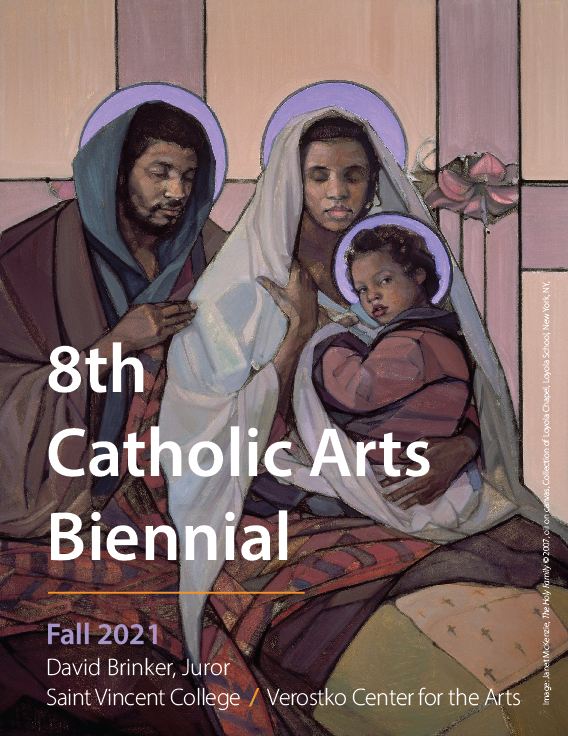
Artists can be of any religious or denominational affiliation and can submit up to three works by the deadline of June 25. In addition to being exhibited September 6–October 29, 2021, at the Verostko Center for the Arts, the finalists will also be eligible for a top prize of $1,000, plus other cash prizes. The juror this year is David Brinker, director of the Museum of Contemporary Religious Art at Saint Louis University. (The painting on the promotional poster is The Holy Family by Janet McKenzie, a previous winner.)
+++
SONGS:
>> “Prarthana Kelkaname” (Hear Our Prayer): Jijo Hebron, a Christian worship leader from Kerala, India, and his wife Niveda Jijo released this YouTube recording on Sunday, in which they sing to God in the Malayalam language. The song’s English meaning is below. [HT: Global Christian Worship]
Hear our prayer and supplication, oh Lord
It is the promise in your Son’s name:
Whatever we ask, it will be granted.
There is no one to take care of my worries apart from you
Who stands as my father and mother
>> “Morning Prayer” by Langhorne Slim: From the album Strawberry Mansion, released this January.
+++
ANIMATED SHORT: If Anything Happens I Love You: “In the aftermath of tragedy, two grieving parents journey through an emotional void as they mourn the loss of a child.” Written and directed by Will McCormack and Michael Govier and animated by Youngran Nho and team, this thirteen-minute film won Best Animated Short at the 2021 Oscars. It’s amazing how much I feel for these characters after such a short time of getting to know them. Streaming on Netflix.
+++
ARTICLE: “Art and Interfaith Conversation” by Andrew Smith: Birmingham, England, is a religiously diverse city, home not only to Christians but also to Muslims, Sikhs, Hindus, Buddhists, Jews, and others. The Church of England recognizes this rich presence and has on staff a director of interfaith relations for the bishop of Birmingham, Canon Dr. Andrew Smith. Smith is interested in how art and artifacts can be used to develop conversations between people of different faiths and to create new conversations, and here he discusses a Birmingham Conversations project he led along that vein: multifaith group tours at the Birmingham Museum and Art Gallery and St. Philip’s Cathedral. These he embarked on with a posture primarily of learning, not teaching. [HT: Still Life]
Smith served as a consultant for the museum’s faith gallery, which highlights religious objects from various traditions. He discusses the importance of honoring the integrity of each object’s spiritual significance, and some of the difficulties of creating a space that’s welcoming to people of all faiths when certain faiths regard certain imagery as problematic or even forbid it. He also shares some of the responses of non-Christian participants to specific works of Christian art, in both the museum and the cathedral. Some from the latter are recorded in the following video:
The Birmingham Conversations also commissioned two local artists, Jake Lever and Mandy Ross, to produce work informed by their visits over a yearlong period to different places of worship around Birmingham.
Sarah and Hagar as kin
“Kin” by Mohja Kahf
Sarah, you massaged my sacrum
with a tennis ball when I was in labor.
Like a priestess of the body, you
wiped the newborn Ismail clean
of birthblood and whispered first
holy words into his ear. You are his mother
too. We are kin. No decrees
of man or God can make this truer
than it is, nor can it be cloven.

We did not begin with the husband we shared,
but in Egypt, with divine
intelligence arrowed from eye to eye
across a patio of pagan strangers,
when I was royalty and you were trembling
in the house. You knew exile and I
knew exile. You suffered and I suffered.

Like matter, kinship can be changed
but not destroyed. Cruelty tarnishes,
but cannot dissolve it. We are kin
from bread baked together,
salted, broken, eaten, sacred
as a challah braid at sunset on the Night of Power;
from the battering waters of the sea we crossed;
from the Tree of Life whose branches
we burned to stay alive. Kin
we are from knowledge of the Name;

you had the first letters, I had the last
and, putting them together, we
spelled out the Secret.
“Kin” by Mohja Kahf is from Hagar Poems (University of Arkansas Press, 2016). Reprinted by permission of The Permissions Company, Inc., acting on behalf of the publisher.
Mohja Kahf is a Syrian American poet, novelist, and scholar of Arabic literature, postcolonial studies, and Arab and Arab American feminism. Born in Damascus but moving to the midwestern US as a child, she was raised in a devout Muslim household. In her creative work and scholarship, she both respects and interrogates her own faith tradition.
Her second poetry collection, Hagar Poems, gives voice to several female characters from the Qur’an and Islamic history, many of whom are also present in the biblical narrative. Part 1 focuses on Hajar (or Hagar, as she’s called in the Bible) and, to a lesser extent, Sarah, the ancient matriarchs of Islam and Judaism, respectively. The remaining two parts spotlight Zuleikha (Potiphar’s wife); Asiya (Moses’s adoptive mother); Balqis (the queen of Sheba); Maryam (Mary); Khadija, Aisha, and Fatima (wives of Muhammad); Nusaiba (a disciple of Muhammad’s); and Hamamah (an Ethiopian princess-turned-slave known primarily as the mother of Bilal, a Muslim convert). The stories of these women are sometimes transposed into contemporary times. For example, Hajar goes to the moon, sees a therapist, participates in an AIDS march, and is visited by a caseworker responding to a report of domestic violence.
Like a few others in the volume, the poem I’ve selected here explores the relationship between Hagar and Sarah as a metonym for the relationships between modern-day adherents of the two religions they represent, on both personal and political scales (i.e., the Arab-Israeli conflict). But “Kin” is revisionist and aspirational, reimagining a more congenial, mutually supportive, compassionate sisterhood between the two matriarchs, and therefore also a brighter future for their descendants. It might be said that patriarchy made Hagar and Sarah rivals. Both suffered abuse within the system and at different points inflicted it as each gained privilege over the other and vulnerabilities and power dynamics shifted.
According to the biblical story (Gen. 12:10–20), a famine in Canaan drove Abraham and his wife Sarah to seek relief in Egypt. Fearful that his life would be endangered because of Sarah’s beauty (kings were, after all, known to go to extreme measures to get what they want), Abraham presents Sarah to the royal court as his sister, implying that she is sexually available. Pharaoh thus acquires her for his harem and, in gratitude for the giving over of his “sister,” lavishes Abraham with livestock and servants. But as judgment against Pharaoh’s act of (unwitting) adultery, God strikes him and his household with plagues, which is when Pharaoh realizes that he has been deceived. He orders Abraham and Sarah to leave Egypt.
It’s not until Genesis 16:1 that we meet Hagar, identified as “an Egyptian slave” (or, as some translations have it, a handmaid or servant) owned by Sarah. Presumably Sarah acquired—and yes, I use that disgusting term again, because women were treated as possessions in ancient Mesopotamia, including by other women—Hagar during her time in Egypt.
When Sarah cannot get pregnant, she forces Hagar to have sex with Abraham to bear him an heir. But when Hagar conceives Ishmael, Sarah becomes jealous, and the abuse worsens to the point that Hagar runs away. But God visits Hagar in the wilderness with words of comfort and reassurance. She returns to Abraham’s household and gives birth to Ishmael. Sometime later, Sarah herself miraculously conceives and gives birth to a son, Isaac, after which she casts out Hagar and Ishmael, no longer having need of them. God again comes to Hagar and to her son, both of them weak from thirst and on the verge of death. He reveals to them a well and promises to make of Ishmael a great nation, just as he promised of Isaac. “You are the God who sees me,” Hagar exults (Gen. 16:13).
According to Jewish midrash, before her enslavement to Sarah, Hagar was actually an Egyptian princess—that is, a daughter of Pharaoh’s. When Pharaoh witnessed the power of Sarah’s God, who came to Sarah’s defense by unleashing pestilence on Pharaoh’s house, he gave Hagar to her, saying, “Better that my daughter be a maidservant in this house than a mistress in another house” (Genesis Rabbah 45:1). In other retellings, Pharaoh gives her away reluctantly as penance, not wanting to incur any more of God’s wrath. And in yet another version, leaving Egypt with Sarah is Hagar’s idea, as she wishes to follow the one true God.
Islamic tradition also affirms Hagar’s royal birth, though according to the Qisas Al-Anbiya, she was the daughter of the king of Maghreb, whom Pharaoh killed, thus capturing her. Notably, neither Sarah nor Hagar are mentioned by name in the Qur’an; they are only briefly alluded to in Surah Ibrahim 14:37, where Abraham says in prayer, “I have settled some of my family in a barren valley near your Sacred House.” Hagar is, however, mentioned amply in the hadith.
In “Kin,” Kahf is interested in what binds Sarah and Hagar—and Jews and Muslims—together. Both women were subjected to gendered oppression, including sexual abuse, and had no recourse against it. Both were, at different times, strangers in a strange land—first Sarah in Egypt, then Hagar in Canaan and later the wilderness of Paran. Both experienced miraculous interventions by God and even heard his voice. Both were mothers. They shared, at least initially, a husband and a home—they baked and broke bread together. Their family lines would diverge, but the two, Kahf writes, were as intertwined as the braids of a challah loaf. “Kin / we are from knowledge of the Name”—both knew and embraced the same God, as would their spiritual descendants.
The poem is written to Sarah from Hagar’s perspective. Hagar looks back with empathy to their first meeting, when “I was royalty” (as rabbinic tradition has it) “and you were trembling / in the house.” Kahf idealistically envisions an intimacy between the two, and a cooperative spirit—for example, Sarah giving Hagar a sacral massage while she’s in labor, afterward welcoming Ishmael into the world with love and devotion.
This picture is not what we get in the sacred texts, where Sarah regards Hagar with bitterness and hostility and mistreats her, and, if Sarah’s complaints can be trusted, Hagar lords it over Sarah when Hagar becomes pregnant with Abraham’s first son.
But what if the women had been friends? What if Ishmael and Isaac had been raised together as brothers? How might those strong familial ties and goodwill have impacted subsequent generations and influenced Jewish-Muslim relations in the present day?
(Related post: “Bithiah’s Defiance: Kelley Nikondeha and poet Eleanor Wilner imagine Pharaoh’s daughter”)
+++
Like Kahf, Indian American Jewish artist Siona Benjamin also explores gender and religious identity through her work, focusing especially on the biblical matriarchs. Also like Kahf, she is interested in the midrashic process by which exegetes, be they scholars or artists, approach the stories of scripture with a spirit of seeking and inquiry, responding with creative interpretations that read between the lines and ponder implications.

In her painting Beloved (Sarah and Hagar), Sarah wears a kippah on her head and tefillin (small boxes with passages from the Torah curled inside) on her arms, while Hagar wears a hijab and a misbaḥah (string of prayer beads). The two women are wound together in a tight embrace—“reflections of each other,” the artist says. They’re also wounded together, their bodies blown apart, blood dripping like tears from the rifts. To the side is a pair of amputee Israeli soldiers, whose surveillance camera has identified three Palestinian suicide bombers. Integrated into the foliate decoration around the border are guns and grenades.
Benjamin says this painting represents the eventual reuniting of Sarah and Hagar after Hagar’s banishment, an invented outcome but one that expresses hope for reconciliation between Jews and Muslims, and particularly between Israel and Palestine. When we recognize the shared humanity of the “other,” and how they are just as beloved of God, it becomes impossible to view them as the enemy, to be occupied or killed.
Did Sarah and Hagar ever share the kind of closeness Benjamin envisions in Beloved? Probably not. But does that mean the two nations they founded must forever be at war? Let us pray for peace and pursue it.
Instead of finger-pointing or offering political solutions, these two artistic works—one by a Muslim, one by a Jew—serve as prayers of lament and hope. They probe beneath the surface of Sarah and Hagar’s story and imagine future possibilities.

