Warning: This post contains distressing photographs, including one of an emaciated child and one of a wounded (but bandaged) infant.
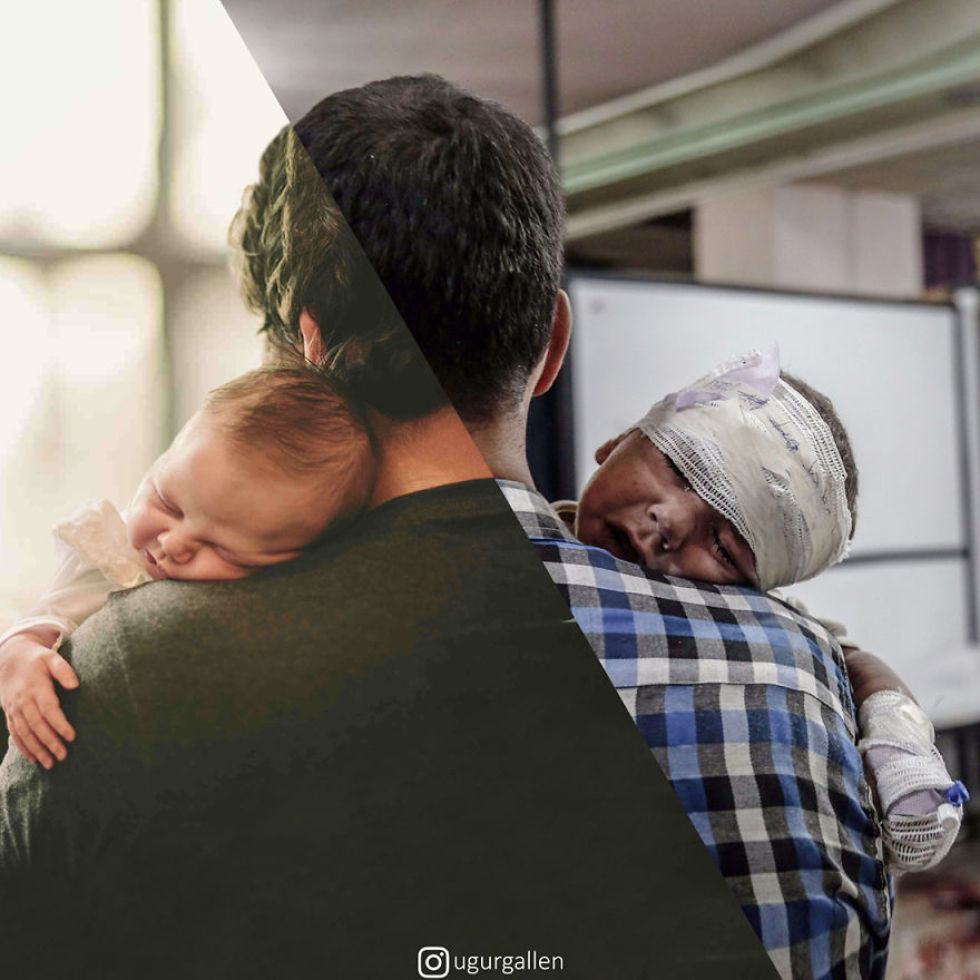
Uğur Gallenkuş (Turkish, 1990–) is an Istanbul-based artist whose digital photomontages address the widening global divide between the privileged and the oppressed. By combining photojournalistic images and stock photos with similar compositional elements, he juxtaposes the relative safety, stability, comfort, and flourishing experienced by middle- and upper-class Westerners with the violence, terror, trauma, and hardship experienced by victims of poverty, war, and displacement. Because Gallenkuş lives in the Middle East, he focuses on that geographic region.
Releasing November 20 in honor of World Children’s Day, Parallel Universes of Children brings together fifty of Gallenkuş’s sobering mash-ups, integrating facts of children’s lived realities around the world. It is $60 plus shipping, available only through the artist’s website. (For US buyers, there’s stock warehoused in New Jersey, so you won’t be paying to ship it from Turkey.)
“I aim to create awareness and inspire action to remember and to ask ourselves every day what we have done to safeguard children’s rights, both near home and across the globe,” Gallenkuş says. He wants not only to alert the well-off to the suffering they often shield themselves from, shaking them out of their complacency, but also to remind those in underdeveloped countries that they deserve better government and education, the right to thrive.
I’ve linked each image to its source on Instagram, where you can find out more information about it—when and where the photograph was taken and by whom (Gallenkuş does not take the photos himself), context, stats, etc. Some of the links will take you to a revised (updated) form of the image; in those instances, the originals I found at Juxtapoze.
The stark contrast between the two component photos of each montage is jolting, intentionally so. Reflecting socioeconomic and political disparities, they tell drastically different stories about childhood. My existence must look like a fairy tale to those who have grown up in war zones or refugee camps.
One of Gallenkuş’s montages shows a lavish bathroom with a chandelier, pristine tiles, and freshly pressed towels next to the remnants of a bathroom whose walls were blown out by an Israeli airstrike, where a father bathes his daughter and niece.
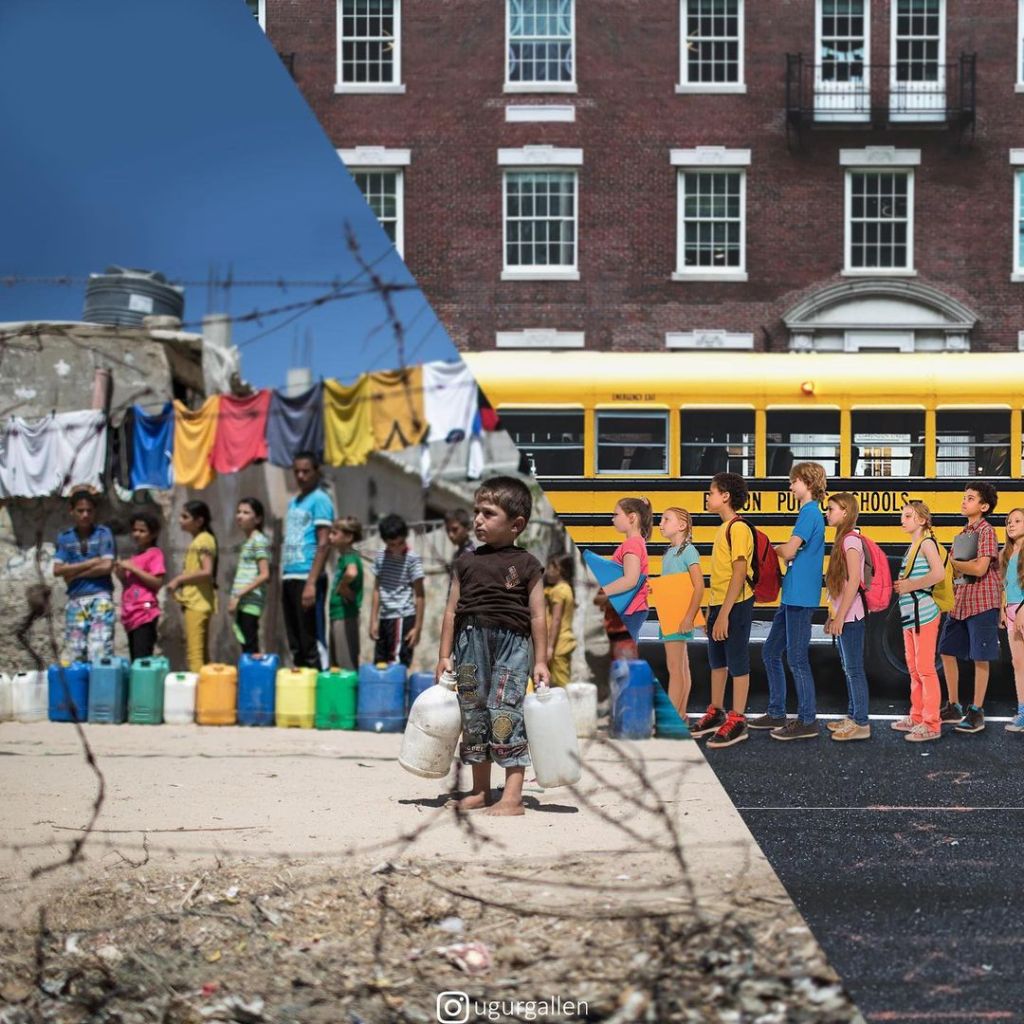
Another one shows a line of American schoolchildren waiting to board a bus, which transforms into a line of Palestinian children waiting to fill jerrycans and bottles with drinking water from public taps at the Deir al-Balah refugee camp in central Gaza Strip. (Many fall sick from the water, whose source is polluted with human waste.)
Consider, too, the differences in play. A child at an IDP camp plays with a toy grenade launcher, while his counterpart plays doctor. A Syrian boy has fun balancing on the barrel of a tank in a pile of wreckage, while opposite him, in a green park, a boy rides a harmless seesaw. The imaginations of children are shaped by what surrounds them, whether that be violence or possibility.
Do not wait for the earth to shatter,
Sodom’s consumption by fire.
Tiny wonders from day to day are
Greater, deeper to admire.
Come, place your hand upon your heart and
Hear well, observe what it conveys.
Is this fine beating not by far the
Greatest, most wonderous music phrase?
Come, look into that deep blue Endless,
Look at those tiny silver things:
Not wonderous that your orphaned soul is
Rising towards them, spreading wings?
Look how your shadow runs before you,
How it expands and shrinks with you.
Not a wonder? Or that the waters
Reflect the heavens for your view?
Do not expect big things in life, for
Joys are snowflakes, they drift and stray.
Silent, sifting petals of wonder.
In them’s God’s voice: I’m coming.
Translated from the Hungarian by Leslie A. Kery. Reproduced by permission of Mr. Kery.
Image credit: Gina Gilmour (American, 1948–), A Door in the Woods, 1994. Oil on canvas, 79 × 88 3/4 in. (200.7 × 225.4 cm). Bechtler Museum of Modern Art, Charlotte, North Carolina. Photo: Victoria Emily Jones.
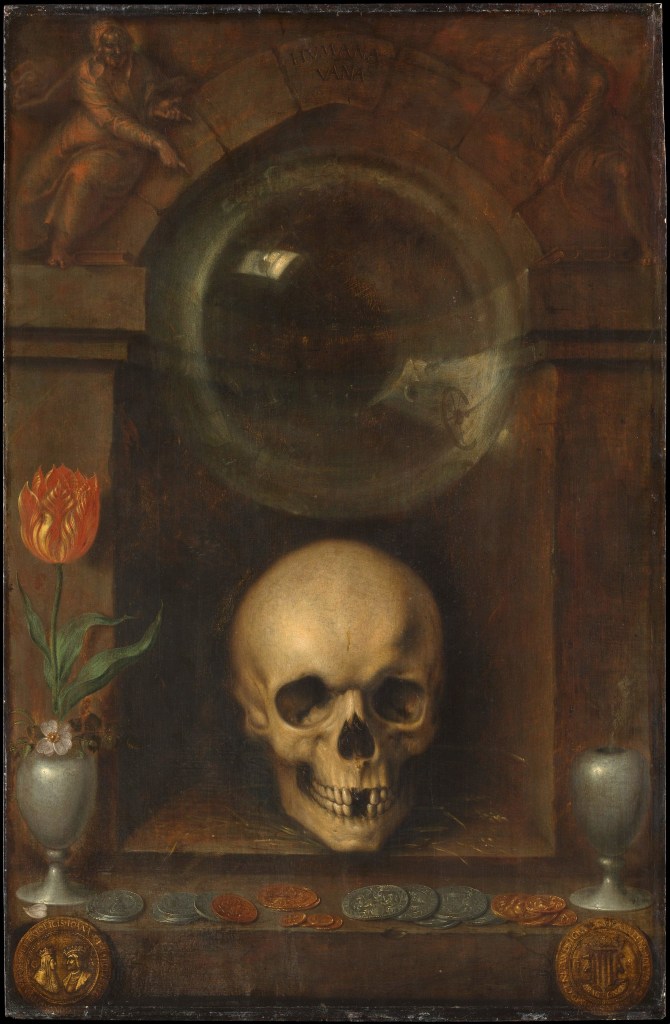
Jacques de Gheyn II (Netherlandish, 1565–1629), Vanitas Still Life, 1603. Oil on wood, 32 1/2 × 21 1/4 in. (82.6 × 54 cm). Metropolitan Museum of Art, New York.
Lord, you have been our dwelling place in all generations. Before the mountains were brought forth, or ever you had formed the earth and the world, from everlasting to everlasting you are God.
You return man to dust and say, “Return, O children of man!” For a thousand years in your sight are but as yesterday when it is past, or as a watch in the night.
You sweep them away as with a flood; they are like a dream, like grass that is renewed in the morning: in the morning it flourishes and is renewed; in the evening it fades and withers.
. . .
The years of our life are seventy, or even by reason of strength eighty; yet their span is but toil and trouble; they are soon gone, and we fly away.
. . .
So teach us to number our days that we may get a heart of wisdom.
—Psalm 90:1–6, 10, 12
+++
MUSIC: Élégie in E-flat Minor, op. 3, no. 1, by Sergei Rachmaninoff, 1892 | Performed by Sheku Kanneh-Mason, with Isata Kanneh-Mason, 2017
I’ve mentioned these stellar sibling musicians on the blog before, when I shared Sheku’s arrangement of “In the Bleak Midwinter.” In fact, all seven Kanneh-Mason siblings, ranging in age from eleven to twenty-four, are musical—and of an exceptionally high standard! Their debut album as a family, Carnival, dropped November 6; it is a collaboration with Oscar-winning actor Olivia Colman and children’s author Michael Morpurgo.
Sheku Kanneh-Mason released Rachmaninoff’s Élégie, from Morceaux de fantaisie, as a single in 2017. He has two solo records: Elgar (2020) and Inspiration(2018).
Vanitas (from the Latin vanus, “empty”) is a subgenre of still life painting, especially common in the Low Countries in the seventeenth century, that shows, through symbolism, the brevity of life and the transience of earthly pleasures.
Art historian Ingvar Bergström discusses Vanitas Still Life by Jacques de Gheyn II (Jacob de Gheyn) at length in the 1970 journal article “De Gheyn as a ‘Vanitas’ Painter.” The commentary that follows is derived from that.
In de Gheyn’s painting, a skull sits inside a stone niche on a bed of dry grass, a reminder that “all flesh is grass, and all the goodliness thereof is as the flower of the field: the grass withereth, the flower fadeth . . .” (Isaiah 40:6–7; cf. 1 Peter 1:24). Sitting on the left side of the ledge, the tulip and the wild rose with the fallen petal symbolize how man “cometh forth like a flower, and is cut down” (Job 14:2). The smoking urn on the other side references Psalm 102:3: “my days are consumed like smoke.” Between these two are a spill of Spanish coins and a Dutch military medal, and propped up against the ledge on each side is a gold ten-ducat coin showing, on the obverse, Joanna and Charles as sovereigns of Aragon. The message is that beauty, riches, and worldly power and honors all come to an end.
Lest this message somehow be missed, HUMANA VANA (“human vanity”) is carved into the top of the arch. The inscription is flanked by fictive sculptures of Heraclitus and Democritus, the weeping and laughing philosophers of Greek antiquity. Both figures point to a soap bubble (“Man is but a bubble” is a classical aphorism), which, if read in light of the traditional iconography of the two philosophers, doubles as a globe.
The bubble mirrors a number of disparate objects, which are difficult to make out. Bergström identifies a trophy group along the middle axis of the bubble: a crown in the center with various weapons converging upon it. At the top is an upturned moneybag with coins streaming out. Most discernible is the wheel of torture at the bottom right, and above that is a leper’s rattle, which lepers in some areas were required to shake to alert others to their proximity; these are symbols of human frailty. Also reflected “are a caduceus (probably signifying commerce) and a pair of bellows (signifying luxury?). Playing cards, backgammon with dice, and drinking vessels allude to vain pleasures and pastimes. The highlight of the sphere mirrors a burning heart, pierced by an arrow—an image of earthly love, of luxury” (153).
Though the painting doesn’t explicitly reference our lectionary reading from Psalm 90, it does complement the psalmist’s reflection on how short and precarious life is—it’s like a wilting flower, a burning candle, a fragile bubble. Here today, gone tomorrow. Which is why it’s so important to live wisely while we still can.
+++
To access another Artful Devotion for AProp28, on 1 Thessalonians 5:1–11, click here.
This post belongs to the weekly series Artful Devotion. If you can’t view the music player in your email or RSS reader, try opening the post in your browser.
To view all the Revised Common Lectionary scripture readings for Proper 28, cycle A, click here.
VISUAL MEDITATION: “At the Whipping Post” by Victoria Emily Jones: Last year the Museu de Arte de São Paulo (MASP) ran a major retrospective on Djanira da Motta e Silva, “a central artist in Brazilian mid-century modernism” (Rodrigo Moura). ArtWay’s editor asked me to choose a painting of hers to write about—I chose the one she submitted to the 1955 “Christ of Color” contest, showing Jesus as an enslaved African being scourged in the historic center of Salvador de Bahia, the first colonial capital of Brazil.
Djanira da Motta e Silva (Brazilian, 1914–1979), Largo do Pelourinho, Salvador, or Cristo na coluna (Christ at the Column), 1955. Oil on canvas, 81 × 115 cm. Private collection, Rio de Janeiro, Brazil. Photo: Jaime Acioli.
+++
LECTURE: “Is Christianity a White Man’s Religion?” by Dr. Vince L. Bantu: I first encountered Vince Bantu in a Conversing (Fuller Studio) podcast episode on African American identity and the church. (He joined the Fuller faculty last year as assistant professor of church history and Black church studies.) In this video from January 2018, he returns to his alma mater, Wheaton College, to discuss the history of Christianity in Africa—which some people are surprised to learn predates colonialism. “To study ancient African history is to study Christianity. They go together,” he says. “If you want to study Ethiopian literature, . . . you’re going to be reading a whole bunch of Christian literature. Same thing in Nubian. Same thing in Coptic.” While the Anglo-Saxons were still worshipping Odin and Thor, Bantu says, Black Africans were building churches, establishing seminaries, and writing Christian theological treatises!
The talk starts at 11:34 and really kicks into gear at around 24:00. Q&A starts at 52:40 and includes discussion of a three-point spectrum of approaches to culture, mission as “cultural sanctification,” and internalized theological racism. Take note of Bantu’s response, at 1:09:35, to the question “What do we do with this information?”
“Christianity is and always has been a global religion,” Bantu reminds us. Unfortunately, people tend to associate it most with western Europe. That’s because Rome, the dominant culture for some time, essentially said, “Christianity belongs to us,” instituting a theological hegemony. The West proclaimed itself the guardian of the Christian faith, declaring heretical churches in other regions that didn’t express theology the same way they did, with no regard for differences in language and philosophical frameworks.
I appreciate how Bantu teaches Christian history in part through art and architecture, which are material witnesses to the faith and sometimes even modes of theology. He shows photos of churches and monasteries and their interior decoration. Most fascinating to me is a tenth-century wall painting he photographed at the Great Monastery of Saint Anthony in Old Dongola (present-day Sudan), a Nativity scene that shows Africans wearing animal crest masks and worshipping Christ with traditional instruments. (You can view some photos here. See also The Wall Paintings from the Monastery on Kom H in Dongolaby Malgorzata Martens-Czarnecka, or the freely accessible essay by the same author, “The Christian Nubia and the Arabs.”)
Great is your name, Lord Jesus Christ Praise to your name, Lord Jesus Christ Power to your name, Lord Jesus Christ Praise to your name, exalted Jesus Christ
Hallelujah, hallelujah Hallelujah, hallelujah Hallelujah, hallelujah Praise to your name, exalted Jesus
“I Am Thine (Plague Hymn)”: Made especially timely by the current COVID-19 pandemic, this hymn text was written in 1519 by Swiss Reformer Ulrich Zwingli while convalescing from the bubonic plague, having caught it ministering to others. This year Zac Hicks wrote a new melody for it, and it’s sung here by Leif Bondarenko. Released by Advent Birmingham.
+++
BIBLICAL ART DATABASE: Visual Midrash: “Visual Midrash is an online bilingual (Hebrew and English) collection of Bible art and commentary, sponsored by the TALI Education Fund in Israel. At present, the site contains more than 1100 art images relating to 33 different subjects from all three divisions of the Hebrew Bible – including such figures as Abraham, Jacob, Moses, David, the women of the Book of Judges, the scrolls of Ruth and Esther and much more. Among the images are objects from the Ancient Near East; frescoes from the ancient synagogue of Dura Europos; medieval illuminated manuscripts; paintings, sculptures, lithographs, and nearly 100 other art media from Michelangelo to Rembrandt to Chagall to contemporary artists.” I’ve had fun browsing! Below is just a small sampling of images from the site.
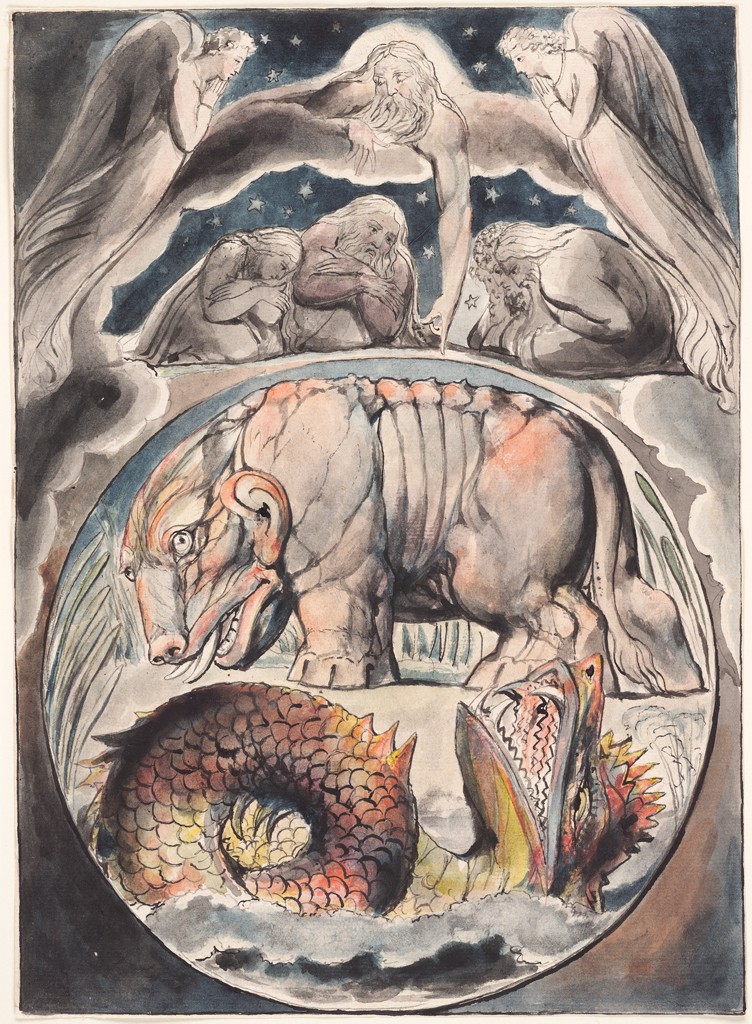
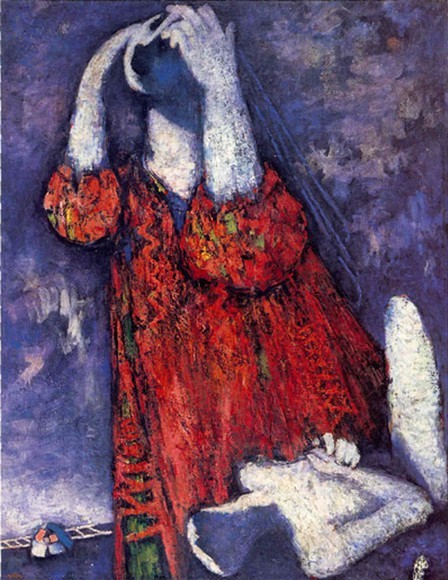
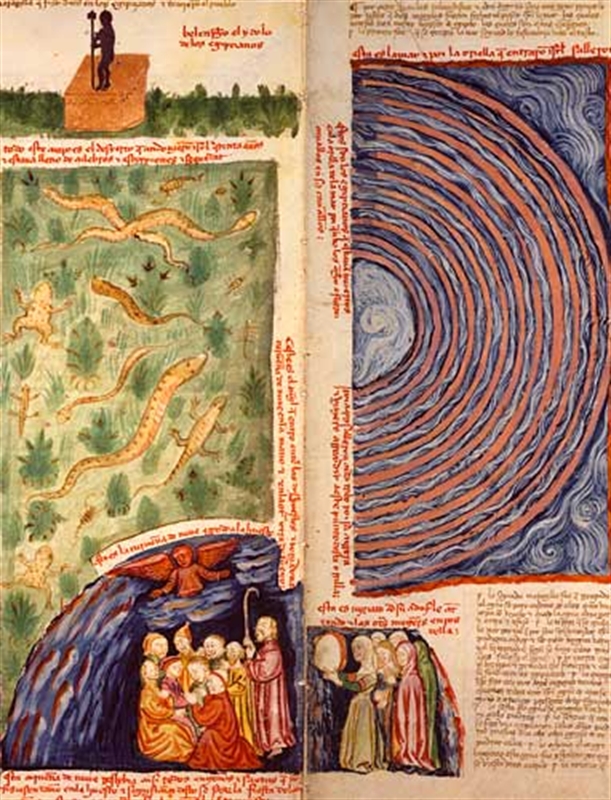
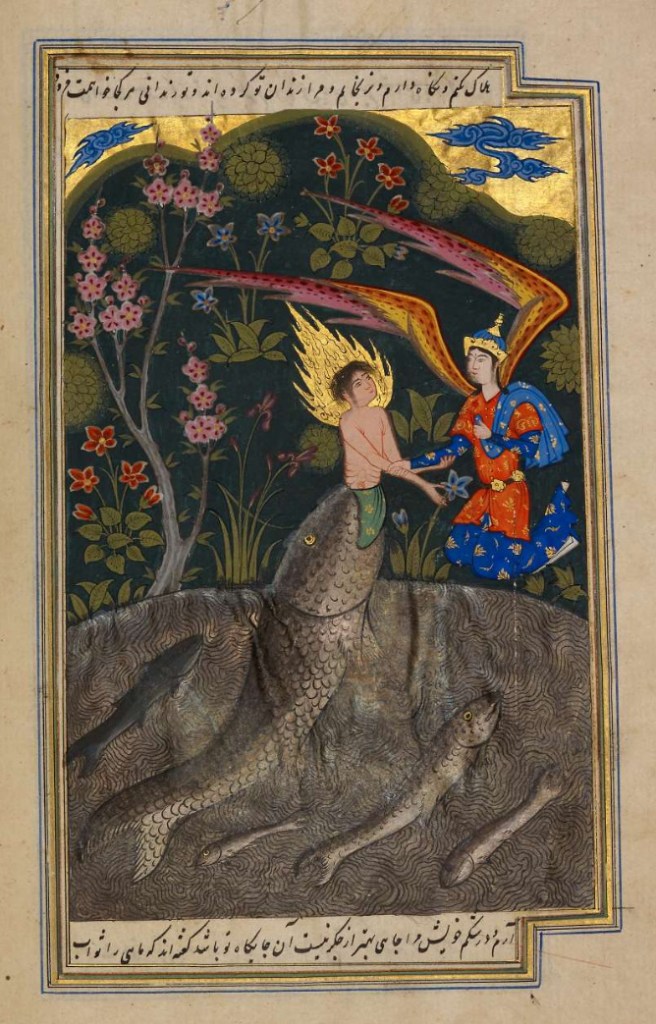
William Blake (British, 1757–1827), Behold Now Behemoth, Which I Made With Thee (The Book of Job) (Linnell set), 1821. Watercolor, black ink, and graphite on off-white antique laid paper, 27.5 × 20 cm. Harvard Art Museums/Fogg Museum, Cambridge, Massachusetts. [HT]Mordecai Ardon (Israeli, 1896–1992), Sarah, 1947. Oil on canvas, 138 × 108 cm. Jewish National and University Library, Jerusalem.“The Finding of Moses,” wall painting made in 244 CE, from Dura-Europos Synagogue in Syria. Preserved at the National Museum of Syria, Damascus. [HT]“Crossing of the Red Sea,” Spain, 1430. Illumination from the Alba Bible (fol. 68v–69r), Liria Palace, Madrid.“Jonah,” Iran, 1577. Illumination from the Qisas al Anbiya (Diez A Fol. 3, fol. 142v), Staatsbibliothek, Berlin. [HT]
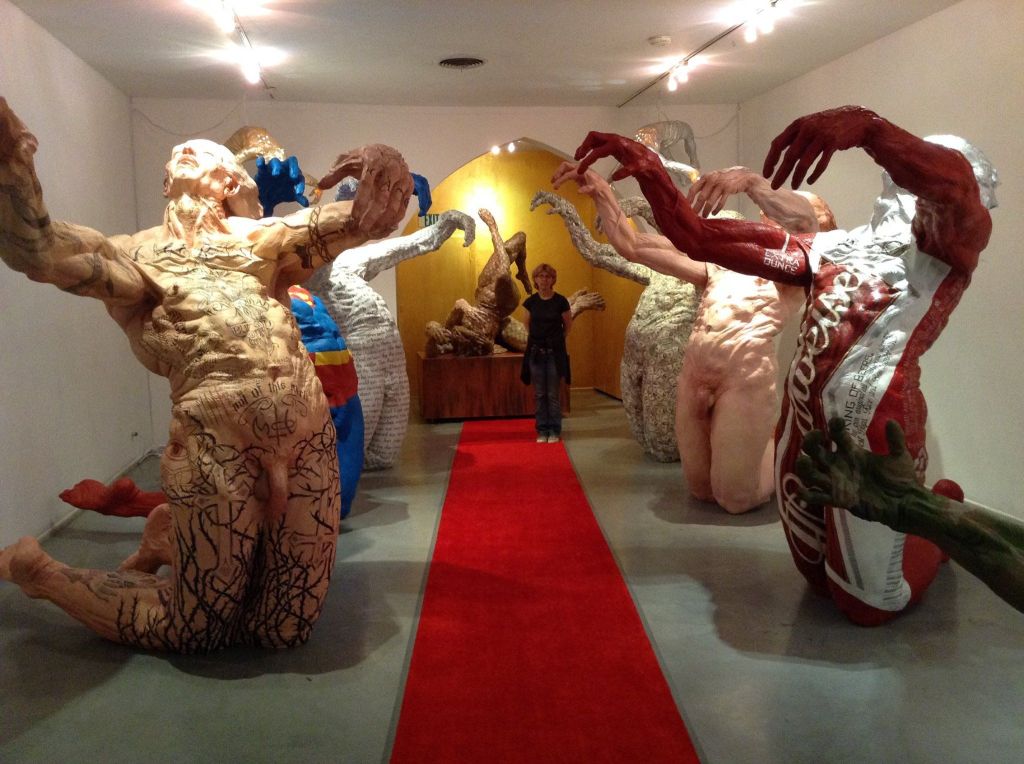
Cindy Jackson (American, 1960–2017), (Not Quite) Salvation, 2014. Mixed media installation.
“Now therefore fear the LORD and serve him in sincerity and in faithfulness. Put away the gods that your fathers served beyond the River and in Egypt, and serve the LORD. And if it is evil in your eyes to serve the LORD, choose this day whom you will serve, whether the gods your fathers served in the region beyond the River, or the gods of the Amorites in whose land you dwell. But as for me and my house, we will serve the LORD.”
—Joshua 24:14–15
In this excerpt from Sunday’s lection, Joshua, Moses’s successor, admonishes the people of Israel to serve the one true God, Yahweh, but if they don’t, to choose between their ancestral gods from Mesopotamia or the gods worshipped by the peoples of Canaan, whose land they have taken over. Joshua unequivocally states his own allegiance to Yahweh, who had proven himself faithful to his promises.
Joshua’s imperative may seem irrelevant to life today, but it could actually be extrapolated to apply even to those who are not theistic, because all humans are worshipping beings. Those who don’t worship a god or gods, as the word is conventionally conceived, are giving their ultimate love and devotion to someone or something else, be it power, money, popularity or fame, intellect, a career, a political party, a social cause, a sports team, television, social media following, physical attractiveness or fitness, a romantic partner, a child, or what have you. The American writer David Foster Wallace, who was not a Christian (that I’m aware of) but who had a spiritual sensibility, spoke incisively about this in his “This Is Water” commencement speech, delivered at Kenyon College on May 21, 2005. He said,
In the day-to-day trenches of adult life, there is actually no such thing as atheism. There is no such thing as not worshipping. Everybody worships. The only choice we get is what to worship. And an outstanding reason for choosing some sort of God or spiritual-type thing to worship—be it J.C. or Allah, be it Yahweh or the Wiccan mother-goddess or the Four Noble Truths or some infrangible set of ethical principles—is that pretty much anything else you worship will eat you alive. If you worship money and things—if they are where you tap real meaning in life—then you will never have enough. Never feel you have enough. It’s the truth. Worship your own body and beauty and sexual allure and you will always feel ugly, and when time and age start showing, you will die a million deaths before they finally plant you. . . . Worship power—you will feel weak and afraid, and you will need ever more power over others to keep the fear at bay. Worship your intellect, being seen as smart—you will end up feeling stupid, a fraud, always on the verge of being found out. And so on.
Look, the insidious thing about these forms of worship is not that they’re evil or sinful; it is that they are unconscious. They are default-settings. They’re the kind of worship you just gradually slip into, day after day, getting more and more selective about what you see and how you measure value without ever being fully aware that that’s what you’re doing. And the world will not discourage you from operating on your default-settings, because the world of men and money and power hums along quite nicely on the fuel of fear and contempt and frustration and craving and the worship of self. Our own present culture has harnessed these forces in ways that have yielded extraordinary wealth and comfort and personal freedom. The freedom to be lords of our own tiny skull-sized kingdoms, alone at the center of all creation.
In his book Counterfeit Gods: The Empty Promises of Money, Sex, and Power, and the Only Hope That Matters, Tim Keller says that idols (false gods) are usually good things that we turn into ultimate things: “anything more important to you than God, anything that absorbs your heart and imagination more than God, anything you seek to give you what only God can give, . . . anything so central and essential to your life that, should you lose it, your life would feel hardly worth living” (xvii–xviii). He identifies some idols that Christians may be unlikely to consider as such, including doctrinal accuracy, ministry success, and moral rectitude.
Who or what do you live for? Where do you place your primary identity? How do you define your worth?
“Choose this day whom you will serve.”
+++
SONG: “Gotta Serve Somebody” by Bob Dylan, on Slow Train Coming (1979)
“Gotta Serve Somebody” is the first song Bob Dylan released after his conversion to Christianity in the late seventies. (It came out as a single before appearing on Slow Train Coming.) In it he lists various occupational titles—rock musician, businessman, doctor, athlete, ambassador, police officer, homebuilder, politician, barber, preacher, etc.—and other roles, saying that all, rich and poor, are “gonna have to serve somebody, yes / You’re gonna have to serve somebody / Well, it may be the devil or it may be the Lord / But you’re gonna have to serve somebody.” As in Sunday’s lectionary passage from Joshua, and as in David Foster Wallace’s famous speech, Dylan suggests that the choice to not worship God is in itself a choice to worship something/someone else in God’s place. Some atheists are at least honest enough to recognize that they worship themselves—like John Lennon, who wrote “Serve Yourself” as a riposte to Dylan.
Dylan won a Grammy for Best Rock Vocal Performance by a Male for “Gotta Serve Somebody.” The song has been covered by many artists, including Mavis Staples, Etta James, Judy Collins, and Willie Nelson.
+++
The gallery installation pictured above is by the late Cindy Jackson. It’s discussed extensively, along with her other art, in the article “Cindy Jackson’s Bevy of Boisterous Bodies” by Gordon Fuglie, published in issue 92 of Image journal. And Eric Minh Swenson has made a short film where he interviews the artist in her studio as she works on these pieces:
In (Not Quite) Salvation, six twice-life-size urethane sculptures of nude men, cast from the same mold but painted differently, form a sort of tunnel over a red carpet that leads to a “chapel.” Their supersize arms are extended outward in a state of—rapture? torment? dead stupor? The installation “explores the various ways redemption and meaning are sought in society,” says Jackson. “What we worship indicates how we hope to be saved from our suffering. What we yearn for are the symbols of our perceived exoneration.”
The first two in line, arranged opposite each other, are Beer Man, his body overlaid with Budweiser branding, and Tattoo Man, whose inked skin, an amalgamation of various signs and slogans, is a “critique of a lazy American pop pluralism run amok,” as Fuglie says. The next duo is Super Man, in all his muscly righteousness, and Sex Man, lusty and sporting a condom. The final pair is, on the left, Dogma Man, who is inscribed with words from various sacred texts, poems, and song lyrics—a “smorgasbord of pop spirituality.” And on the right, Money Man, who is papered over with (photocopies of) dollar bills.
“They have betrayed their true spiritual identity and are damaged souls,” Fuglie writes. “Jackson affirms this by inscribing a hopeful poetic aphorism, [attributed to] the Sufi mystic Rumi, on the invisible interior surfaces of each hollow figure: ‘The wound is the place where the light enters you.’ These words imply that spiritual grounding is attainable only when the sufferer acknowledges the injuries inflicted by his false persona and begins to nurture his inner life, the locus of genuine illumination.” Only when their veneer cracks is the light/Light able to get in.
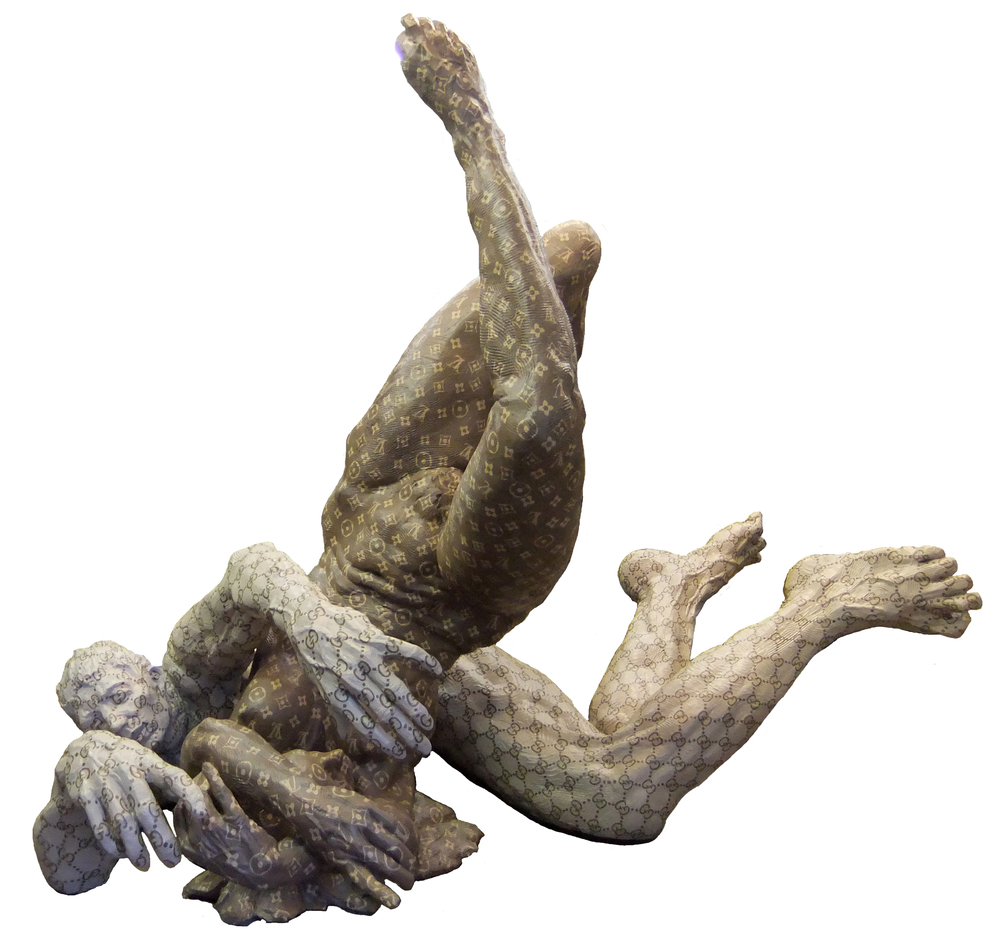
In the room at the end of the installation is one more sculpture pair, titled Always Wanting/Never Enough: a man and a woman covered in Gucci and Louis Vuitton logos and wrestling each other on an altar-like pedestal, signifying consumerism.
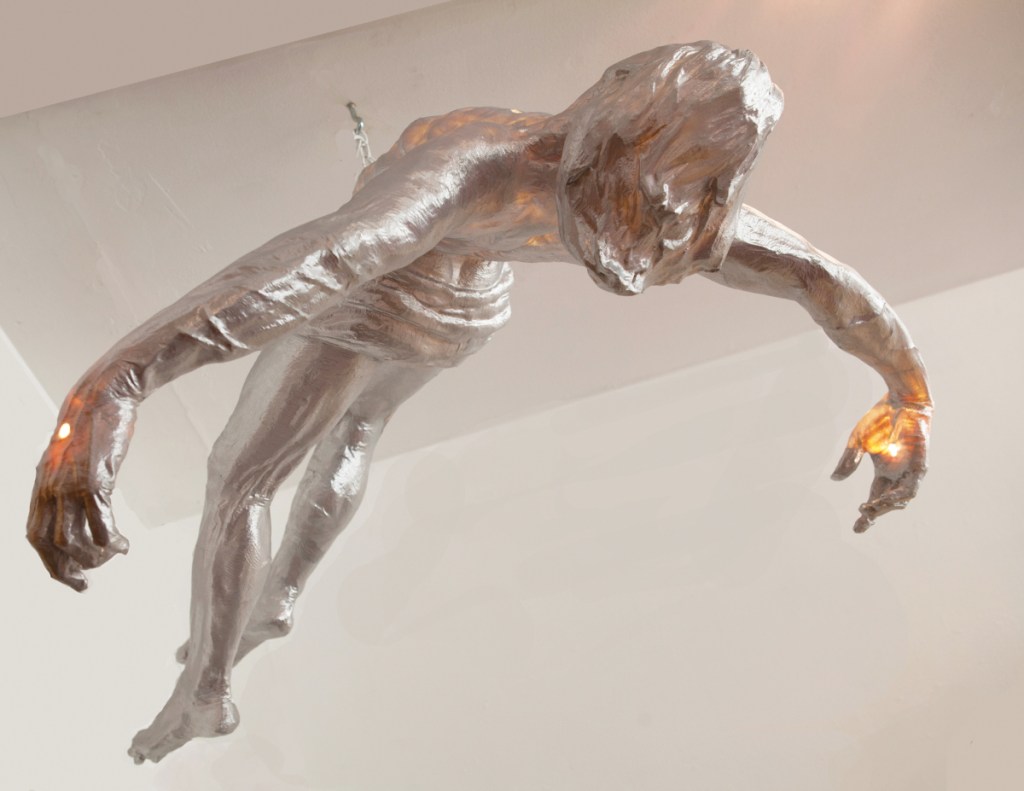
Cindy Jackson (American, 1960–2017), Always Wanting/Never Enough, 2014. Acrylic on polyurethane.Cindy Jackson (American, 1960–2017), Falling Jesus Swag Lamp, 2014. Polyurethane, tulle fabric, and LED lights.
Hanging above them—the interpretive key, at least in my reading—is a Christ figure deposed from the cross, whose wounds glow with LED lights. In a clever visual riff on the Rumi quote, “the light of divine sacrifice and surrender exits him,” through his stigmata, “shining on the desperately entangled couple,” offering redemption, Fuglie writes.
Jesus, the light of the world, seeks to penetrate our false selves, our false loves, and make us more ourselves, revealing to us our true identity as children of the living God. This God is far greater and more ultimately satisfying than sex, money, chemical substances, designer brands, and any other god we might worship. And I daresay that’s precisely because he’s not a megaman but rather is vulnerable—a wounded healer.
+++
Another lectionary reading for Sunday is the wonderfully evocative Amos 5: “Let justice roll down like waters . . .” I feature this passage in a previous Artful Devotion and in a post on my old blog, where I discuss a batik by Solomon Raj that draws on that prophetic image.
This post belongs to the weekly series Artful Devotion. If you can’t view the music player in your email or RSS reader, try opening the post in your browser.
To view all the Revised Common Lectionary scripture readings for Proper 27, cycle A, click here.
“Psalms in Dialogue: Psalms 22, 23, and 24,” presented by Duke University Chapel: This multidisciplinary video presentation brings together dancers, musicians, a theologian, a painter, and (other) members of the Duke community to draw out the meaning of, or respond to, these three sequential psalms through art, prayer, and conversation. The livestreamed event aired October 17 and will be available for viewing for a limited time. Several of the segments, which I’ve time-stamped below, are intercut with photos from the streets in 2020 (showing the impact of the pandemic and racial unrest), of artist Makoto Fujimura in his studio and of his three finished paintings, and of Ekklesia Contemporary Ballet dancers in training. I wish more university chapels and well-resourced churches would offer experiences like this! Thank you to my friend Peggy for telling me about it. Read more about Duke Chapel’s multiyear Psalms project here.
1:51: “How do we name the impossible mystery?,” a theological reflection by Morley Van Yperen
6:02: Organ: “Jésus accepte la souffrance,” from La Nativité du Seigneur [previously] by Olivier Messiaen, performed by Christopher Jacobson
10:58: Psalm 22 by Makoto Fujimura, 2020, oyster shell on Belgium canvas, 48 × 48 in.
49:45: Recitation of Psalm 24 by Julia Hendrickson
51:32: Conversation continued
1:11:49: “He’s Got the Whole World in His Hands,” African American spiritual arranged by Mark A. Miller, performed by the Duke Chapel Choir
+++
POEMS: This week’s edition ofImageUpdate includes two poems that I really appreciated. The first, which was new to me, is “America” by Claude McKay, a key figure in the Harlem Renaissance. Originally published in The Liberator in 1921, it expresses the pain of living in a country where you’re hated for your race and yet remains optimistic, beginning, “Although she feeds me bread of bitterness, / And sinks into my throat her tiger’s tooth, / Stealing my breath of life, I will confess / I love this cultured hell . . .” The second poem is “Making Peace” by Denise Levertov, one of the best-known Christian poets of the twentieth century. “The poets must give us / imagination of peace, to oust the intense, familiar / imagination of disaster,” she writes. Poets can help us feel our way toward shalom—give us a vision of its permeating the world that inspires us to live out its rhythms, its metaphors, its structure, its grammar, our lives like poems.
+++
MUSIC VIDEO: “We Americans” by the Avett Brothers: I’m so moved by this song from the Avett Brothers’ 2019 album Closer Than Together—its grappling with the historical legacy of the US, its greatness and its guilt, with a mixture of heartache, empathy, and hope. It’s one of the healthiest expressions of patriotism I’ve ever come across in a song. We need to see America as the complex entity that she is, which means in part not ignoring her flaws but with love exposing them so that they can be remediated and we can move forward together more faithful to her celebrated ideals. “We Americans” is both confession and supplication, an “I’m sorry, God” and “God, help us to do better.” The final chorus:
I am a son of God and man And I may never understand The good and evil But I dearly love this land Because of and in spite of We the People We are more than the sum of our parts All these broken bones and broken hearts God, will you keep us wherever we go? Can you forgive us for where we’ve been? We Americans
>> “Bring Your Peace” by the Walking Roots Band: This song was written this year by Seth Thomas Crissman and Greg J. Yoder of the Walking Roots Band as part of a collection of fifteen songs for Shine, a children’s Sunday school curriculum published by MennoMedia and Brethren Press. It appears on Everybody Sing: Worship Songs for Children, released in June as a double album with Everybody Sing: Songs for the Seasons (which comprises ten original songs by The Many). The song asks God to bring his peace into our fears and into the storms we face, and to make us instruments of that peace to others.
>> “Rest Assured,” sung by the Walking Roots Band: TWRB learned this song from a bandmate’s parent (original authorship unknown) and recorded it a cappella in their separate locations at the start of quarantine in March. The chorus goes,
Rest assured, He’s not forgotten Rest assured, He’ll take care of you Look at the times He’s been there before He’ll be there again, rest assured
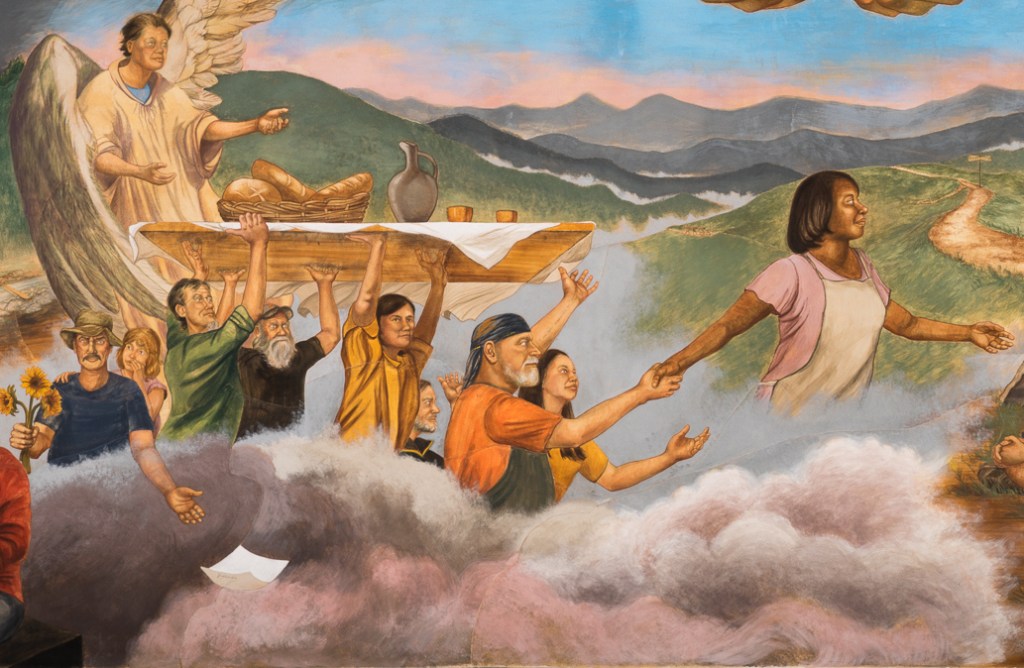
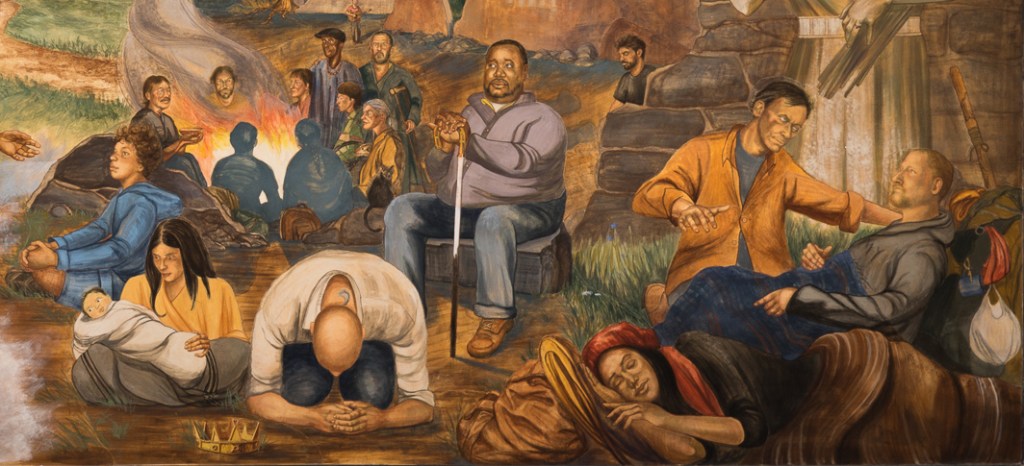
Christopher Holt (American, 1977–), Haywood Street Beatitudes, 2018–19. Fresco, 9 1/2 × 27 ft. Haywood Street Congregation, Asheville, North Carolina. Photo: John Warner.
“Blessed are the poor in spirit, for theirs is the kingdom of heaven.
“Blessed are those who mourn, for they shall be comforted.
“Blessed are the meek, for they shall inherit the earth.
“Blessed are those who hunger and thirst for righteousness, for they shall be satisfied.
“Blessed are the merciful, for they shall receive mercy.
“Blessed are the pure in heart, for they shall see God.
“Blessed are the peacemakers, for they shall be called sons of God.
“Blessed are those who are persecuted for righteousness’ sake, for theirs is the kingdom of heaven.
“Blessed are you when others revile you and persecute you and utter all kinds of evil against you falsely on my account. Rejoice and be glad, for your reward is great in heaven, for so they persecuted the prophets who were before you.”
—Matthew 5:3–11
+++
SONG: “Beatitudes” by Bernice Johnson Reagon | Performed by Sweet Honey in the Rock, live at Carnegie Hall, November 7, 1987
“Bernice Johnson Reagon (born October 4, 1942) is a song leader, composer, scholar, and social activist who in the early 1960s was a founding member of the Student Nonviolent Coordinating Committee’s Freedom Singers in the Albany Movement in Georgia. In 1973 she founded the all-black female a cappella ensemble Sweet Honey in the Rock, based in Washington, DC. Reagon, along with other members of the SNCC Freedom Singers, realized the power of collective singing to unify the disparate groups who began to work together in the 1964 Freedom Summer protests in the South. ‘After a song,’ Reagon recalled, ‘the differences between us were not so great. Somehow, making a song required an expression of that which was common to us all. . . . This music was like an instrument, like holding a tool in your hand.’” [source]
Reagon was the creator and host of the Peabody Award–winning NPR series Wade in the Water: African American Sacred Music Traditions, which originally aired in 1994 in twenty-six parts. (All the episodes are freely accessible online!) Under Reagon’s guidance, the production team traveled all over the country to record baptismal and congregational services, concerts, and interviews with a range of performers, composers, and community members. A four-CD set was released as a companion to the series.
+++
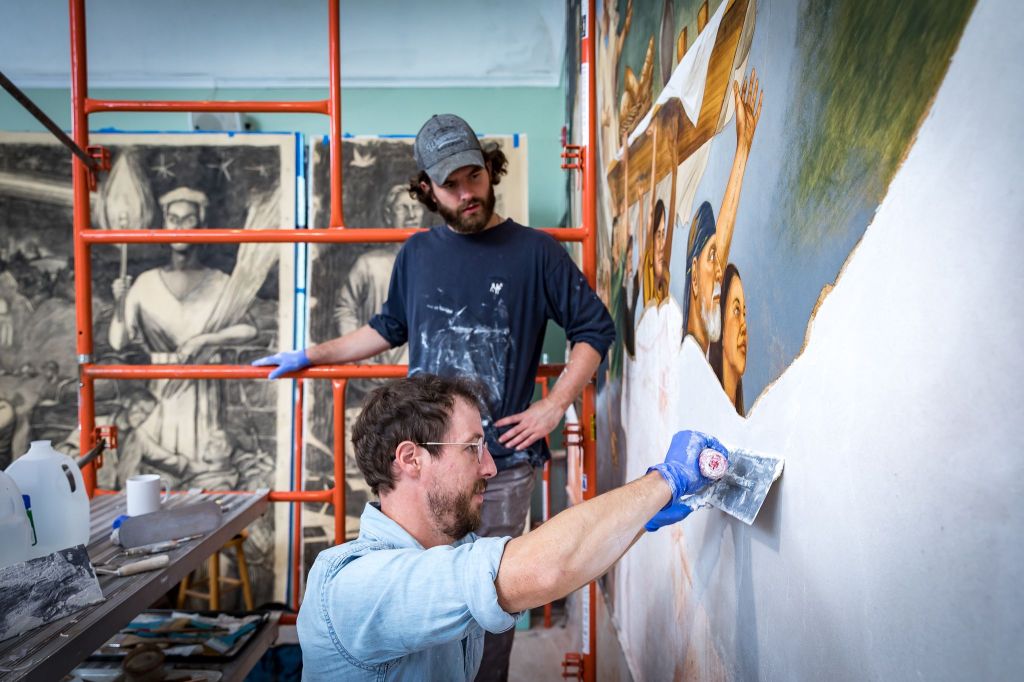
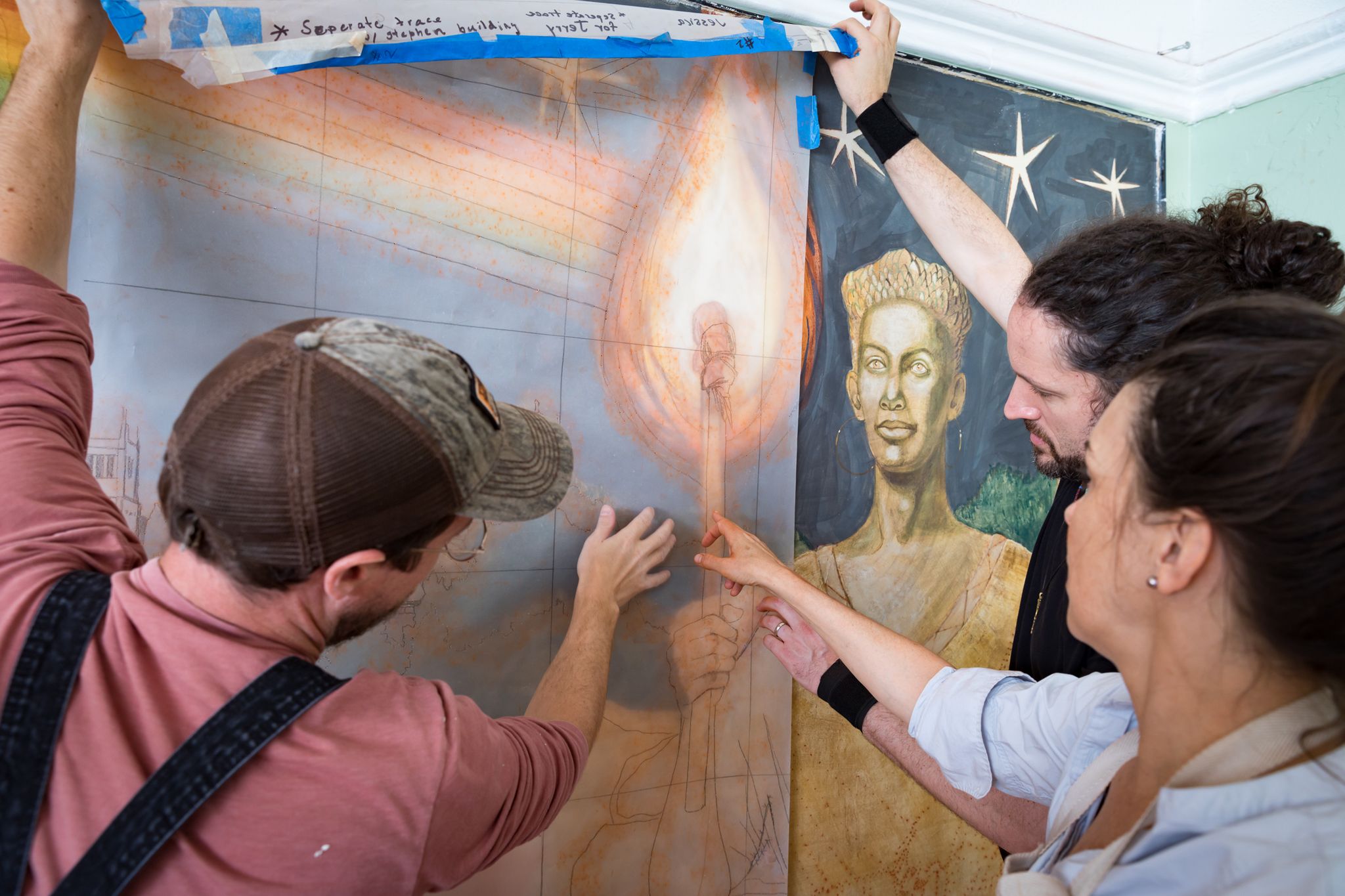
The Haywood Street Beatitudes fresco was completed last year in the sanctuary of Haywood Street Congregation in Asheville, part of whose mission is “breaking down barriers that divide the ‘haves’ from the ‘have-nots’ and reminding each person of their worth, their goodness.” The principal artist is Christopher Holt, and he worked with a team of four others. To learn more about the fresco, visit the interactive website https://visit.haywoodstreetfresco.org/, which includes many photos and sketches that document the making process in detail, information about the people pictured and an interpretive guide, and comments from participants in the project. All the quotes and photos in this section I’ve sourced from there.
The Rev. Brian Combs, who is shown emerging from behind the stone wall on the right, founded Haywood Street Congregation in 2009 to be a place of welcome for those struggling with addiction and/or homelessness. “The most painful part of holding a cardboard sign at the intersection,” he says, “is not the humiliating public declaration of helplessness or having trash thrown at you, or watching the automatic doors lock down. By far, from what I’ve heard after a decade of listening, is the refusal of so many drivers, idling just feet away at the red light, to even make eye contact.”
Commissioning this fresco—a permanent medium in which paint joins with plaster, making the image inseparable from the church architecture—is one way in which Haywood Street is “affirming sacred worth, restoring human dignity, and sabotaging the shame of poverty.” Fresco painting reached its zenith in the Italian Renaissance, but “too often . . . religious art . . . was made over in the image of those in power who were paying for it. God was rendered European and male. Jesus was more prince than peasant. Salvation meant being upper class.” The Haywood Street Beatitudes contains a more racially and socioeconomically diverse set of individuals that is reflective of the makeup of the community. Its message is that “God continues to show up in everyday life among the unhoused and the housed, the poor and poor in spirit, the meek, the merciful, and the hungry.”
The skyline, with its Appalachian Mountain vista, offers an idealized portrait of Asheville. Some historical buildings are visible in the background, such as the racially segregated Stephens-Lee High School (on the top of the hill), which opened in 1923 and became a center for culture and arts and a source of pride for the Black community; it closed in 1965 as part of the county school board’s integration plan, and in 1975 most of it was bulldozed.
Haywood Street is most known for its Downtown Welcome Table ministry: family-style meals are served—with cloth napkins and on china plates!—on Wednesdays and Sundays in the church’s dining room, where people from all backgrounds are encouraged to come and eat together and enjoy fellowship. (Due to COVID-19 restrictions, meals are currently served to-go.) “We are a ministry that acknowledges each of us has gifts and each of us has needs. While some come with hunger from the body, others come with a hunger in their souls.” The website goes on to explain that visitors can “expect roles to be reversed. If you are coming to give, you might be asked to receive, to simply sit and have lunch. . . . If you are coming to receive, you might be called upon to serve.”
“Table is the defining metaphor at Haywood Street,” signifying relationship and togetherness. In the fresco, community members prepare the table and hold it up, led by Miss Mary (center); “keep the house open and be generous with your life,” she says. Holding her hand is Dave, a US Air Force veteran who grew up in Alabama in a culture where he was told never to touch a Black person. At Haywood he has overcome the prejudice he was formerly steeped in.
Other pictured individuals include Edward, the church organist; Robert, a gardener who arranges flowers for the altar and dining room tables each week; Soleil, a little girl who loves coming to Haywood Street for the desserts and who is whispering into Robert’s ear; Wayne (bottom right), who initially came to Haywood Street through its Respite ministry, which provides a safe place for homeless adults to rest, recover, and be cared for following a hospital discharge; and so on.
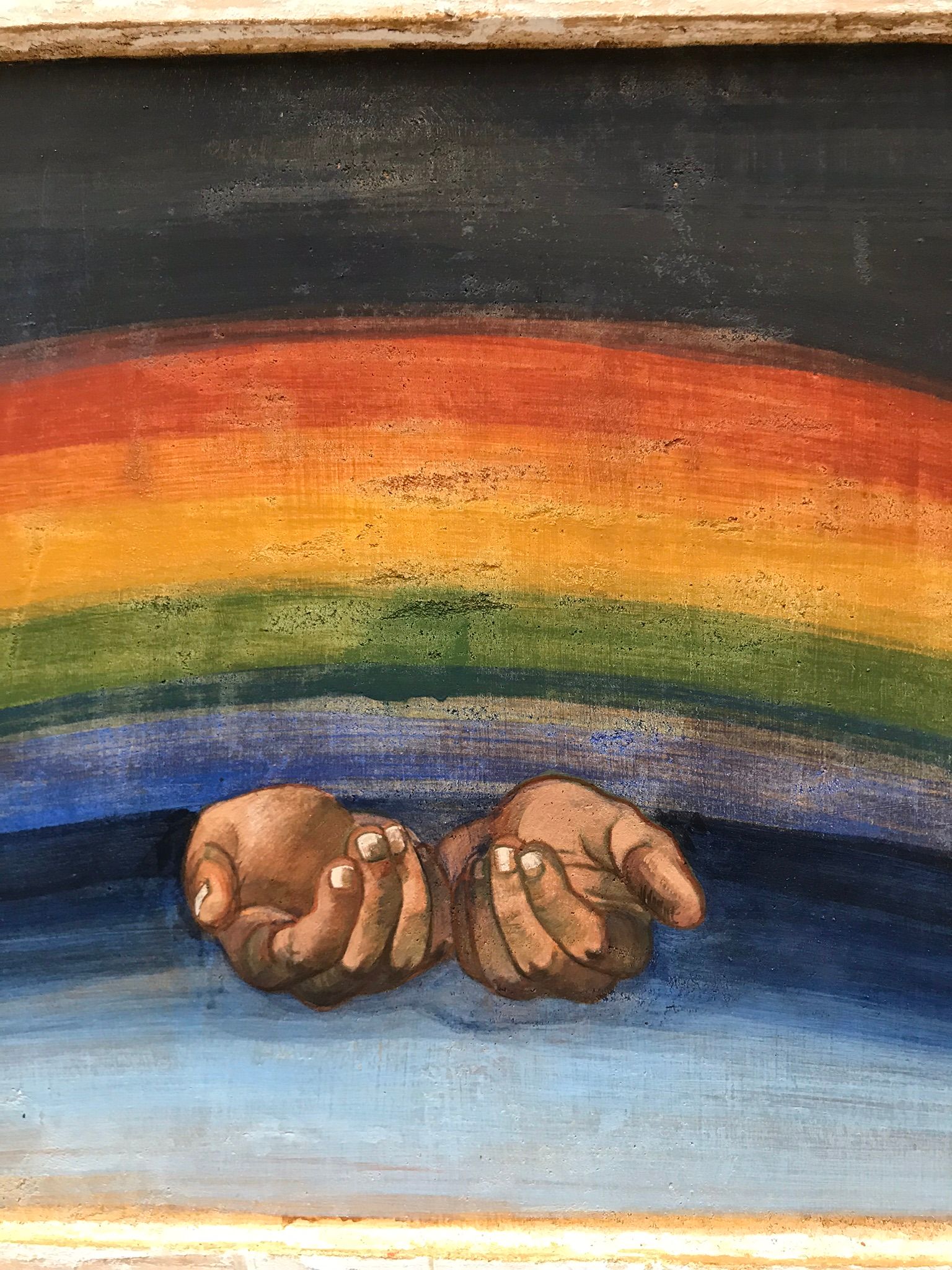
All are underneath the blessing hands of God and the rainbow of God’s promise.
Flanking the scene are two sentinel figures, each holding a light so that those in the darkness can find their way. The one on the left is modeled after Charles, a community member who died of cancer in May 2019, a few months before the fresco was completed. He was foundational to the church, as he lived on the streets and vouched for Haywood Street to all his friends when it was just getting started. His dog, Emma, sits in front of him, next to an open pouch of his woodworking tools. The other light-bearer, on the right, is Jeanette, a single mom who “came for lunch” one day between job interviews “and found love.” She is a care minister at Haywood Street and is on the board of directors. The two hold the Communion elements: Charles, a wine flask, and Jeanette, a sheaf of wheat.
Shout-out to Alexandra Davison, director of Culture Care RDU and a docent at the North Carolina Museum of Art, whose blog post “Lent, COVID-19 & the Beatitudes on Haywood Street” introduced me to this fresco.
+++
I’ve addressed the Beatitudes in previous Artful Devotions, which feature
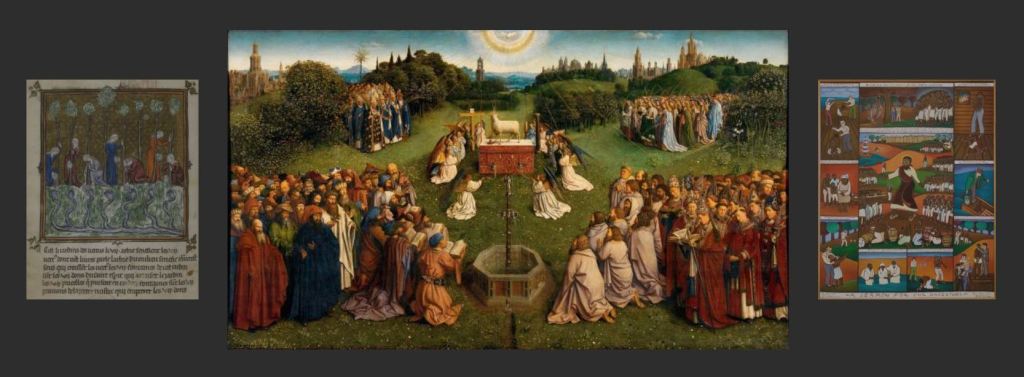
For more Beatitudes-related art, see the Visual Commentary on Scripture exhibition “Blessed,” curated by Rebekah Eklund, a professor of New Testament, theology, and ethics at Loyola University Maryland. I appreciate how she addresses descriptive versus prescriptive interpretations of the Beatitudes. She examines (1) an illumination from a French medieval moral treatise that shows seven women in a “virtue garden,” each representing a different beatitude; (2) an Ethiopian-inspired canvas painting by contemporary American artist Laura James, which places the Beatitudes in the context of chattel slavery; and (3) the central panel of the Ghent Altarpiece [previously], where seven groups of saints gather round a bleeding Lamb.
“All three artworks place a Christ-figure in the centre: the tallest tree in the middle of the garden tended by prayer, an African Jesus with open arms delivering the Sermon on the Mount, or the slaughtered Lamb standing triumphantly on the altar of his sacrifice and surrounded by angels. This centrality suggests Christ’s role not only as the speaker of the Beatitudes but also as their embodiment and fulfilment.”
This post belongs to the weekly series Artful Devotion. If you can’t view the music player in your email or RSS reader, try opening the post in your browser.
To view all the Revised Common Lectionary scripture readings for All Saints’ Day, cycle A, click here.
BLOG POST: “Jesus as Dancer: Jyoti Sahi’s ‘Lord of Creation’” by Victoria Emily Jones: I wrote a guest post for the Sojourn Arts blog about a gouache I own by Indian artist Jyoti Sahi, which shows Jesus leading the dance of new creation. On one side he pounds a drum, and on the other he emerges from a lotus. The painting brings together Jyoti’s interests in Christian and Hindu theologies and folk symbolism.
Jyoti Sahi (Indian, 1944–), Lord of Creation, 1982. Gouache on paper, 14 3/4 × 20 in. Collection of Victoria Emily Jones.
Sojourn Arts is a ministry of Sojourn Church Midtown in Louisville, Kentucky, that seeks to support artists and build up the church through the arts. They have organized and/or hosted numerous exhibitions over the years and have commissioned temporary installations for their sanctuary, as well as coordinated community art projects. Visit www.sojourn-arts.com.
+++
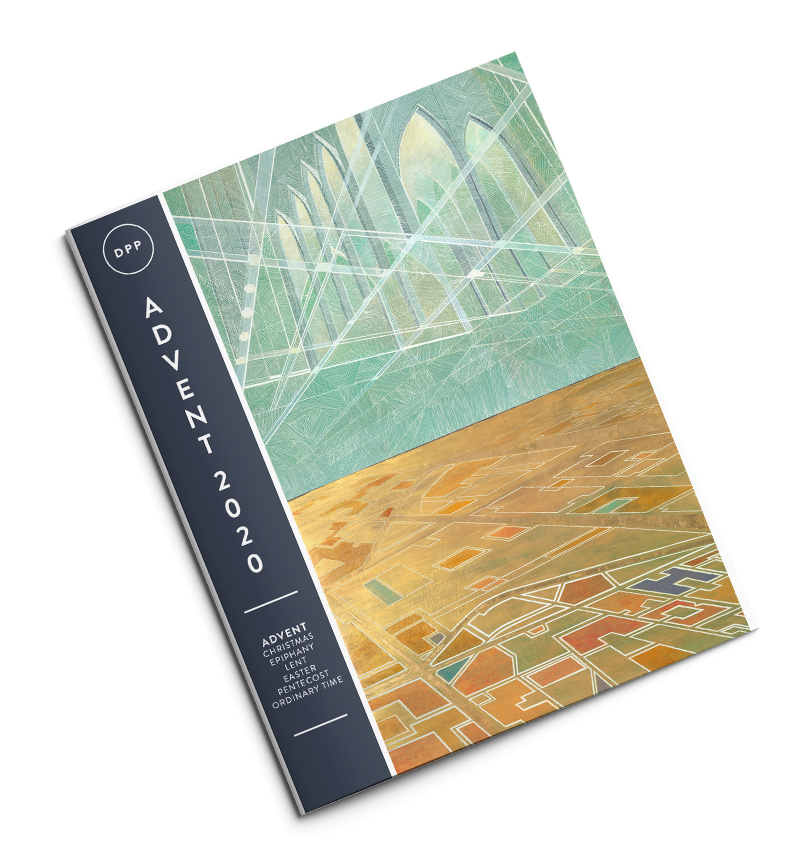
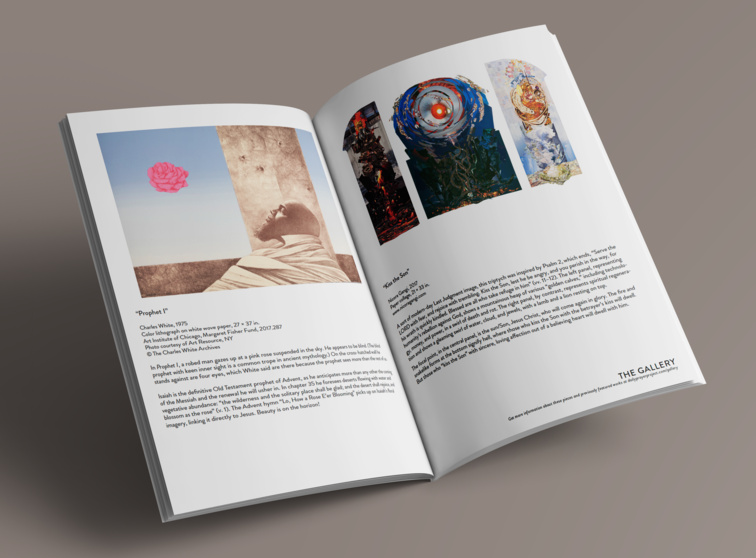
THE DAILY PRAYER PROJECT: This fall I joined the team at the Daily Prayer Project as curator of visual art. The Daily Prayer Project is a periodical that covers every season of the Christian year with robust, rooted, and cross-cultural liturgies for use in congregations, households, workplaces, small groups, or other gatherings. Released in seven editions per year, it features daily morning and evening prayer guides for the week, which include Psalm, Old Testament, and New Testament readings; short prayers sourced from around the globe and from different eras; specific prayer prompts; and songs (including lead sheets). In addition to the cover image, there is a mini-gallery of two art images inside, reproduced in full color, to serve as visual prompts for further contemplation and prayer. There is also a section called “The Practices,” with two page-long seasonal reflections by staff members or guest contributors.
The Advent 2020 issue of the DPP, covering November 29 through December 24, was released last week. It features prayers by African American civil rights leader Fannie Lou Hamer, the tenth-century English saint Ethelwold, and others; a Hebrew folk song, a Taizé chant, and an Argentine hymn by Federico J. Pagura; a striking cover image by Hilary Siber, which shows heaven coming down to earth; Charles White’s Prophet I, which resonates with passages from Isaiah; and an apocalyptic paper collage by Nicora Gangi.
The periodical is available as a physical booklet or as a PDF download. Visit the website for more information. If you are an artist and are interested in having your work considered for publication in a future prayerbook, email team@dailyprayerproject.com.
+++
VIDEO: “Local Riches: Ethnoarts and Sumba”: A workshop for churches on the island of Sumba in Indonesia, led by Yayasan Suluh Insan Lestari in July 2019, reinforced that God is best honored, and the global body of Christ built up, when people worship God using their unique cultural and linguistic gifts, bringing their whole, authentic selves before him in praise. [HT: Global Christian Worship]
For centuries many Christian missionaries to other countries brought with them Western hymns and images, presenting them as definitive—as forms that alone are good and pleasing to God. (For example, a woman in the video mentions how she had previously thought that worship songs had to be based on Western scales and performed using certain instruments to be acceptable.) But in the last fifty or so years especially, at least from what I’ve noticed, many missionaries have recognized the falsity of this line of thinking and seek to undo negative conditioning by promoting the use of indigenous artistic expressions (sometimes called “ethnoarts”) in Christian worship, be it dance, drama, music, storytelling, carving, or what have you. I found it interesting that the interviewees seem to suggest that now it’s the forces of modernism that most threaten the survival of traditional cultures, whereas it used to be that the church was largely blamed (missionaries did undeniably play a large part, banning this and that, though in every era there were exceptions to the rule). Now the church is at the forefront of trying to preserve not only traditional languages but also traditional art forms.
“Everything we have was created by God, and we need to return to it with gratefulness because this is how God made us!” says Rev. Herlina of the Christian Church of Sumba. “With whatever we already have, we can be a blessing to our people.”
+++
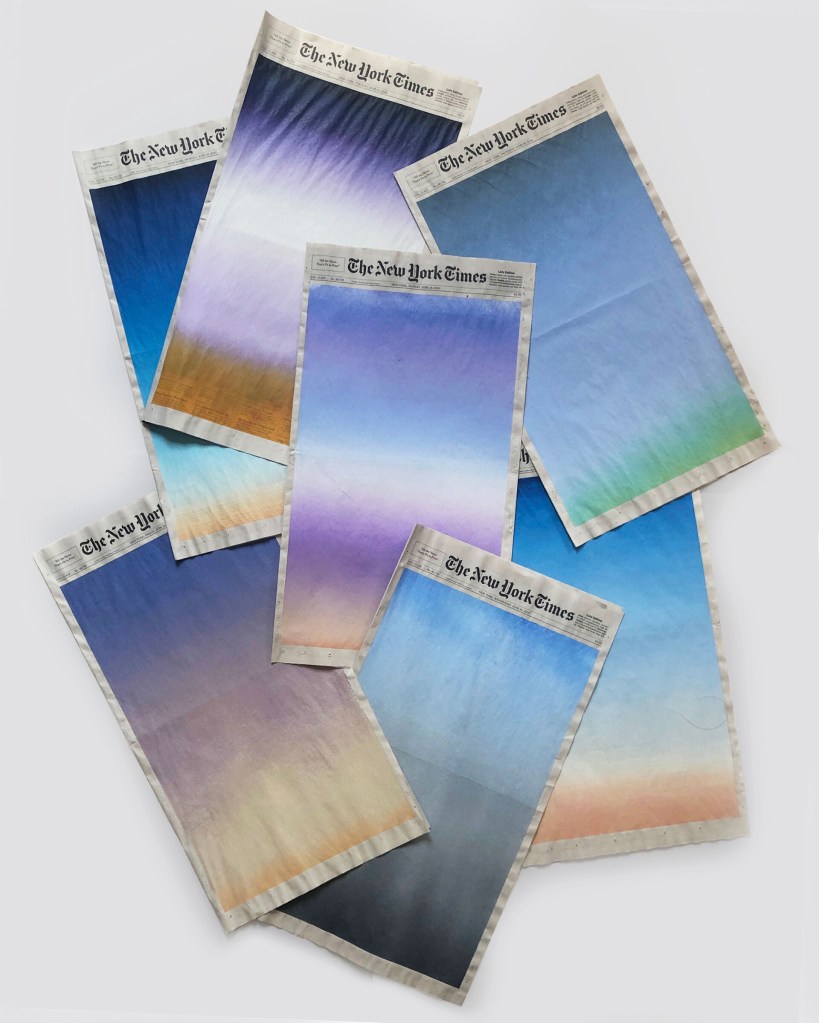
NEW ART SERIES: “Organic, Sunrise Gradients Mask Front Pages of the New York Times by Artist Sho Shibuya”: Since the lockdown started in March, Brooklyn-based artist and graphic designer Sho Shibuya has been painting color gradients in acrylic over the front pages of the New York Times, inspired by each morning’s sunrise. He calls the series “Sunrises from a Small Window.” I love how he’s able to express gratitude for a beautiful new day and to access calm amid dire news cycles. Shibuya is still reading those headlines and articles; he’s just putting them in a larger perspective. (As for myself, call me escapist, but I’ve found that actually blocking out the news—turning down the noise—for certain periods can be a helpful spiritual practice.)
Sho Shibuya, Sunrises from a Small Window, June 22–28, 2020. Acrylic on newsprint.
“I started . . . contrasting the anxiety of the news with the serenity of the sky, creating a record of my new normal,” Shibuya says. “Their front page has always been a time capsule of a day in history, so it made sense to use history as the canvas because the paintings are meant to capture a moment in time. . . . The spirit of the project is that maybe, even after the pandemic subsides, people can continue some of the generosity and peace we discovered in ourselves and that the sky reminds us of every day with a sunrise through a small window. If one thing the news has made clear, we need generosity and peace for all people now more than ever.”
+++
TWO FILMS: “Death on Netflix: I’m Thinking of Ending Things and Dick Johnson Is Dead” by Mitch Wiley: I really liked both these cinematic reflections on mortality, but they’re completely different, as this short Gospel Coalition article bears out. Dick Johnson Is Dead is the more “Christian” of the two because of its hopeful perspective—the human subject of the film is a Seventh-Day Adventist, so death for him is not a final end. After her father was diagnosed with dementia, filmmaker Kirsten Johnson asked her dad if he’d be interested in a collaborative film project where, to help them both face the inevitable, she would stage his death in inventive and comical ways. Relishing the opportunity to spend more time with his busy daughter, he enthusiastically agreed.
The documentary shows them preparing and carrying out these stunts but also interacting in other contexts—birthday parties, trick-or-treating, looking through old photo albums, cleaning out Dick’s office, Dick’s being asked to give up driving, and so on. It made me laugh and cry—films that can do both tend to rate highly on my favorites list. There’s so much love and warmth and heartache and whimsy in it as father and daughter confront death together, talking very openly about it, which I found, strange as it may seem, refreshing. Oh, and the heaven sequences just may be the best I’ve ever seen.
For a more cynical take on death, here’s the trailer to I’m Thinking of Ending Things (Charlie Kaufman isn’t for everyone, but I’m still thinking about this movie after watching it a month ago, which means it made an impression!):
Seeing and Believing, a Christ and Pop Culture podcast, covered Ending Things and Dick Johnson in episodes 264 and 266, respectively, as have most other film podcasts and reviewers, with Dick Johnson being uniformly lauded as one of the best movies of the year.
+++
SONG: “Hodu” (Give Thanks), performed by the Platt Brothers: The Platt Brothers [previously] singing scripture to me? Yes, please. The text of this song is Psalm 118:1–4, and the music is by Debbie Friedman (1951–2011), a Jewish singer-songwriter whose songs are used widely in Reform and Conservative Jewish liturgies in North America. Friedman’s “Hodu” was originally released on her 1981 album And the Youth Shall See Visions. (Find sheet music here.)
In this video from earlier this month, Henry, Jonah, and Ben Platt sing “Hodu” to a guitar accompaniment by Al Seller.
Hodu l’Adonai kitov Ki l’olam chasdo, ki l’oam chasdo Yomar na, yomar na, Yisraeil Ki l’olam chasdo, ki l’olam chasdo Yomru na, yomru na veit Aharon Ki l’olam chasdo, ki l’olam chasdo
Let all who revere G-d’s name now say Ki l’olam chasdo Give thanks to the Lord for G-d is good Ki l’olam chasdo
The first time the Platt Brothers performed in public as a trio was this April, when they appeared in a virtual Yom Ha’atzmaut celebration at the request of the Jewish Federations of North America, singing “Ahavat Olam.” Ben and Jonah are musical theater performers: Ben originated the title role in Broadway’s Dear Evan Hansen and won a Tony for it, and Jonah is best known for playing Fiyero in Wicked on Broadway from 2015 to 2016. Henry is a senior at the University of Pennsylvania, where’s he’s a member of the a cappella group Counterparts.
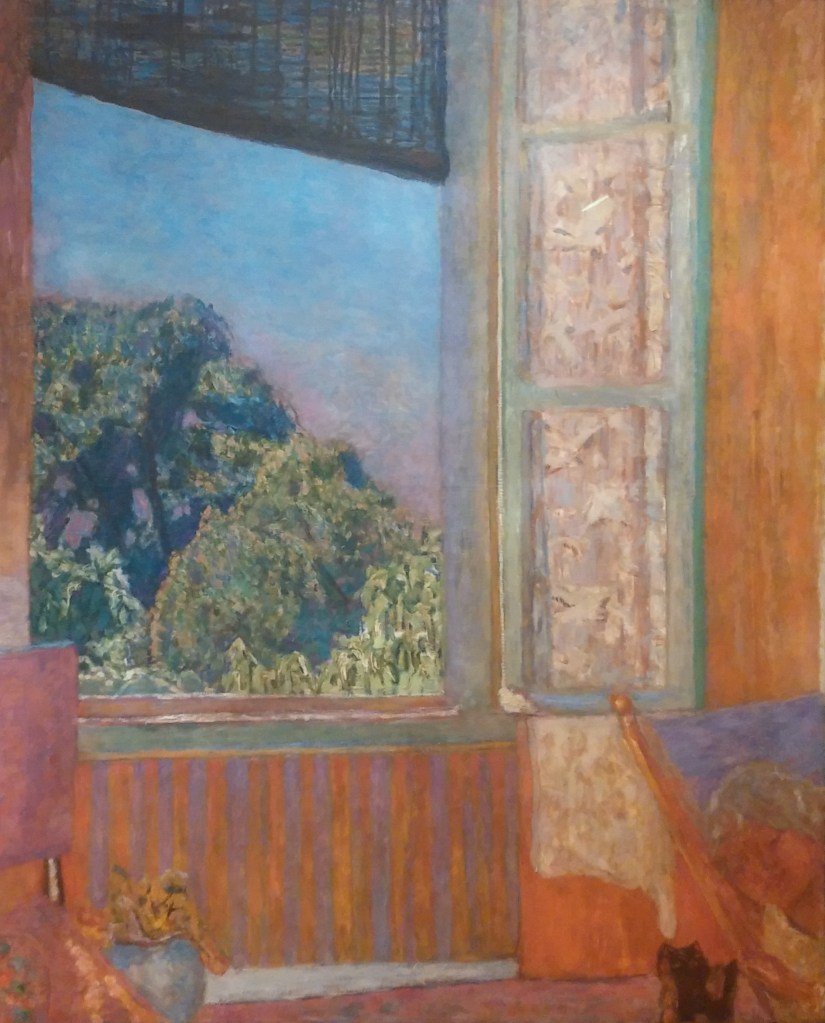
Pierre Bonnard (French, 1867–1947), The Open Window, 1921. Oil on canvas, 46 1/2 × 37 3/4 in. (118.1 × 95.9 cm). Phillips Collection, Washington, DC. Photo: Victoria Emily Jones.
Satisfy us in the morning with your steadfast love, that we may rejoice and be glad all our days.
—Psalm 90:14
+++
SONG: “Oh to Be Loved” by Thad Cockrell, on To Be Loved (2009)
This post belongs to the weekly series Artful Devotion. If you can’t view the music player in your email or RSS reader, try opening the post in your browser.
To view all the Revised Common Lectionary scripture readings for Proper 25, cycle A, click here.
Several readers have asked if there’s a way to donate to the work of this blog. After much thought I’ve decided to go ahead and add a Donation page, where those who wish to send a small financial gift to support the blog’s upkeep and development can do so through PayPal if they feel so inclined. Thank you!
+++
CIVA ART AUCTION, November 13–15, 2020: In a few weeks CIVA (Christians in the Visual Arts) is hosting an online auction of art created and/or donated by CIVA members. The lots comprise a range of media, sizes, and styles—a little something for everyone. It’s a great way to support artists of faith (by supporting CIVA), and to acquire beautiful art for your home!
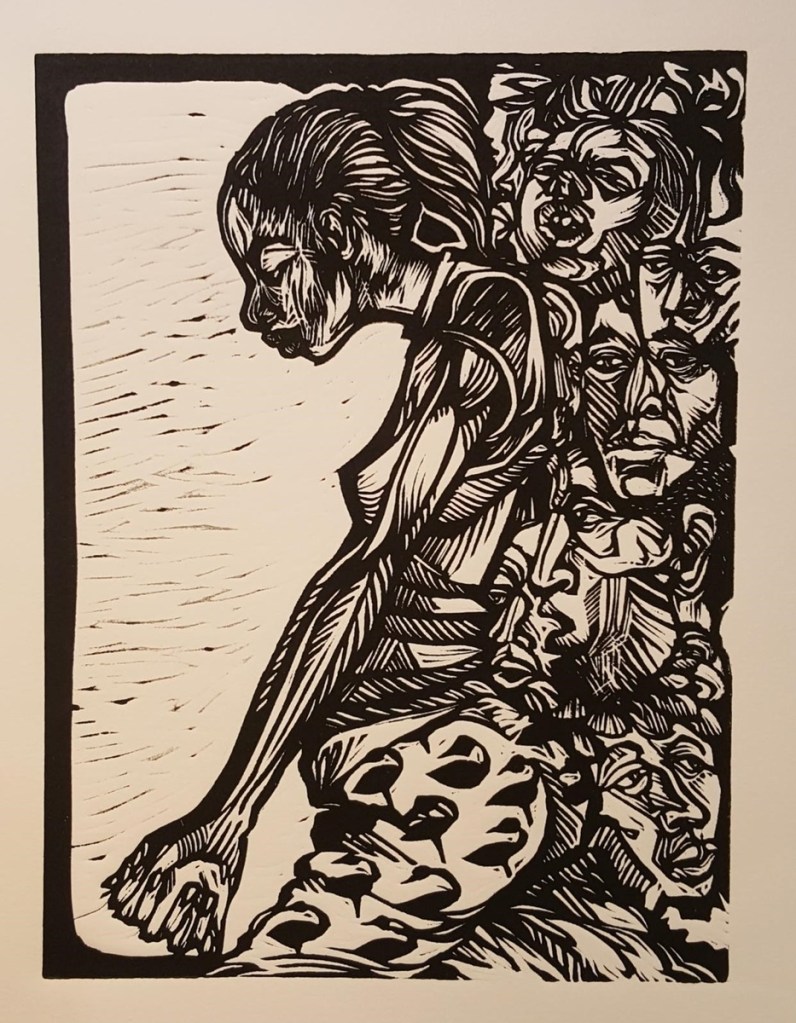
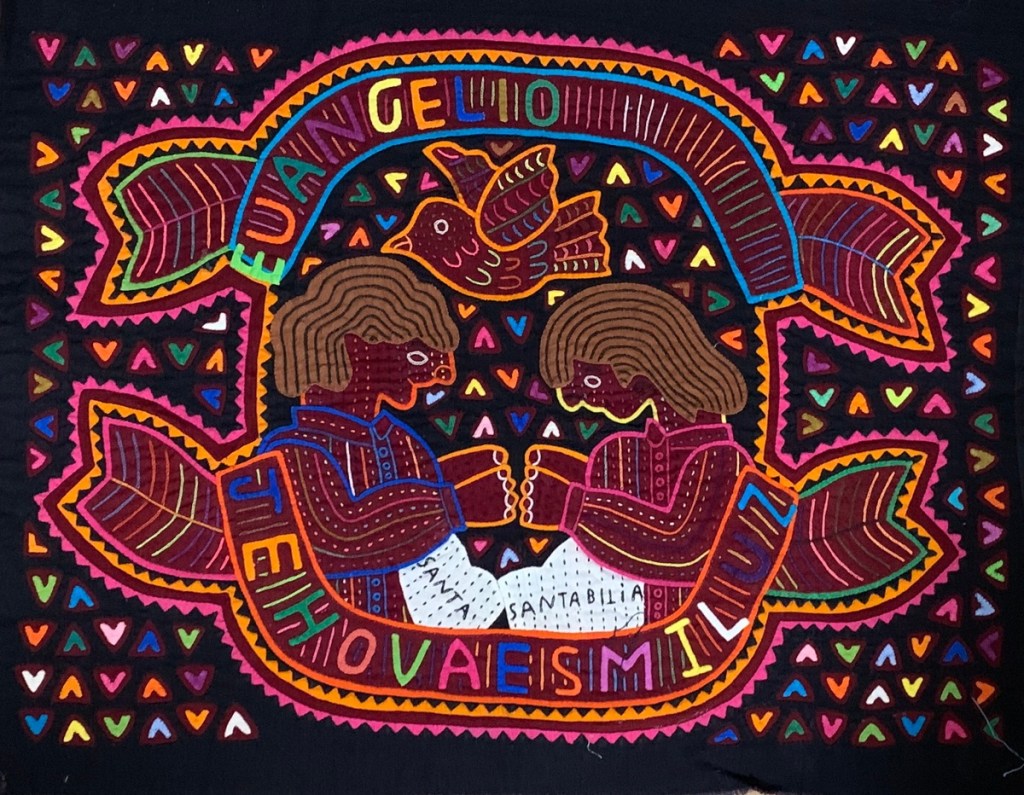
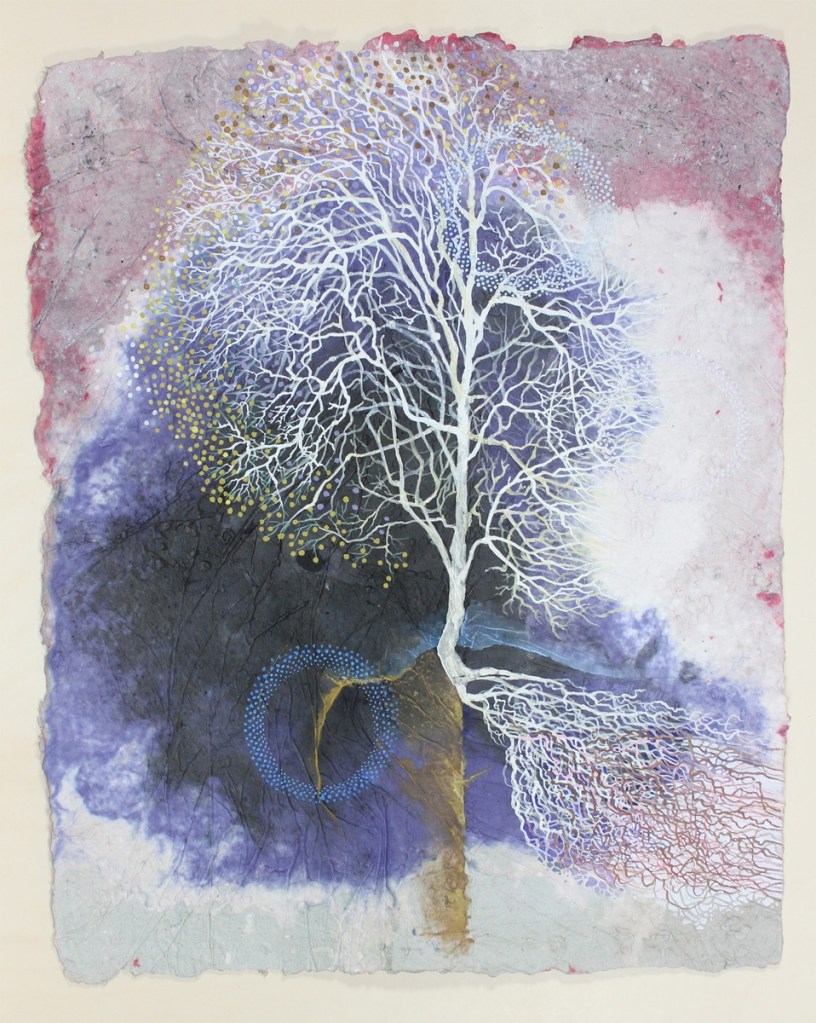
The first artwork I ever purchased was through a CIVA auction: a linocut by Steve Prince, who has three new works up for bid this year. Sandra Bowden has donated several works from her extensive and esteemed collection of religious art, including an Adoration of the Magi lithograph by the major modern artist Otto Dix and a mola (handmade textile) from Panama, which I’m eyeing. I also noticed 40 Days, Forty Sacraments, a set of gouaches painted by Kari Dunham over the course of Lent one year as a way to rediscover beauty in the ordinary. And a mixed-media piece by Joseph di Bella, whose theme of redemption is underscored by the making of the substrate, which consists of “failed and unfinished works on paper” that “are destroyed, then reformed into new, yet still imperfect sheets.”
Steve Prince, Faith Walk. Linocut, 12 × 9 in. “Shows a woman walking in faith while the ancestors encourage, uplift, and guide her along the way.”Jehova es mi luz (Jehovah Is My Light), San Blas Islands, Panama, 1980s. Reverse embroidery, 14 × 17 1/2 in.Joseph di Bella, Tree Parables (Generations), 2017. Gouache, dry pigment, and ashes on handmade paper, 38 1/2 × 30 1/2 × 1 1/2 in. (framed).
If you plan on bidding, be sure to register; you will be able to see all the other bids and can set up notifications. And if you don’t win, don’t be discouraged: you can always go to the artist’s website, and there will likely be other works available for purchase there.
+++
ALBUM: Daughter Zion’s Woe: Produced by Rachel Wilhelm and released last month by Cardiphonia, this new album features thirteen lament songs written, arranged, and performed by women. It will be available on Spotify after Christmas, but until then, all Bandcamp sales benefit Hagar’s Sisters, an organization that serves victims of domestic violence. My favorite song on the album is “The Glory Shall Be Thine” by Christy Danner, a retuning of the late nineteenth-century “Transformed” by F. G. Burroughs (pseudonym for Ophelia Burroughs, later Adams, née Browning); this hymn text is completely new to me, and what a gem! Danner’s music really draws out its poignancy. Other highlights include Eden Wilhelm’s “Lord, Draw Near” (Psalm 88), Sister Sinjin’s “Silence,” and Lo Sy Lo’s “Let It Be So” (Psalm 12).
+++
EXHIBITION:The Evidence of Things Unseen by Titus Kaphar,October 16–November 28, 2020, former Église du Gesù, Brussels: Titus Kaphar’s [previously] art, which reinterprets traditional Anglo-centric imagery through a Black lens, has grown out of his “spending time in European museums and longing for pictures that looked like they actually made space for individuals that look like me.” In this new exhibition, staged by the Maruani Mercier gallery in a deconsecrated church in Belgium, Kaphar revises Christian paintings by silhouetting, covering in tar, or duct-taping over likenesses of white Jesus, drawing attention to unseen people and narratives. The exhibition’s title is taken from Hebrews 11:1.
Titus Kaphar, Untitled, 2020. Oil and tar on canvas. Photo courtesy Maruani Mercier.
The press release reads: “It is virtually impossible to tell the story of Renaissance art without an exploration of Christianity. While the personal faith of the individual artist varied from devotee to atheist opportunist, the largest patron of the arts was the Church, and Catholic iconography the artist’s lingua franca. . . .
“In The Evidence of Things Unseen, Kaphar utilizes Catholic iconography as a ground on which to explore ideas beyond simple proselytization. Kaphar utilizes his whole vocabulary of formal innovation in this exhibition: canvases aggressively fold, crumple, undulate, and project from the wall, forcing themselves into the space of the viewer. Through Kaphar’s physical interventions, works like Susan and the Elders and Eve exist as bodies transformed into landscape and typography rather than polite easel paintings. In Jesus Noir Kaphar duct-tapes a portrait of a young black man over the face of Christ. Christ’s outstretched right hand, originally pointing to the heavens, now appears as a plea for help. The application of duct tape – a utilitarian material known to be used in all kinds of industrial and household repairs – suggest urgency and impermanence.
“Even though many biblical stories take place in the Middle East and Africa, representations of Christ and his followers are almost always depicted as European. It is not surprising that the devoted attempt to see themselves in the stories of the Bible, and to envision a Christ they can recognize: Christian tradition teaches that mankind was created in God’s own ‘image and likeness.’ And yet, religious paintings from the Renaissance unwittingly oversimplify an understanding of God by excluding a part of his creation. There are no black angels of the Renaissance. The Evidence of Things Unseen is Kaphar’s latest attempt at revision.”
+++
ANIMATED SHORT: “Brené Brown on Empathy”: In this 2013 video from the RSA (Royal Society for Arts, Manufactures and Commerce), Katy Davis animates an excerpt from a talk by Professor Brené Brown, “The Power of Vulnerability.” “The Webby Award-winning RSA Shorts animation series provides a snapshot of a big idea, blending voices from the RSA Public Events Programme and the creative talents of illustrators and animators from around the world. It responds to the ever-increasing need for new ideas and inspiration in our busy lives and acts as a jolt of ‘mental espresso’ that will awaken the curiosity in all of us. If you’re interested in the opportunity of animating one of our Shorts, please email your bio and links to your portfolio to shorts@rsa.org.uk.” Other RSA shorts include Jonathan Haidt on Why We’re Convinced We’re Right, David Brooks on Character in a Selfie Age, and David Graeber on the Value of Work.
+++
PANEL DISCUSSION: “Perspectives on Empathy and the Arts”: In 2017 Roots of Empathy brought together a panel of three—Cameron Bailey, artistic director of the Toronto International Film Festival (TIFF); Martha Durdin, chair of the board of trustees of the Royal Ontario Museum (ROM); and Raymond Mar, professor of psychology at York University—to discuss the connection between art and empathy and why it’s so important. The conversation is moderated by Mary Ito. I especially appreciated from 42:32 onward.
4:10: Children who take acting lessons are more prosocial and empathetic 5:48: Films and empathy 9:34: Fiction and empathy 12:42: Moonlight(2016) 21:54: Learning from mistakes: Into the Heart of Africa (1989) and point of view 28:38: Pompeii: In the Shadow of the Volcano (2015) 30:37: Forced assimilation of Native people in church-run residential schools 31:18: Can art museums institutionalize empathy? 34:48: How does me empathizing with a character in a book or a painted figure translate to me being empathetic to actual people? 39:05: Superhero comics and movies 41:22: Are we suffering from an empathy deficit? 44:37: Empathy for ideological opponents 46:10: Where does empathy run up against morality/ethics? Are we to empathize with abusers? 46:56: How do we do better through the arts?









 Art & Theology