Miniature from the Menologion of Basil II (Vat. Gr. 1613, page 59), made in Constantinople, 976–1025. Vatican Library, Rome.
When God saw what they did, how they turned from their evil way, God relented of the disaster that he had said he would do to them, and he did not do it.
But it displeased Jonah exceedingly, and he was angry. And he prayed to the LORD and said, “O LORD, is not this what I said when I was yet in my country? That is why I made haste to flee to Tarshish; for I knew that you are a gracious God and merciful, slow to anger and abounding in steadfast love, and relenting from disaster. Therefore now, O LORD, please take my life from me, for it is better for me to die than to live.” And the LORD said, “Do you do well to be angry?”
Jonah went out of the city and sat to the east of the city and made a booth for himself there. He sat under it in the shade, till he should see what would become of the city. Now the LORD God appointed a plant and made it come up over Jonah, that it might be a shade over his head, to save him from his discomfort. So Jonah was exceedingly glad because of the plant. But when dawn came up the next day, God appointed a worm that attacked the plant, so that it withered. When the sun rose, God appointed a scorching east wind, and the sun beat down on the head of Jonah so that he was faint. And he asked that he might die and said, “It is better for me to die than to live.” But God said to Jonah, “Do you do well to be angry for the plant?” And he said, “Yes, I do well to be angry, angry enough to die.” And the LORD said, “You pity the plant, for which you did not labor, nor did you make it grow, which came into being in a night and perished in a night. And should not I pity Nineveh, that great city, in which there are more than 120,000 persons who do not know their right hand from their left, and also much cattle?”
—Jonah 3:10–4:11
After Jonah, at God’s behest, reluctantly went to preach to the pagan city of Ninevah, its people repented and were spared destruction. (Ninevah was the capital of Assyria, Israel’s enemy.) This is where Sunday’s lectionary reading, the final chapter of the book of Jonah, picks up.
When God extended his mercy to Jonah earlier in the story, it filled Jonah with thanksgiving (Jonah 2:9), but when God is merciful to Ninevah, it fills Jonah with anger. Jonah believed that the Ninevites should be punished for their sin, that they are not worthy of God’s forgiveness. He wanted them to be crushed, not saved! Thus accusing God of injustice, he stalks over to a spot east of Ninevah, plops himself down, and pouts.
The book of Jonah condemns the title character’s bigotry and ethnocentrism, portraying him as a rather ridiculous figure. The idea that God loves only “us,” not “them,” is one that has persisted down through the ages and that’s satirized in this quatrain:
We are God’s chosen few,
All others will be damned;
There is no place in heaven for you,
We can’t have heaven crammed.
(This is sometimes attributed to Jonathan Swift, but it’s not in his collected works; if you know the original source, let me know!)
Jonah wants God’s love to have boundaries that hem him in and others out. To expose the faultiness of Jonah’s thinking, God “appoints a plant” to provide shade for Jonah, relief from the heat, but only for a day. The next day God destroys the plant, and Jonah is so upset that he wants to die. God then questions why he grieves the destruction of a mere plant but not the prospect of an entire city being destroyed.
The narrative ends without telling us whether Jonah receives the lesson well and repents of the hatred he harbors.
This post belongs to the weekly series Artful Devotion. If you can’t view the music player in your email or RSS reader, try opening the post in your browser.
To view all the Revised Common Lectionary scripture readings for Proper 20, cycle A, click here.
Though I grew up in the church, for a long time I was ignorant of the vibrant threads of lament and justice that run throughout scripture. I imbibed the message that good Christians never complain or get angry or question God or call him to account, that “rejoicing always” means always putting on a happy face (dwelling in sadness was tantamount to distrust), and that social justice is a “liberal agenda” and a distraction from the gospel. As my faith has matured and my engagement with the scriptures has deepened, my eyes have been opened to the embeddedness of justice in the biblical narrative, and how any lack of justice is cause for lament.
Tim Keller’s book Generous Justice: How God’s Grace Makes Us Just (2012) was instrumental in helping me see how social justice is an expression of God’s own heart and an important part of the church’s mission, not tangential to the gospel but an extension of it. My earlier conception of the gospel, the good news of Jesus Christ, was so impoverished, as I had reduced it down to nothing more than a private transaction between me and God regarding the eternal destination of my soul. As I began to see, through reading scripture, that God cares about this world, and he cares about people’s souls and bodies, I came to realize how expansive the gospel really is, with real implications for the here and now. We may be in right relationship with God, or think we are, but are we in right relationship with our neighbors and, I would add, with the rest of God’s creation? That is, do we live justly, as God commands, which includes supporting policies that promote, as best as possible, the flourishing of all, not just ourselves or others like us?
Keller shows how the Christianese terms “sin” and “righteousness” have to do not only with personal morality but also with systems, and how “justice” is more multifaceted than merely “punishment.” Punishing wrongdoers and reestablishing rights is one type of justice, called rectifying (or retributive) justice, or mishpat in Hebrew. But primary justice (aka distributive justice) is making sure goods and opportunities are more equitably distributed in society. It’s proactive. “Primary justice, or tzadeqah, is behavior that, if it was prevalent in the world, would render rectifying justice unnecessary, because everyone would be living in right relationship to everyone else” (11). Keller says that when these two Hebrew words appear together in the Bible, the best translation of the compound is “social justice.” So, for example, when Psalm 33:5 says, “He loveth righteousness [tzadeqah] and judgment [mishpat],” perhaps a better modern translation would be “The LORD loves social justice.”
The truncated “ticket to heaven,” “me and Jesus” understanding of salvation shows up in countless Christian worship songs, which form, or malform, our imaginations. I’m not at all dismissing the need for personal salvation (that is a critical component of the gospel!), or suggesting that we ought not to be looking toward eternity. What I am saying is that our relationship with Jesus, including our transformative experience of his love and grace, should have a profound impact on how we relate to and advocate for our neighbors, and our conception of heaven should be as huge and as glorious as the Bible alludes to (the entire world renewed and in harmony under the headship of Christ)—and we should start living into that vision NOW, even as we await Christ’s return. I often wonder whether, if there had been more biblical justice–oriented songs circulating and in church use during my upbringing, my deep hurt over the brokenness of the world and thus my sense of social responsibility as a Christian would have developed sooner.
Founded in 2017 by Isaac and Megan Wardell, The Porter’s Gate is a music collective whose mission is to be a “porter” for the Christian church—one who looks beyond church doors for guests to welcome. Their first album, Work Songs (2017), explores the concept of vocation in both the public and private spheres. That was followed up by Neighbor Songs (2019), centered on the communal aspect of Christian living and of God’s future, and the embodied love at the heart of the gospel.
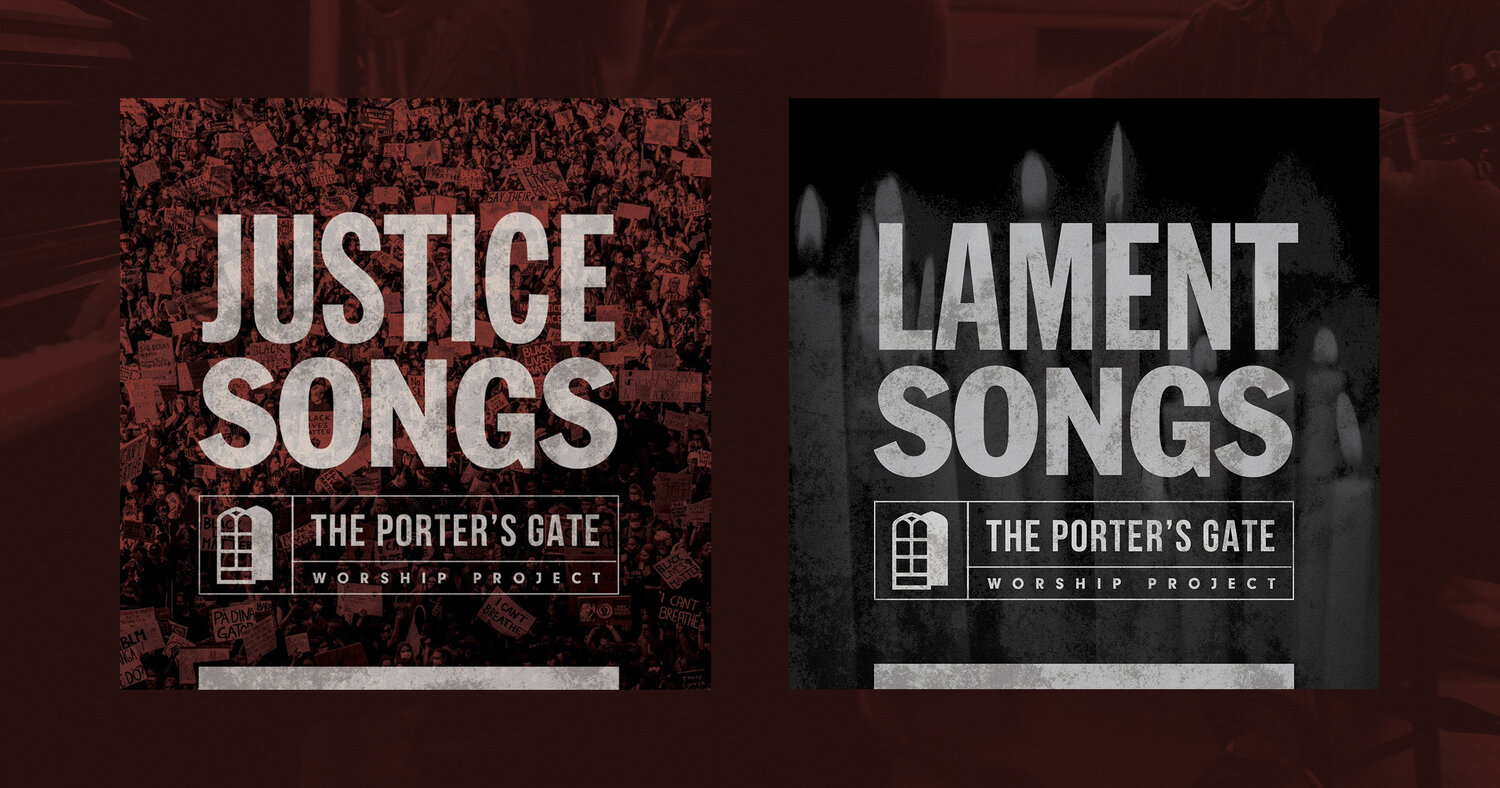
And now, released this month, are two companion albums: Lament Songs and Justice Songs. Recorded by a diverse group of musicians in July 2020 on a farm in Virginia, the albums interweave fragments from the Psalms with biblical prophecies and apocalypses, blessings, Gospel stories, and protest chants, crafting a robust kingdom theology that promotes constructive engagement with contemporary issues and a looking toward the reconciliation of all things in Christ. “We fight for the victories we know You will win” (a lyric from “Justicia”) is a good encapsulation.
Political corruption, police brutality, racism, mass incarceration, sexual violence, economic exploitation, and war are all referenced, either implicitly or explicitly, as forms of oppression that need to be toppled, as they are an affront to God, marring his image.
Full of heartbreak and hope, the songs are shepherding me out of my tendency toward cynicism and helping me recapture the beauty of God’s vision for the world. They’re saturated in biblical language. An antidote to the all-too-common escapism theology present in some Christian music, they catalyze the church to weep with those who are weeping (Rom. 12:15), to bear the burdens of others (Gal. 6:2), and to participate in God’s work of renewal in the world. God has not redeemed us to wait idly by while sin tightens its grip on society. No, he calls us to sow the seeds of his kingdom in anticipation of a bountiful harvest. To walk in the power of the Spirit, into dark corners, bringing light.
The Porter’s Gate seeks to provide songs for corporate worship, and all these would (potentially) be appropriate in that setting; for churches that aren’t used to the practice of lament or to engaging justice issues, some advance education and pastoral guidance will be in order. Some songs will naturally land better in some churches than in others. Some are challenging—and that’s a good thing, as challenge tends to grow us.
As one would expect, God is supplicated throughout the songs. Entreaties include
Come, Jesus, come
Be our light
Drive out the darkness
End all the violence
Do not be silent
Be near!
Illuminate the shadows
Take pity!
Keep the enemy back
Comfort
Be our refuge
Break oppression
Make me an instrument
Help me restore
And God is abundantly praised, and his promises laid claim to.
The songwriters on the two albums are Isaac Wardell, Latifah Alattas, Kate Bluett, Jessica Fox, Jon Guerra, Casey J, Wendell Kimbrough, Leslie Jordan, Dan Marotta, Orlando Palmer, John Swinton, Gregory Thompson, Liz Vice, Keith Watts, Tina Colón Williams, and Paul Zach.
As the writers would acknowledge, the general content and ethos of the songs are not “new” or alien to Christianity. If you cringe at the thought of bringing current events into worship or singing a confession of corporate sin or expressing sadness or outrage to God, just know that faithful Christians have been doing it since the beginning, and your discomfort may be because you haven’t been exposed to church traditions outside your own. Ecumenicism is an important aspect of The Porter’s Gate’s identity, says Isaac Wardell—an ecumenicism that says, “I come with gifts of the Spirit of my tradition, but I come also with the poverty of my tradition, looking for the charisms and the gifts of your tradition.” And I love that about the project.
Because I’m eager for others to see the biblical groundedness of the songs (which will be obvious to many upon first listening, but maybe not to those who are more selectivist in their Bible reading), and because I’m a musical worship leader who approaches worship music with great discernment of the theology it espouses, I’m going to point out just some of the scriptural connections in the songs.
Acknowledging that the world is not right, and mourning specific instances of that unrighteousness, is the first step in justice work. It’s called lament. Lament cries out, “Why, God?” and “How long?” Honest expressions of woe are not irreverent. The Bible is full of such language. The fact that lament is addressed to God means that faith has not been abandoned; on the contrary, lament leads to a renewed confidence in God.
The first song on Lament Songs, “Wake Up, Jesus” (feat. Liz Vice), takes as its conceit the story of Jesus’s calming the storm after being woken up by his scared disciples, but it is sung in medias res, from the vantage point of one who is caught in a storm that is still raging. “Jesus, when you gonna wake up? . . . Won’t you rise up?” Again, maybe you’ve always assumed this kind of forthrightness is forbidden in prayer, but it’s in perfect sync with the way the biblical psalmists, for example, relate to God; take Psalm 44: “Awake, Lord! Why do you sleep? / Rouse yourself! Do not reject us forever. / Why do you hide your face / and forget our misery and oppression?” (vv. 23–24). (See more biblical examples of this demand at https://artandtheology.org/2019/07/09/rise-up-artful-devotion/.)
When the instrumental intro to the second song begins, we recognize the famous passion chorale tune by Hassler, and we ready ourselves to sing “O Sacred Head . . .”—but instead we get “O Sacred Neck.” The word change is jarring. Why are we talking about Jesus’s neck? Then with the next phrase, “pressed down by blows and knees,” it becomes clear that the reference is to black victims of police violence, like George Floyd, who died in May after an officer, arresting him for trying to make a purchase with a counterfeit twenty-dollar bill, knelt on his neck for nearly eight minutes while he pled for his life and then died. (Two other officers assisted in restraining him, and another prevented onlookers from intervening.)
Maggi Hambling (British, 1945–), Wall of Water II, 2011. Oil on canvas, 78 × 89 in. (198.1 × 226.1 cm). Photo: Douglas Atfield.
Then the angel of God who was going before the host of Israel moved and went behind them, and the pillar of cloud moved from before them and stood behind them, coming between the host of Egypt and the host of Israel. And there was the cloud and the darkness. And it lit up the night without one coming near the other all night.
Then Moses stretched out his hand over the sea, and the LORD drove the sea back by a strong east wind all night and made the sea dry land, and the waters were divided. And the people of Israel went into the midst of the sea on dry ground, the waters being a wall to them on their right hand and on their left. The Egyptians pursued and went in after them into the midst of the sea, all Pharaoh’s horses, his chariots, and his horsemen. And in the morning watch the LORD in the pillar of fire and of cloud looked down on the Egyptian forces and threw the Egyptian forces into a panic, clogging their chariot wheels so that they drove heavily. And the Egyptians said, “Let us flee from before Israel, for the LORD fights for them against the Egyptians.”
Then the LORD said to Moses, “Stretch out your hand over the sea, that the water may come back upon the Egyptians, upon their chariots, and upon their horsemen.” So Moses stretched out his hand over the sea, and the sea returned to its normal course when the morning appeared. And as the Egyptians fled into it, the LORD threw the Egyptians into the midst of the sea. The waters returned and covered the chariots and the horsemen; of all the host of Pharaoh that had followed them into the sea, not one of them remained. But the people of Israel walked on dry ground through the sea, the waters being a wall to them on their right hand and on their left.
Thus the LORD saved Israel that day from the hand of the Egyptians, and Israel saw the Egyptians dead on the seashore. Israel saw the great power that the LORD used against the Egyptians, so the people feared the LORD, and they believed in the LORD and in his servant Moses.
—Exodus 14:19–31
+++
SONG: “Wade in the Water,” African American spiritual
There have been many, many performances of this song over the years. For a nice, concise history of recordings, from gospel and doowop and choral to modern jazz, R&B, heavy rock, and northern soul, see this article by Mike Hobart. Below is a handful I’ve found and enjoy.
A gospel version by Brother John Sellers from 1959, driven by piano:
A choral arrangement by Paul T. Kwami, performed by the Fisk Jubilee Singers in 2019 (the soloist isn’t credited, but she’s amazing!):
Pegasis is a vocal trio of sisters from the Dominican Republic, formerly performing under the name The Peguero Sisters. Accompanied on guitar by their dad, here they are with stellar harmonies from their 2016 album Peace Through Praise:
The Petersens apply their signature bluegrass stylings in their rendition, performed a few weeks ago in this video but also on their 2019 album Homesick for a Country:
According to oral lore, Harriet Tubman used the song “Wade in the Water” to communicate strategy to slaves traveling the Underground Railroad: its coded language alerted freedom seekers that bounty hunters were on their trail with bloodhounds and that they should jump into the river so that the dogs couldn’t track their scent. This popular myth about the song has not been confirmed, and the National Park Service, which preserves historical sites associated with the Underground Railroad and promotes research on the topic, suggests that it’s probably not true.
It is known, however, that it was sung at river baptisms, and still is, as the Exodus is seen as an archetype of baptism, of redemption through water. Not only that, but the song also draws on the pool of Bethesda passage in John 5, where people gathered to be healed: “For an angel went down at a certain season into the pool, and troubled the water: whosoever then first after the troubling of the water stepped in was made whole of whatsoever disease he had” (v. 4). (This verse is found in some early New Testament manuscripts but not the earliest and is therefore omitted from several modern translations.)
In the documentary God’s Greatest Hits, pastor and gospel recording artist Wintley Phipps says, “‘Wade in the Water,’ to me, . . . means people who are afraid of moving forward, progressing, taking a step, and facing uncertainty—go ahead, wade in the water. Take that step. As terrifying as it may seem at that very moment, it’s gonna be alright, and the miracle we seek is gonna happen.”
There’s the famous song “Bridge Over Troubled Water.” Well, in Exodus, God carves out a bridge through troubled water! Imagine walls of water standing multiple stories high on either side of you, filled with tiger sharks and other marine life. And you have to cross the sandy bottom in faith that those walls will hold up until you reach the other side.
“Wade in the Water” affirms that God is going to stir things up; he’s going to do something big. Just like he did when he brought Israel up out of Egypt.
Maggi Hambling is one of Britain’s most significant painters and sculptors. Her nine “Walls of Water” paintings were made in 2010–11 and were first exhibited in 2014 at the National Gallery in London. Vast, intense, and energetic, they were inspired by her experience of giant waves crashing onto the seawall at Southwold, Suffolk, where she lives. “Through turbulence and exuberant colour, Hambling continues to affirm painting’s immediacy, saying, ‘The crucial thing that only painting can do is to make you feel as if you’re there while it’s being created – as if it’s happening in front of you’” (source).
Maggi Hambling (British, 1945–), Wall of WaterV, 2011. Oil on canvas, 78 × 89 in. (198.1 × 226.1 cm). Photo: Douglas Atfield.
View other paintings from the series at Artsy.net.
This post belongs to the weekly series Artful Devotion. If you can’t view the music player in your email or RSS reader, try opening the post in your browser.
To view all the Revised Common Lectionary scripture readings for Proper 19, cycle A, click here.
At the beginning of the book of Exodus, the Hebrews have been in Egypt for several generations, their migration blessed by a previous pharaoh in appreciation of Joseph’s handling of a food crisis. But their peaceful coexistence comes to an end when a new pharaoh comes to power and conscripts the Hebrews into hard labor. In addition to the enslavement, Pharaoh issues an imperial edict that all newborn Hebrew boys are to be killed.
In her excellent new book Defiant: What the Women of Exodus Teach Us about Freedom, practical theologian and community developer Kelley Nikondeha talks about the exodus of the Israelites out of captivity in Egypt as a series of small rescue operations, starting with the midwives who refuse to carry out Pharaoh’s death order. Then there’s Jochebed, Moses’s birth mother, who relinquishes her son in order to save him, placing him in a basket on the Nile: Nikondeha imagines her navigating the basket across the river and placing it strategically in a thicket of reeds to be discovered by Pharaoh’s daughter, whose pensive nature and possible sympathies she had been observing for the past three months.
Pharaoh’s daughter is unnamed in the biblical narrative, but Jewish tradition gives her the Hebrew name Bithiah, “daughter of Yahweh” (Leviticus Rabbah 1:3), identifying her with the woman in 1 Chronicles 4:18. In this verse she is called a Judahite (i.e., a Jew), which Megillah 13a says is because she repudiated the gods of her people—that when “she came down to bathe at the river” (Exodus 2:5), it was to cleanse herself of idolatry; essentially, to perform a ritual conversion to Judaism, as her loyalties will bear out. When she discovers the baby, she knows he’s Hebrew, and presumably out of compassion, she decides to raise him as her own. She hires Jochebed as a wet-nurse (it’s unclear whether she knows Jochebed is Moses’s birth mother) and, once the child is weaned two to three years later, receives him into the palace. She names him Moses, Egyptian for “son” but also sounding like the Hebrew word mashah, “to draw out” (of the water).
Scripture gives us no information about Moses’s upbringing and very little about his adoptive mother, so questions are unavoidable. Did Moses look different from the Egyptians? Did Pharaoh know Moses was Hebrew but overlook it to indulge his daughter, or did Bithiah have to hide Moses from him and others at court? When did Moses find out he was Hebrew? (The biblical narrative skips from Bithiah naming Moses as a toddler to “One day, when Moses had grown up, he went out to his people . . . ,” meaning the Hebrews, and he clearly knew at that point. No more mention of Bithiah.) Had Bithiah told Moses about his heritage, or did she hide it from him? Maybe his biological sister, Miriam, encountered him one day and told him? Did Moses ever know his birth mother? And what ever happened to Bithiah—if Pharaoh disapproved of her making a Hebrew part of the royal family, was she exiled (as a popular rabbinical interpretation suggests), or even killed? Was she married, and did she have any other children? Did she follow Moses out of Egypt? (Jewish tradition supposes yes.) The Bible leaves room for multiple interpretations, and stories have developed in different directions to try to fill in the gaps.
I love Nikondeha’s speculative retelling of the Exodus story. (Her book, Defiant, integrates exegesis, meditation, and imagination, as she believes, as do I, that biblical study is enriched by the practice of envisioning fully fleshed narratives, including character backstories and relationships.) Nikondeha sees Bithiah as an Egyptian princess who has slowly awakened to her father’s tyranny—she sees a dead baby in the water one day, she hears the Hebrew mothers’ laments across the river. She wants to stand against the injustice but is unsure where to start, feeling overwhelmed and powerless. And then she meets Moses. The Hebrew women had initiated a strategy for liberation, and Bithiah commits then and there to become an ally, to partner with them in their freedom work. To fight the evils of empire, but secretly from within.
Nikondeha imagines that during Moses’s breastfeeding years Bithiah developed a relationship with Jochebed, which was doubtless fraught at first, but Jochebed eventually opened up, and Bithiah learned to listen. During clandestine meetings in the palace gardens and even twice in the slaves’ quarters, Jochebed taught Bithiah about Hebrew history and culture, and Bithiah bore witness to Hebrew rage, which further catalyzed her to resist her father. The two women were part of what Nikondeha calls the Nile network, a resistance movement that crossed ethnic and socioeconomic lines, operating in the shadows.
Nikondeha, who is a light-skinned American, writes not only as an adopted child but also as the adoptive mother of a Burundian son. (Her husband is Burundian.) This gives her special insight into Moses’s transcultural adoption story and Bithiah’s mindset. She describes Bithiah’s thoughts after saying goodbye to Jochebed for the last time, once Moses is weaned:
She knew relaying his full identity to him was her responsibility now. Continuing his connection to his Hebrew heritage would be her yoke to carry. Also on her shoulders: the subversive work of educating her son to see injustice from the inside and imagine something different. She would raise him in Pharaoh’s house but not indoctrinate him with the imperial values that produced endless quotas, death edicts, and dead boys washed up on the river’s shore. . . .
I feel a kinship with Bithiah, not only in her position of privilege that needed to be disarmed but also in her determination to make sure Moses knew he was as Hebrew as he was Egyptian. She didn’t erase his Hebrew heritage; she didn’t ignore it. She marked him with a name that said “you are both” and set him out on that journey of discovery. It is what I aim to do with my own son. I doubt either of us do it perfectly, and Lord knows we need help from our sisters to deepen our understanding. I think that in my own way, I, like Bithiah, set foot on a journey as a novice peacemaker that continues as I learn to navigate two cultures, various animosities, and what it means to oppose discrimination for the sake of peace for my son. . . .
Moses followed the liberation trajectory set by the mothers in his life—Jochebed and Bithiah but also all the other women who mothered him with liberative verve. (100, 104, 113)
Max Beckmann (German, 1884–1950), The Egyptian Woman, 1942. Oil on canvas, 60 × 30 cm. Private collection.
“Epitaph” by Eleanor Wilner
Though only a girl, the first born of the Pharaoh,I was the first to die.
Young then,
we were bored already,
rouged pink as oleanders
on the palace grounds, petted
by the eunuchs, overfed
from gem-encrusted bowls, barren
with wealth, until the hours of the afternoon
seemed to outlast even
my grandmother’s mummy, a perfect
little dried apricot
in a golden skin. We would paint
to pass the time, with delicate
brushes dipped in char
on clay, or on our own blank lids.
So it was that day we found him
wailing in the reeds, he seemed
a miracle to us, plucked
from the lotus by the ibis’ beak,
the squalling seed of the sacred
Nile. He was permitted
as a toy; while I pretended play
I honed him like a sword.
For him, I was polished and as perfect
as a pebble in a stutterer’s mouth.
While the slaves’ fans beat
incessantly as insect wings,
I taught him how to hate
this painted Pharaoh’s tomb
this palace built of brick
and dung, and gilded like a poet’s
tongue; these painted eyes.
The epigraph of the poem is the epitaph of Pharaoh’s daughter, Bithiah. It could mean she died in the tenth plague God unleashed on Egypt: the death of every Egyptian firstborn. While Exodus 4:23 and 13:15 seem to suggest it was only the firstborn sons who were killed, some rabbis have said that firstborn daughters were also among the victims—but that Bithiah was spared (Exodus Rabbah 18:3). The day before Passover each year, it’s customary in Jewish families for the firstborn to fast to commemorate the salvation of the Israelite firstborns; in most traditions the fast is obligatory for males only, but in some communities it is observed by female firstborns as well. Anyway, if all firstborns, regardless of gender and without exception, were struck by the plague, Bithiah, if she was Pharaoh’s firstborn and wasn’t already deceased, would have fallen.
But I don’t read the epitaph this way. I take it to mean that Bithiah rejected her despotic father and chose Israel over Egypt, which was itself a kind of death. She was “the first to die” because she “died” decades before the plagues swept through. She died to the expectations she had had for her life and, if we assume she left Egypt with Moses and the rest, forsook all the comforts and privileges that came with being a pharaoh’s daughter. One Jewish exegetical tradition commends her heroism and has God saying, “Because she caused salvation to come to Israel and brought them forth to life, behold, I will prolong her life. . . . I have made a covenant with your fathers and they followed in the path of their fathers. This woman, however, who has forsaken her royal status and attached herself to you [Israel], shall I not reward her?” (Kallah Rabbati 3:25).
“Epitaph” is written in Bithiah’s voice. She describes her boredom with pampered palace life, the emptiness of wealth (and, as her family’s was amassed through abuse of power, its foulness), and her growing revulsion for all that her father stands for. For the time being she still looks and acts the part of princess, but underneath the surface she seethes. When a Hebrew baby shows up on the riverbank, separated from his mother in a desperate attempt to protect him from Pharaoh’s genocide, Bithiah resolves to take him in and raise him—but not as allegiant to Pharaoh. “While I pretended play / I honed him like a sword,” she says, teaching him about his origin and exposing him to the hideousness of slavery while instilling in him values of compassion and bravery. She sharpened his perception of the world and of his own identity and calling.
“I was polished and as perfect / as a pebble in the stutterer’s mouth”—a reference to Exodus 4:10, where Moses expresses reticence about being God’s mouthpiece, telling him, “I am not eloquent . . . I am slow of speech and of tongue.” (The Greek orator Demosthenes was said to have treated his speech impediment by talking with pebbles in his mouth.) By raising Moses to hate oppression, Bithiah planted seeds of rebellion in him that germinated during his time in Midian, sprouted in his conversations with God, and came into full bloom in his dramatic confrontations with the next Pharaoh.
Bithiah leveraged her privilege to save not only Moses but all of Israel. Ashamed of the exploitative practices and murders perpetrated by her father, she joined the Hebrew resistance, ultimately foiling the house of Pharaoh by helping to free Israel.
The LORD said to Moses and Aaron in the land of Egypt, “This month shall be for you the beginning of months. It shall be the first month of the year for you. Tell all the congregation of Israel that on the tenth day of this month every man shall take a lamb according to their fathers’ houses, a lamb for a household. And if the household is too small for a lamb, then he and his nearest neighbor shall take according to the number of persons; according to what each can eat you shall make your count for the lamb. Your lamb shall be without blemish, a male a year old. You may take it from the sheep or from the goats, and you shall keep it until the fourteenth day of this month, when the whole assembly of the congregation of Israel shall kill their lambs at twilight.
“Then they shall take some of the blood and put it on the two doorposts and the lintel of the houses in which they eat it. They shall eat the flesh that night, roasted on the fire; with unleavened bread and bitter herbs they shall eat it. Do not eat any of it raw or boiled in water, but roasted, its head with its legs and its inner parts. And you shall let none of it remain until the morning; anything that remains until the morning you shall burn. In this manner you shall eat it: with your belt fastened, your sandals on your feet, and your staff in your hand. And you shall eat it in haste. It is the LORD’s Passover. For I will pass through the land of Egypt that night, and I will strike all the firstborn in the land of Egypt, both man and beast; and on all the gods of Egypt I will execute judgments: I am the LORD. The blood shall be a sign for you, on the houses where you are. And when I see the blood, I will pass over you, and no plague will befall you to destroy you, when I strike the land of Egypt.
“This day shall be for you a memorial day, and you shall keep it as a feast to the LORD; throughout your generations, as a statute forever, you shall keep it as a feast.”
Passover is a major Jewish holiday celebrated every spring, marking God’s deliverance of the people of Israel out of Egyptian bondage. Exodus 12 tells the story of how in Egypt God sent death as a means of judgment against oppressors but “passed over” the houses of the faithful who, following God’s instructions, smeared their doorposts with the blood of a lamb.
Christians interpret this event as a prefiguration of the death of Jesus, the lamb of God, whose blood saves from death those who choose to place themselves under it, liberating us from our slavery to sin. Driving home the connection, all four Gospel writers mention that Jesus was killed during the feast of Passover. His blood smeared the wooden posts of the cross.
+++
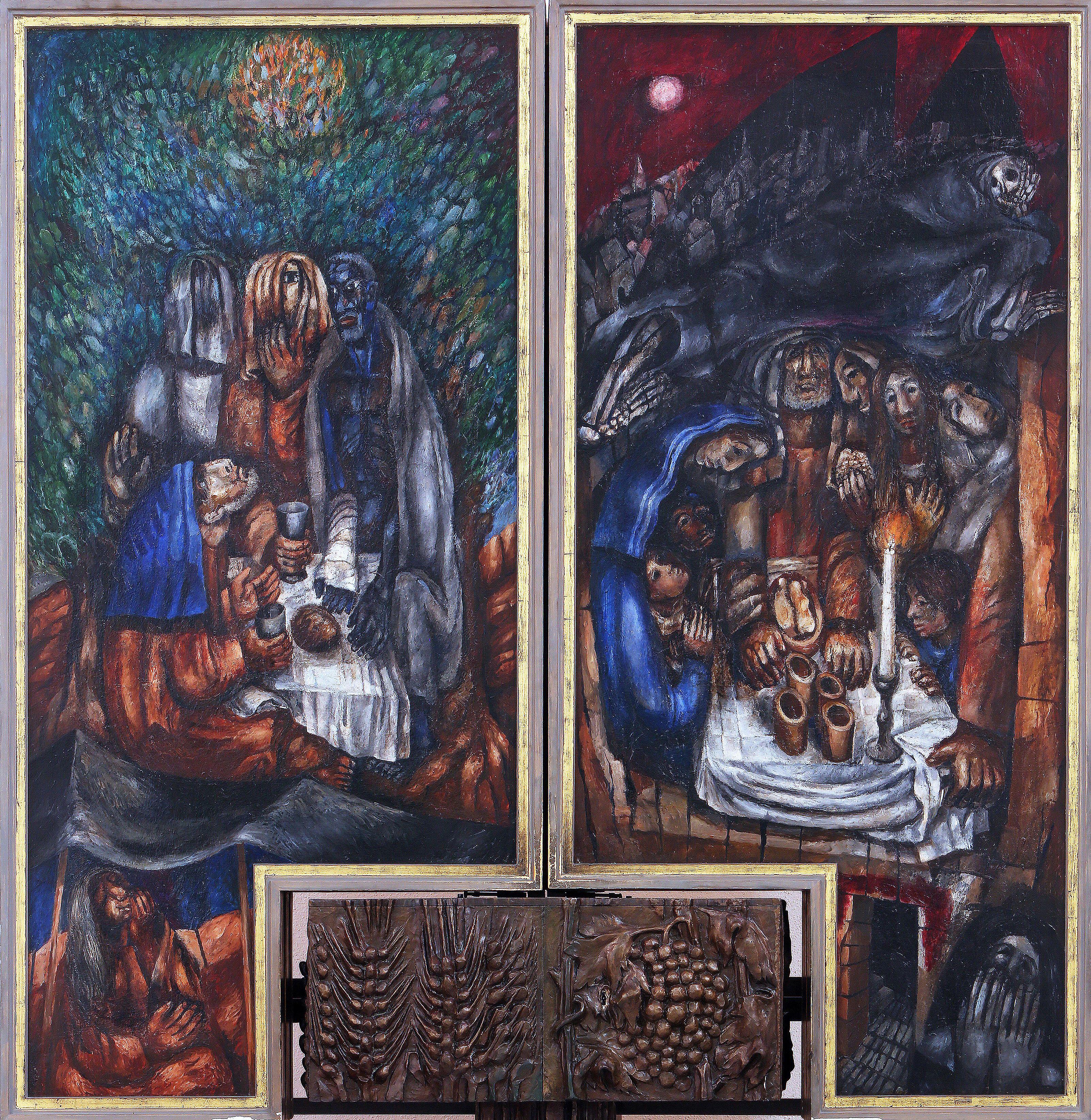
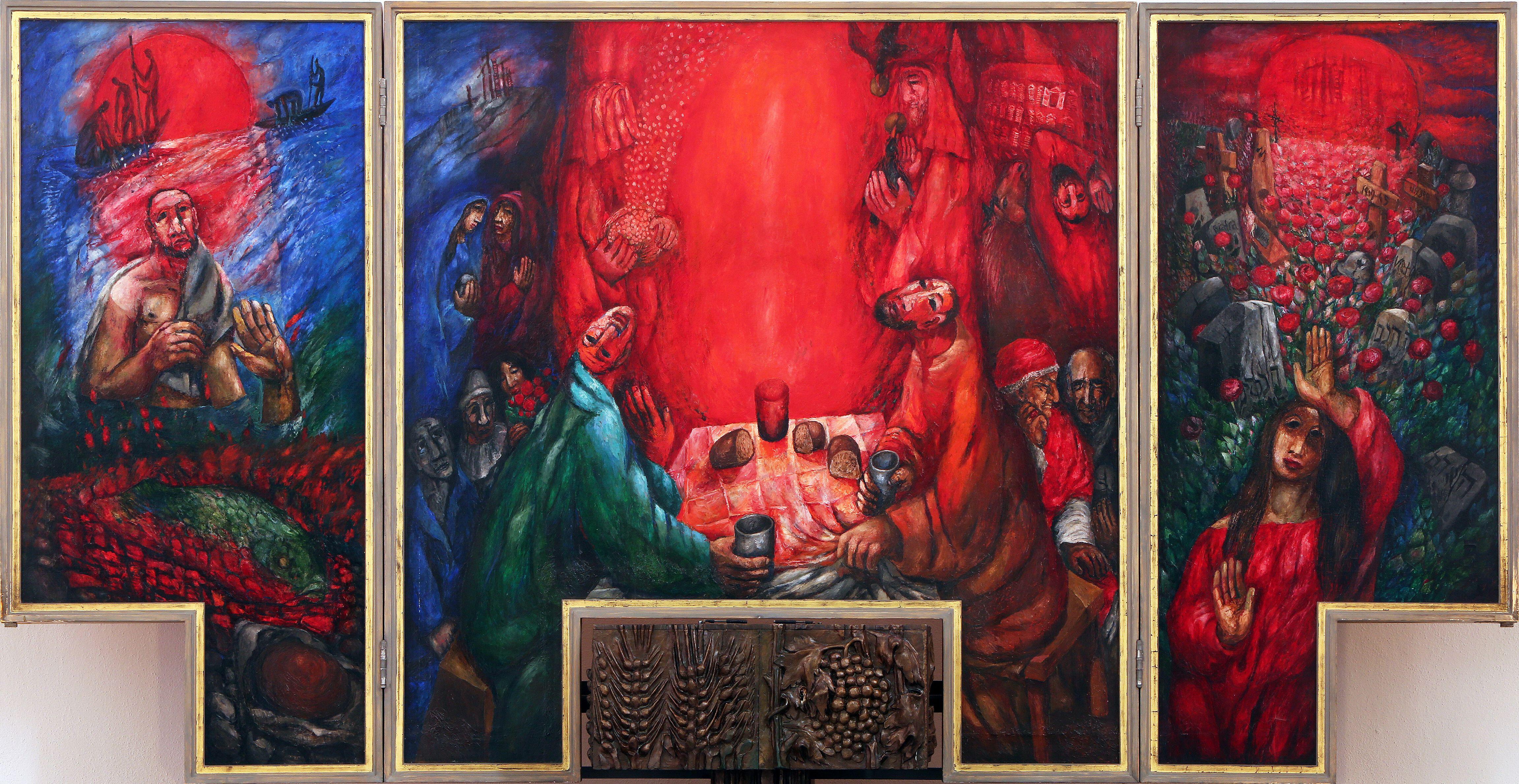
Father Sieger Köder was born in Wasseralfingen in Swabia in southwestern Germany in 1925. From 1947 to 1951 he attended the State Academy of Fine Arts Stuttgart, where he trained as a silversmith and a painter. While establishing his art practice, he also worked as an art teacher at a secondary school in Aalen for just over a decade. Increasingly he felt a pull into Christian ministry, so from 1965 to 1970 he studied theology in Tübingen, becoming ordained in the Catholic Church a year later. He served as a parish priest in Hohenberg and Rosenberg from 1975 to 1995, combining that vocation with his work as an artist. He continued his art making well into retirement, dying in 2015 at age ninety. His religious paintings can be found all over Germany and in other parts of Europe.
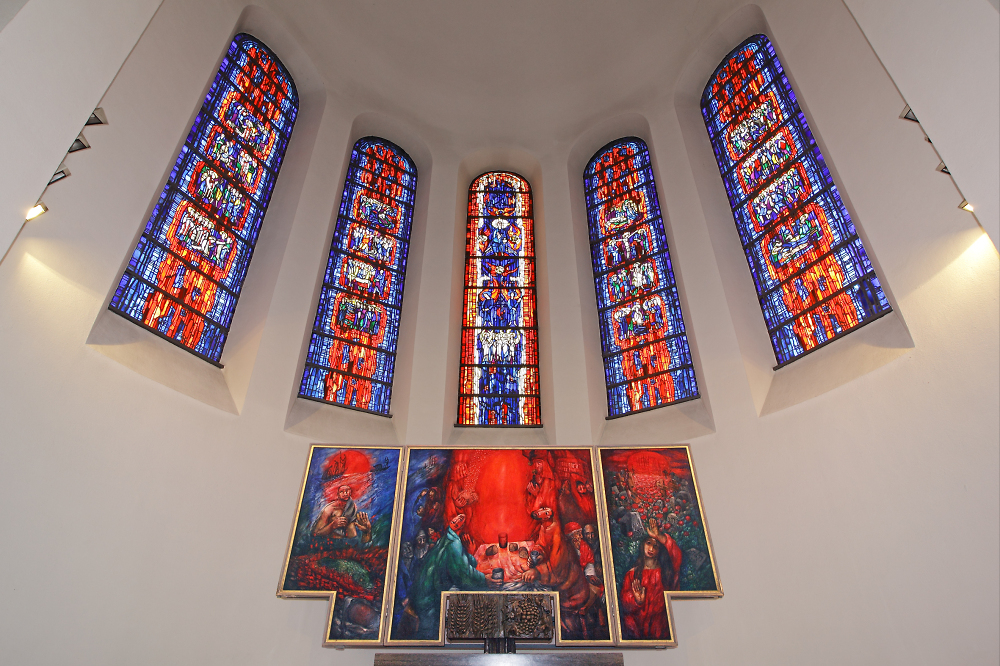
The artwork above is the closed view of the high altarpiece Köder made for the parish church in his hometown, Saint Stephen’s (Sankt Stephanus).
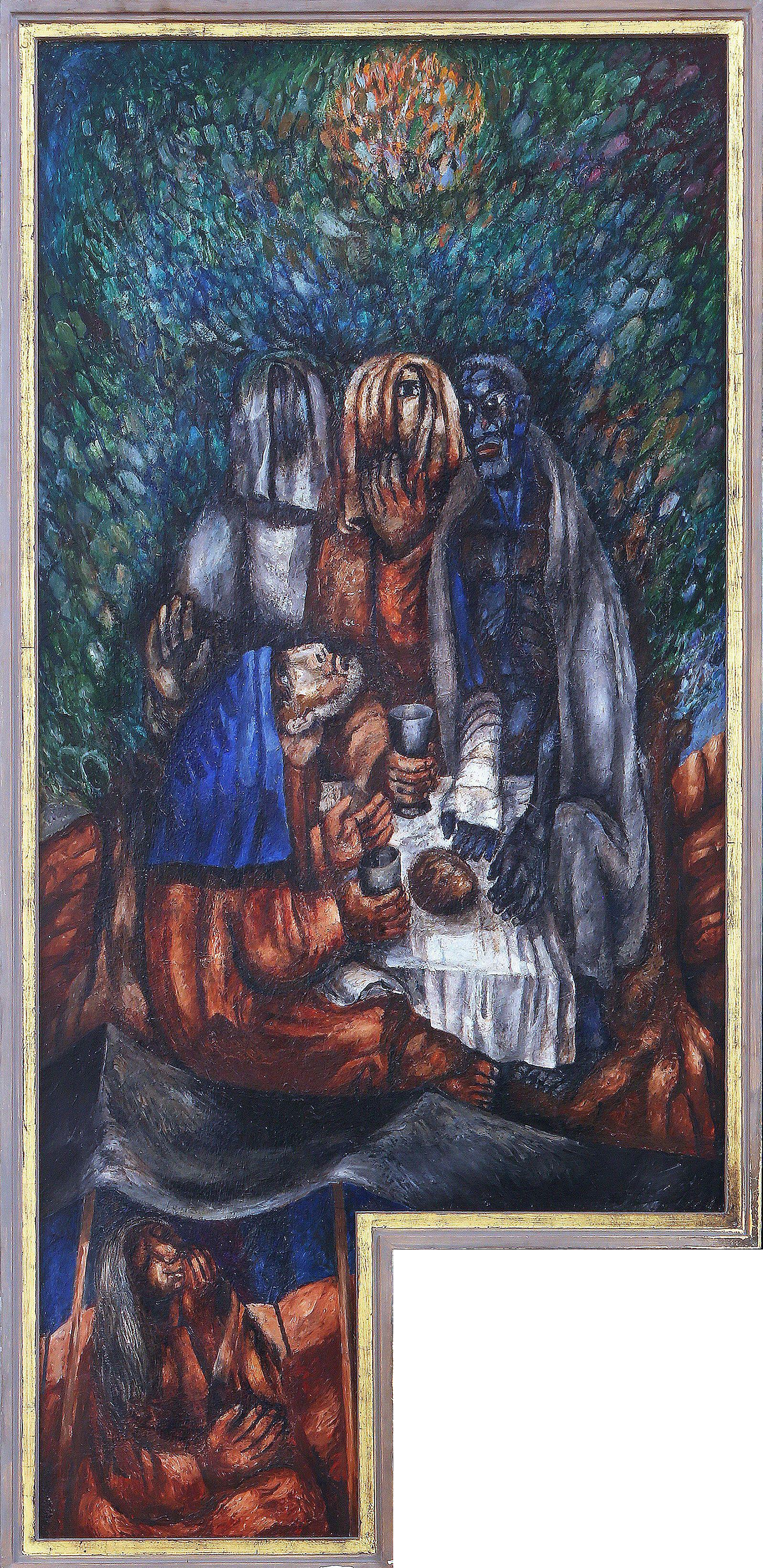
The outer left panel shows the Hospitality of Abraham (Genesis 18:1–21)—that is, Abraham’s entertaining three men who turn out to be a theophany, an appearance of God in a human body (or in this case, three human bodies). I’m guessing that the man on the left, who is veiled, represents God the Father; the man in the middle, who’s holding the cup, is God the Son; and the man on the right, who appears to have a broken arm and to be naked except for a blanket draped over him, is God the Spirit—though he is likely also meant to show how God often comes to us in the guise of the poor, the hungry, the unsheltered (Matthew 25:31–46). Above the heads of this trinity, glowing through the oak leaves, is a fiery orb reminiscent of the burning bush from which God would call Moses a few centuries later. At the bottom of the painting Abraham’s wife Sarah laughs from inside her tent, having eavesdropped on the visitors’ news that she, a nonagenarian, will conceive a child. The lineage of that child, Isaac, would produce Jesus.
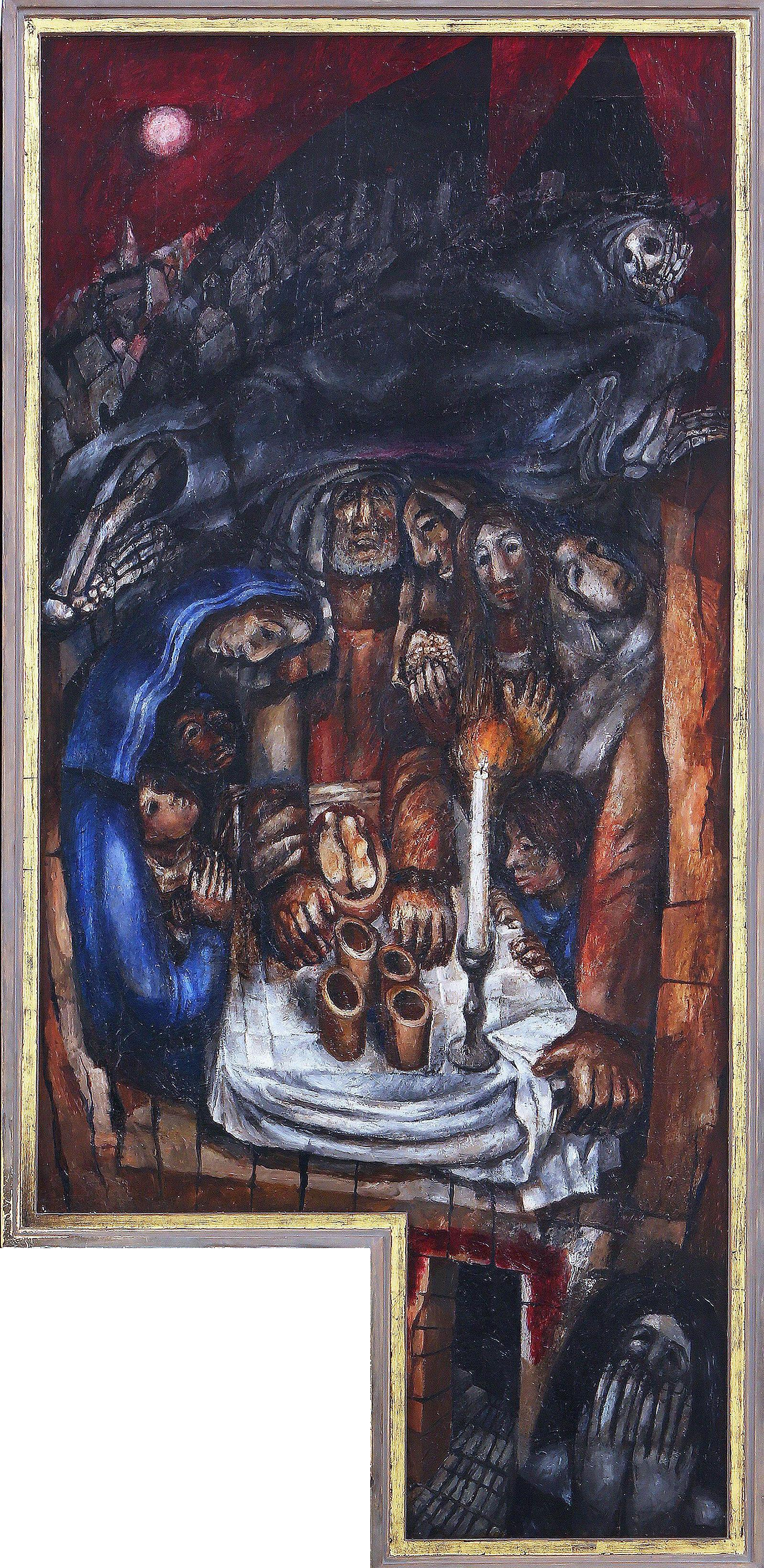
The outer right panel, based on Sunday’s lectionary reading, shows the first Passover. Israelite families huddle around a meal of roast lamb, unleavened bread, and bitter herbs as a cloaked, skeletal presence passes by overhead. One of the adults tries to steady the rattling table with his hand while a mother protects two of her children, hugging them tightly to herself. Though afraid, they are in no danger, as their doorway is covered in the blood of the lamb whose flesh they eat.
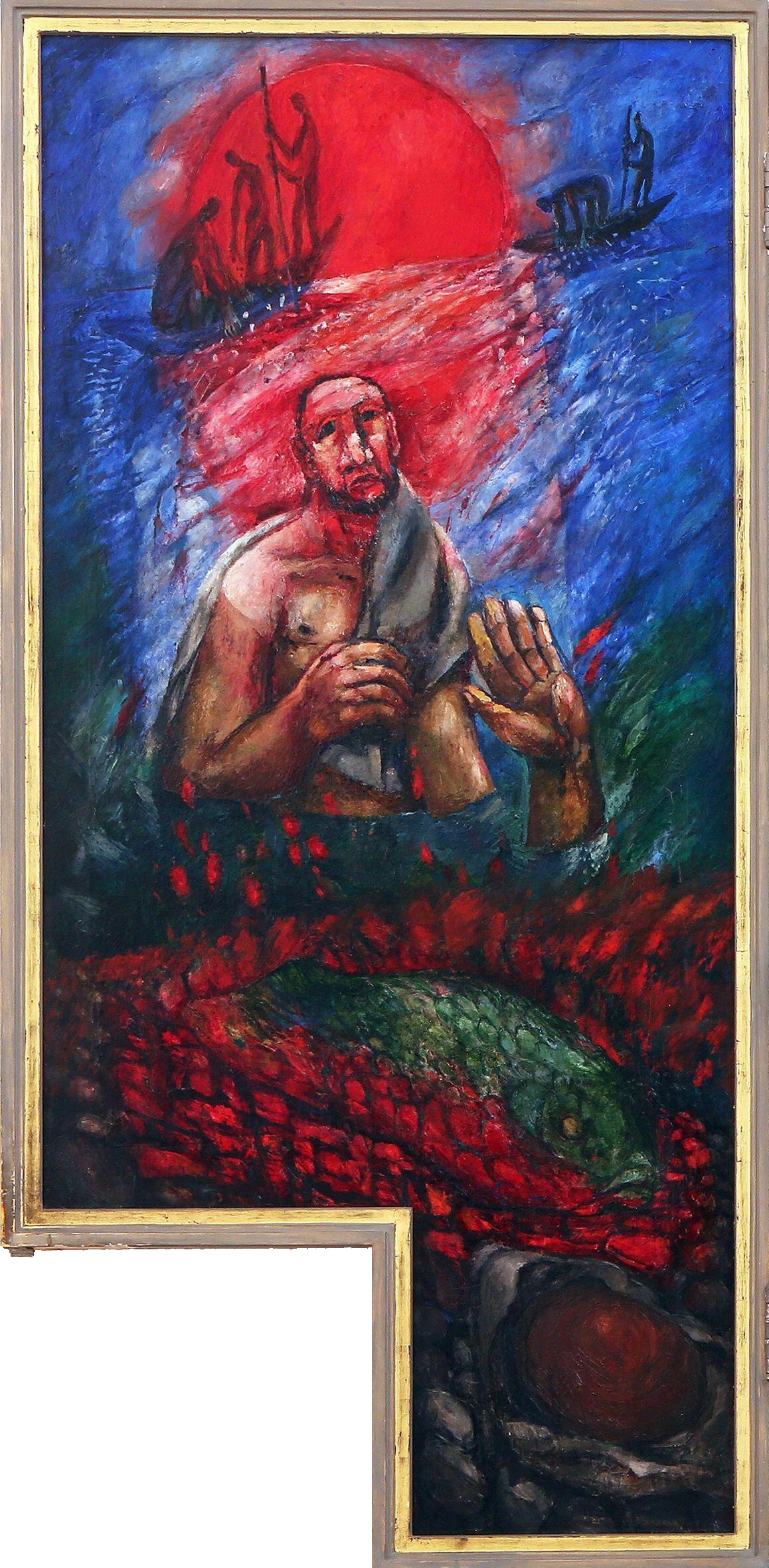
When opened, the triptych reveals three Resurrection-themed panels. The inner left panel shows one of my favorite biblical episodes, which I call “Breakfast on the Shore”: Jesus’s resurrection appearance to Peter at dawn on the Sea of Galilee (John 21). Following Jesus’s instruction in Jerusalem (Matthew 28:7, 10), Peter had returned home with some of the other disciples and, not knowing what to do, took back up his fishing nets. He and six others are on the lake when a man calls out from the shore, “Children, do you have any fish?” They don’t. The man tells them to cast in their nets once more, and when they do, up comes a humongous catch. After which Peter exclaims, “It is the Lord!” Ever the impulsive one, he throws himself into the sea and pushes his way through the water to greet Jesus. They chargrill some of the fish and sit down to eat.
The scene is one of reconciliation. Peter had denied he knew Jesus three times the night of Jesus’s arrest, abandoning him in his time of need, and now, after breakfast, Jesus gives Peter three chances to reaffirm his love for him, asking him thrice, “Simon, son of John, do you love me?” The foregrounding of the hot coals in Köder’s painting is perhaps a subtle nod to the recent failure of Peter’s, as earlier in his Gospel John mentions that, in the courtyard of the high priest where Jesus was being tried, Peter warmed himself at a charcoal fire alongside Jesus’s captors (John 18:18). There’s also a hand coming up out of the water that I’m guessing references the earlier episode of Peter’s walking on water and then, when doubt in Jesus’s power set in, sinking, only to be saved by Jesus’s outstretched hand (Matthew 14:22–33). But Jesus forgives Peter’s weaknesses and disloyalty, restoring him to fellowship. He invites Peter to come and feast. The sun at the top indicates that it’s the dawn of a new era.
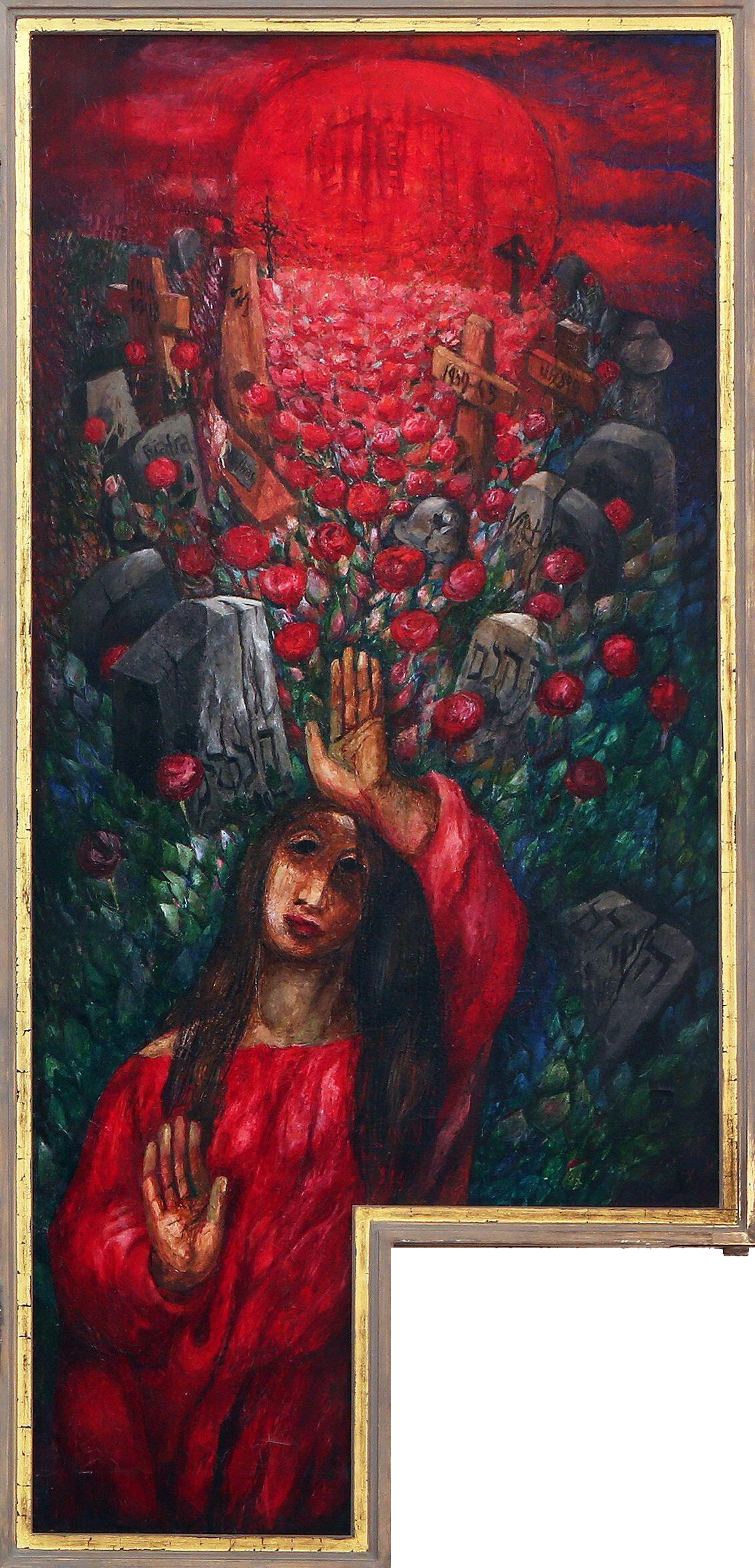
The bright-red morning sun also appears on the inner right panel, which shows another very personal encounter between the risen Christ and a disciple: Mary Magdalene at the empty tomb. In Köder’s visual retelling, Mary wades through a sea of poppies—a red flower symbolic of sacrifice—her hand shielding her eyes from the brilliance of Jesus’s resurrection body. He who she initially thought to be the cemetery gardener is in fact her dear friend and Lord.
Look closely at some of the grave markers, and you’ll notice that they carry the names and/or dates of wars: “1914–1918,” “1939–1945,” “Vietnam,” “Biafra” (a reference to the Nigerian Civil War). The latter two were still raging on when Köder painted this. The artist was actually a prisoner of war during World War II, and underneath the cross representing that war in the painting is a bullet-blasted soldier’s helmet. I take these graves to imply that Jesus’s resurrection put death to death.
I’m not sure what the Hebrew grave inscriptions say—anyone know?
Update, 9/30/21: Dr. Franz Posset, a former student of the artist’s, emailed me today with transcriptions and translations of the Hebrew tombstone inscriptions:
האדם – Adam, The Man (lower right corner, next to Mary’s elbow)
חוה – Eve, The Woman (in the shadows at the right, behind the “Vietnam” tombstone)
החכם – The Wise (to the right of Mary’s raised hand)
כסילה – The Fool (to the left of Mary’s raised hand)
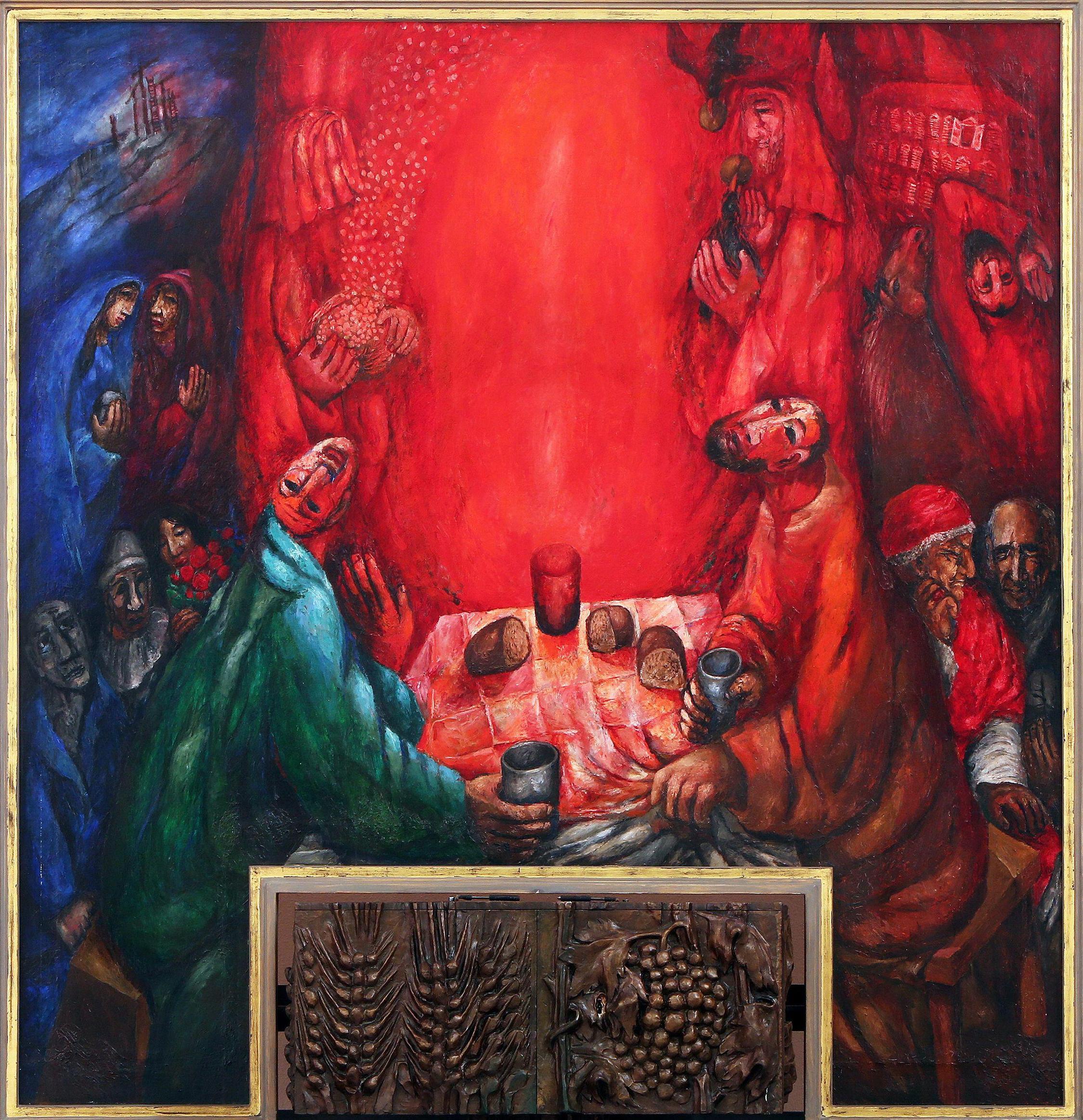
The central panel of the altarpiece portrays the Supper at Emmaus as a sort of Transfiguration à la Mount Tabor, an unveiling of Christ’s glory. Luke tells us that after the resurrection Jesus appeared to Cleopas and another unnamed disciple, who were on their way home from Jerusalem; their hearts “burned within them” as he spoke about the scriptures, but their eyes weren’t opened to his true identity until he blessed and broke the bread at mealtime. In Köder’s painting, Jesus’s form is barely discernible through the red glow—he’s a pillar of light, really. Artists have always struggled to give an impression of what Jesus’s resurrection body might have looked like: it was a flesh-and-bone body, for sure, but a glorified one, not always immediately recognizable, and it seems as though he was able to walk through walls and disappear. Köder bathes him in the color of blood—of his passion, and of life. Köder’s nonrepresentational approach emphasizes the otherness aspect of the newly risen Christ and the marvel the two Emmaus disciples must have felt upon realizing who they were dining with.
Jesus appears between Moses, who holds a basket of manna (Exodus 16), and Elijah, who cradles a raven with a morsel of bread in its beak, a reference to his being fed miraculously by God in the wilderness (1 Kings 17:1–7). The figure to the right of Elijah may be Paul (Saul) fallen off his horse on the road to Damascus.
At Saint Stephen’s the Eucharist is celebrated regularly before this altarpiece. (The metalwork tabernacle below, decorated with stalks of grain and clusters of grapes, is where the eucharistic elements are stored.) Köder reminds partakers that they are covered (pardoned) by Jesus’s blood, that Christ is present in the meal, that he nourishes and sustains his people with his very self. Death has passed over us because it struck the firstborn of all creation, who bore the curse on our behalf. However, death could not keep him down, and on the third day he rose again, appearing to many, the firstborn of new creation. “Mary,” he called out to one of his closest followers outside his tomb, speaking her name in a familiar tone, sparking recognition and joy. “Come and have breakfast,” he called out to Peter. To the Emmaus disciples he illuminated the scriptures and finally revealed himself around a table. Christ invites us into fellowship with him, through his blood.
P.S. It appears there is yet a third configuration of the altarpiece, as indicated by this photo, which includes a Madonna and Child, the Tower of Babel, and I can’t make out the left two panels.
This post belongs to the weekly series Artful Devotion. If you can’t view the music player in your email or RSS reader, try opening the post in your browser.
To view all the Revised Common Lectionary scripture readings for Proper 18, cycle A, click here.
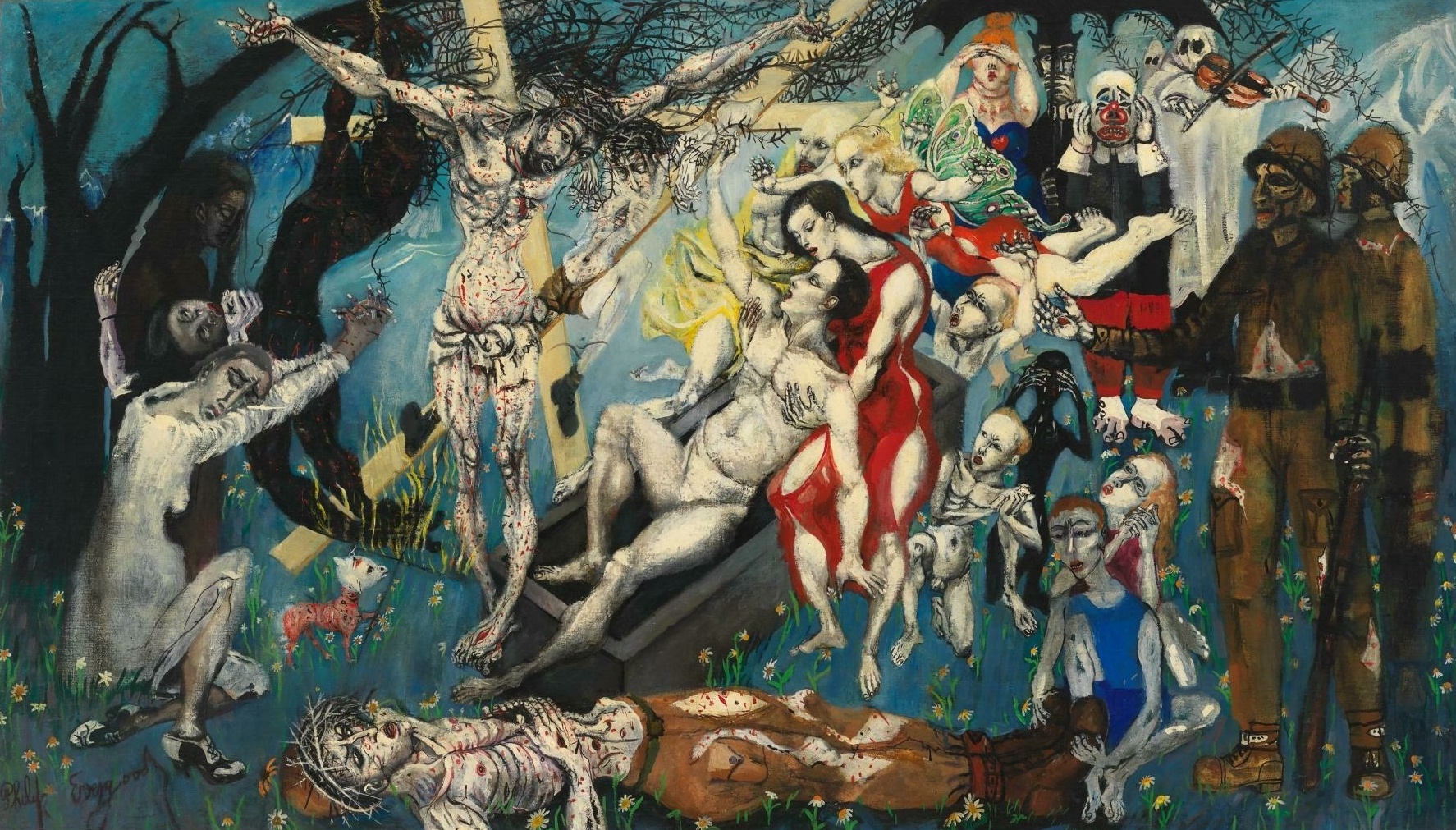
VISUAL MEDITATION: “Waking Up from Apathy,” on Philip Evergood’s The New Lazarus: My latest visual meditation for ArtWay has just been published. It’s on a crowded, noisy, garish painting that, honestly, is distressing to look at. And it’s supposed to be. Because it exposes what Martin Luther King Jr. called the triple evils of society: racism, militarism (war), and economic exploitation (aka extreme materialism, a systematic cause of poverty). Though Philip Evergood was not a Christian, he draws on Christian narrative and iconography, with the figures of Lazarus and Christ, to protest the cycles of violence that we need to rise out of before we self-destruct.
Philip Evergood (American, 1901–1973), The New Lazarus, 1927–54. Oil and enamel on canvas mounted on wood, 148 × 237.2 cm. Whitney Museum of American Art, New York.
The see-nothing, hear-nothing, say-nothing figures in the background remind me of people today who insist that racism does not exist and therefore tune out the cries of Black Lives Matter, for instance. I’m implicated too by these symbols of willful ignorance, because I admit that I do not often care to question where my food, clothes, coffee, chocolate, and other conveniences come from, or how the businesses I regularly support with my dollars treat their employees.
Evergood was politically engaged in both his art and his life, espousing egalitarian ideals. He participated in strikes and demonstrations for workers’ rights and was jailed more than once and beaten by police. He was greatly influenced by Mexican muralism, and he embraced the label of “propaganda” for his art, acknowledging that he was trying persuade the public to join the cause of social justice. “He was a figurative painter when much of the art world placed greater value on abstraction,” writes the University of Kentucky Art Museum, “and he was a moralist when moralizing was not considered an option for serious painters.” Nevertheless, he had a successful career, and his work is in many major museum collections, including the Tate Gallery, the Los Angeles County Museum of Art, the Art Institute of Chicago, the Hirshhorn Museum, the Museum of Modern Art, and the Whitney Museum of American Art.
In addition to providing individual commentaries, Quash also talks about reading art theologically instead of just aesthetically, art as developing physical sight toward spiritual insight (external and internal seeing), the persistence of Christian iconography in the art of today, and the ways in which art can implicate the viewer.
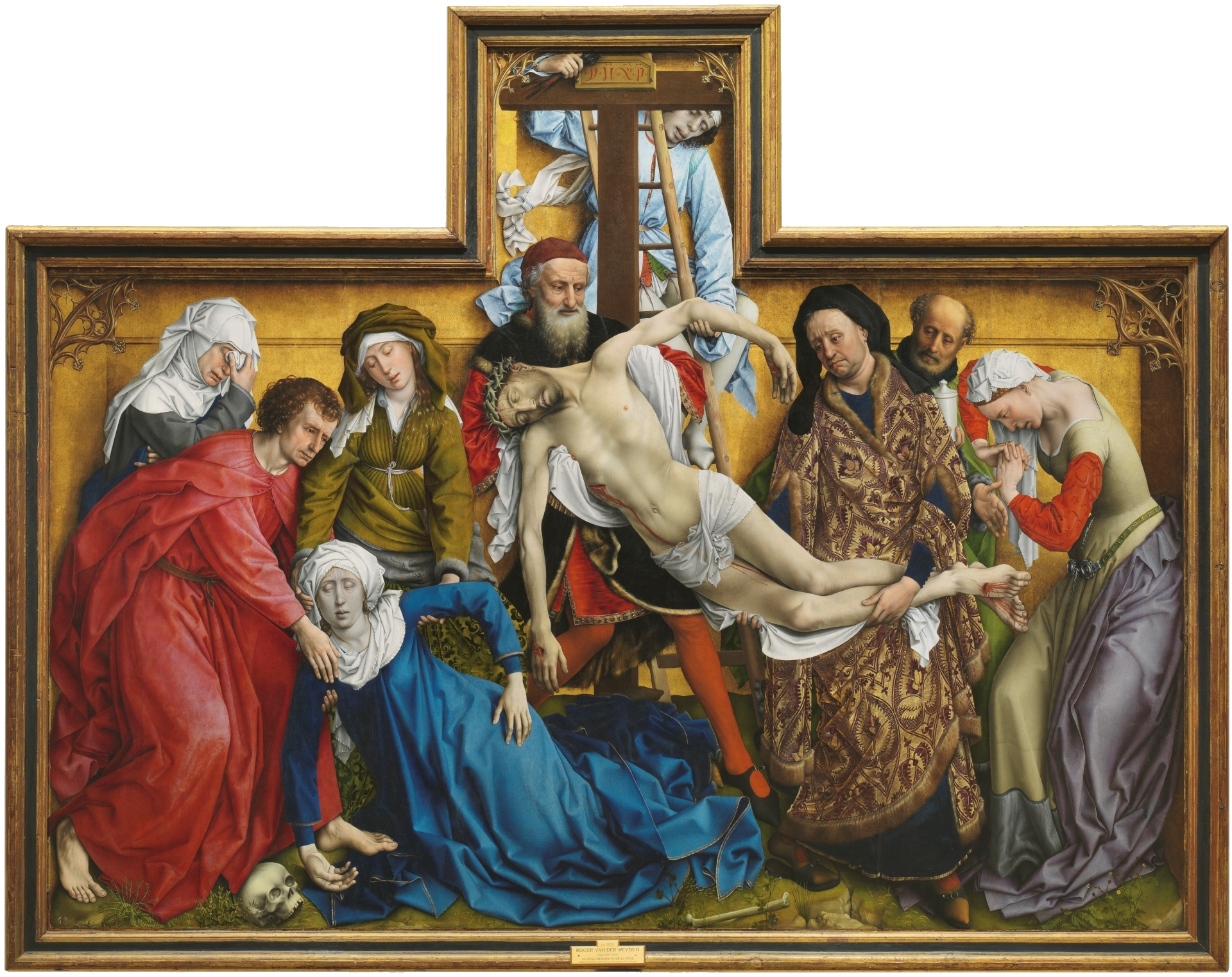
Rogier van der Weyden (Netherlandish, 1399–1464), Descent from the Cross, before 1443. Oil on panel, 204.5 × 261.5 cm. Museo Nacional del Prado, Madrid.
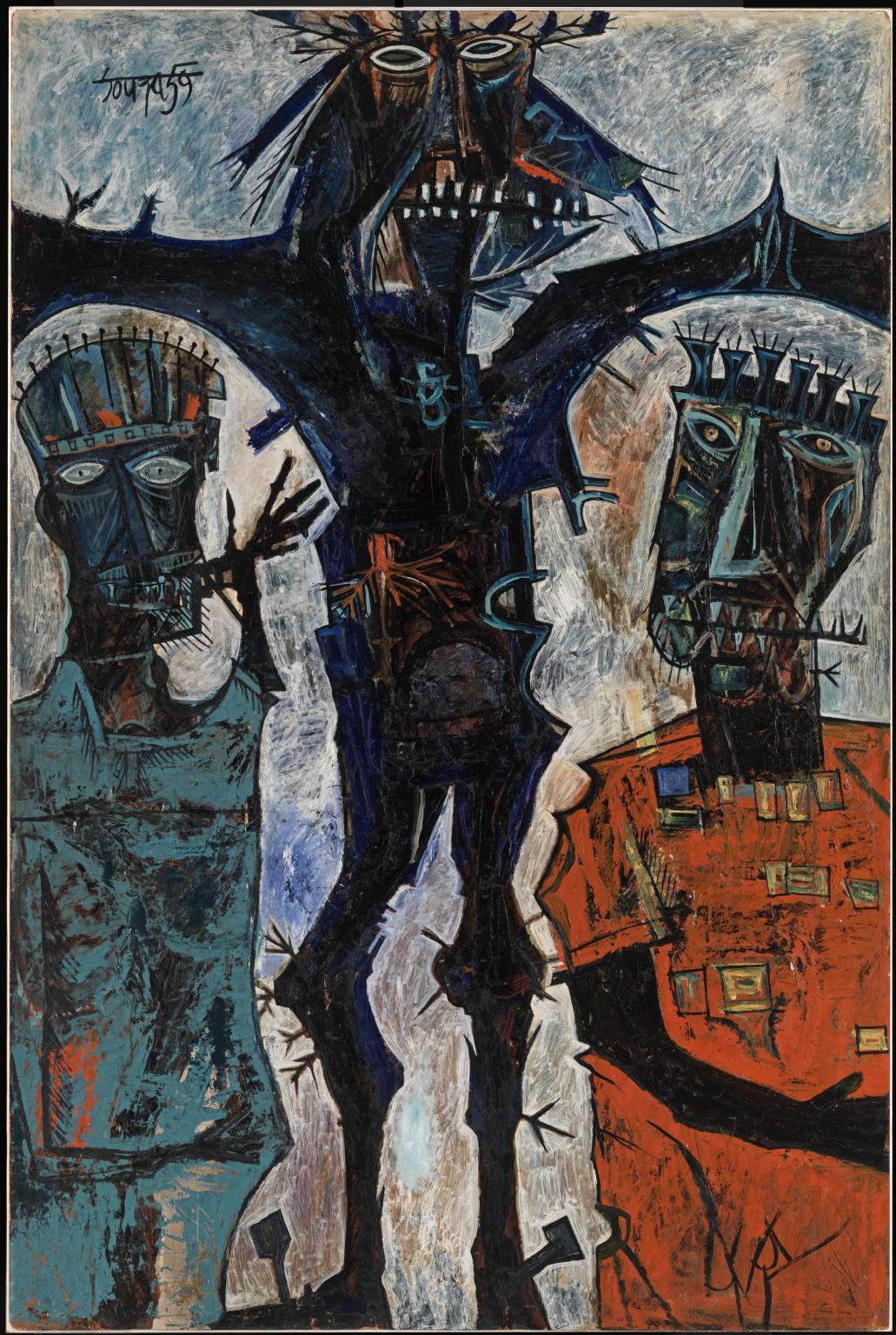
F. N. Souza (Indian, 1924–2002), Crucifixion, 1959. Oil on board, 183.1 × 122 cm. Tate Modern, London.
There’s so much that’s quotable in the conversation, but because it applies to the ArtWay meditation I linked to above, I’ll just highlight part of his discussion of nonreligious artists’ attraction to Crucifixion imagery in the twentieth century. The Isenheim Altarpiece (1515), he says, a visual reference point for many modern artists,
shows an agonized Christ whose tongue is swollen and protruding from his mouth, whose body is covered in sores, whose skin is tinged green, whose fingers are curled up in agony. There’s no idealization here of what a death like that might have been. Instead there’s a strong assertion that the extremes of human pain and suffering are not alien to the Christian message. And yet it’s a religious image—this is a Christian image painted for a Christian context.
When that work comes into contact with the new traumas of the twentieth century—we talked about [Stanley] Spencer and the Second World War, here [Francis Newton] Souza experiencing colonialism in India—when that painting comes into contact with those sorts of extremes of human experience, it activates, it speaks to them, and calls forth new artistic responses, because it feels as though Christianity can still speak, even in those extremes. And I think Souza, like [Graham] Sutherland and [Francis] Bacon, while they may not have felt comfortable with traditional Christianity, saw the power of that Christian tradition to in some way help them articulate the traumas and the horrors of their own time.
So that’s a very interesting work, and typical of several examples of the extraordinary way in which we might think we’re in a secular age, but Christian iconography is probably as lively as ever—although it’s doing new things—in the work of modern and contemporary artists.
+++
SONGS . . .
from the GOOD SHEPHERD COLLECTIVE: Spearheaded by David Gungor and Tyler Chester, the Good Shepherd Collective [previously] “creates liturgical art to inspire the Christian imagination, that we may embody the love of Christ for the good of our neighbors.” They’ve just released an album of ten hymns. One of them is “Joyful, Joyful, We Adore Thee,” queued up in the liturgical service video below, and though it didn’t make the final album cut, I also really like their version of “His Eye Is on the Sparrow.”
from Family Company: Charles Jones, the lead singer on both of the above videos, is also a part of Family Company, an LA-based music collective celebrating the traditions of soul, blues, and R&B. You might enjoy these seventies covers of theirs: “Heaven Help Us All” (popularized by Stevie Wonder), featuring Charles Jones, and “Let Us Love” by Bill Withers, featuring Teddy Grossman. See more on their YouTube channel.
+++
BALLET SOLO: “Lift Every Voice and Sing”: Premiering at the Lincoln Center in 2019, Ounce of Faith is a contemporary ballet choreographed by Darrell Grand Moultrie, the score a mix of jazz standards, original music, and spoken word. This excerpt is performed by Khalia Campbell of the Alvin Ailey American Dance Theater, with movements suggestive of both struggle and pride.
Known as the Black National Anthem, “Lift Every Voice and Sing” was written in 1899 by writer and activist James Weldon Johnson and set to music by his brother, John Rosamond Johnson. The hymn is sung here, just the first of its three verses, by Aisha Jackson, with Dante Hawkins on piano. It’s a song of historical remembrance and lament but also of hope, a rallying cry to move forward together, in unity, out of our “dark past,” into the truth of God, continuing to fight injustice wherever we find it so that everyone can live free. It acknowledges that God is the one who leads his people in love and who wills liberty, and it supplicates: “Keep us forever in the path [of Your light], we pray.” Learn more about the hymn in this NPR feature. See also this UMC Discipleship article, especially the part where Dr. James Abbington, a choir director and a scholar of African American sacred music, answers the question, “Is this a hymn just for African Americans or is it for all people?”
+++
LITERARY ESSAY: “To Sit with an Onion” by Elizabeth Harwell: God “is tethered to this world in delight” and does not weary of it as we do, writes Elizabeth Harwell after having sat with a mussel shell for one hour, upon the advice of Robert Farrar Capon. (An exercise in wonder! Any inanimate object will do.) Harwell marvels at how the shell—blueberry-blue and milk-white, cold, curvaceous, smooth—was “an entire world to the mussel who called [it] home,” and now, since she picked it up off a Maine beach, it sits in a silver dish in her dining room, a reminder of the Creator’s quiet mirth. And there’s much more where that came from. “That shell represented one of thousands (millions?) of pearly homes that will never lay bare in front of human eyes—miles of ocean floor, covered in secret delights, that began as thoughts in my Father’s mind. We humans can be so self-important that we’ve never considered that God is enjoying parts of creation that none of us will ever see.” Read the whole essay at The Rabbit Room.
(Quash’s discussion of Stanley Spencer’s Wilderness series in the abovementioned podcast, in which Christ gets down on the ground like a curious child to observe wildflowers, scorpion, hen, dovetails nicely with this essay!)
Detail of 6th-century mosaic from the sanctuary of San Vitale, Ravenna. Photo: Fr. Lawrence Lew, OP.
Now Moses was keeping the flock of his father-in-law, Jethro, the priest of Midian, and he led his flock to the west side of the wilderness and came to Horeb, the mountain of God. And the angel of the LORD appeared to him in a flame of fire out of the midst of a bush. He looked, and behold, the bush was burning, yet it was not consumed. And Moses said, “I will turn aside to see this great sight, why the bush is not burned.” When the LORD saw that he turned aside to see, God called to him out of the bush, “Moses, Moses!” And he said, “Here I am.” Then he said, “Do not come near; take your sandals off your feet, for the place on which you are standing is holy ground.” And he said, “I am the God of your father, the God of Abraham, the God of Isaac, and the God of Jacob.” And Moses hid his face, for he was afraid to look at God.
Then the LORD said, “I have surely seen the affliction of my people who are in Egypt and have heard their cry because of their taskmasters. I know their sufferings, and I have come down to deliver them out of the hand of the Egyptians and to bring them up out of that land to a good and broad land, a land flowing with milk and honey, to the place of the Canaanites, the Hittites, the Amorites, the Perizzites, the Hivites, and the Jebusites. And now, behold, the cry of the people of Israel has come to me, and I have also seen the oppression with which the Egyptians oppress them. Come, I will send you to Pharaoh that you may bring my people, the children of Israel, out of Egypt.” But Moses said to God, “Who am I that I should go to Pharaoh and bring the children of Israel out of Egypt?” He said, “But I will be with you, and this shall be the sign for you, that I have sent you: when you have brought the people out of Egypt, you shall serve God on this mountain.”
Then Moses said to God, “If I come to the people of Israel and say to them, ‘The God of your fathers has sent me to you,’ and they ask me, ‘What is his name?’ what shall I say to them?” God said to Moses, “I am who I am.” And he said, “Say this to the people of Israel: ‘I am has sent me to you.’” God also said to Moses, “Say this to the people of Israel: ‘The LORD, the God of your fathers, the God of Abraham, the God of Isaac, and the God of Jacob, has sent me to you.’ This is my name forever, and thus I am to be remembered throughout all generations.”
—Exodus 3:1–15
+++
SONG: “Take Your Shoes Off, Moses” by J. D. Jarvis, 1967 | Performed by Courtney Patton, 2014
Written by Kentuckian John Dill Jarvis, “Take Your Shoes Off, Moses” was popularized by Ralph Stanley and the Clinch Mountain Boys in the early seventies (with Keith Whitley singing lead). This performance is by country music artist Courtney Patton from Texas, recorded as part of Modern Trade’s Southern Gospel Revival project.
The first verse and chorus are taken from Sunday’s lectionary reading in Exodus 3, which narrates God’s first direct contact with Moses.
The second verse is based on a later episode in Exodus, where the desert-wandering Israelites are refreshed by water from a rock:
And the LORD said to Moses, “Pass on before the people, taking with you some of the elders of Israel, and take in your hand the staff with which you struck the Nile, and go. Behold, I will stand before you there on the rock at Horeb, and you shall strike the rock, and water shall come out of it, and the people will drink.” And Moses did so, in the sight of the elders of Israel. (Exodus 17:5–6)
The third and final verse references an instruction given just before the parting of the Red Sea:
And Moses said to the people, “Fear not, stand firm, and see the salvation of the LORD, which he will work for you today.” (Exodus 14:13)
+++
Photo: Paul Dykes
One of the most impressive programs of early Christian mosaic is inside the Basilica of San Vitale [previously] in Ravenna, Italy. The Moses scene is found on the right side of the choir, in the left spandrel: Moses tends his father-in-law’s sheep, then removes his shoes in response to God’s call from the burning bush—which in this artist’s conception is pockets of flame that burn all over Horeb! The prophet Isaiah stands opposite Moses on the right spandrel. Between the two, in the lunette, are Abel and Melchizedek, both understood as types of Christ, offering sacrifices to God. Flanking the mullioned window above them are two of the four evangelists with their symbols: Matthew (with [winged] man) and Mark (with lion).
This post belongs to the weekly series Artful Devotion. If you can’t view the music player in your email or RSS reader, try opening the post in your browser.
To view all the Revised Common Lectionary scripture readings for Proper 17, cycle A, click here.
Joseph H. Davis (American, 1811–1865), Mary Antoinette Lorania Pike and Sarah Adeline Pike, 1835. Watercolor, pencil, and ink on paper, 8 1/2 × 11 in. American Folk Art Museum, New York. Photo: John Bigelow Taylor.
Let love be without hypocrisy. Detest evil; cling to what is good. Love one another deeply as brothers and sisters. Outdo one another in showing honor. Do not lack diligence in zeal; be fervent in the Spirit; serve the Lord. Rejoice in hope; be patient in affliction; be persistent in prayer. Share with the saints in their needs; pursue hospitality.
Bless those who persecute you; bless and do not curse. Rejoice with those who rejoice; weep with those who weep. Live in harmony with one another. Do not be proud; instead, associate with the humble. Do not be wise in your own estimation. Do not repay anyone evil for evil. Give careful thought to do what is honorable in everyone’s eyes. If possible, as far as it depends on you, live at peace with everyone.
Give good gifts one to another,
Peace, joy, and comfort gladly bestow;
Harbor no ill ’gainst sister or brother,
Smooth life’s journey as you onward go.
Broad as the sunshine, free as the showers,
So shed an influence, blessing to prove;
Give for the noblest of efforts your pow’rs;
Blest and be blest, is the law of love.
+++
Born in Limington, Maine, to a farming family, Joseph H. Davis was an itinerant artist who created small, inexpensive portraits of New England citizens from 1832 to 1837. He wandered from town to town through the border region between Maine and New Hampshire with his watercolors, paper, pencils, and brushes, initially seeking clients among his church connections. (He was a member of the Freewill Baptist Church.) His reputation spread by word of mouth, and over a five-year period he executed at least 150 watercolor portraits, most often posing together in profile a husband and wife or, as in the above painting, siblings, either in parlor settings or outdoors. The family pets are sometimes included too. Along the bottom borders he recorded the sitters’ names and ages.
After Davis’s daughter was born, he gave up painting and became involved in land speculation, manufacturing, and inventing.
Mary Antoinette Lorania Pike and Sarah Adeline Pike was part of the exhibition A Piece of Yourself: Gift Giving in Self-Taught Art, which ran from July 22, 2019, to January 10, 2020, at the American Folk Art Museum in New York City. Other pieces included quilts, handmade valentines and toys, Shaker gift drawings, a tin top hat (a tenth anniversary present), and a delicate, lacelike papercut made in 1830 by an inmate at Walnut Street Prison in Pennsylvania for a prison guard’s daughter.
This post belongs to the weekly series Artful Devotion. If you can’t view the music player in your email or RSS reader, try opening the post in your browser.
To view all the Revised Common Lectionary scripture readings for Proper 17, cycle A, click here.
Mirta Cerra (Cuban, 1904–1986), Plegaria (Prayer), ca. 1946. Oil on canvas, 24 × 17 1/2 in. (60.9 × 44.5 cm). Torna Art Gallery, Havana.
I appeal to you therefore, brothers and sisters, by the mercies of God, to present your bodies as a living sacrifice, holy and acceptable to God, which is your spiritual worship. Do not be conformed to this world, but be transformed by the renewing of your minds, so that you may discern what is the will of God—what is good and acceptable and perfect.
The version on the MP3, from a church service at New City Fellowship’s University City, Missouri, location, is piano-based and led by a female vocalist (and includes strong harmonies), whereas the version in the video, from Redeemer Church in Jackson, Mississippi, is guitar-based and has a male lead (Ryan Dean). Both recordings are from 2011. Visit the New City Fellowship Music website, the source of the MP3, to download sheet music and explore more of the church’s gospel music repertoire.
Songwriter Kirk Ward’s original demo is located here. (I’ve previously featured his song “Year of Jubilee.”)
+++
For an Artful Devotion centered on Isaiah 51:3 (another excerpt from Sunday’s lectionary), click here.
This post belongs to the weekly series Artful Devotion. If you can’t view the music player in your email or RSS reader, try opening the post in your browser.
To view all the Revised Common Lectionary scripture readings for Proper 16, cycle A, click here.







 Art & Theology