Space Face by Akili Ron Anderson (American, 1946–)
Forgetting what lies behind and straining forward to what lies ahead, I press on toward the goal for the prize of the upward call of God in Christ Jesus.
This post belongs to the weekly series Artful Devotion. If you can’t view the music player in your email or RSS reader, try opening the post in your browser.
To view all the Revised Common Lectionary scripture readings for Proper 22, cycle A, click here.
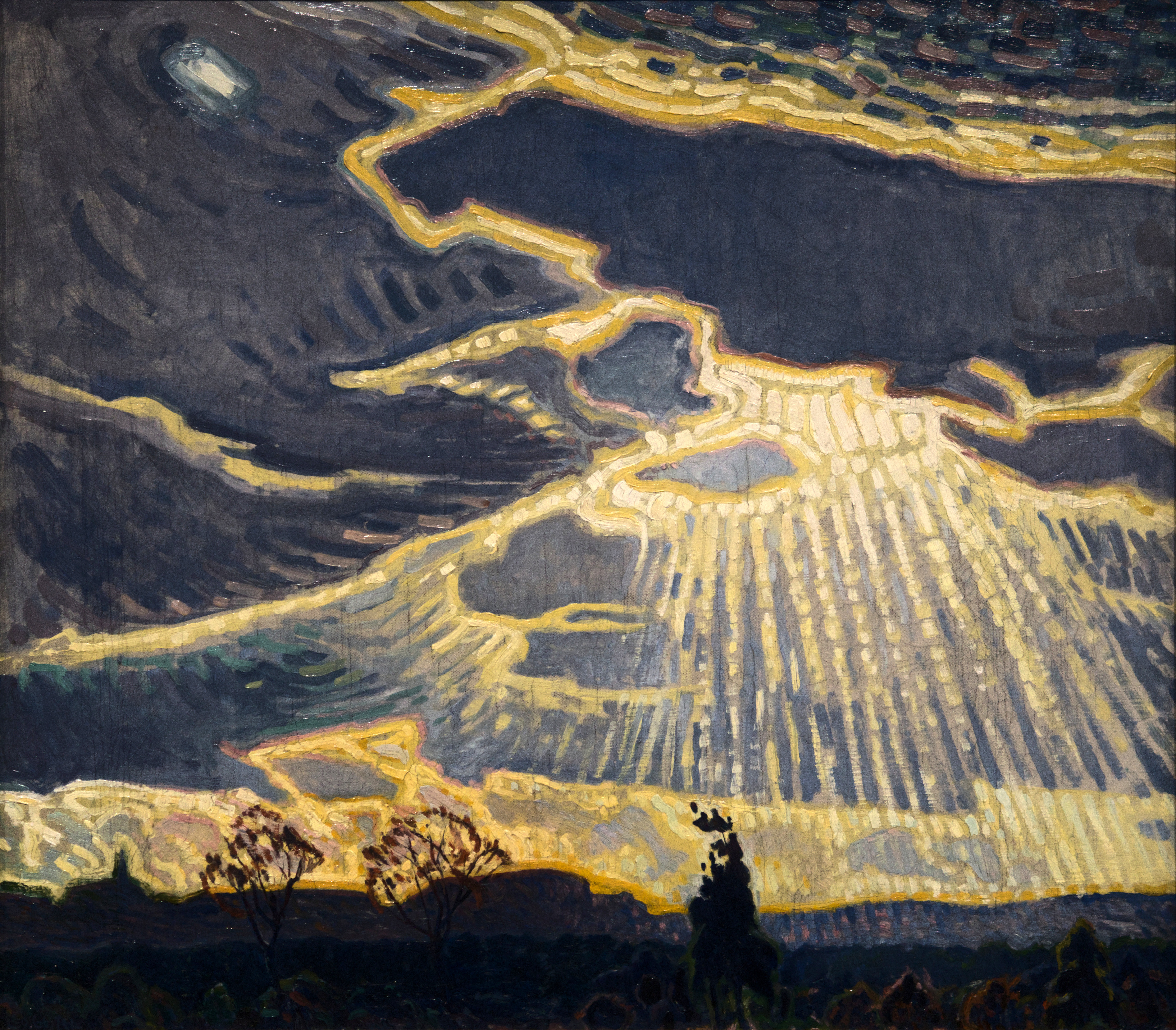
Leo Gestel (Dutch, 1881–1941), Autumn, 1909. Oil on canvas, 53.5 × 61 cm. Museum Kranenburgh, Bergen, Netherlands. Photo: Victoria Emily Jones.
You, Sunshine,
strand of pearls,
lay yourself down
on a country pond
one at a time
. . . . . . . . . . .
You, Sunshine,
bountiful benefactor,
. . . . . . . . . . . . . . . . .
dangle your golden earrings
never grow old
teach me to roam.
Early this week I was searching the Hymnary database for hymns based on or referent to Sunday’s lectionary reading from Ezekiel 18, where God calls on his people to “repent and turn from all your transgressions, lest iniquity be your ruin” (v. 30b), and the very similar passage later in the book: “As I live, declares the Lord GOD, I have no pleasure in the death of the wicked, but that the wicked turn from his way and live; turn back, turn back from your evil ways, for why will you die, O house of Israel?” (Ezek. 33:11).
One of the search results was “Turn Back, O Man” by the English poet and playwright Clifford Bax. Written in 1916, it doesn’t explicitly reference World War I, but it’s likely that that was the intended subtext.
Turn back, O man, forswear thy foolish ways.
Old now is earth, and none may count her days,
Yet thou, its child, whose head is crowned with flame,
Still wilt not hear thine inner God proclaim,
“Turn back, O man, forswear thy foolish ways.”

Earth might be fair, and people glad and wise.
Age after age their tragic empires rise,
Built while they dream, and in that dreaming weep.
Would they but wake from out their haunted sleep,
Earth shall be fair, and people glad and wise.

Earth shall be fair, and all its people one,
Nor till that hour shall God’s whole will be done!
Now, even now, once more from earth to sky
Peals forth in joy the old, undaunted cry,
“Earth shall be fair, and all its people one.”
The tune it’s set to in hymnals, OLD 124TH, is by Louis Bourgeois and is from the 1551 edition of the Genevan Psalter. Gustav Holst arranged the tune as a motet (a polyphonic, unaccompanied choral composition) in 1916 and in fact is the one who approached Bax with the request for a new text.
Here is a performance by the University of Texas Chamber Singers, from their 2008 album Great Hymns of Faith:
When I read the first line, it sounded familiar, and I was reminded that the song (with a much different tune and style!) opens the second act of Godspell. This 1971 musical created by John-Michael Tebelak and composed by Stephen Schwartz is based on Jesus’s teaching ministry as told in the Gospels, especially Matthew’s. (The show’s title is the archaic English spelling for “gospel.”) In addition to Jesus and John the Baptist/Judas, the cast consists of eight nonbiblical, “holy fool” characters who use their own names and sing and act out the parables and other sayings.
Tebelak, who wrote the play as his master’s thesis at Carnegie Mellon, was studying Greek and Roman mythology when, in his last year at school, he started reading the Christian Gospels in earnest and was enraptured by the joy they exuded and compelled by their emphasis on community. He tells the story of how on March 29, 1970, in pursuit of knowing more, he attended an Easter Vigil service at a church in Pittsburgh, wearing his usual overalls and a T-shirt—and he was frisked for drugs. “I left with the feeling that, rather than rolling the rock away from the Tomb, they were piling more on,” he said. That experience motivated him to write Godspell.
Tebelak’s Godspell was produced at Carnegie Mellon in late fall 1970, featuring an original song by cast member Jay Hamburger (“By My Side”) and a handful of old Episcopal hymns played by a rock band.
After leaving university, Tebelak took the show to New York City, where prospective producers suggested a new score and brought in Stephen Schwartz for the job. The rescored show, which retained Hamburger’s single song contribution, opened May 17, 1971, at the off-Broadway Cherry Lane Theatre and became a hit.
Six of Godspell’s eighteen song texts, including the chart-topping “Day by Day,” are actually taken straight from the Episcopal Hymnal. Schwartz liked the idea of dusting the cobwebs off some of these stodgy hymns and giving them new melodies with a catchy seventies pop vibe that would leave audiences singing them as they exited the theater.
“Turn Back, O Man” is one of those. It’s sung by Sonia, the sassy character with a put-on sensuality, a role originated by Sonia Manzano (of Sesame Street fame). Here’s the scene from the 1973 film adaptation directed by David Greene, with “Sonia” played by Joanne Jonas:
Isolated from the rest of the musical, this song seems completely irreverent and unbefitting the serious nature of God’s call to repentance. Its zaniness and sense of play, punctuated by Jesus’s pensive delivery of the third verse, is on a par with the tone of the whole—and that unique approach to telling the gospel works, I think, really well overall in Godspell, bringing to mind how “the foolishness of God is wiser than men, and the weakness of God is stronger than men” (1 Cor. 1:25). The characters embody the countercultural aspect of Jesus’s teachings, which appear ridiculous, clownish, to the rest of the world.
“The characters in Godspell were never supposed to be hippies,” Stephen Schwartz clarifies.
They were supposed to be putting on “clown” garb to follow the example of the Jesus character as was conceived by Godspell’s originator, John-Michael Tebelak, according to the “Christ as clown” theory propounded by Harvey Cox of the Harvard Divinity School (among others). . . . Because the show was originally produced in the hippie era, and because the director of the Godspell movie somewhat misinterpreted the characters as hippie-esque, that misunderstanding has come to haunt the show a bit.
In this particular song, performed by a hammy character in a feather boa, the lyrics entreat hearers to give up their “foolish ways,” going on to suggest that what is truly foolish is living as if asleep—building “tragic empires,” chasing empty dreams. Though endowed with the flame of reason and conscience, humanity at large, generation after generation, keeps rejecting God’s will, hence the lack of global unity and gladness.
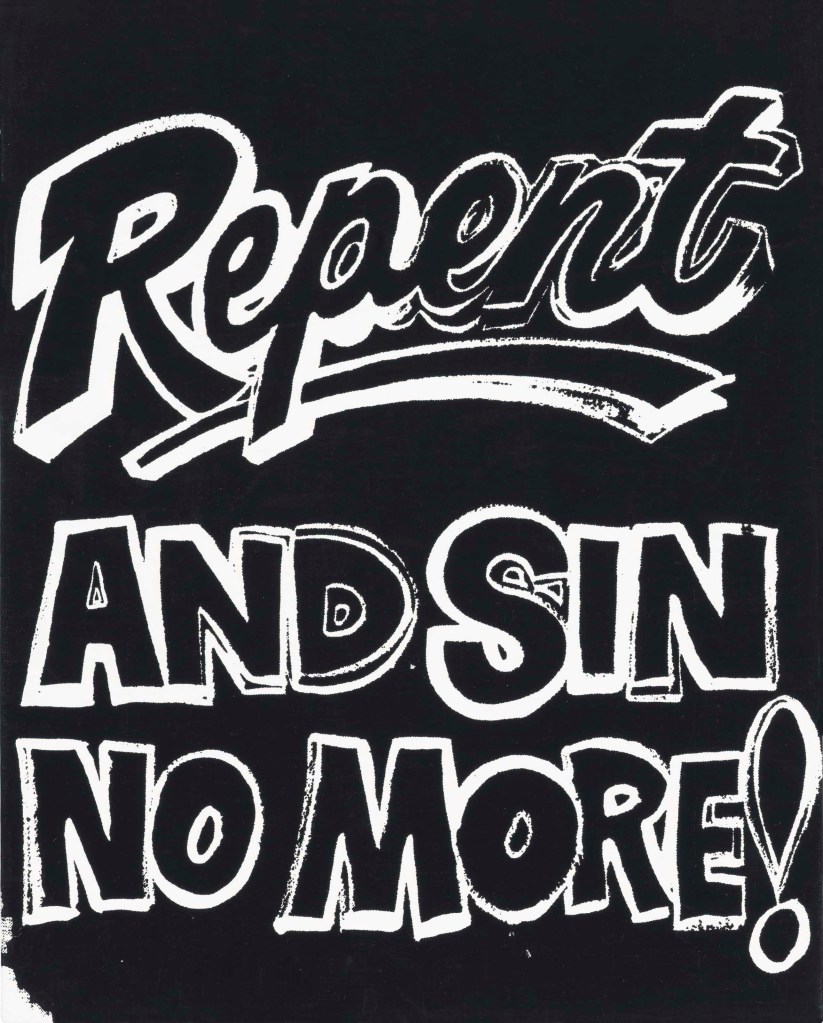
Andy Warhol (American, 1928–1987), Repent and Sin No More!, 1985–86. Synthetic polymer and silkscreen ink on canvas, 20 × 16 in. (50.8 × 40.6 cm).
“When a righteous person turns away from his righteousness and does injustice, he shall die for it; for the injustice that he has done he shall die. Again, when a wicked person turns away from the wickedness he has committed and does what is just and right, he shall save his life. Because he considered and turned away from all the transgressions that he had committed, he shall surely live; he shall not die. Yet the house of Israel says, ‘The way of the Lord is not just.’ O house of Israel, are my ways not just? Is it not your ways that are not just?
“Therefore I will judge you, O house of Israel, every one according to his ways, declares the LORD GOD. Repent and turn from all your transgressions, lest iniquity be your ruin. Cast away from you all the transgressions that you have committed, and make yourselves a new heart and a new spirit! Why will you die, O house of Israel? For I have no pleasure in the death of anyone, declares the LORD GOD; so turn, and live.”
—Ezekiel 18:26–32
+++
HYMN: “Sinners, Turn, Why Will You Die?” by Charles Wesley, 1742
Sinners, turn: why will you die?
God, your Maker, asks you why.
God, who did your being give,
made you himself, that you might live;
he the fatal cause demands,
asks the work of his own hands.
Why, you thankless creatures, why
will you cross his love, and die?

Sinners, turn: why will you die?
God, your Savior, asks you why.
God, who did your souls retrieve,
died himself, that you might live.
Will you let him die in vain?
Crucify your Lord again?
Why, you ransomed sinners, why
will you slight his grace and die?

Sinners, turn: why will you die?
God, the Spirit, asks you why;
he, who all your lives hath strove,
wooed you to embrace his love.
Will you not his grace receive?
Will you still refuse to live?
Why, you long-sought sinners, why
will you grieve your God, and die?

You, on whom he favors showers,
you, possessed of nobler powers,
you, of reason’s powers possessed,
you, with will and memory blest,
you, with finer sense endued,
creatures capable of God;
noblest of his creatures, why,
why will you forever die?

You, whom he ordained to be
transcripts of the Trinity,
you, whom he in life doth hold,
you for whom himself was sold,
you, on whom he still doth wait,
whom he would again create;
made by him, and purchased, why,
why will you forever die?

You, who own his record true,
you, his chosen people, you,
you, who call the Savior Lord,
you, who read his written word,
you, who see the gospel light,
claim a crown in Jesu’s right;
why will you, ye Christians, why,
will the house of Israel die?

Turn, he cries, ye sinners, turn;
by his life your God hath sworn;
he would have you turn and live,
he would all the world receive;
he hath brought to all the race
full salvation by his grace;
he hath not one soul passed by;
why will you resolve to die?

Can ye doubt, if God is love,
if to all his mercies move?
Will ye not his word receive?
Will ye not his oath believe?
See, the suffering God appears!
Jesus weeps! Believe his tears!
Mingled with his blood they cry,
why will you resolve to die?
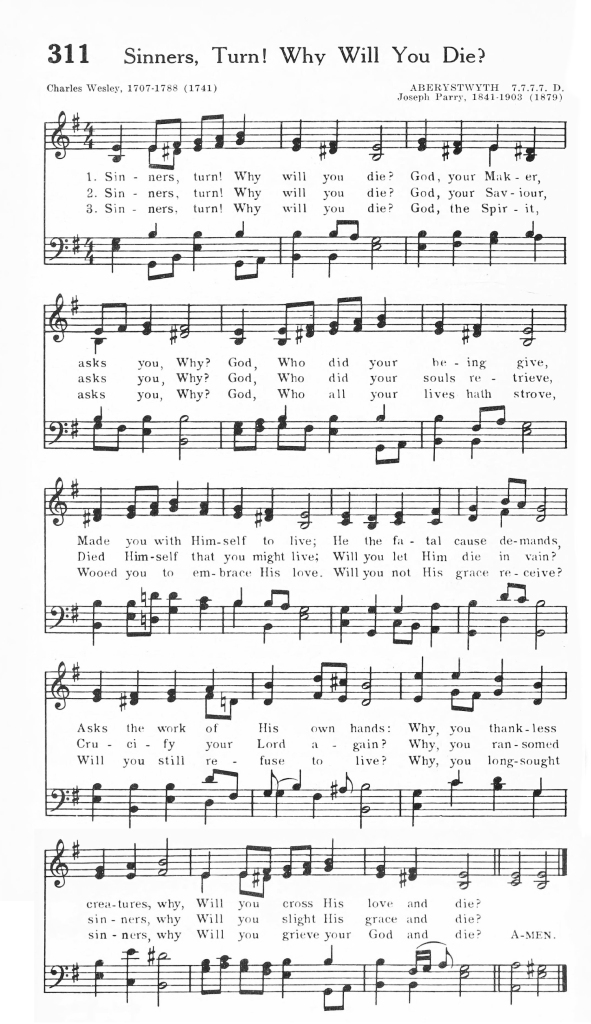
This Wesleyan hymn of invitation has historically been paired with a number of different tunes. I quite like it with the Welsh ABERYSTWYTH by Joseph Parry, composed in 1879, but I can’t find any such recordings. Here’s the sheet music.
I did find a solo performance by Alan Lett, from his 2006 album Heart, Soul, and Hymns, that employs a very lovely and effective tune in the minor mode. I’m not sure whether the tune is traditional or contemporary, perhaps one he wrote himself, and I can’t find any contact info for him online, as it appears that he is no longer active as a music artist. Do you recognize the music? I do know that Lett is not only singing on the track but is also at the keys, and that the vocal and piano arrangements are his own—both are impressive. He cuts the length of Wesley’s text considerably, though, singing only verse 2.
+++
“Over the course of a prominent and prolific career,” writes the Andy Warhol Museum, “Andy Warhol both pictured religious subjects and practiced his religious faith. Yet in twentieth-century histories of modern American art, religion is largely excluded. Warhol was perhaps doubly excluded, as a gay man, and a believing Christian, whose identity in the art world and in American society was made complicated by those identities.”
Warhol’s Repent and Sin No More! silkscreen prints are part of a series executed toward the end of his life, with source material pulled from religious ads and pamphlets.
In January I took a weekend trip to Pittsburgh to see the exhibition Andy Warhol: Revelation[previously], which examined the pop artist’s Byzantine Catholic faith in relation to his artistic output. It actually exceeded my expectations! While there, I attended a museum lecture by Jonathan A. Anderson, coauthor of Modern Art and the Life of a Culture: The Religious Impulses of Modernism [previously], that contextualized and commented on the exhibition. You can watch it in full in the video below.
This post belongs to the weekly series Artful Devotion. If you can’t view the music player in your email or RSS reader, try opening the post in your browser.
To view all the Revised Common Lectionary scripture readings for Proper 21, cycle A, click here.
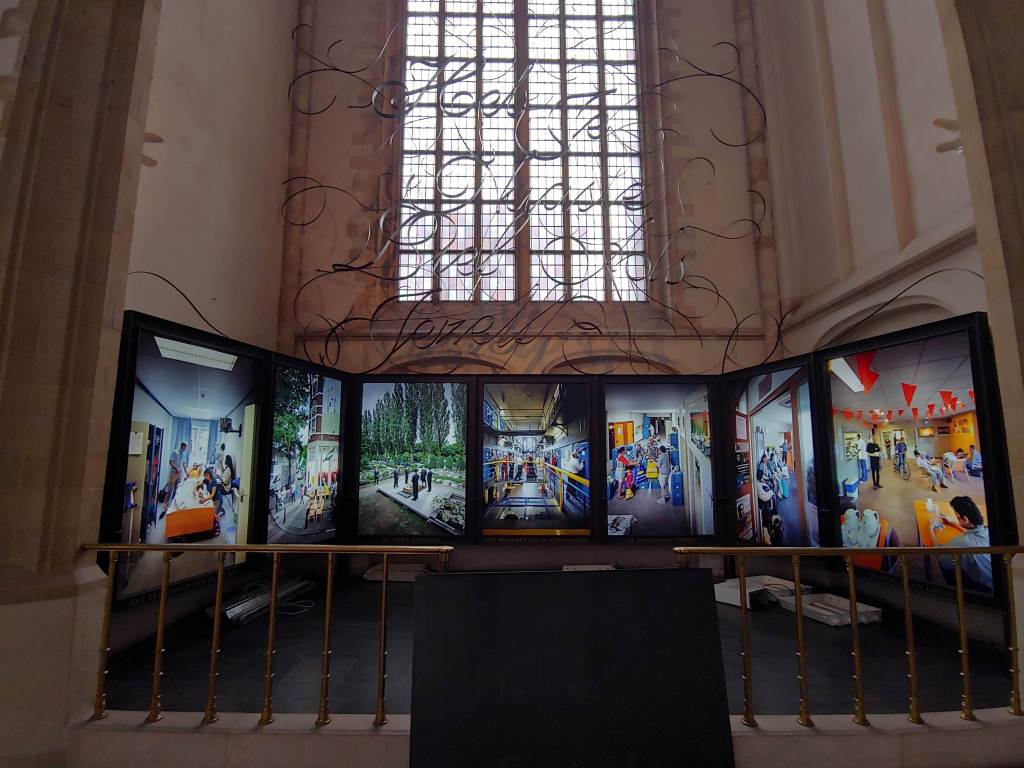
RADIX ARTICLE: “The Seven Works of Mercy: How two Dutch artworks—one Renaissance, one contemporary—can help us recover an ethic of neighborly care” by Victoria Emily Jones: When I was in the Netherlands last year, I saw lots of artistic representations of what are called the seven works of mercy, derived from Matthew 25. (Even after the Protestant Reformation, the subject remained popular among Dutch artists, who delighted in representations of everyday life.) In this article, published last week, I share just two. One is a multipaneled painting, now at the Rijksmuseum, commissioned in 1504 by the Holy Ghost Confraternity in Alkmaar, which ran an almshouse that provided medical care for the sick and housing for the poor (social welfare programs were carried out by the church in those days); notably, in each contemporary townscape, Jesus stands among the afflicted—a theologically loaded artistic choice. The other artwork is a set of photographs by Thijs Wolzak on display inside Rotterdam Cathedral, which feature community service organizations in action, caring for drug users, undocumented immigrants, and others. (Note: The chapel was in a bit of disarray when I was there, with light fixtures disassembled all over the floor and a ramp blocking my entrance, hence the messy staging of my photo! See a professional photograph in the article link, including photos of individual panels.)
Master of Alkmaar, Feeding the Hungry, leftmost panel from the Seven Works of Mercy polyptych, 1504. Oil on panel, 103.5 × 55 cm. Rijksmuseum, Amsterdam. The inscription on the original frame underneath (not pictured) is a rhyming Dutch couplet: “Deelt mildelick den armen / God zal u weder ontfarmen” (Share generously [with] the poor, [and] God shall have mercy on you).Thijs Wolzak (Dutch, 1965–), in collaboration with Kathelijne Eisses, Werken van Barmhartigheid (Works of Mercy), 2010. Duratrans prints in light boxes. Chapel of Works of Mercy, Sint-Laurenskerk (Church of St. Lawrence), Rotterdam, Netherlands. Photo: Victoria Emily Jones.
It’s interesting to consider the overlap of Christian and civic duty the images present and the way in which they function(ed) in their disparate spaces. The more explicitly theological Alkmaar polyptych was originally owned by a lay brotherhood and sited in a church beside the collection box, and its primary purpose was “to stir up . . . to love and good works” (Heb. 10:24), and to financial giving—but it is now in a large, government-run art museum, where it’s viewed mainly as an art historical object. The Wolzak piece, on the other hand, was commissioned as a permanent installation inside an active church that is also a heritage museum and something like a community center, with the purpose of highlighting the charitable work being done in the city. I like how Wolzak helps us to see where some of the needs lie in contemporary society and examples of tangible ways they might be met, through such services as safe-injection sites (for those suffering from heroin addiction) or the Lonely Funeral Foundation (for the anonymous dead).
NEW BOOK: Off the Walls: Inspired Re-Creations of Iconic Artworks: This March on social media, the Getty Museum issued the #GettyMuseumChallenge, inviting art lovers to channel the stir-crazy energy of COVID-19 quarantine into crafting themselves, their families, and their pets into masterpieces of world art and posting the photos online. By May there were at least 100,000 re-creations uploaded to the Internet—246 of which are featured in the new book Off the Walls, released this month by Getty Publications. All profits from the book will go to the charity Artist Relief to support artists facing financial emergencies to the coronavirus pandemic. This is such a fun way to get people to engage with art!
+++
NEW SONG RELEASES
“Hallelujah (Come Bless the Lord)” by September Penn:September Penn is a singer, songwriter, performance artist, worship leader, and cofounder of The Power of Song Inc., an organization that educates about social justice issues through song, theater, and art. She wrote “Hallelujah” while directing the Kaleo Choir at Fuller Theological Seminary, where she earned an MDiv this year with a focus on Worship, Theology, and the Arts. The song was released September 3 as a single on all music-streaming platforms.
“Nara Ekele Mo” by Tim Godfrey, performed by Resonance: Last month the Global Resonance Multicultural Worship Collective, under the organization Arts Release, posted on YouTube a multicontinent, multilingual cover of the Nigerian Igbo song “Nara Ekelo Mo” by Tim Godfrey. It features thirty-seven singers from Brazil, England, France, Indonesia, Singapore, and Spain, with lyrics in Igbo, Yoruba, Tamil, Bahasa Indonesia, French, Mandarin, Portuguese, Spanish, and English. (See the original version of the song here.) [HT: Global Christian Worship]
+++
POEMS
“Field Guide” by Tony Hoagland: A few weeks ago SALT Project reprinted this poem that celebrates the ordinary in nature—along with brief commentary and a stunning macrophoto of a dragonfly. An excerpt from the opening chapter of Ralph Waldo Emerson’s essay “Nature” is referenced: “If the stars should appear one night in a thousand years, how would men believe and adore; and preserve for many generations the remembrance of the city of God which had been shown! But every night come out these envoys of beauty, and light the universe with their admonishing smile.” (The poem is from Hoagland’s 2010 collection Unincorporated Persons in the Late Honda Dynasty, published by Graywolf Press.)
from the current issue of Image:Image journal is the one piece of mail I most look forward to receiving every quarter—full of poetry, visual art, literary essays, and short stories with a spiritual sensibility. In its current issue, no. 105, some of the poems I particularly enjoyed were “Trench Coat” by Cameron Alexander Lawrence, on the accumulation of things; “Pastoral with Wheat” by John Hart, on fatherhood as beatitude, and as a continual lesson in dying to self; “Duet” by Chelsea Wagenaar [previously], about the “music” of the ordinary moments of motherhood, like tending to your child’s bee sting; and “The Eighth Sacrament” by Peter Cooley, on grief, written after the death of his wife, Jacqueline.
Miniature from the Menologion of Basil II (Vat. Gr. 1613, page 59), made in Constantinople, 976–1025. Vatican Library, Rome.
When God saw what they did, how they turned from their evil way, God relented of the disaster that he had said he would do to them, and he did not do it.
But it displeased Jonah exceedingly, and he was angry. And he prayed to the LORD and said, “O LORD, is not this what I said when I was yet in my country? That is why I made haste to flee to Tarshish; for I knew that you are a gracious God and merciful, slow to anger and abounding in steadfast love, and relenting from disaster. Therefore now, O LORD, please take my life from me, for it is better for me to die than to live.” And the LORD said, “Do you do well to be angry?”
Jonah went out of the city and sat to the east of the city and made a booth for himself there. He sat under it in the shade, till he should see what would become of the city. Now the LORD God appointed a plant and made it come up over Jonah, that it might be a shade over his head, to save him from his discomfort. So Jonah was exceedingly glad because of the plant. But when dawn came up the next day, God appointed a worm that attacked the plant, so that it withered. When the sun rose, God appointed a scorching east wind, and the sun beat down on the head of Jonah so that he was faint. And he asked that he might die and said, “It is better for me to die than to live.” But God said to Jonah, “Do you do well to be angry for the plant?” And he said, “Yes, I do well to be angry, angry enough to die.” And the LORD said, “You pity the plant, for which you did not labor, nor did you make it grow, which came into being in a night and perished in a night. And should not I pity Nineveh, that great city, in which there are more than 120,000 persons who do not know their right hand from their left, and also much cattle?”
—Jonah 3:10–4:11
After Jonah, at God’s behest, reluctantly went to preach to the pagan city of Ninevah, its people repented and were spared destruction. (Ninevah was the capital of Assyria, Israel’s enemy.) This is where Sunday’s lectionary reading, the final chapter of the book of Jonah, picks up.
When God extended his mercy to Jonah earlier in the story, it filled Jonah with thanksgiving (Jonah 2:9), but when God is merciful to Ninevah, it fills Jonah with anger. Jonah believed that the Ninevites should be punished for their sin, that they are not worthy of God’s forgiveness. He wanted them to be crushed, not saved! Thus accusing God of injustice, he stalks over to a spot east of Ninevah, plops himself down, and pouts.
The book of Jonah condemns the title character’s bigotry and ethnocentrism, portraying him as a rather ridiculous figure. The idea that God loves only “us,” not “them,” is one that has persisted down through the ages and that’s satirized in this quatrain:
We are God’s chosen few,
All others will be damned;
There is no place in heaven for you,
We can’t have heaven crammed.
(This is sometimes attributed to Jonathan Swift, but it’s not in his collected works; if you know the original source, let me know!)
Jonah wants God’s love to have boundaries that hem him in and others out. To expose the faultiness of Jonah’s thinking, God “appoints a plant” to provide shade for Jonah, relief from the heat, but only for a day. The next day God destroys the plant, and Jonah is so upset that he wants to die. God then questions why he grieves the destruction of a mere plant but not the prospect of an entire city being destroyed.
The narrative ends without telling us whether Jonah receives the lesson well and repents of the hatred he harbors.
This post belongs to the weekly series Artful Devotion. If you can’t view the music player in your email or RSS reader, try opening the post in your browser.
To view all the Revised Common Lectionary scripture readings for Proper 20, cycle A, click here.
Though I grew up in the church, for a long time I was ignorant of the vibrant threads of lament and justice that run throughout scripture. I imbibed the message that good Christians never complain or get angry or question God or call him to account, that “rejoicing always” means always putting on a happy face (dwelling in sadness was tantamount to distrust), and that social justice is a “liberal agenda” and a distraction from the gospel. As my faith has matured and my engagement with the scriptures has deepened, my eyes have been opened to the embeddedness of justice in the biblical narrative, and how any lack of justice is cause for lament.
Tim Keller’s book Generous Justice: How God’s Grace Makes Us Just (2012) was instrumental in helping me see how social justice is an expression of God’s own heart and an important part of the church’s mission, not tangential to the gospel but an extension of it. My earlier conception of the gospel, the good news of Jesus Christ, was so impoverished, as I had reduced it down to nothing more than a private transaction between me and God regarding the eternal destination of my soul. As I began to see, through reading scripture, that God cares about this world, and he cares about people’s souls and bodies, I came to realize how expansive the gospel really is, with real implications for the here and now. We may be in right relationship with God, or think we are, but are we in right relationship with our neighbors and, I would add, with the rest of God’s creation? That is, do we live justly, as God commands, which includes supporting policies that promote, as best as possible, the flourishing of all, not just ourselves or others like us?
Keller shows how the Christianese terms “sin” and “righteousness” have to do not only with personal morality but also with systems, and how “justice” is more multifaceted than merely “punishment.” Punishing wrongdoers and reestablishing rights is one type of justice, called rectifying (or retributive) justice, or mishpat in Hebrew. But primary justice (aka distributive justice) is making sure goods and opportunities are more equitably distributed in society. It’s proactive. “Primary justice, or tzadeqah, is behavior that, if it was prevalent in the world, would render rectifying justice unnecessary, because everyone would be living in right relationship to everyone else” (11). Keller says that when these two Hebrew words appear together in the Bible, the best translation of the compound is “social justice.” So, for example, when Psalm 33:5 says, “He loveth righteousness [tzadeqah] and judgment [mishpat],” perhaps a better modern translation would be “The LORD loves social justice.”
The truncated “ticket to heaven,” “me and Jesus” understanding of salvation shows up in countless Christian worship songs, which form, or malform, our imaginations. I’m not at all dismissing the need for personal salvation (that is a critical component of the gospel!), or suggesting that we ought not to be looking toward eternity. What I am saying is that our relationship with Jesus, including our transformative experience of his love and grace, should have a profound impact on how we relate to and advocate for our neighbors, and our conception of heaven should be as huge and as glorious as the Bible alludes to (the entire world renewed and in harmony under the headship of Christ)—and we should start living into that vision NOW, even as we await Christ’s return. I often wonder whether, if there had been more biblical justice–oriented songs circulating and in church use during my upbringing, my deep hurt over the brokenness of the world and thus my sense of social responsibility as a Christian would have developed sooner.
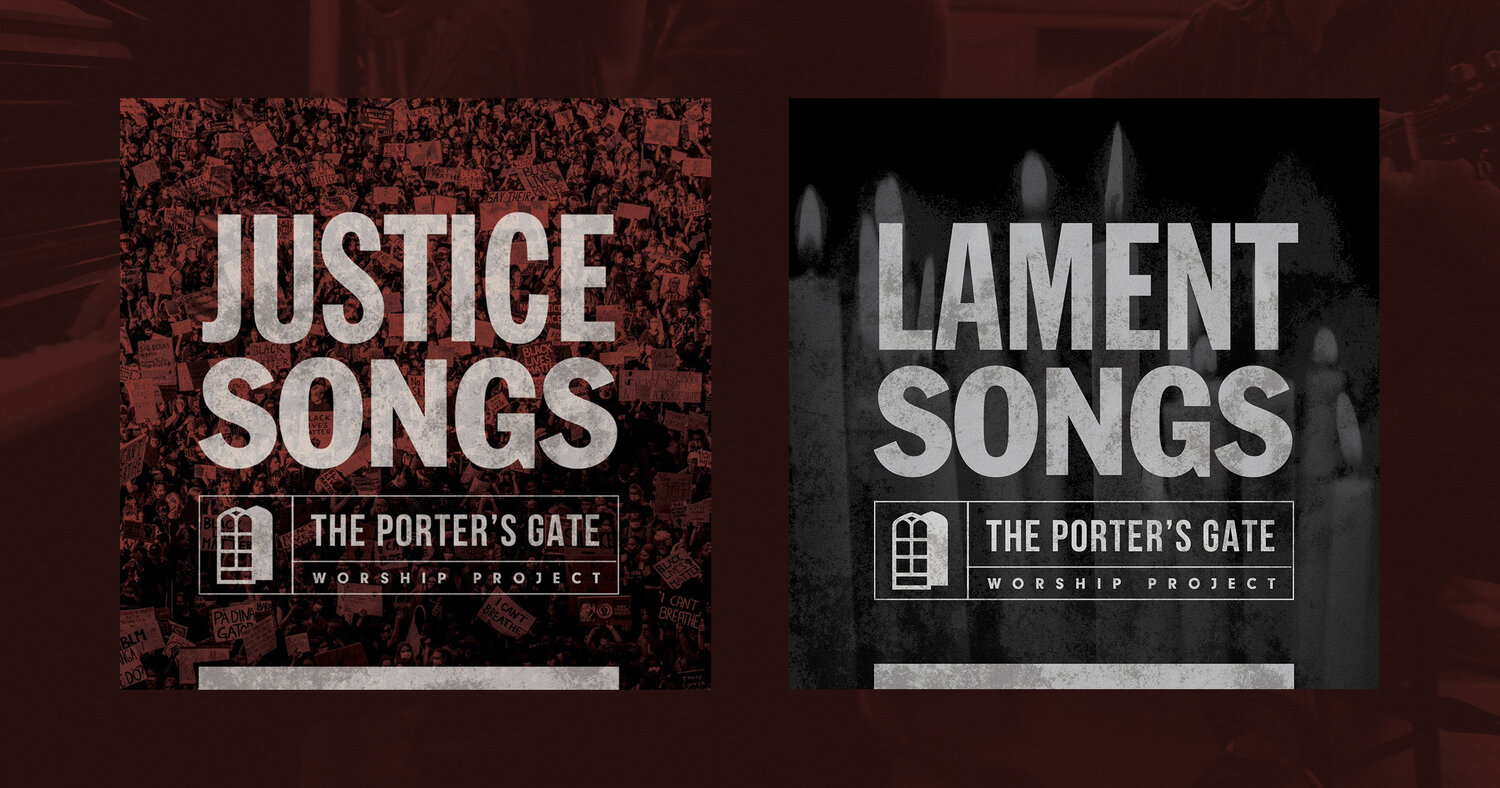
Founded in 2017 by Isaac and Megan Wardell, The Porter’s Gate is a music collective whose mission is to be a “porter” for the Christian church—one who looks beyond church doors for guests to welcome. Their first album, Work Songs (2017), explores the concept of vocation in both the public and private spheres. That was followed up by Neighbor Songs (2019), centered on the communal aspect of Christian living and of God’s future, and the embodied love at the heart of the gospel.
And now, released this month, are two companion albums: Lament Songs and Justice Songs. Recorded by a diverse group of musicians in July 2020 on a farm in Virginia, the albums interweave fragments from the Psalms with biblical prophecies and apocalypses, blessings, Gospel stories, and protest chants, crafting a robust kingdom theology that promotes constructive engagement with contemporary issues and a looking toward the reconciliation of all things in Christ. “We fight for the victories we know You will win” (a lyric from “Justicia”) is a good encapsulation.
Political corruption, police brutality, racism, mass incarceration, sexual violence, economic exploitation, and war are all referenced, either implicitly or explicitly, as forms of oppression that need to be toppled, as they are an affront to God, marring his image.
Full of heartbreak and hope, the songs are shepherding me out of my tendency toward cynicism and helping me recapture the beauty of God’s vision for the world. They’re saturated in biblical language. An antidote to the all-too-common escapism theology present in some Christian music, they catalyze the church to weep with those who are weeping (Rom. 12:15), to bear the burdens of others (Gal. 6:2), and to participate in God’s work of renewal in the world. God has not redeemed us to wait idly by while sin tightens its grip on society. No, he calls us to sow the seeds of his kingdom in anticipation of a bountiful harvest. To walk in the power of the Spirit, into dark corners, bringing light.
The Porter’s Gate seeks to provide songs for corporate worship, and all these would (potentially) be appropriate in that setting; for churches that aren’t used to the practice of lament or to engaging justice issues, some advance education and pastoral guidance will be in order. Some songs will naturally land better in some churches than in others. Some are challenging—and that’s a good thing, as challenge tends to grow us.
As one would expect, God is supplicated throughout the songs. Entreaties include
Come, Jesus, come
Be our light
Drive out the darkness
End all the violence
Do not be silent
Be near!
Illuminate the shadows
Take pity!
Keep the enemy back
Comfort
Be our refuge
Break oppression
Make me an instrument
Help me restore
And God is abundantly praised, and his promises laid claim to.
The songwriters on the two albums are Isaac Wardell, Latifah Alattas, Kate Bluett, Jessica Fox, Jon Guerra, Casey J, Wendell Kimbrough, Leslie Jordan, Dan Marotta, Orlando Palmer, John Swinton, Gregory Thompson, Liz Vice, Keith Watts, Tina Colón Williams, and Paul Zach.
As the writers would acknowledge, the general content and ethos of the songs are not “new” or alien to Christianity. If you cringe at the thought of bringing current events into worship or singing a confession of corporate sin or expressing sadness or outrage to God, just know that faithful Christians have been doing it since the beginning, and your discomfort may be because you haven’t been exposed to church traditions outside your own. Ecumenicism is an important aspect of The Porter’s Gate’s identity, says Isaac Wardell—an ecumenicism that says, “I come with gifts of the Spirit of my tradition, but I come also with the poverty of my tradition, looking for the charisms and the gifts of your tradition.” And I love that about the project.
Because I’m eager for others to see the biblical groundedness of the songs (which will be obvious to many upon first listening, but maybe not to those who are more selectivist in their Bible reading), and because I’m a musical worship leader who approaches worship music with great discernment of the theology it espouses, I’m going to point out just some of the scriptural connections in the songs.
Acknowledging that the world is not right, and mourning specific instances of that unrighteousness, is the first step in justice work. It’s called lament. Lament cries out, “Why, God?” and “How long?” Honest expressions of woe are not irreverent. The Bible is full of such language. The fact that lament is addressed to God means that faith has not been abandoned; on the contrary, lament leads to a renewed confidence in God.
The first song on Lament Songs, “Wake Up, Jesus” (feat. Liz Vice), takes as its conceit the story of Jesus’s calming the storm after being woken up by his scared disciples, but it is sung in medias res, from the vantage point of one who is caught in a storm that is still raging. “Jesus, when you gonna wake up? . . . Won’t you rise up?” Again, maybe you’ve always assumed this kind of forthrightness is forbidden in prayer, but it’s in perfect sync with the way the biblical psalmists, for example, relate to God; take Psalm 44: “Awake, Lord! Why do you sleep? / Rouse yourself! Do not reject us forever. / Why do you hide your face / and forget our misery and oppression?” (vv. 23–24). (See more biblical examples of this demand at https://artandtheology.org/2019/07/09/rise-up-artful-devotion/.)
When the instrumental intro to the second song begins, we recognize the famous passion chorale tune by Hassler, and we ready ourselves to sing “O Sacred Head . . .”—but instead we get “O Sacred Neck.” The word change is jarring. Why are we talking about Jesus’s neck? Then with the next phrase, “pressed down by blows and knees,” it becomes clear that the reference is to black victims of police violence, like George Floyd, who died in May after an officer, arresting him for trying to make a purchase with a counterfeit twenty-dollar bill, knelt on his neck for nearly eight minutes while he pled for his life and then died. (Two other officers assisted in restraining him, and another prevented onlookers from intervening.)
Maggi Hambling (British, 1945–), Wall of Water II, 2011. Oil on canvas, 78 × 89 in. (198.1 × 226.1 cm). Photo: Douglas Atfield.
Then the angel of God who was going before the host of Israel moved and went behind them, and the pillar of cloud moved from before them and stood behind them, coming between the host of Egypt and the host of Israel. And there was the cloud and the darkness. And it lit up the night without one coming near the other all night.
Then Moses stretched out his hand over the sea, and the LORD drove the sea back by a strong east wind all night and made the sea dry land, and the waters were divided. And the people of Israel went into the midst of the sea on dry ground, the waters being a wall to them on their right hand and on their left. The Egyptians pursued and went in after them into the midst of the sea, all Pharaoh’s horses, his chariots, and his horsemen. And in the morning watch the LORD in the pillar of fire and of cloud looked down on the Egyptian forces and threw the Egyptian forces into a panic, clogging their chariot wheels so that they drove heavily. And the Egyptians said, “Let us flee from before Israel, for the LORD fights for them against the Egyptians.”
Then the LORD said to Moses, “Stretch out your hand over the sea, that the water may come back upon the Egyptians, upon their chariots, and upon their horsemen.” So Moses stretched out his hand over the sea, and the sea returned to its normal course when the morning appeared. And as the Egyptians fled into it, the LORD threw the Egyptians into the midst of the sea. The waters returned and covered the chariots and the horsemen; of all the host of Pharaoh that had followed them into the sea, not one of them remained. But the people of Israel walked on dry ground through the sea, the waters being a wall to them on their right hand and on their left.
Thus the LORD saved Israel that day from the hand of the Egyptians, and Israel saw the Egyptians dead on the seashore. Israel saw the great power that the LORD used against the Egyptians, so the people feared the LORD, and they believed in the LORD and in his servant Moses.
—Exodus 14:19–31
+++
SONG: “Wade in the Water,” African American spiritual
There have been many, many performances of this song over the years. For a nice, concise history of recordings, from gospel and doowop and choral to modern jazz, R&B, heavy rock, and northern soul, see this article by Mike Hobart. Below is a handful I’ve found and enjoy.
A gospel version by Brother John Sellers from 1959, driven by piano:
A choral arrangement by Paul T. Kwami, performed by the Fisk Jubilee Singers in 2019 (the soloist isn’t credited, but she’s amazing!):
Pegasis is a vocal trio of sisters from the Dominican Republic, formerly performing under the name The Peguero Sisters. Accompanied on guitar by their dad, here they are with stellar harmonies from their 2016 album Peace Through Praise:
The Petersens apply their signature bluegrass stylings in their rendition, performed a few weeks ago in this video but also on their 2019 album Homesick for a Country:
According to oral lore, Harriet Tubman used the song “Wade in the Water” to communicate strategy to slaves traveling the Underground Railroad: its coded language alerted freedom seekers that bounty hunters were on their trail with bloodhounds and that they should jump into the river so that the dogs couldn’t track their scent. This popular myth about the song has not been confirmed, and the National Park Service, which preserves historical sites associated with the Underground Railroad and promotes research on the topic, suggests that it’s probably not true.
It is known, however, that it was sung at river baptisms, and still is, as the Exodus is seen as an archetype of baptism, of redemption through water. Not only that, but the song also draws on the pool of Bethesda passage in John 5, where people gathered to be healed: “For an angel went down at a certain season into the pool, and troubled the water: whosoever then first after the troubling of the water stepped in was made whole of whatsoever disease he had” (v. 4). (This verse is found in some early New Testament manuscripts but not the earliest and is therefore omitted from several modern translations.)
In the documentary God’s Greatest Hits, pastor and gospel recording artist Wintley Phipps says, “‘Wade in the Water,’ to me, . . . means people who are afraid of moving forward, progressing, taking a step, and facing uncertainty—go ahead, wade in the water. Take that step. As terrifying as it may seem at that very moment, it’s gonna be alright, and the miracle we seek is gonna happen.”
There’s the famous song “Bridge Over Troubled Water.” Well, in Exodus, God carves out a bridge through troubled water! Imagine walls of water standing multiple stories high on either side of you, filled with tiger sharks and other marine life. And you have to cross the sandy bottom in faith that those walls will hold up until you reach the other side.
“Wade in the Water” affirms that God is going to stir things up; he’s going to do something big. Just like he did when he brought Israel up out of Egypt.
Maggi Hambling is one of Britain’s most significant painters and sculptors. Her nine “Walls of Water” paintings were made in 2010–11 and were first exhibited in 2014 at the National Gallery in London. Vast, intense, and energetic, they were inspired by her experience of giant waves crashing onto the seawall at Southwold, Suffolk, where she lives. “Through turbulence and exuberant colour, Hambling continues to affirm painting’s immediacy, saying, ‘The crucial thing that only painting can do is to make you feel as if you’re there while it’s being created – as if it’s happening in front of you’” (source).
Maggi Hambling (British, 1945–), Wall of WaterV, 2011. Oil on canvas, 78 × 89 in. (198.1 × 226.1 cm). Photo: Douglas Atfield.
View other paintings from the series at Artsy.net.
This post belongs to the weekly series Artful Devotion. If you can’t view the music player in your email or RSS reader, try opening the post in your browser.
To view all the Revised Common Lectionary scripture readings for Proper 19, cycle A, click here.
At the beginning of the book of Exodus, the Hebrews have been in Egypt for several generations, their migration blessed by a previous pharaoh in appreciation of Joseph’s handling of a food crisis. But their peaceful coexistence comes to an end when a new pharaoh comes to power and conscripts the Hebrews into hard labor. In addition to the enslavement, Pharaoh issues an imperial edict that all newborn Hebrew boys are to be killed.
In her excellent new book Defiant: What the Women of Exodus Teach Us about Freedom, practical theologian and community developer Kelley Nikondeha talks about the exodus of the Israelites out of captivity in Egypt as a series of small rescue operations, starting with the midwives who refuse to carry out Pharaoh’s death order. Then there’s Jochebed, Moses’s birth mother, who relinquishes her son in order to save him, placing him in a basket on the Nile: Nikondeha imagines her navigating the basket across the river and placing it strategically in a thicket of reeds to be discovered by Pharaoh’s daughter, whose pensive nature and possible sympathies she had been observing for the past three months.
Pharaoh’s daughter is unnamed in the biblical narrative, but Jewish tradition gives her the Hebrew name Bithiah, “daughter of Yahweh” (Leviticus Rabbah 1:3), identifying her with the woman in 1 Chronicles 4:18. In this verse she is called a Judahite (i.e., a Jew), which Megillah 13a says is because she repudiated the gods of her people—that when “she came down to bathe at the river” (Exodus 2:5), it was to cleanse herself of idolatry; essentially, to perform a ritual conversion to Judaism, as her loyalties will bear out. When she discovers the baby, she knows he’s Hebrew, and presumably out of compassion, she decides to raise him as her own. She hires Jochebed as a wet-nurse (it’s unclear whether she knows Jochebed is Moses’s birth mother) and, once the child is weaned two to three years later, receives him into the palace. She names him Moses, Egyptian for “son” but also sounding like the Hebrew word mashah, “to draw out” (of the water).
Scripture gives us no information about Moses’s upbringing and very little about his adoptive mother, so questions are unavoidable. Did Moses look different from the Egyptians? Did Pharaoh know Moses was Hebrew but overlook it to indulge his daughter, or did Bithiah have to hide Moses from him and others at court? When did Moses find out he was Hebrew? (The biblical narrative skips from Bithiah naming Moses as a toddler to “One day, when Moses had grown up, he went out to his people . . . ,” meaning the Hebrews, and he clearly knew at that point. No more mention of Bithiah.) Had Bithiah told Moses about his heritage, or did she hide it from him? Maybe his biological sister, Miriam, encountered him one day and told him? Did Moses ever know his birth mother? And what ever happened to Bithiah—if Pharaoh disapproved of her making a Hebrew part of the royal family, was she exiled (as a popular rabbinical interpretation suggests), or even killed? Was she married, and did she have any other children? Did she follow Moses out of Egypt? (Jewish tradition supposes yes.) The Bible leaves room for multiple interpretations, and stories have developed in different directions to try to fill in the gaps.
I love Nikondeha’s speculative retelling of the Exodus story. (Her book, Defiant, integrates exegesis, meditation, and imagination, as she believes, as do I, that biblical study is enriched by the practice of envisioning fully fleshed narratives, including character backstories and relationships.) Nikondeha sees Bithiah as an Egyptian princess who has slowly awakened to her father’s tyranny—she sees a dead baby in the water one day, she hears the Hebrew mothers’ laments across the river. She wants to stand against the injustice but is unsure where to start, feeling overwhelmed and powerless. And then she meets Moses. The Hebrew women had initiated a strategy for liberation, and Bithiah commits then and there to become an ally, to partner with them in their freedom work. To fight the evils of empire, but secretly from within.
Nikondeha imagines that during Moses’s breastfeeding years Bithiah developed a relationship with Jochebed, which was doubtless fraught at first, but Jochebed eventually opened up, and Bithiah learned to listen. During clandestine meetings in the palace gardens and even twice in the slaves’ quarters, Jochebed taught Bithiah about Hebrew history and culture, and Bithiah bore witness to Hebrew rage, which further catalyzed her to resist her father. The two women were part of what Nikondeha calls the Nile network, a resistance movement that crossed ethnic and socioeconomic lines, operating in the shadows.
Nikondeha, who is a light-skinned American, writes not only as an adopted child but also as the adoptive mother of a Burundian son. (Her husband is Burundian.) This gives her special insight into Moses’s transcultural adoption story and Bithiah’s mindset. She describes Bithiah’s thoughts after saying goodbye to Jochebed for the last time, once Moses is weaned:
She knew relaying his full identity to him was her responsibility now. Continuing his connection to his Hebrew heritage would be her yoke to carry. Also on her shoulders: the subversive work of educating her son to see injustice from the inside and imagine something different. She would raise him in Pharaoh’s house but not indoctrinate him with the imperial values that produced endless quotas, death edicts, and dead boys washed up on the river’s shore. . . .
I feel a kinship with Bithiah, not only in her position of privilege that needed to be disarmed but also in her determination to make sure Moses knew he was as Hebrew as he was Egyptian. She didn’t erase his Hebrew heritage; she didn’t ignore it. She marked him with a name that said “you are both” and set him out on that journey of discovery. It is what I aim to do with my own son. I doubt either of us do it perfectly, and Lord knows we need help from our sisters to deepen our understanding. I think that in my own way, I, like Bithiah, set foot on a journey as a novice peacemaker that continues as I learn to navigate two cultures, various animosities, and what it means to oppose discrimination for the sake of peace for my son. . . .
Moses followed the liberation trajectory set by the mothers in his life—Jochebed and Bithiah but also all the other women who mothered him with liberative verve. (100, 104, 113)
Max Beckmann (German, 1884–1950), The Egyptian Woman, 1942. Oil on canvas, 60 × 30 cm. Private collection.
“Epitaph” by Eleanor Wilner
Though only a girl, the first born of the Pharaoh,I was the first to die.
Young then,
we were bored already,
rouged pink as oleanders
on the palace grounds, petted
by the eunuchs, overfed
from gem-encrusted bowls, barren
with wealth, until the hours of the afternoon
seemed to outlast even
my grandmother’s mummy, a perfect
little dried apricot
in a golden skin. We would paint
to pass the time, with delicate
brushes dipped in char
on clay, or on our own blank lids.
So it was that day we found him
wailing in the reeds, he seemed
a miracle to us, plucked
from the lotus by the ibis’ beak,
the squalling seed of the sacred
Nile. He was permitted
as a toy; while I pretended play
I honed him like a sword.
For him, I was polished and as perfect
as a pebble in a stutterer’s mouth.
While the slaves’ fans beat
incessantly as insect wings,
I taught him how to hate
this painted Pharaoh’s tomb
this palace built of brick
and dung, and gilded like a poet’s
tongue; these painted eyes.
The epigraph of the poem is the epitaph of Pharaoh’s daughter, Bithiah. It could mean she died in the tenth plague God unleashed on Egypt: the death of every Egyptian firstborn. While Exodus 4:23 and 13:15 seem to suggest it was only the firstborn sons who were killed, some rabbis have said that firstborn daughters were also among the victims—but that Bithiah was spared (Exodus Rabbah 18:3). The day before Passover each year, it’s customary in Jewish families for the firstborn to fast to commemorate the salvation of the Israelite firstborns; in most traditions the fast is obligatory for males only, but in some communities it is observed by female firstborns as well. Anyway, if all firstborns, regardless of gender and without exception, were struck by the plague, Bithiah, if she was Pharaoh’s firstborn and wasn’t already deceased, would have fallen.
But I don’t read the epitaph this way. I take it to mean that Bithiah rejected her despotic father and chose Israel over Egypt, which was itself a kind of death. She was “the first to die” because she “died” decades before the plagues swept through. She died to the expectations she had had for her life and, if we assume she left Egypt with Moses and the rest, forsook all the comforts and privileges that came with being a pharaoh’s daughter. One Jewish exegetical tradition commends her heroism and has God saying, “Because she caused salvation to come to Israel and brought them forth to life, behold, I will prolong her life. . . . I have made a covenant with your fathers and they followed in the path of their fathers. This woman, however, who has forsaken her royal status and attached herself to you [Israel], shall I not reward her?” (Kallah Rabbati 3:25).
“Epitaph” is written in Bithiah’s voice. She describes her boredom with pampered palace life, the emptiness of wealth (and, as her family’s was amassed through abuse of power, its foulness), and her growing revulsion for all that her father stands for. For the time being she still looks and acts the part of princess, but underneath the surface she seethes. When a Hebrew baby shows up on the riverbank, separated from his mother in a desperate attempt to protect him from Pharaoh’s genocide, Bithiah resolves to take him in and raise him—but not as allegiant to Pharaoh. “While I pretended play / I honed him like a sword,” she says, teaching him about his origin and exposing him to the hideousness of slavery while instilling in him values of compassion and bravery. She sharpened his perception of the world and of his own identity and calling.
“I was polished and as perfect / as a pebble in the stutterer’s mouth”—a reference to Exodus 4:10, where Moses expresses reticence about being God’s mouthpiece, telling him, “I am not eloquent . . . I am slow of speech and of tongue.” (The Greek orator Demosthenes was said to have treated his speech impediment by talking with pebbles in his mouth.) By raising Moses to hate oppression, Bithiah planted seeds of rebellion in him that germinated during his time in Midian, sprouted in his conversations with God, and came into full bloom in his dramatic confrontations with the next Pharaoh.
Bithiah leveraged her privilege to save not only Moses but all of Israel. Ashamed of the exploitative practices and murders perpetrated by her father, she joined the Hebrew resistance, ultimately foiling the house of Pharaoh by helping to free Israel.
The LORD said to Moses and Aaron in the land of Egypt, “This month shall be for you the beginning of months. It shall be the first month of the year for you. Tell all the congregation of Israel that on the tenth day of this month every man shall take a lamb according to their fathers’ houses, a lamb for a household. And if the household is too small for a lamb, then he and his nearest neighbor shall take according to the number of persons; according to what each can eat you shall make your count for the lamb. Your lamb shall be without blemish, a male a year old. You may take it from the sheep or from the goats, and you shall keep it until the fourteenth day of this month, when the whole assembly of the congregation of Israel shall kill their lambs at twilight.
“Then they shall take some of the blood and put it on the two doorposts and the lintel of the houses in which they eat it. They shall eat the flesh that night, roasted on the fire; with unleavened bread and bitter herbs they shall eat it. Do not eat any of it raw or boiled in water, but roasted, its head with its legs and its inner parts. And you shall let none of it remain until the morning; anything that remains until the morning you shall burn. In this manner you shall eat it: with your belt fastened, your sandals on your feet, and your staff in your hand. And you shall eat it in haste. It is the LORD’s Passover. For I will pass through the land of Egypt that night, and I will strike all the firstborn in the land of Egypt, both man and beast; and on all the gods of Egypt I will execute judgments: I am the LORD. The blood shall be a sign for you, on the houses where you are. And when I see the blood, I will pass over you, and no plague will befall you to destroy you, when I strike the land of Egypt.
“This day shall be for you a memorial day, and you shall keep it as a feast to the LORD; throughout your generations, as a statute forever, you shall keep it as a feast.”
Passover is a major Jewish holiday celebrated every spring, marking God’s deliverance of the people of Israel out of Egyptian bondage. Exodus 12 tells the story of how in Egypt God sent death as a means of judgment against oppressors but “passed over” the houses of the faithful who, following God’s instructions, smeared their doorposts with the blood of a lamb.
Christians interpret this event as a prefiguration of the death of Jesus, the lamb of God, whose blood saves from death those who choose to place themselves under it, liberating us from our slavery to sin. Driving home the connection, all four Gospel writers mention that Jesus was killed during the feast of Passover. His blood smeared the wooden posts of the cross.
+++
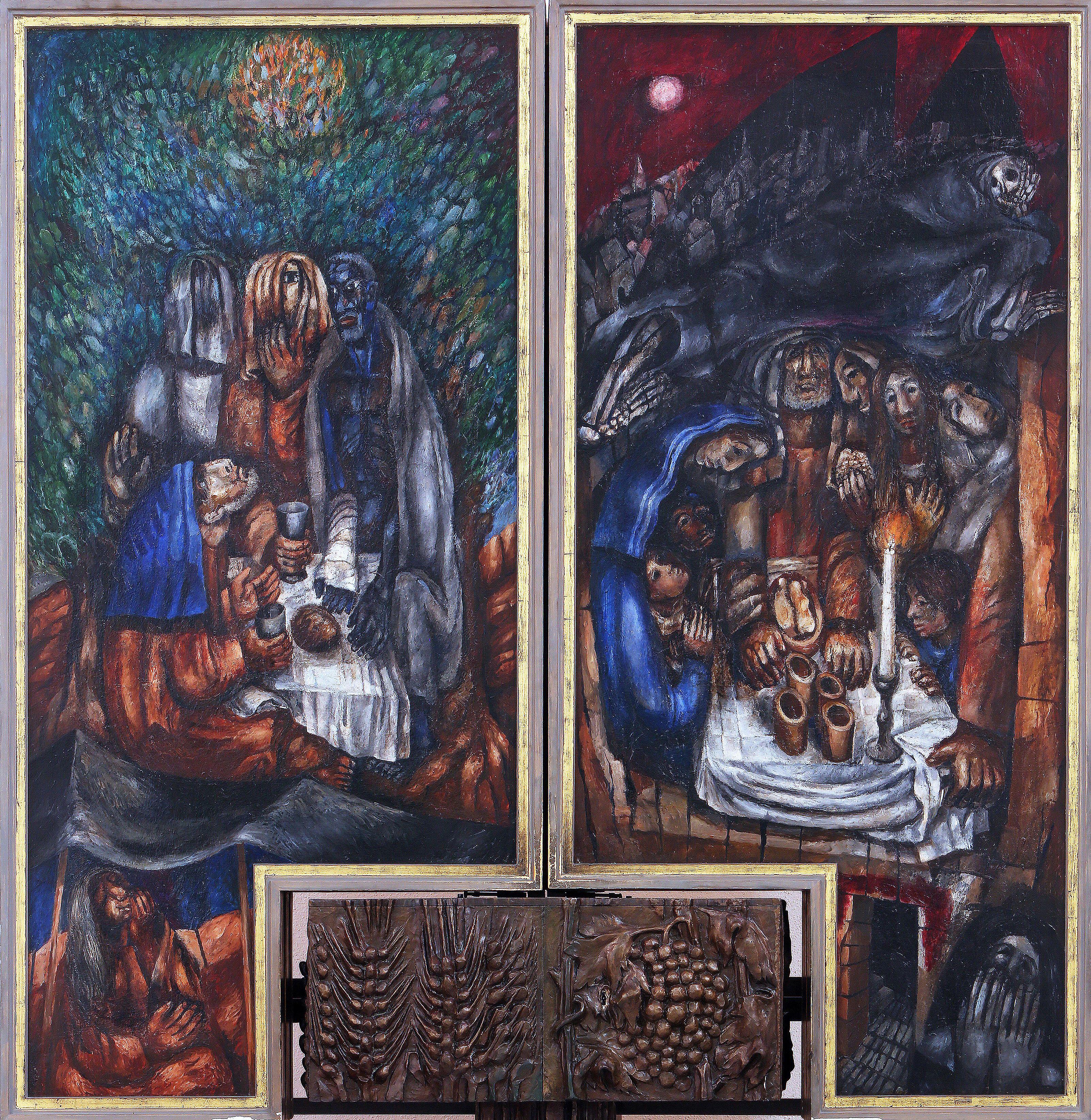
Father Sieger Köder was born in Wasseralfingen in Swabia in southwestern Germany in 1925. From 1947 to 1951 he attended the State Academy of Fine Arts Stuttgart, where he trained as a silversmith and a painter. While establishing his art practice, he also worked as an art teacher at a secondary school in Aalen for just over a decade. Increasingly he felt a pull into Christian ministry, so from 1965 to 1970 he studied theology in Tübingen, becoming ordained in the Catholic Church a year later. He served as a parish priest in Hohenberg and Rosenberg from 1975 to 1995, combining that vocation with his work as an artist. He continued his art making well into retirement, dying in 2015 at age ninety. His religious paintings can be found all over Germany and in other parts of Europe.
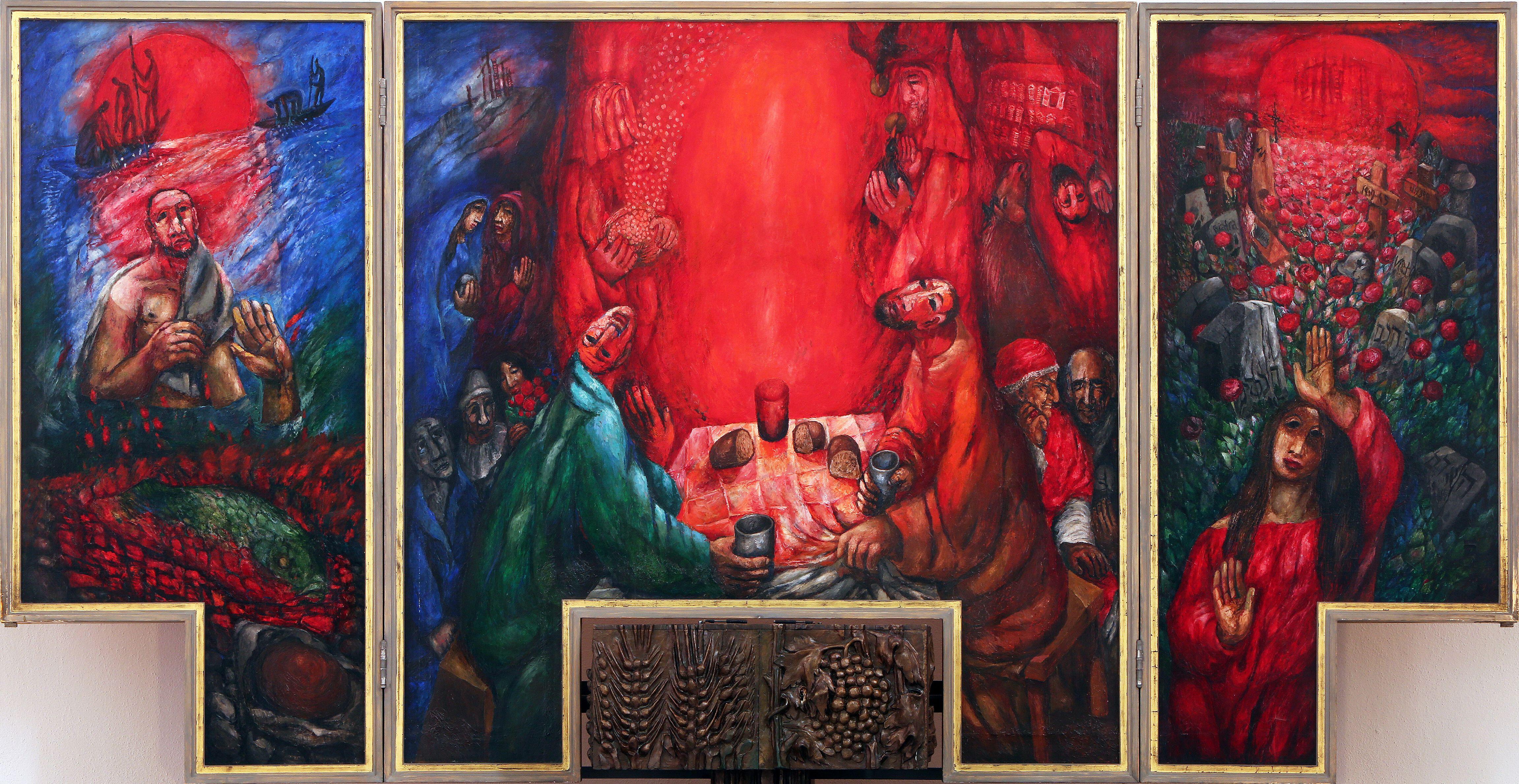
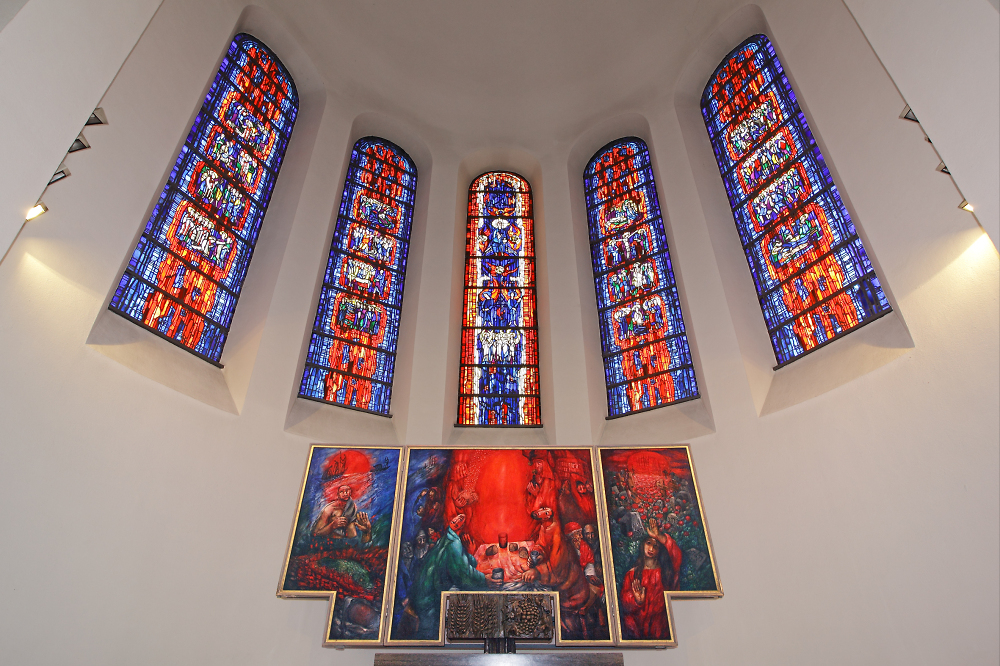
The artwork above is the closed view of the high altarpiece Köder made for the parish church in his hometown, Saint Stephen’s (Sankt Stephanus).
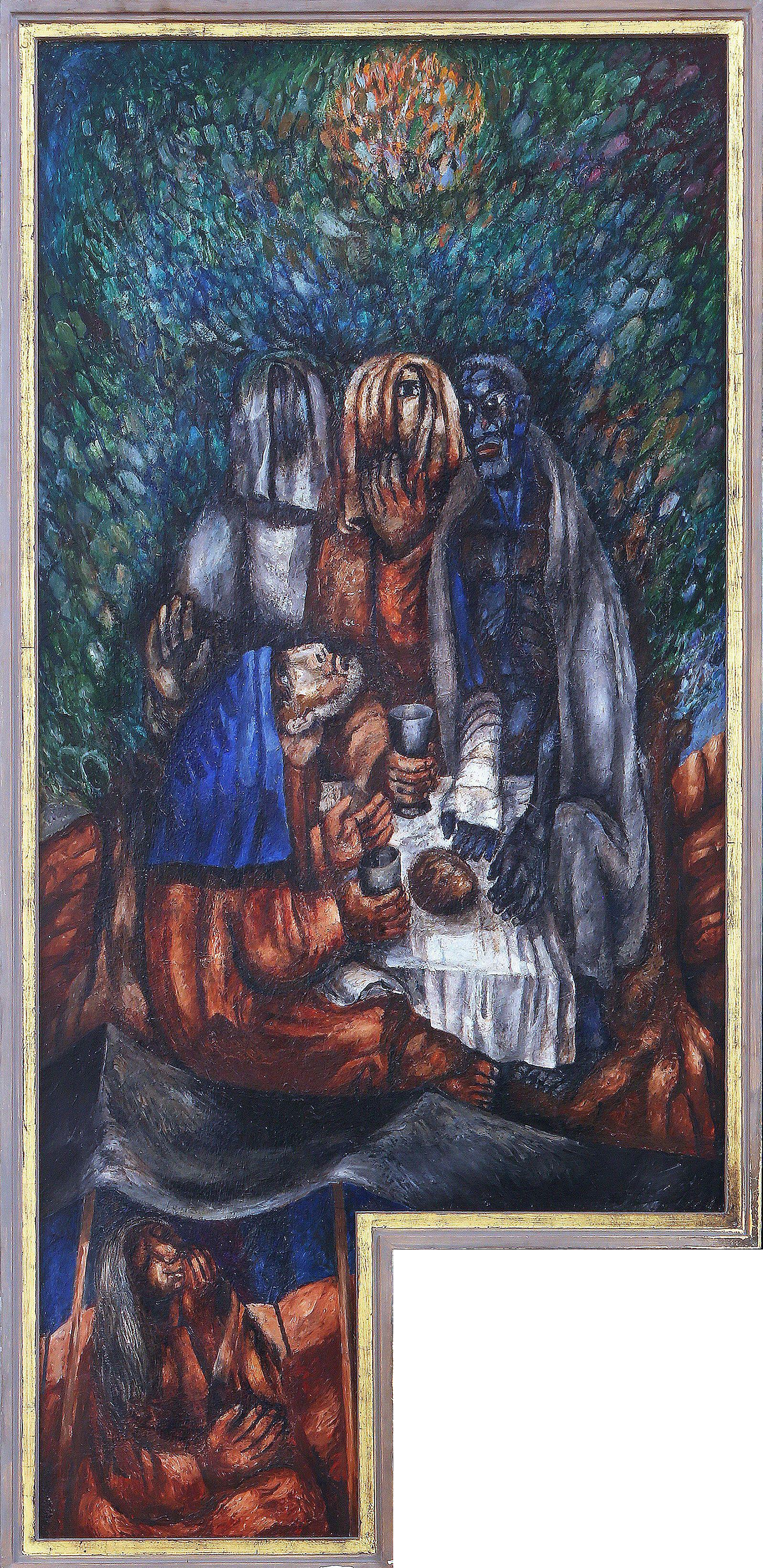
The outer left panel shows the Hospitality of Abraham (Genesis 18:1–21)—that is, Abraham’s entertaining three men who turn out to be a theophany, an appearance of God in a human body (or in this case, three human bodies). I’m guessing that the man on the left, who is veiled, represents God the Father; the man in the middle, who’s holding the cup, is God the Son; and the man on the right, who appears to have a broken arm and to be naked except for a blanket draped over him, is God the Spirit—though he is likely also meant to show how God often comes to us in the guise of the poor, the hungry, the unsheltered (Matthew 25:31–46). Above the heads of this trinity, glowing through the oak leaves, is a fiery orb reminiscent of the burning bush from which God would call Moses a few centuries later. At the bottom of the painting Abraham’s wife Sarah laughs from inside her tent, having eavesdropped on the visitors’ news that she, a nonagenarian, will conceive a child. The lineage of that child, Isaac, would produce Jesus.
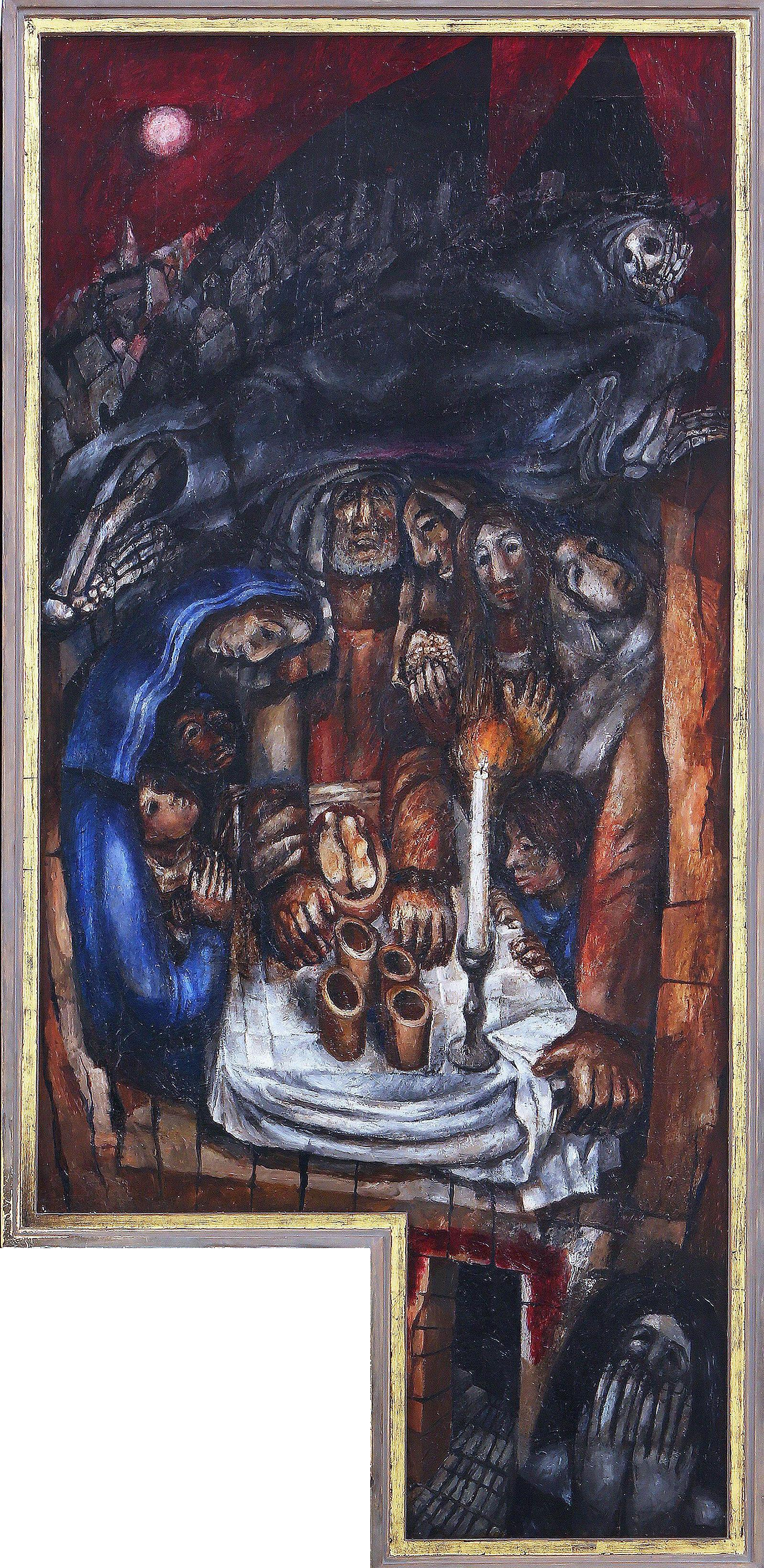
The outer right panel, based on Sunday’s lectionary reading, shows the first Passover. Israelite families huddle around a meal of roast lamb, unleavened bread, and bitter herbs as a cloaked, skeletal presence passes by overhead. One of the adults tries to steady the rattling table with his hand while a mother protects two of her children, hugging them tightly to herself. Though afraid, they are in no danger, as their doorway is covered in the blood of the lamb whose flesh they eat.
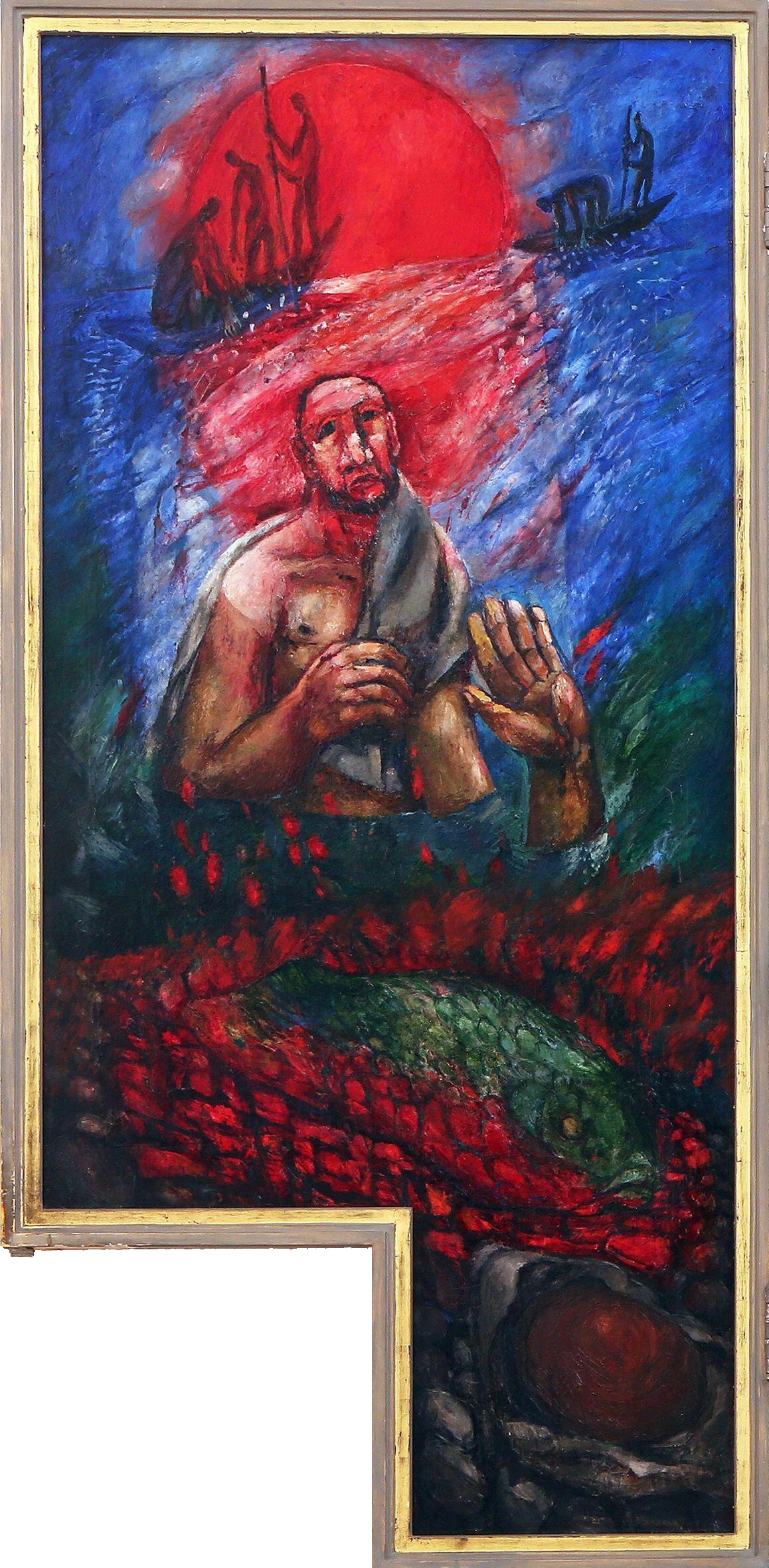
When opened, the triptych reveals three Resurrection-themed panels. The inner left panel shows one of my favorite biblical episodes, which I call “Breakfast on the Shore”: Jesus’s resurrection appearance to Peter at dawn on the Sea of Galilee (John 21). Following Jesus’s instruction in Jerusalem (Matthew 28:7, 10), Peter had returned home with some of the other disciples and, not knowing what to do, took back up his fishing nets. He and six others are on the lake when a man calls out from the shore, “Children, do you have any fish?” They don’t. The man tells them to cast in their nets once more, and when they do, up comes a humongous catch. After which Peter exclaims, “It is the Lord!” Ever the impulsive one, he throws himself into the sea and pushes his way through the water to greet Jesus. They chargrill some of the fish and sit down to eat.
The scene is one of reconciliation. Peter had denied he knew Jesus three times the night of Jesus’s arrest, abandoning him in his time of need, and now, after breakfast, Jesus gives Peter three chances to reaffirm his love for him, asking him thrice, “Simon, son of John, do you love me?” The foregrounding of the hot coals in Köder’s painting is perhaps a subtle nod to the recent failure of Peter’s, as earlier in his Gospel John mentions that, in the courtyard of the high priest where Jesus was being tried, Peter warmed himself at a charcoal fire alongside Jesus’s captors (John 18:18). There’s also a hand coming up out of the water that I’m guessing references the earlier episode of Peter’s walking on water and then, when doubt in Jesus’s power set in, sinking, only to be saved by Jesus’s outstretched hand (Matthew 14:22–33). But Jesus forgives Peter’s weaknesses and disloyalty, restoring him to fellowship. He invites Peter to come and feast. The sun at the top indicates that it’s the dawn of a new era.
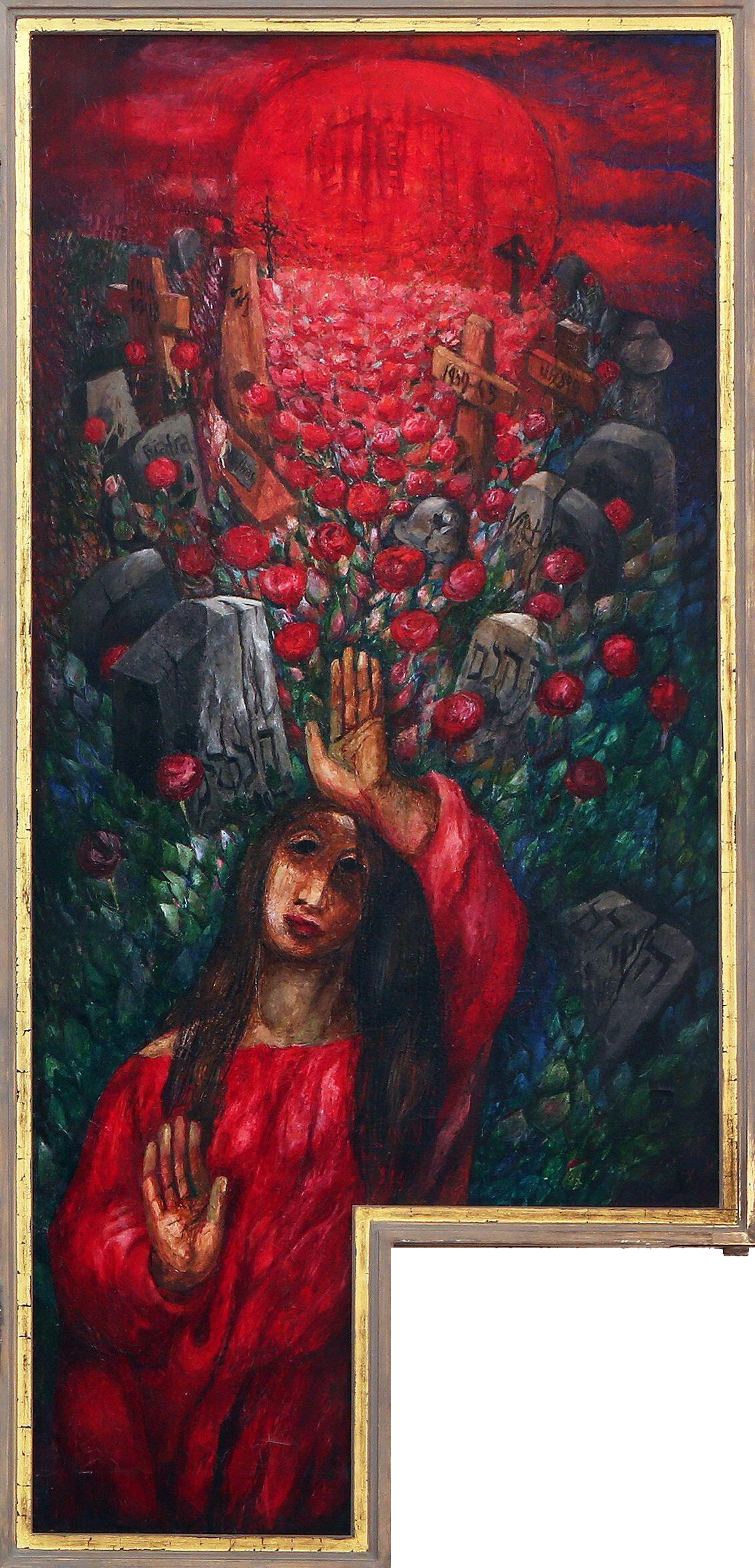
The bright-red morning sun also appears on the inner right panel, which shows another very personal encounter between the risen Christ and a disciple: Mary Magdalene at the empty tomb. In Köder’s visual retelling, Mary wades through a sea of poppies—a red flower symbolic of sacrifice—her hand shielding her eyes from the brilliance of Jesus’s resurrection body. He who she initially thought to be the cemetery gardener is in fact her dear friend and Lord.
Look closely at some of the grave markers, and you’ll notice that they carry the names and/or dates of wars: “1914–1918,” “1939–1945,” “Vietnam,” “Biafra” (a reference to the Nigerian Civil War). The latter two were still raging on when Köder painted this. The artist was actually a prisoner of war during World War II, and underneath the cross representing that war in the painting is a bullet-blasted soldier’s helmet. I take these graves to imply that Jesus’s resurrection put death to death.
I’m not sure what the Hebrew grave inscriptions say—anyone know?
Update, 9/30/21: Dr. Franz Posset, a former student of the artist’s, emailed me today with transcriptions and translations of the Hebrew tombstone inscriptions:
האדם – Adam, The Man (lower right corner, next to Mary’s elbow)
חוה – Eve, The Woman (in the shadows at the right, behind the “Vietnam” tombstone)
החכם – The Wise (to the right of Mary’s raised hand)
כסילה – The Fool (to the left of Mary’s raised hand)
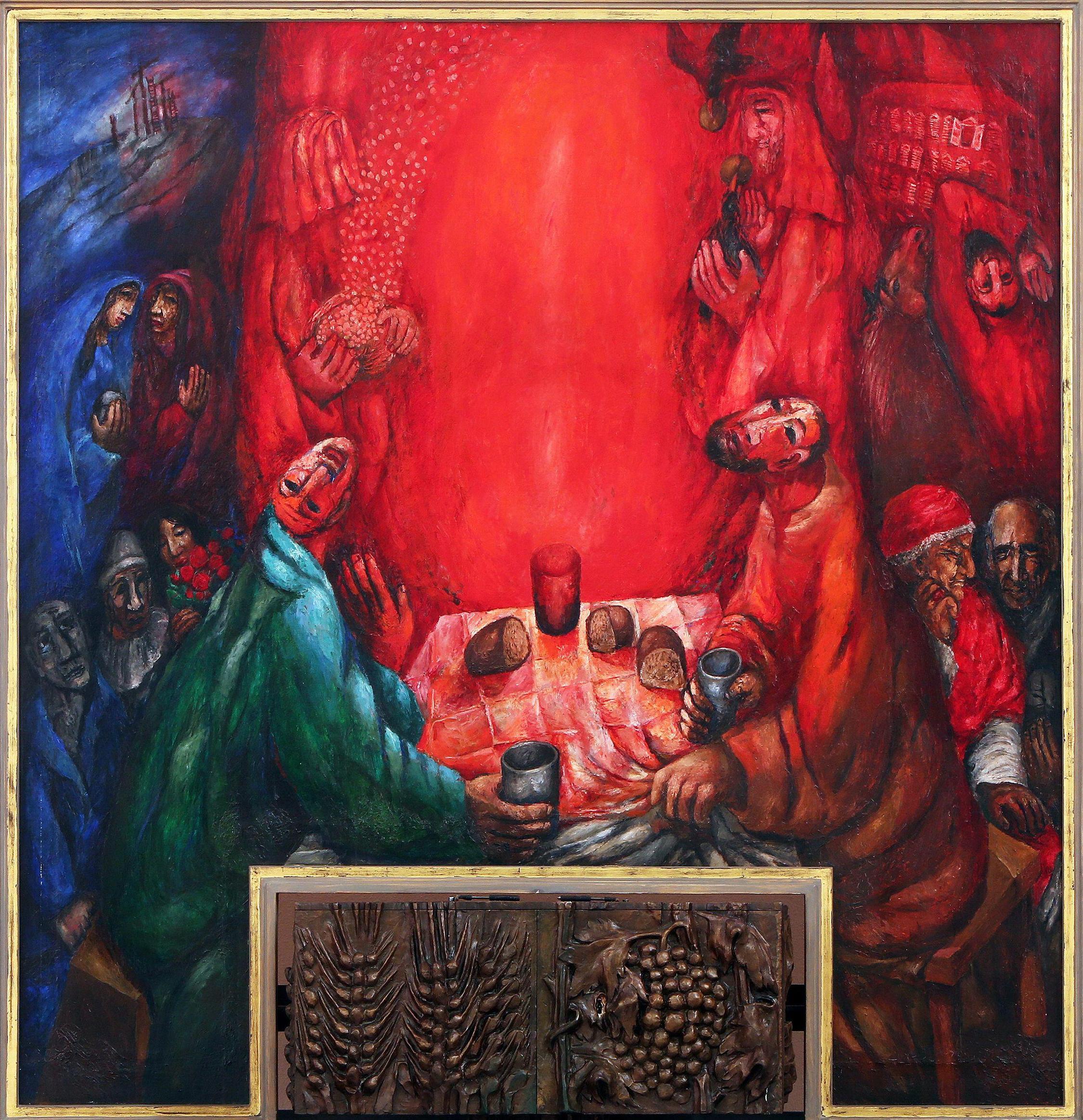
The central panel of the altarpiece portrays the Supper at Emmaus as a sort of Transfiguration à la Mount Tabor, an unveiling of Christ’s glory. Luke tells us that after the resurrection Jesus appeared to Cleopas and another unnamed disciple, who were on their way home from Jerusalem; their hearts “burned within them” as he spoke about the scriptures, but their eyes weren’t opened to his true identity until he blessed and broke the bread at mealtime. In Köder’s painting, Jesus’s form is barely discernible through the red glow—he’s a pillar of light, really. Artists have always struggled to give an impression of what Jesus’s resurrection body might have looked like: it was a flesh-and-bone body, for sure, but a glorified one, not always immediately recognizable, and it seems as though he was able to walk through walls and disappear. Köder bathes him in the color of blood—of his passion, and of life. Köder’s nonrepresentational approach emphasizes the otherness aspect of the newly risen Christ and the marvel the two Emmaus disciples must have felt upon realizing who they were dining with.
Jesus appears between Moses, who holds a basket of manna (Exodus 16), and Elijah, who cradles a raven with a morsel of bread in its beak, a reference to his being fed miraculously by God in the wilderness (1 Kings 17:1–7). The figure to the right of Elijah may be Paul (Saul) fallen off his horse on the road to Damascus.
At Saint Stephen’s the Eucharist is celebrated regularly before this altarpiece. (The metalwork tabernacle below, decorated with stalks of grain and clusters of grapes, is where the eucharistic elements are stored.) Köder reminds partakers that they are covered (pardoned) by Jesus’s blood, that Christ is present in the meal, that he nourishes and sustains his people with his very self. Death has passed over us because it struck the firstborn of all creation, who bore the curse on our behalf. However, death could not keep him down, and on the third day he rose again, appearing to many, the firstborn of new creation. “Mary,” he called out to one of his closest followers outside his tomb, speaking her name in a familiar tone, sparking recognition and joy. “Come and have breakfast,” he called out to Peter. To the Emmaus disciples he illuminated the scriptures and finally revealed himself around a table. Christ invites us into fellowship with him, through his blood.
P.S. It appears there is yet a third configuration of the altarpiece, as indicated by this photo, which includes a Madonna and Child, the Tower of Babel, and I can’t make out the left two panels.
This post belongs to the weekly series Artful Devotion. If you can’t view the music player in your email or RSS reader, try opening the post in your browser.
To view all the Revised Common Lectionary scripture readings for Proper 18, cycle A, click here.