Roundup: Free Bifrost Arts songs, civil religion hymn revised, Bono and Eugene Peterson talk Psalms, Crystal Cathedral transformation, mercy-themed movies

Entire Bifrost Arts catalog available for free download: For a limited time, the Christian music collective Bifrost Arts is offering all forty-eight of their songs for free download from NoiseTrade. Donations are welcome—100 percent of them will go to the Salt and Light Artist fund, which funds residencies for Christian artists in Arab countries, providing a platform for interaction with the local arts community.

Alternative song lyrics for “America, the Beautiful”: In 1993 Sister Miriam Therese Winter adapted the lyrics to “America, the Beautiful” to make the song more appropriate for a Christian worship service (i.e., less nationalistic). Her adaptation is #594 in the United Church of Christ’s New Century Hymnal.

Interview with Bono and Eugene Peterson on the Psalms: This short film, released in April, documents the friendship between Bono (of the band U2) and Eugene Peterson (author of contemporary-language Bible translation The Message) revolving around their common interest in the Psalms. Inspired by their conversation, interviewer David Taylor compiled a list of resources for exploring the Psalms.

Transforming a Protestant worship space into a Catholic one: The largest glass building in the world, the Crystal Cathedral in Orange County, California, has been undergoing renovations since having been sold in 2013 by the Reformed Church in America to the Roman Catholic Diocese of Orange. “Our charge is to convert an open, all-glass Evangelical church into a great Catholic cathedral to serve its centuries-old sacraments and ritual processions, and to reinforce the centrality of the Eucharist,” write architects Scott Johnson and Frank Clementi. This article published in Faith and Form describes some of the symbolic, aesthetic, environmental, and technical challenges of this project and includes renderings of the new space, which is scheduled to reopen next year.

Crystal Cathedral renovations

Top 25 films on mercy: I’ve been enjoying these top 25 film lists put together by the Arts & Faith online community—especially how they reach beyond the obvious choices, dipping into the silent era as well as non-American cinema. Here’s their latest, a list of films that “show us visions of a world so often lacking in mercy, as well as worlds in which one merciful act alters the landscape of human experience forever.” Click here to view their other lists: road films, horror films, divine comedies, films on marriage, and films on memory.

Roundup: Mavis Staples documentary, baptizing the imagination, how medieval manuscripts were made, Nubian Christian art, and Twain’s war prayer

Mavis!: The HBO documentary Mavis! profiles gospel and soul music legend Mavis Staples, from her rise to stardom as part of the Staples Singers, whose Uncloudy Day was the first gospel album to sell one million copies, and her involvement in the civil rights movement, to her still active career as a solo artist. “I’ll stop singin’ when I have nothin’ left to say,” she says. “And that ain’t gonna happen!” Watch the trailer below.

Luci Shaw on art and Christian spirituality: In this 1998 article from Direction journal, the oh-so-quotable poet Luci Shaw writes about imagination, mystery, receptivity, sacramentality, the similarities between art and faith, and her muse, the Holy Spirit. Concludes with her poem “Ghostly,” which explores the Spirit’s different manifestations.

Making medieval manuscripts: Through narrated demonstrations, this video by the Getty Museum shows how paper, pens, ink, paint, book covers, and bindings were made during the Middle Ages—laborious processes! It also shows how the illuminators (visual artists) worked with the scribes (calligrapher-copyists), jobs typically filled by two separate people.

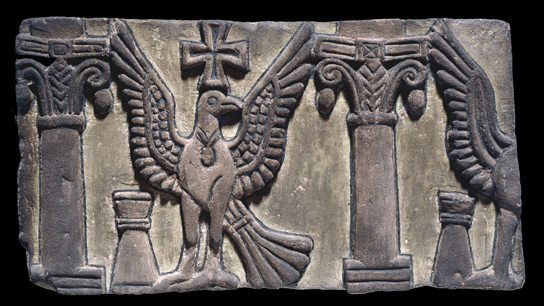
Christianity on the Middle Nile: The two largest Christian kingdoms in the medieval world were actually in modern-day Sudan, writes curator Julie Anderson in a British Museum blog post from 2014: the Makuria and the Alwa kingdoms. Many wall paintings and other objects have been excavated from Faras Cathedral and its adjoining tombs, such as the pottery lamp (with the inscription “Great is the name of God”) and sandstone frieze fragment in the British Museum’s collection. (The paintings are divided between the Sudan National Museum and the National Museum of Warsaw, as it was a Polish team that rescued them from flooding by Lake Nasser.)

Faras Cathedral frieze fragment
Seventh-century sandstone frieze fragment from the former Faras Cathedral in Nubia. Collection of the British Museum.
Fiery Furnace fresco from Faras Cathedral
Fresco from the former Faras Cathedral in Nubia depicting the three youths in the fiery furnace. Collection of the National Museum of Sudan.

“The War Prayer” by Mark Twain: In his day Twain was radically opposed to American military intervention in Cuba and the Philippines and frustrated by the so-called patriotism that made his fellow countrymen so uncritically supportive of it. The stranger’s speech in Twain’s short story “The War Prayer,” set during a church service, exposes the ridiculousness of some of the prayers that go up during wartime even today.

Roundup: Art & Theology on Twitter, Van Gogh earthwork, flowers overhead, God in pop culture, Raised documentary

After years of hesitance, I’ve finally decided to try out this whole Twitter thing. My handle is @artandtheology. I will be sharing posts from the blog as well as retweeting others in the field. Feel free to engage with me there.

+++

Van Gogh’s Olive Trees reinterpreted as earthscape for aerial viewing: Last year the Minneapolis Institute of Art commissioned earthworks artist Stan Herd to recreate Vincent Van Gogh’s Olive Trees, an important painting in its collection, on a 1.2-acre plot of land so that people flying into the Minneapolis–Saint Paul Airport could look down from their windows and be welcomed to the city (and invited to the museum!). Watch Herd at work on the project in the video below.

+++

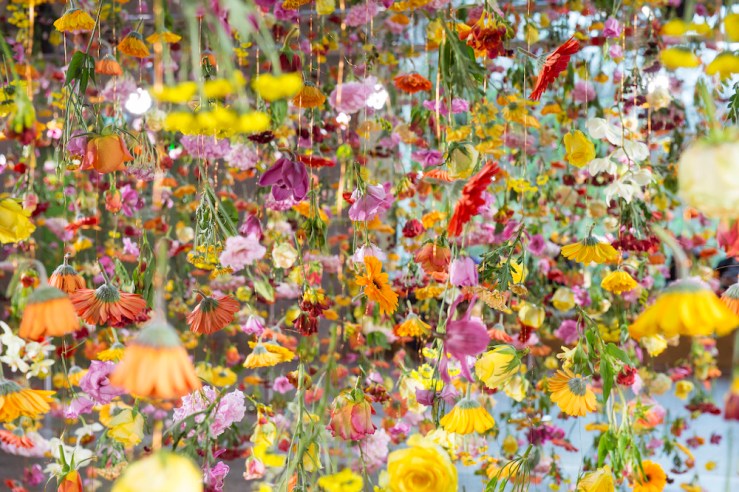
Deconstructed flower garden suspended in air: To herald the start of spring, London-based installation artist Rebecca Louise Law has suspended 30,000 live flowers from copper wire in the atrium of the concept shopping mall Bikini Berlin in Germany, giving shoppers a perhaps unexpected taste of natural beauty. Natural materials, especially flora, are Law’s specialty. Visit her website to view more of her stunning works (The Yellow Flower from Sasebo, Japan, is probably my favorite), or stop by Bikini Berlin anytime through May 1 to experience Garten.

Garten by Rebecca Louise Law

Garten by Rebecca Louise Law

+++

10 best representations of God in culture: My friend Paul Neeley alerted me to this recent list published in The Guardian. Culled from film, theatre, and visual art, several of these are new to me!

+++

Book and documentary collaboration on the Resurrection: In 2014 Zondervan published Raised? Finding Jesus by Doubting the Resurrection by Jonathan K. Dodson and Brad Watson to demonstrate why the bodily resurrection of Jesus is believable and the possibilities it offers for a life of hope. As a tie-in to the book, Moving Works created a four-part documentary in which Benjamin and Jessica Roberts tell the story of how Christ’s resurrection has personally impacted them. Watch the documentary below, and click here to access related materials for small group study.

Schreck-Botts “Via Dolorosa” video collaboration

While working at a rehabilitation center for torture survivors in Chicago, Greg Halvorsen Schreck was struck by the profound physical and emotional traumas these individuals had experienced. He thought of Christ, who suffers in solidarity with those who suffer. And he thought that as a fine-art photographer, maybe he could tell the story of this via dolorosa (“way of sorrow”) they were traveling, by linking it to the medieval Christian devotional practice of the fourteen stations of the cross.

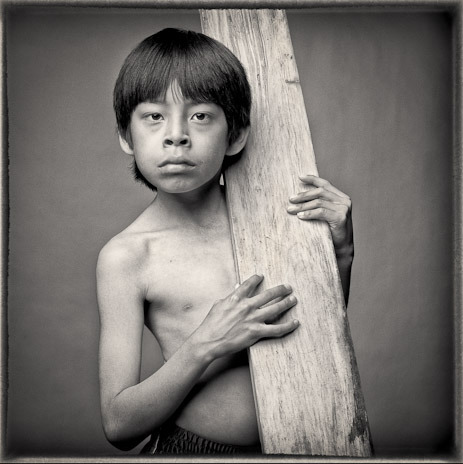
Station 2 by Greg Schreck
Greg Halvorsen Schreck (American, 1957–), Station 2: Jesus is given his cross, from the Via Dolorosa project, 2012. Photograph.

The stations of the cross originated in the thirteenth century as a way for Christians to enter more fully into Jesus’s last hours by praying visually, verbally, and bodily with fourteen images that highlight various points along his journey to the cross, from his trial to his entombment. Derived from the scriptural accounts (save for the legendary addition of Veronica’s veil, plus the embellishment of Christ’s three falls), the stations offered a stay-at-home alternative for Christians who couldn’t afford a pilgrimage to Jerusalem: instead of literally walking the road between Antonia fortress and Golgotha, they could walk it metaphorically, in their imaginations, with fourteen way stations to provide particular foci.

The models Schreck used in his Via Dolorosa cycle—which can be viewed in full here, and in the video below—are not themselves torture survivors. (That would have posed a safety risk.) But “the stories and the general ethos of those in our midst wounded by war, political upheaval, and unspoken violence shaped my approach,” he said.

It was important to him to portray a range of ethnicities—which is why his stations include people not only of European descent but of Latin American, Caribbean, Middle Eastern, East Asian, and African descent, including a few of mixed race. The falling Christ is portrayed by a Mexican American veteran of the Iraq War. Simone of Cyrene is portrayed by an Ethiopian woman. Mary Magdalene, with her jar of incense, is portrayed by a woman who is half-Syrian.

Schreck also included his two children, adopted from Guatemala, in the project. His daughter, Magdalena, is cast alongside three of her friends as a daughter of Jerusalem in station 8 (top left). His son, Teo, is featured in stations 2 and 13; in the latter, Schreck himself stands in for Joseph of Arimathea or Nicodemus, a reference to Michelangelo’s self-portrait in his Florence Deposition sculpture, Schreck says.

His wife, Karen, poses as Mary in station 4.   Continue reading “Schreck-Botts “Via Dolorosa” video collaboration”

Cute-love roundup for Valentine’s Day

The feast day of Saint Valentine on February 14 is associated in popular culture with romantic love because of the legendary account of Valentine’s subversive performance of wedding ceremonies in Rome during a national ban in the third century. Wanting to build a strong army, Emperor Claudias II had issued an edict that prohibited the marriage of young people; unmarried soldiers, he thought—who are less concerned with the risks of war—fought better than married ones. Not wanting to deny couples the privilege of marriage, Valentine, a priest, secretly wed them. He was eventually caught, imprisoned, and executed, for this as well as other offenses of a Christian nature.

In honor of our brother’s witness, here are three works of love-themed art—a musical short film, a Latin ballroom dance, and a collection of comics—for you to enjoy with your significant other this Valentine’s Day weekend. Romantic love, of course, has many shades; this is a look at its sweet shade.

Lava by Pixar:

This 2014 computer-animated musical short written and directed by James Ford Murphy tells the story of two Pacific Ocean volcanoes who, after millions of years of waiting, find love. It features the voices of Kuana Torres Kahele as Uku and Napua Greig as Lele: “I lava you,” they sing to a ukelele accompaniment. I’m a sucker for word puns, so this video lights me up.

Samba from Dancing with the Stars:

Choreographed and performed by Maksim Chmerkovskiy with his season 18 celebrity partner, Olympic athlete Meryl Davis, this samba—a dance of Afro-Brazilian origin—is here given a subtle Indian flair, as its soundtrack is “I Wanna Be Like You” from Disney’s The Jungle Book.

Illustrations from Soppy:

In 2014 Philippa Rice published Soppy: A Love Story, a collection of comics inspired by real-life moments she’s shared with her boyfriend, Luke Pearson. Its premise is that love can be found in simple, everyday intimacies, like impromptu cuddling on the couch, brushing your teeth side-by-side, or lending sympathy for a cup of tea gone cold. When I think about the times I treasure most with my husband, they are the sum total of all these understated forms of bonding Rice has highlighted. View a sampling of illustrations from the book at BoredPanda.com.

Philippa Rice illustration
“You can be in the same room without having to do everything together.”
Illustration by Philippa Rice
“Even shopping for food can be exciting.”