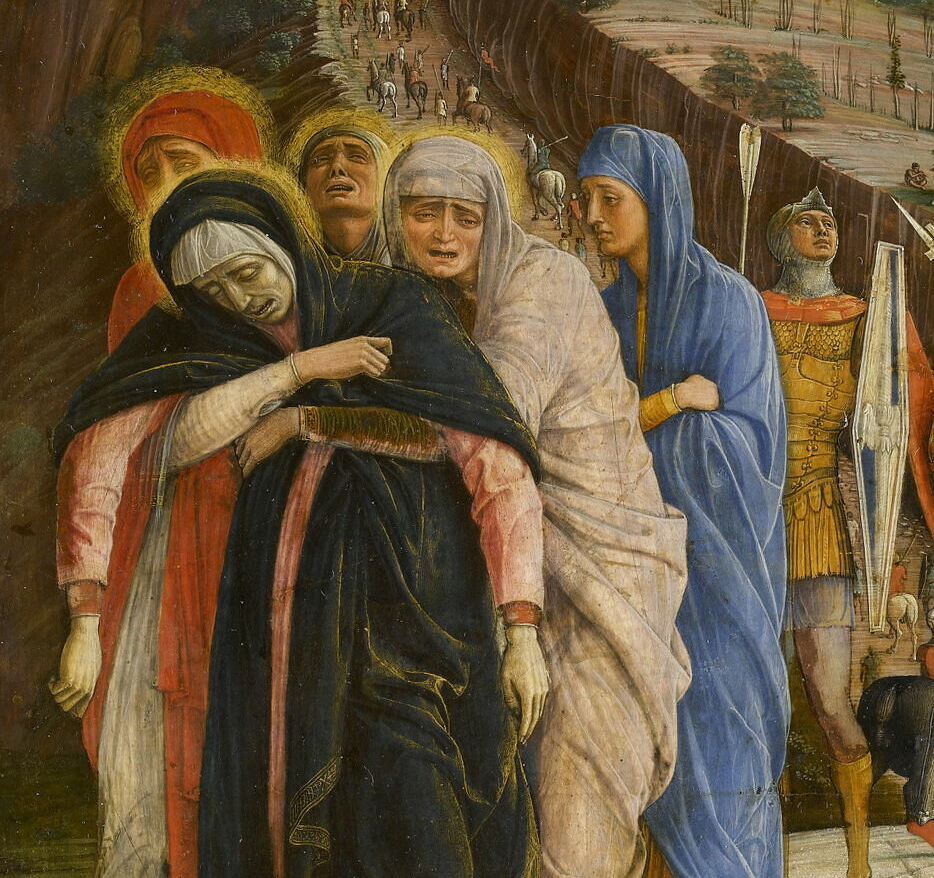
Andrea Mantegna (Italian, ca. 1431–1506), The Crucifixion, 1457–59. Tempera on panel, 75 × 96 cm. Musée du Louvre, Paris. [object record]
There’s much to look at in this painting. I want to focus on Jesus’s grieving mother under the cross to our left.
In Renaissance art of the Crucifixion, Mother Mary is often shown swooning, supported by John or by one of her female companions. Here she’s with a group of four women—the other Marys—two of whom wrap an arm around her to bolster her up when her legs give out. Her son has just died, and she can’t bear to look.
This work was painted by Andrea Mantegna between 1457 and 1459 as the central element of the predella (base) of the high altarpiece at San Zeno in Verona, Italy, a monumental work of art. In 1797, French Napoleonic forces plundered the altarpiece and brought it to Paris; the country returned the three main panels to Verona in 1815 when Napoleon lost power, but they kept the three predella panels, which are on display in museums: The Crucifixion at the Louvre, and The Agony in the Garden and The Resurrection at the Musée des Beaux-Arts in Tours.
LISTEN: “Swete Sone” | Words: Anon., 14th century (before 1372) | Music by Katharine Blake, 1998 | Performed by Mediæval Bæbes on Worldes Blysse, 1998
This song is in Middle English. If you’re reading along with the lyrics, you’ll want to know that the letter thorn, þ, says th; and u makes a w or v sound.
Suete sone, reu on me, & brest out of þi bondis; For [nou] me þinket þat i se, þoru boþen þin hondes, Nailes dreuen in-to þe tre, so reufuliche þu honges. Nu is betre þat i fle & lete alle þese londis.
Suete sone, þi faire face droppet al on blode, & þi bodi dounward is bounden to þe rode; Hou may þi modris herte þolen so suete fode, Þat blissed was of alle born & best of alle gode!
Suete sone, reu on me & bring me out of þis liue, For me þinket þat i se þi detȝ, it neyhit suiþe; Þi feet ben nailed to þe tre—nou may i no more þriue, For [al] þis werld with-outen þe ne sal me maken bliþe.
Sweet son, have pity on me, and break out of your bonds; For I think I see through both your hands Nails have been driven into the tree, so painfully you hang there. It would be better if I fled now and abandoned all these lands.
Sweet son, your beautiful face is dripping with blood, And your body beneath is bound to the cross; How will your mother’s heart endure [the suffering of] such a sweet child, Who was born most blessed of all and was the most goodly of all!
Sweet son, have pity on me and deliver me from this life, For I think I see your death approaches quickly; Your feet have been nailed to the tree—now I may never prosper, For without you, all this world can never make me happy.
These three monorhyming quatrains are from John of Grimestone’s commonplace book, where he jotted down material for sermons; it’s unknown whether they’re original to him or compiled from some other source. (For other lyrics I’ve featured from this notebook, see “Undo Thy Door, My Spouse Dear” and “Love Me Brought.”)
In the poem, written in Mother Mary’s voice, Mary reveals a premonition she’s had of her son being nailed on a tree to die. (At least that’s how I read it, mainly because of the “I think I sees.”) She agonizes over this nightmare and asks Jesus that if it be true, to deliver her from this life, as she won’t be able to endure the sorrow of losing him.
Verses like these really humanize Mary, a woman who, faithful as she was to God’s unfolding plan, felt the intense parental pangs that inevitably accompany witnessing one’s child being brutalized and killed.
The poem has been set to medieval-style music by Katharine Blake, the founder of Mediæval Bæbes, a classical chart–topping British music ensemble celebrating its thirtieth anniversary this year.
The song opens with an unaccompanied solo voice singing in free time. In the second half of the first stanza, additional voices enter, as well as a strummed instrument. Then with “& þi bodi dounward is bounden to þe rode,” the tempo quickens; a 2/4 meter takes shape and regularizes, with percussion keeping the beat; and the volume amplifies with twelve women now singing. With the final stanza, there’s once again a softening as the song returns to a single vocalist and the instrumentation drops out. This movement from weary pain, Mary barely able to speak it aloud, to foot-stomping anger, which her friends join in solidarity, and back to solitary desolation captures different shades of grief.
For a wholly a cappella solo rendition, see this performance by Ariana Ellis:
They will mock him and spit upon him and flog him and kill him . . .
—Mark 10:34
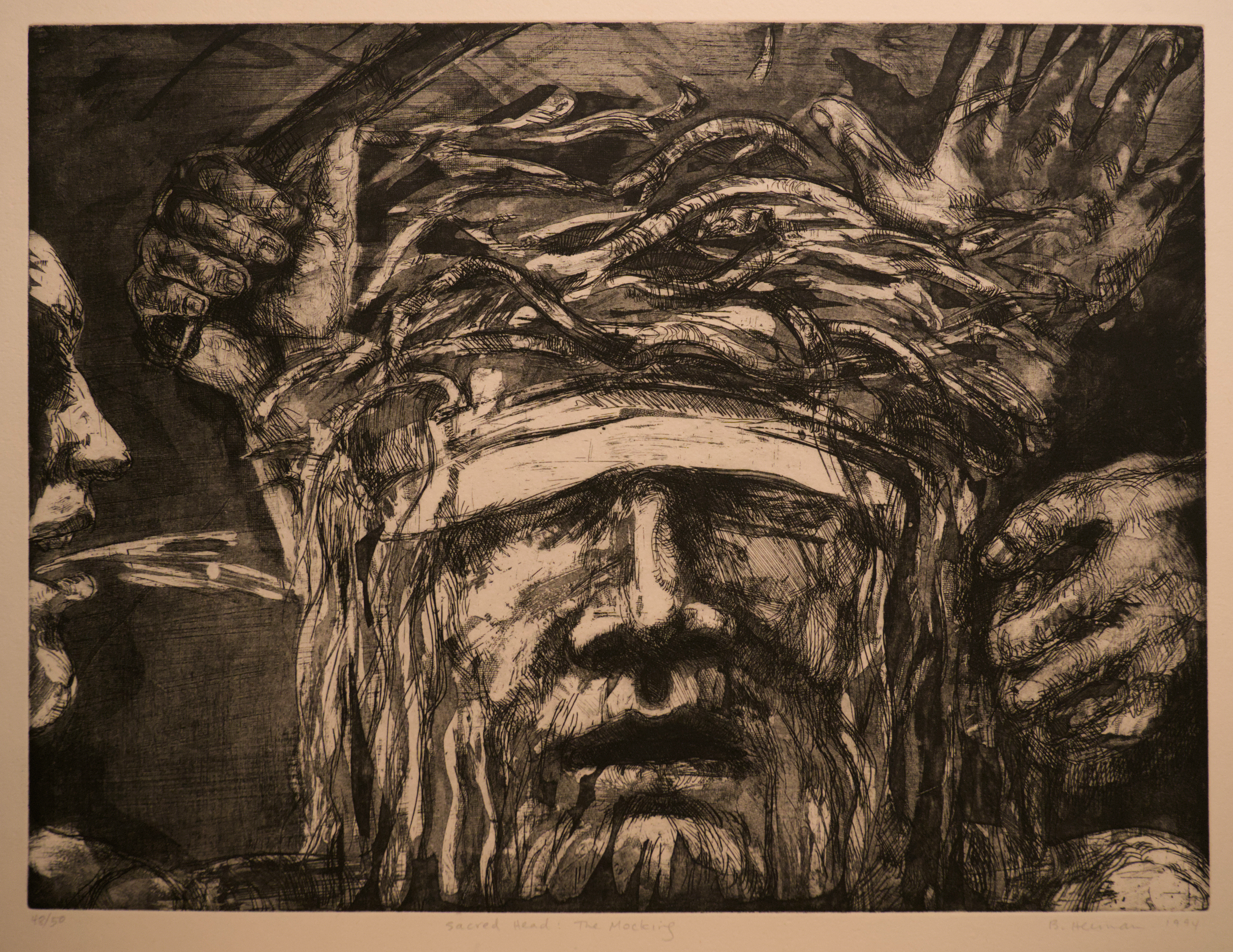
LOOK: Sacred Head II: The Mocking by Bruce Herman
Bruce Herman (American, 1953–), Sacred Head II: The Mocking, from the Florence Portfolio, 1994. Intaglio, edition 48/50, sheet 21 1/2 × 30 1/8 in., image 17 3/4 × 23 5/8 in. Collection of Victoria Emily Jones.
The Florence Portfolio is a suite of twenty intaglio prints based on the biblical theme of sacrifice, made by six artists from Christians in the Visual Arts (CIVA) who lived and worked together for a month in Florence, Italy. I purchased two limited-edition portfolio prints—this one, and Wayne Forte’s Deposition—from the CIVA store shortly before the organization closed its operations in 2023.
A tightly cropped image of Christ’s blindfolded face, Bruce Herman’s Sacred Head II: The Mocking conveys disorientation. Hands slapping, shoving, pounding. Spittle on the cheek, in the ear. A nest of thorns piercing the scalp. Taunting epithets and derisive laughter. A cracking scourge. This is only a fraction of the violence and humiliation Christ suffered in the hours before his death.
Pilate took Jesus and flogged him Soldiers, they twisted a crown of thorns And put it on his head And arrayed him in a purple robe
Hail, King of the Jews! Hail, King of the Jews!
And they struck him with their hands And when they had mocked him They stripped him of the purple robe And put on his own clothes And they led him away To crucify him
They went to a place called Gethsemane, and [Jesus] said . . . “My soul is deeply grieved, even to death. . . . Abba, Father, for you all things are possible; remove this cup from me, yet not what I want but what you want.”
—Mark 14:32, 34, 36
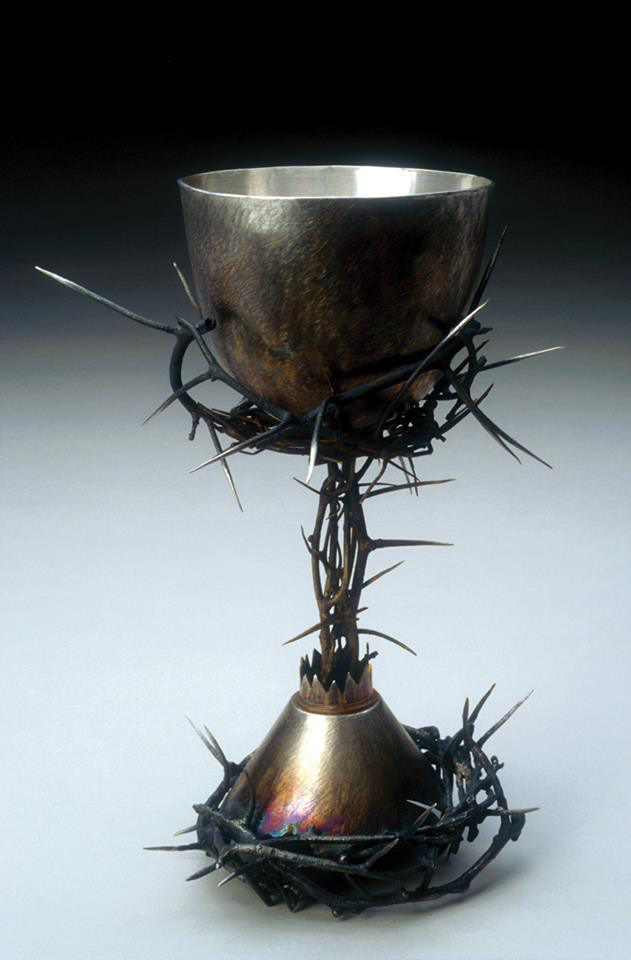
LOOK: Can you drink the cup I am about to drink? by John Kiefer
John Kiefer (American, 1944–), Can you drink the cup I am about to drink?, 1999. Sterling silver and other metals, 10 × 3 × 3 in. Bowden Collections, Chatham, Massachusetts.
Fr. John Kiefer is a Catholic priest, metalsmith, and woodworker from Indiana. His piece Can you drink the cup I am about to drink? is from the collection of Sandra and Bob Bowden in Chatham, Massachusetts, and is part of the traveling exhibition they loan out called Come! The Table Is Ready.
Can you drink is a silver chalice enwrapped ominously, cup and foot, by thorns. In the Bible, a cup often symbolizes one’s portion or destiny that comes from God. Jesus’s cup entails suffering and premature death. Deeply distraught, Jesus asks his Father, if it be possible, to remove the cup.
Request denied.
Within eighteen hours of voicing this prayer, Jesus is taken, tried, tortured, and killed—“tast[ing] death for everyone” (Heb. 2:9).
Some biblical commentators have interpreted the cup Jesus must drink as God’s wrath over sin, as that metaphor—cup as bitter-tasting divine punishment poured out—was a common one in the ancient Near East, including in the Bible. But that doesn’t make sense if we pull in what Jesus says to James and John earlier, in Matthew 20:22 (cf. Mark 10:38): “Are you able to drink the cup that I am about to drink?” They affirm yes, and Jesus corroborates: “You will indeed drink my cup . . .”
This is why the cup is best understood more generally as one of suffering. So argues Raymond E. Brown in his magisterial two-volume work The Death of the Messiah, albeit conceding that “some of the connotation of the classical cup of wrath or judgment may be preserved in Mark [14:36], not in the sense that Jesus is the object of wrath, but inasmuch as his death will take place in the apocalyptic context of the great struggle of last times when God’s kingdom overcomes evil” (1:170).
Archimandrite Seraphim Bit-Kharibi [previously] is an Assyrian Orthodox priest living in the country of Georgia. He is one of the few priests in the world who celebrates the Divine Liturgy in Aramaic, the language of Jesus. The video above shows him chanting the words Jesus prayed in the garden of Gethsemane the night before his execution.
I wasn’t able to find the full text he uses (and my email inquiry went unanswered), but I’m fairly sure the core is this:
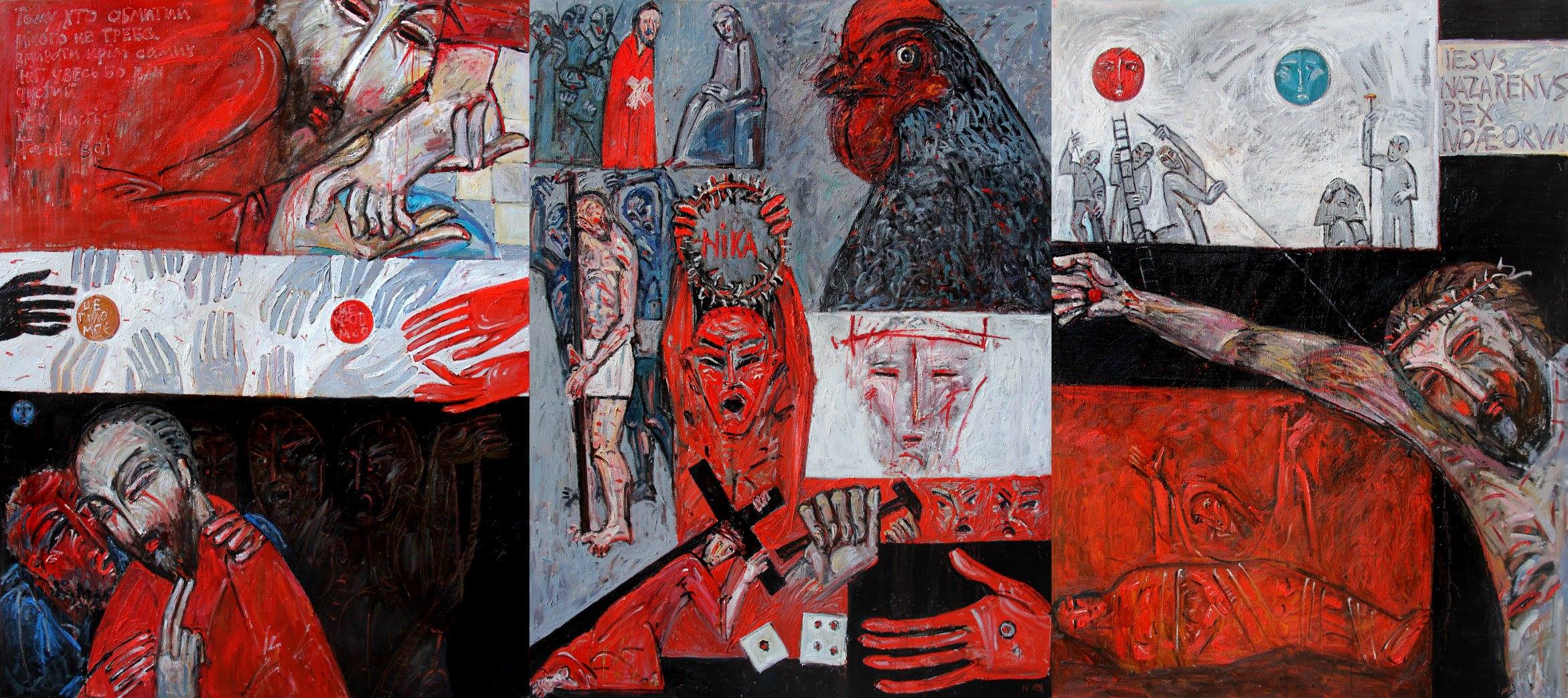
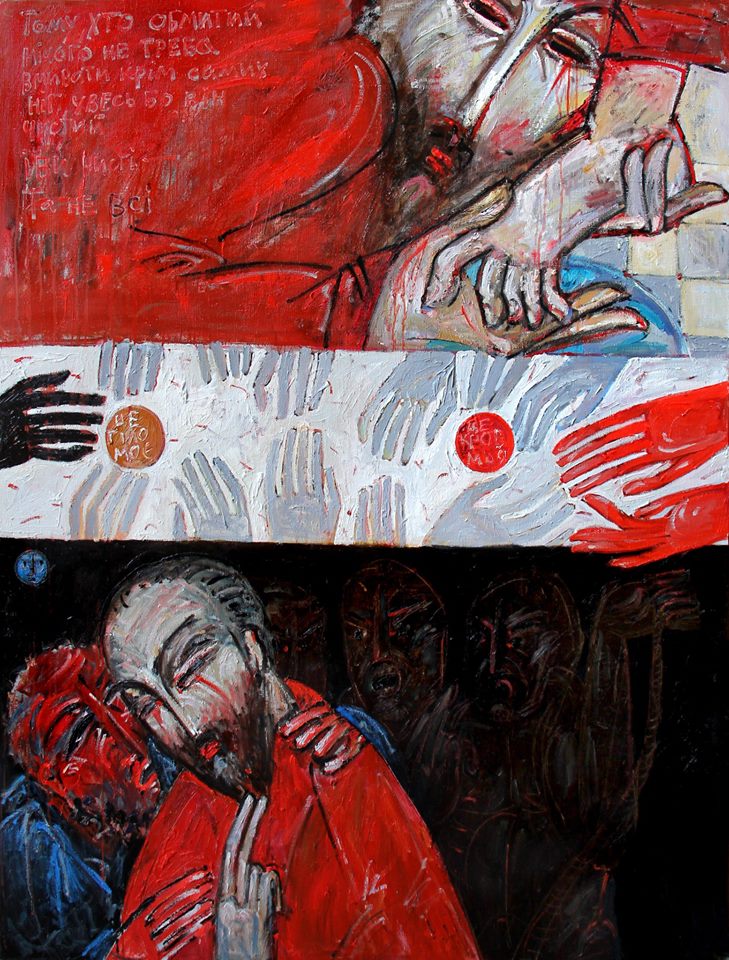
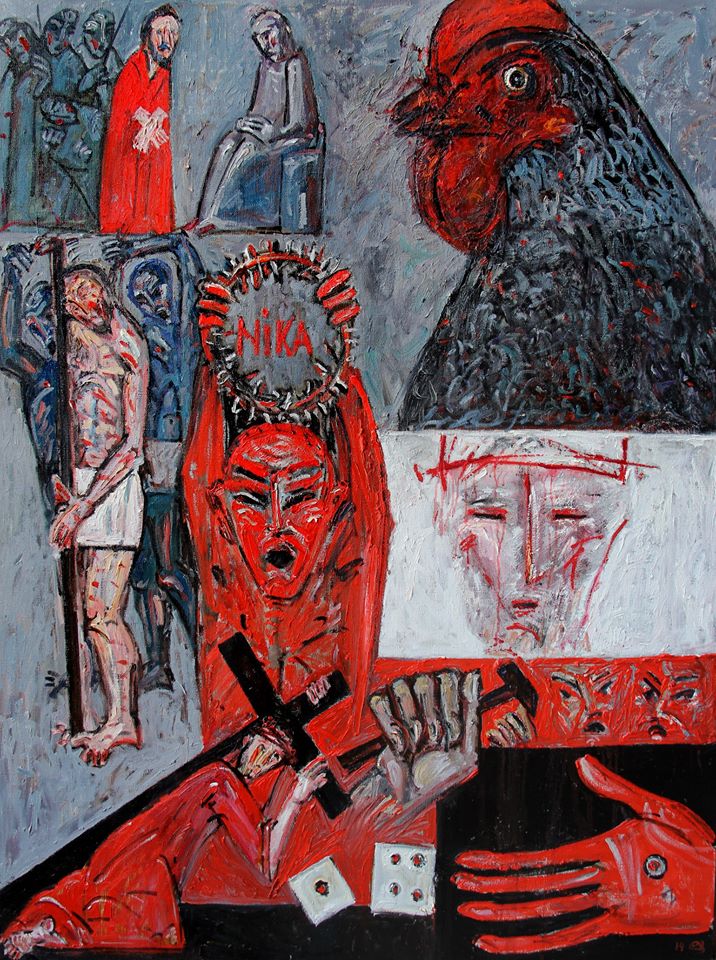
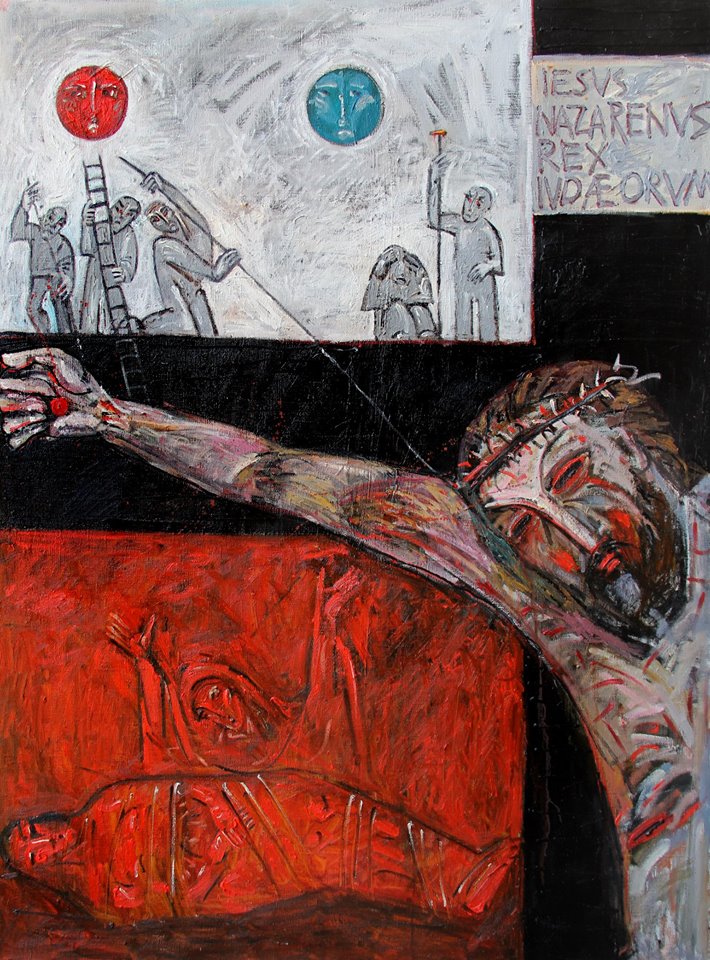
This painting by the late Ukrainian artist Ostap Lozynsky portrays a handful of episodes from Passion Week: Jesus washing his disciples’ feet, the Last Supper, the Kiss of Judas, Christ before Pilate, the Flagellation, the Crowning with Thorns, Peter’s denial (represented emblematically by the rooster), Christ taking up his cross, Christ being nailed to the cross, the Crucifixion, and the Lamentation over the Dead Christ.
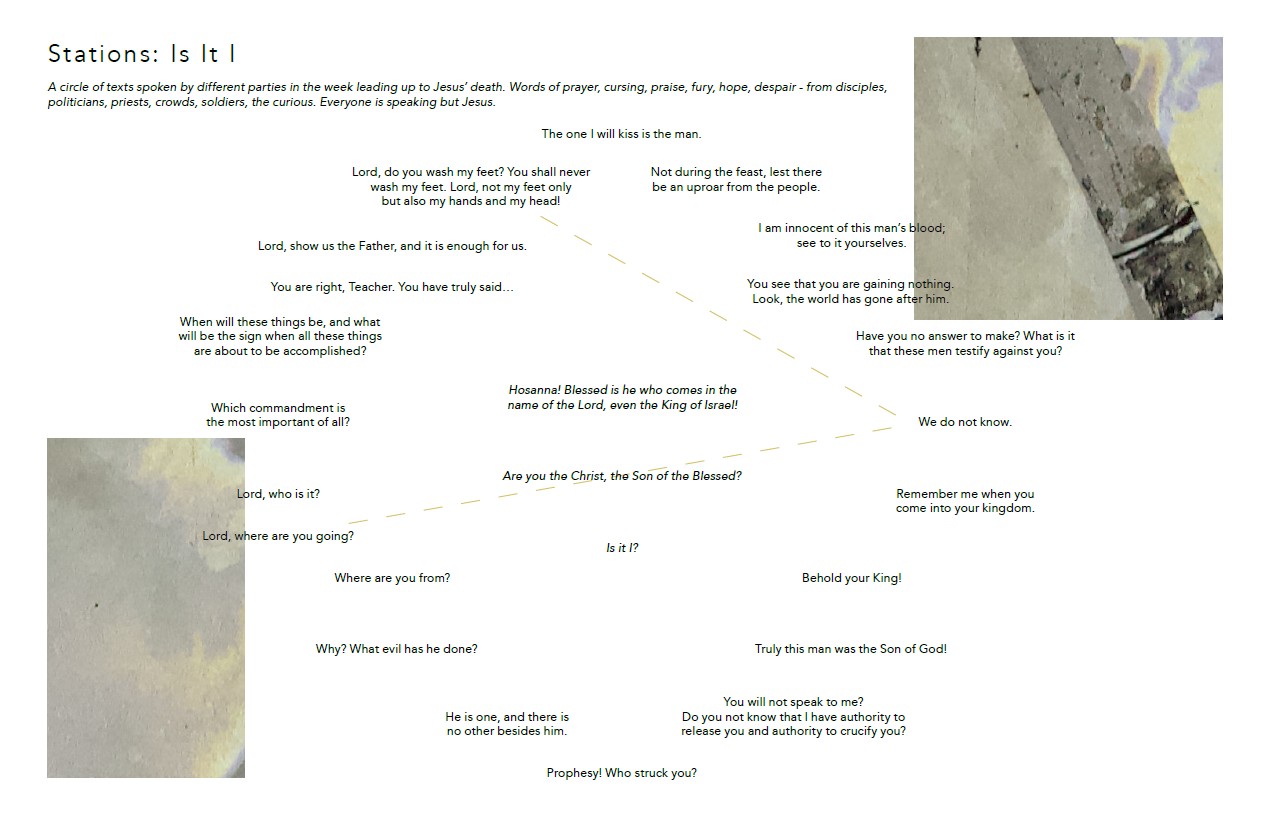
From liner notes of PRIMEMOVER by Joshua Stamper. Pinch to zoom, or if on a computer, right-click and open the image in a new tab to enlarge.
Joshua Stamper is “a transdisciplinary artist and composer whose work explores hiddenness, revelation, ephemera, and archive.” Commissioned by Resurrection Philadelphia, his “Stations: Is It I” composition collages spoken “words of prayer, cursing, praise, fury, hope, despair—from disciples, politicians, priests, crowds, soldiers, the curious,” all parties connected to Jesus’s final week. The texts are taken from scripture.
The cacophony is stressful. Maybe you turned off the recording before it finished, unable to bear it. I encourage you to stick with it for the full four minutes and twenty-one seconds, as a way of sitting with the discomfort and chaos of Christ’s passion, of entering into this story that’s at the center of the church’s proclamation.
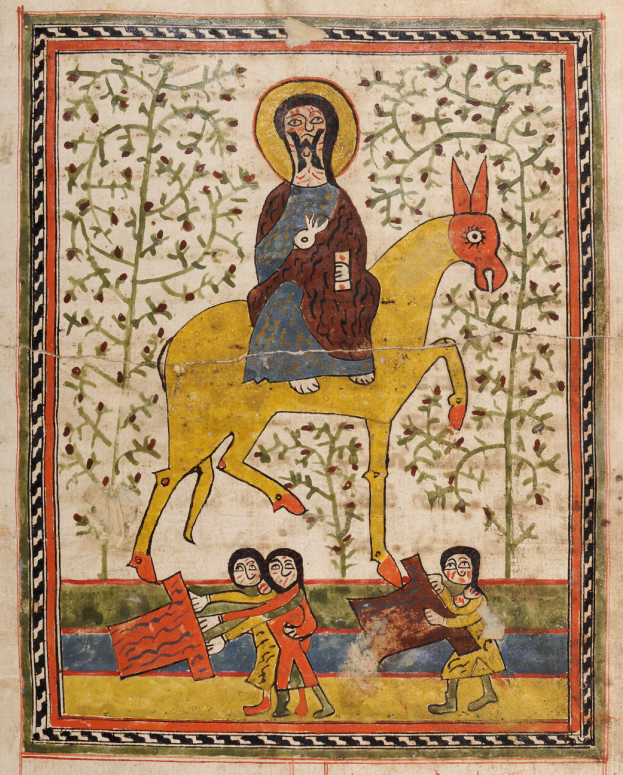
Christ’s Entry into Jerusalem, Alqosh, Iraq, 1723, from a Syriac Gospel lectionary. Collection of the Dominican Friars of Mosul (DFM 13, fol. 43v). Digitized in collaboration with the Centre Numérique des Manuscrits Orientaux (CNMO), Ankawa, Erbil, Iraq.
Made three centuries ago at a monastery in Iraq, this is one of three figurative paintings from a Syriac Gospel lectionary, the other two depicting Thomas touching Jesus’s wounds and the apocryphal saint George defeating a dragon. While the scribe is named in the manuscript as ʼEliyā bar Yaldā, the artist, if he is a different person (as they usually were), is not identified.
I love the fanciful coloration! Yellow and orange for the donkey, and a tricolored road of yellow, blue, and green. Plus, in the background, fruiting tree branches that climb and curl. The red striations on the figures’ necks and faces are, as far as I know, an idiosyncratic aesthetic choice of the artist’s; they may signify blood running through the veins, or perhaps the marks are simply decorative.
While the donkey is shown in profile, clopping along toward Jerusalem’s city center, Jesus rides sidesaddle and is oriented toward us, his eyes meeting ours. He holds a scroll in one hand, signifying that he is the fulfillment of Old Testament prophecies (most directly in this moment, Zechariah 9:9), and his right hand, which is heavily stylized, I can only assume is raised in a gesture of blessing, as it is in many other images of this subject.
At his feet, the people spread their cloaks, a sign of reverence.
Addendum: The following video of Palm Sunday celebrations in Iraq showed up in my Instagram feed a few hours after I published this blog post, and I thought it fitting to add.
LISTEN: “Hosanna! (Matthew 21:9 & 11)” by Frank Hernandez, for Steve Green’s Hide ’Em in Your Heart: Bible Memory Melodies, 1990 | Performed by Susanna and Rosalia, 2026
Blessed is he who comes in the name of the Lord Blessed is he who comes in the name of the Lord
Hosanna to the Son of David Hosanna in the highest Hosanna to the Son of David Hosanna, this is Jesus
Blessed is he (blessed is he) who comes in the name of the Lord Blessed is he (blessed is he) who comes in the name of the Lord
Hosanna to the Son of David Hosanna in the highest Hosanna to the Son of David Hosanna, this is Jesus
Hosanna (Hosanna) Hosanna (in the highest) Hosanna (Hosanna) Hosanna, this is Jesus
I learned this song two years ago when two girls from my church, sisters, sang it during the offertory for our Palm Sunday worship service. I asked them if they’d be willing to reprise their performance for my blog, as I love the sweetness of their voices together, and they obliged. They are thirteen and eleven years old.
Palm Sunday is an especially great day to utilize the children’s voices in your congregation for music or other parts of the liturgy, as Matthew mentions in his account of Christ’s entry into Jerusalem that “when the chief priests and the scribes . . . heard the children crying out in the temple and saying, ‘Hosanna to the Son of David,’ they became angry and said to [Jesus], ‘Do you hear what these are saying?’ Jesus said to them, ‘Yes; have you never read, “Out of the mouths of infants and nursing babies you have prepared praise for yourself” [Ps. 8:2]?’” (Matt. 21:15–16). “Hosanna” is an expression that in this context means something like “Hooray for salvation!,” as John Piper puts it.
The enthusiasm of the masses upon Jesus’s arrival in Judea’s capital city for Passover, and especially their ascription to him of the messianic title “Son of David” (not to mention “prophet” and “wonderworker”), raised the hackles of the temple leadership. He was a threat to their authority and status and to their understanding of the scriptures. So they purposed, in collusion with Rome, to put him to death.
Holy Week starts this Sunday. Per usual, I’ll be publishing daily art and music pairings during that period (so, too, during the Easter Octave), but here is some additional art and music, and a theological reflection, for the occasion. You might also consider spending time with the Holy Week Playlist I curated on Spotify.
TENEBRAE SERVICE: Good Friday, April 2, 2021, Good Shepherd New York: Not all churches host a service on Good Friday, but for me, it is one of the most meaningful services of the year and helps make Easter all the more potent and celebratory. It wasn’t until 2011 that I attended my first Good Friday service—of the Tenebrae variety, Latin for “darkness,” meaning we started with multiple lit candles, and they were gradually extinguished throughout the evening, symbolizing the Light of the World dying out. If you’re curious about what such a service might look like, here’s a great example from 2021, from Good Shepherd New York. Filmed during the pandemic, it was a digital-only offering. As is typical, it combines song and scripture readings to tell the story of Christ’s death. Some Tenebrae services include a brief homily, but this one does not. I’ve included a list of time stamps to the songs below.
1:15: “When I Survey the Wondrous Cross” by Isaac Watts and Lowell Mason
6:26: “I Need Thee Every Hour” by Annie Hawks and Robert Lowry
24:28: “How Deep the Father’s Love for Us” by Stuart Townend
31:08: “Remember Me” by Paul Zach
35:50: “Were You There?,” African American spiritual (with a watercolor by Soyoung L Kim, inscribed with Isaiah 53:11a: “Out of the anguish of his soul he shall see and be satisfied”)
+++
INSTRUMENTAL MUSIC FOR GOOD FRIDAY: The one Facebook group I belong to is Liturgy Fellowship; I joined when I was a worship planner and stick around because of the many great resources, especially musical ones and ideas for marking holy days as a congregation, that are shared by Christians across denominations. One post I made note of is from Andrew Kerhoulas, the associate pastor at Grace Mills River in Mills River, North Carolina. As a prelude for their 2023 Good Friday service, he said, Grace Mills River musicians played an excerpt from the fifth movement of Olivier Messiaen’s Quartet for the End of Time. Here’s the full movement, performed by cellist Bingxia Lu and pianist Jackie Tu:
“The piece is avant-garde and not a little abrasive to those with pop music sensibilities,” Kerhoulas wrote to the group. “But once you know that it was written in 1941 by a French prisoner of war while in a German prison and first performed for fellow prisoners, it takes on depths of meaning. So too the cross: It is grotesque and horrific, but it becomes meaningful and even beautiful when you know the occasion—the deeper story—in which Jesus gave up his life.”
The church concluded its Good Friday service with a string quintet postlude, “On the Nature of Daylight” by Max Richter, played to the dimming of lights. Again, the following performance is not from Grace Mills River, but rather by Louisa Fuller, Natalia Bonner, John Metcalfe, Chris Worsey, and Ian Burdge for the fifteenth anniversary edition of The Blue Notebooks album.
Some people think that music used in Christian worship as a focal piece (i.e., not in the background) needs to have words to be worshipful and productive. I strongly disagree. Instrumental music conveys beauty and sets a mood and, yes, even communicates—often that which is difficult to express verbally. I love Grace’s thoughtful inclusion of these two modern and contemporary pieces from the classical tradition in their community’s observance of Good Friday.
+++
ART COMPILATION: “Crucifixion: Armenian Illuminated Manuscripts” by Levon Ounanian: This compilation brings together thirty-one Armenian miniatures of Christ’s passion. (Miniatures are painted illustrations in a manuscript, so called not because they’re small, though they usually are, but because artists often sketched them using a red lead pigment called minium.) According to the author, of the 31,000 Armenian manuscripts currently listed around the world, about 6,000 of them contain miniatures, not to mention the many more that contain non-narrative decoration.
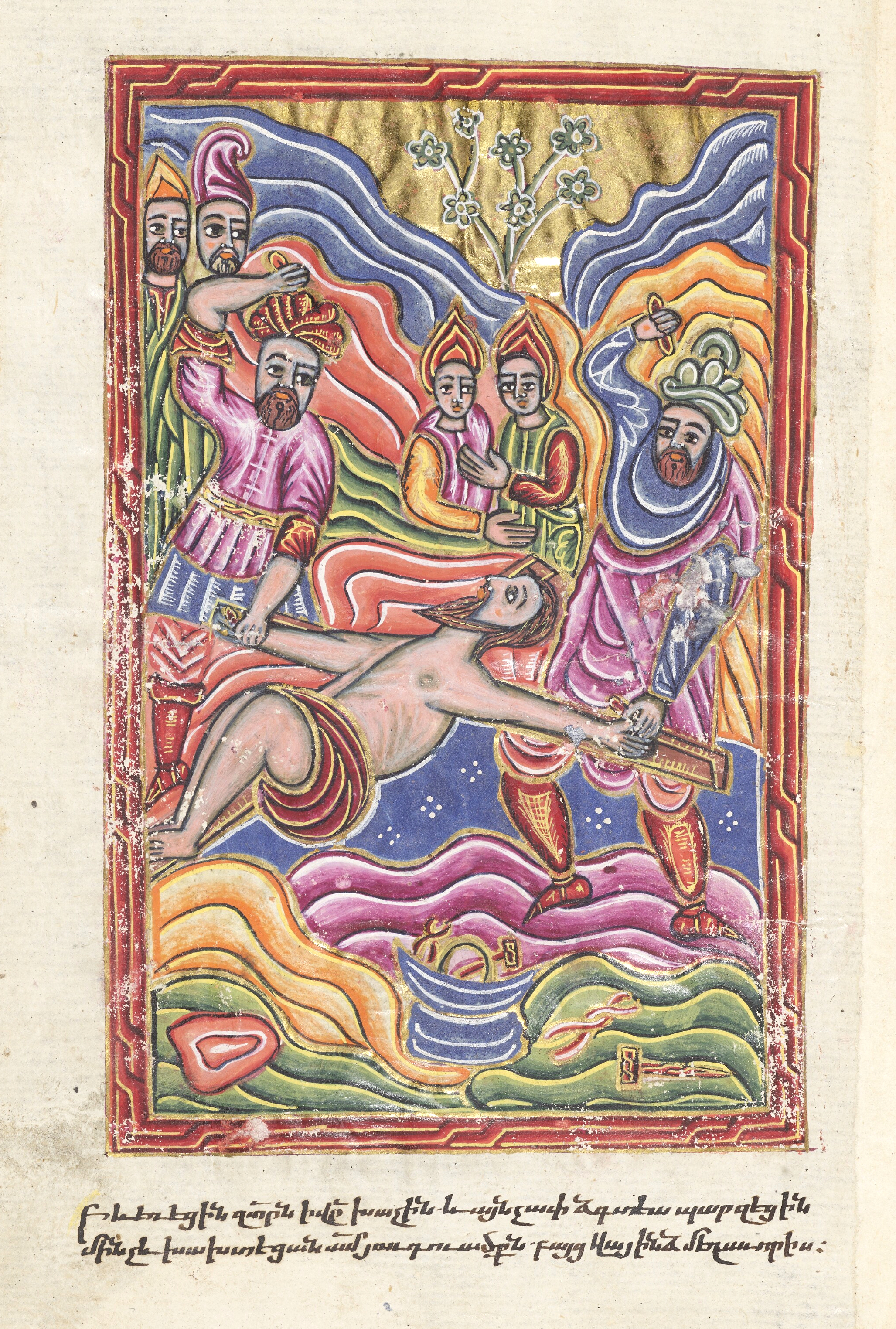
Mesrop of Khizan (Armenian, active in Persia, ca. 1560–ca. 1652), The Nailing on the Cross, from an Armenian Gospel book, 1609. Oxford, Bodleian Library, MS. Arm. d.13, fol. 13v. Click to view the fully digitized manuscript.
+++
SONG: “Saare Paap” (सारे पाप) (All Sins), performed by James Bovas: In this video, James Bovas [previously] performs a Hindi version of a Malayam song about the Crucifixion. The Hindi lyrics and English translation were supplied to me by the Indian gospel media production company Sarah Creation.
सारे पाप और दाग ममटाकर, मुक्क्त देने के मलए मुक्क्त दाता ने बहाया, खून अपना क्रूस से खून के प्यासे भेडियों ने, आके घेरा यीशु को मारे कोिे टोकी कीले, धारे ननकली ज़ख्मों से मेरे मन तू याद कर ले, क्यों सहे दुुःख यीशु ने तेरा खानतर जान देकर, दी ररहाई यीशु ने श्राप सारे लेके मेरे, दे दी मुझको आमशषे यीशु के पावन लहू से, भाग्य मेरे खुल गए
To remove all the stains and sin, and to give salvation The Redeemer shed his blood on the cross Bloodthirsty wolves surrounded Jesus He was scourged, nailed, and a stream of blood issued forth from his wounds O my soul, never forget why Jesus suffered! He gave his life to set you free He took all my curses and gave me all the blessings By the holy blood of Jesus, my destiny changed forever
+++
ESSAY: “The Path from Death to Life” by Kurt Koch, Plough, March 30, 2024: A Catholic cardinal reflects on the dark side and the bright side of Holy Saturday. “As the day Jesus rested in the grave, Holy Saturday is the day of God’s concealment and silence in history,” Koch writes. “And yet, Holy Saturday also has a hopeful and joyful aspect. . . . [On this day] Jesus traveled to [Hades,] the place of greatest loneliness – a place completely bereft of any human relationships – and stirred the souls and limbs trapped by rigor mortis with the warming love of God. He transformed their grave into a place of new life.” This essay is anthologized in the revised and expanded edition of Bread and Wine: Readings for Lent and Easter (Plough, 2026).
There are hundreds of creative works I could feature on the topic of Christ’s wounds. Here are just a few of note.
ARTICLE: “‘Your body is full of wounds’: references, social contexts and uses of the wounds of Christ in Late Medieval Europe” by Johanna Pollick, Emily Poore, Sophie Sexon, and Sara Stradal: In this three-part collaborative essay, I was most intrigued, in part because of its newness to me, by the first section, “The flowering wound: Christ’s heart in Princeton University, MS Taylor 17,” in which Dr. Johanna Pollick explores a small English illuminated devotional book, dating from around 1500, that portrays Christ’s wounds as wells. For help in interpreting these images, she turns to medieval literary traditions as well as to the Carthusian Miscellany.
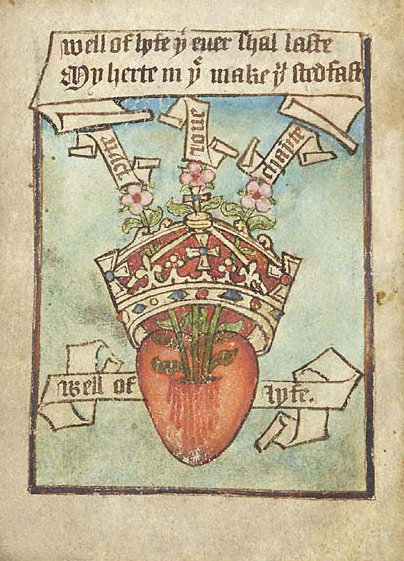
Wounded Heart of Christ as the Well of Lyfe, England, ca. 1500. Princeton University Library, MS Taylor 17, fol. 10v.
Dr. Grace Hamman writes about MS Taylor 17’s extraordinary “well of lyfe” page in Jesus through Medieval Eyes (and for InterVarsity’s The Well), which is what brought me to this essay. The hand-colored image shows flowers—labeled “pyte” (pity), “loue” (love), and “charyte” (charity)—springing forth from the wounded heart of Jesus. The verse prayer at the top reads, “Well of lyfe that ever shall laste / My herte in thee make it stedfast.”
The same theme shows up in another late fifteenth-century English lyric in MS Arundel 286 at the British Library, which appears in modern compilations under the title “The Wounds, as Wells of Life” or “The Wells of Jesus’ Wounds”:
Ihesus woundes so wide
Ben welles of lif to the goode,
Namely the stronde of his syde
That ran ful breme on the rode.
Yif thee list to drinke
To fle fro the fendes of helle,
Bowe thu doun to the brinke
And mekely taste of the welle.
Jesus’s wounds so wide
Are wells of life to the good,
Namely the stream from his side
That ran fiercely on the rood.
If thou list to drink,
To flee from the fiends of hell,
Bow thou down to the brink
And meekly taste of the well.

Trans. Victoria Emily Jones
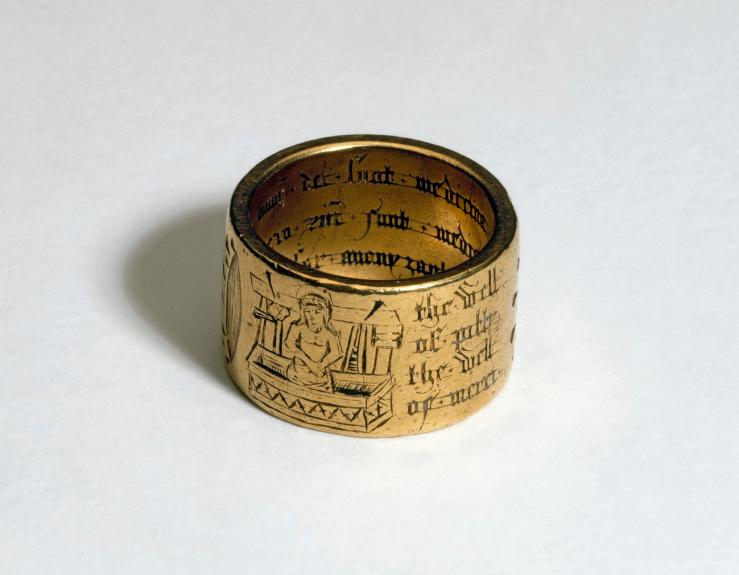
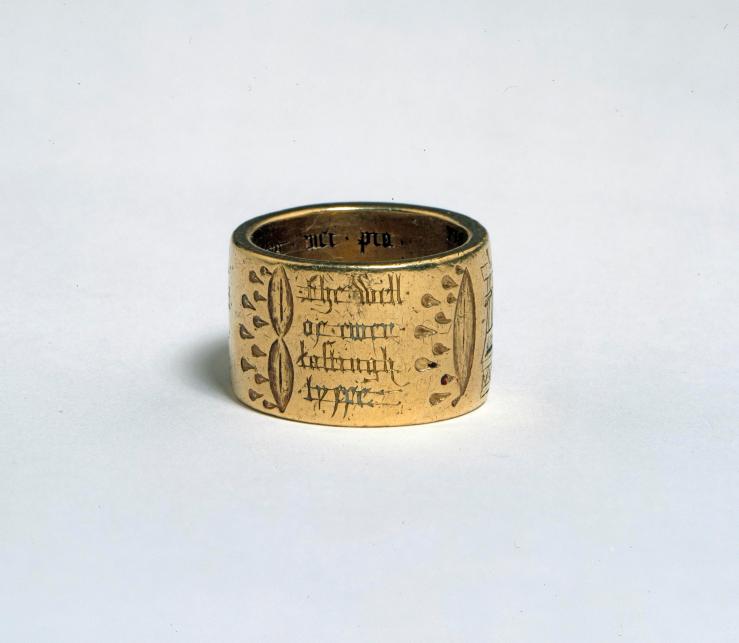
And in a late fifteenth-century gold ring, also from England, engraved with a Man of Sorrows image and hieroglyphs of Christ’s five wounds, labeled “The well of pitty, the well of merci, the well of confort, the well of gracy, the well of everlastingh lyffe”:
SONG: “Deep Were His Wounds” by William Johnson, 1953: This midcentury hymn is composed of three simple stanzas: The first half of each meditates on Jesus’s cruel death on the cross, whereas each second half (“But . . .”) celebrates the healing, freedom, and eternal life that death wrought.
>> Music by Leland B. Sateren, 1958: I like this tune, called MARLEE, but it’s difficult to sing congregationally. Here’s a soloist, Sarah Gulseth, singing it for her church’s 2011 Good Friday service, accompanied on organ by Luther Gulseth:
>> Music by Vito Aiuto, 2008: I was first introduced to “Deep Were His Wounds” through the Welcome Wagon’s debut album, Welcome to the Welcome Wagon, “a ramshackle singalong enterprise of a Presbyterian pastor (the Rev. Vito Aiuto) and his wife (Monique) wrestling out the influences of folk music, religion, popular culture, and church tradition.” Mood-wise, Aiuto’s tune wouldn’t work as well for Good Friday—even given the paradox of that day, it’s too bright, in my opinion, for that somber observance. But it’s great for throughout the year, especially for churches that favor a contemporary/folksy style of music.
+++
CANTATA CYCLE:“Membra Jesu Nostri” (The Limbs of Our Suffering Jesus) by Dieterich Buxtehude: Dieterich Buxtehude (ca. 1637–1707) was a Danish German organist and composer of the mid-Baroque period. For Good Friday 1680, he composed a cycle of seven concerto-aria cantatas. The texts of the aria sections are taken from the medieval Latin hymn “Salve mundi salutare” (Hail, the World’s Salvation) by the Cistercian abbot Arnulf of Leuven (ca. 1200–1250), whereas the concerto section texts are Old Testament quotations. The following video is a 2004 performance from Payerne, Switzerland; see the YouTube video description for further credits. The video includes English subtitles, but you can also read the lyrics (with translation) here.
The cycle begins by paying homage to Christ’s wounded feet (“Ad Pedes” = “To the Feet”), and then progresses upward to his knees, hands, side, breast, heart, and finally, face/head. Traditionally, Christ’s wounds are enumerated as five: a hole in each foot, a hole in each hand, and a hole through his side/heart (from the centurion’s spear). But Arnulf meditates on seven distinct body parts of Christ’s that were injured on Good Friday.
+++
ARTWORKS:
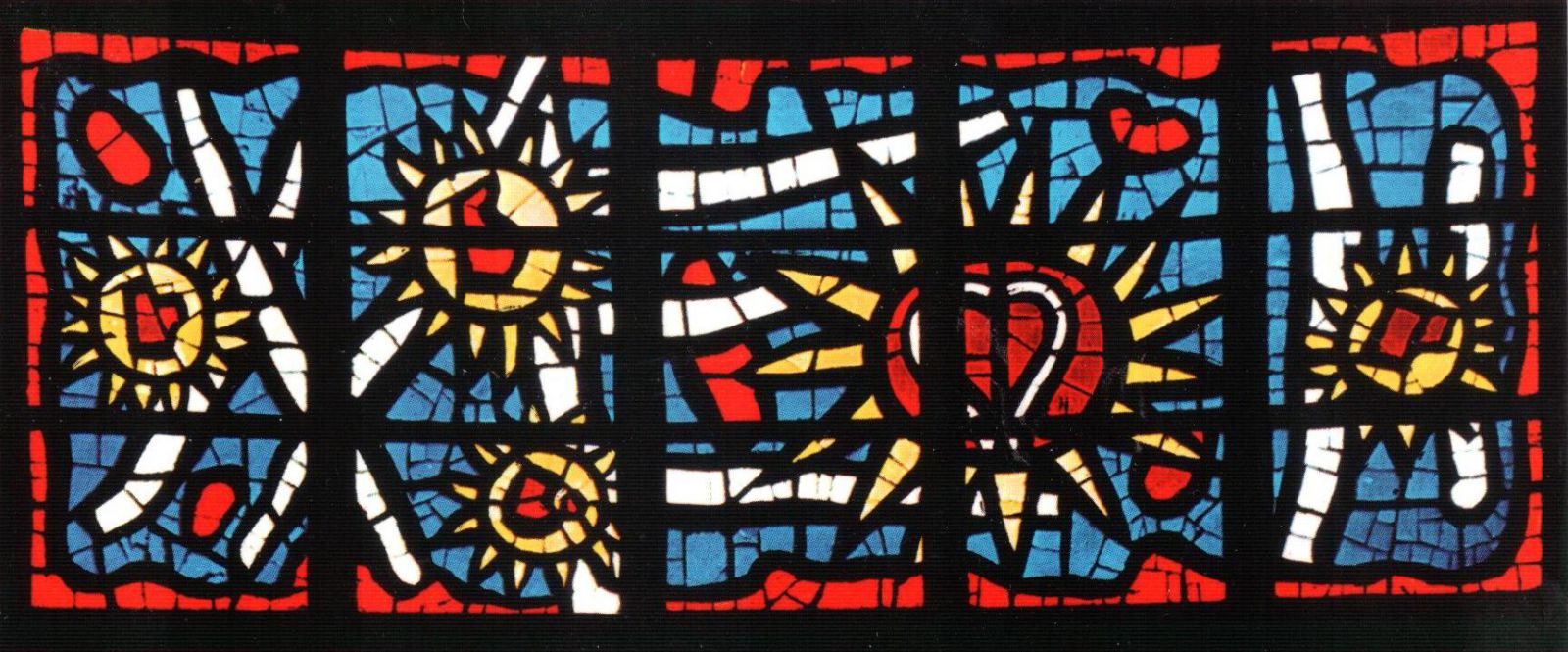
>> The Five Wounds of Christ by Fernand Léger | Commentary by Albert Hengelaar: This visual meditation is about the architecture and interior decoration of the Sacré-Coeur in Audincourt, France, a product of the Art Sacré movement, a Catholic art renaissance spearheaded by the French Dominican Order from 1919 to the 1950s. The centerpiece of the church, sited above the high altar, is a stained glass window depicting the five wounds of Christ shining like suns—one of seventeen windows the artist Fernand Léger designed to encircle the space in a strip.
Fernand Léger (French, 1881–1955), The Five Wounds of Christ, 1950–52. Stained glass window, Église du Sacré-Cœur (Church of the Sacred Heart), Audincourt, France.
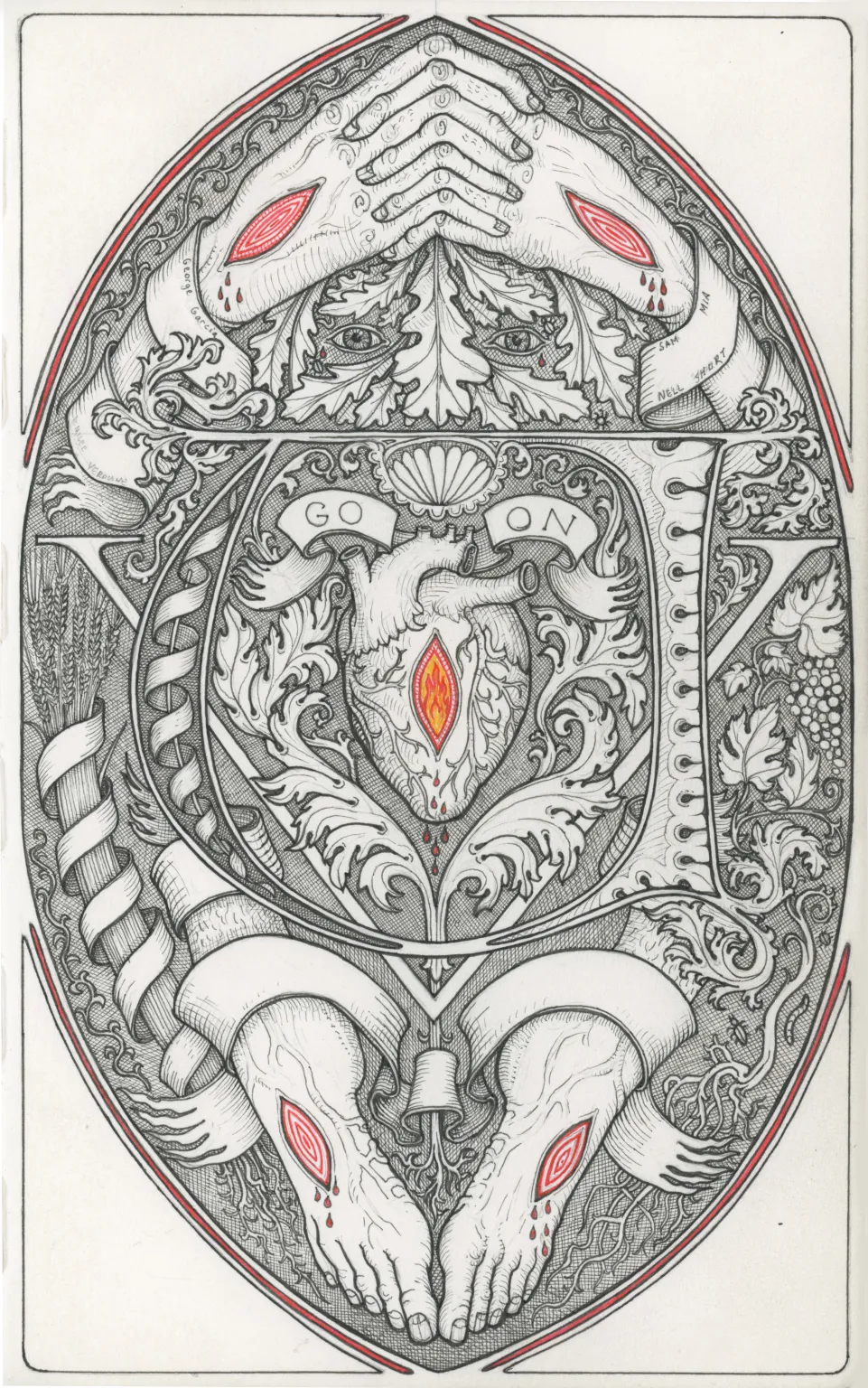
>> The Great Wound, aka Go On, Wounded Healer by Jack Baumgartner | Commentary by Sam Kee: In this Substack post, Sam Kee unpacks a drawing by his friend Jack Baumgartner [previously], which shows that “there is life in His [Christ’s] wounds, and He pours His life into our wounds.” The drawing started with the roman numeral V, which stands for the five wounds of Christ. The circumference is one large wound that encompasses five smaller wounds, eye-like, each one weeping blood. Other symbols that Kee analyzes in the drawing are wheat, grapes, fig leaves, seashell, fire, heart, and womb. “Go on” is a refrain that Baumgartner uses often in his work, a mantra for persevering in the faith, for continuing on the path.
Jack Baumgartner (American, 1976–), The Great Wound, 2024. Drawing from the series The Diary of a Tree Standing on Its Head.
Kee concludes with an original ekphrastic poem.
You can purchase an archival reproduction of The Great Wound from Baumgartner’s online shop. I encourage you to explore his website as well. I admire how his work is somehow both mystical and earthy, rooted.
In honor of Women’s History Month, here are a few creative works by and/or (in the case of Kinloch’s “Some Women” poems) about women.
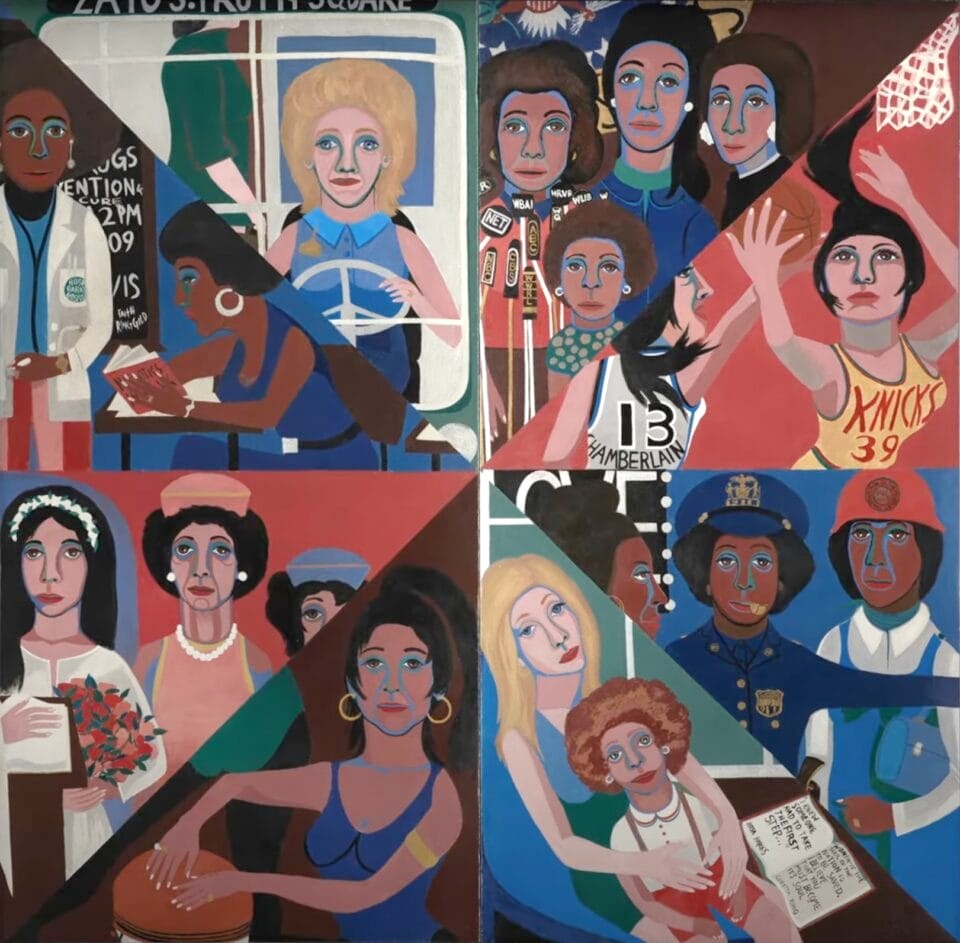
ARTICLE: “A New Documentary Traces How a Faith Ringgold Mural at Rikers Island Helped Women Break Free,”Colossal: Directed by Catherine Gund, the documentary Paint Me a Road Out of Here (2025) tells the story of Faith Ringgold’s For the Women’s House (1971), a mural commissioned by the New York State Council on the Arts for the Correctional Institution for Women on Rikers Island. When Ringgold asked the incarcerated women what they wanted her to paint, they said, “I want to see a road leading out of here.”
Faith Ringgold (American, 1930–2024), For the Women’s House, 1971. Oil on canvas, 96 × 96 in. Commissioned by the New York State Council on the Arts for the Correctional Institution for Women on Rikers Island; on loan to Brooklyn Museum.
Organized into eight triangular sections, the painting portrays women of various races (Black, white, Latina, Asian) in professional roles “that have not traditionally been theirs,” Ringgold says: doctor, bus driver, US president, basketball player, police officer, construction worker, drummer, priest. At the bottom, a white mother reads to her multiracial daughter words by Rosa Parks and Coretta Scott King, and in another scene, a bride is given away by her mother.
When Rikers Island transitioned to housing men in 1988, the women were moved to the Rose M. Singer Center, and the prison staff painted over Ringgold’s mural. Gund’s documentary chronicles the fight—by Ringgold and other artists, activists, politicians, and correctional officers—to have the mural restored, relocated, and preserved, but more deeply, the film is a “parable for a world without mass incarceration.”
Paint Me a Road Out of Here is not currently available on VOD, but here’s a list of public screenings: https://paintmearoadfilm.com/watch.
+++
LECTURE: “Re-Valuing Women Hymn Writers” by Dr. Lyn Loewi, St. John’s Church, Lafayette Square, Washington, DC, June 11, 2023: “Women have always been making sacred music, but they are underrepresented in our hymnals. Their contribution lies in the stories they tell from the margins, away from the narratives of dominant power. In this talk, Lyn Loewi will look at the poetry women have brought to our understanding of the Sacred. From the 9th-century Greek Orthodox nun Kassia to newly written hymns, women have expanded our language for God, remembered the stories of biblical women, and spoken for other discounted voices in society.”
Loewi, who has a doctorate in musical arts, has been an organist and church choir director for over forty years. She is currently the director of music ministries at Christ Church Capitol Hill, as well as the president of the Women’s Sacred Music Project. In this talk she discusses:
The Hymn of Kassiani
“The first one ever, oh, ever to know” by Linda Wilberger Egan
“Healing River of the Spirit” by Ruth Duck (text)
“Down by the Riverside” by Sister Rosetta Tharpe (arrangement)
“Balulalow” by Elizabeth Poston (music)
“Beyond the hopes and dreams of all creation” by Fr. Robert Easton (text) and Ghislaine Reece-Trapp (music)
The last few minutes of the recording, starting at 38:33, comprise audience Q&A; don’t miss the last question (41:29), where a woman expresses exasperation with all the “he/him” pronouns used for God in hymns—Loewi’s response is helpful.
+++
HYMNS:
When I was responsible for choosing songs for my church’s worship services, I made sure that every week I was on, at least one of the five songs we sang was written by a woman. Here are just three female-authored hymns that were part of my rotation—one (likely) from the tenth century, one from the eighteenth century, and one from the twenty-first century.
>> “Bí Thusa Mo Shúile” (Be Thou My Vision), Anon., trans. Mary Elizabeth Byrne, vers. Eleanor Hull: I can’t believe I’ve never featured this hymn on the blog before; it’s one of my all-time favorites. Its precise origins are not known. Most scholars date the original Early Middle Irish text, a lorica (prayer recited for protection), to the late tenth or eleventh century. It was translated into English in 1905 by Mary Elizabeth Byrne and then versified in 1912 by Eleanor Hull—meaning she adapted Byrne’s translation to fit a meter so that the words could be more easily sung. The music is a traditional Irish folk tune.
In this video, the hymn is sung in modern Irish by Madelyn Monaghan, a New York City–based soprano specializing in Irish traditional (Sean-nós) singing. It was for her friend’s wedding Mass. And wow, is her voice gorgeous!
>> “Dear Refuge of My Weary Soul” by Anne Steele (text) and Kevin Twit (music): Anne Steele was a Baptist hymn writer, poet, and essayist from Georgian England who published under the pen name Theodosia. Coming from a well-off family, she was educated and chose to remain single (she rejected several marriage proposals) so that she could focus on her writing, which she considered a calling. Rev. Kevin Twit, a Reformed University Fellowship pastor in Nashville and the founder of Indelible Grace, says Steele was the first significant female Christian hymn writer and the first, of either sex, to write lament hymns; over half her oeuvre, he says, deals with suffering and doubt.
Twit has set several of Steele’s hymns to music, most famously “Dear Refuge of My Weary Soul,” which Steele wrote in 1760. The solo performance above is from the January 24, 2021, worship service at Second Presbyterian Church in Memphis, Tennessee. The names of the singer and accompanist are not given. You can also listen to the song on Indelible Grace’s 2008 album.
>> “We Will Feast in the House of Zion” by Sandra McCracken and Joshua Moore:Sandra McCracken is one of today’s leading Christian singer-songwriters, and this hymn, which she wrote with Josh Moore, is the most popular of her congregational songs. From her 2015 album Psalms, it paints a vision of the eschaton, of the new heavens and the new earth, marked by restoration, shalom, and celebration. One thing I noticed as a church music leader is how many hymns and other worship songs use first-person singular pronouns (I/me/my) and emphasize one’s personal relationship with God; those are fine and even necessary, as the book of Psalms models, but I always made sure, when making a song list, to balance them with songs that use first-personal plural (us/we/our) and that convey a more communal picture of the Christian life and of the gospel, which is at least but also much more than what Jesus did for me. This is perhaps my favorite hymn about heaven, a place of safety and rest, yes, but also where all of creation is redeemed, made new; where everyone and everything flourishes in harmony under the benevolent reign of Christ.
“We Will Feast” works well during Communion (a ritual that anticipates the marriage supper of the Lamb) or as a closer, as it sends worshippers out with a benediction, a good word—a promise of the restorative beauty to come.
+++
VIDEO: “Poetry Unbound: A Conversation with David Kinloch and Pádraig Ó Tuama,” Washington National Cathedral, April 26, 2021: The On Being Project in partnership with Washington National Cathedral presents Pádraig Ó Tuama in conversation with the Scottish poet David Kinloch, part of a series of interviews with contemporary poets whose work demonstrates an artistic and literary engagement with biblical narratives and characters. They primarily discuss Kinloch’s extensive “Some Women” sequence of poems from his collection In Search of Dustie-Fute (Carcanet, 2017), voiced by women of the Bible (or, in the case of the first, Jewish folklore): Lilith, Cain’s wife, Adah and Zillah, Sarah, Lot’s wife, Rebekah, Zipporah, Deborah, Rahab, the Levite’s concubine, Ruth, Bathsheba, the daughters of Job, King David’s concubines, Hannah, Martha, the Virgin Mary, Mary Magdalene, and the Jewish women followers of Jesus responding to the apostle Paul’s teachings.
(The conversation starts at 7:55.)
Kinloch reads three poems from “Some Women”: “First Letter of the Hebrew Women to St Paul” (15:36), “Ruth” (23:49), and “Cain’s Wife” (29:58). He also reads two additional poems from the same volume, from the sequence “Joseph’s Dreams”: “St Joseph’s Dream” (40:44) and “Another Dream” (1:08:53).
This conversation impelled to check out In Search of Dustie-Fute from the library. I like the “Some Women” sequence overall—Kinloch’s creative engagement with the stories of these women, some very little known (e.g., I had to look up “Adah” and “Zillah”!) or little thought about (like the unnamed victims of sexual abuse)—though I will warn you that it contains some profanity and crude sexual language. In the Q&A that starts at 49:09, one of the questions is about the role of shock and humor in his poetry. (Kinloch says if his poems offend, they fail.) Other questions are about the biblical literacy that he does or does not presuppose, his editing process, a character from the Bible that he wants to write about but hasn’t yet, and why he, a man, feels justified in writing from the perspective of women.
Kinloch is an agnostic, so his relationship with biblical texts is different from that of one who is devout. But the Bible is not the exclusive domain of believers; Kinloch can just as well help us inhabit these stories and can derive questions or insights from them. I really appreciated hearing from him. Here’s what he had to say on the vernacular of everyday human experience:
It seems to me that there’s such distance—in terms of time, in terms of culture—between us in the twenty-first century and the people of those [ancient Near Eastern] communities. You need to find common ground so that some kind of dialogue can open up, so that you can shrink that distance. And therefore, the emphasis in all of these poems, really, is on the humanity of the people. I’m not writing sermons, I’m not writing homilies; I’m writing little dramatic monologues, mostly, and trying to make these people as believable, as real, as possible in the present moment of reading about them. My hope, I suppose, is that if people have enjoyed the poems, then maybe they might go back to those stories in the Bible. And it’s at that point that there will be an encounter with the divine, with the extraordinary. I don’t really feel that I have access to those moments of extraordinariness. All the extraordinariness is in the Bible, and I can only offer an avenue of approach to that.
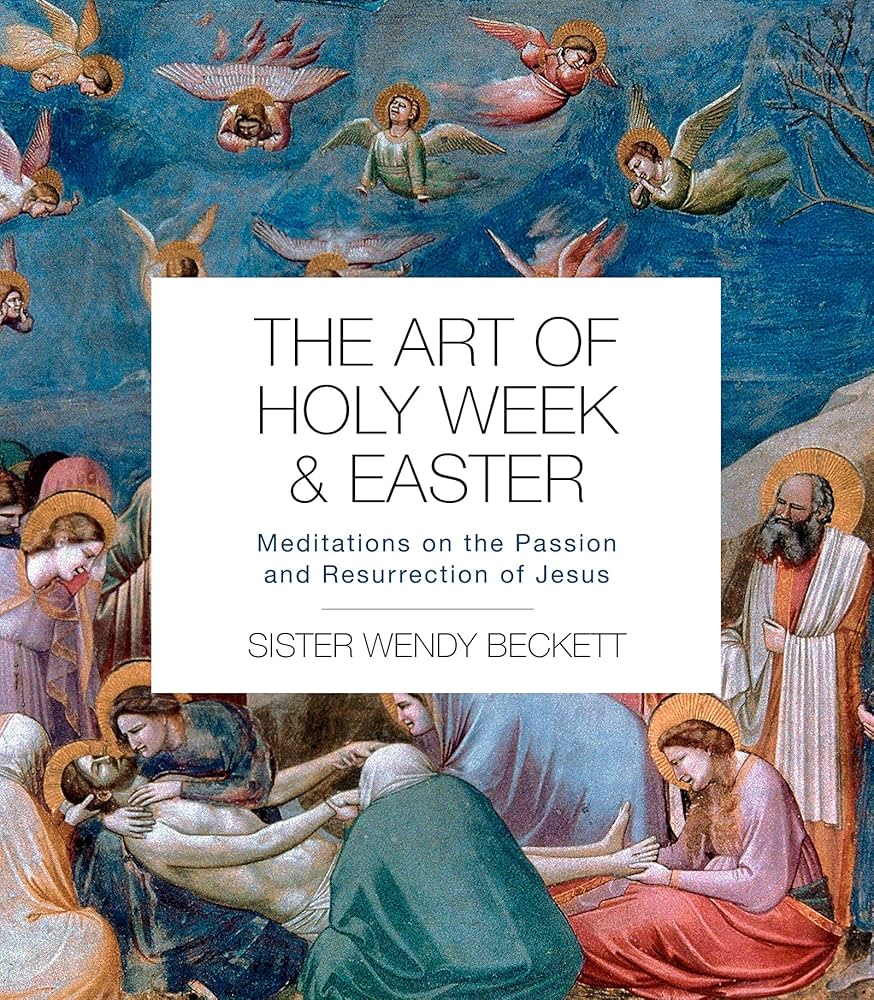
BOOK: The Art of Holy Week and Easter: Meditations on the Passion and Resurrection of Jesus by Sister Wendy Beckett (2021): Sister Wendy Beckett, a British Catholic nun and art enthusiast who died in 2018, is the one who first got me interested in art history. We watched clips from her BBC series Sister Wendy’s Story of Painting in my studio art class in high school, and I was so drawn to the way she looked at art and talked about it. Enthusiastic, warm, inquisitive, spiritually sensitive and theologically astute, and interested not just in the technical qualities of a work but also in its content—though I know I lack the same flair, my own voice and approach when it comes to art are indebted to hers.
So I was delighted to see that SPCK (and IVP in North America) has published two church calendar–based art devotionals by Sister Wendy: one for Lent, and one for Holy Week and Easter. I was disappointed with The Art of Lent: It has an admirable diversity of art selections, but Sister Wendy’s reflections are short and basic, and most don’t shine in the way I’ve come to expect from her; there were only two standouts for me. I also found it thematically confusing (for example, a section on “Confidence”?), unfocused, and redundant (especially in the “Silence” and “Contemplation” sections). I will grant that Lent is a more difficult season to structure for a project like this than Advent is, as I found the one year I published a daily Lent series; it can mean many things to many people.
Sister Wendy’s The Art of Holy Week and Easter, on the other hand, I did enjoy and recommend, even though I wish it had the same variety as the Lent book. (There’s only one modern/contemporary painting.) I care for only about half the featured artworks—two favorites are below—but even for the ones I was disinclined toward, her commentary helped me appreciate them.
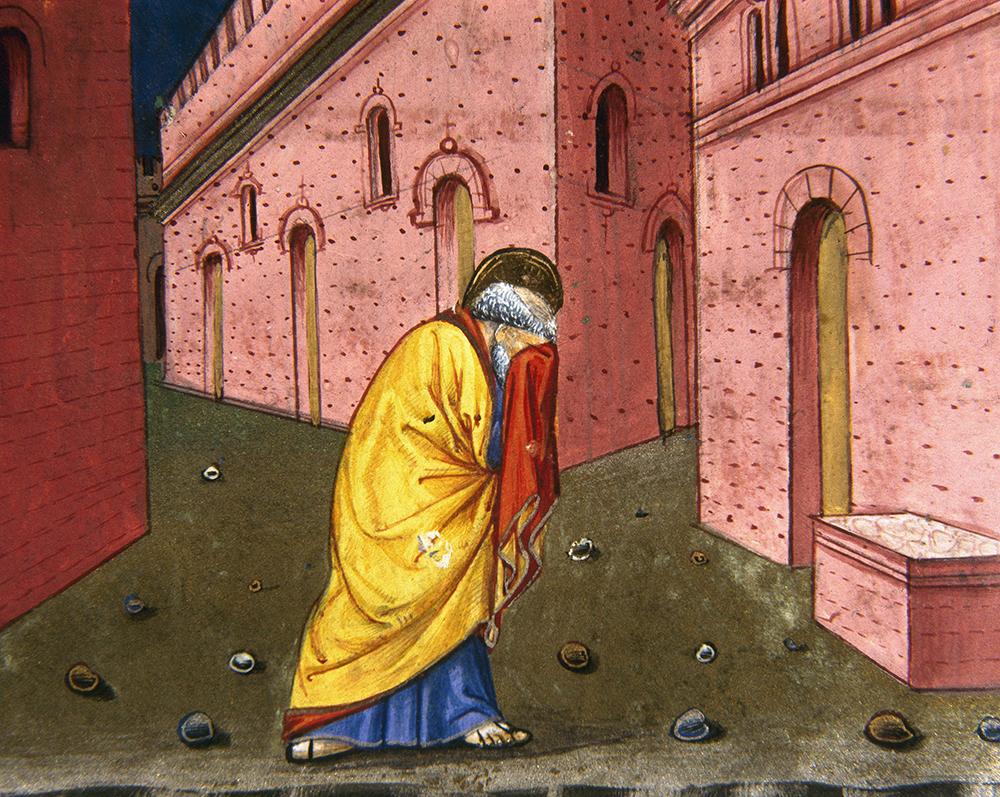
Cristoforo de Predis (Italian, 1440–1486), “Saint Peter realizing he has thrice betrayed Jesus,” from the Leggendario Sforza-Savoia, 1476. Codice Varia 124, Biblioteca Reale (Royal Library), Turin, Italy.
About a medieval manuscript illumination of Peter weeping by Cristoforo de Predis, Sister Wendy writes:
This magical little picture presents an unforgettable image of grief. It is that most painful kind of grief, lamenting of our own folly. Here we see Peter with his shamed face covered, stumbling blindly forward from one closed door to the next. There are ways out behind him, but Peter is too lost in misery to look for them. This claustrophobic despair, this helpless anguish, this incapacitating sense of shame: these are the result of a sudden overturn of our own self-image.
Peter had honestly seen himself as one who loved and followed Jesus, priding himself, moreover, on how true his loyalty was in comparison with that of others. ‘Even if all should betray you, I will never betray you’ – it was a boast, but he had meant it. Now he sees, piercingly, that he is fraudulent. He has been unmasked to himself, he has lost his self-worth.
The crucial question is: What next? Will he hide his face forever, destroyed by self-pity? Will he lose all heart, perhaps even kill himself, as Judas did? But while Judas felt only remorse, Peter feels contrition, a healing sorrow that will lead to repentance and a change of heart. Now that he knows his true weakness, he will cling to Jesus as never before. He will cling in desperate need and not in false strength, and will in the end become truly Peter, the ‘rock’, on which the Church, likewise dependent on Christ, will be built. (26)
El Greco (Greek Spanish, 1541–1614), Christ Crucified with Toledo in the Background, 1604–14. Oil on canvas, 111 × 69 cm. Fundación Banco Santander, Madrid.
About El Greco’s Christ Crucified, she mentions how “Jesus . . . dies looking upwards, his determination set upon his Father’s will and its consummation. . . . His body spirals upwards like a white flame, radiating out as he spreads his arms to share the light with the defeated shadows” (38).
+++
HYMNS:
>> “O Love, How Deep, How Broad, How High”: I’ve enjoyed learning a few new-to-me hymns from the YouTube channel of Josh Bales. Attributed to the fifteenth-century German Dutch Catholic mystic Thomas à Kempis, this hymn text was translated from Latin into English by Benjamin Webb in 1871. It appears in the Episcopal hymnal with the tune EISENACH by Bartholomäus Gesius, as adapted by Johann Hermann Schein in 1628, which is what Bales sings. It’s rare among hymns for emphasizing that our salvation was won not just by Christ’s death but also by his life—his faithful obedience to the Father.
>> “I Stand Amazed (How Marvelous)”: A favorite from my childhood, this 1905 gospel hymn by Charles H. Gabriel is performed here by the Imani Milele Choir, made up of orphaned and/or vulnerable children and youth from Uganda.
>> “Come Let Me Love”: I recently learned of this shape-note hymn from a book I’m reading by J. R. Watson. Written by the late great Isaac Watts, the text was first published in the 1706 edition of Watts’s Horæ lyricæ with the title “Christ’s Amazing Love and My Amazing Coldness.” I especially love verses 4 and 5, reproduced below. The tune in the following video, LAVY, is actually a new one (from 1993) that sounds old, by John Bayer Jr.
Infinite grace! Almighty charms! Stand in amaze, ye rolling skies! Jesus, the God with naked arms, Hangs on a cross of love and dies.
Did pity ever stoop so low, Dress’d in divinity and blood? Was ever rebel courted so, In groans of an expiring God?
+++
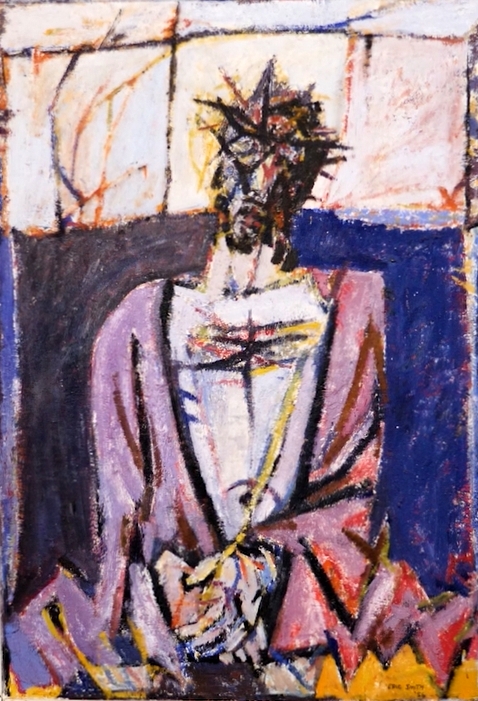
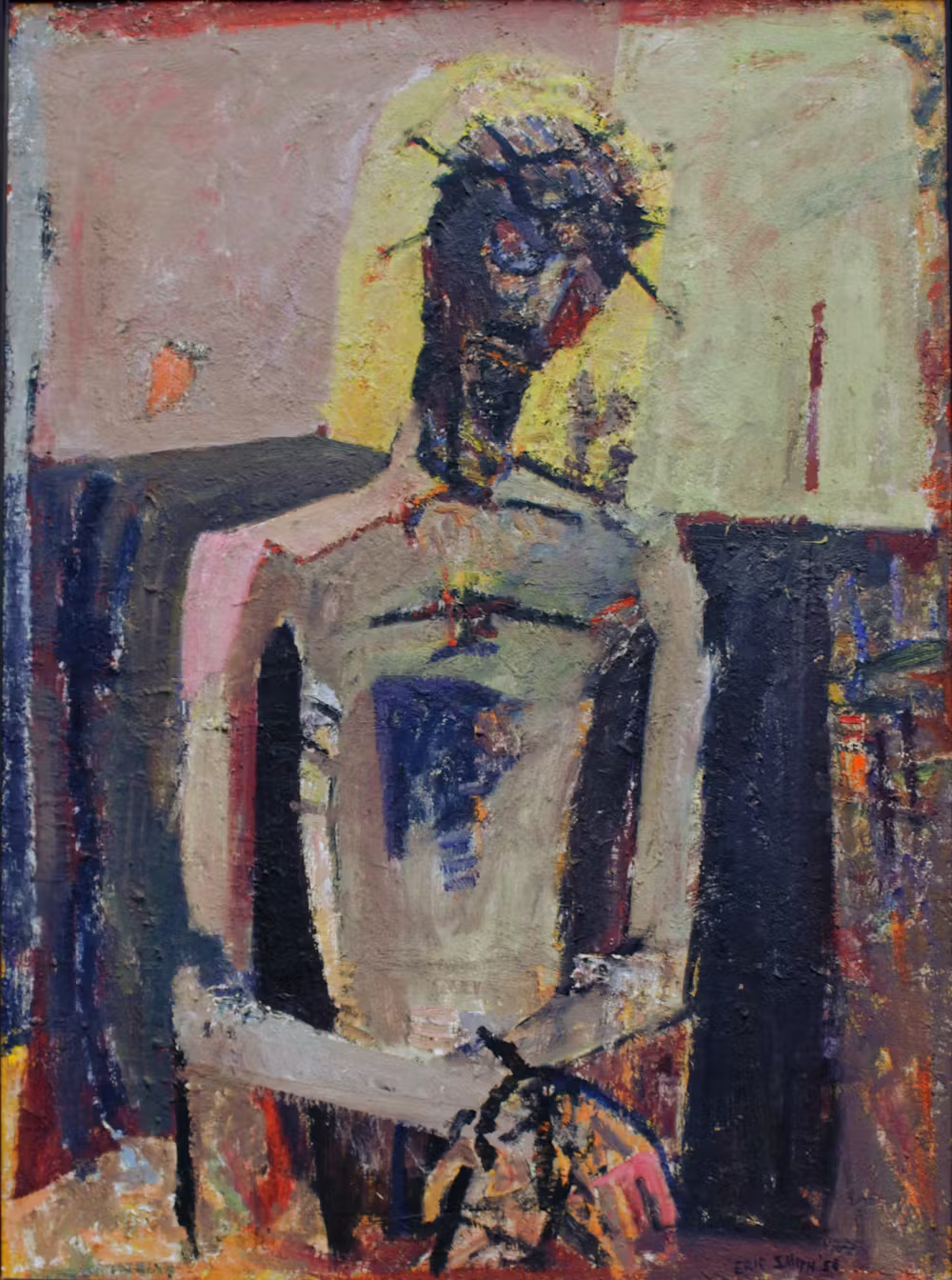
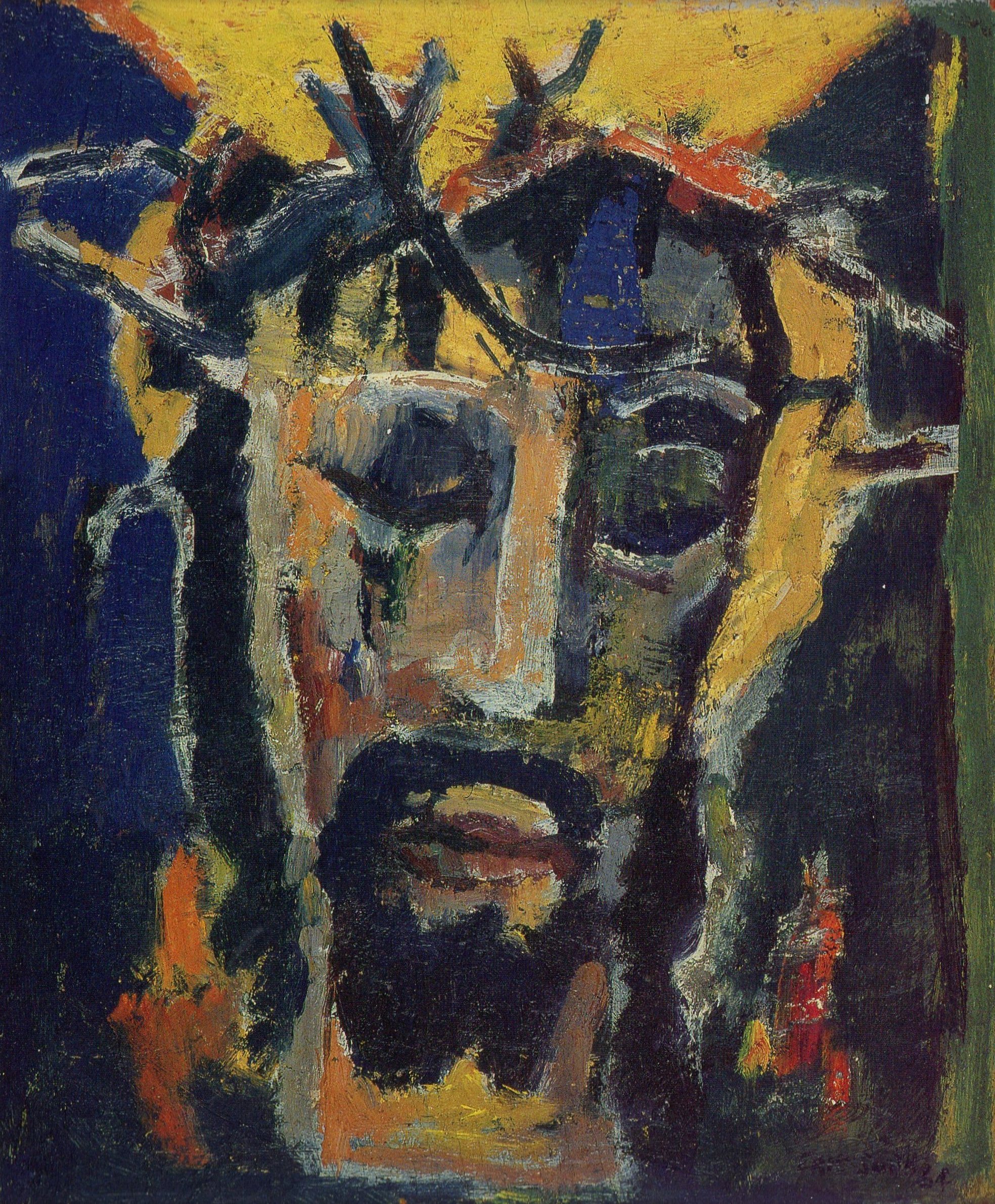
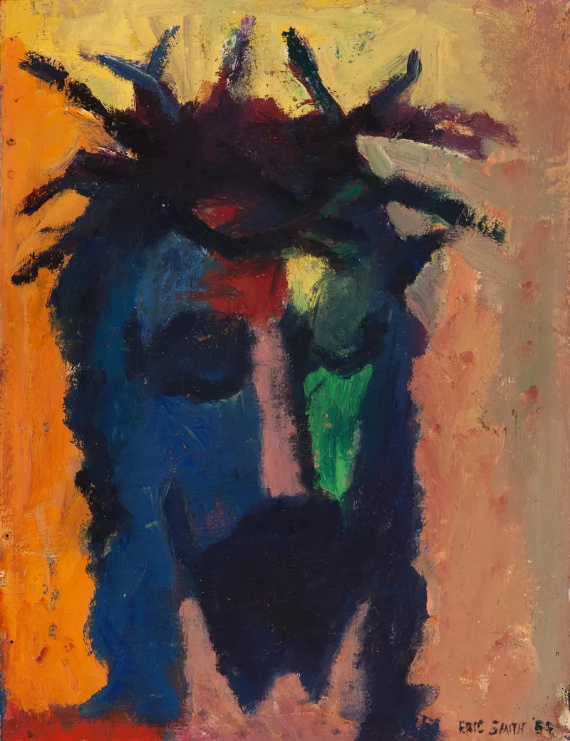
VIDEO:“Christ by Eric Smith”: This is the first video in the (Catholic) Archdiocese of Brisbane’s four-part Art Aficionados series from 2022. In it, Archbishop Emeritus Mark Coleridge, theology professor Maeve Heaney, and Rev. Dr. Tom Elich of Liturgy Brisbane discuss the semiabstract Ecce homo painting Christ by the modern Australian artist Eric Smith—its pathos, calm, and double irony. This Christ is crushed yet composed, Coleridge says. Smith won the prestigious Blake Prize for Religious Art six times, including, in 1956, for a painting similar to this one (see second image in slideshow below). I’d love to see more dioceses releasing videos like this!—close looking at art.
Eric Smith (Australian, 1919–2017), Christ, 1956. Oil on Masonite, 138 × 95 cm. Collection of Holy Spirit Seminary (Queensland Provincial Seminary), Banyo, Brisbane, Australia. Photo courtesy of Tom Elich.
Eric Smith (Australian, 1919–2017), The Scourged Christ, 1956. Oil on Masonite, 116 × 85 cm. Penrith Regional Gallery, Emu Plains, Australia.
Eric Smith (Australian, 1919–2017), Head of Christ, 1954. Oil on wood, 47 × 39.4 cm. Collection of Newman College, University of Melbourne, Australia.
Eric Smith (Australian, 1919–2017), Head of Christ, 1954. Oil on Masonite, 40.5 × 32.6 cm. Art Gallery of South Australia, Adelaide.
+++
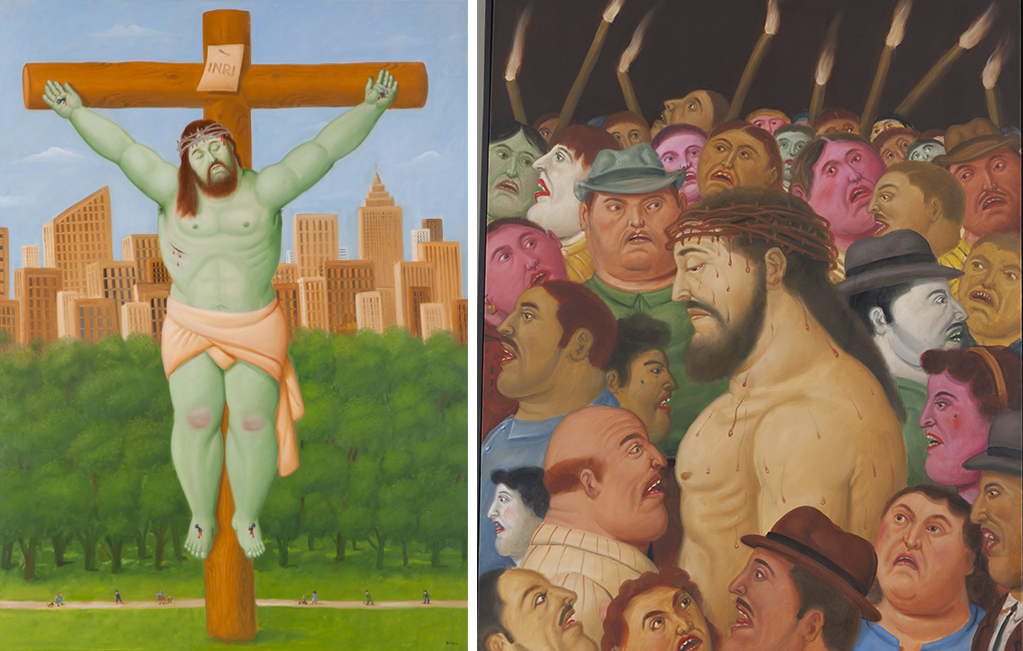
ART SERIES: Via Crucis: La pasión de Cristo (Way of the Cross: The Passion of Christ) by Fernando Botero: Executed in 2010–11, Via Crucis is a series of twenty-seven oil paintings and thirty-four mixed-media drawings by Colombia’s most famous artist, Fernando Botero (1932–2023) [previously]. Botero said he turned to the subject of Christ’s passion not because he’s religious, but out of admiration for the great works of art on the subject; he approached it with “a spirit of great respect,” aiming to portray God as a tortured man. The artist donated the series to the Museo de Antioquia in Medellín for his eightieth birthday. I can’t find a compilation of the whole series (the museum has digital records of the Boteros in its collection, but not all the images are showing up for me)—but you can view fourteen of the paintings in this article, and here’s a quick little Facebook reel.
Marlborough Gallery in New York offers a catalog of the series for $75, and Artika offers a much more expensive one (a gorgeous product, but $9,500!):
Here’s a news segment, in English, about the series’ exhibition at Lisbon’s Palacio de Ajuda in November 2012 (unfortunately, the video quality is low):
Fernando Botero (Colombian, 1932–2023), Crucifixión (Crucifixion), 2011, and Jesús y la multitud (Jesus and the Crowd), 2010. Oil on canvas. Museo de Antioquia, Medellín, Colombia.
+++
I have thematic playlists on Spotify for Lent and Holy Week—for the latter, don’t miss “From the Garden to the Tomb” by The Soil and The Seed Project, one of several recent additions.
But, by popular request, I also have a brand-new March 2026 playlist, a somewhat random assortment of songs I’ve been enjoying—some new releases, some not.
Timber Timbre is the moniker of the Canadian folk blues singer-songwriter Taylor Kirk. The opening track on his 2009 self-titled album, “Demon Host,” establishes the album’s haunted tone. The song is mournful and mystical, and it references God, religion, sin, death, and repentance.
Death, she must have been your will A bone beneath the reaper’s veil With your voice my belly sunk And I began to feel so drunk
Candle, candle on my clock Oh Lord, I must have heard you knock Me out of bed as the flames licked my head And my lungs filled up black in their tiny little shack It was real and I repent All those messages you sent Clear as day, but in the night Oh, I couldn’t get it right
Here is a church and here is a steeple Open the doors, there are the people And all their little hearts at ease For another week’s disease
And eagle, eagle talons scream I never once left in between I was on the fence and I never wanted your two cents Down my throat, into the pit, with my head upon the spit Oh Reverend, please, can I chew your ear? I’ve become what I most fear And I know there’s no such thing as ghosts But I have seen the demon host
There are several different ways to interpret this song, but at its core, it seems to me it’s about an agnostic facing death. In the first four lines he hears death calling to him—personified, atypically, as a woman. The “your,” I think, is God, whom the speaker names a few lines later. (Alternatively, “death” could be a noun of direct address and “your” its pronoun, in which case “she” may refer to a female friend who has died, inciting the crisis that follows.) Unprepared for this sudden confrontation, the speaker feels woozy with shock.
Candles and clocks serve as memento mori, reminders of death. As the wax burns down and time ticks on, he’s jolted out of a nightmare about the flames of judgment. Awake now to the reality of God’s holiness, he repents, realizing that God has been pursuing him all along.
He enters a church, but he’s turned off by the apparent easiness with which the people greet “another week’s disease.” I’m not sure what that means—the horrors and suffering of the world? personal sin? If these Christians struggle with either, they mask it. He is not able to feel the same sense of peace and victory they do.
“Eagle, eagle talons scream” is an elusive yet evocative line that may refer to the feeling of being pierced or gutted, perhaps having one’s sin revealed by the Holy Spirit. Or maybe it expresses a more indefinable sense of anxiety and distress.
The speaker admits he had always been perfectly comfortable sitting on the fence, “in between” faith and no-faith, not committing to this or that system of belief and practice. He never wanted God to intervene with his “two cents” on what is real and how to live. He resents the church’s teachings on eternal punishment and hellfire. And yet he’s ambivalent about Christianity. He cherishes his indecision, but he’s also restless. He seeks out the pastor to talk with.
“I’ve become what I most fear,” he confesses. And what is that? Being sold out to Jesus? Engulfing wickedness?
Even the title of the song, taken from the last line, is ambiguous, as the word “host” has multiple meanings. The “demon host” could refer to an army of demons, to a body that’s possessed by a demon, or to a parody of the Eucharist (in Christian liturgies, the consecrated bread, the body of Christ, is called the host). It seems the speaker has either experienced a stark vision of evil, or some evil has taken hold of him. Or maybe it’s death that he’s characterizing as demonic, but if so, it’s manifesting supernaturally, as he calls it ghostly.
In the music video there’s a menacing hooded figure that stands outside the shed in which Kirk performs, looking very much like the Grim Reaper. This entity listens, then gradually approaches, then even holds the microphone for Kirk, but his face is always in shadow. In some shots we see a second figure, dressed in the same garb, holding a guitar.
Lyrically, the song is unresolved, and musically, the last minute is unsettling.
Is this a song about damnation? Or dying to self, crucifying the ego, part of the conversion process? What about addiction? Or surviving a near-death experience and living in light of that? Whatever the particulars, the song is in the voice of someone who is shaken from his equivocation into seriously considering faith; someone who wrestles with God, mortality, and evil.
I’m eager to hear what you make of it or what stands out to you.

#/media/File:Mantegna,_Andrea_-_crucifixion_-_Louvre_from_Predella_San_Zeno_Altarpiece_Verona.jpg)

 Art & Theology