He has come, the Christ of God: Left for us his glad abode; Stooping from his throne of bliss To this darksome wilderness.
Refrain 1: He has come, the Prince of Peace: Come to bid our sorrows cease; Come to scatter with his light All the shadows of our night.
He, the mighty King, has come, Making this poor earth his home: Come to bear our sin’s sad load, Son of David, Son of God.
Refrain 2: He has come, whose Name of grace Speaks deliverance to our race: Left for us his glad abode, Son of Mary, Son of God.
Unto us a Child is born: Ne’er has earth beheld a morn, Among all the morns of time, Half so glorious in its prime.
Refrain 3: Unto us a Son is given: He has come from God’s own heaven, Bringing with him from above Holy peace and holy love.
While he was a worship pastor at Bayou City Fellowship in Houston, Ryan DeLange wrote a new tune for this nineteenth-century Christmas hymn by Horatius Bonar, a Scotsman who is best known for “Be Still, My Soul.” To hear DeLange discuss what drew him to this hymn, see season 2, episode 2 of the Hymnistry podcast, which aired December 5, 2016. He performs the song at 9:22 of the episode, and at 27:01, Pastor Jacob Breeze charges listeners to “keep the party going” for all twelve days of Christmas.
The 2016 video above is from Scarlet City Church in Columbus, Ohio. The singer is Janelle Jackson, and she’s accompanied on guitar by Rev. Mike Juday, who was the church’s music pastor at the time but who is now the associate rector of Village Church Anglican in Greenville, South Carolina.
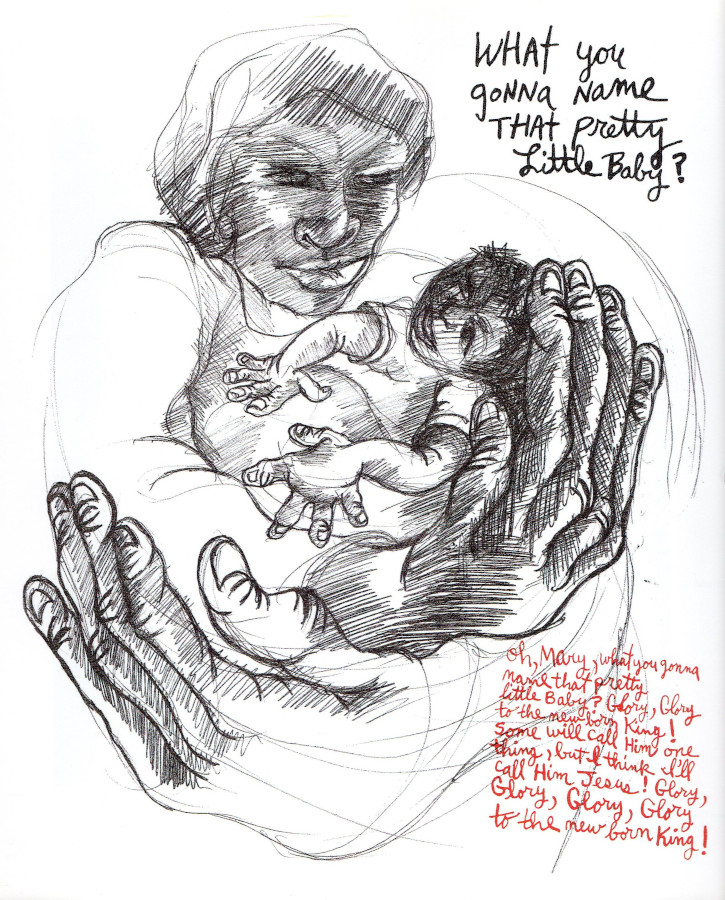
Aminah Brenda Lynn Robinson (1940–2015) was an artist working in multiple media whose work celebrates Black history and culture. She was a lifelong resident of Columbus, Ohio, and bequeathed her art, writings, home, and personal property to the Columbus Museum of Art, who established the Aminah Robinson Legacy Project in 2020.
The drawing above is one of twenty-six from Robinson’s excellent book The Teachings: Drawn from African-American Spirituals (Harcourt Brace Jovanovich, 1992). These drawings, she writes in the introduction, “have grown from the stories and songs that were given to me by my family and my early teachers, and I offer them here to the children of today’s troubled world and the children of tomorrow. They carry a message of dignity, knowledge, and wisdom . . . speak of survival, of freedom and determination, of love and faith, of justice and of hope . . .”
The artist’s estate is represented in the US by Fort Gansevoort in New York, which is currently showing Aminah Brenda Lynn Robinson: Character Studies through January 25.
Another exhibition of her work, Aminah Robinson: Journeys Home, a Visual Memoir, will be touring nationally for the next few years: to the Springfield Museum of Art in Ohio (February 1–July 13, 2025), the Newark Museum of Art in New Jersey (October 16, 2025–March 1, 2026), the Mobile Museum of Art in Alabama (March 26, 2026–January 9, 2027), and two remaining venues to be announced. This is a major exhibition that brings together Robinson’s drawings, prints, paintings, textiles, collages, homemade books, dolls, “hogmawg” sculptures (made of a mixture of mud, clay, twigs, leaves, lime, animal grease, and glue), and “RagGonNon” pieces (monumental swaths of fabric encrusted with buttons, beads, and other found objects) to create a portrait of her life.
LISTEN: “Mary, What You Gonna Name That Pretty Little Baby?,” African American spiritual | Arranged by Alex Bradford, 1961 | Performed by Princess Stewart and Marion Williams on Black Nativity: Gospel on Broadway! (Original Broadway Cast), 1962
Mary, Mary, what you gonna name that pretty little baby? Mmm, mmm, pretty little baby Mmm, mmm, pretty little baby Glory be to the newborn King
Some call him one thing, I think I’ll call him Jesus Mmm, mmm, sweet Jesus Mmm, mmm, (ain’t he sweet?) sweet Jesus Glory be to the newborn King
Some call him Jesus, I think I’ll call him Wonderful Mmm, mmm, wonderful Mmm, mmm, he’s so wonderful Glory be to the newborn King
Some call him Wonderful, I think I’ll call him Emmanuel Mmm, mmm, King Emmanuel Mmm, mmm, (ain’t he the king?) Emmanuel Glory be to the newborn King
Some call him Emmanuel, I’m gonna call him the Prince of Peace Mmm, mmm, Prince of Peace Mmm, mmm, Prince of Peace Glory be to the newborn King
Some call him Prince of Peace, I’m gonna call him Jesus Mmm, mmm, sweet Jesus Mmm, mmm, (ain’t he sweet?) sweet Jesus Glory be to the newborn King
Mary, Mary, what you gonna name that pretty little baby? Mmm, mmm, pretty little baby Mmm, mmm, pretty little baby Glory be to the newborn King
This Christmas spiritual, a dialogue between an unnamed visitor and the new mother Mary, has been recorded by many artists. I think I like the original cast recording from the Langston Hughes musical Black Nativity best, featuring soloist Princess Stewart on the first verse and Marion Williams on the remaining six, backed by the Stars of Faith.
But here’s a handful of other versions I like. Because the song was passed down orally, it has taken on different lyrical variations and accrued new verses. Some reference the wise men.
>> “The Virgin Mary Had One Son” by the Staple Singers, arr. Roebuck “Pops” Staples, on The 25th Day of December (1962):
>> “The Virgin Mary Had One Son” by Josh Garrels, on The Light Came Down (2016):
>> “What ’Cha Gonna Call the Pretty Little Baby” by the National Lutheran Choir, dir. David M. Cherwien, arr. Ronald L. Stevens, on Christ Is Born (2016):
>> “Glory to the Newborn King” by Chicago a Cappella, dir. Jonathan Miller, arr. Robert Leigh Morris, on Holidays a Cappella Live (2002):
>> “Virgin Mary Had One Son” by Joan Baez and Bob Gibson, live at the 1959 Newport Folk Festival (see also “Virgin Mary,” a bonus track on the 2001 Vanguard reissue of Baez’s 1966 album Noël):
A praising of God is what laughter is, because it lets a human being be human.
Laughter is a praise of God, because it lets a human being be a loving person.
Laughter is praise of God because it is a gentle echo of God’s laughter, of the laughter that pronounces judgment on all history.
Laughter is praise of God because it foretells the eternal praise of God at the end of time, when those who must weep here on earth shall laugh.
The laughter of unbelief, of despair, and of scorn, and the laughter of believing happiness are here uncannily juxtaposed, so that before the fulfillment of the promise, one hardly knows whether belief or unbelief is laughing.
Soichi Watanabe (Japanese, 1949–), You Shall Laugh, 2011. Oil on canvas, 16 × 12 in. (41 × 31 cm). Kwansei Gakuin University Chapel, Kobe, Japan. Photo courtesy of the artist.
Soichi Watanabe is a Japanese Christian artist who served as the 2008–9 artist in residence at the Overseas Ministries Study Center (OMSC) in New Haven, Connecticut (now at Princeton Theological Seminary). OMSC published a catalog of his work, titled For the Least of These: The Art of Soichi Watanabe, in 2010, featuring forty-three of his paintings.
Watanabe doesn’t supply facial features for his human figures because he wants viewers to be able to see themselves in the characters portrayed. He concentrates on form and color.
I was introduced to this painting of his through the OMSC-sponsored Zoom presentation he gave on February 3, 2021. There he said, “We can laugh as the love of God is being poured out on us . . . the laughter of knowing that the Lord is with us in pain and sorrow.” The wave shape at the bottom, he told me in an email, is a reference to the tsunami of March 11, 2011, which wiped out his home city of Ishinomaki and accelerated his mother’s dementia.
Watanabe also painted a companion piece, With Those Who Weep, which shows the same three figures huddled together in a mass, one comforting the two who are crying. Together, the paintings encourage us to fully feel our griefs and our hurts, and to be present to one another through those experiences, but also to hold on to joy, which transcends circumstance.
The artist pointed out to me that the three figures in You Shall Laugh resemble a flower spreading out its petals. The kanji for “bloom,” he says, originally meant “laugh” and was written as “birds sing, flowers laugh.”
LISTEN: “Jesus soll mein erstes Wort” (Jesus shall be my first word) from Gott, wie dein Name, so ist auch dein Ruhm (God, as your name is, so also your praise is to the ends of the world) (BWV 171) | Words by Picander (Christian Friedrich Henrici), 1728 | Music by Johann Sebastian Bach, 1728 | Performed by Kathleen Battle and Itzhak Perlman on J. S. Bach: Arias for Soprano and Violin, 1991
Jesus soll mein erstes Wort
In dem neuen Jahre heißen.
Fort und fort
Lacht sein Nam in meinem Munde,
Und in meiner letzten Stunde
Ist Jesus auch mein letztes Wort.
Jesus shall be my first word
uttered in the new year.
Again and again
his name laughs in my mouth,
and in my last hour
Jesus will also be my last utterance.
This aria is the fourth movement of a cantata Bach composed for his church in Leipzig for New Year’s Day 1729. January 1 is also the Feast of the Holy Name of Jesus, since Jesus was given his name when he was eight days old (Luke 2:21). Read the full libretto of BWV 171 here, and listen to the full cantata here. (It’s only sixteen minutes.)
For the excerpt I’ve chosen a recording by the legendary American operatic soprano Kathleen Battle, who is accompanied by the equally famous Israeli American violinist Itzhak Perlman.
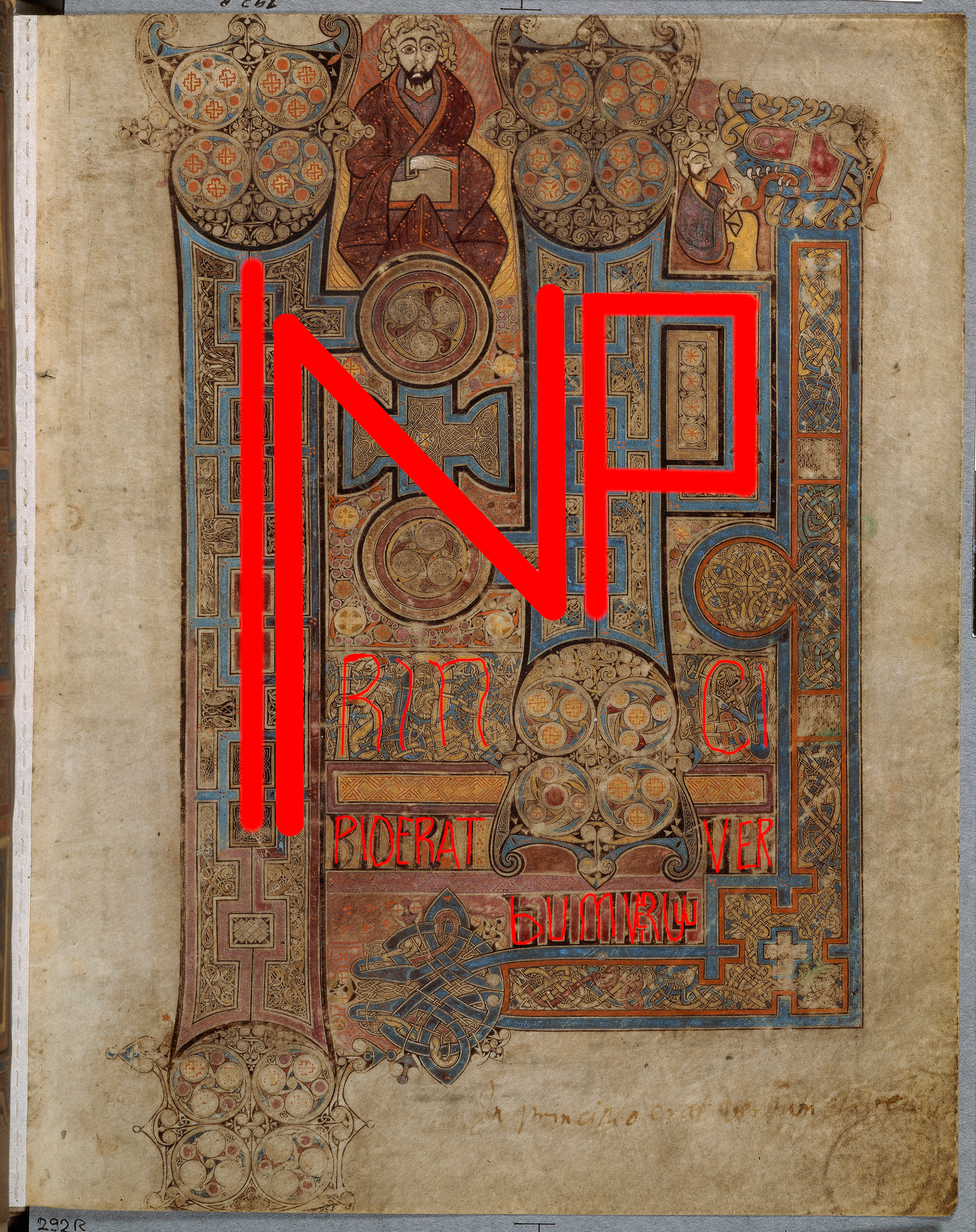
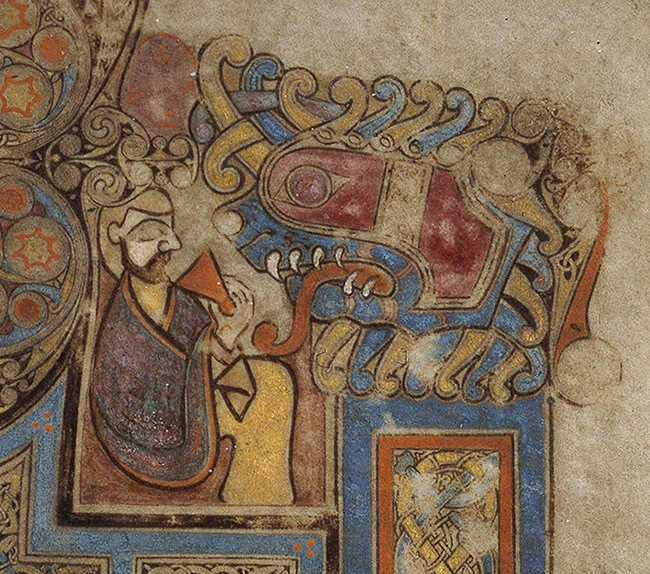
LOOK: Incipit to the Gospel of John from the Book of Kells
Incipit to the Gospel of John, Book of Kells, ca. 800. Trinity College Dublin MS 58, fol. 292r.
Made by Celtic monks in a Columban monastery around the year 800, the Book of Kells—an illuminated Gospel book named after the monastery of Kells in County Meath, Ireland, where it spent eight centuries—is one of the most beautiful manuscripts ever created. Pictured here is the lavishly decorated opening page of the Gospel of John, which bears the words “In p/rinci/pio erat ver/bum [et] ver[b]um” (“In the beginning was the Word, and the Word . . .”). The passage continues on the following page.
Bernard Meehan, the former head of research collections and keeper of manuscripts at Trinity College Dublin, describes the lettering on folio 292r:
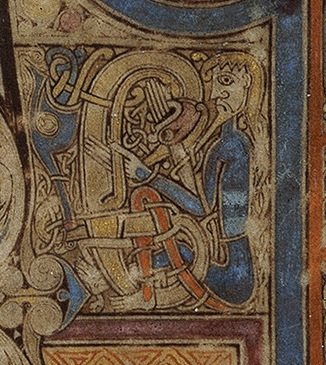
The letters IN P, filled with interlacing snakes, crosses and abstract ornament, dominate the composition. Snakes form the letters RIN and C, with C taking the form of a harp, played by the man who forms the letter I. The urge of the artist to decorate has taken precedence over legibility, to the extent that the letters ET and B are missing from the last line. [1]
Because some of the letters are difficult to discern, I’ve done my best to trace them in red in this graphic:
The text unfolds in four rows. The column on the left forms the I and doubles as the left stem of the N. The diagonal stroke of the N passes through the cross-shape, and its right stem is formed by another blue column, which also doubles as the stem of the P.
The following R, I, N, and C are beige and blue serpentine figures, tangled together, the latter shaped like a harp and being “played” by a seated man whose torso forms an I.
The remaining text is organized in two rows and is black. As Meehan mentioned, the artist-monk unintentionally omitted the ET and B in “et verbum.” And the final M is upside down, an artistic variation.
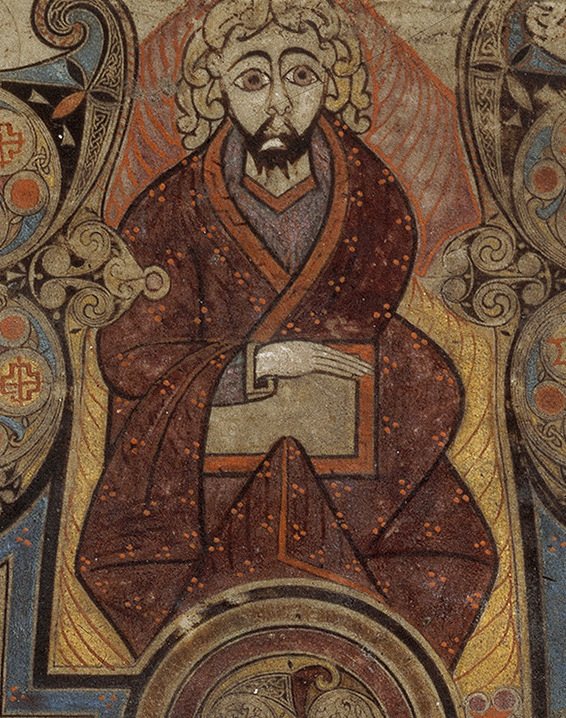
Scholars disagree on who the curly-haired figure at the top is, holding a book: some suppose it’s John the Evangelist, the author of the fourth Gospel, while others think it’s Christ the Logos. I’m in the latter camp. Christ is often shown in art sitting on a throne holding a book, representing the gospel—as on folio 32v of this very manuscript. And a full-page portrait of John already appears on the opposite page, folio 291v; granted, the iconography is similar, but it would be an unusual choice to repeat a person in the same pose on a single page spread. Also, as art historian Heather Pulliam points out, the yellow and red striations that encompass the figure resemble flame—a “throne of light,” writes Françoise Henry—an attribute more befitting of the figure of Christ than of John. [2]
The identity of the smaller figure on the right who’s drinking from a red chalice is also debated. Again, it could be either John or Christ. According to an apocryphal legend that first appeared in the second-century Acts of John and that was popularized in the thirteenth-century Golden Legend, a pagan priest challenged John to drink a cup of poisoned wine to test whether his God was truly powerful enough to protect him. John blessed the cup, downed the wine, and suffered no harm. That’s why in art one of John’s attributes is a chalice with a serpent in it, representing the poison rising out and the triumph of Christian faith.
On the other hand, the drinking figure may be Christ drinking the cup of suffering (John 18:11). The monstrous head to the right supports either interpretation—it could be Satan tormenting Christ in Gethsemane, or in John’s case, the threat of death by poison, or the evil intent of the pagan priest who sought to discredit him.
Additional possibilities have also been posited. Małgorzata Krasnodębska-D’Aughton argues that the man is meant to be a generic Christian partaking of the Eucharist, [3] whereas Pulliam suggests that the cup represents not the blood of Christ but “the chalice of wisdom received from the breast of Christ.” [4] She cites Augustine’s first tractate on the Gospel of John:
Thence John, who said these things, received them, brothers, he who lay on the Lord’s breast, and from the breast of the Lord drank in what he might give us to drink. But he gave us words; you ought then to receive understanding from the source, from that which he drank who gave to you; so that you may lift up your eyes to the mountains from where shall come your aid, so that from there you may receive, as it were, the cup, that is, the word, given you to drink; and yet, since your help is from the Lord, who made heaven and earth, you may fill your breast, from the source. [5]
In Pulliam’s interpretation, the man imbibes the words of God—that is, scripture—providing a model for us to emulate.
Bernard Meehan, The Book of Kells: An Illustrated Introduction to the Manuscript in Trinity College Dublin (Thames & Hudson, 1994, 2008), 34.
Heather Pulliam, Word and Image in the Book of Kells (Four Courts Press, 2006), 180–83; cf. Françoise Henry, The Book of Kells: Reproductions from the Manuscript in Trinity College, Dublin (Thames & Hudson, 1974).
Małgorzata Krasnodębska-D’Aughton, “Decoration of the In principio initials in early Insular manuscripts: Christ as a visible image of the invisible God,” Word and Image: A Journal of Verbal/Visual Enquiry 18, no. 3 (Fall 2002): 117.
Pulliam, Word and Image, 185.
Augustine, In Joannis Evangelium 1.1, PL 35: 1382.
LISTEN: “The Word Was God” by Rosephanye Powell, 1996 | Performed by the University of Pretoria Camerata, dir. Michael Barrett, 2022
In the beginning was the Word, and the Word was with God, and the Word was God.
The same was in the beginning with God.
All things were made that have been made. Nothing was made he has not made.
While this choral anthem is not a Christmas song per se, it is a setting of John 1:1–3, the opening of the great prologue of the Incarnation. These first three verses are about Christ’s eternal being, his oneness with the Father, and his active role in creation. I can’t hear them without anticipating verse 14: “And the Word was made flesh, and dwelt among us . . .”
“The Word Was God” is by Dr. Rosephanye Powell (pronounced ro-SEH-fuh-nee) (born 1962), an African American composer, singer, professor, and researcher. One of her most popular and widely recorded works, it is full of rhythmic energy and drive. Read detailed notes by Powell here, where she explains her musical choices and their theological significance.
Some of you may wonder why I’m still posting Christmas content. It’s because it’s still Christmastime! Christmas is a twelve-day feast extending from December 25 to January 5. So keep the celebration going with parties, carols, decoration, storytelling, worship, and meditation on the amazing historic event of the Incarnation.
As far as I can tell, this is the first installment in a series of children’s retellings of the Nativity story from around the world that Compassion International releases annually. Subsequent videos—all of them worth watching!—are from Indonesia (2022), Bolivia (2023), and the Philippines (2024).
+++
CONCERT RECORDING: O Holy Night: An Annie Moses Band Christmas Special: Named after their great-grandmother, the Annie Moses Band is an Americana string band of six siblings, raised by award-winning Nashville songwriters Bill and Robin Wolaver, who are committed to godly excellence in the arts. This Christmas concert of theirs, featuring outstanding arrangements of a range of classic carols and one original, was released on DVD in 2018 and just made available by the band for free on YouTube!
Here’s the set list. Links are to standalone videos, excerpted from the performance above. My favorites are probably the opener, “On This Day,” and “We Three Kings”:
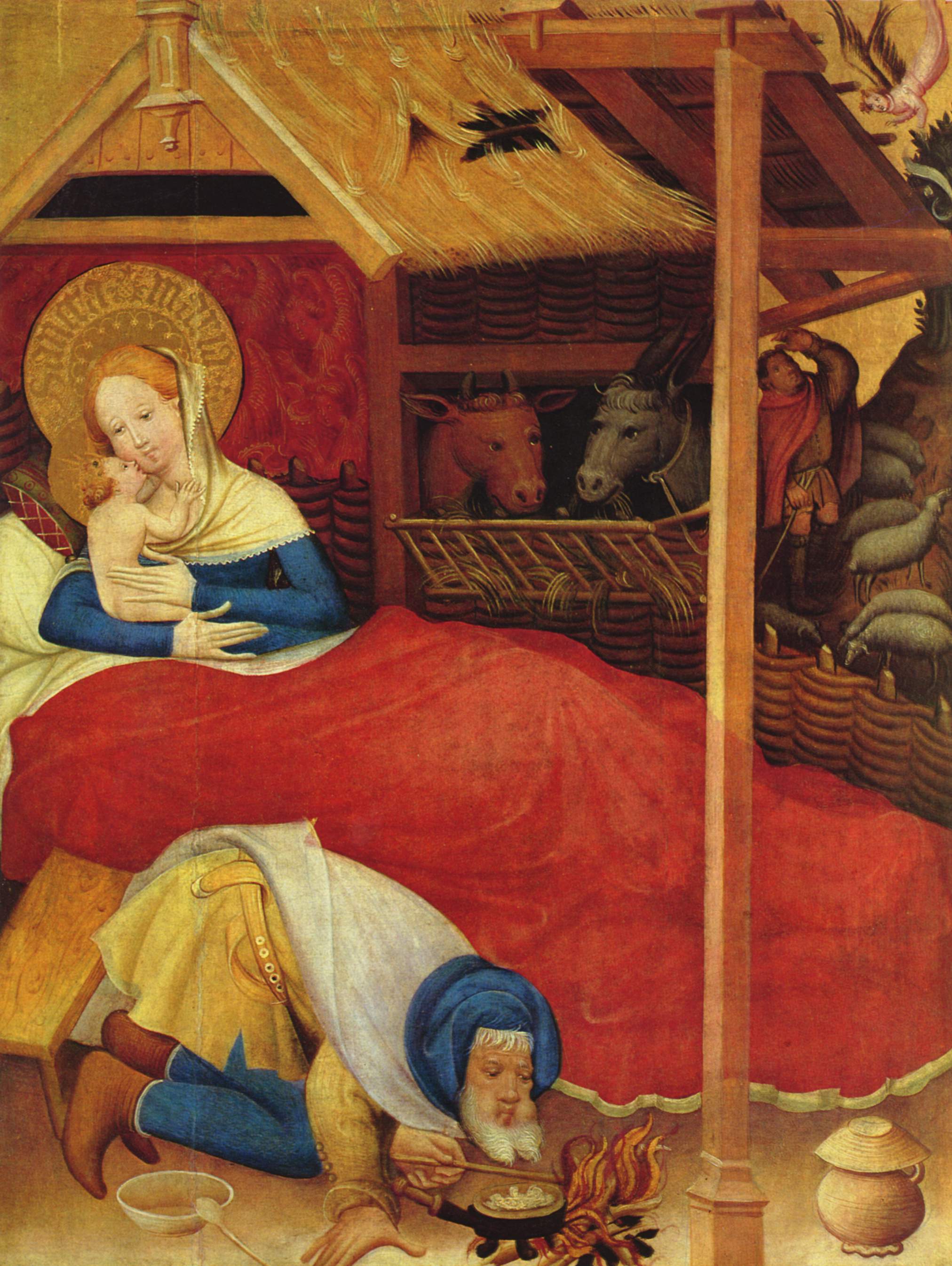
ARTICLE: “Saint Joseph as Baby Daddy: An Illustrated Medieval Guide” by Ela Bobek, DailyArt Magazine:In 2021 on Instagram I shared a small compilation of images that show Joseph as helpful and industrious at the Nativity, as opposed to the more classic depiction of him sitting off to the side with his head in his hands. I’ve since collected over a dozen more and have been wanting to develop a reflection on this motif into a full-fledged article (and probably still will someday), but Ela Bobek has beaten me to it! Check out the images she has compiled that show Joseph cooking, doing laundry, sewing clothes, preparing a bath, and swaddling or holding the baby—allowing Mary some much-needed rest. What a loving, caring, actively involved father and husband!
Conrad von Soest (German, ca. 1370–ca. 1422), Nativity, panel in the left wing of the Niederwildungen Altarpiece, 1403. Tempera on wood, 73 × 56 cm. Stadtkirche St. Nikolaus, Bad Wildungen, Germany. [view full altarpiece]
+++
SONGS:
>> “Christmas Ko Ramjham Ma” by Milan Bhujel and Surya Rasaili: This Nepali Christmas song was written by Milan Bhujel (words) and Surya Rasaili (music) in 2022 and is performed here (with dancing!) by Bhujel and friends. I couldn’t find a translation of the Nepali lyrics, but the gist of it is “Let’s dance and rejoice, let’s celebrate the birth of Jesus, who has come to save us. Jesus is a light dispelling all darkness.” [HT: Global Christian Worship]
Ivan Večenaj (Croatian, 1920–2013), Nativity, 1970. Oil on glass. Galerija Ivan Večenaj, Gola, Croatia.
Ivan Večenaj (1920–2013) was a self-taught artist from Croatia, a representative of the Hlebine school of naive painting. He loved nature and folk culture—many of his paintings depict local village life or biblical scenes set in Croatia’s rural countryside. His works are in the collections of the Croatian Museum of Naïve Art in Zagreb and the Vatican Museums, among others. There is also a museum dedicated to his work: the Galerija Ivan Večenaj (Ivan Večenaj Gallery) in his home village of Gola in the Prekodravlje region.
Večenaj’s 1970 Nativity sets Jesus’s birth in Gola. Mary bounces the boy Jesus on her knee under a makeshift shelter roofed with a purple blanket that resembles a mountain. Emerging from the snowy ground behind them is a red cross, a crown of thorns hanging from the center and blood dripping from a wedged nail on both terminals onto a barren tree and Mary’s cloak. But this sign of death is counterbalanced with signs of life—flowers, wheat, and a grapevine sprouting up around the two, references to the Eucharist and to the blossoming of salvation.
The scene emphasizes Jesus’s humble birth into a peasant family—the artist, too, had a peasant background—and foreshadows his atoning death.
LISTEN:“Ar gyfer heddiw’r bore”(For the sake of this very morning), aka “Faban Bach” (A Little Baby) | Words by David Hughes, early nineteenth century | Tune: MENTRA GWEN, traditional Welsh | Performed by Parti Fronheulog, 1967
Ar gyfer heddiw’r bore’n faban bach, faban bach, y ganwyd gwreiddyn Iesse’n faban bach; y Cadarn ddaeth o Bosra, y Deddfwr gynt ar Seina, yr Iawn gaed ar Galfaria’n faban bach, faban bach, yn sugno bron Maria’n faban bach.
Caed bywiol ddŵfr Eseciel ar lin Mair, ar lin Mair, a gwir Feseia Daniel ar lin Mair; Caed bachgen doeth Eseia, ’r addewid roed i Adda, yr Alffa a’r Omega ar lin Mair, ar lin Mair; mewn côr ym Meth’lem Jiwda, ar lin Mair.
Diosgodd Crist o’i goron, o’i wirfodd, o’i wirfodd, er mwyn coroni Seion, o’i wirfodd; i blygu’i ben dihalog o dan y goron ddreiniog i ddioddef dirmyg llidiog, o’i wirfodd, o’i wirfodd, er codi pen yr euog, o’i wirfodd.
Am hyn, bechadur, brysia, fel yr wyt, fel yr wyt, i ’mofyn am dy Noddfa, fel yr wyt i ti’r agorwyd ffynnon a ylch dy glwyfau duon fel eira gwyn yn Salmon, fel yr wyt, fel yr wyt, gan hynny, tyrd yn brydlon, fel yr wyt.
For the sake of this very morning, as a little baby, a little baby Was born the root of Jesse, as a little baby; The Strong one who came from Bosra, The Lawmaker of old on Sinai, The Redemption to be had on Calvary, as a little baby, a little baby, Suckling the breast of Mary, as a little baby.
The life-giving water of Ezekiel is found on Mary’s knee, on Mary’s knee, And the true Messiah of Daniel on Mary’s knee; Here is the wise boy-child of Isaiah, The promise made to Adam, The Alpha and Omega on Mary’s knee, on Mary’s knee; In the stall in Bethlehem of Judah, on Mary’s knee.
Christ took off his crown, of his freewill, of his freewill, In order to crown Zion, of his freewill; To bow his undefiled head Under the thorny crown, To suffer enraged derision, of his freewill, of his freewill, To raise the head of the guilty, of his freewill.
Therefore, sinner, hurry, as thou art, as thou art, To ask for his sanctuary, as thou art; For thee the well was opened Which washes thy wounds Like the snow on Salmon, as thou art, as thou art. For that, come promptly, as thou art.
With roots dating back to the pre-Reformation era, theplygain service is a Welsh Christmas tradition in which Christians gather at church from 3 a.m. to 6 a.m. on Christmas morning for community-led carol singing. One of the popular carols that’s sung is “Ar gyfer heddiw’r bore,” its text by the Welsh poet David Hughes (ca. 1794–1862), known by his bardic name of Eos Iâl. It’s twelve stanzas in all, which start with the Nativity and then move through various stages of Christ’s passion, from Gethsemane to Pilate’s hall to Golgotha to the garden of the tomb, commemorating the incarnation, the atonement, and Christ’s ascension and intercession for sinners.
The recording here is by Parti Fronheulog, a folk trio of brothers from southeast Denbighshire, Wales—Tom Williams (lead), Osmond Williams (tenor), and Ted Williams (bass)—who were active in the 1960s. They sing stanzas 1, 2, 5 and 12.
Maryam and Isa (Mary and Jesus), miniature from a Falnama, Mughal India, 1550–1600. Opaque paint, gold, and silver on paper, 49 × 35 cm. Wereldmuseum, Rotterdam, Netherlands, Inv. 07180329.
This delicate painting is from an Islamic manuscript made in India during the Mughal era. It shows Mary sitting outside with her son, Jesus, on her lap, whose flaming halo identifies him as a prophet. Enclosed by a gate, they are seated on a mat, and Jesus hands his mother a fruit that looks to me like a pomegranate—though a date would cohere better with the Qur’an’s Nativity account (19:25–26). Verdant pink hills rise up behind them, as does a palm tree, under which sits a pitcher of water. From the left, an anthropomorphized sun gazes down on the sacred pair. The inscriptions are in Persian.
Like Christians, Muslims revere Jesus—his birth is recounted in the Qur’an 19:16–34 and 3:45–53, and in that book he is also described as the Messiah, the Word of God, and the Spirit of God—but unlike Christians, Muslims do not regard Jesus as divine.
We remember today, O God, the slaughter of the holy innocents of Bethlehem by King Herod. Receive, we pray, into the arms of your mercy all innocent victims; and by your great might frustrate the designs of evil tyrants and establish your rule of justice, love, and peace; through Jesus Christ our Lord, who lives and reigns with you, in the unity of the Holy Spirit, one God, for ever and ever. Amen.
—Collect from the Book of Common Prayer
Western church calendars mark December 28 as the Feast of the Holy Innocents, or Childermas, a day set aside to remember the slaughter of male Bethlehemites aged two and under by Herod the Great, king of Judea, as recounted in Matthew 2:16–18. Historians estimate there were probably ten to twenty children of that age in Bethlehem at the time.
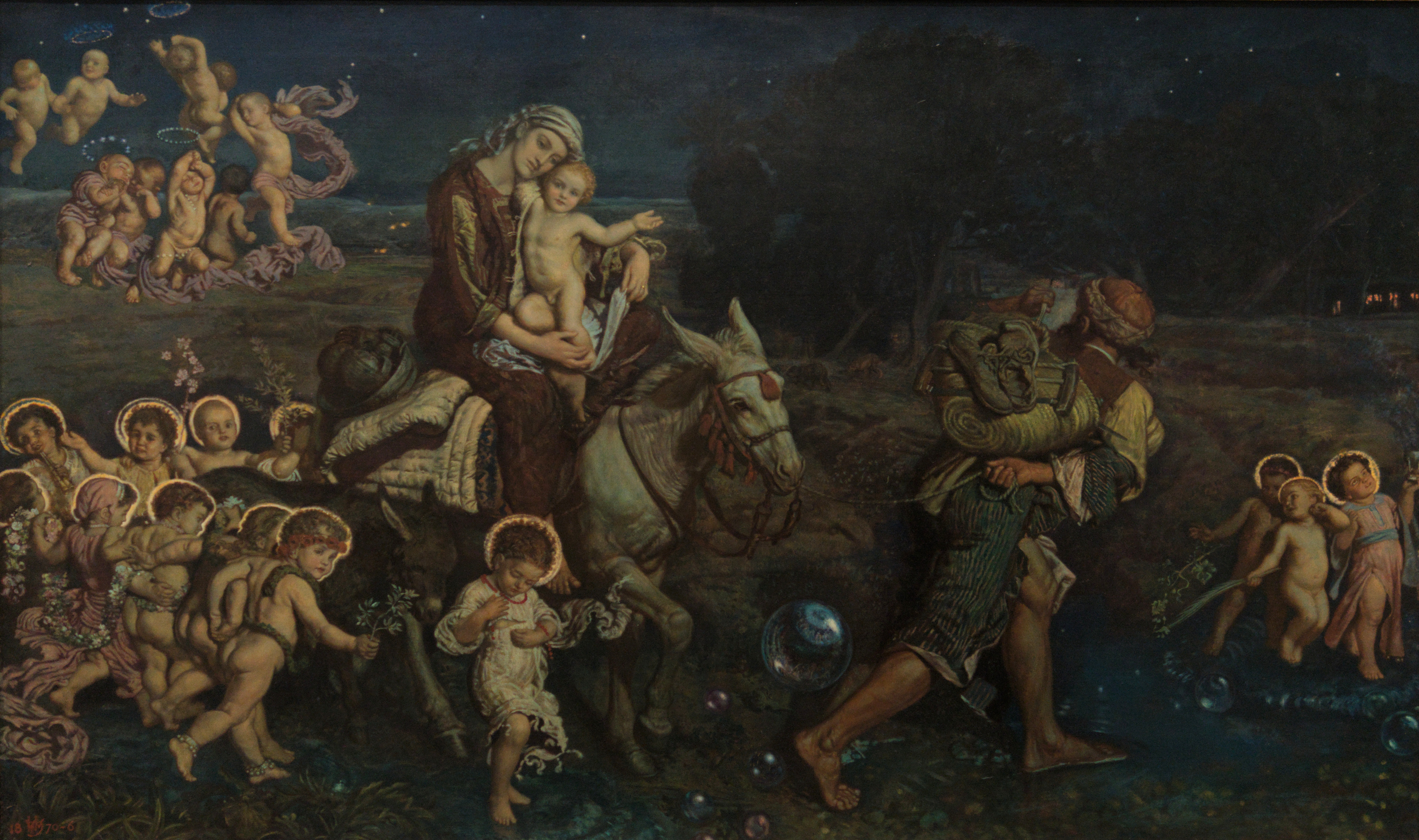
LOOK: The Triumph of the Innocents by William Holman Hunt
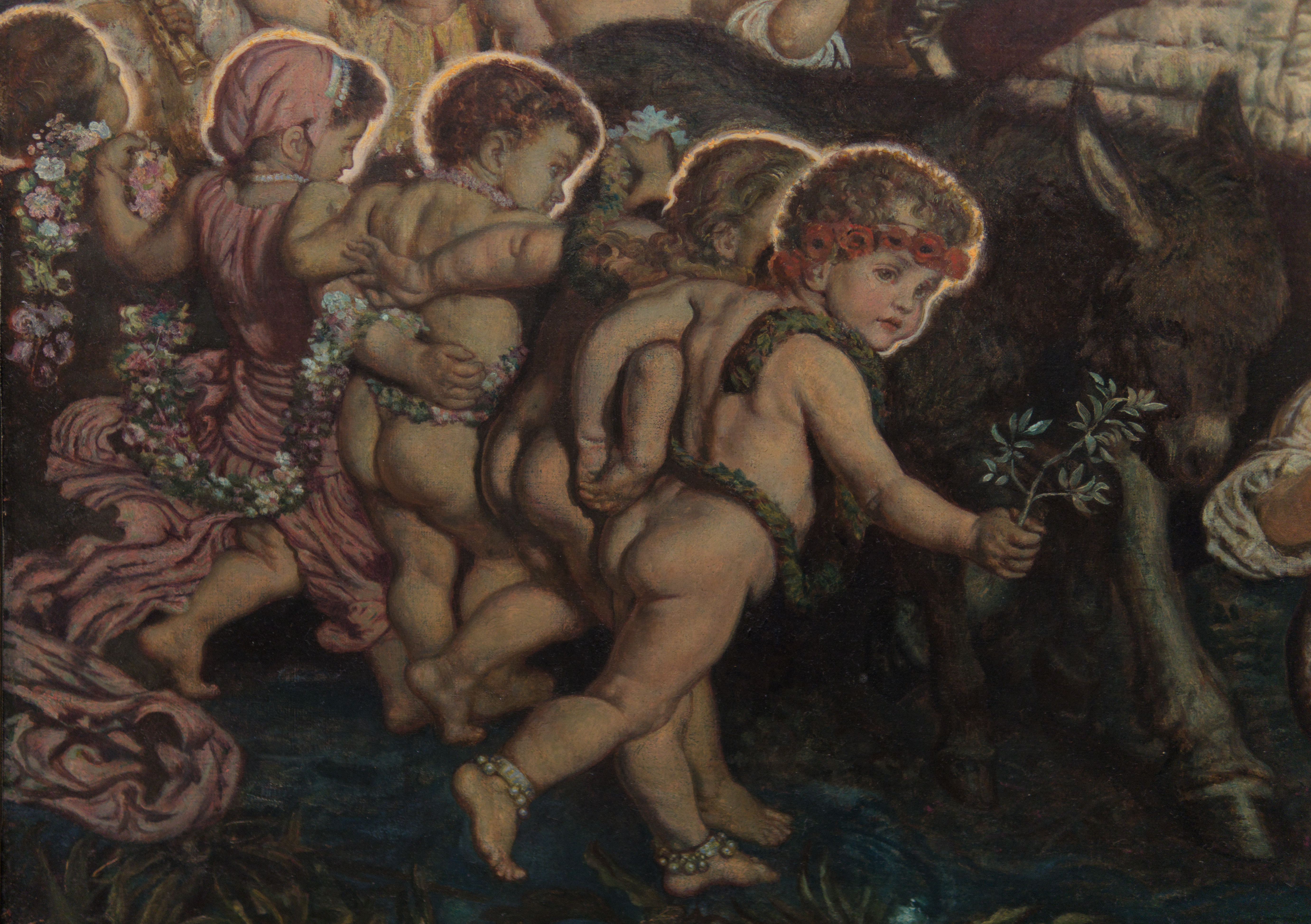
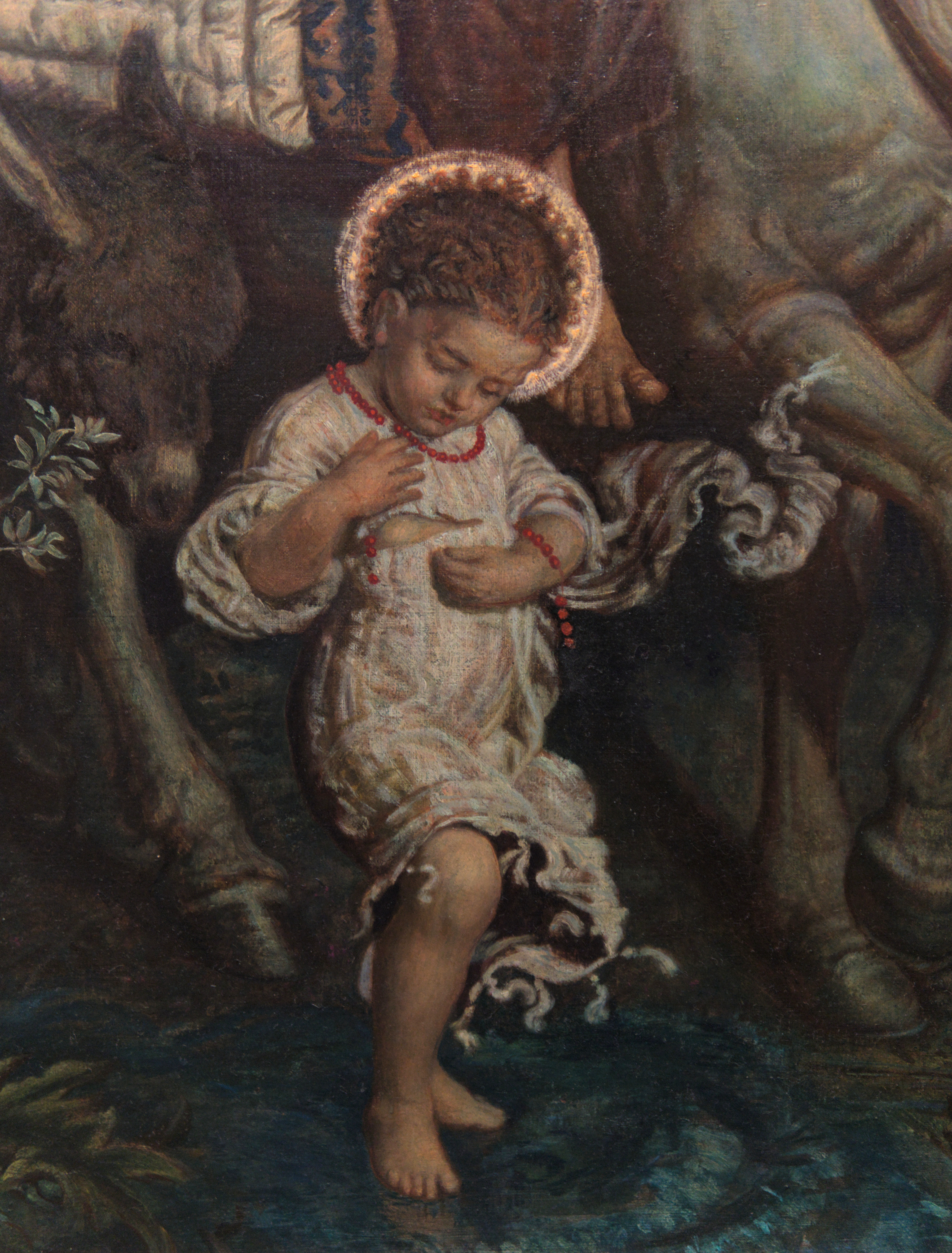
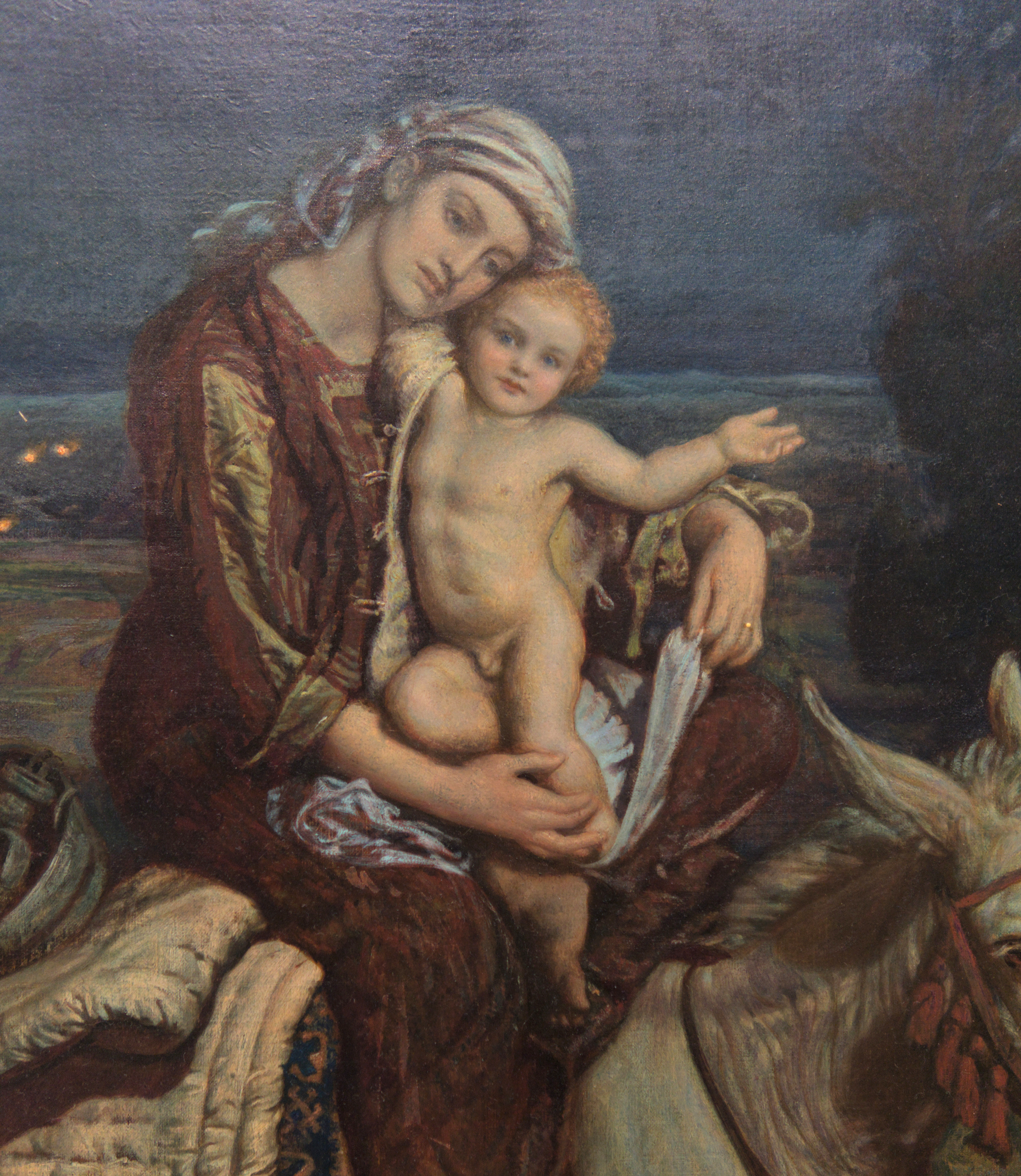
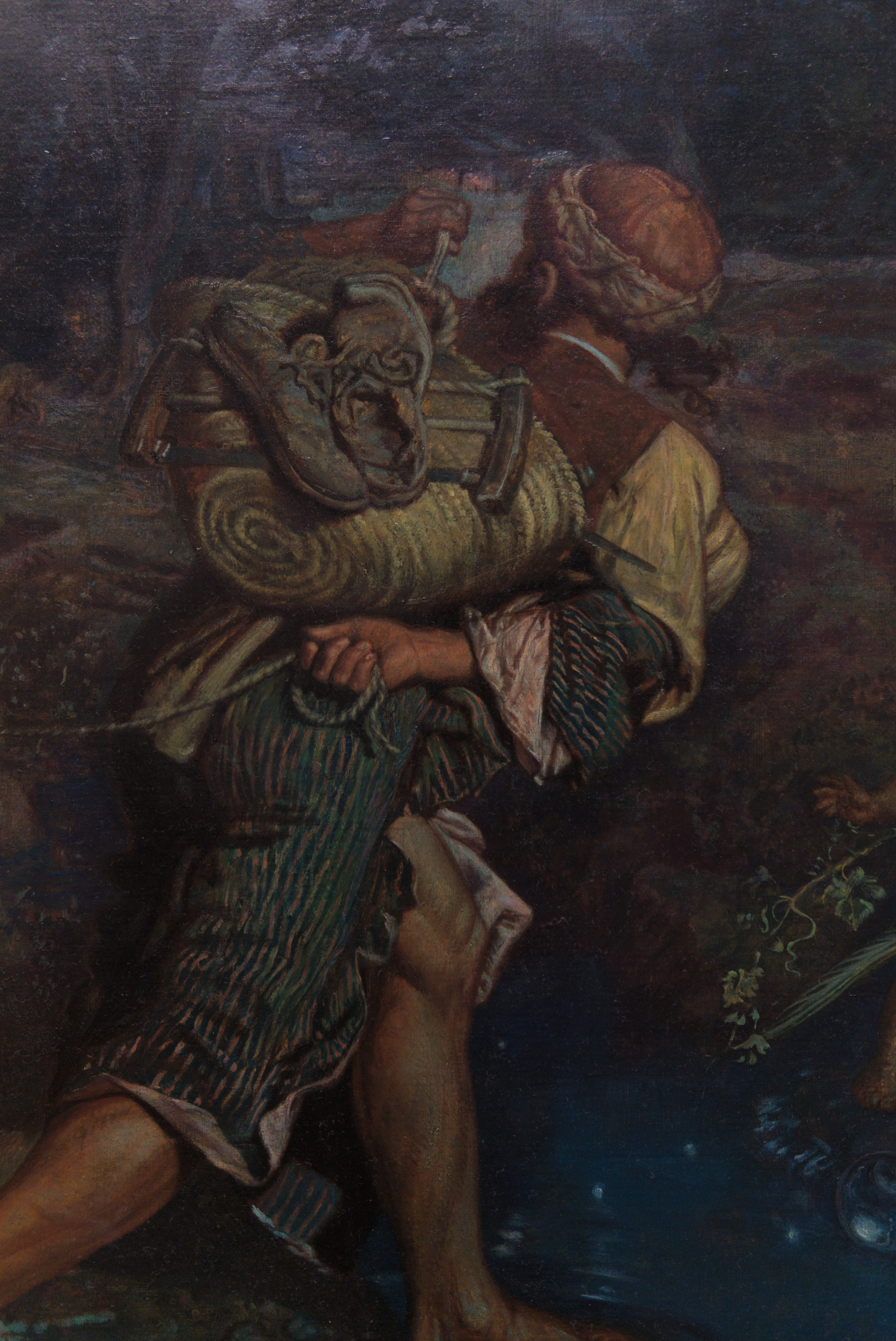
William Holman Hunt (British, 1827–1910), The Triumph of the Innocents, 1870–1903. Oil on canvas, 75.3 × 126 cm. Harvard Art Museums, Cambridge, Massachusetts. Photo: Victoria Emily Jones. [object record]
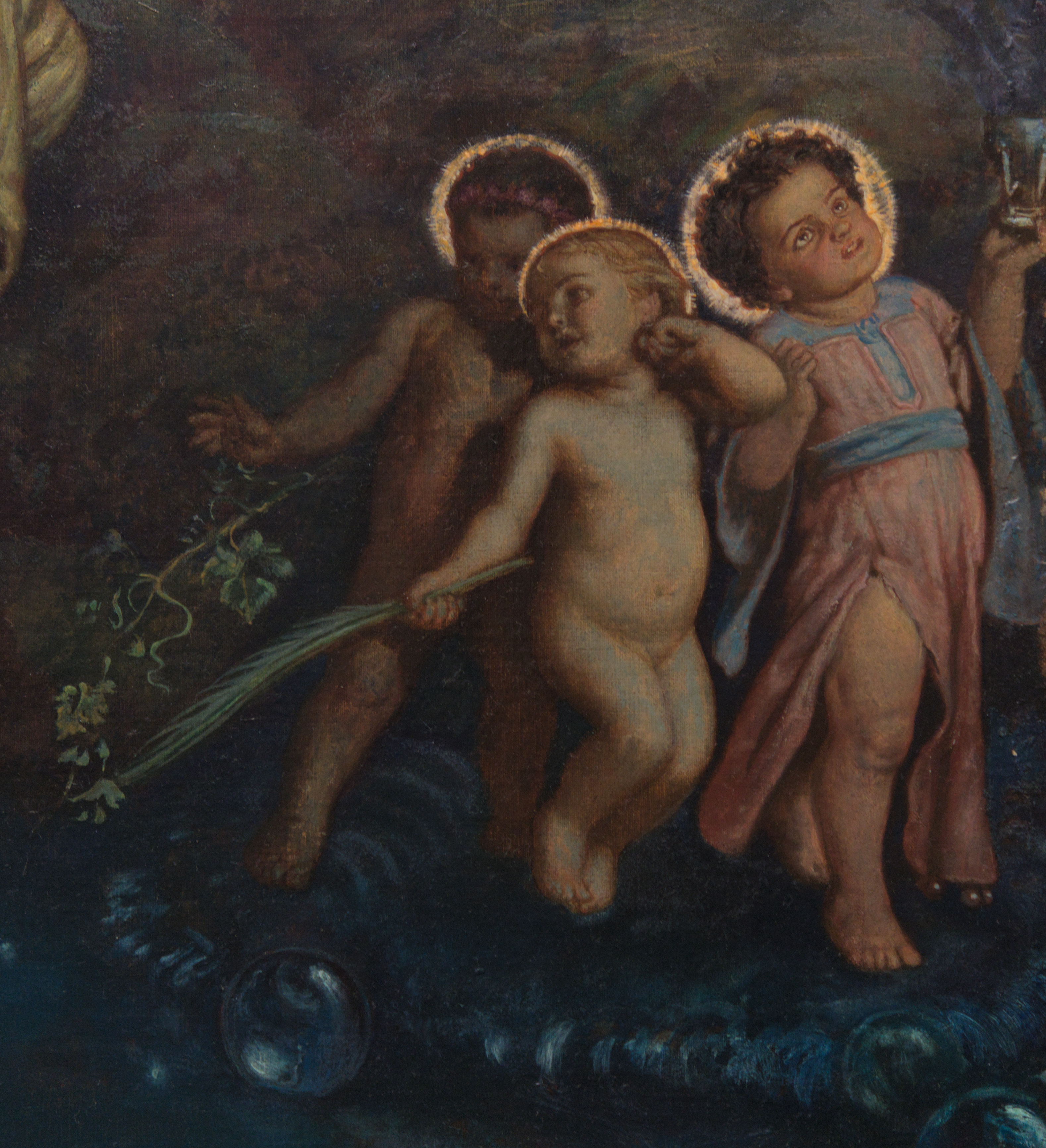
This visionary realist painting by the Pre-Raphaelite artist William Holman Hunt is a unique interpretation of the Flight to Egypt. It shows, surrounding the Holy Family on the run, the embodied spirits of all the little boys in Bethlehem—the “innocents”—who were slain at Herod’s behest. It’s the first of three versions Hunt painted of the subject, mostly completed by 1876, but with some of the background left unfinished until 1903. The other two versions are in the Tate Britain in London and the Walker Art Gallery in Liverpool.
The early church understood these boys as the first Christian martyrs. Though they were not conscious witnesses for Christ, they were killed because of him, casualties of a persecuting tyrant’s brooking no rival. Their death prefigures that of future Christian martyrs, starting with Stephen, as well as Christ’s own death.
Despite the solemnity of this episode, Hunt casts it in a triumphant light. Instead of showing the infants dismembered or impaled in a bloodbath with their mothers wailing in helpless grief, as artists have historically done, Hunt shows them in the light of glory, carrying palms and other branches and wearing floral crowns and garlands. They are, in the words of John Powell Lenox, the “first of that glorious company whose shining ranks are nearest the throne of the Slain One.”
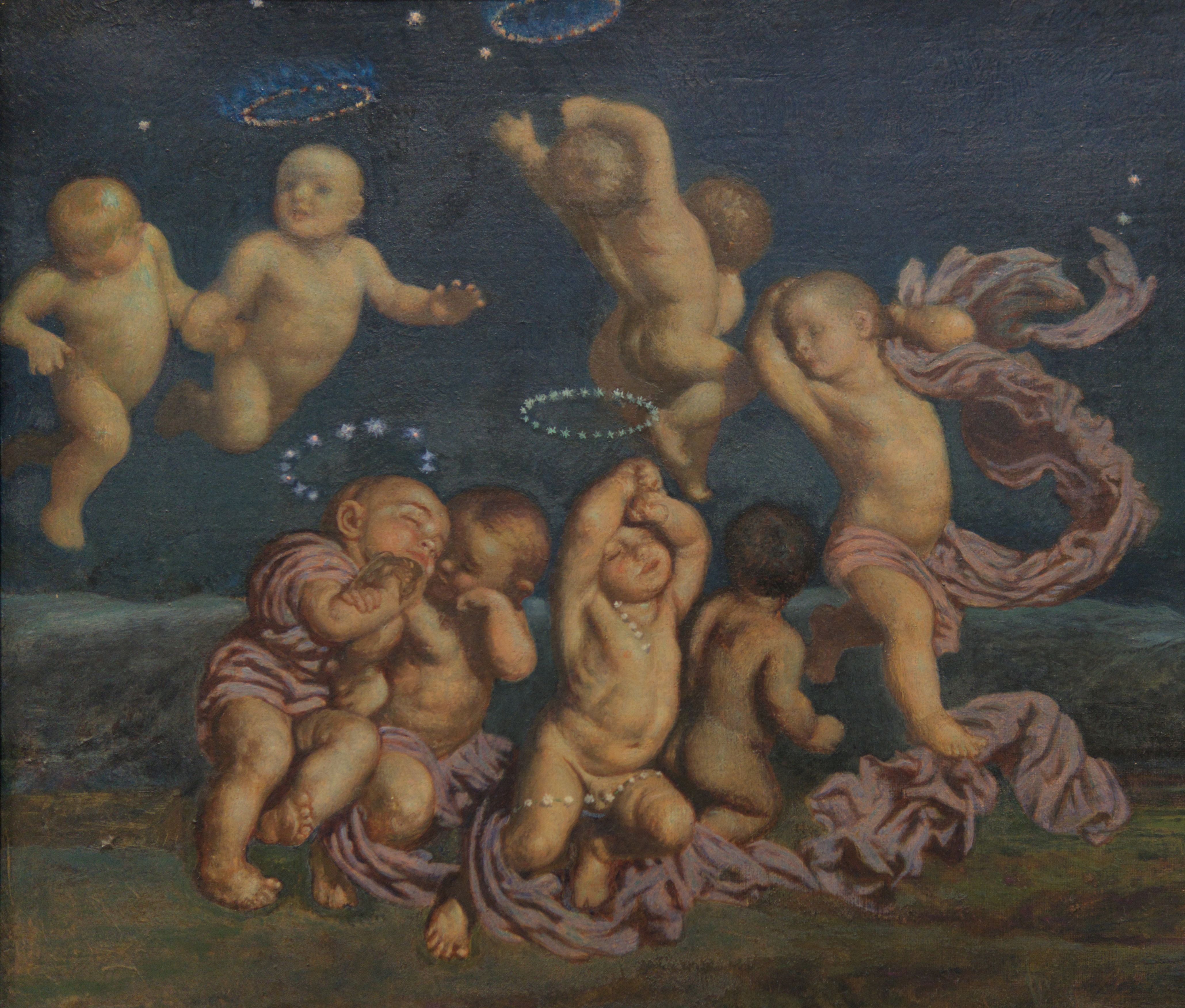
Floating in air, those at the upper left are just waking up to their new spiritual life—they open their eyes and stretch.
Those on the ground lock arms in solidarity and play, surrounding a little foal. One curly-locked lad wears a red necklace, the beads spilling from the chain reminiscent of blood drops. But the fatal chest wound that one of Herod’s soldiers had inflicted by sword is no more, as he looks down with wonder to discover through a tear in his tunic. Healed flesh!
In the center Mary rides a mule, holding Jesus, who greets his playmates with a wave and a smile. He’s the only one who’s aware of them, these mystic brothers accompanying him into exile. Joseph leads the way forward, staying alert to potential threats. His tool basket is slung over his shoulder, which he’ll use to make a living for his family in Egypt.
At the far right one of the child-martyrs, “in priestly office” and holding a censer, leads the celestial band, while his two companions “cast down their tokens of martyrdom in the path of their recognised Lord,” as Hunt wrote in the catalog for the 1885 exhibition of the Tate version by the Fine Art Society in London.
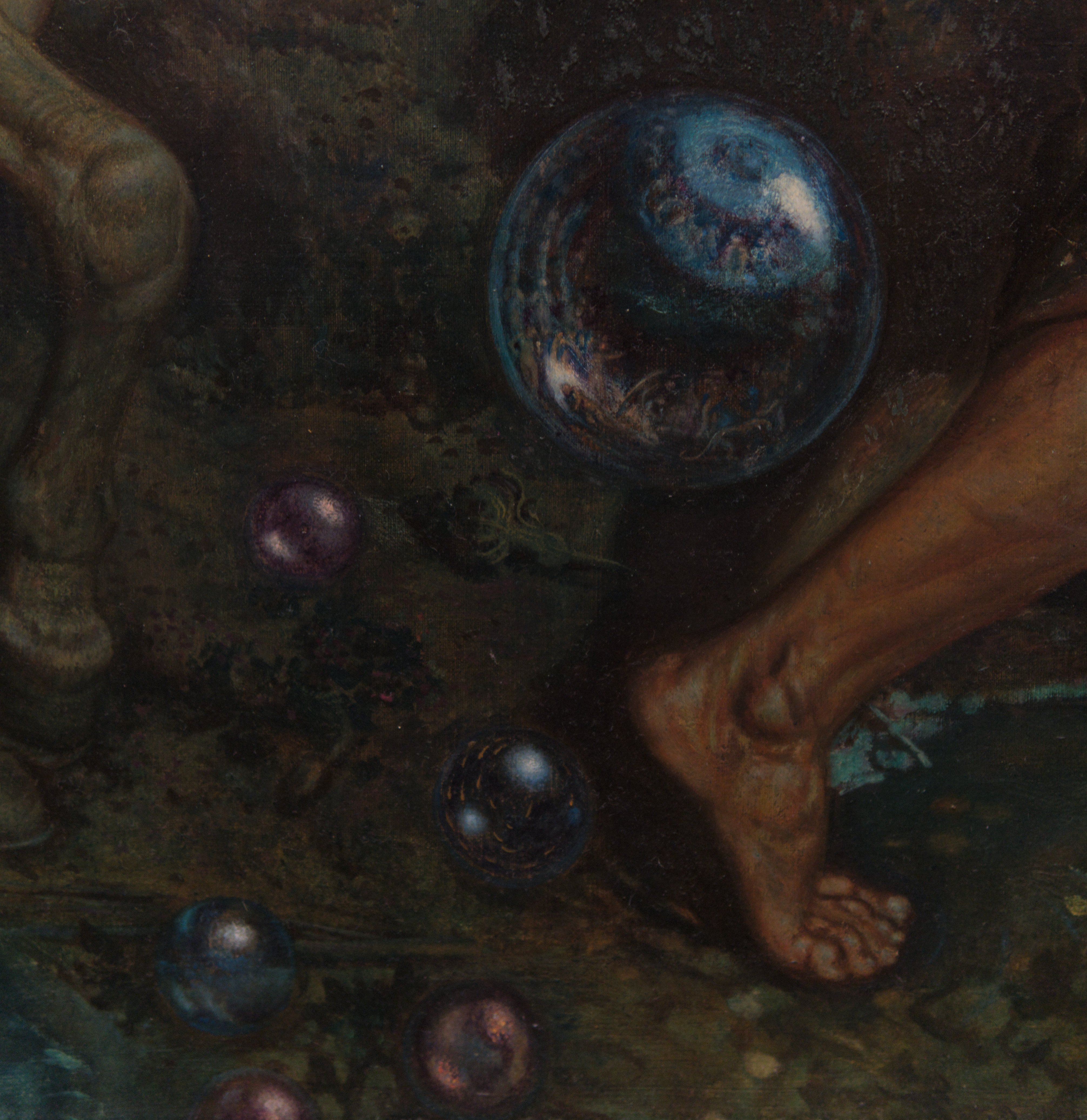
The children tread through “the living fountains of water, the streams of eternal life . . . ever rolling onward and breaking—where it might if real water be dissipated in vapour—into magnified globes which image the thoughts rife in that age in the minds of pious Jews . . . of the millennium which was to be the mature outcome of the advent of the Messiah.” The large bubble above Joseph’s right calf reveals Jacob’s dream at Bethel, which “first clearly speaks of the union of Earth and Heaven” that Christ will one day make total and permanent.
LISTEN: “Salvete Flores Martyrum” (Hail, Martyr Flowers) | Words by Aurelius C. Prudentius, early fifth century | Music by Claudio Dall’Albero, 2022 | Performed by the Choir of Sidney Sussex College, Cambridge, dir. David Skinner, on Vespertina Hymnodia: Sacred Music by Claudio Dall’Albero, 2022
Salvete flores Martyrum
Quo lucis ipso in limine
Christi in secutur sustulit
Ceu turbo nascentes rosas.

Vos prima Christi victima
Grex immolatorum tener
Aram ante ipsam simplices
Palma et coronatis luditis.

Jesu tibi sit Gloria
Qui natus es de Virgine
Cum Patre et almo Spiritu
In sempiterna saecula
All hail, ye little Martyr flowers,
Sweet rosebuds cut in dawning hours!
When Herod sought the Christ to find,
Ye fell as bloom before the wind.

First victims of the Martyr bands,
With crowns and palms in tender hands,
Around the very altar, gay
And innocent, ye seem to play.

All honor, laud, and glory be,
O Jesu, Virgin-born, to Thee;
All glory, as is ever meet,
To Father and to Paraclete.

Trans. Athelstan Riley
“Salvete flores martyrum” is the office hymn for Lauds on the Feast of the Holy Innocents. It is a cento from the 208-line Epiphany poem in the Cathemerinon by the ancient Latin Christian poet Prudentius, first assembled in the 1568 Breviary of Pope Pius V.
This text has been set to music by many composers ever since the Renaissance. My favorite setting is probably by the contemporary Italian composer Claudio Dall’Albero, from his cycle Five Hymns for Vespers, shared above.
Athelstan Riley’s is one of several metrical English translations, but here’s a prose translation provided by John Carden in his compilation A Procession of Prayers:
God keep you, O finest flowers of martyrs, who, at the dawn of life, were crushed by the persecutor of Christ and flung like petals before a furious wind.
You, the first to die for Christ, tender flocks of martyrs, now dance before the altar, now laugh candidly with your palms and gardens.
LOOK: Nativity relief sculpture from Chartres Cathedral
The Nativity, ca. 1230–40. Limestone fragment from the now destroyed rood screen of Chartres Cathedral, France, 93 × 133 cm.
LISTEN: “A Cradle in Bethlehem” by Alfred Bryan (words) and Larry Stock (music), 1952 | Performed by Gregory Porter and the Jazz at Lincoln Center Orchestra with Wynton Marsalis, on Big Band Holidays, 2015
Sing sweet and low a lullaby till angels say, “Amen” A mother tonight is rocking a cradle in Bethlehem While wise men follow through the dark a star that beckons them A mother tonight is rocking a cradle in Bethlehem
A little child will lead them, the prophets said of old In storm and tempest heed him until the bell is tolled Sing sweet and low your lullaby till angels say, “Amen” A mother tonight is rocking a cradle in Bethlehem
A mother tonight is rocking a cradle in Bethlehem A mother tonight is rocking her baby in Bethlehem
This song was popularized by Nat King Cole on his 1960 album, The Magic of Christmas. In addition to the live recording above featuring singer-songwriter Gregory Porter and legendary jazz trumpeter Wynton Marsalis, here are two other recordings I like:
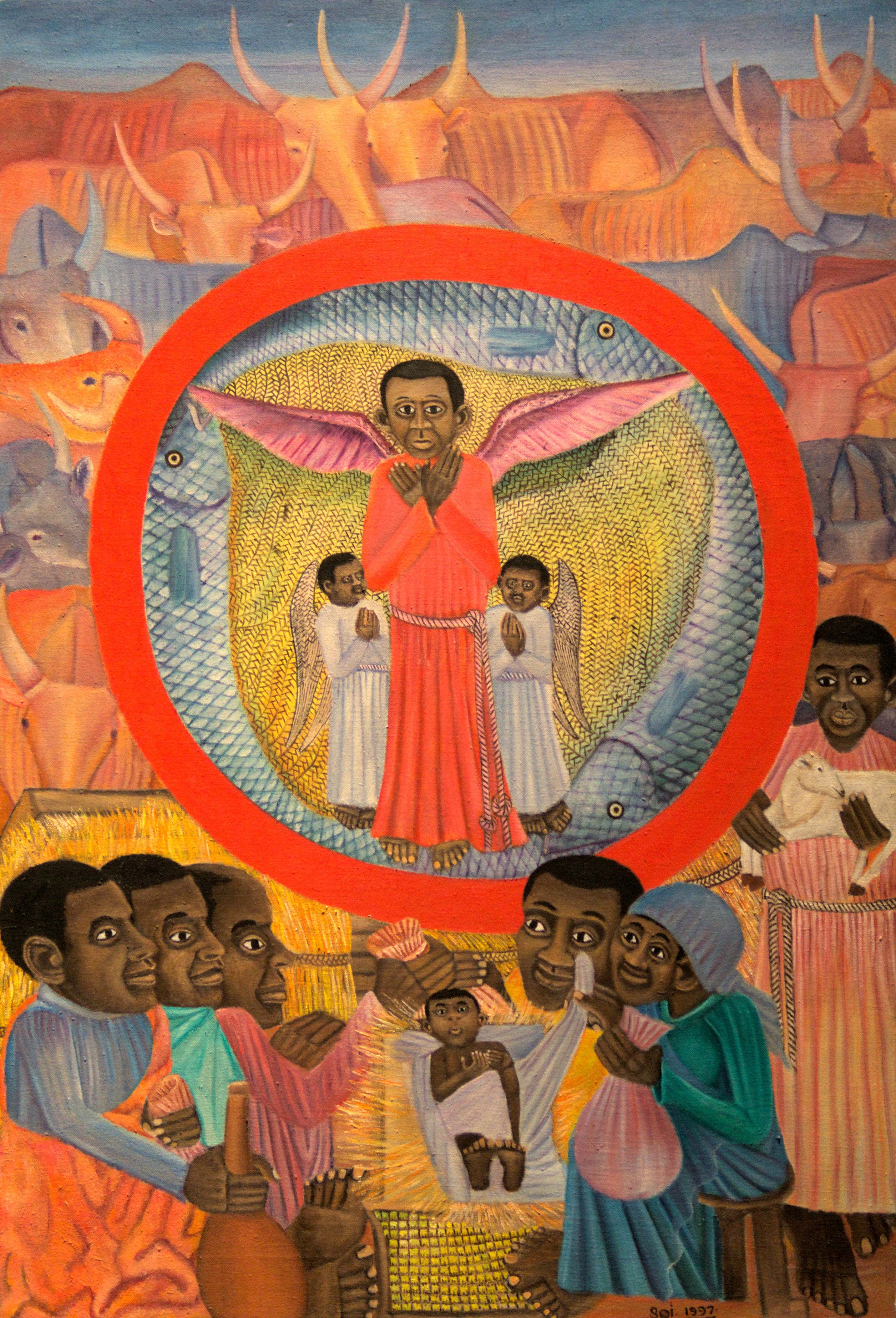
LOOK: Birth of Jesus with Magi and Celestial Observers by Ancent Soi
Ancent Soi (Kenyan, 1939–2022), Birth of Jesus with Magi and Celestial Observers, 1997. Oil on canvas, 34 × 23 in. (86.4 × 58.4 cm). North Carolina Museum of Art, Raleigh. Photo: Victoria Emily Jones. [object record]
LISTEN: “Nyathi Onyuol” (A Child Is Born) | Traditional Luo spiritual, arr. Enrico Oweggi, 1990 | Performed by the Nairobi Chamber Chorus, 2021
Isaya ne okoro k’owacho niya “Kuomwa nyathi onyuol.” Nyathi ma wuoyi, no luonge Hono, Jabura, Nyasaye ma Jateko, Wuonwa, Emmanuel.
Chieng’o nogo piny neolil piny neo kuwe, Sulwe ne rieny, Nyathi n’o nyuol. Kanyna n’oting’o Maria, yawa, kodhiyoe piny mar Daudi kwargi kanyna n’oting’o Maria yawa Maria ne pek Yesu Jawar Kar nindo n’otamo Maria yudo Bethlehem ne opon’g ting ma pek Josef chwore n’o manyo ot tone ot otamo Kuom hawi Josef n’onyis kund dhok Gotieno nogo muoch neoyako Maria.
Isaya ne okoro . . .
ENGLISH TRANSLATION:
Isaiah prophesied and said: “Unto us a child is born!” He shall be called Wonderful Counselor, the Mighty God, our Father, Emmanuel!
On that day it was dark and silent. There was no place in Bethlehem for Mary and Joseph. By chance they were shown a shed, and that night Mary gave birth to the child.
Isaiah prophesied . . .
This song of unknown authorship is written in the Luo language of the Luo people, who traditionally live on the shores of Lake Victoria in western Kenya and northern Tanzania. It was popularized by Muungano National Choir, who recorded it on their 1990 album Missa Luba: An African Mass—10 Kenyan Folk Melodies, as arranged by one of their members, Enrico Oweggi (sometimes rendered “Owegi”).
The Luo lyrics and loose English translation above are sourced from the liner notes of Christmas a Cappella: Songs from Around the World by Chicago a Capella (2008).







 Art & Theology