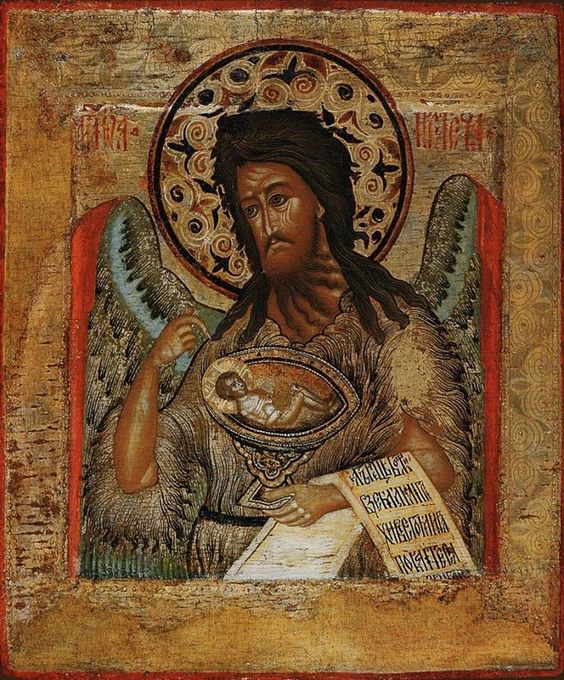
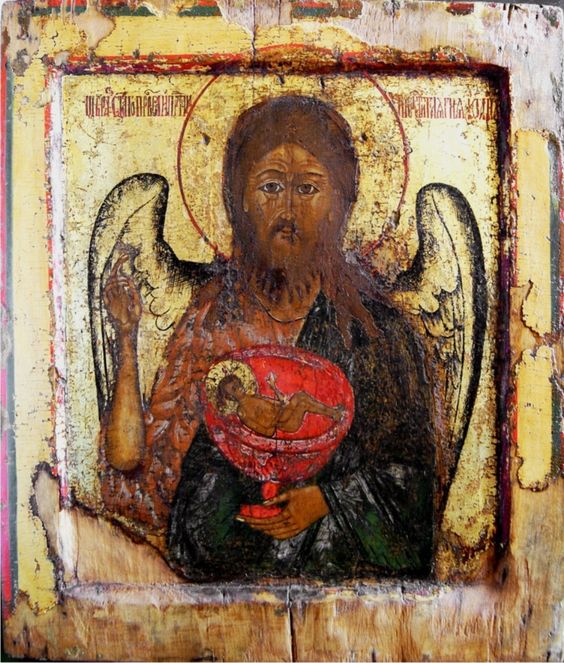
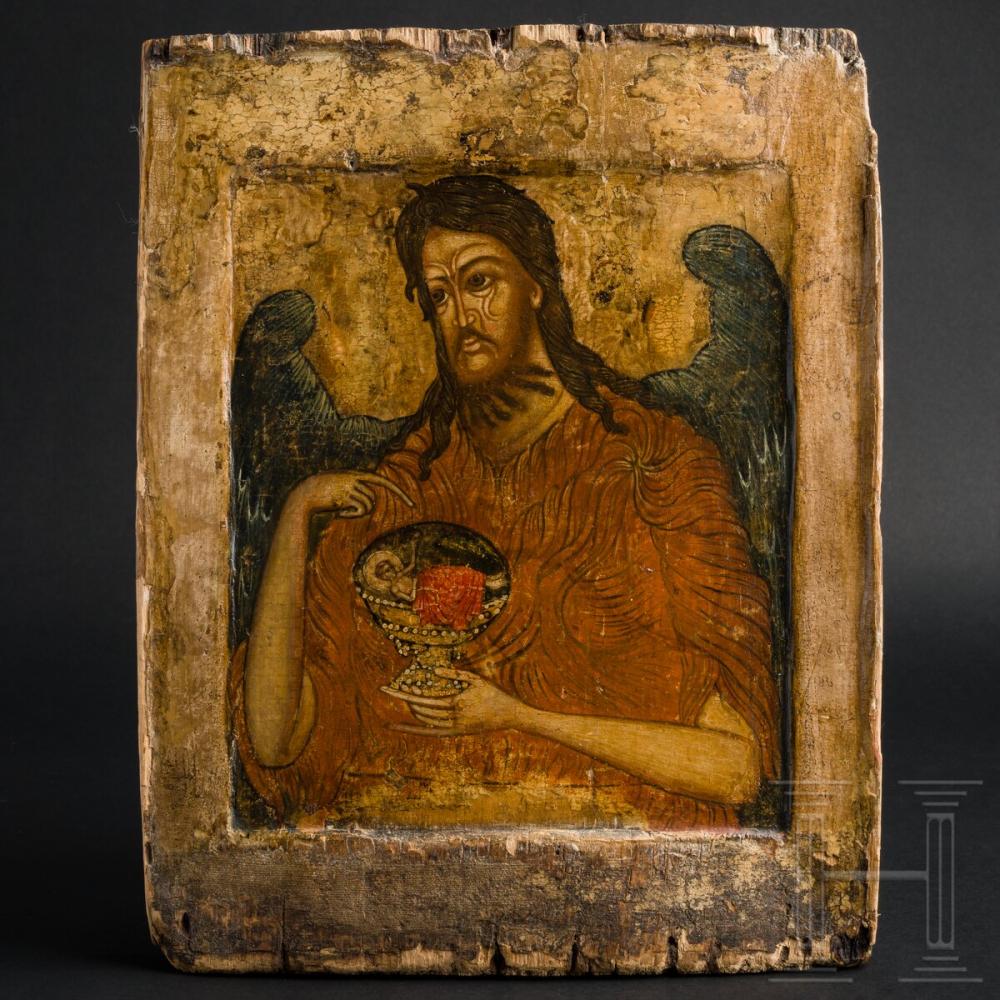
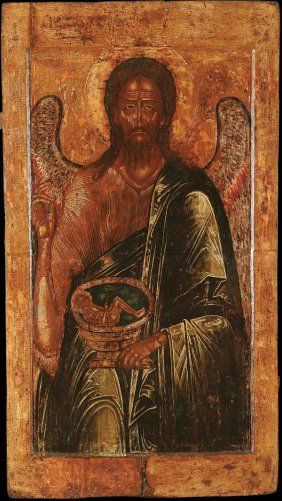
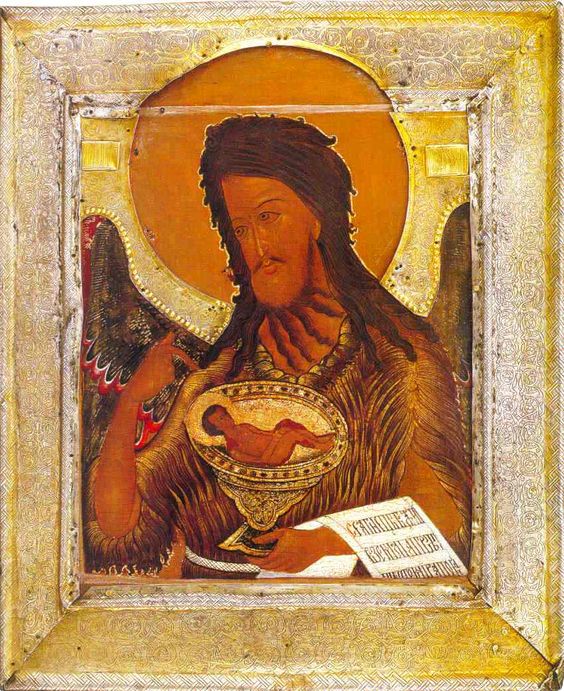
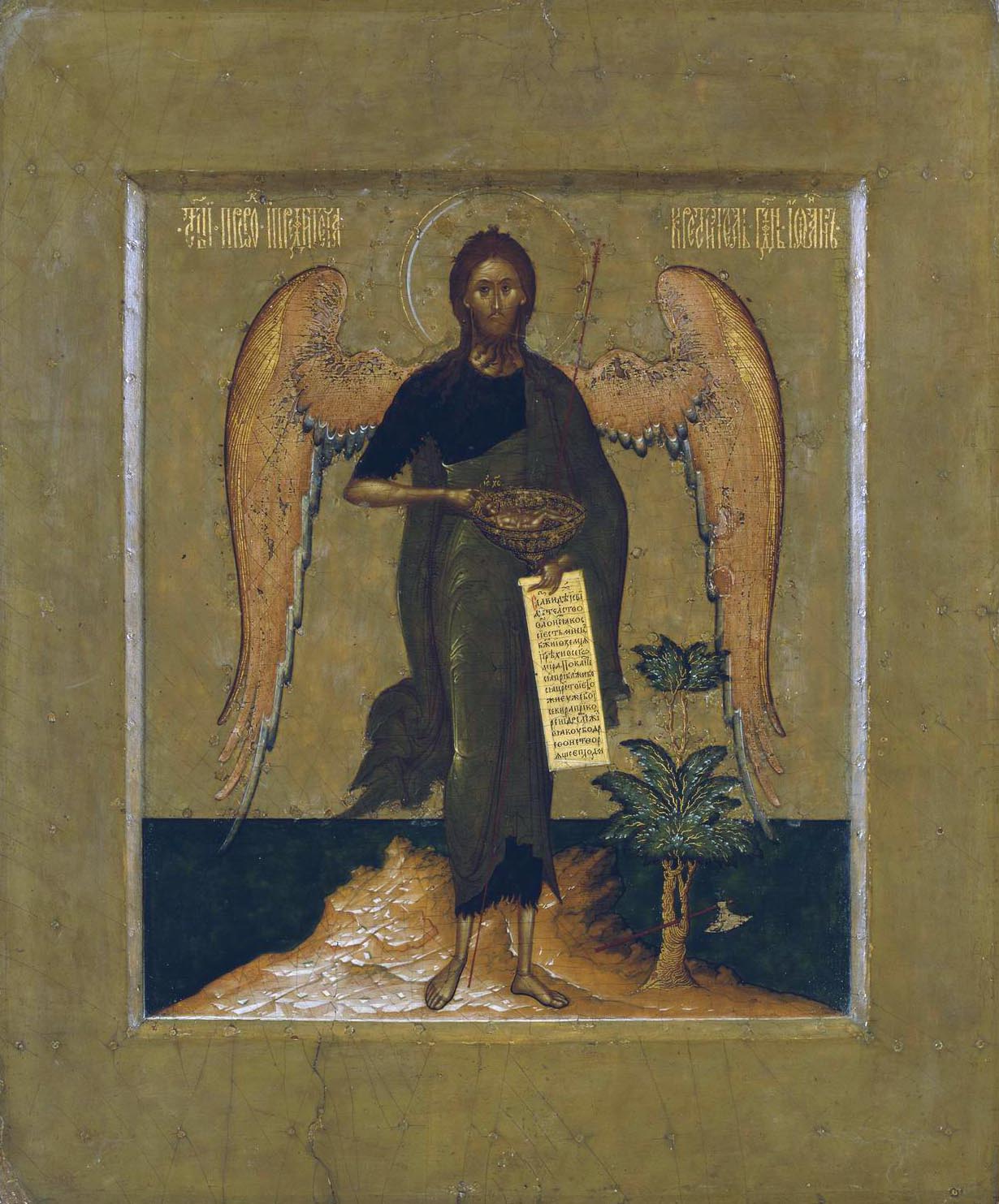
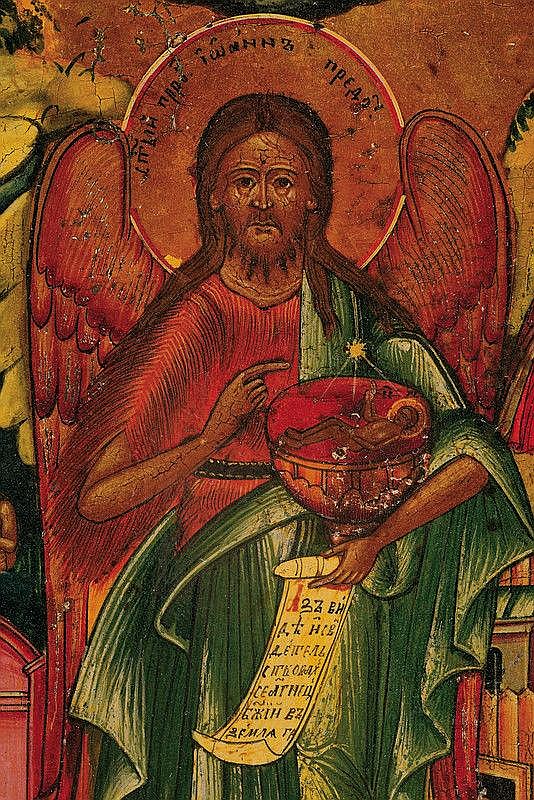
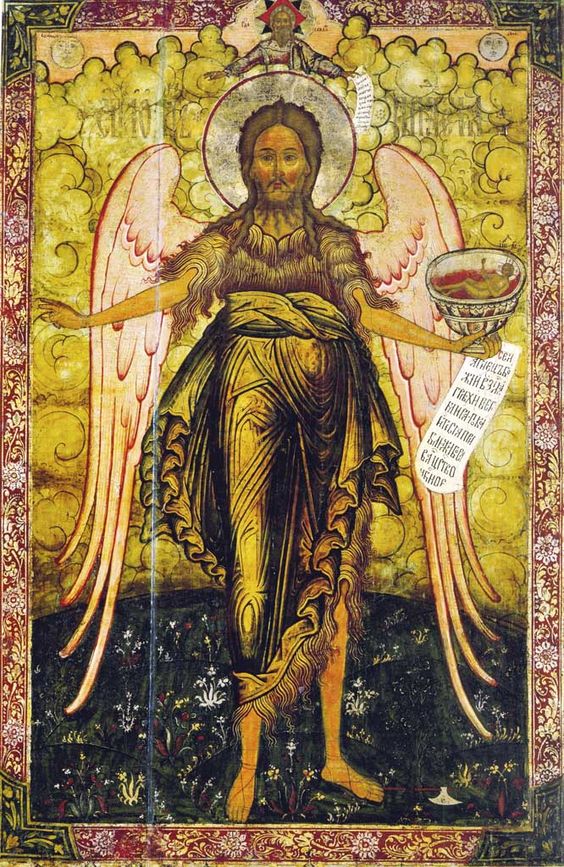
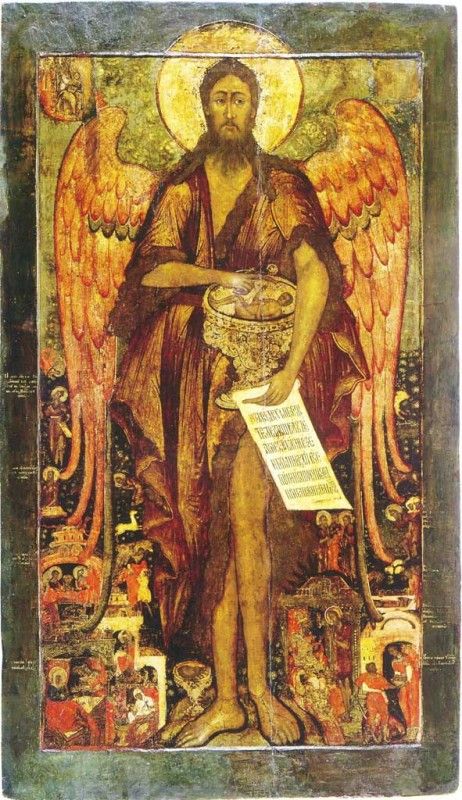
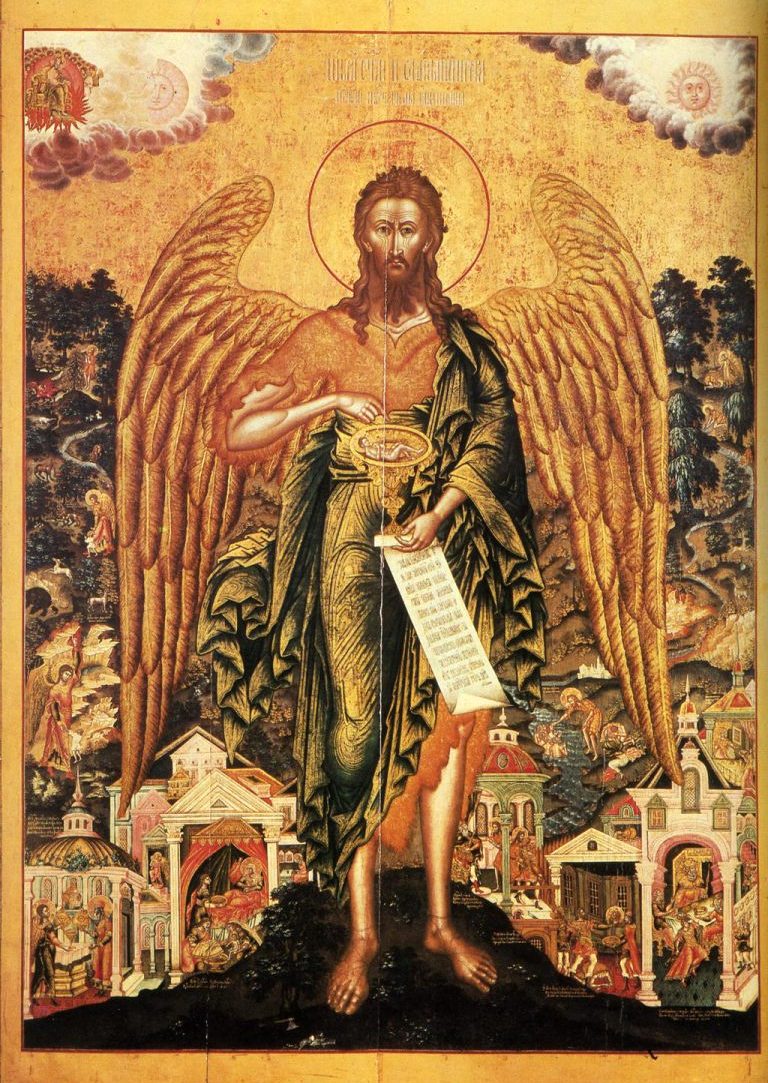
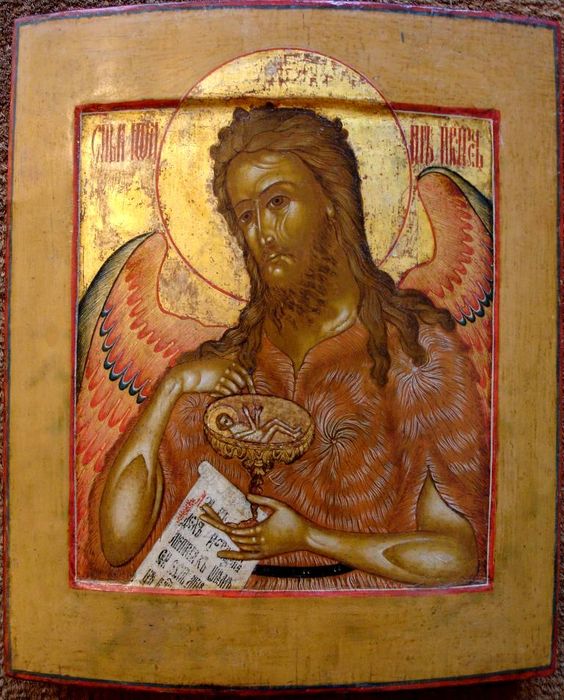
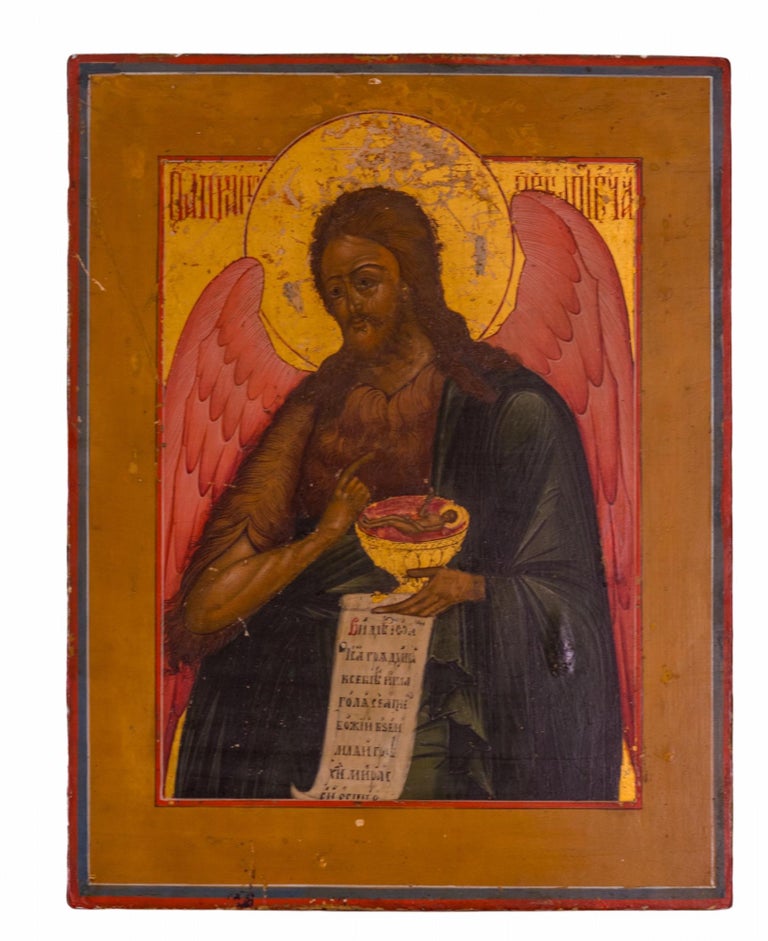
John the Baptist, Angel of the Desert, Russia, 17th or 18th century
John the Baptist served as a bridge between the old and new covenants, calling on people to repent of their sins and produce good fruit in preparation for the arrival of the Messiah. “The kingdom of heaven is at hand!” he vigorously proclaimed on the banks of the river Jordan. “Get ready.”
Eastern Orthodox icons sometimes portray John the Baptist with wings, as the word “angel” means “messenger.” God had announced through his prophet Malachi, “See, I am sending my messenger [mal’āḵ] to prepare the way before me, and the Lord whom you seek will suddenly come to his temple. The messenger of the covenant in whom you delight—indeed, he is coming, says the LORD of hosts” (Mal. 3:1). The Hebrew word, mal’āḵ, that is translated as “messenger” in this passage is translated elsewhere in the Old Testament as “angel.” Christian commentators see this prophecy as fulfilled in John the Baptist.
The iconography of John the Baptist as Angel of the Desert/Wilderness first started appearing in the sixteenth century and is present only in the East. In addition to having two wings, he wears camel skins, an allusion to his asceticism (Matt. 3:4). He usually holds an unfolded scroll bearing his words from Matthew 3:2—“Repent, for the kingdom of heaven has come near”—as well as a poteiron (liturgical chalice) in which lies a naked Christ Emmanuel, evoking the Eucharist. John points to Christ, the source of our salvation.
Sometimes it is John’s own severed head that lies in the chalice instead. This variation references his martyrdom, commemorated each year on August 29.
I’ve compiled a range of John the Baptist, Angel of the Desert icons that include the Christ child in a eucharistic cup. They are all from seventeenth-, eighteenth-, or nineteenth-century Russia; many are in private collections, and a few are in the State Tretyakov Gallery in Moscow.
What is the crying at Jordan? Who hears, O God, the prophecy? Dark is the season, dark our hearts, and shut to mystery.
Who, then, shall stir in this darkness, prepare for joy in the winter night? Mortal, in darkness we lie down, blindhearted, seeing no light.
Lord, give us grace to awake us, to see the branch that begins to bloom; in great humility is hid all heaven in a little room.
Now comes the day of salvation; in joy and terror the Word is born! God comes as gift into our lives; oh let salvation dawn!
The “crying at Jordan” in the first line of this modern hymn refers not to weeping but to a loud uttering—that of John the Baptist preparing the way for the Messiah through the preaching of repentance. When, in response to John’s ministry, the priests and Levites asked him who he was, he declared, “I am the voice of one crying out in the wilderness, ‘Make straight the way of the Lord,’ as the prophet Isaiah said” (John 1:23; cf. Isa. 40:3; Matt. 3:3).
The third stanza refers to Mary’s pregnancy, echoing the closing couplet of the poet John Donne’s “Annunciation” sonnet: “Thou hast light in dark, and shutst in little room, / Immensity cloistered in thy dear womb.” This is an idea that many Christians, both before and after Donne, have mused on and marveled at.
Thank you to my friend Peggy, who introduced me to this remarkable Advent hymn!
Taken near Mars Desert Research Station in Hanksville, Utah, in 2019, this photograph shows yellow and purple flowers peeping up through the dry cracks of a desert floor. It’s a superbloom, “a rare desert botanical phenomenon in which an unusually high proportion of wildflowers whose seeds have lain dormant in desert soil germinate and blossom at roughly the same time. The phenomenon is associated with an unusually wet rainy season” [source]. View more photos here.
Even the wilderness and desert will be glad in those days The wasteland will rejoice and blossom with spring crocuses Yes, there will be an abundance of flowers and singing for joy The deserts will become as green as the mountains of Lebanon As lovely as Mount Carmel or the plain of Sharon There the Lord will display his glory The splendor of God With this news, strengthen those who have tired hands And encourage those who have weak knees Say to those with fearful hearts: Be strong and do not fear Your God is coming He is coming to save you
This electronica chant sets to music a popular Advent scripture: Isaiah 35:1–4. Sung by Tara Ward [previously] of the Opiate Mass, it was recorded live on December 4, 2010, at Immanuel Lutheran Church in Seattle.
The name [The Opiate Mass] is a nod both to the Christian liturgical form and to Karl Marx’s assessment that religion is the opiate for the masses. Perhaps it is. Or perhaps the common desire for comfort, rest, escape, or relief are more complicated and mysterious than we know.
In our pursuit of creating spaces of beauty and awe, we find ourselves partial to cathedrals, antiquity, ambience, pipe organs, samplers, synthesizers, incense, tongues, silence, joy, meditation, ambiguity, the abstract. We strive to avoid pretense, hype, cliché, certainty, celebrity, egotism, greed, noise.
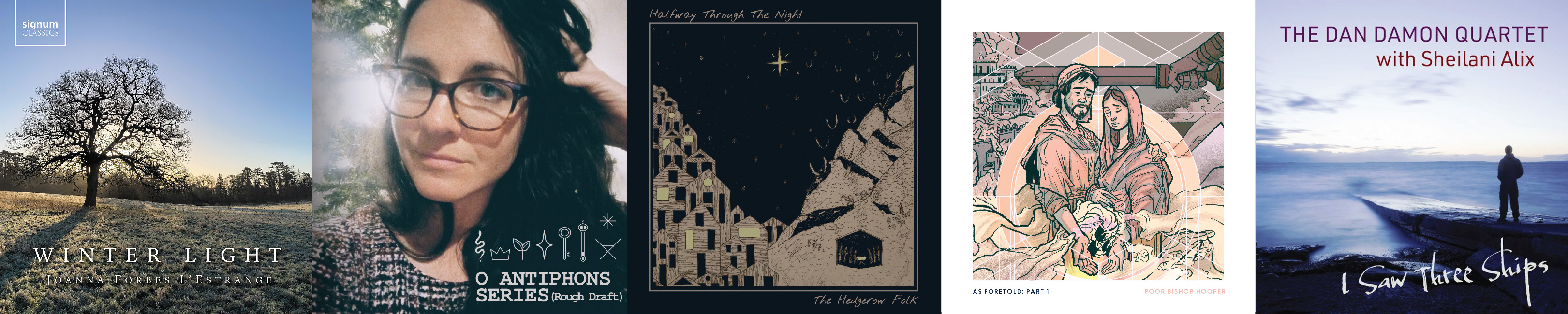
Every fall a number of new holiday albums hit the market. Here are five from this year that I’ve been enjoying. I’ve included one or two sample tracks from each.
A smorgasbord of choral works by the British composer Joanna Forbes L’Estrange, plus a few written or cowritten by her husband, Alexander, and one by her son Harry, all performed by Ben Parry’s London Voices. I learned about this album from Angier Brock, who wrote the anthem text for the title track. One of my favorite pieces is the “Advent ‘O’ Carol,” which I’ll be featuring in a devotional post on December 17. Below is a retune of “In the Bleak Midwinter” (risky, since Holst’s beautiful tune is so iconic, but I love what L’Estrange does with Rossetti’s poem), followed by an original jazzy carol about “The Three Wise Women” of Christmas—Mary, Elizabeth, and Anna.
Elise Massa is a singer-songwriter and music minister currently living in Durham, England, where she works for United Adoration, a global nonprofit that seeks to empower local artists to create music and art rooted in Christ and meaningful to their particular context, culture, and language. This quiet, understated album consists of seven original songs based on the O Antiphons, refrains sung during evening prayer on the seven last days of Advent preceding Christmas Eve. Here’s the first one, “O Wisdom (O Sapientia)”:
Named after a phrase from a C. S. Lewis poem, The Hedgerow Folk is an Alabama-based acoustic Americana trio: Jon Myles, Amanda Hammett, and Bryant Hains. “Halfway through the night” is a through line that weaves through this their first Christmas album as a declaration of hope. My two favorite tracks: their reharmonized rendition of “Lo, How a Rose E’er Blooming,” and their bluegrass arrangement of “Oh Come, Divine Messiah” (which I knew previously only from an a cappella choir of nuns). Also available on vinyl.
As Foretold is a trilogy of albums that takes its subject matter from the prophetic fulfillment passages in Matthew’s Gospel. Part 1, released this week, covers the first two chapters of the book—Jesus’s birth, his flight to Egypt, Herod’s slaughter of innocents, and Jesus’s return to Nazareth. Three of the tracks deal with Joseph’s three dreams—a rarity in music! In his first dream, an angel appears to tell him that Mary is telling the truth, that the son inside her was indeed conceived by the Holy Spirit. In the second dream, treated in the “Out of Egypt” song below, the angel tells Joseph to take his family and flee Bethlehem to Egypt to escape Herod’s wrath, and in the third, the angel informs him it’s safe to return to their homeland.
Poor Bishop Hooper is offering the album for free download from their website! Parts 2 and 3 will release in early 2025.
Daniel Charles Damon is a jazz pianist, hymn writer, and retired Methodist pastor from San Francisco, who also works as associate editor of hymnody at Hope Publishing Company. His latest jazz Christmas album features a combination of classics and originals, including two hymns he wrote both the words and music for (“Like a Child” and “Winter’s Child”); “Hunger Carol” by Shirley Erena Murray (words) and Saya Ojiri (tune), which Damon has freshly arranged; and “Peace Child,” another Murray hymn, for which Damon wrote a tune.
It’s difficult to choose a favorite track, as I love this album through and through! I’ll highlight first the nineties hymn “Peace Child,” a pensive reflection on how Christ comes to us “in the silence of stars, in the violence of wars,” “through the hate and the hurt, through the hunger and dirt.” Second, a lively medieval carol whose Latin refrain, “Id-e-o-o-o, id-e-o-o-o, id-e-o, gloria in excelsis Deo!,” translates to “Therefore, glory to God in the highest!”
The vocalist on the album is the award-winning Sheilani Alix. She is accompanied by Damon on piano, Kurt Ribak on acoustic bass, Carrie Jahde on drums, and Lincoln Adler on tenor saxophone and soprano sax.
If you like this album, be sure to also check out Damon’s 2022 Christmas album, No Obvious Angels.
Blessed are the meek, for they will inherit the earth.
—Matthew 5:5
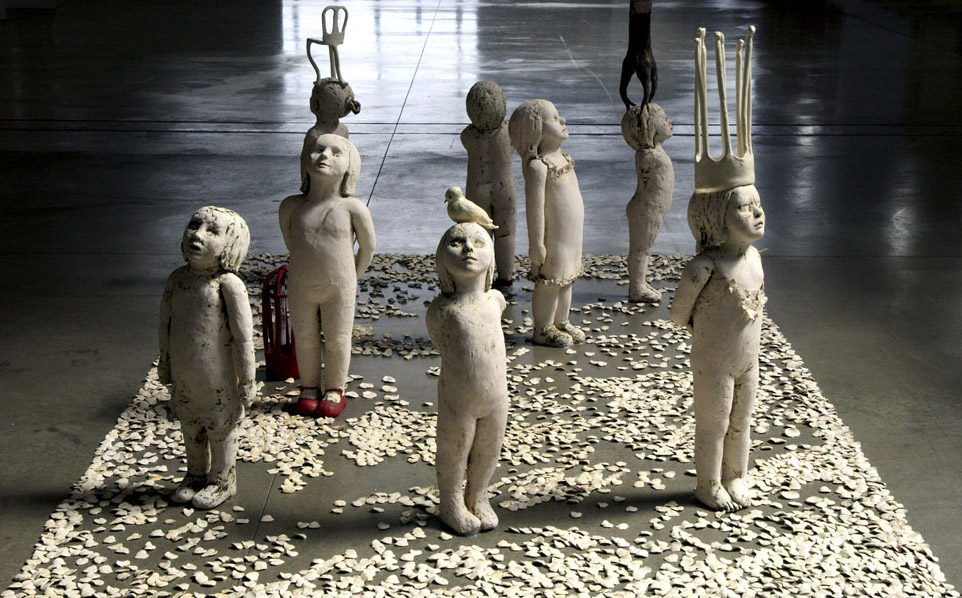
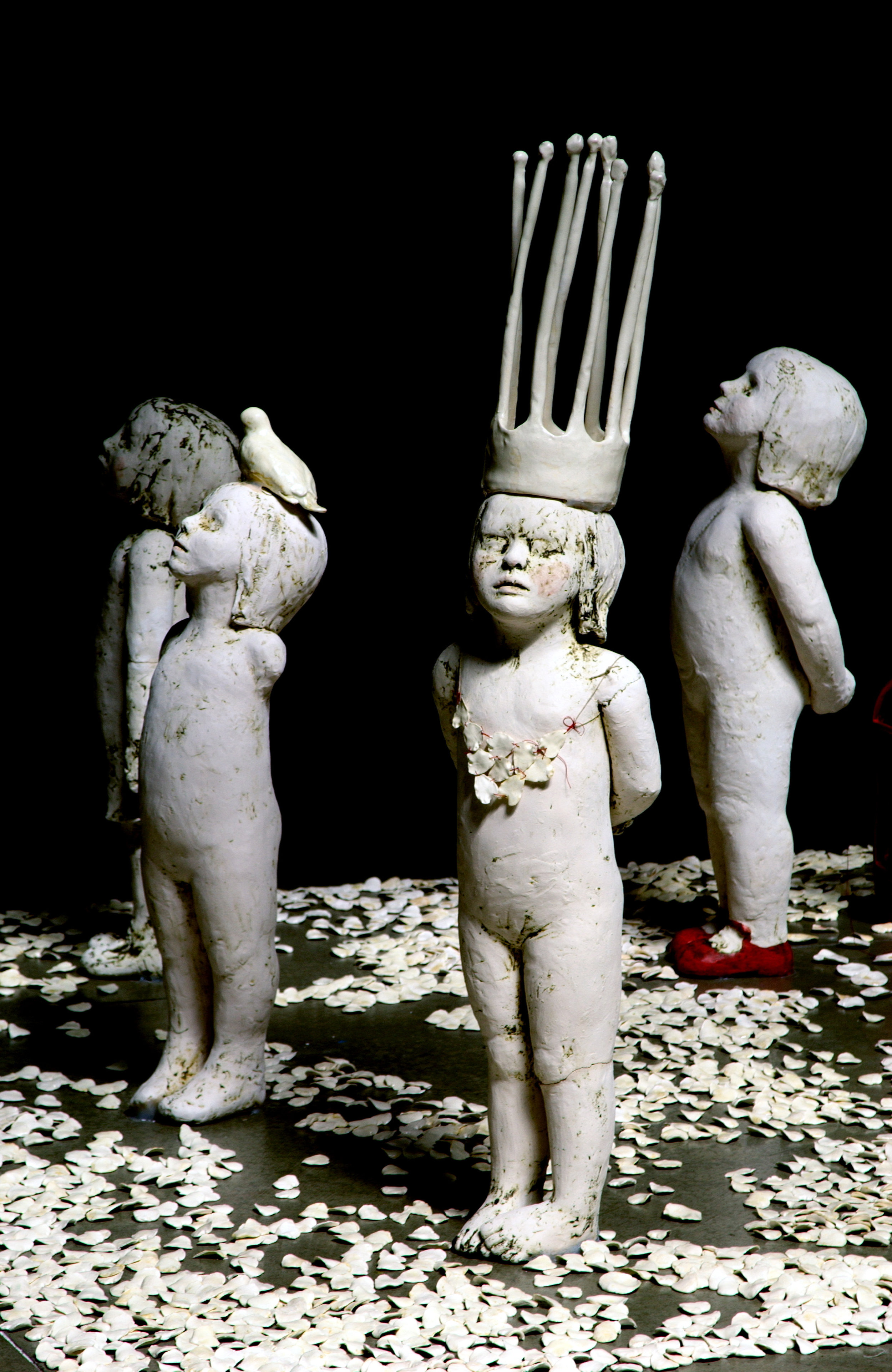
LOOK: The Bruised Sky by Claudia Alvarez
Claudia Alvarez (Mexican American, 1969–), The Bruised Sky, 2005. Porcelain and ceramic, 46 in. × 8 ft. × 14 ft. Photo from an exhibition at California College of the Arts, San Francisco. Click on image to view more.
LISTEN: “The Gentle Strong” by David Benjamin Blower, on The Book of Bare Life and Returns: Praying the Psalms in the Anthropocene (2023)
Fret ye not, little heart At the wheels that want and take and hurt O forsake their heartless rage For the wheels shall all lay down and be covered in moss And the trees shall take back all the towers
Refrain: And the gentle strong shall inherit the land Be ancestors of the better days at hand No wealth but life No wealth but life All shall pass right
Be not forged in their fires Who live as though living were a war on life Put your feet in the soil And speak to the Yon thy delights and thy heart’s desires And your justice wax still as the noon [Refrain]
David Benjamin Blower [previously] from Birmingham, England, is one of the most original, thoughtful, and compelling songwriters of faith working today. His songs contain unique poetic images, never resort to cliché, and often embody Advent vibes in their weary hope and their yearning for shalom. This subdued track from his 2023 album addresses the “gentle strong,” another word for the “meek” who are lifted up by Jesus in the Beatitudes.
Gentleness or meekness is not a trait that’s typically rewarded in modern Western cultures. Last month, for example, the people of the United States elected a brash, crude, violent, and egotistical man into our nation’s highest office. It seems to me that many voters mistake his loudness and self-importance for strength.
But the kingdom of God is not like the kingdoms of this world. In God’s kingdom, the gentle strong flourish under the benevolent rule of Jesus Christ, who himself models gentle strength.
Blower’s song gives us images of renewal: Of wheels that used to drive and crush becoming still and growing moss. Of trees overtaking our skyscrapers, reclaiming the land—organic growth and abundance, supporting human and nonhuman life. Of the meek entering at last into their inheritance.
The better days are at hand; may we do our part in bringing them to birth. May we be forged in a different fire: not ire or selfish ambition but love. May we embrace life and the things that make for life. May we keep in constant conversation with “the Yon”—the One who is above and beyond and yet, paradoxically, immanent, a friend who’s always close by. May we be consistently grounded in doing justice, loving mercy, and walking humbly with our God.
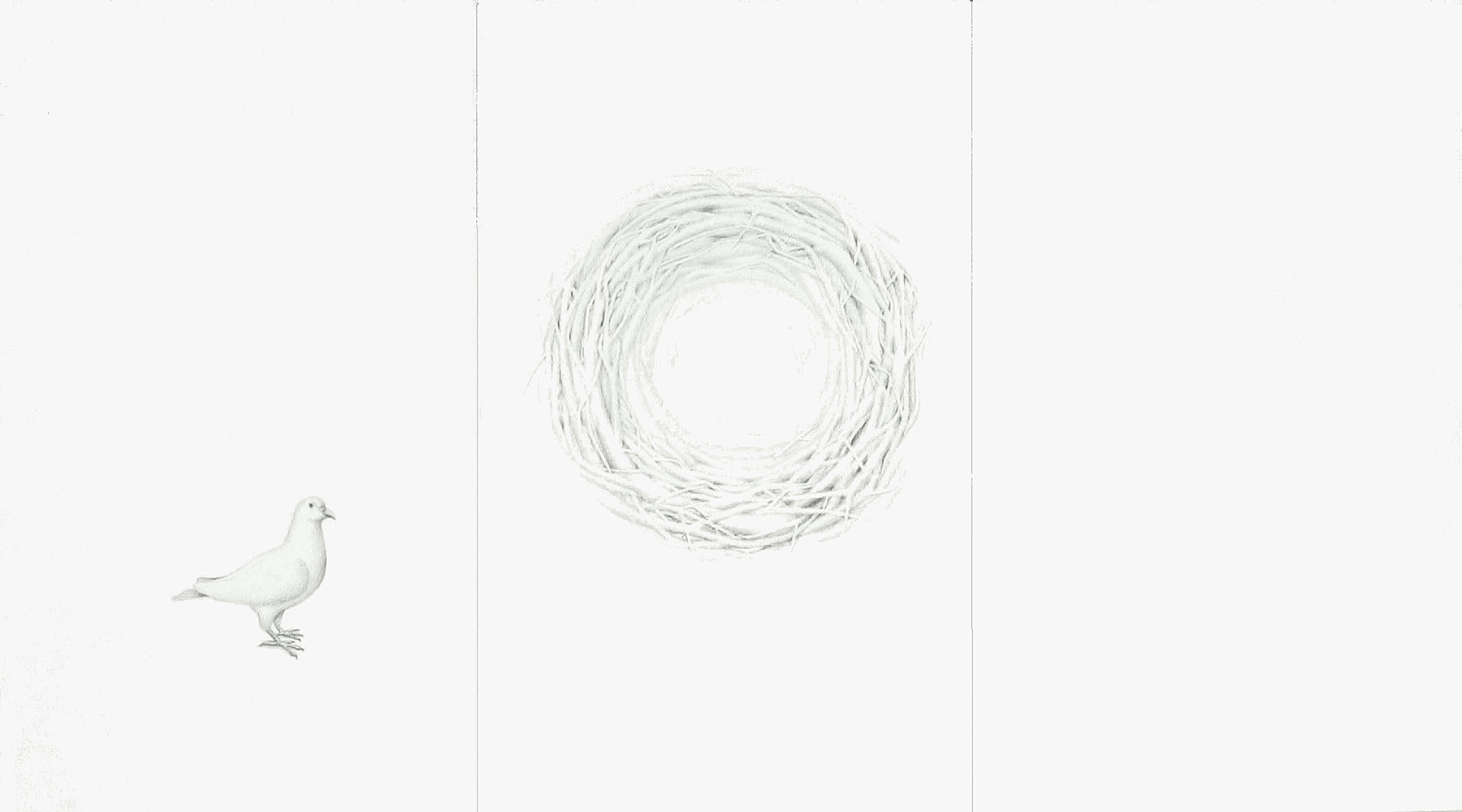
Carola Faller-Barris (German, 1964–), Bethlehem, 2009. Pencil on paper on MDF board, 100 × 180 cm. [HT]
LISTEN: “Peace” | Words by Gerard Manley Hopkins, 1879, and Wilfred Owen, 1917 | Music by Peter Bruun, 2017 | Performed by the Svanholm Singers, dir. Sofia Söderberg, on Exclusive, 2019
When will you ever, Peace, wild wooddove, shy wings shut, Your round me roaming end, and under be my boughs? When, when, Peace, will you, Peace? I’ll not play hypocrite To own my heart: I yield you do come sometimes; but That piecemeal peace is poor peace. What pure peace allows Alarms of wars, the daunting wars, the death of it?
Out there, we’ve walked quite friendly up to Death,— Sat down and eaten with him, cool and bland,— Pardoned his spilling mess-tins in our hand. We’ve sniffed the green thick odour of his breath,— Our eyes wept, but our courage didn’t writhe. He’s spat at us with bullets and he’s coughed Shrapnel. We chorussed when he sang aloft, We whistled while he shaved us with his scythe.
Oh, Death was never enemy of ours! We laughed at him, we leagued with him, old chum. No soldier’s paid to kick against His powers. We laughed,—knowing that better men would come, And greater wars: when each proud fighter brags He wars on Death, for lives; not men, for flags.
O surely, reaving Peace, my Lord should leave in lieu Some good! And so he does leave Patience exquisite, That plumes to Peace thereafter. And when Peace here does house He comes with work to do, he does not come to coo, He comes to brood and sit.
The text of this choral work by the Danish composer Peter Brunn combines two British poems: “Peace” by Gerard Manley Hopkins and “The Next War” by Wilfred Owen. Let’s look at each one separately, and then together.
“Peace” by Gerard Manley Hopkins
When will you ever, Peace, wild wooddove, shy wings shut, Your round me roaming end, and under be my boughs? When, when, Peace, will you, Peace? I’ll not play hypocrite To own my heart: I yield you do come sometimes; but That piecemeal peace is poor peace. What pure peace allows Alarms of wars, the daunting wars, the death of it?
O surely, reaving Peace, my Lord should leave in lieu Some good! And so he does leave Patience exquisite, That plumes to Peace thereafter. And when Peace here does house He comes with work to do, he does not come to coo, He comes to brood and sit.
The Jesuit poet-priest Gerard Manley Hopkins (1844–1889) wrote this curtal sonnet on October 2, 1879, after finding out he was reassigned from his role as curate at St. Aloysius’s church in Oxford to curate at St. Joseph’s in the industrial town of Bedford Leigh, near Manchester. He was apprehensive about this move to a place he described as “very gloomy” and unclean. The following decade, the last of his life, he would be plagued by melancholic dejection, which his later poems reflect. In addition to the internal disquiet he was experiencing in the fall of 1879, there was also an external lack of peace, as Great Britain was at war on three fronts—in southern Africa (against the Zulu kingdom), Afghanistan, and Ireland.
The speaker of the poem addresses Peace, an elusive dove, begging him to come settle down to nest, to incubate his eggs. “Brooding” here, writes J. Nathan Matias, is not a morose act but a generative, warmly creative one, birthing life.
Though the dove appears in scripture as a symbol of God the Spirit, in the last three lines of this poem he could be God the Son, the Prince of Peace. The people waited for generations upon generations for his arrival. And when he came, he was not all talk. He came with serious work to do; he came to hatch a newborn world.
This poem expresses yearning for peace in our hearts and in our lands—a permanent, holistic peace that only Christ can bring.
“The Next War” by Wilfred Owen
“War’s a joke for me and you, While we know such dreams are true.” —Siegfried Sassoon
Out there, we’ve walked quite friendly up to Death,— Sat down and eaten with him, cool and bland,— Pardoned his spilling mess-tins in our hand. We’ve sniffed the green thick odour of his breath,— Our eyes wept, but our courage didn’t writhe. He’s spat at us with bullets and he’s coughed Shrapnel. We chorussed when he sang aloft, We whistled while he shaved us with his scythe.
Oh, Death was never enemy of ours! We laughed at him, we leagued with him, old chum. No soldier’s paid to kick against His powers. We laughed,—knowing that better men would come, And greater wars: when each proud fighter brags He wars on Death, for lives; not men, for flags.
One of the premier poets of World War I, Wilfred Owen (1893–1918) was a British soldier whose poems lament the horrors of trench and gas warfare. His cynicism and transparency about war stood in stark contrast to the confidently patriotic verse written by earlier war poets.
Owen wrote “The Next War” while being treated for “shell shock” (PTSD) at Craiglockhart War Hospital in Edinburgh; he sent it in a letter to his mother dated September 25, 1917, writing the following week that he wanted her to show it to his youngest brother, Colin—for him “to read, mark, learn.” Owen was discharged from the hospital two months later and returned to the front lines of France, where he was killed in action on November 4, 1918, a week before the armistice, at age twenty-five.
He opens his ironic-toned sonnet with an epigraph from “A Letter Home” by Siegfried Sassoon, a fellow war poet he met at Craiglockhart, who became a friend and a mentor to him. (Bruun omits the epigraph in his choral work so that there’s a seamless transition between poems.) “Dreams will triumph, though the dark / Scowls above me,” Sassoon writes earlier in his poem, a poem that acknowledges the bleakness of war but, imagining the rebirth of a friend slain in battle, clings to the hope that it will soon be over and we can laugh it off.
Owen undercuts the optimism and solace in these lines with what follows in his own poem. The speaker of “The Next War”—which it’s pretty clear is the poet himself—personifies Death as a comrade whose intimate presence is normal among soldiers. He spits bullets, coughs shrapnel, and breathes stinking odors, and yet they ally themselves with him, sing Death’s song, go with him into battle.
Soldiers only delude themselves if they think they fight against Death, Owen asserts; they fight with him. Their nations’ governments will say they’re heroes, taking up arms to save lives and secure peace, but Owen rejects the idea that there’s anything noble, glorious, or effective about war. Soldiers kill men “for flags”—merely serving national interests—and their doing so never puts an end to war but only leads to another.
By bringing together these two texts, sandwiching Owen between Hopkins, Bruun gives a more hopeful framing to Owen’s disillusioned reflections on war, ending with the final image of a brooding dove. I like how the two poems play off one another. For example, Hopkins’s rhetorical question of “What pure peace allows / . . . the death of [peace]?” stands in starker relief when read in conjunction with Owen’s criticism of the ostensible rationale for war.
Bruun still honors Owen’s experience of being made far too familiar with death, his endurance of mortar blasts and mustard gas and all-around carnage, to no apparent end. Owen’s text starts at 2:11 of the video, where a menacing, march-like cadence enters. We feel the anxiety and the darkness of battle. The specificity of the poem resists us metaphorizing war—that is, applying the poem to a situation of inner turmoil (battling inner demons) only. This is physical combat between nations, which, of course, has severe psychological repercussions on the participants.
But at 5:33 the hushed tones of Hopkins return. Bruun had been attracted to Hopkins’s poem “Peace” for some time. In 2010 he wrote a setting of it for solo voice and flute, clarinet, horn, percussion, glockenspiel, violin, violoncello, and contrabass, and in 2016 he published a new setting, with Owens now inserted, as the second in a five-song cycle called Wind Walks for mixed choir and accompaniment, all five texts taken from Hopkins. He then adapted the song for the male-voice chamber choir the Svanholm Singers from Sweden, which is what I feature here.
The pointed and repeated “When” at the opening of Bruun’s piece, a word that Hopkins repeats three times in his poem, is powerful, an echo of the familiar biblical refrain, “How long, O Lord?” If we read Peace as Christ, then the poem is a prayer, asking Christ to come home to us, to our world—to spread his wings over it and nurture it back to life.
In Hebrew thought, shalom, “peace,” is not a passive thing, merely the absence of war. It’s the active presence of God and an all-encompassing state of completeness, soundness, health, safety, and prosperity.
Shalom is what we long for, especially during Advent. It’s what scripture promises will come someday—but now, its lack is keenly felt. It may occasionally flit and hover nearby, but then it flies off again.
As the church, may we embrace “Patience exquisite, / That plumes to Peace thereafter,” as we await Christ’s return, in the meantime preparing his way through acts of righteousness and reconciliation.
LOOK: Isaiah’s Vision of Eternal Peace by Mordecai Ardon
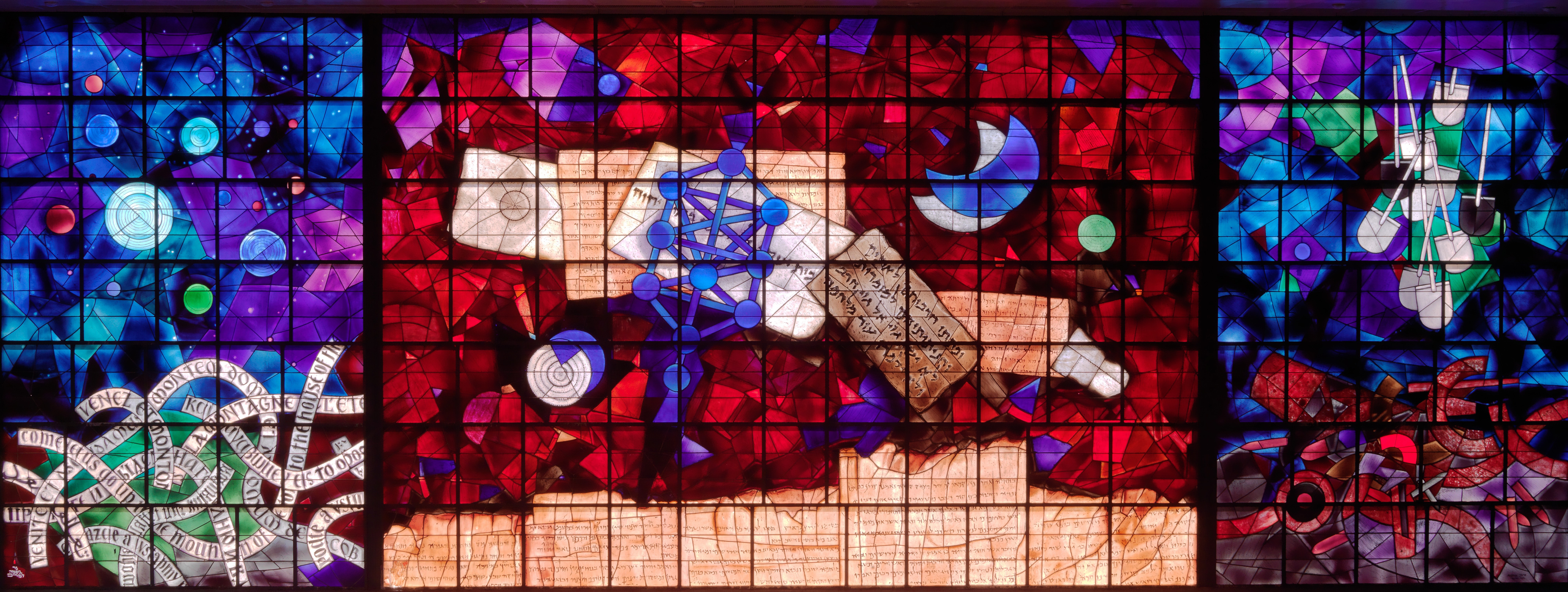
Mordecai Ardon (Israeli, 1896–1992) (designer) and Charles Marq (French, 1923–2006) (fabricator), Isaiah’s Vision of Eternal Peace, 1982–84. Stained glass, 6.5 × 17 m. Old National Library of Israel building, Givat Ram campus, Hebrew University of Jerusalem. Photo: Hanan Cohen.
Born in 1896 to a Jewish family in the village of Tuchów in what is today Poland, Mordecai Ardon studied art in Germany under Paul Klee and Wassily Kandinsky. When the Nazis came to power in 1933, he moved to Jerusalem, becoming a teacher in 1935 at Palestine’s chief art academy, the Bezalel School of Arts and Crafts, which he directed from 1940 to 1952. Known for their vibrant tones and stirring rhythms, Ardon’s paintings often explore the connections between the visible and the invisible and reflect his interest in mysticism and antiquity.
From 1982 to 1984 Ardon carried out a commission by the National Jewish University and Library (now the National Library of Israel) in Jerusalem to develop a monumental triptych of stained glass. His painted designs were translated into the medium of stained glass by the French master glazier Charles Marq, a frequent collaborator of Marc Chagall’s. The result is titled Isaiah’s Vision of Eternal Peace.
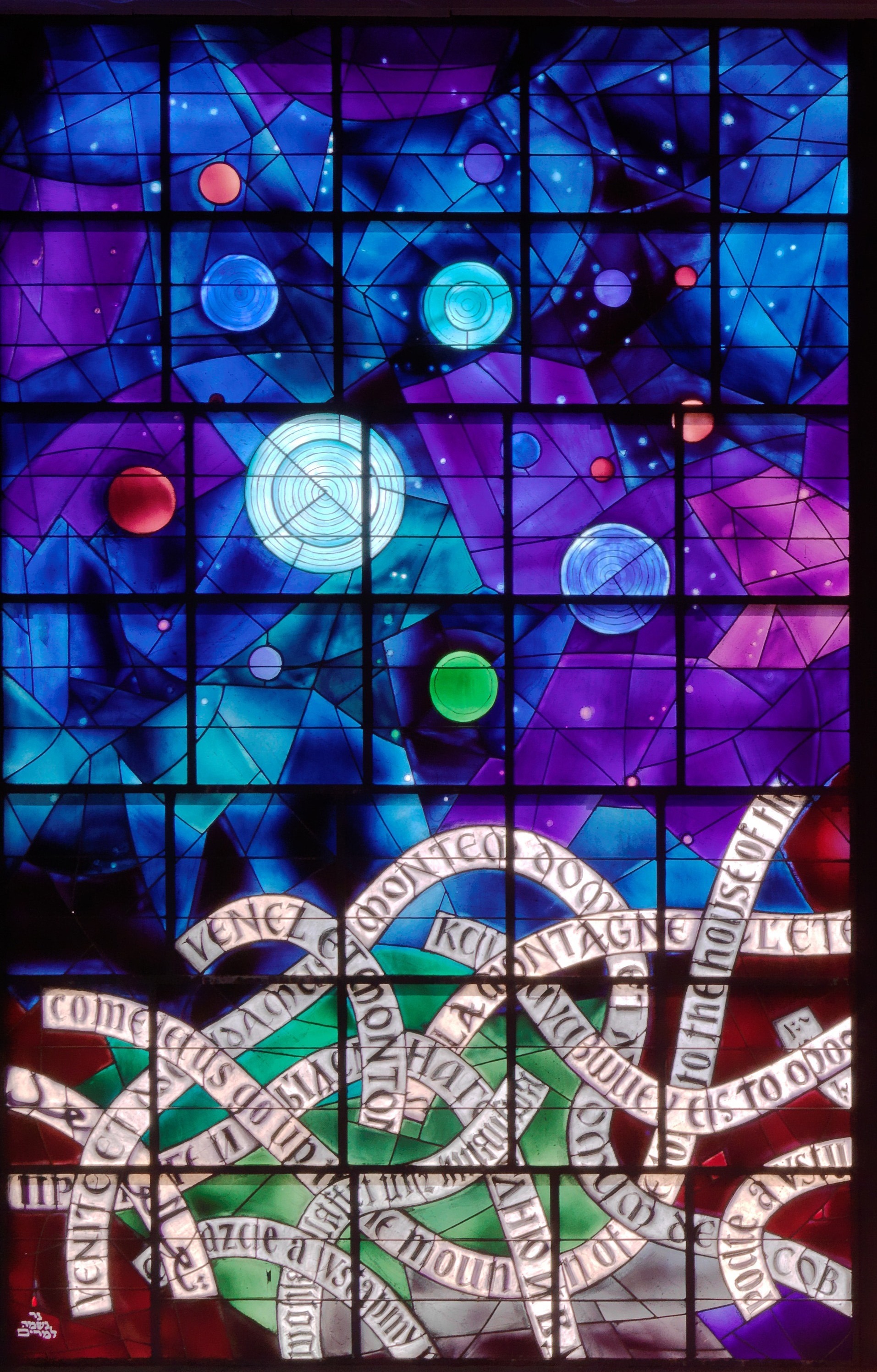
The left panel illustrates Isaiah 2:2–3:
In days to come the mountain of the LORD’s house shall be established as the highest of the mountains and shall be raised above the hills; all the nations shall stream to it. Many peoples shall come and say, “Come, let us go up to the mountain of the LORD, to the house of the God of Jacob, that he may teach us his ways and that we may walk in his paths.”
Winding like roads, the white bands contain the boldfaced line in various languages—I can detect English, Russian, Polish, Arabic, Latin, and French—representing the peoples of the world streaming to Jerusalem.
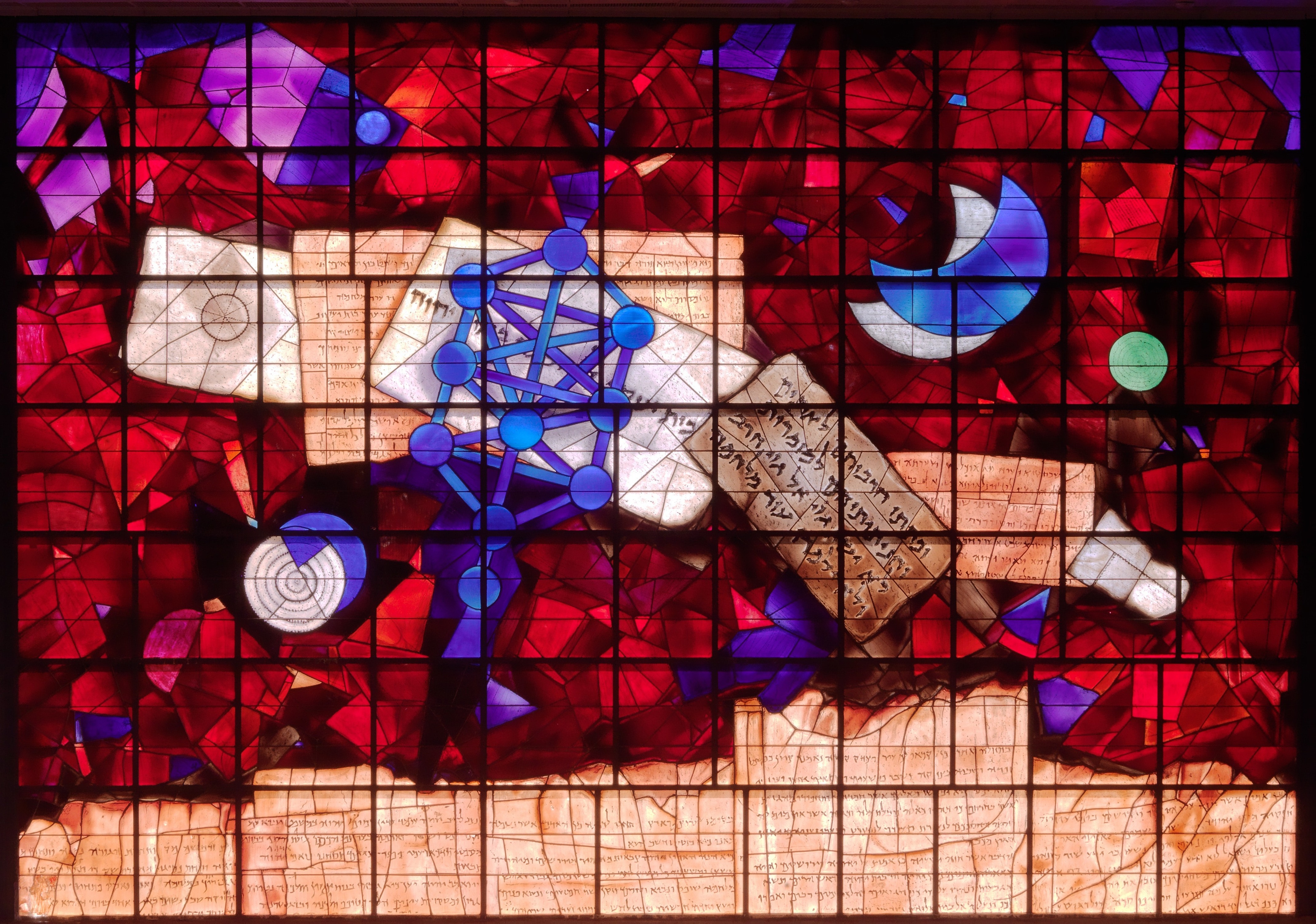
The center panel depicts a merging of the earthly and heavenly Jerusalems. At the bottom stand the city walls, made up of the seventeen sheets of parchment that comprise the Great Isaiah Scroll from Qumran, dating to around 100 BCE. Floating above are Kabbalistic symbols, including the Tree of the Sefirot, signifying the Divine Presence. There are also several Hebrew texts from Jewish history that I can’t identify.
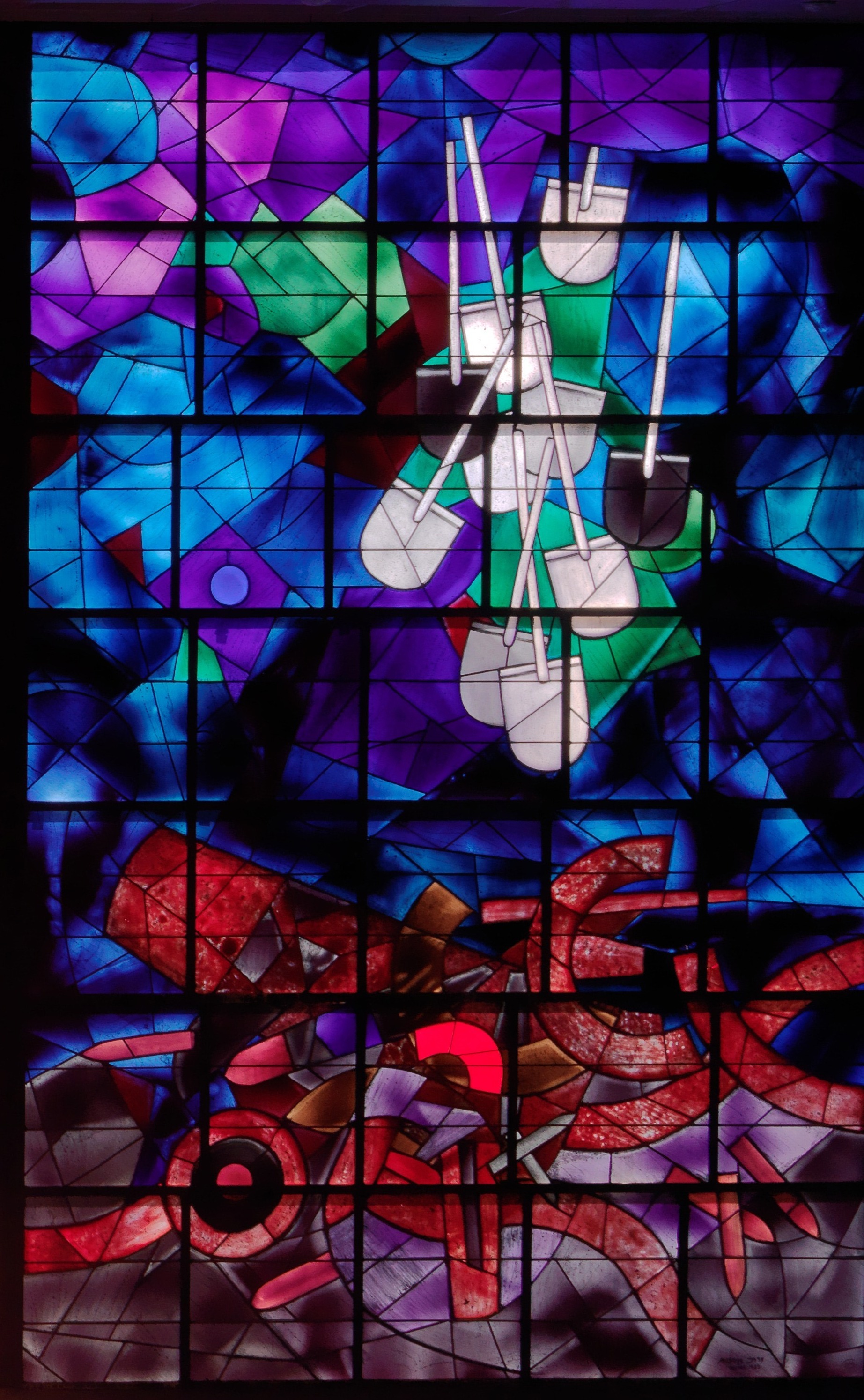
The right panel visualizes the fulfillment of Isaiah 2:4: “. . . they shall beat their swords into plowshares and their spears into pruning hooks; nation shall not lift up sword against nation; neither shall they learn war any more.” All the machinery of war—tanks and fighter jets, guns and bullets—lies in a garbage heap at the base, and shovels emerge overhead as the weapons are transformed into farming tools.
This glasswork covers an entire wall of the old National Library of Israel building on the Givat Ram campus of Hebrew University. The library moved into a new building in October 2023, situated between the Knesset and the Israel Museum in the heart of Jerusalem. But Ardon’s window remains in its original building at HUJI, which has become a multipurpose space.
LISTEN: “Lo Yisa Goy (Study War No More)”(ֹא יִשָּׂא גוֹי)|Traditional Jewish folk song, arr. Linda Hirschhorn and Fran Avni | Performed by Vocolot, on Behold! (1998)
(Transliteration: Lo yisa goy el goy cherev Lo yilmadu od milchama)
(Translation: Nation will not take up sword against nation Nor will they train for war anymore)
And into plowshares [they’ll] beat their swords Nations shall learn war no more
The lyrics of this traditional Jewish antiwar song come from the original Hebrew of Isaiah 2:4, a text held sacred by both Jews and Christians. The song looks with prayerful hope toward the day when global peace will be a reality.
If this is the glorious end state to which we all are headed, the future that God has envisioned and charted for us, then why do we participate in violence now? When governments try to control people through violence, and those people respond with violence, that response only provokes violent retaliation, and so the cycle continues on and on—militancy and death. The line between aggressor and defender becomes blurred. We’ll never get closer to the Isaiah 2 ideal by asserting ourselves with weapons.
May the people of God be a people who refuse violence even when the state commands it, even when we’ve been hit tremendously hard and the urge for payback is intense. May we not become what we fear, inflicting terror because we have been terrorized. And may God bring peace and healing to people and nations who have been victims of war; so too perpetrators of war. To those just trying to survive and be free in this fallen world as best they know how.
The first chapter of Isaiah, which precedes the famous “swords into plowshares” chapter, contains this word from the Lord to his people:
When you stretch out your hands, I will hide my face from you; even though you make many prayers, I will not listen; your hands are full of blood. Wash yourselves clean, make yourselves clean; remove the evil of your doings from before my eyes; cease to do evil, learn to do good; seek justice, rescue the oppressed, defend the orphan, plead for the widow.
—Isaiah 1:15–17
So let us renounce our vindictiveness and “wash ourselves clean.” And then let us sing this song (1) as a prayer that the Messiah, whom Christians recognize to be Jesus of Nazareth, would come to actualize this beautiful vision of peace, but (2) also as a pledge, committing ourselves to the path of life—to, in the words of the apostle Paul, “overcom[ing] evil with good” (Rom. 12:21).
I like Vocolot’s “Lo Yisa Goy” arrangement best; it has a celebratory mood, as if the coming peace is in sight. But what follows is a handful of others that carry more of a lamentful tone, which is also appropriate as we consider the persistence of war and how short we fall of God’s plan for human flourishing that’s never at the expense of others.
For harp and voice by Estela Ceregatti of Brazil, 2020:
A cappella by the American Midwest female vocal trio Rock Paper Scissors, 2010:
For strings, by La Roche Quartett from Germany, 2018:
A virtual choir under the direction of Andrea Salvemini, 2020:
The last performance employs an increasing number of instruments as the song progresses: guitar, recorder, keyboard, cello, percussion, and accordion. It also includes steps to an Israeli circle dance performed by participants in isolation because this was during the days of COVID quarantines; elsewhere online you can find communal performances where the circle is closed.
Some versions add these two lines as a verse, adapted from Micah 4:4:
And every man ’neath his vine and fig tree Shall live in peace and unafraid
>> “Peace on Earth” by U2: “Heaven on earth—we need it now. I’m sick of all this hanging around. Sick of the sorrow, sick of the pain . . .” U2’s “Peace on Earth” was inspired by the Omagh bombing in Northern Ireland on August 15, 1998. It first appeared on their 2000 album All That You Can’t Leave Behind, but I prefer the stripped-down acoustic version they recorded last year on Songs of Surrender.
The song wrestles with the tension between the angels’ proclamation of peace in Luke 2 and the course of history ever since, riddled, as before, with violence. “Hope and history won’t rhyme,” the lyrics lament—they’re just not matching up. “Peace on earth” feels naive; the words sometimes stick in our throats. The refrain addresses Christ: “Jesus, can you take the time / To throw a drowning man a line?” In its emotional honesty and its asks, it resembles a biblical psalm. (Bono has in fact spoken about how the Psalms have influenced his songwriting.)
When U2 performed “Peace on Earth” live at Sphere Las Vegas this February, Bono substituted the names of five Irish casualties of the Troubles listed in one of the verses with the names of four Palestinian and Israeli children who have been killed in the current Israel-Hamas War: Gal, Ayat, Hind, and Mila.
>> “There Will Be a Day (Isaiah 2)” by Caroline Cobb, arr. Joel Littlepage: I cued up my favorite song from last year’s Dawning Light service at Grace Mosaic church in Washington, DC (it’s at 32:50–37:29 of the video): “There Will Be a Day” by Caroline Cobb, based on Isaiah 2. The song is from Cobb’s album A Seed, a Sunrise: Advent to Christmas Songs (2020)—it’s my favorite of all her songs, and because of its emotional and summative power, I’ve set it as the concluding track of my Advent Playlist. Joel Littlepage, Grace Mosaic’s pastor of worship and formation and the director of the Daily Prayer Project, arranged it with gospel inflections for his church’s annual Advent carols service. He’s at the keyboard; his wife, Melissa Littlepage, is the vocal soloist (she’s also the choir director); and the saxophonist is Skip Pruitt.
ARTWORK: Home (land) Birth (place) by Beth Krensky:Beth Krensky is an artist, activist, and educator of Jewish heritage who describes herself as “a gatherer of things—objects, words, spirit—and a connector of fragments to make us whole.” Her website documents many compelling artistic projects she has undertaken over the past decade. One of them, Home (land) Birth (place), is a performance from 2016 with her academic colleague Amal Kawar, a professor of political science and the author of Daughters of Palestine: Leading Women of the Palestinian National Movement.
Beth Krensky (American, 1965–), Home (land) Birth (place), a performance with Amal Kawar, 2016, Great Salt Lake, Utah. Photo: Josh Blumental.
For this piece, Krensky sewed together a truce flag from baby clothes and other white linens and attached it to two olivewood poles onto which she burned quotes from Israeli and Palestinian mothers who have lost a child to Israeli-Palestinian violence. She and Kawar held the flag aloft in the desert outside their hometown of Salt Lake City as a call for peace. Read the artist’s statement at the link above, and view additional photos of the flag here.
+++
DEVOTIONAL POST: “Swords Will Be Turned into Plowshares,” Center for Christianity, Culture, and the Arts at Biola University: Every year Biola University’s CCCA publishes free daily Advent and Christmas devotions online that feature an artwork, a song, a poem, and a written reflection—the work of many contributors. You can access their 2024 Advent Project here.
Last year I was particularly taken with the peace-themed compilation offered on January 2, which includes a poem by Denise Levertov, a socially conscious, participatory art project led by Pedro Reyes (more on that in next roundup item), a Sweet Honey in the Rock rendition of an African American spiritual, and a wonderful reflection by Dr. Natasha Aleksiuk Duquette, a literature professor. Check it out.
+++
ARTICLE: “Mexican Artist Pedro Reyes Molds 1,527 Guns into Shovels Used to Plant Trees,”Colossal: Pedro Reyes is a Mexican artist, architect, and cultural agent who seeks to turn social problems into opportunities for tangible change through works that integrate elements of theater, psychology, and activism. (I learned about him through Biola’s Advent Project, above.) In 2008, in cooperation with city authorities, he led a campaign in Culiacán, Mexico, to collect firearms, giving donors vouchers for electronic appliances in exchange. The hundreds of guns he received were publicly crushed by a steamroller, melted, and remolded into shovels, which were then distributed to public schools and other institutions who committed to planting trees with them. This project was an effort to curb local gun violence and to cultivate the collective imagination toward life.
Pedro Reyes (Mexican, 1972–), Palas por Pistolas (Guns for Shovels), 2008Artist Pedro Reyes steamrolled 1,527 surrendered guns for his Palas por Pistolas project, transforming them into shovels for planting trees.
I’m interested in exploring more of Reyes’s work, as I love what he’s doing. In 2016, as a visiting lecturer in MIT’s Art, Culture, and Technology Program, he cotaught the course “The Reverse Engineering of Warfare: Challenging Techno-optimism and Reimagining the Defense Sector (an Opera for the End of Times).” A full-color illustrated survey of his projects, Pedro Reyes: Ad Usum / To Be Used, was published by Harvard University Press in 2017.
+++
INSTAGRAM SERIES: “Alternative Advent 2024” by Kezia M’Clelland: Through December 24, follow the Instagram account @alternative_advent for a progressively revealed photo essay of Advent promises told through journalistic images from 2024, sourced from various news organizations. I call attention to this project every year. The woman behind it, Kezia M’Clelland, has a master’s degree in violence, conflict, and development from SOAS University of London and helps equip churches and communities to support children and families in crisis situations.
Below are two performances of this Advent song. The first is by a man and woman from the Parroquía Divino Niño Jesús in Morelia, Mexico, and the second is by the choir Tallo De Amor, from Mexico City:
Toda la tierra espera al Salvador y el surco abierto, la obra del Señor; es el mundo que lucha por la libertad, reclama justicia y busca la verdad.
Dice el profeta al pueblo de Israel: “De madre virgen ya viene Emmanuel,” será “Dios con nosotros,” semilla será, con él la esperanza al mundo volverá.
Montes y valles habrá que preparar; nuevos caminos temenos que trazar. él está ya muy cerca, venidlo a encontrar, y todas las puertas abrid de par en par.
En una cueva Jesús apareció, pero en el mundo está presente hoy. Vive en nuestros hermanos, con ellos está; y vuelve de nuevo a darnos libertad.
ENGLISH TRANSLATION:
All earth is waiting to see the Promised One, and the open furrows, the sowing of the Lord. All the world, bound and struggling, seeks true liberty; it cries out for justice and searches for the truth.
Thus says the prophet to those of Israel: “A virgin mother will bear Emmanuel,” for his name is “God with us,” our brother shall be, with him hope will blossom once more within our hearts.
Mountains and valleys will have to be made plain; open new highways, new highways for the Lord. He is now coming closer, so come all and see, and open the doorways as wide as wide can be.
In the lowly stable the Promised One appeared, yet, feel his presence throughout the earth today, for he lives in all Christians and is with us now; again, with his coming he brings us liberty.
Trans. Gertrude C. Suppe
Alberto Taulé (1932–2007) from Barcelona, Spain, was a Roman Catholic priest and a composer of liturgical music who “believed that every parish should have a dynamic, evolving repertoire”—that “quality music and the regular introduction of new songs are vital to a parish’s spiritual health,” as his Catholic Online obituary reads. Working in the wake of the Second Vatican Council (1962–65), which sanctioned the use of vernacular languages and musical styles in the Mass, Taulé wrote new worship songs that could be grafted into the preexisting liturgical structure, used during the entrance procession, the offertory, the Eucharist, or the closing.
In Spanish-speaking church communities around the world, “Toda la Tierra” is sometimes used as the entrance song for one of the four Advent Sundays. Since the United Methodist Church commissioned an English translation from Gertrude C. Suppe and added the song (with bilingual lyrics) to its hymnal in 1989, it has become more widely known in English-speaking communities as well.
The Evangelical Lutheran Church in America published a different English translation by Madeleine Forell Marshall in the 2006 edition of its hymnal, Evangelical Lutheran Worship; hers preserves the aabb rhyme scheme of the original Spanish and begins with the line “All earth is hopeful, the Savior comes at last!”
The Spanish verb esperar means both “to wait” and “to hope” and is thus especially fitting to describe the action of the church during Advent.
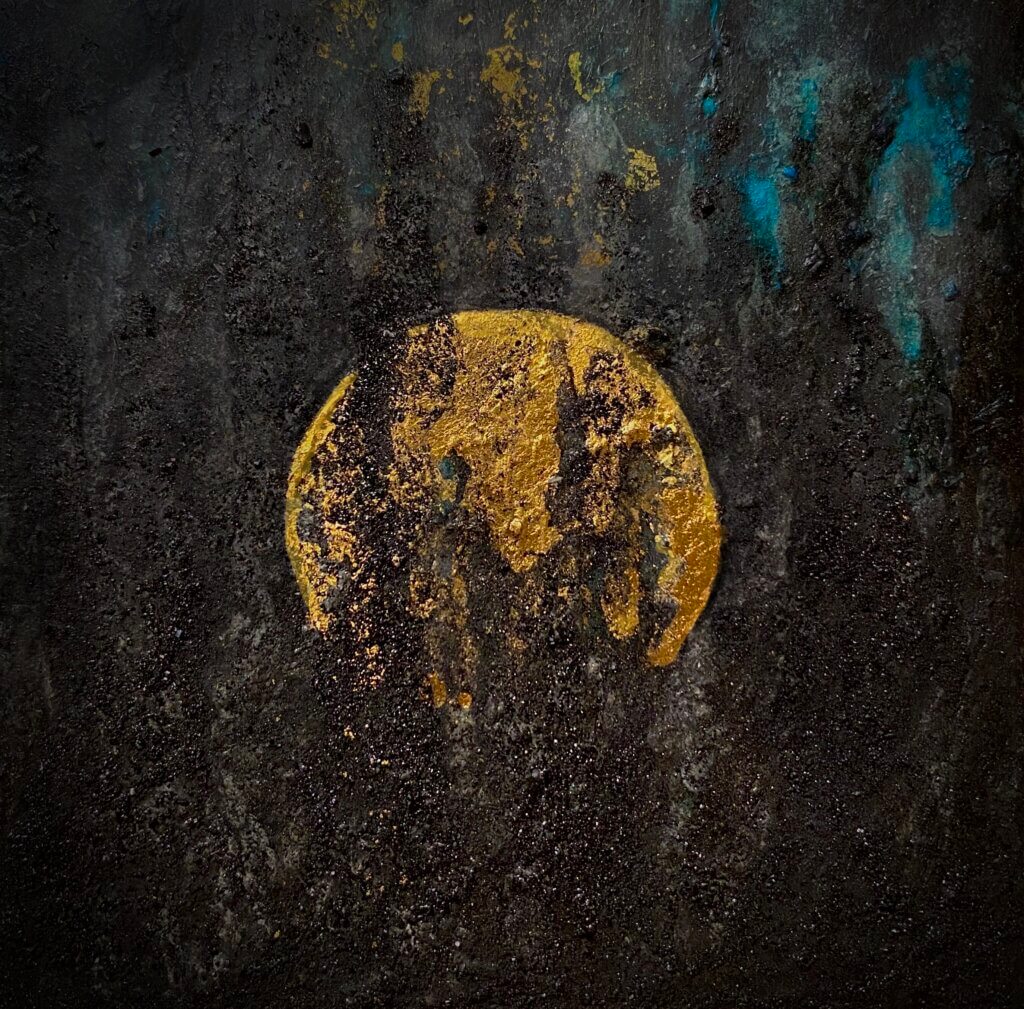
Tim Joyner (American, 1987–), Incarnation, 2021. Foraged pigment on board-mounted paper, 4 × 4 in.
Tim Joyner is an artist who works primarily with natural pigments and inks derived from locally foraged materials, such as stone, lichen, and seaweed. He is also the worship director at Trinity Church Congregational in Bolton, Massachusetts, where he lives with his wife and four kids.
Incarnation is a painting he made during Advent 2021. He describes its makeup and meaning in a Rabbit Room blog post:
The painting . . . is pretty dark for an Advent piece. It’s primarily Lamp Black (a pigment that I associate with longing and prayer because I make it from the discarded stubs of vigil candles), with some even darker Jet Black. There’s some white from Jingle Shells and a bit of Verdigris, but those are there mostly to make the black pigment look even blacker. Even the orb of gold leaf in the very center of the painting is obscured enough that it mostly just draws attention to the rising movement of dark pigment.
This painting is a reminder to myself that, yes, at the end of all this waiting there is an arrival. But it’s not me arriving at the other end of darkness or doubt, brokenness or betrayal. It is the Christ Child who arrives. He meets us here. And rather than chasing away all that it means to be human—including the pain and the longing unfulfilled—and banishing it forever, He wraps Himself in it. We find Christ not on the other side of our longing, but within it.
asks for Christ to be born into the aches of our world and the longing of our hearts.
Although the Son of God came into our world to joyfully dwell with us, the Christmas season, for many, is often painful, lonely, and despairing as the realities of broken families, stinging disappointments, personal addictions, and profound grief confront us in a poignant way.
Our desire in writing this song is to connect the birth of Christ to these very real, dark areas of our everyday lives. It is a prayer for the hope of the Messiah to be “born” into the places where no light seems to exist.
LOOK: Woman Waiting for the Moon to Rise by Uemura Shōen
Uemura Shōen (Japanese, 1875–1949), Woman Waiting for the Moon to Rise, 1944. Nihonga watercolor on silk, 73 × 86 cm. Adachi Museum of Art, Yasugi, Japan.
Uemura Shōen, the pseudonym of Uemura Tsune (1875–1949), was a Japanese artist active in the first half of the twentieth century, known primarily for her bijin-ga paintings of beautiful women in the nihonga style. A mold-breaking artist of exceptional skill, “she won international awards and accolades, defied social norms as a single mother of two, and dived into the world of professional painting at a time when women weren’t welcome.” In 1948 she became the first woman to be awarded Japan’s prestigious Order of Culture.
Uemura painted Woman Waiting for the Moon to Rise during World War II, showing a young woman leaning against a bridge railing on a foggy evening, her chin resting on her folded hands and her face looking ahead wistfully. Though the title tells us she’s waiting for the moon to rise, perhaps she’s also waiting for the war to end, for peace to be restored.
LISTEN: “Wait for the Lord” by Jacques Berthier of the Taizé Community, on Alleluia (1988)
Wait for the Lord, whose day is near. Wait for the Lord: be strong, take heart!
The text of this simple chant comes mainly from Psalm 27:14: “Wait for the LORD; be strong, and let your heart take courage; wait for the LORD!” The chant was written as a responsorial refrain to the reading of another psalm, Psalm 37. As the hymnal Lift Up Your Hearts (2013) instructs congregations: sing the Taizé refrain; read Psalm 37:1–5, sing; read Psalm 37:6–9, sing; read Psalm 37:10–11, 39–40, sing. Like this:
Wait for the Lord, whose day is near. Wait for the Lord: be strong, take heart!
Do not fret because of the wicked; do not be envious of wrongdoers, for they will soon fade like the grass, and wither like the green herb.
Trust in the LORD, and do good; so you will live in the land, and enjoy security. Take delight in the LORD, and he will give you the desires of your heart.
Commit your way to the LORD; trust in him, and he will act.
Wait for the Lord, whose day is near. Wait for the Lord: be strong, take heart!
He will make your vindication shine like the light, and the justice of your cause like the noonday.
Be still before the LORD, and wait patiently for him; do not fret over those who prosper in their way, over those who carry out evil devices.
Refrain from anger, and forsake wrath. Do not fret—it leads only to evil. For the wicked shall be cut off, but those who wait for the LORD shall inherit the land.
Wait for the Lord, whose day is near. Wait for the Lord: be strong, take heart!
Yet a little while, and the wicked will be no more; though you look diligently for their place, they will not be there. But the meek shall inherit the land, and delight themselves in abundant prosperity.
The salvation of the righteous is from the LORD; he is their refuge in the time of trouble. The LORD helps them and rescues them; he rescues them from the wicked, and saves them, because they take refuge in him.
Wait for the Lord, whose day is near. Wait for the Lord: be strong, take heart!
Psalm 37 encourages trust and patience in God, who will one day vindicate the righteous and put wickedness to bed.





 Art & Theology