Christmas, Day 3: The Infinite a Sudden Guest

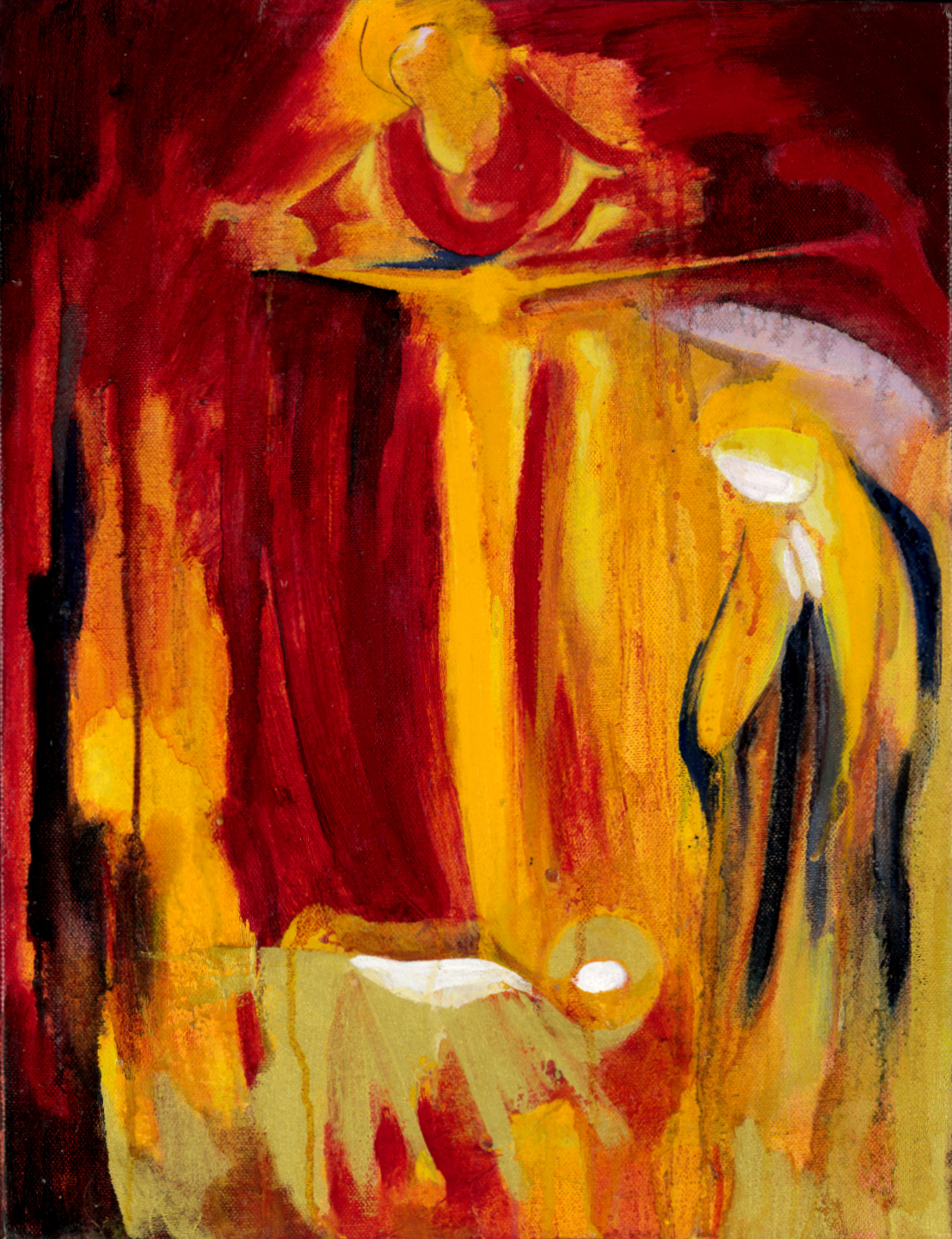
LOOK: I Am Born by Ihor Paneyko

Paneyko, Igor_I Am Born
Ihor Paneyko (Ukrainian, 1957–), Я родився (I Am Born), 1986. Oil on canvas.

LISTEN: “The Infinite a Sudden Guest” by Josh Rodriguez, 2015 | Performed by New City Music on Songs from Engedi, 2015

The Infinite a sudden guest—

Awake, mankind!
For your sake God has become man.
Awake, you who sleep:
God has become man.
Awake, rise up from the dead,
And Christ will enlighten you.
For your sake, God became man.

You would have suffered eternal death,
Never freed from sinful flesh,
Had he not taken on himself
The likeness of sinful flesh;
Lost from everlasting unhappiness,
Had it not been for this mercy.
You would never have returned to life,
Had he not shared your death.

Let us celebrate the coming of salvation and redemption!
Let us celebrate the day who is the great and eternal day,
Came from the great and endless day of eternity
Into our own short day of time.

Christ, born of Mary.
Eternity entered time.
Truth has arisen from the earth:
Christ who said, “I am the Truth.”
And Justice looked down from heaven:
Because believing in this newborn child,
Man is justified not by himself but by God.

Truth has arisen from the earth:
Because the Word was made flesh,
And Justice looked down from heaven.
Justified by faith, let us be at peace with God.
For Peace and Justice have embraced in Jesus Christ.

The Infinite a sudden guest—
God
In time
In God
In time
In God
In time
In God
In time
In God
In time
In God
In time
In God.

In 2015 Josh Rodriguez [previously here and here] composed this piece for SATB choir, violin, and percussion for New City Presbyterian Church in Royal Oak, Michigan, where he served as music director at the time.

Its striking title and first line come from a short poem by Emily Dickinson, and the rest of the text is taken from a Christmas sermon by Augustine of Hippo (cataloged as Sermon 185 by scholars), which centers on Psalm 85:11: “Truth shall spring out of the earth; and righteousness shall look down from heaven.” Augustine sees this prophecy as fulfilled in Christ. The full sermon can be read in St. Augustine, Sermons on the Liturgical Seasons, trans. Mary Sarah Muldowney, RSM (vol. 38 of the Fathers of the Church series) (Washington, DC: Catholic University of America Press, 1959), 6–9. Section 1 can be read for free here.

Celebrating the entrance of God into human history, this choral work alternates between vigorous, exuberant passages and ones that are slower and more introspective. In the opening, there’s a wonderful crescendo on “guest”—an expansion that reflects the possibility opened up by the Incarnation. The final passage alternates between the phrases “in God” and “in time.” God is in time and time is in God, the infinite contracted to a span.


This post is part of a daily Christmas series that goes through January 6. View all the posts here, and the accompanying Spotify playlist here.

Christmas, Day 2: Born Every Day

LOOK: Cristo nace cada día by Pablo Sanaguano

Sanaguano, Pablo_Christ Is Born Every Day
Pablo Sanaguano (Ecuadorian, 1964–), Cristo nace cada día (Christ Is Born Every Day), 1994. Acrylic on particle board, 41 × 50 cm. © missio Aachen.

In this celebratory painting with elements of the surreal, the birth of Christ is transplanted to Chimborazo province in the Andean highlands of Ecuador, where artist Pablo Sanaguano lives. Light spills from a giant overturned jug (which doubles as the cave of the Nativity), spotlighting the newborn child who is held aloft by his proud parents, Mary and Joseph. Summoned by a bocina (horn), villagers come bearing corn, potatoes, and other gifts from their harvest, while others play instruments—a bamboo panpipe, a quena (flute), a bomba (drum). The “angels” flying overhead are men in mythical bird costumes.

LISTEN: “Todos los días nace el Señor” by Juan Antonio Espinoza, 1976 | Performed by musicians at Iglesia Presbiteriana Comunidad de Esperanza (Community of Hope Presbyterian Church), Bogotá, Colombia, 2020

Para esta tierra sin luz, nace el Señor;
para vencer las tinieblas, nace el Señor;
para cambiar nuestro mundo,
todos los días nace el Señor.

Para traer libertad, nace el Señor;
nuestras cadenas rompiendo, nace el Señor;
en la persona que es libre,
todos los días nace el Señor.

Para quitar la opresión, nace el Señor;
para borrar la injusticia, nace el Señor;
en cada pueblo que gime,
todos los días nace el Señor.

Para vencer la pobreza, nace el Señor;
para los pobres que sufren, nace el Señor;
por la igualdad de las gentes,
todos los días nace el Señor.

Para traernos la paz, nace el Señor;
para esta tierra que sangra, nace el Señor;
en cada pueblo que lucha,
todos los días nace el Señor.

Para traernos amor, nace el Señor;
para vencer egoísmos, nace el Señor;
al estrechar nuestras manos,
todos los días nace el Señor.

Para este mundo dormido, nace el Señor;
para inquietar nuestras vidas, nace el Señor;
en cada nueva esperanza,
todos los días nace el Señor.

English translation:

Into a world without light, Jesus Christ is born.
Coming to conquer the darkness, Jesus Christ is born.
He comes to bring us a new world.
Jesus our Lord is born every day!

Freedom is coming to all, Jesus Christ is born.
Chains of oppression are breaking, Jesus Christ is born.
Liberating all of God’s children,
Jesus our Lord is born every day!

Justice is coming to all, Jesus Christ is born.
There will be no more oppression, Jesus Christ is born.
He hears the cry of his people.
Jesus our Lord is born every day!

He is the friend of the poor, Jesus Christ is born.
He brings hope to all who suffer, Jesus Christ is born.
Earth’s fruits are for all who labor.
Jesus our Lord is born every day!

He comes to bring us his peace, Jesus Christ is born.
Where there is strife, blood, and hatred, Jesus Christ is born.
Wherever his people are struggling,
Jesus our Lord is born every day!

He comes to teach us to love, Jesus Christ is born.
Throw off the shackles of hatred, Jesus Christ is born.
Join hands, sisters and brothers!
Jesus our Lord is born every day!

He wakes the world from its sleep, Jesus Christ is born.
He stirs and calls us to action, Jesus Christ is born.
In every heart that is hopeful,
Jesus our Lord is born every day! [1]

This contemporary Venezuelan carol is popular throughout Latin America. Its title and refrain translate to “Jesus our Lord is born every day!” This declaration does not dehistoricize the birth, but rather extends it. In what sense is Christ born every day? In the hearts and communities of those who embrace him.

The medieval German mystic Meister Eckhart once preached on Christmas Day,

Here, in time, we are celebrating the eternal birth which God the Father bore and bears unceasingly in eternity, because this same birth is now born in time, in human nature. St. Augustine says, “What does it avail me that this birth is always happening, if it does not happen in me? That it should happen in me is what matters.” We shall therefore speak of this birth, of how it may take place in us and be consummated in the virtuous soul, whenever God the Father speaks His eternal Word in the perfect soul. [2]

NOTES

1. English translation by Alvin Schutmaat, in Hans-Ruedi Weber, Immanuel: The Coming of Jesus in Art and the Bible (Geneva: World Council of Churches, 1984), 92.

2. Meister Eckhart, Dum medium silentium, Sermon on Wisdom 18:14–15, in The Complete Mystical Works of Meister Eckhart, trans. and ed. Maurice O’C. Walshe, rev. Bernard McGinn (New York: Herder & Herder: 2009), 29. The quote by Augustine is untraced. (Eckhart’s quotations from authorities are often free, from memory, and thus difficult to verify.)


This post is part of a daily Christmas series that goes through January 6. View all the posts here, and the accompanying Spotify playlist here.

Christmas, Day 1: Rejoice!

Merry Christmas!

LOOK: Ethiopian Nativity tapestry

Ethiopian Nativity
Tapestry after: Tadesse Wolde Aregay (Ethiopian, 1953–), Joy in Heaven: Glory Be to God, 1985, painting on goatskin. Copyright of the original image belongs to Berliner Missionswerk and the Raad voor de Zending der NHK (Mission Council of the Dutch Reformed Church in the Netherlands).

I don’t know the maker or whereabouts of this charming tapestry, but I did find that it is based on a painting made by the Ethiopian artist Tadesse Wolde Aregay, which you can view here, along with three of Aregay’s other Christmas paintings. In it, a trumpeting angel points to the newborn Christ, whose mother, Mary, wraps him warmly in a blanket. Joseph stands on the left with a staff. On the right is Salome, a midwife and disciple of Jesus who appears in the Nagara Maryam (History of Mary), an apocryphal book of Marian legends from Ethiopia, and who is often portrayed in Ethiopian paintings of the Nativity and the Flight to Egypt.

LISTEN: “Christ Is Born Today” | Original German and Latin words attributed to Heinrich Suso (ca. 1295–1366); English translation by John Mason Neale, 1853 | Music: German dance tune, 14th century | Arranged by Elbertina “Twinkie” Clark and performed by the Clark Sisters on New Dimensions of Christmas Carols, 1978

Good Christian men, rejoice
With heart, and soul, and voice;
Give ye heed to what we say:
Good news!
Jesus Christ is born today!
Ox and ass before him bow;
He is in the manger now.
Christ is born today!

(Joy to the world)
Christ is born today!
(He’s in the manger now)
Christ is born today!
(Peace on earth, goodwill to men)
Christ is born today!
(Unto us)

And man is blessèd evermore.
Christ is born today!
(Christ is born today)
Christ is born today!
(Peace on earth, goodwill to men)
Christ is born today!
(Unto us a child is given)
Christ is born today!

This Christmas carol has its origins in late medieval Germany. It’s attributed to the Dominican friar Henry Suso—a legend says he had a vision of angels singing and dancing with joy about the birth of Christ, and, caught up in the mystic celebration, he penned the song.

I love the quick-tempoed, 6/8 version I grew up singing in church—but I also love what the Clark Sisters have done with it!

Officially formed in 1973 and active ever since, the Grammy-winning Clark Sisters are Jacky Clark Chisholm, Elbernita “Twinkie” Clark, Dorinda Clark-Cole, and Karen Clark Sheard. They were born in Detroit to gospel musician and choral director Dr. Mattie Moss Clark, who got them started in their singing careers. The group is a pioneer of contemporary gospel music, and last year they were inducted into the Black Music & Entertainment Walk of Fame in Atlanta.

The soloist on “Christ Is Born Today” is Denise “Niecy” Clark-Bradford, who left the group in 1986. In the first verse she mistakenly sings “groan” instead of “bow.”

Note that in hymnals today it is common to replace the first line with “Good Christian friends, rejoice” or “Good Christian folk, rejoice” to avoid the gendered “men,” and likewise in a later verse to change “And man is blessèd evermore” to “And we are blessed forevermore.” I get that “men” is being used in the broad sense of “humankind,” but where small lyrical changes for gender inclusivity are nondisruptive, as they are here, I am in favor of them.

The carol is written in the voice of the angels who excitedly proclaimed Christ’s birth to the shepherds, and their proclamation is taken up by Christians around the globe who sing this song, spurring one another to rejoice in the good news.


This post is part of a daily Christmas series that goes through January 6. View all the posts here, and the accompanying Spotify playlist here.

Advent, Day 22: The Light Came Down

LOOK: Light Shower by Bruce Munro

Munro, Bruce_Light Shower
Bruce Munro (British, 1959–), Light Shower, 2010. Temporary installation at Salisbury Cathedral, England.

For Christmas 2010, Salisbury Cathedral commissioned a site-specific light installation from multimedia artist Bruce Munro. Called Light Shower, the piece consists of an invisible wire matrix suspended from the ceiling above the transept, from which dangle hundreds of optical fibers lit with tiny LEDs. As the title implies, they look like drops of light descending like rain.

LISTEN: “The Light Came Down” by Josh Garrels, on The Light Came Down (2016)

There is a light
Bright star shining
In the dark night
Old tales come true

All of our fears
Hopes and prayers
He has heard
And answered us

The light came down
Cast the darkness away
He appeared
A helpless child
The light of God came down

There is a light
A new day dawning
Old things pass
All things made new

Prophets have spoken
All he would accomplish
When the light of God
Would dwell with men

The light came down
Cast the darkness away
He appeared
A helpless child
The light of God came to save us
To the world that he made us
O Lord and Savior
Alleluia


This is the final post in the 2023 Advent series (daily Christmas posts will follow through January 6). View all the posts here, and the accompanying Spotify playlist here.

Advent, Day 21: Arriving in Bethlehem

LOOK: Painting by Armen Vahramyan

Armen Vahramyan
Painting by Armen Vahramyan (Armenian, 1968–)

LISTEN: “Joseph mon cher fidèle” (Joseph, My Dear Faithful One), traditional carol from the French West Indies | Performed by Robert Mavounza on Bakwa Nwel (2005)

Marie:
Joseph, mon cher fidèle,
Cherchons un logement,
Le temps presse et m’appelle
A mon accouchement.
Je sens le fruit de vie,
Ce cher enfant des cieux,
Qui d’une sainte vie,
Va paraître à nos yeux.

Joseph:
Dans ce triste équipage,
Marie allons chercher,
Par tout le voisinage,
Un endroit pour loger.
Ouvrez, voisin la porte,
Ayez compassion
D’une vierge qui porte
Votre rédemption.

Les voisins de Bethléem:
Dans toute la bourgade,
On craint trop les dangers,
Pour donner le passage
A des gens étrangers,
Au logis de la lune,
Vous n’avez qu’à loger,
Le chef de la commune
Pourrait bien se venger.

Marie:
Ah! Changez de langage,
Peuple de Bethléem,
Dieu vient chez nous pour gage,
Hélas! Ne craignez rien.
Mettez-vous aux fenêtres,
Ecoutez ce destin,
Votre Dieu, votre Maître,
Va sortir de mon sein.

Les voisins de Bethléem:
C’est quelque stratagème
On peut faire la nuit,
Quelque tour de bohème,
Quand le soleil ne luit.
Sans voir ni clair, ni lune,
Les méchants font leurs coups,
Gardez votre infortune,
Passants, retirez-vous!

Joseph:
O ciel quelle aventure,
Sans trouver un endroit,
Dans ce temps de froidure,
Pour coucher sous le toit.
Créature barbare,
Ta rigueur te fait tort,
Ton coeur déjà s’égare
En ne plaignant mon sort.

Marie:
Puisque la nuit s’approche
Pour nous mettre à couvert,
Ah! Fuyons ce reproche,
J’aperçois au désert
Une vieille cabane,
Allons mon cher époux,
J’entends le boeuf et l’âne
Qui nous seront plus doux.

Joseph:
Que ferons-nous Marie,
Dans un si méchant lieu,
Pour conserver la vie
Au petit Enfant-Dieu?
Le monarque des anges
Naîtra dans un bercail
Sans feu, sans drap, sans langes
Et sans palais royal.

Marie:
Le ciel, je vous assure,
Pourrait nous secourir,
Je porte bon augure,
Sans crainte de périr.
J’entends déjà les anges
Qui font d’un ton joyeux,
Retentir les louanges,
Sous la voûte des Cieux.

Joseph:
Trop heureuse retraite,
Plus noble mille fois,
Plus riche et plus parfaite
Que le louvre des rois!
Logeant un Dieu fait homme,
L’auteur du paradis,
Que le prophète nomme
Le Messie promis.

Marie:
J’entends le coq qui chante,
C’est l’heure de minuit,
O ciel! Un dieu m’enchante,
Je vois mon sacré fruit,
Je pâme, je meurs d’aise,
Venez mon bien-aimé!
Que je vous serre et baise!
Mon coeur est tout charmé.

Joseph:
Vers Joseph votre père
Nourrisson plein d’appas,
Du sein de votre mère
Venez entre mes bras!
Ah! Que je vous caresse,
Victime des pêcheurs,
Mêlons, mêlons sans cesse,
Nos soupirs et nos pleurs.
Mary:
Joseph, my dear faithful one,
Let us search for lodging;
Time is pressing and calling me
To give birth.
I feel the fruit of life,
This dear child from heaven
Who, with a holy life,
Will appear before our eyes.

Joseph:
In this sad predicament,
Let us search, Mary,
Throughout the neighborhood
For a place to stay.
Open the door, neighbor;
Have compassion
For a virgin who carries
Your redemption.

The people of Bethlehem:
Throughout the town,
There is too much fear of danger
To offer shelter
To strangers.
Under the moonlight
Is where you can go lodge;
The town’s ruler
Might seek revenge [on us].

Mary:
Ah! Change your words,
People of Bethlehem;
God comes to us as a pledge.
Alas! Do not fear.
Stand by your windows,
Listen to this destiny:
Your God, your Master,
Will come forth from within me.

The people of Bethlehem:
It’s some kind of ploy,
Which they can work at night,
Some vagabond trick,
When the sun isn’t shining.
Without seeing clearly, without the moon,
The wicked carry out their deeds.
Keep your misfortune;
Passersby, be gone!

Joseph:
Oh heavens, what a hardship,
To not find a place
In this cold weather,
A roof to sleep under.
Barbaric creatures,
Your harshness does you wrong;
Your heart is gone astray,
Not sympathizing with my fate.

Mary:
As the night draws near
To wrap us with its cover,
Ah! let us escape this reproach.
I see in the desert
An old shed.
Come, my dear husband:
I hear the ox and the donkey
Who will be kinder to us.

Joseph:
What shall we do, Mary,
In such a wretched place,
To preserve the life
Of the little Child of God?
The king of angels
Will be born in a manger,
Without fire, without sheets,
And without a royal palace.

Mary:
Heaven, I assure you,
Will come to our aid;
I carry good omens,
And no fear of perishing.
I already hear the angels,
In a joyful tone,
Resounding with praises
Under the vault of heaven.

Joseph:
What a blessed retreat,
A thousand times nobler,
Richer, and more perfect
Than the abode of kings!
Lodging a God made man,
The author of paradise,
Whom the prophet calls
The promised Messiah.

Mary:
I hear the rooster singing;
It’s the hour of midnight.
Oh heavens! A god enchants me.
I see my sacred fruit;
I faint, and am overcome with joy.
Come, my beloved [son]!
Let me hold you and kiss you!
My heart is completely charmed.

Joseph:
Come to Joseph, your father,
Darling boy;
Come into my arms
From your mother’s breast!
Ah! Let me caress you,
Sacrifice for sinners!
Let’s mingle, let’s mingle without ceasing,
Our sighs and our tears.

* This English translation by Djasra Ratébaye was commissioned in 2023 by Art & Theology.

Written as a dialogue between Mary, Joseph, and the people of Bethlehem as the couple first arrives in town, this traditional Christmas carol is from the French Caribbean islands of Guadeloupe and Martinique. As for its approximate date of origin, I found several of its verses appearing as far back as 1703, with a complete version showing up in an 1817 carol collection, but it very well could have circulated prior to that.

The song was famously recorded by Manuela Pioche, Henri Debs, and Guy Alcindor in 1969 on Noël Aux Antilles (reissued on CD in 1993), but overall, I prefer Robert Mavounza’s recording from 2005. In Mavounza’s version, a chorus of voices sings what sounds like “waylo” after every line. The person who translated the song for me is neither Guadeloupean nor Martinican and wasn’t sure of the meaning of the word; he suggested that it’s either a wordless vocable used for embellishment, or else a creole word.

“Joseph mon cher fidèle” is part of the popular repertoire of the Chanté Nwel, the tradition of communal carol singing (with live percussion accompaniment!) that takes place throughout December in Guadeloupe and Martinique. It’s one of the most convivial times of the year.

The Holy Couple’s anxious search for lodging as Mary’s labor pangs begin is a feature of many retellings of the Christmas story, though it’s not present in either of the two Gospel narratives of Christ’s birth. Luke simply says that Joseph “went to be registered [in Bethlehem for the census] with Mary, to whom he was engaged and who was expecting a child. While they were there, the time came for her to deliver her child. And she gave birth to her firstborn son and wrapped him in bands of cloth and laid him in a manger, because there was no place in the guest room” (Luke 2:5–7 NRSV).

Centuries of misinterpretation of the Greek word kataluma as “inn” (instead of the more accurate “guest room”) has led to the invention of an innkeeper character who coldly refuses the needy parents the accommodations they seek. By extension, the whole of Bethlehem is often characterized as inhospitable, for how dare they let the King of the universe be born in a lowly stable? In all historical likelihood, Mary and Joseph were welcomed by family when they got to Bethlehem, but the house where they were staying was full because of the large number of out-of-towners present for the census registration. Adapting to space limitations, Mary and Joseph stayed with their baby in the room where the animals were kept, which would have been attached to the family’s living quarters. Mary most likely would have been assisted by one or more midwives in giving birth and surrounded by family afterward.

Nevertheless, “Joseph mon cher fidèle” is a part of the tradition that imagines a more tense and harrowing birth narrative. When Joseph and Mary arrive in Bethlehem and, hurried by Mary’s increasingly regular contractions, desperately knock on doors to ask for lodging, they are turned away again and again. The townspeople know how suspicious Herod is of strangers, how easily threatened, and they don’t want to risk his ire by harboring one, so they tell the strange couple to go sleep outside somewhere. When Mary tells them she is about to give birth to God, they accuse the couple of trickery and lies; if “God” comes forth from this woman, they chide, it would be some kind of wicked conjuration they produced under the dark cover of shadows.

Joseph reprimands the people of Bethlehem for their rejection and mistrust while Mary resourcefully sets her sights on a distant stable. Joseph laments its unsuitability for such a son as theirs, but Mary reassures him that it will suit Jesus just fine and that God will protect them all through the night. The humble shelter, Joseph concedes, will be made magnificent and holy by the Holy One who inhabits it.

At the hour of midnight, Jesus starts to crown. Mary is ecstatic to meet her son at last, and Joseph sweeps him up into her arms to be showered with love and kisses.

I love that Joseph gets more treatment in this carol than in most others. He gets the last word—the final stanza is in his voice—which is full of such fatherly affection. He and Mary sigh together in relief for a safe delivery and cry together tears of joy, which mingle with the wails of their newborn.

Despite the conflict and stress in the narrative, the music is bright and upbeat throughout. This is, after all, a party carol! Mary maintains a steadfast faith in the God who called and empowered her for the task of bringing God-in-flesh into the world.


This post is part of a daily Advent series from December 2 to 24, 2023 (with Christmas to follow through January 6, 2024). View all the posts here, and the accompanying Spotify playlist here.

Roundup: Nativity art from Asia, the Christ Hymn in Thai, and more

ARTICLES:

>> “How Asian Artists Picture Jesus’ Birth from 1240 to Today” by Victoria Emily Jones, December 18, 2023, Christianity Today: My first CT article was published this week! I was asked to curate and introduce a sampling of Nativity art from across Asia. By representing Jesus as Japanese, Indonesian, or what have you, these artists convey a sense of God’s immanence, his “with-us–ness,” for their own communities—and for everyone else, the universality of Christ’s birth.

Turun, I Wayan_In Bethlehem
I Wayan Turun (Indonesian, 1935–1986), In Bethlehem, 1958. Acrylic on canvas, 46 × 64 cm. Collection of Stichting Zendingserfgoed (Missionary Heritage Foundation), Zuidland, Netherlands.

>> “The Story of Christ in Chinese Art: Scholars at Peking University Make a Christmas Portfolio for LIFE,” Life, December 22, 1941, pp. 40–49: In doing research for my Christianity Today article, I found this old article from Life magazine that features eight Chinese watercolors on silk from the collection of Dr. William Bacon Pettus (1880–1959), an American educator and president of the California College of Chinese Studies in Peking (Beijing) in the 1920s and ’30s, which were being exhibited at New York’s American Bible Society at the time. With the ordination of six Chinese bishops by Pope Pius XI in 1926, the Chinese Catholic Church was transitioning from a mission church to an indigenous local church, and Chinese-style religious art—much of it coming out of the art department of the new Catholic University of Peking (Beiping Furen Daxue)—was part of that localization. Productivity seems to have continued at Furen during the Japanese occupation, as this article attests. Many of the students and faculty were recent converts to Christianity, though the article reports that non-Christians also enrolled and taught in the art program.

Lu Hongnian_Nativity
Lu Hongnian (Lu Hung-nien) ( 陸鴻年) (Chinese, 1914–1989), The Birth of Jesus, ca. 1941. Chinese watercolor on silk.

Here is one of the paintings by Lu Hongnian, who sometime after this article was published, in part through his having engaged the New Testament as inspiration for his paintings, became a Christian and took the name John. It shows the Holy Family in a mountainside cave, Mary gazing adoringly at her newborn son as Joseph brings more straw to cushion him. Beside them, an angel holds up a lantern for light, while two shepherd children approach from the entrance, eager to meet their Savior.

+++

SONGS:

>> “Philippians 2:511” by HARK Music: This song takes a traditional Thai melody, arranged by Tirasip Kraitirangul, and puts it to a Thai translation of the famous Christ Hymn from Philippians 2. It’s performed by the HARK Duriya Tasana Singers (feat. Somchairak Sriket and Damrongsak Monprasit) and Dancers, filmed on location at Chaloem Kanchanaphisek Park in Bangkok. The song is from HARK’s Thai Hymns Album (2014), which can be downloaded for free at https://harkpublications.com/?product=thai-hymns-album-2. The two-stringed bowed instrument you see at 3:21 is a saw u.

The Duriya Tasana (“Curators of the Arts”) ensemble was formed in 2012 under the commission of the Thai-Psalms Project, an endeavor to create Thai traditional and classical music settings for the psalms of the Bible. Many of the members are affiliated with the Bunditpatanasilpa Institute of Fine Arts in Bangkok. Thanks to my friend Janet, whose sister is preparing a move to Thailand, for alerting me to this group!

>> “Jesus You Come” by Tenielle Neda, performed with Jon Guerra: This song by the Australian singer-songwriter Tenielle Neda [previously], which she sings with Jon Guerra, makes a nice complement to the Thai song above. The performance is from “Songs for Hope: A TGC Advent Concert” on December 6, 2020.

+++

MIDDLE ENGLISH LULLABY: “As I lay upon a night”: Medievalist Eleanor Parker introduces a charming Christmas lullaby from fourteenth-century England, a dialogue between Mary and the Christ child, and provides a modern English translation of its thirty-seven stanzas. In the Middle Ages, says Rosemary Woolf, the subject matter of lullabies was often a prophecy of the baby’s future—presumably a romantic promise of great and happy achievements. But here it is the child who relates the future to his mother, thus providing the material for his own lullaby.

+++

ART VIDEO: “Third Sunday of Advent: Ethiopian Art: Gospel Book” by James Romaine: Every December, my friend James Romaine, an art historian who teaches at Lander University, publishes four videos on his Seeing Art History YouTube channel related to the themes of the season, part of his annual Art for Advent series. This year he’s chosen to focus on Ethiopian art, covering illuminations from two different manuscripts, a diptych icon, and a rock-hewn church.

In this video Romaine discusses the formal qualities of two paintings from a sixteenth-century Ethiopian Gospel-book, the identity of the figures, and the liturgical context of the book, including the use of the red veil that’s attached at the top, which, Romaine says, “both protects and sanctifies the icon,” creating a sense of anticipation for the Orthodox believer who, in faith, lifts the veil to see what is revealed.

Advent, Day 20: People, Look East

LOOK: Vision by Timur d’Vatz

D'Vatz, Timur_Vision
Timur d’Vatz (Russian, 1968–), Vision, 2020. Oil on canvas, 31 1/2 × 43 5/16 in. (80 × 110 cm).

LISTEN: “People, Look East” | Words by Eleanor Farjeon, 1928 | Music: French folk melody | Performed by Amy White (voice, Celtic harp) and Al Petteway (guitar) on Winter Tidings: An Appalachian Christmas, 2006

People, look east. The time is near
Of the crowning of the year.
Make your house fair as you are able,
Trim the hearth and set the table.
People, look east and sing today:
Love, the guest, is on the way.

Furrows, be glad. Though earth is bare,
One more seed is planted there:
Give up your strength the seed to nourish,
That in course the flower may flourish.
People, look east and sing today:
Love, the rose, is on the way.

Birds, though you long have ceased to build,
Guard the nest that must be filled.
Even the hour when wings are frozen
God for fledging time has chosen.
People, look east and sing today:
Love, the bird, is on the way.

Stars, keep the watch. When night is dim
One more light the bowl shall brim,
Shining beyond the frosty weather,
Bright as sun and moon together.
People, look east and sing today:
Love, the star, is on the way.

Angels, announce with shouts of mirth
Christ who brings new life to earth.
Set every peak and valley humming
With the word, the Lord is coming.
People, look east and sing today:
Love, the Lord, is on the way.

This is probably my favorite Advent hymn text. Isn’t it wonderful?

In her version, Amy White inserts two verses from the anonymous old Besançon carol “Shepherds! Shake off your drowsy sleep,” which uses the same tune:

See how the flowers all burst anew,
Thinking snow is summer dew;
See how the stars afresh are glowing,
All their brightest beams bestowing.

Hark! Even now the bells ring round,
Listen to their merry sound;
Hark! How the birds new songs are making
As if winter’s chains were breaking.


This post is part of a daily Advent series from December 2 to 24, 2023 (with Christmas to follow through January 6, 2024). View all the posts here, and the accompanying Spotify playlist here.

Advent, Day 19: Behold

“They will hunger no more and thirst no more;
    the sun will not strike them,
    nor any scorching heat,
for the Lamb at the center of the throne will be their shepherd,
    and he will guide them to springs of the water of life,
and God will wipe away every tear from their eyes.”

—Revelation 7:16–17

Then the angel showed me the river of the water of life, bright as crystal, flowing from the throne of God and of the Lamb through the middle of the street of the city. On either side of the river is the tree of life with its twelve kinds of fruit, producing its fruit each month, and the leaves of the tree are for the healing of the nations. Nothing accursed will be found there any more. But the throne of God and of the Lamb will be in it, and his servants will worship him; they will see his face, and his name will be on their foreheads. And there will be no more night; they need no light of lamp or sun, for the Lord God will be their light, and they will reign forever and ever.

And he said to me, “These words are trustworthy and true, for the Lord, the God of the spirits of the prophets, has sent his angel to show his servants what must soon take place.”

 “See, I am coming soon! Blessed is the one who keeps the words of the prophecy of this book.”

—Revelation 22:1–7

LOOK: The Supper of the Lamb by Wayne Forte

Forte, Wayne_The Supper of the Lamb
Wayne Forte (Filipino American, 1950–), The Supper of the Lamb, 2004. Oil on canvas, 60 × 48 in.

In this eschatological painting by Wayne Forte, the slain and risen Lamb reopens Eden, welcoming us all to the feast. He holds a palm branch, symbol of the martyr’s victory, and stands atop a table set with bread, wine, and the fruits of the tree of life. A river issues forth, further underscoring that this is a place of refreshment.

In the foreground, the iron grillwork of the gate depicts key events from salvation history: the Fall and Expulsion, Noah’s Ark, the Sacrifice of Isaac, the Exodus, the Nativity, the Crucifixion, and the Resurrection. Originating in the early Christian era, the IHS monogram at the top denotes the first three letters of the Greek name of Jesus, ΙΗΣΟΥΣ: iota, eta, sigma. Later it came to be mistakenly (but appropriately!) interpreted as an acronym for the Latin Jesus Hominum Salvator, “Jesus, Savior of Humanity.”

LISTEN: “Behold, Behold” by Caroline Cobb, performed with Sean Carter on A Home and a Hunger: Songs of Kingdom Hope (2017)

I see a city coming down
Like a bride in whitest gown
Purely dressed
I see the pilgrims coming home
All creation finds shalom
The promised rest
The Lamb of God will be her light
The sun will have no need to shine

Refrain:
Behold, behold
God makes his home with us
He’ll take his throne, forever glorious
Behold, behold
God makes his home with us
He’ll take his throne, forever glorious
The curse will be undone
O come, Lord Jesus, come

The Lord will banish every sin
All that’s broken he will mend
And make new
And we will see him face to face
As he wipes our tears away
And death is through
And all the ransomed and redeemed
From every tongue and tribe will sing

[Refrain]

At last the darkness will surrender to the light
But we, unveiled in glory, will forever shine
At last the powers of hell will drown in lakes of fire
But we will freely drink the crystal streams of life

Come, thirsty, taste and see
Come, hungry, to the feast
Come, weary, find your peace
The Bride and Spirit sing
Come!
Come!

[Refrain]

Based on Revelation 21–22, “Behold, Behold” is the last song on Caroline Cobb’s album A Home and a Hunger, which traces kingdom hope from Genesis to Revelation, each song focusing on a different biblical book.


This post is part of a daily Advent series from December 2 to 24, 2023 (with Christmas to follow through January 6, 2024). View all the posts here, and the accompanying Spotify playlist here.

Advent, Day 18: New World a-Comin’

LOOK: New World A’Coming by Norman Lewis

Lewis, Norman_New World A'Coming
Norman Lewis (American, 1909–1979), New World A’Coming, 1971. Oil on canvas, 73 × 87 in. © Estate of Norman Lewis; courtesy of Michael Rosenfeld Gallery LLC, New York.

Born in Harlem to Black Bermudian immigrants, Norman Lewis began his art career making social realist paintings but after World War II turned increasingly to abstraction. He is known for his rhythmic lines and shapes.

New World A’Coming is one of his later works. In it “a crowd of figures, abstracted in geometric frenzy, gather in processional unity under the glow of a crimson sun,” the Bill Hodges Gallery writes. “Enveloped in a burnt-umber haze, the dark silhouette of the congregation is accented by a bright white glow that seems to emanate from within the crowd”—they are a holy people. The upward curve suggests movement, ascent. It’s as if the people are dancing their way to a new dawn.

LISTEN: “New World a-Comin’” by Duke Ellington, 1943

“New World a-Comin’” by the famous African American jazz pianist, composer, and bandleader Duke Ellington is a single-movement work for piano and ensemble. Ellington premiered the earliest version with his eponymous jazz orchestra at Carnegie Hall on December 11, 1943, with himself on piano. He edited and reprised the piece throughout the years, orchestrating it for symphony orchestra in 1966 (the score is lost) and sometimes performing it as a piano solo without accompaniment. He never made a definitive studio recording of “New World a-Comin’” in its original form, and he never wrote down the piano part.

Above is a recording of the live premiere performance. But here it is, below, with the symphony orchestration, recorded in 1970 with the Cincinnati Symphony Orchestra, directed by Erich Kunzel, and again featuring Ellington as soloist. This recording appears on the album Duke Ellington: Orchestral Works (released on CD in 1989):

Of all the renditions, though, Harvey G. Cohen writes in his book Duke Ellington’s America that Ellington’s unaccompanied solo performance at the Whitney Museum of Art in 1972 may be the most poignant; it’s “searching and delicate,” Cohen says (239).

If you want to see a video recording, here’s Ellington soloing it up at a sacred music concert at Grace Cathedral in San Francisco on September 16, 1965 (view the full concert):

The title of this piece comes from the Peabody Award–winning book New World A-Coming: Inside Black America by the prominent Black journalist Roi Ottley, which documents the daily lives of African Americans in Harlem during the 1920s and ’30s as well as their hope for a better future.

In his 1976 memoir Music Is My Mistress, Ellington wrote, “I visualized this new world as a place in the distant future where there would be no war, no greed, no categorization, no non-believers, where love was unconditional, and no pronoun was good enough for God” (183).

“Musically,” writes Los Angeles Philharmonic content director Ricky O’Bannon, “that hope takes the form of a virtuoso showpiece for Ellington at the piano—unusual for the bandleader and a more-than-capable pianist who preferred showing off his skills as a composer. The beautiful theme and variations are supported with rich overtones and chords that Ellington scholar Mark Tucker describes as reminiscent of Ravel to the point it ‘might be called Fox-Trots Nobles et Sentimentales’ and is first-rate Ellington. Other parts might be evocative of the Romantic sweetness of Rachmaninoff.”


This post is part of a daily Advent series from December 2 to 24, 2023 (with Christmas to follow through January 6, 2024). View all the posts here, and the accompanying Spotify playlist here.

Advent, Day 17: Yonder Come Day

Be attentive to this [God’s message] as to a lamp shining in a dark place, until the day dawns and the morning star rises in your hearts.

—2 Peter 1:19b

LOOK: Bridge of Glory by Nicholas Roerich

Roerich, Nicholas_Bridge of Glory
Nicholas Roerich (Russian, 1874–1947), Bridge of Glory, 1923. Tempera on canvas, 82 × 163 cm. Nicholas Roerich Museum, New York.

LISTEN: “Yonder Come Day,” African American spiritual | Performed by the Schola Cantorum of St. Peter’s in the Loop, dir. J. Michael Thompson, on Music for Advent II (2005)

Yonder come day, day is a-breakin’
Yonder come day, O my soul
Yonder come day, day is a-breakin’
Sun is a-risin’ in my soul

This spiritual originated in the nineteenth century in the enslaved Black communities of St. Simons Island off the coast of Georgia. Daybreak here can be read as a metaphor for salvation, happiness, death/beatification, or possibility. The latter was an especially common application, as the song was typically sung at Watch Night services, a New Year’s Eve tradition of Christian prayer, worship, song, and dance lasting from around 7 p.m. until midnight.

Recorded in 1963 in Los Angeles, the performance below is from the short film Georgia Sea Island Singers (1964), available on the DVD The Films of Bess Lomax Hawes (2003) and streaming on Kanopy:

The singers are, from left to right, John Davis, Bessie Jones, Emma Ramsay, Henry Morrison, and Mabel Hillary. They sing these lyrics:

Yonder come day
(O day)
Yonder come day
(O day)
Yonder come day
Day done broke
Into my soul

Yonder come day
(I was on my knees)
Yonder come day
(I was on my knees)
Yonder come day
(I was on my knees)
Yonder come day
Day done broke
Into my soul

. . . I heard him say . . .

. . . It’s a New Year’s day . . .

. . . Come on, child . . .

In 2016, Paul John Rudoi arranged “Yonder Come Day” together with “Hush, Hush,” “Steal Away,” and “Swing Low, Sweet Chariot,” creating a medley of spirituals in which “Yonder” is the through line. The medley is performed in the following video by the University of Oregon Chamber Choir, featuring soloist Alexa McCuen:

The coming of Christ is often described as the rising of a new day. That goes for his first advent in Bethlehem; his second, future advent; and his advent in the human heart, as people receive him and are flooded with spiritual light. “Yonder Come Day” is an apt song for remembering with gratitude one’s own conversion, that moment when Christ came to you and transformed you from the inside out.


This post is part of a daily Advent series from December 2 to 24, 2023 (with Christmas to follow through January 6, 2024). View all the posts here, and the accompanying Spotify playlist here.