Today, June 4, is Trinity Sunday! Here’s a handful of art and music items on the topic.
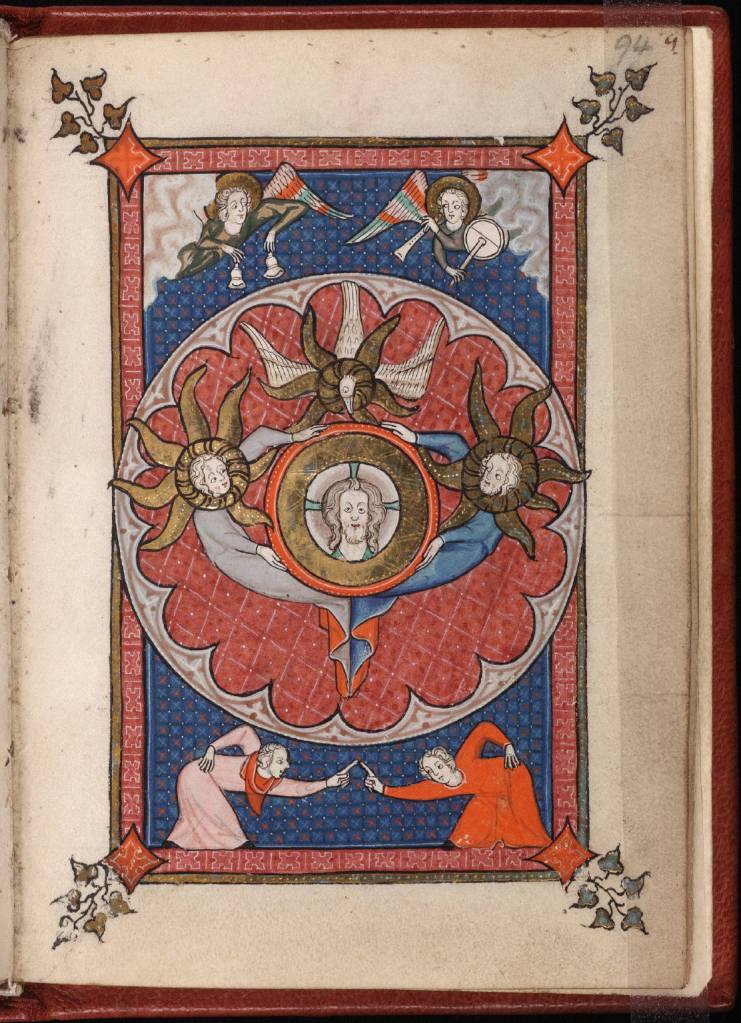
VISUAL MEDITATION: “The Wheeling Playfulness of the Trinity” by Victoria Emily Jones: The Rothschild Canticles [previously] from ca. 1300 Flanders contains some of the most inventive and delightful artistic renderings of the Trinity that I’ve ever seen. I key in on four of them in today’s visual meditation for ArtWay.
Beinecke MS 404, fol. 94r
+++
MUSICAL COMMENTARY: “Theology in Sound and Motion: Perichoresis, for Brass Quintet” by Delvyn Case:Delvyn Case provides musical and theological commentary on his brass quintet composition “Perichoresis” (2006), inspired by the divine dance of the Trinity. “Its overall mood is joyous, an ecstatic whirling-about in which all three members become lost in the ecstasy of divine fellowship,” he writes. “At the exact moment of the dance when one member moves, the other fills in the spot left vacant.” “Perichoresis” premiered by Boston’s Triton Brass and appears on Case’s 2018 album Strange Energy. About this piece, Bible scholar and theologian Walter Brueggemann said, “I . . . have pondered ‘perichoresis’ for a long time. This is the finest exposition of that thick idea that I have encountered.”
+++
SONGS:
>> “Trinity Song” by Paul Zach: Performed in 2021 by Solomon Dorsey with Liz Vice and Madison Cunningham, this song by Paul Zach evolved into “God of Grace and Mystery” for The Porter’s Gate’s 2022 album Climate Vigil Songs. This earlier iteration has a Trinitarian focus that’s just lovely. “God of all eternity / Father, Spirit, and the Son / Ever-loving Three-in-One / O divine community / . . . / Calling us to join your dance . . .”
>> “One-Two-Three” by the Chosen Gospel Singers: This song was recorded in Los Angeles for Specialty Records and released as a single in 1952, with singers J. B. Randall (bass), E. J. Brumfield (tenor), George Butler (tenor), Fred Sims (tenor), and Oscar Cook (baritone). It opens with a repetition of the lines “One, two, three / One-in-Three and the Trinity.” The refrain is:
One for the Father Two for the Son Three for the Holy Ghost All made of one
The song is largely eschatological. The first verse is about John the Revelator’s vision of the New Jerusalem descending, among other wonders; it ascribes a vision of the Trinity to John, even though that is not explicit as such in either John’s Gospel or the Apocalypse (but see “The Trinity in the Book of Revelation” by Edwin Reynolds). The second verse anticipates our singing and praising the Triune God in heaven, dressed in our brand-new robes. It also mentions David and Goliath, and I’m honestly not sure how that relates. But with gospel songs, floating lyrics are common, taken from one song and spliced into another, some more coherent than others in their new context.
+++
ESSAY: “The Hospitality of Abraham in the Work of Julia Stankova, Painter of Bulgarian Icons” by François Bœspflug: The first half of this peer-reviewed article introduces readers to the Bulgarian artist Julia Stankova, rehearsing her biography and examining her relationship to the icons tradition. The second half explores twelve of her paintings on the subject of the three angelic visitors to Abraham and Sarah in Genesis 18, whom the narrator suggests are a manifestation of God (“The LORD appeared to Abraham at the oaks of Mamre . . .”); because of the number of visitors, many Christians interpret this passage as revealing something of God’s triune nature, and for this reason traditional icons of the story are often titled The Trinity.
Julia Stankova (Bulgarian, 1954–), The Hospitality of Abraham, 2004. Tempera on primed wooden panel and lacquer technique, 46 × 41 cm.
Since the publication of this article in 2019, Stankova has made at least three more paintings on the subject, all of which foreground Sarah and are titled Sarah’s Smile. She has just heard the angels announce that she will conceive a son in her old age.
+++
POEM: “After Rublev’s Trinity”by Carrie Purcell Kahler: Published in Image no. 99 (Winter 2018), p. 21, this ekphrastic poem by Carrie Purcell Kahler interprets the famous fifteenth-century Trinity icon by Andrei Rublev. Sometimes referred to as “the hospitality of Abraham,” this biblical episode, as the iconographers interpret it, is really about the hospitality of God, who extends a hand to humanity, ever inviting us to sit at his table.
Andrei Rublev (Russian, 1360–ca. 1430), The Trinity, ca. 1411. Tempera on wood, 141.5 × 114 cm. Tretyakov Gallery, Moscow.
A new choral setting of this poem by Garrett John Law is premiering today at Holy Trinity Episcopal Church in Covina, California, where Law serves as music director and organist. I believe it can be heard on the 10:30 a.m. PT worship service livestream on the church’s YouTube channel, but I’m not sure whether the performance will be archived online for later viewing. (Update, 6/12/23: Here it is! Sung by Holy Trinity’s seven-person choir.)
AVANT-GARDE CLASSICAL: Klang—Die 24 Stunden des Tages (Sound—The 24 Hours of the Day) is a cycle of chamber-music compositions by the avant-garde German composer Karlheinz Stockhausen, which he worked on from 2004 until his death in 2007. (The intention was for there to be twenty-four pieces, but the cycle was unfinished at twenty-one.) The first two pieces in the cycle, on the themes of Ascension and Pentecost, were commissioned for the interdisciplinary Pause festival at Milan Cathedral by artache, a Milan-based nonprofit committed to showcasing contemporary artworks in public places of worship. The artistic director of artache at the time was Don Luigi Garbini, a priest at the church of San Marco in Milan and cofounding director of the artache initiative the Laboratorio di Musica Contemporanea al Servizio della Liturgia (Laboratory for Contemporary Music in the Service of the Liturgy).
>> No. 81: “KLANG, 1st Hour: Himmelfahrt (Ascension)” by Karlheinz Stockhausen, for organ or synthesizer, soprano, and tenor, 2004–5: This thirty-seven-minute piece premiered at Milan Cathedral on Ascension Day, May 5, 2005. The two hands of the organist almost always play in different, independent tempos of a chromatic time scale, while the soloists sing words or phrases associated with “ascension,” particularly the Ascension of Christ. According to the composer, “Asking a performer to break the barrier of time by playing simultaneously in different tempi is like submitting a man to physical disruption, allowing him to go in spirit form towards another world” (source). For musical analysis by Ed Chang, see here. The performance below is from the North American premiere at the Schwartz Center for the Performing Arts at Emory University in Atlanta on October 11, 2005, featuring organist Randall Harlow, soprano Teresa Hopkin, and tenor John Bigham.
>> No. 82: “KLANG, 2nd Hour: Freude (Joy)” by Karlheinz Stockhausen, for two harps and voice, 2005: This forty-minute piece premiered at Milan Cathedral on July 6, 2006. The text is taken from the medieval Pentecost hymn “Veni Creator Spiritus” [previously], which the harpists sing in spurts, “in alternation or sometimes together . . . , while plucking, picking, caressing, stroking, pinching, rubbing, striping, striking, pinking, jubilating,” as Stockhausen put it. In program notes dated February 15, 2006, he writes, “There is something unique about the adventure to combine two harps which are normally tuned in diatonic scales and to synthesise them into one large chromatic harp. . . . Pentecost unites what has been separated. My work FREUDE too.” For musical analysis by Ed Chang, see here. The performance below is from the Stockhausen Memorial Concert in Kürten, Germany, on December 16, 2017, featuring Marianne Smit and Miriam Overlach.
NEW DOCTORAL COHORT:The Sacred Art of Reading: The Eugene Peterson Center for Christian Imagination at Western Theological Seminary in Holland, Michigan, is offering a new, mostly remote, three-year DMin track called “The Sacred Art of Reading,” which begins this October, taught by Professor Chris E.W. Green. The program is centered on the reading of scripture—the Old Testament narrative books (Year 1), Old Testament poetry and wisdom literature (Year 2), and the Gospels and Apocalypse (Year 3)—alongside a number of additional primary texts, whose titles you can view on the website; authors include, among others, Avivah Gottlieb Zornberg, Amy-Jill Levine, Daniel Berrigan, Robert Alter, Shusaku Endo, and of course Eugene Peterson! Participants get together in person for one week each semester (times six semesters) and are responsible for, in addition to the $17,280 tuition, travel and lodging costs. The application deadline is June 30, 2023. Applicants must hold an MDiv degree or its educational equivalent and have at least three years of ministry experience since completing the MDiv. Here’s a condensed program description:
The Sacred Art of Reading cohort will be dedicated to collaboration in “the forbidding discipline of spiritual reading,” confident that such an undertaking cultivates the loving attentiveness, prophetic discernment, and childlike openness to surprise that characterize what St. Paul calls the faith that works by love. . . . The cohort is designed to cultivate an alternative awareness, one shaped by the slow, painstaking work of collaborative interpretation. And to that end, the heart of the program is the reading of the Christian Scriptures. The aim will be both philosophical and devotional, critical and celebratory, mystical and pastoral. No one reading method will be stipulated, but students will be encouraged to find ways to honor the traditions of the communities in which they learned to argue, to muse, and to pray.
Besides Scripture, the cohort will engage a wide range of texts including poems, memoirs, essays, treatises, sermons, and stories old and new, familiar and strange, sacred and “worldly,” in part and in whole, not so much in order to “plunder the Egyptians” as to bear glad witness to the wonder that God is never left without a witness because all truth, truly received, trues.
This approach really wets my whistle! I don’t have a master’s degree, so I’m out, but I feel so energized by the reading list and wanted to share the opportunity with you all, as the program seems doable for those with full-time jobs. A virtual interest meeting is being held on June 1. Click here to view other doctor of ministry cohorts at Western.
+++
FUNDRAISING CAMPAIGN: The Soil and The Seed Project: I’ve mentioned this project several times on the blog before, as I’m a big fan. A ministry of VMMissions (Virginia Mennonite Missions), The Soil and The Seed Project releases original music, art, and liturgies throughout the Christian year, especially suitable for families with littles. They launched in December 2021 and since then have put out seven collections, with their latest and largest yet—Vol. 7 // Ordinary Time—dropping this week. (Request a free download through their website, or stream the music through your favorite service.) Coinciding with this release, they have also launched a campaign to raise $27,000 by June 18 to cover the costs of recording, mixing, pressing, printing, shipping, etc., for future collections. Learn more in the five-minute video below, which features the new songs “In the Little Moments,” “Teach Me, O LORD,” and “Because of Jesus.”
The Soil and The Seed Project offers all their content for free, including physical CDs (as stock permits), and are committed to keeping it that way—which is why they need the support of donors. Donate to their campaign, and you can opt to receive stickers, notecards, and/or a T-shirt as a thank-you. Also note: they’ll be giving a concert at 6:30 p.m. on Saturday, June 3, at the Brethren & Mennonite Heritage Center in Harrisonburg, Virginia.
+++
SONG: “Holy Spirit” by Victoria Williams: “Part front-porch soothsayer, part quirky bayou princess, and part eternal child, Victoria Williams writes songs of indescribable originality that embrace the earthly and the divine with wit, charm, and understated vision,” writes Josh Kun for Bomb magazine. The song “Holy Spirit” [read lyrics] is from her 1990 album Swing the Statue!. It opens with the familiar invocation from a Gullah spiritual: “Kum ba yah, my Lord” (which translates to “Come by here”). She seeks God’s presence and then, given a renewed sensitivity to it, identifies and celebrates its flow throughout her daily goings. She feels the Holy Spirit while building a raft with friends on the shores of Louisiana’s Lake Bistineau and riding a New York City subway beside a whistling stranger, as well as in graveyards and at bars and out under open night skies. The Spirit flows through all of life. I can’t find the song online anywhere other than in this YouTube fan video, which sets it to photos. [HT: Jonathan Evens]
+++
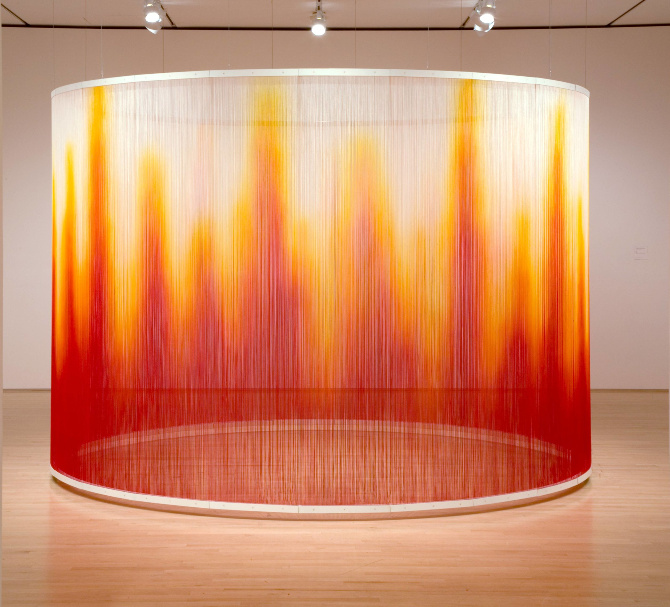
ARTWORK: Fire by Teresita Fernández: In the collection of SFMOMA, this ring of warm-colored silk yarn conveys something of the flickering quality of fire. At the link is a short video interview with the artist about the piece. Fernández says she is interested in the sensorial aspects of viewer engagement with art.
Teresita Fernández (American, 1968–), Fire, 2005. Silk yarn, steel armature, and epoxy, 243.8 × 365.8 cm. San Francisco Museum of Modern Art, California.
Fire was a highlight of the 2013 exhibition Beyond Belief: 100 Years of the Spiritual in Modern Art, jointly organized by SFMOMA and the Contemporary Jewish Museum. Here’s a video of the Lick Wilmerding High School Vocal Ensemble singing “Famine Song” by VIDA around the installation that year, a song inspired by the basket weavers of Sudan, who persist in their craft during times of hardship, their hands working natural fibers into beautiful, colorful vessels. “Weave, my mother; weave, my child; weave your baskets of rushes wild . . .”
SUMMER COURSES: Arts at Regent: Regent College in Vancouver is offering eight one- or two-week in-person courses on its arts track this summer, including “After Disenchantment” with Joy Marie Clarkson (reading list includes Charles Taylor, James K. A. Smith, Kazuo Ishiguro, etc.), “The Puritan Literary Imagination” (on Paradise Lost and Pilgrim’s Progress) with Johanna Harris, and “The Arts, Empathy, and Spiritual Formation” with Mary McCampbell. Several years ago I took a Regent summer course on worship and the arts and really enjoyed it!
+++
BIBLICAL COMMENTARY: “Ascension Sunday (Year A): Luke 24:44-53 and Acts 1:1-11” by SALT Project: This Sunday marks the risen Jesus’s departure after forty days of dwelling with the community of disciples. While SALT Project’s commentary doesn’t plumb all the meaning of the Ascension, I was struck by its pointing out of the significance of the Mount of Olives (in light of Zechariah’s prophecy and the “choreography” of Palm Sunday) and the resonances with Elijah’s ascent, particularly with Christ’s passing on his mantle to the church.
>> Music by Rowland Hugh Prichard, 1830: The hymn is often paired with the public-domain Welsh tune HYFRYDOL (which I know best from its association with “Jesus, What a Friend for Sinners”). It’s sung here by Ben Lashey and Chris Joyner:
>> Music by Rebecca Almazar and Brian Gurney, 2020: I really love this new tune that Almazar and Gurney wrote for the hymn while they were at New City Fellowship in Manassas, Virginia, which was released on the church’s EP A Liturgy. Gurney is now the director of contemporary worship at The Falls Church Anglican in Falls Church, Virginia. The song is not yet available on CCLI, but in the meantime, he has granted permission for license-free church use; here are the chords.
+++
CALL FOR ENTRIES: 2023 Sacred Art Competition and Exhibition: “Seeking the finest contemporary sacred art for an online juried exhibition hosted by the Catholic Art Institute, with a world-wide audience and the opportunity to sell work, be featured on the Catholic Art Institute website.” The top prize is $2,500. The deadline for submission is November 6, 2023. From what I can tell, participants need not be Catholic, but the artwork(s) should be suitable for devotional and/or liturgical use by Catholics.
In the fourteenth century, Hamman says, fathers generally loved their children but were less involved in the day-to-day tasks of caring for their physical and emotional needs, whereas mothers were deeply present. Julian wrote about how Christ gave birth to his children on the bed of the cross, how he nurses them from his side, and how he acutely hears and responds to their individual cries. This podcast episode is an excellent summation of a theological idea that may sound odd and unorthodox at first but that is in fact biblically derived, appearing throughout church history, and that grants us fuller insight into who Christ is.
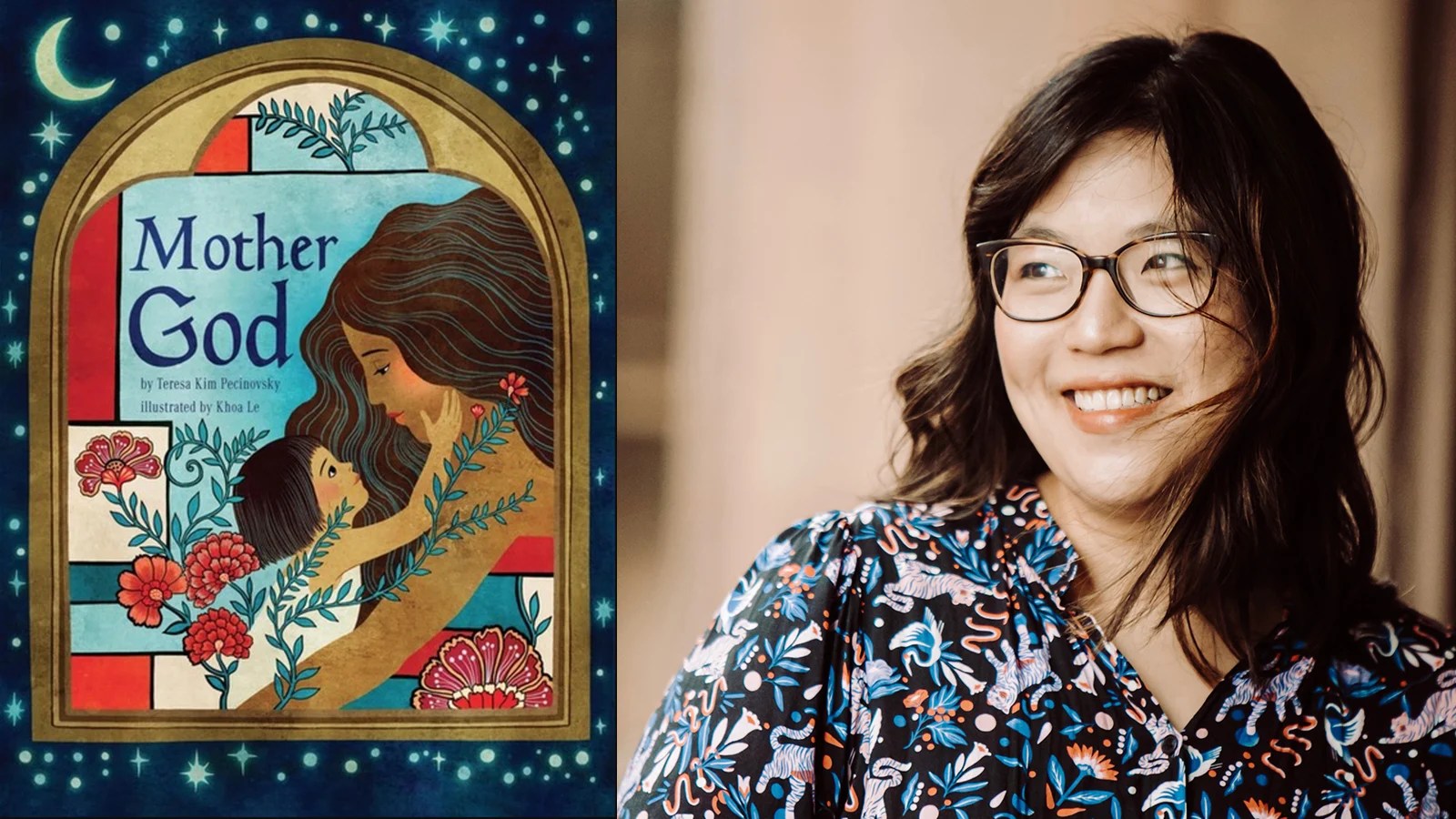
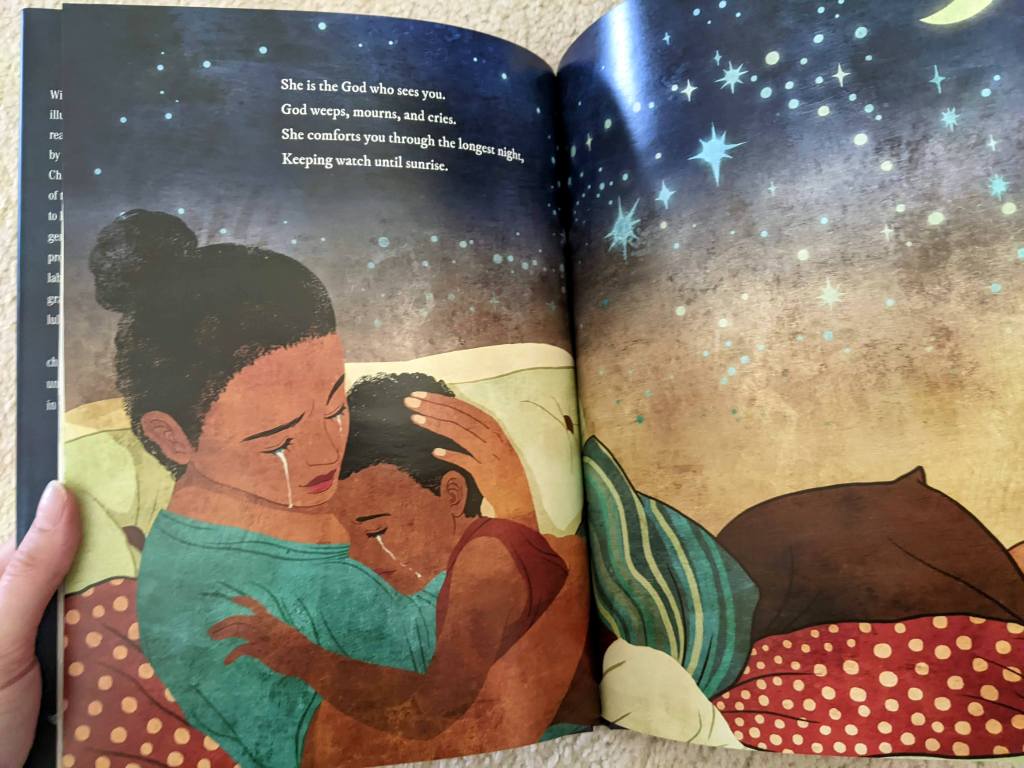
BOOK: Mother God by Teresa Kim Pecinovsky, illustrated by Khoa Le: Dovetailing with Hamman’s recent podcast episode is this beautifully unique children’s book that came out last year from Beaming Books. “With lyrical, rhyming text and exquisite illustrations, Mother God introduces readers to a dozen images of God inspired by feminine descriptions from Scripture. Children and adults alike will be in awe of the God who made them as they come to know her as a creative seamstress, generous baker, fierce mother bear, protective mother hen, strong woman in labor, nurturing nursing mother, wise grandmother, and comforting singer of lullabies. This gorgeous picture book welcomes children into a fuller, more diverse understanding of what it means to be made in the image of God.” Born in South Korea, raised in Iowa, and living in Texas, author Teresa Kim Pecinovsky (MDiv, MEd) (pictured below) is a hospice chaplain ordained in the Christian Church (Disciples of Christ) and a former elementary school teacher. Khoa Le is an artist from Vietnam.
Some traditionalists will no doubt have a visceral reaction against the cover and concept—“God reveals himself as Father, not Mother!” they’ll say, or “The Bible uses only masculine pronouns for God”—but it’s important to remember that God is nongendered, although God does contain both the masculine and the feminine (see, e.g., Gen. 1:27). “Father” is a metaphor, same as “mother.” God became incarnate as a male, Jesus, but as Hamman shows (see previous roundup item), Jesus also exhibited some qualities traditionally associated with women and mothers in particular, and therefore we can speak metaphorically of Christ as mother, as we can, too, of the First Person of the Trinity. Having an academic background in literature, I’m very comfortable with (and enthralled by!) metaphor, but I can understand, lamentably, how it trips some people up.
+++
ARTICLE: “Waking Ancient Seeds: Why the Middle Ages Matter” by Matthew J. Milliner, Comment, May 10, 2023: “For the medievals, Jesus is the Rosetta stone of cosmic meaning, with whom all things are aglow in the polyphonic resonance of truth, and without whom the world hurdles into centrifugal disconnection,” writes Matt Milliner, a theologically trained professor of art history at Wheaton College, an evangelical institution in Illinois. “It is our world that has been flattened, lacking the full-orbed splendour of medieval significance and depth.” In this article he contrasts the symbolism and sense of wonder and reverence of the Middle Ages with the deficits of the present, identifying several, sometimes unlikely places in which these “ancient seeds” are sprouting again.
Celebrated fifty days after Easter, Pentecost is one of the great feasts of the Christian year. It commemorates the descent of the Holy Spirit on Jesus’s apostles when they were gathered in Jerusalem for the Feast of Weeks ten days after Jesus ascended to heaven, marking the birth of the church. Acts 2 describes the Spirit’s coming as accompanied by a “rushing mighty wind” and “tongues of fire”—quite the dramatic entry! The Spirit filled the apostles with the miraculous ability to preach in speech that was comprehensible to all the many Jewish pilgrims, from various language groups, who were gathered in the city, resulting in the conversion that day of three thousand to the Jesus Way.
I’ve compiled a Spotify playlist of one hundred-plus Pentecost songs that celebrate God’s Spirit poured out over the face of the earth, bringing life and power. The indie folk genre is heavily represented, but there’s also an Appalachian fiddle tune, a Renaissance motet, a Native American dance song, a Russian Orthodox kontakion, Sacred Harp hymns, modern classical, Pentecostal gospel, blues, jazz, pop, lo-fi, and more. I hope to capture something of the Spirit’s dynamism with these selections.
The Holy Spirit ministers in a handful of ways. He renews, purifies, transforms. He gifts and empowers. He guides and illumines and comforts. He dwells within, a constant friendly presence. He intercedes for us with wordless groans. He unites believers across lines of difference, making us one. He enables us to bear fruit—love, joy, peace, etc.—for God’s glory and the world’s good.
So many songs centered on the Holy Spirit have an individualistic focus and a gentle, subdued tone. The Spirit does of course minister to the individual, and can be gentle and soothing (Jesus refers to him as the Comforter, after all!), and we often invoke him in our weariness. But the Spirit is also wild and uncontainable. And the life he brings is not merely of an inward spiritual kind; his impact manifests itself in tangible deeds out in the community, as those whom he fills go forth to serve their neighbors after the example of Christ.
Urban Doxology’s “Spirit, Send Your Fire” is a good example of a Holy Spirit song with an outward, communal focus, and it’s full of anticipatory excitement:
In terms of energy, consider the vigor with which Bach ornaments the final line of the Gloria, “Cum Sancto Spiritu in gloria Dei Patris” ([You, Jesus Christ, alone are the Most High] with the Holy Ghost in the glory of God the Father), in his B minor Mass. And for wildness: the loud clashing of the piano chords in Daniel Glover’s “The Descent of the Holy Spirit”from Misteria, evoking a sense of the disorientation that must have been felt on that historic day when the Spirit came suddenly sweeping in and the apostles started speaking multiple languages at once. (Some observers thought they were drunk!)
“Let the Waters” is another high-octane Pentecost song—this one in a rock style—which Michael Gungor wrote in 2014 when he was part of the Liturgists. In 2020 he revisited it with the Good Shepherd Collective, adding as a tag the African American spiritual “Wade in the Water” [previously]. In this context the spiritual references both the Spirit’s tendency to disrupt and the ancient Jewish folk belief that an angel would periodically come down to stir the waters of a certain pool in Bethesda, activating its healing properties (see John 5:4). The GSC released this new arrangement later in 2020 under the title “Pentecost,” featuring on vocals Gungor, Liz Vice, and Charles Jones.
Let the waters cool ya Let the Spirit move ya Feel the fire on your lips and sing your hallelujah Sing your hallelujah
O my soul, sing hallelujah
Wade in the water Wade in the water, children Wade in the water God’s gonna trouble the water
Led by Betty Pamptopee of Isabella Reservation, Michigan, “Methodist Hymn” is the first verse of “O for a Thousand Tongues to Sing” in Ojibwe (but to the tune of “Alas, and Did My Savior Bleed”). Even though “tongues” in the song’s titular first line is probably referring not to languages but to the individual’s desire to maximize God’s praise—as in “Oh, that I had more tongues to praise you with!”—I love the implications for Pentecost, when the gospel went out in many tongues, the beginning of the “proclaim[ing] and spread[ing] through all the earth abroad / the honors of [Jesus’s] name.” I think there’s massive potential for a multilingual choral arrangement of this hymn. (I’m thinking, for example, of Laurel MacDonald’s “Qui habitat,” featured here.)
Several of the songs on the playlist highlight the Spirit’s creativity, such as verse 1 of “Come, Holy Spirit” (alt title: “Holy Spirit, Groaning”) by David Benjamin Blower. Genesis 1 says that in the beginning, the Spirit hovered over the waters of chaos—implying that he was active in creation. And he is still a creative force, bringing forth new life.
Hildegard of Bingen [previously], a twelfth-century nun and polymath from Germany, wrote several beautiful Latin antiphons to the Holy Spirit, both words and music, which together convey a sense of mystery and awe. One of them is “Spiritus sanctus vivificans,” from her Symphony of the Harmony of Celestial Revelations, sung here by soprano Anna Sandström:
Here are two English translations; I can’t decide which I like best, so I proffer them both:
Holy Spirit,
giving life to all life,
moving all creatures,
root of all things,
washing them clean,
wiping out their mistakes,
healing their wounds,
you are our true life,
luminous, wonderful,
awakening the heart
from its ancient sleep.

Trans. Stephen Mitchell
The Spirit of God
is a life that bestows life,
root of the world-tree
and wind in its boughs.

Scrubbing out sins,
she rubs oil into wounds.

She is glistening life
alluring all praise,
all-awakening,
all-resurrecting.

Trans. Barbara Newman
Most songs take the form of calling on the Spirit to descend once more with the breath or fire of revival, such as many of the old hymns: by Ambrose (retuned by Bradford Loomis and Beth Whitney), Rabanus Maurus, Bianco da Siena (retuned by Seth Thomas Crissman, and another version by Luke Brodine), Martin Luther (retuned by Paula Best and Tara Ward), Heinrich Held (retuned by Joshua Bennetch), Isaac Watts (retuned by Jon Green), Joseph Hart (retuned by Stephen Gordon), Charles Wesley (retuned by Jered McKenna), Benjamin Beddome, and Samuel Longfellow (retuned by Seth Thomas Crissman, and another version by Greg Yoder, both of The Soil and The Seed Project).
For example, we might ask the Spirit to increase our love for God and others. In Watts’s “Come, Holy Spirit, heav’nly dove,” we beseech him to come “with all Thy quick’ning pow’rs; come, shed abroad a Savior’s love, and that shall kindle ours.” Or elsewhere, similarly, to “light up our mortal frame” with love, “till others catch the living flame” (Ambrose). The Spirit also kindles belief and trust. “Revive our drooping faith,” prays Hart.
Further, the Spirit knits together diverse peoples into a brand-new family whose head is Christ. Fr. Peter Raymond Scholtes, a Catholic priest living on the south side of Chicago, penned the post–Vatican II hymn “One in the Spirit” (aka “They’ll Know We Are Christians by Our Love”) against the backdrop of the civil rights movement. It proclaims that Christians are united by their share in, as the apostle Paul puts it, “one body and one Spirit . . . one hope . . . one Lord, one faith, one baptism, one God and Father of all . . .” (Eph. 4:2–5), and prays “that all unity [across all humankind] will one day be restored.” It also emphasizes the importance of the church’s public witness through acts of love. As Jesus says in John 13:35, “By this everyone will know that you are my disciples, if you have love for one another.” Love is the primary fruit of the Spirit that Paul lists in Galatians 5:22–23. Here’s a jazz arrangement of the hymn performed by Ruth Naomi Floyd:
Unity is also the theme of one of four featured hymns from the Orthodox liturgy for Pentecost, the text of which translates to: “When the Most High descended and confused tongues [at the Tower of Babel], he scattered the people; but when he distributed the tongues of fire, he called all to unity. Therefore, with one voice, let us praise the most Holy Spirit.” Pentecost is often referred to as a reverse Babel.
There are several musical settings of scripture on the playlist, including:
“O Children of Zion” by Seth Thomas Crissman (The Soil and The Seed Project), a setting of Joel 2:23a, 28: “O children of Zion, be glad and rejoice in the LORD your God. . . . I will pour out my spirit on all flesh; your sons and your daughters shall prophesy, your old men shall dream dreams, and your young men shall see visions.”
“If Ye Love Me” by Thomas Tallis, a setting of John 14:15–17: Jesus says, “If you love me, you will keep my commandments. And I will ask the Father, and he will give you another Advocate [/Helper/Comforter; Gr. parakletos, Paraclete], to be with you forever. This is the Spirit of truth, whom the world cannot receive because it neither sees him nor knows him. You know him because he abides with you, and he will be in you.”
“The Spirit of Life” by Cody Curtis (Psallos), a setting of Romans 8:1–17, about living not according to the flesh but according to the Spirit, who is “life and peace” and who abides in us, enabling us to resist sin and bearing witness that we are children of God and therefore join heirs with Christ
“God Is Love” by Ri-An, a setting of 1 John 4:7–21, about how we abide in God, and God in us, through the Spirit, who is love
There are also a few songs that reference the story of Ezekiel in the valley of dry bones [previously], in which God brings his prophet to a desolate landscape littered with human bones. But then: “Thus says the Lord GOD to these bones: I will cause breath to enter you, and you shall live. . . . Come from the four winds, O breath, and breathe upon these slain, that they may live” (Ezek. 37:5, 9). And the bones reassembled, took on flesh, and became animated once again—a picture of the regenerative power of God’s Spirit. (The Hebrew word for “spirit” is ruach, which can also be translated “breath”; same with the Greek pneuma.) Here’s Caroline Cobb’s “Dry Bones”:
I hope the Art & Theology Pentecost Playlist helps you to more fully exult in the myriad workings of the Spirit, who came in a blaze some two thousand years ago and burns still, all over the globe, where Christ’s kingdom has taken root.
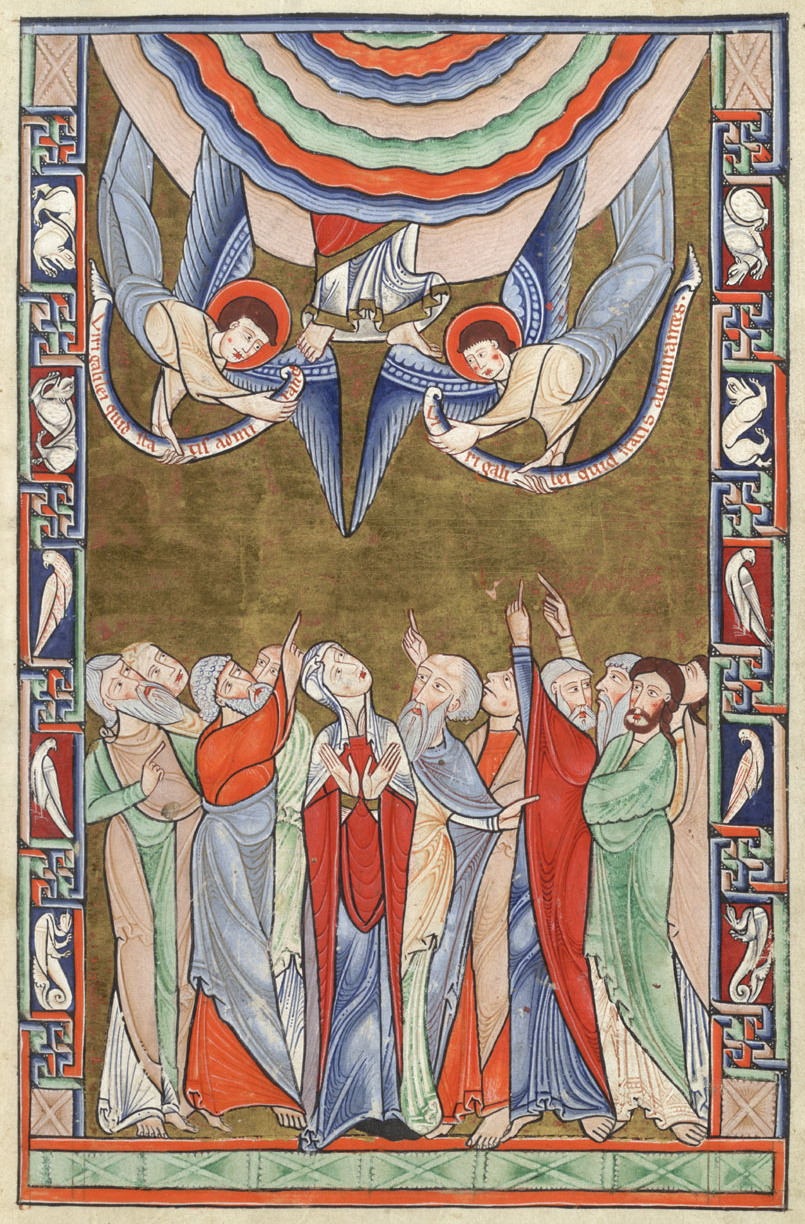
Looking for hymns for Ascension Day (which is May 18 this year), I came across “A Hymn of Glory Let Us Sing.” Originally written in Latin, it is attributed to the Venerable Bede (673–735), a monk at the Northumbrian monastery of Monkwearmouth and one of the most important scholars of the Early Middle Ages.
“Hymnum canamus gloriæ” circulated throughout medieval Europe in various versions, with the earliest known surviving example appearing in the mid-eleventh century in Beinecke MS 481.36, fols. 2r–2v.
The Ascension, from the Hunterian Psalter, made in England, ca. 1170. Glasgow University Library, MS Hunter 229, fol. 14r.
Below is the fairly standardized seven-stanza version that appears in the Hymnale Secundum Usum Insignis Ac Praeclarae Ecclesiae Sarisburiensis (London, 1850), pages 163–64, which in turn is taken from the Psalterium cum Hymnis ad usum insignis Ecclesiae Sarum et Eboracensis, a quarto edition printed in Paris by Byrkman in 1516. The English translation on the right, from the 1852 edition of the Hymnal Noted, is by Benjamin Webb.
Hymnum canamus gloriæ,
Hymni novi nunc personent,
Christus novo cum tramite
Ad Patris ascendit thronum.

Apostoli tunc mystico
In monte stantes chrismatis
Cum matre clara virgine,
Iesu videbant gloriam.

Quos alloquentes angeli,
Quid astra stantes cernitis?
Salvator hic est, inquiunt,
Iesus triumpho nobili;

Sicque venturum asserunt,
Quemadmodum hunc viderunt,
Summa polorum culmina
Scandere Iesum splendida.

Da nobis illuc sedula
Devotione tendere,
Quo te sedere cum Patre
In arce regni credimus.

Tu esto nostrum gaudium,
Qui es futurus præmium,
Sit nostra in te gloria,
Per cuncta semper sæcula.

Gloria tibi, Domine,
Qui scandis supra sidera,
Cum Patre et Sancto Spiritu
In sempiterna sæcula.
Sing we triumphant hymns of praise,
New hymns to heav’n exulting raise;
Christ, by a road before untrod,
Ascendeth to the throne of God.

The holy apostolic band
Upon the Mount of Olives stand,
And with the Virgin Mother see
Jesu’s resplendent majesty.

To whom the angels, drawing nigh,
“Why stand and gaze upon the sky?
This is the Savior,” thus they say;
“This is his noble triumph day.”

“Again shall ye behold him so
As ye today have seen him go,
In glorious pomp ascending high,
Up to the portals of the sky.”

O grant us thitherward to tend,
And with unwearied hearts ascend
Unto thy kingdom’s throne, where thou,
As is our faith, art seated now.

Be thou our joy, and thou our guard,
Who art to be our great reward:
Our glory and our boast in thee
For ever and for ever be!

All glory, Lord, to thee we pay,
Ascending o’er the stars today;
All glory, as is ever meet,
To Father and to Paraclete.
Numerous layers of translation and revision have marked the transmission of this hymn text. Two other nineteenth-century English translations are by:
John David Chambers, from Lauda Syon, Ancient Latin Hymns of the English and Other Churches, Translated into corresponding Metres (London, 1857), pp. 198–99
Elizabeth Rundle Charles, from The Voice of the Christian Life in Song; or Hymns and Hymn Writers of Many Lands and Ages (London, 1858), pp. 165–66
O grant us thitherward to tend and, with unwearied hearts, ascend unto thy kingdom’s throne, where thou, as is our faith, art seated now.
Bede, trans. Benjamin Webb
The version used in most twentieth-century English-language hymnals appears to be a mashup of Charles (from whom comes the title and first line “A Hymn of Glory Let Us Sing”) and Webb, with additional editorial alterations. For example, here’s what’s in Christian Worship: A Lutheran Hymnal (1993), which is credited as a composite translation:
A hymn of glory let us sing! New songs throughout the world shall ring: Alleluia, alleluia! Christ, by a road before untrod, ascends unto the throne of God. Alleluia, alleluia! Alleluia, alleluia, alleluia!
The holy apostolic band upon the Mount of Olives stand. Alleluia, alleluia! And with his followers they see their Lord ascend in majesty. Alleluia, alleluia! Alleluia, alleluia, alleluia!
To them the shining angels cry, “Why stand and gaze upon the sky?” Alleluia, alleluia! “This is the Savior,” thus they say. “This is his glorious triumph day.” Alleluia, alleluia! Alleluia, alleluia, alleluia!
“You see him now, ascending high up to the portals of the sky.” Alleluia, alleluia! “Hereafter Jesus you shall see returning in great majesty.” Alleluia, alleluia! Alleluia, alleluia, alleluia!
Be now our joy on earth, O Lord, and be our future great reward. Alleluia, alleluia! Then, throned with you forever, we shall praise your name eternally. Alleluia, alleluia! Alleluia, alleluia, alleluia!
O risen Christ, ascended Lord, all praise to you let earth accord. Alleluia, alleluia! You are, while endless ages run, with Father and with Spirit one. Alleluia, alleluia! Alleluia, alleluia, alleluia!
Christian Worship pairs the text with LASST UNS ERFREUEN, a seventeenth-century tune from Germany that is most commonly associated with “All Creatures of Our God and King.” It works really well! Below you can listen to an abridgement of this version of “A Hymn of Glory Let Us Sing” (verses 1, 5, and 6), plus a different version featuring a new, custom melody.
>> Tune: LASST UNS ERFREUEN, 1623 | Performed by the Good Shepherd Collective, 2023: The musicians who make up the Good Shepherd Collective are masters of their craft. Each week I tune in to the musical portion of the Good Shepherd New York virtual worship service for inspiration and nourishment, and to see what they’ve been up to. I always love their arrangements and the breadth encompassed by their selections. I’ve cued up their premiere performance of “A Hymn of Glory Let Us Sing” from the GSNY April 30 service, located at 1:49–4:57. The lead vocalists are Jonathan Seale and Jayne Sugg.
>> Music by Steven Brooks, 2020 | Performed by Andrew Shubin, 2020: Dr. Steven D. Brooks is a pastor, author, professor of music and worship at Azusa Pacific University, and the founding director of Worship Quest Ministries, which serves as a resource for worship renewal and spiritual formation in the global church. A former student of Brooks’s, Andrew Shubin is a singer, guitarist, and actor living in Los Angeles. He has done session singing, appeared on TV, starred in musical theater productions, and written original songs. In this video he sings a retuned version of “A Hymn of Glory Let Us Sing” by Brooks, which uses the three-verse translation from the United Church of Christ’s New Century Hymnal (1995) but adds a new refrain. For permission to use this song, email resources@worshipquest.net.
A hymn of glory let us sing! New songs throughout the world shall ring: Christ, by a road before untrod, ascends unto the throne of God.
Refrain: Alleluia! Arise and let your praises ring. Alleluia! Arise and sing to Christ the King.
You are a present joy, O Christ, triumphant love once sacrificed, and great the light in you we see to guide us to eternity. [Refrain]
O risen Christ, ascended now, to your blessed name all knees shall bow; you are, while endless ages run, in Triune Godhead ever One. [Refrain]
The Easter season is a time of hope. There still is fear, there still is a painful awareness of sinfulness, but there also is light breaking through. Something new is happening, something that goes beyond the changing moods of our life. We can be joyful or sad, optimistic or pessimistic, tranquil or angry, but the solid stream of God’s presence moves deeper than the small waves of our minds and hearts. Easter brings the awareness that God is present even when his presence is not directly noticed. Easter brings the good news that, although things seem to get worse in the world, the Evil One has already been overcome. Easter allows us to affirm that although God seems very distant and although we remain preoccupied with many little things, our Lord walks with us on the road and keeps explaining the Scriptures to us. Thus there are many rays of hope casting their light on our way through life.
—Henri Nouwen, A Cry for Mercy: Prayers from the Genesee (1981) [HT]
+++
TRAVELING EXHIBITION: Arte de Lágrimas: Refugee Artwork Project: Started in August 2014 by the Rev. Dr. Gregory Cuéllar and Nohemi Cuéllar, Arte de Lágrimas (Art of Tears) is a traveling art exhibit and archive that aims to create greater public awareness of the lived migratory journeys of asylum-seeking children and youth from Central America. The Cuéllars and other volunteers have visited respite centers in Texas border towns like McAllen, Brownsville, and Eagle Pass, distributing art supplies to migrant children who are waiting for buses to take them to their longer-term destination. They want to give these children the option to express themselves or process their journeys through an artistic outlet. Some of the children have chosen to donate their artworks to the volunteers, and it is these that constitute the Arte de Lágrimas collection, which is currently on display at Fuller Theological Seminary in Pasadena, California.
This Thursday, April 27, Fuller is holding a gallery reception at Travis Auditorium (180 N. Oakland Ave., Pasadena) from 6 to 9 p.m., which will include a presentation by Gregory Cuéllar as well as a panel discussion; RSVP here. Cuéllar, who teaches Old Testament at Austin Presbyterian Theological Seminary, is the author of Resacralizing the Other at the US-Mexico Border: A Borderland Hermeneutic (Routledge, 2020) and Voices of Marginality: Exile and Return in Second Isaiah 40–55 and the Mexican Immigrant Experience (Peter Lang, 2008).
If you can’t make it to the exhibition at Fuller, you can at least tour the Virtual Showroom that the Cuéllars developed, which hangs the images in a digital space that gives users the impression of being in a physical gallery.
+++
ARTICLE: “‘He Is Not Here’: A Choral Easter Season” by Mark Meynell: This Rabbit Room blog post is part of 5&1, a weekly series from 2021 in which British chaplain Mark Meynell shares five short pieces of classical music and one long piece, drawing attention to some of their musical elements. For Easter he selected a setting of Psalm 118:24 by Renaissance composer William Byrd; “O dulce lignum” (O Sweet Wood) from Ēriks Ešenvalds’s Passion and Resurrection (below); “Christus Vincit” by Sir James MacMillan; an anthem for Ascension Day by Gerald Finzi; an Easter hymn from an Italian opera by Pietro Mascagni (also below); and the fifth movement of Mahler’s famous Resurrection Symphony. I appreciate that he provides lyrics and translations!
+++
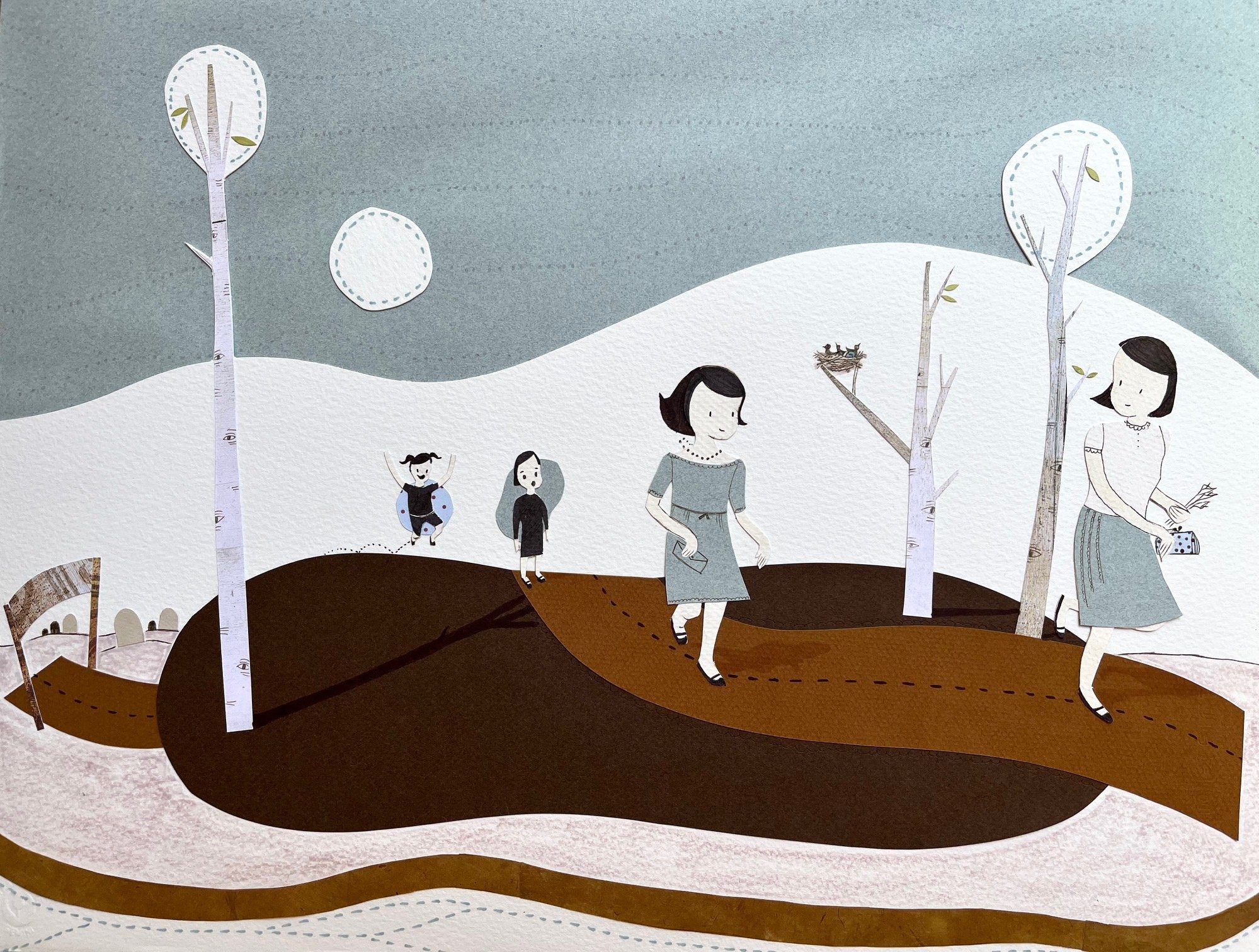
BLOG POST: “The Good Fridays of Our Eastertide Lives” by W. David O. Taylor, feat. Sam Wedelich: W. David O. Taylor, a theology professor at Fuller Theological Seminary, shares a visual interpretation of Matthew 28:8 by Sam Wedelich, at the time a member of Hope Chapel in Austin, where Taylor served as arts pastor. Wedelich’s collage shows how both fear and joy gripped the hearts of the two Marys on Easter morning, reflecting the complexities of our own often muddled-up feelings. Whether we’re skipping to the tune of “Hallelujah” this Easter or standing still, immobilized—or experiencing, like the Marys, some strange mixture of stances—the Risen Lord meets us, Taylor writes.
Sam Wedelich, With Fear and Great Joy, 2005. Collage.
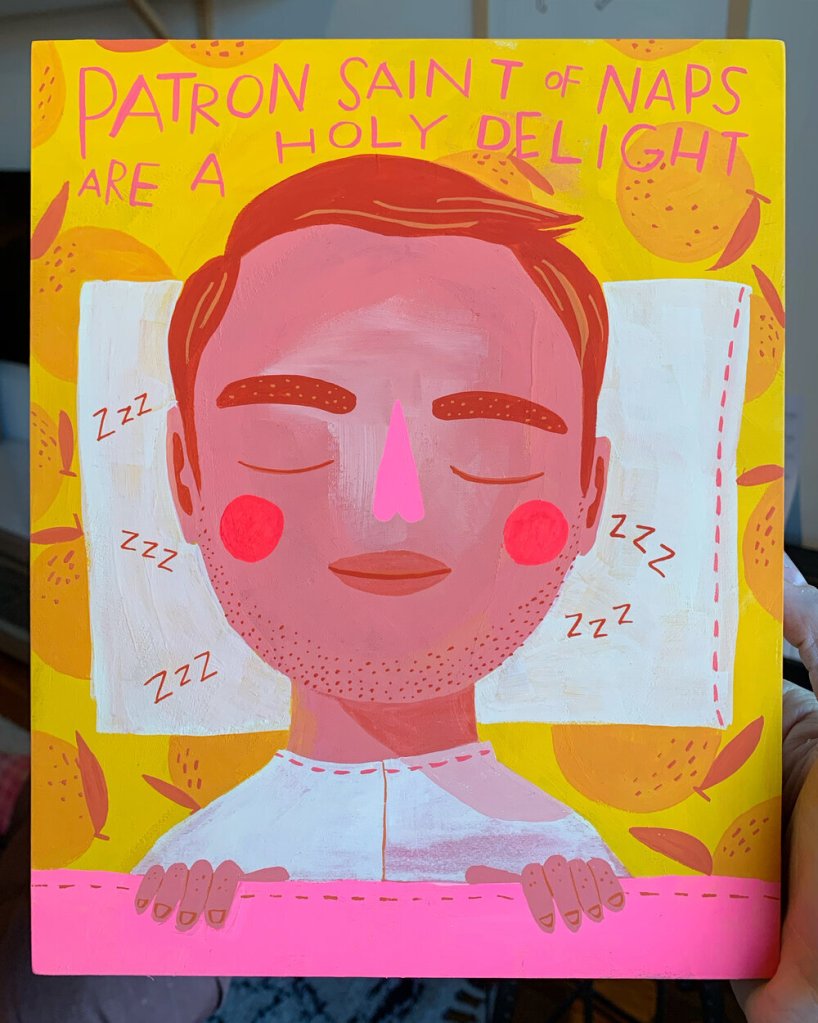
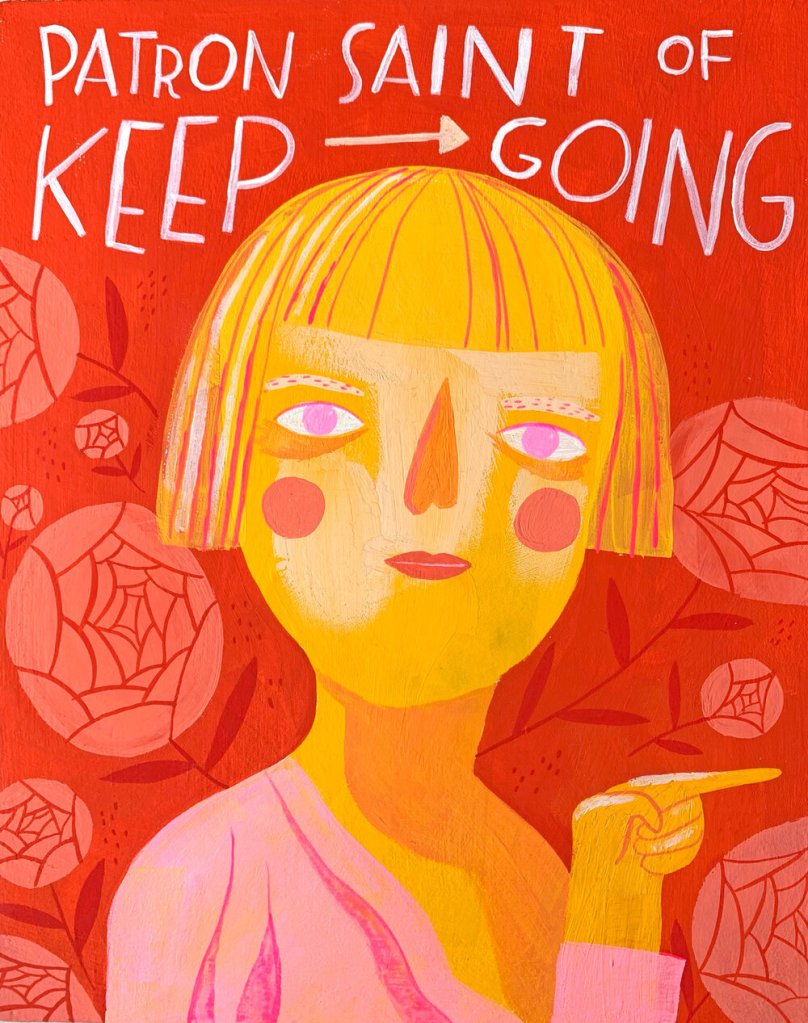
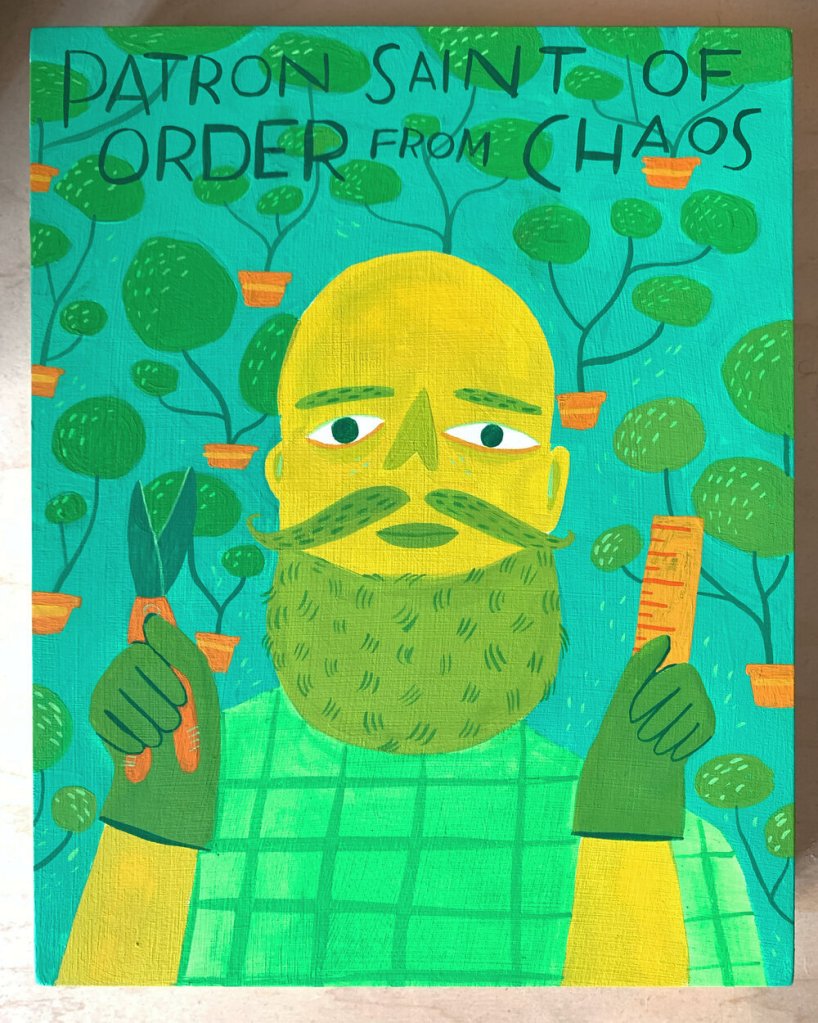
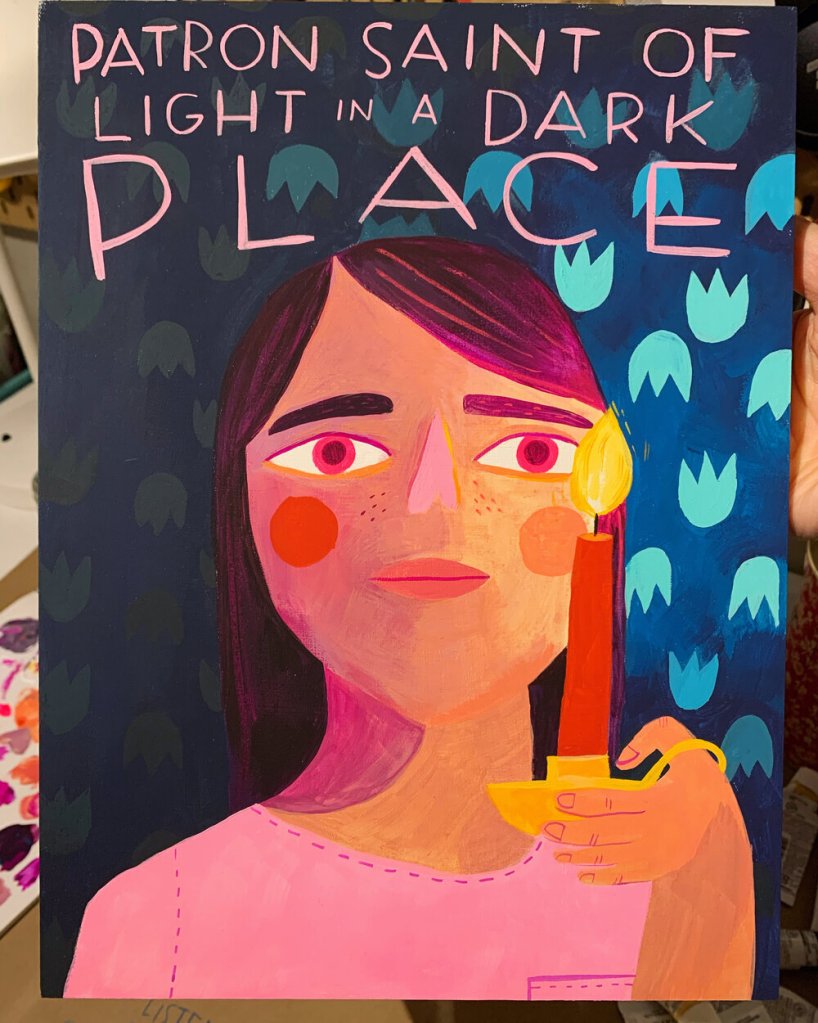
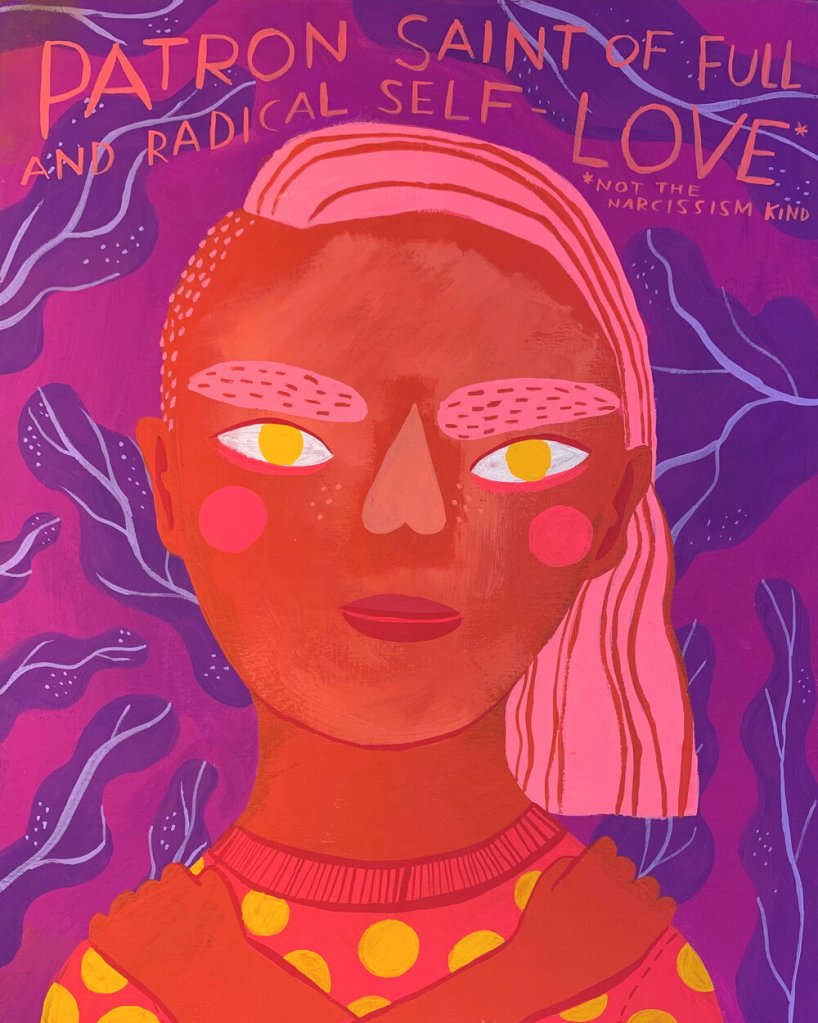
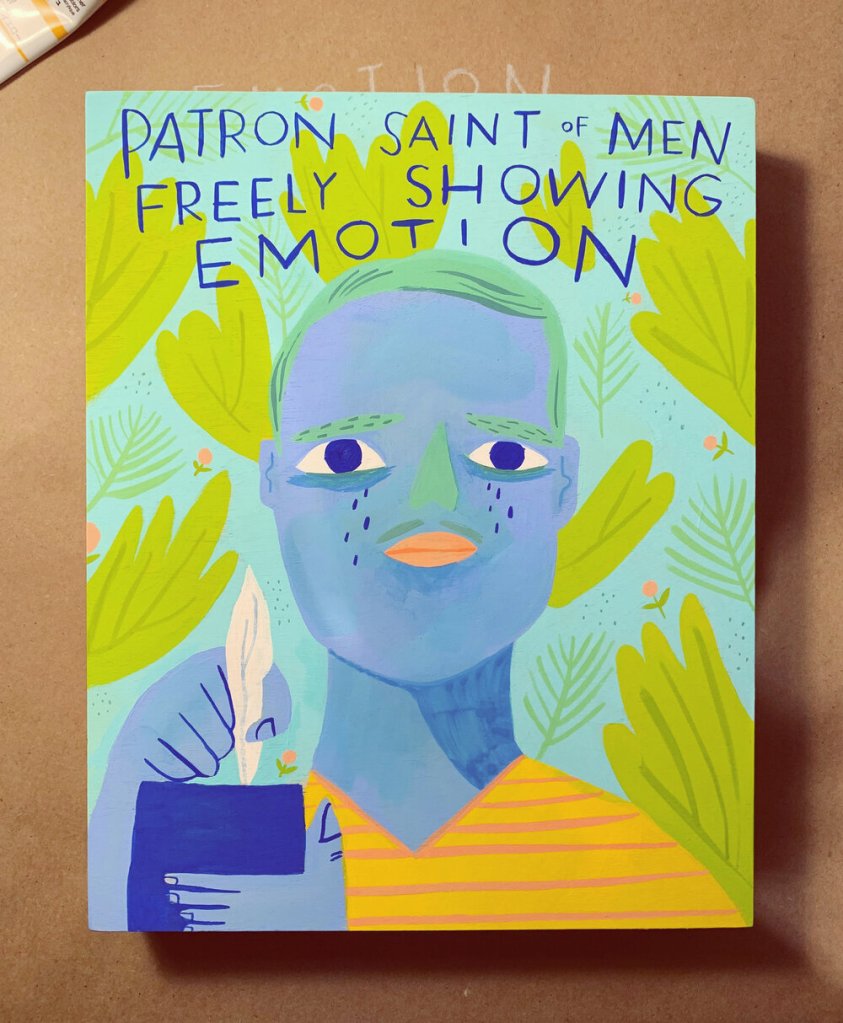
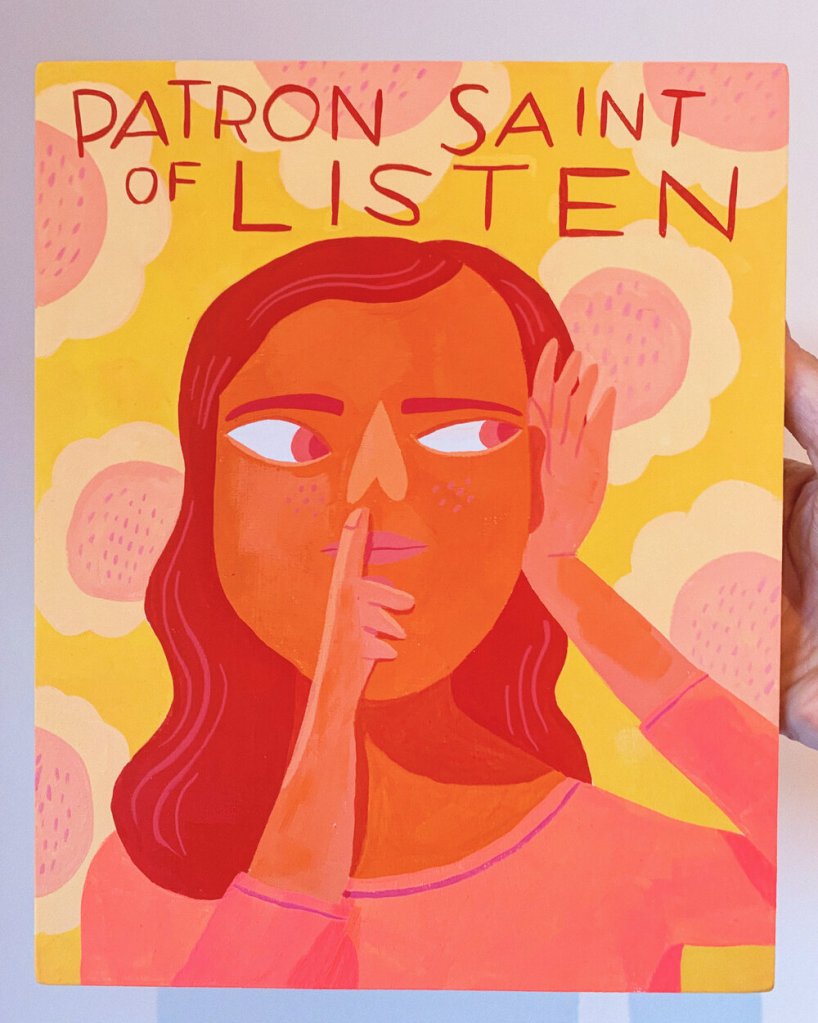
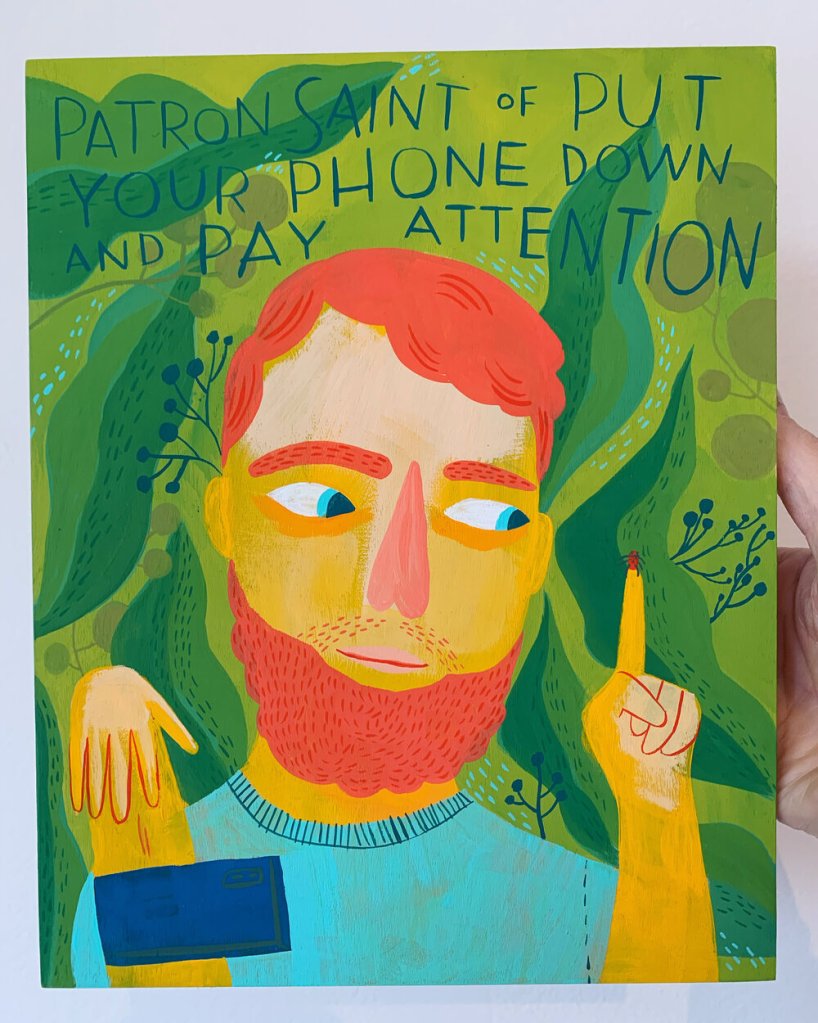
This is an early piece by Wedelich, which she made when she was a college student. She has since become well established as an illustrator. Follow her on Instagram @samwedelich. I especially like the series of “patron saint” paintings she did in 2020. Two of them are available for sale as prints from her online shop: Patron Saint of Keep Going and Patron Saint of Listen.
SONG: “To Thessalonica” by John Davis: Dedicated to his father, who passed away last month, Nashville-based rock singer-songwriter John Davis’s new album, My Hope Is Found in a God Who Can Raise Up the Dead, includes an original musical adaptation of 1 Thessalonians 4:14–18: “This we declare to you by word from the Lord: We who are alive, who are left until the coming of the Lord, will not precede those who sleep in death. The Lord will descend with a cry of command; the voice of an archangel too. And with the sound of the trumpet of God, the dead in Christ will rise up first. The dead in Christ will rise up first. I know, I know, I know we’re gonna meet in the air. Yeah! The shout of command and the voice of the angel, the trumpet of God will declare. Yeah! I believe, I believe in, I believe, I believe in . . . My hope is found in a God who can raise up the dead, yeah! . . . My hope is found in a God who has raised up the dead. . . .” [HT: Crowdfunding Christian Music]
What then are we to say? Should we continue in sin in order that grace may increase? By no means! How can we who died to sin go on living in it? Do you not know that all of us who were baptized into Christ Jesus were baptized into his death? Therefore we were buried with him by baptism into death, so that, just as Christ was raised from the dead by the glory of the Father, so we also might walk in newness of life.
For if we have been united with him in a death like his, we will certainly be united with him in a resurrection like his. We know that our old self was crucified with him so that the body of sin might be destroyed, so we might no longer be enslaved to sin. For whoever has died is freed from sin. But if we died with Christ, we believe that we will also live with him. We know that Christ, being raised from the dead, will never die again; death no longer has dominion over him. The death he died, he died to sin once for all, but the life he lives, he lives to God. So you also must consider yourselves dead to sin and alive to God in Christ Jesus.
—Romans 6:1–11
LOOK: The Man and the Cross by Rufino Tamayo
Rufino Tamayo (Mexican, 1899–1991), The Man and the Cross, 1975. Oil on canvas, 130 × 97 cm. Collection of Modern and Contemporary Art, Vatican Museums.
Part 1:

In Christ we live
And in Christ we die
And in Christ we rise up again
Let heaven rejoice
And let earth be glad
And sing, “Alleluia, amen!”
Part 2:

In Christ
We live
In Christ we rise again
Let heaven
Rejoice
And sing, “Amen!”
>> Recorded by the Elnora Bible Institute Choir, 2020:
Part 1:

In Christ
We live
And die and rise again
Let heaven
Be glad
And sing, “Amen, amen!”
Part 2:

In Christ we live
And in Christ we die
And in Christ we rise up again
Let heaven be glad
And let earth rejoice
And sing, “Alleluia, amen!”
This buoyant song in two-part polyphony was written by John Bell of the Iona Community, an international, ecumenical Christian movement working for justice and peace, the rebuilding of community, and the renewal of worship. The community was founded in Glasgow in 1938, and its music arm is regarded in the UK as one of the most vibrant sources of new congregational music.
Bell, a Church of Scotland minister, worked for the Iona Community for over forty years before retiring from his position as resource worker last November, though he continues to be involved as a member. He leads workshops on liturgy, music, spirituality, and social justice; has written and edited song collections, sermon collections, and a wide range of liturgical materials as part of the Wild Goose Resource Group he founded with the late Graham Maule; and contributes regularly to the annual Greenbelt festival in England. Much of his work has been in convincing people they can sing, regardless of their ability to read music, and encouraging more congregational participation in music making.
The video above shows a session from a Music That Makes Community gathering at St. Paul’s Chapel in New York City in April 2008, led by Connecticut pastor Nancy Boldt McLaren. I love the enthusiasm of the group who is learning this song for the first time! The Spotify link is to a recording by a choir from Elnora Bible Institute in Indiana, which sings the words as published (whereas McLaren makes a few small tweaks).
This concludes the Easter Octave—but keep celebrating! Easter is a fifty-day season that culminates with the feast of Pentecost on May 28. I’ll be releasing a brand-new Pentecost playlist on Spotify next month, but until then, check out the one for Eastertide, which includes today’s featured song.
Again your Spirit sweeps, a wind over the deep; a new creation now arrives to rouse us from our sleep.
The breath of heaven brings the long-awaited spring into the fields and seas and skies and every barren thing.
Refrain: Creation blooms anew in fresh and joyful hue. In Christ’s arising all things rise to draw their breath from you.
Awaken by the sound of forging swords into plows. Come fill the Garden with your light, and we will till the ground.
The earth is being cleared for heaven to come near. From every depth an eager sigh is all that we can hear. [Refrain]
Nick Chambers [previously] is the worship pastor at Church of the Incarnation in Atlanta and a singer-songwriter whose debut album, Great Cloud, released last year. “Creation Blooms Anew” is not part of that LP, but he shared it on YouTube in 2020. It was inspired by a hymn of Adam of St. Victor, a major Latin-language poet from twelfth-century France:
Earth blooms afresh in joyous dyes; In Christ’s arising all things rise; A solemn joy o’er nature lies; Alleluia!
Now peace the sea, the sky doth fill; Heav’n’s breath wakes fair each vale and hill; Spring pours through barren hearts and chill; Alleluia!
Life wins from death the glorious prey; The cherub’s sword is turned away, And Eden’s paths are free today; Alleluia!
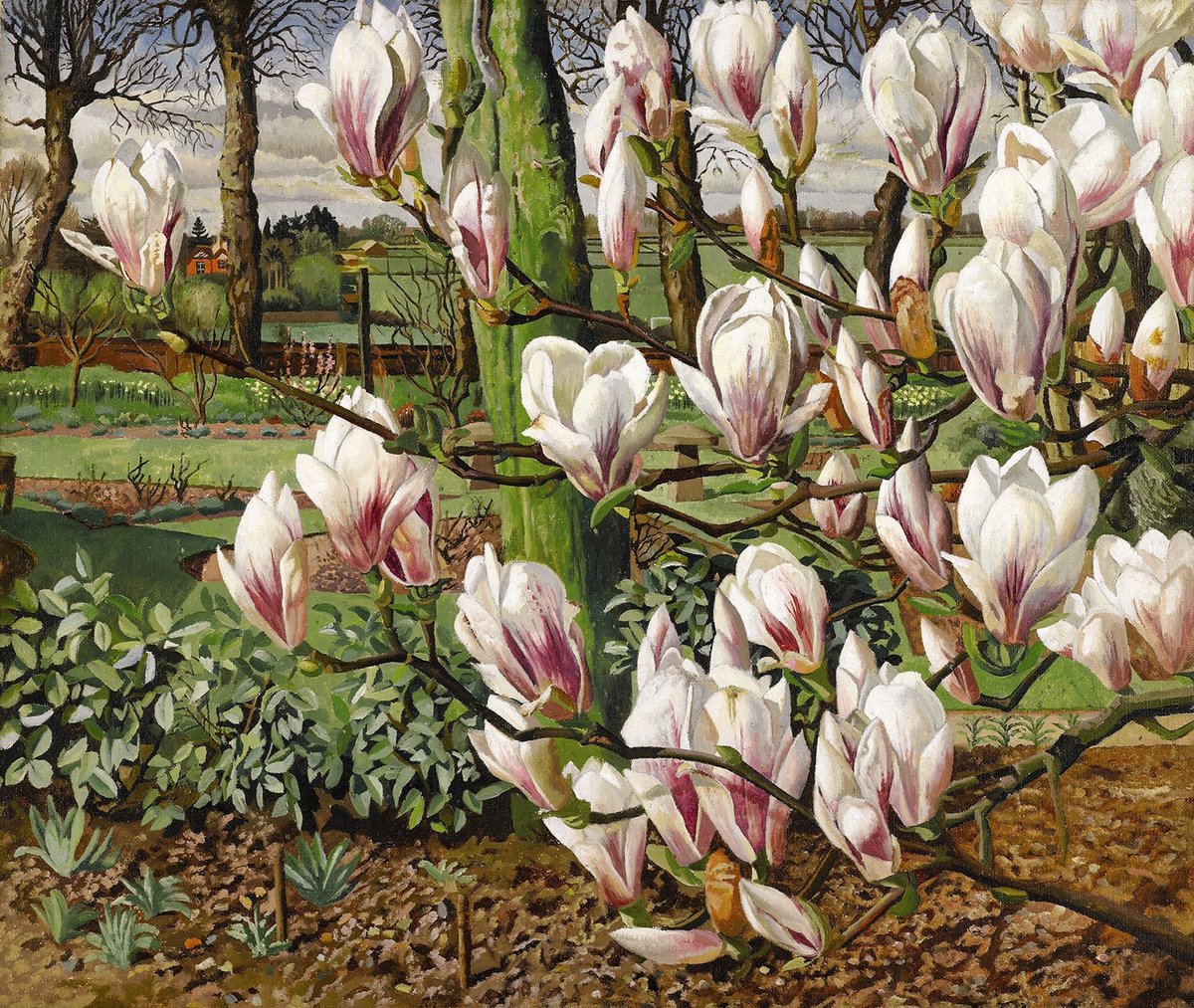
Memories of his family’s first Easter in Atlanta in 2017 also influenced the song. “More than anything I remember the magnolia flowers,” Chambers said, “bright white and big as our baby’s head. The branches bent with the weight of them, swinging like bells welcoming us into a new home, a new season of life.”
Chambers reflects further on the image of flowering:
Norman Wirzba, in one of his many reflections on gardening, writes, “It is significant that the material context for creation and for redemption should be a garden, for it is precisely through gardening that we most experience ourselves as created beings, as beings tied to a magnificent creation and to God. . . . [The writer of Genesis 2] is clear that we become authentic and truly fulfill our vocation as we learn to care for the garden which is creation itself.” He continues, “Gardens have long been a place of spiritual nourishment, because it is here that we can sense the vivifying and gracious power of the creator at work in the creation. Without much help from us, and sometimes in spite of our worst efforts, we can plainly see that we are in the presence of a life- and death-wielding power that overcomes and envelops us all” (The Paradise of God, 117).
In the beginning, God creates humanity to till the ground in a garden. Christ suffers anguish and grief in a garden, then to be resurrected in a garden and even mistaken for its caretaker. The story comes to its endless ending in a garden—steady streams in the shade of trees thick with healing leaves. We live from this past into this future, ourselves like flowers nourished by soil and bending toward the sun. Here and now, Easter invites us into this vision, into the wild surprises of spring to be both gardeners and the garden itself.
BANJO DUET: “Foggy Morning Breaking” by Alison Brown and Steve Martin: Did you know the actor Steve Martin also has a music career? He’s been playing the banjo since he was a teenager, and he writes, records, and tours, both solo and as part of bluegrass bands. He’s even won three Grammys for his banjo music!
Fellow banjoist Alison Brown invited him to contribute to one of the tunes on her forthcoming album, On Banjo, which releases May 5. It’s called “Foggy Morning Breaking.” She wrote and plays the A section; he wrote and plays the B. The piece was released last month as a single, along with this music video.
>> April 22: “The Ekstasis Café: An Evening of Poetry, Music, Testimony, and Gallery,” Goldberry Books, Concord, North Carolina: Ekstasis is a beautiful quarterly magazine “exhibit[ing] arts and letters that reflect the depths of Christian life.” Next Saturday they are hosting their first-ever public gathering! Their hope with it is to foster meaningful connections, conversation, deep aesthetic encounters, and inspiration.
Stephen Procopio, Ascension, 2020. A full-color version of an illustration for Come See a Man (an illustrated Gospel of John) by Fish Coin Press.
From April 9 to May 28, the gallery at Sojourn Church Midtown in Louisville is exhibiting a selection of art from Fish Coin projects (open Sundays from 9 a.m. to 12:30 p.m., or by appointment); here are a few exhibition views. And two Friday evenings from today, Fish Coin Press creative director Jared Boggess and development lead Stephen Procopio, who are illustrators themselves, will be visiting the gallery to discuss “visual theology” and its role in the local church. There will be a Q&A and a sneak preview of upcoming publications.
+++
POEM: “Psalm” by Dorianne Laux: This poem sings the glories of “the hidden and small,” of the plants and creatures beneath our feet. Read more of Laux’s poems at https://www.doriannelaux.net/poems.
+++
LECTURE: “Resurrection and the Renewal of Creation” by N. T. Wright: In this 2018 lecture sponsored by Lanier Theological Library and Baylor University’s Truett Seminary, ancient historian and New Testament scholar N. T. Wright discusses the meaning of Jesus’s resurrection, a topic he explores thoroughly in the influential academic tome The Resurrection of the Son of God and its more accessible corollary, Surprised by Hope: Rethinking Heaven, the Resurrection, and the Mission of the Church. “Easter is the start of something; it isn’t the ending,” he says. With the resurrection of Christ, the new creation has been launched and put to work in the world. It’s not about securing our souls a place in some nonspatiotemporal heaven when we die but about heaven colonizing earth here and now. We humans, he says, are meant to stand at the place where heaven and earth interlock. We who have received life are to be ourselves life-bringers, to participate in God’s massive renewal project. We are resurrection people!
Wright addresses common Christian misconceptions about death, judgment, and the fate of this world, seeking to root out the corrupting influence of Platonism and other pagan Greek philosophies on Christian eschatology. (For example, the new creation won’t be a creatio ex nihilo, creation out of nothing; it will be a creatio ex vetere, a creation out of the old. The implications of that are huge.) He also affirms the absolute importance of belief in Jesus’s bodily resurrection—his rising is no mere metaphor!—and calls on Christians to recover a centralizing hope in the general resurrection (what he calls “life after life after death”; fully embodied life in the new heavens and the new earth that comes after the not-yet-fully-realized life experienced in the interim between one’s death and the future cosmic coming of Christ) rather than regarding what happens immediately after one’s death as the ultimate beatitude.
Wright always makes me excited about what God’s doing and excited to be a disciple of Jesus. What more could a preacher ask for?
The final half hour of the video is Q&A.
+++
DIGITAL COMIC: 30 Days of Comics (2022) by Madeleine Jubilee Saito:Madeleine Jubilee Saito [previously] is a Seattle-based cartoonist who is interested, as she says on her website, in “friendship, formal experimentation, medieval sacred comics, the built environment, solidarity, climate justice, the psalms, the material world, and the sacred.” Last year she was one of five artists in the inaugural cohort of On Being Project’s Artist Residency; during that time she created “For living, in climate crisis.” Her work is poetic, spiritual, and earthy, and I love it.
Comic by Madeleine Jubilee Saito, 2022, the ninth of thirty from “30 Days of Comics.”
In November 2022 Saito made a one-page, four-panel comic (almost) every day for the duration of the month. The series is resurrection-themed and, she told me, inspired by one of my blog posts: the one about Fra Angelico’s Noli me tangere at San Marco, a painting in which Christ the Gardener sows his stigmata across the lawn, as art historian Georges Didi-Huberman so beautifully interprets in his monograph on the artist. Click on the image and scroll down (then, at the bottom, click “←older”) to view all twenty-seven comics from the series. Each can stand alone, but they also have a cumulative effect. It’s stunning! You can follow Saito on Instagram @madeleine_jubilee_saito.
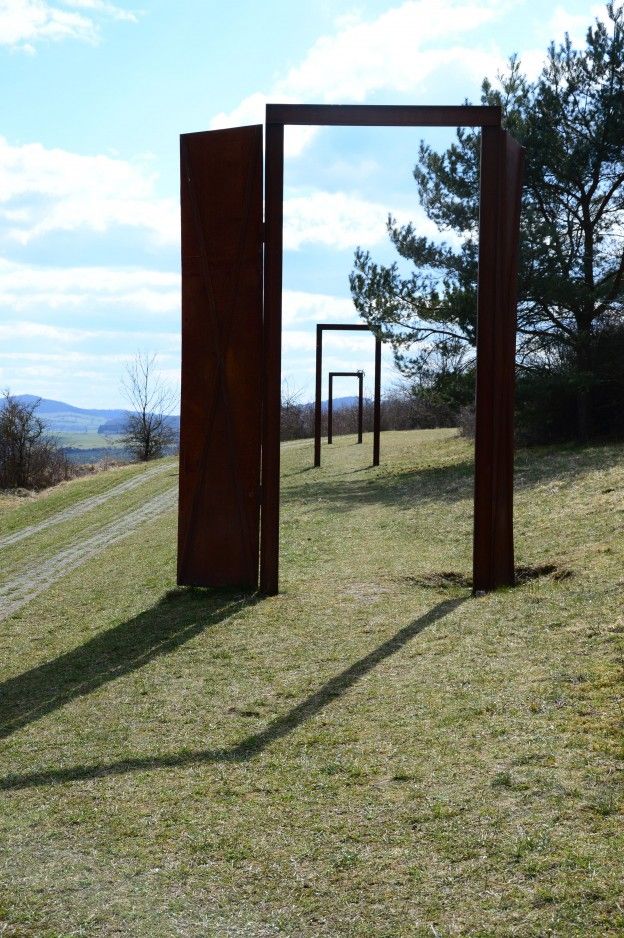
Ulrich Barnickel (German, 1955–), Hoffnung (Hope), fourteenth station from the cycle Weg der Hoffnung (Path of Hope), 2009–10. Iron sculpture, Geisa, Germany.
This is the last of fourteen monumental sculptures situated along the former inner German border that separated Soviet-occupied East Germany and Allied-occupied West Germany from 1952 to 1990. Stretching from Hesse to Thuringia, this highly militarized frontier consisted of high metal fences, barbed wire, alarms, watchtowers, and minefields, a literal iron curtain that divided families, friends, and neighbors.
In 2009, the Point Alpha Foundation, founded to preserve the historic site as a memorial, commissioned German metal sculptor Ulrich Barnickel to create an artwork as part of the memorial. He decided to draw on the traditional fourteen Stations of the Cross, connecting the suffering of Jesus to that of the people on the inner German border under Communism. Collectively titled Path of Hope, his fourteen iron sculptures cover 1,400 meters of ground (scaling down the 1,400 kilometers of the former border). All but the last are figurative, representing Jesus falling, meeting his mother, being nailed to the cross, and so on. They contain artifacts from or references to German Cold War era history, such as a vintage steel helmet hanging on Pilate’s chair, or the grenade and the trench that Jesus stumbles over.
The final station, titled Hope, is a threefold open doorway. After all the heaviness of the previous thirteen stations, we get this breather. Here’s what the doors say to me: Invitation. Possibility. The fourteenth station of the cross is traditionally where Christ is buried in his tomb. But instead of a dead body on a slab or a sealed-up cave, Barnickel gives us an open frame, a door ajar, a view of sky. It alludes to resurrection. Jesus walked through death and came out the other side. And so can we.
While the Path of Hope is a vehicle for remembering, lamenting, and healing from the collective traumas of war and political violence and oppression, it can also speak to personal losses, to any individual’s journey of grief. It’s an invitation to acknowledge the pain we carry but also to see beyond it to the Better Day that is coming, as well as to embrace the life before us here and now. The doors ask us to unburden ourselves of whatever weight is crushing us and to be renewed. (Notice the crown of thorns, an emblem of suffering, left hanging on the corner of the final threshold.) To follow the Man of Sorrows, who walks beside us in our own sorrow, from death into life.
For those accompanying a loved one to the door of death, or who have had a loved one suddenly snatched through, may Barnickel’s Hope meet you in your grieving, filling you with soft consolations of a Love stronger than death, a Love who, once buried, became on the third day the firstfruits of the resurrection harvest.
Waking up to tragic dawn Not comprehending what is going on Alleluia, Christ is risen once again
And it frames a hollow place Lost dreams and accolades Alleluia, Christ is risen once again
Alleluia, Christ is risen Though the walls of castles fall Alleluia, he is risen for us all
From these sights the shadows light In an overwhelming night Alleluia, Christ is risen once again
Hopes fly from us every day Fear reigns far and so does hate Alleluia, Christ is risen once again
Alleluia, Christ is risen Though the gates of all this war Alleluia, Christ is risen evermore
Alleluia, God is able To complete the life you led Alleluia, Christ is risen from the dead
Alleluia, he is risen once again
From the sorrow you have fled You have joy around your head Alleluia, Christ is risen once again
And as from earthly trials you fly You leave sadness when you die Alleluia, Christ is risen once again
Alleluia, Christ is risen And the life you’re living now Alleluia, all’s forgiven somehow
Alleluia, there is beauty When I think of you, joy I feel Alleluia, in my sadness, faith is real
Alleluia, Christ is risen once again Alleluia for you, my friend
Tara Ward [previously] wrote this song during the 2007 Easter season when two tragedies struck within a week of each other. On April 16, a mass shooter opened fire at Virginia Tech, killing thirty-two people, and on April 21, Ward’s friend Liz Duncan was fatally struck by a car while jogging. In the second half of the song, Ward addresses Duncan in the second person, rejoicing through tears that she has entered a state of joy and rest and will one day be raised, body and soul.
Ward returned to the song for Easter 2020 following the death that March of another friend and the initial outbreak of COVID-19. “I was trying to think of what I would sing if I was still working at a church, looking for honest songs to sing on Easter, and this one came up,” she writes on the YouTube video description.
The Nashville community, and America at large, is still reeling from the March 27 shooting at Covenant School that left seven dead, the 131st mass shooting in the US this year. I can only imagine the absolute devastation and rage a parent would feel upon learning that the child they dropped off at school that morning would not be coming home because they were gunned down with an assault rifle.
As I listen to this song, I think, too, of Leslie Bustard, a writer and book publisher, a luminary in the art and faith sphere, who, less than two months after hosting an amazing Square Halo conference on the theme of “ordinary saints,” is now in hospice with late-stage cancer.
Sometimes all the exuberance of Easter can seem disjunctive with the bleak state of the world or our own present circumstances. Christ is risen, but death is still a reality, and it’s still painful. Quiet and aching, this song gives space to grief while also confessing this central Christian doctrine: that Jesus rose from the dead, giving life to all who will receive it. Of course, that doesn’t mean Christians are exempt from experiencing physical death—we will all one day go to the grave—nor from the grief that follows in the wake of a loved one’s passing.
But what Ward’s song helps us do is sing “alleluia” in our sadness, because Christ’s resurrection life is at work in those who have passed on in him, and it’s at work in those of us who walk through the valley of death’s shadow here on earth. The “once again” language—“Christ is risen once again”—indicates that Jesus’s historical rising has ongoing implications, its efficacy extending to every new place of death.





 Art & Theology