And at midnight there was a cry made, Behold, the bridegroom cometh; go ye out to meet him.
—Matthew 25:6 KJV
In the Orthodox Church, observances of Holy Monday, Tuesday, and Wednesday (which in that tradition take place next week) focus on the end times, “remind[ing] us of the eschatological meaning of Pascha,” says Alexander Schmemann.
The Gospel reading for the Liturgy of the Presanctified Gifts on Holy Tuesday is Matthew 24:36–26:2, which covers the need for watchfulness, the parable of the ten bridesmaids, the parable of the talents, and the Last Judgment. These passages constitute the latter half of Jesus’s Olivet Discourse, or Little Apocalypse, which, according to the chronology of Mark’s Gospel, Jesus preached the Tuesday before his death.
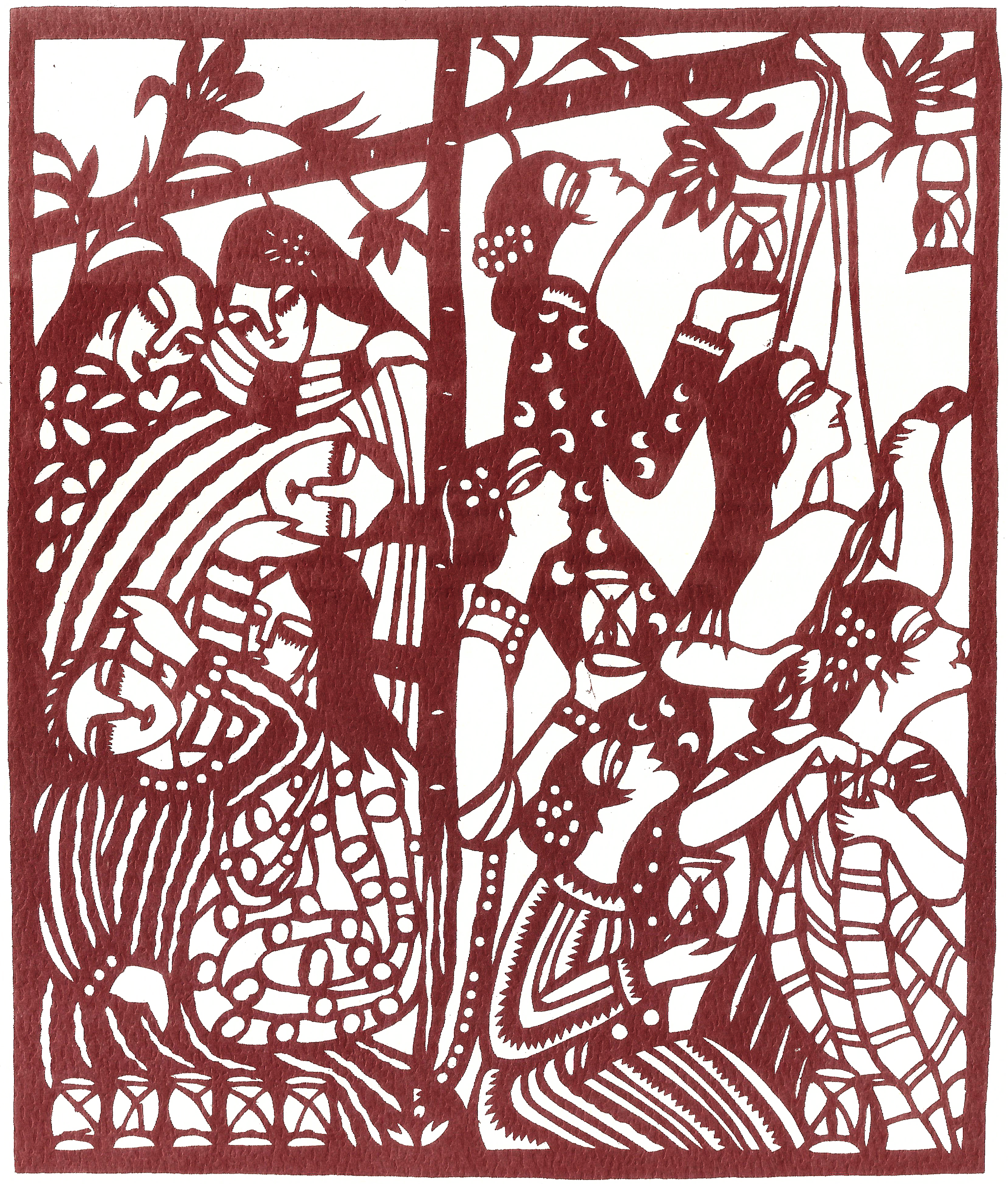
So, informed by the Matthew 25:1–13 reading, today I’ve selected a papercut by Chinese artist Fan Pu and a Black gospel song from the southern US that both engage with Jesus’s call to keep our metaphoric oil lamps burning in expectation of the return of the Bridegroom, who died and rose for love of us, and who has gone to build us a home.
LOOK: Ten Bridesmaids by Fan Pu
Fan Pu (Chinese, 1948–), Ten Bridesmaids, 2001. Papercut. Collection of the Asian Christian Art Association.
(Note: This artwork has changed since the original publication of this post. I learned that the previous artist did not want her work featured or her name mentioned on the website.)
LISTEN: “The Bridegroom’s Coming,” traditional gospel song | Recorded August 6, 1940, by Mitchell’s Christian Singers, on Mitchell’s Christian Singers, vol. 3 (1938–1940) (released 1996)
I couldn’t find lyrics for this song online, so I transcribed them myself the best I could. I’m not positive about the second line in the refrain, and I couldn’t make out the second half of the last line of verse 2.
Refrain: And behold (and behold), lo, the Bridegroom’s coming Lift up (lift up), I heard the voices cryin’ out loud And be ready (and be ready) when the Bridegroom’s coming To meet him in the air
Ever seen such a man as this? Jesus was sent, he came down to die Jesus was sent, he came down to die Came to save my soul from the burning fire [Refrain ×2]
Ever seen such a man as this? Jesus was sent, he came down to die Jesus was sent, he came down to die I want to meet . . . (?) [Refrain ×2]
Mitchell’s Christian Singers [previously] were an influential early gospel group from Kinston, North Carolina.
The Kentucky Jubilee Four recorded an earlier version of this song for OKeh in St. Louis, Missouri, in 1927.
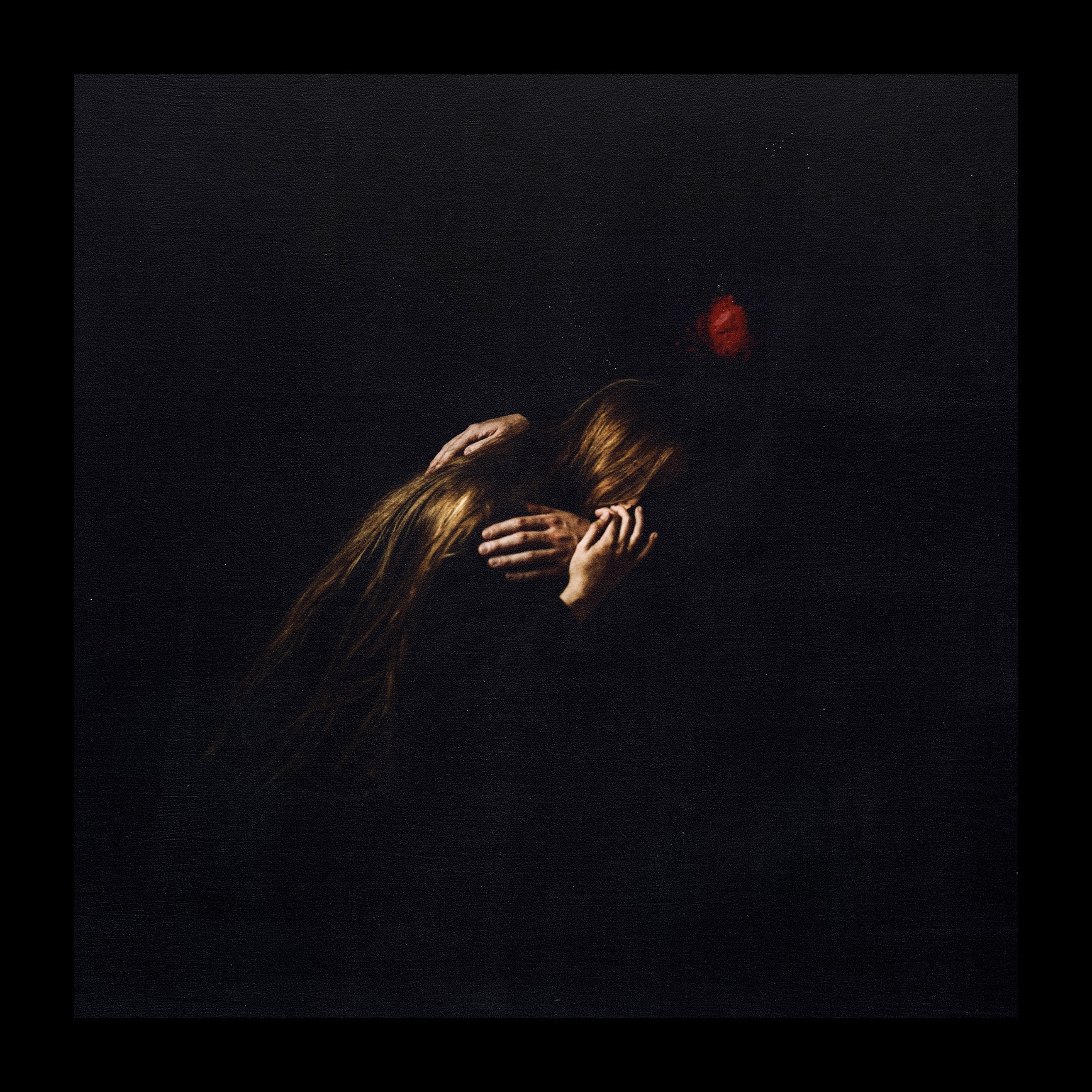
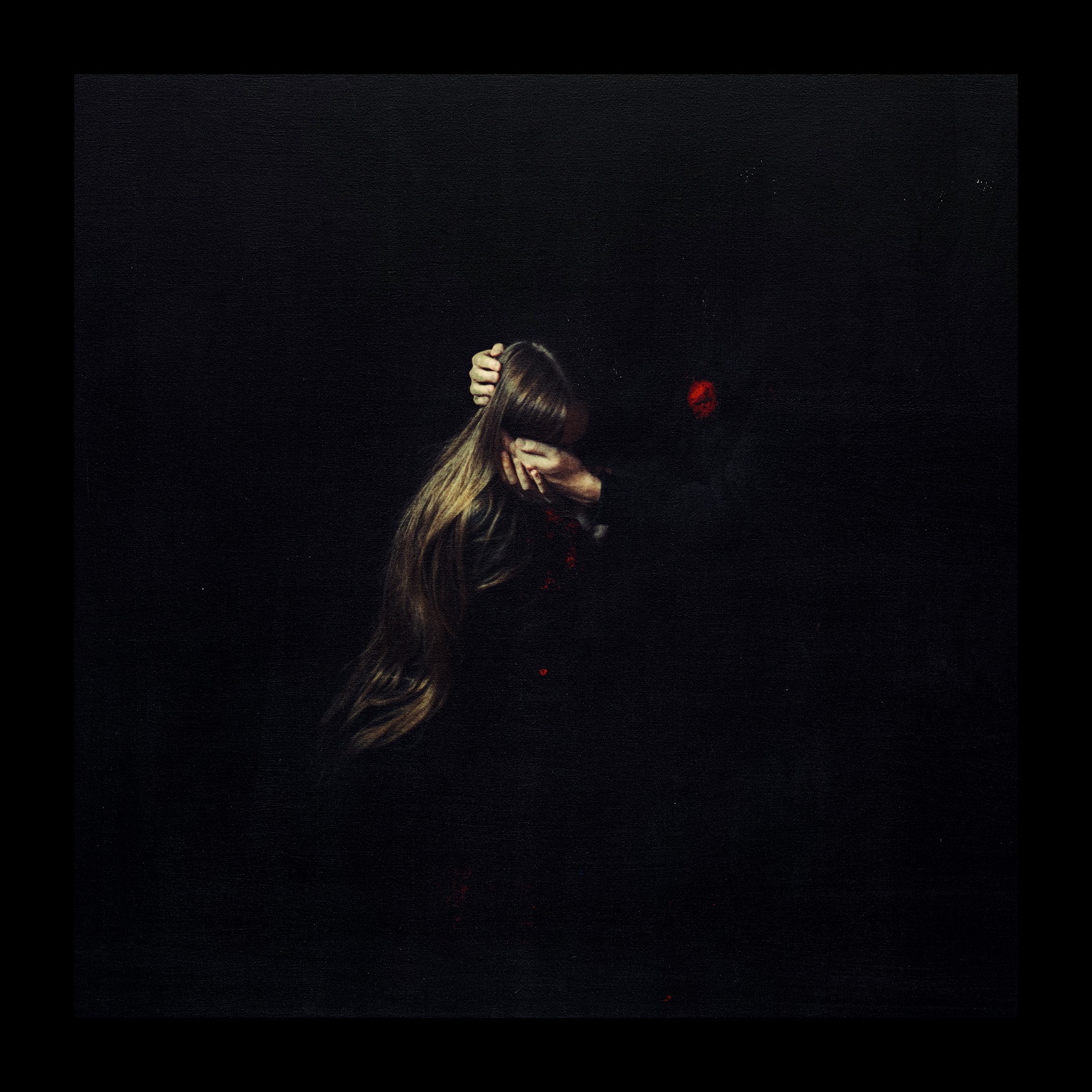
Laura Makabresku (Polish, 1987–), Intimacy of the Heart (7), 2020Laura Makabresku (Polish, 1987–), Intimacy of the Heart (8), 2020
LISTEN: “Mary” by the Brothers of Abriem Harp, on Last Days (2015) [reviewed here]
Mary, my dear, come over here Tell me, is it true what they say? Mary, my dear, let go of your fear And bring your gift to me, I pray Let your heart rest with mine I don’t have much time So break your fragrance free, my dear
Let your tears fall on me Brush your hair on my feet Let your alabaster tears fall on me Fall on me
Overflow, overflow And go where you go Let this fragrance fill the air with love divine Love divine
Fill the air, fill the air Let your heart beat with mine Let this fragrance fill the air with love divine Love divine
Mary, my dear, bring yourself near Let your heart beat with mine, my dear
Laura Makabresku (Polish, 1987–), Intimacy of the Heart (10), 2020
Justin O’Brien (Australian, 1917–1996), Palm Sunday, 1962. Oil on canvas, 45.5 × 62 cm.
This triptych (three-paneled artwork) by Australian artist Justin O’Brien portrays three scenes from the life of Christ. On the left wing is the Baptism of Christ, where he’s anointed by God’s Spirit for his messianic role, and on the right is the Miraculous Draught of Fishes, a story of miraculous abundance. The center panel shows Jesus about to enter the gates of a hilltop city representing Jerusalem. He rides a donkey and is dressed in red, the color of martyrdom. One man lays down his cloak before Jesus’s dusty path as a sign of reverence. Now the people welcome him in, but in just a few short days many will turn on him.
O’Brien grew up in a Catholic household in Sydney. In 1948–49 he visited Italy and fell in love with the work of the Proto- and Early Renaissance painters from Tuscany, like Duccio and Piero della Francesca. Most of O’Brien’s paintings are on religious subjects, despite his renunciation of Catholicism in 1954. Though he self-identified as agnostic for the second half of his life, he continued to be artistically inspired by the stories of the New Testament. He moved to Rome in 1967 and spent the remainder of his days there, returning to his home country of Australia every few years for exhibitions.
LISTEN: “Jerusalem Interlude,” excerpted from “The Holy City” | Words by Frederick E. Weatherly, 1892 | Music by Stephen Adams (pseudonym of Michael Maybrick), 1892; arr. Noble Caine, 1946 | Performed by the Aeolians of Oakwood University on Aeolianology Acappella, vol. 2, 2015
Jerusalem, Jerusalem Lift up your gates and sing Hosanna in the highest Hosanna to your king
This is the refrain of the Victorian choral ballad “The Holy City” by the English lawyer, author, lyricist, and broadcaster Frederick E. Weatherly (best known for writing “Danny Boy”) and his regular collaborator, the English composer Michael Maybrick, who published under the pen name Stephen Adams. The song became hugely popular in the UK and the US at the beginning of the twentieth century, and is even mentioned in James Joyce’s Ulysses (1920). It is sung by early Hollywood musical superstar Jeanette MacDonald in the 1936 film San Francisco.
Lyrics to the complete song are below, as is a video performance by the Aeolians from 2020:
Last night I lay a-sleeping There came a dream so fair I stood in old Jerusalem Beside the temple there I heard the children singing And ever as they sang Methought the voice of angels From heav’n in answer rang
“Jerusalem, Jerusalem! Lift up your gates and sing Hosanna in the highest Hosanna to your king!”
And then methought my dream was chang’d The streets no longer rang Hush’d were the glad Hosannas The little children sang The sun grew dark with mystery The morn was cold and chill As the shadow of a cross arose Upon a lonely hill
“Jerusalem, Jerusalem! Hark! how the angels sing Hosanna in the highest Hosanna to your king!”
And once again the scene was chang’d New earth there seem’d to be I saw the Holy City Beside the tideless sea The light of God was on its streets The gates were open wide And all who would might enter And no one was denied No need of moon or stars by night Or sun to shine by day It was the new Jerusalem That would not pass away
“Jerusalem, Jerusalem! Sing, for the night is o’er! Hosanna in the highest! Hosanna for evermore!”
The song’s speaker has a dream about Christ’s celebrated entry into Jerusalem, with crowds surrounding him and shouting his praises. But then the mood turns dark and hushed as a cross is erected on Golgotha and the newly hailed king is crucified. However, the mood revolves back to one of celebration in the final verse as the New Jerusalem comes down, permanently displacing all sorrow, its gates thrown open wide in universal welcome and the wounded but victorious Jesus seated on the throne.
The Aeolians’ isolation of the first refrain for their “Jerusalem Interlude,” which echoes Psalm 24:7–10 [previously], makes a perfect antiphon for Palm Sunday. Though the words are exultant, the music has an aching quality that foreshadows the suffering that is soon to come and that matches the tone of Jesus’s lament over Jerusalem on this day: “As he came near and saw the city, he wept over it, saying, ‘If you, even you, had only recognized on this day the things that make for peace! But now they are hidden from your eyes’” (Luke 19:41–42; cf. Matt. 23:37–39).
The American jazz composer Duke Ellington used the refrain’s melody as the basis of the opening of his “Black and Tan Fantasy” (1927), in which a cornet and trombone play dolefully in parallel harmony. Can you hear the clopping donkey?
Addendum, 4/23/25: Here’s another arrangement of the song I like, by African Vocals, an a cappella group from Namibia. The following video shows one of the performances from their 2019 Germany tour. Soloist Reinhard Kungairi Kahambuee (who doesn’t come into frame until fifty seconds in) is wonderful! Note that at 1:40, the tempo becomes bright, lively, and more rhythmic, with the addition of hand claps.
Holy Week begins Sunday. I will be publishing short daily devotional posts during that time and through the first eight days of Easter. Also: don’t forget about the Art & TheologyHoly Week Playlist and Eastertide Playlist! I’ve made some new song additions since last year, mixed in to preserve the narrative flow.
+++
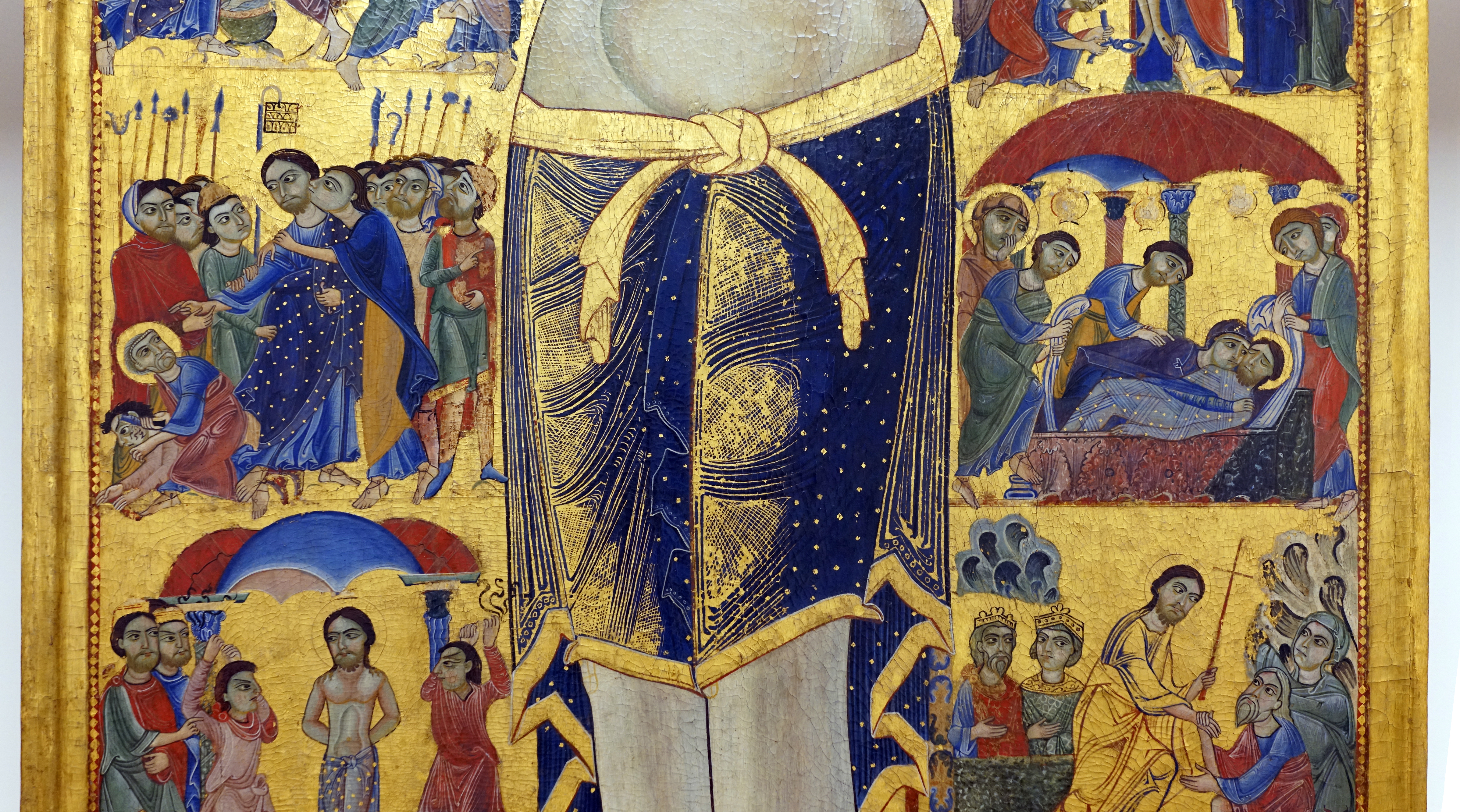
ART VIDEO: “The Crucifixion, c. 1200 (from Christus triumphans to Christus patiens)”: When I was a student in Florence for a semester, my first paper for my Italian history, art, and culture class traced the evolution of the painted wood-panel crucifix in late medieval Italy, from the Christus Triumphans (Triumphant Christ) type to Christus Patiens (Suffering Christ). I lived less than a five-minute walk from the Uffizi, which has in its collection a beautiful example of each—explored by Drs. Steven Zucker and Beth Harris in this short Smarthistory video. Longtime readers of the blog may recognize the latter, which I posted back in 2018.
Painted cross (detail), Pisa, ca. 1180–1200. Tempera and gold leaf on wood, 277 × 231 cm. Galleria degli Uffizi, Florence, Inv. 432. [object record]
Zucker provides wonderful photos of both in high resolution on his Flickr page (start here and scroll right)—the full crosses and details of each apron scene—available for free noncommercial use under a Creative Commons license. And there are many other art historical images there as well!
+++
ONLINE EXPERIENCE: “Anamnesis: Journey through the Stations of the Cross”: This year visual artist Daniel Callis and the music and liturgy collective The Many collaborated on a self-guided set of online Stations of the Cross. There are fifteen total, which are being released one at a time every morning and evening from March 30 through April 5. Each station consists of an artwork, a prayer, a song, and a written meditation that help us enter into lament.
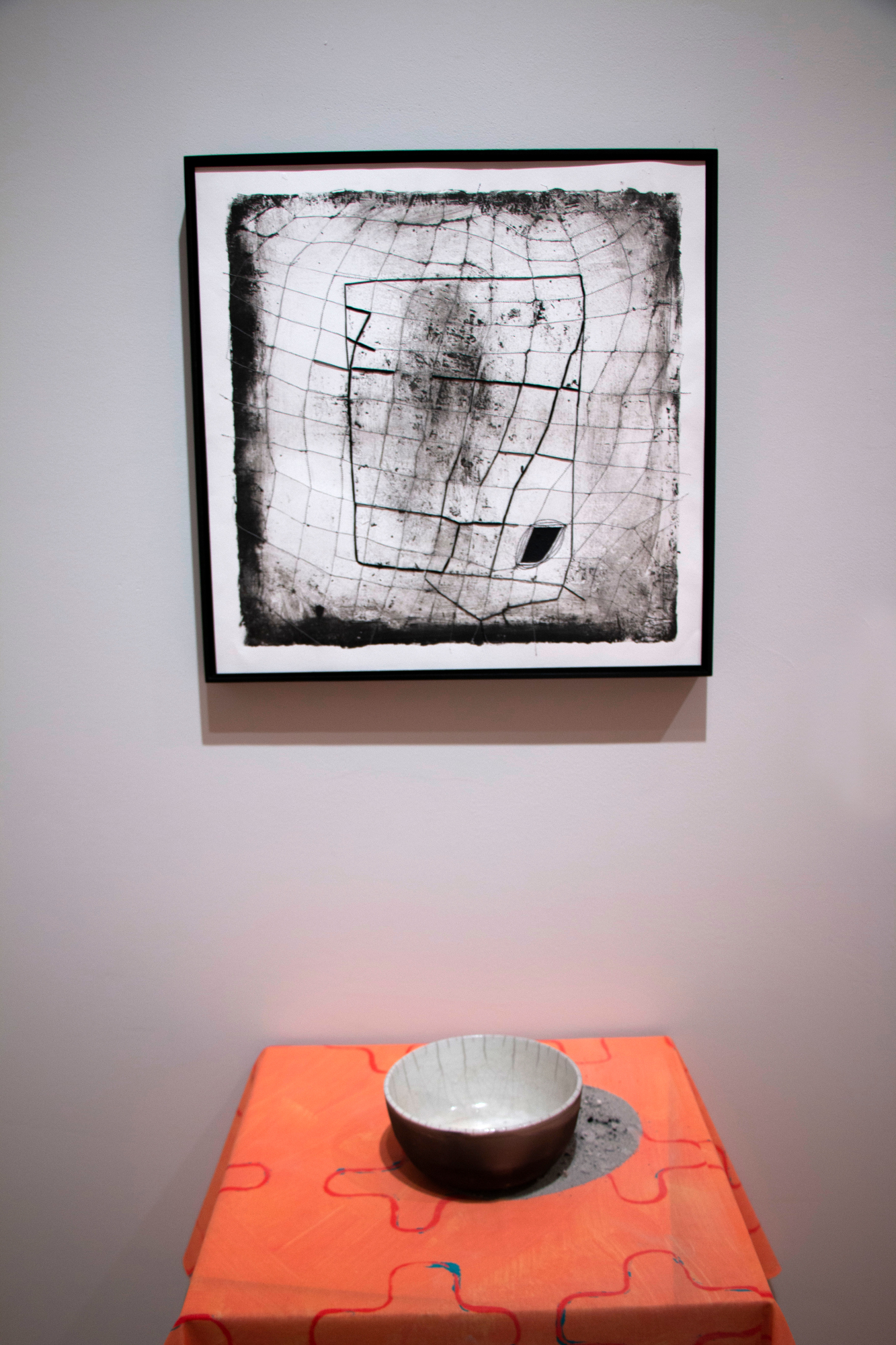
Daniel Callis (American, 1955–), Grief Station #1, Prognosis, 2022. Ink, oil, palm ash, fiber, clay, ash, fabric, 60 × 24 × 24 in. (total work). Photo courtesy of the artist.
The artworks are by Callis, and they’re from his Stations: Resurgam series, a body of work that was just exhibited this month at Green Art Gallery at Biola University in La Mirada, California. He began the series in January 2021 in response to the death of his son, Jeremy David Callis (1980–2020). It consists of fifteen mixed-media works on paper (his process involves printing, “wounding,” stitching, etc.) and fifteen raku-fired offering bowls that incorporate, from the cooling process, copies of letters, hospital documents, and drawings from Jeremy. “They are about pain and the absurd insistent pursuit of hope,” Callis says of the series. Resurgam is Latin for “I shall rise again.”
The songs are by The Many.
+++
BOOK EXCERPT from The Unvarnished Jesus: A Lenten Journey by Brian Zahnd: In this post from his blog, Pastor Brian Zahnd excerpts a passage from his book The Unvarnished Jesus (2019). “To interpret the meaning of the cross is more than a life’s work—in fact, it has and will remain the work of the church for millennia,” he writes. “The cross is the ever-unfolding revelation of who God is, and it cannot be summed up in a simple formula. This is the bane of tidy atonement theories that seek to reduce the cross to a single meaning. The cross is many things: It’s the pinnacle of God’s self-disclosure. It’s divine solidarity with all human suffering. It’s the shaming of the principalities and powers. It’s the point from which the satan is driven out of the world. It’s the death by which Christ conquers Death. It’s the abolition of war and violence. It’s the supreme demonstration of the love of God. It’s the re-founding of the world around an axis of love. It’s the enduring model of co-suffering love we are to follow. It’s the eternal moment in which the sin of the world is forgiven . . .” Read more.
+++
SONGS:
>> “The Leaves of Life”: “The Leaves of Life,” alternatively titled “The Seven Virgins,” is a traditional English ballad carol of Christ’s passion, first set down in the nineteenth century. It is narrated by (the apostle?) Thomas, who on a fateful Friday runs into the Virgin Mary and six of her companions, who are looking for Jesus. He directs them to the hill where Jesus is being crucified (“And sit in the gallery” may be a corruption of “The city of Calvary”). The women tearfully fly to the site, and Jesus tries to console his mother from the cross before breathing his last. The song ends with Thomas imbibing a strong scent of rose and fennel as he meditates on Christ’s love. [HT: Global Christian Worship]
Here the song is performed in the chapter house of Wells Cathedral in Somerset by William Parsons, founder of the British Pilgrimage Trust and author of Singing for Our Supper: Walking an English Songline from Kent to Cornwall, a book about the seven months he spent as a wandering minstrel. Parsons refers to it as a gypsy carol because Ralph Vaughan Williams collected one version of it from the Roma singer Esther Smith during his 1908–13 collecting trips that resulted in the publication, with Ella May Leather, of Twelve Traditional Carols from Herefordshire (1920).
>> “Were You There”: This African American spiritual is performed here by Pegasis, a vocal trio of sisters—Marvelis, Rissel, and Yaina Peguero Almonte—originally from the Dominican Republic but now living in Green Bay, Wisconsin. It’s as if they’re the three Marys singing their testimony! The song is on their 2016 album Peace Through Praise, which they released under the name The Peguero Sisters. Their harmonies are gorgeous.
+++
PODCAST EPISODE: “Malcolm Guite: Poems on the Passion”: In this special passion- and resurrection-themed Nomad devotional episode from 2018, Malcolm Guite reads and reflects on three of his poems, and David Benjamin Blower performs an original three-part song that he wrote in response and that has not been released elsewhere (see 4:30, 16:04, and 27:18).
Guite’s “Jesus dies on the cross,” part of his Stations of the Cross sonnet cycle, was inspired by a line from George Herbert’s poem “Prayer”: “God’s breath in man returning to his birth.” And his “Easter Dawn” [previously] is based in part on a sermon by the seventeenth-century Anglican bishop Lancelot Andrewes. Paraphrasing Andrewes, Guite says, “Jesus is the gardener of Mary [Magdalene]’s heart—her heart is all rent and brown and wintery, and with one word, he makes all green again.” Beautiful! For more on the theme of Jesus as gardener, see my 2016 blog post “She mistook him for the gardener.”
VIDEO: “Waiting with Christ: An Artful Meditation for Holy Week”: A collaboration between Duke Initiatives in Theology and the Arts in Durham, North Carolina, and City Church in Cleveland, Ohio, this half-hour video from 2021 presents a small collection of scripture readings, poems, visual art, and music for Holy Week, interspersed with reflections by theologian Jeremy Begbie. The artistic selections are a spoken word performance by Paul Turner, Malcolm Guite’s sonnet “Jesus Meets His Mother,” the Adagio movement of Schubert’s String Quintet in C Major, the painting Riven Tree by Bruce Herman, and Bifrost Arts’ “Our Song in the Night,” performed by Salina Turner, Allison Negus, and Joel Negus [previously].
+++
ARTICLE: “6 Musical ‘Passions’ Beyond Bach” by Josh Rodriguez: Composer, professor, and Deus Ex Musica cofounder Josh Rodriguez is an excellent classical music curator and guide. In this article he introduces us to six modern large-scale musical works about Jesus’s final week: The Passion of Yeshua by Richard Danielpour, La Pasión Según San Marcos by Osvaldo Golijov, The Passion of the Christ Symphony by John Debney, Johannes-Passion by Sofia Gubaidulina, Simeron by Ivan Moody, and the St. John Passion by James MacMillan. He interweaves composer biography, musical analysis, and meaning in concise ways, with nods to music history. Stylistic influences for these diverse selections range from Byzantine chant to salsa! Audio/video excerpts are provided, such as the cued-up “¿Por qué?” from Golijov’s Pasión (see below), a movement centering on the woman who anointed Jesus’s feet with perfume (Mark 14:3–9).
+++
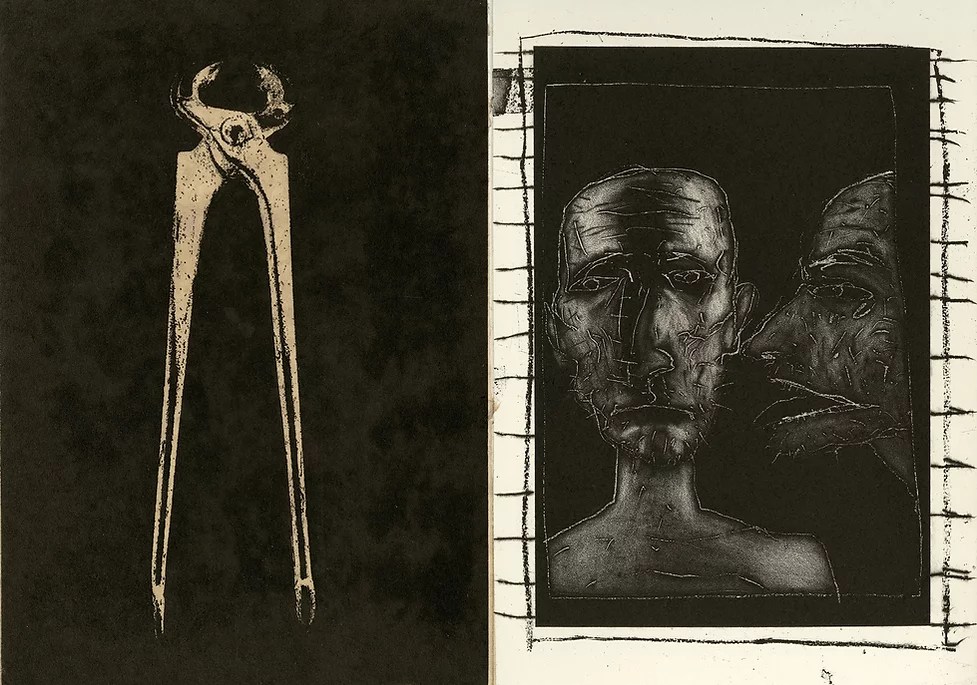
PRINT SERIES: The Passion and Its Objects (after Dürer) by Marcus Rees Roberts: “The Passion and Its Objects (after Dürer) is a series of etchings and monotypes by Marcus Rees Roberts. The images derive from fragments from Albrecht Dürer’s series of woodcuts The Small Passion (1511). Images of the Passion – and of the crucifixion in particular – are so embedded in Western consciousness that we forget that it is a depiction of betrayal, prejudice, and torture. In this version of the Passion by Dürer, one of several he made, small, everyday objects lie scattered within the images – a jug, pliers, a hammer, a coil of rope. Even five hundred years later, we recognise these objects as our own; we can identify with them. But in so doing, we enter the depicted space, and we become complicit in the cruelty. This is one reason why Dürer’s Small Passion is both so powerful and so uncomfortable.”
Marcus Rees Roberts (British, 1951–), The Passion and Its Objects (after Dürer) I, 2019. Diptych etching and aquatint with chine collé printed on Somerset Satin soft white 300gsm, each plate 29.5 × 21 cm (overall 29.5 × 42 cm). Edition of 15.
+++
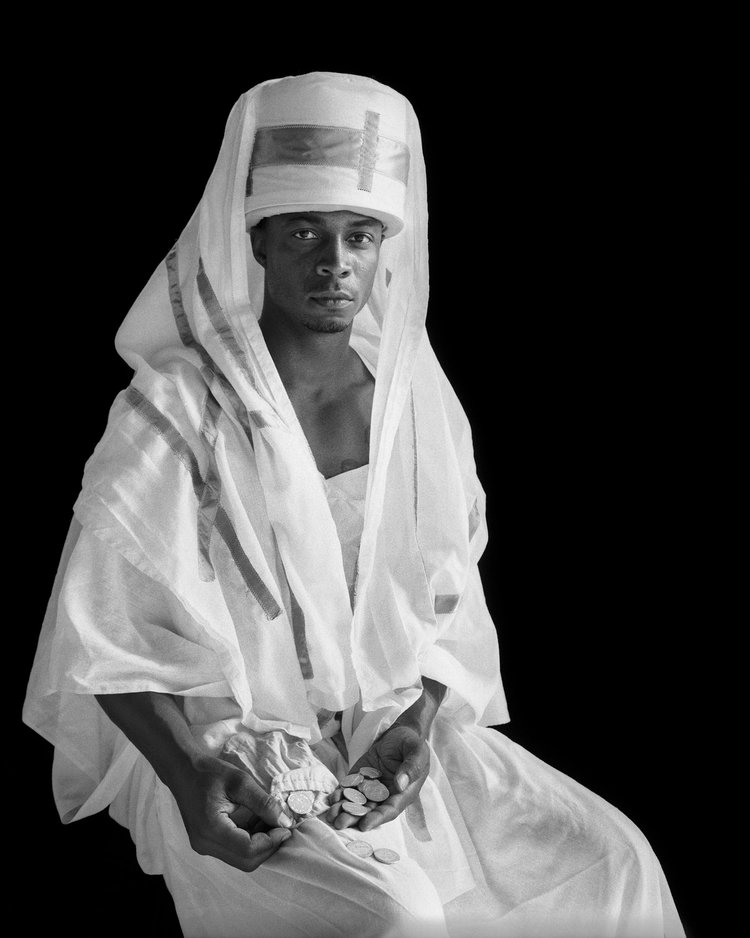
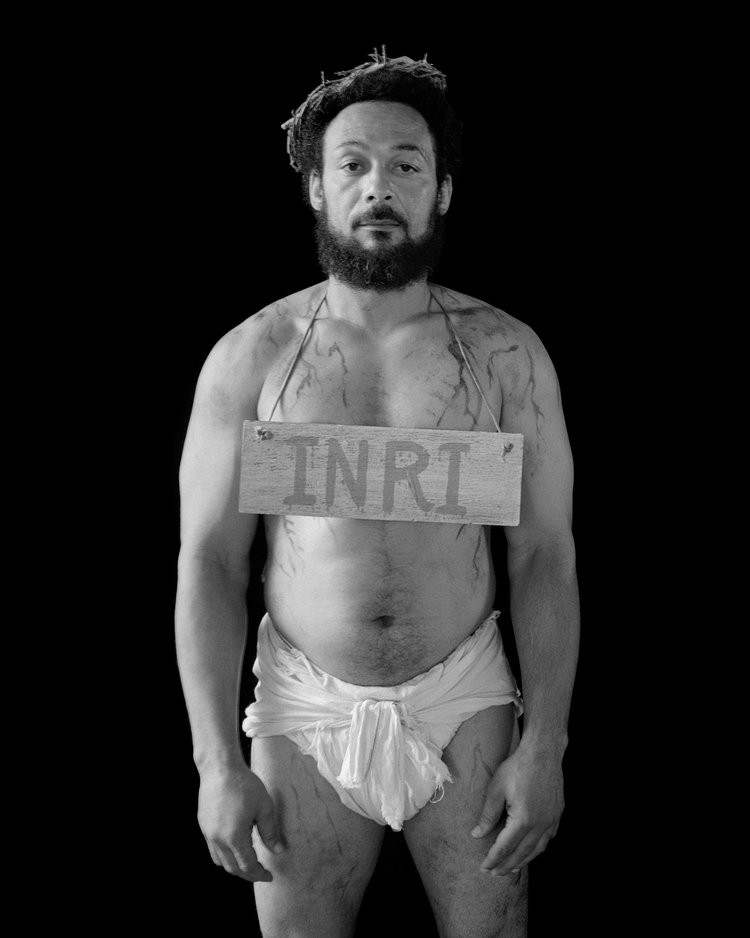
PHOTOGRAPHY SERIES: Passion Play by Deborah Luster: “There are more than 5,300 inmates at the Louisiana State Penitentiary at Angola. Nearly 4,000 of them are serving life without parole. In 2012 and 2013 the Angola Prison Drama Club staged a play unlike any other in the prison’s experience. The Life of Jesus Christ featured 70 inmates, men and women acting together for the first time—in costume, with a real camel, performing for the general public. For the untrained actors, this production held special meaning as they saw pieces of their own lives revealed in the characters they played.”
Layla “Roach” Roberts (Inquisitor), sentenced to LIFE, Angola Prison, Louisiana. Photograph by Deborah Luster, from the Passion Play series, 2013.Bobby Wallace (Jesus), Angola Prison, Louisiana. Photograph by Deborah Luster, from the Passion Play series, 2013.
+++
SONGS:
>>“May I Go with You” by January Lim: This Maundy Thursday song was written in 2020 in the voice of Jesus in Gethsemane, speaking to God the Father. In the first stanza, it seems to me that Jesus is asking to be taken up to heaven, like Elijah—just whisked away back to glory, and spared tomorrow’s cruelties and pain. But in the second stanza that same request seems to shift in meaning as Jesus expresses a desire to go with God’s plan and asks for the strength to follow through. The song was released on the EP Gathered Sighs (2021), put out by Evergreen Baptist Church of Los Angeles, where Lim serves as worship arts pastor. [HT: Global Christian Worship]
O my people, what have I done to you? In what have I wearied you? Answer me!
—Micah 6:3
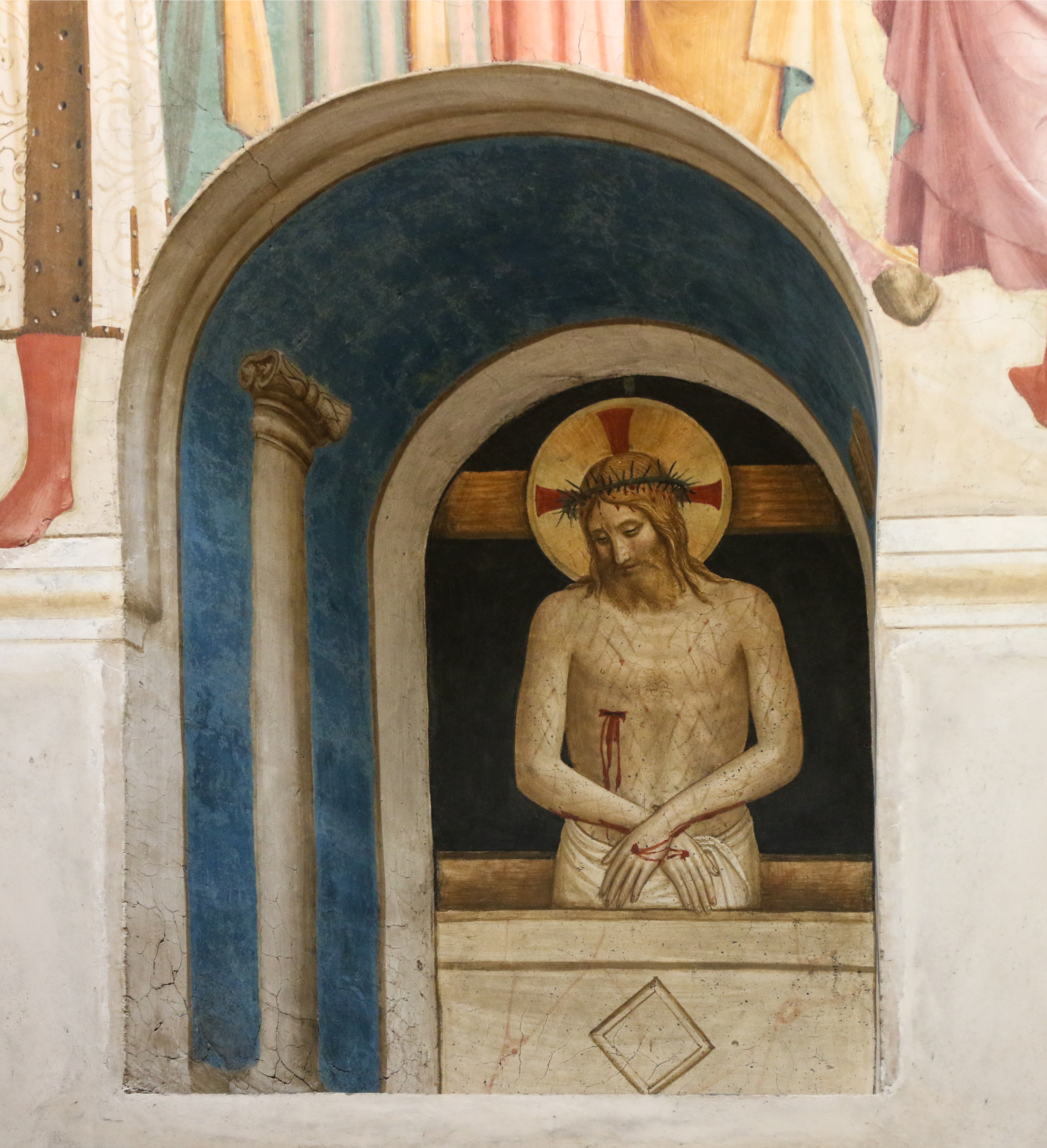
The Reproaches (Latin: Improperia), also known by the first phrase of their refrain, “Popule meus” (O My People), are a series of antiphons and responses used in Good Friday liturgies across all three branches of Christianity. The text contrasts Old Testament stories of God’s goodness with humanity’s enactment of evil against God’s Son. Whereas God graciously delivered his people from death time and again throughout history, they delivered his Son to death—death on a cross. Thus God reproaches us, his beloved ones, for our fatal rejection of Christ, his greatest gift, lamenting that we have spurned his love.
The lyrics are reproduced below (the side-by-side formatting with English translation on the right is best viewed on a computer screen), followed by four musical settings, chosen from among dozens. In the present Roman Rite, the roman-style text is sung by a cantor and the italicized text by a choir, and the lines of the Trisagion (“Thrice Holy”), the ancient hymn that follows the first improperium, are sung by two halves of a choir in alternation—the first singing in Greek, the second in Latin. Composers working outside that context, however, may assign the sections differently.
Fra Angelico (Italian, ca. 1395–1455), Man of Sorrows, ca. 1440. Fresco, Cell 39, Convent of San Marco, Florence. Photo: Fr. Lawrence Lew, OP.
Popule meus, quid feci tibi?
Aut in quo contristavi te?
Responde mihi.

Quia eduxi te de terra Aegypti:
parasti Crucem Salvatori tuo.

   Hagios o Theos.
      Sanctus Deus.
   Hagios Ischyros.
      Sanctus fortis.
   Hagios Athanatos, eleison himas.
      Sanctus immortalis, miserere nobis.

Quia eduxi te per desertum quadraginta annis:
et manna cibavi te, et introduxi te in terram satis bonam:
parasti Crucem Salvatori tuo.
Hagios . . .

Quid ultra debui facere tibi, et non feci?
Ego quidem plantavi te vineam meam speciosissimam:
et tu facta es mihi nimis amara:
aceto namque sitim meam potasti:
et lancea perforasti latus Salvatori tuo.
Hagios . . .

Ego propter te flagellavi Aegyptum cum primogenitis suis:
et tu me flagellatum tradidisti.
Popule meus . . .

Ego te eduxi de Aegypto, demerso Pharone in mare Rubrum:
et tu me tradidisti principibus sacerdotum.
Popule meus . . .

Ego ante te aperui mare:
et tu aperuisti lancea latus meum.
Popule meus . . .

Ego ante te praeivi in columna nubis:
et tu me duxisti ad praetorium Pilati.
Popule meus . . .

Ego te pavi manna in desertum:
et tu me cedisti alapis et flagellis.
Popule meus . . .

Ego te potavi aqua salutis de petra:
et tu me potasti felle et aceto.
Popule meus . . .

Ego propter te Chananeorum reges percussi:
et tu percussisti arundine caput meum.
Popule meus . . .

Ego dedi tibi sceptrum regale:
et tu dedisti capiti meo spineam coronam.
Popule meus . . .

Ego te exaltavi magna virtute:
et tu me suspendisti in patibulo crucis.
Popule meus . . .
O my people, what have I done to thee?
Or how have I offended thee?
Answer me.

Because I led thee out of the land of Egypt:
thou hast prepared a cross for thy Savior.

   O holy God!
      O holy God!
   O holy strong One!
      O holy strong One!
   O holy and immortal, have mercy upon us.
      O holy and immortal, have mercy upon us.

Because I led thee through the desert for forty years:
and fed thee with manna, and brought thee into a land exceeding good:
thou hast prepared a cross for thy Savior.
O holy God! . . .

What more ought I to have done for thee, that I have not done?
I planted thee, indeed, my most beautiful vineyard:
and thou hast become exceeding bitter to me:
for in my thirst thou gavest me vinegar to drink:
and with a spear thou hast pierced the side of thy Savior.
O holy God! . . .

For thy sake I scourged the firstborn of Egypt:
Thou hast given me up to be scourged.
O my people . . .

I led thee out of Egypt, having drowned Pharaoh in the Red Sea:
and thou hast delivered me to the chief priests.
O my people . . .

I opened the sea before thee:
and thou hast opened my side with a spear.
O my people . . .

I went before thee in a pillar of cloud:
and thou hast led me to the judgment hall of Pilate.
O my people . . .

I fed thee with manna in the desert:
and thou hast assaulted me with blows and scourges.
O my people . . .

I gave thee the water of salvation from the rock:
and thou hast given me gall and vinegar to drink.
O my people . . .

For thy sake I struck the kings of the Canaanites:
and thou hast struck my head with a reed.
O my people . . .

I gave thee a royal scepter:
and thou hast given a crown of thorns for my head.
O my people . . .

I exalted thee with great strength:
and thou hast hanged me on the gibbet of the cross.
O my people . . .
First up, a traditional setting of the Latin by the Spanish Renaissance composer Tomás Luis de Victoria (ca. 1548–1611) [previously], performed by Ensemble Invocatio under the direction of Daniel Knaggs in 2022 at Seminary Church in Warsaw, Poland. The soloist is Łukasz Dziuba. This four-part motet is the most widely performed setting of the Reproaches.
This setting in English by the British composer John Sanders (1933–2003) has become standard repertoire for many English cathedral and church choirs. Sanders first wrote it in 1984 for a Good Friday service at Gloucester Cathedral, where he served as organist, but it wasn’t published until 1993. It’s performed here by the Ely Cathedral Choir, conducted by Sarah MacDonald, from 2018. Whereas Victoria scored his setting for four voices (SATB), Sanders scored his for eight (SSAATTBB), creating more complex harmonies, including dissonance.
3. “Popule meus” by Filipe Faria and Sérgio Peixoto (2015)
In 1999 Portuguese composers Filipe Faria (b. 1976) and Sérgio Peixoto (b. 1974) founded Sete Lágrimas ECMC (Early and Contemporary Music Consort) to create dialogues between medieval, Renaissance, and early Baroque music on the one hand and contemporary music on the other. Their “Popule meus,” which includes just the opening refrain, is from their Missa Mínima, a minimalistic setting for two voices and recorder of the five parts of the Catholic Mass, along with other important liturgical texts. They began composing it in 1999, put it on the back burner for a while, and returned to it later, completing it in 2015. In this 2016 recording, the singers are Faria and Peixoto. The melodic embellishment on the syllable -sta in contristavi (literally “saddened” but more often translated in this song as “offended” or “distressed”) creates a tense quivering effect, a climax before the languid return to the title phrase and a petering off with “Responde mihi.”
American singer-songwriter Paul Zach wrote this condensed version of the Reproaches with frequent collaborator Kate Bluett [previously], which puts the words in the voice of the people, who assume and repent of their responsibility for Jesus’s death—for no matter our temporal or geographical proximity to the event, it was our sin that led him to and held him on the cross. Transferring the speaker from God to the Christian for the whole duration helps make the song more suitable for congregational singing, as it can then function as a corporate confession.
You delivered us from Pharaoh; We delivered you to death. You gave manna in the desert; We gave a crown of thorns for your head.
You brought us out of slavery Into the promised land; We brought you up to Calvary And pierced your feet and hands.
Holy God, Holy Mighty One, Holy Immortal One, Have mercy, mercy, Have mercy on us.
You opened up the Red Sea; We opened up your side. “Come down, come down,” we mocked you; “My God, my God,” you cried.
Holy God, Holy Mighty One, Holy Immortal One, Have mercy, mercy, Have mercy on us.
Zach told me he’s not fully satisfied with the song and is working on a rewrite that he may release in 2024. Nonetheless, I really like what he and Bluett have created here! And I appreciate how it brings the Reproaches into an indie-folk idiom, making that long-standing sung portion of the global church’s Good Friday liturgy accessible to those who find it difficult to connect with choral music or chant.
Addendum, 3/21/23: Rev. Bill Combs from Greensboro, Georgia, has just reminded me of a contemporary adaptation of the text of the Reproaches by Janet Morley, a liturgist from the UK. It’s from her wonderful collection All Desires Known, a resource for public worship and private devotion, and can be read here. Combs’s church, Episcopal Church of the Redeemer, chants this text as part of their annual Good Friday service using Tone II.1.
NEW ALBUM: Lent Hymns by Paul Zach: Released this month, Lent Hymns by Paul Zach comprises twelve songs, a mix of originals and classics, with contributions by IAMSON, Jessica Fox, Sara Groves, Jon Guerra, and Kate Bluett. The LP is available wherever music is streamed or sold. Here’s an Instagram video that excerpts “Draw Me In”:
KICKSTARTER: New Porter’s Gate album: This summer The Porter’s Gate, an interdenominational Christian music collective, is gathering songwriters to write and record musical settings of passages from The Message, a translation of the Bible by the late Eugene Peterson [previously] that uses contemporary idioms and phrases. The project is in partnership with the Eugene Peterson Center for Christian Imagination at Western Theological Seminary in Holland, Michigan. I’m so looking forward to this!
+++
SONGS:
>> “Вечірня молитва” (Vechirnya molytva) (Evening Prayer): A choral setting of a text from the Divine Service of the Eastern Orthodox Church, by contemporary Ukrainian composer Iryna Aleksiychuk. Performed in 2012 by the Female Choir of Kiev Glier Institute of Music, conducted by G. Gorbatenko. [HT: Global Christian Worship]
English translation:
Heavenly King, Comforter, Spirit of Truth, Who art everywhere present and fillest all things, Treasury of good things, and Giver of life: Come and abide in us, and cleanse us from every sin, And save our souls, O Good One! Holy God, holy Mighty, holy Immortal, Have mercy on us.
>> “Bare and Bones” by Candace Coker: Trinidad-born, Vancouver-based singer-songwriter Candace Coker sings the title track from her new album, Bare and Bones, with her boyfriend, Josiah Charleau. The video is shot at Bamboo Cathedral, a thousand-foot stretch of roadway in Tucker Valley in Chaguaramas, Trinidad and Tobago, where bamboo stalks bend toward each other across the road, creating a canopy.
>> “HigherHoly” by IAMSON:IAMSON is the artist name of singer-songwriter and music producer Orlando Palmer, based in Richmond, Virginia. He released this song as a single in 2020. The rap is performed by guest artist Marv (Marvin Hudgins II) of Chattanooga, Tennessee, and the animation in the video is by Kenya Foster.
>> “I Could Sing of Your Love Forever” (cover) by Mary Yang and Ger Vang: Mary Yang and Ger Vang are Hmong Christian musicians living in Milwaukee, Wisconsin. (The Hmong are an Indigenous people group from East and Southeast Asia.) Here they perform their bossa nova arrangement of this modern worship classic by Martin Smith of the English band Delirious?. Yang and Vang are part of the Fishermen’s Project, a band that releases mainly classic hymns translated into the Hmong language. [HT: Global Christian Worship]
I’ve received a few requests from followers to resume my monthly thirty-song playlists. I had previously thought I’d stick to publishing these during Ordinary Time, since I have longer, thematic playlists for the seasons of Advent, Christmas, Lent (our current place in the calendar), and Easter—which you can find on my Spotify profile. But I’m happy to oblige! Here’s a new playlist for March:
+++
ESSAY: “Victor Hugo’s Masterpiece of Impossibility” by Caitrin Keiper, Plough: A wonderful essay on how competing vows in the novel and musical Les Misérables reveal the paradox of grace. I’ve been captivated by this story of mercy, forgiveness, and transformation set in revolutionary France ever since I saw the 1998 film adaptation starring Liam Neeson in middle school. The faith-inspired actions of Bishop Myriel at the beginning set the life of the protagonist Jean Valjean, an escaped convict, on a trajectory that is beautiful to watch unfold, and the downfall of the law-obsessed Inspector Javert, who cannot bring himself to accept the grace offered him, is most tragic.
+++
PODCAST EPISODES:
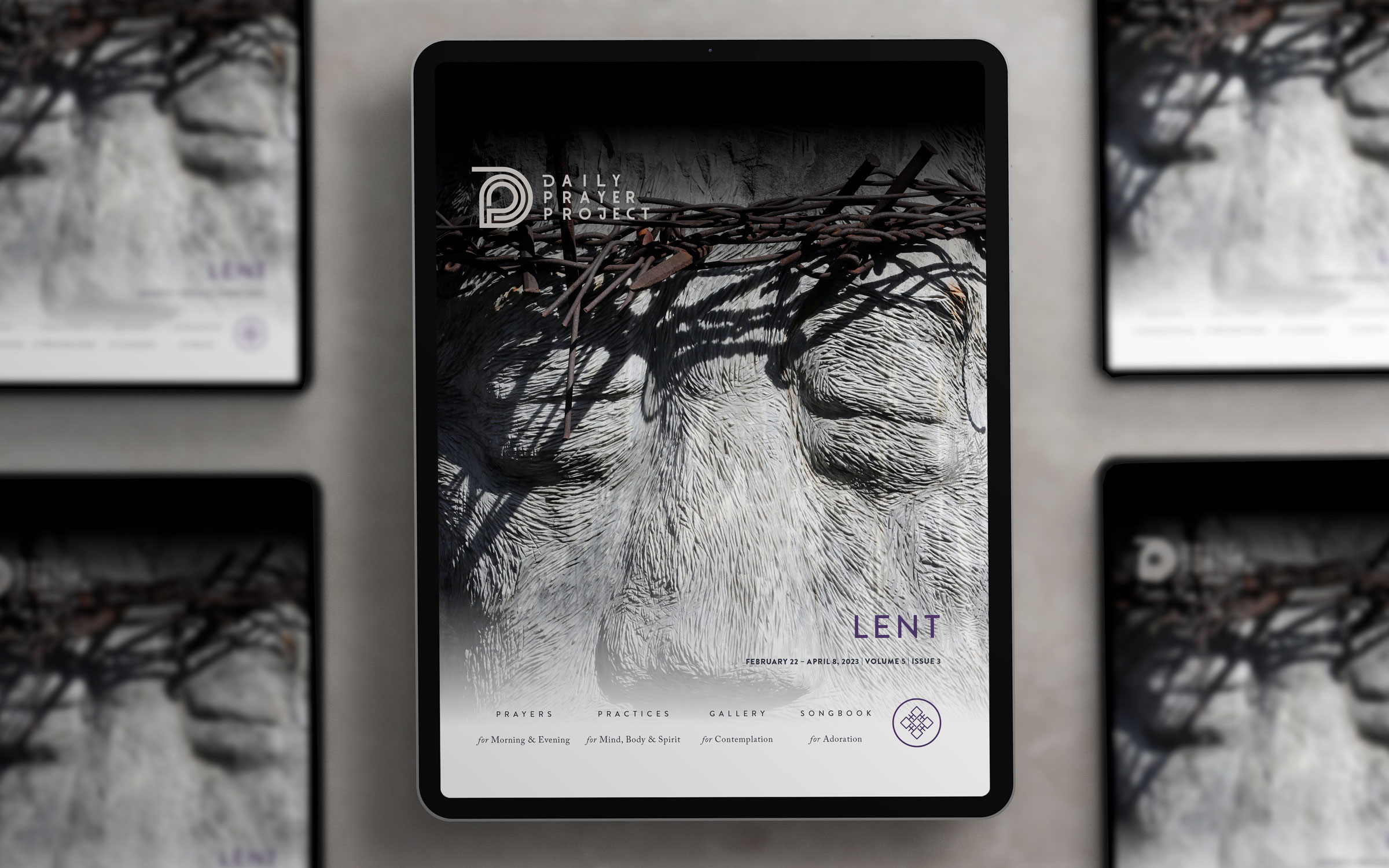
>> Season 2, episode 2, of Gather Round, on the DPP’s Lent 2023 Living Prayer Periodical: On the in-house podcast of Grace Mosaic in Washington, DC, three of my four Daily Prayer Project colleagues and I walk listeners through the latest edition of our prayer periodical, which covers the six weeks of Lent. The conversation starts at 3:46. Rev. Joel Littlepage, curator of the liturgies and songs, highlights a litany to the Servant-Christ from Andhra Theological College in Hyderabad, India, and a song by Pastor Antonio Rivera González of Mexico (see below). Ashley Williams, who commissions or secures reproduction rights for the practice-based essays and curates the photographs throughout, shares some teasers for “Calling Out to God in Lament” by Nina Barnes and “Intractable Sin, Preemptory Prayer” by Alicia Akins.
The Daily Prayer Project’s Lent 2023 booklet, featuring scripture, prayers, practical essays, art, and music from diverse contributors, is available in print and digital formats.
As curator of the art on the cover and in the Gallery section, I discuss the marble sculpture Condemned to Death by Chang Dong Ho (장동호) (see more by the artist), the mixed-media piece Gathering Fragments 1 by C. F. John, the photograph Untitled #10, Flushing, NY from the Stranger Fruit series by Jon Henry, and the painted woodcarving Qwi:qwelstom (Halkomelem, a Coast Salish language, for “Balance and Harmony”) by Don Froese.
At 32:44–35:06, our theological editor, Rev. Russ Whitfield, discusses a theological method that has informed our work at the DPP called triperspectivalism (or multiperspectivalism), which says that we can enrich our perspective, limited on its own, by looking at things from different angles, especially those revealed to us by other people and cultures. For a snippet of the Herman Bavinck quote, see here. What Russ says is SO GOOD! I believe our prayerbooks stand out from other similar projects in that they are deliberately cross-cultural—not because it’s trendy, but because there is so much beauty and wisdom we are missing by not availing ourselves of the many resources of the global church. Our content is also cross-historical.
There are subscription options for individuals (you receive a print edition and a digital download link) and groups (digital access, with bulk-printing options). You can also buy a single copy, but it’s cheaper to purchase a monthly subscription and then cancel after you receive your edition if you don’t wish to continue. We publish six editions a year, each following the same format but filled with new content for the given season.
>> “Lent: Season of Repentance, Renewal . . . and Rebellion” with Esau McCaulley, For the Life of the World: Here Rev. Dr. Esau McCaulley—associate professor of New Testament at Wheaton College, contributing opinion writer for the New York Times, and award-winning author of Reading While Black—talks about the Christian practice of Lent as a collective wisdom passed down through generations of Jesus followers, as well as a spiritual rebellion against mainstream American culture, which has its own established rhythms that shape how we spend our money, when we feast, and what we celebrate.
McCaulley spent the first twenty-one years of his life in the Black Baptist church and the past twenty in a high-liturgical tradition, both of which have been formative for him. One thing he appreciates about liturgy (both the yearly calendar and the elements within a worship service), he says, is how it helps him more fully inhabit the story of Christ. He construes Lent as a season of repentance and grace; he points out the justice practices of Lent; he walks through a Christian understanding of death, and the beautiful practice of stripping the altars on Maundy Thursday; and he’s emphatic about how Lent is a guided season of pursuing the grace to find, or perhaps return to, yourself as God has called you to be. These ideas are expanded upon in his new book, Lent: The Season of Repentance and Renewal, from IVP’s Fullness of Time series.
+++
SONGS:
>> “Divino compañero del camino” (O Lord, Divine Companion): Written in 1964 by Antonio Rivera of Mexico, this popular Spanish-language song is performed here by Karina Moreno and Joseph Espinoza. It’s based on Luke 24:28–32, from the postresurrection story of the walk to and supper at Emmaus, but its pilgrimage aspect—the idea of Jesus as a companion on our life journey—makes it appropriate for Lent. [HT: The Daily Prayer Project]
>> “Yeshu Ji Mere Paap Kshama Kar Do” (Lord Jesus, Forgive My Sins): A Hindi song of confession with words by the late Shri Jalal Masih and music by his granddaughter, Mercy Sharon Masih. Mercy sings it here with her father, Hanook Masih. For an English translation, click the “CC” button. [HT: Global Christian Worship]
+++
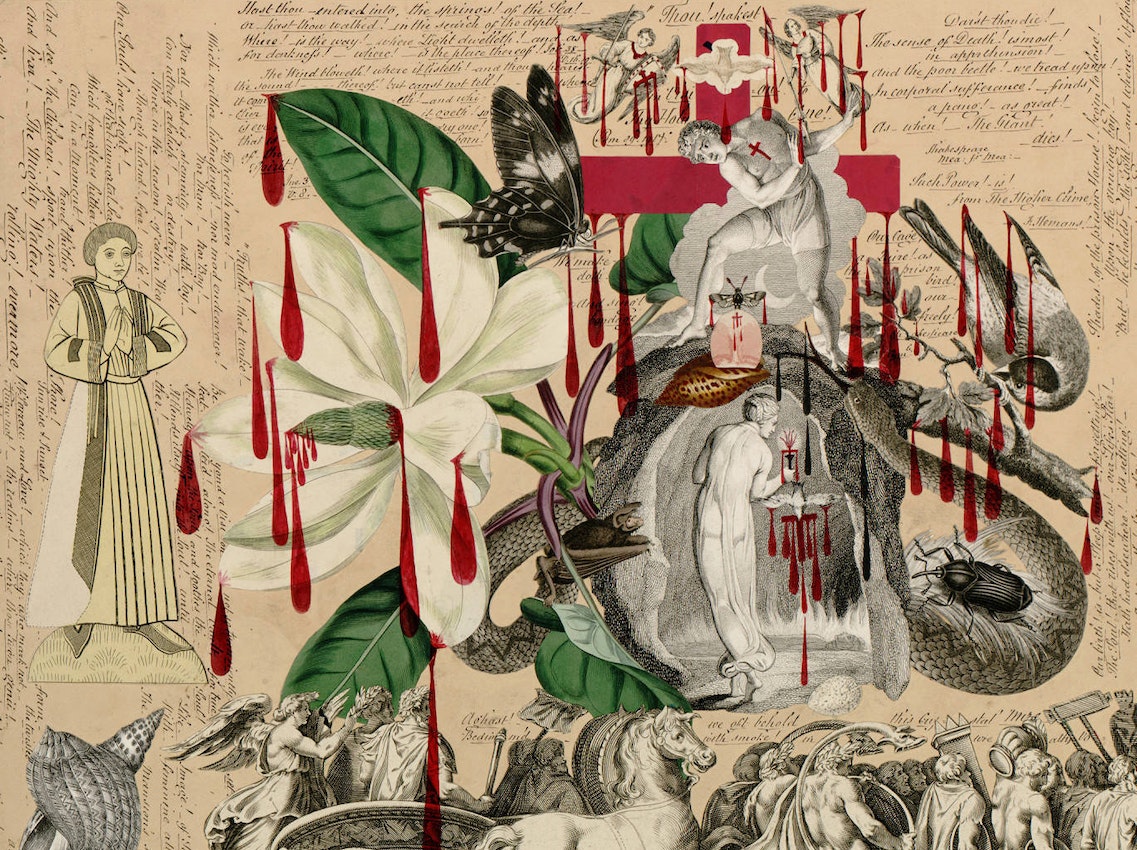
ARTICLE: “The Blood Collages of John Bingley Garland (ca. 1850–60),”Public Domain Review: Peruse the so-called Victorian Blood Book, an eccentricity made by the British politician and fishmonger John Bingley Garland as a wedding gift for his daughter Amy in 1854. It consists of forty-one collages whose sources are engravings by William Blake and various other religious artists, botanical and zoological illustrations, photographs of medieval tombs, and other images from nineteenth-century books, but with one distinguishing decorative addition by Garland’s hand: drops of blood in red India ink, presumably signifying the blood of Christ. The pages also bear extensive handwritten religious commentary.
Detail from a page of John Bingley Garland’s “Blood Book” (ca. 1850–60), featuring a cut-out from a reproduction of William Blake’s engraving The Soul exploring the recesses of the Grave.
The Blood Book transferred from the collection of novelist Evelyn Waugh to the Harry Ransom Center at the University of Texas at Austin upon Waugh’s death, and they identify it as “the single most curious object in the entire library.” Though modern eyes may see the collages as surreal or even grotesque, Garland’s descendants regarded them as nothing other than “a precious reminder of the love of family and Our Lord,” as they have written. The Harry Ransom Center has digitized the full book.
ONLINE EVENT: “Theodicy of Beauty” by Sarah Clarkson, March 6, 2:30 p.m. ET: “The question of suffering is one of the central, aching questions of faith. Too often, we meet suffering with an argument for God’s goodness, rather than an invitation to find and discover his goodness anew. Join me for an exploration of what it means to encounter and trust the beauty of God in our times of darkness, suffering, and pain. Drawing on my own story of mental illness and depression, I’ll explore what it means to engage with God’s goodness in a radically healing way, one that restores our capacity to imagine, hope, and create. We’ll use literature, art, and poetry to discern the ways that God arrives in our darkness to heal us, and also to restore us as agents of his loveliness in the midst of a broken world.”
This Crowdcast talk by Sarah Clarkson is based on her book This Beautiful Truth: How God’s Goodness Breaks into Our Darkness. Registration is $7 and includes a complimentary downloadable copy of “Encountering Beauty,” an arts-based reader’s guide to Clarkson’s book. I have appreciated her From the Vicarage: Books, Beauty, Theology newsletter and her wise, gentle reflections on spirituality, literature, and motherhood on Instagram @sarahwanders, so I’m looking forward to hearing from her on this topic!
+++
LECTURES (available on podcast platforms):
>> “The Loving Look” by Dr. Elissa Yukiko Weichbrodt: In this keynote address for the 2018 Beautiful Orthodoxy conference, art historian Elissa Yukiko Weichbrodt [previously], author of Redeeming Vision: A Christian Guide to Looking at and Learning from Art, discusses how contemporary art—which can sometimes be confounding or otherwise challenging—can drive us to confession, empathy, and love. Sharing her encounters with three contemporary artworks, she talks about art as a place where we can experience sanctification and common grace; how the Incarnation further vested our material world with significance; art as an invitation to embodied knowledge; art as part of how we order and understand our physical world; artworks as mirrors and shapers of culture; and how viewers, not just artists, are called to faithfulness.
She cites Esther Lightcap Meek’s Loving to Know: Covenant Epistemology, in which Meek says that all acts of coming to know are integrative; they become part of us. Knowledge is an act of covenantal care, Meek says. We don’t know in order to love; we love in order to know. Weichbrodt says, “For me, contemporary art—particularly art made by artists grappling with histories and experiences that have remained largely unseen, unknown, and unloved by the dominant culture—has served as a catalyst for faithful knowing.”
>> “The Arts as a Means to Love” by Dr. Mary McCampbell: In this lecture given for English L’Abri, Mary McCampbell [previously], an associate professor of humanities at Lee University, discusses some of the ideas from her book Imagining Our Neighbors as Ourselves: How Art Shapes Empathy. I appreciate how her writing and teaching embraces the arts of film and television alongside literature, such that not only are works like The Power and the Glory by Graham Greene, “A Good Man Is Hard to Find” by Flannery O’Connor, and Beloved by Toni Morrison explored, but so are, for example, the comedy-drama Lars and the Real Girl and the drama series Better Call Saul. Discrediting the recent odd assertion from a prominent evangelical corner that empathy is a sin, McCampbell affirms that empathy is, on the contrary, an essential Christian virtue, and one that the narrative arts are adept at forming in us, exposing us to people and stories outside our realms of experience and helping us recognize the image of God in unlikely places.
+++
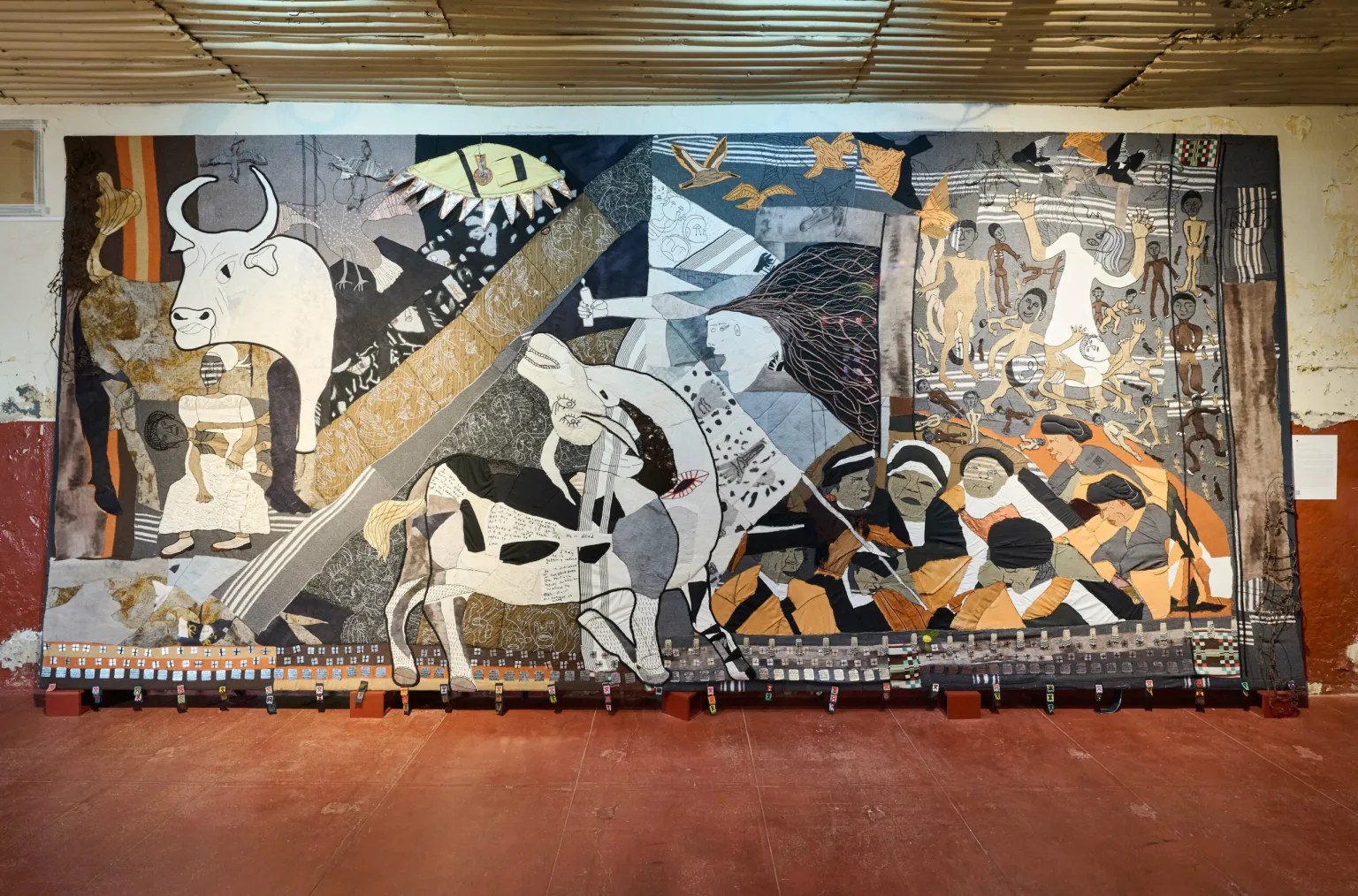
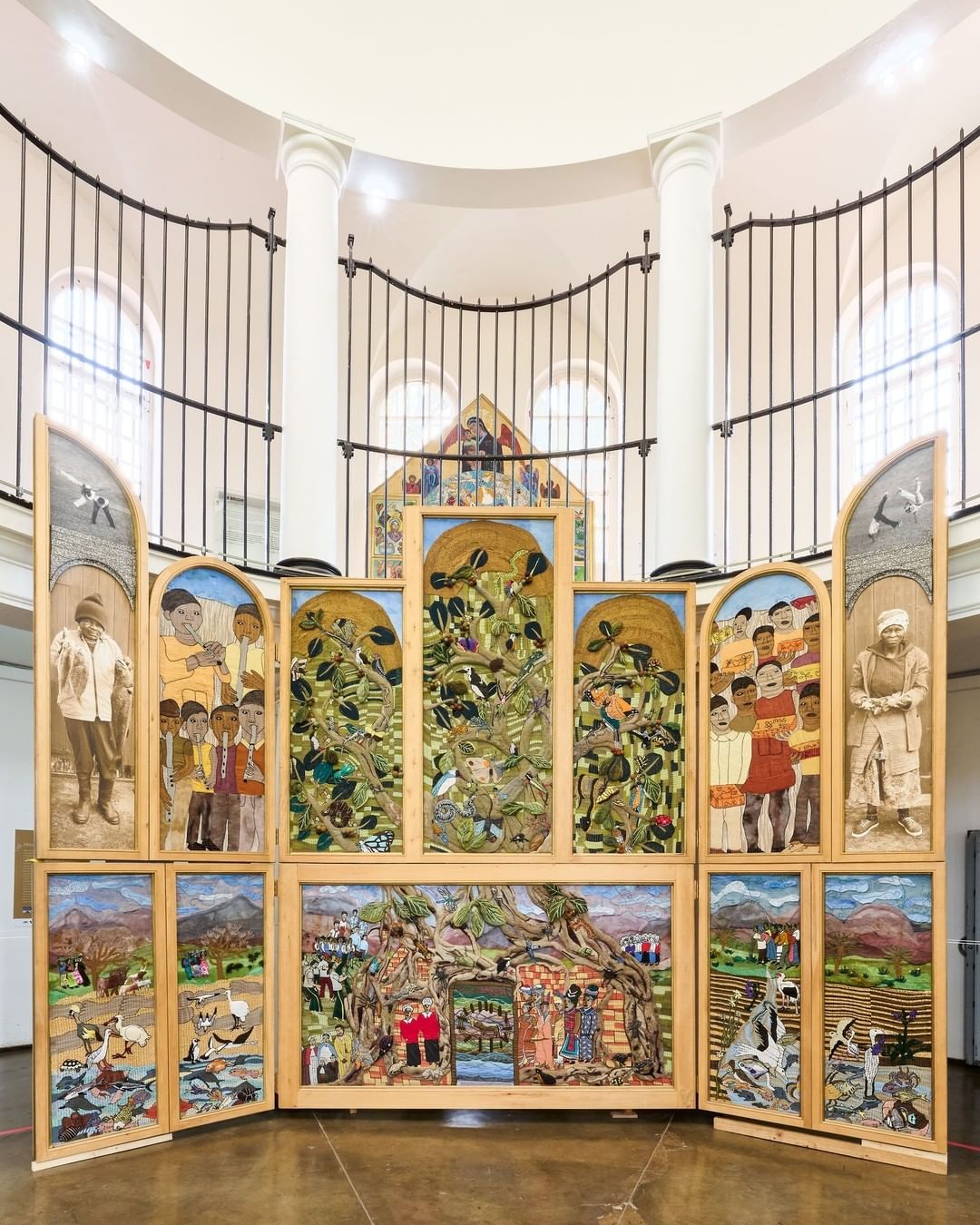
EXHIBITION REVIEW: “Mourning and Perseverance Stitched into South African Tapestries” by Alexandra M. Thomas: Through March 24 at Constitution Hill in Johannesburg, you can see Umaf’evuka, nje ngenyanga, dying and rising, as the moon does, a major retrospective of the work of the Keiskamma Art Project. Founded in 2000, the project archives the collective memory and oral histories of the rural Eastern Cape of South Africa through textile artworks, mainly by Xhosa women. Monumental and small-scale works tell stories of trauma, grief, hope, faith, resilience, and celebration. One of my favorite art research projects has been the one I did on the Isenheim-inspired Keiskamma Altarpiece in 2015, which resulted in the article “Sewing seeds of hope in South Africa”; this altarpiece is one of the many works on display. Let me call out just two others. The photos are from the current exhibition.
Keiskamma Guernica, 2010. Mixed media, including appliqué, felt, embroidery, rusted wire, metal tags, beaded AIDS ribbons, used blankets, and old clothes, 3.5 × 7.8 m. Collection of Javett Art Centre at the University of Pretoria, Tshwane, South Africa. Photo: Anthea Pokroy / Keiskamma Trust.Creation Altarpiece, 2007. Mixed media, including felt, embroidery, photographs, beadwork, wirework, and appliqué, 3.8 × 5.2 m (open). Collection of Unisa Art Gallery, Tshwane, South Africa.
Keiskamma Guernica, after Picasso’s famous antiwar painting, laments the limited access to HIV treatment in rural South Africa in the 2000s and the negligence of government hospitals, which resulted in many HIV/AIDS deaths. The piece repurposes the blankets and clothes of the deceased and serves as an expression of outrage as well as a form of commemoration. Creation Altarpiece, modeled loosely after the Ghent Altarpiece, exults in the region’s abundant wildlife and natural resources and in life-giving initiatives like Hamburg’s music education program, its capoeira group (a dance-like martial art), and the memory boxes made by orphaned children to remember their parents. The three top central panels depict a fig tree eating up an old hotel built by colonialists (a real-life scene observed in the nearby village of Bell!), and the bottom three show villagers of all kinds gathering around Christ, represented as a bull (whereas lambs were commonly sacrificed in ancient Israelite religion, traditional Xhosa religion calls for bull sacrifices).
SONG: “Kyrie” by Ngwa Roland:Ngwa Roland is a composer and the director of De Angelis Capella [previously], a Catholic choir from Yaoundé, Cameroon. Here is his choral setting of the Kyrie eleison (Greek for “Lord, have mercy”), an important Christian prayer used in liturgies around the world.
+++
ARTICLES:
>> “To One Kneeling Down No Word Came” by Jonathan Chan, Yale Logos:Jonathan Chan is a Singapore-based poet and essayist who graduated with a master’s degree in East Asian Studies from Yale in 2022. In this personal essay he reflects on the poetry of R. S. Thomas, a twentieth-century Anglican priest from Wales, particularly as it relates to the toil of prayer—prayer as a discipline requiring persistence and solitude. Thomas’s poems often express a sense of alienation from God, which is not what we might expect from a pastor, but, as Chan remarks, “God’s absence cultivates a desire for God’s presence.”
>> “Stabat Mater: How a 13th Century Lament Resonates Today” by Josh Rodriguez, Forefront: Back in July 2020, composer Josh Rodriguez [previously here and here] published this article on four modern settings of one of the most celebrated Latin hymns of all time, the twenty-stanza Stabat Mater Dolorosa (lit. “The sorrowful mother was standing”), about Mary mourning the death of her son Jesus. Written in the Middle Ages, it continues to inspire composers today, and it remains “a powerful vehicle for ‘grieving with those who grieve,’” Rodriguez writes. He spotlights the settings by James Macmillan, Julia Perry, Hawar Tawfiq, and Paul Mealor, analyzing some of the musical elements of each and quoting the composers in regards to the piece’s meaning to them.
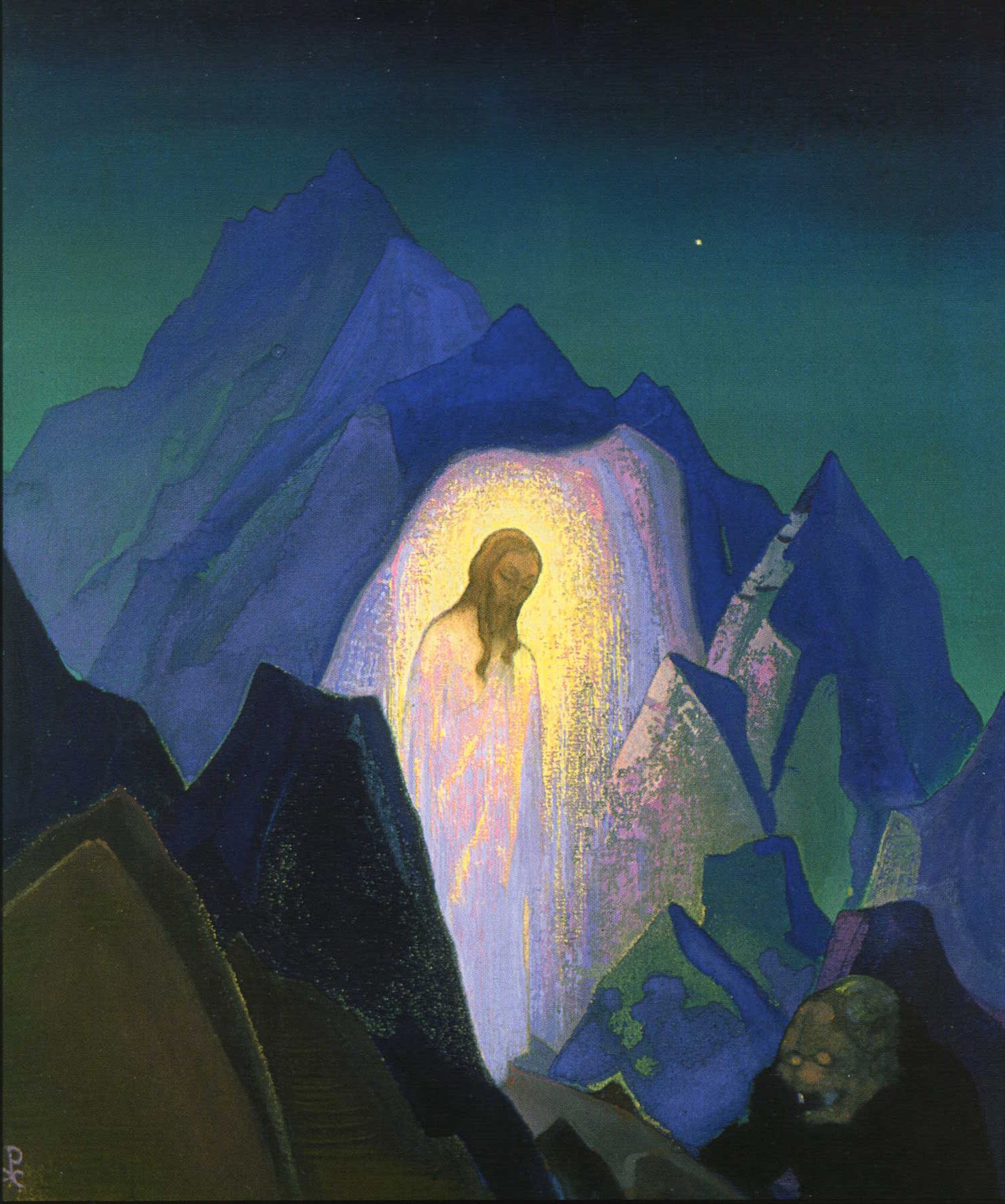
Nicholas Roerich (Russian, 1874–1947), Christ in the Desert, 1933. Tempera on canvas, 60 × 50.9 cm. Nicholas Roerich Museum, Moscow.
QUOTE:
The tradition of Lent means many different things to many different people. I honour the traditions and wisdom of the ages—and I’m interested in discerning what these practices mean [today].
At [my church], Lent is about learning from Jesus, particularly Jesus’ path through the real-life wilderness experiences we all face. We are interested in emulating and discovering a Jesus-shaped life in the hard things, the growing things, and the uncomfortable things. We believe not in an idealized plane of existence no one can quite attain; instead we believe in knowing and living out a Jesus way in the grey areas, the dirt and dust of our earthly lives here and now. . . .
Together and for you, this is our prayer (by Ann Siddall): “May this Lenten journey, with its stories about the hard places of Jesus’ experience, give strength and courage to all whose journey is far from easy. And may it inspire us to risk Christ’s Way of love as we share the journey with other travelers. We make this prayer in his name. Amen.”
>> “Ash Wednesday and the Practice of Truth-Telling” by Christine Valters Paintner: In this introduction to the season of Lent, spiritual writer and retreat leader Christine Valters Paintner discusses lament as a Lenten practice—lament as truth-telling, resistance, solidarity, and the release of God’s power. We need to touch those places of grief that we carry, and open ourselves in compassion to the grief of others. Paintner also unpacks the word “repentance,” visiting its Hebrew and Greek root words to further illuminate its meaning.
>> “Forty for 40: A Literary Reader for Lent” by Nick Ripatrazone:Nick Ripatrazone, the culture editor for Image journal and columnist at The Millions, offers suggestions and blurbs for forty stories, poems, essays, and books appropriate for Lent. Some pieces are inspired by feast days and Gospel readings, while others capture the discernment of the season. From Flaubert’s The Temptation of Saint Anthony and Hemingway’s one-act play Today Is Friday to Love & Salt: A Spiritual Friendship Shared in Letters and Karr’s “Disgraceland,” the selections are varied and intriguing. The dates are off because this was published in 2017, but the list is still valid, and many of the poems can be read online.
+++
LIVING ROOMEVENT: “Poetry of Lent”: On March 4, under the aegis of the local arts nonprofit the Eliot Society, I’m moderating an evening of crowdsourced Lenten poetry at a friend’s home in Crownsville, Maryland. If you’re in the Baltimore-Washington metro area, I’d love to see you there! The themes of this season are so expansive, and I’m looking forward to hearing what people share. Of course, I will have many poems in my back pocket as well. Some words I’ve been thinking of in preparation: pilgrimage; hunger; emptying; grace; greening; solitude; beloved; blood.
+++
SONGS:
>> “Circles” by Tow’rs: Tow’rs, an indie-folk band out of Flagstaff, Arizona, is made up of Gretta and Kyle Miller, drummer Dan Bagle, guitarist Kyle Keller, and cellist Emma Riebe. This song of theirs is about how God lovingly pursues us and clothes our shame.
>> “Parce Domini” by Jacob Obrecht:The Gesualdo Six perform a motet by the Flemish composer Jacob Obrecht (1457/58–1505), which sets a traditional Latin liturgical text based on Joel 2:17, 13.
Parce Domine, parce populo tuo quia pius es et misericors. Exaudi nos in aeternum, Domine.
Spare, O Lord, spare thy people, for Thou art gracious and merciful. Hear us for ever, O Lord.
+++
VISUAL COMMENTARY: “Handling Our Fragility, Seeking a Wise Heart” by Rachel Muers: As part of the Visual Commentary on Scripture project, theologian Rachel Muers has selected and comments on three artworks that resonate with Psalm 90 [previously], a song that combines communal lament with a meditation on wisdom. The psalm ends with the cry “Prosper for us the work of our hands—O prosper the work of our hands!”—which guided Muer in her curation. She gives us nine-thousand-year-old handprints on an Argentinian cave wall, a hospital drawing by Barbara Hepworth, and a cat’s-cradle sculpture by Mitzi Cunliffe. This mini-exhibition is a great way to enter into and engage with this typically Lenten psalm.
Cueva de las Manos (Cave of Hands), began ca. 7,000 BCE. Mural, UNESCO World Heritage Site, Santa Cruz, Argentina.
On a related note: For this Lent, the VCS is dipping into its archives to bring you “Lent Stations: Repentance and Forgiveness,” fourteen artworks with commentary (two per week) that relate to the stated theme. Follow the link to sign up.






 Art & Theology