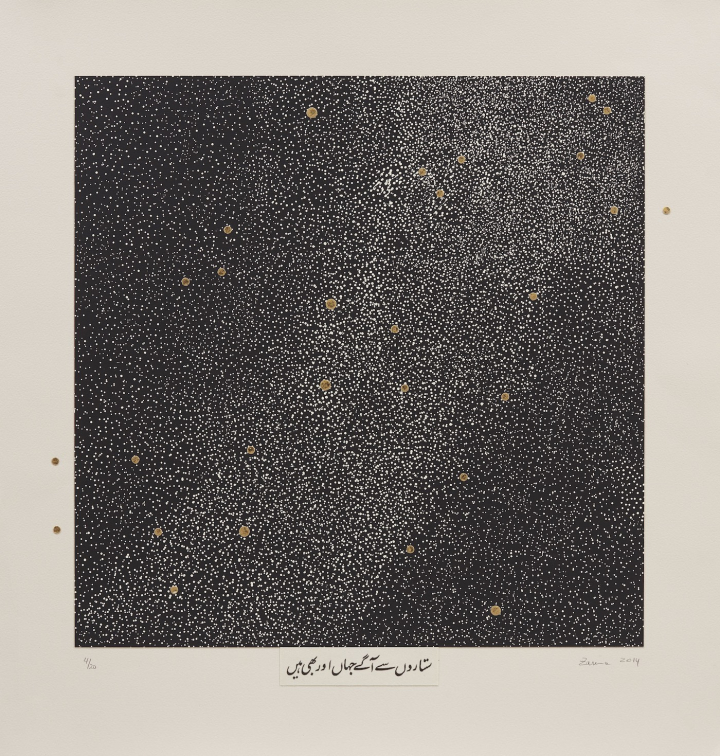
Zarina (Indian American, 1937–2020), Beyond the Stars, 2014. Woodcut printed on BFK light paper collaged with gold leaf and Urdu text, mounted on Somerset Antique paper, 24 × 23 in. Photo: Farzad Owrang.
Printmaker Zarina Hashmi, who preferred to identify herself professionally by her first name only, was born and raised in the small university town of Aligarh, India, and was displaced to Karachi, Pakistan, after the partition of India in 1947. She had a cosmopolitan education, studying woodblock printing in Bangkok and Tokyo and intaglio in Paris. At the beginning of her career she moved to New York, living and working there for forty years before finally moving to London in 2018 to be near family. She passed away two years later.
In Beyond the Stars Zarina shows, through the medium of woodcut, the glory of a night sky. Innumerable stars dot the black ink, as do a smattering of small 22-karat gold orbs that could be read as angels or as the divine presence made visible.
LISTEN: “All Shall Be Well” by Jill McFadden, on Good News by Ordinary Time (2016)
He called him into the night, said Abram, count the stars so bright Through you true peace will come To every tribe and tongue Though no one knows my Name Blessing is coming all the same
And all shall be well
Now many years went by Of withered hopes, unanswered cries Till one night a virgin heard A cry that broke the silence of God That star above them bright Had shone for Abram that night This child so weak, so small Brings peace and rest to all
And all shall be well (2×)
The years unending seem Here in this in between “Peace on earth, God’s will for men” Seems like it came and went The wars, they linger on The darkness overcomes We need not stars but sun Break in, O Coming One Sometimes we cannot tell That You will make all well
But all shall be well All shall be well
Jill McFadden is one-third of the sacred folk band Ordinary Time. She wrote the song “All Shall Be Well” for a Lessons and Carols service, to correspond with the Genesis 22 reading (cf. Gen. 15), where God tells Abraham, “I will indeed bless you, and I will make your offspring as numerous as the stars of heaven and as the sand that is on the seashore . . . and by your offspring shall all the nations of the earth gain blessing for themselves” (vv. 17–18).
This covenant extended down through the ages, reaching fruition many generations later in the person of Jesus of Nazareth, the Promised One from of old and on high, born to make all things well. As the song’s lyrics put it: “many years went by of withered hopes, unanswered cries, till one night a virgin heard a cry that broke the silence of God.” That is, the cry of Mary’s newborn son, whom the angel Gabriel called the “Son of the Most High” and said would establish a kingdom that has no end (Luke 1:32–33).
The Star of Bethlehem, the song says, was one of the millions present when God first promised to bless the world through Abraham’s seed, and now it burns particularly bright over the spot where that blessing is enfleshed in a brand-new and earthshaking way—for the babe in the manger is God incarnate.
But has all really been made well by God’s coming in Christ? There’s still violence and sin and pain and relational fracture. Where’s the peace?
The third stanza of “All Shall Be Well” entreats Christ’s second coming. It laments how peace and light seem elusive here on earth and asks God to make good on his ancient promise. Show us the blessing! Show us the new day, that universal redemption. We’ve received foretastes, but we want to sink our teeth into the whole magnificent meal.
The refrain is a reassurance rooted in God’s steadfast love and faithfulness: “All shall be well.” No matter how far-off that total wholeness feels for you, know that it’s written in the stars, so to speak. The God who created everything good will make it good again as he promised. Until then, we continue to hope and pray, work and wait.
If you would like a harmonized lead sheet, chord chart, and/or string parts for this song, email info@ordinarytimemusic.com, and Jill will make them freely available to you.
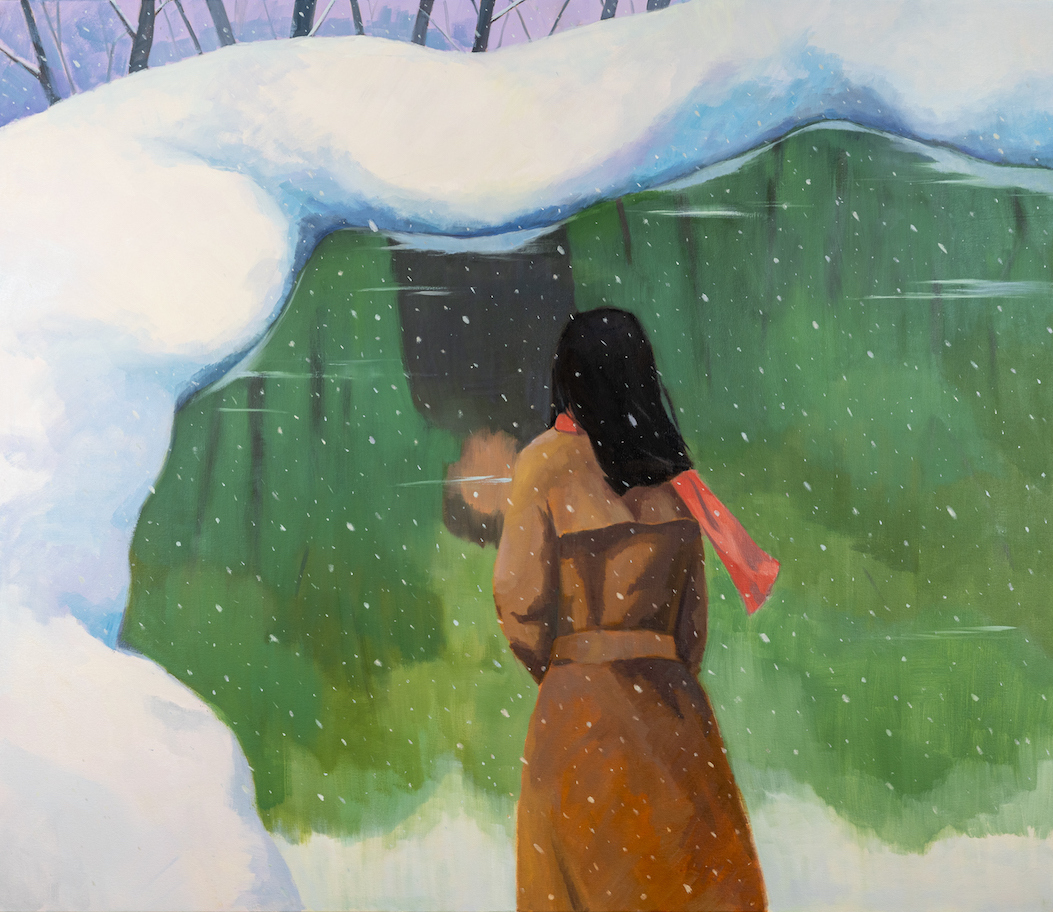
Yuri Yuan (Chinese American, 1996–), Norwegian Wood, 2020. Oil on canvas, 63 × 73 in.
This painting by New York–based artist Yuri Yuan shows a woman in a belted brown trench coat, her back to us, standing at the edge of a frozen pond. A small gust of snowy wind whips her hair and scarf. Though her face isn’t visible, she appears to be deep in thought.
Reflected on the pond’s surface is a man dressed in black. We don’t see his physical form, and his features are indistinguishable in the mirroring ice. Who is he? Does he wish to speak to the woman? Does he come with news, or an invitation, perhaps? Or simply to wait with her in silence?
There’s a mystic quality to the image that’s heightened by the incongruity between the environment and its reflection. In the upper left, the trees are barren and dusted with the white of winter, and indeed the woman is dressed for the cold. And yet in the trees’ reflection in the pond, they are in full foliage, leafy green, as if it were summer.
It’s as if two worlds are converging here in this wood. Or the woman foresees, with the eyes of her spirit, a lushness that has not yet come to pass.
Notice how the snowbanks piled up along the water’s edge could almost double as clouds, particularly in the bottom left, where the white mass meets the sky’s reflection. The heavens and the earth becoming one.
I chose this image to kick off the Advent season (which begins tomorrow) because it captures the sense of longing that the church leans into most especially during these four weeks, but also the sense of promise, the possibility, that’s just as characteristic of the season. In the eschatological reality that Israel’s prophets foresaw, the barren becomes verdant and the dead come to life. “The wilderness and the dry land shall be glad; the desert shall rejoice and blossom” (Isa. 35:1).
Strangely, Norwegian Wood is a painting of both absence and presence, distance and nearness.
If you like, imagine Yuan’s mystery man as God coming close—which is what the Incarnation is: God coming closer than close!
What invitation might God have for you this Advent? What heartache from the past year, or even further back, do you need to bear to the Healer? What hopes do you need to speak out loud?
We wait, we hope We yearn, prepare For who or how or what or where? Maybe the changing of the tide Maybe the turning of someone’s eye Maybe the falling of the snow Only heaven knows What happens when God comes close
We wait, we hope We yearn, prepare For who or how or what or where? Maybe the healing of a heart Maybe reunion of a drift apart Maybe a child’s coming home Only heaven knows What happens when God comes close
We wait, we hope We yearn, prepare For who or how or what or where? Maybe the song, a place to belong Maybe some faith, just a touch of grace Maybe love, it’s rarely what we think of Only heaven knows What happens when God comes close
This is the first post in a daily series that will extend to January 6. You are welcome to subscribe via email or RSS, but posts are optimized for viewing on a web browser. (And note that Gmail sends WordPress posts to your Social tab, unless you create a filter to tell it otherwise.) Links will be shared on Facebook and Twitter.
Jackson Beardy (1944–1984) was an Anishinaabe artist born on the Garden Hill Reserve in Manitoba. He belonged to the Woodland school of art [previously], adopting its distinctive style of Indigenous expression characterized by thick black outlines and vivid, compartmentalized color. His paintings draw on Ojibwe and Cree oral traditions and often express cosmological and spiritual concepts.
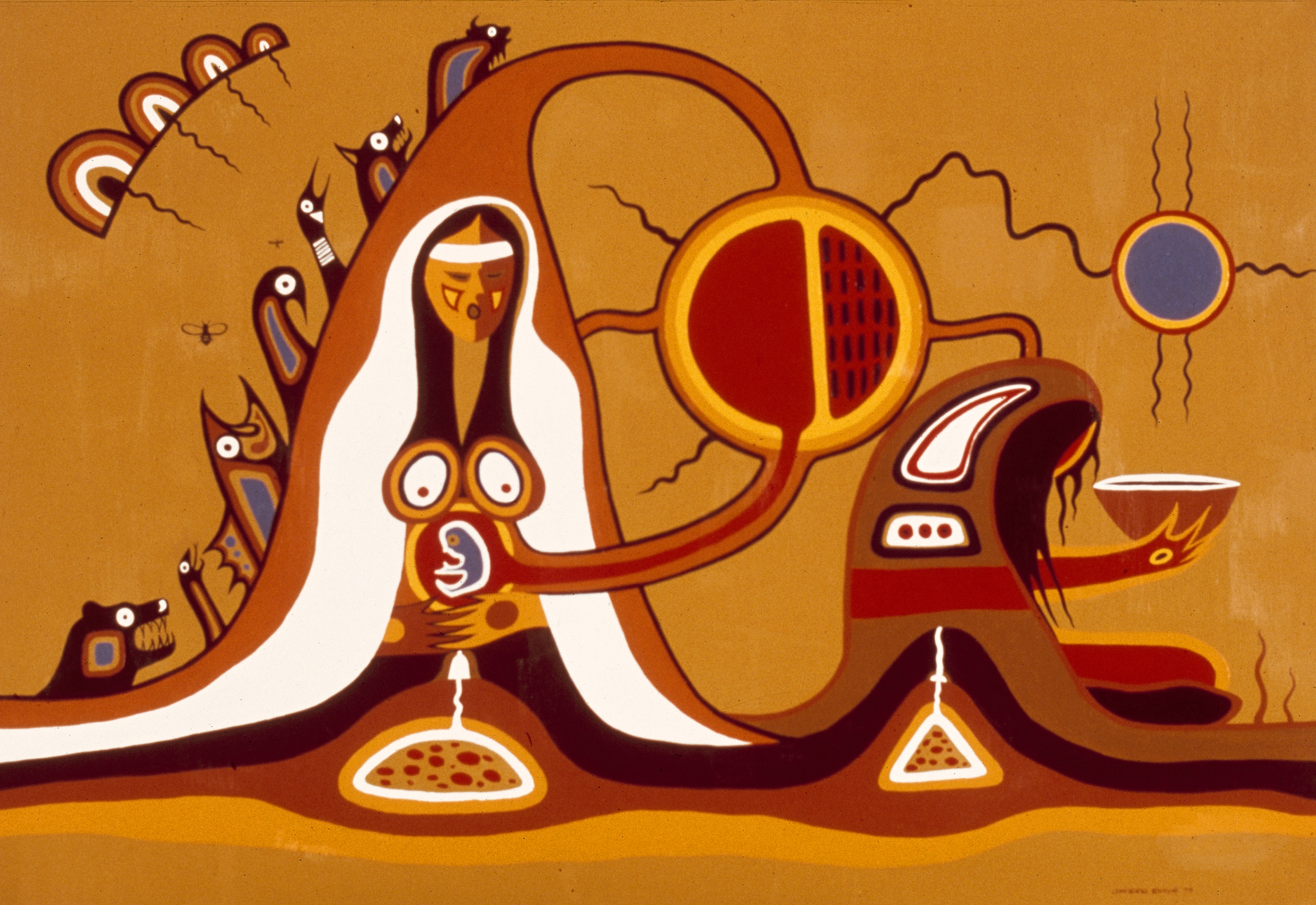
Beardy is one of twenty Canadian artists commissioned by the Canadian Conference of Catholic Bishops in 1975 to convey the Christian message using whatever idiom they wished. Beardy chose to portray the Virgin Mary pregnant with the Word, the sun’s fire pouring into her and yet she is not consumed. He provided the following artist’s statement:
It is my personal belief that a messenger from the Great Spirit came to earth in the form of His image after Him through a virgin birth in unrecorded history. Through this man, knowledge was passed on to man from the Great Spirit. Many of the teachings of this man have been kept by word of mouth through the ages by the elders of all tribes.
We see the virgin mother-to-be holding on to an embryo connected to the sun symbol (the Great Spirit) [center] who has deemed it necessary to send his messenger to his people. The mother is also connected to Mother Earth, who is nursing her [see the breast shape below]. She too is connected by a lifeline to the sun symbol. Around her are all the orders of creatures who come to see the messenger. He is born to explain their existence, [to restore] harmony between humanity and the elements, physically, mentally, and spiritually.
On the other side of the sun symbol we see an elder in prayer, ritually offering a bowl filled with sacred things. You can see the sun symbol is resting on his hunched frame, bearing him down with doubts, fear, depression, and all the ills of his time, his back to the very miracle he is praying for. It will take time for all to fully comprehend this phenomenon which has come to pass.
The four semicircles represent the elements of the air: snow, rain, tornadoes, heat. The moon [the blue circle] is painted above the elder. We regard the moon as our Grandmother who keeps vigil over all creatures during the night.
Though titled The Nativity, the painting is actually a prebirth scene, as Jesus is still in utero. Beardy shows the Christ child taking root in Mary’s womb (having been conceived by the power of the Great Spirit) and growing to full term as people and animals alike long for his arrival. They groan, they watch, they wrestle and seek. Creator Sets Free—as the First Nations Version of the New Testament translates the name Jesus—is almost here.
(Note: There’s a flipped version of this image floating around online. I confirmed with the CCCB that the file posted here, which I licensed directly from them, represents the correct orientation.)
Leaning into that Advent yearning, here is a performance of “O Come, O Come, Emmanuel” in Ojibwe—“Ondaas, Ondaas, Emaanooyen”—performed by E Halverson:
Now, I have a crowdsourcing request: I am searching for Advent or Christmas songs originally written in Indigenous Canadian or Native American languages, preferably by an Indigenous person. If you know of any, please let me know in the comments below, or in an email. Thanks!
Before I launch into the Advent content, I want to alert newcomers to, and remind old-timers of, my Thanksgiving Playlist on Spotify (introduced here), which is revised and expanded since last year. You can get an overview at this blog post. From Destiny’s Child to Yo-Yo Ma, Meister Eckhart to Mister Rogers, there’s a little something for everyone, I hope. And exemplifying the global nature of Christianity, there are songs in Hebrew, Luganda, Zulu, Swahili, Yoruba, Spanish, French, Hawaiian, Arabic, Korean, and Tamil.
+++
ESSAY: “All Creation Waits” by Gayle Boss: In the northern hemisphere, Advent is accompanied by a deepening of the dark and cold. In her bestselling and wholly unique Advent devotional, All Creation Waits, Gayle Boss provides twenty-five reflections that detail how wildlife—turtles, loons, black bears, and so on—adapts to these changing conditions. Animals know that the darkness is a door to a new beginning, and we would do well to embrace this wisdom. In the book, each day’s reading is paired with a woodcut illustration by David G. Klein.
The year of the book’s 2016 release, On Being published the introduction on its blog, where Boss answers, “Why animals for Advent?” and describes some of the inspiration behind and framing of the book. This year Paraclete Press released a hardcover gift edition with a new introduction and afterword.
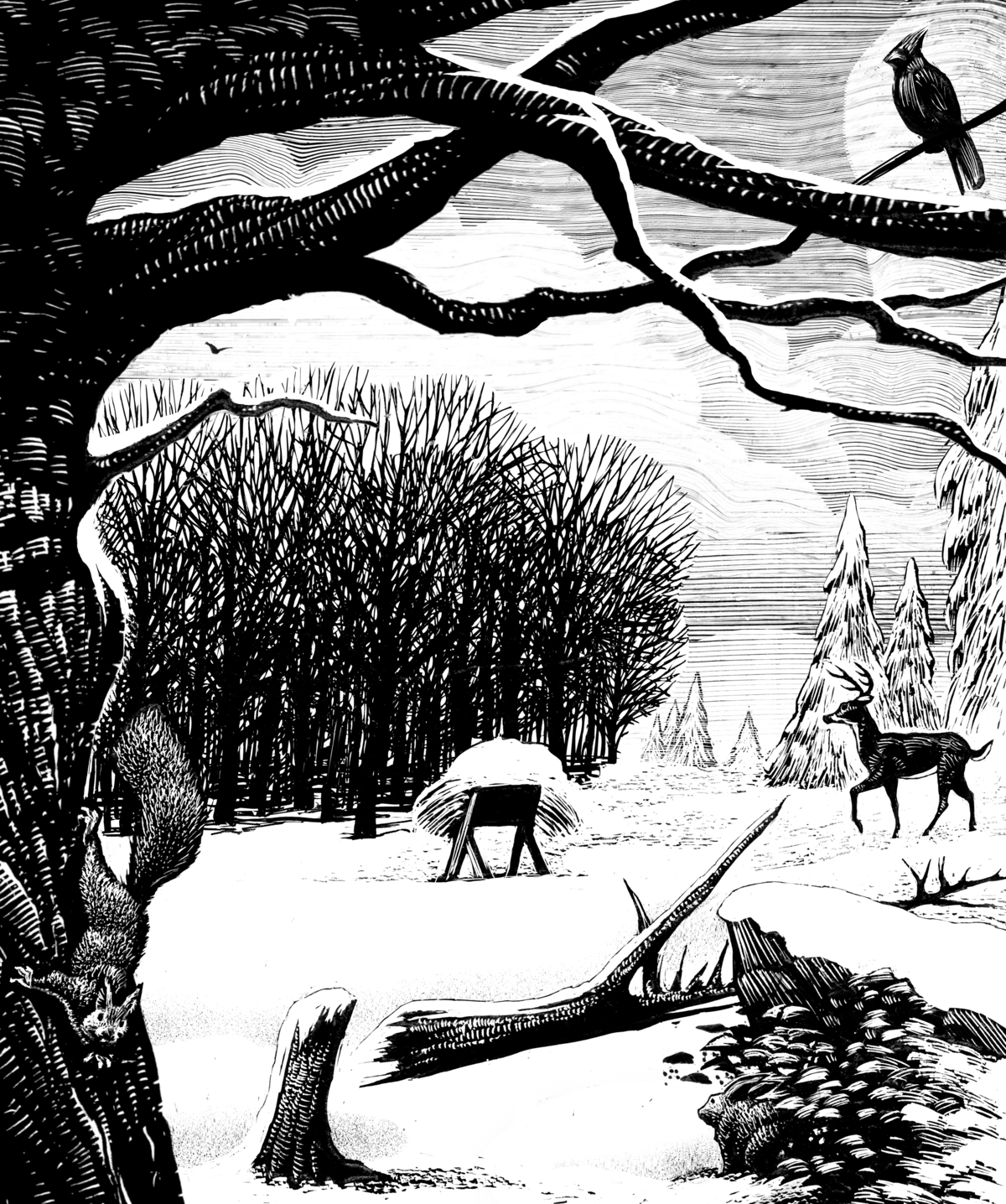
Woodcut by David G. Klein, 2016. In All Creation Waits, Gayle Boss tells a story of how one year, a week into Advent, she found a manger in the woods, which local children had filled with hay for the animals, then shelled corn.
+++
SONG: “O Come, O Come, Emmanuel”: There are hundreds of arrangements and recordings of this most beloved Advent hymn. Last year I featured two that I particularly like, and I think I’ll start a trend on the blog by doing the same at the beginning of each Advent—sharing two new renditions of the song.
>> Anna Hawkins.Anna Hawkins is a singer-songwriter of Irish heritage living in New Zealand. In her version of “O Come, O Come, Emmanuel” from her album Divine (2015), she sings the first verse in Hebrew, honoring the lyrics’ rootedness in the Hebrew scriptures. The music video was shot in Israel (cinematography by Michael Hilsden from Aspiring Productions). [HT: Global Christian Worship]
חזור חזור עמנואל ופדה אסירי ישראל שבגולה נאנחים עד כי תבוא בן- האלוהים ,שמחו! שמחו! עמנואל יבוא לכם בני ישראל
Chazor, chazor Immanu-El Ufde asirei Israel Shebagola ne’enachim Ad ki tavo Ben Elohim Simchu, Simchu, Immanu-El Yavo lachem bnei-Israel
[English translation:] O come, O come, Emmanuel And ransom captive Israel That mourns in lonely exile here Until the Son of God appear Rejoice! Rejoice! Emmanuel Shall come to thee, O Israel
>> CeCe Winans, arr. Alvin Love III.CeCe Winans is a gospel legend. On Something’s Happening! A Christmas Album (2018), she collaborated with her son, Alvin Love III, who wrote the lush orchestral arrangements and produced the record. “O Come, O Come, Emmanuel” opens with a celesta, which sounds like a music box or twinkling stars and has long been associated with the supernatural. The accompaniment is played by the Zagreb Philharmonic Orchestra, conducted by Tim Akers.
+++
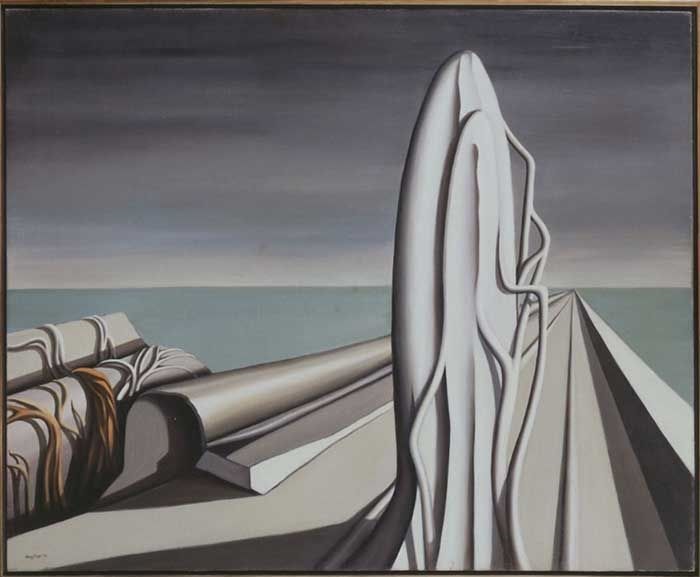
VISUAL MEDITATION: “I Corinthians 7:29-31: God Only Knows” by Lynn Miller: Rev. Dr. Lynn Miller is an author, ecclesiastical artist, workshop leader, and Presbyterian minister who holds a BFA in graphic design, an MA in art history, an MFA in creative writing, an MDiv, and a DMin. From 2014 to 2021 she ran the blog Art&Faith Matters, curating a diversity of images based on the liturgical calendar. In this post she guides us in looking at the surrealist painting At the Appointed Time by Kay Sage, which features a mysterious, draped figure or object and lines receding toward the horizon. “What do you see in the painting? What do you think about what you see? What do you wonder about this painting?” She posits a number of possible interpretations.
Kay Sage (American, 1898–1963), At the Appointed Time, 1942. Oil on canvas, 81.3 × 99.1 cm. Newark Museum of Art, Newark, New Jersey.
+++
PODCAST SERIES: “Whispered Light: Advent Reflections on Death, Judgement, Heaven and Hell” by Matt Simpkins: In this four-episode podcast series from December 2020, Rev. Matt Simpkins, an Anglican priest and musician from Essex, explores the four themes traditionally contemplated by Christians during Advent—death, judgment, heaven, and hell—through four old American folk songs. He performs the songs, giving their history and using them as a launchpad for spiritual and theological reflection, which also integrates discussion of the Psalms. He addresses misconceptions about these “last things,” tracing the thread of hope and redemption that runs through them all. Just twenty to thirty minutes each, the episodes are available on your favorite podcast app and on YouTube (links below).
Episode 1: “O Death” (aka “A Dialogue with Death”)
The season of Advent begins Sunday, November 27, this year and is followed by the Twelve Days of Christmas, culminating on Epiphany, January 6. During these six weeks I will be publishing daily posts, each centered on a visual artwork and a piece of music that I hope will promote contemplation and prayer around the seasons’ themes, around the narrative of Christ’s coming. If you’d like to receive these posts in your inbox, enter your email address on the Subscribe page. This will subscribe you to the blog as a whole, but you can always unsubscribe afterward if you want to stick around for just this one series.
Some people erroneously consider Advent to be simply an extension of Christmas. Not so! The two seasons are, of course, related, but Advent is a four-week period that focuses not just on Christ’s first coming and the signposts leading up to it, but also his second, as well as his coming, as Spirit, into our hearts, lives, and communities. It is an opportunity for us to lean into the deep longing we feel for God’s presence.
“Advent is a season of hope,” writes the Rev. Tish Harrison Warren, “and part of practicing hope is noticing where we need it”—so many of the Advent selections have a tone of lament. But still others are celebratory, marked by a joyful anticipation of the new dawn and all that it will usher in.
Included in this year’s edition of the Advent-Christmas series are a community art project in Lima; a jazz setting of a poem by Malcolm Guite, plus settings of Emily Dickinson and George MacDonald; ancient hymns from Prudentius of Spain and Ephrem of Syria; an antiphon by Hildegard of Bingen that references Mary as the New Eve; a light installation in an abandoned warehouse in Malaysia; a South African Nativity linocut with native wildlife; a Chinese watercolor on silk of the Annunciation to the Shepherds; a parable-inspired spiritual with roots in Jamaica; an acoustic-folk adaptation of Hannah’s song, a likely influence on Mary’s Magnificat; and more. The assurance that “All shall be well,” popularized by Julian of Norwich, bookends the series.
Oh, and there will be a “prelude” post on November 26.
Bridegrooms and oil lamps, clouds and snowdrifts, trumpets and butterflies, rivers and stairs—these are some of the images, verbal and/or visual, that we’ll encounter as we journey from Genesis to Revelation, from humanity’s fall and God’s covenant with Abraham to the incarnation of the promised Savior to the new heavens and the new earth, where that Savior reigns in love over all the redeemed.
Many of the songs will be drawn from my two Spotify playlists:
I look forward to walking with you all through this wonder-full, ancient, ongoing Story that enfolds us.
—Victoria
P.S. Want a better sense of what to expect before sharing or subscribing? You can peruse last year’s posts here and here.
I am committed to making all Art & Theology content free for everyone, but that means my income takes a hit. I have been working on this series since August, saying no to some paid freelance offers to make it happen. If you find the posts meaningful and it is within your means, would you please consider donating whatever amount you feel the product is worth? (You can use the form below, or PayPal.) I will also include a donation link at the bottom of the final post, if you’d rather wait and decide then. Thank you!
VIRTUAL ARTIST RESIDENCY: 2023 Inbreak Residency: Led by Dea Jenkins, the organization Inbreak, which promotes social healing through the arts, is hosting its third annual (virtual) residency, open to US-based artists of any discipline interested in exploring the intersections of art, faith, and race in the United States. The residency provides a collaborative environment and opportunities for artistic development and creative leadership growth, with group workshops, group feedback sessions, studio visits, and a curriculum featuring a curated selection of viewings, readings, and dialogue prompts. It culminates in a live or virtual exhibition.
Applications are due by November 20, 2022; you are required to submit work samples, an artist statement and/or short bio, and a community-focused project proposal. Four applicants will be selected for the 2023 cohort, which runs from January to May, and each given a $500 stipend.
+++
SONG: “Lux Aeterna”: “Lux Aeterna” (Eternal Light) is the Communion antiphon for the Roman Catholic Requiem Mass. The traditional Latin text has been set to music by many composers. Recorded at All Hallows’ Gospel Oak in London in May 2021, this performance by the Gesualdo Six is of the setting by Spanish Renaissance composer Cristóbal de Morales. I share it in anticipation of All Saints’ Day on November 1.
The lyrics translate as follows:
May eternal light shine upon them, Lord, with your saints forever, for you are good.
Grant them eternal rest, Lord, and may light perpetual shine upon them, with your saints forever, for you are good.
The video came out of the Interfaith Sacred Art Forum and the Sacred Art in Collections pre-1900 Network, both launched last year as part of the National Gallery’s Art and Religion research strand. In their inaugural 2021–22 season, the theme was “Crossing Borders,” and they have used two paintings in the museum’s collection as a foundation for wide-ranging events and activities. The theme for 2022–23 is “The Art of Creation,” and the two paintings around which conversations and activities are based are Rachel Ruysch’s Flowers in a Vase (1685) and Claude Monet’s Flood Waters (1896).
+++
VIDEO: “Introducing Annie Dillard” by Tish Harrison Warren: In this video from the Trinity Forum, Anglican priest and writer Tish Harrison Warren introduces the forum’s fall reading, the Pulitzer Prize–winning classic Pilgrim at Tinker Creek (1975) by Annie Dillard. The book comprises Dillard’s evocative reflections on her time spent wandering about and observing the lively woods, creeks, and natural world of Virginia’s Roanoke Valley while she convalesced from illness.
“She [Dillard] has taught me, in the words of Eugene Peterson, to pray with my eyes open,” Warren says. “She has taught me to notice God at work in the world in ways that I wouldn’t.”
I hear Dillard quoted all the time, but I’m embarrassed to say that I have not yet read this quintessential book of hers! Though I do own it. I have now pulled it off the shelf and put it in my “to read imminently” stack. 😊
+++
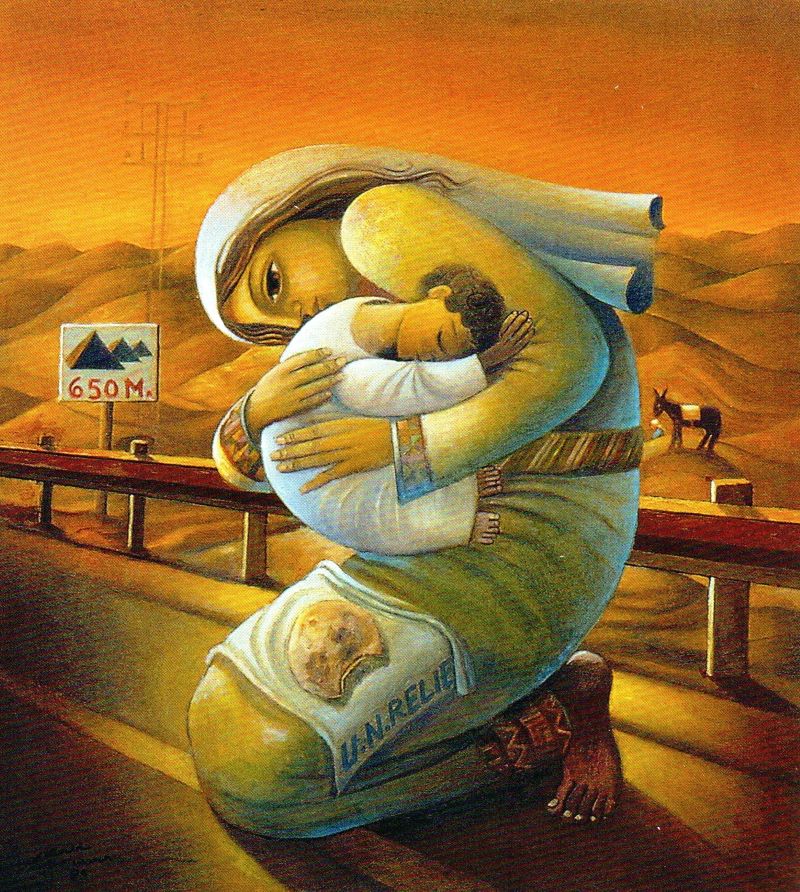
VISUAL MEDITATION: “The Taste of Palestine” by Meryl Doney, on the art of Sliman Mansour: Sliman Mansour is a Palestinian Christian artist whose work centers on the Palestinian struggle against the Israeli occupation. This ArtWay article is a great, concise introduction to his work, spotlighting four of his paintings: Picking Olives; The Flight to Egypt; Hagar; and The Holy Family in an Olive Grove.
Sliman Mansour (Palestinian, 1947–), The Flight to Egypt, 1984. Oil on canvas.
Last month my friend Becky Hadeed, food photographer and creator and host of The Storied Recipe podcast, released an episode called “Honoring the Women of Palestine,” where she interviews Mai of Almond and Fig. Mai discusses growing up in Palestine and shares some of the ways she seeks to connect with her Middle Eastern heritage from her kitchen in Chicago.
Update, 10/27/22: Two weeks after this article was published, Tokens Show rebranded and relaunched with a new name, No Small Endeavor; learn the inspiration behind the original title here, and the reason for the change here. Their mission remains the same but with a renewed commitment to greater diversity of guests, and their new tagline is “Exploring what it means to live a good life.” They also announced that starting in 2023, their radio show will be nationally syndicated.
“Public theology” is a term I’ve been seeing more and more—in people’s professional titles, in books, in taglines, etc. Public theology is theology that talks with and not just to society, write Sebastian Kim and Katie Day in their introduction to A Companion to Public Theology (2017); it ventures outside the ivory tower and the walls of the church, engaging issues of common interest to build the common good. It’s incarnational and touches all aspects of life, which means it’s interdisciplinary, addressing economics, politics, healthcare, criminal justice, the arts, and so on.
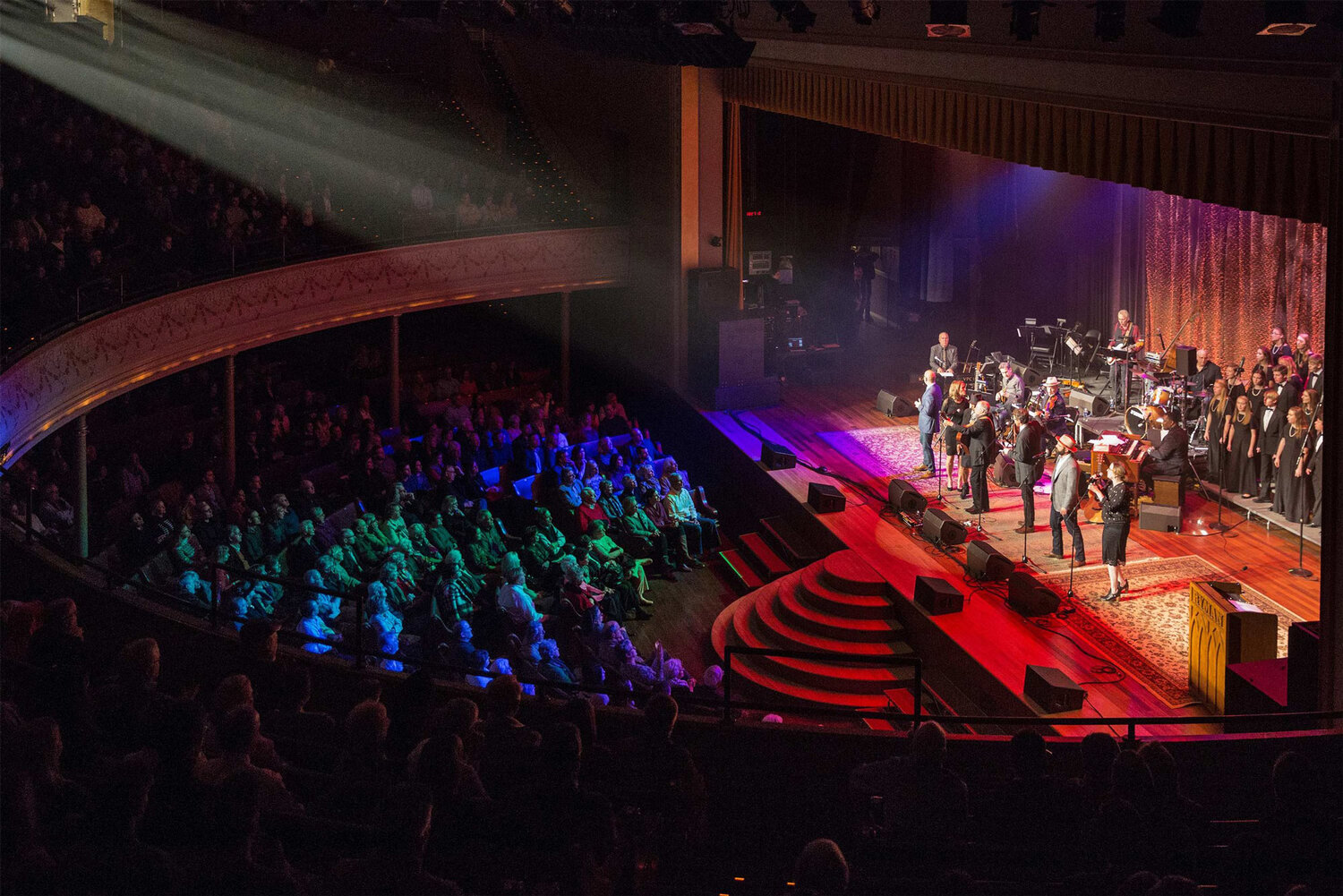
One media entity that does public theology really well is Tokens Media, which encompasses live events (Tokens Show), a podcast, a radio show, and online courses. Sponsored by Lipscomb University in Nashville with funding from the Lilly Endowment and the John Templeton Foundation, the shows are hosted and produced by Lee C. Camp, a professor of theology and ethics at Lipscomb.
Tokens Show blends music, theology, comedy, and social issues, bringing together a host of talent and thought from the local Nashville scene and the country at large for evenings of conversation and fun. See a trailer below, followed by a blurb from the Tokens press materials.
Called Nashville’s best variety show, our philosophical and theological events imagine a world governed by hospitality, graciousness, and joy; life marked by beauty, wonder, and truthfulness; and social conditions ordered by justice, mercy, and peace-making. We exhibit tokens of such a world in music-making, song-singing, and conversations about things that matter.
Unapologetically Christian but casting a wide net, Tokens Show spotlights poets, pastors, theologians, ethicists, historians, singer-songwriters, psychologists, journalists, politicians, activists, scientists, entrepreneurs, and other scholars and practitioners. Its long list of distinguished guests includes James Cone, Rachel Held Evans, Stanley Hauerwas, Miroslav Volf, Francis Collins, Jim Wallis, Tracy K. Smith, Keb’ Mo’, Christian Wiman, Naomi Shihab Nye, Walter Brueggemann, Amy-Jill Levine, Willie James Jennings, Pádraig Ó Tuama, Barbara Brown Taylor, Ricky Skaggs, Over the Rhine, and many more.
Tokens was launched in February 2008 as a quarterly event, generally held in Lipscomb’s Collins Alumni Auditorium, with its annual Thanksgiving show, a major bash, held at Nashville’s historic Ryman Auditorium since 2010. (This year’s is November 20—and I’ll be there! See more info at bottom of post.) The Tokens house band, the Most Outstanding Horeb Mountain Boys, consists of much-sought-after Nashville session players Byron House (upright bass), Pete Huttlinger (guitar), Aubrey Haynie (fiddle, mandolin), Chris Brown (drums), and Buddy Greene (harmonica, vocals), led by music director Jeff Taylor (piano, accordion).
Sojourners magazine praised Tokens Show for its substantive entertainment and overall playful tone:
If A Prairie Home Companion ever moved south and got religion—or at least went to divinity school—it might look a lot like TOKENS. While Camp and his cast deal with theology, they are after something bigger—glimpses of God’s action in the world . . . tokens of grace. . . . Camp knows the power of a pregnant pause, and how to switch from a song about environmental degradation to a radio skit without missing a beat. And the cast never seems to take itself too seriously.
One of Tokens Show’s regular segments is “Class and Grass,” where the house band plays a medley of classical music and bluegrass arranged by bandleader Jeff Taylor. For example, for Tokens’ 2019 Thanksgiving show, Taylor built a ruckus-raising medley around “Orange Blossom Special,” a fiddle tune from the 1930s named after a luxury passenger train of the same name, weaving in excerpts from Brahms’s Hungarian Dance No. 5, Bizet’s “Habanera,” Offenbach’s “Galop infernal,” and Rossini’s William Tell overture:
For their 2018 Thanksgiving show, they mashed up the Shaker hymn “Simple Gifts” with Aaron Copland’s Fanfare for the Common Man and “Did You Ever See the Devil, Uncle Joe?”:
“Für Elise and the Prophetic Imagination,” from “The Prophetic Ethic” show on June 6, 2014, features jazz, tango, and bluegrass variations on Beethoven’s famous, posthumously discovered bagatelle:
And the “Class and Grass” segment of Tokens’ April 13, 2010, show, “Back to Green,” combines a piano piece (anyone know what this is? Bach? Mozart?) and “Billy in the Lowground,” a popular fiddle tune among Kentucky musicians that has been known in Scotland for centuries:
Though several musical styles are represented on the Tokens stage—bluegrass, country, gospel, folk, blues, rock, classical—bluegrass predominates. Here’s a bluegrass version of the African American spiritual “My Lord Is a Rock in a Weary Land,” led by Buddy Greene:
And “Crying Holy Unto the Lord,” a song by Irene Amburgey that’s performed here by Bryan Sutton and Company:
One of the show’s past musical guests was Nefesh Mountain, a Jewish bluegrass band fronted by married couple Doni Zasloff and Eric Lindberg. Here they sing “Wayfaring Stranger” and “Esa Einai,” an original setting of Psalm 121:1 (“I lift my eyes to the mountains . . .”) in English and Hebrew.
Tokens Show also regularly features hymns, a significant part of Christian heritage, especially in the US. In the following video, Audrey Assad describes growing up in a Plymouth Brethren church that forbade the use of musical instruments but placed a high value on four-part a cappella singing. She then leads a vocal quartet in one of my favorite hymns, “Praise to the Lord, the Almighty” (the other singers are Michael Gungor, Buddy Greene, and Lee C. Camp):
Here’s an instrumental bluegrass hymn medley comprising “Where the Soul of Man Never Dies,” “Are You Washed in the Blood,” “Pass Me Not, O Gentle Savior,” and “Leaning on the Everlasting Arms”:
For some hymns, the audience is invited to sing along, as with “Pass Me Not, O Gentle Savior,” featuring soloist Jason Eskridge:
The show highlights new musical works as well, like singer-songwriter and upright bassist Scott Mulvahill’s “The Lord Is Coming”:
And Gungor’s “God and Country,” an antiwar anthem performed by Michael Gungor, Audrey Assad, and friends:
From their “Singing Down the Pain” show, I learned that the tune of Elvis’s “Love Me Tender” was taken from the American Civil War ballad “Aura Lee,” adopted by soldiers on both sides. I also learned about a historic music-sharing experience that happened outside Murfreesboro, Tennessee, on December 30, 1862, when, on the eve of a major military battle, Confederate and Union brass bands exchanged songs, Battle of the Bands–style, across enemy lines. Winding down, the Confederates started playing the familiar “Home, Sweet Home,” and the Union joined in, with soldiers from both North and South singing in unison their mutual longing for home.
Despite this bonding, the Battle of Stones River commenced early the next morning, resulting in 24,000 casualties.
As you can see from that video, Tokens Show is largely story-driven.
It occasionally features spoken-word pieces, as in their October 4, 2016, episode, “God Songs.” Leslie Garcia, one of Camp’s students at the time (now a digital product designer in New York), delivers a poetic reflection on the Latin American immigrant journey, drawing on her own family history. It opens, “My mother came to this country in the back of a pickup truck . . .”
Real-life questions and issues are met with the best of theological reflection at Tokens events, with Camp as emcee providing the connective tissue that links the various acts.
One thing I like about Tokens Show is how it recognizes the complexities of American Christianity’s past and present, painting neither as entirely good or entirely bad. It addresses some of the lamentable aspects of US and church history and culture, but it also speaks hope, confronting these realities with gospel truth so that we might humbly allow that truth to drive us to confession, action, and anticipation. And while it does acknowledge the ways in which sin has marked systems, it also celebrates those places within those systems where virtue or redemption can be found.
Tokens Show has a healthy relationship to tradition, which for them is a wellspring of creativity. In terms of music especially, Tokens showcases vibrant works from earlier eras but also, often, innovates on them or draws them into new contexts. In their theology, too, they adhere to the orthodox creeds while being open to what happens when those traditional tenets of belief are brought into so-called secular arenas of contemporary life, further unfolding their meaning. In the root sense of the words, Tokens is both conservative and progressive—conserving what’s worth conserving, leaving behind what’s not (such as cultural accretions that diminish the gospel), recovering and progressing toward the good, semper reformanda.
While some of the song selections may prompt nostalgia for some, Tokens Show is not all warm and cozy. There can be a bite and a challenge as we hear wrenching personal stories or encounter new facts. Tokens does not shy away from provocation for God’s sake. But it is to the show’s credit that the tone is never haranguing, always invitational.
The gospel calls us out of our bubbles and into the world. Our faith should have an impact on how we think about public issues and relate to others in the public square. Tokens Show models this kind of engagement.
During the COVID-19 pandemic, when live shows had to be shut down, Tokens launched a podcast, its first episode airing May 21, 2020. Its tagline is “Public theology. Human flourishing. The good life.” Even though live shows have resumed, the podcast continues to be active. I have enjoyed every single episode, but let me share just a few in particular:
>>“The Making of Biblical Womanhood: Beth Allison Barr,” June 3, 2021: Controversially, historian Beth Allison Barr defines “complementarianism,” the theological view that promotes male headship and female subordination, as “Christian patriarchy.” Hear her unpack that and other ideas from her book The Making of Biblical Womanhood: How the Subjugation of Women Became Gospel Truth in this episode. She offers a unique reading of 1 Corinthians 14 (bringing it into conversation with ancient Roman law codes); reminds us of the oft-neglected Romans 16 (which names a woman apostle and a woman deacon, among other early church leaders who were female, though several English translations obscure the fact); notes how the 1980s revival of the Arian heresy coincided with the explosion of “biblical womanhood”; and shares her and her husband’s personal connection to the topic in their ministerial life.
Shorter interviews of this nature also take place during the live shows, even though this blog article highlights the music.
You can subscribe to the Tokens podcast through the app of your choice, and episodes (audio only) are also posted on YouTube, though there’s a bit of a lag there. You can also find video excerpts from Tokens events on the Tokens YouTube channel.
Their annual Thanksgiving show this year is “No Small Endeavor”—Sunday, November 20, 7:30 p.m.,at Ryman Auditorium—with musical guest Johnnyswim, a husband-wife folk duo comprising Abner Ramirez and Amanda Sudano. As I mentioned, I’ll be going; I paid $137 for two tickets last week, including taxes and fees, and it looks like the house is already more than half-full. (There is also a $20 virtual option available, or a $47 virtual membership that gives you streaming access to four shows.) It will be my first Tokens Show and my first time in Nashville, and I’m making a long weekend of it with my husband. Let me know what we should do/see there, and if you have any tips on where to stay. We’re not country music fans, but bluegrass, gospel, blues, and folk—yes, please! We’re foodies too.
Besides catching one of Tokens’ live events, if you live in the Nashville area, you might also want to tune in to their radio show, which airs Sundays at 2 p.m. Central on WPLN Nashville Public Radio.
SPOTIFY PLAYLIST: October 2022 by Victoria Emily Jones: This month’s thirty-track assortment includes the jaunty “Now I’m on My Way” by Howard Smith and Frederick D. Fuller, performed by the Brooklyn Tabernacle Choir under the direction of Carol Cymbala, and the recently released “Good Tree” by the Hillbilly Thomists, a bluegrass band of Dominican friars.
+++
GOSPEL PERFORMANCE: “I’ve Got the Joy / It Is Summertime in My Heart / Give Me Oil in My Lamp” and “Do Lord” by The Four Girls: Did you know that Hollywood Golden Age actress Jane Russell was part of a traveling gospel music quartet, The Four Girls? In 1954, a year after starring with Marilyn Monroe in Gentlemen Prefer Blondes, she sang this medley on an Easter Sunday broadcast alongside fellow group members Connie Haines, Beryl Davis, and Rhonda Fleming (replacing Della Russell), who were Baptist, Episcopalian, and Mormon, respectively. Quite the interdenominational group! All four were active in the Hollywood Christian Group, founded in 1947 by Henrietta Mears.
That choreo, haha! And boy are they aggressive in their evangelism/catechesis of that little girl in the last number!
The Four Girls grew out of an impromptu performance at a fundraising event for St. Stephen’s Episcopal Church in Los Angeles in fall 1953. A representative of Coral Records was in the audience, and he signed the women immediately. Their recording of the spiritual “Do Lord” sold over 2 million copies.
+++
I get a kick out of Jack Black’s hammy character performances, especially the ones that involve singing. In each of the last two movies I saw him in, he plays a strangely likeable Christian criminal based on a real-life person.
In the dark comedy Bernie (2011) by Richard Linklater, Black plays Bernie Tiede, a small-town Texas mortician who befriends a wealthy widow but, when the emotional toll of her possessiveness and persistent nagging becomes too much, ends up killing her. The opening credit sequence (which comes after a scene of Bernie teaching a class, with great tenderness, on how to prepare a deceased body for viewing) shows him driving in his Lincoln Town Car, jamming to the Florida Boys’ “Love Lifted Me” on the radio. Millennium Entertainment has released a singalong version on YouTube, featuring a take from the movie with added lyrics and a bouncing Jack Black head!
Six years after this Golden Globe–nominated performance, Black starred in The Polka King (2017) as Polish American polka legend Jan Lewan, who was imprisoned in 2004 for running a Ponzi scheme. Although he’s a con artist, the movie portrays him as sympathetic—bright-eyed, kind, gentle—and devoutly Catholic. (Yes, he really did meet the pope!) The end credits feature Black as Lewan singing “Thank You So Much, Jesus,” written by Stephen Kaminski, Maya Forbes, and Wallace Wolodarsky for the movie. The repeated “dziekuje” is Polish for “thank you.” Enjoy the accent.
+++
SONG: “Morning Star Rise” by Josh White: Josh White is a singer-songwriter, the founding pastor of Door of Hope church in Portland, Oregon, and cofounder, with Evan Way, of Deeper Well Records. In the early 2010s he formed the neo-gospel collective The Followers, and encouraged one of his parishioners, Liz Vice, to get involved as a vocalist. She is featured on Deeper Well’s first record, Wounded Healer (2012), including on the song “Morning Star Rise”—performed live in 2012 in the video below, with White on lead. (Vice is on the left; Holly Ann is on the right.)
White recognized Vice’s musical talent and wrote a batch of songs for her to record on her own, which became her debut solo album, There’s a Light (2015)—an immense hit. Yay for pastors who notice and nurture the gifts of their people!
Psalm 91 (Psalm 90 in the Vulgate) is a psalm of protection, commonly invoked in times of hardship or before embarking on a journey. It conveys the sheltering presence of God, using the metaphor, tender and intimate, of a mother bird who cares for her fledglings, shading them under her wings and lifting them up out of danger. This image recurs throughout the Psalter and the Bible at large (see Pss. 17:8; 36:7; 57:1; 63:7; Exod. 19:4; Deut. 32:11).
Agnes Pelton (American, 1881–1961), The Primal Wing, 1933. Oil on canvas, 25 × 24 in. San Diego Museum of Art, California. Source: Agnes Pelton: Desert Transcendentalist, p. 113.
Let me quote the psalm in full, using the King James Version, whose poetic quality cannot be beat:
1 He that dwelleth in the secret place of the most High shall abide under the shadow of the Almighty.
2 I will say of the Lord, He is my refuge and my fortress: my God; in him will I trust.
3 Surely he shall deliver thee from the snare of the fowler, and from the noisome pestilence.
4 He shall cover thee with his feathers, and under his wings shalt thou trust: his truth shall be thy shield and buckler.
5 Thou shalt not be afraid for the terror by night; nor for the arrow that flieth by day;
6 Nor for the pestilence that walketh in darkness; nor for the destruction that wasteth at noonday.
7 A thousand shall fall at thy side, and ten thousand at thy right hand; but it shall not come nigh thee.
8 Only with thine eyes shalt thou behold and see the reward of the wicked.
9 Because thou hast made the Lord, which is my refuge, even the most High, thy habitation;
10 There shall no evil befall thee, neither shall any plague come nigh thy dwelling.
11 For he shall give his angels charge over thee, to keep thee in all thy ways.
12 They shall bear thee up in their hands, lest thou dash thy foot against a stone.
13 Thou shalt tread upon the lion and adder: the young lion and the dragon shalt thou trample under feet.
14 Because he hath set his love upon me, therefore will I deliver him: I will set him on high, because he hath known my name.
15 He shall call upon me, and I will answer him: I will be with him in trouble; I will deliver him, and honour him.
16 With long life will I satisfy him, and shew him my salvation.
The righteous will be protected, sings the psalmist, from sickness and attack, whether by arrow or by wild animal. Because of the psalm’s specific mention of plagues, or “deadly disease,” it became especially popular during the COVID-19 pandemic.
Now, we know from experience that some of these statements cannot be taken at face value. Physical harm does befall those who love God. Believers were among the “ten thousand” (and more) felled by the most recent raging pestilence. It’s wrong to conclude that this was a result of their lack of faith.
Biblical scholar J. Alec Motyer clarifies that “the promise [in Psalm 91] is not security from but security in.” That God looks after us is an absolute principle, but the Bible makes clear that no one is immune from suffering. Still, we can trust in God’s grace and strength and ultimate deliverance, and entreat him for specific protections. Bodily salvation won’t come in full until the new heavens and the new earth are ushered in, but we are kept spiritually in the shelter of our loving God.
That doesn’t mean Psalm 91 is a lie; it is poetry, and poetic language is often not meant to be literal. The assurances are still worth praying. God does often intervene on our behalf.
The ancient Jewish community at Qumran near the Dead Sea, through whom the oldest manuscript fragments of the Hebrew Bible come to us, referred to Psalm 91 as a “psalm against demons,” and it is thought to have been used by that community in exorcisms. Jewish midrash interprets many of the listed threats as veiled language for demons, and there is Christian precedent for that interpretation as well. In Luke 10:17, Jesus’s followers marvel that “Lord, in your name even the demons submit to us!,” to which Jesus affirms that yes, “I have given you authority to tread on snakes and scorpions and over all the power of the enemy, and nothing will hurt you”—language very similar to that in Psalm 91.
In the Late Antique era, both Jews and Christians wore the words of Psalm 91 on amulets, to attain or simply feel God’s guarding power. In the church it is traditionally sung or recited during Compline services and on the first Sunday of Lent (in Matthew 4:6 the devil manipulatively quotes verse 11 in his temptation of Christ in the desert).
This psalm has also influenced popular culture, as from it comes the concept of guardian angels (vv. 11–12).
Below I have selected fifteen musical settings or adaptations of Psalm 91 from diverse sources, including homophonic and polyphonic choral works, songs in indie folk and soul styles, a Puerto Rican hymn, a Nepali bhajan, and more.
For each I have embedded either a YouTube video or Bandcamp track, and if a Spotify link exists, I’ve included it at the end of the description. If you cannot see these music players in your email client or RSS feed reader, open the post in your browser.
This is a curation, not a collation, meaning that I’ve intentionally picked these songs from among hundreds of options, for both excellence and variety. I tried to limit the list to ten and just couldn’t, but I thought twenty would be too overwhelming, so I compromised by choosing fifteen with five honorable mentions. I’ve added almost all twenty to a YouTube playlist (the Sister Sinjin song isn’t available on that platform), if you prefer to listen that way.
1. Gregorian chant performed by Harpa Dei: Born in Germany and raised in Ecuador, siblings Nikolai, Lucía, Marie-Elisée, and Mirjana Gerstner form the sacred vocal quartet Harpa Dei. Here they sing Psalm 91 in Latin in the medieval plainchant tradition. Subtitles are provided in Spanish and English.
For a plainchant in English, albeit of verses 4–5 only, see here.
2. “Psalm 91” by Victory Boyd: This is probably my favorite of all the selections. Victory Boyd is one of seven musical siblings, and before she started her solo career, she was a member of the vocal-harmony sibling act Infinity Song. Her voice is gorgeous, as is this simple musical setting she wrote, conveying both the vulnerability and confidence present in the psalm.
3. “Psalm 91” by Poor Bishop Hooper: Every Wednesday since January 1, 2020, married couple Jesse and Leah Roberts, who record music under the alias Poor Bishop Hooper, have been releasing a new psalm-based song for free download as part of their EveryPsalm project. Handling them consecutively, they have just eight left to go! They made a live video for “Psalm 91,” which shows them playing their own piano four hands accompaniment. [Spotify]
4. “Qui habitat in adjutorio altissimi” (He who dwells in the shelter of the Most High)by Josquin des Prez, adapted by Laurel MacDonald: Josquin des Prez (pronounced “joss-can day pray”) was a highly influential Franco-Flemish composer of the High Renaissance. In 1542 he wrote a setting of Psalm 91[90]:1–8 in Latin for twenty-four voices (SATB ×6)—that is, six distinct soprano parts, six distinct alto parts, etc.
Inspired by this choral motet, in 2007 composer and video artist Laurel MacDonald worked with longtime associate John Oswald to create qui, a sound installation of twenty-nine voices singing an adaptation of des Prez’s “Qui habitat” in twenty-nine languages over twenty-nine speakers, for the Royal Ontario Museum in Toronto. MacDonald revisited the project in 2010, creating the short video “XXIX” (below) with twenty-one of the original qui singers, each singing in the language of his or her personal heritage. They weave a complex tapestry with interlocking threads of Krio, Spanish, Korean, Hungarian, Hindi, Greek, Finnish, English, French, Italian, Latin, Zulu, Xhosa, Sesotho, Georgian, Russian, English, Tamil, Hebrew, Swahili, Japanese, and Arabic—a multilingual declaration of God’s protective power.
To hear Josquin des Prez’s motet as originally conceived, click here.
5. “Your Wings” by Lauren Daigle: Lauren Daigle is one of the most popular CCM (contemporary Christian music) artists of the past decade. Two-time-Grammy-winning and with two platinum records, she is often compared to Adele in terms of her vocal style—soulful, rich, in a husky register. In April 2020 she released on YouTube a stripped-down, “social distancing” version of her Psalm 91–based song (written with Jason Ingram and Paul Mabury) from Look Up Child, with just her and a piano. You can get a sense of her strong stage presence from the video; here she hits the melody with both her voice and her body—bouncy on the verses, smooth on the refrain! [Spotify (studio version)]
6. “Whomsoever Dwells” by Sinéad O’Connor: “Whomsoever Dwells,” written with Ron Tomlinson, is one of nine Hebrew Bible–based songs that appears on Sinéad O’Connor’s stellar 2007 double album, Theology. (Thanks to Art & Theology reader Koen Desmecht for introducing me to this!) The acoustic performance below—from November 8, 2006, at The Sugar Club in Dublin—was released on disc one, subtitled “The Dublin Sessions,” and features guitars, fiddle, harp, and low whistle; the same song, arranged for a pop-rock band and recorded in a London studio, is on disc two. (I much prefer the acoustic version.)
“Theology is an attempt to create a place of peace in a time of war and to provoke thought,” O’Connor said. It is very “personal” and “emotional.”
7. “El que habita al abrigo de Dios” (Those Who Dwell in the Shelter of God) by Luz Ester Ríos de Cunaand Rafael Cuna: This 1943 hymn from Puerto Rico is a versification of Psalm 91 in Spanish by Luz Ester Ríos de Cuna, with music by her husband, Rafael Cuna (1907–1995). I learned of it from the bilingual hymnal Santo Santo Santo: Cantos para el pueblo de Dios (Holy, Holy, Holy: Songs for the People of God). Here it’s performed by musicians from Iglesia Central del Movimiento Misionero Mundial en el Perú (Central Church of the World Missionary Movement in Peru) in Lima. Their names are not given.
8. “Denn er hat seinen Engeln befohlen” (For he shall give his angels charge),MWV B 53by Felix Mendelssohn: Early Romantic composer Felix Mendelssohn, a Reformed Christian with Jewish ancestry, wrote this setting of Psalm 91:11–12 in German in 1844 for Berlin Cathedral, where he was serving as Generalmusikdirektor (royal composer of church music). It is for an unaccompanied eight-part choir, but he later reused it with orchestral accompaniment as movement 7 of his oratorio Elijah.
9. “No Harm Befall You (Psalm 91)” by Sister Sinjin: Released on the 2022 compilation album Joy to the World (Psalms 90–106) from Cardiphonia Music, “No Harm Befall You” was written by Elizabeth Duffy and is sung by her and Kaitlyn Ferry, who make up the Indianapolis folk duo Sister Sinjin. Their harmonies are a hallmark of their music.
10. “Psalm 91” by Sharyn:Sharyn (pronounced “sha-REEN”) is a Ugandan-born, London-based gospel/R&B singer-songwriter “whose mission is to spread the gospel through adventurous, original, and engaging music,” she says. She wrote “Psalm 91” during the height of the coronavirus, as that scripture passage is one she would read again and again as a source of comfort amid the uncertainty. “This song is an affirmation and a reminder of who God is, what He can do, will do and has done,” she says. “Never forget that God is faithful and his promises are the greatest form of protection we can ever have. His promises are your armor and shield.” The recording features Calibleubird on backing vocals. [Spotify]
11. “Shelter Me” by Buddy Miller: In a 2010 episode of PBS’s Soundstage, country-rock artist Buddy Miller performed a set with other Americana greats Emmylou Harris, Shawn Colvin, and Patty Griffin, including this original song (written with Julie Miller) from his 2004 album Universal United House of Prayer. “Shelter Me” is about not being scared in the face of disaster or war, for God is our hiding place. The song could apply to Psalm 57 just as well, which addresses the same themes as Psalm 91 and even uses the same language of sheltering under the wings of the Almighty. [Spotify (studio version)]
12. “Underneath the Shadow” by Tom Wuest: This is one of twelve quiet, sparsely instrumented songs that Tom Wuest recorded with his wife, Karen, which were written as their two young sons fell asleep. They all “draw their lyrics from the psalms and from our family’s joy in and meditation upon the good creation of God,” he says. Fitting indeed for meditation, “Underneath the Shadow” comprises just three simple lines: “Underneath the shadow of Your wings / We dwell underneath the shadow of Your wings / Hidden close to Thee, we find rest.” [Spotify]
13. “Mero Saransthaan (My Shelter)” by Suraj Khadka: A Nepali adaptation of Psalm 91, this bhajan (devotional song) from 2021 features traditional instruments from the Indian subcontinent: sarangi (vertical fiddle), bansuri (bamboo flute), and dholak, madal, and tabla (drums). Thanks to Dr. Paul Neeley at Global Christian Worship for alerting me to this one.
14. “Lang en gelukkig (Psalm 91)” (Long and Happy) by Psalmen voor Nu: Founded in 2002, Psalmen voor Nu (Psalms for Now) was a project in the Netherlands to set all 149 psalms (they combined Psalms 42 and 43) in Dutch to music, a task they completed in 2014 with the release of their eleventh album. Seeking “to introduce as many people as possible to the beauty and power of the psalms,” the team comprised some twenty theologians, poets, and composers, plus a band. They wanted the texts to be understandable and the melodies modern and singable. This particular song from the project was written by Liesbeth Goedbloed (words) and Roeland Smith (music) and released in 2013. It has a smoky nightclub vibe. I’ve copied the lyrics below. [Spotify]
[1] Als je bij de Allerhoogste woont, mag je in zijn schaduw slapen. Als je zegt: ‘De Hoogste is mijn huis. mijn God, ik kan op u vertrouwen’, dan mag je in zijn schaduw slapen.
[2] Het is God die jou bevrijdt van de dood, de zwarte dood. Hij dekt je met zijn vleugels toe. Ga maar slapen. Je bent moe. Zijn trouw zal jou beschermen. Dan kun je slapen, dan kun je slapen. God waakt over jou. Dan kun je slapen.
[3] Voor de angst die elke avond komt, hoef je niet meer bang te wezen, ook al spookt de zwarte dood weer rond, al sloopt een ziekte alle mensen, jij hoeft niet meer bang te wezen.
[4] Ook al komt de dood dichtbij, vallen duizend mensen om, toch zul jij altijd veilig zijn wat de rest ook overkomt en slechte mensen krijgen, durf je te kijken, durf je te kijken? hun verdiende loon. Durf je te kijken?
[5] Jij zei ooit: ‘Mijn God, u bent mijn huis. Geen ziekte komt de drempel over.’ Die ellende gaat je deur voorbij, sinds je dicht bij God ging wonen. Geen ziekte komt je drempel over.
[6] Zijn engelen staan klaar. Ze dragen je op handen. God stuurt ze met je mee. Je stoot je nergens aan. De leeuw, de draak, de adder jij loopt over ze heen.
[7] Want je houdt van mij, zegt God, en die liefde maakt je vrij. Ik dek je met mijn vleugels toe, omdat jij weet wie ik ben. Je kent mijn naam en roept me. Ik kom je redden, ik kom je redden. En ik antwoord jou: ik kom je redden.
[8] In de zwartste nacht blijft ik bij jou. Ik red je en ik geef je leven. Deze keer is alle eer voor jou. Ik zeg: Ik ben voor jou een zegen! Voor jou een lang gelukkig leven!
[Outro] Lang en gelukkig, lang zul je leven, lang zul je leven, lang en gelukkig, lang zul je le ven! [source]
15. “In Him I Will Trust” by Sherri Youngward: Covering Psalm 91:1–5, this is one of sixteen psalm-passage settings by Bay Area singer-songwriter Sherri Youngward. For more, see her two Scripture Songs albums.
If you appreciated this post and would like to see more like it in the future, please consider donating to my work. If you do, leave a note telling me which psalm you’d like me to do next!
>> “The Music of the Psalms in Church History” by W. David O. Taylor, Christ Church, Austin, Texas, October 1, 2022: “For two thousand years, Christians have found the Psalter to be an invaluable resource for worship and prayer. And, like the original psalmists, Christians have felt compelled and inspired to set the text of the psalms to music, of all sorts: from a cappella to choral, from folk to rock, from reggae to gospel, and more. In collaboration with local musicians, David Taylor, Associate Professor of Theology and Culture at Fuller Theological Seminary and author of Open and Unafraid: The Psalms as a Guide to Life, will explore how Christians in different periods of church history have sung the psalms within corporate worship,” spanning the apostolic, medieval, Renaissance, Reformation, modern, and contemporary eras.
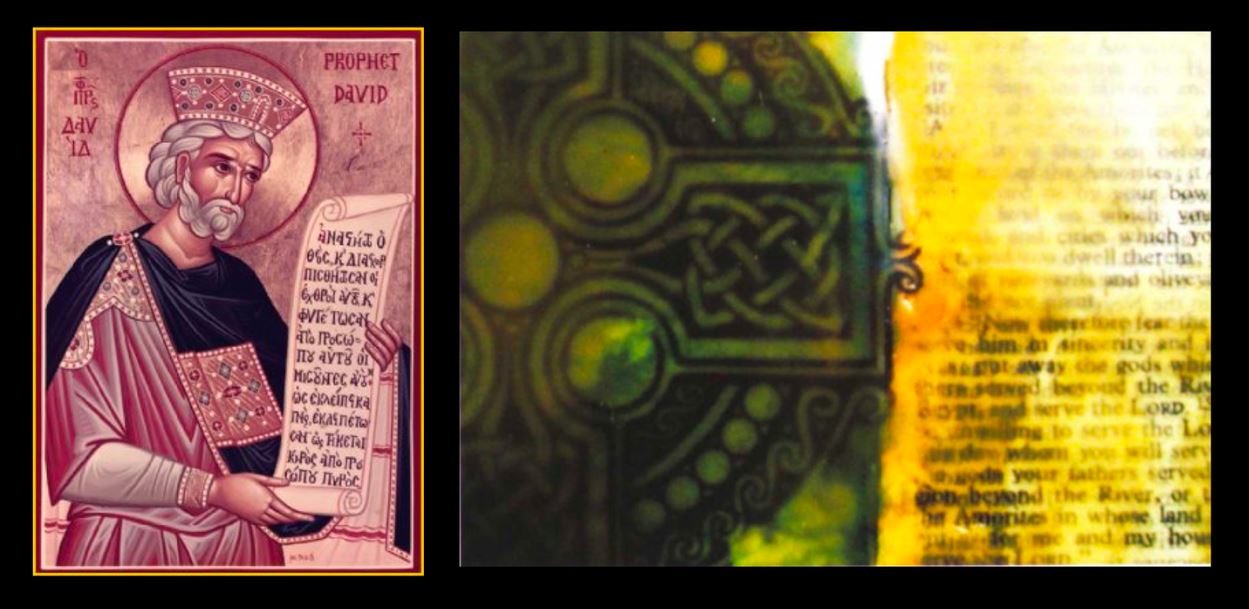
Left: Icon of the Holy Prophet-King David. Right: Celtic Cross with Bible Page, encaustic by Phaedra Jean Taylor.
A choir will perform several chants (Hebrew, Byzantine, Gregorian) and a motet, and then attendees will be led in a handful of Psalm-based songs, from a hymn of German origin to an African American spiritual to CCM classics. Along the way Taylor will provide historical context and trace a narrative.
Sponsored by the Brehm Center at Fuller Theological Seminary, the event is free, but registration is required and filling up; reserve your spot here. It will be recorded and eventually posted on the Fuller Studio YouTube channel (whether there will be a livestream is still TBD).
>> Baylor Symposium on Faith and Culture: Art Seeking Understanding, Baylor University, Waco, Texas, October 26–28, 2022: Every fall the Institute for Faith and Learning at Baylor University organizes a symposium around a given topic, and this year’s topic is the arts. Registration is still open! The standard cost is $250, or $125 for students. “The notion of art seeking understanding (ars quaerens intellectum) invites association with the notion of faith seeking understanding (fides quaerens intellectum). Just as faith is a gift of grace that grows toward deeper knowledge, so it seems that art is a gift whose practice leads to a deeper order of understanding. This seems true not only for the person who experiences art, but also the artist—whether musician, painter, sculptor, or poet. The 2022 Baylor Symposium on Faith and Culture invites contributions from across the disciplines (including scholars, artists, and other practitioners) as we explore together how art seeks understanding and thus contributes to human flourishing.”
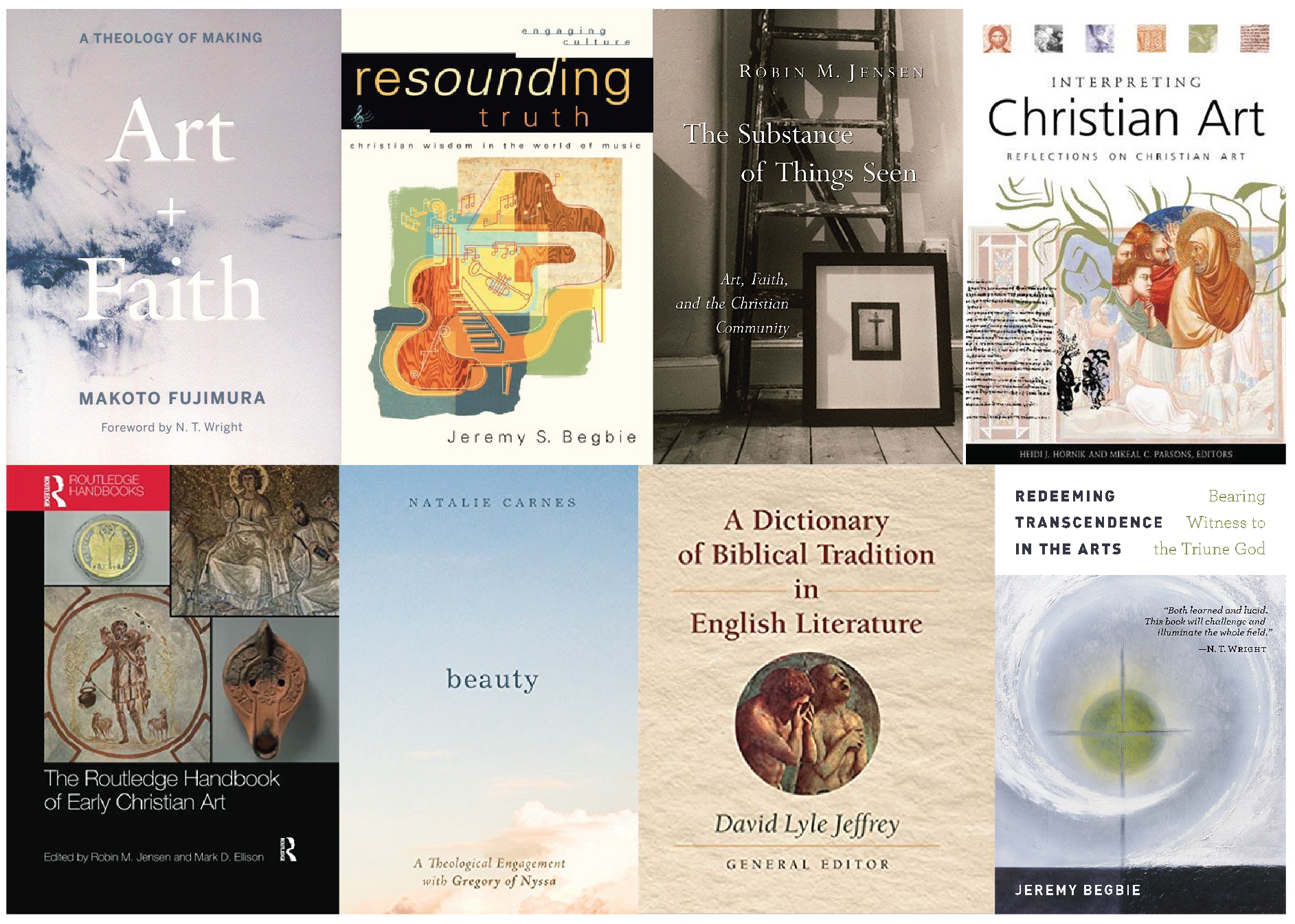
Their line-up of presenters includes several from within Baylor’s own distinguished ranks, such as composer and liturgist Carlos Colón, theologian Natalie Carnes, art historian Heidi J. Hornik, and literature scholar David Lyle Jeffrey, in addition to famous outside guests like theologian-pianist Jeremy Begbie, contemporary nihonga painter Makoto Fujimura, and Early Christian art historian Robin M. Jensen. See a full list by clicking on the boldface link above.
Just a fraction of the books authored by the eminent speakers at the upcoming Baylor symposium
The website does not provide a list of presentation titles, but among the topic suggestions on its call for proposals page are how art contributes to moral and spiritual perception, sensitivity, and/or character formation; the power of imagination; the relation of poetic art to the communication of moral truth; art therapy in pastoral counseling; how musical settings of biblical texts add value to those texts; and how to reconcile the making of religious art with the commandment in Exodus 20:4.
+++
SONG: “The Lord Is My Light” by Lillian Bouknight | Performed by the Notre Dame Folk Choir, dir. Emorja Roberson: “Very little is known about Lillian Bouknight (d. 1990), except that she was an African American from North Carolina, and a soloist and composer in the Pentecostal Holiness movement in the Aliquippam, PA, Community, also serving as a prayer warrior and on the Mother’s Board.” This setting of Psalm 27 that she composed appears in the African American Heritage Hymnal #160.
+++
VIDEO: “Theology through the Arts” by Jeremy Begbie: A pioneer of the field of theology and the arts, UK-born and US-based scholar Jeremy Begbie is the headliner for the Baylor symposium mentioned above. I met him briefly at a Duke conference a few years ago, and he’s such a delightful person, not to mention a phenomenal teacher who often dispenses wisdom from a piano bench. If you’re not familiar with his work, this fourteen-minute video is a great introduction to it. He’s all about demonstrating how instrumental music (his specialization is Western classical) can help unlock the truths of the Christian gospel. Here he talks about the given, the improvised, and the ministry of the Holy Spirit.
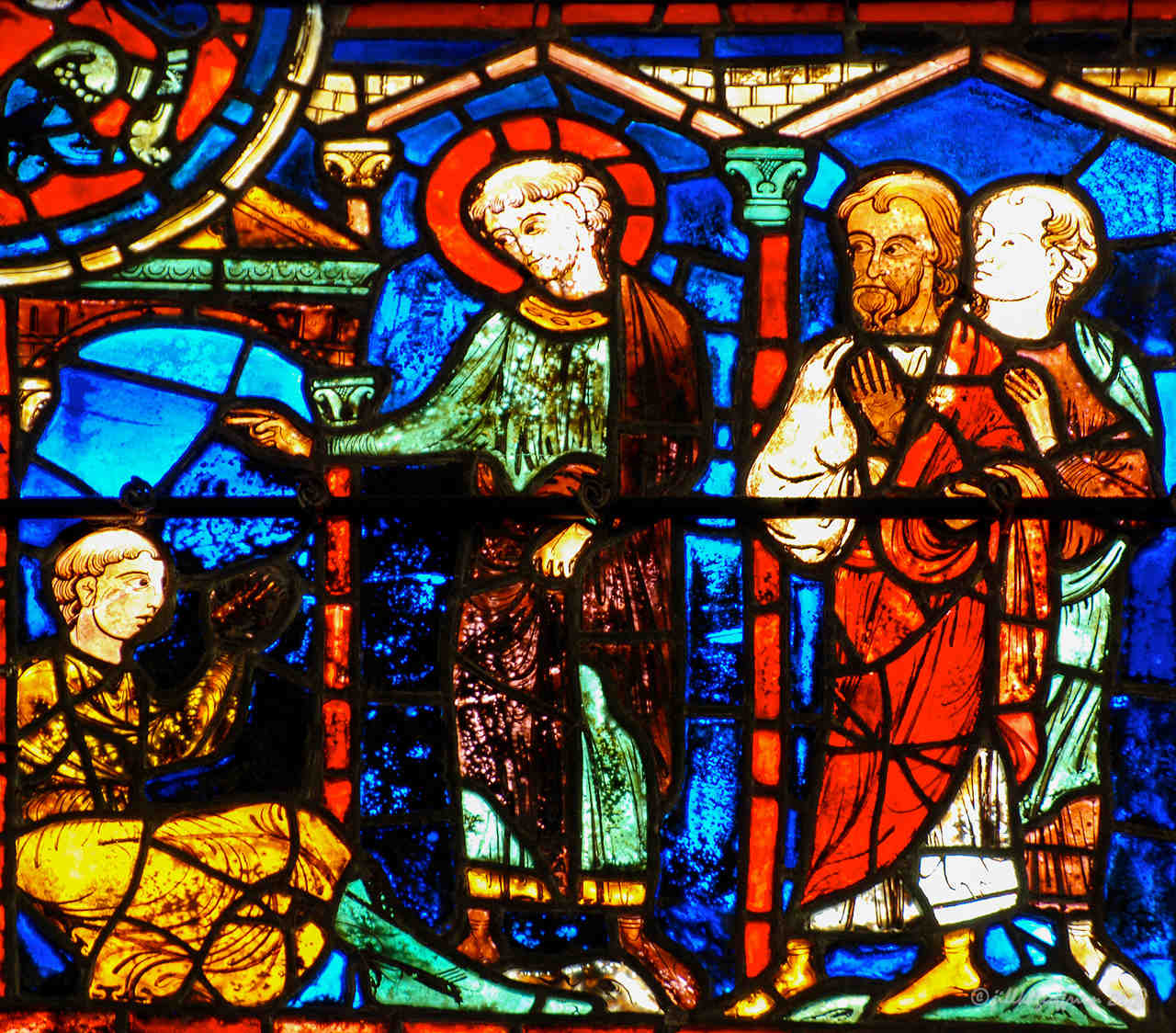
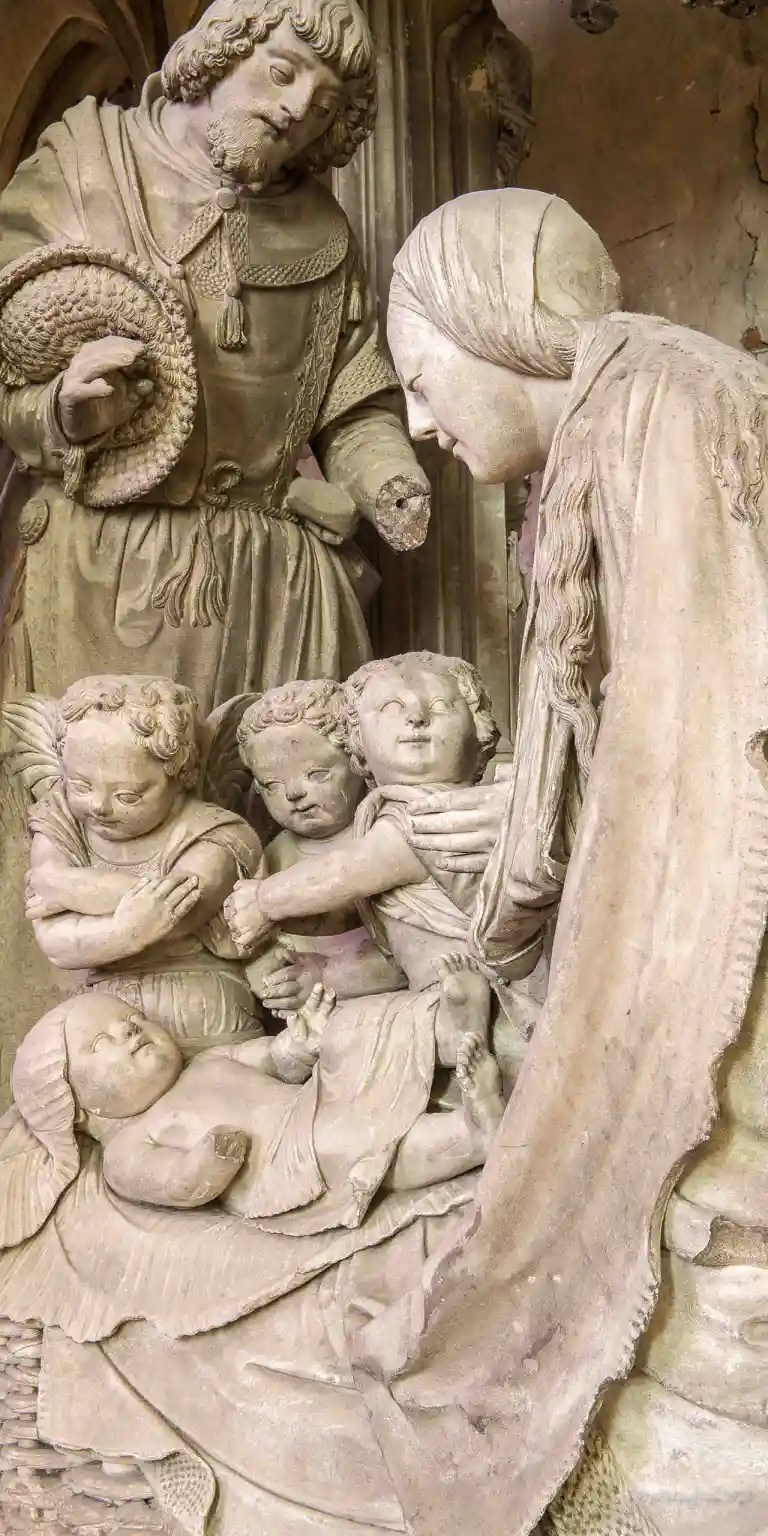
Geoffrion is also a professional photographer, and she shares many of her beautiful art photographs from Chartres on her blog, providing specific prompts for prayer and meditation based on the images. For example, in a post on the stained glass panel of Saint Martin bringing a man back to life, she writes, “Think of what is dead and needs resurrection in you, in those you love, in those who live within twenty-five miles of you, and in whatever country you call home. Then, take a very deep exhale and plead with God, ‘Bring resurrection!’” Or, reflecting on the sixteenth-century Nativity sculpture group attributed to Jehan Soulas, she invites us to “imitate one or more of the sets of eyes in the image . . . as you pray, ‘May I see with Your eyes, God. Teach me to see anew.’”
Saint Martin bringing a man back to life (with two onlookers), 1217–20, stained glass window panel in the south ambulatory at Chartres Cathedral, France. Photo: Jill Geoffrion.Jehan Soulas, Nativity, 1529, from the choir screen in Chartres Cathedral, France. Photo: Jill Geoffrion.
Geoffrion’s blog is a wonderful free resource for those looking to engage prayerfully with the art treasures of Chartres Cathedral. New content is typically posted in batches a few times a year, and the archive goes back to 2015. Sometimes Geoffrion digitally isolates certain details of the stained glass to aid in a more concentrated focus.
As I said when I featured the Tree of Jesse window several years ago, Chartres is high on my list of places to visit, for aesthetic, historical, and spiritual reasons. I hope to make it there sometime in the next five years.


 Art & Theology