A Little East of Jordan (Artful Devotion)

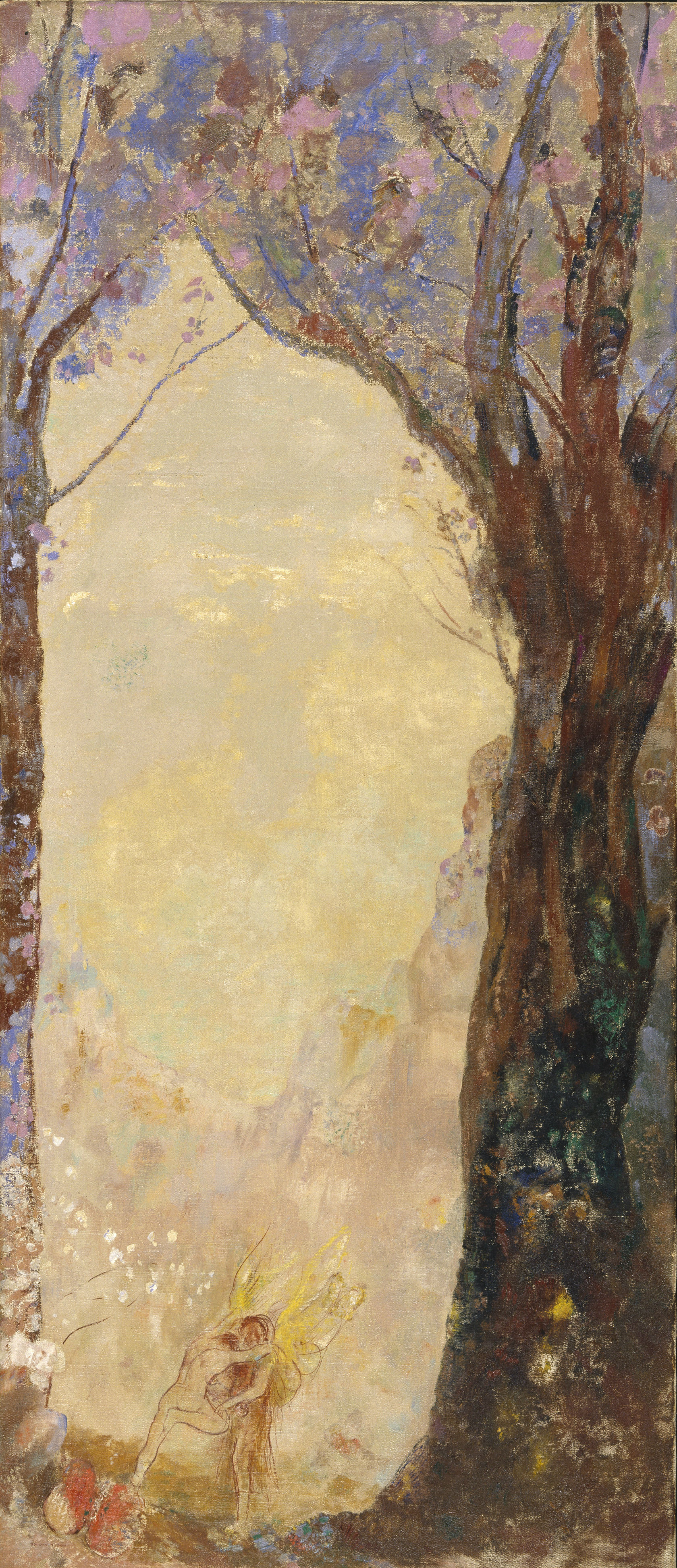
Redon, Odilon_Jacob Wrestling with the Angel
Odilon Redon (French, 1840–1916), Jacob Wrestling with the Angel, ca. 1905–10. Oil on canvas, 56 1/2 × 24 1/2 in. (143.5 × 61.9 cm). Brooklyn Museum of Art, New York.

And he rose up that night, and took his two wives, and his two womenservants, and his eleven sons, and passed over the ford Jabbok.

And he took them, and sent them over the brook, and sent over that he had.

And Jacob was left alone; and there wrestled a man with him until the breaking of the day.

And when he saw that he prevailed not against him, he touched the hollow of his thigh; and the hollow of Jacob’s thigh was out of joint, as he wrestled with him.

And he said, Let me go, for the day breaketh. And he said, I will not let thee go, except thou bless me.

And he said unto him, What is thy name? And he said, Jacob.

And he said, Thy name shall be called no more Jacob, but Israel: for as a prince hast thou power with God and with men, and hast prevailed.

And Jacob asked him, and said, Tell me, I pray thee, thy name. And he said, Wherefore is it that thou dost ask after my name? And he blessed him there.

And Jacob called the name of the place Peniel: for I have seen God face to face, and my life is preserved.

And as he passed over Penuel the sun rose upon him, and he halted upon his thigh.

—Genesis 32:22–31 (KJV)

+++

SONG: “Whilst falling asleep, Savta told me of Jacob” | Text by Emily Dickinson, ca. 1859 | Music by Dominic de Grande, 2017 | Performed by St. Salvator’s Chapel Choir, under the direction of Tom Wilkinson, on Annunciations: Sacred Music for the 21st Century, 2018 [listen on SoundCloud]

This choral composition was commissioned in 2016 as part of the TheoArtistry project [previously] of the Institute of Theology, Imagination and the Arts (ITIA) at the University of St. Andrews in Scotland, the aim of which is to reinvigorate dialogues between theologians and practicing artists. Emerging theologians from St. Andrews’ divinity school were paired with composers under the guidance of Sir James Macmillan to create six new choral settings of Hebrew Bible “annunciations,” communications of God to humankind. The collaborations are mutually beneficial: composers who may have no Christian background or no formal theological training but who want to contribute to the landscape of modern sacred music or seek out new lyrical content in the Bible are provided with textual exegesis and consultation by those who are learned in the fields of theology and biblical studies, and on the other hand theologians have Bible passages opened up to them in new ways through music, helping them to engage the texts on a more experiential level. Creative inspiration on both sides! Dr. George Corbett, director of TheoArtistry and an ITIA lecturer, says the St. Andrews divinity school wants composers and other artists to use them as a resource.

Dominic de Grande was one of six composers selected from an applicant pool of about a hundred to write a choral piece approximately three minutes in length that would be performable by a good amateur choir. He was assigned Jacob’s nocturnal wrestling match and was partnered with theologian Marian Kelsey, who oriented him to the ambiguity of the Genesis 32 narrative, the Hebrew wordplay, and the narrative’s appropriations in liturgy, literature, and visual art. De Grande chose to set Emily Dickinson’s poem on the subject, “A little East of Jordan”:

A little East of Jordan,
Evangelists record,
A Gymnast and an Angel
Did wrestle long and hard—

Till morning touching mountain—
And Jacob, waxing strong,
The Angel begged permission
To Breakfast—to return—

Not so, said cunning Jacob!
“I will not let thee go
Except thou bless me”—Stranger!
The which acceded to—

Light swung the silver fleeces
“Peniel” Hills beyond,
And the bewildered Gymnast
Found he had worsted God!

Because the tone of the poem is light and playful, de Grande scored it in the context of a grandmother telling the story to her grandchild at bedtime; he titled the composition “Whilst falling asleep, Savta told me of Jacob,” the word Savta being Hebrew for “grandmother.” It starts off gently, lilting, with a harmonic underpinning consisting of three chords. But, as Kelsey pointed out, the biblical text evokes a sense of danger and intensity, so after Dickinson’s third stanza, de Grande inserted a fragment from Genesis—“LET ME GO, FOR DAY IS BREAKING”—spoken by Jacob’s mysterious opponent. It’s sung as a burst of voices and organ, the latter six syllables introducing six new chords, evoking a sense of otherness. This demand forms a juxtaposition with the sweet, innocuous language of Dickinson’s angel, who politely asks permission to break for mealtime. After the interjection the piece returns to its gentler tone, as dawn dispels the “silver fleeces” of cloud and Jacob sits in the aftermath of the encounter. The human whistling throughout suggests something of the numinous.

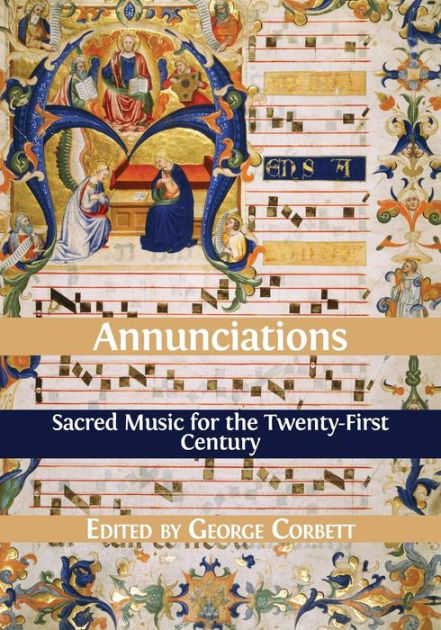
Annunciations (ITIA book)

To learn more about the TheoArtistry Composers’ Scheme, check out Annunciations: Sacred Music for the Twenty-First Century (2019), an open-source book available for free download as a PDF or for purchase in other formats. The book includes reflections on the collaboration process and other aspects of the project by all twelve participating theologians and composers (plus full scores! and links to audio) as well as chapters by various contributors on sacred music in worship settings versus secular settings, the theology of music, the vocation of the composer, moments of divine encounter in the ancient Near East, Mary as a model for creative people, the Gospel canticles in church liturgies, and more.

You can also watch this twenty-minute behind-the-scenes documentary:

The other “annunciations” in the TheoArtistry Composers’ Scheme are God speaking to Adam and Eve (Genesis 3), Moses and the burning bush (Exodus 3), the threefold calling of Samuel (1 Samuel 3), Elijah and the “sound of sheer silence” (1 Kings 19), and the Song of Songs 3:6–11.

+++

For an Artful Devotion from last year on this same biblical text, see “Wrestling Jacob”; it features a contemporary woodcut illustration from a German Bible and one of my favorite Charles Wesley hymns, with music from the shape-note tradition.

For theologically informed commentary by Natalie Carnes [previously] on three modern artworks of Jacob wrestling the angel, see The Visual Commentary on Scripture.


This post belongs to the weekly series Artful Devotion. If you can’t view the music player in your email or RSS reader, try opening the post in your browser.

To view all the Revised Common Lectionary scripture readings for Proper 13, cycle A, click here.

Victory Is Ours (Artful Devotion)

Alston, Charles_Walking
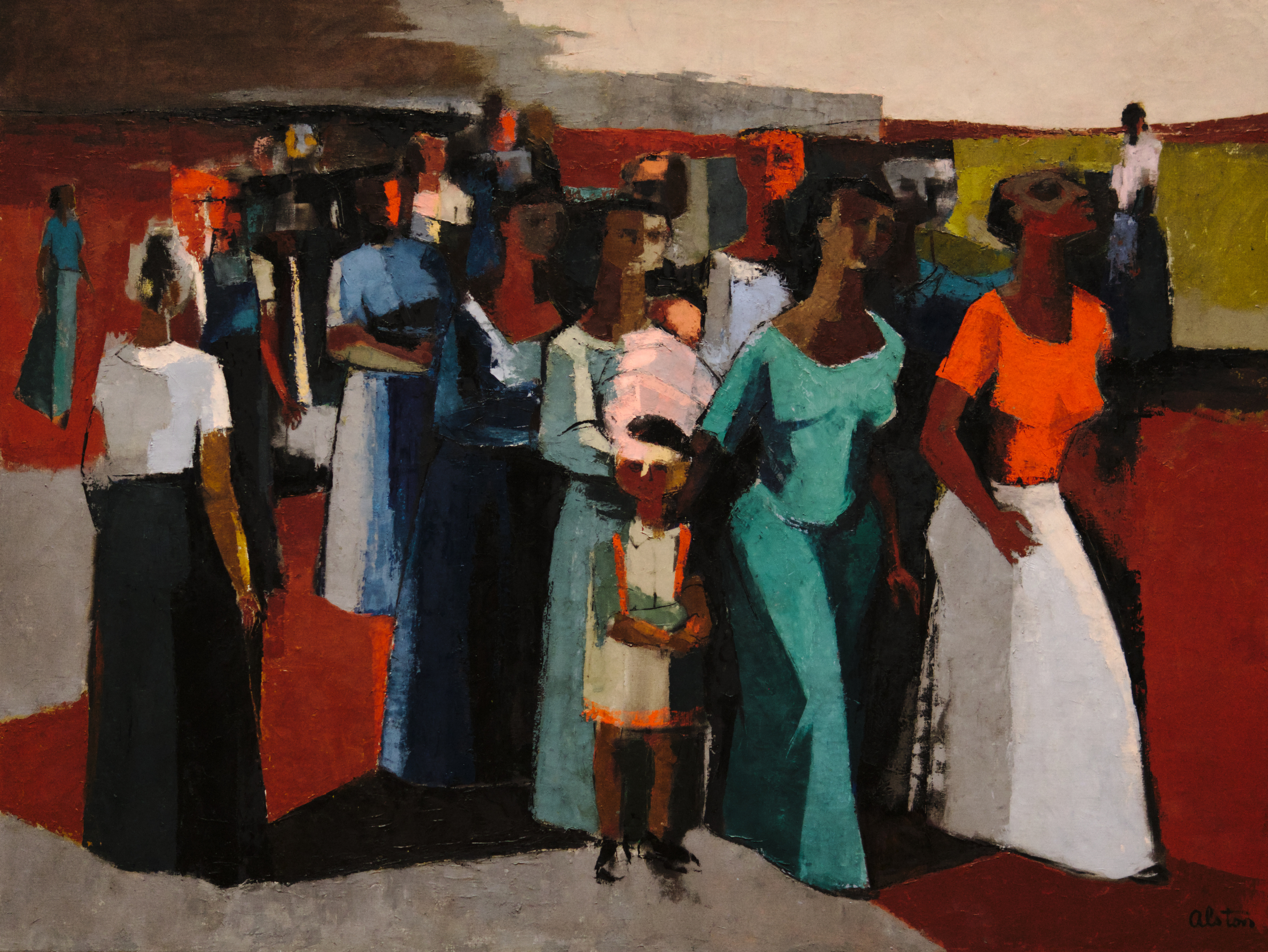
Charles Alston (American, 1907–1977), Walking, 1958. Oil on canvas, 48 3/8 × 64 3/4 in. (122.9 × 164.5 cm). Smithsonian National Museum of African American History and Culture, Washington, DC. Photo: Victoria Emily Jones.

If God is for us, who can be against us? . . . Who shall separate us from the love of Christ? Shall tribulation, or distress, or persecution, or famine, or nakedness, or danger, or sword? . . . No, in all these things we are more than conquerors through him who loved us.

—Romans 8:31b, 35, 37

+++

SONG: “Victory Is Ours,” a setting of a prayer by Desmond Tutu

Goodness is stronger than evil
Love is stronger than hate
Light is stronger than darkness
Life is stronger than death
Victory is ours through Him who loves us

First published in An African Prayer Book (Doubleday, 2006), this text is by Desmond Tutu, the famous South African Anglican cleric and theologian known for his work as an anti-apartheid and human rights activist. It has been set to music by several composers, most popularly John Bell but also James Whitbourn, David Schwoebel, Thomas Keesecker, and others. My favorite setting is the one in the video above, sung by an ecumenical choir from churches in and around Ridgewood, New Jersey, at the 2012 Hymn Festival at West Side Presbyterian Church. A few weeks ago I emailed the church’s music minister asking who the composer is but haven’t heard back, and extensive online searching has yielded no results. If you know who wrote the music, please do share! I’d also love to get my hands on some sheet music.

In the epistle reading from Sunday’s lectionary, the apostle Paul is writing to the church in Rome regarding religious persecution, assuring them that in Christ they have the power to face and overcome tribulations, distresses, and attacks of the enemy. Tutu extends that idea into the context of racial persecution, state-sponsored or otherwise. We must actively resist such injustice in the name of him who is Goodness, Love, Light, and Life. When we walk together in the Spirit on the side of these virtues, we will ultimately prevail against all counterforces.

+++

“A pivotal figure within the Harlem Renaissance, Charles Henry Alston was passionately dedicated to empowering African Americans through cultural enrichment and artistic advancement. Throughout his distinguished career as an artist and an educator, he continually sought to reclaim and explore racial identity with its complicated implications. Inspired by the modern idiom of Modigliani and Picasso, as well as African art, Alston’s work addresses both the personal and communal aspects of the black experience.” (Read more)

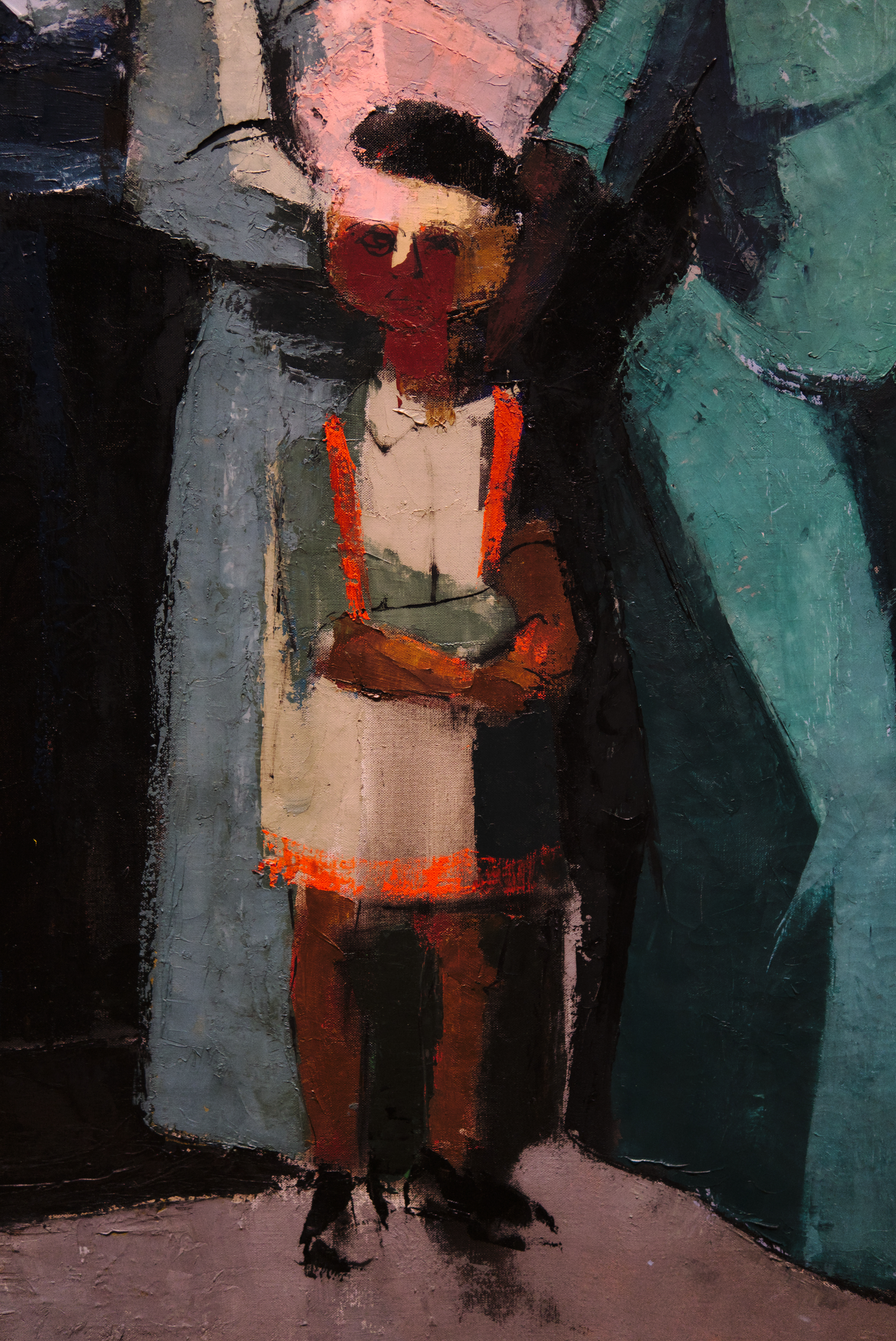
Alston’s Walking was inspired by the Montgomery bus boycott of 1955–56, a massive protest campaign against racial segregation in public transit, organized by black women’s political groups and facilitated through churches. The boycott was a seminal event in the civil rights movement in the US, coming years before the Selma to Montgomery marches in Alabama in 1965. “The idea of a march was growing,” Alston recalled of the time of the painting, 1958. “It was in the air . . . and this painting just came. I called it Walking on purpose. It wasn’t the militancy that you saw later. It was a very definite walk—not going back, no hesitation.”

Walking is part of the Smithsonian’s “Oh Freedom! Teaching African American Civil Rights Through Art” curriculum.

Alston, Charles_Walking (detail)

Alston, Charles_Walking (detail)


This post belongs to the weekly series Artful Devotion. If you can’t view the music player in your email or RSS reader, try opening the post in your browser.

To view all the Revised Common Lectionary scripture readings for Proper 12, cycle A, click here.

Roundup: Carrying a boulder, toppling statues, art and prayer retreat, and more

NEW SONG: “Trust in You” by Antoine Bradford: Alternative soul artist Antoine Bradford released the original song “Trust in You” on April 21, and then came this acoustic version, which simultaneously moves me and stills me! Another single, “How Many Times,” came out yesterday, and a full-length album is on its way, on the Humble Beast label.

+++

PODCAST EPISODES

“Andre Henry on Systemic Racism,” Conversing (Fuller Studio), May 7, 2020: Writer, musical artist, speaker, and activist Andre Henry sits down with Mark Labberton, president of Fuller Theological Seminary (where Henry earned a master’s in 2016), to share his personal journey of learning about systemic racism and some of the ways he’s exposing and pushing against it. He talks about growing up the son of Jamaican immigrants in Stone Mountain, Georgia, and the early influence of reggae music; his moving to New York City during the age of stop-and-frisk to take a job as a worship leader; and his time at Fuller in California, where, in the wake of Freddie Gray’s death, he shifted from the perspective of “Black people are treated differently in the US” to “The US is a fundamentally racist society.”

Along the way, he discusses “whiteness” as an invention made to subjugate other people, not letting the news cycle dictate when you talk about racism, his study of social movement theory and the post-Shoah theologians, his realization that black people are not powerless, his writing the songs “It Doesn’t Have to Be This Way” and “How Long,” the failure of many (white) church ministers to minister to black congregants, the resistance he met while interviewing for pastoral positions, the religious doubts that surfaced after repeatedly hearing from Christian friends that “Racism isn’t a priority for God” and that social activism distracts from the gospel, and more.

I particularly appreciated hearing Henry describe, starting at 28:36, an art piece he performed over the course of six months in 2016, in which he pulled around a hundred-pound boulder in a wagon everywhere he went—work, classes, dinners, church, grocery store, etc. The boulder was painted white and had words like “Mass incarceration,” “police brutality,” and “white fragility” written on it. Labberton, who was one of the many witnesses of this performance, interprets its intent as “I’m trying to externalize a burden that is the burden that I walk with every day, and I want you to see it for what it actually is, and the weightiness of it.” “Stunning,” “profound,” “a significant liturgical act,” and “a Jeremiah kind of an enactment” are some of the ways Labberton describes Henry’s boulder-carrying, the latter referring to the biblical prophet’s outrageous symbolic acts, such as the retrieval of soiled, tattered underwear, the breaking of a clay jug, and the wearing of an oxen yoke. (As a side note, one of my all-time favorite articles from the esteemed Image journal is “The Avant-Garde and Sacred Discontent: Contemporary Performance Artists Meet Ancient Jewish Prophets” by Wayne Roosa.)

Andre Henry carrying a boulder

To learn more about Andre Henry, visit his website, http://andrehenry.co/, where you can find his Hope and Hard Pills podcast, blog, and music and sign up for his newsletter. See also his self-introduction on Twitter and the short video Fuller Studio made with him in 2016, “Culture Care and Music.”

“Why Christians Have a Reputation for Smashing Statues,” Quick to Listen, interview with Matthew Milliner, July 8, 2020: Following the killing of George Floyd in May, protesters have torn down or vandalized dozens of statues connected to the Confederacy and to other controversial historical figures like Christopher Columbus. Matthew Milliner, associate professor of art history at Wheaton College, joins Christianity Today’s global media manager Morgan Lee and editorial director Ted Olsen “to discuss how much earlier Christian battles over statues echo today’s fights, what Christians have learned that might help us better understand the call to remove statues today, and whether we should even be creating memorials and monuments in the first place.”

Milliner references the Emancipation Memorial and Mary McLeod Bethune statue in DC’s Lincoln Park; the National Memorial for Peace and Justice in Montgomery, Alabama [previously]; Maya Lin’s Vietnam Veterans Memorial; the St. Augustine Foot Soldiers Monument; and UNC–Chapel Hill’s Silent Sam monument to the Confederacy and lesser-known Unsung Founders Memorial. After the interview he created a chart titled “What to Do with Monuments,” providing five options and citing historical analogues as well as contemporary examples in the US and internationally.

+++

OBITUARY: “Ennio Morricone, Oscar-Winning Composer of Film Scores, Dies at 91”: Regarded as one of the most influential film composers of all time, Ennio Morricone wrote over four hundred scores for cinema and television, as well as over a hundred classical works. I know him best for the soundtrack of The Mission, especially the “Gabriel’s Oboe” theme, which is played in the movie by the Spanish Jesuit priest Father Gabriel (Jeremy Irons) as an outreaching gesture of friendship to the Paraguayan Guarani.

+++

ONLINE RETREAT: “The Art of Prayer” with Monsignor Timothy Verdon: On August 7 Paraclete Press is hosting an online retreat with Monsignor Timothy Verdon, a Roman Catholic priest and art historian based in Florence, Italy. As in his book Art and Prayer: The Beauty of Turning to God, Msgr. Verdon will reflect on the ways in which visual art has historically supported, and can still support, prayer, guiding participants in meditating on images from the lives of Christ, Mary, and the saints. View the schedule and reserve your ticket here.

Timothy Verdon

+++

CHORAL ANTHEM: “Lead Me, Lord” | Text: Psalm 5:8, Psalm 4:9 | Music by Samuel Sebastian Wesley, 1905 | Performed by the Chapel Choir of Girton College, Cambridge, June 2020 [HT: Malcolm Guite]

Lead me, Lord,
Lead me in thy righteousness;
Make thy way plain before my face.
For it is thou, Lord,
Thou, Lord, only,
That makest me dwell in safety.

Truly Grateful (Artful Devotion)

McIver, Beverly_Truly Grateful
Beverly McIver (American, 1962–), Truly Grateful, 2011. Oil on canvas, 30 × 30 in. (76.2 × 76.2 cm). North Carolina Museum of Art, Raleigh. Photo: Victoria Emily Jones.

I give thanks to you, O Lord my God, with my whole heart,
and I will glorify your name forever.
For great is your steadfast love toward me;
you have delivered my soul from the depths of Sheol.

. . . You, O Lord, are a God merciful and gracious,
slow to anger and abounding in steadfast love and faithfulness . . .

—Psalm 86:12–13, 15

+++

SONG: “Gospel Medley” by Beyoncé Knowles, Kirk Franklin, and Richard Smallwood | Performed by Destiny’s Child, on Survivor (2001)

The liner notes of Survivor credit Beyoncé [previously], Kirk Franklin, and Richard Smallwood as the writers of this song, but from what I can tell, the credit goes mainly to Beyoncé, who has woven together different gospel fragments and, it seems, written the first two-thirds of the song, which fan web pages say is an interpolation of Franklin’s “Now Behold the Lamb” and “So Good” (I myself can’t hear much of a resemblance). This is followed by a gospel rendition of the Anna B. Warner hymn “Jesus Loves Me” that is much like the one Michele Lamar Richards and Whitney Houston sing in the 1992 movie The Bodyguard. The medley concludes with the “Amen” section of Smallwood’s “Total Praise.”

+++

About the above painting by Beverly McIver, the North Carolina Museum of Art writes,

McIver is renowned for her expression-filled, emotive canvases that commemorate her life and the lives of those closest to her—in particular, her mother, who passed away in 2004, and her sister, who is mentally disabled. Such works reveal as much about the artist as they do about the subjects portrayed therein. As McIver has noted about her paintings, “All of my portraits are self-portraits,” says the artist. “I use the faces of others who reflect my most inner being.”

In Truly Grateful, the artist moves her focus away from her family and back towards herself, and the resulting self-portrait is one of quiet, contemplative acceptance. The artist represents herself at bust length, draped in a bright blue scarf, with her head bowed and eyes closed, perhaps in midst of prayer. McIver’s signature brushwork, patchy and lively, adds a marked contrast to an otherwise peaceful scene. She does not highlight any other figures or objects in this canvas, allowing the viewer to focus solely on the artist herself and her emotional state. The yellow-orange background surrounds her figure with a warm glow, reminiscent of the traditional gold-leaf ground seen in traditional European icons. As a result, the painting exudes a calming, almost spiritual atmosphere.

It is possible to examine McIver’s personal biography to determine the significance of the title, Truly Grateful. Over the past five years, McIver has grappled with the ongoing repercussions of her mother’s death. Her mother’s passing left Renee, McIver’s sister, without a caretaker to provide her with the assistance, comfort and protection required due to her disabilities. McIver, bolstered by a promise made to her mother years prior, became Renee’s primary guardian, taking on all related responsibilities and allowing her sister to move into her home. After years of struggle, Renee recently moved into her own apartment complex for the handicapped and disabled, freeing McIver to pursue her artistic career at a more fervent pace while being reassured of Renee’s continued care and contentment.


This post belongs to the weekly series Artful Devotion. If you can’t view the music player in your email or RSS reader, try opening the post in your browser.

To view all the Revised Common Lectionary scripture readings for Proper 11, cycle A, click here.

“The Servant Song” by Richard Gillard

Written by British New Zealander Richard Gillard in 1977, “The Servant Song” (CCLI #72673) is such a beautiful expression of the Christian call to community and friendship, marked by selfless service, a walking alongside, and the bearing of one another’s joys, sorrows, and fears.

Here’s a 2015 performance by Father Cyprian Consiglio, prior of New Camaldoli Hermitage in Big Sur, California, and Brother James Makil:

And, from 2017, a performance by Lowana Wallace [previously], accompanied by Matt Froese on guitar. Wallace has one of the most gorgeous voices I’ve heard.

The first line was originally written as “Brother, let me be your servant” but has since been updated to be gender-inclusive, as either “Brother, sister, let me serve you” or “Will you let me be your servant.” Wallace uses “Sister” as the address in the first verse and then “Brother” in the repeat of that verse at the end.

Will you let me be your servant
Let me be as Christ to you
Pray that I may have the grace
To let you be my servant too

We are pilgrims on a journey
Fellow travelers on the road
We are here to help each other
Walk the mile and bear the load

I will hold the Christ-light for you
In the nighttime of your fear
I will hold my hand out to you
Speak the peace you long to hear

I will weep when you are weeping
When you laugh, I’ll laugh with you
I will share your joy and sorrow
Till we’ve seen this journey through

When we sing to God in heaven
We will find such harmony
Born of all we’ve known together
Of Christ’s love and agony

Will you let me be your servant
Let me be as Christ to you
Pray that I may have the grace
To let you be my servant too

Jesus’s words to his disciples in Matthew 20:26–28 inspired the song’s main theme: “But whoever would be great among you must be your servant, and whoever would be first among you must be your slave, even as the Son of Man came not to be served but to serve, and to give his life as a ransom for many.” Other scriptural allusions include “And if anyone forces you to go one mile, go with him two miles” (Matt. 5:41), “Rejoice with those who rejoice, weep with those who weep” (Rom. 12:15), and “Bear one another’s burdens, and so fulfill the law of Christ” (Gal. 6:2).

Girded with Joy (Artful Devotion)

Klee, Paul_Joyful Mountain Landscape
Paul Klee (Swiss, 1879–1940), Heitere Gebirgslandschaft (Joyful Mountain Landscape), 1929. Oil on board, 17 5/16 × 24 13/16 in. (43.9 × 63.1 cm). Yale University Art Gallery, New Haven, Connecticut.

By awesome deeds you answer us with righteousness,
O God of our salvation,
the hope of all the ends of the earth
and of the farthest seas;
the one who by his strength established the mountains,
being girded with might;
who stills the roaring of the seas,
the roaring of their waves,
the tumult of the peoples,
so that those who dwell at the ends of the earth are in awe at your signs.
You make the going out of the morning and the evening to shout for joy.

You visit the earth and water it;
you greatly enrich it;
the river of God is full of water;
you provide their grain,
for so you have prepared it.
You water its furrows abundantly,
settling its ridges,
softening it with showers,
and blessing its growth.
You crown the year with your bounty;
your wagon tracks overflow with abundance.
The pastures of the wilderness overflow,
the hills gird themselves with joy,
the meadows clothe themselves with flocks,
the valleys deck themselves with grain,
they shout and sing together for joy.

—Psalm 65:5–13

Psalm 65 is a such a magnificent praise song, and I especially love the expression in verse 12: “the hills gird themselves with joy” (ESV). Other translations have “the little hills rejoice on every side” (KJV), “the hillsides blossom with joy” (NLT), and “the hills [are set] to dancing” (MSG). The picture extends into the final verse, where, along with pastures, meadows, and valleys, the mountains “shout and sing” to their Creator. Last year when I saw Paul Klee’s Joyful Mountain Landscape at the Yale University Art Gallery, I instantly thought of this psalm—of how nature sings praises to God simply by being itself.

Human beings are called to join in creation’s joyful song.

[Related post: “Creation’s Praise” (Artful Devotion)]

+++

SONG: “I Sing the Mighty Power of God” | Words by Isaac Watts, 1715 | Music (tune: ELLACOMBE) from Gesangbuch der Herzogl, Württemberg, 1784

I sing the mighty power of God
that made the mountains rise,
that spread the flowing seas abroad
and built the lofty skies.
I sing the wisdom that ordained
the sun to rule the day;
the moon shines full at his command,
and all the stars obey.

I sing the goodness of the Lord
that filled the earth with food;
he formed the creatures with his word
and then pronounced them good.
Lord, how thy wonders are displayed,
where’er I turn my eye,
if I survey the ground I tread
or gaze upon the sky.

There’s not a plant or flower below
but makes thy glories known,
and clouds arise and tempests blow
by order from thy throne;
while all that borrows life from thee
is ever in thy care,
and everywhere that man can be,
thou, God, art present there.

For a fairly traditional rendition of this classic hymn, here’s a three-part a cappella arrangement performed by the Ball Brothers in 2012:

If you prefer a more modern sound, check out the version by Ben Thomas on the 2015 album Bring Forth. Thomas wrote a new melody for the song and recorded it under the title “I Sing the Goodness” (using the language of verse 2 instead of 1).

The whole Bring Forth album is great, which takes as its basis thirteen hymn lyrics dating from the fourth through twentieth centuries—“all seeking to find the Divine in the everyday elements of our existence,” Thomas says. Thomas adapted and retuned the hymns and released them in three movements that echo the cycle of time: Dawn, Day, and Dusk. To guide you through your listening, there is a meditation and prayer for each movement published on his website.

Other favorites of mine from the album are “Creator God, Creating Still,” “Tell Me the Old, Old Story,” “Lord of All Being,” “Peace, Troubled Soul,” and “Bring Forth.”


This post belongs to the weekly series Artful Devotion. If you can’t view the music player in your email or RSS reader, try opening the post in your browser.

To view all the Revised Common Lectionary scripture readings for Proper 10, cycle A, click here.

Rest (Artful Devotion)

Lenbach, Franz von_The Red Umbrella
Franz von Lenbach (German, 1836–1904), The Red Umbrella, ca. 1860. Oil on paper mounted on cardboard, 10 1/2 × 13 3/5 in. (26.9 × 34.6 cm). Hamburger Kunsthalle, Hamburg.

Come to me, all who labor and are heavy laden, and I will give you rest.

—Matthew 11:28

+++

SONG: “Rest” by Ken Burton, 2009 | Performed by the Aeolians of Oakwood University, on Aeolianology A Cappella, vol. 1, 2015

Sheet music is available for purchase at https://www.alfred.com/rest/p/12-0571519865/.


This post belongs to the weekly series Artful Devotion. If you can’t view the music player in your email or RSS reader, try opening the post in your browser.

To view all the Revised Common Lectionary scripture readings for Proper 9, cycle A, click here.
Roundup: Why Art Matters, “Spirit and Endeavour” exhibition, and more songs in lockdown

VIDEO TALK: “The Breath of Life: Why Art Matters in a Pandemic” by James K.A. Smith: In this half-hour Zoom talk released June 2, Image journal editor in chief Jamie Smith [previously] discusses the ability of the arts to stimulate our cultural imagination in much-needed ways. “The arts matter in a pandemic,” he says, “because they shape us for the work of reshaping and rebuilding society. In other words, we all need artists to continue creating for us so the rest of us can cultivate the imagination we need to re-create our common life, our social bonds.” And again: “The arts train our imagination so that we relearn to see what we need to see. . . . It’s art as imagination therapy, it’s art as an ophthalmology of the soul that we need in order to build and sustain and restore the institutions of a healthy, flourishing society. . . . If we’re going to imagine the world otherwise, we need imaginations that are trained in subtlety, that have been humbled by mystery, and that are infused with infinity.”

At 14:44 Smith introduces three ways in which art matters during and after a pandemic: art helps us (1) attend, (2) transcend, and (3) mend. That is, art helps us attend more carefully to the world and our neighbors, calling sometimes for gratitude, sometimes for grief, often both; art helps us transcend despair, attesting to the “something more” we long for (“the arts enable us to transcend the tragic when they invite us into a joy that forgets nothing”); and art helps us mend our tattered social fabric by helping us to better understand one another and to imagine possibilities. For each of these functions he provides a few concrete examples, including the current Home Alone Together exhibition.

Kitchen
Photo by Yola Monakhov Stockton, May 17, 2020, for the “Home Alone Together” exhibition

+++

Along these same lines . . . at the end of the Makers & Mystics podcast episode “Art as Healing,” recorded live last year at The Farm House in Charlottesville, Virginia, and released June 5, 2020, host Stephen Roach reads an excerpt from a book he’s writing:

In our present day, it can be easy to conclude from the various crises taking place around the world, all the injustice and political unrest, the rampant poverty and environmental threats, persecution and killings, diseases and displacements, that art and beauty are mere luxury. It could even make some feel that to focus on art and beauty is insensitive or shortsighted. However, I want to suggest that it’s precisely because of these desperate situations that the artist is called upon to beautify the world with art and engage these issues from a vantage point of hope.

The desperate situation in our world calls for the artist to emerge as a prophetic voice for change and to offer heaven’s alternatives. I’m reminded of the example of Iraqi cellist Karim Wasfi, who countered the tragedy of war by playing music at the sites of car-bomb explosions, with smoldering buildings in the background of his concertos. Wasfi said, “The other side chose to turn every element, every aspect of life in Iraq into a battle and into a war zone. I chose to turn every corner of Iraq into a spot for civility, beauty, and compassion.”

This is the call of the artist in collaboration with God: we are called to be the architects of hope and to counter the destruction of life with the opposite spirit in beauty and creativity.

Here’s a video of Wasfi playing an original cello composition in the destroyed buildings of Al Shifa Hospital in Mosul, Iraq, in September 2018, where some two thousand explosive hazards were removed by UNMAS (United Nations Mine Action Service):

It reminds me of a photograph by Julie Adnan that I saw in National Geographic a decade ago and that, of all the extraordinary photos published in that magazine, has stuck with me the most. Its caption reads, “Some 160 miles northeast of Baghdad, in a Sulaymaniyah music hall ravaged by war, looting, and neglect, a violin-playing boy sounds a note of hope. His teacher, Azad Maaruf, lives there, instructing scores of students.”

Boy playing violin
Photo by Julie Adnan, taken in Sulaymaniyah, Iraq, published in the February 2010 issue of National Geographic

The expression “fiddling while Rome burns,” which legend says the emperor Nero did in 64 CE, is used deprecatingly to refer to the doing of something trivial and irresponsible during a crisis. But beauty is not trivial, and its pursuit during times of crisis does not indicate apathy. I love that this little boy wants to play music while bombs sound out around him. Making art can be a daring act of resistance, an assertion of and call to common humanity, a better way. It’s life-affirming. As artist Laura Bon says: “Artists need to create on the same scale that society has the capacity to destroy.”

+++

NEW SONG: “The Medicine” by Dee Wilson: Dee Wilson of Common Hymnal premiered this song on his YouTube channel on May 27, and then Good Shepherd New York and friends put together a beautiful arrangement for the church’s June 7 virtual worship service. It’s a prayer that God would save us from the virus of racism, which harms and divides. The chorus goes: “We don’t know what to do, so we turn our eyes to you. We’ve run out of words to say. But if you come and have your way, you can save us from ourselves before our wounds hurt someone else. We need you now.” The video features Wilson on lead vocals, Liz Vice on background vocals, Orlando Palmer and Charles Jones on keyboard, Franklin Rankin on guitar, Michael Decena on bass, and Terence F. Clark on drums.

Every Sunday since March 15, Good Shepherd New York (“an interdenominational church helping New Yorkers embody the love of Christ for the good of our neighbors”) has been releasing a worship service video with liturgy, prayer, sermon, open communion—and phenomenal music led by associate pastor David Gungor, which engages current events. The whole services are worth watching/participating in, but here are a few musical highlights I’ve queued up. I especially like the medleys, which blend together excerpts from a range of songs:

  • June 21, instrumental prelude: “Strange Fruit” by Abel Meeropol, arr. Edward W. Hardy
  • June 7: MEDLEY: “What’s Goin’ On?” by Marvin Gaye / “Which Way Are You Goin’?” by Jim Croce / “Will We Ever Rise” by the Brilliance
  • May 31: “Let the Waters” by Michael Gungor (also a standalone video)
  • May 10: MEDLEY: “My Brother, My Sister” by David Gungor / “Higher Love” by Steve Winwood
  • March 22: MEDLEY: “All Who Are Thirsty” by Brenton Brown and Glenn Roberts / “Take Me to the River” by Leon Bridges / “Amazing Grace” (with traditional English folk tune RISING SUN)
  • March 15: “Until These Tears Are Gone” by Young Oceans

A link to the digital worship guide for each week is provided in the video’s YouTube description field.

+++

NEW COVER SONGS

“Something Has to Break”Written by Kierra Sheard, Mia Fields, and Jonathan Smith – Performed by Tinika Wyatt, Andy Delos Santos, Julia Carbajal, Eric Lige, and Shawn Halim (members of the Urbana Worship Team) – Premiered at InterVarsity Live! on June 5, 2020 [HT: Global Christian Worship]

“Way Maker” – Written by Sinach (Osinachi Kalu) – Performed by Zanbeni and Benny Prasad – This husband-wife duo [previously] brings a fusion of R&B, jazz, and Indian classical music to this 2015 gospel song.

+++

EXHIBITION / VIRTUAL ART TOUR: Celebrating 800 Years of Spirit and Endeavour: To celebrate the eight hundredth anniversary of the laying of its first foundation stone, Salisbury Cathedral organized a major exhibition this year, which was three years in the making. After the art was sited and installed both inside the building and outside on the lawns, COVID-19 hit, and the cathedral was forced to close. But the planning team adapted to the setback, developing a virtual tour that uses panorama technology to enable the viewer to enter the cathedral virtually, watch a video introduction, and navigate around the exhibition space by clicking on thumbnail images of the works and links to the corresponding catalog pages.

Curated by Jacquiline Creswell, who has led the cathedral’s visual arts program for the past eleven years, the exhibition features twenty-nine works of art by significant artists of the modern and contemporary eras, including Henry Moore, Elisabeth Frink, Antony Gormley, Mark Wallinger, Shirazeh Houshiary, and Subodh Gupta. Nine of the works are from the cathedral’s permanent collection, while the other twenty were specially brought in, of which two were newly commissioned: the abstract, solar-powered mobile in the nave by Daniel Chadwick, and the light installation in the north porch by Bruce Munro.

The beautifully photographed, ninety-page exhibition catalog is available for free download from the Spirit and Endeavour page of the cathedral website. Besides providing commentary on all the artworks, it also includes an essay by Sandy Nairne that discusses significant art commissions by British churches in the twentieth and twenty-first centuries and the difference between viewing art in a cathedral versus a museum gallery. Another available resource is a guide for kids with questions and activities. While I do hope the interior portion of the exhibition is able to open to visitors soon, I’m grateful that the online resources enable me to “visit” from my living room in the US.

Chadwick, Daniel_Somewhere in the Universe
Daniel Chadwick (British, 1965–), Somewhere in The Universe, 2019–20. Acrylic sheet, stainless steel, solar-powered motor, 1,000 × 1,000 cm. Temporary installation at Salisbury Cathedral. Photo: Ash Mills.
Woodrow, Bill_Clockswarm
Bill Woodrow (British, 1948–), Clockswarm, 2001. Bronze, 25 × 35 × 11 cm. Photo: Ash Mills.
Young, Emily_Angel Gabriel
Emily Young (British, 1951–), Angel Gabriel, 2008. Purbeck stone, 90 cm. Collection of Salisbury Cathedral. Photo: Ash Mills.

View more photos here.

+++

PSALM 13 SETTINGS FROM INDIA: In November 2015 a group of musicians from Poona Faith Community Church in Pune, India, composed and recorded worship songs in several of the country’s languages. Because Psalm 13 is assigned in today’s lectionary, here are three settings of that lament, in Marathi, Hindi, and Nepali. [HT: Global Christian Worship]

How long, O LORD? Will you forget me forever?
How long will you hide your face from me?
How long must I take counsel in my soul
and have sorrow in my heart all the day?
How long shall my enemy be exalted over me?

Consider and answer me, O LORD my God;
light up my eyes, lest I sleep the sleep of death,
lest my enemy say, “I have prevailed over him,”
lest my foes rejoice because I am shaken.

But I have trusted in your steadfast love;
my heart shall rejoice in your salvation.
I will sing to the LORD,
because he has dealt bountifully with me.

(This psalm has also been impactfully adapted by Isaac Wardell, as “How Long,” on Bifrost Arts’ 2016 Lamentations album.)

Given (Artful Devotion)

Bailey, Greg_The Sacrifice of Isaac
Greg Bailey (Jamaican, 1986–), The Sacrifice of Isaac, 2017. Oil on canvas, 90 × 57 in.

After these things God tested Abraham and said to him, “Abraham!” And he said, “Here I am.” He said, “Take your son, your only son Isaac, whom you love, and go to the land of Moriah, and offer him there as a burnt offering on one of the mountains of which I shall tell you.” So Abraham rose early in the morning, saddled his donkey, and took two of his young men with him, and his son Isaac. And he cut the wood for the burnt offering and arose and went to the place of which God had told him. On the third day Abraham lifted up his eyes and saw the place from afar. Then Abraham said to his young men, “Stay here with the donkey; I and the boy will go over there and worship and come again to you.” And Abraham took the wood of the burnt offering and laid it on Isaac his son. And he took in his hand the fire and the knife. So they went both of them together. And Isaac said to his father Abraham, “My father!” And he said, “Here I am, my son.” He said, “Behold, the fire and the wood, but where is the lamb for a burnt offering?” Abraham said, “God will provide for himself the lamb for a burnt offering, my son.” So they went both of them together.

When they came to the place of which God had told him, Abraham built the altar there and laid the wood in order and bound Isaac his son and laid him on the altar, on top of the wood. Then Abraham reached out his hand and took the knife to slaughter his son. But the angel of the LORD called to him from heaven and said, “Abraham, Abraham!” And he said, “Here I am.” He said, “Do not lay your hand on the boy or do anything to him, for now I know that you fear God, seeing you have not withheld your son, your only son, from me.” And Abraham lifted up his eyes and looked, and behold, behind him was a ram, caught in a thicket by his horns. And Abraham went and took the ram and offered it up as a burnt offering instead of his son. So Abraham called the name of that place, “The LORD will provide”; as it is said to this day, “On the mount of the LORD it shall be provided.”

—Genesis 22:1–14

+++

SONG: “He Is Given” by Isaac Wardell, 2010 | Sung by DM Stith and Chelsey Scott on He Will Not Cry Out: Anthology of Hymns and Spiritual Songs, vol. 2 by Bifrost Arts, 2013

+++

Sunday’s lectionary reading from Genesis is a difficult one—about Abraham’s near-sacrifice of his son Isaac. Christians have traditionally understood it as a prefiguration of the sacrifice of Jesus, the beloved and faithful Son who, like Isaac, carried the wood for his own sacrifice to the top of a mountain and laid down on it to die. He is also the lamb who takes our place, saving us from the flames of death.

Jamaican artist Greg Bailey casts two young black men as Abraham and Isaac. Isaac lies down on a floral-printed sheet, his open palms facing upward in surrender, as Abraham, whose face is hidden from our view, raises his machete. Scattered around them are Polaroids that allude to other elements of the story: the “angel of the Lord” who stops the killing, the ram that’s sacrificed instead, and, anticipating the New Testament fulfillment, crosses. Two of the Polaroids are of Baroque paintings of the sacrifice of Isaac by Caravaggio and Titian.

This painting was exhibited at St. Stephen Walbrook in London in July 2017 as part of the Jamaican Spiritual exhibition.


This post belongs to the weekly series Artful Devotion. If you can’t view the music player in your email or RSS reader, try opening the post in your browser.

To view all the Revised Common Lectionary scripture readings for Proper 8, cycle A, click here.
Sinking (Artful Devotion)

Graffam, Catherine_Head High, Tears Dry
Catherine Graffam (American, 1993–), Head High, Tears Dry, 2015. Oil on wood, 27.9 × 35.5 cm.

Save me, O God!
For the waters have come up to my neck.
I sink in deep mire,
where there is no foothold;
I have come into deep waters,
and the flood sweeps over me.
I am weary with my crying out;
my throat is parched.
My eyes grow dim
with waiting for my God.

. . .

My prayer is to you, O LORD.
At an acceptable time, O God,
in the abundance of your steadfast love answer me in your saving faithfulness.
Deliver me
from sinking in the mire;
let me be delivered from my enemies
and from the deep waters.
Let not the flood sweep over me,
or the deep swallow me up,
or the pit close its mouth over me.

Answer me, O LORD, for your steadfast love is good;
according to your abundant mercy, turn to me.
Hide not your face from your servant,
for I am in distress; make haste to answer me.

—Psalm 69:1–3, 13–17

[Related post: “From the Mire (Artful Devotion),” on Psalm 40]

+++

SONG: “Save Me, O God” by Marty Haugen, on Here Among Us: Songs for the Liturgical Year (2015)


This post belongs to the weekly series Artful Devotion. If you can’t view the music player in your email or RSS reader, try opening the post in your browser.

To view all the Revised Common Lectionary scripture readings for Proper 7, cycle A, click here.