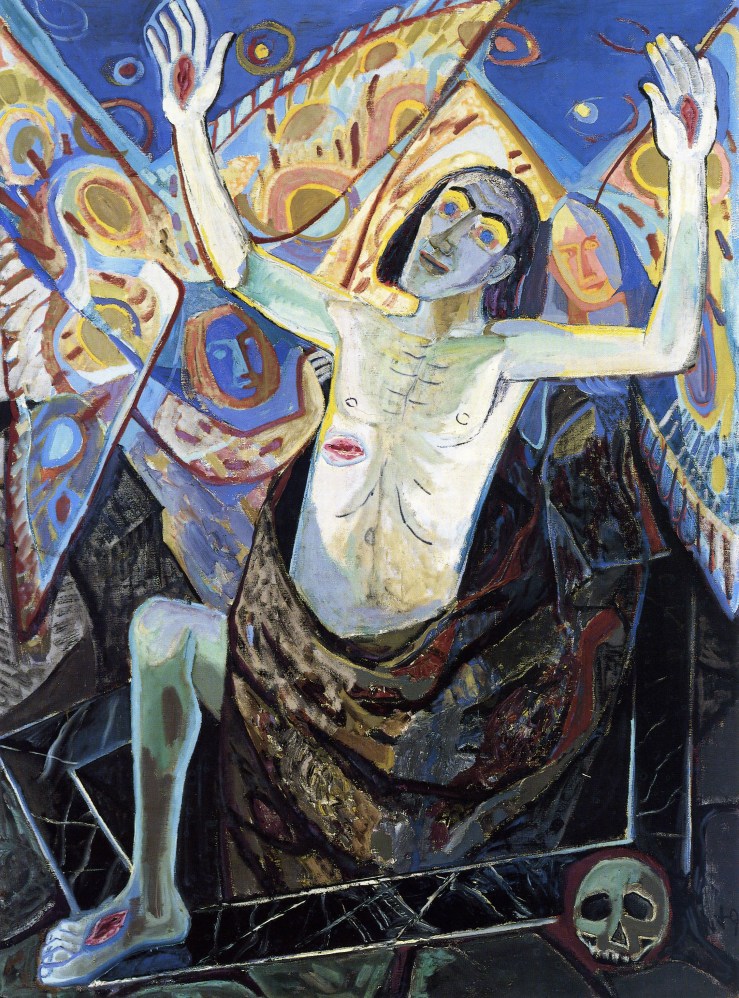
Otto Dix (German, 1891–1969), The Resurrection, 1949. Oil on canvas, 213 × 163.5 cm. Kunstmuseum Stuttgart, Germany.
He . . . has risen.
—Luke 24:6a
The Lord is my strength and my song;
he has become my salvation.
Glad songs of salvation
are in the tents of the righteous:
“The right hand of the Lord does valiantly,
the right hand of the Lord exalts,
the right hand of the Lord does valiantly!”
I shall not die, but I shall live,
and recount the deeds of the Lord.
—Psalm 118:14–17
+++
SONG: “The Strife Is O’er” | Words: Anonymous Latin poem (first compiled 1695), translated by Francis Pott, 1861 | Music: Rev. Vito Aiuto, on Precious Remedies Against Satan’s Devices by the Welcome Wagon (2012)
The strife is o’er, the battle done;
The victory of life is won;
The song of triumph has begun:
Alleluia! Alleluia!
The pow’rs of death have done their worst;
But Christ their legions hath dispersed;
Let shouts of holy joy outburst:
Alleluia! Alleluia!
The three sad days are quickly sped;
He rises glorious from the dead;
All glory to our risen Head:
Alleluia! Alleluia!
He closed the yawning gates of hell;
The bars from heav’n’s high portals fell;
Let songs of praise his triumph tell:
Alleluia! Alleluia!
Lord, by the stripes which wounded thee,
From death’s dread sting your servants free,
That we may live, and sing to thee:
Alleluia! Alleluia!
(I’ve noticed several slight variations in the English lyric translation attributed to Francis Pott. This is the version used by the Welcome Wagon.)
This post belongs to the weekly series Artful Devotion. If you can’t view the music player in your email or RSS reader, try opening the post in your browser.
To view all the Revised Common Lectionary scripture readings for Easter Sunday, cycle C, click here.
This Sunday marks the start of Passion Week, with Jesus riding into Jerusalem on a donkey, where he is greeted by palm branches and Hosannas. By Thursday, though, these shouts of praise will devolve into “Is it I?,” “I do not know him,” and “Crucify him!”
In a series of simple verses, Hiram Ring’s blues-inflected song “My Lord” moves from Jesus’s triumphal entry to his agony in the garden (where he drinks heavily the bitter draft of suffering) to his crucifixion. The final two verses shift then to his resurrection and his exaltation in heaven.
+++
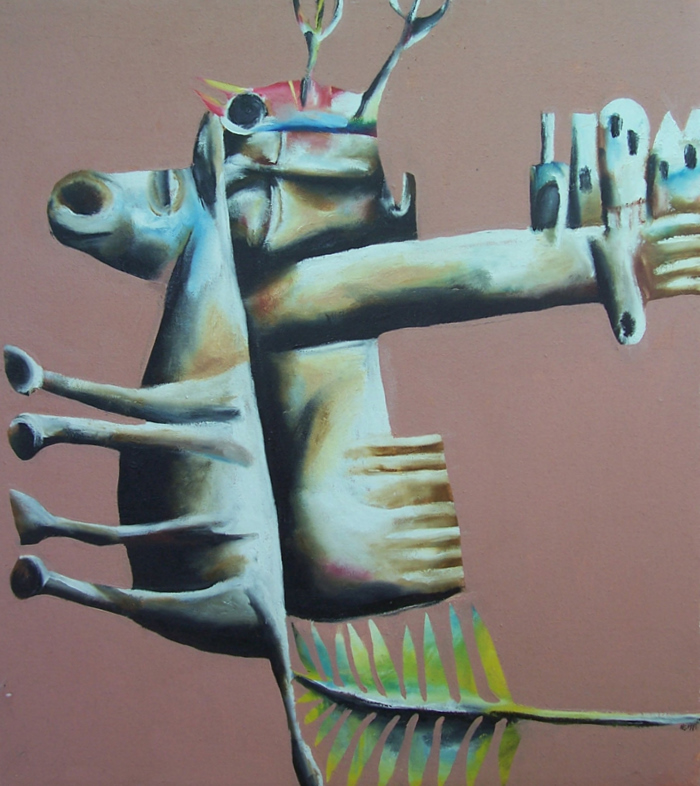
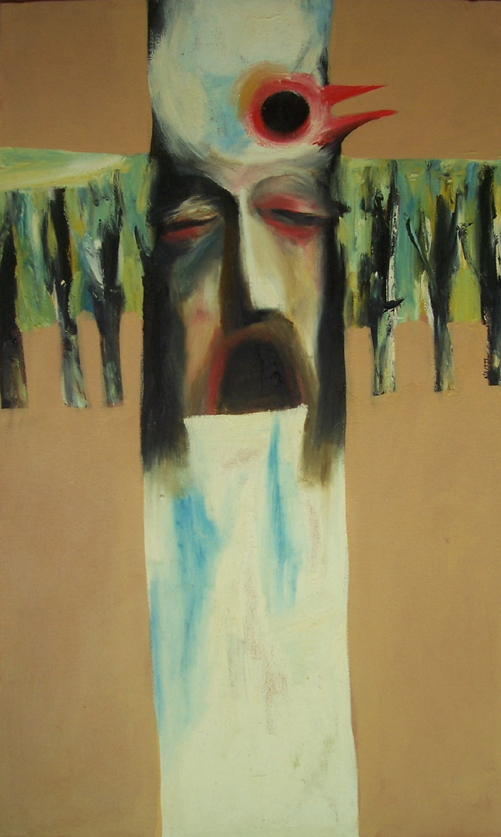
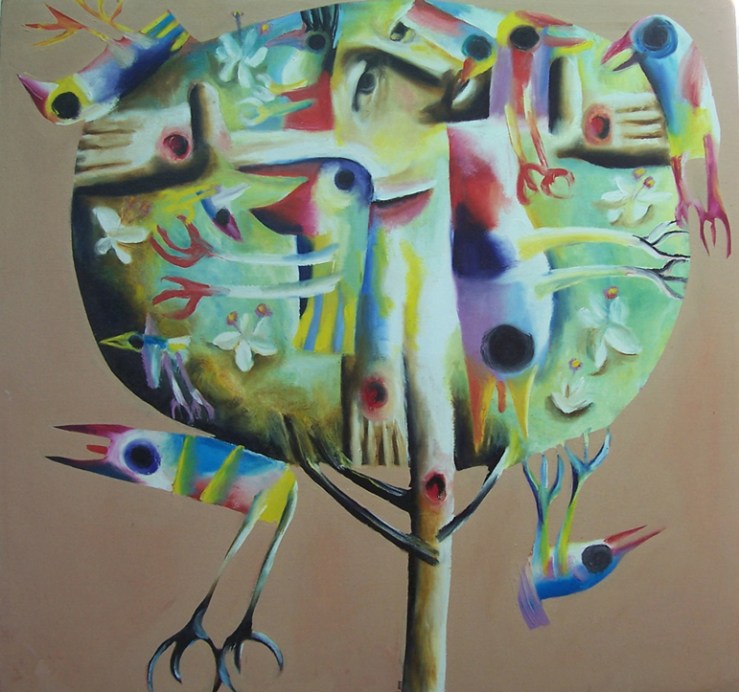
Nathan Simpson (Australian, 1973–), Agony in the Garden, 1999. Oil on canvas.Nathan Simpson (Australian, 1973–), Large Resurrection, 1999. Oil on canvas.
I’m compelled by the Gospel narrative paintings of contemporary Australian artist Nathan Simpson. These are a few I saved from his website a while ago before it went under construction. In Simpson’s Agony in the Garden, Christ’s anguish is palpable. The image combines the Gethsemane narrative with all the suffering that lies ahead, culminating in death. A row of olive trees forms the horizontal beam of a cross, while a rooster (alluding to Peter’s betrayal) forms the vertical; Christ’s head, with swollen eyes and gaping mouth (“My God, my God . . .”), is the point of intersection.
Simpson’s Resurrection painting, by contrast, shows a Christ who’s victorious over death, his face serene. The artist plays with the popular “tree of life” motif, fusing Christ’s body into this flowering, bird-filled plant. An arborescent Christ! See how the nail wound in his left foot is also the tree’s hollow.
+++
In their latest blog post, SALT Project suggests a simple at-home Holy Week ritual for families that I really like: a Tenebrae Wreath (tenebrae means “shadows”).
Imagine . . . a sort of Advent Wreath in reverse: four candles in a circle with a Paschal candle in the middle, extinguished one by one. Sunday night: beginning with only the Paschal candle lit, read Luke’s story of Palm Sunday, and then light all four candles in joy, hope, and thanksgiving. Thursday night: read Luke’s story of the Last Supper, and extinguish one candle; then read Luke’s story of Gethsemane, and extinguish a second. Friday night: read Luke’s story of Peter’s denials and desertion, and extinguish a third candle; then read Luke’s story of Jesus’ suffering, and extinguish the fourth; and then finally, read Luke’s story of Jesus’ death, and extinguish the Paschal candle. Saturday, the wreath remains unlit and bare, perhaps shrouded with cloth. And Sunday morning, the shroud is gone and all candles are lit, with a few more candles added—along with some flowers and Easter sweets! Read Luke’s story of the empty tomb, and sing your favorite Easter hymn (or two).
This post belongs to the weekly series Artful Devotion. If you can’t view the music player in your email or RSS reader, try opening the post in your browser.
To view all the Revised Common Lectionary scripture readings for Palm Sunday and the Liturgy of the Passion, cycle C, click here and here.
Vincent van Gogh (Dutch, 1853–1890), Sower with Setting Sun, 1888. Oil on canvas, 162.5 × 204.5 cm. Kröller-Müller Museum, Otterlo, Netherlands.
When the Lord restored the fortunes of Zion,
we were like those who dream.
Then our mouth was filled with laughter,
and our tongue with shouts of joy;
then they said among the nations,
“The Lord has done great things for them.”
The Lord has done great things for us;
we are glad.
Restore our fortunes, O Lord,
like streams in the Negeb!
Those who sow in tears
shall reap with shouts of joy!
He who goes out weeping,
bearing the seed for sowing,
shall come home with shouts of joy,
bringing his sheaves with him.
—Psalm 126
Psalm 126 is “a community lament that recalls a previous time of God’s mercy on his people and asks for a fresh show of that mercy” (ESV Study Bible). The second stanza anticipates not only a literal food harvest but also a more general flourishing of life in all its aspects, an abundant crop of joy.
+++
SONG: “Psalm 126” by Isaac Wardell | Performed by Molly Parden, on Bifrost Arts’ He Will Not Cry Out (2013)
Isaac Wardell’s musical adaptation of Psalm 126 was regularly programmed into the worship services of my former church, Citylife, usually as a going-out song, and it was always a favorite of mine. If you’d like to sing it at your church, you can license it through CCLI (#7023230).
This post belongs to the weekly series Artful Devotion. If you can’t view the music player in your email or RSS reader, try opening the post in your browser.
To view all the Revised Common Lectionary scripture readings for the Fifth Sunday in Lent, cycle C, click here.
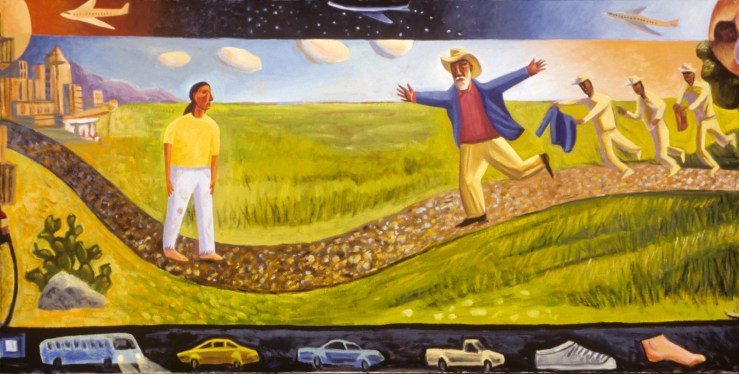
James B. Janknegt (American, 1953–), Two Sons, 2002. Oil on canvas, 24 × 84 in.
Once there was this man who had two sons. One day the younger son came to his father and said, “Father, eventually I’m going to inherit my share of your estate. Rather than waiting until you die, I want you to give me my share now.” And so the father liquidated assets and divided them. A few days passed and this younger son gathered all his wealth and set off on a journey to a distant land. Once there he wasted everything he owned on wild living. He was broke, a terrible famine struck that land, and he felt desperately hungry and in need. He got a job with one of the locals, who sent him into the fields to feed the pigs. The young man felt so miserably hungry that he wished he could eat the slop the pigs were eating. Nobody gave him anything.
So he had this moment of self-reflection: “What am I doing here? Back home, my father’s hired servants have plenty of food. Why am I here starving to death?I’ll get up and return to my father, and I’ll say, ‘Father, I have done wrong—wrong against God and against you.I have forfeited any right to be treated like your son, but I’m wondering if you’d treat me as one of your hired servants?’”So he got up and returned to his father. The father looked off in the distance and saw the young man returning. He felt compassion for his son and ran out to him, enfolded him in an embrace, and kissed him.
The son said, “Father, I have done a terrible wrong in God’s sight and in your sight too. I have forfeited any right to be treated as your son.”
But the father turned to his servants and said, “Quick! Bring the best robe we have and put it on him. Put a ring on his finger and shoes on his feet.Go get the fattest calf and butcher it. Let’s have a feast and celebrate because my son was dead and is alive again. He was lost and has been found.” So they had this huge party.
Now the man’s older son was still out in the fields working. He came home at the end of the day and heard music and dancing. He called one of the servants and asked what was going on. The servant said, “Your brother has returned, and your father has butchered the fattest calf to celebrate his safe return.”
The older brother got really angry and refused to come inside, so his father came out and pleaded with him to join the celebration. But he argued back, “Listen, all these years I’ve worked hard for you. I’ve never disobeyed one of your orders. But how many times have you even given me a little goat to roast for a party with my friends? Not once! This is not fair! So this son of yours comes, this wasteful delinquent who has spent your hard-earned wealth on loose women, and what do you do? You butcher the fattest calf from our herd!”
The father replied, “My son, you are always with me, and all I have is yours. Isn’t it right to join in the celebration and be happy? This is your brother we’re talking about. He was dead and is alive again; he was lost and is found again!”
—Luke 15:11–32 (The Voice)
+++
SONG: “Prodigal Son” by Robert Wilkins, on Reverend Robert Wilkins—Memphis Gospel Singer (1964); re-released on Prodigal Son (2014)
Robert Timothy Wilkins (1896–1987) was a gospel blues guitarist and vocalist and a minister of the Church of God in Christ. Part African American, part Cherokee, he was born in Mississippi but spent his entire adult life in Memphis, where he became fairly well known for his music. In 1929 he wrote and recorded the predecessor to “Prodigal Son”: same melody and guitar lines, but with lyrics that bemoan cheating women, and he called it “That’s No Way to Get Along.” After he “got religion” (that is, converted to Christianity) in 1936, he gave up singing secular songs. He’d still play them on his guitar for private audiences—it was only the words he deemed sinful—and he even reworked several by replacing his original lyrics with religious ones, as was the case with “That’s No Way to Get Along,” which he retitled “Prodigal Son” and transformed into a retelling of the biblical parable. [Read the lyrics]
We probably would have never heard these gospel songs from Wilkins’s later years if it weren’t for American folk musicologist Dick Spottswood, who in the 1960s combed the South looking for blues singers whose decades-old 78s he had encountered, seeking to record new performances. Wilkins was in his seventies, but he agreed to perform for a recording (and subsequently, for the Newport Folk Festival in Rhode Island), insisting that he would do only gospel. The resultant album, released in 1964 by Piedmont Records, was Reverend Robert Wilkins—Memphis Gospel Singer, on which “Prodigal Son” first appears. The song was remastered, restored, and re-released in 2014 on a compilation album of Wilkins material, Prodigal Son, which adds four uncollected gospel songs to the original album’s track list.
The song [“Prodigal Son”] did not appear in Wilkins’ church services, as it was deemed not exciting enough for his congregants. Instead, the piece was reserved as a late-night solo, played for small audiences in the comfort of his living room. The quiet picking, repetitious bass note run and Wilkins contemplative drawl make for a hypnotic mix and the quickest 10-minute song I’ve ever encountered. The open tuning allows for a richer low end and frees Wilkins’ left hand to speak easily with his slide.
Wilkins recorded “Prodigal Son” in 1964, but it wasn’t until 1968, when the Rolling Stones covered it on Beggars Banquet, that it gained a wide audience. They condensed the ten-minute song to just under three minutes, and I think they do quite a fine job with it. Royalties generated by sales of Beggars Banquet created a solid supplemental income for Wilkins until his death in 1987.
The Rolling Stones are heavily influenced by blues music (their name comes from a Muddy Waters song) and have done much to keep it alive and expand its popularity. Keith Richards says, “If you don’t know the blues . . . there’s no point in picking up the guitar and playing rock and roll or any other form of popular music.”
+++
The parable of the prodigal son—or, perhaps more accurately, the parable of the two sons—is a familiar one, and artist James B. Janknegt (previously) interprets it visually for the present day, localizing it to his native Texas.
After insulting his father and taking his money, the younger son flies off to pursue fleeting pleasures—strip clubs and all that. But those pleasures don’t satisfy. He ends up working at McDonald’s and, having squandered his wealth, is reduced to eating his meals from a dumpster. He feels cheap, trashy, and spiritually dry, as indicated by the cactus in the adjacent panel.
Hungry for more, he decides to return home, so he hops on a bus, and when the bus can take him no farther, he hitchhikes, catching one, two, three rides, then walks the rest of the way until his shoes wear out. Finally he reaches the front-yard footpath of his father’s house, the dry ground he treads giving way to green grass that becomes increasingly lush the nearer he gets. Anticipating his return, the father comes running out to welcome him home with full forgiveness.
But his big brother isn’t nearly as happy at this turn of events. Quite the contrary, he’s confused, upset: Why would Dad not punish little brother for his flagrant disrespect and waywardness? Why is he being thrown a party? In a fit of anger, he breaks the neck of his guitar across his thigh. Instead of joining the musical celebration, he stews in his own bitterness. His heart is as dead as the cattle skull at his feet.
Still, the father looks on him lovingly, just as he does his other son, waiting patiently for him to experience a similar metanoia—a turning toward the light, a coming to the party.
Two Sons is one of forty of James B. Janknegt’s modernized parable paintings that appear in the book Lenten Meditations, which you can purchase from Jim’s website.
This post belongs to the weekly series Artful Devotion. If you can’t view the music player in your email or RSS reader, try opening the post in your browser.
To view all the Revised Common Lectionary scripture readings for the Fourth Sunday in Lent, cycle C, click here.
HYMNS FOR LENT: A list of fifty-plus hymns for Lent, including free sheet music downloads, compiled by Dean B. McIntyre, director of music resources at the Center for Worship Resourcing at the United Methodist Church’s Discipleship Ministries in Nashville. Most of these hymns—either their tune, their words, or both—are contemporary, and I believe they were all either written or arranged by members of the UMC. I love that so many of them are minor-key! (There’s such a dearth of minor-key hymns in my evangelical tradition.) “The Desolate Messiah Dies” is a real standout for me—WOW. Here are the others that I really like. The first three would work particularly well for a Good Friday service:
“Behold the Savior of Mankind” – Words by Samuel Wesley, ca. 1709 | Music by Henry Purcell (“Dido’s Lament”), 1680s, arr. Dean B. McIntyre (alternate tune: Tennessee Harmony, 1818) [Note: The Purcell tune, originally written as an opera aria, makes a gorgeous pairing to this hymn text, but I feel that it’s better suited to a soloist; the Tennessee Harmony tune would be easier for a congregation to sing.]
“Holy God of Power and Might” –Words by Lawrence A. Wik, 2013 | Music by Thomas Hastings, 1830 [tune for “Rock of Ages”]
“Holy, Holy, Lord of Mercy” – Words by Lawrence A. Wik, 2013 | Music: French carol melody [tune for “Let All Mortal Flesh Keep Silence”]
“Sovereign Most Holy” – Words by Lawrence A. Wik, 2013 | Music by Johann Crüger, 1640 [tune for “Ah, Holy Jesus”]
“Hosanna (Save, Mighty Lord)” – Words by John Cennick, 1743, and Reginald Heber, 1811 | Music by J. A. and J. F. Wade, 1854 | Words and music adapted by Ryan D. Neaveill, 2005
+++
SONG: “You Can Never Hold Back Spring” by Tom Waits, covered by Lowana Wallace: I’ve had this song on repeat for the past several weeks—Lowana Wallace’s rendition is simply gorgeous. “This cover is a tribute to Canadians in March. Winter will end, you guys,” Wallace writes. “And maybe Tom didn’t mean for this song to point Christians to the beauty of Lent leading to Easter, but it did for me.”
Lowana Wallace is a singer-songwriter from Caronport, Saskatchewan. If you’ve listened to the Porter’s Gate Worship Project’s acclaimed album Work Songs, you will have encountered her work: she cowrote the song “Day by Day.” Check out more of her music videos, a mix of covers and originals, on her YouTube channel—they’re all great! To help her make more of these, consider becoming a Patreon supporter. You can also download four of the nine tracks from her Christmas jazz album, Hymns and Carols (2009), on NoiseTrade.
+++
POETRY: “5 Female Poets of Faith”: March is Women’s History Month, and Jody Lee Collins has compiled a list of five women poets you should know, whose Christian faith infuses their work: Abigail Carroll, Barbara Crooker, Jeanne Murray Walker, Laurie Klein, and Marjorie Maddox. I heartily second these recommendations! For each poet, Collins has selected a representative poem, giving you a taste of their style, and has provided links to the poets’ published volumes.
+++
2 FILMS + ART EXHIBITION: Incarceration is the theme of two HBO movies that premiered on television last month (following a positive reception at 2018’s Tribeca Film Festival) and the tie-in pop-up art exhibition, sponsored by HBO, that ran from February 20 to 25 at Studio 525 in Chelsea, Manhattan.
Written by Stephen Belber and directed by Madeleine Sackler, O.G. is an introspective drama that follows Louis (Jeffrey Wright), who, after spending twenty-four years in prison for murder, is about to be released. Groundbreakingly, it was filmed almost entirely inside an active prison—Pendleton Correctional Facility in Indiana—with a cast made up largely of inmates and correctional officers, who also consulted on the script. Read an interview with Wright, a professional actor best known for Westworld, and one with supporting actor Theothus Carter, who is serving a sixty-five-year sentence at Pendleton. When he was offered the role of Beecher, Carter said, “I was so happy, it was like being jolted alive back from the dead. I know I’ve never been dead before, but being dead has to feel like being in prison, because here it feels like you don’t matter anymore. This made me feel like I mattered again.”
It’s a Hard Truth, Ain’t It is a companion film to O.G. that is directed by Madeleine Sackler and thirteen incarcerated men at Pendleton, who reflect on their lives and the consequences of their crimes in front of and behind the camera. When Sackler received permission from the prison to lead a filmmaking workshop for inmates, she hadn’t intended to make a documentary, but she was so moved by the depth and intimacy of the conversations that were arising in that workshop, as participants shared their personal stories, and they all decided these stories and perspectives needed to be captured on film, crafted together, and shared more widely. An animator was brought on to bring the men’s memories to life.
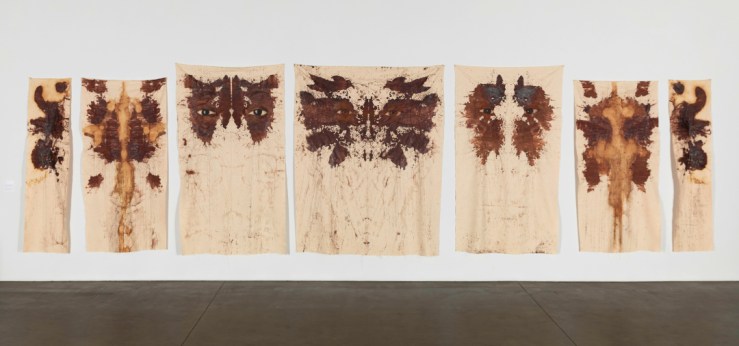
Coinciding with the HBO premiere of these two films was a six-day exhibition in New York City called The OG Experience, curated by Jesse Krimes and Daveen Trentman. Like the Hard Truth film, this exhibition offered an insider narrative about the US prison system, as the art was all by formerly incarcerated individuals. The pieces on display included an installation of reclaimed cafeteria trays, a re-creation of a prison cell that invited viewers to sketch on the wall with a screwdriver, a video of the artist boxing with a projection of himself, a self-portrait in pastels over legal documents, and a mural of newsprint images transferred onto prison-issued bedsheets using hair gel (a method developed, and a work begun, by Krimes while in solitary confinement).
On seeing his work on display, Krimes said, “It was really emotional because so much of that experience and what our prison system is designed to do is pretty much destroy you. It’s designed to take away your identity, it’s designed to take away your humanity, and I think in creating that work and investing myself in something meaningful, and coming home and getting to see the final thing . . . it was something that made me feel like I came out of this situation intact, like I’m still a whole human being, and that this thing did not destroy me and it did not take away who I am at my core or change me in a way that it was designed to do.” Since his release from prison, Krimes cofounded the Right of Return Fellowship to directly support formerly incarcerated artists.
I particularly like the works by Russell Craig (also), a self-taught artist from Philadelphia. In his seven-piece set of unstretched canvases, E-Val, pairs of eyes peer out hauntingly from within Rorschach blots made of ox blood; “Craig, who was given Rorschach tests as part of his psychological evaluations during his time in the foster care system, wanted to represent the trauma felt in black communities,” the exhibition text says. Another work, a self-portrait he drew over his prison documents, “symbolizes the stigma of being a criminal,” Craig explained. “No matter how much you change your life around, you’re still viewed as a criminal.”
Stephen Watson (American), Thirst, 2013. Shorter University Arnold Art Gallery, Rome, Georgia.
O God, you are my God; earnestly I seek you;
my soul thirsts for you;
my flesh faints for you,
as in a dry and weary land where there is no water.
—Psalm 63:1
+++
SONG: “Tzama Lecha Nafshi” (My Soul Thirsts for You) by Sasha Fishman | Performed by Shai Sol, 2016
Shai Sol is a singer-songwriter from Tel Aviv, Israel, and a Jewish follower of Yeshua (Jesus). Follow her on Facebook, Bandcamp, and/or YouTube.
+++
Artist Stephen Watson (previously) describes his 2013 installation Thirst: “These 2,500+ empty cups are arranged in the shape of a river. Unfilled, they create a dry river bed. In their multitude, they depict the severity of the thirst of an unquenched soul.”
This post belongs to the weekly series Artful Devotion. If you can’t view the music player in your email or RSS reader, try opening the post in your browser.
To view all the Revised Common Lectionary scripture readings for the Third Sunday in Lent, cycle C, click here.
SONG: “Wayfaring Stranger” | 19th-century American folk song | Performed by Rhiannon Giddens (banjo, vocals) and Phil Cunningham (accordion) for BBC Northern Ireland, 2016
This “world of woe” is not our home; we’re just temporary residents. St. Paul reminds us that we are citizens of a new world, and while this statement needs a lot of fleshing out (hence the development of systematic “kingdom theologies”), the well-known American folk lament “Wayfaring Stranger” emphasizes simply, soul-baringly, the longing aspect of it, that anticipation of returning to the “bright land” of our (re)birth, “no more to roam.”
This post belongs to the weekly series Artful Devotion. If you can’t view the music player in your email or RSS reader, try opening the post in your browser.
To view all the Revised Common Lectionary scripture readings for the Second Sunday in Lent, cycle C, click here.
UPCOMING LECTURE: “The Arts of Lament” by Margaret Adams Parker: I’m one of the artistic directors of the Eliot Society, a DC-based nonprofit that promotes spiritual formation through the arts. Our next event is a lecture on April 6, 2019, by printmaker and sculptor Margaret (Peggy) Adams Parker (previously), which I’m really looking forward to.
Most especially during Lent, we recall the prominence of lament in Scripture: the psalms of lament; David’s lament for Jonathan; the Lamentations of Jeremiah; Christ’s lament over Jerusalem. These laments bear witness to outrage, sorrow, suffering, fear, desolation. And through these passionate cries, the biblical authors allow us to experience and express—in God’s holy presence—our own stories of brokenness and loss.
The visual arts make these laments visible. In this program Parker will present images by Grünewald, Rembrandt, Goya, Käthe Kollwitz, Jacob Lawrence, and others, as well as some of her own work. We will ask, How might these depictions of the horrors of war, displacement, oppression, sickness, and death enlarge our appreciation of the scriptural laments and in turn illuminate our understanding of suffering? Further, we will explore the spiritual significance of the practice: how lament might ultimately serve to console and strengthen, helping to lead us out of dark places into the light.
+++
SHALOM CHANT: At the 2019 Brehm Conference, “Worship, Theology, and the Arts in a Divided World,” liturgist Julie Tai led attendees in a group chant of the word shalom, an exercise she picked up from the author, speaker, psychotherapist, songwriter, and Episcopal priest Ian Morgan Cron. I streamed in from afar, and even from this distance, I found it really moving. “Really think about the places and spaces that need shalom—shalom meaning not our flat language of just ‘peace,’” Tai said by way of preface. “It’s an embodied word, a disruptive word. And we don’t get to see the completeness of shalom until all of us are at the table.” She instructs that after chanting shalom in unison three times, everyone is to find a note, any note, and sing it. Dissonance is welcome. The thick texture and distinctive timbre that result are possible only because each and every person is contributing their unique selves. The exercise is about listening to your neighbor, seeing your neighbor, and praying for and committing to pursuing shalom, wholeness, in this world. It expresses, in community, a shared hope and intention.
Chanting is a practice found in almost all spiritual traditions. Through rhythmical repetition, a word or short phrase washes over you and settles into the mind. When done in a group, everyone’s biorhythms become synchronized; individual breaths and sound vibrations unite, a physical manifestation of a spiritual communion.
“Julie Tai is the director of chapel at Fuller Theological Seminary. She received a BA in Asian American Studies and studied vocal jazz at UCLA before earning an MA in Intercultural Studies from Fuller. She is a songwriter, worship leader, and liturgist who loves to explore creative and integrative ways to engage diverse people in worship. A proud second-generation Korean American, Julie has led worship experiences at Urbana, the Calvin Worship Symposium, and SIM’s Global Assembly. She passionately trains worship leaders, seminarians, and pastors to see liturgy as a unifying and artistic act of justice . . . the reordering of glory, honor, and praise to the One seated on the throne.” [source]
+++
NEW SONG: “Jesus, See the Traveler” by Sara Groves: “I wanted a way for Ruby [my daughter] and me to remember the number of people who are on the road, displaced and wandering on any given night,” said Sara Groves about this new song she wrote. “Due to war and violence, there are more displaced people right now than any other time in history, and I want to be in the number who are responding in love—both in person in my community, and in my music.” The official music video is below; purchase the single on iTunes or stream on Spotify. [HT: Tamara Hill Murphy, A Sacramental Life]
+++
ARTICLE: “Art Interrupted” by Sophie Haigney: Unfinished artworks, like La Sagrada Familia (whose architect was hit by a tram when the cathedral was only a quarter of the way done) or Elizabeth Shoumatoff’s famous FDR portrait (the president slumped over mid-portrait-sitting and died of a brain hemorrhage), are reminders of our mortality. [HT: Michael Wright, Still Life]
Cranes hover over the spires of La Sagrada Familia in Barcelona, whose construction began in 1882 under architect Antoni Gaudí and is still going on.
+++
PODCAST EPISODE:“Roma,”Sunday Morning Matinee, January 22, 2019: To help me think more deeply and articulately about movies, I appreciate the work of, among others, Sunday Morning Matinee (formerly Technicolor Jesus), hosted by Matt Gaventa and Adam Hearlson. Back in January they discussed a movie that was one of my favorites of 2018, which is Roma, written, directed, and shot by Alfonso Cuarón. Set in the Colonia Roma neighborhood of Mexico City in the early ’70s, it focuses on Cleo (played by newcomer Yalitza Aparicio), a Mixtec domestic servant for a middle-class family. It was a very personal project for Cuarón, who based the character of Cleo on the real-life nanny who helped raise him, Liboria “Libo” Rodríguez.
This still frame from Roma captures a climactic moment of shared intimacy as Cleo (center), grieving a recent trauma, receives love and support from the family she works for.
“As artists, our job is to look where others don’t,” Cuarón said in his acceptance speech last month for the Academy Award for Best Director. (The movie also won Best Foreign Language Film and Best Achievement in Cinematography.) As an adult, Cuarón looked back and realized that Libo had another life, both internal and external, that he had not been aware of as a child, and this is his way of honoring Libo’s beautiful complexity. This podcast episode discusses the opening and closing shots of the movie, water symbolism, the contrast of the terrestrial and the heavenly, the role of memory, Cleo’s interiority and who gets access to it, the possibilities and limits of employer-employee relationships, and more.
Brian Kershisnik (American, 1962–), Treading the Basilisk, 2003. Oil on panel, 85 × 32 in.
Because you have made the Lord your dwelling place—
the Most High, who is my refuge—
no evil shall be allowed to befall you,
no plague come near your tent.
. . .
You will tread on the lion and the adder; the young lion and the serpent you will trample underfoot.
“Because he holds fast to me in love, I will deliver him;
I will protect him, because he knows my name . . .”
—Psalm 91:9–10, 13–14
+++
SONG: “Anyataka” (Victory), a Congolese folk song | Performed by New City Fellowship, July 21, 2013
This video is from a Sunday worship service at New City Fellowship (previously here and here), a multicultural church in St. Louis, Missouri. The church contains a fair number of immigrants from the Democratic Republic of the Congo, including on its leadership team, which has led it to partner with churches in the DRC, a relationship of mutual encouragement. “Anyataka” was introduced to the congregation by Athoms Mbuma, a visiting pastor and musician from Kinshasa and a member of the popular Congolese worship band Le Groupe Adorons L’Éternel (GAEL).
Anyati Satana lelo! (“We stomp on Satan!”), sing the worshippers in Lingala, miming the action with gusto. “Victory! We have victory in Jesus.” And the refrain: “Yahweh, you reign.”
Many Christians read Psalm 91 as a messianic psalm, prophesying Christ’s victory over Satan. (Visual theologians included: check out the fascinating super aspidem motif, aka “Christ treading on the beasts.”) But it can also be applied more broadly, as the psalmist no doubt intended, to the people of God.
An adder, or viper, is a venomous snake; the word is sometimes alternately translated as “asp,” “cobra,” or even “basilisk,” a mythical reptile. According to the ESV Study Bible commentary, “The lion and the adder are probably images for people bent on harming the faithful (cf. Ps. 58:3–6; Deut. 32:33), or perhaps the demonic agents that inspire the harm.” I’m reminded of Luke 10:19 (cf. 9:1), where Jesus delegates his power over demons to his disciples: “Behold, I have given you authority to tread on serpents and scorpions, and over all the power of the enemy, and nothing shall hurt you.”
The Christian’s power over evil is rooted in the very power of Christ, who by his death and resurrection has vanquished the Enemy. Now we, too, can put evil under our feet.
Both works of art in this post—the painting by Kershisnik and the Congolese worship song—are inspired by Psalm 91 (the song a little less directly), but they approach it with different tones. The song is very exultant, heightened by a demonstrative performance in which the singers enact the victory of which they sing. By contrast, the figure in the painting is very matter-of-fact about her crushing of the snake; by the power of the word (signified doubly by the book in one hand and the sword in the other), she quietly and assuredly renders it powerless. She appears completely undisturbed by the incident; it barely registers!
Both responses to the text are, I think, appropriate. Christ’s victory, which he grants to us, ought to elicit our loud and happy praise, befitting the context of a worship gathering. But what Kershisnik gives us in this private devotional painting is a calm assurance that in our day-to-day, when the Enemy rears its head, we need not fear one bit; we can carry on unfazed because the battle has already been won—we merely need to claim the victory.
This post belongs to the weekly series Artful Devotion. If you can’t view the music player in your email or RSS reader, try opening the post in your browser.
To view all the Revised Common Lectionary scripture readings for the First Sunday in Lent, cycle C, click here.
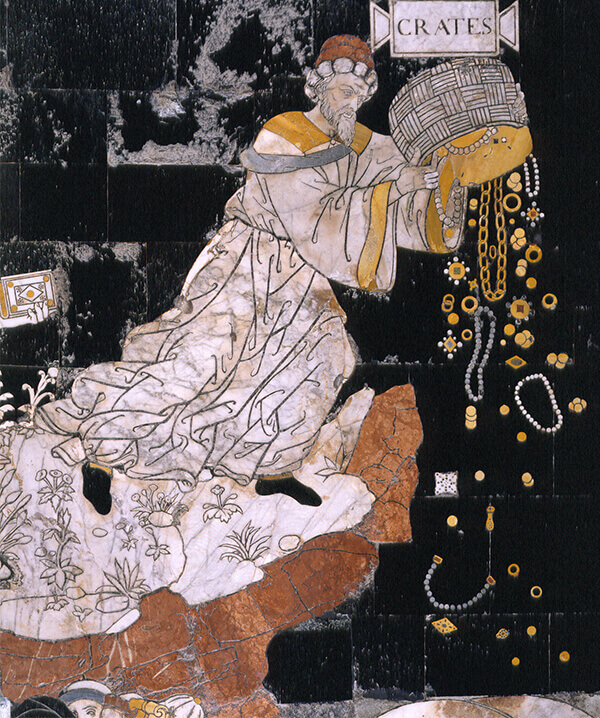
Crates of Thebes dumps out his wealth into the sea in this detail of the “Mount of Wisdom” marble mosaic inlay and graffito, designed by Pinturicchio in 1505, from the floor of Siena Cathedral in Italy.
Do not lay up for yourselves treasures on earth, where moth and rust destroy and where thieves break in and steal, but lay up for yourselves treasures in heaven, where neither moth nor rust destroys and where thieves do not break in and steal. For where your treasure is, there your heart will be also.
SONG: “House of Gold” by Hank Williams, 1948 | Performed by the Secret Sisters, 2010
+++
In her poem “Storage,” Mary Oliver describes the total emptying of a storage unit she rented for years:
I felt like the little donkey when
his burden is finally lifted. Things!
Burn them, burn them! Make a beautiful
fire! More room in your heart for love,
for the trees! For the birds who own
nothing—the reason they can fly.
Lent, which begins Wednesday, is a season for throwing out that which has been weighing us down—whether that be physical possessions, or things of the heart (such as unhealthy attitudes, habits, or dependencies; in a word, sins). It’s a spring cleaning of sorts, where we clear out those accumulations that have subtly edged out God. “Make a beautiful fire!” Oliver exclaims. A bonfire of vanities. Once you relinquish your burdens to the fire, you will be light as a bird, and free to fly.
+++
Giorgio Vasari described the floor of Siena Cathedral as “the most beautiful . . . , largest and most magnificent . . . ever made.” Read an excellent, beautifully photographed introduction to this allegorical masterwork, unique in terms of its technique and message, at https://operaduomo.siena.it/en/sites/floor/.
View down the nave of Siena Cathedral
Is it a contradiction for the church to have poured much of its wealth into the making of this magnificent floor whose imagery, in part, categorizes earthly wealth as a potential pitfall on the path to Wisdom? No, I don’t think so. Its beauty glorifies Christ, proclaiming him the ultimate Treasure. This is not wealth hoarded away for personal security but wealth poured out before God, for the soul-nourishment of others. The spending of large sums of money on art when poverty persists is and will always remain a tricky conundrum (not least during Lent, when an ethic of simplicity and almsgiving are emphasized), but artist Makoto Fujimura navigates it quite well in his 1996 essay “The Extravagance of God.”
This post belongs to the weekly series Artful Devotion. If you can’t view the music player in your email or RSS reader, try opening the post in your browser.
To view all the Revised Common Lectionary scripture readings for Ash Wednesday, cycle C, click here.









 Art & Theology