The angel Gabriel awakes the dead on Resurrection Day in this medieval stained glass tondo from the Musée de Cluny in Paris. Photo: Spencer Means.
And just as it is appointed for man to die once, and after that comes judgment, so Christ, having been offered once to bear the sins of many, will appear a second time, not to deal with sin but to save those who are eagerly waiting for him.
—Hebrews 9:27–28
+++
SONG: “Get Happy” | Words by Ted Koehler, 1930 | Music by Harold Arlen, 1930 | Performed by the Puppini Sisters, on Hollywood(2011)
See also the Judy Garland version from Summer Stock (1950), below, which the American Film Institute ranked #61 in its survey of top tunes in American cinema.
+++
“The Day of Judgment” by Henry Vaughan
O day of life, of light, of love!
The only day dealt from above!
A day so fresh, so bright, so brave,
’Twill show us each forgotten grave,
And make the dead, like flowers, arise
Youthful and fair to see new skies.
All other days, compared to thee,
Are but Light’s weak minority;
They are but veils, and cypress drawn
Like clouds, before thy glorious dawn.
O come! arise! shine! do not stay,
Dearly loved day!
The fields are long since white, and I
With earnest groans for freedom cry;
My fellow-creatures too say “Come!”
And stones, though speechless, are not dumb.
When shall we hear that glorious voice
Of life and joys?
That voice, which to each secret bed
Of my Lord’s dead,
Shall bring true day, and make dust see
The way to immortality?
When shall those first white pilgrims rise,
Whose holy, happy histories
—Because they sleep so long—some men
Count but the blots of a vain pen?
Dear Lord! make haste!
Sin every day commits more waste;
And Thy old enemy, which knows
His time is short, more raging grows.
Nor moan I only—though profuse—
Thy creature’s bondage and abuse;
But what is highest sin and shame,
The vile despite done to Thy name;
The forgeries, which impious wit
And power force on Holy Writ,
With all detestable designs,
That may dishonor those pure lines.
O God! though mercy be in Thee
The greatest attribute we see,
And the most needful for our sins,
Yet, when Thy mercy nothing wins
But mere disdain, let not man say
“Thy arm doth sleep,” but write this day
Thy judging one: descend, descend!
Make all things new, and without end!
This post belongs to the weekly series Artful Devotion. If you can’t view the music player in your email or RSS reader, try opening the post in your browser.
To view all the Revised Common Lectionary scripture readings for Proper 27, cycle B, click here.
David Hockney (British, 1937–), The Arrival of Spring in Woldgate, East Yorkshire in 2011 (twenty eleven), 2011. Oil on 32 canvases, 365.8 × 975.4 cm (each 91.4 × 121.9 cm); one of a 52-part work. Photo: Jonathan Wilkinson.
Psalm 119:1, three translations:
Blessed are the undefiled in the way, who walk in the law of the LORD. (KJV)
Joyful are people of integrity,
who follow the instructions of the LORD. (NLT)
You’re blessed when you stay on course,
walking steadily on the road revealed by GOD. (The Message)
+++
SONG: “Beati quorum via” (Blessed are those whose way) | Music by Charles Villiers Stanford, ca. 1892 | Performed by VOCES8, 2017
Stanford’s “Beati quorum via,” op. 38, no. 3, is a motet for mixed unaccompanied six-part choir, a setting of Psalm 119:1 in Latin: “Beati quorum via integra est, qui ambulant in lege Domini.” It is the last of Stanford’s Three Latin Motets, published in 1905—the other two being on the subjects of Christ’s ascension and the souls of the just at rest in heaven.
This post belongs to the weekly series Artful Devotion. If you can’t view the music player in your email or RSS reader, try opening the post in your browser.
To view all the Revised Common Lectionary scripture readings for Proper 26, cycle B, click here.
Tomorrow begins Allhallowtide, a three-day Christian festival in which the saints in heaven are remembered. Several friends of mine have lost loved ones this year—siblings, parents, uncles—and just this month my church said goodbye to one of its dear members who passed on. All Hallows’ Day, the central observance of the triduum, recognizes that a spiritual bond still exists between the departed saints and those on earth, whom Christ binds together in one communion. So let us honor this week the memory of those who have gone before us in faith, praising our great and gracious God who sanctifies his people—and who is preparing a family reunion like no other!
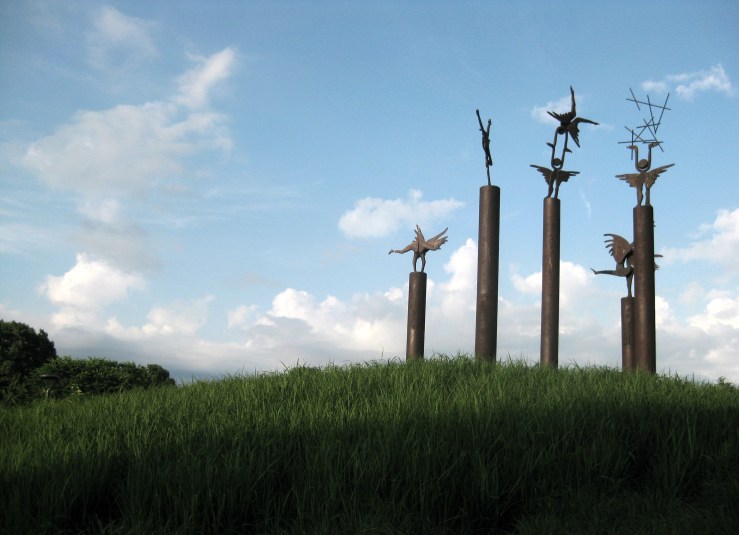
Joseph Kinnebrew (American, 1942–), Visitations: Gifts; A Slight Lapse of Purpose; Hand Stands; Yea; Majorette, 1994–97. Cast iron, 54 to 69 inches tall. Frederik Meijer Gardens and Sculpture Park, Grand Rapids, Michigan. Photo: Victoria Emily Jones.
. . . they seemed to have died, and their departure was thought to be an affliction, and their going from us to be their destruction; but they are at peace. . . . Their hope is full of immortality.
—Wisdom of Solomon 3:2–4
(Note: The Wisdom of Solomon, or the Book of Wisdom, is a deuterocanonical book, meaning it is part of the Septuagint but not the Hebrew canon and therefore is not recognized as canonical by Protestants. However, it still contains spiritual wisdom and, as Martin Luther believed, is “useful and good to read” alongside the inspired scriptures.)
+++
SONG: “Sky World” | Words and music by Theresa Bear Fox, 2015 | Performed by Teio Swathe (vocals) and Supaman (dance), 2017
“Sky World” was written in Mohawk and English by Theresa Bear Fox of the Akwesasne Mohawk Nation as a song of remembrance for those who have passed on. An abridged version was recently recorded by Teio Swathe and released as a music video with Apsáalooke hip-hop artist Supaman fancy-dancing (that’s actually the name of the style!) in White Sands, New Mexico. On October 12 the video won a Nammy Award.
Ha io ho we iaa
Ha na io ho we ia he
Io ha io ha io ho we ia
Ha na io ho we ia he
Ha io ha io ho we ia
Ha na io haioho we ia
Iooho we ia
We ha na io ho we ia he
Let’s put our minds together as one
And remember those who have passed on to the sky world
Their life duties are complete, they are living peacefully
In the sky world, in the sky world
Supaman lives on the Crow Nation reservation in south-central Montana. His own music fuses rapping with traditional Native American sounds and aims to inspire hope; he is best known for his “Prayer Loop Song,” which has over 2.3 million views on YouTube. In 2011 Supaman was interviewed on NPR’s All Things Considered, where he shared the story of his conversion to Christianity as an adult and the influence it has had on his life and work.
+++
This world is not conclusion;
A sequel stands beyond,
Invisible, as music,
But positive, as sound.
—Emily Dickinson
This post belongs to the weekly series Artful Devotion. If you can’t view the music player in your email or RSS reader, try opening the post in your browser.
To view all the Revised Common Lectionary scripture readings for All Saints’ Day, cycle B, click here.
JOHN PIPER ON IMAGINATION: “Obey God with Your Creativity: The Christian Duty of Imagination”: Within evangelicalism (the tradition I belong to), the imagination is often deemed more of a liability than a virtue, something to be distrusted, at the very least, and at most, to be rejected as evil. So I was thrilled earlier this month to hear John Piper, one of America’s leading evangelicals, speak out in strong affirmation of imagination, which he calls “one of the great duties of the Christian mind.” It can be used destructively, he cautions, but it’s a God-given capacity that God wants us to exercise and strengthen, like a muscle, so that we can see more clearly what is and what could or what will be.
“The imagination,” Piper writes, “calls up new words, new images, new analogies, new metaphors, new illustrations, new connections to say old, glorious truth—whether from the world or from the word of God. Imagination is the faculty of the mind that God has given us to make the communication of his beauty beautiful.” To communicate breathtaking truth in a boring way is “probably a sin,” he says, for God is “infinitely worthy of ever-new verbal, musical, and visual expressions.”
“A college—or a church, or a family—which is committed to the supremacy of God in the life of the mind will cultivate many fertile, and a few great, imaginations. And oh, how the world needs God-besotted minds that can say the great things of God and sing the great things of God and play the great things of God in ways that have never been said or sung or played before.”
+++
INCLUSIVE DANCE: Founded by Marisa Hamamoto in 2015, Infinite Flow is a professional dance company and nonprofit whose mission is “to use dance as a vehicle to create an inclusive world and eliminate the stigma and inequality associated with disability,” especially wheelchair use. Artistic excellence, social innovation, empowerment, community, and integration are among its values, which are played out through dance classes, workshops, and outreach events that incorporate people with and without disabilities. You can view snippets from classes and rehearsals as well as polished, artfully filmed choreographed routines on their Facebook page—like this most recent one, in which Hamamoto dances with Piotr Iwanicki, a multiple wheelchair World Latin Champion.
After twenty years of training in ballet and contemporary dance, Hamamoto suffered a spinal cord infarction, which left her temporarily paralyzed from the neck down. Upon recovery, she developed an interest in and pursued ballroom dancing, which led her to imagine what an inclusive form of the genre might look like. To learn more about Infinite Flow, see these twopromo videos, and follow them on Facebook. You’ll also want to check out “Gravity.”
+++
PODCAST: Speaking with Joy: Lately I’ve been devouring this podcast by Joy Clarkson, a doctoral candidate at the Institute for Theology, Imagination, and the Arts at St. Andrew’s University in Scotland (she’s studying the role of the affections and the arts in moral formation). Though it was launched last November, I first discovered it in July at the tail-end of her summer book series on The Great Divorce, an allegorical tale by C. S. Lewis, in which she discusses themes such as desire, grace, the real, incurvatus in se (St. Augustine), self-choice, being seen and known, and need-love versus gift-love. I was hooked! Now I’m a Patreon supporter.
Speaking with Joy is such a bright corner of the Internet, full of hope, wisdom, and delight. The standard episode format is an exploration of a given theme through three pieces of art: one literary, one visual, and one musical. I really enjoyed the last three I listened to: “The Army of Emotions,” featuring St. Macrina, Mister Rogers’s ditty “What Do You Do with the Mad That You Feel?,” and the Irish animated film The Song of the Sea; “The Wisdom of Whimsy,” featuring Manalive by G. K. Chesterton, the illustrations of Beatrix Potter and Breezy Brookshire, and “On the Radio” by singer-songwriter Regina Spektor; and “Decent Men in Indecent Times,” which explores why and how we tell stories of the two world wars by looking at the contrasting poetry of Wilfred Owen and Laurence Binyon, the movie Dunkirk, and John Williams’s score for Schindler’s List.
+++
NEW IMAGE STAFF: Last week Image journal announced that James K. A. Smith, a professor of philosophy at Calvin College, will be taking the helm of Image as the journal’s new editor in chief. What a perfect choice! I’ve been hearing a lot of Smith since the publication of his book You Are What You Love: The Spiritual Power of Habit in 2016 and have appreciated his recognition of the important role of artists. “If you want to change how the world thinks, you first have to change how they imagine,” he once said. “That’s why, today, artists are our apologists.” More recently, in a letter to the Image search committee, he wrote,
The arts speak to aspects of human nature ignored or denied by a culture captivated by brutal notions of “efficiency” or quasi-scientific narratives that reduce us to animality. It’s in literature, poetry, film, and so many other art forms that we hear echoes of a biblical understanding of humanity—that we are created in God’s image, animated by hungers and hopes, made to delight and play. In other words, the arts are evidence of what I’ve called “cracks in the secular”—the recalcitrant mystery at the heart of the human that refuses to be eviscerated. Art continues to shout Nein! to our disenchantment.
I’m looking forward to this next chapter of Image.
Caravaggio (Italian, 1571–1610), Nativity with San Lorenzo and San Francesco, 1609. Oil on canvas. The angel’s banderole reads, “Gloria in eccelsis Deo.”
+++
NEW ALBUM: Yesterday Moda Spira (the stage name of Latifah Alattas) released Divorce, an intimate musical chronicle of the unexpected end of her marriage and the journey of grief she’s been on since. “I hope it helps those of you that might feel alienated or lost in the throes of divorce or disconnection from someone you love,” she says. In response to a request, Alattas released a series of podcast episodes that discuss each song on the album in depth; listen here. I first learned about the project back in July when Stephen Roach interviewed Alattas on the Makers & Mystics podcast—such a rich and memorable conversation that deepened my empathy for the loved ones of mine who have had to endure the pain of divorce.
Below is a video promo Alattas made for the album’s Kickstarter campaign. Click here to view the variety of streaming and purchase options.
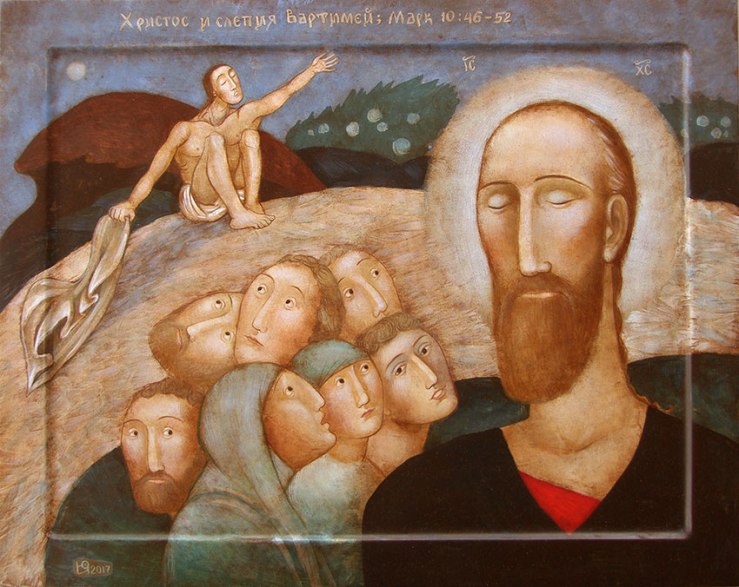
Julia Stankova (Bulgarian, 1954–), Christ and Bartimaeus, 2017. Tempera on primed wooden panel and lacquer technique, 36 × 45 cm.
And they came to Jericho. And as he was leaving Jericho with his disciples and a great crowd, Bartimaeus, a blind beggar, the son of Timaeus, was sitting by the roadside. And when he heard that it was Jesus of Nazareth, he began to cry out and say, “Jesus, Son of David, have mercy on me!” And many rebuked him, telling him to be silent. But he cried out all the more, “Son of David, have mercy on me!” And Jesus stopped and said, “Call him.” And they called the blind man, saying to him, “Take heart. Get up; he is calling you.” And throwing off his cloak, he sprang up and came to Jesus. And Jesus said to him, “What do you want me to do for you?” And the blind man said to him, “Rabbi, let me recover my sight.” And Jesus said to him, “Go your way; your faith has made you well.” And immediately he recovered his sight and followed him on the way.
—Mark 10:46–52 (cf. Matthew 20:29–34; Luke 18:35–43)
Here’s an introduction and acoustic performance by band leader Cam Huxford, who cowrote “Son of David” with fellow Ghost Ship member Shay Carlucci:
+++
“The Blind Suppliant” by Richard Crashaw
Silence, silence, O vile crowd;
Yea, I will now cry aloud:
He comes near, Who is to me
Light and life and liberty.
Silence seek ye? yes, I’ll be
Silent when He speaks to me,
He my Hope; ah, meek and still,
I shall ’bide His holy will.
O crowd, ye it may surprise,
But His voice holdeth my eyes:
O have pity on my night,
By the day that gives glad light;
O have pity on my night,
By the day would lose its light,
If it gat not of Thee sight;
O have pity on my night,
By day of faith upspringing bright;
That day within my soul that burns,
And for eyes’ day unto Thee turns.
Lord, O Lord, give me this day,
Nor do Thou take that away.
This post belongs to the weekly series Artful Devotion. If you can’t view the music player in your email or RSS reader, try opening the post in your browser.
To view all the Revised Common Lectionary scripture readings for Proper 25, cycle B, click here.
One of the blogs I follow is Good Letters, run by Image journal and authored by a diverse, gifted team of spiritual writers. Updated each weekday, it features short personal essays that make fresh connections between faith and daily life. Here are a few posts from the past month that I particularly enjoyed.
“Beginner Ballet” by Melissa Florer-Bixler: Like the author, I too took a beginner’s ballet class at a late age (mid-twenties), and her words capture my felt experience so well:
I assumed ballet would be an interesting and different way to exercise, the chance to try a new fitness routine and to escape the general chaos of my life for an hour each week.
But in this dance class, the ballet one does in socks after work, I discovered that dance offers an aesthetic world, a way for me to discover new possibilities for my body. How strange it was to push my energy down a smooth line as my body sunk to the floor, to wonder over the shape of my fingers, to imagine a string lifting me up, off my toes, to float an inch above the gleaming rehearsal studio floor.
Everything in ballet was strength in the service of beauty. Even the language was beautiful. . . .
+++
“The Ordinary Time” (poem) by Dana Littlepage Smith: I love Good Letters’ ongoing “Poetry Fridays,” in which a writer will introduce a poem with brief commentary. A few weeks ago Suzanne Nussey introduced this little gem in which the speaker learns through the observance of barnyard creatures how to slow down and be more attentive to life’s ordinary moments, how to enter God’s time. (The title references the liturgical season the church is currently in.) As she considers the birds, she sees how they work with joy, singing as they build, and are content just to be. The poem opens with a beautiful image and a subtle admonition:
Goldfish in the horse trough
nibble at morning’s surface.
They are not busy;
they are breathing.
+++
“On Writing Odes: Taking Time to Celebrate”by Tania Runyan: Runyan has been doing a Good Letters teaching series on poetic forms—sonnets, sestinas, villanelles, and now odes, which are characterized by praise and celebration. Here she presents the ode “To Autumn” by John Keats as a choice example, and then shares one of her own, “Ode to a Bodhran Player.” (A bodhran is a traditional Irish drum.) She concludes with an assignment: “Find something that you love, or maybe even something you don’t, and regale it with an ode. Give yourself to the true, noble, lovely, and excellent practice of praise.”
“To Autumn” by John Keats
Season of mists and mellow fruitfulness, Close bosom-friend of the maturing sun;
Conspiring with him how to load and bless With fruit the vines that round the thatch-eves run;
“Emmy Watch: This Is Us”by Tania Runyan: Eric and I enjoy watching this TV show together and appreciate its complex portrayals of familial relationships: husband-wife, parent-child, and sibling (including siblings-in-law). Even within the parent-child category, different forms of parenthood are explored—biological, adoptive, and foster. Here Runyan writes about the show’s positive portrayal of open adoption, which is now more common in the US than traditional “closed” adoption. When Runyan and her husband adopted their son, Samuel, they chose the open option, which in their case means they deliberately entered into and maintain in-person relationships with Samuel’s biological family. (To read more about Runyan’s experience, see “He Fits Right In: Our Story of Open Adoption.”) Runyan shares a conversation she had with her son’s biological grandmother about the show.
The third season of This Is Us began September 25. It airs Tuesdays at 9 p.m. on NBC.
+++
“Leonard Cohen’s Holy and Broken Hallelujah”by Alisa Ungar-Sargon: Leonard Cohen’s “Hallelujah” is one of the most-covered songs of all time, and it’s full of biblical references. (Like the writer, my first introduction to it was also as a preteen through the movie Shrek!) “The song’s central premise is the value, even the necessity, of praise in the face of confusion, doubt, or dread,” writes Ungar-Sargon, who led her high school English students in an analysis of its lyrics as poetry.
Here’s a cover by the husband-wife duo Gungor (that is, Michael and Lisa Gungor).
Barbara Wolff (American), “And the Mountains Rose” (vv. 5–8), from Psalm 104: You Renew the Face of the Earth, 2006–10. Contemporary pigments and precious metals on goatskin. Morgan Library and Museum, New York. MS M.1190, fol. 2.
Bless the LORD, O my soul!
O LORD my God, you are very great!
You are clothed with splendor and majesty,
covering yourself with light as with a garment,
stretching out the heavens like a tent.
He lays the beams of his chambers on the waters;
he makes the clouds his chariot;
he rides on the wings of the wind;
he makes his messengers winds,
his ministers a flaming fire.
He set the earth on its foundations,
so that it should never be moved.
You covered it with the deep as with a garment;
the waters stood above the mountains.
At your rebuke they fled;
at the sound of your thunder they took to flight.
The mountains rose, the valleys sank down
to the place that you appointed for them.
You set a boundary that they may not pass,
so that they might not again cover the earth.
You make springs gush forth in the valleys;
they flow between the hills;
they give drink to every beast of the field;
the wild donkeys quench their thirst.
Beside them the birds of the heavens dwell;
they sing among the branches.
From your lofty abode you water the mountains;
the earth is satisfied with the fruit of your work.
You cause the grass to grow for the livestock
and plants for man to cultivate,
that he may bring forth food from the earth
and wine to gladden the heart of man,
oil to make his face shine
and bread to strengthen man’s heart.
The trees of the LORD are watered abundantly,
the cedars of Lebanon that he planted.
In them the birds build their nests;
the stork has her home in the fir trees.
The high mountains are for the wild goats;
the rocks are a refuge for the rock badgers.
He made the moon to mark the seasons;
the sun knows its time for setting.
You make darkness, and it is night,
when all the beasts of the forest creep about.
The young lions roar for their prey,
seeking their food from God.
When the sun rises, they steal away
and lie down in their dens.
Man goes out to his work
and to his labor until the evening.
O LORD, how manifold are your works!
In wisdom have you made them all;
the earth is full of your creatures.
Here is the sea, great and wide,
which teems with creatures innumerable,
living things both small and great.
There go the ships,
and Leviathan, which you formed to play in it.
These all look to you,
to give them their food in due season.
When you give it to them, they gather it up;
when you open your hand, they are filled with good things.
When you hide your face, they are dismayed;
when you take away their breath, they die
and return to their dust.
When you send forth your Spirit, they are created,
and you renew the face of the ground.
May the glory of the LORD endure forever;
may the LORD rejoice in his works,
who looks on the earth and it trembles,
who touches the mountains and they smoke!
I will sing to the LORD as long as I live;
I will sing praise to my God while I have being.
May my meditation be pleasing to him,
for I rejoice in the LORD.
Let sinners be consumed from the earth,
and let the wicked be no more!
Bless the LORD, O my soul!
Praise the LORD!
—Psalm 104
+++
SONG: “Psalm 104” | Text: Psalm 104:1–5 (Hebrew) | Traditional Jewish Babylonian melody, arranged by Yonnie (Jonathan) Dror | Performed by Yamma Ensemble, 2012
An ancient setting of the first five verses of Psalm 104, composed by the Jewish diaspora community in Babylon and passed down aurally, is refreshed through this modern arrangement by Yamma Ensemble, whose instrumentation blends the old and the new. It opens with a virtuosic oud solo by Sefi Asfuri. At 1:13, the other instrumentalists come in, creating rhythmic complexity: Yonnie Dror (clarinet and flute), Aviad Ben Yehuda (darbuka), and Avri Borochov (double bass). The lead vocalist, Talya G.A Solan, enters at 2:00. At 3:48, all the instruments drop out, and male vocals are added.
While this particular performance is from 2012, an earlier one, from 2011, can be heard on the album Yamma under the title “Bless the Lord, O My Soul.” The lyrics are on YouTube.
Yamma Ensemble presents original contemporary Hebrew music in which group members stay true to the character of the Middle East, the region where they were born and raised. The soulful, exotic music is accompanied by ancient musical instruments (kopuz, duduk, ney, oud, shofar, hand drums), which are typical of the Middle East. In addition to this unique art, Yamma also performs the traditional music and material of the various Jewish diasporas. We present songs of the Jewish communities from Yemen, Babylon, and Sefarad, as well as Hasidic music, with the fascinating forms and rhythms that have been preserved by generations of Jewish traditions. [source]
To hear more from Yamma Ensemble, visit their Facebook page and YouTube channel. If you like their music, consider supporting them on Patreon.
+++
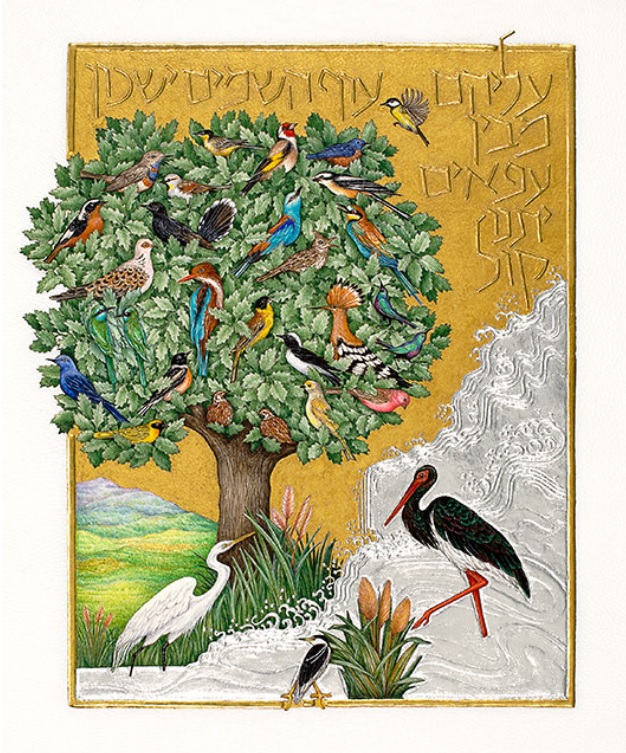
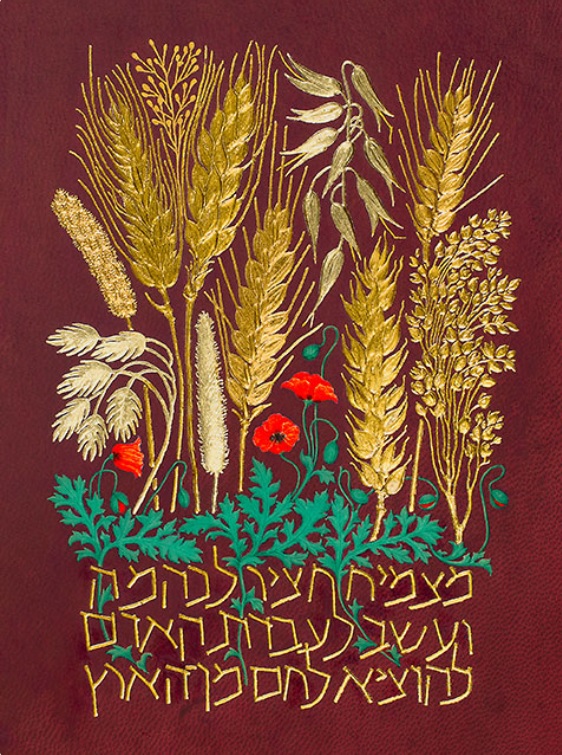
The manuscript illumination above is one of ten from Barbara Wolff’s unbound cycle Psalm 104:You Renew the Face of the Earth. The artist writes (in the third person),
The 104th Psalm is a song in celebration of all creation. The psalmist marvels at the infinite variety of life on earth. With words that reflect a deep awareness of our finitude and an implicit faith in the eternity of creation, we are reminded of the intricate web which connects all living creatures. In the ten illuminations which comprise Psalm 104: You Renew the Face of the Earth, Barbara Wolff has attempted to reflect some of the light and brilliance of this word picture of the cosmos and illuminate its profound sense of reverence for all creation. In a number of the paintings she has portrayed flora and fauna which the ancient Psalmist would certainly have known, and which still may be found in the land of Israel today. She has included the flowers and grasses of its fields and forests, birds which pass through the land each spring and fall, and sea creatures of the Mediterranean, from a precious Murex snail to the great whales.
Barbara Wolff (American), “Among the Branches They Sing” (v. 12), from Psalm 104: You Renew the Face of the Earth, 2006–10. Contemporary pigments and precious metals on goatskin. Morgan Library and Museum, New York. MS M.1190, fol. 3.Barbara Wolff (American), “To Bring Forth Bread” (v. 14), from Psalm 104: You Renew the Face of the Earth, 2006–10. Contemporary pigments and precious metals on goatskin. Morgan Library and Museum, New York. MS M.1190, fol. 4.Barbara Wolff (American), “Leviathan Whom Thou Hast Formed” (vv. 25–26), from Psalm 104: You Renew the Face of the Earth, 2006–10. Contemporary pigments and precious metals on goatskin. Morgan Library and Museum, New York. MS M.1190, fol. 8.Barbara Wolff (American), “You Renew the Face of the Earth” (v. 30), from Psalm 104: You Renew the Face of the Earth, 2006–10. Contemporary pigments and precious metals on goatskin. Morgan Library and Museum, New York. MS M.1190, fol. 9.
Prior to pursuing a career in fine art, Wolff spent many years illustrating natural science texts, honing her eye to see and her hands to reproduce the miniscule details of different plant, animal, and insect species. In the early 2000s, on a whim, she took a course on medieval manuscript illumination, learning, among other things, how to work with parchment, gesso, mineral pigments, and precious metal leaf (silver, gold, and platinum). “It just changed by life,” she said. She has since devoted the bulk of her time to illuminating Jewish texts, a focus made possible by individual and institutional patrons. Her Psalm 104 and RoseHaggadah were commissioned by philanthropists Daniel and Joanna S. Rose and subsequently donated to the Morgan Library and Museum in New York City. Other patrons of hers include the Israel Museum and the Jewish Theological Seminary of America.
Joanne Palmer, reviewing Wolff’s work for the Jewish Standard, writes,
Psalm 104 is about beauty. It is about other things as well, true, but it starts with beauty and returns to it as a touchstone. It describes the world with rapturous metaphor. God, who is “clothed with glory and majesty,” who covers himself with “light as with a garment, who stretches out the heavens like a curtain,” has made the world in his image.
When you [see Wolff’s illumination cycle], you are surrounded by the wild precise beauty of that creation, in rich, lush, exquisite, witty, masterfully detailed, controlled miniatures. To [view these paintings] is to be stunned by beauty.
To view all ten illuminations from Wolff’s Psalm 104 cycle and to purchase facsimiles, visit http://www.artofbarbarawolff.com/projects.php?psalm. To learn more about the materials Wolff uses and to read commentaries on individual folios, see the links below.
This post belongs to the weekly series Artful Devotion. If you can’t view the music player in your email or RSS reader, try opening the post in your browser.
To view all the Revised Common Lectionary scripture readings for Proper 24, cycle B, click here.
This August saw the homegoing of two beloved Christian art-makers.
>> “Making meaning out of suffering and loss is one of poetry’s most fundamental aims,” wrote poetAnya Silver, who passed away from inflammatory breast cancer on August 6 at age forty-nine. Since her diagnosis in 2004, she published four volumes of poetry that entwine faith with deep, honest questioning of God. Many of her poems contain imagery related to cancer and its treatment and describe with unswerving candor what it’s like to live under the threat of imminent death. When she received a Guggenheim Fellowship this year, the foundation described her work as “engag[ing] with the trauma of chronic and terminal illness, and with religious faith and mystery, storytelling, memory, and the risks and rewards of being human.” One of her best-known poems is “Psalm 137 for Noah,” written for her only child, whom she gave birth to during her illness.
“I have a tremendous amount of joy in my life, and my joy exists with pain,” Silver said in an interview with Georgia Public Radio in January. “I don’t see those two things as completely separate. All of life is woven together, and separating the strands is impossible.” Read her obituary in the New York Times, and a sweet tribute by Elizabeth Palmer in the Christian Century.
>> A giant of contemporary French sacred art, Jean-Marie Pirot, known professionally as Arcabas, died August 23 at age ninety-one. He is best known for his paintings, which feature biblical characters and scenes, but he also worked in sculpture, engraving, tapestry, mosaic, and cabinetry, as well as in the theater making scenery and costumes. His magnum opus is the interior decoration of Saint-Hugues-de-Chartreuse in the Isère region of France, which comprises over a hundred works by the artist created over a span of thirty-five years.
There has been much published about Arcabas in French (e.g.) but unfortunately very little in English—though for starters, I recommend this ArtWay article. A YouTube search of his name yields several video interviews and feature news segments—again, in French. I’ve embedded a recent video homage below, which shows you inside Saint-Hugues as well as his designs for the stained glass windows inside the Basilica of the Sacred Heart in Grenoble, a project he was working on when he died. I’d love to help bring out some of these books, or even a brand-new catalogue raisonné, in English, so if any of you have connections to Arcabas’s French publishers or people close to him, or have experience translating from French to English, let me know!
+++
PAINTING: Saint Agatha’s Grief by Melissa Weinman: October is Breast Cancer Awareness Month, so what better time to get acquainted with Agatha of Sicily, patron saint of breast cancer patients. Agatha was a third-century Christian from a noble family whose martyrdom has been authenticated, although its details have not. According to legend, fifteen-year-old Agatha made a vow of virginity and rejected the amorous advances of the Roman prefect Quintianus. After consistently being spurned, Quintianus had her arrested for her faith (this was during the persecutions of Decius) and tortured. Among the tortures she underwent was the tearing off of her breasts with pincers. She died in prison, probably in the year 251.
Melissa Weinman (American), Saint Agatha’s Grief, 1996. Oil on canvas, 42 × 42 in.
In traditional portraiture, Agatha is shown holding her severed breasts on a platter (see, e.g., Francisco de Zurbarán). More recently, though, American artist Melissa Weinman painted a double portrait of Agatha as a modern-day woman in a white tank top enduring the tortuous experience of breast cancer. The two women stand back to back, the left figure having presumably just received the diagnosis, and the right figure bearing blood stains on the chest that indicate a mastectomy. There is an immediate sense of violation in the image, but also a sense that God’s glory is at work. While the one figure is cast in darkness, the other leans toward the light, suggesting hope and faith in the purposes of God, even in the groaning.
+++
RECENT EXHIBITION: “Creença”: This summer fifty artists from a variety of disciplines participated in a two-month residency at Konvent, a nineteenth-century convent (now an art center) in Cal Rosal, Catalonia, Spain. Organized by Void Projects, the residency culminated in a three-day pop-up exhibition from August 30 to September 2, titled “Creença” (Belief), which included not just visual art but live theater, talks, and music.
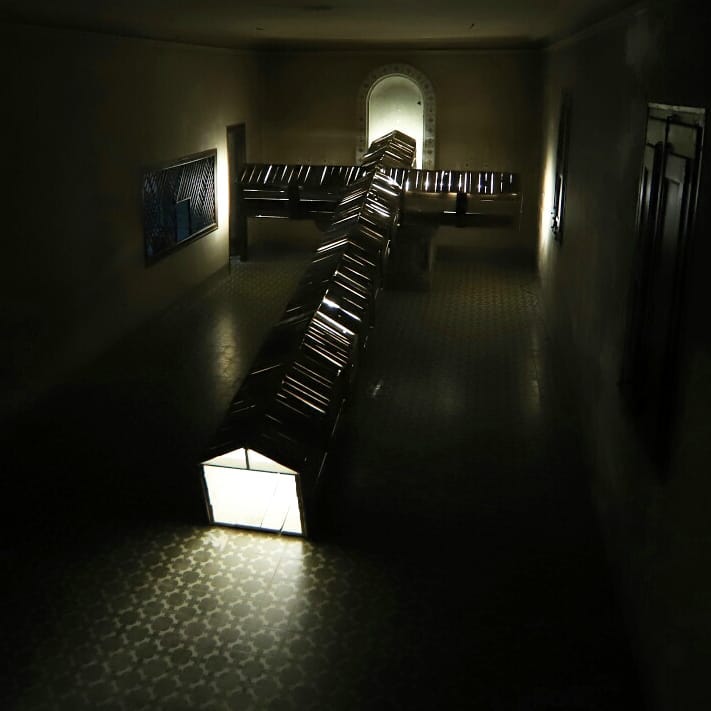
Site-specific installation by Jofre Oliveras and Stefan Krische, 2018, in Konvent, Cal Rosal, Catalonia, Spain.
+++
CURRENT EXHIBITION: “Wrestling the Angel: A Century of Artists Reckoning with Religion,” Bechtler Museum of Modern Art, Charlotte, North Carolina: Through October 28, the Bechtler is showing 219 pieces of religious-themed art spread out across its large fourth floor, including works by Dalí, Rouault, Chagall, Warhol, Manessier, Bearden, and other modern greats. I visited last weekend, and while I feel that the theme was treated too loosely and therefore the exhibition lacked the full impact it could have had, I thoroughly enjoyed individual portions, and I appreciate the Bechtler, and in particular curator Jen Edwards, for bringing together these diverse works that speak in some way to religion, spirituality, or morality.
This was the first time I’ve seen Rouault’s entire Miserere (“Have Mercy”) series—all fifty-eight aquatints!—in one space, and it was stunning. Its display alongside Charlotte artist Gina Gilmour’s Break Your Guns and Stacy Lynn Waddell’s Untitled (Mike Brown’s Battle at Normandy) reinforces the theme of lament for violence and suffering inherent in all three. In the same room the set of small bronze crucifixes by Elizabeth Turk, which in their original gallery installation in 2002–03 contained lit candles in the hollows of the heads, invite further reflection on death, subtly connecting (through strategic placement) Christ’s crucifixion with the “crucifixions” of those slain in the past century through acts of war, gun violence, and police brutality.
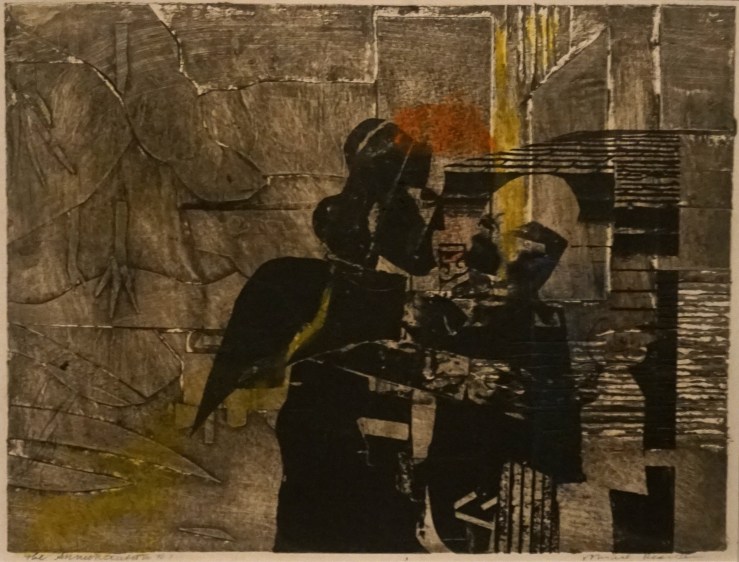
Installation view: “Wrestling the Angel,” Bechtler Museum of Modern Art, Charlotte, North Carolina, 2018. Left: Prints from Georges Rouault’s Miserere series, 1927. Right: Break Your Guns by Gina Gilmour, 1980. Photo: Victoria Emily Jones.Elizabeth R. Turk (American, 1961–), untitled bronzes from Poppyfields, 2002–03. Installation view: “Wrestling the Angel,” Bechtler Museum of Modern Art, Charlotte, North Carolina, 2018. Photo: Victoria Emily Jones.Romare Bearden (American, 1911–1988), The Annunciation, ca. 1967. Collograph, 11 3/4 × 15 1/2 in. (29.6 × 39.4 cm). Courtesy of Jerald and Mary Melberg. Photo: Victoria Emily Jones.
For other reviews of this exhibition, see those by Andy Smith and Barbara Schreiber. And word to the wise: avoid the last day, because it’s a Carolina Panthers NFL home game, and the stadium is right across the street from the museum. (I wish I had thought to check the schedule before I made the cumbersome trek last Sunday!)
George Frederic Watts (British, 1817–1904), ‘For he had great possessions,’ 1894. Oil on canvas, 139.7 × 58.4 cm. Tate Britain, London.
And as he was setting out on his journey, a man ran up and knelt before him and asked him, “Good Teacher, what must I do to inherit eternal life?”
And Jesus said to him, “Why do you call me good? No one is good except God alone. You know the commandments: ‘Do not murder, Do not commit adultery, Do not steal, Do not bear false witness, Do not defraud, Honor your father and mother.’”
And he said to him, “Teacher, all these I have kept from my youth.”
And Jesus, looking at him, loved him, and said to him, “You lack one thing: go, sell all that you have and give to the poor, and you will have treasure in heaven; and come, follow me.”
Disheartened by the saying, he went away sorrowful, for he had great possessions.
—Mark 10:17–22 (cf. Matthew 19:16–30; Luke 18:18–30)
+++
SONG: “Iesū Me Ke Kanaka Waiwai” (Jesus and the Rich Young Man) | Words and music attributed to John Kamealoha Almeida, 1915 | Performed by Mark Yamanaka, with Sean Naleimaile, 2018
The origins of this song are debated, which is why it often circulates with the credit “Traditional,” but many sources attribute it to John K. Almeida (1897–1985), a famous singer, songwriter, and bandleader from Oahu, who said he wrote it in 1915. According to music archivist Harry B. Soria Jr., Almeida offered “Kanaka Waiwai” to the Mormon Church, of which he was a member, but his gesture was turned down when the piece was deemed too “hula sounding” and unsuitable for a worship service [liner notes, John Kameaaloha Almeida (HanaOla Records, 2003)].
Almeida first recorded it, along with secular mele (songs), in 1946, accompanied by Genoa Keawe’s Trio. It gained immense popularity in 1971, when the Sons of Hawaii recorded it with Moe Keale on vocals. Now it is one of Hawaii’s best-loved hymns and is widely performed not only in recording studios but in churches. I’ve combed through dozens of performances to find what I consider the best, which is Mark Yamanaka’s. You’ll notice he employs a characteristic Hawaiian vocal technique known as leo ki’eki’e (“high-pitched voice”), a yodel-like break between registers. The video above is from a HiSessions acoustic live session shot earlier this year, but you can also hear him singing the song on his 2013 album Lei Maile.
Ma ke alahele ʻo Iesû
I hālāwai aku ai
Me ke kanaka ʻōpio hanohano
Kaulana i ka waiwai
Pane mai e ka ʻōpio
ʻE kuʻu Haku maikaʻi
He aha hoʻi kaʻu e hana aku ai
I loaʻa e ke ola mau?
E hāʻawi, e hāʻawi lilo I kou mau waiwai Huli a hahai mai iaʻu I loaʻa e ke ola mau ia ʻoe
Minamina e ka ʻōpio
I kona mau waiwai
I ke kūʻai a hāʻawi lilo aku
I ka poʻe nele a hune
Huli aʻe ʻo Iesū lā
Pane aku i ka ʻōpio
ʻAʻole aʻe hiki ke kanaka waiwai
I ke aupuni o ka lani
A literal English translation, by Haunani Bernardino, is as follows:
Along the road, Jesus
Met
With a distinguished young man
Who was known for his wealth.
The young man said,
“My good lord,
What must I do
To gain eternal life?”
“Give, give away all Of your possessions, Then come and follow me In order to gain eternal life.”
The young man grieved
Over his wealth,
Unwilling to sell and give all
To the poor and destitute.
Jesus then turned
And answered the man,
“Rich man, you will not enter
The Kingdom of Heaven.” [source]
When the song is sung in English, however (even by native Hawaiians), a completely different set of lyrics is used, going something like this:
Let me walk through paradise with you, Lord
Take my hand and lead me there
All my earthly treasures I will gladly give
Teach me how to love and how to share
Greed and lust and vanity were mine, Lord
Till I found your love divine
Now on my knees I pray that I will find a way
Let me walk through paradise with you
Oh, my Lord, my Savior
Guide my poor feet along that lonely road
Faith and hope and love will light the way before me
And I’ll walk through paradise with you
Oh, my Lord, my Father
Take my hand and lead me to paradise
Oh, my Lord, let me follow in your footsteps
Let me walk through paradise with you
I’m not sure where these lyrics originated, nor why a closer approximation of the original has not been attempted. This English rewrite drastically changes the content of the song, shifting it from a retelling of a Gospel narrative that ends on a sad note to a personal prayer that, while touching on some of the themes of the rich man’s encounter with Jesus, is sweet and bright and indicates conversion. One could say it’s a revisionist account told in the rich man’s voice—if he had surrendered to Jesus’s call rather than resisted, unwilling to give up his material wealth. He is thus held up as a positive model in this version, and we are enjoined to respond with similar boldness of vow (“All my earthly treasures I will gladly give”) and fervency of petition (“Let me walk through paradise with you”).
In the following video, an unnamed woman with beautiful vocals performs this English version to a simple ukulele accompaniment:
This post belongs to the weekly series Artful Devotion. If you can’t view the music player in your email or RSS reader, try opening the post in your browser.
To view all the Revised Common Lectionary scripture readings for Proper 23, cycle B, click here.
Detail of a Himalayan “Life of Christ” thangka, 19th century. Private collection of Terry Anthony. (Click on image to learn more)
And they were bringing children to him that he might touch them, and the disciples rebuked them. But when Jesus saw it, he was indignant and said to them, “Let the children come to me; do not hinder them, for to such belongs the kingdom of God. Truly, I say to you, whoever does not receive the kingdom of God like a child shall not enter it.” And he took them in his arms and blessed them, laying his hands on them.
—Mark 10:13–16
+++
MUSIC: “Children’s Medley” | Solo piano arrangement by Marilynn Ham, 1985 | Performed by Cheryl Johnston, 2011
Marilynn Ham is probably my favorite arranger of sacred piano music—I own many of the books she’s published over the decades. “Children’s Medley” is from Ivory Exaltation: Arrangements for the Advanced Pianist, and here a parishioner from Green Valley United Methodist Church in Henderson, Nevada, performs it at the beginning of a worship service as an acolyte processes forward to light the two candles at the altar. In this context, the piece functions as a call to worship, combining “Praise Him, All Ye Little Children” by Carey Bonner with excerpts from Mozart’s Piano Sonata in C Major, “Jesus Loves Me” by William Batchelder Bradbury, and “Music Box Dancer” by Frank Mills. While these two primary songs are often sung by kids (whose belonging they affirm), they hold truth for people of all ages, for we are all called to come into God’s presence like little children—praising him with wonder and excitement, loving him without conditions, relying on his strength, receiving his love.
I have fond memories of singing both of these songs in children’s church when I was young. “Praise Him, All Ye Little Children,” not quite as familiar as “Jesus Loves Me,” was written by a Baptist minister from England who served as the General Secretary of the National Sunday School Union from 1900 until 1929. In 1905 it was published in The Sunday School Hymnary: A Twentieth Century Hymnal for Young People, a 674-page songbook Bonner compiled, now in the public domain. Here’s an adorable little two-year-old girl singing the first verse:
Praise Him, praise Him, all ye little children,
God is love, God is love;
Praise Him, praise Him, all ye little children,
God is love, God is love.
Love Him, love Him, all ye little children,
God is love, God is love;
Love Him, love Him, all ye little children,
God is love, God is love.
Thank Him, thank Him, all ye little children,
God is love, God is love;
Thank Him, thank Him, all ye little children,
God is love, God is love.
If you’re an advanced pianist and you liked Ham’s medley arrangement above, you will also want to check out “The Child in Each of Us” in Notes from a Thankful Heart, a medley of “Chopsticks,” “Deep and Wide,” “Running Over,” “If You’re Happy and You Know It,” and “I Am a ‘C.'” I have such fun playing these!
This post belongs to the weekly series Artful Devotion. If you can’t view the music player in your email or RSS reader, try opening the post in your browser.
To view all the Revised Common Lectionary scripture readings for Proper 22, cycle B, click here.















 Art & Theology