Unveiled Mystery (Artful Devotion)

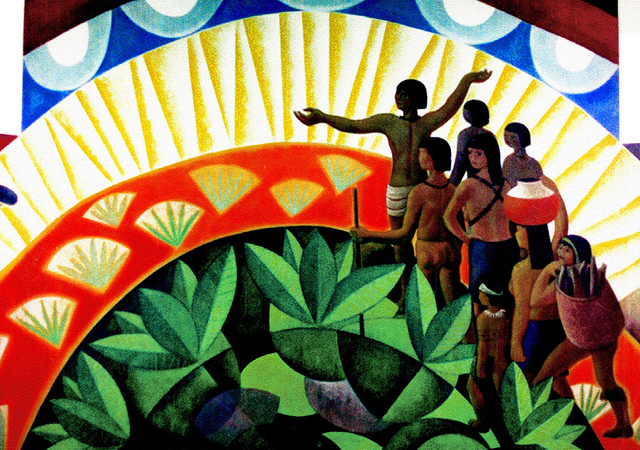
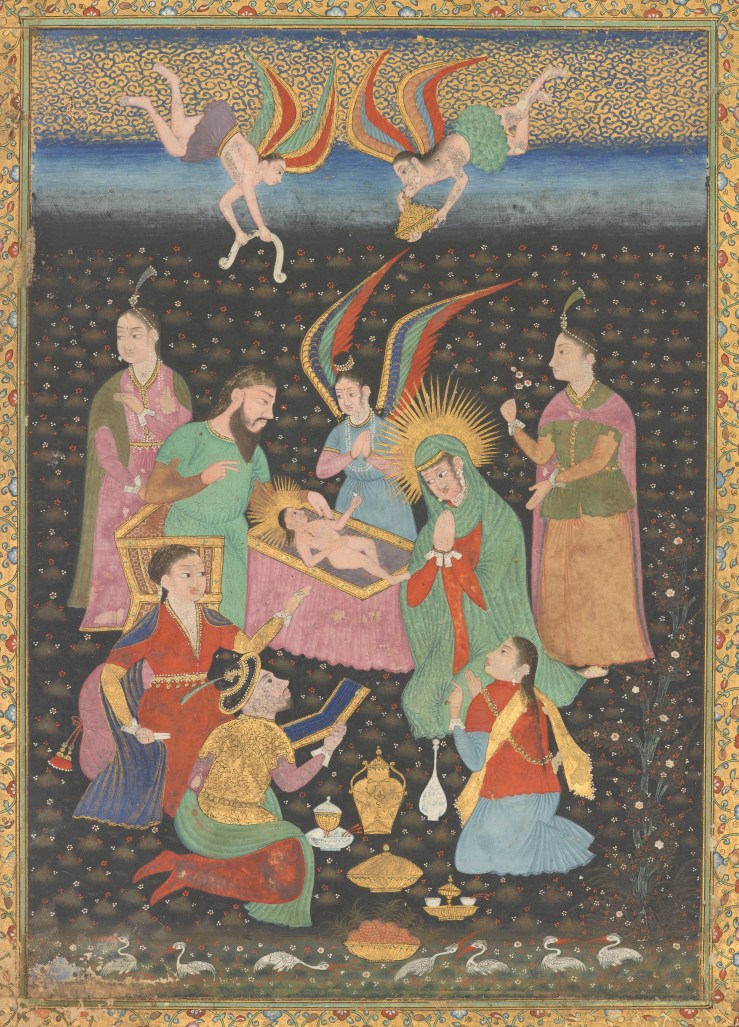
Nativity by Galo Ocampo
Galo Ocampo (Filipino, 1913–1985), Nativity, late 1930s. Oil on canvas. UST Museum (University of Santo Tomas Museum of Arts and Sciences), Manila, Philippines.

“The revelation of the mystery that was kept secret for long ages . . . is now disclosed.” (Romans 16:25–26)

+++

SONG: “Come Behold the Wondrous Mystery” | Words and music by Matt Boswell, Matt Papa, and Michael Bleecker, 2012 | Arranged for a cappella choir by Cliff Duren | Performed by Doxology Vocal Ensemble

For lyrics and music scores, click here.


This post belongs to the weekly series Artful Devotion. If you can’t view the music player in your email or RSS reader, try opening the post in your browser.

To view all the Revised Common Lectionary scripture readings for the Fourth Sunday of Advent, cycle B, click here.

The evolution of “Jesu, Joy of Man’s Desiring”

You’ve probably heard this lovely lilting Baroque piece performed as an instrumental at weddings. But the composer who popularized the tune—the inimitable J. S. Bach—originally used it for the two chorale movements, one of them the finale, of a ten-movement liturgical work celebrating the miraculous pregnancies of Mary and Elizabeth from the Gospel of Luke, and God’s subversion of the world order through the birth of Christ. “The wondrous hand of the exalted Almighty / is active in the mysteries of the earth!” the work proclaims.

Under Bach’s design, those iconic triplets (DUM-da-da DA-da-da DA-da-da . . .) gird up a choir-song of praise to Jesus Christ, Emmanuel, our joy and our strength. Even when the light, bright major chords give way to the minor in line 5, signifying the turning of life’s circumstances, the Christian’s confession remains the same: Jesus is mine; what shall I fear?

Though Bach is often cited as the melody’s originator, that credit in fact goes to Johann Schop; it was first published in 1642 with Johann Rist’s hymn text “Wach auf, mein Geist, erhebe dich” (“Wake, My Spirit, Rise”). In 1661 Martin Janus wrote a new text for the tune—of no less than nineteen stanzas!—titled “Jesu, meiner Seelen Wonne” (“Jesus, My Soul’s Bliss”). Bach took stanzas 6 and 17 of this hymn, harmonized and orchestrated them, and placed them as the closings to part 1 and part 2, respectively, of his cantata Herz und Mund und Tat und Leben (Heart and Mouth and Deed and Life) (BWV 147).

These two chorale movements, titled “Wohl mir, daß ich Jesum habe” (Blest am I, that I have Jesus) and “Jesus bleibet meine Freude” (Jesus shall remain my joy), have identical musical settings, and their English translation is as follows:

Blest am I, that I have Jesus!
O how tightly I cling to him,
so that he delights my heart
when I am sick and sad.
I have Jesus, who loves me
and gives himself to me as my own;
ah, therefore I will not let go of Jesus,
even if my heart is breaking.

Jesus shall remain my joy,
my heart’s comfort and sap;
Jesus shall fend off all sorrow.
He is the strength of my life,
the delight and sun of my eyes,
the treasure and wonder of my soul;
therefore I will not let Jesus go
out of my heart and sight. [source]

Bach wrote Herz und Mund in 1723 during his first year as the director of church music in Leipzig, basing it on an earlier cantata he had written in Weimar in 1716 for the fourth Sunday of Advent. Because Leipzig observed tempus clausum (a “closed time” of penitence) during Advent, allowing cantata music only on the first Sunday of the season, Bach could not perform the cantata for the same occasion in Leipzig, so he adapted it for the Feast of the Visitation on July 2.

Scored by Bach for four solo vocalists, a four-part choir, and an instrumental ensemble of trumpet, two oboes, violin, viola, and continuo, the chorale music was first given the title “Jesu, Joy of Man’s Desiring” in 1926 when Dame Myra Hess published a transcription for solo piano—which you can hear Benjamin Moser play in the video below.

(“Jesu” is a poetic derivation of the Latin form of the name Jesus. I most commonly hear it pronounced YAY-su, but see here.)   Continue reading “The evolution of “Jesu, Joy of Man’s Desiring””

Roundup: “O Children, Come”; the Christmas story through news photos; Messiaen and the Incarnation; art from Bethlehem; nativity musical soundtrack

SONG: “O Children, Come” by Keith and Kristyn Getty: The Gettys are an Irish married couple who are major contributors to the modern Christian hymn-writing movement. I really enjoyed singing this song of theirs at church last week (CCLI 7036340); it was my first time hearing it. The acoustic performance below is from the Gettys’ 2015 Christmas concert. They’ve also recorded it with Ladysmith Black Mambazo.

+++

PHOTO ESSAY: “Alternative Nativity”: Kezia M’Clelland works with children affected by conflict in the Middle East and raises public awareness through her blog, Kezia Here and There. In 2015 she compiled news photos that document the refugee crisis and set them to excerpts from St. Matthew’s account of Christ’s birth and the prologue to St. John’s Gospel—a very powerful pairing that gives impetus to our Advent cry, “Come, Lord Jesus!” This is not a generic mashup; each photo was carefully selected to amplify a corresponding scripture text.

Alternative nativity1
“About that time Caesar Augustus ordered a census to be taken throughout the Empire. This was the first census when Quirinius was governor of Syria. Everyone had to travel to his own ancestral hometown to be accounted for.” (Photo via Reuters. Displaced Yazidis escape across the Syrian border by foot, fleeing violence from the Islamic State militants who have taken over their home town of Sinjar.)
Alternative nativity2
“So Joseph went to Bethlehem. He took with him Mary, his fiancée, who was obviously pregnant by this time.” (Photo via Al Jazeera. A refugee father with his pregnant wife and daughter asks for permission to enter into Hungary near Roszke as the border fence with Serbia is closed by Hungarian police.)

For each subsequent Advent, M’Clelland has released something in a similar vein: the video “Hope Is on the Way” in 2016, and this year, “Light in the Darkness,” with verses of scripture, mainly from the Old Testament prophets, emblazoned across photos from today’s Middle East. “This year again these Advent pictures and words will speak of a hope that is now and not yet,” she writes. “I am grateful that Advent gives us the freedom to weep and to hope, to rejoice and to grieve, to wait for and to recognise the Christ who is already here among us.”

Marrying the Christmas story with contemporary photojournalism can teach us to “pray with the Bible in one hand and a newspaper in the other,” as the popular adage goes. As we see the world’s brokenness, it should intensify our fervor for Christ’s shalom and impel us to action.

+++

UPCOMING MUSIC & ART EVENT: “Messiaen and the Incarnation,” December 20, 8 p.m., St. Mary’s Addington, London: Next Wednesday evening, Dr. Edward Forman will be performing three movements each from the French avant-garde composer Olivier Messiaen’s organ suite La Nativité du Seigneur (The Nativity of the Lord) and piano suite Vingt regards sur l’Enfant-Jésus (Twenty Contemplations on the Infant Jesus). Messiaen was a committed Christian who sought to express theological truths in a fresh, modern idiom. Like much of his output, these two works reject the Western conventions of forward motion, development, and diatonic harmonic resolution, so they can be difficult for first-time hearers. But this complexity, this sense of the unexpected, is appropriate for the mystical content they seek to convey.

Inspired by the unique palette of sounds, textures, and rhythms of Nativité, British artist Sophie Hacker translated these into visual form. After deeply studying the music, in 2007 she created nine mixed-media panels in response—one for each movement—using slats of wood, nails, lead, wire, tree bark, and other found objects; you can see some of her process in the video below. These premiered at Winchester Cathedral in 2008. Then again in 2015 Hacker participated in another Messiaen-inspired artistic collaboration, under the direction of pianist Cordelia Williams, with poets Michael Symmons Roberts and Rowan Williams. This project is called “Between Heaven and the Clouds: Messiaen 2015.”

La Nativité du Seigneur by Sophie Hacker
Sophie Hacker (British), La Nativité du Seigneur (The Nativity of the Lord), 2007. Mixed media on nine canvases, 60 × 60 cm each. Photo: Mike J. Davis.

To guide us through the listening experience, St. Mary’s will be projecting Hacker’s artworks onto a screen during the playing, and interspersing it with poetic reflections on the theological themes—from the Bible, Messiaen, Roland Riem (Icons of the Incarnation), and other sources. “We think it is equally pointless to try to explain Messiaen’s music in words as to attempt a sensible account of what it means for God to become human,” writes Forman in the booklet that will be provided to attendees. “We hope that the visual effects, words and music will enhance each other in ways that are inspiring and provoking.”

Messiaen’s compositions are definitely more challenging than the standard Christmas music fare, so I am grateful that St. Mary’s has the boldness, vision, and talent to offer them to the public, and in the meaningful context (which you likely won’t get in the concert hall) of meditation on the mystery of the Incarnation.

+++

ARTIST PROFILE: Zaki Baboun: Zaki Baboun is a Palestinian Christian artist living in Beit Jala, a suburb of Bethlehem. He paints religious scenes in oils on olive wood, which you can browse and purchase here—either the originals or reproductions on Christmas cards.

The first video below contains a short, two-minute interview with Zaki and shows him painting The Journey of the Magi; the second shows him painting The Good Shepherd.

+++

ALBUM: The Unusual Tale of Mary and Joseph’s Baby by Waterdeep: I saw the world premiere of this nativity musical last summer in New York (read my review here), and it really helped shepherd my imagination into a deeper understanding of Mary and Joseph’s social and emotional realities. Now the album is out! The songs express the many ups and downs the Holy Couple likely underwent in their faith journeys to bring the Messiah into the world, with the theme of deliverance standing in highest relief. (Mary’s opening song, “I Want to Be Delivered,” is what spurs, much to her shock, the Annunciation, and the finale, “Walk Through the Sea on Dry Land,” draws everyone into a joyful reminiscence of God’s mighty hand in ages past, manifest in the present through the birth of the Christ child.) Comedy is provided through invented characters like Joseph’s friend Benjamin, the innkeeper and his wife, and a shepherd named Naphtali.

The Unusual Tale of Mary and Joseph's Baby album cover

The most poignant scene, for me—and hence probably my favorite song—is the “Magnificat.” The biblical account doesn’t tell us much about Mary’s state of mind at this point, so the writers imagine her coming to Elizabeth filled with fear, and Elizabeth building her up, preaching truth to her (and sharing her own story of shame), helping her move from doubt to confidence. Elizabeth’s song is what emboldens Mary to sing. Their “Magnificat” is later reprised by the full cast immediately following Christ’s birth, concluding part 1.

The new album is not an original cast recording; instead the songs were recorded by their writer, Don Chaffer, and his wife, Lori, and released under the Waterdeep moniker. Stream on Spotify; sample and purchase at Amazon or iTunes.

Jina la Bwana ni takatifu! (Artful Devotion)

At that time Mary got ready and hurried to a town in the hill country of Judea, where she entered Zechariah’s home and greeted Elizabeth. When Elizabeth heard Mary’s greeting, the baby leaped in her womb, and Elizabeth was filled with the Holy Spirit. In a loud voice she exclaimed: “Blessed are you among women, and blessed is the child you will bear! But why am I so favored, that the mother of my Lord should come to me? As soon as the sound of your greeting reached my ears, the baby in my womb leaped for joy. Blessed is she who has believed that the Lord would fulfill his promises to her!”

And Mary said:

“My soul glorifies the Lord
and my spirit rejoices in God my Savior,
for he has been mindful
of the humble state of his servant.
From now on all generations will call me blessed,
for the Mighty One has done great things for me—
holy is his name.
His mercy extends to those who fear him,
from generation to generation.
He has performed mighty deeds with his arm;
he has scattered those who are proud in their inmost thoughts.
He has brought down rulers from their thrones
but has lifted up the humble.
He has filled the hungry with good things
but has sent the rich away empty.
He has helped his servant Israel,
remembering to be merciful
to Abraham and his descendants forever,
just as he promised our ancestors.”

—Luke 1:39–55

+++

SONG: “Jina la Bwana: An African Magnificat” by Steven C. Warner, 1995 | Performed by the University of Notre Dame Folk Choir, on Prophets of Joy (1996)

The Swahili refrain, “Jina la Bwana ni takatifu,” translates as “The name of the Lord is holy.”

+++

Windsock Visitation by Mickey McGrath
Mickey McGrath, OSFS (American), Windsock Visitation, 1995. Visitation Monastery of Minneapolis.

Artist’s statement:

This image of the Visitation of Mary and Elizabeth was commissioned for the Monastery of the Visitation in north Minneapolis, a group of monastic sisters very near and dear to my heart. In what has become a well-known neighborhood tradition, the sisters hang a windsock outside their house every other day of the week as a signal to the neighborhood children that they can come in and enjoy after-school activities. They read and paint. They pray and have fun. The sisters celebrate birthdays with the kids and walk through hard times with them as well. The spirit of the first Visitation, where Jesus was so lovingly shared between two kinswomen, is very much alive today and is the inspiration for this painting.

Mary, dressed in gold because she is the woman clothed with the sun, also wears a cape with green stars and blue crosses, which symbolize Bethlehem and Calvary. She is a little fearful of the news she has recently received herself, that she was pregnant with God’s child. But Luke tells us that she put her fears aside to be with her cousin Elizabeth and help her in her own miraculous pregnancy. Elizabeth’s bright and welcoming smile assures Mary, and us, that in God’s plans, everything always works out for the best. The tops of their halos form a heart which meets at the bottom in the wombs of the two women. The fluttering windsock behind them reminds us of the wind of the Holy Spirit, ever fresh, ever new.


This post belongs to the weekly series Artful Devotion. If you can’t view the music player in your email or RSS reader, try opening the post in your browser.

To view all the Revised Common Lectionary scripture readings for the Third Sunday of Advent, cycle B, click here.

Three Advent video series

“Art for Advent 2017” (Dr. James Romaine): For the third year in a row, my friend James Romaine, an art historian, is releasing four videos in which he discusses historically significant artworks keyed to the season of Advent. Last year he looked at works from the Met Cloisters; this year he’s focusing on paintings by the African American artist Henry Ossawa Tanner (1859–1937). If you want to learn more about Tanner, see Romaine’s essay on him in the recently published book Beholding Christ and Christianity in African American Art, which Romaine coedited; I own a copy and look forward to reviewing it on the blog in the new year! (Update: Here’s the book review.)

Annunciation (detail) by Henry Ossawa Tanner
Henry Ossawa Tanner (American, 1859–1937), The Annunciation (detail), 1898. Oil on canvas, 57 × 71 1/4 in. (144.8 × 181 cm). Philadelphia Museum of Art. Photo: Victoria Emily Jones.

Romaine’s first “Art for Advent 2017” video covers Tanner’s Annunciation, which has been the header image of this website for the last two months. I saw the painting in person for the first time this summer at the Philadelphia Museum of Art, and it transfixed me. (Along with Rogier van der Weyden’s Crucifixion, it was my favorite piece on display.) It was the first major painting of a biblical subject that Tanner completed following his six-week trip to the Holy Land, undertaken as part of his search for historically authentic imagery.

First Sunday of Advent: The Annunciation:

Second Sunday of Advent: The Holy Family:

Third Sunday of Advent: Flight into Egypt:

Fourth Sunday of Advent: Christ and His Mother Studying the Scriptures:

To view “Art for Advent” videos from previous years, visit Romaine’s Seeing Art History YouTube channel.

+++

“The Joyous Mysteries” (The Liturgists): Meditating on the five “Joyous Mysteries” of Christ’s childhood—the Annunciation, the Visitation, the Nativity, the Presentation in the Temple, and the Finding of Christ in the Temple—is a Catholic devotional practice, part of “praying the rosary,” that some Protestants have found spiritually helpful and have adapted to their own quiet times with God.

To draw us into the movements of the Christmas story, The Liturgists invited four visual artists to create a work based on one of the first four Joyous Mysteries. They then shot two videos for each artwork—one an “Artist Narrative,” where the artist talks about his or her work and process, and the other an “imago divina” meditation led by Mike McHargue (“Science Mike”), which guides us through looking at and responding to the artwork. The videos are backed by original instrumental compositions by Tim Coons of Giants & Pilgrims and one by Jon Leverkuhn, which you can download for free on Bandcamp. You can also purchase signed, limited edition art prints for $35 each, or $95 for a full set.

Here is the list of videos; I’ve embedded my two favorites (I’m partial to figurative art):

1. The Annunciation, with art by Betony Coons: Meditation | Artist Narrative

2. The Visitation, with art by Wes Sam-Bruce: Meditation | Artist Narrative

3. The Nativity, with art by Katie Mai-Fusco: Meditation | Artist Narrative

4. The Presentation, with art by Tony Garza: Meditation | Artist Narrative

Thank you, Liturgists and friends, for this impressive Advent offering!   Continue reading “Three Advent video series”

Roundup: Cracked lanterns; Incarnation songs; Christmas gallery talks; pregnancy poem

COMMUNITY ART PROJECT + INSTALLATION: Light the Well by Anna Sikorska: Last month artist Anna Sikorska led the congregation of St. Martin-in-the-Fields in creating a constellation of cracked, translucent porcelain globes, lit from within like lanterns and linked together—a visualization of Paul’s words in 2 Corinthians 4:6–12, about our hearts being clay jars whose fragility and brokenness enable the light of Christ to shine through all the more. Light the Well was installed at St. Martin’s on November 11, and since November 19 the individual lanterns have been selling for £10 a piece to benefit New Art Studio and Art Refuge UK, charities working with art therapy in the context of migration and displacement. Associate vicar Jonathan Evens delivered a beautiful reflection on this artwork and the scripture that inspired it, as well as a prayer and benediction, which you can read in full here.

Light the Well installation

I love it when churches use art not merely to decorate or prettify the building but to further the congregation’s engagement with scripture and to foster shared doing and seeing.

+++

SONGS:

“City of David” by the Gray Havens: The Gray Havens, a “narrative pop folk duo” from Nashville made up of married couple David and Licia Radford, released a new Christmas single on November 17—recorded on an iPhone! Listen to the song and watch some of their “making of” process in the video below. God the Father often gets overlooked during this season, so I like that the refrain reminds us that “the Father sent him [the Son] down.” [Purchase here]

“Human for Me” by Katy Kinard: Released last year on the album God of Fireflies, this song praises God for assuming full humanity—for not circumventing any frustrating or painful aspect of it. [Purchase here]

+++

GALLERY TALKS:

“The Christmas Story in Art” at the National Gallery, Washington, DC: Gallery lecturer David Gariff will lead a 75-minute discussion about paintings in the collection that depict the birth of Jesus, including one of my favorites, Duccio’s Nativity with the Prophets Isaiah and Ezekiel. (Click on the link to see a full list of works.) The event is free and geared to an adult audience. To participate, meet in the West Building Rotunda at 1 p.m. on December 9 or 10, or 2 p.m. on December 14, 18, 20, 21, or 22.

Nativity with Isaiah and Ezekiel by Duccio
Duccio (Italian, ca. 1255–60–ca. 1318/19), The Nativity with the Prophets Isaiah and Ezekiel, 1308/1311. Tempera on single poplar panel, 48 × 86.8 × 7.9 cm (18 7/8 × 34 3/16 × 3 1/8 in.). National Gallery of Art, Washington, DC.

“Adoration of the Kings” Facebook Live tour at the National Gallery, London: Friday, December 15 at 9 a.m. GMT, director Gabriele Finaldi will be exploring Jan Gossaert and Pieter Bruegel the Elder’s paintings of the Adoration of the Magi. This “tour,” offered exclusively online, will be broadcast live on the Gallery’s Facebook page, and a replay version will be available on the channel afterward.

Adoration of the Kings by Jan Gossaert
Jan Gossaert (Flemish, d. 1532), The Adoration of the Kings, 1510–15. Oil on oak, 179.8 × 163.2 cm. National Gallery, London.
Adoration of the Kings by Pieter Bruegel
Pieter Bruegel the Elder (Flemish, d. 1569), The Adoration of the Kings, 1564. Oil on oak, 112.1 × 83.9 cm. National Gallery, London.

+++

POEM: “Scale” by Chelsea Wagenaar: Chelsea and I went to the same small North Carolina church as kids, back when she was a Henderson and I a Hartz, so we share a heritage of learning Bible lessons from Butch the Dragon and competing annually in the Bean Bag Relay at the AWANA Olympics. Now she is an award-winning poet, a Lilly Fellow, a lecturer in Valparaiso University’s English department, and a mom!

Inspired by her pregnancy, the poem “Scale” is full of metaphors that revel in the wonders of prenatal life—the womb is a “winterplum sky,” the cluster of baby cells “untufted cotton,” the belly a “Lenten moon.” The central theme, which Chelsea cleverly plays around, is Psalm 139:16, a praise verse by King David: “Your eyes saw my unformed substance; in your book were written, every one of them, the days that were formed for me, when as yet there was none of them.”

Chelsea’s poem is especially appropriate for Advent, a season of pregnancy in which we position ourselves retrospectively with Mary, letting our hearts expand as we wait expectantly for that marvelous deliverance, the coming of the Christ child.

Prepare the Way (Artful Devotion)

Serima Mission Church door (detail)
Teak wood relief door panel carved by Cornelio Manguma, 1958, showing John the Baptist preaching repentance (upper register) and baptizing Christ (lower register). St. Mary’s Church, Serima Mission, Zimbabwe. [full door]

A voice cries:

“In the wilderness prepare the way of the LORD;
make straight in the desert a highway for our God.
Every valley shall be lifted up,
and every mountain and hill be made low;
the uneven ground shall become level,
and the rough places a plain.
And the glory of the Lord shall be revealed,
and all flesh shall see it together,
for the mouth of the Lord has spoken.”

—Isaiah 40:3–5

The beginning of the gospel of Jesus Christ, the Son of God.

As it is written in Isaiah the prophet,

“Behold, I send my messenger before your face,
who will prepare your way,
the voice of one crying in the wilderness:
‘Prepare the way of the Lord,
make his paths straight,’”

John appeared, baptizing in the wilderness and proclaiming a baptism of repentance for the forgiveness of sins. And all the country of Judea and all Jerusalem were going out to him and were being baptized by him in the river Jordan, confessing their sins. Now John was clothed with camel’s hair and wore a leather belt around his waist and ate locusts and wild honey. And he preached, saying, “After me comes he who is mightier than I, the strap of whose sandals I am not worthy to stoop down and untie. I have baptized you with water, but he will baptize you with the Holy Spirit.”

—Mark 1:1–8

+++

SONG: “Prepare the Way, O Zion” | Text by Frans Mikael Franzen, 1812; trans. Augustus Nelson, 1958; adapt. Charles P. Price, 1980 | Music: Then Swenska Psalmboken, 1697 | Arranged and performed by Chicago Metro Presbytery Music, on Proclaim the Bridegroom Near, 2011

+++

In A Tourist in Africa (1960), the British writer Evelyn Waugh describes St. Mary’s Church in Serima, Zimbabwe, as the “African Chartres.” Designed by the Swiss Catholic missionary Fr. John Groeber, it was built in 1956–66 and filled with hundreds of carvings, murals, and ecclesiastical artworks by the Shona people. To see more photos of the church and to learn more about it, visit ZimFieldGuide.com or, if you can get your hands on a copy, check out the bilingual (English-German) book Serima: Towards an African Expression of Christian Belief (Gwelo, Rhodesia: Mambo Press, 1974), edited by Albert B. Plangger and Marcel Diethelm.

Another great resource for learning about the Serima Mission, and African Christian art in general, is Christliche Kunst in Afrika by Josef Franz Thiel and Heinz Helf (Berlin: Dietrich Reimer Verlag, 1984), whence I scanned the above photo. The text is all German, but there are hundreds of magnificent art images from all over the African continent that make this volume one of my favorites from my personal library.


This post belongs to the weekly series Artful Devotion. If you can’t view the music player in your e-mail or RSS reader, try opening the post in your browser.

To view all the Revised Common Lectionary scripture readings for the Second Sunday of Advent, cycle B, click here.

Advent 2017 online arts devotional by Biola University

The Advent Project published yearly by Biola University’s Center for Christianity, Culture, and the Arts (CCCA) is an online devotional that brings together daily scripture readings, visual art, music, poetry, and written reflections for the seasons of Advent and Christmas (which this year is December 3–January 6). Introduced in 2013, it is the only recurrently published art-forward Advent/Christmas devotional I know of, and I recommend it highly. It is in large part what inspired my year-round “Artful Devotion” series and the Advent art booklet I published digitally last year.

Click here to view and/or subscribe to Biola’s Advent Project 2017.

With so many different elements, design matters a lot, and I’m super-impressed by what Biola has come up with. The homepage is laid out as a gridded calendar with thumbnail images; click on a date, and you’re brought to a new viewing mode in which a large image and a music player are set in a fixed position on the left while the right sidebar contains scrollable text, separated into two tabs—the main content, and biographical information about the artists. This design enables the image to remain before your eyes so that you can continue to reference it as you read on (something that, frustratingly, I cannot achieve with Art & Theology’s long-scrolling format), and it also relegates the bios to “back matter.” It’s all very organized and easily navigable.

This initiative is an outworking of the CCCA’s mission to explore the rich interrelationships between contemporary art making, theology, and religious tradition. Be sure to check out the other sections of their website; they offer plenty of free resources, including an archive of past Advent (and Lent!) devotionals, and a calendar of events, such as lectures, workshops, symposia, art exhibitions, concerts, film screenings, and more.

Below is one of my favorite Advent Project entries from last year, reproduced by kind permission of the CCCA. Centered on Mary’s Magnificat, it brings together the work of an Italian Renaissance painter, a contemporary British video artist (who I’ve written about before), a modern Bohemian Austrian poet, and a minimalist composer working with Spanish, Latin, and English texts. Adjunct professor of philosophy Evan Rosa (who is a superb writer!) reflects on how scandalous Mary’s humility is for power-hungry Western Christians—just as it would have been for the Greco-Roman world in which she lived. He concludes with a prayer that invites us to move from self-magnification to the magnification of God.

Due to this blog’s design limitations, I had to adapt the following content from its original format. To view the devotion on the Biola website, click here. I have excluded biographical information for the song performers and poet.

+++

ARTWORKS: The Visitation by Pontormo; The Greeting by Bill Viola

The Greeting by Bill Viola
Left: Jacopo da Pontormo, The Visitation, 1528, oil on canvas, Church of San Francesco de Michele, Carmignano, Italy. Right: Bill Viola, The Greeting, 1995, still image from a large-screen video installation.

About the Artist and Artwork #1:

Jacopo Carucci (1494–1557), usually known as Pontormo, was an Italian Mannerist painter and portraitist from the Florentine School. His work represents a profound stylistic shift from the calm perspectival regularity that characterized the art of the Florentine Renaissance. He is famous for his use of twining poses, coupled with ambiguous perspective; his figures often seem to float in an uncertain environment, unhampered by the forces of gravity. Pontormo’s painting The Visitation, completed in 1528, now adorns the altar of a side chapel in a small church called the Pieve di San Michele in Carmignano, a town west of Florence, Italy. The setting for this painting is the visitation of the Virgin Mary on her older pregnant cousin Elizabeth, the wife of Zacharias. Elizabeth and Mary, who are painted in profile, gracefully embrace each other as they exchange glances of mutual affection and share in the news of Mary’s pregnancy. They dominate the canvas as they stand on the threshold of Zacharias’s house.

About the Artist and Artwork #2:

Bill Viola (b. 1951) is internationally recognized as one of today’s leading artists. He has been instrumental in the establishment of video as a vital form of contemporary art, and in so doing has helped to greatly expand its scope in terms of technology, content, and historical reach. His works focus on universal human experiences—birth, death, the unfolding of consciousness—and have roots in both Eastern and Western art as well as spiritual traditions.

Bill Viola’s large-screen video installation The Greeting was inspired by The Visitation, painted by Italian Mannerist artist Jacopo Pontormo. Viola’s video sequence echoes the drama of Pontormo’s Visitation, but transforms the moment into an enigmatic contemporary narrative. In this still frame, three women are dressed in long, flowing garments and stand in an Italianate architectural setting similar to that in Pontormo’s painting. The woman in the orange dress, her stomach visibly swollen, has just entered the scene from the left, interrupting a conversation and perhaps whispering to the older woman the news of her pregnancy. This encounter was filmed in less than a minute, but Viola has slowed the video down to ten minutes. The use of extreme slow motion draws attention to the nuances of the women’s gestures and glances, and intensifies the psychological dynamic of the exchange.  

Continue reading “Advent 2017 online arts devotional by Biola University”

Come Down, Shine Forth (Artful Devotion)

Sunday will mark the start of Advent and a new liturgical year (cycle B in the Revised Common Lectionary). In this season we dwell on the “three comings” of Christ—into human history, into our hearts, and at the eschaton. We cry out with Asaph the psalmist, “Shine forth!”

Nuit de Noel by Henri Matisse
Henri Matisse (French, 1869–1954), Maquette for Nuit de Noël, 1952. Gouache on paper, cut and pasted, mounted on board, 271.8 × 135.9 cm (107 × 53.5 in.). Museum of Modern Art, New York.

Give ear, O Shepherd of Israel,
you who lead Joseph like a flock.
You who are enthroned upon the cherubim, shine forth.
Before Ephraim and Benjamin and Manasseh,
stir up your might,
and come to save us!

Restore us, O God;
let your face shine, that we may be saved!

—Psalm 80:1–3

+++

SONG: “Holy Love Come Down” by David Isaac Rivers, from Psalms (2016)


This post belongs to the weekly series Artful Devotion. If you can’t view the music player in your email or RSS reader, try opening the post in your browser.

To view all the Revised Common Lectionary scripture readings for the First Sunday of Advent, cycle B, click here.

Every Right to Receive My Praise (Artful Devotion)

Christus Rex by Peter Eugene Ball
Peter Eugene Ball (British, 1943–), Christus Rex, 1999. Wood sculpture covered in copper and embellished with silver and gold leaf. Ely Cathedral, Cambridgeshire, England.

The final Sunday in the 2016–17 lectionary year, November 26 is designated in the Western church as the feast of Christ the King, known formally as the Solemnity of Our Lord Jesus Christ, King of the Universe. One of the scripture readings for the conclusion of cycle A is as follows:

I pray that the God of our Lord Jesus Christ, the Father of glory, may give you the Spirit of wisdom and of revelation in the knowledge of him, having the eyes of your hearts enlightened, that you may know what is the hope to which he has called you, what are the riches of his glorious inheritance in the saints, and what is the immeasurable greatness of his power toward us who believe, according to the working of his great might that he worked in Christ when he raised him from the dead and seated him at his right hand in the heavenly places, far above all rule and authority and power and dominion, and above every name that is named, not only in this age but also in the one to come. And he put all things under his feet and gave him as head over all things to the church, which is his body, the fullness of him who fills all in all.

—Ephesians 1:17–23

+++

SONG: “Every Right” | Words and music by Josh Davis, Dawn Anthony, and Billy Anthony | Performed by Josh, Dawn, and others from Proskuneo Ministries, on With One Heart (2009)

+++

If to Christ our Lord is given all power in heaven and on earth; if all people, purchased by his precious blood, are by a new right subjected to his dominion; if this power embraces all people, it must be clear that not one of our faculties is exempt from his empire. He must reign in our minds, which should assent with perfect submission and firm belief to revealed truths and to the doctrines of Christ. He must reign in our wills, which should obey the laws and precepts of God. He must reign in our hearts, which should spurn natural desires and love God above all things, and cleave to him alone. He must reign in our bodies and in our members, which should serve as instruments for the interior sanctification of our souls, or to use the words of the Apostle Paul, as instruments of justice unto God.

Encyclical of Pope Pius XI on the Feast of Christ the King (1925)


This post belongs to the weekly series Artful Devotion. If you can’t view the music player in your email or RSS reader, try opening the post in your browser.

To view all the Revised Common Lectionary scripture readings for Proper 29, cycle A, click here.