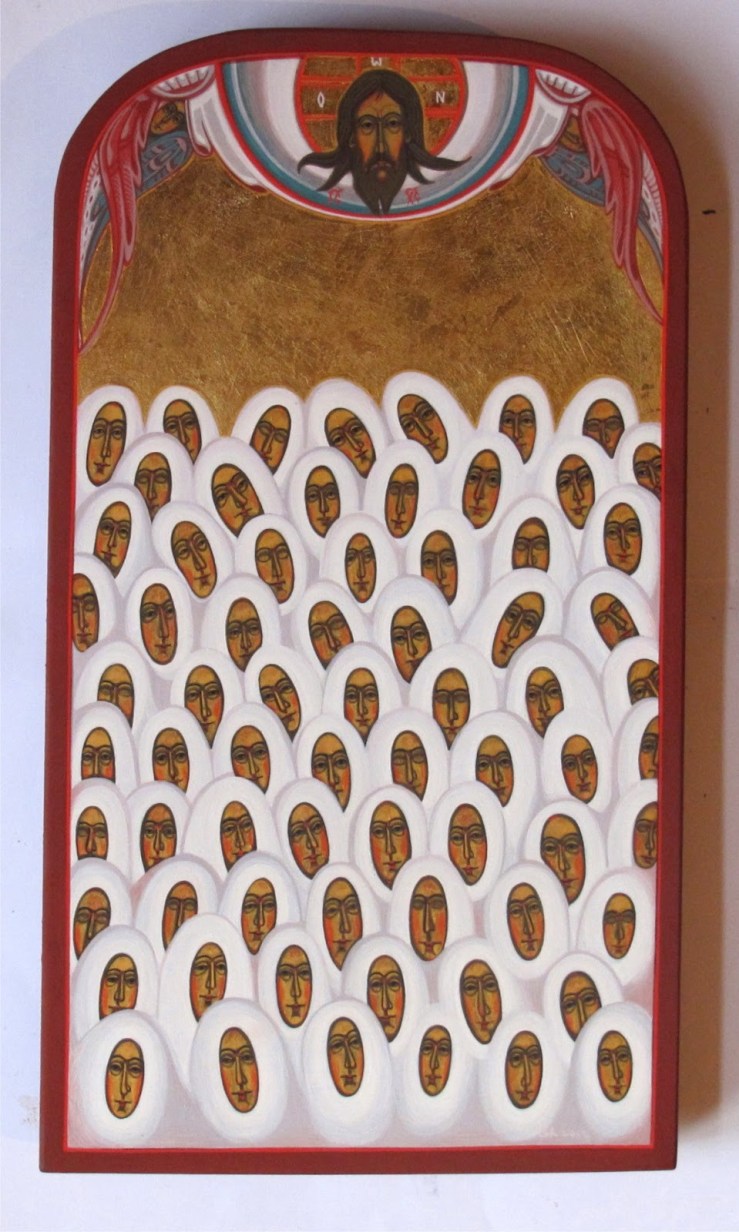
“And those who are wise shall shine like the brightness of the sky above; and those who turn many to righteousness, like the stars forever and ever.”
—Daniel 12:3
“On that day the Lord their God will save them,
as the flock of his people;
for like the jewels of a crown
they shall shine on his land.”
—Zechariah 9:16
“Then the righteous will shine like the sun in the kingdom of their Father.”
—Matthew 13:43
+++
SONG: “Shine Like a Star in the Morning” | American folk song, adapted by Elizabeth Mitchell from a string trio arrangement by Ruth Crawford Seeger | Performed by Elizabeth Mitchell, Simi Stone, and friends on The Sounding Joy (2013)
Though passed off as a Christmas song on this Smithsonian Folkways album, “Shine Like a Star in the Morning” seems to me especially fitting for All Saints’ Day (November 1), as it draws on those biblical passages that equate righteousness with heavenly resplendence. “Shine, shine all around the throne of God,” the song goes.
Look at the stars! look, look up at the skies!
O look at all the fire-folk sitting in the air!
The bright boroughs, the circle-citadels there!
Down in the dim woods the diamond delves! the elves’-eyes!
. . . . . . . . . . . . . . . . . . . . . . . . . . . . . . . . . . . . . . . . .
. . . Christ and his mother and all his hallows.
This post belongs to the weekly series Artful Devotion. If you can’t view the music player in your email or RSS reader, try opening the post in your browser.
Matthew 13:43 belongs to the Gospel lection for July 23, 2017 (Proper 11, cycle A). To read the passage in full, along with the week’s three other Revised Common Lectionary scripture passages, click here.
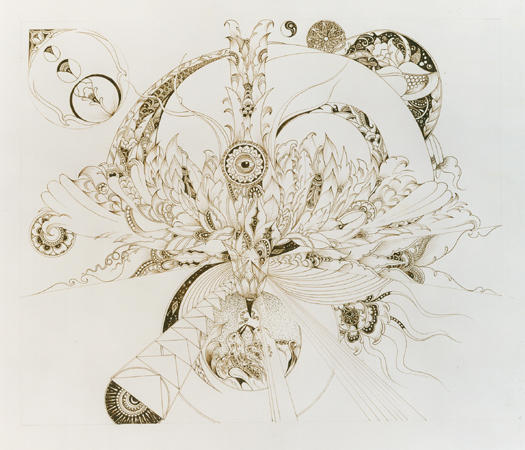
Sawai Chinnawong (Thai, 1959–), Holy Spirit, 2003. Ink drawing, 14 × 17 in. Artist’s statement: “God’s all-seeing eye takes in the whole of creation, here represented by slivers of his cosmos. A great mother bird feeds us, her spiritual young. The metamorphosis of all life, part flower, part animal, takes place in my Christian view of Yin and Yang.”
Romans 8:6:
“To set the mind on the flesh is death, but to set the mind on the Spirit is life and peace.”(RSV)
“Obsession with self . . . is a dead end; attention to God leads us out into the open, into a spacious, free life.” (The Message)
This post belongs to the weekly series Artful Devotion. If you can’t view the music player in your email or RSS reader, try opening the post in your browser.
To view all the Revised Common Lectionary scripture readings for Proper 10, cycle A, click here.
Image and song have long been used in Christian worship—the latter since the formation of the first church community, and the former since at least as far back as 200 AD. Supporting the liturgy, supporting personal spiritual growth, art (from all disciplines) has a way of helping us enter deeper into God’s truth. “Artists are the midrashic thinkers of our day,” says Nate Risdon, program director of the Brehm Center, referring to art’s ability to interpret the scriptures. By illuminating the word, art illuminates the Word.
I’m starting a new ongoing series of Tuesday blog posts, each of which will draw an art image and a piece of music into conversation with a short scripture text. I am not going to write any commentary, as I want to let the word and works speak for themselves and you to be free to make your own connections. (Not to mention that just curating, not researching and writing, will enable me to maintain a consistent weekly frequency.) In addition to the scripture–visual art–music triad, I may also occasionally provide a poem, recorded dance performance, film clip, or some other type of art to further illuminate the selected scripture passage.
Now, when I say illuminate, I do not mean illustrate. I mean, as per Merriam-Webster, enlighten, brighten with light; bring to the fore; make illustrious or resplendent; beautify. In some cases there will be a direct correspondence among the selected pieces, while at other times that correspondence will be more slant.
So this will be an online art devotional of sorts. My entire blog has a devotional focus (which I hope comes across); although some posts are more information-heavy than others, I always have the edification of believers in mind with everything I publish. But this new, concise format—which will be supplementing, not replacing, my usual medium- and longer-form posts—will hopefully be more accessible and is meant to be attended with quiet, focused contemplation.
I’m calling the series “Artful Devotion.” I realize that “art” and “devotion” in the same sentence is an uncomfortable pairing for some Protestants, but by devotion I simply mean cultivating a deeper love for Christ by meditating on his word, an act that I think can be enriched by the “commentary” of artists, be they songwriters, painters, or whatever. “Doing my devotions” is a common phrase in Protestant parlance, which refers to prayerfully reading the Bible. Many Protestants already incorporate singing or listening to music into this practice. I’m going one further and adding visual art—because we are a visual people, and what we see shapes our desires.
How will I choose the scripture passages? My intention, for now, is to follow the Revised Common Lectionary, a three-year cycle of weekly scripture readings built around the church year. Every Sunday the RCL assigns four passages—one each from the Hebrew Bible, the Psalms, the Epistles, and the Gospels—so I will select an excerpt from one of these to anchor the Artful Devotion on the Tuesday prior. We’ll see how it goes.
I hope you enjoy this new offering. As always, feedback is welcome, via either the blog’s public comment fields or a private e-mail to victoria.emily.jones@gmail.com.
The first entry in the series will be published tomorrow.
Psallos: The Hebrews Album (Kickstarter): You have the opportunity to help finance a musical adaptation of the book of Hebrews for folk rock band and chamber orchestra. Cody Curtis, the composer behind Psallos, has already written the music; now he needs your help to pay for the recording and production. Curtis has already proven his skill at capturing the varied tones and trajectory of an epistle with his setting of Romans, released in 2012 (read my review here), and Thomas Griffith and Kelsie Edgren are returning to lend their beautiful vocal interpretations. I have full confidence that Psallos’s second epistle-based album will be nothing short of amazing! Besides a copy of the CD when it’s released, tiered reward options include the chance to sing on the CD as a choir member, the choice of any passage of scripture for Curtis to set to music, and a Psallos concert at your church. Also, the team is looking for a videographer and donated instruments, so get in touch with them if you’re able to help out in either of those areas.
+++
Should Patriotism Have a Place in Church?I really appreciate John Piper’s response to this question in last week’s Ask Pastor John podcast episodes. (Listen to part 2 here.) “I have been in several churches,” he says, “where on the Fourth of July the focus”—on each of the military branches and patriotic songs and flags and marches and decorations in red, white, and blue—“seemed to me uninformed, unshaped by the radical nature of the gospel, and out of proportion to the relationship between America and the kingdom of Christ.” He advises that American flags not be displayed in the sanctuary, and pledges of allegiance to the USA not be recited in a worship service, because church is where we acknowledge the absolute authority of Christ and no other.
As Christians, Piper says, we have “no unqualified allegiance to any political party, any nationality, any ethnicity, any tribal identity, or any branch of the armed service. It is all qualified. It is all secondary. It is all relative to the will of Christ. We should not say anything or do anything that looks as if that were not true. . . . The recitation of a pledge to a human authority”—and/or the display of a symbol of national identity—“in the setting of the worship of divine authority does not provide for the kind of Christian qualifications and nuances that are so necessary precisely in our day.”
The seed, Lord, falls on stony ground
Which sun and rain can never bless—
Until the soil is broken found—
With harvest fruitfulness.
John Constable (British, 1776–1837), Spring Ploughing, 1821. Oil on panel, 19 × 36.2 cm.
Run by Rick Wilcox, “Literary Life is a celebration of the Word. Leading with a discussion of modern and classic literature, we seek to tease out eternal truths which may be illumined by fiction, poetry, art and music.” The blog recently finished walking through Karen Swallow Prior’s memoir Booked: Literature in the Soul of Me; before that, it was Malcolm Guite’s The Word in the Wilderness: A Poem a Day for Lent and Easter. Each post is a treat!
+++
Mary of Guelders prayer book now online: In the early fifteenth century, while the Limbourg Brothers were hard at work on the Très Riches Heures de Duc de Berry, Duchess Mary of Guelders (John of Berry’s niece) commissioned an extraordinary 900-plus-page book that would become the high point of the late medieval book industry in the Northern Low Countries. Due to its condition, it has been stored away for the last few decades at the Staatsbibliothek zu Berlin, inaccessible even to most scholars. But a crowdfunded project led by Johan Oosterman is bringing the hidden treasure to light, allowing for extensive research, restoration, and (next October) public exhibition.
To keep the public informed of progress, a new website has been launched, with blog posts, videos, and tabs on “Mary’s World,” “The Prayers,” “The Decoration,” and more. And best of all, just last month a full digitization of the book was added to the site so that anyone with an Internet connection can browse through its hundreds of prayers and 106 miniatures. The miniature that stood out most to me is the one on verso page 132, illustrating the parable of Lazarus and the Rich Man. It shows Dives on his golden throne being swallowed by a hell-mouth, while from heaven Abraham denies his request for a drink of water.
“Lazarus and the rich man from the mouth of hell,” from the prayer book of Mary of Guelders, ca. 1415. Fol. 132v. Staatsbibliothek zu Berlin-Preußischer Kulturbesitz.
+++
New arrangement of “Joyful, Joyful, We Adore Thee” and “Come, Thou Almighty King”: The music at last month’s General Assembly of the Presbyterian Church in America, convened in Greensboro, North Carolina, was fantastic. With permission, I’m posting a video excerpt from the evening worship service held on June 14, 2017. The first hymn, “Joyful, Joyful, We Adore Thee,” was written by Henry Van Dyke in 1907 to a tune from Beethoven’s Ninth Symphony; this version was arranged by Joel Littlepage (the musical director and keyboardist with the bowtie; assistant pastor of worship at Redeemer Presbyterian Church in Winston Salem) and Michael Anderson (the pianist; composer-in-residence at Redeemer) and was orchestrated by Joel Littlepage. The first verse is sung very traditionally—in strict time to a chorded piano accompaniment—but then at 1:05, it gets real lively! The orchestra kicks into full gear, expressing the brightness of the hymn text.
Then just when you think it couldn’t get any more joyful, the praise team launches into a second hymn at 3:36 to ululation (celebratory cheer sounds), this one Caribbean-flavored. Composed by Felice de Giardini in the eighteenth century, “Come, Thou Almighty King” is a Trinitarian invocation: “Come, Thou Almighty King” (verse 1), “Come, Thou Incarnate Word” (verse 2), “Come, Holy Comforter” (verse 3). This particular arrangement is by Joel Littlepage, with orchestration by Michael Anderson. The musicians are as follows.
Vocal section (left to right): Kyle Dickerson; David Gill; Mary Higgins; Melissa Littlepage; Nikki Ellis, choir director Rhythm section: Joel Littlepage, keyboard; Michael Anderson, piano; Daniel Faust, drums; Larry Carman, hand percussion; Kevin Beck, electric guitar Horn section: Christian Orr, trumpet; Tim Plemmons, saxophone; Ben Nelson, trombone String section: Heather Conine, violin; Violet Huang, viola; Adi Muralidharan, cello; Julie Money, harp Wind section: Suzanne Kline and Lydia Wu, flute
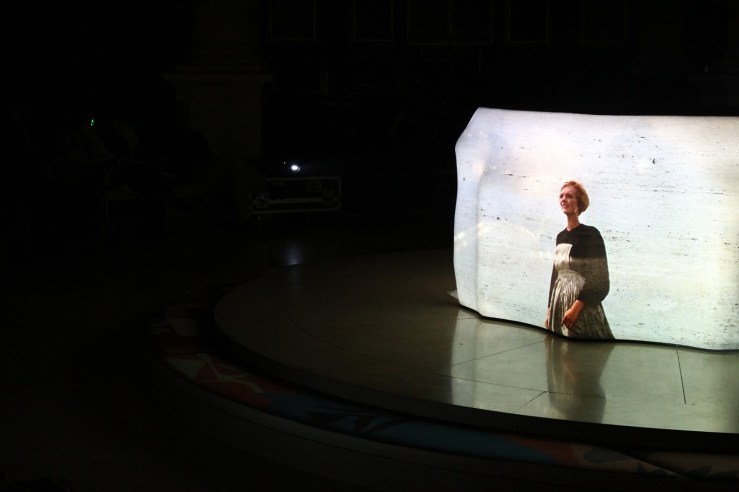
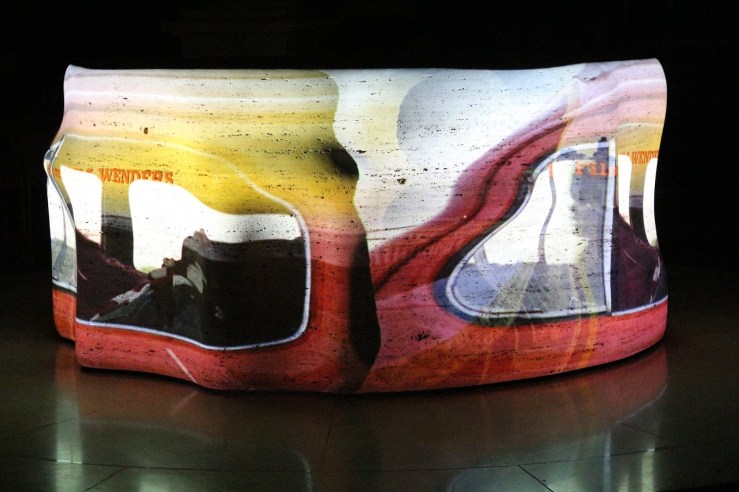
“Mark Dean Projects Stations of the Cross Videos on Henry Moore Altar,” exhibition review and artist interview by Jonathan Evens: On April 15–16 St. Stephen Walbrook in London hosted an all-night Easter Eve vigil that featured a fourteen-video installation by artist-priest Mark Dean. Inspired by the Stations of the Cross, these videos were projected, in sequence and interspersed with readings and periods of silence, onto the church’s round stone altar by the famous modern artist Henry Moore (Dean wanted his work to be presented as an offering). The vigil culminated with a dance performance by Lizzi Kew Ross & Co and a dawn Eucharist. Evens writes,
Mark Dean’s videos are not literal depictions of the Stations of the Cross, the journey Jesus walked on the day of his crucifixion. Instead, Dean appropriated a few frames of iconic film footage together with extracts of popular music and then slowed down, reversed, looped or otherwise altered these so that the images he selected were amplified through their repetition. As an example, in the first Stations of the Cross video, a clip of Julie Andrews as the novice Maria from the opening scenes of The Sound of Music was layered over an extract, from the Alfred Hitchcock film Psycho, of a car arriving at Bates Motel where Marion Crane would be murdered by Norman Bates. The blue of the sky and the innocence suggested by Maria’s religious vocation was in contrast with the footage from Psycho, which was indicative of the violent death to which Jesus was condemned. [Read more of the review, plus an interview with the artist, here.]
Mark Dean, “I. The Royal Road,” from Stations of the Cross cycle. Video projected on Henry Moore altar at St. Stephen Walbrook, London, April 15–16, 2017. Photo: Jonathan EvensMark Dean, “VIII. Daughters of Jerusalem,” from Stations of the Cross cycle. Video projected on Henry Moore altar at St. Stephen Walbrook, London, April 15–16, 2017. Photo: Jonathan EvensMark Dean, “IX. In Freundschaft,” from Stations of the Cross cycle. Video projected on Henry Moore altar at St. Stephen Walbrook, London, April 15–16, 2017. Photo: Jonathan Evens
Sounds like an exemplary integration of art and liturgy! You can read the catalog essay and watch the videos on Dean’s website, tailbiter.com. See also the interview with curator Lucy Newman Cleeve published in Elephant magazine.
+++
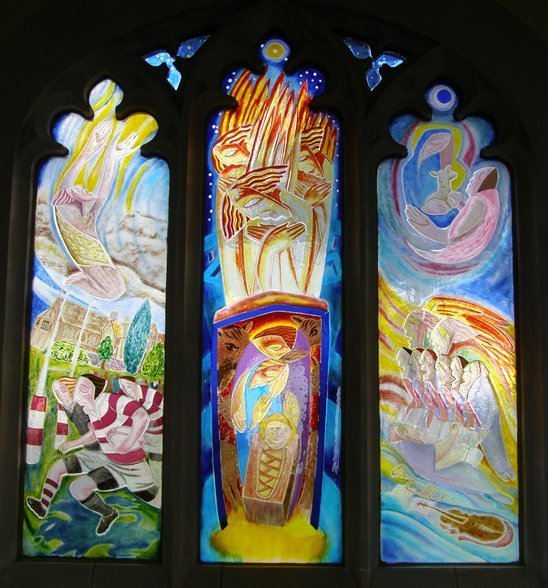
“Featured Artist: Nicholas Mynheer” by Victoria Emily Jones: This month I wrote a profile on British artist Nicholas Mynheer for Transpositions, the official blog of the Institute for Theology, Imagination, and the Arts at the University of St. Andrews in Scotland. (There’s a glitch with their publishing tool that is preventing all the artworks from displaying, but all the ones I discuss in the article can be found at www.mynheer-art.co.uk.) A painter, sculptor, and glass designer, Nick works almost exclusively on religious subjects, in a style that blends influences from medieval, primitive, and expressionist art. I met him in 2013 and got to see his studio and his work in situ in various Oxford churches. His love of God and place was obvious from my spending just one afternoon with him. Other articles I’ve written are on Nick’s Wilcote Altarpiece, Islip Screen, and 1991 Crucifixion painting (which I own).
Nicholas Mynheer (British, 1958–), Harvest, 2010. Oil on canvas, 70 × 70 cm.Nicholas Mynheer (British, 1958–), Michaelmas Term Window, 2012. Fused glass. Abingdon School Chapel, Oxfordshire, England.Nicholas Mynheer (British, 1958–), Corpus of Christ, 2010. English limestone, 85 cm tall.
+++
Season 14 of So You Think You Can Dancepremiered last Monday (the only TV show I never miss!). Watching dancers draws me into a deeper awe of God, as I see all the creative potentialities of the human body he designed. Here are my two favorite auditions from episode 1. The first is husband-wife duo Kristina Androsenko and Vasily Anokhin performing ballroom. The second is a modern dance number performed by Russian twins Anastasiia and Viktoriia; they gave no comment on the dance’s motivation or meaning, but it’s clear that it represents trauma of some kind.
+++
“Why we need Mary Oliver’s poems” by Debra Dean Murphy: “Oliver is a mystic of the natural world, not a theologian of the church. . . . Her theological orientation is not that of orthodox Christianity. Nevertheless, Christians have much to gain from reading Oliver . . .” Her poems are “occasions for transfiguring the imagination and a summons to wonder and delight”; they remind us “of what it means to attend to what is before us in any given moment,” teach us to adopt “a posture of receptivity that Christians sometimes speak of as part of our vocation—the calling to live more fully into our humanity as persons bearing the imago dei, to mirror the divine dance of mutual presence, mutual receptivity, mutual love.” Some of my favorite Oliver poems are “Praying,”“I Wake Close to Morning,”“Messenger,”“The Summer Day,” and “How the Grass and the Flowers Came to Exist, a God-Tale.”
+++
NEW SONG: “Weep with Me” by Rend Collective: Written last month in response to the Manchester Arena bombing, “Weep with Me” is a contemporary lament psalm in which the speaker asks God to do what the title says: weep with him. To feel his pain and respond. It’s introduced and performed acoustically by band member Chris Llewellyn in the video below.
Can worship and suffering co-exist? Can pain and praise inhabit the same space? Can we sing that God is good when life is not? When there are more questions than answers? The Bible says a resounding yes: these songs are called laments and they make up a massive portion of the Psalms.
We felt it was fitting to let you hear this lament we’ve written today as we prepare to play tonight in Manchester. We can’t make the pain go away. We refuse to provide cheap, shallow answers. But hopefully this song can give us some vocabulary to bring our raw, open wounds before the wounded healer, who weeps with us in our distress. We pray that we can begin to raise a costly, honest and broken hallelujah. That is what it means to worship in Spirit and in Truth.
One of the art blogs I follow is Hyperallergic, “a forum for serious, playful, and radical thinking about art in the world today.” It’s not Christian-affiliated, but because of Christianity’s vast influence on the arts, it’s not unusual for “Christian” works, or works that reference Christianity, to be covered. This past month two such features stood out to me for the outsider perspectives they offered:
(1) “A Meditation on the Ineffable Grandeur of Churches” by Jennifer R. Bernstein: An “irreligious, halfhearted Jew” describes “what it means to love church but not God,” to be transported in a way that she has never been in synagogue. By way of example, she shows a photo of La Sagrada Familia in Barcelona; an agnostic friend of mine had a similar experience as this author—he told me that when he visited that cathedral last year, he came very close to believing in God and falling to his knees right then and there in repentance, so moved was he by the architecture and what it signified.
Interior of La Sagrada Familia in Barcelona
Here are some excerpts from Bernstein’s article:
Crossing the narthex of a cathedral is like starting a great book: You simply aren’t in your home world anymore.
***
In my view, the truest kind of reader/viewer is not the intellectual, but the supplicant. To “consume” a work of art is really to be consumed by it: to surrender your will to the vision of the creator — or, in this case, the Creator.
***
Organized grandeur makes us feel small and powerless, yet connected to something all-powerful.
***
Church, if we take it seriously, if we give in to stillness, threatens to reorder what we care about. . . . An extraordinary environment forces us into a confrontation with a striking somewhere, reminding us that we can and should take care in choosing where we place our bodies, for there we also place our minds.
(2) “A Timely Performance of MLK’s Final Sermon Takes Viewers to Church” by Seph Rodney: Commissioned by BRIC for its inaugural BRIC OPEN Festival, The Drum Major Instinct is a dramatization of the Rev. Dr. Martin Luther King Jr.’s final sermon accompanied by original music by Phil Woodmore, presented on April 30 by Theater of War Productions and NYC Public Artist in Residence Bryan Doerries. True to BRIC’s mission, it was followed by an open community discussion on race and social justice.
What was shocking, to me, about this article is the reviewer’s candid opposition to King on the grounds of his “rigid, hierarchic, conservative” Christianity. We’ll take the social justice he promoted, Rodney seems to say, but without all the God-talk. Does he not understand how integral King’s religious faith was to shaping his vision and motivation? And he achieved practical, world-changing results. If our “desire to follow our inherited religious templates” “dooms us,” then why did King’s template, taken from the Bible, usher in such positive change in America? Citing today’s (Muslim) theocracies as evidence of how religion and human rights violations go hand in hand is irrelevant. Continue reading “Non-Christians respond to Christian artworks”→
I’ve seen two movies from 2016 that center on a nun, or nuns. The first is Little Sister, a dramedy directed by Zach Clark. It’s about twenty-something Colleen Lunsford, a novice (prospective nun) who’s temporarily called away from the convent when her brother returns from the Iraq War, suffering from depression after a bomb left his face disfigured. In the town she grew up in Colleen is known as the Goth girl, so former high school friends are shocked to learn about her new religious vocation.
I wish the faith dimension was explored a bit more—the only insight we get into Colleen’s decision to become a Christian and pursue the monastic life is a line she mutters about structure and stability. (Was that her only motivation?) The film is more about reconnecting with family and recognizing that even though you grow up and your interests and bearing and goals may change, your past self, or selves, always remain a little bit a part of you. It’s empathetic and dark but also funny, and it shows how there’s no one mold that makes a nun; nuns come from different places in life, and oftentimes sustain (complicated) relationships outside the cloister. (Watch on Netflix)
The second one I’ve seen and commend is The Innocents, directed by Anne Fontaine. Set in a convent in late-1945 Poland and based on a true story, it documents the crisis of faith the nuns of that community are forced to undergo when many of them are raped by invading Russian troops and some pregnancies result. The nuns respond in diverse ways to the horror, struggling to regain their spiritual equilibrium. In desperation, they employ an atheistic French female doctor from the Red Cross, stationed nearby, to help them deliver their babies and to bear their secret. (Watch on Amazon Video)
+++
“If I Believe You: Agnostic Songs to Jesus” by Joy Clarkson: This article analyzes the song “If I Believe You” by the 1975—which opens with “I’ve got a God-shaped hole that’s infected . . .”—in light of the wider trend of self-proclaimed unreligious artists writing songs addressed to Jesus. Clarkson observes that (1) even within the profoundly secular industry of popular music, there is an openness to spirituality, religion, and Jesus; (2) songs written not only about Jesus, but to Him, create a unique discursive space; and (3) an invocation of negative transcendence may create an openness to a true spiritual experience. I’m intrigued by the titles of the books she references, including The Bible in/and Popular Culture: A Creative Encounter (2010); Mashup Religion: Pop Music and Theological Invention (2011); and Personal Jesus: How Popular Music Shapes Our Souls (2013).
+++
Knits by Petros Vrellis: Designed using an algorithm, Vrellis’s re-creations of figures from famous El Greco paintings are formed by knitting a single thread across anchor pegs on a circumference loom. Watch a time-lapse video of Vrellis putting together a knit based on El Greco’s Christ Blessing, below, and read more about his process here. (Another Jesus portrait Vrellis has done is based on El Greco’s Christ in Prayer, visible at 2:27 at the bottom right.) Vrellis has a master’s degree in art sciences; he enjoys exploring the potential of new media through digital art and interactive installations and considers himself more of a “toy inventor” than an artist. Thank you to Tobias M. from Vienna for informing me of this impressive work.
Knit by Petros Vrellis (Greek, 1974–), based on the painting Christ Blessing by El Greco.
Some of Vrellis’s knits are for sale via Saatchi Art.
The light he was returns
Unto the Light that is.
—Wendell Berry
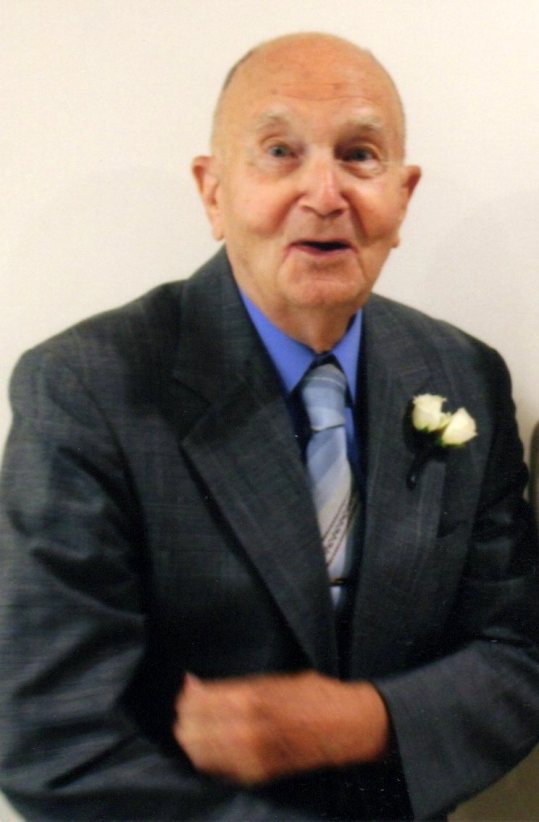
My grandpa, Richard Joseph Hartz, passed away on May 22 at age ninety-two. A cradle-to-tomb resident of Mercer County, New Jersey, he was a simple man who loved his Lord, his family and friends, and his work. He was faithful, caring, contented, ingenuous, and conservative in every sense of the word. Clocks, cars, and Phillies baseball were among his hobbies. He got thrills from things like cereal box prizes (his favorite was a plastic spoon that lights up—he said, facetiously, that it helps him find his mouth), Dollar Tree purchases (“Can you believe this only cost a dollar?”), and fish sandwiches from Burger King (I don’t think I ever saw him so excited as when he unwrapped a BK gift card for his ninetieth birthday).
Pop-Pop’s Bible never gathered dust; he read it every morning, along with Our Daily Bread. His constancy in this regard is something my dad inherited. It is because of Pop-Pop’s (and Mom-Mom’s) religious faith, which they lived and breathed and passed on to their kids, that I am a Christian. It is the greatest treasure I have ever received.
The highlight of Pop-Pop’s week was always Saturday-morning breakfast with the ROMEOs (“Retired Old Men Eating Out”)—a moniker bestowed affectionately by his sister Theresa to describe him and his group of cronies. In flat cap and cardigan, he’d be dressed to go. Scrambled eggs and coffee was his custom, and a plate of sausage split with his brother-in-law Don.
Pop-Pop’s most distinctive, and most beloved, trait was his joke telling. His jokes were mainly of the Reader’s Digest variety—that is, clean and corny. After making sure he had our attention, he’d start in, wide eyed and serious, all the way up to the punchline, when he’d break down chuckling. His repertoire wasn’t too large, so during any one visit, we’d hear the same joke at least twice, and then again the next time we saw him. But we’d always laugh as if it were brand-new to our ears.
Some staples:
If a bear was chasing you and up ahead there was a tree on one side and a church on the other, would you run up the tree or into the church?
Response: I don’t know—into the church?
With a bear (bare) behind?
[When we’re eating corn] We’re having a chicken dinner!
I went to the doctor’s, and he gave me a prescription for smart pills. When I saw the bill, I couldn’t believe it. “$100!” I said. “These aren’t worth that much!”
The doctor replied, “See, you’re smarter already.”
If we were to shrink your head to the size of your brain, you could wear a peanut shell for a Panama hat.
One time he floored us all with a real grade A insult at my younger brother’s expense. We were posing for a photo, and Rob, clowning around, bent over and stuck his head between his legs. Pop-Pop, camera in hand, retorted, “You’ll have to smile, Robbie, so that I know which end’s your face.” Ooo, burn! Continue reading “A eulogy for Pop-Pop”→
“Journey to the Cross: Artists Visualize Christ’s Passion” (+ Part 2): As a devotional support for Passion Week and to show the breadth of Christian art across cultures, I’ve curated an online gallery of thirteen art images for the International Mission Board. Spanning the Last Supper through the Resurrection, the images come from the Democratic Republic of Congo, Japan, Bulgaria, the Philippines, China, Croatia, India, South Africa, Australia, Ecuador, Ukraine, Malaysia, and Slovenia.
Clifford Possum Tjapaltjarri (Anmatyerre, 1932–2002), Good Friday, 1994. Acrylic on canvas, 116 × 154 cm. National Gallery of Australia, Parkes, ACT, Australia.
+++
FREE SONG DOWNLOADS:
“Into the Woods My Master Went”: Last summer singer-songwriter Seth Woods (The Whiskey Priest) discovered in an old Baptist hymnal an unusual nineteenth-century hymn text by Sidney C. Lanier, about Christ in Gethsemane—unusual not just for its content but for its rhyme and meter. In the first verse, Jesus enters the garden and receives the friendship of nature—the olive leaves caress him for comfort, and the thorns retract so as not to hurt him. In the second verse, Jesus departs from the garden, assured in his mission, and is forthwith arrested, taken from trees (olive grove) to tree (cross). Woods and Richard Kentopp (The Gentle Wolves) each took a stab at setting the text to music, and they invited four other friends—Jana Horn, Bruce Benedict, Alex Dupree (Idyl), and Chris Simpson (Mountain Time)—to do the same. These six retunings are available for free download via Bandcamp. The diverse results demonstrate how the same text can inspire different creative approaches.
“Wheat and Tares” and “Draw Me to You”: The Windtalkers is a Florida-based husband and wife duo (Benny and Ashley Permuy) backed by a band of musician friends who seek to create songs of life and truth unto the Lord. Through NoiseTrade they’re offering two of the seven tracks from their upcoming album All Creation Groans (available May 30): the blues-inflected “Wheat and Tares,” and the cello-backed “Draw Me to You.”
+++
KICKSTARTER PROJECT: “Refiguring the Biblical” juried exhibition (includes cash prizes): Others Imagining Initiative hopes to organize a juried art exhibition featuring racially diverse depictions of biblical characters, awarding prize money to select artists. The purpose is to help promote a Christian visual culture that does not elevate white Jesus but rather is inclusive of minorities. Submissions would be limited to current and recently graduated art students (BA/BFA within the last two years), and the exhibition would open in January 2018 at Biola University, hopefully traveling to other US universities as well. The viability of this project is dependent on the raising of funds through Kickstarter.
+++
EXHIBITIONS:
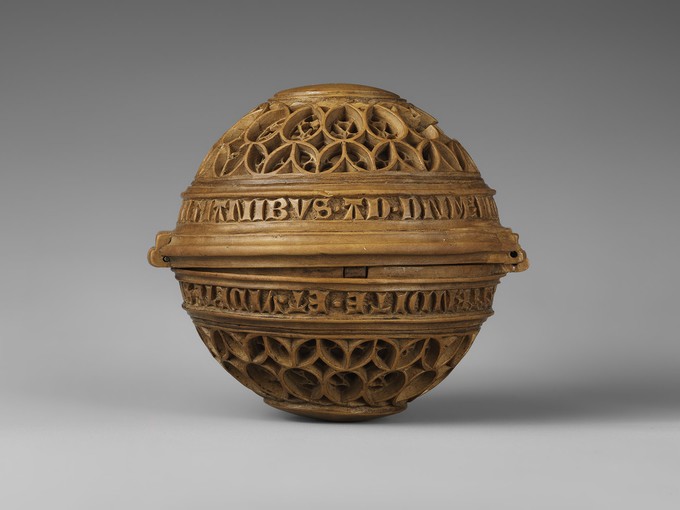
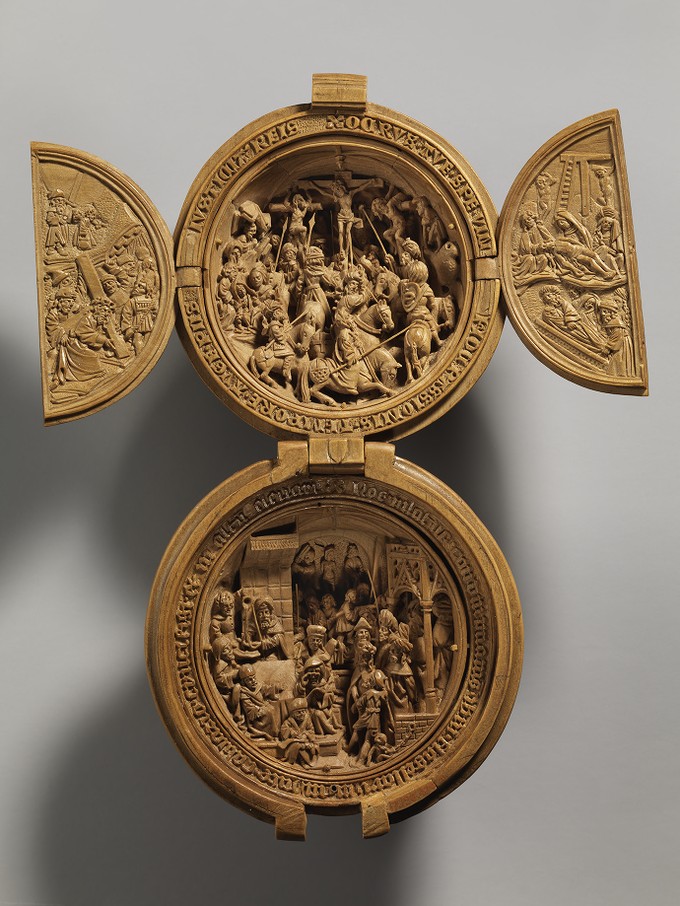
“Small Wonders: Gothic Boxwood Miniatures” (The Met Cloisters): On display through May 20. “Small in scale, yet teeming with detail, miniature boxwood carvings have been a source of wonder since their creation in the Netherlands in the 16th century. On these intricately carved objects—some measuring a mere two inches (five centimeters) in diameter—the miracles and drama of the Bible unfold on a tiny stage. Many of the works can be opened and closed: masterfully crafted hinges and clasps still function today. . . . Offering new insight into the methods of production and cultural significance of these awe-inspiring works of art, this exhibition [organized in partnership with the Art Gallery of Ontario and the Rijksmuseum] highlights more than four years of research that has used cutting-edge technology to understand these elegantly precise miniature rosaries, prayer beads and altarpieces.” The AGO’s Boxwood Project is a fantastic resource—an online catalogue raisonné, with photos and essays.
Boxwood prayer bead (closed), Netherlands, ca. 1500–25, from the Metropolitan Museum of Art.Boxwood prayer bead (open), Netherlands, ca. 1500–25, from the Metropolitan Museum of Art.
Now Jesus stood before the governor, and the governor asked him, “Are you the King of the Jews?” Jesus said, “You have said so.” But when he was accused by the chief priests and elders, he gave no answer. Then Pilate said to him, “Do you not hear how many things they testify against you?” But he gave him no answer, not even to a single charge, so that the governor was greatly amazed.
—Matthew 27:11–14
Consider the incredible self-control Jesus exercises in his appearance before Pilate. He has just come from his religious trial, where he was passed from Annas to Caiaphas to the Sanhedrin and found guilty of blasphemy. But the Sanhedrin does not have the authority to issue death sentences, so they turn Jesus over to the civil authorities, claiming he’s a threat to Roman power, guilty of sedition.
Both charges are false, and yet Jesus gives no defense against either one. Why? Why not prove that he truly is the Son of God, and that he’s no insurrectionist? Why not clear his name? In John’s account of the trial before Pilate (18:33–38), Jesus is more verbal; he explains, “My kingdom is not of this world.” But still, he offers no hard evidence, calls no witnesses (they’ve scattered anyway). He essentially sits back and lets the judgment fall.
English poet and clergyman Richard Crashaw (1612–1649) was inspired by Christ’s silence under pressure to pen an epigrammatic verse unpacking its significance. As a teenager attending Charterhouse School in London, he and his fellow students were required to write epigrams based on the epistle and Gospel readings from the day’s chapel services, and it’s a practice Crashaw continued throughout his life. The following was originally published in Steps to the Temple: Sacred Poems, with Other Delights of the Muses in 1646.
“Matthew 27” by Richard Crashaw
And he answered them nothing.
O Mighty Nothing! unto thee,
Nothing, we owe all things that be.
God spake once when he all things made,
He sav’d all when he Nothing said.
The world was made of Nothing then;
’Tis made by Nothing now again.
In “Matthew 27,” Crashaw apostrophizes the word Nothing. (Apostrophe is a poetic device in which the speaker addresses an absent person, an abstract idea, or a thing; Paul does it, for example, in 1 Corinthians 15:55: “O death, where is thy sting? O grave, where is thy victory?”) He plays on its opposite: everything. By no thing comes all things. Continue reading “The “Nothing” that won our salvation”→









 Art & Theology