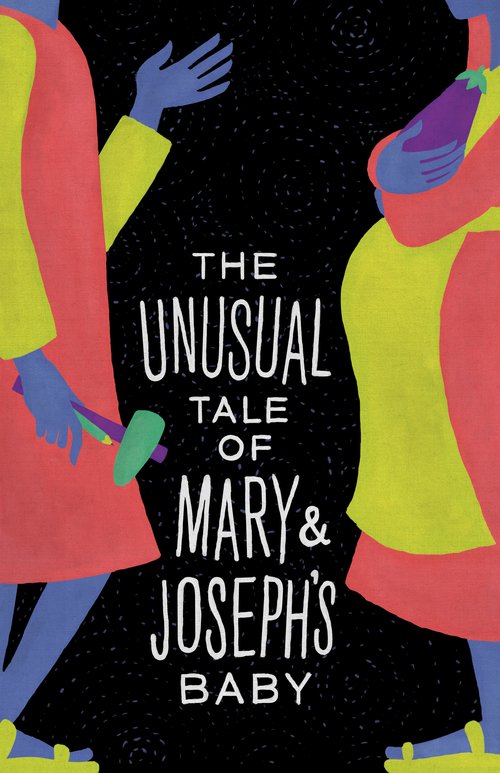
This December hundreds of churches around the world will no doubt bring to life onstage the unusual tale of Mary and Joseph’s baby. Most of the characters will be played by little kids dressed up in robes and star-tinsel garlands, and “Hark! The Herald Angels Sing” is sure to make the song list. A beloved tradition—but one that has perhaps made Jesus’s birth too familiar to us, rendered it not unusual or shocking at all.
Into this milieu comes Don Chaffer and Chris Cragin-Day’s new musical, The Unusual Tale of Mary and Joseph’s Baby, to shake things up. Running December 8–18 at River and Rail Theatre in Knoxville, Tennessee, the play retells Matthew and Luke’s nativity accounts with a modern imagination, focusing on the hopes and fears of the young couple chosen to bear God into the world. My husband and I attended its world premiere this August at the New York International Fringe Festival, produced by Firebone Theatre, and loved it. (We’re still singing “Hel-looo! Hel-looo!” to each other—the catchy angelic greeting.) Far from the tired, pious storytelling of many a Christian-penned pageant, The Unusual Tale bursts with energy and even surprises, inviting believers and nonbelievers alike to consider anew the meaning of the Incarnation.
The show has a cast of four: Mary, Joseph, and two multirole characters (one male, one female). Mary and Joseph are humanized and given dimension. They are at times angry, scared, hurt, frustrated, confused, happy, tired, skeptical, or insistent. Their personalities sometimes clash—Mary is plucky and passionate and refuses to accept the way things are, whereas Joseph is mostly content and prefers to play it safe. When they are confronted with the outrageous news that Mary is to give birth to the son of God, they are forced to exercise a degree of trust in God and in each other that they had not been required to previously, and it doesn’t come easy. But they grow together into God’s plan in their own different ways as they learn more and more how to do the work they’ve been called to.
One of the most enthralling possibilities that the play opens up is that the Incarnation was triggered not just by God’s feeling that “now’s the time” or by some generic devoutness on the part of Mary but by a spoken vow of hers. Fed up with how the Roman authorities have been roughing up her fiancé at work, Chaffer and Cragin-Day’s Mary starts sermonizing about how God raised up stuttering Moses to deliver their people from slavery in Egypt, and little ole David to conquer a Philistine giant, and why couldn’t he do the same today?
“You know what I think? I think God is just waiting for someone to step up and say, ‘I’ll do it. Choose me.’ Like David did. So you know what I’m gonna do?” Mary says, stepping onto a crate, despite Joseph’s objections.
“I’ll do it, God. I’ll slay Goliath. I am available and willing.”
“One of these days, God’s gonna call your bluff,” Joseph says.
In a recent interview, Bono issued a call to Christians for more authentic songwriting, for the “brutal honesty” before God that characterizes the book of Psalms. We need more realism in art and in life, he said; we need to be “porous.”
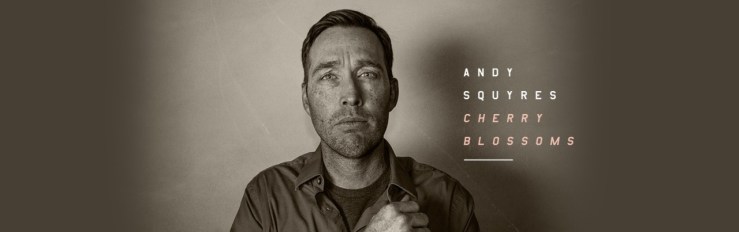
Andy Squyres delivers all this in his 2015 album Cherry Blossoms, which chronicles his journey through pain and loss after his friend was murdered by a home intruder. Tragedy destabilizes; it prompts questions regarding the nature of God and the viability of faith in the face of reality. But it also throws into high relief God’s promises—to love, to strengthen, to walk with, to bring through. Not immediately, but with time.
A necessary step to regaining stability after receiving a blow like the death of a loved one is to spend time sitting in the darkness of the why, and that’s exactly what many of the tracks on Cherry Blossoms allow us to do: grieve, question, wrestle hard for a blessing until daybreak.
My favorite song is “What Nobody Should Know”:
While all the others focus on personal pain, this one shows what it looks like to suffer in community. (The murder victim was a fellow church member.) Here’s an excerpt:
We were in a church but we were shouting Mourning our loss but not our doubting Wondering why love is allowing All of us to hit the floor Down here is one of the strangest places Nothing but hearts and dirty faces Maybe this is where amazing grace is God knows we need some more
Squyres’s lyrics are very evocative, sensory.
In “The Pestle and the Mortar,” he writes that his sweet illusions were crushed like spice pods—turned to dust—by the pestle of affliction. The implication is that suffering, by virtue of its pounding, releases in us an aroma and preps us to be used in delicious ways.
In “Labor in Vain,” he references John Henry, the steel driver of African American folklore, and considers the field as a metaphor for life, in that we often have to cut through hard ground. It’s laborious work, and it requires perseverance. But the yield is grain and grapes—that is, fuller communion with the body and blood of Christ (his people, his suffering).
Cherry Blossoms gives voice to other frustrations as well, like economic injustice. In “The Hawk and the Crow,” Squyres grapples with feelings of hatred toward the inconsiderate wealthy whose lack of care oppresses. I’m really intrigued by the line “mercy is the burden of the poor.” When I asked Squyres if he could unpack it a little for me, this is what he said:
It is the idea that those who are marginalized (the poor, the rejected, the outcast, etc.) are the most likely to be recipients of injustice and therefore have the most opportunity to forgive the oppressor, to heap mercy upon the one who has probably done great harm. Jesus doesn’t let the poor off the hook just because they’re poor. We have to show mercy too.
“Only love can give what vengeance cannot cure.”
There’s only one song on the album that’s not autobiographical, and that’s “Don’t Forget About Me When I’m Gone.” Squyres said he approached it as an exercise in songwriting and empathy: he wanted to tap into that feeling of separation we sometimes feel from our loved ones.
The album concludes with the titular “Cherry Blossoms,” a redemption song full of springtime imagery. Previously “bur[ied] . . . in a blanket of evening snow,” Squyres is now thawed out, warmed by a reassurance of God’s love. Here he is singing the song with his daughter Savannah McAffrey:
Stating his resolve to not give in to the forces of frustration and death, Squyres clings to hope and issues forth praise that is anything but cheap—it cost him blood and bone. It’s not that he’s arrived spiritually; rather, he has cycled through a season of life with God and has landed at a gracious new beginning. “Orientation-disorientation-reorientation” is how Walter Brueggemann schematizes this constant flow along which God’s children are always in transit.
Both bitter and sweet, Cherry Blossoms is for those whose equilibrium has ever been disrupted by a life event—and more than that, it’s for the church at large, because we are in desperate need of a language of suffering. Such a language is part of our heritage—i.e., the Psalms—and Squyres helps us reclaim it, letting us walk, and sing, with him through his own valley. Squyres shows that pain and praise are companions in the life of faith (the one need not be suppressed), and that Love is always there to be our breakthrough.
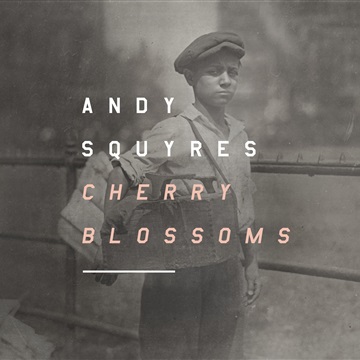
I really admire Squyres’s artistic sensibility, not only in regard to lyrics and composition but also extending to things like disc packaging. The album cover photo is striking. I asked him about its origin, and he had this to say about it:
I had seen a photo at an art exhibit at the Mint Museum in Charlotte of some kids in the 1930s standing on a street corner in Harlem. They were smoking cigarettes and looked like they had already seen their fair share of life and most of them were probably only young teenagers. When I saw that photo I just knew I wanted it for my album cover. We couldn’t get permission to use that one but we found the shoeshine boy. I love him because he looks world-weary yet determined. He’s probably got dreams, but he’s probably just gonna have to figure out a way to survive. That is the story of most of us.
He brings this sensibility to his job as worship pastor at Queen City Church in Charlotte, North Carolina, along with his life experience and heart of faith.
In a blog post dated October 15, 2012, Squyres wrote,
The season of your existence between the day you are born and the day you die is the only moment in the entire span of eternity from which you can love God in the midst of trouble, from the altar of pain. When you are finally out of the realm of time, loving God will be altogether glorious but equally obvious. You won’t be asking “why” this trouble. You won’t be reaching with hands of faith anymore. Faith will pass and you will be in the ecstasy of His presence. That’s why you must see this life, any affliction, any sorrow, any struggle as the most incredible gift that it is; this is your chance to love God from this place and in this moment. It will never again be. Every tear will be wiped away. So if now, you have a tear, then give it to God with all the imperfect love in your heart.
Cherry Blossoms is Squyres’s tear-offering—to God and to the church.
Cherry Blossoms is available for free download from NoiseTrade (in exchange for your e-mail address). You can purchase the physical disc here.
Here’s a bonus song, not part of the album but of the same spirit: “Why, Oh Why”:
New Gospel-book set promotes aesthetic reading experience: Photographer Bryan Chung and designer Brian Chung, both campus ministers (and no relation), believe that beauty is fundamental to understanding who God is. So they’ve teamed up for project Alabaster: a brand-new design of the holy Gospels, in four volumes, integrated with contemplative photographs. They’ve already well exceeded their funding goal on Kickstarter, which means there’s already a lot of interest in having Bible reading be a visual experience—and at a 7½ × 9½ trim, the books are definitely wieldy, meant to be regularly handled and read! If you want a guaranteed copy, be sure to back the project on Kickstarter, as the number of names in the system will determine the size of the print order. You have until October 7; the publication month is April 2017. This project aligns so well with my mission here at Art & Theology, and I’m thrilled to see it in the works.
+++
90-year-old man spends lifetime building a cathedral by hand: From Great Big Story: “For 53 years, Justo Gallego has been building a cathedral by hand on the outskirts of Madrid almost entirely by himself. Gallego has no formal architecture or construction training, but that hasn’t stopped him from toiling on this herculean task. At 90 years old, Gallego knows that he will not be able to finish the project in his lifetime. But he keeps at it anyway, day after day, driven by his faith.”
+++
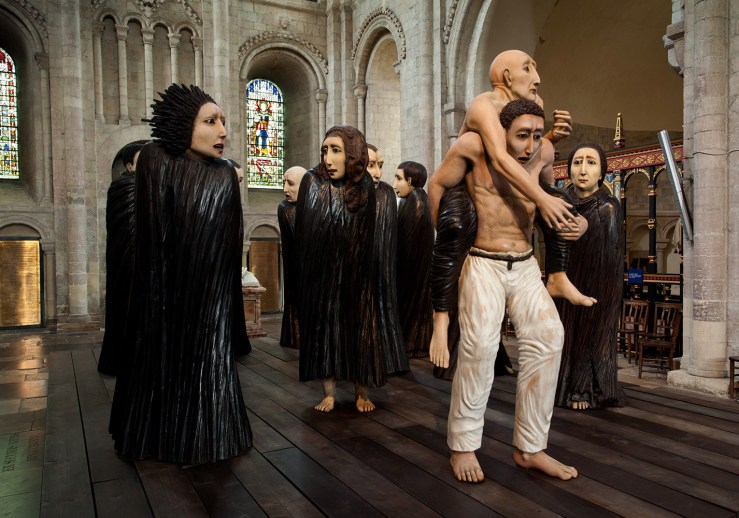
Ana Maria Pacheco (Brazilian, 1943–), Shadows of the Wanderer, 2008. Polychromed wood sculpture, 260 × 390 × 605 cm. Installation view at Norwich Cathedral, 2010, via Pratt Contemporary Art.
Art installation at Chichester Cathedral speaks to the refugee experience:Shadows of the Wanderer by Brazilian-born artist Ana Maria Pacheco is on display in the north transept of Chichester Cathedral through November 14. A multipiece figurative sculpture in polychromed wood, it has as its centerpiece a young man carrying an elderly man on his back—a reference to the Aeneid’s Aeneas carrying his lame father out of the ruins of Troy. The cathedral has organized events around the installation, including a lecture by Christopher Wintle on the representation of suffering in Pacheco’s art (audio here, transcript here); a series of workshops for schools and colleges exploring the refugee experience, developed in partnership with Amnesty International; a debate titled “Refugees: Problem or Gift?”; an interview with the artist; and a woodcarving workshop. The photo above is an installation view from 2010 inside Norwich Cathedral; to see photos of the work in its current location at Chichester, click here.
+++
Addressing racial injustice as a church: Paul Neeley at Global Christian Worship has compiled an excellent list of resources for churches looking for ways to address racial tensions in America with an eye toward healing, including a prayer service of lament by Paul Burkhart; two litanies by Fran Pratt; a list of relevant hymns, curated by the Hymn Society; an article by Sandra Van Opstal, “Reconciling Witness And Worship: Six Ways To Begin”; and materials from the 2016 Reconciliation and Justice Network conference. I’d like to add to it the lecture series “Race and the Church,” especially Jemar Tisby’s “Understanding the Heart Cry of #BlackLivesMatter,” which I live-streamed with my church back in July. (It definitely sparked fruitful conversation.) For common objections to the movement, like “What about black-on-black crime?” and “Don’t #AllLivesMatter?,” he refers listeners to the video below, produced by MTV.
+++
SONG: “Light a Candle”: Also on Neeley’s website I found a video performance of the song “Light a Candle” by Mary Louise Bringle (words) and Lori True (music). It’s sung here, to a ukulele accompaniment, by Becky Gaunt, director of music and liturgy at St. Jude of the Lake Catholic Church in Mahtomedi, Montana.
She posted it on her Facebook page in July along with this note:
We cannot continue to let language divide us. We cannot continue to let language distract us from loving one another. We cannot continue to let words like “black lives matter” or “all lives matter” cause us to keep missing the point!
I’m sad and tired. And you probably are too. But now is NOT the time to be neutral! The Sun may be shining outside, but we need to come together and light a candle in this oppressive darkness. This beautiful song by Lori True (amazing text by Mary Louise Bringle) is my prayer right now. I invite you to pray this with me.
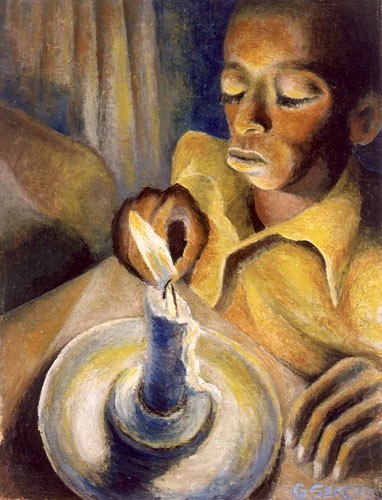
Gerard Sekoto (South African, 1913–1993), Boy with a Candle, 1943. Oil on canvas, 46.2 × 36 cm.
Jyoti Sahi (Indian, 1944–), Thy Kingdom Come. Oil on canvas.
When the heart is hard and parched up, come upon me with a shower of mercy.
When grace is lost from life, come with a burst of song.
When tumultuous work raises its din on all sides, shutting me out from beyond, come to me, my lord of silence, with thy peace and rest.
When my beggarly heart sits crouched, shut up in a corner, break open the door, my king, and come with the ceremony of a king.
When desire blinds the mind with delusion and dust, O thou holy one, thou wakeful one, come with thy light and thy thunder.
This untitled poem is no. 39 from the collection Gitanjali (Song Offerings) by Rabindranath Tagore. Originally written and published in Bengali in 1910, it was translated into English by Tagore himself in 1912, along with other poems of his from various sources, and published by the India Society of London with an introduction by W. B. Yeats. For this volume he was awarded the Nobel Prize in Literature—the first non-European to receive such a distinction.
Here the speaker entreats God to break into his life, bestowing divine gifts: mercy, like rainwater, to moisten his dry heart; grace, like a song, to lift his spirit; and peace and rest to counteract the overwhelm of daily work. He asks God to come like a king and lavish his riches on all us spiritually impoverished, and like thunder and lightning, to jolt us awake from our sin and delusion. Each line of the poem works by contrast: man in his neediness, and the need-meeting God.
Tagore’s poetry bears Hindu influence but has wide cross-religious appeal and has inspired numerous musical settings in his native India and abroad. The composition below (a setting of “When the heart is hard and parched up”) is by the famous Indian classical singer and composer Jagjit Singh.
In 2010 American composer Joan Szymko wrote A Burst of Song, a short three-movement choral cycle that sets three poems from the English Gitanjali. Movement 1, “A Shower of Mercy,” excerpts our familiar text. Listen to a performance below (the first movement goes through 1:56) by Portland University’s Man Choir and its female choir, Vox Femina:
“Mormon painting of a black Eve draws fire, but not for the reasons you might think” by Peggy Fletcher Stack, Salt Lake Tribune: Early this year a new painting of a seminude black Eve by Mormon artist J. Kirk Richards went on display at Writ & Vision gallery in Provo, Utah. While many Mormons have expressed how captivated and inspired they are by it (and I should note, black figures are extremely rare in Mormon art), a few have insisted it’s wrong for a white man to depict a nude black woman because it conjures up collective memories of sexual brutality and enslavement. The article features some interesting perspectives by black Mormon feminists. In addition to raising important questions surrounding racial histories and representation, the painting, I’ve noticed, also illustrates a distinctly Mormon view of the Fall, which differs from the orthodox Christian view—a fact Richards alludes to in his March 14 gallery talk. View the painting.
+++
“A Conversation about Creativity and the Liturgical Calendar,” panel discussion presented by Brehm Center and Fuller Studio: Moderator Edwin M. Willmington, composer-in-residence at Fuller Theological Seminary, talks with an all-star trio of creatives and liturgists comprising David Gungor of The Brilliance [00:50], on authenticity in songwriting and introducing liturgical practices to the evangelical church he attended; Todd E. Johnson [10:40], on the history, purpose, and major observances of the church calendar; and Lauralee Farrer [26:18], on discovering the Canonical Hours in a New Mexico desert and later developing them into characters for a film project. Questions: [34:02] How has liturgy shaped you? [36:20] Advice for artists on how to bring the church year to bear in their art? [37:11] Have you found that lament is generally embraced or resisted? [39:41] Advice for worship leaders?
+++
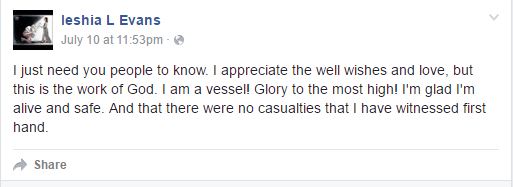
“An Art Historical Perspective on the Baton Rouge Protest Photo that Went Viral” by An Xiao Mina and Ray Drainville, Hyperallergic: During a July 10 protest following the fatal killing of Alton Sterling, Reuters photographer Jonathan Bachman captured the moment of twenty-eight-year-old Ieshia L. Evans’s arrest. As heavily armored policemen pressed in, the other protestors dropped back, but Ieshia stood assuredly in the middle of the three-lane highway, prepared to be bound. This article lauds the strength of this image of confrontation by citing compositionally and thematically similar paintings, including Briton Riviere’s Daniel in the Lion’s Denand Giotto’s The Arrest of Christ, and other works of art.
Ieshia considers herself a vessel of God, eager to be used by him to bring justice and peace. Here’s what she wrote on her Facebook wall the night of her release from jail:
+++
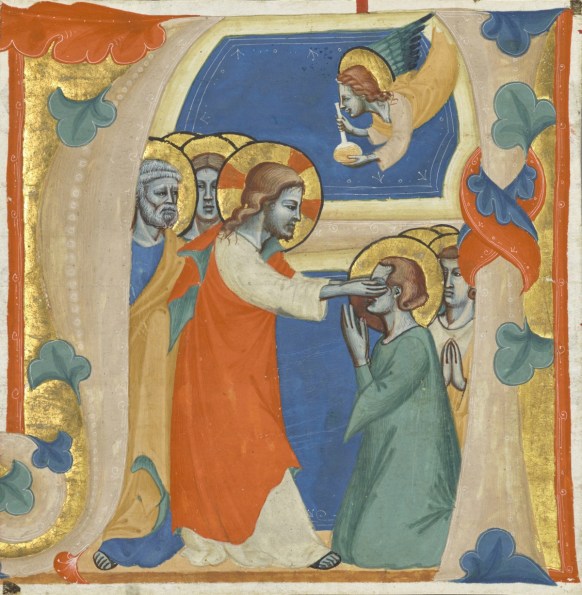
“Things Unseen: Vision, Belief, and Experience in Illuminated Manuscripts”: Running through September 25 at the Getty Center in Los Angeles, this exhibition “explores the visual challenges artists faced as they sought to render miraculous encounters with the divine, grand visions of the end of time, the intricacies of belief, and the intimate communications of prayer.” It includes a September 15 talk, “How Do We Depict Religious Experiences?”—that is, how do we convey metaphysical essence in physical form? I appreciated the Getty’s blog post this week featuring a newly acquired choir book leaf that’s part of the exhibition. Curator Bryan C. Keene writes about the difficulties of identifying the illuminator and about discovering, through an examination of the back and a search on the Cantus database, that the illumination depicts the wiping of tears from saints’ eyes, not, as previously assumed, the healing of the blind.
Initial A: Christ Wiping the Tears from the Eyes of the Saved, attributed to the Master of the Antiphonary of San Giovanni Fuorcivitas, ca. 1345–50. Tempera and gold leaf on parchment, 5 1/3 × 5 1/3 in. (13.5 × 13.5 cm). The J. Paul Getty Museum, Ms. 113, recto. Digital image courtesy of the Getty’s Open Content Program.
+++
“Ya Hey” song cover by The Brilliance: Written by Ezra Koenig of Vampire Weekend, “Ya Hey” is a modern-day psalm that expresses frustration with God’s seeming unresponsiveness—to being spurned and being sought, to brokenness and suffering, to sin and struggle. The title is a play on the word Yahweh, the Hebrew name for God. The chorus references the burning bush of Exodus 3: “Through the fire and through the flames / You won’t even say your name / Only ‘I am that I am.’” The Brilliance’s acoustic cover of “Ya Hey” was released last month as a music video on YouTube featuring four New York City ballet dancers. It abandons the shrill vocoder and heavy percussion of the original song in favor of a softer, purer sound. Read the lyrics and an analysis at Sound: Interrupted.
Paul’s epistle to the Romans is, I’d say, the most theologically foundational book of the Bible. As a young Christian I was taught the “Romans Road” method of sharing the gospel, using verses like Romans 3:23 (“For all have sinned and come short of the glory of God”), Romans 6:23 (“For the wages of sin is death; but the gift of God is eternal life through Jesus Christ our Lord”), and so on to teach the doctrines of sin and salvation. The book is definitely Paul’s magnum opus.
Countless commentaries on Romans have been produced, but none takes the unique approach of Cody Curtis: exegeting the entire text with music.
The project began, loosely, in 2011, when Curtis’s pastor asked him if he could set to music Paul’s benediction in Romans 11:33–36 to supplement a sermon series. The result, “O the Depth!,” was well received, which gave Curtis the confidence to experiment with lyrical adaptations and musical settings of other Romans passages. In 2014 he decided to pursue a full-out album in collaboration with other musical students, alumni, and friends of his alma mater Union University in Jackson, Tennessee. They call themselves Psallos, from the Greek verb psallō, translated in Ephesians 5 as “making melody”: “Be filled with the Spirit, addressing one another in psalms and hymns and spiritual songs, singing and making melody to the Lord with your heart” (vv. 18b–19).
Released in March 2015, Romansmines the theological depths of its eponymous book, bringing to life Paul’s teachings on sin, grace, sanctification, and divine promise with music. The predominant style could be described as orchestral folk pop, but elements of rock, soul, and jazz are also present on the album. (Read more about the eclectic style choices in Trevin Wax’s interview with Curtis from last year.) Besides your standard piano, guitar, and drums, other instruments include the violin, viola, cello, flute, clarinet, trumpet, trombone, and harmonium. Curtis’s compositions bring to bear his extensive music education—he’s a newly minted doctor of musical arts—as well as his experience leading music for church congregations. He presently serves as music minister at Pleasant Plains Baptist Church in Jackson, Tennessee.
Entire Bifrost Arts catalog available for free download: For a limited time, the Christian music collective Bifrost Arts is offering all forty-eight of their songs for free download from NoiseTrade. Donations are welcome—100 percent of them will go to the Salt and Light Artist fund, which funds residencies for Christian artists in Arab countries, providing a platform for interaction with the local arts community.
Interview with Bono and Eugene Peterson on the Psalms: This short film, released in April, documents the friendship between Bono (of the band U2) and Eugene Peterson (author of contemporary-language Bible translation The Message) revolving around their common interest in the Psalms. Inspired by their conversation, interviewer David Taylor compiled a list of resources for exploring the Psalms.
Transforming a Protestant worship space into a Catholic one: The largest glass building in the world, the Crystal Cathedral in Orange County, California, has been undergoing renovations since having been sold in 2013 by the Reformed Church in America to the Roman Catholic Diocese of Orange. “Our charge is to convert an open, all-glass Evangelical church into a great Catholic cathedral to serve its centuries-old sacraments and ritual processions, and to reinforce the centrality of the Eucharist,” write architects Scott Johnson and Frank Clementi. This article published in Faith and Form describes some of the symbolic, aesthetic, environmental, and technical challenges of this project and includes renderings of the new space, which is scheduled to reopen next year.
Top 25 films on mercy: I’ve been enjoying these top 25 film lists put together by the Arts & Faith online community—especially how they reach beyond the obvious choices, dipping into the silent era as well as non-American cinema. Here’s their latest, a list of films that “show us visions of a world so often lacking in mercy, as well as worlds in which one merciful act alters the landscape of human experience forever.” Click here to view their other lists: road films, horror films, divine comedies, films on marriage, and films on memory.
Jyoti Sahi is a prolific artist who founded an art ashram in Silvepura Village outside Bangalore in southern India. His paintings are infused with Christian spirituality, often depicting biblical narratives set on Indian soil.
Jyoti Sahi (Indian, 1944–), Lord as Ladder of Perfection, 2014. Oil on canvas.
Lord as Ladder of Perfection references Jacob’s dream from Genesis 28:10–22, wherein Jacob witnesses angels descending and ascending a cosmic ladder. This vision resurfaces in the New Testament, when heaven opens and angels are seen pressing in on the Son of Man (John 1:51), ministering to him in his passion and then heralding his resurrection.
By entwining Jesus in this ladder from Genesis, Sahi suggests that Jesus himself is our ladder—the One who connects earth to heaven, heaven to earth. By him, we can access God.
We are meant to identify with the figure in the bottom left corner of the painting, whose gender is deliberately ambiguous. In this figure you might see Jacob, or perhaps you see Mary Magdalene, who is often shown in art weeping at the foot of the cross and is traditionally understood to be the “sinful woman” who anoints Jesus’s feet with expensive perfume and tears in Luke 7:37–38. Either way, we are invited into the painting by this bent body, invited to worship Christ.
The cosmic implications of Jesus’s mediating role are suggested in a few ways. First, Jesus’s left leg is lifted in the pose of Nataraja (“Lord of the Dance”), an embodiment of the Hindu god Shiva. Nataraja’s dance destroys all obstacles on the path to liberation and prepares the universe for renewal, and here Jesus is grafted into that iconography. He dances, and the world is transformed.
Moreover, the four elements are present: earth, wind, fire, water. Earth forms the base of the painting, where the ladder, treelike, is rooted. Wind sweeps down in the form of a hamsa, a mythical swan-like bird, here signifying the Holy Spirit. Fire burns at the bottom right, a biblical symbol for cleansing and refining, and appears to be setting aflame a bush, a reminder for us to be attentive to God’s call, as Moses was. Straight down the center, water bursts forth from Christ’s side wound, a river of life that washes over the worshipper.
At the top, the ladder branches out and flowers.
Painted in 2014, Lord as Ladder of Perfection reminds me of the traditional hymn “Jacob’s Vision,” which likewise identifies the ladder of Jacob’s dream with the crucified Christ. I wrote about the hymn here—in particular, the beautiful cello-accompanied rendition sung by Ralph Stanley, who passed away on Thursday. I enjoy listening to it while I gaze at Sahi’s painting, as the two interpret each other.
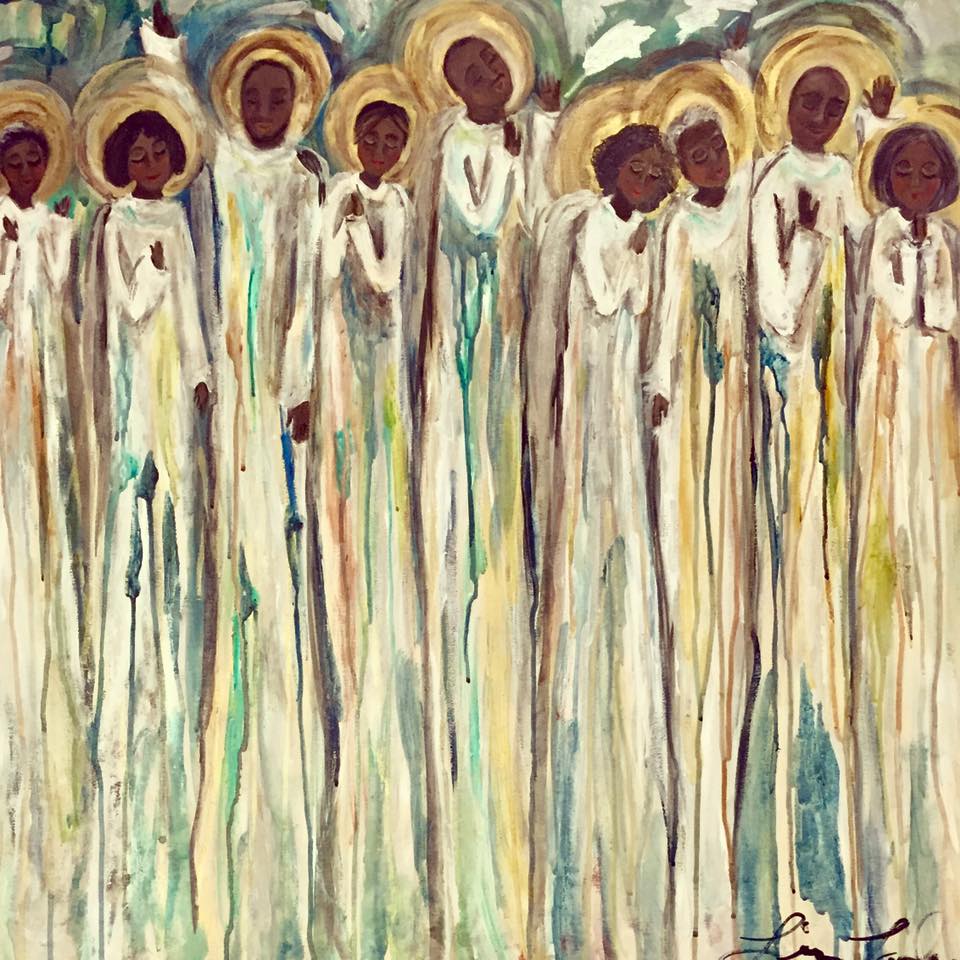
Friday, June 17, marks the one-year anniversary of the racially motivated mass shooting at Emanuel African Methodist Episcopal Church in Charleston, South Carolina, where nine members were killed by gunman Dylann Roof at a midweek service: Sharonda Coleman-Singleton, Cynthia Marie Graham Hurd, Susie Jackson, Ethel Lee Lance, Depayne Middleton-Doctor, Clementa C. Pinckney, Tywanza Sanders, Daniel Simmons, and Myra Thompson.
In response to the tragic event, Alabama artist Liz Landgren painted A Bridge Over Troubled Water, which shows the nine victims ascending, winged and haloed, from the troubled waters of this world.
Liz Landgren (American, 1974–), A Bridge Over Troubled Water, 2015. Acrylic on wood panel, 36 × 36 in.
Landgren says her visualization was inspired by Aretha Franklin’s 1971 cover of the Simon and Garfunkel song “Bridge Over Troubled Water”:
The original song premiered on November 30, 1969, on the CBS documentary feature Songs of America. Here, as in Landgren’s painting, it was connected with death, being played over footage from the funerals of John F. Kennedy, Robert Kennedy, and Martin Luther King Jr.
Paul Simon, who wrote the song, says his idea for it came from a line that Claude Jeter extemporized in the Swan Silvertones’ 1958 recording of the African American spiritual “Oh Mary Don’t You Weep”: “I’ll be your bridge over deep water if you trust in my name.” The speaker is Jesus; the context, his raising of Lazarus (see John 11:32–33). So whereas “Bridge Over Troubled Water” is often transmitted today as a message from one friend to another, its source material actually identifies that friend as Jesus, the one who lays himself down so that we can cross over pain without drowning in it.
Because of the religious significance of the song, Simon sought to give it a gospel feel. For this task he enlisted the help of Larry Knechtel, who arranged the song for piano (Simon had written it on guitar), styling it after church hymns. Knechtel’s piano playing is one of the song’s most distinguishing characteristics.
So back to Landgren’s painting. The waters of suffering roll off the figures’ garments, a heaviness they no longer bear, as they “sail on by” to be with their Lord. Saints on earth, they now pass into the extended communion of saints in heaven, leaving behind a world that’s roiling with violence and hate, anger and grief.
We lament the deaths of the Charleston Nine. We lament the laws that make it easier to kill. We lament the dividedness of our country. But we celebrate the witness of Sharonda, Cynthia, Susie, Ethel, Depayne, Clementa, Tywanza, Daniel, and Myra, whose Christian hospitality toward a white stranger cost them their lives.
The painting brings to my mind another song: “All God’s chillun [children] got wings . . . a robe . . . a crown . . . a song,” and when we get to heaven we’re gonna put them on.
Praise be to God, who raises us up—from death and from woe.
MaMuse is an acoustic folk duo from Chico, California, made up of Karisha Longaker and Sarah Nutting. Known for their soulful harmonies and light, bright lyrics, these women have said that they want their music to bring spiritual uplift and to connect people to the richness of life. Both Longaker and Nutting have backgrounds in music therapy and therefore view music as a healing art form. They also consider it an opportunity to bless others. Because of the intimacy it affords, they especially love performing house concerts.
Although they are not confessional Christians (they have a very all-embracing spirituality), they do cite gospel influences, which is evident in songs like “Hallelujah” and “On the Altar.” The former is the first track on their 2009 debut album All the Way and is one of the most beautiful songs I’ve heard in a while. Watch the music video below.
The song invokes a whole cluster of water imagery from the Bible. Jesus, for example, declared his Spirit to be the living water that quenches one’s deepest thirst (John 4:1–45, 7:37–39). Those who believe in him will receive within them “a spring of water welling up to eternal life”; “from [their] innermost being will flow rivers of living water.” The third verse of the song alludes to this gift:
There is a river In this heart of hearts With a knowingness Of my highest good
The Spirit not only nourishes and refreshes us but also prompts us to do what is right and good, coursing through our veins like a river of holy desire and spurting forth like a fountain for all to see. Continue reading “The soul-nourishing music of MaMuse”→






 Art & Theology