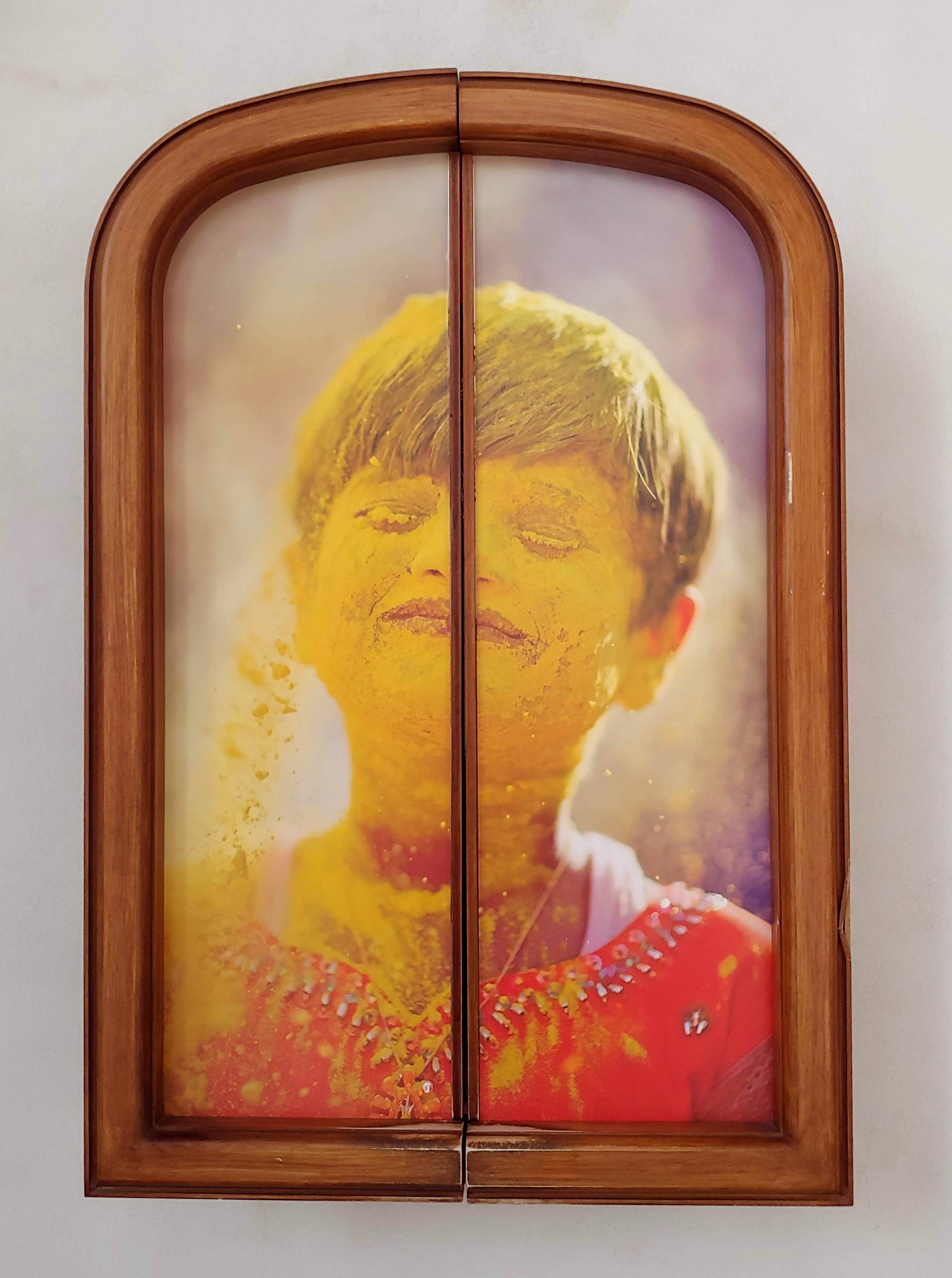
One of thirteen wall-mounted display panels (with opening doors) designed by Kossmanndejong for the ambulatory of the Church of St. Lawrence in Rotterdam, portraying the city’s diverse religious festivals. This one portrays Holi, a Hindu festival in March celebrating the victory of light over darkness and involving the throwing of colored powder and water. I took this photo when visiting during Lent 2019.
The following text has been floating around the internet for some time. It’s often attributed to the American motivational writer and Methodist lay leader William Arthur Ward (1921–1994), but it is not in his compilation of maxims, Fountains of Faith (Droke House, 1970), and it doesn’t sound like his other writings.
Fast from judging others; feast on the Christ within them. Fast from emphasis on difference; feast on the unity of life. Fast from apparent darkness; feast on the reality of light. Fast from thoughts of illness; feast on the healing power of God.
Fast from words that pollute; feast on phrases that purify. Fast from discontent; feast on gratitude. Fast from anger; feast on patience. Fast from pessimism; feast on optimism.
Fast from complaining; feast on appreciation. Fast from worry; feast on trust in God’s care. Fast from unrelenting pressure; feast on unceasing prayer. Fast from facts that depress; feast on verities that uplift.
Fast from lethargy; feast on enthusiasm. Fast from thoughts that weaken; feast on promises that inspire. Fast from shadows of sorrow; feast on the sunlight of serenity. Fast from problems that overwhelm; feast on prayer that undergirds.
Fast from bitterness; feast on forgiveness. Fast from self-concern; feast on compassion for others. Fast from personal anxiety; feast on eternal truth. Fast from discouragements; feast on hope.
It’s a stirring exhortation, and it always gets special traction during Lent, a penitential season in which many Christians practice the spiritual discipline of fasting (in the traditional sense of limiting food intake) and/or abstinence (refraining from eating a certain type of food). The language of “fasting” can be confusing, because traditionally, you’re to fast from good things for a set period of time, and then enjoy them all the more fully during a period of feasting; but people sometimes use the word “fast” to describe the act of giving up something that’s bad for them or that’s unholy and that, truth be told, would best be given up year-round. This text uses the latter meaning: reducing or abstaining from attitudes and behaviors that drag you or others down. It also acknowledges, as did the church fathers, that when you cut something unwholesome out of your life, it’s often wise to replace it with something wholesome.
Lent is an annual prompt for self-examination, a spiritual wellness check in which we’re invited to identify the ways we’ve veered off course from the way of Christ (or where we’re stumbling) and to let Christ’s grace draw us back (or help us surmount the obstacles). It’s a chance to tend to our disordered manners of being and develop healthy new habits as we seek to live more faithfully as people of God.
In February 2010, Msgr. Kerry Beaulieu adapted the above text for Our Lady Queen of Angels Catholic Church in Newport Beach, California, which he pastored from 2004 to 2018:
Fast from a gloomy outlook on life; Feast on what is bright and cheerful.
Fast from always being right; Feast on seeing another’s point of view.
Fast from always pointing out differences; Feast on what unites us all.
Fast from words that pollute; Feast on those that purify.
Fast from complaining; Feast on appreciation.
Fast from self-pity; Feast on goodness in others and self.
Fast from self-concern; Feast on going out to others.
Fast from overdoing; Feast on time for prayer.
Fast from worry; Feast on God’s love.
It was also adapted into the song “Fast from, Feast On” in 2014 by Latifah Alattas and Dave Wilton and is performed by Alattas (under the artist name Page CXVI) on the album Lent to Maundy Thursday.
Fast from the swelling darkness Feast on the power of his light Fast from discontentment Feast on the joy that he brings
Refrain: Sustainer, protector, the well of life My helper, my comfort, the bread of life Is you Is you
Fast from the fear that haunts us Feast on the power of his might Fast from the trap of judgment Feast on all that’s been redeemed [Refrain]
Bridge: From the sorrow’s shadow to perfect light From the darkness of our doubt to a cleansing white From the sorrow’s shadow to perfect light From the blindness of our sin to healing sight [Refrain]
I recommend choosing one or more of these fast-feast pairings to partake of during Lent. Or you could write your own aspirational list, tailored to the areas where you struggle and want to see growth. Rephrase it as a vow: “I will fast from . . . I will feast on . . .” If you are comfortable sharing for the edification of other readers, feel free to do so in the Comments section below.
ADVENT SERIES: Restful Advent by Tamara Hill Murphy:Tamara Hill Murphy [previously] is one of my favorite spiritual writers, her thoughtful words and curation of resources having served as a well of inspiration for me over the years. Each year, similar to Art & Theology but with the sensibilities and expertise of an Anglican spiritual director, she publishes a new daily Advent and Christmastide guide through her Substack, Restful, running this year from November 30 to January 5. Each post in the series includes lectionary readings, art, music, a prayer, and a simple practice to help us notice God’s presence during these waiting days. This time around, the Daybook will feature excerpts from Claude Atcho’s new book Rhythms of Faith along with ideas from The Liturgical Home by Ashley Tumlin Wallace and some of my own formerly published art commentaries.
“The Daybook is a way to pay attention to Christ’s three arrivals—then, now, and still to come—and to walk through December with a quieter heart and a stronger hope,” Murphy writes.
Murphy is offering Art & Theology readers a 50% discount to Restful using this link, which brings the subscription cost down to $4/month (let it run for two months if you want to receive the full Christmastide Daybook) or $32/year, which will give you access to her year-round content. The offer expires January 5, 2026.
+++
BLOG POST: “The Sacred Journey of Advent” by Ashley Tumlin Wallace, The Liturgical Home: “Advent,” writes Wallace, “is a season of preparation, for the coming of Christ at Christmas, and also for His return in glory at the end of time.” This is a great introduction to the season that kicks off the new church year.
+++
SONGS:
One of the scripture texts of Advent is Isaiah 40:3–5:
A voice cries out: “In the wilderness prepare the way of the LORD; make straight in the desert a highway for our God. Every valley shall be lifted up, and every mountain and hill be made low; the uneven ground shall become level, and the rough places a plain. Then the glory of the LORD shall be revealed, and all flesh shall see it together, for the mouth of the LORD has spoken.”
The Gospel-writers Matthew (3:3), Mark (1:3), and Luke (3:4) all see this exclamatory figure as John the Baptist, who told people to prepare for God’s coming by repenting of sin, since holding on tightly to ways of unlove erects barriers to God’s entry into one’s life. Here are two songs based on this Advent passage.
>> “Prepare the Way” by Maverick City Music and Tribl, feat. Chandler Moore and Siri Worku, on Tribl I (2021): This song repeats, again and again, the Advent mantra “Prepare the way,” embedding John the Baptist’s invitation deeply into hearts and minds. Its tag beseeches Christ to come with the fire of purging, the rain of refreshment, and the oil of blessing. To welcome this coming, this transformation and growth, we need to decenter ourselves, ceding to God the place of primacy, from which he works our good and his glory.
>> “Prepare the Way” by Christopher Walker, on Rise Up and Sing, 3rd ed., vol. 3 (2009): This 1991 song is by Christopher Walker, a church music composer, lecturer, and choral conductor originally from the UK but now living in Santa Monica, California. Published by OCP (Oregon Catholic Press), it would make a great song for a children’s Advent choir.
+++
2018 SERIES: Advent Caravan: Walking with the Holy Family by Sarah Quezada: I learned about Sarah Quezada’s work at the intersection of faith, justice, and culture through Tamara Hill Murphy (see first roundup item) in 2018, when Quezada published a five-part series reflecting on the likelihood that Mary and Joseph traveled to Bethlehem for the census not alone but in a caravan. Interweaving personal story, biblical interpretation, and current events, Quezada considers how the holy couple’s experience in the final months of Mary’s pregnancy connects to the reality of people on the move seeking hope, peace, joy, and love today.
While the series is not hosted online, I received permission from Quezada to reproduce it here.
On Instagram, Quezada also shared a photo of her friend’s Advent mantel, where she combined figurines from her various nativity sets to form a “caravan” of travelers.
Photo via @sarahquezada
+++
YOUTUBE PLAYLIST: Jouluradion Hoosianna: Jouluradio is a Finnish radio station that broadcasts annually from November 1 to January 6, playing all Advent and Christmas music. Since 2012, every year they premiere a new arrangement and video performance of the popular Scandinavian Advent hymn “Hoosianna” (Hosanna, an Aramaic expression meaning “Save now!”), which Lutheran and Catholic churches in Finland sing on the first Sunday of the season. Based on Matthew 21:9, its lyrics greet the approaching Christ, affirming his identity and craving the deliverance only he can bring:
Hoosianna, Daavidin Poika,
kiitetty olkoon hän!
Kiitetty Daavidin Poika,
joka tulee Herran nimeen.
Hoosianna, hoosianna,
hoosianna, hoosianna!
Kiitetty Daavidin Poika,
joka tulee Herran nimeen.
Hosanna, Son of David,
Most blessed Holy One,
Hosanna, Son of David,
Who comes in the name of the Lord!
Hosanna, hosanna, hosanna
In the highest!
Hosanna, Son of David,
Who comes in the name of the Lord!
This hymn was written by the German composer, educator, and piano and organ virtuoso Georg Joseph Vogler in 1795 while working in Sweden as court conductor as well as tutor to the crown prince Gustav IV Adolf.
The Jouluradio commissions, which the station has compiled in a YouTube playlist, encompass a range of genres, including jazz, hip-hop, choral, pop, and electronic. Below is a list of previous years’, of which I’ve embedded the two asterisked ones on this page. Jouluradio typically releases their annual “Hoosianna” the day before Advent, so 2025’s will likely be posted this Saturday. [HT: Gracia Grindal]
*2015: Sointi Jazz Orchestra, arr. Jukka Perko (I don’t really understand the narrative in the video. I think the man is remembering a time in his childhood when he got lost in the woods, and then was found by his mother?)
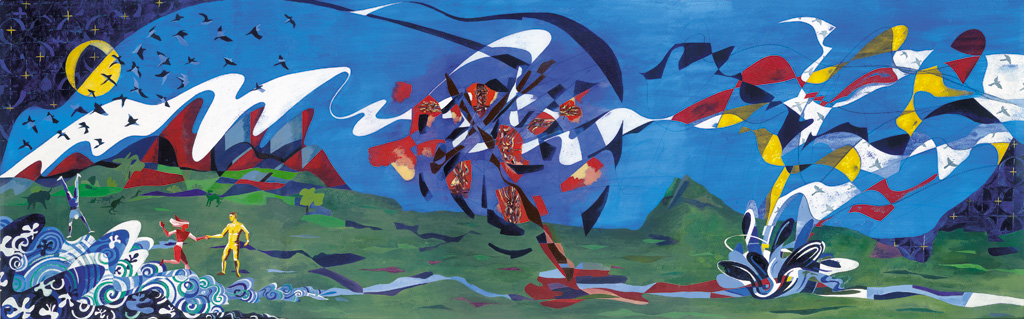
Paul Hobbs (British, 1964–), Three in One, 2000. Acrylic on paper, 55 × 177 cm.
We believe in God above us, Maker and Sustainer of all life, of sun and moon, of water and earth, of male and female.
We believe in God beside us, Jesus Christ, the Word made flesh, born of a woman, servant of the poor, tortured and nailed to a tree. A man of compassion, he died forsaken; he descended into the earth to the place of death. On the third day he rose from the tomb; he ascended into heaven to be everywhere present; and his kingdom will come on earth.
We believe in God within us, the Holy Spirit of Pentecostal fire, life-giving breath of the church, spirit of healing and forgiveness, source of resurrection and eternal life.
Amen.
The Iona Community is an international, ecumenical Christian movement working for justice and peace, the rebuilding of community, and the renewal of worship. This Affirmation of Faith, one of several they use in their liturgies, is found in the Sunday Morning Communion Service A in the Iona Abbey Worship Book (Wild Goose Publications, 2017), pp. 27–28.
The following exhortation is by Kenneth Tanner, pastor of Holy Redeemer church in Rochester Hills, Michigan, and the author of Vulnerable God: Reviving the Wonder of God-with-Us in Our Humanity, forthcoming from Brazos Press. He originally posted it on Facebook on March 26, 2018, and I reprint it here with his permission.
[In 2004] a film premiered during Lent. The film was about this week we are entering, the week that changes the world.
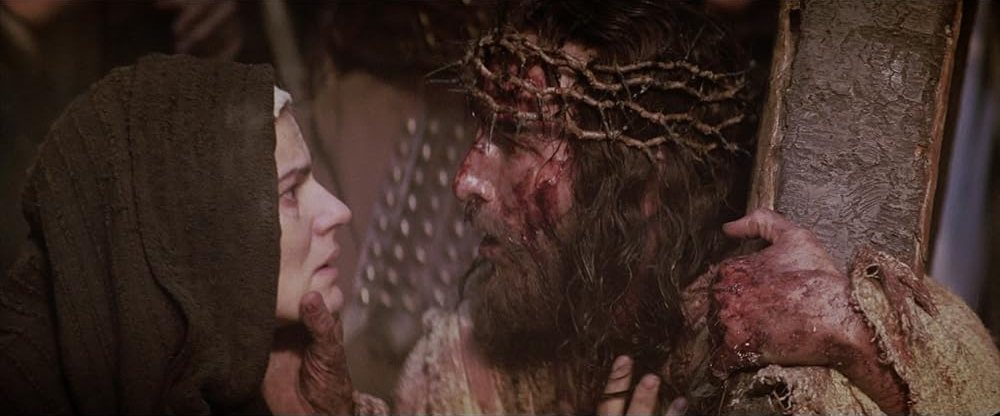
There’s a scene in the film of Jesus falling flat on his face into a dusty road; surrounded by crowds, a crown of thorns on his head, the heavy timber he is carrying comes down hard on his back.
He falls at the intersection of an alleyway where we see his mother Mary huddled in anguish as she waits in horror to glimpse Jesus passing.
When Jesus hits the ground just yards from her, Mary flashes back to a moment when as a child Jesus stumbled and hurt himself. In the memory, Jesus runs to her in pain and she takes him into her arms of comfort.
Startled back from her vision, back to the reality of her son laying prostrate in the dust, Mary springs to life and rushes to the aid of her son. When Jesus sees her, he shoulders his cross, and as he slowly rises back to his feet, he looks at Mary and says, “Behold, mother, I make all things new.”
Film still from The Passion of the Christ (2004), dir. Mel Gibson
Once a year Christians let this story be the priority in their lives. We take children out of music lessons and sporting events. We don’t plan social engagements. We pause. We take a deep breath. We put ordinary busyness on hold. We take a long weekend of sabbaths.
We pray. We sing. We lament. We remember. We find silence and dwell in it. We worship.
We ENTER the story together by the Spirit in gathered liturgies that re-enact the gift of the Last Supper, the command to love as God has loved us, the anxious questions and perspiration of Gethsemane.
We come together again to take a hard look at the cross, at our own violence toward God, at the Love that forgives even as we betray and deny and flee, as we smite and whip and nail and mock.
In the quiet of Holy Saturday we ponder a world without God, where death reigns without the resurrection.
Then we gather once more with great joy to remember that death is not the end of anyone or the end of the world, that the resurrection is the end of all things.
I want to encourage you to disconnect from the grind and walk the way of the cross this week, to stay with Jesus and the women and John in the darkness that has to come before the new dawn.
You will never quite understand our community, ancient practices, or the deeper meanings of this week until you let it take over your life once a year. And with every passing year, as you keep this sacred week sacred, free from other obligations and pursuits, you will see and experience and encounter Jesus Christ anew.
So I invite you to surrender and enter contemplation of the mighty acts whereby God has reconciled the world to himself in Jesus Christ, the things only Jesus can do, for we cannot do them ourselves, where we find genuine rest from our labors in the acts of Love that make the world new.
To assist your contemplations, I’ll be sharing a song and an artwork here on each day of Holy Week, as is my custom. (You can view the archived posts in this annual series, from 2024, 2023, 2022, 2021, and 2020.) Some of the songs can be found on Art & Theology’s Holy Week Playlist:
The honor of fasting consists not in abstinence from food, but in withdrawing from sinful practices, since they who limit their fasting only to abstinence from meats are they who especially disparage fasting.
Do you fast? Give me proof of it by your works. If you see a person who is poor, take pity on them. If you see an enemy, be reconciled to them. If you see a friend being honored, do not envy them. Let not only your mouth fast, but also your hands and feet and eyes and ears and all the members of your body. Let the hands fast by being free of avarice. Let the feet fast by ceasing to run after sin. Let the eyes fast by not looking with lust. Let the ears fast by not listening to malicious talk or false reports. Let the mouth fast from hateful words and unjust rants. For what good is it if we abstain from birds and fishes but bite and devour our brothers and sisters?
—John Chrysostom, from Homily 3 on the Statutes, secs. 11–12, written in Greek in 387 CE
ART SERIES: Magnificat by Mandy Cano Villalobos:Mandy Cano Villalobos [previously] is a multidisciplinary artist from Grand Rapids, Michigan. Her Magnificat series consists of bundles of discarded clothing, bound in string and meticulously hand-coated with imitation gold. The title—the Latin name of Mary’s praise song that opens, “My soul magnifies the Lord!”—invites associations with the Christmas story, including the image of the swaddled Christ child, a gift to the world that surprises and delights.
Mandy Cano Villalobos (American, 1979–), Magnificat XV, 2019. Cloth, string, and imitation gold.Installation of select pieces from the Magnificat and Cor Aurum series by Mandy Cano Villalobos, December 2020, Sojourn Midtown, Louisville, Kentucky
The series debuted in 2019 at Cano Villalobos’s solo show All That Glitters at the Urban Institute for Contemporary Arts (UICA) in Grand Rapids. I first encountered it, though, through online promotions of Sojourn Midtown’s Advent 2020 installation to correspond with the church’s sermon series Wrapped in Flesh, for which twelve of the artist’s works, some from her related Cor Aurum (Heart of Gold) series, were placed in niches around the sanctuary.
“The objects, all made of wood and fabric covered in imitation gold, point to something both humble and glorious,” writes Michael Winters, Sojourn Midtown’s arts and culture director. “Like these small sculptures of rags and gold, the birth of Jesus was also marked by humility and glory.”
+++
ARTICLE: “My Swaddled Savior” by Jeff Peabody, Christianity Today: Pastor Jeff Peabody of Tacoma, Washington, describes the traditional Japanese art of furishoki, or wrapping goods in cloths, as he reflects on Jesus having been swaddled as an infant, a wrapped gift given to the world. “Jesus came to us in furoshiki, wrapped in cloths,” he writes.
+++
BLOG POST: How to receive gifts and enjoy feasting without shame, by Tamara Hill Murphy: In this old blog post of hers, spiritual director and The Spacious Path author Tamara Hill Murphy absolves us of the guilt we so often feel around (1) receiving (unreciprocated) gifts and (2) feasting. We should receive both presents and food, she says, as means of grace. Too often we’re embarrassed when we receive a gift from someone to whom we gave no gift, or a gift of lesser value, and so instead of receiving their gift with joy, we receive it with shame or an annoying sense of obligation. But Murphy says she hopes to receive gifts this way: “When Jesus told us to come to him as little children, he must have been imagining the way children openly, delightedly, innocently receive gifts. Children do not question their place as ones worthy of receiving gifts. Children boldly believe the beauty of unearned kindness.”
As for food, how many times have you been to a Christmas party or dinner and heard people bemoan all the fat and sugar they’ve been consuming, and about how they’ll have to punish their body in the new year to work off the extra calories, to shrink themselves back down to size? Feasting, though, is a spiritual discipline, a way to celebrate important events, like the birth of Christ, with family and friends. Feel no shame about indulging in gustatory pleasures this Christmas! Take in the sweet, the creamy, and the juicy! Murphy’s mom’s motto for hospitality is a wise one: “While we feast, we savor.”
On her blog A Clerk of Oxford, medievalist Eleanor Parker also affirms the virtue of feasting, noting how the popular modern practice of fasting in January runs counter to medieval Christian practice:
Since the late 20th century it’s become common to invert the traditional relationship between fasting and feasting in the Christmas season. The ancient custom was to fast in Advent in preparation for the feast, and then to celebrate for at least twelve days after Christmas (and to some degree, all through January). Now we do it the other way around; for many people the feast is followed by a penitential fast, in the form of ‘Dry January’ or New Year’s resolutions about eating less and going to the gym. As a manifestation of the desire for a fresh start, this ‘new year, new you’ impulse is natural enough, but it does strike me as strange that it’s so often framed in negative terms. There’s an odd sense, encouraged mostly perhaps by journalists and advertisers, that the indulgence of Christmas is a ‘sin’ which has to be atoned for – as if eating and drinking with friends and family, to celebrate the turn of the year from darkness to light, is a moral lapse for which one must subsequently make amends by privation and self-punishment. We are much less kind to ourselves in these weeks after Christmas than the strictest confessor would have been in the Middle Ages. Feasting at Christmas is not something to atone for, but a proper observance due to the season; and that feasting is also the sustenance we need to carry us into the New Year with energy and strength.
+++
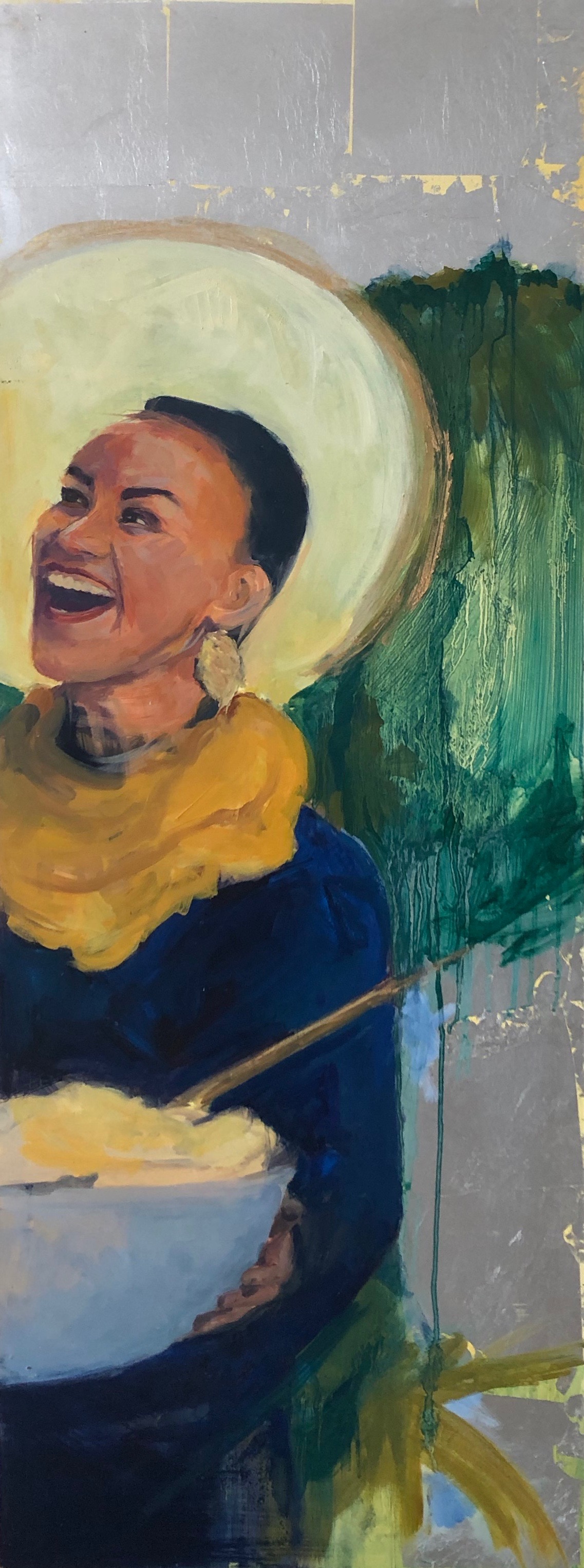
VIDEO: “Our Vocation of Delight: On Advent, Beauty, and Joy” by Christen Yates: In this thirty-minute “Space for God” Advent devotional from Coracle, artist Christen Yates (Instagram @christenbyates) invites us to experience the Christian “duty of delight” through engaging a selection of artworks by herself, Sedrick Huckaby, Letitia Huckaby, and Ashley Sauder Miller. She opens with a liturgical commission she fulfilled for the Advent season while serving as artist in residence at her church in Charlottesville: a portrait painting of congregation member Arley Bell (née Arrington), a baker who is now the owner of Arley Cakes in Richmond. Waiting for her dough to rise, Arley captures the joyful expectancy of Advent.
Christen Yates (American, 1977–), Advent: Arley, baker, 2016. Oil and gold and silver leaf on board, 48 × 18 in. Collection of All Souls Charlottesville, Charlottesville, Virginia. Photo courtesy of the artist.
The law of growth is rest. We must be content in winter to wait patiently through the long bleak season in which we experience nothing whatever of the sweetness or realization of the Divine Presence, believing the truth, that these seasons which seem to be the most empty are the most pregnant with life. It is in them that the Christ-life is growing in us, laying hold of our soil with strong roots and thrust deeper and deeper, drawing down the blessed rain of mercy and the sun of Eternal Love through our darkness and heaviness and hardness, to irrigate and warm those roots. . . .
The seed must rest in the earth. We must allow the Christ-life to grow in us in rest. Our whole being must fold upon Christ’s rest in us, as the earth folds upon the seed.
Emil Nolde (German, 1867–1956), Dark Red Sea, ca. 1938. Watercolor. Nolde Museum, Seebüll, Germany.
Mon Dieu, protégez-moi, mon navire est si petit et votre mer si grande!
Lord, help me . . . Because my boat is so small, And your sea is so immense.
This anonymous prayer collected from a Breton sailor—or fisherman, as some anthologies cite—is found in Émile Souvestre, Les derniers Bretons (The Last Bretons), vol. 1 (Paris: Charpentier, 1836), page 121. The English translation is by Robert Bly and is from the anthology The Soul Is Here for Its Own Joy: Sacred Poems from Many Cultures (New York: Ecco, 1995), which Bly edited. He identifies the prayer as “French medieval” but doesn’t provide a source. The prayer also appears as #422 in The Oxford Book of Prayer and on page 80 of 2000 Years of Prayer; the latter places it in the “Celtic Christianity” section, as Bretons are descendants of the Celts who emigrated from the British Isles to Armorica, the northwestern extremity of Gaul (now called Brittany, part of France), after the Anglo-Saxon invasions.
Though “boat” and “sea” were likely meant first and foremost literally, there is a long tradition of boats being used as metaphors for our fragile selves, afloat the vicissitudes of life, or carried about by the divine will. Living outside a maritime context, I pray this prayer in that metaphoric sense.
Walter Rauschenbusch (1861–1918) was a Baptist minister, theology professor, and pioneer of the Social Gospel movement, which dominated American Protestant thought in the late nineteenth and early twentieth centuries. This movement sought to apply the ethical principles Jesus taught and the theological vision he espoused to pressing social concerns, such as poverty, pollution, alcoholism, unjust wages, unregulated factories, child labor, inadequate schools, women’s suffrage, racism, and violence. The son of German immigrants, Rauschenbusch pastored a congregation in the congested and impoverished neighborhood of Hell’s Kitchen in New York City from 1886 to 1897, where he witnessed firsthand, in the lives of his congregants, the misery of exploited workers. Adults and children alike worked ten- to twelve-hour days, six days a week, and lived in unsafe and unsanitary tenements.
This pastorate was deeply formative for him as he went on to teach in academic settings and to write. From 1897 until his death he taught courses in church history and Christian ethics at Rochester Theological Seminary and published a handful of books: Christianity and the Social Crisis (1907), Prayers of theSocial Awakening (1910), Christianizing the Social Order (1912), Dare We Be Christians? (1914), The Social Principles of Jesus (1916), and A Theology for the Social Gospel (1917). Christianity Revolutionary, which he wrote in 1891, was published posthumously as The Righteousness of the Kingdom in 1968.
In some Christian circles, “social gospel” is a dirty word, as some think it overemphasizes material concerns and detracts from what they see as Jesus’s core message of the salvation of souls. The sermons and writings of Social Gospelers did swing that way, focusing on the this-worldly social implications of the good news of Jesus and not as much on the spiritual, but that’s because at the turn of the century there was a relative dearth in preaching and writing about social issues from an informed Protestant theological perspective that they sought to rectify. Christians were already well versed in the narrative of personal sin and redemption. But the notion of societal sin and societal redemption was underdeveloped territory, so Rauschenberg, Josiah Strong, Washington Gladden, Richard T. Ely, and others moved in to articulate this neglected aspect of the gospel.
The Social Gospel movement makes the kingdom of God its central doctrine. Adherents believe the mission of the church is to propagate God’s kingdom, aka the kingdom of heaven, on earth. It’s a mischaracterization that the movement is concerned only with fixing society and not people. People make up society, and change starts with them—with personal repentance. Social Gospelers would say that as people turn to Christ and are spiritually transformed by him into new creations, those transformed people, in the power of the Holy Spirit, can then, and indeed are called to, “renew the face of the earth” (Ps. 104:30).
Rauschenbusch calls out the passivity of those Christians who say they are waiting for Christ to return to set all things right but don’t participate in the Christ-spirited renewal, the setting right, that is already underway. Of course he still believed in Christ’s second coming; he just also believed it a Christian duty to anticipate that coming with acts of charity and justice. Addressing the complaint that humans are powerless to solve the world’s overwhelming social problems and can never achieve the kind of sweeping regeneration Christ will bring, he wrote in Christianity and the Social Crisis:
We know well that there is no perfection for man in this life: there is only growth toward perfection. . . . We shall never have a perfect social life, yet we must seek it with faith. We shall never abolish suffering. . . . At best there is always but an approximation to a perfect social order. The kingdom of God is always but coming.
But every approximation to it is worthwhile. . . . Everlasting pilgrimage toward the kingdom of God is better than contented stability in the tents of wickedness.
He highlights the horizontal dimension of Christ’s mission and the apostle Paul’s institution of it, claiming that “the essential purpose of Christianity was to transform human society into the kingdom of God by regenerating all human relations and reconstituting them in accordance with the will of God.” He sees the Lord’s Prayer as key, in which we pray for God’s will to be done on earth as it is in heaven. “There is no request here that we be saved from earthliness and go to heaven, which has been the great object of churchly religion,” he writes. “We pray here that heaven may be duplicated on earth through the moral and spiritual transformation of humanity, both in its personal and its corporate life.” God’s salvation is not a salvation from this world but a salvation in and for this world.
The 1892 statement of the Brotherhood of the Kingdom, drafted by Rauschenbusch, Nathaniel Schmidt, and Leighton Williams, comments on the all-too-common truncated view of the gospel:
Because the individualist conception of personal salvation has pushed out of sight the collective idea of a Kingdom of God on earth, Christian men seek for the salvation of individuals and are comparatively indifferent to the spread of the spirit of Christ in the political, industrial, social scientific, and artistic life of humanity, and have left these as the undisturbed possessions of the spirit of the world. Because the Kingdom of God has been understood as a state to be inherited in a future life rather than as something to be realized here and now, therefore Christians have been contented with a low plane of life here and have postponed holiness to the future.
While I wouldn’t say I’m part of the Social Gospel movement, I’ve definitely been positively influenced by it—I’m not in the bandwagon of denigrators—even as I try to integrate and balance its wisdom with Jesus’s other proclamations.
Martin Luther King Jr. was an appreciator too. He wrote in Stride toward Freedom (1958),
Rauschenbusch had done a great service for the Christian church by insisting the gospel deals with the whole man, not only his soul but his body; not only his spiritual well-being but his material well-being. It has been my conviction ever since reading Rauschenbusch that any religion which professes to be concerned about the soul of men and is not concerned about the social and economic conditions that scar that soul, is a spiritually moribund religion waiting for the day to be buried.
(King was killed, remember, at a workers’ rights rally.)
The Social Gospel movement advocated social change, seeking the betterment of industrialized society through the application of biblical principles. It contributed to the New Deal and other progressive governmental programs in the US and Canada in the 1930s and ’40s and prefigured elements of liberation theology, which emerged in Latin America in the late 1960s.
My entrée to Rauschenbusch’s thought was through his published prayers. I had been conditioned to treat as suspect any products of the Social Gospel movement, so I was not expecting to be as moved as I was by his petitions and thanksgivings to God, which convey his deep and wide concern for the world, and which I’ve found meaningful to lift up in my own prayer time.
His collection includes prayers for employers, homeless children, immigrants, consumers, judges, legislators, artists, doctors and nurses, journalists, the environment, and so on, as well as prayers for morning, evening, and mealtime.
The following is a selection of prayers from Walter Rauschenbusch, Prayers of the Social Awakening (Boston and Chicago: The Pilgrim Press, 1910), which is in the public domain. I have lightly edited them, mainly for gender inclusivity. All headings, save for the fourth one (which I updated the language of), are Rauschenbusch’s.
Grace before Meat
“Our Father, thou art the final source of all our comforts, and to thee we render thanks for this food. But we also remember in gratitude the many men and women whose labor was necessary to produce it, and who gathered it from the land and afar from the sea for our sustenance. Grant that they too may enjoy the fruit of their labor without want, and may be bound up with us in a fellowship of thankful hearts.”
Prayer for This World
“O God, we thank thee for this universe, our great home; for its vastness and its riches, and for the manifoldness of the life which teems upon it and of which we are part. We praise thee for the arching sky and the blessed winds, for the driving clouds and the constellations on high. We praise thee for the salt sea and the running water, for the everlasting hills, for the trees, and for the grass under our feet. We thank thee for our senses by which we can see the splendor of the morning, and hear the jubilant songs of love, and smell the breath of the springtime. Grant us, we pray thee, a heart wide open to all this joy and beauty, and save our souls from being so steeped in care or so darkened by passion that we pass heedless and unseeing when even the thornbush by the wayside is aflame with the glory of God. Enlarge within us the sense of fellowship with all the living things, our kin, to whom thou hast given this earth as their home in common with us. We remember with shame that in the past we have exercised dominion with ruthless cruelty, so that the voice of the earth, which should have gone up to thee in song, has been a groan of travail. May we realize that they live not for us alone but for themselves and for thee, and that they love the sweetness of life even as we, and serve thee in their place better than we in ours. When our use of this world is over and we make room for others, may we not leave anything ravished by our greed or spoiled by our ignorance, but may we hand on our common heritage fairer and sweeter through our use of it, undiminished in fertility and joy, that so our bodies may return in peace to the great mother who nourished them and our spirits may round the circle of a perfect life in thee.”
Prayer for Employers
“We invoke thy grace and wisdom, O Lord, upon all people of goodwill who employ and control the labor of others. Amid the numberless irritations and anxieties of their position, help them to keep a quiet and patient temper, and to rule firmly and wisely, without harshness and anger. Since they hold power over the bread, the safety, and the hopes of the workers, may they wield their powers justly and with love, as older siblings and leaders in the great fellowship of labor. Suffer not the heavenly light of compassion for the weak and the old to be quenched in their hearts. When they are tempted to follow the ruthless ways of others, and to sacrifice human health and life for profit, do thou strengthen their will in the hour of need, and bring to naught the counsels of the heartless. Save them from repressing their workers into sullen submission and helpless fear. May they not sin against the Christ by using people’s bodies and souls as mere tools to make things, forgetting the human hearts and longings of these their brothers and sisters.”
Prayer for the Unemployed
“O God, we remember with pain and pity the thousands of our brothers and sisters who seek honest work and seek in vain. For though unsatisfied wants are many, and though our land is wide and calls for labor, yet these thy sons and daughters have no place to labor, and are turned away in humiliation and despair when they seek it. O righteous God, we acknowledge our common guilt for the disorder of our industry which thrusts even willing workers into the degradation of idleness and want, and teaches some to love the sloth which once they feared and hated. We remember also with sorrow and compassion the idle rich, who have vigor of body and mind and yet produce no useful thing. Forgive them for loading the burden of their support on the bent shoulders of the working world. Forgive them for wasting in refined excess what would feed the pale children of the poor. Forgive them for setting their poisoned splendor before the thirsty hearts of the young, luring them to theft or shame by the lust of eye and flesh. Forgive them for taking pride in their workless lives and despising those by whose toil they live. Forgive them for appeasing their better self by pretended duties and injurious charities. We beseech thee to awaken them by the new voice of thy Spirit that they may look up unto the stern eyes of thy Christ and may be smitten with the blessed pangs of repentance. Grant them strength of soul to rise from their silken shame and to give their brothers and sisters a just return of labor for the bread they eat. And to our whole nation do thou grant wisdom to create a world in which none shall be forced to idle in want, and none shall be able to idle in luxury, but in which all shall know the health of wholesome work and the sweetness of well-earned rest.”
Prayer for Artists and Musicians
“O thou who art the all-pervading glory of the world, we bless thee for the power of beauty to gladden our hearts. We praise thee that even the least of us may feel a thrill of thy creative joy when we give form and substance to our thoughts and, beholding our handiwork, find it good and fair. We praise thee for our brothers and sisters, the masters of form and color and sound, who have power to unlock for us the vaster spaces of emotion and to lead us by their hand into the reaches of nobler passions. We rejoice in their gifts and pray thee to save them from the temptations which beset their powers. Save them from selfish ambition and the vanity that feeds on cheap applause, and from the dark phantoms that haunt the listening soul. Let them not satisfy their hunger for beauty with mere tricks of skill, devoid of spirit. Teach them that they are but servants of their fellow beings, and that the promise of their gifts can fulfill itself only in the service of love. Give them faith in the inspiring power of a great purpose and courage to follow to the end the visions of their youth. Kindle in their hearts a compassion for the joyless lives of the people, and make them rejoice if they are found worthy to hold the cup of beauty to lips that are athirst. Make them reverent interpreters of you, they who see thy face and hear thy voice in all things, so that they may unveil for us the beauties of nature which we have passed unseeing, and the sadness and sweetness of humanity to which our selfishness has made us oblivious.”
Prayer for Lawyers and Legislators
“O Lord, thou art the eternal order of the universe. Our human laws at best are but an approximation to thine immutable law, and if our institutions are to stand, they must rest on justice, for only justice can endure. We beseech thee for the men and women who are set to make and interpret the laws of our nation. Grant to all lawyers a deep consciousness that they are called of God to see justice done, and that they prostitute a holy duty if ever they connive in its defeat. Fill them with a high determination to make the courts of our land a strong fortress of defense for the poor and weak, and never a castle of oppression for the hard and cunning. Save them from surrendering the dear-bought safeguards of the people for which our foreparents fought and suffered. Revive in them the spirit of the great liberators of the past that they may cleanse our law of the inherited wrongs that still cling to it. Suffer not the web of outgrown precedents to veil their moral vision, but grant them a penetrating eye for the rights and wrongs of today and a quick human sympathy with the life and sufferings of the people. May they not perpetuate the tangles of the law for the profit of their profession. Aid them to make its course so simple, and its justice so swift and sure, that the humblest may safely trust it and the strongest fear it. Grant them wisdom so to refashion all law that it may become the true expression of the fairer ideals of freedom and brotherhood which are now seeking their incarnation in a new age. Make these our brothers and sisters the wise interpreters of thine eternal law, the brave spokespersons of thy will, and in reward bestow upon them the joy of conscious fellowship with thy Christ in saving people from the bondage of ancient wrong.”
Prayer against War
“O Lord, since first the blood of Abel cried to thee from the ground that drank it, this earth of thine has been defiled with human blood shed by the hand of siblings, and the centuries sob with the ceaseless horror of war. Ever the pride of kings and the covetousness of the strong have driven peaceful nations to slaughter. Ever the songs of the past and the pomp of armies have been used to inflame the passions of the people. Our spirit cries out to thee in revolt against it, and we know that our righteous anger is answered by thy holy wrath. Break thou the spell of the enchantments that make the nations drunk with the lust of battle and draw them on as willing tools of death. Grant us a quiet and steadfast mind when our own nation clamors for vengeance or aggression. Strengthen our sense of justice and regard for the equal worth of other peoples and races. Grant to the rulers of nations faith in the possibility of peace through justice, and grant to the common people a new and stern enthusiasm for the cause of peace. Bless our soldiers and sailors for their swift obedience and their willingness to answer to the call of duty, but inspire them nonetheless with a hatred of war, and may they never for love of private glory or advancement provoke its coming. May our young men and women still rejoice to die for their country with the valor of their parents, but teach our age nobler methods of matching our strength and more effective ways of giving our life for the flag. O thou strong Father of all nations, draw all thy great family together with an increasing sense of our common blood and destiny, that peace may come on earth at last, and thy sun may shed its light rejoicing on a holy kinship of peoples.”
Prayer for Conferences and Conventions
“We praise thee, O God, for our friends and fellow workers, for the touch of their hands and the brightness of their faces, for the cheer of their words and the outflow of goodwill that refreshes us. Grant us the insight of love that we may see them as thou seest, not as frail mortals, but as radiant children of God who have wrought patience out of tribulation and who bear in earthen vessels the treasures of thy grace. May nought mar the joy of our fellowship here. May none remain lonely and hungry of heart among us. Let none go hence without the joy of new friendships. Give us more capacity for love and a richer consciousness of being loved. Overcome our coldness and reserve that we may throw ajar the gates of our heart and keep open house this day. Lift our human friendships to the level of spiritual companionship. May we realize thee as the eternal bond of our unity. Shine upon us from the faces of thy servants, thou all-pervading beauty, that in loving them we may be praising thee. Through Christ, our Lord.”
Evening Prayers
“O Lord, we praise thee for our sister, Night, who folds all the tired folk of the earth in her comfortable robe of darkness and gives them sleep. Release now the strained limbs of toil and smooth the brow of care. Grant us the refreshing draught of restfulness that we may rise in the morning with a smile on our face. Comfort and ease those who toss wakeful on a bed of pain, or whose aching nerves crave sleep and find it not. Save them from evil or despondent thoughts in the long darkness, and teach them so to lean on thy all-pervading life and love, that their souls may grow tranquil and their bodies, too, may rest. And now through thee we send Good Night to all our brothers and sisters near and far, and pray for peace upon all the earth.”
“Our Father, as we turn to the comfort of our rest, we remember those who must wake that we may sleep. Bless the guardians of peace who protect us against those of evil will, the watchers who save us from the terrors of fire, and all the many who carry on through the hours of the night the restless commerce we require on sea and land. We thank thee for their faithfulness and sense of duty. We pray for thy pardon if our covetousness or luxury makes their nightly toil necessary. Grant that we may realize how dependent the safety of our loved ones and the comforts of our life are on these our brothers and sisters, that so we may think of them with love and gratitude and help to make their burden lighter.”
“Accept the work of this day, O Lord, as we lay it at thy feet. Thou knowest its imperfections, and we know. Of the brave purposes of the morning only a few have found their fulfillment. We bless thee that thou art no hard taskmaster, watching grimly the stint of work we bring, but the father and teacher of people who rejoices with us as we learn to work. We have naught to boast before thee, but we do not fear thy face. Thou knowest all things and thou art love. Accept every right intention however brokenly fulfilled, but grant that ere our life is done we may under thy tuition become true master workers, who know the art of a just and valiant life.”
“Our Master, as this day closes and passes from our control, the sense of our shortcomings is quick within us and we seek thy pardon. But since we daily crave thy mercy on our weakness, help us now to show mercy to those who have this day grieved or angered us and to forgive them utterly. Suffer us not to cherish dark thoughts of resentment or revenge. So fill us with thy abounding love and peace that no ill will may be left in our hearts as we turn to our rest. And if we remember that any brother or sister justly hath aught against us through this day’s work, fix in us this moment the firm resolve to make good the wrong and to win again the love of our sibling. Suffer us not to darken thy world by lovelessness, but give us the power of the children of God to bring in the reign of love among people.”
O Lord, in whose countenance is the morning of all things made new, shine upon us that we may illumine with peace the world-home thou hast given us. Remove from us pride of might and arrogance of possession. Stretch our thoughts, O Divine Mind, that we may see the whole earth as our country, and the inhabitants thereof as our neighbors. Fill our hearts with love that changes discord to trust.
Temper to our good the weariness and the broken hopes we cannot escape. Pour into us the strength of all valiant spirits. Put into our hands constructive tasks of peace. Let not our striving end with condemnation of folly and stupidity in high places.
Quicken in us the will to resist the hysteria that they who take the sword raise to turn us aside from thy commandments. Give us power to the depth, breadth, and height of our souls to prevent the destructions we have lived to weep. Out of the embers of fires that have scorched and blackened thy kingdom on earth, help us create a new order in which we will no more become savages through fear. Unite us, millions strong, against the darkness of hate, as unnumbered sunbeams streaming one way sweeten the sod unto green ecstasy and fruitfulness.
—Helen Keller, “Prayer for Peace,” delivered April 5, 1936, at the “East of Suez” bazaar at the New History Society’s Caravan Hall, New York City [HT]





 Art & Theology