O my God,
. . . . . . . . . .
I bless You for the soul you have created,
For adorning it, for sanctifying it,
Though it is fixed in barren soil;
For the body you have given me,
For preserving its strength and vigor,
For providing senses to enjoy delights,
For the ease and freedom of limbs,
For hands, eyes, ears that do your bidding;
For your royal bounty providing my daily support,
For a full table and overflowing cup,
For appetite, taste, sweetness,
For social joys of relatives and friends,
For ability to serve others,
For a heart that feels sorrows and necessities,
For a mind to care for my fellow-men,
For opportunities of spreading happiness around,
For loved ones in the joys of heaven,
For my own expectation of seeing you clearly.
I love you above the powers of language to express,
For what you are to your creatures.
Increase my love, O my God, through time and eternity.
—Puritan prayer, compiled in The Valley of Vision (Edinburgh: Banner of Trust, 1975)
Tomorrow, Ash Wednesday, marks the first day of Lent, a season of concentrated prayer, repentance, and simple living during which the church as a collective prepares herself to experience the resurrection joy that is Easter. Most people associate it with fasting—from food or other distractions; this is not an end in and of itself but is for the purpose of cultivating a greater dependence on God and an openness to his will. As Wendy M. Wright writes in her book The Rising, “The forty days of Lent celebrate the dismembering, disequilibrium, and dying that are preludes to the creative transformation of Eastertide. It is a season of being changed and emptied so that new life might come to birth in us and resurrection be found in us as well” (17).
The designation of a forty-day season leading up to the feast of the resurrection is at least as old as the fourth century, as the bishops at the Council of Nicaea in 325 spoke of the quadragesima paschae (“forty days before Easter”). The calculation of days, however, is not that straightforward, and varies by denomination: Roman Catholics count from Ash Wednesday to Holy Thursday (44 days), whereas most Protestants count through Holy Saturday (46 days; excluding Sundays, which are non-fast days, makes 40), and the Orthodox Church uses a different calendar entirely.
Lent is like getting your yearly physical. It’s not that we aren’t to maintain our health throughout the year but that having an “appointment” forces us to come face-to-face with the state of our souls and to really hear the Doctor’s orders. We self-examine, and then we attend to those parts of ourselves that need improvement.
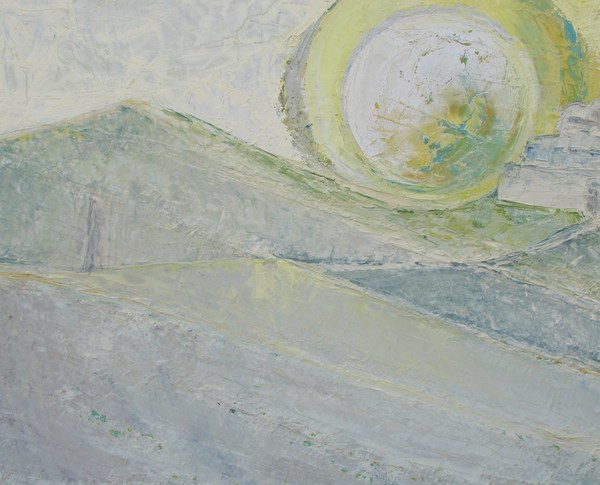
Macha Chmakoff (French, 1952–), Jésus au désert n°2 (Jesus in the Desert 2). Oil on canvas, 65 × 81 cm.
Even though Lent involves pointed reflection on human neediness and the confrontation of sin, it is not meant to be all dark and glum, nor characterized only by emptying. The word “Lent” actually means “springtime”; it’s a time of renewal, growth, filling. Inspired by Jesus’s retreat into the desert to overcome temptation and more fully inhabit his baptismal identity, we too retreat into a proverbial desert, saying no to one or more things so that we can say yes to something else. Continue reading “The season of Lent”→
Other than celebrating the two high holy days of Christmas and Easter, I did not follow the liturgical calendar growing up; it was never highlighted in my church. It wasn’t really until after college, when I became involved in a denominationally diverse Christian community, that I realized what I was missing out on, and since then the liturgical calendar is something I’ve learned to appreciate and observe—at least its main seasons: Advent, Christmas, Lent, and Easter, which concludes with the feast of Pentecost. The observance of these seasons is not mandated in scripture, but the church has devised them as a way to help us relive the story of God together throughout the year and to encourage us to meditate over an extended period on key mysteries of the faith.
Russian icon depicting the twelve great feasts of the Orthodox Church, plus the “feast of feasts,” the Resurrection, in the center, ca. 1903.


 Art & Theology