Emilie Mediz-Pelikan (Austrian, 1861–1908), Blooming Chestnut Trees, 1900. Oil on canvas, 132 × 124 cm. Belvedere, Vienna.
Because I love
        The sun pours out its rays of living gold,
        Pours out its gold and silver on the sea.

Because I love
        The earth upon her astral spindle winds
        Her ecstasy-producing dance.

Because I love
        Clouds travel on the winds through wide skies,
        Skies wide and beautiful, blue and deep.

Because I love
        Wind blows white sails,
        The wind blows over flowers, the sweet wind blows.

Because I love
        The ferns grow green, and green the grass, and green
        The transparent sunlit trees.

Because I love
        Larks rise up from the grass
        And all the leaves are full of singing birds.

Because I love
        The summer air quivers with a thousand wings,
        Myriads of jewelled eyes burn in the light.

Because I love
        The iridescent shells upon the sand
        Take forms as fine and intricate as thought.

Because I love
        There is an invisible way across the sky,
        Birds travel by that way, the sun and moon
        And all the stars travel that path by night.

Because I love
        There is a river flowing all night long.

Because I love
        All night the river flows into my sleep,
        Ten thousand living things are sleeping in my arms,
        And sleeping wake, and flowing are at rest.
“Amo Ergo Sum” (Latin for “I Love, Therefore I Am”) by Kathleen Raine is from The Year One (London: Hamish Hamilton, 1952) and is compiled in The Collected Poems of Kathleen Raine (Ipswich: Golgonooza Press, 2000).
Kathleen Raine (1908–2003) was a British poet and William Blake scholar who fervently promoted spiritual values in an age marked by secular materialism. She was born in Ilford, Essex, and raised in a Methodist household (her father was a lay minister), converting to Catholicism in the 1940s, but, following her interests in Jungian psychology, Neoplatonism, and sacred symbols, she came to embrace the perennial philosophy, which views religious traditions as sharing a single metaphysical truth. With Keith Critchlow, Brian Keeble, and Philip Sherrard and the patronage of then Prince Charles of Wales, Raine founded the Temenos Academy of Integral Studies in 1990, a London charity that offers education in philosophy and the arts in “the light of the sacred traditions of East and West.” Raine authored more than thirty books, both poetry and prose, and her honors and awards include the CBE (Commander of the Order of the British Empire) and the Queen’s Gold Medal for Poetry.
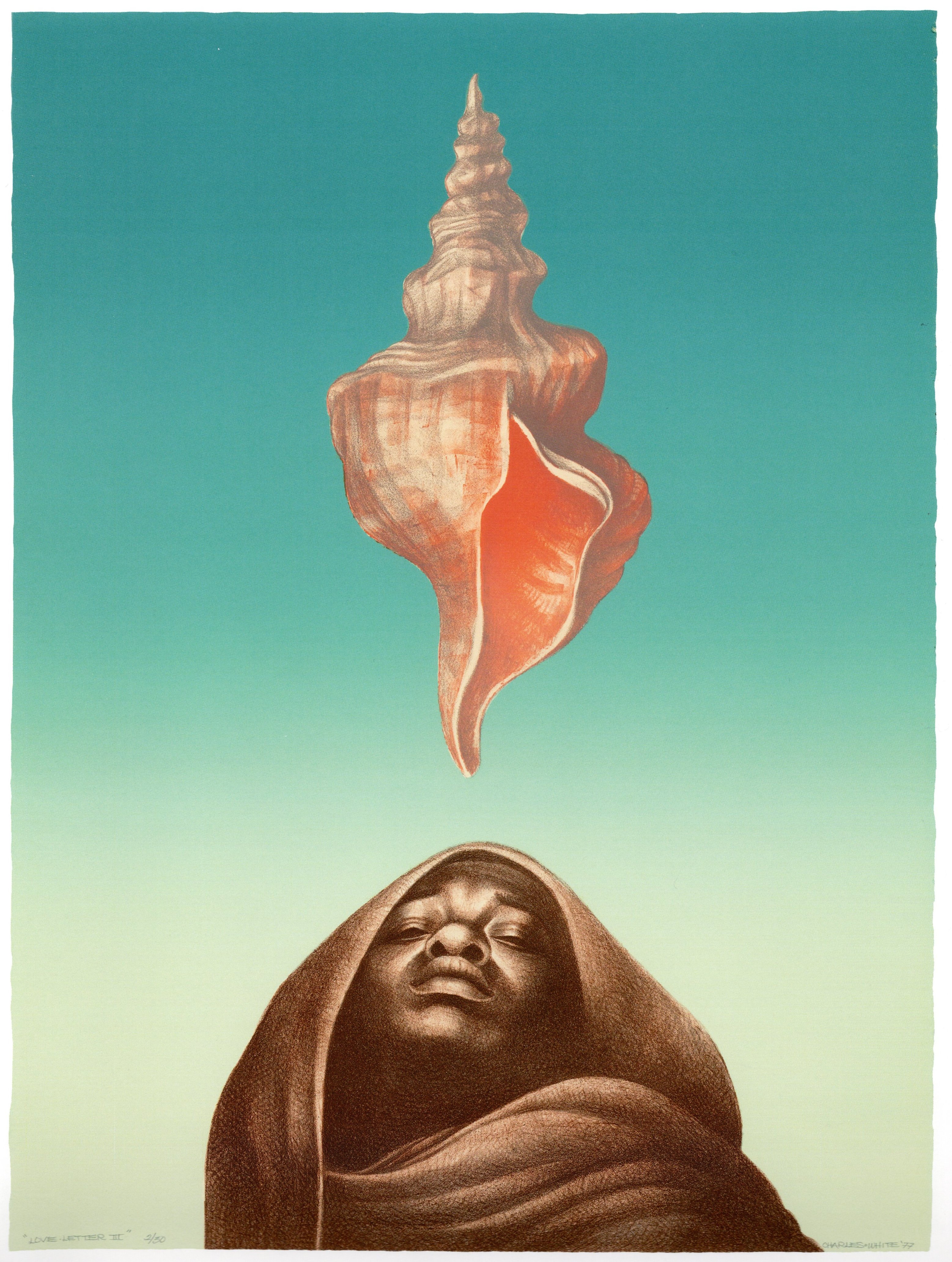
Charles White (American, 1918–1979), Love Letter III, 1977. Color lithograph on cream wove paper, 30 1/16 × 22 5/8 in. (76.3 × 57.4 cm). Edition of 30. Art Institute of Chicago.
First lie in it. Close your eyes. Let it move through you. Rock your shoulders back and forth. Dig your heels in. Slow your breath.
Curl forward and wash your hands with it. Pour it slowly on your legs. Rub your heels deeper into the damp. Bury your toes. Roll back, eyes shut. Disappear into it. Listen to the scratchings, then listen, listen to the roar.
This poem originally appeared in Communion by Pat Mora (Houston: Arte Publico Press, 1991). Used by permission of the publisher.
Pat Mora (b. 1942) is an award-winning poet and author of books for adults, teens, and children. A former teacher and university administrator, in 1996 she founded Children’s Day, Book Day (El Día de los Niños, el Día de los Libros), a year-long initiative to cultivate “bookjoy” in kids nationwide, culminating on April 30. Recurring subjects in Mora’s writing include nature, family, folktales, and her Mexican American heritage. She lives in Santa Fe, New Mexico.
SPOTIFY PLAYLIST: July 2023 (Art & Theology): This month’s Spotify mix that I put together for you all includes a Shona worship song from Zimbabwe; “Adonai Is for Me,” a song in Hebrew by Shai Sol; a Black gospel rendition of the children’s classic “Jesus Loves Me”; a new setting of the Lord’s Prayer by Jon Guerra; a composition for clarinet and piano by Jessie Montgomery, written in April 2020 to try to make peace with the sadness brought about by the pandemic-prompted quarantine orders; a country-style setting of Psalm 121 by Julie Lee; and a benediction by Bob Dylan that I heard Leslie Odom Jr. sing in concert recently—its refrain, “May you stay forever young,” is not an anti-aging wish but rather a call to childlike faith, wonder, and curiosity in perpetuity.
The playlist also includes the following two songs.
>> “Come Go with Me”: A lesser-known African American spiritual performed by the Norwegian jazz singer-songwriter Kristin Asbjørnsen, from her excellent album Wayfaring Stranger: A Spiritual Songbook. She describes the spirituals as “existential expressions of life: songs of longing, mourning, struggling, loneliness, hopefulness and joyful travelling.” This particular one is about walking that pilgrim path to heaven, a path on which Satan lays stones to obstruct our progress but which Jesus, our “bosom friend,” clears away.
>> “Love, More Love”: A short Shaker hymn that opens with a common Shaker greeting: “More love!” “Our parents above” refers, I believe, to the elders of the faith who have passed on. The hymn uses horticultural imagery to describe the qualities of communal love—something planted and grown, becoming stronger and fuller and more beautiful as it is nurtured.
Love, more love A spirit of blessing I would be possessing For this is the call of our parents above
We will plant it and sow it And every day grow it And thus we will build up an arbor of love
The Shakers are a Christian sect founded in 1747, but because celibacy is one of their tenets (and thus they cannot rely on procreation for the community’s continuation), there are only two Shakers left: Sister June and Brother Arnold, who live in Dwellinghouse, Maine. But there has long been a historical interest in Shaker religious culture and aesthetics—which is why, for example, the Enfield Shaker Singers was formed, to preserve the hymnody.
+++
INTERVIEW + PHOTOS: “Photographer Shows the Raw, Unflinching Reality of Life on Skid Row”: For the past decade, anonymous street photographer Suitcase Joe has been spending time on Skid Row in downtown Los Angeles, a neighborhood inhabited by the largest unhoused community in America. He slowly developed trust and built relationships with the people in that community, learning more about their stories, and they granted him unprecedented access to their daily lives, allowing him to capture them on camera. Hear him talk about the experience, and about misconceptions people tend to have about those experiencing homelessness, in this interview, which also includes a sampling of photos. Even though the headline hawks “Raw!” and “Unflinching!,” I was more struck by how the photographs show experiences of joy and friendship.
POEM WITH COMMENTARY: “The Rungs” by Benjamin Gucciardi, commentary by Pádraig Ó Tuama: Each week on the Poetry Unbound podcast, Ó Tuama reads and reflects on a different contemporary poem. In this episode’s featured poem, “a social worker holds a group for teenagers at a school. They only half pay attention to him. Then something happens, and they pay attention to each other.” The poem is from Gucciardi’s latest collection, West Portal.
+++
ARTICLE: “Dool-Hoff: A Dutch Maze with New Jerusalem at its Centre (1705)”: The Public Domain Review is always uncovering unique, amusing prints and other artistic and literary curiosities from centuries past. Here they look at an early eighteenth-century religious maze published in Haarlem, Netherlands, whose pathways are filled with didactic verse, some leading to dead ends but others leading to heaven at the center.
Dool-hoff (maze), signed by the Dutch Catholic printer Claes Braau, 1705. Photo courtesy of the Rijksmuseum, Amsterdam.
+++
SONG: “Home Inside” by Valerie June, performed by the Good Shepherd Collective: This Valerie June cover is sung so gorgeously by Sowmya Somanath with Kate Gungor, Bea Gungor, Jayne Sugg, Liz Vice, and Diana Gameros, and John Arndt accompanies on piano. It premiered in Good Shepherd New York’s March 12 digital service. The song is a prayer for belonging more fully to ourselves, to God, and to this earth; its speaker asks that she might be sensitive to the divine breath in all living things, and be soothed and refreshed by that great stream of water that flows from God’s heart. (Reminds me a bit of Universal Jones’s“River”!)
Agnes Pelton (American, 1881–1961), Translation, 1931. Oil on canvas, 26 × 21 in. (framed). Collection of Fairfax Dorn and Marc Glimcher. Source: Agnes Pelton: Desert Transcendentalist, p. 105.
Great Nature clothes the soul, which is but thin,
With fleshly garments, which the Fates do spin;
And when these garments are grown old and bare,
With sickness torn, Death takes them off with care,
And folds them up in peace and quiet rest,
And lays them safe within an earthly chest:
Then scours them well and makes them sweet and clean,
Fit for the soul to wear those clothes again.
This poem was published in its earliest form under the title “Soule, and Body” in Poems and Fancies by the Right Honourable Lady Margaret, Countess of Newcastle (1653), and appears as above in the book’s second edition (1664). It is in the public domain.
Margaret Lucas Cavendish (1623–1673), duchess of Newcastle-upon-Tyne, was a prolific English writer across the genres of poetry, science fiction, drama, letters, biography, and natural philosophy. A pioneering feminist, she wrote in her own name in a period when most women writers remained anonymous. She spent three years as a lady-in-waiting to Queen Henrietta Maria (wife of King Charles I) at the royal court in Oxford and then in exile in France; it’s there that she met her soon-to-be husband, William Cavendish, then marquis of Newcastle, who remained a great influence throughout her life, encouraging her intellectual pursuits. Cavendish moved in circles that included Thomas Hobbes and René Descartes and, in 1667, was the first woman to be formally invited to visit the Royal Society. She is buried in Westminster Abbey.
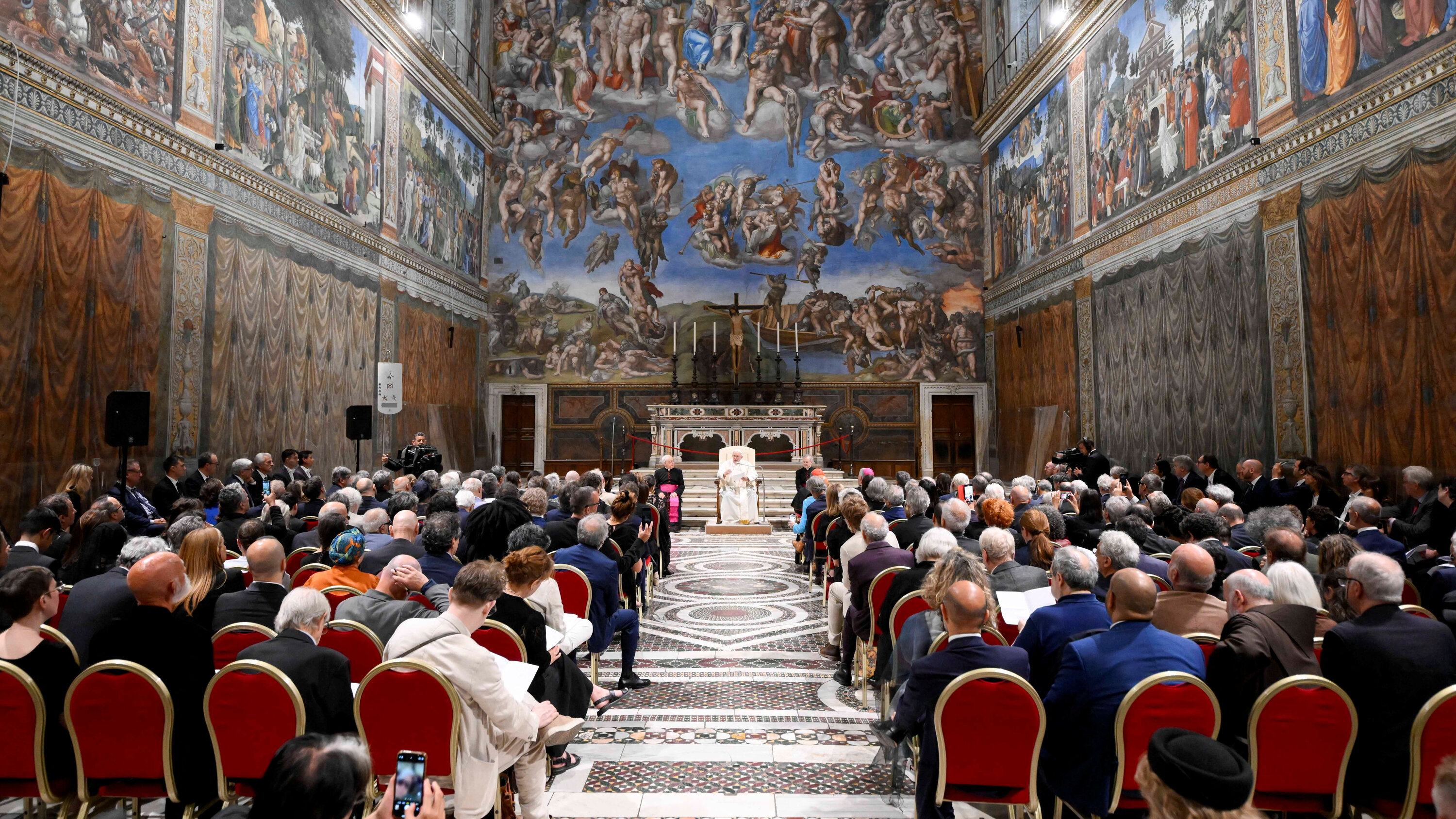
SPEECH: “Address of His Holiness Pope Francis to Artists for the 50th Anniversary of the Inauguration of the Vatican Museums’ Collection of Modern Art”: On June 23, at the invitation of Pope Francis, some two hundred select visual artists, filmmakers, composers, poets, and other creatives gathered at the Sistine Chapel to commemorate the fiftieth anniversary of the Vatican Museums’ Collection of Modern and Contemporary Art, inaugurated in 1973 by Pope John Paul VI. “One of the things that draws art closer to faith is the fact that both tend to be troubling,” Pope Francis said last Friday. “Neither art nor faith can leave things simply as they are: they change, transform, move and convert them.” He applauded how “artists take seriously the richness of human existence, of our lives and the life of the world, including its contradictions and its tragic aspects. . . . Artists remind us that the dimension in which we move, even unconsciously, is always that of the Spirit. Your art . . . propel[s] us forward.” For reporting on this event by the New York Times, see here.
Pope Francis addresses a group of artists, June 23, 2023. Photo: Vatican Media, via Reuters.
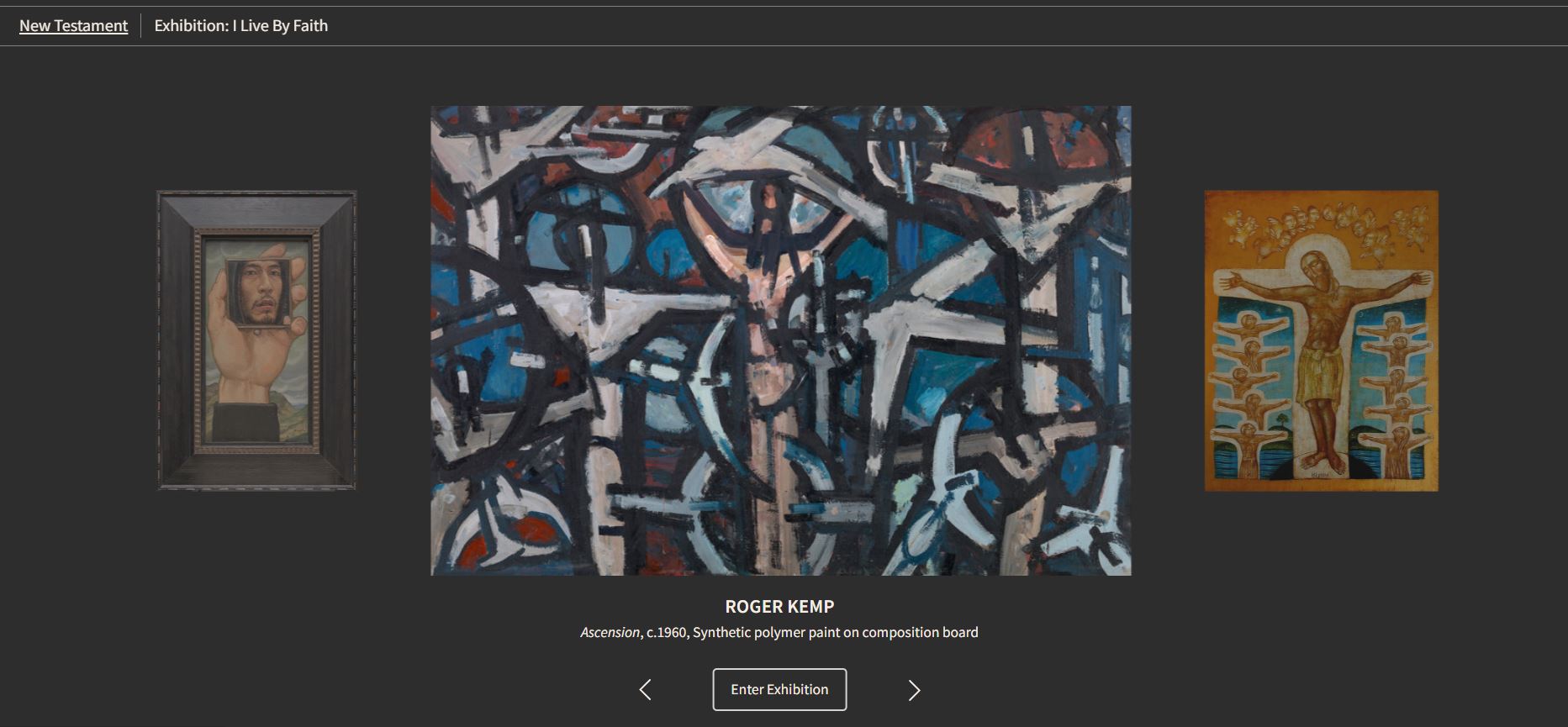
VISUAL COMMENTARY ON SCRIPTURE: “I Live by Faith (Galatians 2:15–21)” by Victoria Emily Jones: My latest set of commentaries for the VCS went live this month! It centers on one of Paul’s famous sayings: “I have been crucified with Christ, and it is no longer I who live, but it is Christ who lives in me.” I was bummed that one of the three commentaries I originally wrote had to be scrapped because the image permission was ultimately denied; I thus had to reconfigure and replace, and I ended up with two artworks in the three-piece exhibition that aren’t as diverse from each other as I had hoped. But still, each artwork brings a unique and compelling lens through which to examine this passage. (Note: If you’re viewing the exhibition on your phone, after you “Enter Exhibition,” you’ll need to expand the “Exhibition Menu” to access the “Show Commentary” button.)
VIDEO: “Abraham: An Interfaith Discussion at the Bode-Museum, Berlin”: Besides publishing written commentaries on works of art in dialogue with Bible passages, the Visual Commentary on Scripture also produces videos. This one brings together an Anglican Christian priest (who directs the VCS), a Jewish rabbi, and a Muslim theologian around a fifth-century ivory pyxis depicting Abraham, a figure held in common by all three faith traditions.
+++
POEM:“Gate A-4”by Naomi Shihab Nye: I’ve always loved this heartwarming poem about an unexpected moment of communion shared with strangers at an airport, made possible through kindness and the letting down of one’s guard. Listen to commentary by Joanne Diaz and Abram Van Engen on the Poetry for All podcast, episode 19; they answer the question “Why is this a poem?” Here’s a video of Nye reading it herself:
+++
NEW ALBUMS:
>> April 21: Worship for Workers by the Porter’s Gate: “In 2022 a group of songwriters, pastors, and professionals gathered in Nashville, Tennessee to write a series of worship songs for workers. Over three days they discussed the spiritual, emotional, and material struggles facing workers around the world today. Soon enough, they began to compose a series of songs specifically designed to help Christians carry their daily work before the Lord.” Here’s one of the thirteen songs on the album, “You Hold It All”:
The Worship for Workers album is part of a larger project, sponsored by the Brehm Center and a number of other institutions, to provide music, prayers, art, liturgies, and training to the church around the topic of work. It grew out of the book Work and Worship: Reconnecting Our Labor and Liturgy by Matthew Kaemingk and Cory Willson.
>> May 5: Glory Hour by Victory: Victory Boyd [previously] is a Grammy-winning soul and gospel artist who got her start singing with her siblings in the group Infinity Song but whose career really kicked into high gear when she worked as a songwriter for Kanye West’s Jesus Is King (2019). Glory Hour is her second full-length album as a solo artist; its title refers to the time of the morning when the sun rises. Most of the tracks are original songs or spoken word, but there are also three classic hymns/gospel songs: “His Eye Is on the Sparrow,” “Great Is Thy Faithfulness,” and “I Know It Was the Blood.” Here’s the music video for “Just like in Heaven,” based on the Lord’s Prayer:
>> May 19: Seven Psalms by Paul Simon: Paul Simon released this original seven-movement composition about doubt and belief as a single thirty-three-minute track, as it is meant to be listened to in one sitting. I’m a Simon fan; one of my early blog posts is a review of his and Garfunkel’s debut album, Wednesday Morning, 3 A.M. But if I’m honest, I was underwhelmed by this much-anticipated release. I’m in the minority there, so I think I’ll need to give it another listen. What do you think of it? Here’s the trailer:
>> June 2: Byrd: Mass for Five Voicesby the Gesualdo Six: One of my favorite vocal ensembles has just come out with an album of songs by William Byrd—his setting of the Mass along with a handful of motets. A Catholic composer in Protestant England in the late Renaissance, Byrd wove together musical “notes as a garland to adorn certain holy and delightful phrases of the Christian rite,” as he wrote in the preface to his second book of Gradualia (1607). Here’s the Gesualdo Six’s performance of his “Afflicti pro peccatis nostris,” a Latin prayer, a desperate plea for sanctification, that translates to “Afflicted by our sins, each day with tears we look forward to our end: the sorrow in our hearts rises to thee, O Lord, that you may deliver us from those evils that originate within us”:
“Lift up your hearts.” “We lift them up.” Ah me!
I cannot, Lord, lift up my heart to Thee:
Stoop, lift it up, that where Thou art I too may be.
“Give Me thy heart.” I would not say Thee nay,
But have no power to keep or give away
My heart: stoop, Lord, and take it to Thyself today.

Stoop, Lord, as once before, now once anew
Stoop, Lord, and hearken, hearken, Lord, and do,
And take my will, and take my heart, and take me too.
This poem was originally published in Time Flies: A Reading Diary (1885) and subsequently Verses (1893) and is in the public domain.
A devout Anglican from Victorian England and one of my favorite spiritual writers, Christina Rossetti (1830–1894) opens her poem “Sursum Corda” with a quotation from the ancient Eucharistic prayer compiled in the Book of Common Prayer: “Lift up your hearts . . .”
The Sursum corda, Latin for “Lift up your hearts,” is a Christian liturgical dialogue between priest/pastor and congregation that dates at least as far back as the third century (it’s mentioned in the Early Christian treatise Apostolic Tradition, as well as by Cyprian, Augustine, and Cyril of Jerusalem) and that is still used in Catholic, Orthodox, and Protestant churches today. Most, like my Presbyterian church, recite it as part of the celebration of the Eucharist, aka the Lord’s Supper, though some place it after the Call to Worship.
Here are the words used in the Roman Rite:
Priest: Dominus vobiscum.
People: Et cum spiritu tuo.
Priest: Sursum corda.
People: Habemus ad Dominum.
Priest: Gratias agamus Domino Deo nostro.
People: Dignum et iustum est.
Priest: The Lord be with you.
People: And with your spirit.
Priest: Lift up your hearts.
People: We lift them up to the Lord.
Priest: Let us give thanks to the Lord our God.
People: It is right and just.
Folio 1r from the Cambrai Missal, made in northern France, ca. 1120. Collection of Notre-Dame Cathedral, Cambrai, France. This page starts mid-liturgy with “Per omnia saecula saeculorum, amen” (Forever and ever, amen; or World without end, amen)—the inhabited initial P has a lion and a fantastical bird inside!—and then proceeds to the Sursum corda. The tildes indicate omitted letters.
The following is what my church uses—you’ll see it concludes with the Memorial Acclamation:
Pastor: The Lord be with you. People: And also with you. Pastor: Lift up your hearts! People: We lift them up to the Lord. Pastor: Let us lift up our hearts to the Lord our God. People: It is right to give him thanks and praise. Pastor: Therefore we proclaim the mystery of faith: All: Christ has died. Christ is risen. Christ will come again.
The phrase “Lift up your hearts” is taken from biblical passages such as Psalm 86:4—“Gladden the soul of your servant, for to you, O Lord, I lift up my soul”—and Lamentations 3:41, which says, in the context of confession and repentance, “Let us lift up our hearts as well as our hands to God in heaven.” The Sursum corda expresses an inclining of the whole self toward God in praise and offering.
Rossetti responds to this jubilant call with an admission of personal weakness. She lacks the power to lift up her heart, she says (perhaps because it’s so heavy); she needs God to lift it for her. She begs him four times to “stoop,” to condescend to her level, so that she might ascend to his throne. Line 4 contains a partial quotation of Proverbs 23:26: “My son, give me thine heart, and let thine eyes observe my ways.” She wants to give God her heart, but in her frail spiritual state, all she can do is bid him “take it.”
I often pray Rossetti’s poems, as I find her such a sensitive seeker, full of longing that so frequently reflects my own. You can find other Rossetti poems from the Art & Theology archives on my new Poetry Index tab. All her poems are accessible online, scattered across various volumes on Google Books, but if you want to read them all in one place and in physical book form, I recommend the Penguin Classics edition of her Complete Poems (which stands at a whopping 1221 pages!).
mother emanuel ame church, charleston, sc, 1822: cross-ankle church, palmetto, ga, 1899: green leaf presbyterian church, keeling, tn, 1900: red top church, hopkinsville, ky, 1915: first baptist church, carteret, nj, 1926
Fisk Jubilee Proclamation
(choral)
O sing unto the Lord a new song . . . (Psalm 96)
O, sing . . . undo the world with blued song
born from newly freed throats. Sprung loose from lungs
once bound within bonded skin. Scored from dawn
to dusk with coffle and lash. Every tongue
unfurled as the body’s flag. Every breath
conjured despite loss we’ve had. Bear witness
to the birthing of our hymn from storied depths
of America’s sin. Soul-worn psalms, blessed
in our blood through dark lessons of the past
struggling to be heard. Behold—the bold sound
we’ve found in ourselves that was hidden, cast
out of the garden of freedom. It’s loud
and unbeaten, then soft as a newborn’s face—
each note bursting loose from human bondage.
Fulton Street M.E. Church, Chicago, IL, 1927: Second Baptist Church, Detroit, MI, 1930: Macedonia Baptist Church, Egg Harbor City, NJ, 1935: Mount Methodist Church, Henderson, NC, 1940: Negro Methodist Church, Loganville, GA, 1947
Source: Olio by Tyehimba Jess (Seattle and New York: Wave Books, 2016). Illustration by Jessica Lynne Brown, from Olio, p. 5. Used with permission. View the book page.
Hear Tyehimba Jess introduce and read his poem at the New York State Writers Institute in this video from 2017:
“Fisk Jubilee Proclamation” by Tyehimba Jess is the first in a heroic crown of sonnets from Jess’s second poetry collection, the Pulitzer Prize–winning Olio. A crown of sonnets is a circular sequence in which the last line of the first sonnet becomes the first line of the second sonnet, the last line of the second sonnet becomes the first line of the third sonnet, and so forth, until eventually the last line of the last sonnet becomes the first line of the first sonnet. What makes Jess’s crown “heroic” (part of the form’s technical name) is that it comprises fifteen sonnets, and the final one is made up of all the first or last lines of the preceding fourteen, in order. Quite the feat!
With this heroic crown, Jess honors the Fisk Jubilee Singers from the historically Black Fisk University in Nashville, Tennessee, a choral ensemble established in 1871 and still active today. Fisk was founded after the Civil War to educate freed men and women and other young African Americans. To raise money for the new school, music professor and treasurer George L. White formed a small choir of nine students to tour the United States. Their repertoire was the spirituals they and their parents sang on the plantations, songs that were rarely known at the time among northern white audiences—such as “Go Down, Moses,” “Steal Away to Jesus,” “Ezekiel Saw the Wheel,” “Joshua Fit the Battle of Jericho,” and “Roll, Jordan, Roll,” to name a few. The Fisk Jubilee Singers are credited with spreading and popularizing this uniquely Black American art form over the country and world.
The nine original Jubilee Singers, Fisk University, Nashville, Tennessee, ca. 1871. From left to right: Minnie Tate, Greene Evans, Isaac Dickerson, Jennie Jackson, Maggie Porter, Ella Sheppard, Thomas Rutling, Benjamin Holmes, Eliza Walker.
Their first eighteen-month stint took them to Ohio, Pennsylvania, New York, Connecticut, Rhode Island, New Jersey, Massachusetts, Maryland, and Washington, DC. Then in 1873, they toured Great Britain and continental Europe, performing for Queen Victoria and other prominent figures.
The name of the group comes from Leviticus 25, where God mandates that every fifty years, the enslaved are to be set free: “And you shall hallow the fiftieth year, and you shall proclaim liberty throughout the land to all its inhabitants. It shall be a Jubilee for you: you shall return, every one of you, to your property and every one of you to your family” (v. 10).
The Fisk Jubilee Singers took up God’s call to proclaim liberty far and wide, and they did so through their song. Written in the singers’ collective voice (hence the “choral” headnote), “Fisk Jubilee Proclamation” opens with an epigraph taken from Psalm 96:1: “O sing unto the Lord a new song . . .” (emphasis mine). The first line plays upon this biblical line by substituting three words that rhyme with the ones displaced: “O, sing . . . undo the world with blued song.”
Their song is blued because it was born out of deep suffering. And with it they undo the world—they open up those who were formerly closed off against them. They unravel racist stereotypes, asserting their sacred humanity.
They sing as an act of defiance. Whereas their enslavers had demanded them and their parents to be quiet and would often beat them into submission, now they are unapologetically loud, unbeaten—their words, like them, set free. They own their voices, which embody a range of nuance, from strong, vigorous, and sharp to soft and smooth. Tongue-tied no more, they burst loose from bondage with their new song of freedom. An unfurling of their body’s flag.
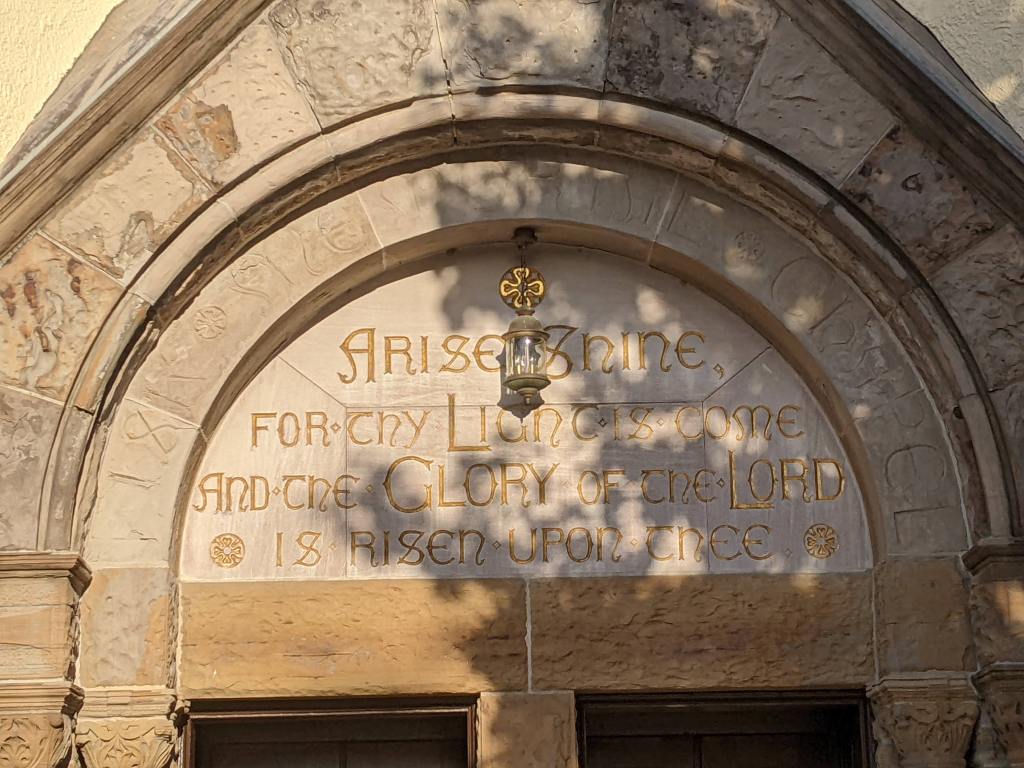
“Arise, shine, for thy light is come, and the glory of the Lord is risen upon thee” (Isa. 60:1). Tympanum, Fisk Memorial Chapel (built 1892), Fisk University, Nashville, Tennessee. Photo: Victoria Emily Jones. This chapel is the home performance site for the Fisk Jubilee Singers.
The poem is full of b alliteration: blued, born, bound, bonded, body’s, breath, bear, birthing, blessed, blood, behold, bold, (un)beaten, bursting, bondage. This letter is what’s known as a plosive consonant, because it makes a small explosive sound as you say it. Such an effect reinforces the idea of eruption.
Jess describes the choir’s singing as an act of childbirth, the hymn that has lain within them finally emerging, through painful labor, for all to hear. That hymn is “scored”—in the sense of its music being written on the page, but also bearing the marks of the slaver’s lash, that trauma, that story of violence and oppression, passed down to new generations. The “worn” in “soul-worn psalms” also has a double meaning, in that the singers wear their souls on the sleeves of their songs (or, the songs are dressed in soul) but also they are soul-weary.
Concurrent with the rise and ongoing performances of the Fisk Jubilee Singers were frequent attacks on Black places of worship. As the singers were spreading beauty and hope through the spirituals, white terrorists were spreading ugliness and hate. To remind readers of this context, Jess provides a litany of church names and dates across the top and bottom of the page of each Fisk Jubilee sonnet, indicating Black churches that were burned down, bombed, or sites of other kinds of racially motivated violence. In the back of the book Jess includes this note “On the Fisk Jubilee Choir testifying through fire . . .”:
The names of our burned and bombed black churches enfold the spirituals sung by our Jubilee choir. Inside each flame burns hum, prayer, and holy book. Each hymn inhabits heat and smolder; each biblical spark is kindled with story. There is no complete record of all such attacks upon the black congregational body, no complete accounting of all the pulpits, pews, and psalm books rendered into fire—these 148 stand in testimony to all the unnamed churches lost to arson and TNT, the slats and nails and sweat that doubled as schoolhouse and underground passageway, the pyres of pine and oak and cedar steeples that sheltered baptisms and home-goings, the silent crucifixions curled into ash. The AMEs and the Graces, the Tabernacles and all the many Firsts; the hand fans, tambourines, mourner’s benches, and collection plates; they rise in smoke like the songs that soaked through them and up to heaven’s blued, eternal door. (221)
The litany traces an unbroken line of violence from 1822 to 2015 and, true to the sonnet corona form, highlights a tragic circularity: Mother Emanuel AME Church in Charleston, South Carolina, is the earliest African American church to suffer arson that Jess found record of in his research, and that same church was the target of a mass shooting on June 17, 2015, which claimed nine victims. (Tomorrow is the eighth anniversary.) This murder occurred while Olio was in production with the publisher, and Jess knew he had to add it to the end of the poem sequence.
Despite such assaults on their dignity and personhood, the Fisk Jubilee Singers have always continued to praise, and that is their glorious legacy. They’ve carried forward the joys, sorrows, and faith of their community in song. The final, extraordinary poem in Jess’s Fisk Jubilee sequence is titled “We’ve sung each free day like it’s salvation.” It ends like this: “We’ve smuggled faith from slave shack to palace, / boiling the air with hallelujah’s balm— / each note bursting loose from bondage / to sing unto the world a new song.”
I wholly commend Olio to you, which is the most inventive volume of poetry I’ve ever read. It took Jess nearly eight years to write, and given its irregular nature, I imagine it also took a while for the designer and production team at Wave Books to work out! An olio is a miscellaneous mixture of heterogenous elements, a hodgepodge, but also, as an early page of the book notes, “the second part of a minstrel show which featured a variety of performance acts and later evolved into vaudeville.”
Part fact, part fiction, the book examines the lives of mostly unrecorded African American performers directly before and after the Civil War up to World War I, in “an effort to understand how they met, resisted, complicated, co-opted, and sometimes defeated attempts to minstrelize them,” as the publisher writes. It includes, for example, transcripts of interviews conducted by the fictitious Julius Monroe Trotter with an array of people who knew the ragtime composer Scott Joplin. It also includes syncopated sonnets (a form of contrapuntal poetry), which can be read up, down, diagonally, or interstitially—listen to Jess read and explain, for example, the sequence he wrote on the conjoined twins Millie and Christine McKoy, where the form stands in for the corpus of the sisters to represent their interconnected but independent narratives. But even for just the fifteen Fisk Jubilee sonnets alone, ten of which are in the voice of each of the original nine singers and their (white) conductor, the book is worth the price.
To learn more about what went into writing the Fisk Jubilee sonnets, read Jess’s blog post for the Poetry Foundation, “Flames of History / Rhythms of Song.” Also check out the interview with Jess published in the Interlochen Review, “Music, Literature, and the Struggle of Consciousness.” One thing that particularly stood out to me from the interview was, when asked about how he intertwines language and music in Olio, he said,
You have to remember in African American literature that we were deprived of the right of reading and writing for most of our history in this country. So, the song and the music became the literature. So, after emancipation, it’s impossible to really completely extract one from the other, because one was so instrumentally carrying so many stories for so long, for so many generations.
Tyehimba Jess (b. 1965) is a major poet whose work bridges slam and academic poetry and is imbued with deep archival research, often fusing music, history, and fiction. His first collection, leadbelly (2005), an exploration of the blues musician Huddie “Lead Belly” Ledbetter’s life, was chosen for the National Poetry Series by Brigit Pegeen Kelly. His second collection, Olio (2016), which celebrates the mostly unrecorded Black musicians, orators, and other performers of the nineteenth and early twentieth centuries, won the 2017 Pulitzer Prize. He teaches English at the College of Staten Island.
Today, June 4, is Trinity Sunday! Here’s a handful of art and music items on the topic.
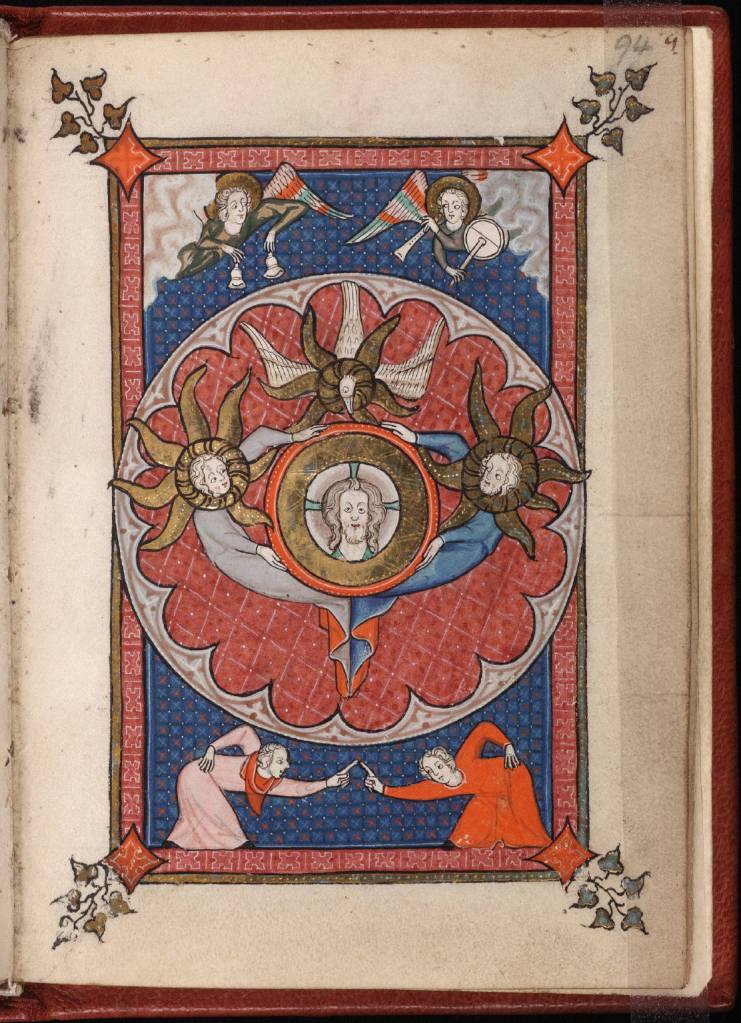
VISUAL MEDITATION: “The Wheeling Playfulness of the Trinity” by Victoria Emily Jones: The Rothschild Canticles [previously] from ca. 1300 Flanders contains some of the most inventive and delightful artistic renderings of the Trinity that I’ve ever seen. I key in on four of them in today’s visual meditation for ArtWay.
Beinecke MS 404, fol. 94r
+++
MUSICAL COMMENTARY: “Theology in Sound and Motion: Perichoresis, for Brass Quintet” by Delvyn Case:Delvyn Case provides musical and theological commentary on his brass quintet composition “Perichoresis” (2006), inspired by the divine dance of the Trinity. “Its overall mood is joyous, an ecstatic whirling-about in which all three members become lost in the ecstasy of divine fellowship,” he writes. “At the exact moment of the dance when one member moves, the other fills in the spot left vacant.” “Perichoresis” premiered by Boston’s Triton Brass and appears on Case’s 2018 album Strange Energy. About this piece, Bible scholar and theologian Walter Brueggemann said, “I . . . have pondered ‘perichoresis’ for a long time. This is the finest exposition of that thick idea that I have encountered.”
+++
SONGS:
>> “Trinity Song” by Paul Zach: Performed in 2021 by Solomon Dorsey with Liz Vice and Madison Cunningham, this song by Paul Zach evolved into “God of Grace and Mystery” for The Porter’s Gate’s 2022 album Climate Vigil Songs. This earlier iteration has a Trinitarian focus that’s just lovely. “God of all eternity / Father, Spirit, and the Son / Ever-loving Three-in-One / O divine community / . . . / Calling us to join your dance . . .”
>> “One-Two-Three” by the Chosen Gospel Singers: This song was recorded in Los Angeles for Specialty Records and released as a single in 1952, with singers J. B. Randall (bass), E. J. Brumfield (tenor), George Butler (tenor), Fred Sims (tenor), and Oscar Cook (baritone). It opens with a repetition of the lines “One, two, three / One-in-Three and the Trinity.” The refrain is:
One for the Father Two for the Son Three for the Holy Ghost All made of one
The song is largely eschatological. The first verse is about John the Revelator’s vision of the New Jerusalem descending, among other wonders; it ascribes a vision of the Trinity to John, even though that is not explicit as such in either John’s Gospel or the Apocalypse (but see “The Trinity in the Book of Revelation” by Edwin Reynolds). The second verse anticipates our singing and praising the Triune God in heaven, dressed in our brand-new robes. It also mentions David and Goliath, and I’m honestly not sure how that relates. But with gospel songs, floating lyrics are common, taken from one song and spliced into another, some more coherent than others in their new context.
+++
ESSAY: “The Hospitality of Abraham in the Work of Julia Stankova, Painter of Bulgarian Icons” by François Bœspflug: The first half of this peer-reviewed article introduces readers to the Bulgarian artist Julia Stankova, rehearsing her biography and examining her relationship to the icons tradition. The second half explores twelve of her paintings on the subject of the three angelic visitors to Abraham and Sarah in Genesis 18, whom the narrator suggests are a manifestation of God (“The LORD appeared to Abraham at the oaks of Mamre . . .”); because of the number of visitors, many Christians interpret this passage as revealing something of God’s triune nature, and for this reason traditional icons of the story are often titled The Trinity.
Julia Stankova (Bulgarian, 1954–), The Hospitality of Abraham, 2004. Tempera on primed wooden panel and lacquer technique, 46 × 41 cm.
Since the publication of this article in 2019, Stankova has made at least three more paintings on the subject, all of which foreground Sarah and are titled Sarah’s Smile. She has just heard the angels announce that she will conceive a son in her old age.
+++
POEM: “After Rublev’s Trinity”by Carrie Purcell Kahler: Published in Image no. 99 (Winter 2018), p. 21, this ekphrastic poem by Carrie Purcell Kahler interprets the famous fifteenth-century Trinity icon by Andrei Rublev. Sometimes referred to as “the hospitality of Abraham,” this biblical episode, as the iconographers interpret it, is really about the hospitality of God, who extends a hand to humanity, ever inviting us to sit at his table.
Andrei Rublev (Russian, 1360–ca. 1430), The Trinity, ca. 1411. Tempera on wood, 141.5 × 114 cm. Tretyakov Gallery, Moscow.
A new choral setting of this poem by Garrett John Law is premiering today at Holy Trinity Episcopal Church in Covina, California, where Law serves as music director and organist. I believe it can be heard on the 10:30 a.m. PT worship service livestream on the church’s YouTube channel, but I’m not sure whether the performance will be archived online for later viewing. (Update, 6/12/23: Here it is! Sung by Holy Trinity’s seven-person choir.)
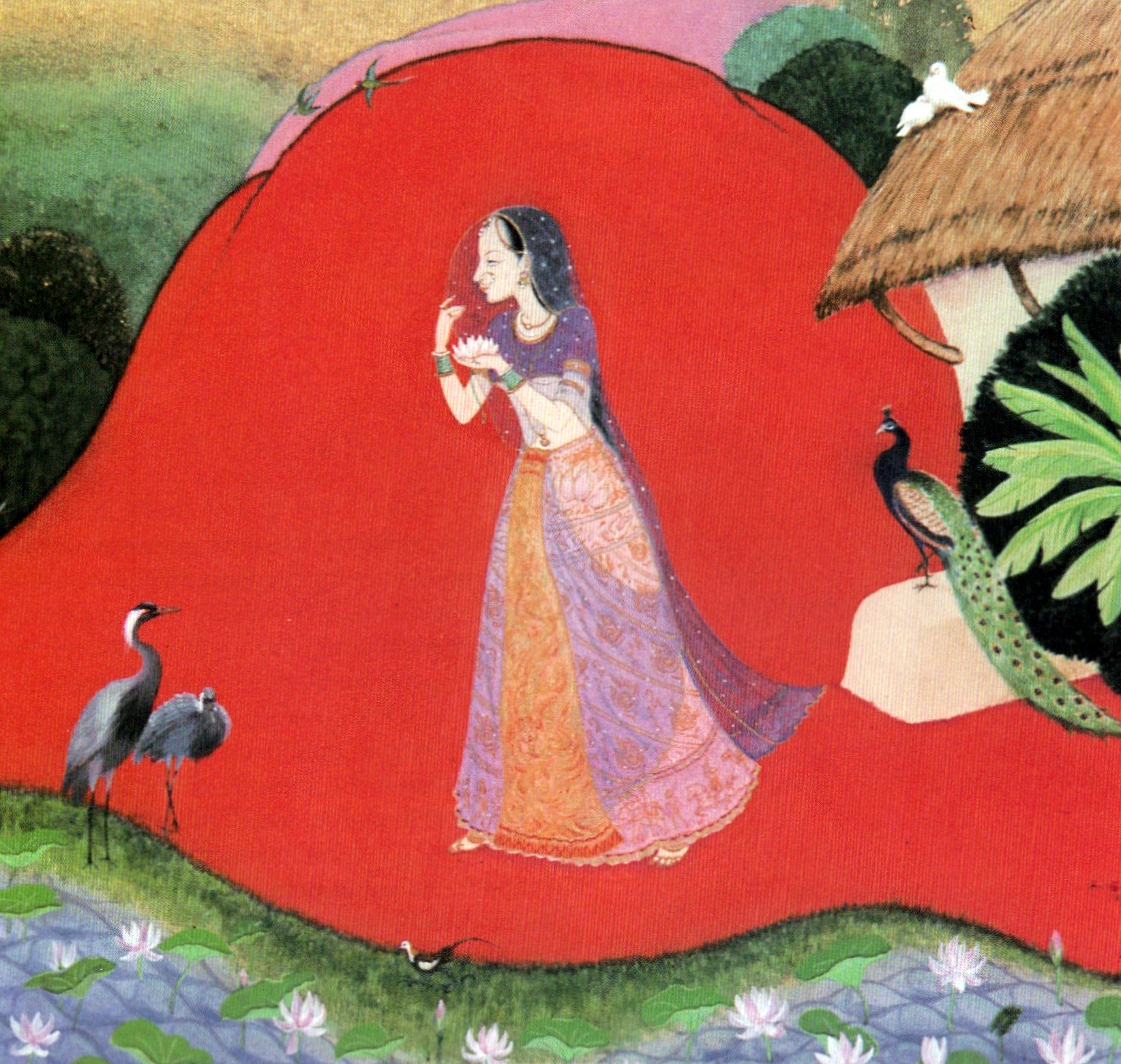
Frank Wesley (Indian, 1923–2002), Mary Going to Visit Elizabeth, n.d. Egg tempera, 20 × 25 cm. Source: Frank Wesley: Exploring Faith with a Brush, p. 173
To Elizabeth she came,
over the hills,
bearing the Lord flowering in her womb—

sacrament of her flesh,
bud richly taut—

the warmth of her
containing His infinity,
the sun His fire.

The dark earth of her body
seemed to encompass all things.
The terraced fields of Juda
pregnant with seed
called out to her
as she passed,
praising the Child
she was yet to bear,
invoking His blessing
on their expectancy.

These must call out,
full in their fullness,
barren beside hers,
then how should a child
six months conceived
adore with stillness
in his mother’s womb?
“The Visitation” by Calvin B. LeCompte Jr., based on Luke 1:39–45, appears in I Sing of a Maiden: The Mary Book of Verse, ed. Sister M. Thérèse (New York: Macmillan, 1947).
In this poem Calvin B. LeCompte Jr. compares the embryonic Christ to a flower bud about to bloom from the warm, dark seedbed of Mary. The glorious abundance of the spring hills, he writes, is nothing—“barren beside hers”—compared to the abundance and glory Mary holds within her, soon to be revealed. LeCompte personifies the Judean countryside that Mary passes through, in her first trimester, on her way to her cousin Elizabeth’s house, who is herself six months pregnant. Like these women, the fields are “pregnant with seed.” And they recognize with reverence the Christ who travels past them, borne in the womb of his mother. They (the grasses) wave, they bow; they call out to him, seeking blessing. If even nonhuman nature is moved by the as-yet-latent Jesus and can’t help but react with praise, then how much more ought the unborn John, kinsman and appointed forerunner, to leap and rejoice when, momentarily, his mom and Jesus’s embrace belly to belly and sing Magnificat.
Calvin Byrd LeCompte Jr. (1922–2001) was a Black Catholic educator, musician, literary critic, and occasional poet from Washington, DC, the son of a prominent medical doctor. He earned a BA in English in 1943 and an MA in linguistics in 1948, both from the Catholic University of America, and he attended a number of the “literary salons” Ezra Pound held at St. Elizabeths Hospital in DC while Pound was a psychiatric patient there. LeCompte also studied piano under Cecil Cohen, giving lecture-recitals at colleges around the country in the late forties, and taught voice at the Frederick Wilkerson Studio for some twenty years. He then went on to serve for twenty-three years as music director at Epiphany Catholic Church in Georgetown, as well as music director at the classical radio station WGMS, where he created and hosted the program Music in Our Time as a showcase and teaching forum for contemporary classical music. A professor of English and music at the University of the District of Columbia, he also lectured at Howard University, Temple University, the University of Pennsylvania, the Kennedy Center, the Opera Guild, and the Folger Library. In addition, he translated in eight languages for the National Catholic News Service.
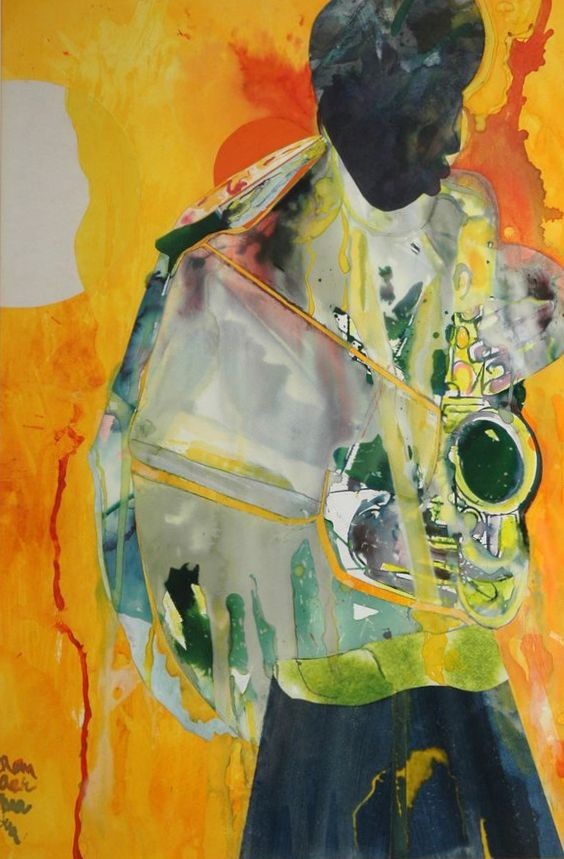
Romare Bearden (American, 1912–1988), All the Things You Are, 1987. Collage, color dyes, and watercolor on board, 36 × 24 in. (91.4 × 61 cm).
I used to think of you
as a symphony
neatly structured,
full of no surprises.
Now I see you as
a saxophone solo
blowing wildly
into the night,
a tongue of fire,
flicking in unrepeated
	patterns.
From Poems by Steve Turner, compiled by Rebecca Winter (Oxford: Lion Publishing, 2002)
Steve Turner is a music journalist, biographer, and poet from the UK who has spent his career chronicling and interviewing people from the worlds of music, film, television, fashion, art, and literature. He has contributed to newspapers such as The Mail on Sunday and The Times, and among his many books is the influential Imagine: A Vision for Christians in the Arts. He lives in London.










 Art & Theology