Michael Smither (New Zealand, 1939–), Doubting Thomas, early 1970s. Mural, St. Joseph’s Church, New Plymouth, New Zealand.
O You!
You tiny who
Of Simeons song
You shepherds shock
You singular star-bright

You student
Shunning company
And travel
For scholars light.

Just apprentice
Of your mothers husband
True measurer
And leveler
And line

Authoritative voice
Enlisting aid
Selector
And selected
And Divine.

Creative host
Of weddings, picnics, graves
Most social
And uncelebrated
Friend

You thoughtful martyr
You thirsty man
You dying God—

I hoped!
But this concludes . . .
                                       Amen. Amen.

O
Heir of power
Crasher
Of closed meetings
The unsummoned
Inviting inspection—

You natural!
You Master
Of surprise.
Sandra R. Duguid (b. 1947) is an American poet living in West Caldwell, New Jersey. For twenty years she taught literature, composition, and creative writing at colleges in the New York/New Jersey metropolitan area and at East Stroudsburg University in Pennsylvania, retiring in 2010 to devote more time to writing. She is a recipient of a Fellowship in Poetry from the New Jersey State Council on the Arts and author of the poetry collection Pails Scrubbed Silver (North Star Press, 2013).
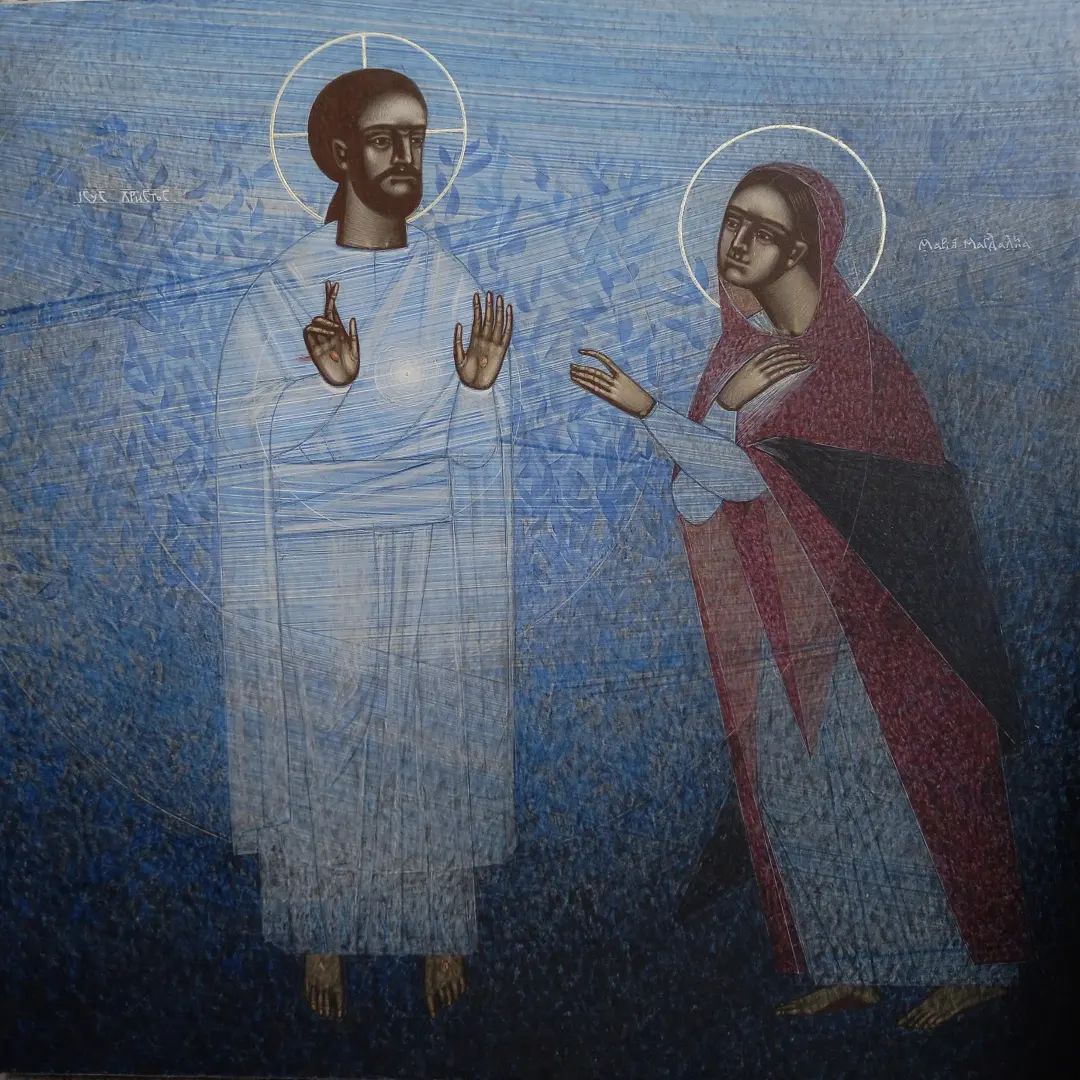
Kateryna Kuziv (Ukrainian, 1993–), Mary!, 2022. Egg tempera and gilding on gessoed wood, 40 × 40 cm.
In the end of the Sabbath, as it began to dawn towards the first day of the week, came Mary Magdalene.

The tomb, the tomb, that
Was her core and care, her one sore.
The light had hardly scarleted the dark
Or the first bird sung when Mary came in sight
With eager feet. Grief, like last night’s frost,
Whitened her face and tightened all her tears.
It was there, then, there at the blinding turn
Of the bare future that she met her past.
She only heard his Angel tell her how
The holding stone broke open and gave birth
To her dear Lord, and how his shadow ran
To meet him like a dog.
And as the sun
Burns through the simmering muslins of the mist,
Slowly his darkened voice, that seemed like doubt,
Morninged into noon; the summering bees
Mounted and boiled over in the bell-flowers.
‘Come out of your jail, Mary,’ he said, ‘the doors are open
And joy has its ear cocked for your coming.
Earth now is no place to mope in. So throw away
Your doubt, cast every clout of care,
Hang all your hallelujahs out
This airy day.’
This is the last of fourteen untitled, epigraphed poems from “Resurrection: An Easter Sequence” by W. R. Rodgers, originally published in Europa and the Bull and Other Poems (Farrar, Straus and Young, 1952) and compiled posthumously in Collected Poems (Oxford University Press, 1971) and later Poems, ed. Michael Longley (The Gallery Press, 1993). Used with permission of The Gallery Press.
William Robert “Bertie” Rodgers (1909–1969) was an Irish poet, essayist, radio broadcaster and scriptwriter, lecturer, and (for eleven years) a pastor. Born, raised, and educated in Belfast, he studied literature as an undergraduate and then entered theological college, becoming ordained as a Presbyterian minister in 1935 and taking a post at Loughgall parish in County Armagh. He began writing poetry three years later, after a friend lent him books by contemporary poets, of whom Auden made the biggest impact. In 1946 he left pastoral ministry to work for the BBC in London and later to freelance, creating radio portraits of Irish writers using a pioneering sound mosaic technique that is now a staple of radio documentaries. He joined a community of writer friends that included Dylan Thomas and Louis MacNeice. During his lifetime he published two books of original verse, with themes including the landscape of Northern Ireland, war, myth, erotic love, and the life of Christ.
BANJO DUET: “Foggy Morning Breaking” by Alison Brown and Steve Martin: Did you know the actor Steve Martin also has a music career? He’s been playing the banjo since he was a teenager, and he writes, records, and tours, both solo and as part of bluegrass bands. He’s even won three Grammys for his banjo music!
Fellow banjoist Alison Brown invited him to contribute to one of the tunes on her forthcoming album, On Banjo, which releases May 5. It’s called “Foggy Morning Breaking.” She wrote and plays the A section; he wrote and plays the B. The piece was released last month as a single, along with this music video.
>> April 22: “The Ekstasis Café: An Evening of Poetry, Music, Testimony, and Gallery,” Goldberry Books, Concord, North Carolina: Ekstasis is a beautiful quarterly magazine “exhibit[ing] arts and letters that reflect the depths of Christian life.” Next Saturday they are hosting their first-ever public gathering! Their hope with it is to foster meaningful connections, conversation, deep aesthetic encounters, and inspiration.
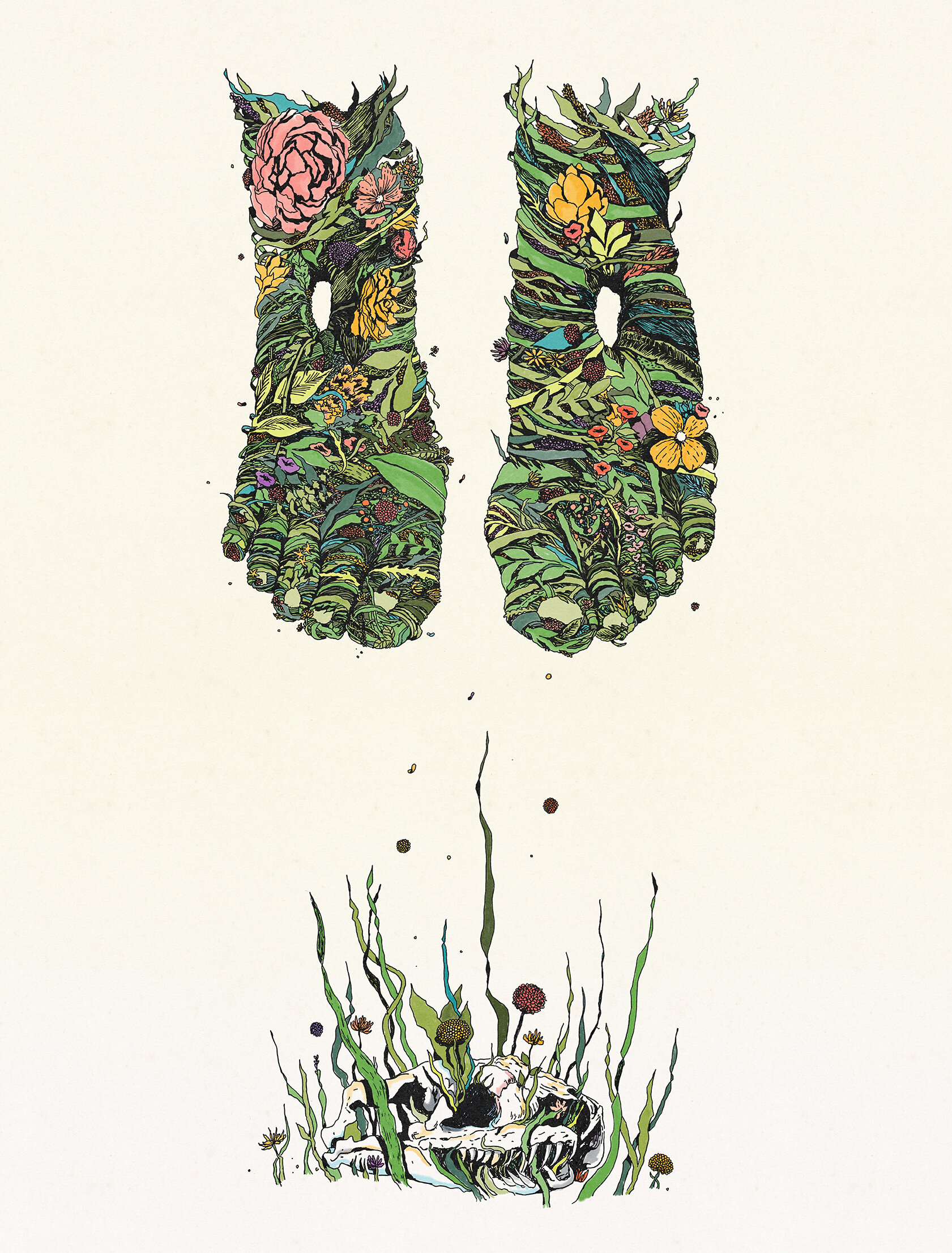
Stephen Procopio, Ascension, 2020. A full-color version of an illustration for Come See a Man (an illustrated Gospel of John) by Fish Coin Press.
From April 9 to May 28, the gallery at Sojourn Church Midtown in Louisville is exhibiting a selection of art from Fish Coin projects (open Sundays from 9 a.m. to 12:30 p.m., or by appointment); here are a few exhibition views. And two Friday evenings from today, Fish Coin Press creative director Jared Boggess and development lead Stephen Procopio, who are illustrators themselves, will be visiting the gallery to discuss “visual theology” and its role in the local church. There will be a Q&A and a sneak preview of upcoming publications.
+++
POEM: “Psalm” by Dorianne Laux: This poem sings the glories of “the hidden and small,” of the plants and creatures beneath our feet. Read more of Laux’s poems at https://www.doriannelaux.net/poems.
+++
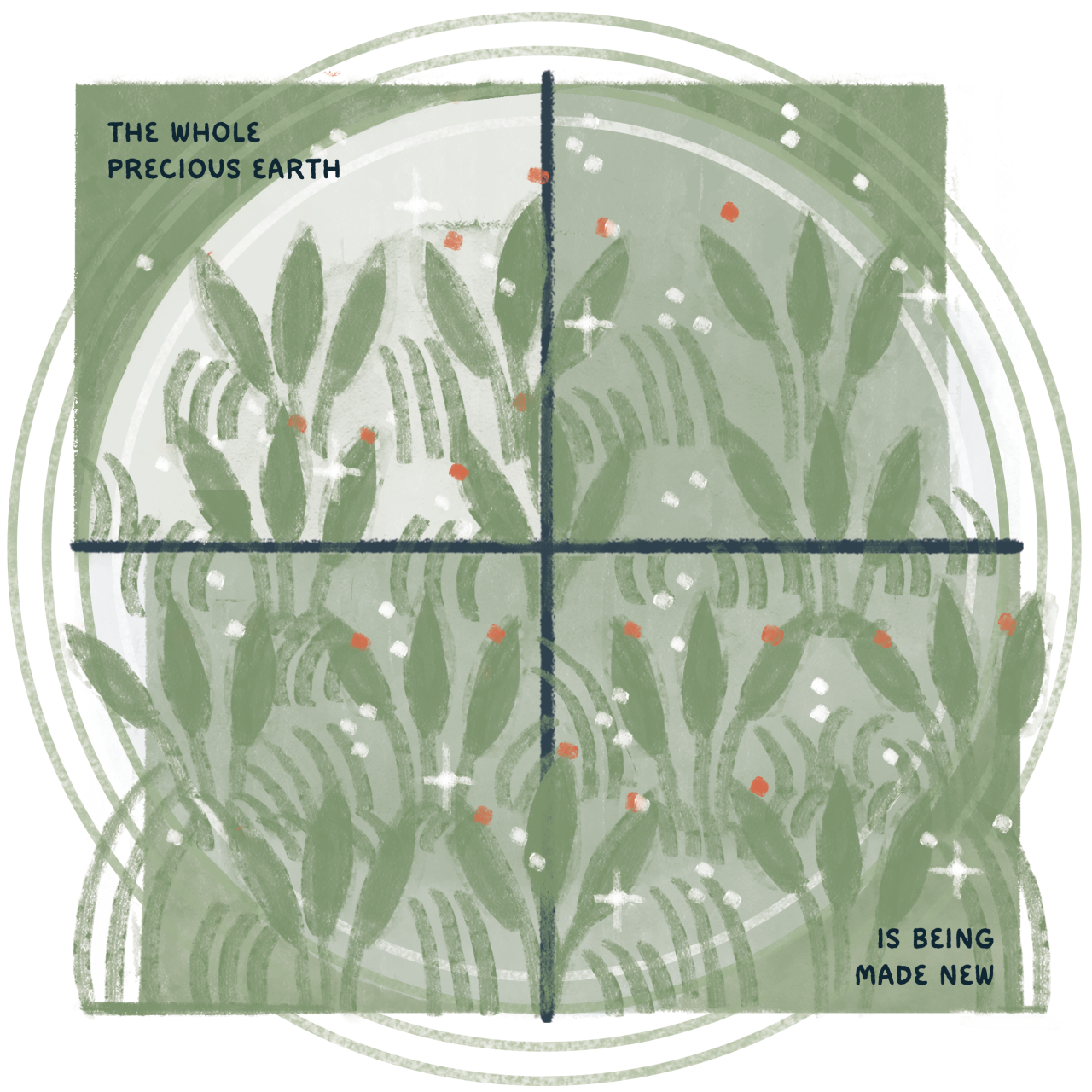
LECTURE: “Resurrection and the Renewal of Creation” by N. T. Wright: In this 2018 lecture sponsored by Lanier Theological Library and Baylor University’s Truett Seminary, ancient historian and New Testament scholar N. T. Wright discusses the meaning of Jesus’s resurrection, a topic he explores thoroughly in the influential academic tome The Resurrection of the Son of God and its more accessible corollary, Surprised by Hope: Rethinking Heaven, the Resurrection, and the Mission of the Church. “Easter is the start of something; it isn’t the ending,” he says. With the resurrection of Christ, the new creation has been launched and put to work in the world. It’s not about securing our souls a place in some nonspatiotemporal heaven when we die but about heaven colonizing earth here and now. We humans, he says, are meant to stand at the place where heaven and earth interlock. We who have received life are to be ourselves life-bringers, to participate in God’s massive renewal project. We are resurrection people!
Wright addresses common Christian misconceptions about death, judgment, and the fate of this world, seeking to root out the corrupting influence of Platonism and other pagan Greek philosophies on Christian eschatology. (For example, the new creation won’t be a creatio ex nihilo, creation out of nothing; it will be a creatio ex vetere, a creation out of the old. The implications of that are huge.) He also affirms the absolute importance of belief in Jesus’s bodily resurrection—his rising is no mere metaphor!—and calls on Christians to recover a centralizing hope in the general resurrection (what he calls “life after life after death”; fully embodied life in the new heavens and the new earth that comes after the not-yet-fully-realized life experienced in the interim between one’s death and the future cosmic coming of Christ) rather than regarding what happens immediately after one’s death as the ultimate beatitude.
Wright always makes me excited about what God’s doing and excited to be a disciple of Jesus. What more could a preacher ask for?
The final half hour of the video is Q&A.
+++
DIGITAL COMIC: 30 Days of Comics (2022) by Madeleine Jubilee Saito:Madeleine Jubilee Saito [previously] is a Seattle-based cartoonist who is interested, as she says on her website, in “friendship, formal experimentation, medieval sacred comics, the built environment, solidarity, climate justice, the psalms, the material world, and the sacred.” Last year she was one of five artists in the inaugural cohort of On Being Project’s Artist Residency; during that time she created “For living, in climate crisis.” Her work is poetic, spiritual, and earthy, and I love it.
Comic by Madeleine Jubilee Saito, 2022, the ninth of thirty from “30 Days of Comics.”
In November 2022 Saito made a one-page, four-panel comic (almost) every day for the duration of the month. The series is resurrection-themed and, she told me, inspired by one of my blog posts: the one about Fra Angelico’s Noli me tangere at San Marco, a painting in which Christ the Gardener sows his stigmata across the lawn, as art historian Georges Didi-Huberman so beautifully interprets in his monograph on the artist. Click on the image and scroll down (then, at the bottom, click “←older”) to view all twenty-seven comics from the series. Each can stand alone, but they also have a cumulative effect. It’s stunning! You can follow Saito on Instagram @madeleine_jubilee_saito.
Holy Week begins Sunday. I will be publishing short daily devotional posts during that time and through the first eight days of Easter. Also: don’t forget about the Art & TheologyHoly Week Playlist and Eastertide Playlist! I’ve made some new song additions since last year, mixed in to preserve the narrative flow.
+++
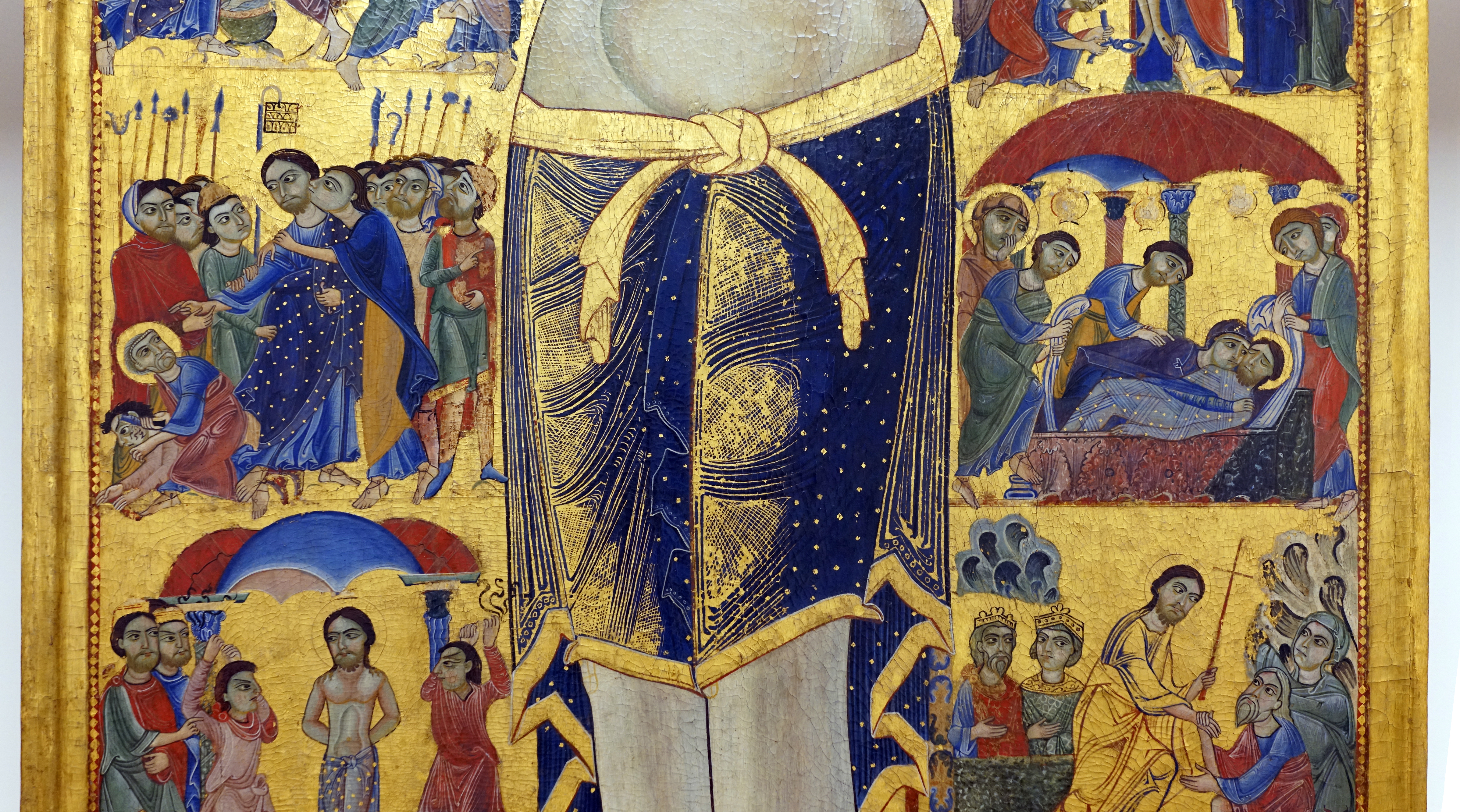
ART VIDEO: “The Crucifixion, c. 1200 (from Christus triumphans to Christus patiens)”: When I was a student in Florence for a semester, my first paper for my Italian history, art, and culture class traced the evolution of the painted wood-panel crucifix in late medieval Italy, from the Christus Triumphans (Triumphant Christ) type to Christus Patiens (Suffering Christ). I lived less than a five-minute walk from the Uffizi, which has in its collection a beautiful example of each—explored by Drs. Steven Zucker and Beth Harris in this short Smarthistory video. Longtime readers of the blog may recognize the latter, which I posted back in 2018.
Painted cross (detail), Pisa, ca. 1180–1200. Tempera and gold leaf on wood, 277 × 231 cm. Galleria degli Uffizi, Florence, Inv. 432. [object record]
Zucker provides wonderful photos of both in high resolution on his Flickr page (start here and scroll right)—the full crosses and details of each apron scene—available for free noncommercial use under a Creative Commons license. And there are many other art historical images there as well!
+++
ONLINE EXPERIENCE: “Anamnesis: Journey through the Stations of the Cross”: This year visual artist Daniel Callis and the music and liturgy collective The Many collaborated on a self-guided set of online Stations of the Cross. There are fifteen total, which are being released one at a time every morning and evening from March 30 through April 5. Each station consists of an artwork, a prayer, a song, and a written meditation that help us enter into lament.
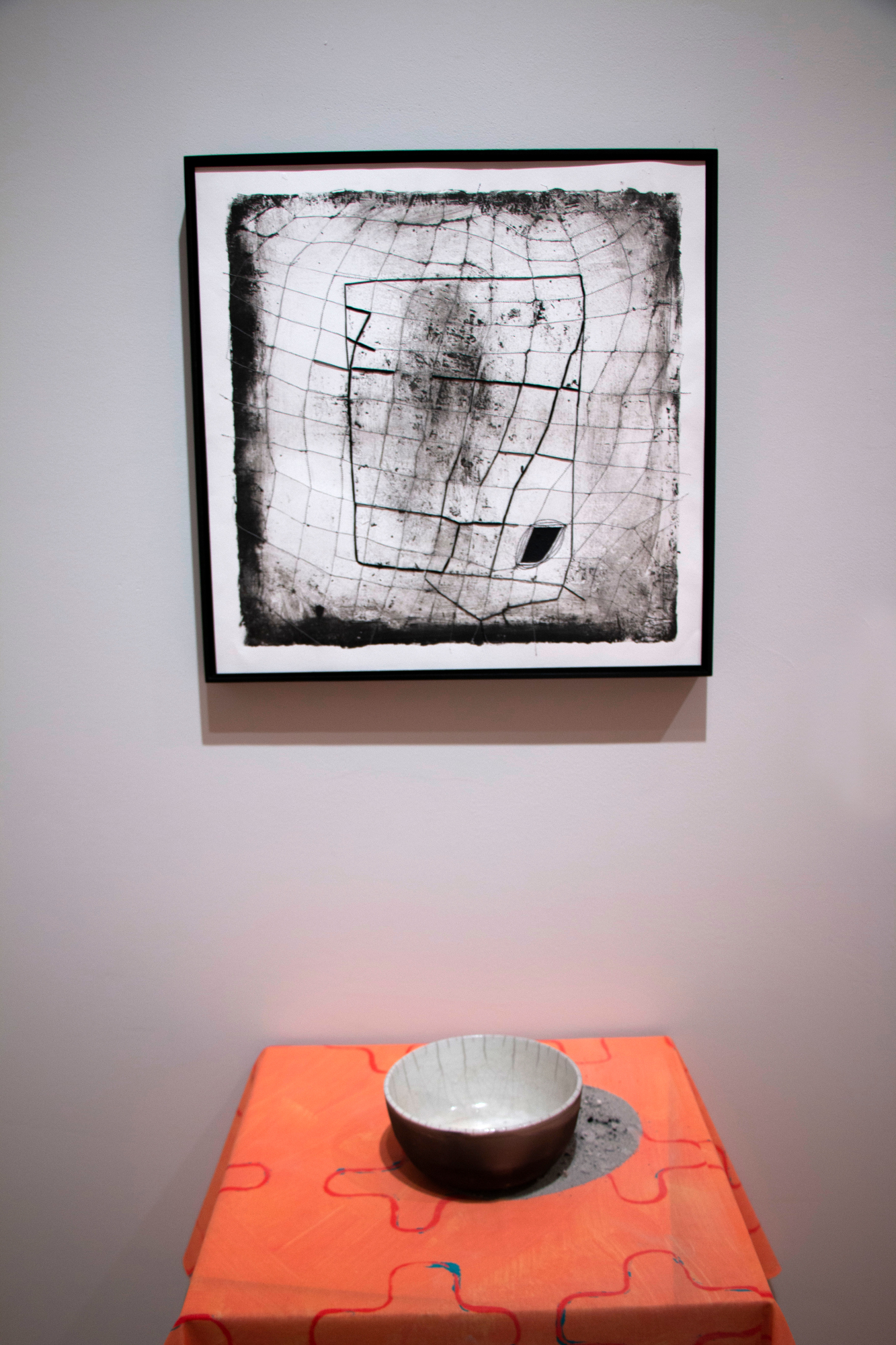
Daniel Callis (American, 1955–), Grief Station #1, Prognosis, 2022. Ink, oil, palm ash, fiber, clay, ash, fabric, 60 × 24 × 24 in. (total work). Photo courtesy of the artist.
The artworks are by Callis, and they’re from his Stations: Resurgam series, a body of work that was just exhibited this month at Green Art Gallery at Biola University in La Mirada, California. He began the series in January 2021 in response to the death of his son, Jeremy David Callis (1980–2020). It consists of fifteen mixed-media works on paper (his process involves printing, “wounding,” stitching, etc.) and fifteen raku-fired offering bowls that incorporate, from the cooling process, copies of letters, hospital documents, and drawings from Jeremy. “They are about pain and the absurd insistent pursuit of hope,” Callis says of the series. Resurgam is Latin for “I shall rise again.”
The songs are by The Many.
+++
BOOK EXCERPT from The Unvarnished Jesus: A Lenten Journey by Brian Zahnd: In this post from his blog, Pastor Brian Zahnd excerpts a passage from his book The Unvarnished Jesus (2019). “To interpret the meaning of the cross is more than a life’s work—in fact, it has and will remain the work of the church for millennia,” he writes. “The cross is the ever-unfolding revelation of who God is, and it cannot be summed up in a simple formula. This is the bane of tidy atonement theories that seek to reduce the cross to a single meaning. The cross is many things: It’s the pinnacle of God’s self-disclosure. It’s divine solidarity with all human suffering. It’s the shaming of the principalities and powers. It’s the point from which the satan is driven out of the world. It’s the death by which Christ conquers Death. It’s the abolition of war and violence. It’s the supreme demonstration of the love of God. It’s the re-founding of the world around an axis of love. It’s the enduring model of co-suffering love we are to follow. It’s the eternal moment in which the sin of the world is forgiven . . .” Read more.
+++
SONGS:
>> “The Leaves of Life”: “The Leaves of Life,” alternatively titled “The Seven Virgins,” is a traditional English ballad carol of Christ’s passion, first set down in the nineteenth century. It is narrated by (the apostle?) Thomas, who on a fateful Friday runs into the Virgin Mary and six of her companions, who are looking for Jesus. He directs them to the hill where Jesus is being crucified (“And sit in the gallery” may be a corruption of “The city of Calvary”). The women tearfully fly to the site, and Jesus tries to console his mother from the cross before breathing his last. The song ends with Thomas imbibing a strong scent of rose and fennel as he meditates on Christ’s love. [HT: Global Christian Worship]
Here the song is performed in the chapter house of Wells Cathedral in Somerset by William Parsons, founder of the British Pilgrimage Trust and author of Singing for Our Supper: Walking an English Songline from Kent to Cornwall, a book about the seven months he spent as a wandering minstrel. Parsons refers to it as a gypsy carol because Ralph Vaughan Williams collected one version of it from the Roma singer Esther Smith during his 1908–13 collecting trips that resulted in the publication, with Ella May Leather, of Twelve Traditional Carols from Herefordshire (1920).
>> “Were You There”: This African American spiritual is performed here by Pegasis, a vocal trio of sisters—Marvelis, Rissel, and Yaina Peguero Almonte—originally from the Dominican Republic but now living in Green Bay, Wisconsin. It’s as if they’re the three Marys singing their testimony! The song is on their 2016 album Peace Through Praise, which they released under the name The Peguero Sisters. Their harmonies are gorgeous.
+++
PODCAST EPISODE: “Malcolm Guite: Poems on the Passion”: In this special passion- and resurrection-themed Nomad devotional episode from 2018, Malcolm Guite reads and reflects on three of his poems, and David Benjamin Blower performs an original three-part song that he wrote in response and that has not been released elsewhere (see 4:30, 16:04, and 27:18).
Guite’s “Jesus dies on the cross,” part of his Stations of the Cross sonnet cycle, was inspired by a line from George Herbert’s poem “Prayer”: “God’s breath in man returning to his birth.” And his “Easter Dawn” [previously] is based in part on a sermon by the seventeenth-century Anglican bishop Lancelot Andrewes. Paraphrasing Andrewes, Guite says, “Jesus is the gardener of Mary [Magdalene]’s heart—her heart is all rent and brown and wintery, and with one word, he makes all green again.” Beautiful! For more on the theme of Jesus as gardener, see my 2016 blog post “She mistook him for the gardener.”
Bruce Herman (American, 1953–), Called, from the Woman series, 2007. Oil, alkyd resin, and 23k gold and silver leaf on wood, 58 3/4 × 48 3/4 in. Collection of Bjorn and Barbara Iwarsson, Lakeville, Minnesota.
My parents named me
    for the daughter of Amram
        and the Levite woman Yocheved:

prophetess with a timbrel
    who cast her baby brother
        on the mercies of the Nile.

Our name means Bitter Waters
    like the salt-encrusted sea
        into which the Jordan flows.

Or perhaps Sea of Myrrh—
    that sticky precious resin
        scenting the anointing oil

which Moshe once used
    to consecrate the Mishkan,
        the place where Presence dwelled.

My namesake had a well
    which followed the Israelites
        in all their wandering,*

a sweet spring in the desert
    bringing clarity to the heart
        of anyone who cupped their hands

and drank. Will I too
    be a wellspring of Torah,
        a source of living waters,

or will I stagnate here
    in this backwater town
        never hearing the voice of God?
* According to the Mishnah (Talmud, Taanit 9a), a well of fresh water miraculously followed Miriam, Moses’s sister, as she wandered with her people through the desert, providing a steady source of drink for all.
Rabbi Rachel Barenblat is a longtime blogger at The Velveteen Rabbi and a cofounder of Bayit, a collective of clergy, liturgists, artists, and educators that develops and distributes online Judaism resources. She holds dual ordination as a rabbi and mashpi’ah (spiritual director) and since 2011 has served as spiritual leader of Congregation Beth Israel in North Adams, Massachusetts. She has an MFA in writing and literature from the Bennington Writing Seminars and is the author of six volumes of poetry, including 70 faces: Torah poems (Phoenicia Publishing, 2011)and Texts to the Holy (Ben Yehuda, 2018). Her work has appeared in Reform Judaism,The Wisdom Daily, The Forward, and anthologies such as The Bloomsbury Anthology of Contemporary Jewish American Poetry and The Women’s Seder Sourcebook. She has taught at Beyond Walls, a writing program for clergy of many faiths at the Kenyon Institute, and is currently serving as a visiting faculty at the Academy for Spiritual Formation.
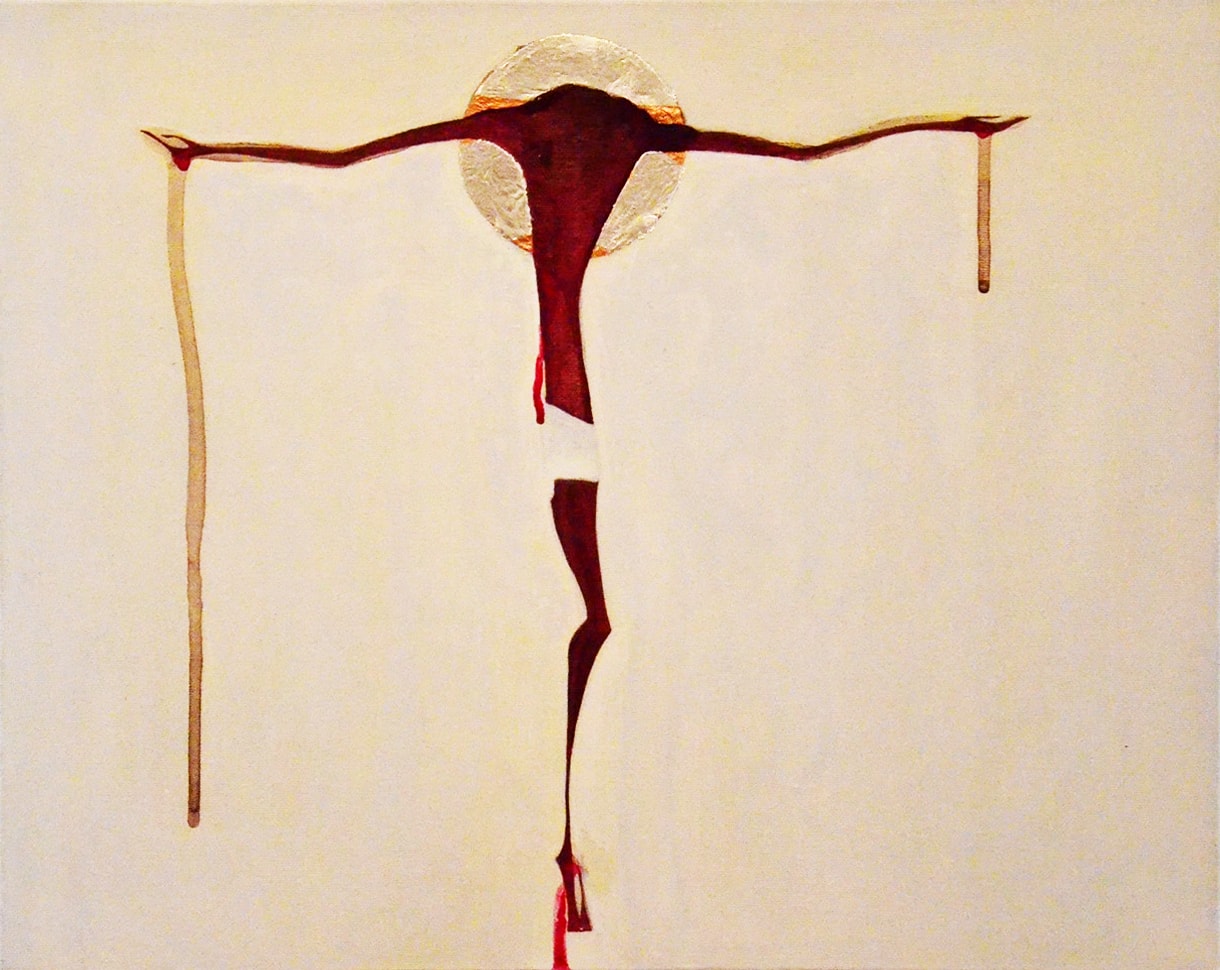
Mariia Bilas (Марія Білас) (née Ivaniuta) (Ukrainian, 1992–), Crucifixion, 2015. Tempera and gold leaf on canvas, 40 × 50 cm.
one
he lays his left hand along the beam
hand that moulded clay into fluttering birds*
hand that cupped wildflowers to learn their peace
hand that stroked the bee’s soft back and touched death’s sting

two
he stretches his right hand across the grain
hand that blessed a dead corpse quick
hand that smeared blind spittle into sight
hand that burgeoned bread, smoothed down the rumpled sea

three
he stands laborious
sagging, split
homo erectus, poor bare forked thing
hung on nails like a picture

he is not beautiful
blood sweats from him in rain

far off where we are lost, desert dry
thunder begins its quiet roar
the first drops startle us alive
the cloud no bigger
than a man’s hand
* According to a legend first recorded in the Infancy Gospel of Thomas, when Jesus was a child he molded sparrows out of clay and then brought them to life. This episode is also referenced in the Qur’an 5:110.
This poem appears in Faith in Her Words: Six Centuries of Women’s Poetry, compiled by Veronica Zundel (Oxford: Lion Books, 1991). Used by permission of the author.
Veronica Zundel is a writer of Christian books, articles, and poetry, living in London. She was born in England in 1953 to Austrian refugee parents (her mother was Jewish) and graduated with a BA in English from Oxford University in 1975. She came to faith in a Baptist church as a teenager and spent time in the Church of England and the Mennonite Church before joining the Methodist congregation she worships with now. Her books include Crying for the Light: Bible Readings and Reflections for Living with Depression, Everything I Know about God I’ve Learned from Being a Parent, and The Lion Book of Famous Prayers, and she contributes regularly to periodicals such as New Daylight and Woman Alive.
Sister Kim Ok-soon (김옥순 수녀), The Bread of Life from Heaven (하늘에서 내려온 생명의 빵), 2014
Stars sing, light-years deep in silent space.
In a bottle’s neck God’s Ghost sings
as the wine is poured.
Out on the edge of eternity, the Father
sees the Lamb slain ere the world is formed.
A soft cough splits the silence of this room
light-years below the wheeling stars.
A hollow prayer; give it breath, O Ghost,
let roar a wind like that which shook
the bones in Vision Vale.
For vision, God spills bread crumbs on the board.
His stars sing, light-years deep in silent space.
Here, emblems speak a mystery of brokenness:
the shattering of him by whom all things consist.
Keith Patman is an occasional poet whose primary vocation is Bible translation. Since 1982 he has worked for Wycliffe Bible Translators, assisting with the translation of scripture into the languages of West and Central Africa. He lived in Cameroon from 1987 to 1995, working on a Nugunu New Testament, and now serves from the US as part of an international team providing tools and training to African translators. He currently lives in Waynesboro, Virginia, with his wife, Jaci, who is a Presbyterian minister. They have two grown children and six grandchildren.
Aelbert Bouts (Netherlandish, ca. 1451/54–1549), Man of Sorrows, mid-1490s. Oil on oak wood, 14 15/16 × 10 7/16 in. (37.9 × 26.5 cm). Harvard Art Museums / Fogg Museum, Cambridge, Massachusetts.
ORIGINAL MIDDLE ENGLISH:

Vndo þi dore, my spuse dere,
Allas! wy stond i loken out here?
     fre am i þi make.
Loke mi lokkes & ek myn heued
& al my bodi with blod be-weued
     For þi sake.

Allas! allas! heuel haue i sped,
For senne iesu is fro me fled,
     Mi trewe fere.
With-outen my gate he stant alone,
Sorfuliche he maket his mone
     On his manere.

Lord, for senne i sike sore,
Forʒef & i ne wil no more,
With al my mith senne i forsake,
& opne myn herte þe inne to take.
For þin herte is clouen oure loue to kecchen,
Þi loue is chosen vs alle to fecchen;
Mine herte it þerlede ʒef i wer kende,
Þi suete loue to hauen in mende.
Perce myn herte with þi louengge,
Þat in þe i haue my duellingge.
Amen.
MODERN ENGLISH TRANSLATION:

“Undo thy door, my spouse dear,
Alas! why stand I locked out here?
     For I am thy mate.
Look, my locks and also my head
And all my body with blood bedewed,
     For thy sake.”

“Alas! alas! evil have I sped,
For sin Jesus is from me fled,
     My true companion.
Without my gate he standeth alone,
Sorrowfully he maketh his moan
     In his manner.”

Lord, for sin I sigh sore,
Forgive, and I’ll do so no more,
With all my might I forsake my sin,
And open my heart to take thee in.
For thy heart is cleft our love to catch,
Thy love has chosen us all to fetch;
My heart it pierced if I were kind,
Thy sweet love to have in mind.
Pierce my heart with thy loving,
That in thee I may have my dwelling.
Amen.
This poem appears in the 1372 “commonplace book” of the Franciscan friar John of Grimestone, who lived in Norfolk, England. Commonplace books were notebooks used to gather quotations and literary excerpts, with entries typically organized under subject headings. Preachers often kept them for homiletic purposes, gathering potential material for sermons. Grimestone’s is remarkable because it includes, in addition to much Latin material, 239 poems in Middle English. (English friars at the time regularly used vernacular religious verse in their sermons.) It is unknown whether Grimestone composed these verses himself or merely compiled them; likely, it is some combination. The first two stanzas of this particular poem are found, transposed, in another manuscript from almost a century earlier. Grimestone revised them slightly and added the third stanza.
Belonging to the Christ-as-lover tradition, “Undo thy door” is based primarily on Song of Solomon 5:2, cited in Grimestone’s manuscript: “I sleep, but my heart waketh: it is the voice of my beloved that knocketh, saying, Open to me, my sister, my love, my dove, my undefiled: for my head is filled with dew, and my locks with the drops of the night.” In a clever interpretation of the Old Testament source, the poet imagines the dewdrops on the Beloved’s brow as blood, thus identifying him with the thorn-crowned Christ. His bride is the human soul. Revelation 3:20 is provided as a further gloss by Grimestone: Jesus says, “Behold, I stand at the door, and knock: if any man hear my voice, and open the door, I will come in to him, and will sup with him, and he with me.”
So in the poem, the speaker is keeping company with sin and has locked out her true lover, Christ. Christ stands at the gate of her heart and implores her with great ardor to let him in and to send sin packing. Wet with the wounds of sacrifice, tokens of his love, he is persistent in his longing for her.
Christ’s entreaties provide the impetus for the speaker’s repentance, expressed in the final stanza, which changes awkwardly in form and meter. His love has pierced her to the core, undoing her resistance. She resolves to break the sin-lock—to turn away from wrongful deeds—and answer Christ’s call so that they can enjoy sweet union together, dwelling in one another’s love. It was his heart that opened first—it was cleft by the centurion’s spear as he hung on the cross—and she is compelled to respond with similar openness, receiving what he has given, requiting his desire.
SOURCES:
This poem is #6108 in the Digital Index of Middle English Verse. It is preserved in Edinburgh, National Library of Scotland, Adv.MS.18.7.21, fol. 121v. A shorter, earlier version, from the late thirteenth century, appears in London, Lambeth Palace Library 557, fol. 185v.
Modern English translation: David C. Fowler, The Bible in Middle English Literature (Seattle: University of Washington Press, 1984), 85–86
For further reading, see chapters 4–5 of Siegfried Wenzel, Preachers, Poets, and the Early English Lyric (Princeton, NJ: Princeton University Press, 1986), especially pages 140–41; and chapter 7, “The Theme of Christ the Lover-Knight in Medieval English Literature,” in Rosemary Woolf, Art and Doctrine: Essays on Medieval English Literature (London: The Hambledon Press, 1986), especially pages 109–10.
ONLINE EVENT: “Theodicy of Beauty” by Sarah Clarkson, March 6, 2:30 p.m. ET: “The question of suffering is one of the central, aching questions of faith. Too often, we meet suffering with an argument for God’s goodness, rather than an invitation to find and discover his goodness anew. Join me for an exploration of what it means to encounter and trust the beauty of God in our times of darkness, suffering, and pain. Drawing on my own story of mental illness and depression, I’ll explore what it means to engage with God’s goodness in a radically healing way, one that restores our capacity to imagine, hope, and create. We’ll use literature, art, and poetry to discern the ways that God arrives in our darkness to heal us, and also to restore us as agents of his loveliness in the midst of a broken world.”
This Crowdcast talk by Sarah Clarkson is based on her book This Beautiful Truth: How God’s Goodness Breaks into Our Darkness. Registration is $7 and includes a complimentary downloadable copy of “Encountering Beauty,” an arts-based reader’s guide to Clarkson’s book. I have appreciated her From the Vicarage: Books, Beauty, Theology newsletter and her wise, gentle reflections on spirituality, literature, and motherhood on Instagram @sarahwanders, so I’m looking forward to hearing from her on this topic!
+++
LECTURES (available on podcast platforms):
>> “The Loving Look” by Dr. Elissa Yukiko Weichbrodt: In this keynote address for the 2018 Beautiful Orthodoxy conference, art historian Elissa Yukiko Weichbrodt [previously], author of Redeeming Vision: A Christian Guide to Looking at and Learning from Art, discusses how contemporary art—which can sometimes be confounding or otherwise challenging—can drive us to confession, empathy, and love. Sharing her encounters with three contemporary artworks, she talks about art as a place where we can experience sanctification and common grace; how the Incarnation further vested our material world with significance; art as an invitation to embodied knowledge; art as part of how we order and understand our physical world; artworks as mirrors and shapers of culture; and how viewers, not just artists, are called to faithfulness.
She cites Esther Lightcap Meek’s Loving to Know: Covenant Epistemology, in which Meek says that all acts of coming to know are integrative; they become part of us. Knowledge is an act of covenantal care, Meek says. We don’t know in order to love; we love in order to know. Weichbrodt says, “For me, contemporary art—particularly art made by artists grappling with histories and experiences that have remained largely unseen, unknown, and unloved by the dominant culture—has served as a catalyst for faithful knowing.”
>> “The Arts as a Means to Love” by Dr. Mary McCampbell: In this lecture given for English L’Abri, Mary McCampbell [previously], an associate professor of humanities at Lee University, discusses some of the ideas from her book Imagining Our Neighbors as Ourselves: How Art Shapes Empathy. I appreciate how her writing and teaching embraces the arts of film and television alongside literature, such that not only are works like The Power and the Glory by Graham Greene, “A Good Man Is Hard to Find” by Flannery O’Connor, and Beloved by Toni Morrison explored, but so are, for example, the comedy-drama Lars and the Real Girl and the drama series Better Call Saul. Discrediting the recent odd assertion from a prominent evangelical corner that empathy is a sin, McCampbell affirms that empathy is, on the contrary, an essential Christian virtue, and one that the narrative arts are adept at forming in us, exposing us to people and stories outside our realms of experience and helping us recognize the image of God in unlikely places.
+++
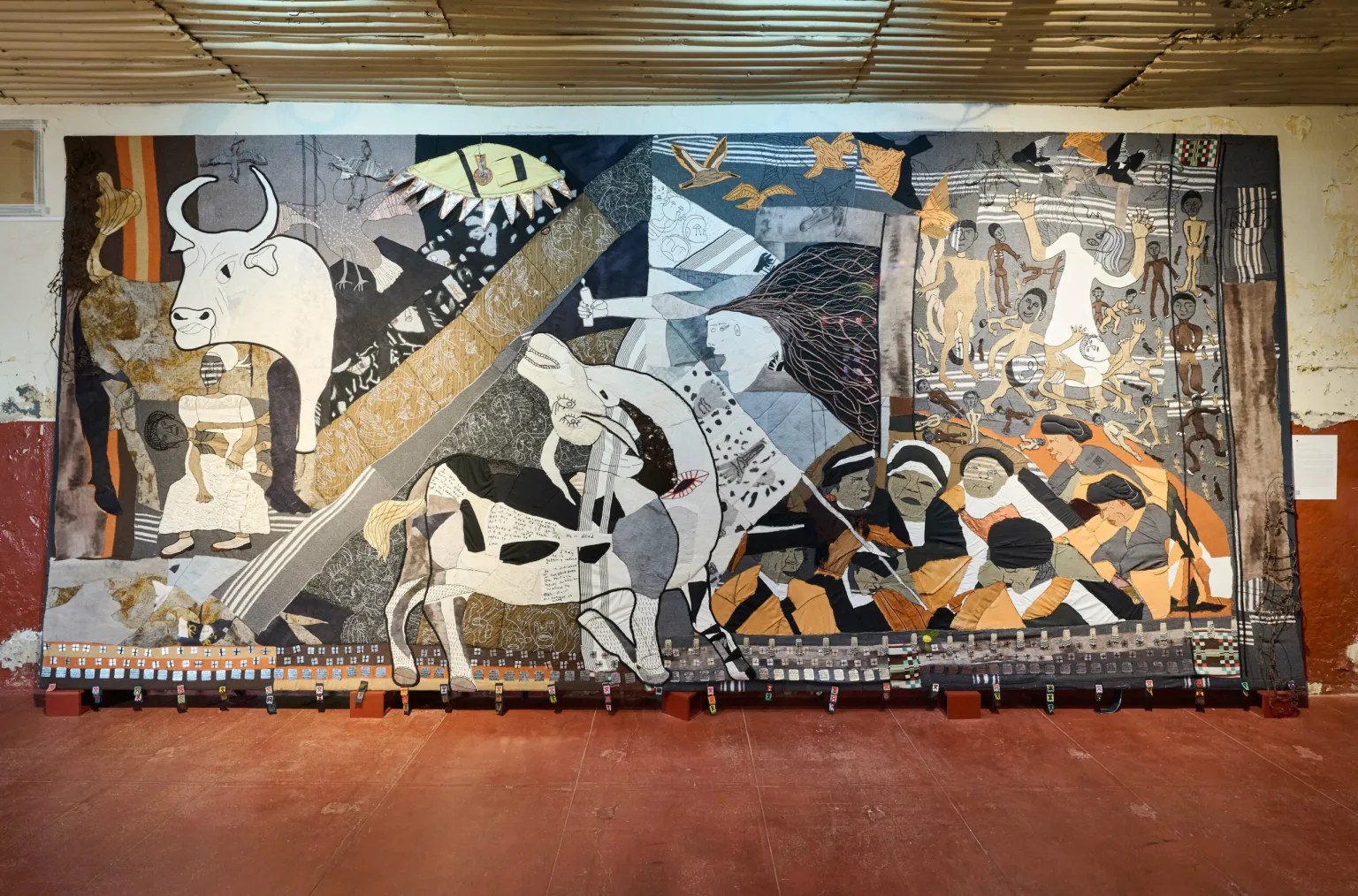
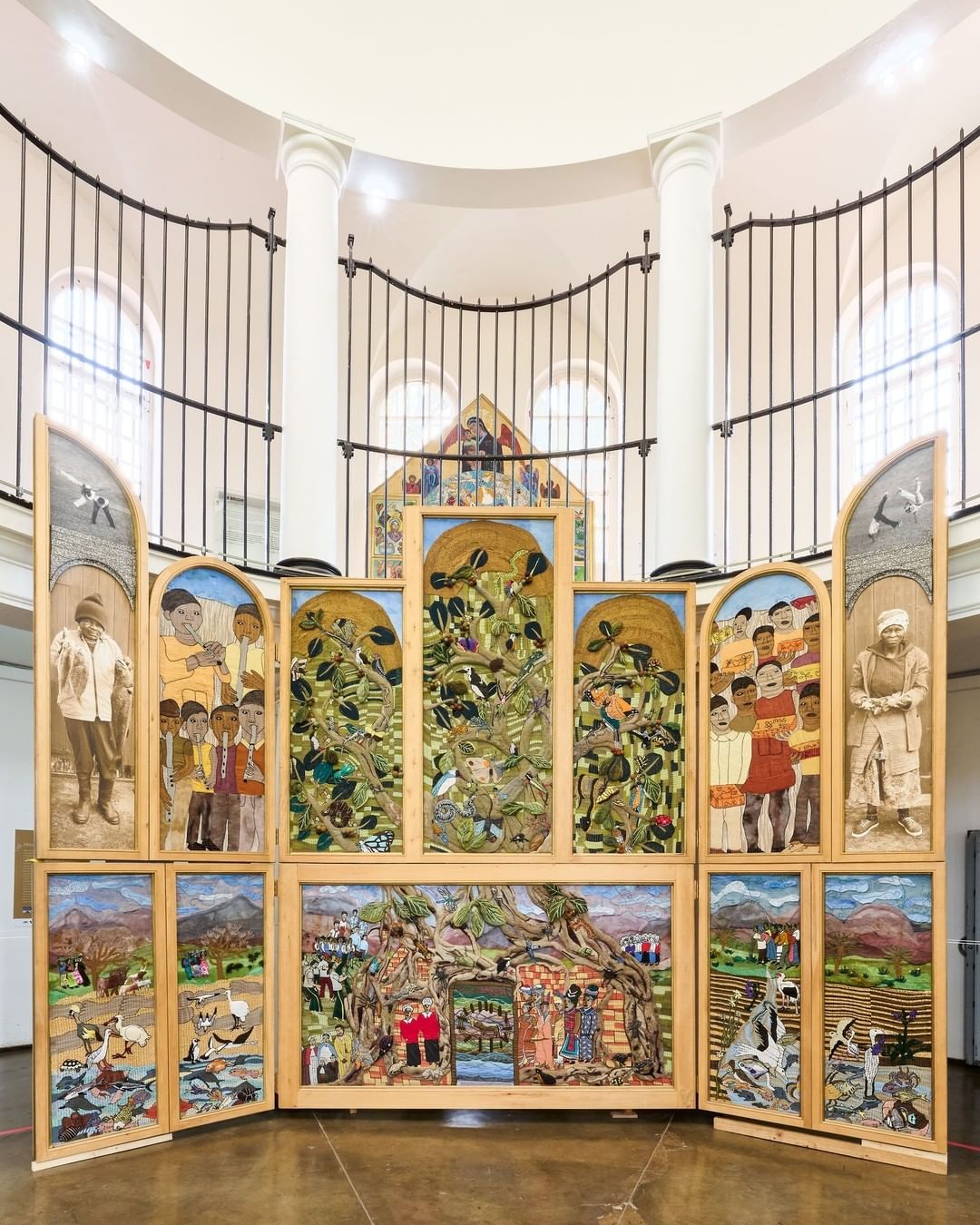
EXHIBITION REVIEW: “Mourning and Perseverance Stitched into South African Tapestries” by Alexandra M. Thomas: Through March 24 at Constitution Hill in Johannesburg, you can see Umaf’evuka, nje ngenyanga, dying and rising, as the moon does, a major retrospective of the work of the Keiskamma Art Project. Founded in 2000, the project archives the collective memory and oral histories of the rural Eastern Cape of South Africa through textile artworks, mainly by Xhosa women. Monumental and small-scale works tell stories of trauma, grief, hope, faith, resilience, and celebration. One of my favorite art research projects has been the one I did on the Isenheim-inspired Keiskamma Altarpiece in 2015, which resulted in the article “Sewing seeds of hope in South Africa”; this altarpiece is one of the many works on display. Let me call out just two others. The photos are from the current exhibition.
Keiskamma Guernica, 2010. Mixed media, including appliqué, felt, embroidery, rusted wire, metal tags, beaded AIDS ribbons, used blankets, and old clothes, 3.5 × 7.8 m. Collection of Javett Art Centre at the University of Pretoria, Tshwane, South Africa. Photo: Anthea Pokroy / Keiskamma Trust.Creation Altarpiece, 2007. Mixed media, including felt, embroidery, photographs, beadwork, wirework, and appliqué, 3.8 × 5.2 m (open). Collection of Unisa Art Gallery, Tshwane, South Africa.
Keiskamma Guernica, after Picasso’s famous antiwar painting, laments the limited access to HIV treatment in rural South Africa in the 2000s and the negligence of government hospitals, which resulted in many HIV/AIDS deaths. The piece repurposes the blankets and clothes of the deceased and serves as an expression of outrage as well as a form of commemoration. Creation Altarpiece, modeled loosely after the Ghent Altarpiece, exults in the region’s abundant wildlife and natural resources and in life-giving initiatives like Hamburg’s music education program, its capoeira group (a dance-like martial art), and the memory boxes made by orphaned children to remember their parents. The three top central panels depict a fig tree eating up an old hotel built by colonialists (a real-life scene observed in the nearby village of Bell!), and the bottom three show villagers of all kinds gathering around Christ, represented as a bull (whereas lambs were commonly sacrificed in ancient Israelite religion, traditional Xhosa religion calls for bull sacrifices).
SONG: “Kyrie” by Ngwa Roland:Ngwa Roland is a composer and the director of De Angelis Capella [previously], a Catholic choir from Yaoundé, Cameroon. Here is his choral setting of the Kyrie eleison (Greek for “Lord, have mercy”), an important Christian prayer used in liturgies around the world.
+++
ARTICLES:
>> “To One Kneeling Down No Word Came” by Jonathan Chan, Yale Logos:Jonathan Chan is a Singapore-based poet and essayist who graduated with a master’s degree in East Asian Studies from Yale in 2022. In this personal essay he reflects on the poetry of R. S. Thomas, a twentieth-century Anglican priest from Wales, particularly as it relates to the toil of prayer—prayer as a discipline requiring persistence and solitude. Thomas’s poems often express a sense of alienation from God, which is not what we might expect from a pastor, but, as Chan remarks, “God’s absence cultivates a desire for God’s presence.”
>> “Stabat Mater: How a 13th Century Lament Resonates Today” by Josh Rodriguez, Forefront: Back in July 2020, composer Josh Rodriguez [previously here and here] published this article on four modern settings of one of the most celebrated Latin hymns of all time, the twenty-stanza Stabat Mater Dolorosa (lit. “The sorrowful mother was standing”), about Mary mourning the death of her son Jesus. Written in the Middle Ages, it continues to inspire composers today, and it remains “a powerful vehicle for ‘grieving with those who grieve,’” Rodriguez writes. He spotlights the settings by James Macmillan, Julia Perry, Hawar Tawfiq, and Paul Mealor, analyzing some of the musical elements of each and quoting the composers in regards to the piece’s meaning to them.
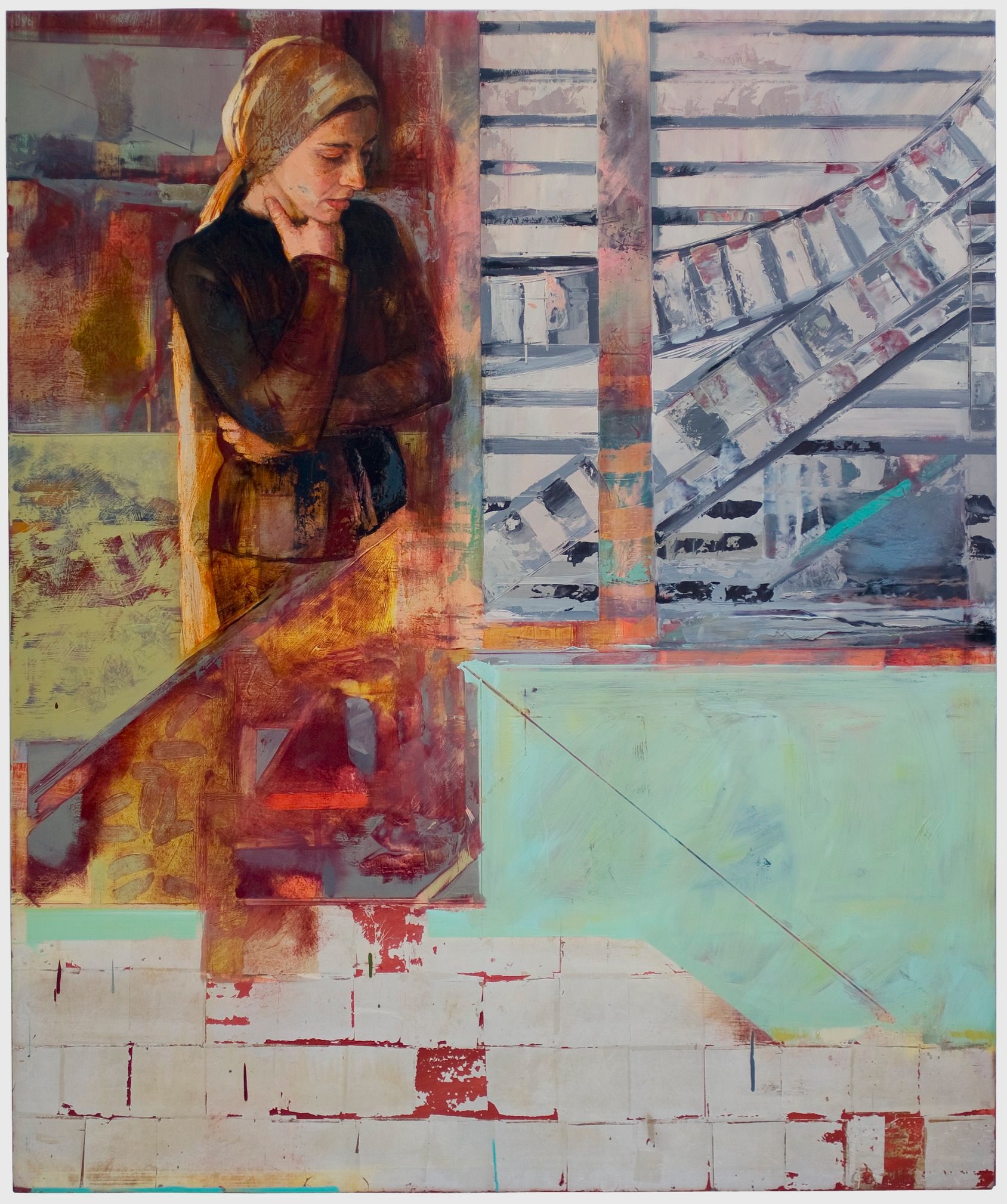
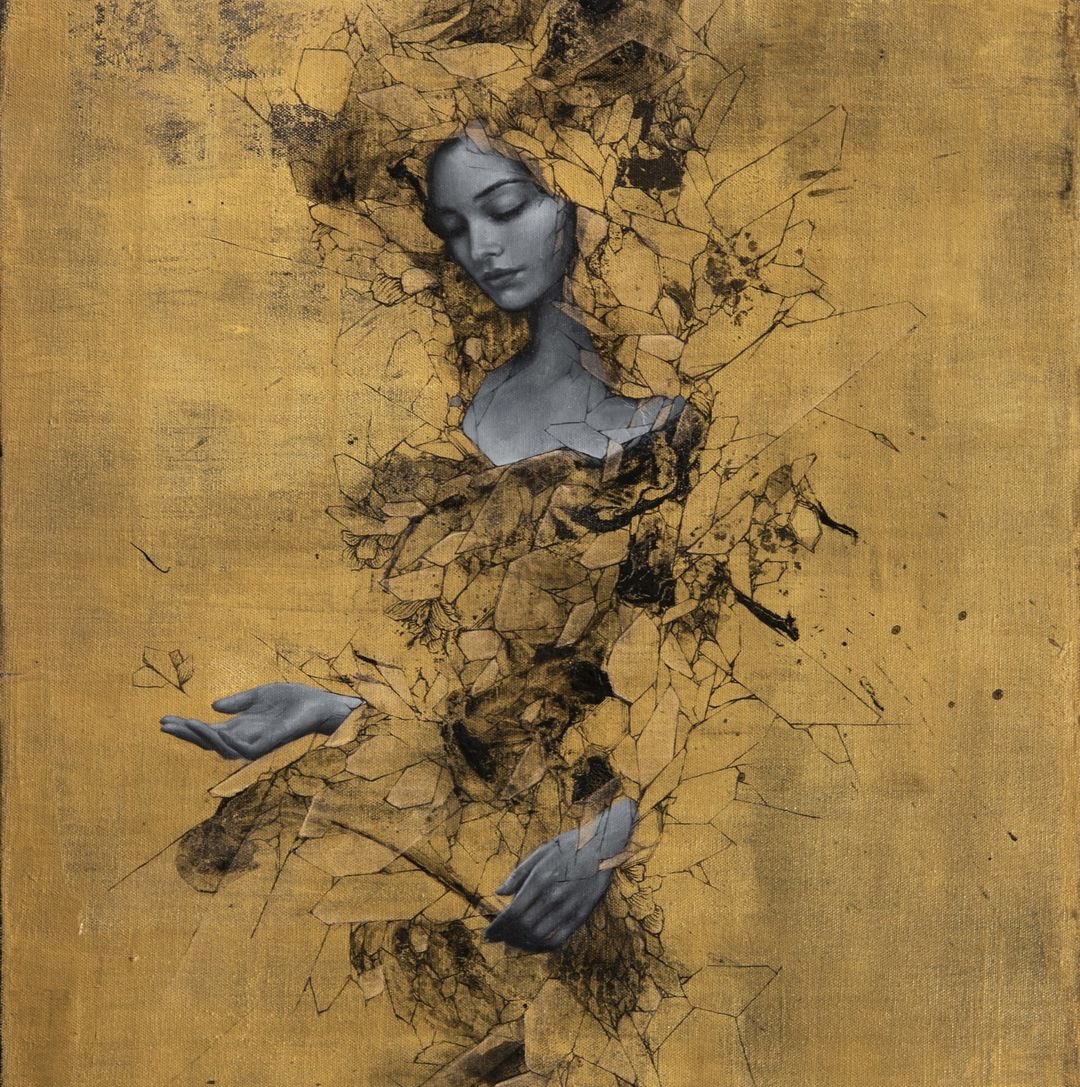
Aiden Kringen (American, 1992–), Opulence 4 (detail), 2022. Oil and acrylic on canvas, 36 × 18 in. [for sale]
I have no wit, no words, no tears;
My heart within me like a stone
Is numbed too much for hopes or fears;
Look right, look left, I dwell alone;
I lift mine eyes, but dimmed with grief
No everlasting hills I see;
My life is in the falling leaf:
O Jesus, quicken me.

My life is like a faded leaf,
My harvest dwindled to a husk:
Truly my life is void and brief
And tedious in the barren dusk;
My life is like a frozen thing,
No bud nor greenness can I see:
Yet rise it shall—the sap of Spring;
O Jesus, rise in me.

My life is like a broken bowl,
A broken bowl that cannot hold
One drop of water for my soul
Or cordial in the searching cold;
Cast in the fire the perished thing;
Melt and remould it, till it be
A royal cup for Him, my King:
O Jesus, drink of me.
One of the most celebrated poets of the Victorian era, Christina Georgina Rossetti (1830–1894) was an English writer of Romantic, devotional, and children’s poems. She was the youngest of four siblings, among them the Pre-Raphaelite artist Dante Gabriel Rossetti, several of whose paintings she sat for, famously modeling for the Virgin Mary. Her father was an Italian political exile to London and instilled in her a love of Dante Alighieri and the Italian language, which he taught at King’s College until being struck ill and rendered blind. He died when Christina was thirteen, and from then onward she suffered bouts of depression and physical illness. Loss and death, heaven, renunciation, the need for grace, and the perfection of divine love are recurring themes in her poetry. A devout Anglican whose verse gives vivid expression to the life of faith and to spiritual longing, she is recognized as a saint by the Church of England and the Episcopal Church, who celebrate April 27 as her feast day.




 Art & Theology