Hymn 4 on the Nativity of Christ (excerpt) by Ephrem the Syrian

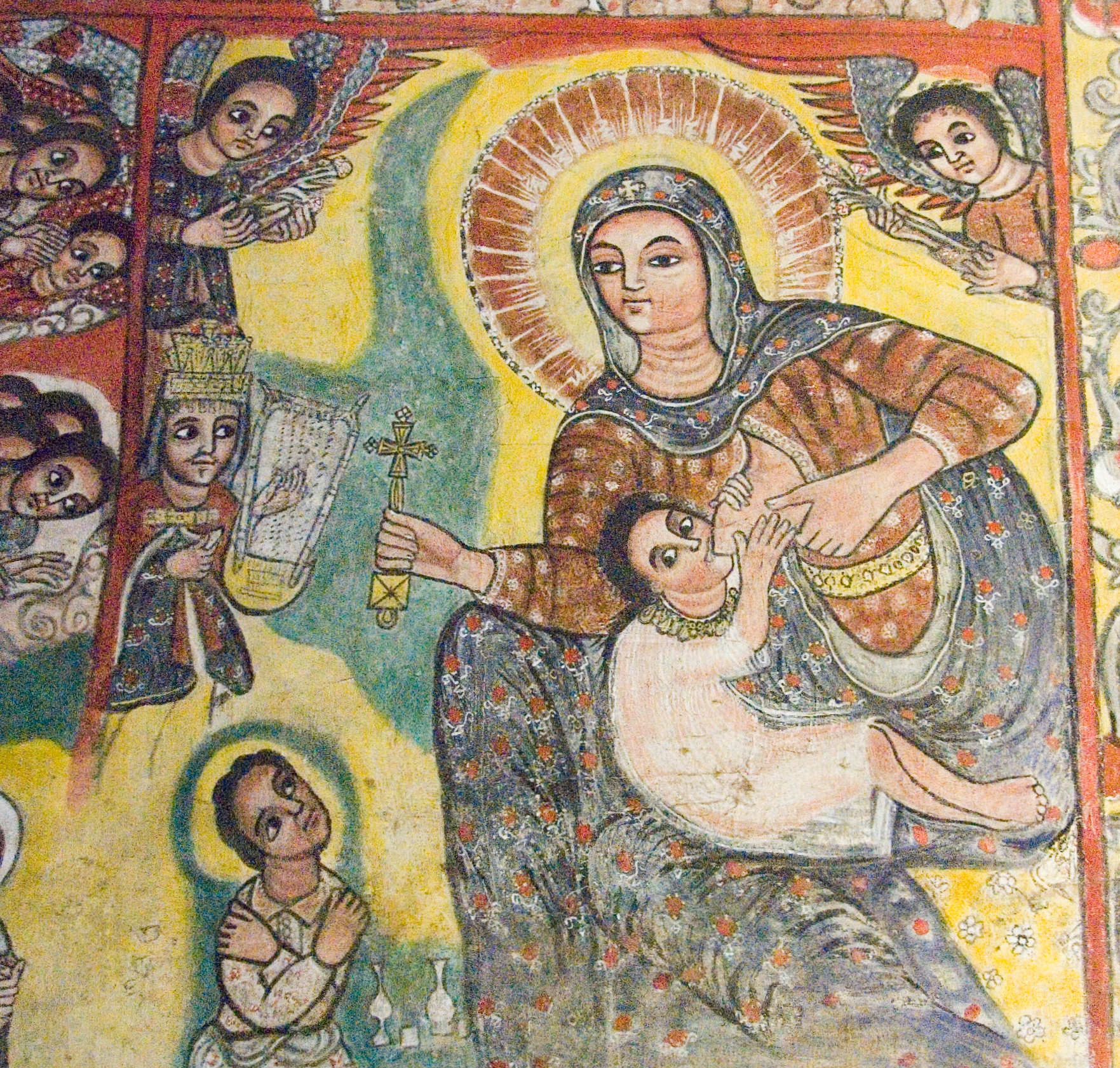
Maria lactans (Ethiopian)
Maria lactans, late 18th century. Fresco, Church of Narga Selassie, Dek Island, Lake Tana, Ethiopia. Photo: Alan Davey.

Glory to that Voice that became a body,
and to the lofty Word that became flesh.
Ears even heard Him, eyes saw Him,
hands even touched Him, the mouth ate Him.
Limbs and senses gave thanks to
the One Who came and revived all that is corporeal.
Mary bore a mute Babe
though in Him were hidden all our tongues.
Joseph carried Him, yet hidden in Him was
a silent nature older than everything.
The Lofty One became like a little child,
yet hidden in Him was a treasure of Wisdom that suffices for all.
He was lofty but he sucked Mary’s milk,
and from His blessings all creation drinks.
He is the Living Breast of living breath;
by His life the dead were suckled, and they revived.
Without the breath of air no one can live;
without the power of the Son no one can rise.
Upon the living breath of the One Who vivifies all
depend the living beings above and below.
As indeed He sucked Mary’s milk,
He has given suck—life to the universe.
As again He dwelt in His mother’s womb,
in His womb dwells all creation.
Mute He was as a babe, yet He gave
to all creation all His commands.
For without the First-born no one is able
to approach Being, for He alone is capable of it.

Translated from the Syriac by Kathleen E. McVey in Ephrem the Syrian: Hymns (Classics of Western Spirituality) (Mahwah, NJ: Paulist Press, 1989), 100–101

A Dietrich Bonhoeffer Hymn for New Year’s

The German theologian and Nazi resister Dietrich Bonhoeffer wrote the poem “Von guten Mächten” (By Gracious Powers), his last theological work, in December 1944 while he was imprisoned in a basement cell at the Reich Security Main Office on Prinz-Albrecht-Strasse in Berlin. He sent it in a letter to his fiancée, Maria von Wedemeyer, with the note “als ein Weihnachtsgruß für Dich und die Eltern und Geschwister” (“as a Christmas greeting for you and the parents and siblings”). Two months later, the building was destroyed by an air raid, and Bonhoeffer was moved to Büchenwald and from there to other places. He was executed April 9, 1945, at Flossenbürg concentration camp, just two weeks before it was liberated by the Allies.

Bonhoeffer poem
Letter from Dietrich Bonhoeffer to Maria von Wedemeyer, December 19, 1944. Collection of Houghton Library, Harvard University, MS Ger 161 (43).

The poem was published posthumously in The Cost of Discipleship under the title “New Year 1945.”

Von guten Mächten treu und still umgeben,
behütet und getröstet wunderbar,
so will ich diese Tage mit euch leben
und mit euch gehen in ein neues Jahr.

Noch will das alte unsre Herzen quälen,
noch drückt uns böser Tage schwere Last.
Ach Herr, gib unsern aufgeschreckten Seelen
das Heil, für das du uns geschaffen hast.

Und reichst du uns den schweren Kelch, den bittern
des Leids, gefüllt bis an den höchsten Rand,
so nehmen wir ihn dankbar ohne Zittern
aus deiner guten und geliebten Hand.

Doch willst du uns noch einmal Freude schenken
an dieser Welt und ihrer Sonne Glanz,
dann wolln wir des Vergangenen gedenken,
und dann gehört dir unser Leben ganz.

Laß warm und hell die Kerzen heute flammen,
die du in unsre Dunkelheit gebracht,
führ, wenn es sein kann, wieder uns zusammen.
Wir wissen es, dein Licht scheint in der Nacht.

Wenn sich die Stille nun tief um uns breitet,
so laß uns hören jenen vollen Klang
der Welt, die unsichtbar sich um uns weitet,
all deiner Kinder hohen Lobgesang.

Von guten Mächten wunderbar geborgen
erwarten wir getrost, was kommen mag.
Gott ist bei uns am Abend und am Morgen
und ganz gewiß an jedem neuen Tag.
With every power for good to stay and guide me,
comforted and inspired beyond all fear,
I’ll live these days with you in thought beside me,
and pass, with you, into the coming year.

The old year still torments our hearts, unhastening:
the long days of our sorrow still endure.
Father, grant to the soul thou hast been chastening
that thou hast promised—the healing and the cure.

Should it be ours to drain the cup of grieving
even to the dregs of pain, at thy command,
we will not falter, thankfully receiving
all that is given by thy loving hand.

But, should it be thy will once more to release us
to life’s enjoyment and its good sunshine,
that we’ve learned from sorrow shall increase us
and all our life be dedicate as thine.

Today, let candles shed their radiant greeting:
lo, on our darkness are they not thy light,
leading us haply to our longed-for meeting?
Thou canst illumine e’en our darkest night.

When now the silence deepens for our harkening,
grant we may hear thy children’s voices raise
from all the unseen world around us darkening,
their universal paean, in thy praise.

While all the powers of Good aid and attend us,
boldly we’ll face the future, be it what may.
At even, and at morn, God will befriend us,
and oh, most surely each new year’s day!

Trans. Geoffrey Winthrop Young

“In this hymn,” writes Joshua Miller for 1517, “Bonhoeffer leaves us a theological legacy that takes seriously the sorrows of life and the reign of death in a world still under the power of sin and the devil. But it’s a hymn that also confesses hope in a God who holds all things in his hands and demonstrates faithfulness to his promise to work all things together for his children’s ultimate good.”

The text has been set to music more than seventy times and appears in a number of hymnals. It is commonly sung by German congregations around New Year’s.

In 2020, the seventy-fifth anniversary of Bonhoeffer’s death, Berlin-based musical artist Sarah Kaiser released the song as a single, using the 1977 melody by Siegfried Fietz. COVID disrupted her plans to shoot a music video with her whole band, so she pivoted, singing a stripped-down, a cappella version with a minimal crew at the Kunstanstalt in Berlin-Köpenick, a former prison. (Bonhoeffer was not kept here, but the space is evocative of the other Berlin prison, no longer extant, where he was.) Filmed by Lukas Augustin, the video is hauntingly beautiful, with Kaiser’s bare vocals echoing through the dark, dank cell, testifying to God’s goodness amid the bleakest of circumstances.

Turn on the closed captioning (CC) on the YouTube video player for English subtitles.

Also, here’s a metrical translation by Fred Pratt Green (©1974 Hope Publishing Company) of five of Bonhoeffer’s original seven stanzas, which appears in several English-language hymnals:

By gracious powers so wonderfully sheltered,
and confidently waiting, come what may,
we know that God is with us night and morning,
and never fails to greet us each new day.

Yet is this heart by its old foe tormented,
still evil days bring burdens hard to bear;
oh, give our frightened souls the sure salvation
for which, O Lord, you taught us to prepare.

And when this cup you give is filled to brimming
with bitter suffering, hard to understand,
we take it thankfully and without trembling,
out of so good and so beloved a hand.

Yet when again in this same world you give us
the joy we had, the brightness of your sun,
we shall remember all the days we lived through,
and our whole life shall then be yours alone.

By gracious powers so faithfully protected,
so quietly, so wonderfully near,
I’ll live each day in hope, with you beside me,
and go with you through every coming year.

Thank you to Dr. Paul Neeley at the Global Christian Worship blog for introducing me to this hymn and this moving performance.

“Deliverance” by Evelyn Bence (poem)

Rego, Paula_The Nativity
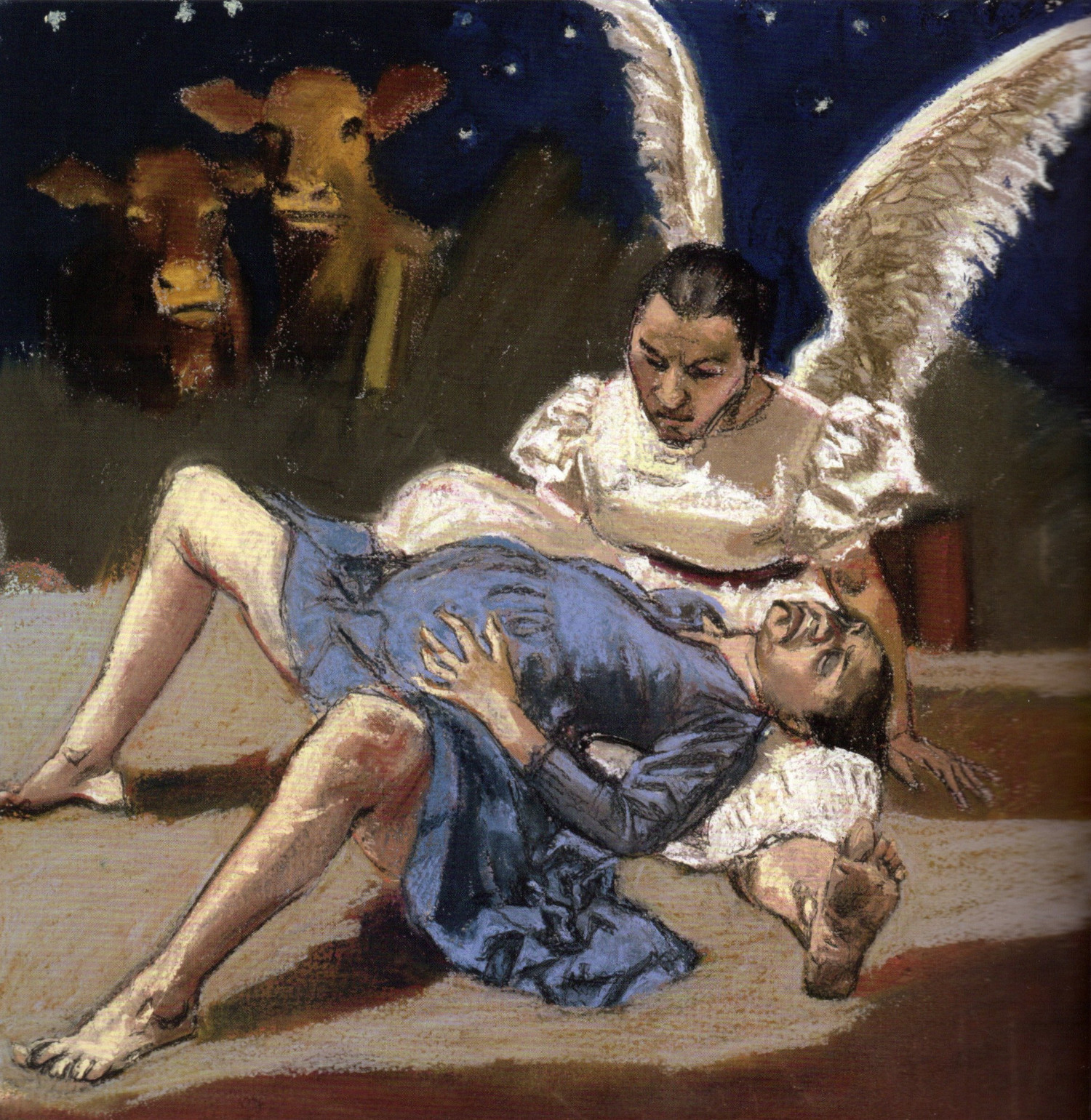
Paula Rego (Portuguese British, 1935–2022), The Nativity, 2002. Pastel on paper mounted on aluminum, 21 3/8 × 20 1/2 in. (54 × 52 cm). Palácio de Belém, Lisbon, Portugal. Source: Paula Rego: The Art of Story, p. 226.

It is time.
My body’s clock gongs
your salvation’s hour.
The water has left the pasture
and flowed toward the river’s mouth.
Follow or you will wither
in the desert that remains.
I will bleed for you
on this your first dark journey,
but in time, when life pushes you
headlong through black canyons,
the wounds will be your own.
May you learn early:
at the end light always shines.
It is here, child.
The time is come.
Breathe.

This poem was originally published in the Winter 1982/83 issue of Today’s Christian Woman and appears in the book Mary’s Journal: A Mother’s Story by Evelyn Bence (Grand Rapids, MI: Zondervan, 1992). Used by permission of the author. (Thanks to Maureen E. Doallas, curator of the exhibition Mary, Mary, for introducing me to it!)

Evelyn Bence (born 1952) is a writer and editor living in Arlington, Virginia. She is the author of Room at My Table; Prayers for Girlfriends and Sisters and Me; Spiritual Moments with the Great Hymns; and the award-winning Mary’s Journal, a novel written in the voice of Jesus’s mother. She has served as religion editor at Doubleday, managing editor for Today’s Christian Woman, and senior editor at Prison Fellowship Ministries. Her personal essays, poems, and devotional reflections have appeared in various publications.

Roundup: Christmas music, old poems with Grace, and more

ADVENT MEDITATION: “Love is . . .” by the Rev. Jonathan Evens: Evens shared this brief written meditation last week at Advent Night Prayer at St Catherine’s Wickford in England, pondering the love Mary demonstrated at various points along the way from the announcement of Jesus’s conception to her and her family’s resettlement in Egypt.

+++

SONGS:

>> “I Pray on Christmas” (cover) by the Good Shepherd Collective: This song was written by Harry Connick Jr. and is performed here by Benjamin Kilgore with Terence Clark, Liz Vice, and Charles Jones of the Good Shepherd Collective, an interdenominational group of musicians collaborating across the US. The video is directed by Jeremy Stanley.

>> “Mary Was the First One to Carry the Gospel” by the Gaither Vocal Band: I grew up in a Baptist church in North Carolina, so southern gospel music is a very familiar genre for me! But I hadn’t heard this song before, until my mom sent me a link last week. It was written by Mark Lowry and Bill Gaither (they took the title from a 1978 song by Dottie Rambo), who sing it here with David Phelps and Guy Penrod at the Alabama Theatre in Birmingham in 2000 as part of the Gaithers’ Christmas in the Country concert. It’s about how Mary was the first person to carry the good news enfleshed—first in her womb, and then in her arms.

>> “Late Upon a Starry Night” by David Benjamin Blower: David Benjamin Blower is an “apocalyptic folk musician, poet, writer, theologian, podcaster, and sound artist” from the UK whose work emphasizes the liberative strains of the gospel. He just released this original Christmas song yesterday, and it will be available only through January 5, 2023, on Bandcamp, with 50 percent of proceeds going to Safe Passage UK, an organization working toward safe routes for refugees. Blower said he wrote the song after hearing a friend talk about her experience of Moria refugee camp in Greece.

The stanzas tell the story of the Annunciation to Mary, Mary and Joseph’s Journey to Bethlehem, the Annunciation to the Shepherds, the Journey of the Magi, and the Flight to Egypt. The refrain draws a line from the first book of the Bible to the last, referencing God’s prophecy in Eden about the serpent’s head being crushed by a descendant of Adam and Eve (Gen. 3:15) (the serpent being representative of sin and death) as well as, implicitly, the image in Revelation 12 of the woman in labor and the dragon. Read the lyrics on the song’s Bandcamp page.

+++

PODCAST SERIES: Advent 2022, Old Books with Grace: I’ve been loving Dr. Grace Hamman’s four-part Advent podcast series, consisting of roughly twenty-minute episodes that discuss seasonal poems. Hamman is a specialist in medieval literature and theology and has the rare gift of being able to translate her extensive knowledge to nonspecialists in engaging and personal ways. She can speak with facility on lit and theology from other eras too. In this series she talks about our status as pilgrims in this world, how Christ carries our prayers in his body, nature-inspired images of the Incarnation, and more. I frequently come away from her podcast with new insight, and always having been spiritually nourished. If you’re traveling for Christmas, queue these up for the car, plane, train, or bus ride! Or work them into your week some other way, perhaps over breakfast, or while you’re doing dishes. Old Books with Grace is available wherever you listen to podcasts. (I use Google Podcasts, but Apple Podcasts or PodBean are the most popular providers.)

  • Episode 1: Were we led all this way for birth or death? (“Journey of the Magi” by T. S. Eliot)
  • Episode 2: Harke! Despair Away (“The Bag” by George Herbert)
  • Episode 3: Heaven Cannot Hold Him (“A Christmas Carol” by Christina Rossetti and excerpt from Piers Plowman by William Langland)
  • Episode 4: Dayspring (releases December 21; will cover an Old English version and Middle English version of one of the O Antiphons)

+++

DANCING ANGEL: This video from a church Christmas pageant in Porter, Indiana, went viral in 2019, but I’m just now seeing it (thanks to @upworthy!). It shows then-four-year-old Isabella Grace Webb dancing it up freestyle in her angel costume to “O Come, All Ye Faithful.” So adorable!

“Out of the Ash” by William Everson (poem)

Phoenix (Aberdeen Bestiary)
Phoenix, from the Aberdeen Bestiary (Aberdeen University Library MS 24, fol. 56r), England, ca. 1200

Solstice of the dark, the absolute
Zero of the year. Praise God
Who comes for us again, our lives
Pulled to their fisted knot,
Cinched tight with cold, drawn
To the heart’s constriction; our faces
Seamed like clinkers in the grate,
Hands like tongs—Praise God
That Christ, phoenix immortal,
Springs up again from solstice ash,
Drives his equatorial ray
Into our cloud, emblazons
Our stiff brow, fries
Our chill tears. Come Christ,
Most gentle and throat-pulsing Bird!
O come, sweet Child! Be gladness
In our church! Waken with anthems
Our bare rafters! O phoenix
Forever! Virgin-wombed
And burning in the dark,
Be born! Be born!

From The Veritable Years: Poems 1949–1966 by William Everson (Brother Antoninus). Copyright © 1998 by Jude Everson and the William Everson Literary Estate. Used with the permission of Black Sparrow Books, an imprint of David R. Godine, Publisher, Inc., godine.com.

William Everson (1912–1994) was an American poet who gained fame in the San Francisco literary renaissance of the 1950s, being classified as part of the Beat movement. Deeply influenced by the poetry of Robinson Jeffers, he wrote about the California landscape, nonviolence, the biblical narrative, and erotic love. He was married twice before converting to Catholicism in 1948, and in 1951 he entered the Dominican Order as Brother Antoninus. However, to pursue a romantic relationship with the woman who would become his third wife, he renounced his monastic vows in 1969, returning to secular life but maintaining his Christian faith and his poetic vocation. He also wrote literary criticism, taught at university, and founded a small press. His collected poems are published in three volumes.

Advent, Day 18: Will There Really Be a Morning?

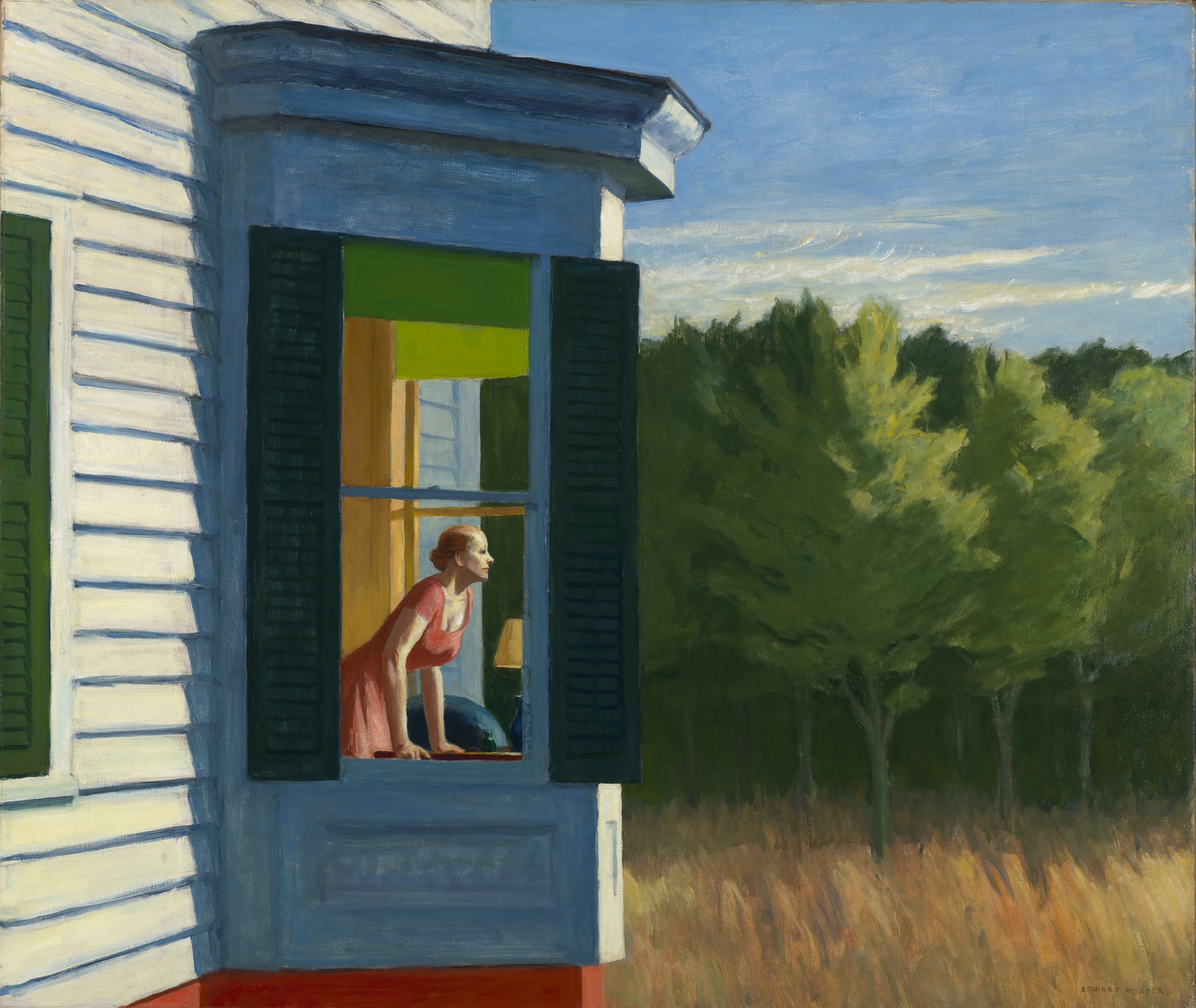
LOOK: Cape Cod Morning by Edward Hopper

Hopper, Edward_Cape Cod Morning
Edward Hopper (American, 1882–1967), Cape Cod Morning, 1950. Oil on canvas, 34 1/8 × 40 1/4 in. (86.7 × 102.3 cm). Smithsonian American Art Museum, Washington, DC.

LISTEN: “Will There Really Be a Morning” | Words by Emily Dickinson, 1860 | Music by Julie Lee, 2011

Will there really be a “morning”?
Is there such a thing as “Day”?
Could I see it from the mountains
If I were as tall as they?

Has it feet like Water lilies?
Has it feathers like a Bird?
Is it brought from famous countries
Of which I have never heard?

Oh some Scholar! Oh some Sailor!
Oh some Wise Man from the skies!
Please to tell a little Pilgrim
Where the place called “morning” lies!

“Incarnation” by Irene Zimmerman (poem)

Glass blower
Photo: Svetlana Day

In careful hands
God held the molten world—
fragile filigree
of unfinished blown glass.

Then Mary’s word: Yes!
rose like a pillar of fire,
and Breath blew creation
into Christed crystal.

This poem originally appeared in Incarnation: New and Selected Poems for Spiritual Reflection, © 2004 Irene Zimmerman. Used by permission of Cowley Publications, an imprint of The Rowman & Littlefield Publishing Group.

Sister Irene Zimmerman, OSF, is a Franciscan nun living in Milwaukee, Wisconsin. Born in 1932 into a large Catholic family on a farm near Westphalia, Iowa, she knew from an early age that she wanted to enter the religious life. She joined the School Sisters of St. Francis in 1954 and spent her career in various ministry roles, including high school English and French teacher, secretary, house mother in a German boarding school for girls, and music minister, along the way developing a keen interest in writing poetry. Now in her retirement, she continues to write and to sing in church choirs. She has published five original poetry collections.

Advent, Day 6: That Holy Thing

LOOK: Holy Family at Night (Rembrandt’s workshop)

Rembrandt (workshop)_Holy Family at Night
Workshop of Rembrandt van Rijn, Holy Family at Night, ca. 1642–48. Oil on panel, 66.5 × 78 cm. Rijksmuseum, Amsterdam.

During the Dutch Golden Age, the master artist Rembrandt van Rijn (1606–1669) ran a flourishing workshop in Amsterdam, overseeing the production of students’ paintings that continued the deep chiaroscuro and distinctive application of paint seen in his own work.

This painting from his workshop shows the Holy Family in a sparsely lit domestic interior at night. The Christ child lies asleep in a wicker cradle at the foot of a half staircase, his grandma Anne likewise nodding off as she rocks him gently with the cradle rope. Relieved by the quiet, Jesus’s mom, Mary, catches up on some reading, and Joseph taps liquid from a barrel on the left under the stairs (he’s very difficult to make out through the shadows).

This lived-in room is full of everyday objects from seventeenth-century Holland. Over the hearth on the left a copper candlestick holder is affixed to the wall. Behind Anne is a map, and beside her a spinning wheel, and a wicker basket hangs from the nail of a curved wooden beam. On the table to the right are a pair of old shoes, a flask attached to a leather belt, and a mortar and pestle, and a Jan Steen jug and other kitchenware are stored in the cupboard above. The shutters are drawn closed over the window. How utterly ordinary!

Although scholarly opinion since 1900 has identified the figures as biblical ones (the title is not the artist’s, as artists did not title their paintings at the time), for much of the painting’s history viewers interpreted it as simply a genre scene—that is, a scene showing regular people going about their daily lives. It lacks the “distinction, nobility, and loftiness” owed to biblical subject matter, it was believed, especially the Holy Family. There are no angels, no haloes. The only hint of sacredness is the pouring of light from a mysterious unknown source.

Rembrandt (workshop)_Holy Family at Night (detail)

But the ordinariness of the scene depicted is precisely what makes it so glorious. Jesus was born into a working-class family. For most of his life he labored as a carpenter, adopting Joseph’s trade. He wasn’t surrounded by lavish things. His upbringing looked much like that of all the other Jewish boys in Nazareth. That he was God incarnate would be revealed in time, to those who had eyes to see. But in the meantime, he cooed and pooed and cried and slept and fed and spit up like any other baby! And his mom was exhausted like any other mom, forced to sneak in some time for herself (including private devotional time, as she’s probably reading her Bible here) wherever she could, between childcare, chores, and other obligations.

That God chose to come to us as an ordinary human being born to an ordinary family (albeit conceived in an extraordinary way!) surprised everyone. The song that follows extends the surprise of the Incarnation into God’s other interventions in our lives, on a more personal scale. Just as he defied expectations in his first coming, so he often continues to surprise us in the ways he comes to us now—that is, not according to our own prescriptions, but down his “own secret stair,” when and where we’re least expecting it.

LISTEN: “That Holy Thing” | Words by George MacDonald, 1877 | Music by Katy Wehr, on In Others’ Words, 2008

They all were looking for a king,
To slay their foes, and lift them high:
Thou cam’st a little baby thing
That made a woman cry.

O Son of Man, to right my lot
Naught but thy presence can avail;
Yet on the road thy wheels are not,
Nor on the sea thy sail.

My how or when thou wilt not heed,
But come down thine own secret stair,
That thou mayst answer all my need,
Yea, every bygone prayer.

This song is a setting of a poem written by George MacDonald (1824–1905) in December 1877 and sent by letter to a handful of friends.* When it was first published in 1893 in the two-volume Poetical Works of George MacDonald, it was with this revised final stanza:

My fancied ways why shouldst thou heed?
Thou com’st down thine own secret stair;
Com’st down to answer all my need,
Yea, every bygone prayer!

The poem appears in the highly influential Oxford Book of English Verse (1900), compiled and edited by Arthur Quiller-Couch, but in its original form.

“That holy thing” is a translation of the Greek word hagios, which appears in Gabriel’s speech to Mary in Luke 1:35: “that holy thing which shall be born of thee shall be called the Son of God.” Educator Missy Andrews unpacks the poem:

In “That Holy Thing,” MacDonald meditates on man’s expectations and God’s will. In the first line of the poem, the poet remembers the first-century Jews who suffered under Roman occupation, waiting for the Messiah who would restore the throne of David to Israel. He acknowledges their plight and their expectation, contrasting it with what they in fact received. The baby Christ represented both a gracious answer to their need, and an immediate disappointment. He satisfied the deepest intentions of their prayer and Yahweh’s ancient prophecies, but frustrated their earthy expectations for geographic kingdoms and vindication. Not only that, but the baby King “made a woman cry.” This references not only the immediate suffering and travail of the Christ Child’s mother, Mary, but ultimately the suffering that would rend her heart when He himself was lifted high upon the cross in answer to their desperate prayer for triumph over their foes.

The poet notes that his own travails and petitions, his own desperate need of God’s intervening help, is denied in its immediacy as well. For, although the Son of Man’s own presence alone can help to “right the lot” of the poet, his coming is not visible by road or sea. In this way, MacDonald acknowledges that his own expectations, like those of his spiritual forebears, eclipse his ability to see the Lord’s coming in his own circumstances. He acknowledges the differences between God’s ways and man’s, in faith acknowledging that the Lord answers man in his own ways and times, keeping secret His approach, but stealthily accomplishing man’s every need, answering his every prayer through the mystery of incarnation. This incarnate Child, the Son of Man, replete with humanity and no stranger to suffering, suggests a remedy for all who wait and suffer.

Andrews is a founding director of CenterForLit, whose goal is “to bring readers face to face with the world’s best books so they can know themselves more fully as God’s creatures.” The center has a special emphasis on equipping parents to teach the classics to their kids.

The commentary above is excerpted, with Andrews’s permission, from the first post of twenty-five published in Advent 2015 for the CenterForLit’s “Literary Advent” blog series (which is excellent!). Andrews provides interpretations of poems by John Donne, Madeleine L’Engle, Gerard Manley Hopkins, T. S. Eliot, W. H. Auden, and more, combining literary analysis and theological reflection. You can enjoy Andrews’s series in print form with the book Wild Bells: A Literary Advent.

Kathryn Wehr, PhD, is a singer-songwriter whose most recent album, which leans folk rock in style, is And All the Marys: Women Encountering Christ in the Gospels (2018).

Besides being a musical artist, Wehr is also a scholar whose interests include theology and the arts, spiritual formation, and church history. Her specialization is the religious drama of Dorothy L. Sayers, and as such, she is the editor of the forthcoming book The Man Born to be King, Wade Annotated Edition (IVP Academic, 2023). In addition, she is the managing editor of Logos: A Journal of Catholic Thought and Culture at the Center for Catholic Studies at the University of St. Thomas in Saint Paul, Minnesota. 

* Thank you to the Special Collections & University Archives at Taylor University, through whose British Author Collections I discovered this earlier composition date for the poem, as well as an authoritative version of stanza 3 from MacDonald’s own hand. They provided me with a scan of one of MacDonald’s handwritten copies of “That Holy Thing” (Ref. ID 482), which contains the headnote “Written for my friends—Christmas, 1877.”

“seasonal ghazal” by Harry Gilonis (poem)

Kandinsky, Wassily_Three Sounds
Wassily Kandinsky (Russian, 1866–1944), Three Sounds, 1926. Oil on canvas, 23 5/8 × 23 1/2 in. Solomon R. Guggenheim Museum, New York.

the silent stars descend to us
come angel seraph sheep pear-tree

o holy o cold
dawn come in snow

offspring of day
light is lily above us

glory birds, calling birds
sun, the fields shining

the day, the earth, skies
peace, contemplation and music

hosanna, no, holly stand
suddenly tree displayed

the yonder star our comfort
bring time again

joy, excelsis a-leaping
world and hope embrace

lullay image and sing sing
a happy new begin

“seasonal ghazal” by Harry Gilonis appears in the chapbook The Twelve Poems of Christmas, vol. 3, ed. Carol Ann Duffy (Candlestick Press, 2011), and in Haphazard by Starlight: A Poem a Day from Advent to Epiphany by Janet Morley (SPCK, 2013). Used by permission of Harry Gilonis.

A ghazal is a traditional Arabic verse-form originating in seventh-century Arabia and spreading in the medieval era into Africa, Spain, Persia, South Asia, and Turkey, where it has continued to develop. It is made up of five to fifteen self-contained couplets connected loosely by mood or theme, however allusive. The poet Agha Shahid Ali compares each ghazal couplet to “a stone from a necklace” that should continue to “shine in that vivid isolation.”

Harry Gilonis’s “seasonal ghazal” doesn’t adhere to all the principles of the classic form (which involve rhyme and refrain), but it does give us autonomous couplets of roughly equal length that unfold without linearity, and these all center on the twinned seasons of Advent and Christmastide. Gilonis composed the poem using a cut-up technique, in which he printed out pages’ worth of sacred and secular English carol texts, excised words or short phrases that stood out to him, and rearranged those excised fragments into varying combinations, creating a medley of seasonal keywords that strikes a new chord.

By separating the words from their original syntactic contexts and collaging them together in new ways, he defamiliarizes and thus revivifies them. Traditional elements of the Christmas story are playfully refreshed.

The poem captures the magic and wonder of the season and a hint of its yearning and lament. For example, the exultant excelsis, Latin for “highest,” from the angels’ song to the shepherds is followed one stanza later by lullay, an archaic word used to soothe children to sleep and voiced in the “Coventry Carol” by mothers of ancient Bethlehem who lullaby into eternal rest their infant sons who are about to be slain by Herod. Elevated choral anthems contrasted with deep, mournful groans. Christmastide is full of “light” and “glory,” but there’s also “cold.”

The line “world and hope embrace” is particularly compelling—a picture of hope throwing its arms around a weary and skeptical world, and the world hugging back.

Because of the poem’s fragmentary nature, the grammatical mood of some of the verbs can’t be definitively discerned, but I read the following, in addition to the Hebrew-derived “hosanna” (“save us, please!”), as imperatives addressed to God: “descend,” “come,” “bring,” and the final word, open and expansive, “begin”—a curtailment of the noun “beginning.”

Jesus’s birth was a new and universal beginning. Can you hear echoes of Isaiah?: “See, I am doing a new thing! Now it springs up; do you not perceive it?” (Isa. 43:19a NIV). Many Christians see in this Hebrew Bible passage the promise of a messianic kingdom inaugurated by Jesus’s birth but not yet brought to completion. The speaker of “seasonal ghazal” seems to recognize the salvation project that’s in motion but longs for “the day” of the Lord, “the earth, skies” reunited. “Begin,” he beckons. Bring in the new era.

What word combinations in this poem stick out to you? What meaning(s) do you see?

25 Poems for Christmas

Hawkins, William L._Nativity Scene
William L. Hawkins (American, 1895–1990), Nativity Scene, 1987. Oil on canvas, 48 × 48 in. Newark Museum of Art, Newark, New Jersey.

1. “Remembering that it happened once” by Wendell Berry: For the last forty-plus years, Kentucky farmer Wendell Berry has been writing what he calls “Sabbath poems,” which emerge from his spiritual practice of walking outdoors on Sundays without any to-do’s. “I go free from the tasks and intentions of my workdays,” he says, “and so my mind becomes hospitable to unintended thoughts: to what I am very willing to call inspiration.” This Sabbath poem from 1986 explores how the sacred permeates the mundane and how Christ is, in a sense, always being born. For an SATB choral setting by Doug Brandt, see here.

Source: A Timbered Choir: The Sabbath Poems 1979–1997 (Washington, DC: Counterpoint, 1998); compiled in This Day: Collected and New Sabbath Poems (Washington, DC: Counterpoint, 2014)

2. “BC:AD” by U. A. Fanthorpe: Ursula Askham Fanthorpe (1929–2009), CBE, FRSL, was an English poet who is well loved by both critics and the general public. She was also a practicing Quaker. Each year she wrote a new Christmas poem to send to friends, of which “BC:AD” is the best known. It considers Jesus’s birth as the pivotal point in history, dividing time into epochs, into “before” and “after.” At this nativity, kairos invaded chronos—and we’re still singing about it millennia later.

Source: Christmas Poems (London: Enitharmon, 2002)

3. “Making the House Ready for the Lord” by Mary Oliver: For many of us who succumb to cultural pressures, December is a time of rushing around, making sure the house is decorated like a magazine, the Christmas cards sent out, the cookies baked to perfection, the gifts individually selected and bought and wrapped. But in all this flurry of activity, are we missing “the better part” (Luke 10:42)? The speaker of this poem, Martha-like, is busy making preparations for Jesus, who’s coming to visit, but as she’s cleaning, outdoor critters keep popping in. At first she bemoans their presence—they’re not on the guest list!—but eventually she comes to accept, even welcome, them, surrendering her fussy desire for orderliness to a charitable embrace of whatever is. And on another level, this poem is about how all of creation longs for Christ (Rom. 8:19–22); the animals, too, want to see him, want to join the party.

Source: Thirst (Boston: Beacon Press, 2006)

4. [It’s all so messy] by Kelly Belmonte: A haiku for Advent.

Source: https://allninemuses.wordpress.com/

5. “Second Advent” by Anya Krugovoy Silver: Memorializing a friend (Ishiuan Hargrove) who died of metastatic brain tumors, “Second Advent” unsettlingly combines stark hospital-room and anatomical language with language that is soft, gentle, lyrical. Recounting one of Ishiuan’s several neurosurgeries, the poet remarks how her head was nimbed by surgical lights and then swaddled in gauze. The title refers to Ishiuan’s waking up on the second Sunday of Advent, but also to the hope of Christ’s second coming, when pain, disease, and sorrow will be done away with. Anya Silver was herself a cancer patient, an experience she wrote much about in her four volumes of poetry, before dying of breast cancer in 2018.

Source: Second Bloom (Eugene, OR: Cascade Books, 2017)

6. “The Nativity” by Henry Vaughan: “Peace!” rang the angels’ song the night of Christ’s birth—and yet what irony, that he who came to bring peace was himself no beneficiary of it in this life, being born among animals in a borrowed stable, then made a refugee, then later disbelieved, betrayed, mocked, tortured, and crucified. The darkness that bred such unwelcome of the Son of God still persists—violence, ignorance. Referencing the Genesis 1 creation narrative as well as the journey of the magi, the poem ends with an invocation for God’s light to manifest once again, leading us to Christ.

Source: Thalia Redivina: The Pass-Times and Diversions of a Countrey-Muse (London: Robert Pawlet, 1678). Public Domain.

7. [little tree] by E. E. Cummings: One of E. E. Cummings’s earliest published poems (it came out in the January 1920 issue of The Dial), “little tree” was intended to appear as one of five “chansons innocentes” in Cummings’s first book of verse, Tulips and Chimneys, but his editor, Thomas Seltzer, cut it (along with sixty-five others!). In it a young child consoles a recently felled evergreen tree—enlisted for the holiday festivities—with promises of glory and love. Though it runs the danger of being read as twee, Cummings remained fond of the poem and even had it printed and sent it as his family Christmas card in 1960, two years before he died.

Source: XLI Poems (New York: The Dial Press, 1925); compiled in E. E. Cummings: Complete Poems, 1904–1962 (New York: Liveright, 2016). Public Domain.

8. “Messiah (Christmas Portions)” by Mark Doty: The speaker of this poem is unexpectedly transported by a local community choir performance of Handel’s Messiah. He marvels at how these ordinary, flawed neighbors of his can produce such beauty with their collective voices. The last line is probably a reference to the accompagnato and air sung by the bass toward the end of the oratorio, taken from 1 Corinthians 15:51–54—about how we will all be changed in a moment at the last trump, and the corruptible will put on incorruption.

Source: Sweet Machine (New York: HarperFlamingo, 1998); compiled in Fire to Fire: New and Selected Poems (New York: Harper Perennial, 2008)

9. “What the Body Knows” by Jean Janzen: The anonymous scribes and illuminators of the Book of Kells spent countless hours copying and beautifying God’s word amid Viking raids. In this ekphrastic poem, Jean Janzen reflects on the Gospel-book’s five whimsically painted folios of Luke’s genealogy of Christ, commenting on the continual inbreaking of God into our world and the “wild safety” of God’s love.

Source: What the Body Knows (Telford, PA: DreamSeeker Books, 2015)

10. “Confession” by Leila Chatti: The Tunisian American poet Leila Chatti was raised by a Muslim father and a Roman Catholic mother, and both religious traditions have shaped her faith and her writing. Islam and Christianity hold many sacred figures in common, including Mary (Maryam), whose conception and delivery of Jesus (Isa) are narrated in the Quran 19:16–34. Chatti confesses to being more compelled by the Islamic characterization of Mary as grunting and sweating in the pangs of labor (in contrast to Catholic teaching, which says her birthing experience was effortless, her contractions painless, though the Bible itself doesn’t specify). Chatti finds comfort in picturing Mary not as someone exempt from the effects of the fall and set apart on a pedestal of supreme virtue, but as one who suffered the same physical and emotional toll as other childbearing women—and who probably did have the occasional selfish thought, which, in moments of intensity and vulnerability, she deigned to vocalize!

Source: Deluge (Port Townsend, WA: Copper Canyon Press, 2020) | https://www.leilachatti.com/

11. “Two Carols” by Evelyn Underhill: An English Anglo-Catholic writer and mystic, Evelyn Underhill meditates in this double poem on how Christ set foot on the long, hard road we travel to be a balm for our wounds and those of the earth. The epigraph to part 1 is from the Latin Vulgate of Song of Solomon 2:12: “The flowers appear on the earth.” What follows are several Catholic titles for Mary: rose without thorn, queen, generatrix. The epigraph to part 2 is a quotation of Romans 8:22: “The whole creation groaneth and travaileth in pain together until now.” The refrain, Dominus tecum!, translates to “The Lord is with you!,” words spoken by the angel Gabriel to Mary and, by virtue of the Incarnation, to all humanity. The other Latin phrases translate to “He who is in the heavens,” “A King is born,” and “Let the kingdom come!” Adveniat regnum!

Source: Immanence: A Book of Verses (London: J. M. Dent, 1912). Public Domain.

12. “The Christmas Babe” by Fr. John Banister Tabb: Written by a Catholic priest from Virginia, this simple quatrain marvels at the paradox of God’s simultaneous largeness and smallness.

Source: Poems (London: John Lane, 1894). Public Domain.

13. “Snowflakes” by Jennifer Grotz: When the world is viewed through a sacramental lens, we recognize God in commonplace wonders like falling snow, and such things can be a sort of wordless prayer that we offer back to God through our enjoyment of them.

Source: Window Left Open (Minneapolis, MN: Graywolf Press, 2016) | https://www.jennifergrotz.com/

14. [The Savior must have been a docile Gentleman] by Emily Dickinson: In these two compact stanzas, Dickinson reflects on how kind Jesus was (an understatement!) to have made the far journey to Bethlehem, “a rugged billion Miles” from heaven, especially in the cold month of December, all “for little Fellowmen.” She refers to him as “docile”—obedient, submissive—harking to Philippians 2, to his yielding to the will of the Father in the Incarnation, taking on human limitations, suffering, and death for the life of the world.

Source: The Complete Poems of Emily Dickinson, ed. Thomas H. Johnson (Cambridge, MA: The Belknap Press of Harvard University Press, 1976)

15. [Wilt thou love God, as he thee? Then digest] (Holy Sonnet No. 15) by John Donne: A self-address to the soul, this poem by the English poet-priest John Donne, first published in 1633, two years after this death, celebrates the Triune God’s salvific workings: we’re adopted by the Father, redeemed by the Son, indwelt and regenerated by the Spirit. The closing couplet, referencing the imago Dei, packs a wallop: “’Twas much, that man was made like God before, / But, that God should be made like man, much more.”

Source: Poems (London: M.F. [Miles Fletcher], 1633). Public Domain.

16. “The Little Towns of Bethlehem” by John Terpstra: All over Canada, Christ is being reborn this Christmas, in the sense that the Story has taken root, is retold, and continues to have impact. The speaker imagines the Christ child “wrapped in cast-off flannel” in a boxcar stopped on the tracks in Esther, Alberta, or feeding at his mother’s breast in a broken-down car on the shoulder of a road in Englehart, Ontario—actual sights that one might encounter today. Localizing the Story can help us to see it afresh, and to see the sacred humanity of families experiencing homelessness or other hardships.

Source: Two or Three Guitars (Kentville, Nova Scotia: Gaspereau Press, 2006) | http://johnterpstra.com/

17. “Song of the Shepherds” by Richard Bauckham: Richard Bauckham, FRSE, FBA, is best known as a biblical scholar—he’s one of today’s tops, in fact—but he also writes poetry! (I featured one of his poems last year.) In this poem, the shepherds on Bethlehem’s hillsides recall an ancient tale about the stars singing at the creation of the universe, which they thought merely a poetic embellishment, until they experienced something of the like for themselves: “a song of solar glory” eclipsing the lesser lights and exorcising the dark, creating the world anew. Unforgettable.

Source: Tumbling into Light: A Hundred Poems (London: Canterbury Press, 2022) | https://richardbauckham.co.uk/

18. “Those Magi” by Kathleen O’Toole: What exactly were the magi seeking? What compelled them to leave their treasure behind in that cattle shed? Whence their strength to defy Herod? Besides musing on these questions, the poem also contains a passing metaphor that I found striking and new: cow breath as incense.

Source: Christian Century, January 18, 2019 | https://kathleenotoolepoetry.com/

19. “Carol of the Brown King” by Langston Hughes: Tradition names one of the wise men who visited the Christ child “Balthazar” and says he’s from Africa. Langston Hughes, a preeminent poet of the Harlem Renaissance, exults that there was “one dark like me—part of His Nativity.” This poem is included in Hughes’s musical play Black Nativity and is one of six Nativity poems by Hughes that make up a children’s book illustrated by Ashley Bryan.

Source: Crisis (Dec. 1958), p. 615; compiled in The Collected Poems of Langston Hughes (New York: Knopf, 1994)

20. “Mosaic of the Nativity: Serbia, Winter, 1993” by Jane Kenyon: I couldn’t find the particular church mosaic program that Kenyon is writing about, but here’s my interpretation. Set inside a Serbian Orthodox church during the Bosnian War, this poem imagines a mosaic of Christ Pantocrator hovering in the dome, lamenting the violence that goes on beneath. Under the gaze of the I AM is another mosaic, portraying Jesus’s birth, but also, in a way, Mary’s, as she herself is being reborn in Christ, her mind increasingly shaped in accordance to his. Nativity icons often show Mary framed by a red blanket that she’s reclining on at the mouth of a cave, which Kenyon reads as embryonic.

Source: Otherwise (Minneapolis, MN: Graywolf Press, 1996); compiled in Collected Poems (Minneapolis, MN: Graywolf Press, 2005)

21. “Breath” by Luci Shaw: This poem reflects on the contraction of the infinite God who breathed the universe into existence into a finite human being needing oxygen, who, as is foreshadowed at his birth, will finally ex-pire (“breathe out” his last) on a cross before entering his “next dark cave,” a prelude to resurrection.

Source: Accompanied by Angels: Poems of the Incarnation (Grand Rapids, MI: Eerdmans, 2006) | https://lucishaw.com/

22. “Mary’s Vision” from medieval Ireland: Mary foresees the future suffering of her infant son and dialogues with him about it in this poem translated from Middle Irish by Eleanor Hull (the same woman whose versification of a medieval Irish lorica, working from a translation by Mary Elizabeth Byrne, gave us the hymn “Be Thou My Vision”!).

Source: The Poem-Book of the Gael (London: Chatto & Windus, 1912). Public Domain.

23. “Joseph at the Nativity” by Tania Runyan: Staring at the “shriveled pod” that Mary just birthed, Joseph grapples with his complicated feelings—doubt, embarrassment, jealousy, helplessness, confusion, pride—and with figuring out what role he should play in the life of this child going forward.

Source: Simple Weight (Lexington, KY: FutureCycle, 2010) | https://taniarunyan.com/

24. “Waiting in Line After Christmas” by Sharron Singleton: (Scroll down to fourth poem) Rather than exchanges of refunded money for unwanted items, Singleton ponders what a mutually life-giving exchange of intangibles might look like.

Source: Our Hands a Hollow Bowl (Hartford, CT: Grayson Books, 2018)

25. “Burning the Old Year” by Naomi Shihab Nye: Through the act of forgetting, we must destroy the worthless trivialities of the year, and we must let that which is solid, that which matters—the “stones”—be revealed and remain.

Source: Words Under the Words: Selected Poems (Portland, OR: Far Corner Books, 1995)