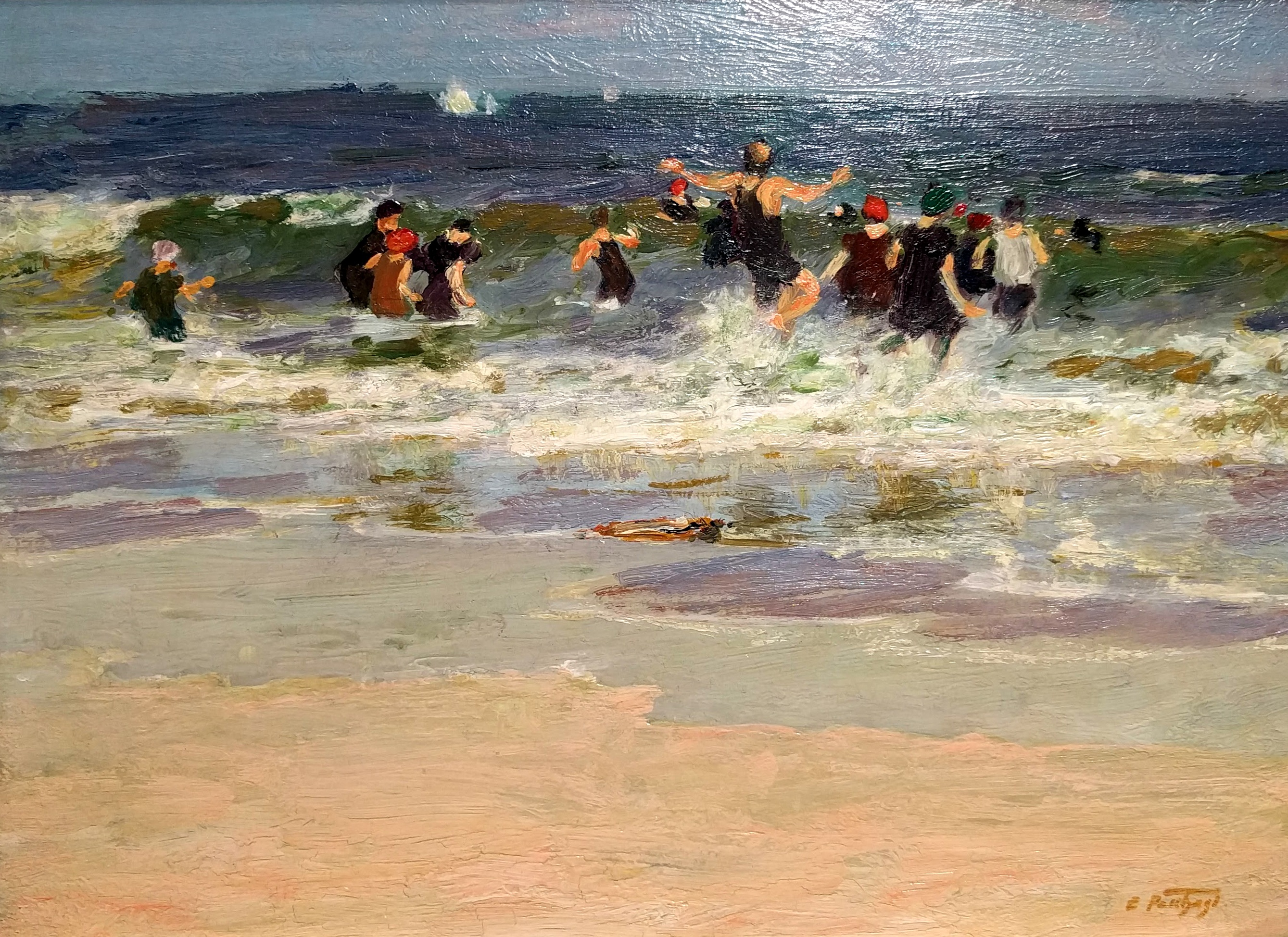
Edward Henry Potthast (American, 1857–1927), Beach Scene, Coney Island, 1915–18. Oil on wood panel, 11 7/8 × 16 in. (30.2 × 40.6 cm). Brandywine River Museum of Art, Chadds Ford, Pennsylvania. Photo: Victoria Emily Jones. [object record]
Why! who makes much of a miracle?
As to me, I know of nothing else but miracles,
Whether I walk the streets of Manhattan,
Or dart my sight over the roofs of houses toward the sky,
Or wade with naked feet along the beach, just in the edge of the water,
Or stand under trees in the woods,
Or talk by day with any one I love—or sleep in the bed at night with any one I love,
Or sit at table at dinner with my mother,
Or look at strangers opposite me riding in the car,
Or watch honey-bees busy around the hive, of a summer forenoon,
Or animals feeding in the fields,
Or birds—or the wonderfulness of insects in the air,
Or the wonderfulness of the sun-down—or of stars shining so quiet and bright,
Or the exquisite, delicate, thin curve of the new moon in spring;
Or whether I go among those I like best, and that like me best—mechanics, boatmen, farmers,
Or among the savans—or to the soirée—or to the opera,
Or stand a long while looking at the movements of machinery,
Or behold children at their sports,
Or the admirable sight of the perfect old man, or the perfect old woman,
Or the sick in hospitals, or the dead carried to burial,
Or my own eyes and figure in the glass;
These, with the rest, one and all, are to me miracles,
The whole referring—yet each distinct, and in its place.

To me, every hour of the light and dark is a miracle,
Every cubic inch of space is a miracle,
Every square yard of the surface of the earth is spread with the same,
Every foot of the interior swarms with the same;
Every spear of grass—the frames, limbs, organs, of men and women, and all that concerns them,
All these to me are unspeakably perfect miracles.

To me the sea is a continual miracle;
The fishes that swim—the rocks—the motion of the waves—the ships, with men in them,
What stranger miracles are there?
“Miracles” by Walt Whitman was originally published in the second edition of Leaves of Grass (Fowler & Wells, 1856). It is in the public domain.
Keith A. Barker (American, 1968–), Stone of Help, 2013–20
Lord of empty bowl and thrift store spoon,
of soil, of paint-flecked arms.
Lord of the mossed live oak, of blank paper, of lobe.
You are gingko leaf, its yellow tone,
an egg feather-stuck, a room.
The lingering scent of myrrh, of aloe, folded strips
of linen, cast light across the sandy floor of a tomb.

You live deep in ginger’s bite, snow’s precision,
the seed the wildflower’s thrown.
You are the Lord of all expectant
breath: height, cloud, vapor, mist.
You are the Lord of what’s been bitten down,
what’s dormant, the remaindered, the paused.

Molecule’s God, salamander’s God, ragweed’s
God, Lord of stones. Lord of green-bellied toad’s
burble and spit. Of broad-winged hawks,
of weather and wings, of wood mites’ burrows,
of whistles, of small things.

We balk, Lord, at how you nestle deep: our bulb, our bee,
juice, the Spirit of pear, the shadow of the dimple,
what’s under every ripple of the creek.

Lord of the hitch, the lob, the blink, the kiss, the shake.
Lord who rose, who wakes;
who lets us sleep, who satiates.
In our palms, cerebrum, nostrils, wrists,
your Spirit lives. What we miss,
forgive.

In our liminal lives, Great and Patient Mystery,
bless us, and if you will,
share with us your margins today.
“Resurrection Psalm” by Kristina Erny, reproduced here with her permission, was originally published in the catalog for Again + Again (2021), a CIVA-organized photography exhibition that invites contemplation of the ordinary and extraordinary through the seasons of the Christian liturgical year. In the exhibition, as here, the poem is presented with Keith Barker’s photographic collage Stone of Help.
Kristina Erny is a third-culture person—an American raised in Seoul, who has spent much of her career teaching abroad. Most recently she has served as an assistant professor of English and the director of the creative writing program at Asbury University in Wilmore, Kentucky. Her poetry has appeared in the Los Angeles Review, Tupelo Quarterly, Rattle, Yemassee, Bluestem, and elsewhere, and her manuscript Wax of What’s Left was a multi-award finalist. She and her family are currently preparing to move to Shanghai, where they will continue their journey as international school educators.
Lava Thomas (American, 1958–), Clouds of Joy, 2021. Tambourines, leather, suede, acrylic mirror, blue acrylic discs, ribbon, 48 × 137 in. Photo courtesy of the artist and Rena Bransten Gallery. [HT]
Tambourines!
Tambourines!
Tambourines
To the glory of God!
Tambourines
To glory!

A gospel shout
And a gospel song:
Life is short
But God is long!

Tambourines!
Tambourines!
Tambourines
To glory!
This poem was originally published in Selected Poems of Langston Hughes (Knopf, 1959),and it appears in The Collected Poems of Langston Hughes, ed. Arnold Rampersad (Knopf, 1994; Vintage Books, 1995).
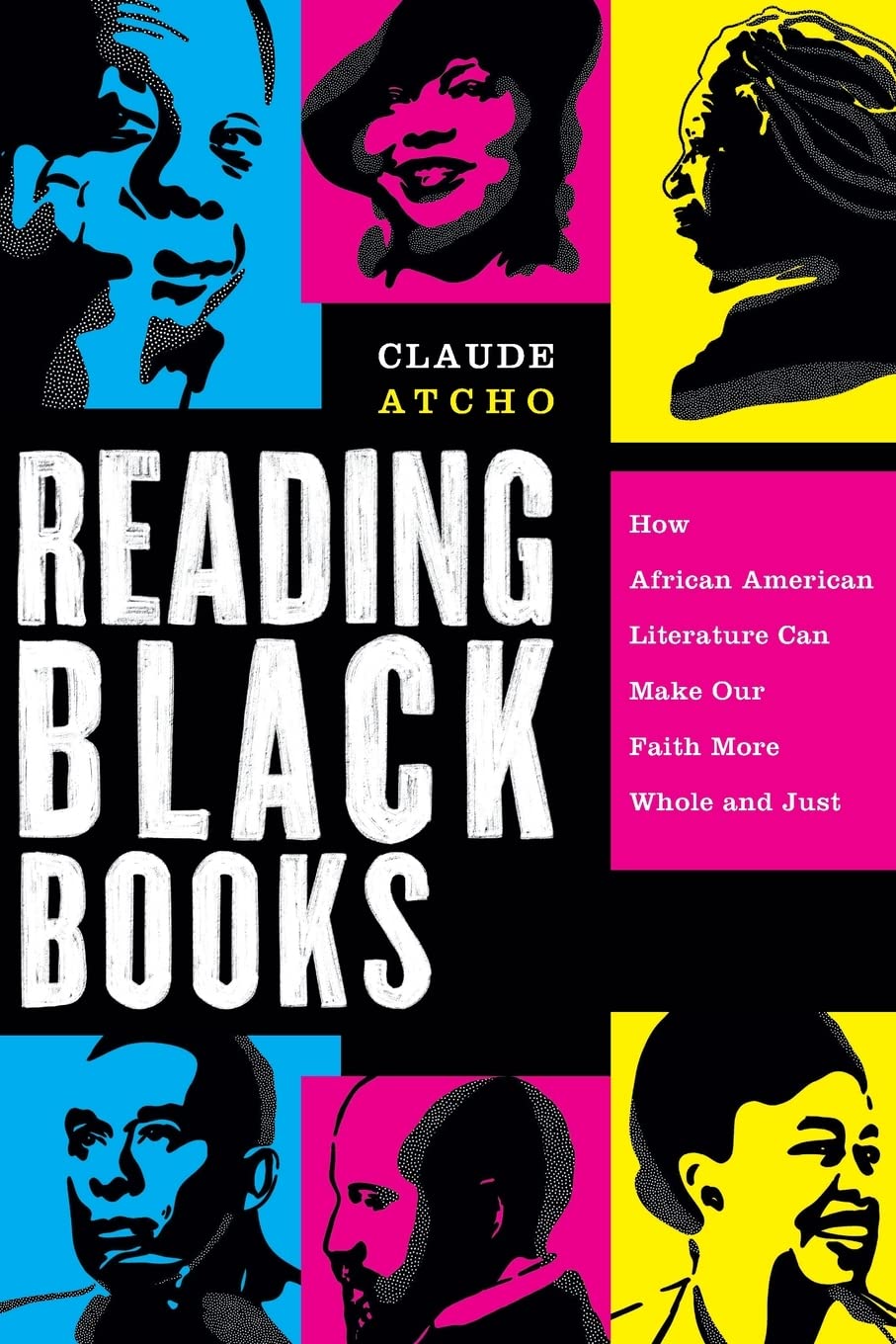
Published last month by Brazos Press, the book consists of ten chapters, each one built around a theologically charged word or concept (such as “sin,” “image of God,” or “lament”) and a twentieth-century novel or poem(s) by a Black author that is then engaged through that lens. A potential danger with this approach is that the interpretations in either direction could be forced to fit into a box, but this turned out not to be the case at all. Reading Black Books is a two-way, mutually enriching exchange between theology and literature, one that is expansive rather than limiting and that takes each discipline seriously on its own terms.
Combining literary analysis and theological reflection, Atcho shows how “God’s truth addresses Black experience and how Black experience, as shown in the literature of our great writers, can prod readers from all backgrounds toward sharper theological thinking and more faithful living” (1). We are invited to inhabit the experiences of various characters and poetic voices and to be transformed as a result. As a middle-class white woman living in a Maryland suburb, I acknowledge that I move about the world with a very different set of experiences than those of people of color. With pastoral sensitivity but also directness, Atcho helps me enter into America’s racial narrative—and the narrative of the gospel!—from a different vantage point. This book is for Christians of any race who desire to be enlarged by story and to live more fully into the liberative arc of scripture.
Atcho provides enough context for each book—introducing us to characters, rehearsing relevant plot points, and highlighting specific scenes, often including quoted excerpts—that you don’t have to have read the work previously to benefit from his commentary. The book does contain spoilers, as all serious literary criticism almost inevitably will. But literature is way more than plot, and readers are encouraged to then engage with the primary texts in full on their own, equipped with frames for thinking about them and open to surprises.
I have attempted to come to this book about books as a guide who integrates my affections: my love for these stories, my love for what they say about Black experience in both trials and triumphs, and my love for Jesus and his kingdom.
Claude Atcho, p. 7
Chapter 1 examines the question “What does it mean to live as an image bearer when other image bearers try to limit your existence?” The protagonist of Ralph Ellison’s Invisible Man (not to be confused with H. G. Wells’s sci-fi novel The Invisible Man) is not physically invisible; rather, he is rendered invisible by others’ refusal to see him. Atcho discusses the need for white sight—our warped “inner eyes”—to be redeemed.
Chapter 2 explores how systemic sin exacerbates personal sin through the controversial character of Bigger Thomas in Richard Wright’s Native Son, a Black man from 1930s Chicago who kills two people (the first one accidentally). Is Bigger a victim or a perpetrator? The question is too simplistic. Bigger is both trapped by Sin and an agent of Sin, Atcho says. Atcho’s explication of Sin with a capital S and sin, little s, is sophisticated and illuminates for me broader discussions going on in contemporary culture. Sin is not just personally experienced and personally enacted; it is also a dominating force that’s been set loose in our world and that has become embedded in systems.
The focus of chapter 3 is James Baldwin’s semiautobiographical debut novel Go Tell It on the Mountain, “a critical generational portrait of the toxic Christian practice that emerges from belief in a loveless God” (40). Baldwin gestures toward true religion through negation—by presenting the character of Gabriel, the protagonist’s minister stepfather, as a promiscuous and abusive binge drinker with a lust for power.
Chapter 4 visits “Christ Recrucified” and the nine-hundred-line “The Black Christ” (read the first stanza here) by Harlem Renaissance poet Countee Cullen, unpacking the picture they paint of a Jesus who suffers for, like, and with us. Published in the 1920s, both poems compare the crucified Christ to a lynched Black man.
In chapter 5 Zora Neale Hurston’s Moses, Man of the Mountain, a folkloric retelling of the book of Exodus, opens up a quest into the doctrine of salvation. Atcho discusses salvation from and to, which story and script forms us most (the old empire or the coming kingdom?), the significance of the promised land, and Christian social concern as a biblical imperative.
The deliverance of the exodus elides the false dichotomy of a truncated salvation. Hurston’s Moses points in the same direction—toward imagining a fully orbed salvation, as did our enslaved ancestors: revelation and liberation.
Is it our attention, then, to be fixed on the sin of slavery or our slavery to sin? Personal piety in the power of the Spirit or social change in Jesus’s name? Liberation or revelation? In the exodus, the Lord frees his people so that they might exist in freedom for him. It is liberation through revelation and atonement. God’s revelation (Exod. 9:4, 16, 29; 10:1–2; 11:7; 14:4), the necessity of atonement (13:13, 15), the urgency of liberation (2:23–25), and the subsequent call to holiness (31:13; Lev. 20:8) cannot be isolated. In the exodus, each motif exists in relation, forming the full melody of salvation. The song of salvation is not played in only one key. The contextual pressures of human experience can force us, understandably at times, to prize piety or liberation when truly salvation expands and contains both—and more. (84–85)
Nella Larsen’s Passing—which was adapted into an acclaimed film last year—is the subject of chapter 6, on racism. The novella delves into the psyches of two light-skinned Black women in 1920s Harlem, one of whom passes for white in all settings as a means of survival, and the other of whom does so only when convenient. Atcho talks about the need to combat colorism with affirmation (e.g., “Black is beautiful”), with denial, and through the flesh of Christ.
Chapter 7 spotlights Beloved, a gothic novel by Toni Morrison that combines the historical and the supernatural to tell the story of a devoted mother named Sethe who is seeking freedom from enslavement. At one point she escapes with her children, but when the authorities find them she kills her two-year-old daughter (who is unnamed in the novel and referred to as “Beloved,” the sole word on her tombstone) rather than relinquish her to a life of slavery. Sethe is ultimately able to get away to an Ohio farmhouse, which becomes haunted by Beloved’s ghost.
Atcho discusses the traumas of enslavement that continue to compound and haunt the body, mind, and soul even after one becomes “free”; the need for righteous rage; enfleshment and bodily liturgy; chattel slavery’s theft of the mother-child relationship; memory as a muscle that needs to be exercised transparently, communally, and redemptively; new creation and anticreation; and exorcism, rescue.
One of the most compelling characters in the novel is Sethe’s mother-in-law, Baby Suggs. A shepherdess of bodies and souls, she creates a new space in the woods near the farmhouse where she enacts weekly liturgies of healing. She directs her people, in Atcho’s words, “to move and be in the sacred humanity that they are and that has so viciously been attacked by those who enslaved and debased them” (117). A key passage in Beloved describes this communal gathering:
After situating herself on a huge flat-sided rock, Baby Suggs bowed her head and prayed silently. The company watched her from the trees. They knew she was ready when she put her stick down. Then she shouted, “Let the children come!” and they ran from the trees toward her.
“Let your mothers hear you laugh,” she told them, and the woods rang. The adults looked on and could not help smiling.
Then “Let the grown men come,” she shouted. They stepped out one by one from among the ringing trees.
“Let your wives and your children see you dance,” she told them, and groundlife shuddered under their feet.
Finally she called the women to her. “Cry,” she told them. “For the living and the dead. Just cry.” And without covering their eyes the women let loose.
It started that way: laughing children, dancing men, crying women and then it got mixed up. Women stopped crying and danced; men sat down and cried; children danced, women laughed, children cried until, exhausted and riven, all and each lay about the Clearing damp and gasping for breath. In the silence that followed, Baby Suggs, holy, offered up to them her great big heart. . . .
“Here,” she said, “in this here place, we flesh; flesh that weeps, laughs; flesh that dances on bare feet in grass. Love it. Love it hard. Yonder they do not love your flesh . . .”
Baby Suggs then goes on to list various parts of the body—eyes, skin, hands, mouth, neck, liver, heart—contrasting what “yonder” men do to those parts (gouge, flay, chop, beat, hang, expose and feed to hogs) with each part’s innate belovedness. Atcho’s comments on this passage—a passage that has stuck with me ever since I first read the novel some fifteen years ago—are among the best in the book.
Chapter 8 is on the theme of lament, and it considers that biblical practice in relation to the poem “A Litany of Atlanta” by W. E. B. Du Bois while also looking at the Psalms and the cross. “There is . . . power in lament that names injustice for what it is,” Atcho writes. “By naming it as such and placing it before God as counter to his moral will, lament teaches us to make no peace with injustice or oppression” (137). Bearing true witness against evil, the poem was written in response to the three-day reign of racial terror that white men unleashed on a Black community in Atlanta in September 1906, killing, maiming, and destroying homes and businesses. It opens, “O Silent God, Thou whose voice afar in mist and mystery hath left our ears an-hungered in these fearful days— / Hear us, good Lord!”
Chapter 9 takes a look at another novel by Richard Wright, The Man Who Lived Underground, published for the first time last year, sixty-one years after the author’s death. (Publishers rejected it during Wright’s lifetime.) It follows Fred Daniels, a Black man who, after being picked up by police and relentlessly tortured, confesses to a double murder that he did not commit, then flees into the city’s sewer system. “The underground” confers on him a new knowledge of the world’s foundations of falsehood and injustice. At the end, he meets his demise.
To imagine a more just world, one must reckon with the world that is.
Claude Atcho, p. 145
Even though the novel promotes a worldview that is bleak and fatalistic, reading it can still be constructive, Atcho says; as Christians, we carry our hope to bleak texts. What would it look like to see this senseless world reconfigured into wholeness and justice? Atcho calls us to action, away from discrimination, violence, and power abuse and toward the pursuit of justice for all people on earth as it is in heaven.
It’s fitting that the last chapter centers on hope, particularly as expressed through Margaret Walker’s poem “For My People.” Atcho describes the poem as “a living history, an ode, an exhortation, a lament, a prayer” that “embodies the fiery passion of a communal hope, a bond of persons and destiny” (160, 166). While the majority of the poem addresses Walker’s Black kin, at the end she expands “my people” to embrace all of humanity, “all the adams and eves.”
+++
Throughout Atcho’s book we see the legacies of racial oppression in America—how it manifests today. Though the most recent of the featured literary works is from 1989, they all speak into our current moment. I appreciate how Atcho defines terms that show up a lot in public discourse, such as liberation and justice, comparing cultural definitions with biblical ones. But he leads with story. While in the public square our tendency is often to arm ourselves with arguments to bolster our views and defend against attacks, story has a way of disarming us. Abstract concepts become incarnate in the lives of characters. Literature can teach us the discipline of listening and can develop our empathy and understanding. It may prompt us to assess our own prejudices or complicities and impel us to repentance and real change.
Reading Black Books demonstrates the power of great literature to form us spiritually, regardless of the faith commitments of its author. Atcho presumes no theological agenda on the part of the writers, but rather chooses to read these works theologically—which can unlock more nuanced interpretations or deepened meaning. Applying a theological framework, Atcho draws out themes from the works that cannot be addressed quite as well, I’d say, without theological language. He connects our collective human story to God’s story.
The back matter includes discussion questions for each chapter.
Though I had previously read and studied all four poems Atcho discusses, I’ve read only one of the seven novels—and this despite my having been an English major in college! This book makes me want to read more for sure. I’ve already stocked up my library accordingly. I’m grateful to Atcho for reactivating my interest in fiction and for extending it in the direction of these seminal African American novels.
EXHIBITION: Paula Rego: Secrets of Faith, Victoria Miro Venice, April 23–June 18, 2022: Portuguese-born British artist Paula Rego died last Wednesday, June 8, after a seven-decade career, and in the midst of four solo exhibitions of her work—including this one at Victoria Miro’s gallery in Venice, which explores her small but significant body of religious art. [HT: Jonathan Evens]
In 2002 Jorge Sampaio, then president of Portugal, commissioned Paula Rego to create eight pastel drawings based on episodes from the life of the Virgin Mary, to be installed permanently in the chapel of the presidential palace (Palácio de Belém) in Lisbon. Titled Nossa Senhora (Our Lady), the cycle comprises Annunciation; Nativity; Adoration; Purification at the Temple; Flight into Egypt; Lamentation; Pietà; and Assumption. Rego had such fun with the commission that she produced additional works on the subject, which she decided to keep for herself. It is these, along with her watercolor studies, that are currently on display in Venice. (The original eight pastels are not allowed to leave the chapel for which they were made.)
Paula Rego (Portuguese British, 1935–2022), The Flight to Egypt, 2002. Watercolor and ink on paper, 8 1/4 × 11 3/4 in. (21 × 29 cm).Paula Rego (Portuguese British, 1935–2022), Descent from the Cross, 2002. Pastel on paper mounted on aluminum, 29 1/2 × 28 3/8 in. (75 × 72 cm).
I learned about Rego’s Marian cycle a few years ago and became enthralled by it, though I’ve never seen it in person, and most of these supplemental works are new to me. It’s unique, in part because of Mary’s corporeality. In a 2003 interview with Richard Zimler, Rego said, “If there is anything new about these representations of the Virgin, it is the fact that they were done by a woman, which is very rare. . . . It always used to be men who painted the life of the Virgin, and now it is a woman. It offers a different point of view, because we identify more easily with her.”
While the president praised the cycle and Rego insisted that “these pictures were created with admiration and respect,” an open letter to Sampaio referred to it as an “outrage done to the vast majority of the Portuguese people,” an “outrage against their religious beliefs and an offence to the Virgin Mary.” In brief: “blasphemous and scandalous.” I can see why Rego’s larger oeuvre, with its often menacing and/or transgressive imagery (not least of which is her Abortion Series), would scandalize conservative viewers, but I am a bit confused by the outrage at Nossa Senhora, which to me seems very honoring. The objectors, it sounds like, are those who prefer Mary to be more ethereal and sedate; they don’t want to see her, for example, slouching or wincing or expressing astonishment, or awkwardly struggling to hold the weight of her son’s corpse. There will always be those who resist any kind of updating of religious art. If the scenes are restaged in an unfamiliar way or rendered in an unfamiliar style or introduce a new element or the figures don’t look like how we have always pictured them, then some will oppose them outright—which is a shame, because such art often invites us more deeply into the story, helping us to see it afresh.
PODCAST EPISODE: “Past Hymns for the Present Moment,”Tokens, May 26, 2022: “Hymns are often sentimentalized in the American church, cast aside as merely retired songs with dated language, bearing no real appeal or relevance. But of course it may be that our old hymnals have some crucial things to say to us in our current cultural moment. This is the challenge I [Lee C. Camp] posed to Odessa Settles, Phil Madeira, and Leslie Jordan: find and perform some old hymns which might be both indicting and encouraging to the modern church, and to the world at large. Beautiful conversation and moving performances, taped at Nashville’s Sound Emporium.”
+++
POETRY UNBOUND EPISODES:
In each episode of this podcast from On Being Studio, host Pádraig Ó Tuama unpacks a contemporary poem in fifteen minutes. Here are two from season 5 (which just came to an end) that I particularly liked.
>> “Looking for The Gulf Motel” by Richard Blanco: “What happens when we remember?” Ó Tuama asks. “Why do we remember? Is it sweet or sad? Is it both? If you particularly associate warm memories, romantic memories, nostalgic memories with a place, and then that place is changed, does that mean that all those memories are gone?” In this poem from a collection of the same title (which I checked out from my local library at Ó Tuama’s recommendation, and it’s excellent!), Cuban American poet Richard Blanco, at age thirty-eight, reminisces about a family beach vacation from his childhood. Read the poem here.
If I were writing this poem, it would be called “Looking for The Blockade Runner,” as that’s the name of the Wrightsville Beach hotel in North Carolina that my family and I used to stay at for four days or so each summer. My little brother and I should still be running around on the waterfront lawn as our parents watch us from inside the giant window of the dining room, finishing up their breakfast. My dad should still be riding in a wave on a boogie board, teaching me technique. My mom should still be lounging at the pool in her black one-piece with sunglasses and a Vanity Fair, I feeling so grown up beside her sipping my virgin piña colada. My brother should still be exhilarated by the live hermit crabs at Wings, and I by the dried starfish and sand dollars. We should all still be walking back from the Oceanic, our bellies filled with she-crab soup and hush puppies and catch-of-the-day, down the shore at dusk.
>> “The change room” by Andy Jackson: A poet who’s interested in difference and embodiment, here Andy Jackson, who has severe spinal curvature due to Marfan syndrome, “is looking at the attention that he gets in his body and is refocusing it, extending it wider, looking at the deeper question of, what does it mean for any of us to be in a body, and how do we in bodies relate to others in bodies?” Read the poem here, from the collection Human Looking.
+++
CORITO VIDEOS: A corito (literally “short song”) is a type of Latino Christian worship song. Coritos have “fairly simple tunes, often with repetitive words, that the people sing by heart,” writes Justo L. González in ¡Alabádle!: Hispanic Christian Worship. “Most of them are anonymous, and pass by word of mouth from one congregation to another. For that reason, the tune or the words of a particular corito may vary significantly from one place to another. They are often sung to the accompaniment of clapping hands, tambourines, and other instruments.” To learn more about this genre, see the Calvin Institute of Christian Worship interview with Rosa Cándida Ramírez and Analisse Reyes and the entry in the Encyclopedia of Christianity in the Global South, vol. 2.
>> Joseph Espinozasings a corito medley consisting of “Cuando el pueblo del Señor” (When the People of the Lord), “No puede estar triste” (The Heart That Worships Christ Cannot Be Sad), “Ven, ven, Espiritu divino” (Come, Come, Holy Spirit), “Cantaré al Señor por siempre” (I Will Sing to the Lord Forever), and “El Poderoso de Israel” (The Mighty One of Israel). Aaron Barbosa is on keyboard, Fabian Chavez is on percussion, and Yosmel Montejo is on bass.
Federico Apecena provides the following translation. (The slashes indicate the number of times that line or passage is sung.)
//The heart that worships Jesus cannot be sad The heart that worships God cannot be sad//
//That’s why I sing, I sing hallelujah The heart that worships God cannot be sad//
//There’s victory, there’s victory, there’s victory in the blood of Jesus// The enemy will not be able to defeat our souls //Because there is victory, because there is victory, because there is victory in the blood of Jesus//
//That’s why I sing, I sing hallelujah The heart that worships God cannot be sad//
///Those that wait, that wait in Jesus/// //Like eagles, like eagles, their wings will open//
They will walk and will not get tired, they will run and will not stop //New life they will have, new life they will have, those that wait, that wait in Jesus//
//That’s why I sing, I sing hallelujah The heart that worships God cannot be sad//
PRAYER COMPILATION: “Prayers for a Violent World” by W. David O. Taylor: “How exactly do we pray in the aftermath of violence? What words should we put on our lips? What can the whole people of God say ‘amen’ to and what might only one of us be able to say amen to in good conscience? These questions are, of course, far from easy to answer, but over the past couple of years I have attempted to give language to such matters and I have included here a number of those prayers, in the hope that they might prove useful, and perhaps comforting, to people who face the terrors and traumas of violent activities on a regular basis.” Included are prayers After a Mass Shooting, Against Bloodthirstiness, For Loving a Hurting Neighbor, For Enemies, For Bitter Lament, For Peace in a Time of War, For Those Who Weary of Doing Justice, and more.
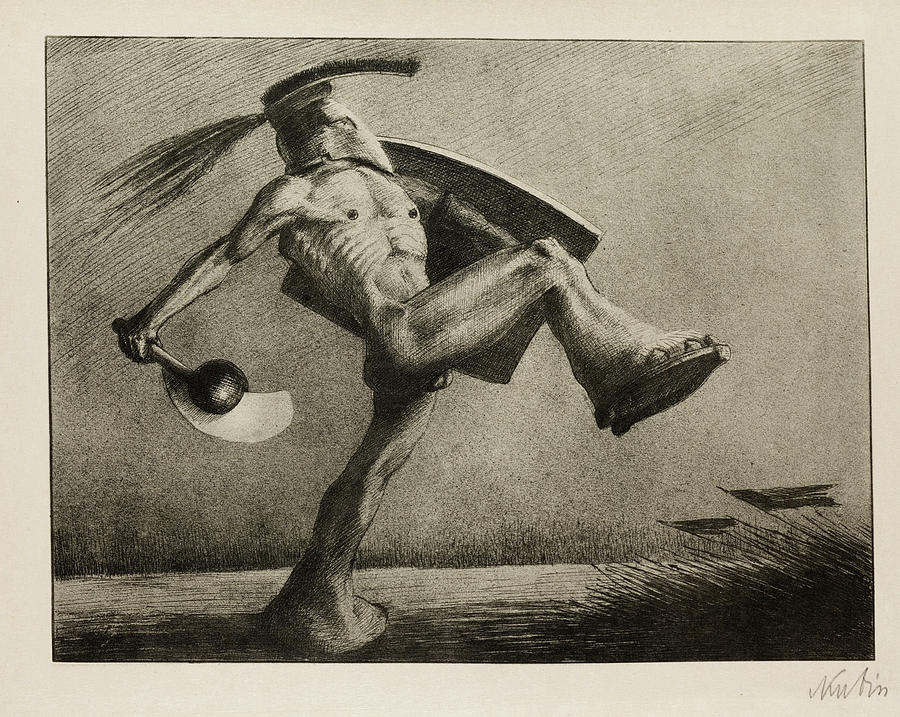
Alfred Kubin (Austrian, 1877–1959), War, 1903
Here’s Taylor’s Prayer of Allegiance to the Prince of Peace:
O Lord, you who deserve all our loyalties, we pledge allegiance this day to the Lamb of God and to the upside-down Kingdom for which he stands, one holy nation under God, the Servant King and the Prince of Peace, with liberty and justice for all without remainder. We pray this in the name of the Holy Trinity. Amen.
+++
NEW ALBUMS:
>> Sorrow’s Got a Hold on Me by Paul Zach: On May 20, singer-songwriter Paul Zachwrote on his Instagram, “My new album of thirteen sad church songs is out today! Many of these songs were written right after one of my weekly EMDR therapy sessions, as I have been working through the sorrow, trauma, and grief of the past few years. I’m learning to bring all of myself to God in prayer and songwriting, which includes my sorrow and anger. I’ve always heard that God shows up in a unique way in times of grief but that has not been my experience. These songs are an invitation for the ‘man of sorrows’ to join me in my grief.”
Zach often writes collaboratively (including as part of the Porter’s Gate! see below), and the cowriters on some of the songs here are Kate Bluett, Latifah Alattas (Page CXVI), Nick Chambers, Orlando Palmer (IAMSON), Jessica Fox, Alex Johnson, and Philip Zach. There are also a few guest vocalists.
>> Climate Vigil Songs by the Porter’s Gate:The Porter’s Gate is a collective of fifty-plus songwriters, musicians, scholars, pastors, and music industry professionals from a variety of Christian worship traditions and cultural backgrounds, making music for churches. This sixth album of theirs, made in partnership with the #ClimateVigil movement, is themed around environmental justice and creation care. Below are videos for “Brother Son (Giving Glory!)” and “Jubilee.”
Besides “Brother Sun,” my favorite tracks are “Satisfied,” a prayer that we would stop seeking to build our wealth (a motive that drives a lot of environmental injustices) and instead be grateful for God’s provision; “The Kingdom Is Coming,” a marchlike call-and-response song that rallies us to pray, wait, and work for an end to creation’s groaning; and “Water to Wine,” which wonders at the miraculous process of planting and growing grapes for harvest. There’s also “All Creatures Lament,” a minor-key arrangement of “All Creatures of Our God and King” with new lyrics that enjoin the animals to mourn habitat loss, air pollution, and other results of humans’ power abuses and irresponsible stewardship.
To learn more about the album, listen to this great interview with Porter’s Gate cofounder and producer Isaac Wardell; it’s from the RESOUNDworship Songwriting Podcast, hosted by Joel Payne. Wardell discusses the vision for Climate Vigil Songs, and especially the difficulty, with thematic albums, of avoiding the pitfalls of being too heavy-handed with the messaging on the one hand, and on the other, being so vague that people don’t see the connection. There’s also a need for tonal balance, and for songs that fill different functions.
We wanted to write for this album at least three different kinds of songs. One kind is essentially songs of lament—songs lamenting the state of creation because of human sin and the brokenness of the world. Secondly, we wanted to write hopeful, you might even call them eschatological, songs—songs that are joyful, that are about this is the world that God has made, this is God’s creative work, this is how God calls us into his creative work. . . . And lastly, we wanted to write mobilization songs—songs that have some kind of an ethical component of calling people to action in some way. . . . We want to make sure the record is not too much of a downer, like all lament songs; we want to make sure that it’s not too much of a happy-clappy “Isn’t creation beautiful!”; and we also don’t want to let it just delve into being a 100 percent political action record. . . . We want to balance those things.
Wardell also talks about the group’s collaborative songwriting approach (including all the theological and editorial work that’s put in), Te Fiti’s stolen (and later, restored) heart in Disney’s Moana, personified nature in the Psalms, creation as an experiencer of the fall and redemption, the role of provocation in church, and biblical imagery he wishes they could have included on the album but had to leave out for length.
+++
POEM + CHORAL SETTING: “when god decided to invent” by E. E. Cummings: “Here’s a brief powerhouse of a poem from E. E. Cummings, two stanzas that draw a sharp distinction between God’s inventive, joyful creativity on the one hand, and our too-frequent turn toward violence on the other. As the mass shootings in Buffalo, Uvalde, and elsewhere continue to reverberate, Cummings’ poem helps us feel and think about what’s at stake – and what the way forward looks like.”
SALT Project reproduces the poem, provides brief commentary, and links to a musical setting by Joshua Shank—a composition for SATB, soprano saxophone, and finger cymbals that premiered in 2005. Shank says the arc of his piece is creation-destruction-recreation. “This final chord is the creator taking control of the creation again.”
+++
RADIO EPISODE: “Belief in Poetry: John Donne”: John Donne (1572–1631) is one of my favorite poets, and looking back on the blog, I can’t believe I’ve not yet featured any of his poems! (I’ll have to rectify that . . .) In this BBC Radio 4 segment from March 13, poet and theologian Pádraig Ó Tuama considers Donne’s complex faith life through his poetry. He speaks with Julie Sanders, professor of English literature and drama at Newcastle University; Mark Oakley, writer and dean of St. John’s College, Cambridge; and Michael Symmons Roberts, poet and professor of poetry at Manchester Metropolitan University. Sir Simon Russell Beale reads the four featured Donne poems: “Death, be not proud” and “Batter my heart, three-person’d God” from his Holy Sonnets series, “Hymn to God, My God, in My Sickness,” and “A Hymn to God the Father.”
Here are two of the quotes that stood out to me:
“It’s easy to think of John Donne’s life falling neatly into two parts: the worldly man, and the spiritual seeker; the lover of women, and the lover of God; Catholic, then Protestant; before Anne, and after Anne; love poet, and religious poet. But life is rarely that clear. And rather, it’s the tension between these dynamics of him that gives birth to so much of his work.”—Pádraig Ó Tuama
“There’s an assumption that a poet working in this territory is sure of their ground and knows what they’re writing about. I don’t think that’s ever true, because why would you write the poems, if that were true? You’d just bathe in your certainty! The whole act of sitting down to write a poem is not to dress up something you already know in a way that makes it an enticing package for other people to be convinced by—and if you attempted that, it’s going to fall like the deadest thing on the page. Making a poem is an exploratory process. You don’t know where it’s going to end when you start it.”—Michael Symmons Roberts
As Luke records in Acts 2, ten days after Jesus ascended to heaven, during the feast of Shavuot, the Holy Spirit manifested as “tongues of fire” and descended on Jesus’s apostles, filling them with power before the multitudes that had gathered. Peter preaches this as a fulfillment of the prophet Joel: “In the last days it will be, God declares, that I will pour out my Spirit upon all flesh, and your sons and your daughters shall prophesy, and your young men shall see visions, and your old men shall dream dreams . . .” (Acts 2:17; cf. Joel 2:28).
As geographically and linguistically diverse pilgrims embraced the good news of Christ that day and carried it back to their homes, God’s Spirit spread throughout the ancient Near East and from there to other parts of the world, such that Christianity is the most global and multicultural religion. The fire that fell that one Sunday in Jerusalem has spread exponentially! First it caught the Twelve, and then some three thousand witnesses, and it’s been burning ever since.
Consider this untitled poem by Theodore Roszak*:
Unless the eye catch fire
     The God will not be seen
Unless the ear catch fire
     The God will not be heard
Unless the tongue catch fire
     The God will not be named
Unless the heart catch fire
     The God will not be loved
Unless the mind catch fire
     The God will not be known
In it the physical senses are ignited, as are the emotions and the intellect. The whole person—body, spirit, and soul—is set on fire. Sounds Pentecostal, no? With echoes of Moses’s meeting God in a burning bush on Mount Horeb (Exod. 2), as revelation is key.
Slowly read each of the five couplets, one at a time, considering how God makes himself known through that faculty. Ponder what it means for the eye to “catch fire,” the ear to catch fire, and so on. What does that image evoke?
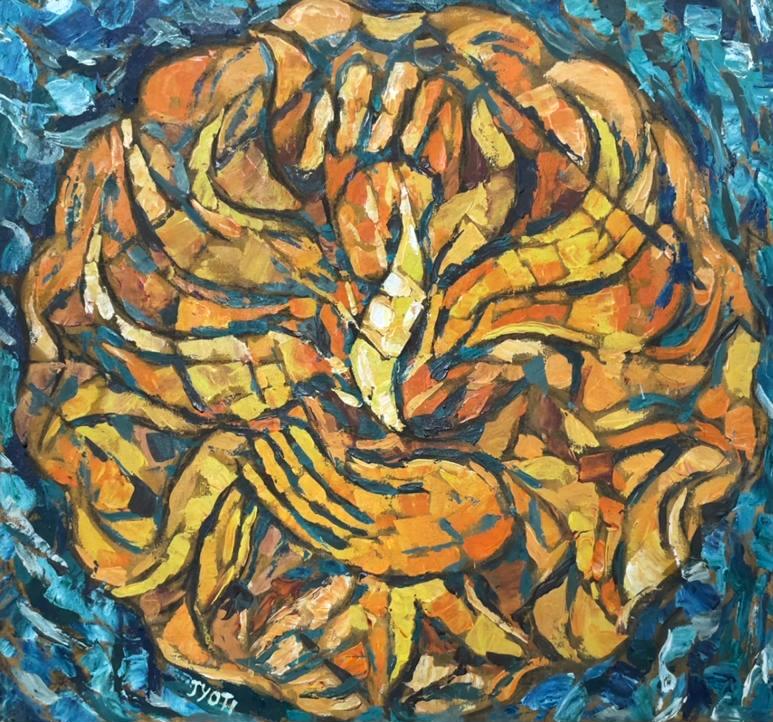
Jyoti Sahi (Indian, 1944–), Holding the Flame of Fire, 2005. Oil on canvas, 36 × 36 in. Painted as a design for a stained glass window for the entrance of Paripurnata Halfway Home in Kolkata, India.
Fire shows up a lot in the work of Indian Christian artist Jyoti Sahi, as in his painting Holding the Flame of Fire, which shows a pair of hands cradling a flame that fans out in bright oranges and yellows, forming a mandala (Sanskrit “circle”). Perhaps you see licking tongues, or dove’s wings, or I AM calling out from a blazing shrub.
This painting was inspired by aarti, a ritual expression of love and gratitude to a deity that originated and is widely practiced in Hinduism but that has been adapted by some Christians in South India. (Sahi demonstrated it to me in a Christian chapel in Bengaluru when I visited him a few years ago.) A lit oil or ghee lamp is placed on a tray, Sahi explains, “where different offerings are arranged representing the senses, such as flowers related to sight, incense sticks in relation to smell, water and fruit in a bowl in relation to taste, and earth and ash in relation to touch.” The priest or householder waves the tray in a clockwise motion, then brings it around from person to person, each of whom cups the flame with their hands and then touches their forehead, seeking divine blessing. Aarti is often accompanied by singing and can be performed at home or in public places of worship.
How awesome is it that the Spirit of God, the living flame, moves among us—even abides within us! The Spirit stirs, illuminates, regenerates, sanctifies, guides, comforts, intercedes, and empowers. What a gift.
* Note on authorship: This poem appears in Where the Wasteland Ends: Politics and Transcendence in Postindustrial Society by Theodore Roszak (Doubleday, 1972) as the epigraph to chapter 9, “Mind on Fire: Notes on Three Old Poets.” While Roszak provides attributions for all the other epigraphs in the book, he does not for this one, leading me to believe that the verse either originated with him or is from an unknown source. It is often misattributed to William Blake—probably because Roszak’s chapter focuses on Blake, in addition to Wordsworth and Goethe—but I confirmed with multiple Blake scholars that these lines are not Blake’s. P. K. Page wrote a short story in 1979 titled “Unless the Eye Catch Fire,” citing Roszak as the title’s source.
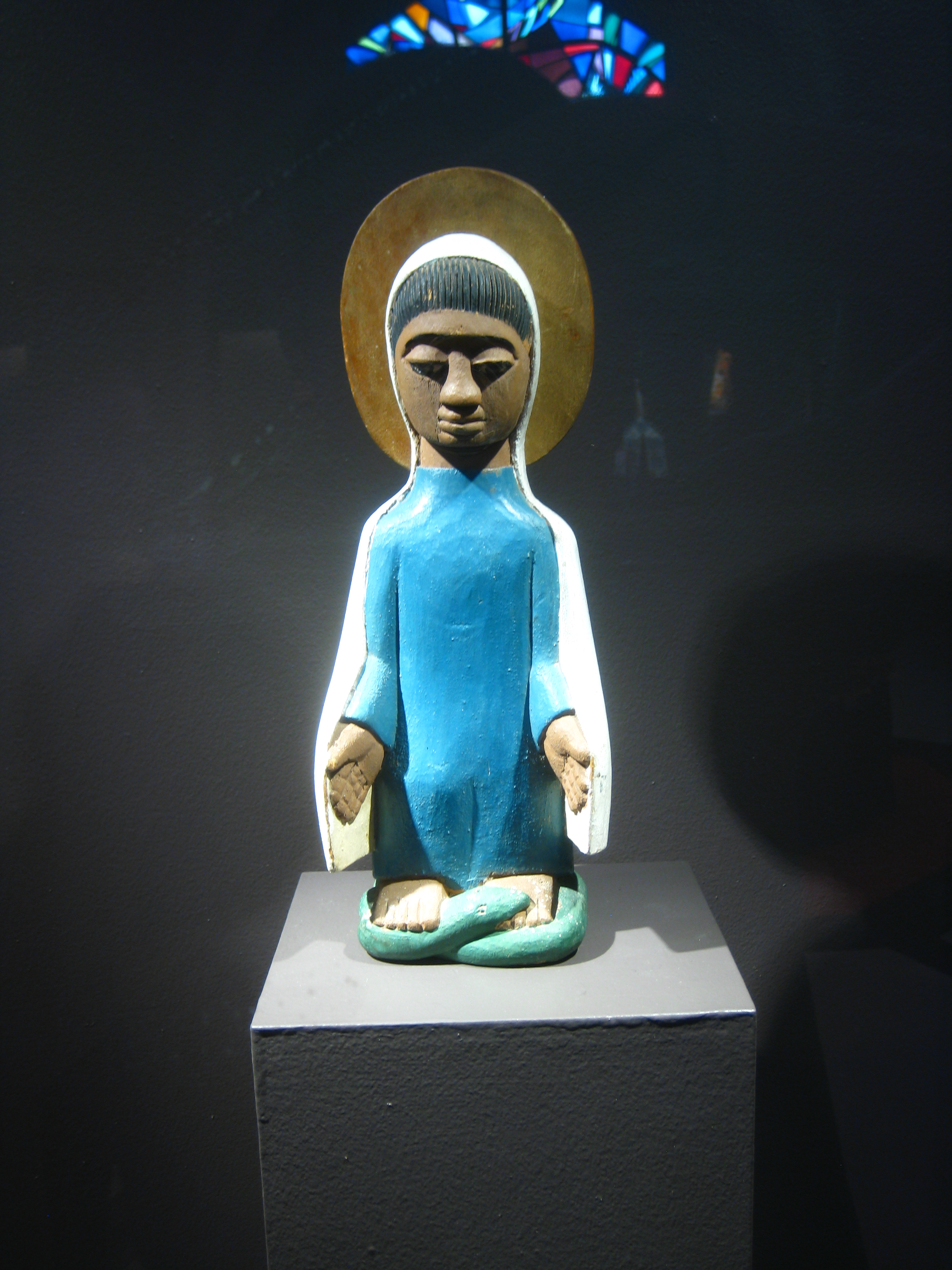
George Bandele (Nigerian, 1910–1995), Virgin Mary, 1960s, wood and pigment. Collection of the SMA African Art Museum, Tenafly, New Jersey. Photo: Victoria Emily Jones.
With the feast of the Visitation coming up on May 31, I’ve been thinking about the song Mary sings in Luke 1:46–55 upon meeting up with her cousin Elizabeth in the hill country of Judea following their miraculous conceptions. It’s bold, exultant, and worshipful, oriented around the liberative power of God. As we continue to reel from the string of mass shootings in the US (Tuesday’s shooting at Robb Elementary School in Uvalde, Texas, was the 212th this year alone), I wonder how Mary’s song might speak to us in this moment—how we, too, might exclaim it with her same fervor and hope, truly believing that God is at work in the world, bringing about justice and healing, even though it is injustice and hurt that so often sound the loudest.
Here is a modern interpretation of the Magnificat by Rev. M Barclay, cofounder and director of enfleshed, an organization that creates prayers, liturgies, art, meditations, teachings, and other spiritual resources for collective liberation. Written in 2019, it captures the verve of Mary’s words while also drawing out shades of sorrow and adding a petitionary element. Barclay uses the gender-neutral pronoun “They” for the Triune God.
My soul is alive with thoughts of God. What a wonder, Their liberating works. Though the world has been harsh to me, God has shown me kindness, seen my worth, and called me to courage. Surely, those who come after me will call me blessed. Even when my heart weighs heavy with grief, still, so does hope abide with me. Holy is the One who makes it so. From generation to generation, Love’s Mercy is freely handed out; none are beyond the borders of God’s transforming compassion. The power of God is revealed among those who labor for justice. They humble the arrogant. They turn unjust thrones into dust. Their Wisdom is revealed in the lives and truths of those on the margins. God is a feast for the hungry. God is the great redistributor of wealth and resources. God is the ceasing of excessive and destructive production that all the earth might rest. Through exiles and enslavement, famines and wars, hurricanes and gun violence, God is a companion in loss, a deliverer from evil, a lover whose touch restores. This is the promise They made to my ancestors, to me, to all the creatures and creations, now and yet coming, and in this promise, I find my strength. Come, Great Healer, and be with us.
Sessions are free and open to the public and will not be livestreamed (and the conversations require advance registration):
June 4, 7–9pm: Live Concert (Seattle, WA)
June 5, 9:45–11am: Worship Service (Normandy Park, WA)
June 5, 7–9:30pm: A Conversation on: Faith and the Arts (Seattle, WA)
June 6, 6:30–8:30pm: A Conversation on: Faith and Technology (Bellevue, WA)
June 7, 7–9pm: A Conversation on: Faith and Work (Seattle, WA)
Guite and Bell have been collaborating for years. Below are two snippets of them performing together. In the first video Guite comedically performs (to rhythmic accompaniment!) a villanelle he wrote in response to something a woman who worked at the venue of one of his poetry talks exasperatedly said to him when his hurried photocopying caused a paper jam. The second video showcases a sonnet by Guite on the baptism of Christ, from his collection Sounding theSeasons: Seventy Sonnets for the Christian Year, and the song that Bell adapted it into, released on Keening for the Dawn.
+++
ESSAY: “The Listening Heart: Corita Kent’s Reforming Vision” by Michael Wright:Corita Kent (1918–1986) [previously] was an American pop artist who was also, for over three decades, a nun. Michael Wright writes about how “she became interested not just in depicting scenes from the Bible but answering this: what might happen if a Christian imagination engaged the world around us through the arts? That art might look less like an illustration from a children’s Bible and more like exploring seeing the stuff of life—even a bread bag—as dialogue partners with mysteries of faith.” wonderbread is one of four works he discusses—“a playful meditation on sacred time, wonder, and communion.”
Corita Kent (American, 1918–1986), wonderbread, 1962. Serigraph, 25 1/2 × 30 1/2 in.
While I do think even Kent’s biblical artworks push the genre of religious art forward, I appreciate how Wright challenges Christians to give a chance to her works that are less straightforwardly religious, as these are often the most imaginative and profound. And they, too, are “deeply Christian work.” Let’s not think so narrowly about what “Christian art” must look like!
+++
LIVING PRAYER PERIODICAL: Pentecost 2022: One of the organizations I work for is the Daily Prayer Project [previously], which publishes seven ecumenical Christian prayer periodicals a year, structured around the liturgical calendar. I do the curation for the Gallery section, which comprises three art images with written reflections, and the editing. Our latest edition covers June 5 (the feast of Pentecost) through August 6, and it includes prayers from India, Japan, Korea, Algeria, Italy, the Choctow Nation, and more. I’m excited to feature on the cover Corita Kent’s word picture: gift of tongues! As many of her screenprints do, it integrates image and text—in this case Acts 2:1–2a, which sprawls out through the sky and onto a billowing banner, like a sail, over a crowd of people aflame with the fire of the newly descended Spirit of God.
On the website there are options for one-time purchase or group subscription, and for digital only or print and digital.
+++
PRAYER: “The Lord’s Prayer, Extended Dance Mix” by Nadia Bolz-Weber: In March, actor Jennifer Garner asked Lutheran pastor and author Nadia Bolz-Weber if she could offer a prayer and a benediction on her InstaLive. Bolz-Weber vamped on the traditional words of the Lord’s Prayer, the text of which you can read at the boldface link.
One of the things I appreciate about Bolz-Weber’s spiritual teaching is her avoidance of clichés. She gives fresh language to the experiences of faith and life in general and to theology, which often reawakens me to the beauty of God and of Christ’s gospel. Describing why she regularly turns to prayer, she says in the Instagram video:
When I don’t have enough—like if I don’t have enough patience, if I don’t have enough compassion for myself or other people, when I don’t have enough resources—prayer is this way in which I can remind myself that there is enough. That I have a connection to my own divine source. I have a connection to God. And in the heart of God there’s enough forgiveness when I don’t have enough. In the heart of God there’s enough compassion when I don’t have enough. And so for me, it’s about reminding myself of that connection.
+++
SONG: “Dry Bones” by Gregory Porter: From Gregory Porter’s 2021 album Still Rising, this song was inspired by Ezekiel 37. The official music video features dancing skeletons in yellow cowboy boots(!), animated by L’Incroyable Studio. The song’s bridge quotes the African American spiritual “Dem Bones.”
The first verse goes,
I won’t die, won’t bury, won’t sink ’Cause love is the spirit I drink I’ll be free in the morning light ’Cause your touch is the medicine of life There’s a dance to this beat, let’s shake Every move—feel my body awake There’s a sound—you and me are one And your hope is the rhythm I drum
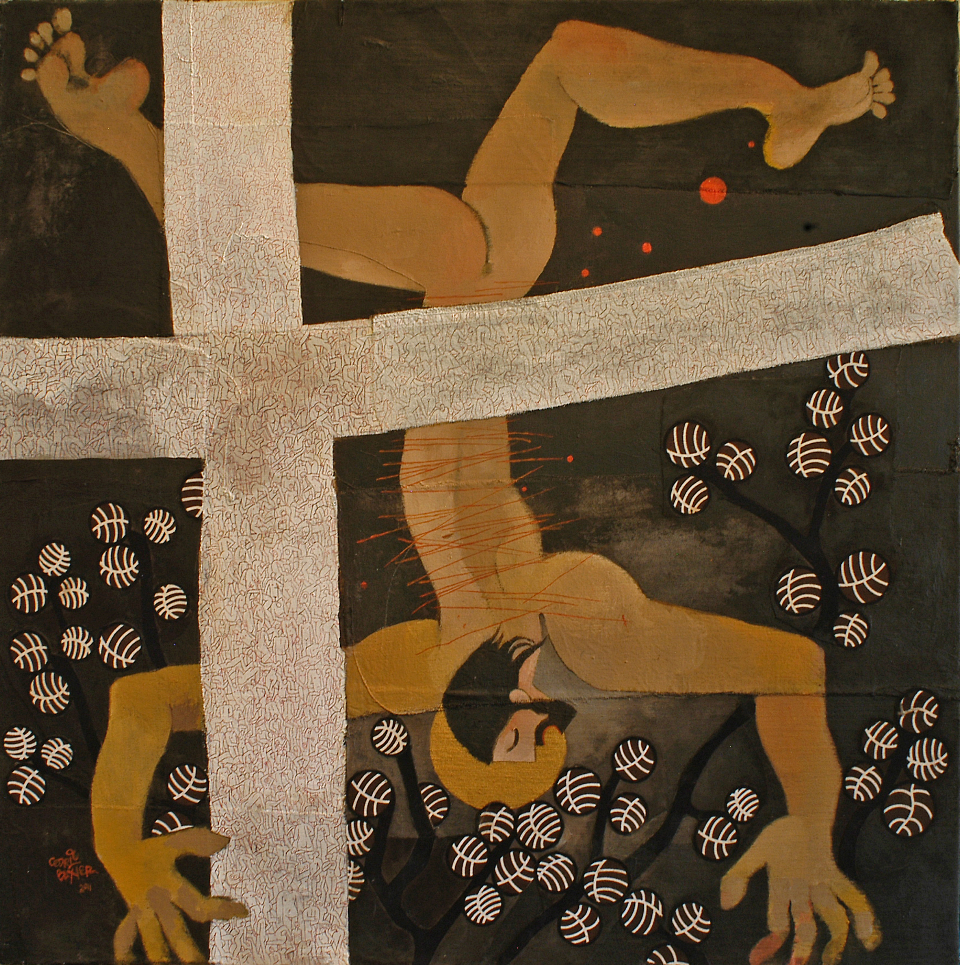
Cedric Baxter (Australian, 1930–), Jesus Striped and Stripped, 2011. Acrylic, collage, and pen on canvas, 91 × 91 cm. Collection of the Uniting Church in Australia. [learn more]
Christ came juggling from the tomb,
flipping and bouncing death’s stone pages,
tossing those narrow letters high
against the roots of dawn spread in cloud.
This Jesus, clown, came dancing
in the dust of Judea, each slapping step
a new blossom spiked with joy.

Hey! Listen—that chuckle in the dark,
that clean blast of laughter behind—
Christ comes juggling our tombs,
tossing them high and higher yet,
until they hit the sun and break open
and we fall out, dancing and juggling
our griefs like sizzling balls of light.
This poem is from Christographia by Eugene Warren (St. Louis, MO: The Cauldron Press, 1977), a chapbook of thirty-two numbered poems that “attempt to express personal views of, & perspectives on, Christ.”The book’s title comes from a series of sermons by the Puritan poet and preacher Edward Taylor.
Gene Warren Doty (1941–2015) was an American poet in the Anabaptist tradition who taught in the English department of Missouri S&T for forty-two years. Throughout his career he explored a variety of non-Western poetic forms, including haiku, renga, tanka, sijo, and ghazals. He is the author of seven books of poetry: Christographia, Rumors of Light, Geometries of Light, Fishing at Easter, Similitudes, Nose to Nose, and Zero: Thirty Ghazals. Until 1988 his books and poems were signed “Eugene Warren,” Warren being the surname of his adoptive father, George, who raised him; but from 1988 onward he used the surname of his biological father, Floyd Doty.







 Art & Theology