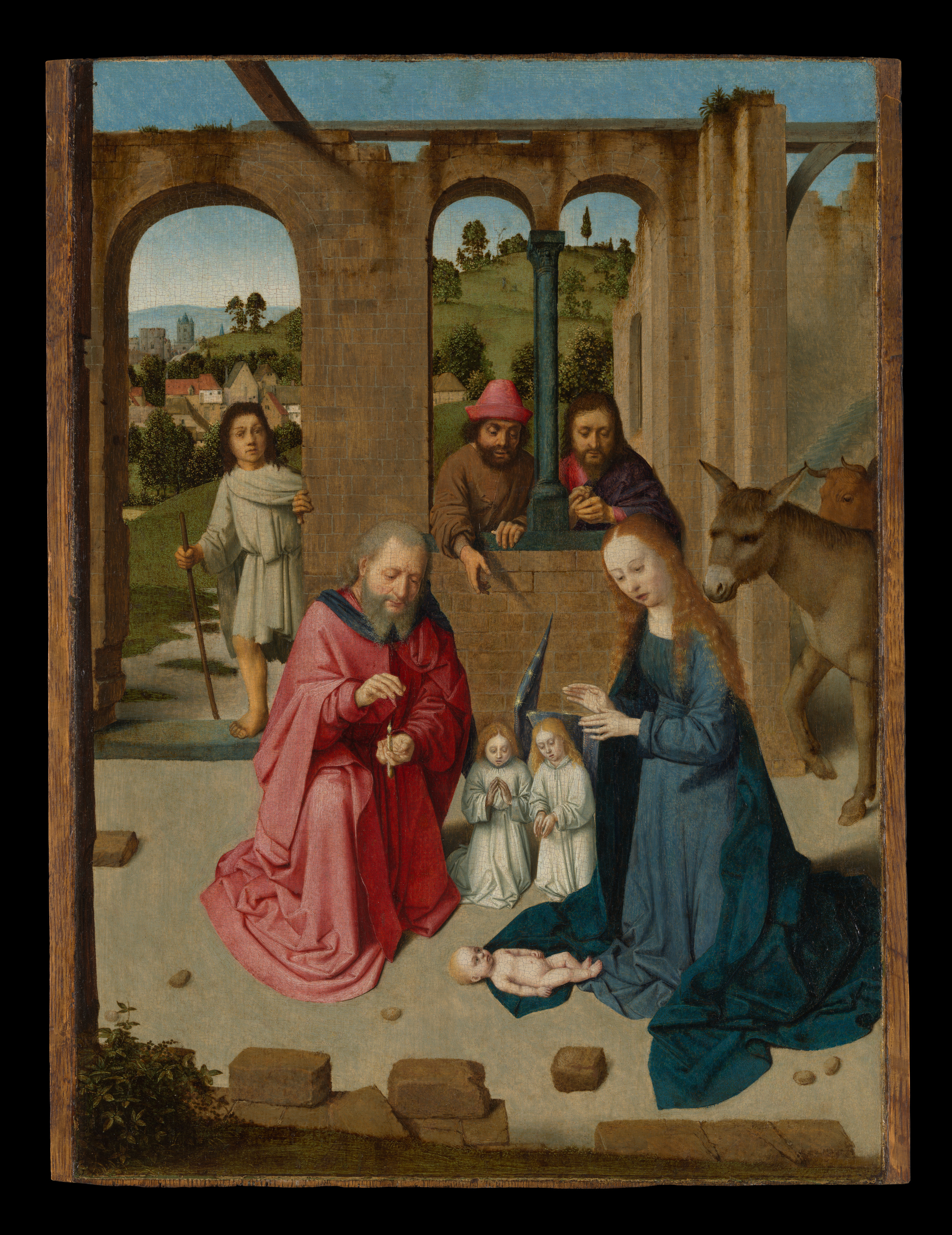
Gerard David (Netherlandish, ca. 1455–1523), The Nativity, early 1480s. Oil on wood, 18 3/4 × 13 1/2 in. (47.6 × 34.3 cm). Metropolitan Museum of Art, New York.
LISTEN: “Where Is This Stupendous Stranger” | Words by Christopher Smart, 1765 | Music by Linda L. Hanson, 2012 | Performed by Fire (women’s a cappella chamber ensemble), 2020
Where is this stupendous Stranger? Prophets, shepherds, kings, advise! Lead me to my Master’s manger, Show me where my Savior lies.
O most mighty, O most holy, Far beyond the seraph’s thought, Are you then so mean and lowly As unheeded prophets taught?
O the magnitude of meekness, Worth from worth immortal sprung! O the strength of infant weakness, If eternal is so young!
God all-bounteous, all-creative, Whom no ills from good dissuade, You have come to be a native Of the very world you made.
The four verses of this Christmas hymn are excerpted from a nine-stanza poem by Christopher Smart [previously] published in Hymns and Spiritual Songs for the Fasts and Festivals of the Church of England (London, 1765). The poem was recovered in the twentieth century and since then has received multiple new musical settings—by composers such as I-to Loh, Charles Heaton, Conrad Susa, Joan A. Fyock, Leo Nestor, Alec Wyton, Thomas Gibbs Jr., Scott M. Hyslop, and Jacques Cohen—as well as pairings with older tunes.
My favorite setting of the text is by Linda L. Hanson, the founding director of Fire, a women’s a cappella chamber ensemble in Charlottesville, Virginia. The group performs the hymn in the video above, which Fire member Mary Welby von Thelen spliced together from thirteen solitary recordings during the COVID-19 pandemic. Hanson is in the top row, the third from the left.
The alliterative opening line of the hymn asks where the “stupendous Stranger” can be found—the divine one sent from heaven. Stupendous isn’t an adjective we use often. It means “causing astonishment or wonder: awesome, marvelous.” The poetic speaker begs the prophets, shepherds, and magi to divulge the location of the Christ child so that he can go and worship him.
The next two stanzas marvel at the paradoxes of the Incarnation—how Christ is “mighty” and “holy,” beyond the comprehension of even the angels, and yet “mean” (humble) and “lowly,” lying here in the dirt before us, visible, tangible, vulnerable, no longer far above us but in our very midst. What “magnitude of meekness,” what “strength of infant weakness.” The eternal one is born in time.
The omnibenevolent Creator has deigned to become part of his creation. No potential ill that he will suffer as a result—and he will suffer many and grievous ills, culminating in death by crucifixion—can deter him from making his beloved earth his home.
Hanson has generously allowed me to share the sheet music of “Where Is This Stupendous Stranger,” and says the hymn can be freely used by local church congregations. Anything outside that context will require her permission.
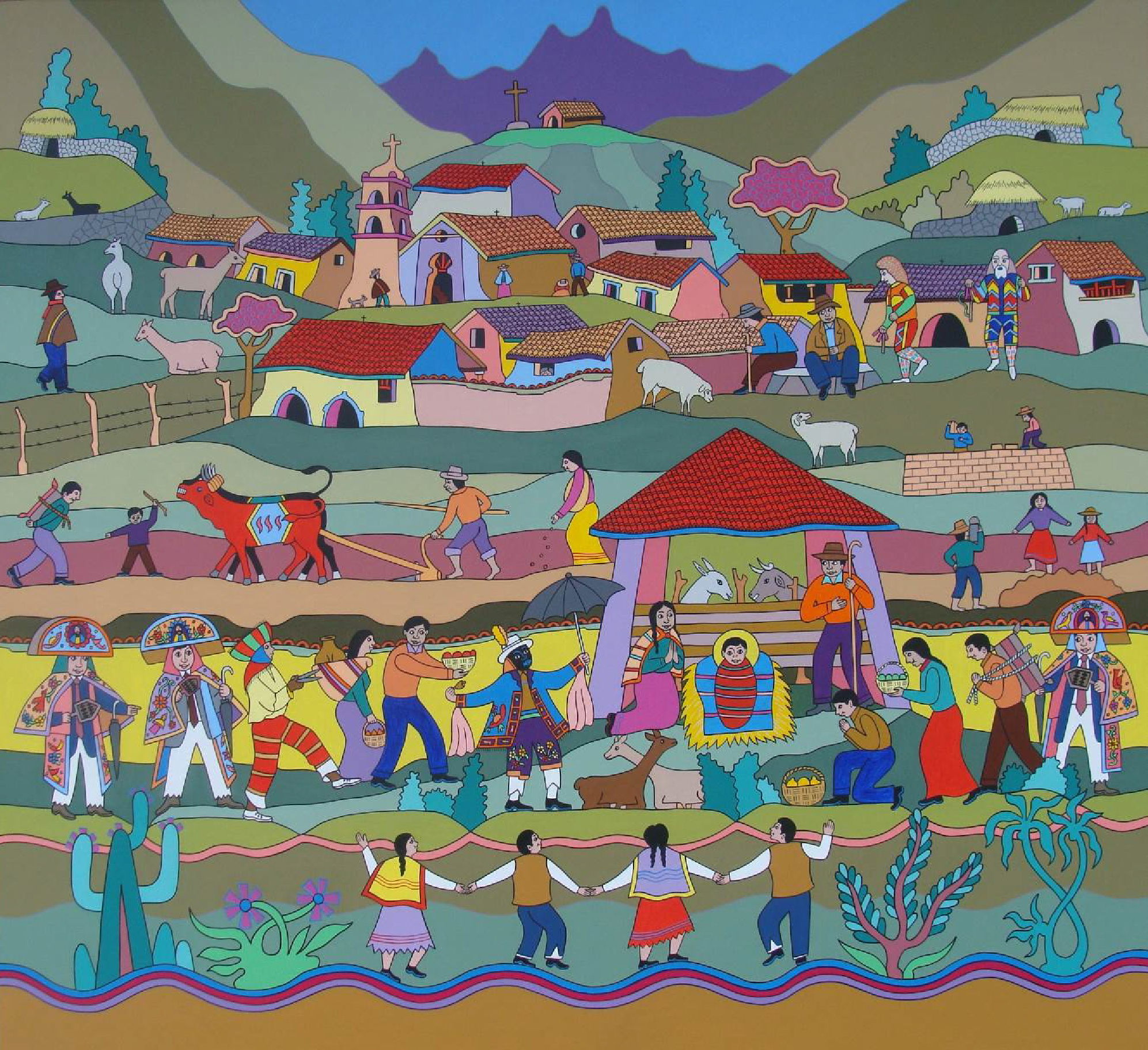
Josué Sánchez Cerrón (Peruvian, 1945–), Navidad en los Andes (Christmas in the Andes)
The Word, for our sake, became poverty clothed as the poor who live off the refuse heap.

The Word, for our sake, became agony in the shrunken breast of the woman grown old by the absence of her murdered husband.

The Word, for our sake, became a sob a thousand times stifled in the immovable mouth of the child who died from hunger.

The Word, for our sake, became rebellion before the lifeless body of Gaspar Sanchez Toma, “scientifically” murdered.

The Word, for our sake, became danger in the anguish of the mother who worries about her son growing into manhood.

The Word became an ever-present absence among the 70,000 families torn apart by death.

The Word, for our sake, became an inexorable accusation arising from the blazing craters which swallowed up their tortured bodies.

The word-knife cut us deeply in that place of shame: the painful reality of the poor.

The Word blew its spirit over the dried bones of the Mummified-Churches, guardians of silence.

The Word, that early-morning-bugle, awoke us from the lethargy which had robbed us of our Hope.

The Word became a path in the jungle, a decision on the farm, love in women, unity among workers,
and a Star for those few who can inspire dreams.

The Word became Light,
The Word became History,
The Word became Conflict,
The Word became Indomitable Spirit,
and sowed its seeds
upon the mountain,
near the river, and in the valley,

and those-of-good-will heard the angels sing.

Tired knees were strengthened,
trembling hands were stilled,
and the people who wandered in darkness
saw the light!

Then,

The Word became flesh in a nation-pregnant-with-freedom,
The Spirit strengthened the arms which forged Hope,
The Verb became flesh in the people who perceived a new day, and for our sake became life in Mary and Joseph who embrace Righteousness and bury the people’s ignominy.

The Word became the seed-of-justice
and we conceived peace.

The Word cried out to the world the truth about the struggle against the anti-man.

The Word made justice to rain
and peace came forth from the furrows in the land.

And we saw its glory in the eyes of the poor converted into true men and women.

Grace and Truth celebrated together
in the laughter of the children rescued by life.

And those-who-saw-the-star
opened up for us
the path we now follow.

Meanwhile,
Herod, slowly dying,
is eaten by worms.

The Word became judgment
and the anti-men ground their teeth.

The Word became forgiveness
and human hearts
learned to beat with love.

And the Word shall continue sowing futures
in the furrows of Hope.

And on the horizon,
the Word made light
invited us to relive a thousand dawns
toward the Kingdom that comes.

The Word will gather us round her table.
And they will come from the East and the West,
from the North and the South,
and dressed in incorruption
we-will-finally-be-happy.
Translated from the Spanish by Maria Elena Acevedo, René Calderón, Maria Elena Caracheo, Sister Caridad Inda, and Philip Wheaton in the bilingual Threatened with Resurrection / Amenazado de Resurreción: Prayers and Poems from an Exiled Guatemalan (The Brethren Press, 1982).
Julia Esquivel (1930–2019) was a Guatemalan poet, theologian, lay preacher, biblical studies teacher, social worker, and human rights activist. In 1953 she moved to Costa Rica to study at the Seminario Biblico Latinoamericano, returning to Guatemala to work at the Instituto Evangélico América Latina. After speaking out against the massacres, assassinations, torture, and forced disappearances being carried out by the Guatemalan military and police, she received death threats and survived two kidnapping attempts and thus went into forced exile in 1980, finding refuge in the monastic Communauté de Grandchamp in Switzerland. She studied at the Ecumenical Institute at Château de Bossey, run by the World Council of Churches. She returned to her home country in 1996 after the signing of the Peace Accords, helping document over two hundred thousand civilian deaths and disappearances for the Recovery of Historical Memory Project and working with women traumatized by violence. She is the author of several books, including the poetry collections Threatened with Resurrection (1982) and The Certainty of Spring (1993).
POEM SERIES: “Twelve Days of Advent” by Kate Bluett: This year on her blog, writer Kate Bluett [previously] is publishing a series of original metrical verses based loosely on the cumulative song “The Twelve Days of Christmas.” She calls it the Twelve Days of Advent and through it explores the theology of Christ’s coming. I love this creative, sacred spin on the popular seasonal ditty! Here’s where the series currently stands (my favorite poems are in boldface):
“A Partridge in a Pear Tree”: Bluett imagines, in the tree of the knowledge of good and evil, a bird singing (representing, as I take it, God’s word), but Adam and Eve heed not his song, and, taking the tree’s forbidden fruit, find themselves exiled. The bird weeps for the alienation of his two friends, and wings his way east of Eden, into the home of a young maiden, a daughter of Eve, who receives him, shelters him, an act that leads to restoration. Bluett uses some of the language of late medieval English folksong, such as “with a low, low, my love, my love” and “welaway.”
“Four Calling Birds”: This poem is brilliant. In it the four matriarchs in Jesus’s genealogy speak to Mary, tenderly calling her “Child” and rejoicing in her “bringing forth our life’s tomorrow.” Tamar, Rahab, Ruth, Bathsheba—they’ve long awaited redemption, and now they’re at its threshold. Mary’s yes to God’s call “set[s] [their] dry bones stirring, thrumming / with a hope [they’d] hardly dared.” They inform her that her vocation will involve great suffering (as we know, she’ll experience the brutal death of her son)—but her willingness to give up her son to the cross, to endure that rupture, will mean new life for the world.
“Six Geese a-Laying”: Picking up the Isaianic language of the wilderness being made glad, the poetic speaker sings an eschatological vision of flocks coming home to “the orchard of the rood” (rood = cross) to lay and hatch eggs in nests once empty, now brimming with life.
SUBSTACK SERIES: “Art + Advent 2025” by Elissa Yukiko Weichbrodt: The art historian Elissa Yukiko Weichbrodt [previously], author of Redeeming Vision and the Loving Look Substack, is one of my favorite writers. This Advent she is writing a weekly series of art reflections centered on the themes of hope, peace, joy, and love.
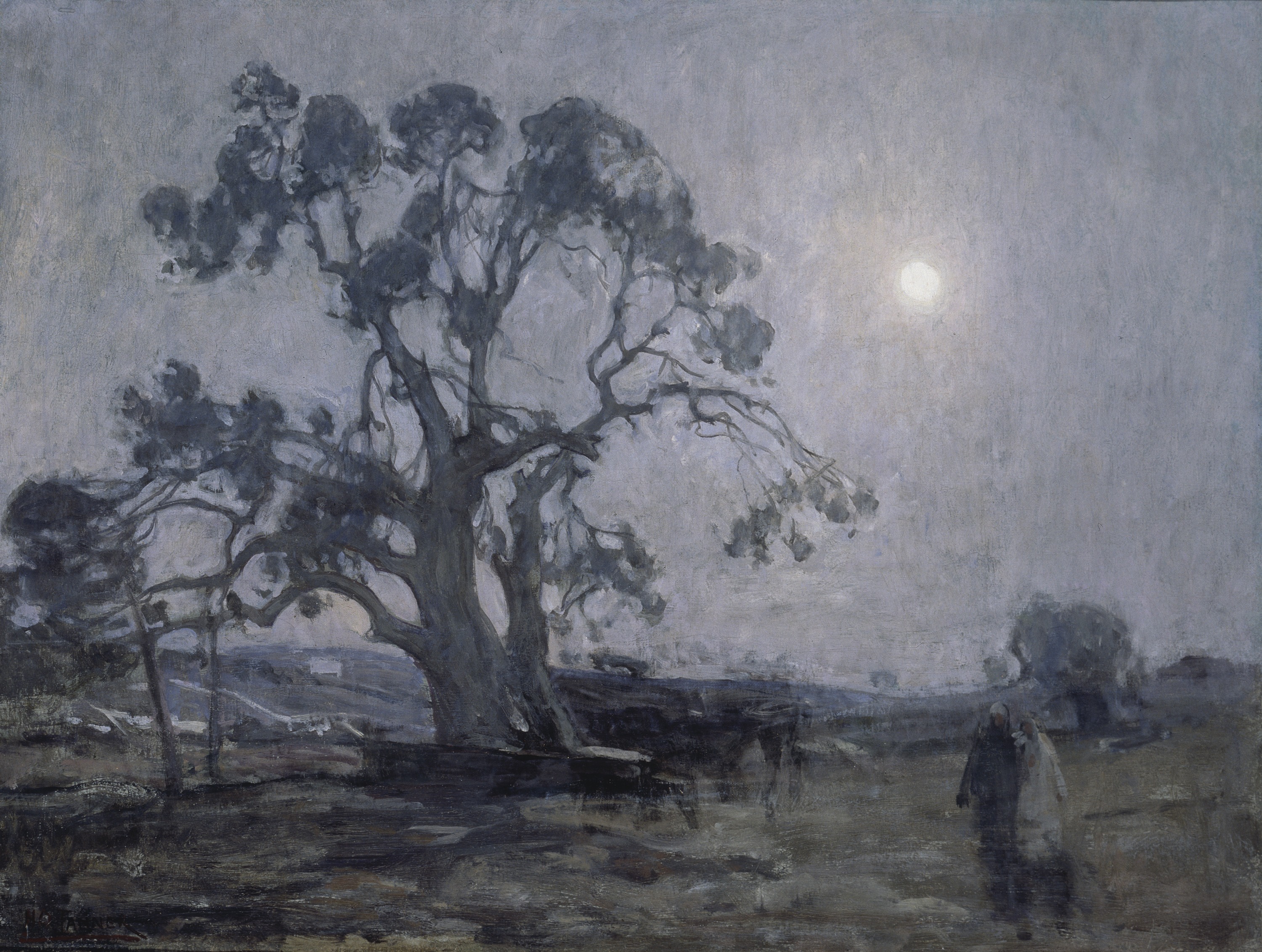
>> “Week 1 // Hope: Abraham’s Oak and Sarah’s Laughter”: Looking at Henry Ossawa Tanner’s painting Abraham’s Oak, Weichbrodt writes about shadowy promise. She also considers, with reference to an early Byzantine mosaic of the Hospitality of Abraham, how to hope again after being wounded, as Sarah did, is a vulnerable thing. “As Advent begins, I find myself peering into a Tanner-like mist, seeing the dim outline of longed-for goodness taking shape in the distance. Sometimes I’m full of hope, but I’m also, like Sarah, sometimes full of armored laughter.”
Henry Ossawa Tanner (American, 1859–1937), Abraham’s Oak, 1905. Oil on canvas, 21 3/8 × 28 5/8 in. (54.4 × 72.8 cm). Smithsonian American Art Museum, Washington, DC.
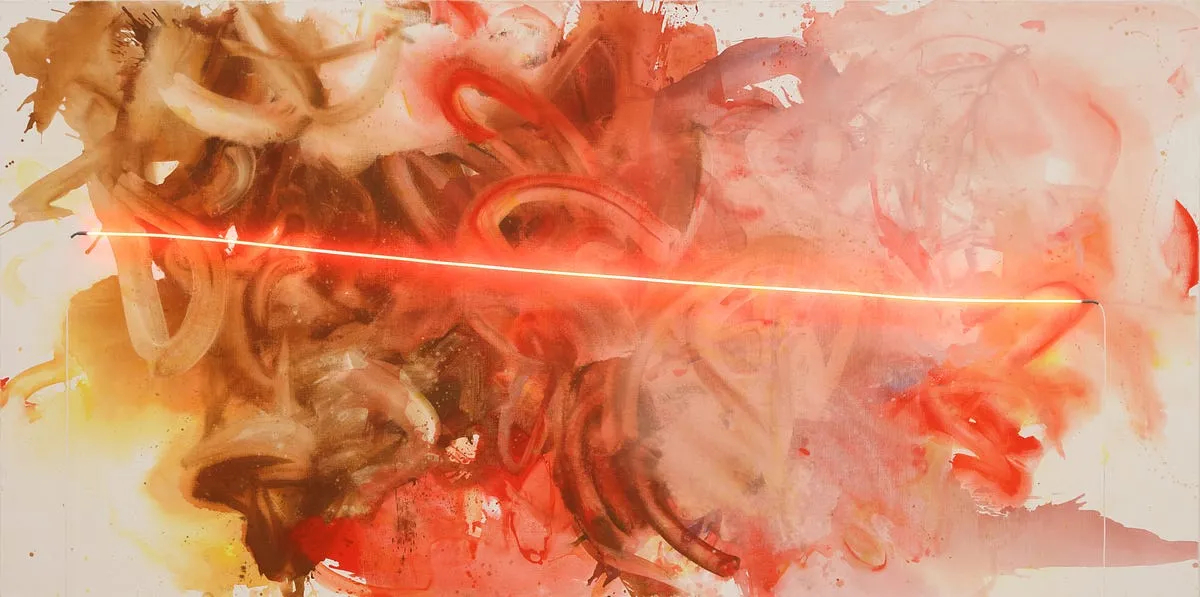
>> “Week 2 // Peace: A Stitch Pulling Tight”: “How do we do repair work in a fraying world with our own, fraying selves? What thread can stitch together all these gaping wounds?” Weichbrodt asks. She looks at Mary Weatherford’s monumental painting Gloria (new to me!), finding in the hot coral neon light blazing across the canvas resonance with Renaissance paintings of the Annunciation, which portray the Light of the World as the stitch that mends the tear between God and humanity.
Mary Weatherford (American, 1963–), Gloria, 2018. Flashe paint and neon on linen, 117 × 234 in. (297.2 × 594.4 cm). High Museum of Art, Atlanta.
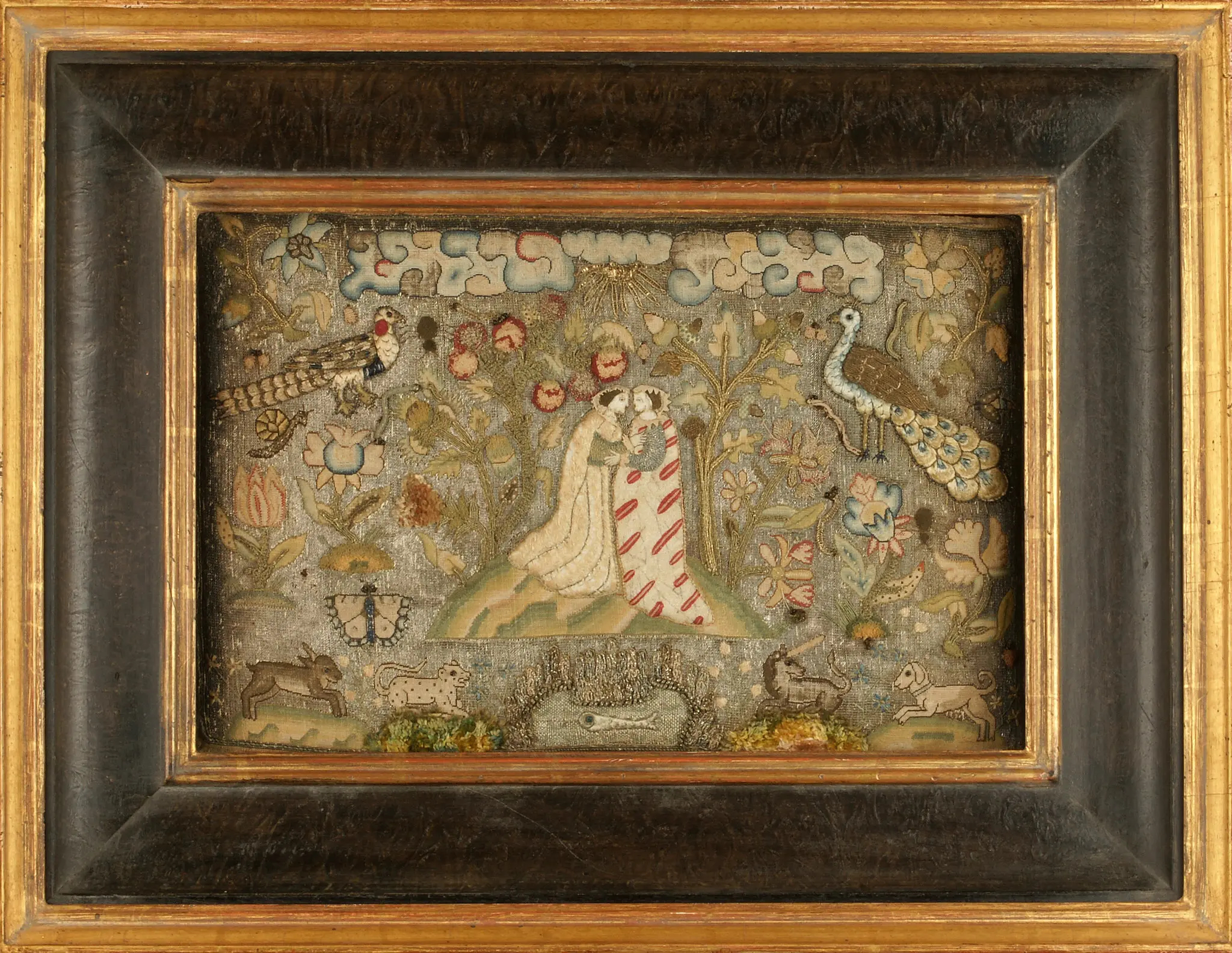
>> “Week 3 // Joy: Far as the Curse Is Found”: In this post, Weichbrodt explores nine Visitation paintings and one extraordinary embroidery. “Every time I see [a Visitation artwork],” Weichbrodt writes, “I encounter joy. It’s not that Mary and Elizabeth are always smiling. Often, their expressions are quite serious. But joy—deep, sustained, sustaining joy—circulates between them like an electrical current.” Justice, threshold, and fecundity are among the supplementary themes touched on.
The Visitation, England, first half of 17th century. Embroidery, 44.1 × 57 cm (framed). Ashmolean Museum, University of Oxford.
Weichbrodt’s final Advent 2025 post, on love, will be published this Saturday. Weichbrodt’s final Advent 2025 post, on love, will be published this Saturday. (Update, 12/20/25: Week 4’s post, “Love In Between,” is now published. It centers on Vincent van Gogh’s painting Almond Blossoms, a gift for his newborn nephew, but also spends time with a Nativity mosaic by Pietro Cavallini and a Nativity painting by Gerard David.)
+++
SONGS:
Here are four newly released Christmas songs of note: two originals, one lyrical adaptation of a classic, and a new arrangement.
>> “War on Christmas” by Seryn:Seryn’s new album is titled War on Christmas. Here’s the title track:
The refrain is:
There is a war on Christmas But it’s not the one you think It’s in the news, it’s out of mind It happens overseas Cause as we sing the hymns and songs With families by our sides There is a war on Christmas Someone’s fighting to survive
“War on Christmas” is a phrase some Christian conservatives in the US use to express their feeling of having their faith traditions attacked by the sinister forces of pluralism when people or signage greet them with a generic “Happy Holidays” instead of “Merry Christmas.” I roll my eyes big-time when I hear people complain about this, because it’s ridiculous for any American to assert that they are impeded from or ostracized for celebrating Christmas in this country, or to take offense that a stranger does not automatically assume their particular religious affiliation.
Seryn’s song affirms that yes, there is a war on Christmas—only it’s a war not against personal religious freedoms in America but against peace, love, and the other values Christ came to teach and embody. When humans wage literal wars with literal weapons, killing and maiming each other and inducing mass terror—that’s an assault against Christ’s mass, with its message of welcome and reconciliation. So, too, when we perpetuate hate, whether on personal, national, or global scales. As another Christmas song puts it, “Hate is strong and mocks the song of ‘Peace on earth, goodwill to men.’”
>> “O New Commingling! O Strange Conjunction!” by the Anachronists: The lyrics to this new song by the Anachronists [previously]—Corey Janz, Andrés Pérez González, and Jonathan Lipps—are a paraphrase from the sermon “On the Theophany, or Birthday of Christ” by Gregory of Nazianzus (ca. 329–390), one of the most influential and poetic theologians of the early church. Gregory delivered the sermon, labeled “Oration 38” in the Nicene and Post-Nicene Fathers series, at Christmastime in 380 in Constantinople, where he served as bishop. In section 13, the Anachronists’ source for the song, he expresses awe at the beautiful mystery of the Incarnation. Below is an excerpt from the public-domain NPNF translation.
The Word of God Himself—Who is before all worlds, the Invisible, the Incomprehensible, the Bodiless, Beginning of Beginning, the Light of Light, the Source of Life and Immortality, the Image of the Archetypal Beauty, the immovable Seal, the unchangeable Image, the Father’s Definition and Word—came to His own Image, and took on Him flesh for the sake of our flesh, and mingled Himself with an intelligent soul for my soul’s sake, purifying like by like; and in all points except sin was made man. . . . O new commingling; O strange conjunction; the Self-Existent comes into being, the Uncreate is created, That which cannot be contained is contained. . . . He Who gives riches becomes poor, for He assumes the poverty of my flesh, that I may assume the richness of His Godhead. He that is full empties Himself, for He empties Himself of His glory for a short while, that I may have a share in His fullness. What is the riches of His goodness? What is this mystery that is around me? I had a share in the image; I did not keep it; He partakes of my flesh that He may both save the image and make the flesh immortal. He communicates a second Communion far more marvelous than the first.
>> “Away in a Manger (Then to Calvary)” by Sarah Sparks: Singer-songwriter Sarah Sparks [previously] released a new EP, Christmas Hymns, last month, comprising five classic carols, including one with revised lyrics that further draw out the significance of the Incarnation. I’m a big fan of Sparks’s voice and her no-frills acoustic style.
Away in the manger No crib for a bed The great King of Heaven Does lay down his head The stars he created Look down where he lay The little Lord Jesus Asleep on the hay
And there in the manger The Maker of earth In riches and glory? No, born in the dirt With oxen and cattle With shepherds and sheep No stranger to weakness He loves even me
And there in the manger Is our Servant-King He sits with the lowly He washes their feet Away in the manger Then to Calvary His birth, life, and death And his raising for me
And there in the manger Is my greatest friend His mercy, his patience His grace know no end Be near me, Lord Jesus For all of my days In life and in death Till we meet face to face
>> “Angels We Have Heard on High” by the Petersens: Last Friday the Petersens [previously] released a music video—shot at Wonderland Tree Farm in Pea Ridge, Arkansas—debuting their new bluegrass arrangement of one of my favorite Christmas carols. Banjo, mandolin, fiddle, acoustic guitar, dobro, upright bass—I love the instrumentation of the bluegrass genre and what it adds here, and the Petersens are consummate performers.
Natalya Rusetska (Ukrainian, 1984–), Nativity, 2016. Tempera on gessoed wood, 17.5 × 15.5 cm.
Gravity’s maker, spinner of spheres and spiraling matter,
made into weight, to sweat. His own feet vulnerable,
drawn flat and close against the punishing ground.

Star-strayed infant, wrapped in weight, heavy heaven.
In the hollow of the years, long and narrow as a well,
he waits suspended, bucket-drawn, clapper in a bell.

Ringing and ringing in the heatfolds of gravity, lines and lines
of weight leaning us into each other, caught up, tumbled
open-face roses in a blue bolt of thorn-pricked cloth.

God made known, fleshly God, Godlight bodied, bleeding
out into wood, over stone. God from God, telluric God,
shadowcast God, lightstricken God, bloodwritten. The pull

electric of low, deep center. God flesh, corpus God, Verbum
corpse, light-riven. Inscribed, blooded, God-heft falling death-
bitten into weighted rising, made and given; the miracle of leaven.
LeighAnna Schesser is a Catholic writer from south-central Kansas whose poetry collections include Struck Dumb with Singing (2020) and Heartland (2016).
Watch therefore: for ye know not what hour your Lord doth come.
—Matthew 24:42 (KJV)
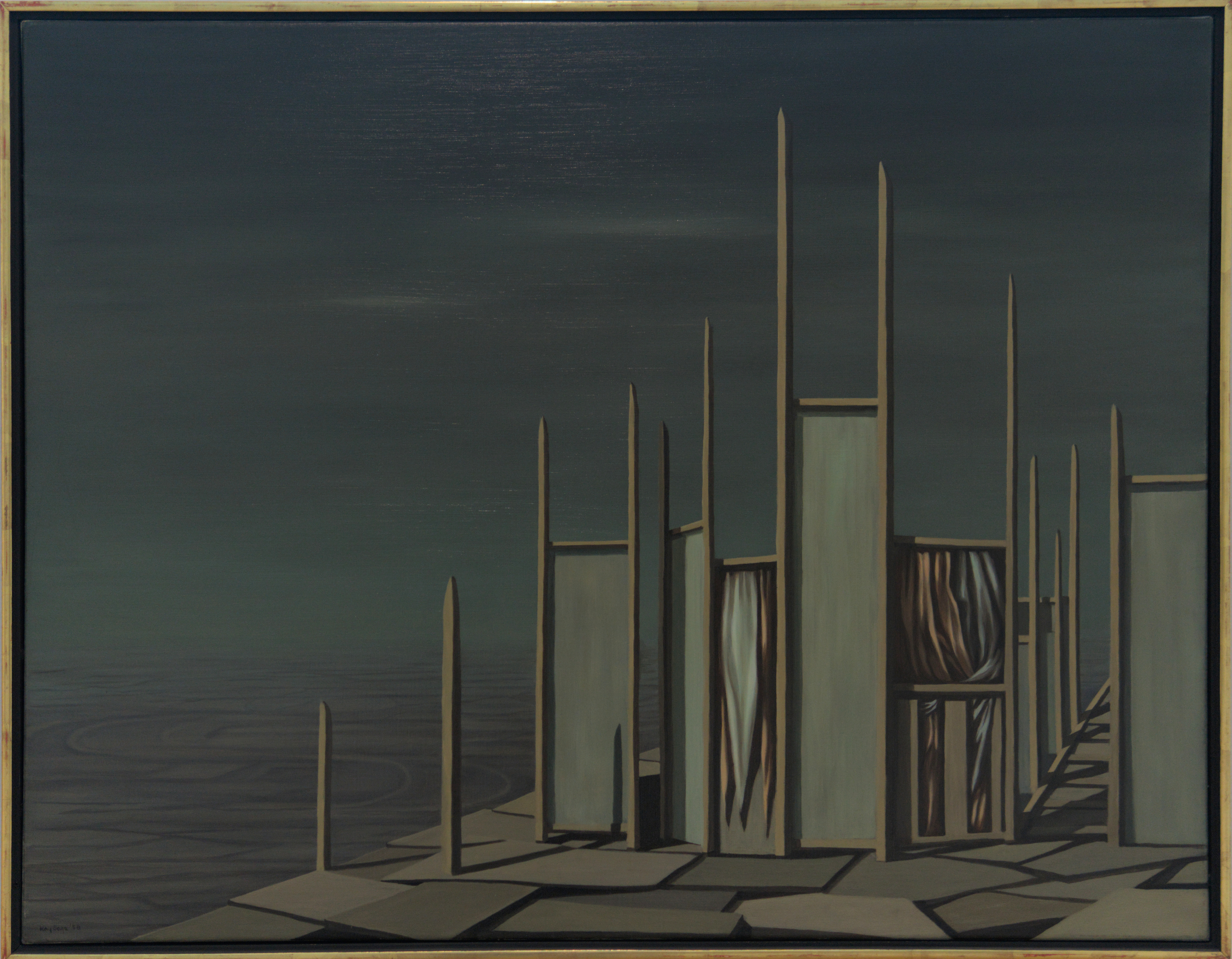
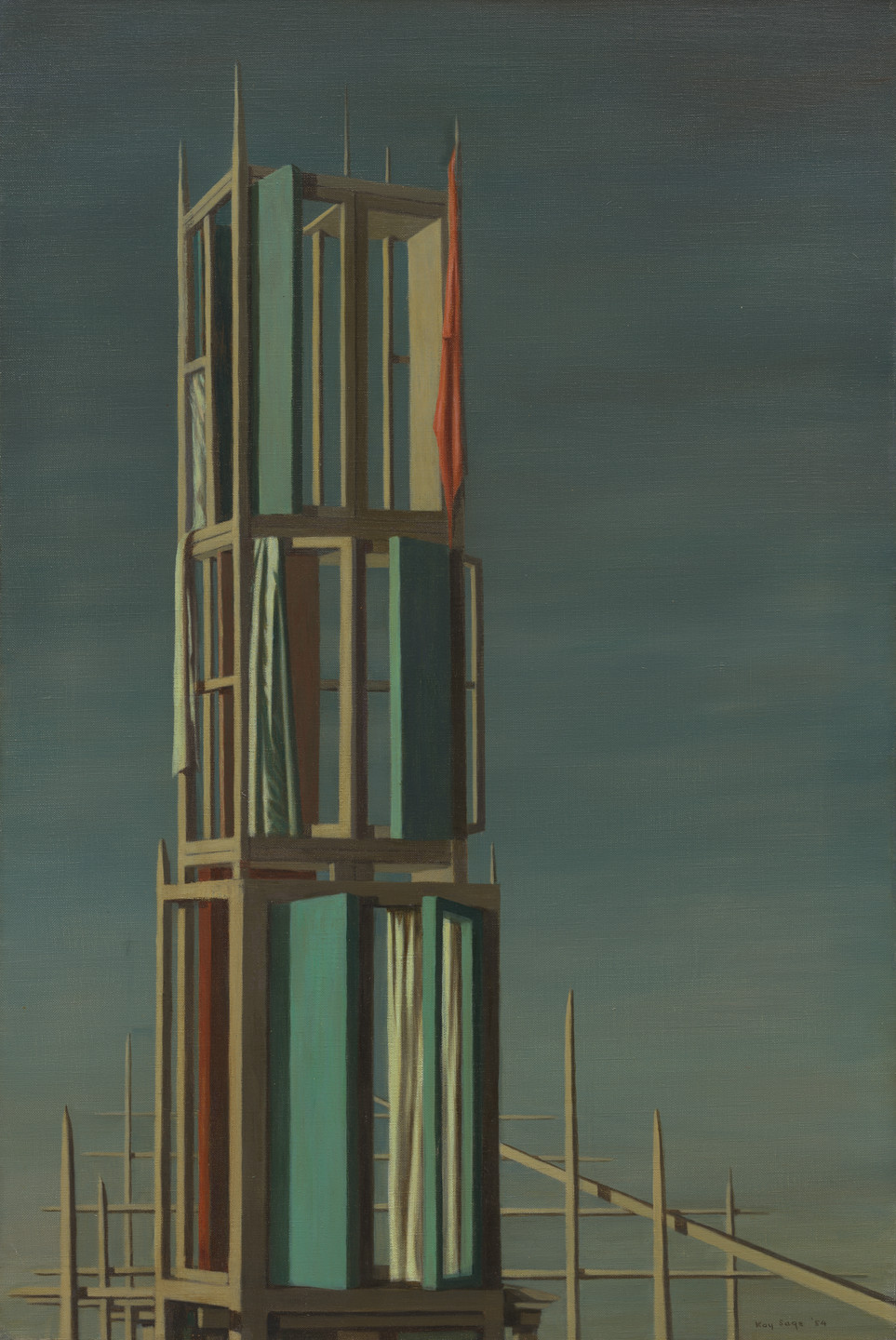
LOOK: Quote-Unquote, Hyphen, and The Point of Intersection by Kay Sage
There’s a wistful quality to the paintings of the midcentury American surrealist artist Kay Sage [previously], which often feature tenuous, draped structures and a distant light in the vast dark. The first work of hers I saw in person was Quote-Unquote, which shows a ragged, exposed architectonic form—is it fallen into disrepair, or incomplete?—whose vertical wood beams pierce the dreary gray sky.
The museum label at the Wadsworth Atheneum reads in part: “Sage’s later paintings featured vertical architectural structures, such as walls and scaffolding, set in otherwise deserted landscapes. These inanimate forms were often draped with plain fabric, as if to suggest a human presence or absence.” The title Quote-Unquote provides little interpretive help. What is being quoted here? Is irony intended?
Painted the same decade, Sage’s Hyphen shows a towering structure of open doors and windows.
And ThePoint of Intersection shows a series of wooden boards and frames standing, slightly diagonal to the viewer, on a ground that recedes into infinity. In the bottom left corner a rumpled sheet or garment lies on a squat platform.
Is the “intersection” of the title between time and eternity, or . . . ?
LISTEN: “Not Knowing When the Dawn Will Come” | Words by Emily Dickinson, ca. 1884 | Music by Jan Van Outryve, 2018 | Performed by Naomi Beeldens (voice) and Jeroen Malaise (piano) on Elysium, Emily Dickinson Project, 2018
Not knowing when the Dawn will come, I open every Door, Or has it Feathers, like a Bird, Or Billows, like a Shore –
This is one of twelve musical settings of Dickinson poems for piano and voice by the Belgian composer Jan Van Outryve. It’s sung by soprano Naomi Beeldens, with Jeroen Malaise on keys.
I’ve always read “Not knowing” as an Advent poem, as promoting a posture of readiness for the coming of Christ—he who is, as we call out in the O Antiphons of late Advent, our Oriens, Rising Sun, Dayspring. Will he come softly, rustling, avian-like, or will he come crashing onto earth’s shore like a wave?
Expecting Dawn’s imminent arrival, the speaker of the poem opens every door, welcoming its light.
From Augustine (Confessions) to Teresa of Ávila (The Interior Castle), the picture-making nunsof St. Walburga’s Abbey in Eichstätt to C. S. Lewis (Mere Christianity), the human heart has long been compared to a house. To open the windows or doors of the heart to Christ is to invite him to come in and dwell there and to transform the place.
Advent commemorates threecomings of Christ: his coming in “history, mystery, and majesty,” as one priest put it. That is, Christ’s coming (1) as a babe in Bethlehem, (2) in the Spirit, to convert, illuminate, equip, and console, and in the bread and wine of the Eucharist, and (3) at the end of time.
Have you opened every door to him? Do you eagerly expect him to arrive—this Christmas (are you telling, singing, enacting the story of his nativity?); into your struggles and brokenness, to companion you and to heal and strengthen; and again on earth, to unite it with heaven and establish, fully and finally, his universal reign?
This is the first post in a daily Advent and Christmastide series that will extend to January 6.I hope you follow along!
“One of poetry’s great gifts is to slow us down,” writes Peggy Rosenthal in Praying the Gospels through Poetry. “We’re used to racing ahead as we read, whether it’s a newspaper or an email memo or even an essay: language in these forms propels us forward, urging us to grab up its main points. But poetry doesn’t press ahead so much as hold us still—in the wonder of words crafted to open into another dimension.”
Below are twenty-five poems to “hold us still” this holiday season.
I’ve collected hundreds of Advent and Christmas poems over the past decade, but for this feature one of the selection criteria was that the poem must be freely available online. I chose the number twenty-five because that is standard in most Advent calendars—tools for counting down the days to Christmas. This way, you can choose, if you wish, to bookmark this page and read just one poem a day from December 1 to 25, each one a little treat.
The order progresses, in general, from Advent longing and anticipation to Christmas joy and wonder to post-nativity moments like the presentation in the temple and the visit of the magi.
1. “Advent Madrigal” by Lisa Russ Spaar: I’m not sure I understand this poem, but I like it. A madrigal is a part-song, and this is a song of waiting in simultaneous belief and doubt, of being irresistibly attracted to God’s story while also skeptical of aspects. The speaker compares the moon to a flashlight that a theater usher shines down the aisle to escort folks to their seats. What does it mean that “the treetops sough // & seize with” escape? Escape from what? And that the earth has been purloined? I don’t know, but the final couplet really lands for me—about how in the dark night of our not-knowing, we make our Advent wreaths, decking them with evergreens, their round shape an O of lament and awe before the yet-to-be-seen.
Source: University of Virginia Office of Engagement
2. “Prayer” by John Frederick Nims: The first in a sequence of five poems, “Prayer” expresses a sense of emptiness and desire, beckoning an unnamed one whom I read as Christ to come and fill. “Come to us, conceiver, / You who are all things, held and holder. / . . . / Come, infinite answer to our infinite want.”
3. “how he is coming then” by Lucille Clifton: This poem is part of a sequence on the life of Mary; it appears between “mary’s dream” (on the Annunciation) and “holy night” (on Mary’s ecstatic birthing experience). In answer to the title, Clifton gives three similes.
4. “Advent 2” by Anna A. Friedrich: This poem is the second in a series of Advent villanelles commissioned by the poet’s church in Boston last year to converse with one or more of the lectionary readings for each week of the season. Malachi 3:1–4 is the primary touchstone here, a formidable prophetic passage that compares God in the day of his coming to a blazing fire that refines metal. Stanza 3 references the fiery repentance-preaching of John the Baptist from Luke 3:1–6, and then Friedrich draws in another, unexpected “fire” text: Daniel 3, in which three young Hebrew men are thrown into a furnace by a Babylonian king for their refusal to worship his gods but are preserved from harm when a mysterious fourth person appears with them in the flames. Friedrich connects this story to the promise that the earth and its inhabitants will not be wholly consumed in the fire of God’s judgment—only the impurities, the dross, will be destroyed, so that all may be restored to their truest selves. Hence why, in Friedrich’s words, “We pray for His fire. We trust this flame.”
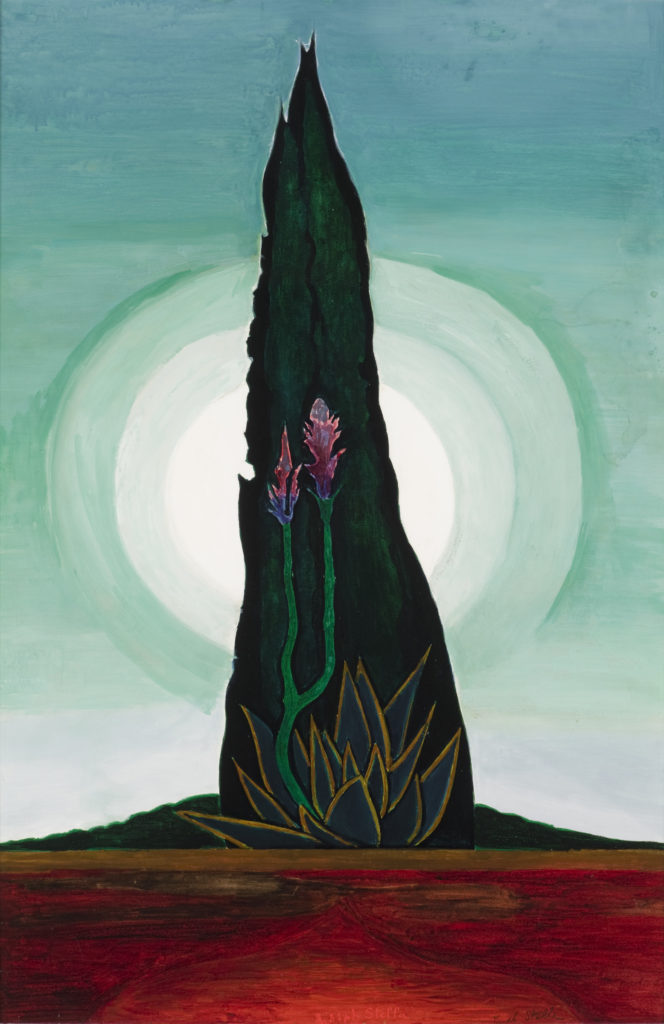
5.“Desert Blossoming” by Amit Majmudar: A reflection on the messianic promise of Isaiah 35:1–2, this poem celebrates how, through the deserts of Israel, Jesus “scattered his verses on the secretly gravid ground,” causing the wilderness to blossom. Majmudar mentions red, the color of fire (an image he connects to the light of faith), rhyming it with “bled.” Although he uses this final word in the sense of spreading into or through—oases bleeding into one another as dry land becomes water—one can’t help but think of Jesus’s sacrificial death, his blood extraordinarily fertile, producing life.
Joseph Stella (American, 1877–1946), Tree, Cactus, Moon, ca. 1928. Gouache on paper, 104.1 × 68.6 cm. Reynolda House Museum of American Art, Winston-Salem, North Carolina.
6.“Name One Thing New”by Seth Wieck: This six-line poem takes the Teacher of Ecclesiastes to task, responding to his cynical claim that “there is nothing new under the sun” (Eccles. 1:9) with a counterexample.
7.“For My Mother at Advent” by Brian Volck: The poet recalls a simple Advent tradition his mother established in his childhood and reflects on her spiritual legacy, her lifetime of Christ-inspired kindnesses that continue to pillow him. How might we soften the hardness of the world for others?
8. “Advent” by Suzanne Underwood Rhodes: This stunning poem makes unlikely intertextual connections, bringing Matthew 19:24 (one of Jesus’s hard sayings regarding wealth) to bear on John 1. Its unique angle on the Incarnation and its evocative imagery have inspired an experimental jazz composition and several paintings.
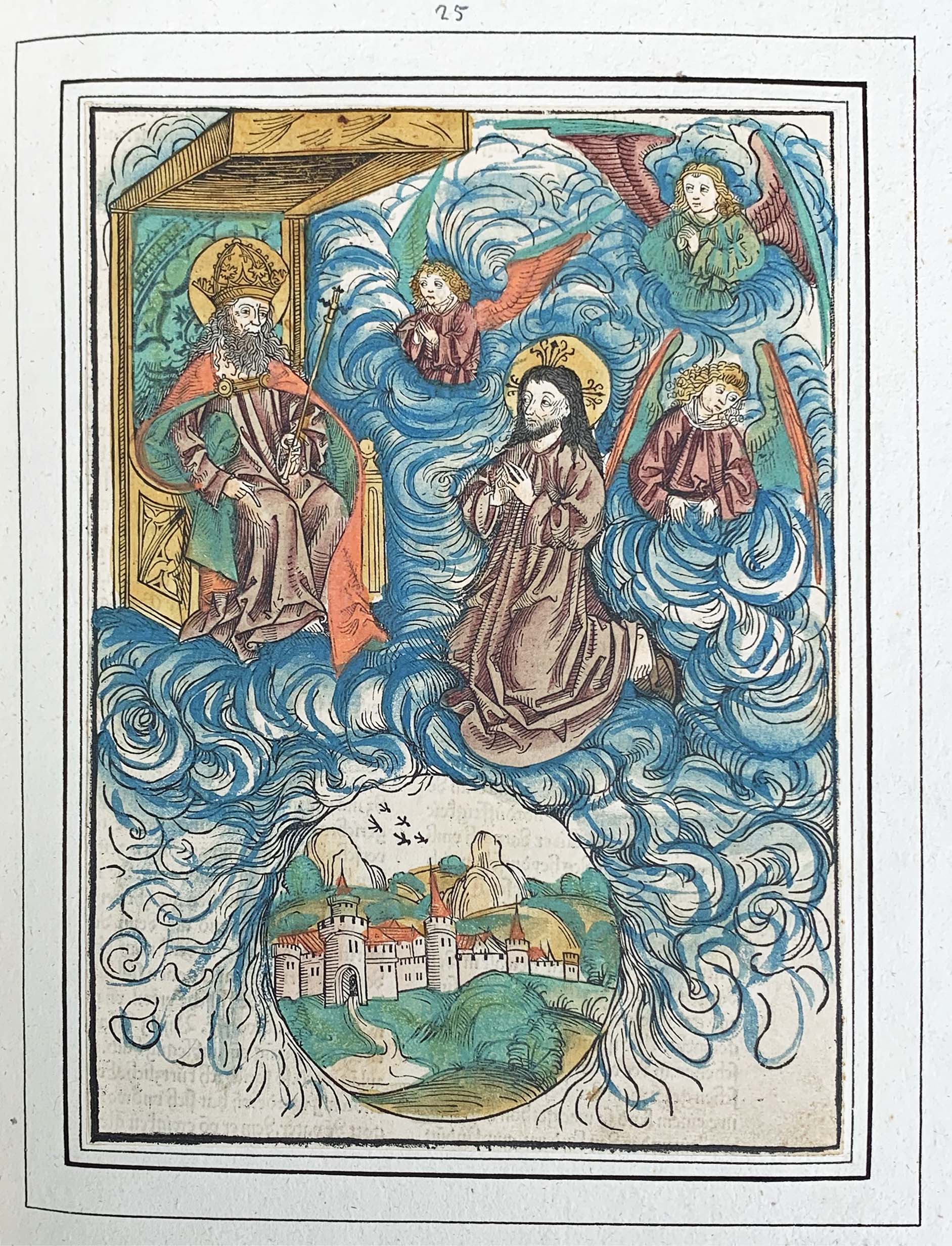
9. “An Hymn to Humanity” by Phillis Wheatley: “Lo! for this dark terrestrial ball / Forsakes his azure-pavèd hall / A prince of heav’nly birth!” So begins this poem on the Incarnation by Phillis Wheatley (ca. 1753–1784), the first African American to publish a book of poetry. In stanzas 2 and 3, God the Father dispatches the Son to establish his throne on earth, “enlarg[ing] the close contracted mind, / And fill[ing] it with thy fire.” The “languid muse” in stanza 5 refers to Wheatley herself, whereas the “celestial nine” are the ancient Greek inspirational goddesses of literature, science, and the arts. The “smiling Graces” is another classical reference.
Michael Wolgemut (German, 1434–1519), The Father sending the Son into the world, 1491. Hand-colored woodcut from the Schatzbehalter (published by Anton Koberger, Nuremberg), 43.7 × 27.5 cm. British Museum, London.
10. “In My Hand” by Sarah Robsdottir: Mary remembers the moment she conceived Jesus, one ordinary day when sitting down to a bowl of lentil stew.
Source: Aleteia, April 9, 2018
11. “The Risk of Birth, Christmas, 1973”by Madeleine L’Engle: Best known for her children’s novel A Wrinkle in Time, Madeleine L’Engle was also a poet. Here she compares our era to the one in which Jesus was born—both are characterized by violence and hate, and yet Jesus, the embodiment of divine love, willingly entered the peril.
12. “On Another’s Sorrow” by William Blake: Through the Incarnation, God lovingly, humanly, entered the world of human woe to experience it firsthand. “He doth give His joy to all,” Blake writes: “He becomes an infant small, / He becomes a man of woe, / He doth feel the sorrow too.” I featured this poem about Emmanuel, God-with-us, in a musical setting by singer-songwriter David Benjamin Blower in 2023 but was surprised that Blower omitted Blake’s final stanza, whose closing couplet I find striking, as it conveys Jesus’s continued identification with and compassion for humanity, how he moans alongside us in our suffering. For a different musical interpretation, also in an acoustic indie folk mode, see the one by Portland-based artist Michael Blake, from his 2021 album Songs of Innocence and Experience:
Source: Songs of Innocence and Experience (London, 1794). Public Domain.
13.“Missing the Goat”by Lorna Goodison: An immigrant from Kingston, Jamaica, to Toronto, Ontario, Goodison writes of the heightened feeling of exile but also of creative adaptations during the holidays as she tries to carry out the food traditions of her native country on a foreign soil where some of the ingredients are in more limited supply. For the sorrel wine, traditionally made with roselle (Hibiscus sabdariffa) petals, tropically grown, she has to make do with redbuds. And the local shops have run out of goat meat—“the host of yardies” (people of Jamaican origin) who’ve moved to the area have already bought it all up—so “we’ll feast then on curried some-other-flesh.” Despite the differences from home, Christmas is still Christmas, and she raises her “hybridized wassail cup” to her new place, her new neighbors (many of them, like her, also recent arrivals from the Caribbean), and the creation of new rituals in multicultural Toronto.
Source: Controlling the Silver (University of Illinois Press, 2010); compiled in Collected Poems (Carcanet, 2017)
14. “Word Made Flesh”by Kathleen Raine: Awarded the CBE (Commander of the Order of the British Empire) for her significant contributions to literature and culture, Raine has been described as a mystical and visionary poet. Here is her revoicing of John 1. What a powerful last two lines!
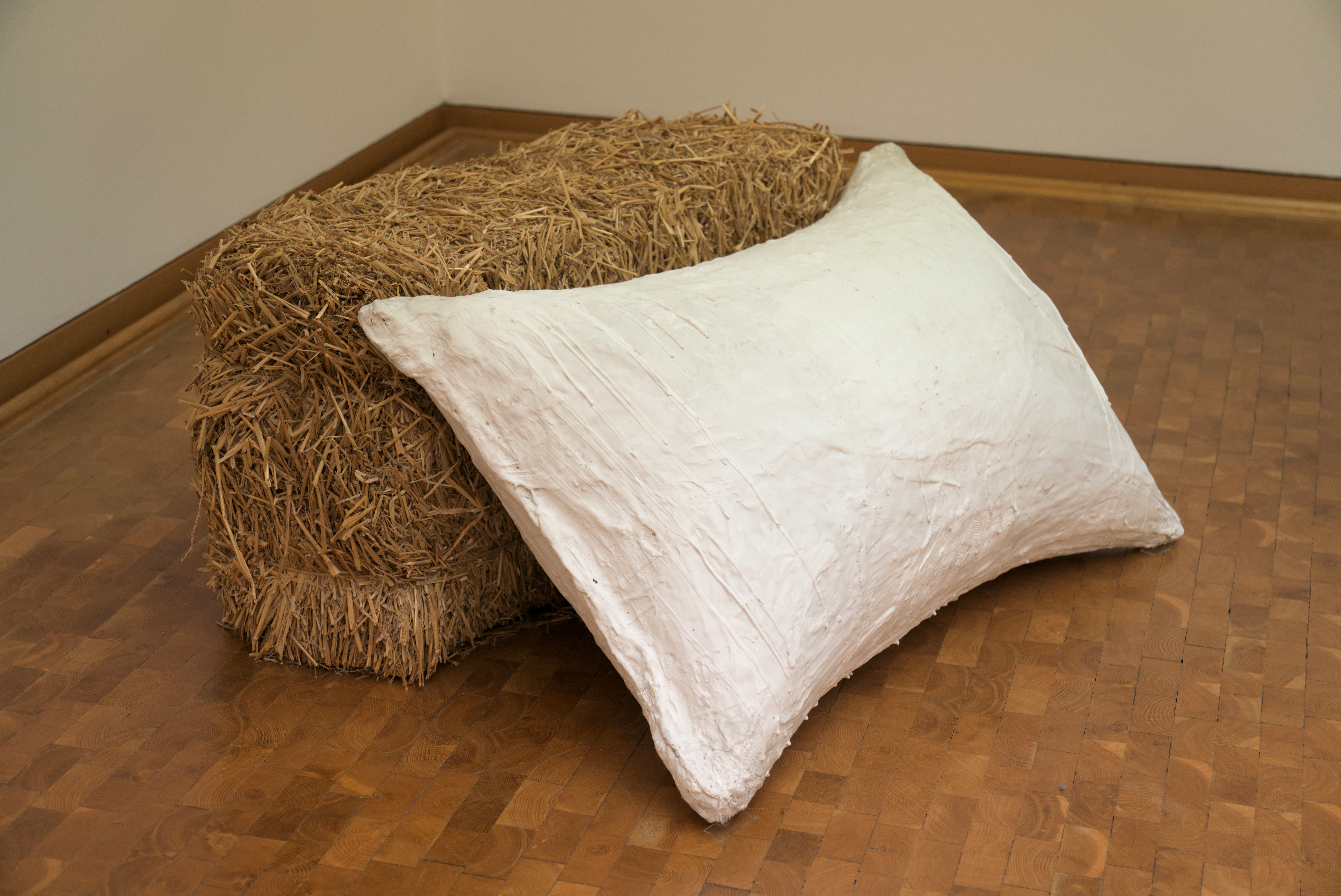
15.“Nativity”by Barbara Crooker: In the heavy dark, in the windy cold, “love is born in the world again” every December when we retell the story of Christ’s birth.
Gary Kuehn (American, 1939–), Straw Pillow, 1963. Straw, plaster. Ludwig Museum, Cologne, Germany, Inv. ML/SK 5185. Photo: Victoria Emily Jones.
16. “First Miracle”by A. E. Stallings: The first miracle Jesus performed, according to the Gospel of John, was turning water into wine. Stallings reflects on an earlier miracle performed by his mother’s body, and all birth-giving mothers’: turning nutrients from her blood into milk.
17.“What Sweeter Music Can We Bring” (or “A Christmas Carol, sung to the King in the Presence at Whitehall”)by Robert Herrick: “The Darling of the world is come”! Originally written as a song for soloists (each number corresponds to a different singer) and chorus, this poem reverses the typical seasonal imagery of Christmas, remarking how, at Jesus’s birth, “chilling Winter’s morn / Smile[s] like a field beset with corn” and “all the patient ground [is turned] to flowers.” The original music by Henry Lawes is lost, but many contemporary composers have written settings of the text, most famously John Rutter.
Source: Hesperides: Or, Works Both Human and Divine (London, 1648). Public Domain.
18.“Sharon’s Christmas Prayer”by John Shea: A five-year-old recounts the Christmas story, and when she reaches the clincher, she can’t hold back her glee.
19.“God”by D. A. Cooper: Riffing on Williams Carlos Williams’s “The Red Wheelbarrow,” this spare poem attends to the birth and death of the incarnate God, upon which so much depends.
Source: Reformed Journal, September 3, 2024
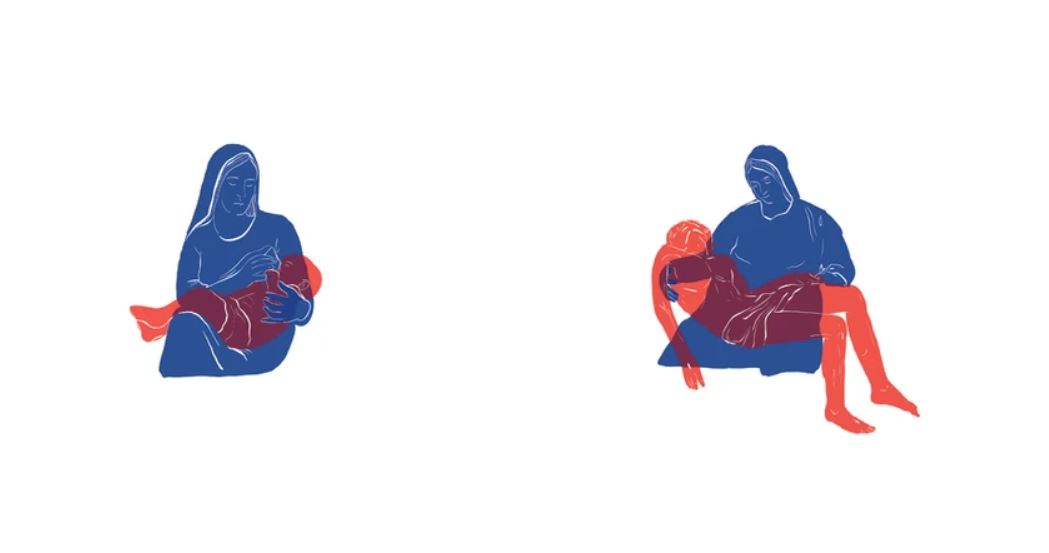
Katarzyna Malinowska (Polish, 1989–), Juxtapose (diptych), 2021. Digital painting, 20 × 30 cm.
20. “Lullaby after Christmas”by Vassar Miller: The speaker wishes sweet sleep for the newborn Christ child, wishes to keep him innocent of his fate for as long as possible—for “even God has right to / Peace before His pain.” Consisting of four sestets whose second, fourth, and sixth lines rhyme, the poem has a sing-songy quality that is jarring for the juxtaposition of words like “soft,” “warm,” and “tinkling” with the likes of “blood,” “gore,” and “die.”
21. “Journey of the Magi”by T. S. Eliot: Eliot wrote this poem shortly after his conversion to Christianity in 1927. Opening with a passage from a Christmas sermon by the seventeenth-century Anglican bishop Lancelot Andrewes, it is from the perspective of one of the magi, who made a long, toilsome journey in search of the meaning of a mysterious guiding star. After the magi’s encounter with the Christ child, they would never be the same; their paganism would no longer satisfy. The poem is about the transformative impact Christ has on those with humility enough to see him for who he is (having followed the light of revelation) and to worship him accordingly. And that transformation is in some ways painful, as it involves giving up some of the things one once held dear.
“Were we led all that way for / Birth or Death?” the magus asks. Jesus’s wasn’t the only birth they witnessed; they, too, were (re)born in Bethlehem. But spiritual rebirth is also a sort of death—the magi died to their old selves and false loves and loyalties. Thus, when they returned to Babylon, they felt like strangers in a strange land. They were now citizens of a different kingdom, and filled with a longing for its consummation.
Source: Journey of the Magi (Ariel Poems) (Faber & Gwyer, 1927). Public Domain.
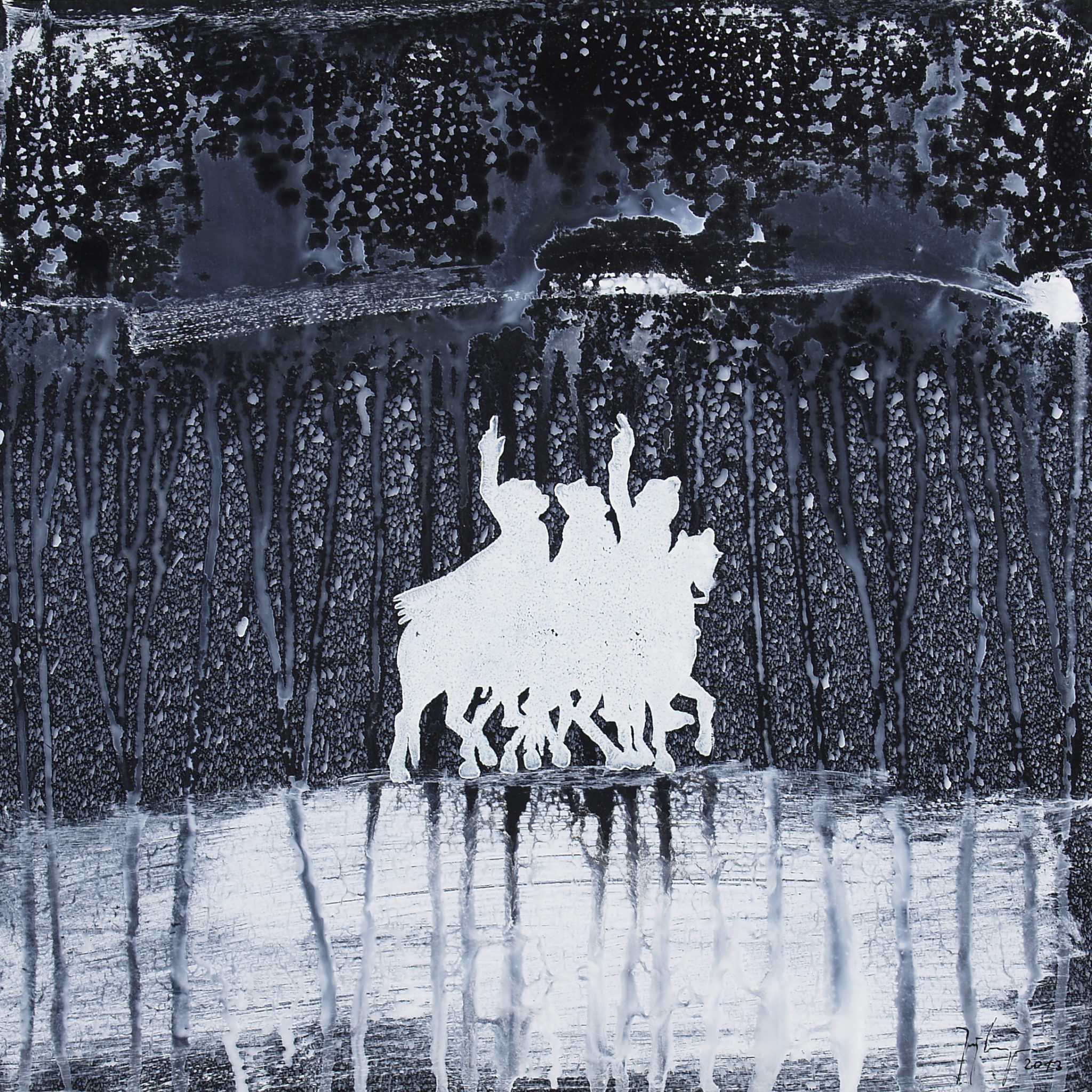
Jörg Länger (German, 1964–), The Three Kings, 2013. Linocut and gesso on aluminum dibond, 38 × 38 cm. The linocut is after a 12th-century illumination from the St Albans Psalter, held at the Dombibliothek, Hildesheim, Germany.
22. “Twelfth Night”by Sally Thomas: (Scroll to second poem.) As the Christmas season draws to a close, holly berries shrivel and drop, the “candles drown themselves in waxen lakes,” “the tree’s a staring corpse,” and a spider has built a web across the mantel nativity. Thomas uses the passing of the season to reflect more broadly on the passing of time and our own dustiness and desiccation—and by contrast, the unchangeability of God.
23. Untitled poemby S. E. Reid: Most reflections on the New Year are full of enthusiastic goal-setting and go-getting, but Reid, gardening in her greenhouse in the crisp cold of January, describes a “fall[ing] backwards,” “dropping into the dark,” “shivering,” herself a seed, latent in the soil, trusting God that growth will come.
24. “Anna the Prophetess” by Tania Runyan: Forty days after Jesus’s birth, Mary and Joseph presented him in the Jerusalem temple. Runyan imagines this event from the perspective of Anna, a woman who was widowed young and thenceforth lived at the temple into old age, devoted to prayer, fasting, praise, and prophecy.
25. “The Work of Christmas”by Howard Thurman: Drawing on Jesus’s mission statement in Luke 4, the great African American theologian and civil rights leader Howard Thurman urges us to continue the work of Christmas—finding, healing, feeding, etc.—throughout the year. Listen to the simple yet vigorous choral setting by Elizabeth Alexander.
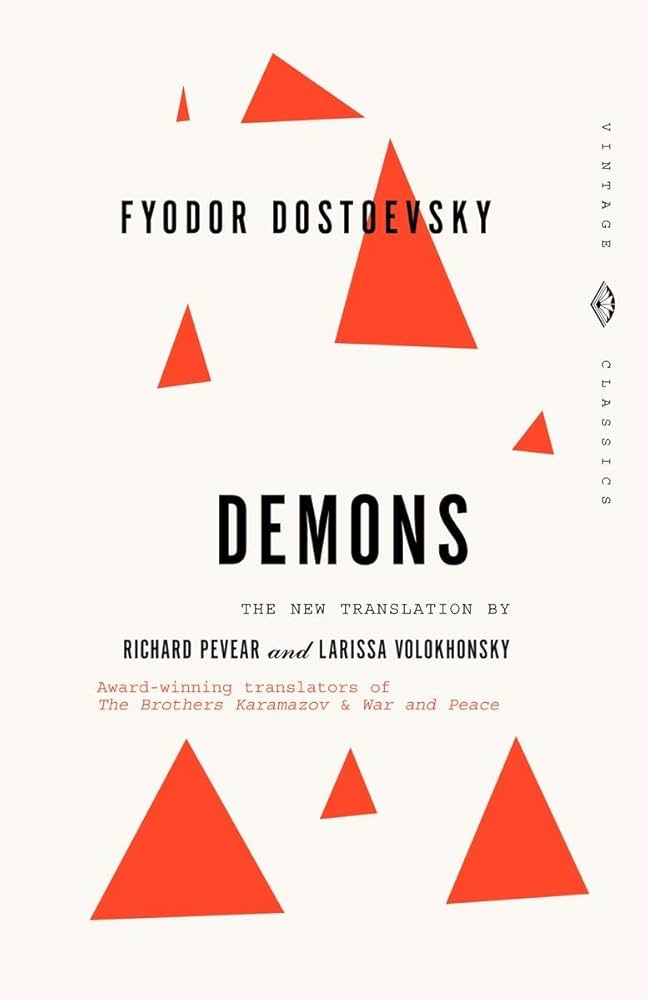
ONLINE COURSE: Studying the novel Demons by Fyodor Dostoevsky with Brian Zahnd, January 3–March 9, 2026: This ten-week online course led by Pastor Brian Zahnd (a Christian writer and preacher I admire) will explore Dostoevsky’s “darkest and most prophetic novel”: Demons (aka The Possessed or The Devils), a social and political satire, psychological drama, and large-scale tragedy inspired by the true story of a 1869 political murder in Russia. The course sounds intriguing to me, and I’m contemplating whether I can invest the time in a seven-hundred-page book—but I did buy a copy just in case! It’s the only one of the literary master’s four novels I haven’t read.
“Dostoevsky’s Demons changed me,” Zahnd writes on Substack. “From it I learned the danger of giving oneself to an ism instead of to Christ. Isms are idols and they often become demonic. Admittedly Demons is a difficult novel, but it’s also prophetic and timely. . . . As you read Demons, expect to be horrified, but also expect to laugh—you are meant to. During the course we will be horrified and warned, but we will also laugh and learn together.”
The live Q&As will take place the first ten Mondays of 2026 at 5 p.m. CT (6 p.m. ET).
+++
SEMINAR (VIDEO):“How to Watch a Movie (as a Christian)” with Chris Retts and Morgan Jefferson: On his FootnotesSubstack, historian Jemar Tisby recently hosted a teach-in with two team members from the Los Angeles Film Studies Center, a nonprofit educational program designed to give undergraduate students at Christian colleges and universities meaningful experience in the film industry during a semester “abroad” in Los Angeles. Chris Retts is the director of the center, and Morgan Jefferson is an instructor.
Before discussing how to watch a movie, they discuss why Christians should watch movies in the first place, beyond the obvious (enjoyment):
Because general revelation can happen anywhere, even at the movies (Rom. 1:20).
Because movies generate empathy, which is central to the greatest commandment (Matt. 22:37–40).
Because every movie has a theology, and media literacy makes it conscious and discernable (1 John 4:1).
They also discuss the four modes of meaning that filmmakers work with; cinematic language; and four steps for exegeting (“drawing out”) a film.
How does film relate to Dr. Tisby’s work at the intersection of faith, history, and justice? He has written for years about the dangers of white Christian nationalism. He says adherents of that ideology, or any, are not evaluating a list of propositions but are buying into a narrative; and “you can’t meet a narrative with logical reasoning,” he says. “You have to invite them into a counter-narrative—a more beautiful story.” Story is why he’s interested in film, as film is an engaging, and probably the most popular (in the US), storytelling medium. “Stories shape our sense of what’s true, what’s possible, and who belongs. That’s as true for political movements as it is for movies.”
DOCUMENTARY SHORT: The Quilters (2024), dir. Jenifer McShane: This thirty-minute documentary on Netflix follows a group of men in a maximum-security prison in Missouri who design and sew custom quilts for children in foster care using donated fabrics and old machines. They care deeply about the quality of their work—they’re proud of what they make—and are emotional about the recipients, some of whom send thank-you cards. The film is about creating beauty and meaning within strict confines, not letting destructive choices from your past stymie you from making constructive ones in the present.
+++
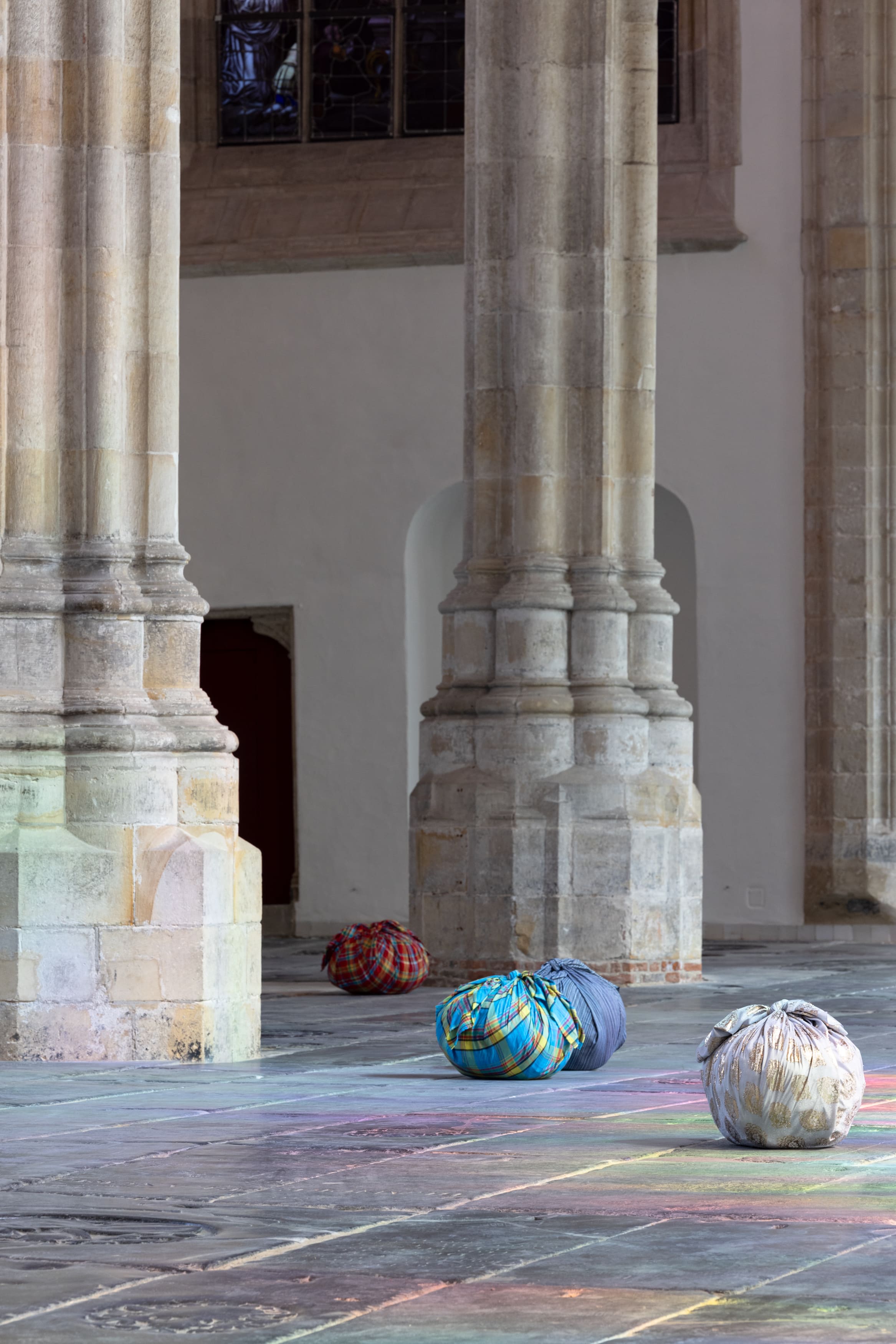
TEMPORARY INSTALLATION: To Breathe—Mokum by Kimsooja, Oude Kerk (Old Church), Amsterdam, May 23–November 9, 2025: Sorry I didn’t get this out while the installation was still up (it wrapped on Sunday), but please do explore the photographic documentation. Kimsooja’s To Breathe—Mokum explores themes of migration, belonging, and the transient nature of home; the Yiddish word in its subtitle means “safe haven.” “At the work’s heart are Kimsooja’s iconic bottari—colorful textile bundles inspired by traditional Korean wrapping cloths,” designboom writes. “Spread across the [medieval] stone floor of the church, these bundles are filled with clothing donated by members of Amsterdam’s diverse communities. Each piece of clothing represents the lives and stories of the people who contribute to the city’s rich multicultural fabric. These textile bundles serve as symbols of both personal and collective journeys, embodying the arrival and departure of individuals who have shaped the identity of the city” over its 750 years.
Kimsooja (Korean, 1957–), To Breathe—Mokum (partial view), 2025. Site-specific installation at Oude Kerk, Amsterdam. Photo: Natascha Libbert.
+++
POEMS:
>> “On the Staten Island Ferry” by A. E. Stallings, Plough, July 1, 2025: Liberty is an American ideal—but for many in this country, an illusory one. Riding in New York Harbor with a boatload of commuters and tourists, Stallings lets settle what a young girl, pointing to the Statue of Liberty, exclaims.
>> “The Pillar of Cloud and Fire”by Anna A. Friedrich, Monafolkspeak (Substack), October 29, 2025: The poet reflects on her confusion as a child about this manifestation of God from the Old Testament, which leads her to surprising insights.
. . . each day a misery and a marvel, each person also.
—Rachel E. Hicks, from “Accumulated Lessons in Displacement”
A white American born in the foothills of the Himalayas to international school educators, Rachel E. Hicks is a second-generation third-culture kid (TCK) whose writing reflects decades of living as a global nomad, exploring themes of memory, connection, suffering, exile (both physical and spiritual), hospitality, and hope. She grew up in six countries—India, Pakistan, the United States, Jordan, the Democratic Republic of the Congo, and Hong Kong—and spent seven years as an adult in Chengdu, China, where she worked for the relief and development organization Food for the Hungry.
In 2013, she, her husband, and their two kids repatriated to the US, settling in Baltimore, where they live today. Hicks has lived in Baltimore longer than in any other city. But even with this rootedness, “the soil of each place in which I’ve lived still clings,” she says.
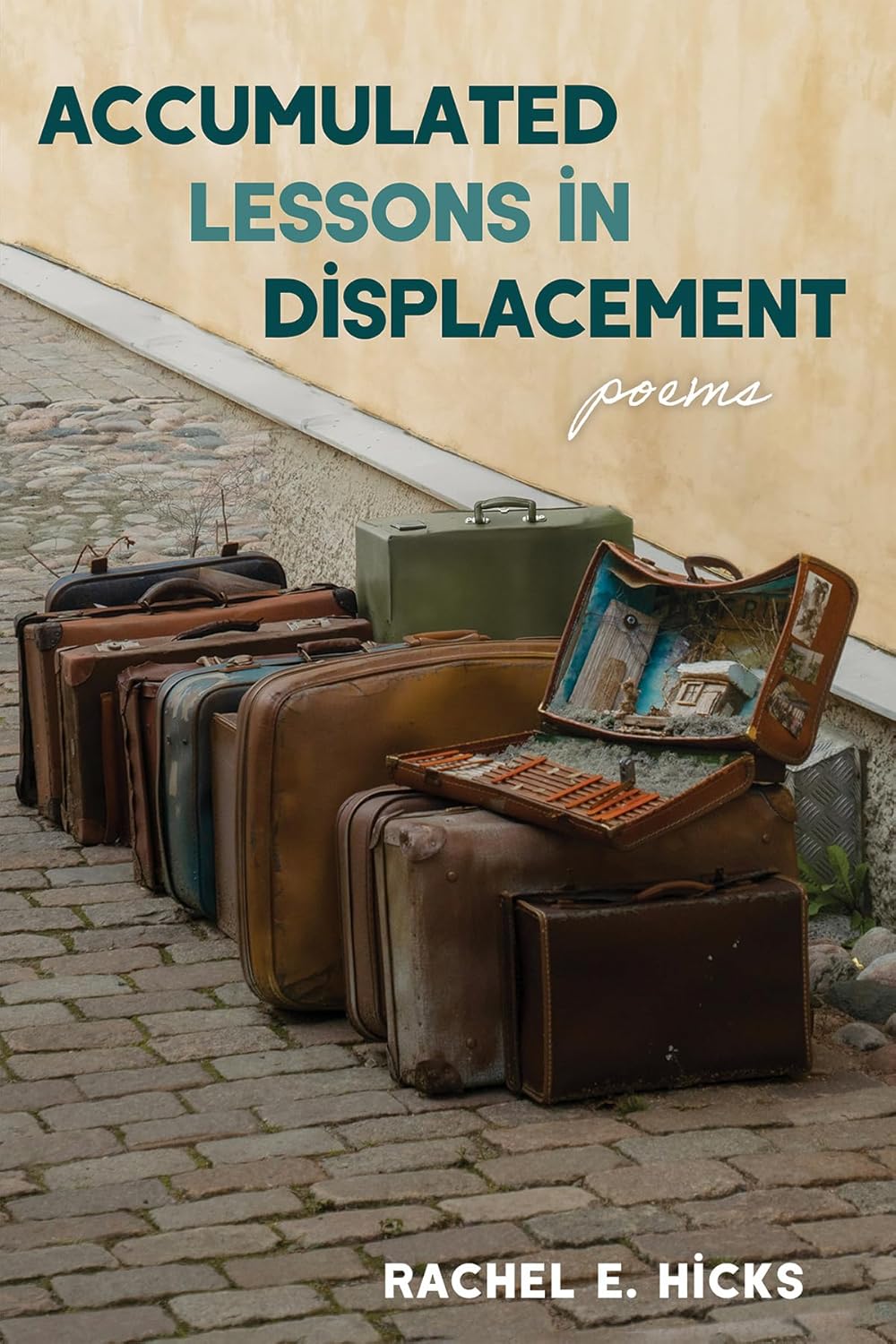
In her debut poetry collection, Accumulated Lessons in Displacement (Wipf & Stock / Resource Publications, 2025), Hicks grapples with the experience of being a “perpetual pilgrim”—on her way to a particular place but also attuned to the significance of each moment along the way. “Pilgrims learn to walk a life of paradox: even though their hearts are set on their final destination, they walk through each day alive to its possibilities, people and lessons,” she wrote in a 2014 blog post.
What is “home”? How can we bear to leave home, whether forced to do so by war, famine, or natural disaster, or we choose to for opportunity or ministry? What do we do with feelings of alienation when we find ourselves in a culture not our own or in which we don’t fit well? How do we live cross-culturally? How do we make a home where we’re at? What are our responsibilities to place? Who is our neighbor?
“I believe that many—all?—of us live our lives with some sense of exile,” Hicks writes on her blog. “We experience it and are aware of it to varying degrees, but it’s there. So many of our quests, our longings, our purpose-seeking, and the stories we create and tell are about trying to find our way home. Home being that place—literal or figurative—in which we feel wholeness and true belonging.”
Accumulated Lessons is divided into two parts: “Bright Sadness, Bitter Joy” and “A Deeper Knowing.” The term “bright sadness”—a translation of the Greek word charmolypê—comes from the Eastern Orthodox tradition, and it describes the paradoxical state of mourning over sin while rejoicing in God’s grace. It can also describe the paradox of living a life of joy amid suffering.
I was trying to learn the word for joy
that settles awkwardly in grief’s nest, an oversized bird. I didn’t want to scare it away.
So says the speaker in the book’s title poem, “Accumulated Lessons in Displacement.” Unfolding over eight sections, this persona poem draws on Hicks’s own experience of abrupt displacement from Kinshasa as a teenager, as well as the experiences of Bosnian refugee friends, and Syrian refugees she had only read about in the news.
It opens with a reflection on “home” in all its ordinariness—the yellow coffee cup, the dusty houseplant, the sunlit window seat—and laments that “no footpath exists leading back to these things,” which, the reader is led to presume, have been destroyed by armed conflict, or its residents blocked from returning by threat of death.
The poem contains several arresting images, like the green threads of a sweater on barbed wire tracing a path across miles. A boy who collects bullet casings to make a necklace for his sister. Charred diary pages dancing around a blown-out living room, “ma[king] a strange poem in my heart.”
Hicks wrestles with the savage violence humans are capable of:
It makes no sense that a soldier can press a button
and somewhere a baby ignites into flame. And he goes home and brushes his teeth.
What we do to each other, to other created souls. Always I carry this burden like a child on my hip.
Another powerful poem in the collection is “Visit to Sarajevo,” where Hicks describes visiting the Bosnian-Herzegovinan capital with her friend Dragan, who was forced to flee it as a young married adult with a child in the 1990s after the city was besieged by Serbian forces. Hicks had met Dragan and his family in 2000 through her husband, Jim, who worked alongside him at a refugee resettlement agency in Phoenix, Arizona, and the families became close. Meeting up years later in Dragan’s hometown, Dragan leads Hicks through the once-familiar streets “in a haze of pride, nostalgia, nightmare,” giving her a tour of sites both historically significant and deeply personal.
Hicks’s passport country too has its national traumas, one of which was precipitated by 9/11, when in 2001, terrorists flew planes into the World Trade Center in New York City, killing almost three thousand people. In “Disaster Chaplaincy Training,” she describes a course she took, taught by a Ground Zero worker, to become further equipped for her work in China, which was focused on disaster preparedness and response. In the course, she learned how to “loiter with intent” in zones of disaster, “acclimat[ing] to [suffering’s] pungency.” Make sure, said the instructor, to “let them see you cupping a small ball / of hope—toss it up, catch it.”
Nationwide crisis struck the US again when on April 12, 2015, a young Black man from Baltimore, Freddie Gray, died of a spinal cord injury while in police custody, allegedly due to police brutality—though none of the six involved officers was ultimately held responsible. Gray’s death led to civil unrest in Baltimore (which Hicks had recently made her home) and throughout the country, as citizens demanded recognition, in word and practice, that “Black lives matter.”
Hicks wrote “The Morning After Freddie Gray’s Funeral” while Baltimore was on lockdown. Fumbling for words, she tries to explain to her children what’s going on as she, too, tries to educate herself more deeply about the history of racism in America and the longstanding grievances of the Black community she lives in. In the poem, she harvests mint from her garden to brew a gallon of black mint tea to share with her neighbor—
as what? An offering, apology?
A way to say I’m trying—learning about all that fuels these fires still smoldering this hushed morning?
The staining of the clear water as the tea steeps becomes a metaphor.
Accumulated Lessons in Displacement addresses global suffering, more localized suffering, as well as personal and family suffering.
One example of the latter has to do with Hicks’s daughter’s diagnosis, following an ankle sprain, with complex regional pain syndrome (CRPS), Ehlers-Danlos syndrome (EDS), and postural orthostatic tachycardia syndrome (POTS), chronic conditions that cause extreme nerve pain. “Bright Sadness” describes a return car ride from a fruitless medical visit, her daughter crying and gasping in agony in the back seat, when offhandedly, Hicks insists, “Turn your cries into opera!” This unexpected and ridiculous suggestion defuses, if for just a moment, the intense situation, resulting in “joy-laughing” amid plaintive contralto tones all the way home.
“Post-Miracle (I)” celebrates her daughter’s miraculous healing, holds the strange, tentative, empty-handed feeling of a fervent prayer request graciously granted. But then comes “Post-Miracle (II),” written when, after two months of her daughter being pain-free, the CRPS returned. Hicks wrestles with gratitude for the brief reprieve and anger at God’s “undoing” the miracle. She wonders about some of the healings Jesus performed in the Gospels, and whether they stuck.
“Post-Miracle (II)” is one of the few poems in the collection with end rhyme, each quatrain following an abba pattern. Perhaps the choice to work with a rhyme scheme for this particular subject represents, consciously or subconsciously, her attempt to make things rhyme again, to harmonize the reality of chronic pain with a good and loving God, to impose structure on the chaos.
Several of Hicks’s poems engage with biblical stories: the Suffering of Job, the Parable of the Prodigal Son, the Massacre of the Innocents, Zacchaeus encountering Jesus, the Walk to Emmaus. She performs poetic midrash, imaginatively interpreting and expanding the texts to connect with them on a deeper level.
Besides the biblical authors, some of her literary conversation partners in this collection are Frederick Buechner, Henri Nouwen, Simone Weil, Czesław Miłosz, Dostoevsky, G. K. Chesterton, Gregory of Nyssa, Paul Kingsnorth, and Karen Blixen.
Although there’s a heaviness to much of the material, it’s not overwhelming, as small graces are woven throughout: complimentary walnuts from a fruit shop owner on a winter Sunday; laughter over language barriers; refreshment from a water hose; the scent of turmeric and cardamom at a Punjab store in Baltimore, reminders of the poet’s birthplace; “the comfort of the priest’s thick thumb / upon my forehead, the signature of / Jesus,” on Ash Wednesday; dandelions and buttercups brushing ankles; a cairn at West Clear Creek; the monks at Great Lavra, Greece, making room for the dispossessed; bundles of sheep ascending limestone slopes at dawn in the Cotswolds; the delightful word cusp; her son’s euphoria upon gliding down a mountain on skis; the slow labor of opening a pomegranate and obtaining its ruby-red seeds for her daughter to eat.
The book is shot through with joy—a joy that coexists with suffering and that is sustained through faith.
“These are poems to live by—to help you stay human, love people, find joy in sorrow, pay attention to the world around you, open yourself to God, welcome mystery, and understand our times at a deeper level,” Hicks wrote in an email announcing the launch of the book. “You’ll journey all around the world and find it—in spite of its sorrow—full of beauty and worth loving.”
One of my favorite poems is “Just Before,” a perfect reading for the upcoming Advent season. It spans four cities of the world—places where people work, play, pray, and rest; places of economic disparity, of spiritual longing as well as mundane concerns—in each imagining the moment just before Jesus returns. In the midst of our threshing corn or lighting a lamp or settling a legal dispute or herding sheep, Jesus will come with a beauty that blossoms all the way out to the horizon, calling all nomads home.
“Just Before” by Rachel E. Hicks
When Jesus comes again in all his glory, somewhere in the Sichuan mountains tires will crackle over corn spread out on the road— easy threshing—while a small child urinates in the gutter, absorbed in watching the car shoot by.
As the first rent opens a fingernail tear in the hazy sky, a woman in the foothills above Rishikesh will lay down her firewood burden and light the clay Diwali lamp in the chilling dusk, circling her cupped hands in blessing.
In the pause before the clamor of heaven’s trumpets, the jurors’ waiting room in Baltimore’s civic court will throb with the quiet turning of pages, a buzzing phone in the hand of a tired man, berating himself for forgetting to bring coffee.
Just before we are aware of him, Jesus will pause to survey the view; two shepherd boys amidst boulders in the Wadi Rum hills south of Amman wipe sleep from their eyes and stand amazed at the blood-red poppies at their feet stretching to the eastern horizon.
Purchase Accumulated Lessons in Displacement here. (Update, 11/14/25: Wipf & Stock is offering a 50% discount through November 30, 2025; use code CONFSHIP at checkout. Media mail shipping is free.)
“Just Before” is reproduced with permission from Wipf and Stock Publishers, www.wipfandstock.com.
Great Spirit of the God who is alive, Whose risen Son I seek before the dawn, Who makes the black and gold sunflower thrive, The earthworm loosen soil beneath the lawn; Great Spirit, grant my great-grandmother’s looks Attend me while I rub her cherry hutch. Great Spirit, grant my late grandfather’s books Preserve his signature I love to touch. Surround and show to me that massive cloud Of witnesses—undauntable or docile. Allow their countenances to enshroud My shoulders, spoken of by Your Apostle. Send generous Nunnehi to my steeple, Returning me, at last, to my dark people.
Note: Nunnehiare spirit people in Cherokee mythology. The Cherokee word has been translated as “The People Who Live Anywhere” or “The People Who Live Forever.”
Jennifer Reeser (born 1968) is a formalist poet of Anglo-Celtic and Native American descent. Her seven poetry collections are Strong Feather (2022), Indigenous (2019), Fleur-de-Lis (2016), The Lalaurie Horror (2013), Sonnets from the Dark Lady and Other Poems (2012), Winterproof (2005), and An Alabaster Flask (2003), and she is anthologized in Christian Poetry in America since 1940 (2022). In addition to writing original poems, she also translates poetry from Russian, French, and Cherokee. A member of the Cherokee Nation, she divides her time between Louisiana, where she was born and raised, and the Cherokee Reservation in Indian Country near Tahlequah, Oklahoma.
This November near where I live in Maryland there are at least two concerts by Christian artists I’d like to invite you to:
>> Matthew Clark, November 1, 2025, Crownsville, MD: The Eliot Society, an organization I volunteer with, is hosting Matthew Clark, a singer-songwriter from Mississippi, for an evening of music and stories this Saturday. Tickets are $10; wine, coffee, and refreshments will be served. Here’s Clark’s song “Ordinary Artists”:
>> Ordinary Time, November 22, 2025, St. Moses Church, Baltimore: Longtime friends Peter La Grand (Vancouver), Jill McFadden (Baltimore), and Ben Keyes (Southborough, Massachusetts) make up the acoustic folk trio Ordinary Time. They’re performing a free concert at McFadden’s church in a few weeks, which will be followed by Q&A around the role of music in the communal life of the church. Here’s their song “I Will Trust (Isaiah 12)”:
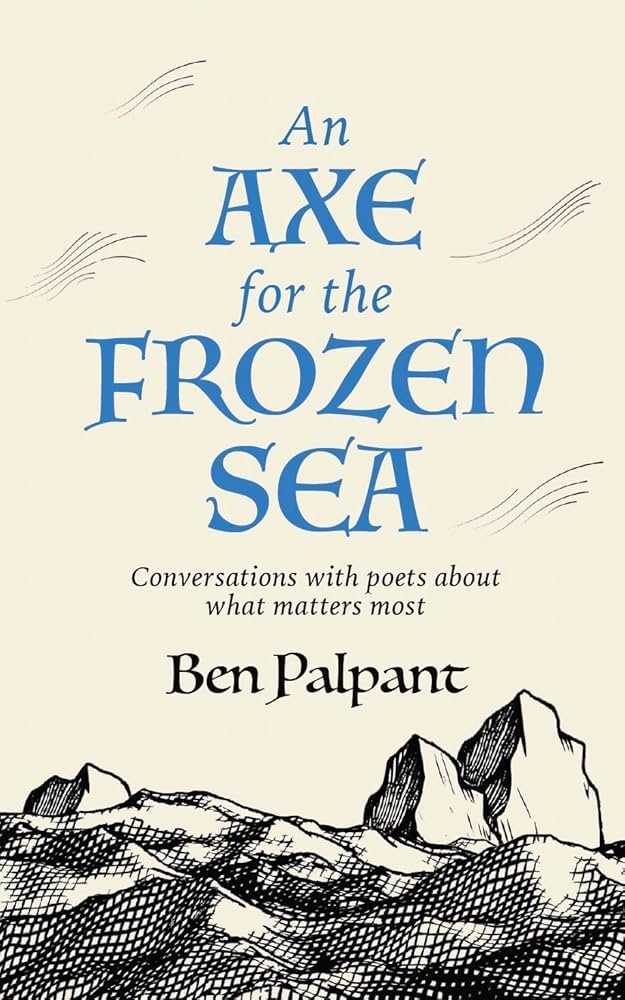
FREE AUDIOBOOK: An Axe for the Frozen Sea: Conversations with Poets about What Matters Most by Bel Palpant: “A book must be the axe for the frozen sea within us,” Franz Kafka wrote in a letter to his friend Oskar Pollak in 1904. That quote is the source of the title of Ben Palpant’s new book, one of my favorites of this year. An Axe for the Frozen Sea is a collection of one-on-one interviews Palpant conducted with seventeen acclaimed poets of faith, exploring the human experience, especially everyday joys and struggles, and the writing life. Featured poets include Scott Cairns, Marilyn Nelson, Robert Cording, Li-Young Lee, and Jeanne Murray Walker. I was really compelled by the conversations.
An Axe for the Frozen Sea is available for purchase in print, but it also kicked off the new podcast Rabbit Room Press Presents, serialized audiobooks of select titles from the publisher. All the book’s content, read by the author, can be listened to for free in this format. Highly recommended!
+++
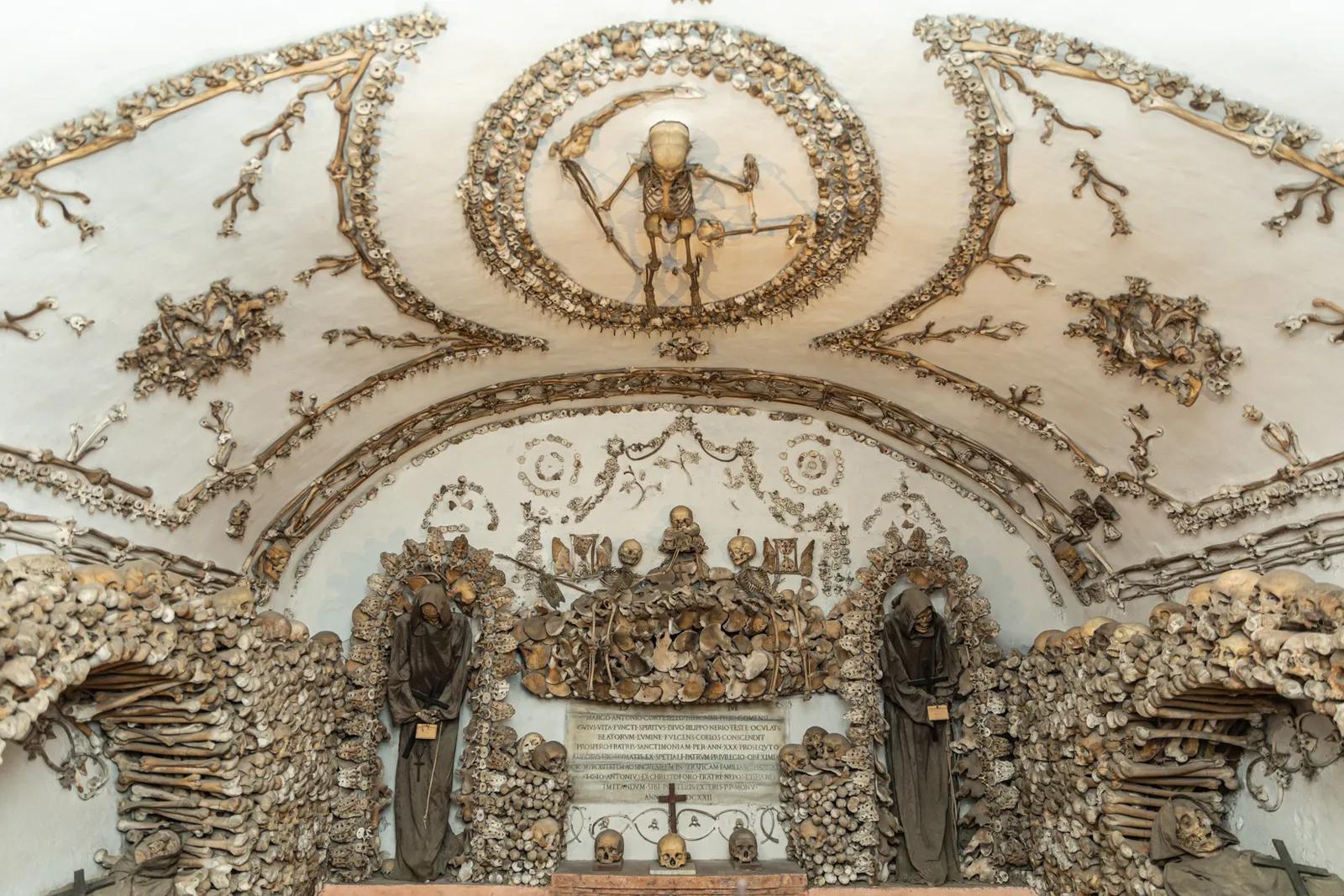
ARTICLE: “Bone chapels and their strange art” by Lanta Davis, Christian Century: If my last blog post piqued your interest in Christian bone chapels, you’ll want to read this article Lanta Davis wrote last November about her visit to the crypt of Santa Maria della Concezione dei Cappuccini in Rome. With a scythe-wielding skeleton overhead and arches, garlands, chandeliers, and mock clocks made of human bones, you’d be forgiven for thinking you mistakenly wandered into a haunted house. But in fact this is a sacred space, its unusual decoration the devotional labor of a seventeenth-century friar. Davis reflects on how the bone installations transform the ugliness of death into something beautiful, rearranging death into surprising forms—such as a skull with butterfly wings made from shoulder blades—that culminate in the Crypt of the Resurrection.
SONG: “Bones” by Mark Shiiba: The title track of Mark Shiiba’s debut album from last year references the placard that greets visitors to Rome’s Crypt of the Three Skeletons (see previous roundup item): “What you are now we used to be; what we are you will be.” This saying was a common memento mori, which I first learned when studying Renaissance art in Florence as a junior in college: Io fu già quel che voi siete, e quel chi son voi ancor sarete, reads the inscription above the fictive cadaver tomb that Masaccio painted inside Santa Maria Novella.
Shiiba’s song is jaunty in tone, and when he shared an excerpt on Instagram, he set it to the similarly sprightly animated short The Skeleton Dance (1929) by Walt Disney, which is based on medieval “danse macabre” imagery. Perhaps that seems to you unbefitting of such a serious subject as death—but since its inception, the church has proclaimed Christ’s ultimate defeat of death. “Where, O death, is your victory?” the apostle Paul taunts. “Where, O death, is your sting?” Death is lamentable, but it’s not the end of the story. The playfully arranged “bones at the bottom of a church in Rome” anticipate the resurrection of our bodies on the last day.


 Art & Theology
