A collaboratively painted “Mural de la Hermandad” (Mural of Brotherhood), initiated by Mexican artist Enrique Chiu, spans a mile of Mexico’s border frontage in Tijuana. Photo courtesy of Enrique Chiu.
Oh, the leaky boundaries of man-made states!
How many clouds float past them with impunity;
how much desert sand shifts from one land to another;
how many mountain pebbles tumble onto foreign soil
in provocative hops!

Need I mention every single bird that flies in the face of frontiers
or alights on the roadblock at the border?
A humble robin—still, its tail resides abroad
while its beak stays home. If that weren’t enough, it won’t stop bobbing!

Among innumerable insects, I’ll single out only the ant
between the border guard’s left and right boots
blithely ignoring the questions “Where from?” and “Where to?”

Oh, to register in detail, at a glance, the chaos
prevailing on every continent!
Isn’t that a privet on the far bank
smuggling its hundred-thousandth leaf across the river?
And who but the octopus, with impudent long arms,
would disrupt the sacred bounds of territorial waters?

And how can we talk of order overall
when the very placement of the stars
leaves us doubting just what shines for whom?

Not to speak of the fog’s reprehensible drifting!
And dust blowing all over the steppes
as if they hadn’t been partitioned!
And the voices coasting on obliging airwaves,
that conspiratorial squeaking, those indecipherable mutters!

Only what is human can truly be foreign.
The rest is mixed vegetation, subversive moles, and wind.
This poem was originally published in Polish in Wisława Szymborska’s 1976 collection Wielka liczba (A Large Number). It appears in English translation by Clare Cavanagh and Stanisław Barańczak, as here, in Map: Collected and Last PoemsbyWisława Szymborska (Houghton Mifflin, 2015).
Maari Christante (American, 1982–), Anchored for Flight, 2019. Digital photograph, 30 × 24 in. [available as a print]
Everything that is born must die;
   Everything that can sigh may sing;
Rocks in equal balance, low or high,
   Everything.

   Honeycomb is weighed against a sting;
Hope and fear take turns to touch the sky;
   Height and depth respond alternating.

O my soul, spread wings of love to fly,
   Wings of dove that soars on home-bound wing:
Love trusts Love, till Love shall justify
   Everything.
This untitled poem was originally published in Time Flies: A Reading Diary (SPCK, 1885) and appears inThe Complete Poemsby Christina Rossetti (Penguin, 2001). It is in the public domain.
INTERACTIVE PERFORMANCE ART:DIG: A Hole to Put Your Grief In by Cara Levine: Last month artist Cara Levine led a weeklong collaborative project in which she invited those in and around Malibu to join her in digging a hole to visualize the depth of grief being experienced right now in response to personal losses as well as national and global crises. Carried out on a property owned by the Shalom Institute, the project was inspired in part by the Jewish ritual of shiva, the seven-day mourning period following the burial of a family member, during which the bereaved discuss their loss and accept comfort from the community.
“Whatever one is grieving is welcome—be it the loss of a loved one, or more nuanced and subtle grief—the grief that comes with aging, with watching children grow, loss of friendships, habitat, completions to other life cycles, opportunities, loves, that one won’t see flourish, and so on,” Levine wrote in an email to Hyperallergic.
Cara Levine, DIG: A Hole to Put Your Grief In, August 14–21, 2021, Shalom Institute, Malibu, California. Photo: Nir Yaniv.
“Part of the act of inviting others to share in the digging, is an invitation for the collective to lift the burden of the individual. I think digging together, expressing the depth and weight of the grief all around us, can be a shared burden.”
At week’s end the hole was filled with water and transformed into a mikvah (ritual bath) for a ceremonial hand washing, before being refilled with the original dirt. As arts writer Matt Stromberg reported, participants were invited to write down what they were grieving on sheets of paper embedded with flower seeds, which were then buried in small pots that could be taken home, while native seeds were scattered in the hole, a symbol of renewal. Though I, living on the opposite coast, didn’t participate, it sounds like it was a meaningful time of healing and of giving and receiving support.
+++
VIDEO:“Mending Trauma” by Makoto Fujimura: In this video from the 2019 Theology of Making series from Fuller Studio, artist and author Makoto Fujimura describes the Japanese art of kintsugi (literally “golden seams”) and how it reflects the beauty that can emerge from our own fractured hearts and lives.
“Kintsugi theology,” he says, is the theology of the new creation, and it’s embodied by Jesus himself. His resurrection body retains the wounds of crucifixion, but there is light flowing through them, suggesting how our traumas will be carried into the new creation but wholly transformed. Like broken bowls mended with gold.
SONG: This video, taken in June 2015 by someone from the Free Burma Rangers humanitarian service movement, shows an Assyrian Christian woman in Kurdistan lingering behind after church let out, singing a praise song to Jesus alone in a pew. She had recently returned home after having fled an ISIS attack. [HT: Global Christian Worship]
+++
NEW BOOKS:
>>The O in Hope by Luci Shaw, illustrated by Ned Bustard: “Combining a joyful poem from the much-celebrated poet Luci Shaw with playful cut-paper art created by Ned Bustard, The O in Hope helps us experience the goodness of God’s gifts of hope and love.” I found out about this recent release from IVP Kids at a Zoom event, where Shaw [previously] read the poem—it’s so delightful!
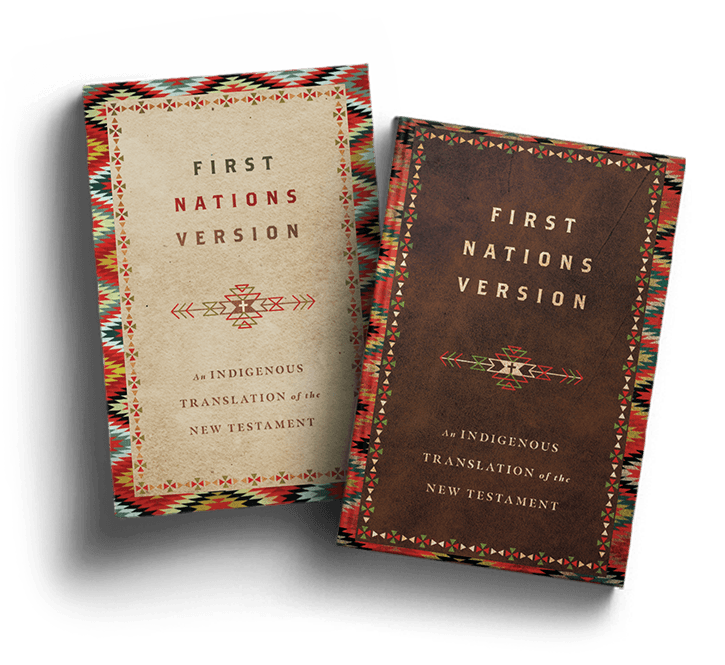
>> First Nations Version: An Indigenous Translation of the New Testament: “Many First Nations tribes communicate with the cultural and linguistic thought patterns found in their original tongues. The First Nations Version (FNV) recounts the Creator’s Story—the Christian Scriptures—following the tradition of Native storytellers’ oral cultures. This way of speaking, with its simple yet profound beauty and rich cultural idioms, still resonates in the hearts of First Nations people.
“The FNV is a dynamic equivalence translation that captures the simplicity, clarity, and beauty of Native storytellers in English, while remaining faithful to the original language of the New Testament.” The project was carried out by an eleven-member council selected from a cross-section of Native North Americans (elders, pastors, young adults, and men and women from different tribes and geographic locations) and overseen by Ojibwe storyteller Terry M. Wildman. Here is Wildman reciting the FNV translation of the Lord’s Prayer from the Gospels, accompanied by his wife, Darlene, on cedar flute:
Dale Chihuly (American, 1941–), Kobe Japan Workshop Ikebana Drawing, 1997. Mixed media on paper. Colorado Springs Fine Arts Center at Colorado College. Photo: Victoria Emily Jones.
Gather quickly
Out of darkness
All the songs you know
And throw them at the sun
Before they melt
Like snow.

This poem was originally published in the Colorado Review’s Spring/Summer 1957 issue, and it appears in The Collected Poems of Langston Hughes, ed. Arnold Rampersad (Knopf, 1994; Vintage Books, 1995).
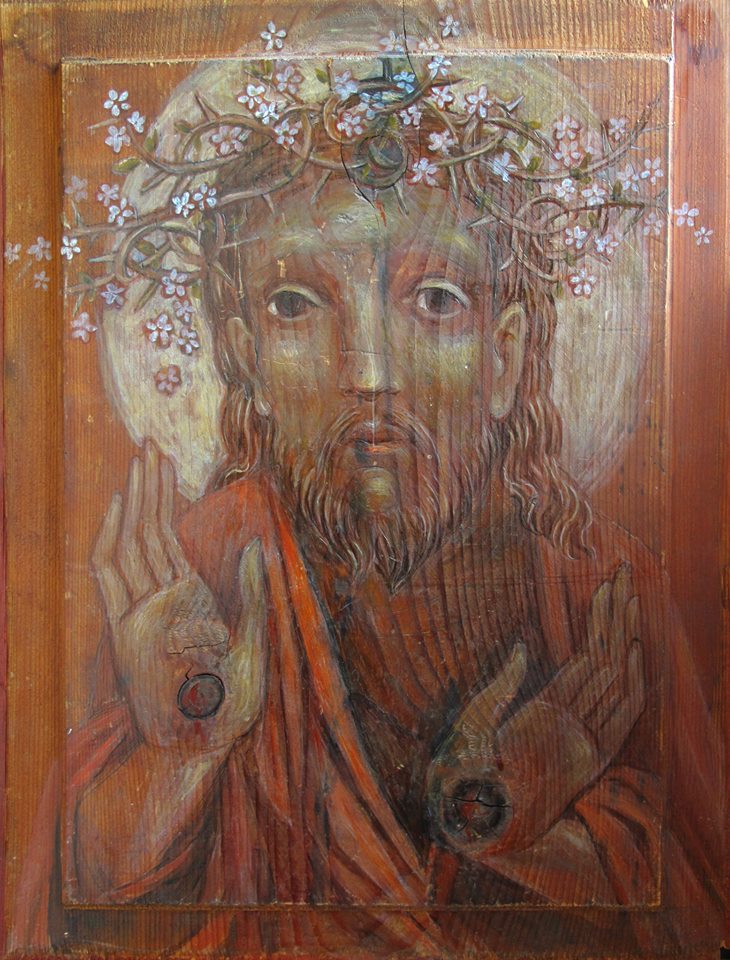
Tetiana Duman-Skop (Ukrainian, 1981–2020), Христос в розквітлому терновому вінку (Christ in a Blossoming Crown of Thorns), 2012. Encaustic on board, 70 × 50 cm.
Your voice speaks to my soul:

Be not afraid of my golden garments, have no fear of the rays of my candles,
For they are all but veils of my love, they are all but as tender hands covering my secret.
I will draw them away, weeping soul, that you may see I am no stranger to you.
How should a mother not resemble her child?
All your sorrows are in me.
I am born out of suffering, I have bloomed out of five holy wounds.
I grew on the tree of humiliation, I found strength in the bitter wine of tears.
I am a white rose in a chalice full of blood.
I live on suffering, I am the strength out of suffering, I am glory out of suffering:
Come to my soul and find your home.
This is section I of the poem “Passion” by Gertrud von Le Fort (1876–1971), translated from the German by Margaret Chanler and published in Hymns to the Church (Sheed and Ward, 1953). The icon is by Tetiana Duman-Skop, who died last year of brain cancer at age thirty-nine.
ONLINE EXHIBITION: A Global Icon: Mary in Context, created by the National Museum of Women in the Arts: Curated by Virginia Treanor, this digital resource was created as an expansion of the in-person exhibition Picturing Mary: Woman, Mother, Idea (see catalog), which ran from December 5, 2014, to April 12, 2015. Click through the pages to experience art images with descriptions, videos, and other content having to do with representations of Mary from across the world. The first video in the series is posted below, and here’s a playlist of all seven.
INTERVIEW (+ upcoming virtual conversation): “A God Who Wails and Dances: A Conversation with Yvonne Adhiambo Owuor”: This interview by Erika Kloss, which appears in the current issue of Image journal (no. 109), is so. good. Kenyan writer Yvonne Adhiambo Owuor is the author of the novels Dust and The Dragonfly Seaand award-winning short stories such as “The Weight of Whispers,” as well as the executive director of the Zanzibar International Film Festival. Here she talks about fiction, faith, coffee, and calling colonialism to account. To engage further, you can register for the Image-sponsored online event “The Art of Fiction: A God Who Wails and Dances with Yvonne Adhiambo Owuor,”which takes place September 23 at 3 p.m. ET.
Here’s just a snippet from her conversation with Kloss, where she describes what she would say to those who want nothing to do with Christianity because of all the evil that has been done in its name:
Dare to rescue God as Emmanuel from the dense debris of hubris, and from the weight and stench of whited sepulchers. For it is true, an excess of ghouls have appropriated for themselves the meaning and potency of the revolutionary One who dares to pronounce to humanity, “Love your enemies . . . Do good to those who hate you.”
Why should young people let themselves be revulsed by a legion who never fully entered into the depths of the subversive, seductive, paradigm-dissolving, drinking-and-hanging-out-with-sinners, beautiful, and heroic man-God? Why wouldn’t young people set out to experience for themselves the grand and compelling epic of a creator God in love, who loses his children and the earth to a defiant and rebellious once-beloved prince of light, and who struggles long and hard to regain the humanity he had loved and lost? So passionate and desperate is the creator in this endeavor that he will enter into humanity to try to court and secure these cherished children, even at the risk of his own murder—and even that does not stop the love. A love stronger than death? Don’t we all write anthems, in one form or another, yearning for this?
Let the next generation of seekers . . . visit old worlds that contain the spirit of the faith, not just in the Middle East, but also northern Africa, northern Sudan, Egypt, and Ethiopia, all those rubbed-out places (that colonialists presumed to suggest they were ‘civilizing’) from which Christianity entered into and transformed Europe and the world. . . . An historical quest for meaning at sites of origins might inspire young people to look again at the call to adventure and transcendent idealism that is the Way.
+++
VIDEO SERIES: How to Read the Bible by BibleProject: “Reading the Bible wisely requires that we learn about the ancient literary styles used by the biblical authors. . . . While the Bible is one unified story, it cannot all be read in the same way. The How to Read the Bible series walks through each literary style found in the Bible to show how each uniquely contributes to the overall story of Scripture.”
Led by Dr. Tim Mackie and Jon Collins, BibleProject is a crowdfunded animation studio that creates videos, podcasts, and small-group curricula. From 2017 to 2020 they executed a series called How to Read the Bible, which is nineteen episodes total. In it they examine the three major literary styles that comprise the Bible: narrative (chronicles, biographies, parables), poetry (celebratory, reflective, erotic, politically resistant, apocalyptic), and prose discourse (laws, sermons, letters). Each style lives by its own rules and structure, and we get into trouble, for example, when we don’t properly understand how metaphor works, or when we don’t recognize that Paul’s epistles were situated in a particular historical context. Here’s one of the videos in the series, on design patterns in biblical narrative:
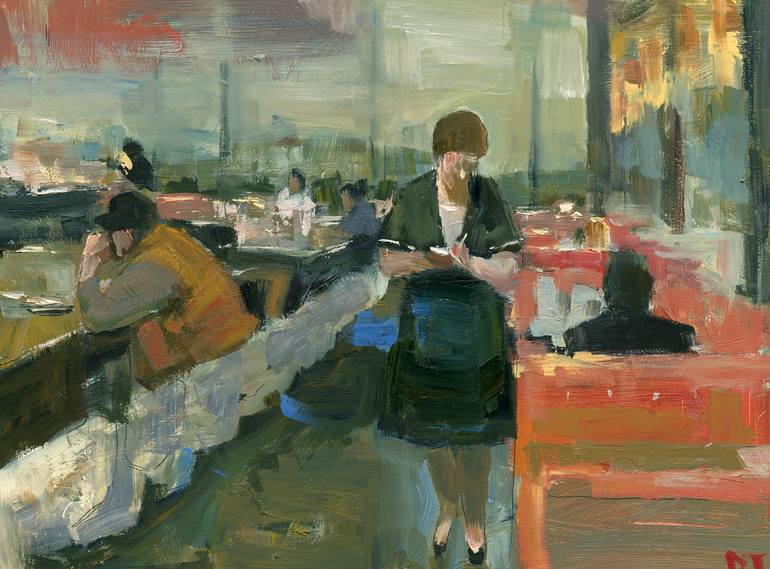
Darren Thompson (American, 1968–), Blonde with Sand, 2019. Oil on wood, 12 × 16 in. (A “blonde with sand” is coffee with cream and sugar.)
The waitress stands over me at 6:00 a.m. with pad and pen. She recites her litany with weary kindness; she says orange juice, coffee, two eggs over easy, says whole wheat toast, marmalade, each word a wafer I take from her hands and eat.
I stand before the white robed technician, my blouse draped around my hips. She gently cups my breasts in her hand, guides me between the cold steel wings of the machine. It will aim its radiant eye to uncover whatever mystery might be hidden there.
The beautician holds my head in her hands, tips it backward over the white chalice of the sink, sluices warm water through my hair again and again, smoothing the wings of my emptiness with her fingers until I am loosened and released.
This poem was originally published in Christianity and the Arts journal in 1999 and is reprinted here with the author’s permission.
+++
Taking its title from Psalm 91:11, “And He Shall Give His Angels Charge Over You” by Sharron Singleton expresses gratitude for those who work in the service sector, such as diner servers, mammography technologists, and hairstylists, who care for us through things like a hot cup of coffee, a diagnostic X-ray, or a relaxing shampoo—gifts that should not be taken for granted. The speaker of the poem, in fact, receives them as sacraments of sorts, describing the waitress’s recitation of menu offerings as “a wafer.” Similarly, the mammography tech wears a white robe, like the alb of a priest; she guides and illumines. And at the salon, the sink is like a chalice, a liturgical vessel, holder of the sacred—or a baptismal font; the speaker leaves washed and unburdened, light of spirit.
Singleton’s first full-length poetry collection, Our Hands a Hollow Bowl (Grayson Books, 2018), is an artful celebration of the sacramentality of nature and of everyday life—gardening, peeling potatoes, working, hiking, having sex, playing baseball, waiting in line, watching one’s son hold his son, selling a home full of memories. She also writes tenderly but without sentimentality about her mother and father, reflecting especially on her upbringing in rural Michigan, her mother’s slow death from cancer, and the pain of absence.
Singleton has recently completed the manuscript for her second full-length collection and is in the process of getting it published.
SONGWRITING CONTEST: 2021 Creation Care and Climate Justice Songwriting Contest, sponsored by The Porter’s Gate: “We are working on new worship resources celebrating God’s creation and His call to care for the created world. Over the next year we’ll be writing new songs on this subject and recording them. As part of this project, we are looking for submissions from anyone who would like to write a song or has already written a song on this subject. If you are a songwriter or composer, or if you know a songwriter who would be interested, click on this link for all the details of the contest. Songwriters are invited to submit worship songs related to caring for God’s creation, and we are offering a $500 cash prize to the winner. We’ll also record the winning piece.” No entry fee. Deadline August 30, 2021.
+++
CINEPOEM: “First Grade Activist” – Poem by Nic Sebastian, video by Marie Craven: This 2014 short by Australian filmmaker Marie Craven takes a poem written and read by Nic Sebastian—one of many poems made freely available for “remixing” through the now-defunct Poetry Storehouse—and sets it to moving images and music. About bullying in schools and transforming perceptions, the poem suggests concrete ways to turn a personal attribute that elicits taunts into one that’s praiseworthy, merely by reframing it. It’s an ode to red hair!
Video poetry, sometimes called “cinepoetry,” is a hybrid genre that combines the best of both art forms to make dynamic new works. To explore more, visit Moving Poems, Poetry + Video, filmpoetry.org, and the Film and Video Poetry Society, which is currently accepting submissions for its fourth annual symposium.
+++
NEW SONGS BY IAMSON:
IAMSON is the alias of Orlando Palmer, a Christian singer-songwriter from Richmond, Virginia. Here are two of his recent songs, each of which he invited a friend to perform.
They discuss the role of metaphor in the Bible, the unique powers of different art forms, and the ways our aesthetic choices open up and close down opportunities for formation in worship.
I so appreciate Taylor’s ecumenicism. He’s an Anglican priest in the United States but does not prescribe any one “right” way of using the arts in worship. In all his examples from across Christian traditions and even historical eras, he’s keen on exploring what motivates aesthetic choices and the benefits and drawbacks of any given choice. For instance, he compares the experiences of worshipping in a Gothic cathedral versus in a living room; neither one is inherently better than the other, but each setting will inevitably form worshippers in distinct ways. He also compares two songs centered on the idea of God as rescuer: the Gettys’ “In Christ Alone” and Hillsong’s “Oceans”; both have a similar aim but take very different approaches to reach it, and that’s OK.
Lots of great content here, folks, and a great intro to the themes in Taylor’s book.
Alberto Giacometti (Swiss, 1901–1966), Dog, 1951 (cast 1957). Bronze, 18 × 39 × 6 1/8 in. (45.7 × 99 × 15.5 cm). Museum of Modern Art, New York.
lopes in bronze:
     scruffy,
          then. In

the Museum of Modern Art
     head
          down, neck long as sadness

lowering to hanging ears
     (he’s eyeless)
          that hear

nothing, and the sausage
     muzzle
          that leads him as

surely as eyes:
     he might
          be

dead, dried webs or clots of flesh
     and fur
          on the thin, long bones—but

isn’t, obviously,
     is obviously
          traveling intent on his

own aim: legs
     lofting
          with a gaiety the dead aren’t known

for. Going
     onward in one place,
          he doesn’t so much ignore

as not recognize
     the well-
          dressed Sunday hun-

dreds who passing, pausing make
     his bronze
          road

move. Why
     do they come to admire
          him,

who wouldn’t care for real dogs
     less raggy
          than he

is? It’s his tragic
     insouciance
          bugs them? or is

it that art can make us
     cherish
          anything—this command

of shaping and abutting space—
     that makes us love
          even mutts,

even the world, having
     rocks
          and the wind for comrades?

It’s not this starved hound,
     but Giacometti seeing
          him we see.

We’ll stand in line all day
     to see one man
          love anything enough.
“Giacometti’s Dog” by Robert Wallace was originally published in Ungainly Things (Dutton, 1968) and is included in the collection The Common Summer: New and Selected Poems (Carnegie Mellon University Press, 1989). Used by permission.
+++
When artists take the time to sculpt (or paint, film, lyricize, etc.) a subject, they inevitably give their careful attention to that person, place, or thing. And attention is a form of love. The best artworks succeed in conveying that love.
In his poem “Giacometti’s Dog,” Robert Wallace muses on how modernist sculptor Alberto Giacometti poured heart, mind, body, and soul into portraying something so “unworthy” and unattractive as a stray dog. Why dignify the malnourished, matted canine with a bronze cast and prominent display in a world-class museum? And why do all the gallery visitors crowd around to see him?
Wallace determines that it is the artist’s love for the dog that attracts people to it. If Giacometti thought him a fitting subject for a sculpture, then he must matter. He is worth attending to. “Art can make us cherish anything,” Wallace writes. Artists show us where to look and teach us what to love.
NEW PLAYLIST: August 2021 (Art & Theology): This month’s thirty-song roundup opens with a 1936 recording by blues guitarist and singer Blind Roosevelt Graves and goes on to include “Amazing Grace” sung to the tune of HOUSE OF THE RISISNG SUN; “Amaholo,” a song in Luganda performed by a youth choir from Kkindu Village, Uganda (its first line is “God’s blessing can’t be blocked by the devil!”); some Joan Baez and Johnny Cash; “Pretty Home,” a Shaker hymn by Patsy Roberts Williamson, an enslaved African American woman whose freedom was purchased by the Pleasant Hill Shaker community in the early 1800s; Psalm 118:1–4 in Hebrew, set by one of the most popular contemporary singer-songwriters of Jewish religious songs, Debbie Friedman, and sung by a trio of brothers; a gospel song from one of my favorite films of 2019, Peanut Butter Falcon; and “God Yu Takem Laef Blong Mi,” a Melanesian choir rendition of “Take My Life and Let it Be” from Terrence Malick’s The Thin Red Line.
+++
CALL FOR PITCHES: Geez 63 Jubilee: “What would the biblical practice of Jubilee look like today? Geez magazine is looking for submissions that reimagine ideas of debt forgiveness, reparations, trumpets singing, and a whole lot of radical rest. Deadline for pitches: August 12.” [HT: ImageUpdate]
Creative nonfiction essays, investigative articles, “flash nonfiction” (short insights, as few as fifty words), photographs, and poems are among the forms accepted. To get you started, Geez provides a whole host of questions for pondering, as well as specific prompts, such as:
Rewrite Isaiah 61, “The year of the Lord’s favor,” in the context of today’s struggles for justice.
Take a nap. Write a poem about it.
Write a street liturgy for the front steps of Navient, American Educational Services, or other student loan debt collectors.
Explore global social movements that have employed practices of Jubilee, implicitly or explicitly.
Describe the sounds of a great Jubilee party.
If you want to stay apprised of what the quarterly is up to in the future, sign up for their newsletter (there’s an option to receive contributor pitch emails) and/or follow them on Facebook and Twitter.
+++
THE GESUALDO SIX:
The Gesualdo Six is an award-winning British vocal ensemble directed by Owain Park. I’ve really been enjoying all the content on their YouTube channel, which includes original performances of sacred motets, hymns, carols, chansons, and contemporary pieces—like the two below, both written specifically for the group. Be sure to check out their website for information about live concerts!
>> “The Blue Bird” by Andrew Maxfield: The composer writes, “The text [see below]—a beloved poem by Mary Elizabeth Coleridge—evokes ‘blueness’ not just in its title; every image is blue: the lake, the bird’s wings, the sky above and beneath. Far from being monochromatic, though, this poetic meditation reveals a multiplicity within the narrow spectrum we label ‘blue.’ Royal. Navy. Cobalt. Tiffany. Sky. Midnight. All of these flash, but only briefly, as our winged protagonist catches his fleeting reflection in the lake’s glassy surface. Blue, then, is the subject and substance of my musical setting. Harmonically, the piece hovers, as the bird does, in what feels to me like a cool, gentle, blue sound—little variations and reflections on the wings and water here and there, but the piece attempts to remain ‘blue in blue’ (or what Miles Davis might have called ‘Kind of Blue’) and, after not too long, disappears, as the birds shifts, glides, and vanishes. Melodically, this bird nods to another: to William Byrd, one of the great composers of the English Renaissance, whose contrapuntal inventiveness inspires me. And—I couldn’t help myself—my setting alludes to Joni Mitchell’s song ‘Blue,’ but I leave it to you to locate the reference.”
The lake lay blue below the hill. O’er it, as I looked, there flew Across the waters, cold and still, A bird whose wings were palest blue.
The sky above was blue at last, The sky beneath me blue in blue. A moment, ere the bird had passed, It caught his image as he flew.
ONLINE EVENTS: “Origin, an Art House Dallas program, seeks to establish a wholeness and connectedness between spiritual formation, imagination, and the arts with the ultimate intent to establish a sacred perspective on how we individually and collectively live and create. We believe that beauty shown through the arts, culture, and creation holds a powerful ability to form the way we see ourselves, the world, and our interaction with both.”
This summer’s iteration of the program consists of a series of online Thursday night talks by artists or pastors, followed by facilitated discussions. Two of these have already passed, but two are still upcoming: “Embodiment” with Guy Delcambre on August 12, and “Beauty” with Kelly Kruse on August 26. RSVP at Eventbrite.
In addition to the free events, there’s an accompanying anthology of articles, poems, visual art, scripture, and questions for prayerful reflection, which is on sale for $8.
+++
MOVIE OPENING: I’m working my way through all the Best Picture Oscar winners since the award’s inception in 1928 and have come upon 1980’s Ordinary People, Robert Redford’s directorial debut. Based on the novel by Judith Guest, it’s about the fragmentation of an upper middle-class family, the Jarretts, following the death of the eldest son, Buck, in a sailing accident and a subsequent suicide attempt by the other son, Conrad (played by Timothy Hutton).
I was really struck by its opening, which features a sacred choral version of Pachelbel’s Canon in D by Noel Goemanne. Although the film is not a religious one, the choice to open it with a prayer from the lips of Conrad, albeit one assigned by his high school choir teacher, is very fitting, as it voices the character’s longings. Throughout the film Conrad will struggle to find that peace, joy, and love he sings about in class—learning over time to assert with sincerity, in spite of grave tragedy, “Alleluia.”
The full lyrics by Goemanne are below, and you can watch a performance of the full song by the Meridian Community College Chorus and Guitar Ensemble here.
In the silence of our souls O Lord, we contemplate Thy peace Free from all the world’s desires Free of fear and all anxiety
O Lord our God Wisdom, joy, and peace and love divine O Lord our God Glory, praise, and honor be always thine
O dearest Lord, come to us now Have mercy on us, stay with us and protect us all
O Lord our God Wisdom, truth, and love and peace and joy O Lord our King Thy praises we will always sing







 Art & Theology