I love listening to Malcolm Guite talk about spirituality, poetry, and the imagination; he’s a phenomenal teacher. In a December 2 podcast episode titled “Keeping Advent: Hope for a Dark World,” host Sally Clarkson interviews Guite on these topics as they relate to Advent. Before he launches into the meat of the talk, he describes the importance of the imagination in getting at truth:
God has given us all kinds of capacities with which to come to the truth, just like he’s given us different sense organs. When a bird is singing, your ears are telling you one part of what’s happening, and your eyes are telling you another. You’ve got both to get that whole experience. If you just had a silent film of the bird, you would be seeing something real, but you’d be missing something as well.
So I sometimes think that reason, the reason that makes for great science—analytic, helps us to think things through logically—that’s a very, very important test for truth, that’s a very important faculty, but it doesn’t get to everything. . . .
Imagination is the thing that shapes and puts things together. Shakespeare put this very beautifully. He said that imagination “apprehend[s] / more than cool reason ever comprehends” [A Midsummer Night’s Dream, 5.1.5–6]. He said we need to apprehend some joy before we can comprehend the bringer of the joy.
Samuel Taylor Coleridge believed that the imagination was part of our capacity to pay attention, and that the imagination would help us to remove, for a minute, the dull film of familiarity that we put over everything, and see it with freshness again. He also used a very beautiful analogy. He uses the example of a little insect, the horned fly, and how, when it’s still in the squashy pupa phase and it’s going to metamorphose, it makes a cocoon—a kind of carapace. He says that when that little fly does that, it leaves room in its involucrum, he calls it—what a wonderful word—for antennae yet to come [Biographia Literaria, vol. 1, chap. 12]. He says that’s what the imagination does.
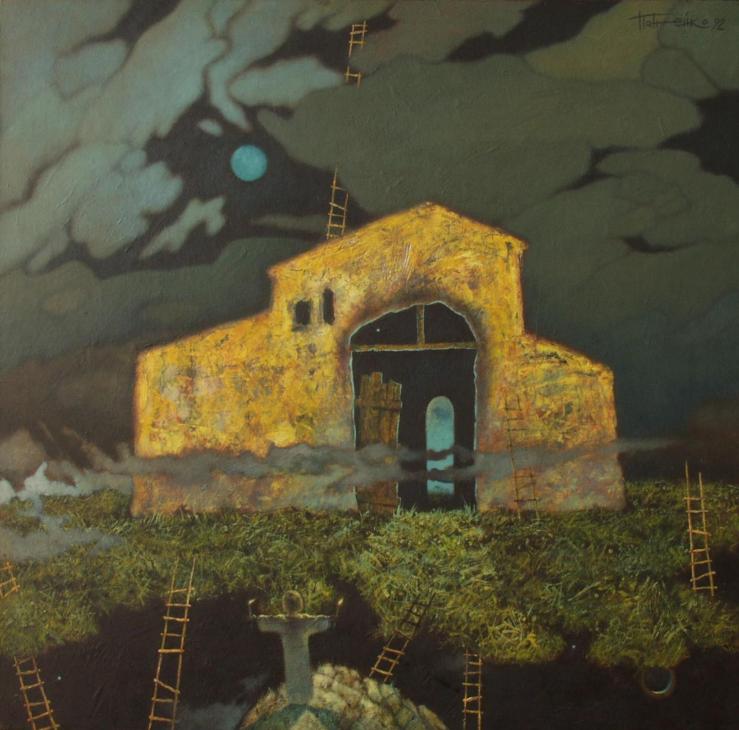
Sometimes the artistic imagination, the poetic imagination, comes to us with something marvelous. And what that marvelous thing is doing is it’s holding open a shape that the rest of our mind is going to grow into, so that the antennae, the real reasoning and figuring it all out, can come a bit later, but the story [or poem or image] gives us something.
Ihor Paneyko (Ukrainian, 1957–), Ворота ІІ (Gate II), 1992. Fiberboard, levkas, yolk emulsion, tempera.
In this interview Guite also reads one of his Advent sonnets, the last in a series of seven he wrote that were inspired by the traditional liturgical chants known as the O Antiphons. Titled “O Emmanuel,” the poem is a prayer for God to come among us again, in all his myriad attributes, and to rebirth not only the hearts of humanity but the whole earth.
“O Emmanuel” by Malcolm Guite
O come, O come, and be our God-with-us,
O long-sought With-ness for a world without,
O secret seed, O hidden spring of light.
Come to us Wisdom, come unspoken Name,
Come Root, and Key, and King, and holy Flame.
O quickened little wick so tightly curled,
Be folded with us into time and place,
Unfold for us the mystery of grace
And make a womb of all this wounded world.
O heart of heaven beating in the earth,
O tiny hope within our hopelessness,
Come to be born, to bear us to our birth,
To touch a dying world with new-made hands,
And make these rags of time our swaddling bands.
Through the needle’s eye
the rich man came
squeezing through stars of razor light
that pared his body down to thread.
Gravity crushed his heart’s chime
and his breath that breathed out worlds
now flattened as fire between walls,
the impossible slit stripped him
admitting him
to stitch the human breach.
This poem was first published in What a Light Thing, This Stone (Sow’s Ear Press, 1999) and is used here by permission of the author.
My research interests have to do mainly with art’s theological potential and its ability to, as Walter Brueggemann puts it, “disclose” truths that are “closed” by prose. I love how it often surprises, and how it can make connections I would have never thought to make myself.
Suzanne Underwood Rhodes’s poem “Advent” demonstrates these values magnificently. Its topic is the Incarnation. But her mooring point is not John 1 or Luke 1–2 or Philippians 2 or any other scripture text traditionally associated with the doctrine. Instead she draws on the famous aphorism of Jesus that’s recorded in Matthew 19:24: “It is easier for a camel to go through the eye of a needle than for a rich person to enter the kingdom of God.”
In this Gospel interaction, Jesus is explaining how terribly difficult it is for wealthy people to enter heaven because they tend to cling tightly to their earthly wealth rather than to God; they let it make claims on them, and they trust in its promises, to the neglect of the claims and promises of God. While the needle saying, in context, pertains to human beings passing from earth to heaven, Rhodes turns it on its head to suggest the movement of God from heaven to earth. A seeming impossibility—infinity becoming finite, God becoming man. But “with God, all things are possible” (Matt. 19:26). To save us, he would give up all the riches of heaven, assuming the role of a servant and ultimately giving up his very life.
Rhodes uses harsh, uncomfortable words—“squeezing,” “razor,” “pared,” “crushed,” “flattened,” “stripped”—to convey a sense of compression into human flesh. God’s breath, once so powerful and expansive that it brought the universe into existence, is now, in the person of the Son, walled in by a rib cage and dependent on oxygen. His heart pumps actual blood. Thus pared down to thread, he slips through the needle “to stitch the human breach,” to repair what we have torn through our disobedience. Severed from God no longer, we are held together with him by Christ himself.
Musical composition: “As by Fire between Walls” by Joshua Stamper
The evocative imagery of this poem has inspired artists in other media to respond in kind. One of them is composer Joshua Stamper, who, commissioned in 2014 by City Church Philadelphia, wrote a four-and-a-half-minute experimental jazz piece for chamber orchestra titled “As by Fire between Walls.”
It starts with minor chords on the piano, floating around ethereally. Then a violin tremolo kicks in (suggestive of the “razor light”), and other sharp bowing techniques (“par[ing] his body down”). Then soulful, wordless vocals. Then a staccato rhythm played on the mellotron, and percussion. Brass too. It’s a wonderfully wrought piece of music, a soundscape of the Incarnation, inclining the ear back toward Rhodes’s words and the heart to the grand story of scripture.
Painting: Through the Needle’s Eye the Rich Man Came by Grace Carol Bomer
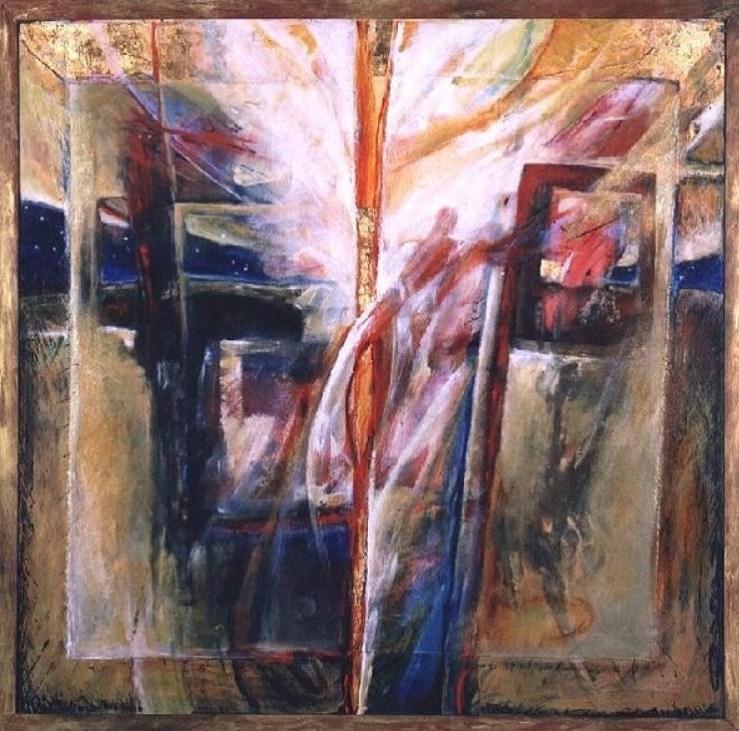
Suzanne Rhodes is a friend of visual artist Grace Carol Bomer’s, who has a studio practice in Asheville, North Carolina. In 1993, Bomer was invited by the Asheville Art Museum to exhibit eight of her paintings for a Christmas show. Through the Needle’s Eye the Rich Man Came, inspired by Rhodes’s “Advent,” is one of those eight.
Grace Carol Bomer (Canadian American, 1948–), Through the Needle’s Eye the Rich Man Came, 1993. Mixed media on torn canvas on wood, 48 × 48 in.
About it, Bomer says,
The Christ of Christmas is God incarnate, the focal point or fulcrum of history. To show this glorious Incarnation, I chose to paint a piercing V (fulcrum) of light rending cloth (canvas on wood). The torn canvas symbolizes the veil of the temple. . . .
It was my personal challenge to show in painting that Christ is God, Spirit and flesh, in a way that would not be trite and sentimental. The Renaissance nativities are infected with beautiful Platonic realism, suited for Christmas card sentimentality. I feel they do not adequately exalt the “mystery hidden for ages,” the Christ of power and glory. Jesus Christ is Spirit and flesh, Son of God and Son of Man. Reality is both “abstract” and “realistic.” So too, art must seek to find this mysterious balance in order to proclaim the gospel. Art totally divested of realism, like Abstract Expressionism, becomes meaningless. Art must proclaim creation, fall, and redemption. I would like the poetic nuances in my work to stimulate the imagination to “see” in the abstract painting the spiritual truths that cannot be painted realistically.
In this piece there are suggestions of blood on doorways, symbolizing a Passover fulfilled, as Christ pushes open the door separating God and man.
So this painting integrates the coming down with the at-one-ing that happens at the cross, the physical tear of the canvas alluding simultaneously to the “human breach” of Rhodes’s poem and the tearing of the temple veil, which symbolizes humanity’s reconciliation to God. Birth and death are wrapped up in a single image, as both are key to Christ’s salvation project.
See how a poet’s imagination and craft can unfold the beauty and wonder of a heady doctrine with such concision? In Literature: Structure, Sound, and Sense, Laurence Perrine defines poetry as “a kind of language that says more and says it more intensely than does ordinary language” (509). That’s just what Suzanne Underwood Rhodes does in “Advent.” And that intense language of hers has inspired works of musical and visual art that explore even further what it means that the Son of God, the “Rich Man” from heaven, constricted himself for our sakes, becoming impossibly small, taking up residence in a virgin’s dark womb, in humanity’s dark world, so that he could stitch back together our ruptured relationships with the Father and with one another.
Kiki Smith (American, 1954–), Starry, Starry Night, 2013
“Leavetaking” by Anne Porter
Nearing the start of that mysterious last season
Which brings us to the close of the other four,
I’m somewhat afraid and don’t know how to prepare
So I will praise you.
I will praise you for the glaze on buttercups
And for the pearly scent of wild fresh water
And the great crossbow shapes of swans flying over
With that strong silken threshing sound of wings
Which you gave them when you made them without voices.
And I will praise you for crickets.
On starry autumn nights
When the earth is cooling
Their rusty diminutive music
Repeated over and over
Is the very marrow of peace.
And I praise you for crows calling from treetops
The speech of my first village,
And for the sparrow’s flash of song
Flinging me in an instant
The joy of a child who woke
Each morning to the freedom
Of her mother’s unclouded love
And lived in it like a country.
And I praise you that from vacant lots
From only broken glass and candy wrappers
You raise up the blue chicory flowers.
I thank you for that secret praise
Which burns in every creature,
And I ask you to bring us to life
Out of every sort of death
And teach us mercy.
This poem appears in Living Things: Collected Poems (Hanover, NH: Zoland Books/Steerforth Press, 2006) and is used here by permission of the publisher.
+++
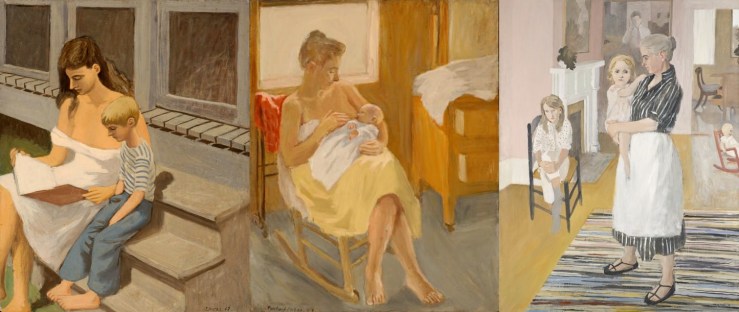
Anne Porter (1911–2011) is one of the last century’s foremost poets of thanks and praise. She wrote all her life, occasionally sharing poems with friends and family, but she focused mainly on raising five kids with her husband, Fairfield Porter, who was a painter.
Fairfield Porter (American, 1907–1975): Anne Reading to Laurence, 1947, oil on Masonite, 30 × 24 in., Parrish Art Museum, Southampton, New York; Katie and Anne, 1949, oil on board, 30 × 24 in., Parrish Art Museum, Southampton, New York; Anne, Lizzie and Katie, 1958, oil on canvas, 78 × 60 in., Sheldon Museum of Art, Lincoln, Nebraska.
She wrote “Leavetaking” upon entering old age, and after her husband had died. As her body grew weaker and more burdensome and death drew nearer, she still found much to praise God for—for the regal shape of swans’ wings overhead, for the “rusty diminutive music” of crickets on starry nights, for the vast love between mother and child, for the hope of resurrection preached in abandoned lots where flowers rise out of debris.
Some years later, Porter’s friend David Shapiro, a literary critic and fellow poet, asked if for his birthday, she could compile some of her poems for him. She gathered up what she could find in the house, and without her foreknowledge, he submitted it to a publisher. The resulting collection, An Altogether Different Language (1994), was published when she was eighty-three and was named a finalist for the National Book Award.
In the foreword to that first book of hers, Shapiro wrote,
If we have problems, because so much of the language of belief has grown connotatively encrusted, then we wait for the poets who believe enough and can freshen this dialect.
Anne Porter is one of the rare poets who believes enough, who lives in days and holidays, and who has stunningly found a language to transmit her Franciscan joy in created things.
Also from the foreword:
“Her faith has enlarged her, not the reverse, and her poetry has the grandeur of seeing things ‘as if for the first time.’”
“Her greatest emotional perspective is that of praise.”
She is “an American religious poet of stature who reminds us that the idea of the holy is still possible for us.”
“For Anne Porter, the holy is found in a commitment to Christ the Mediator and his triumph in suffering for a suffering world. However, she gives a constant, almost pantheistic pressure to the theme that the Kingdom of God is within and without, so that her radiant if concise imagism is all in the service of God.”
Whereas many modern and contemporary poets write about the hiddenness of God, the deus absconditus, Porter wrote unabashedly about the myriad ways in which God reveals himself in the world. Her second and last book, Living Things: Collected Poems (2006), brings together thirty-nine new poems with those published in the previous volume.
In 2010, theologian and biblical scholar Ellen F. Davis wrote a beautiful article for the Christian Century titled “Our proper place: The poetry of care and loss,” in which she discusses Porter’s poetry alongside that of Mary Oliver. Like Oliver, she says, Porter is a “direct descendant of the psalmists”; she “clarif[ies] what is at stake in the Psalter: nothing less than the possibility of praising God truly.”
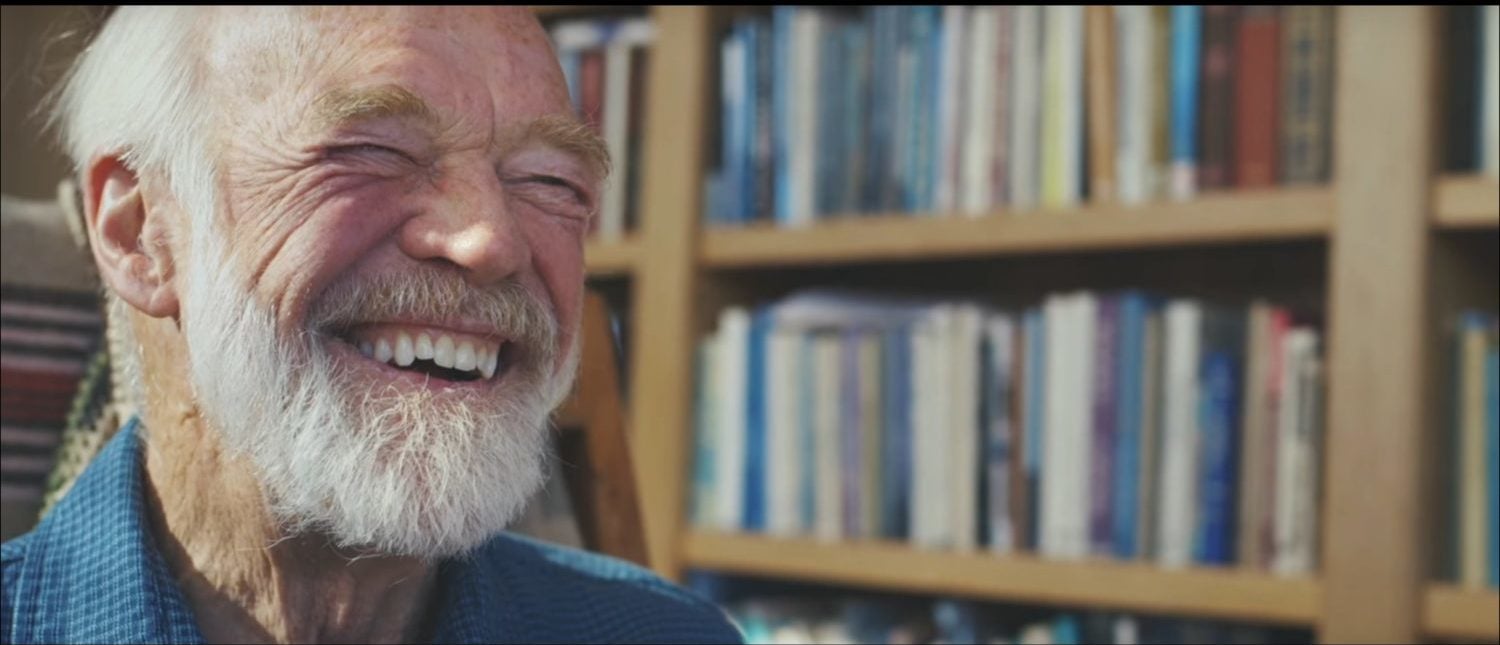
American pastor, professor, author, and poet Eugene H. Peterson passed away on October 22 at age eighty-five. He’s best known for his idiomatic translation of the Bible, The Message, which has sold twenty million copies worldwide since its publication in 2002. He developed this translation over his nearly three decades as a Presbyterian pastor in Bel Air, Maryland, as a way to reinvigorate his congregation’s engagement with scripture. Its most quoted verse is John 1:14, describing the incarnation: “The Word became flesh and blood, and moved into the neighborhood.”
The church culture I grew up in regarded The Message with disdain, as they thought it plays fast and loose with the words of scripture and lacks reverence. Nurtured on a KJV-only diet, I felt rebellious purchasing an NIV Study Bible in middle school, and although I no longer subscribed to the fundamentalism of my youth by the time I had finished college, adding a used copy of The Message to my checkout basket at the Montague Bookmill a few years later still set the “Unsanctioned!” bells ringing in my head. But I was finally ready to engage this translation (or as some would say, paraphrase) of which I had heard so much but read so little.
What I found was that Peterson’s scripture translation, while no doubt sounding very different than the translations arrived at by committee, is full of reverence—and joy, and play, and wonder. It takes the familiar words of the Bible and re-presents them in a new way so as to really bring out their tone and meaning. Take, for example, Psalm 96:4–7. The King James Version reads,
For great is the Lord, and greatly to be praised;
he is to be feared above all gods.
For all the gods of the peoples are worthless idols,
but the Lord made the heavens.
Splendor and majesty are before him;
strength and beauty are in his sanctuary.
Ascribe to the Lord, O families of the peoples,
ascribe to the Lord glory and strength!
The Message has
For God is great, and worth a thousand Hallelujahs.
His terrible beauty makes the gods look cheap;
Pagan gods are mere tatters and rags.
God made the heavens—
Royal splendor radiates from him,
A powerful beauty sets him apart.
Bravo, God, Bravo!
Everyone join in the great shout: Encore!
In awe before the beauty, in awe before the might.
Now, I love the poetry of the King James Version. But I also love Peterson’s renderings. They enliven the texts. That’s not to say God’s word isn’t already living and active, but that sometimes it can grow stale in the ears of those who have been reading it for a lifetime. The jubilance of Psalm 96 in The Message is amplified by the use of contemporary expressions—Bravo! Encore!—to denote enjoyment and praise. As I read this, I am enticed to “join in the great shout.”
While I wouldn’t advise using The Message as your sole or even primary Bible (Peterson himself says as much in the preface), I do uplift it as a wise, fun, and spiritually nourishing supplement. You’ll see that I occasionally feature Peterson’s verse translations in Artful Devotions because they communicate God’s truth with such color and force (see, e.g., Ps. 19, Ps. 51, Rom. 8:6, 2 Cor. 4: 1–6, Eph. 2:1–10). His motivation all along was to expose a new generation to the beauty of the gospel. “Getting the words of the Bible into [people’s] heads and hearts, getting the message lived,” is what he characterized as the primary work of his life (preface, The Message).
When I think of Eugene Peterson, I think imagination. He exemplified that Christian duty not only in his Bible translation but also in his various other professional ministries: as pastor, professor, and author. In each role, he sought to awaken Christians to the goodness of imagination. Listen to him speak on the topic with On Being’s Krista Tippett, in a podcast episode recorded in 2016.
My pursuit of the arts has been indirectly influenced by Peterson, because he was a critical influence on and mentor to W. David O. Taylor, whom I have followed for some time and greatly look up to. An assistant professor of theology and culture at Fuller Theological Seminary, Taylor wrote a beautiful personal tribute to Peterson the other week. “It’s one thing to be given permission to do a thing,” Taylor writes. “It’s quite another to be encouraged, and supported, and patronized, and inspired, and resourced to do a thing. Eugene’s one of those key people in my life who encouraged me to pursue the arts.”
Peterson was Taylor’s professor of spiritual theology at Regent College in Vancouver. “He used the poetry of Gerard Manley Hopkins and the literature of George Eliot, Karl Barth’s theology and Frederick Buechner’s novels, Greek mythology and stories from his Pentecostal childhood as a way to help his students understand who God was and what God was on about it in this expansive vision of Holy Scripture,” Taylor says. “All of it felt immensely exhilarating to me; it still does.” I’ve come to Peterson’s other writings mainly through Taylor, who cites them with deep respect.
Peterson was an especial lover of poetry. He discussed the topic on film with former Poetry editor Christian Wiman and with U2 star Bono (in an interview by Taylor on the Psalms, above), and he has written about it in numerous books of spiritual theology. He’s even written a volume of original poetry called Holy Luck, from which I featured the poem “Aaron’s Beard” last year, and has contributed to some of Luci Shaw’s poetry anthologies, like A Widening Light: Poems of the Incarnation (see “Tempted”). Here is some of what Peterson had to say about poetry:
“Poets are caretakers of language, shepherds of words, protecting them from desecration, exploitation, misuse. Words not only mean something, they are something, each with a sound and rhythm all its own. Poets are not primarily trying to tell us or get us to do something. . . . I do not have more information after reading a poem; I have more experience.” (Holy Luck, xiv)
“People who pray need to learn poetry, even if they’re not adept at it.” (source)
“Poets tell us what our eyes, blurred with too much gawking, and our ears, dulled with too much chatter, miss around and within us. Poets use words to drag us into the depth of reality itself. Poetry grabs us by the jugular. Far from being cosmetic language, it is intestinal.” (Answering God, 11)
“We cannot speed-read a poem. A poem requires rereading. Unlike prose which fills the page with print, poems leave a lot of white space. . . . There is a lot to see, to feel, to sense. We sit before the poem like we sit before a flower and attend to form, relationship, color. We let it begin to work on us. When we are reading prose we are often in control, but in a poem we feel like we are out of control. . . . In prose we are after something, getting information, acquiring knowledge. . . . But in poetry we take a different stance. We are prepared to be puzzled, to go back, to wait, to ponder, to listen. This attending, this waiting, this reverential posture, is at the core of the life of faith, the life of prayer, the life of worship, the life of witness. . . . Read it again, read it again, read it again.” (Subversive Spirituality, 180)
“It takes a while to get the poets. . . . It takes a while to get the gospel. . . . We have to quit getting in a hurry. . . . I think the besetting sin of Americans is impatience.” (source)
Though I never met Eugene Peterson, I am so grateful for his witness, and for the many ways he has blessed the church over the years. His words have tutored, and continue to tutor, my imagination and, yes, deepen my love for Jesus and his gospel.
The angel Gabriel awakes the dead on Resurrection Day in this medieval stained glass tondo from the Musée de Cluny in Paris. Photo: Spencer Means.
And just as it is appointed for man to die once, and after that comes judgment, so Christ, having been offered once to bear the sins of many, will appear a second time, not to deal with sin but to save those who are eagerly waiting for him.
—Hebrews 9:27–28
+++
SONG: “Get Happy” | Words by Ted Koehler, 1930 | Music by Harold Arlen, 1930 | Performed by the Puppini Sisters, on Hollywood(2011)
See also the Judy Garland version from Summer Stock (1950), below, which the American Film Institute ranked #61 in its survey of top tunes in American cinema.
+++
“The Day of Judgment” by Henry Vaughan
O day of life, of light, of love!
The only day dealt from above!
A day so fresh, so bright, so brave,
’Twill show us each forgotten grave,
And make the dead, like flowers, arise
Youthful and fair to see new skies.
All other days, compared to thee,
Are but Light’s weak minority;
They are but veils, and cypress drawn
Like clouds, before thy glorious dawn.
O come! arise! shine! do not stay,
Dearly loved day!
The fields are long since white, and I
With earnest groans for freedom cry;
My fellow-creatures too say “Come!”
And stones, though speechless, are not dumb.
When shall we hear that glorious voice
Of life and joys?
That voice, which to each secret bed
Of my Lord’s dead,
Shall bring true day, and make dust see
The way to immortality?
When shall those first white pilgrims rise,
Whose holy, happy histories
—Because they sleep so long—some men
Count but the blots of a vain pen?
Dear Lord! make haste!
Sin every day commits more waste;
And Thy old enemy, which knows
His time is short, more raging grows.
Nor moan I only—though profuse—
Thy creature’s bondage and abuse;
But what is highest sin and shame,
The vile despite done to Thy name;
The forgeries, which impious wit
And power force on Holy Writ,
With all detestable designs,
That may dishonor those pure lines.
O God! though mercy be in Thee
The greatest attribute we see,
And the most needful for our sins,
Yet, when Thy mercy nothing wins
But mere disdain, let not man say
“Thy arm doth sleep,” but write this day
Thy judging one: descend, descend!
Make all things new, and without end!
This post belongs to the weekly series Artful Devotion. If you can’t view the music player in your email or RSS reader, try opening the post in your browser.
To view all the Revised Common Lectionary scripture readings for Proper 27, cycle B, click here.
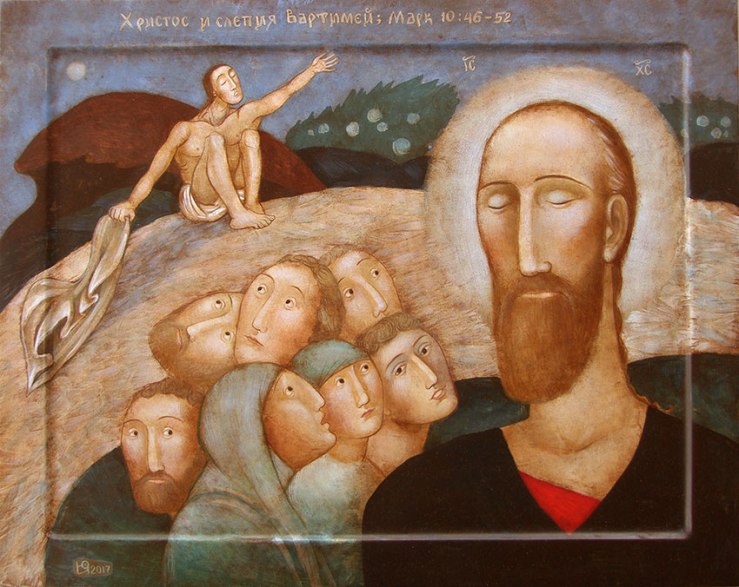
Julia Stankova (Bulgarian, 1954–), Christ and Bartimaeus, 2017. Tempera on primed wooden panel and lacquer technique, 36 × 45 cm.
And they came to Jericho. And as he was leaving Jericho with his disciples and a great crowd, Bartimaeus, a blind beggar, the son of Timaeus, was sitting by the roadside. And when he heard that it was Jesus of Nazareth, he began to cry out and say, “Jesus, Son of David, have mercy on me!” And many rebuked him, telling him to be silent. But he cried out all the more, “Son of David, have mercy on me!” And Jesus stopped and said, “Call him.” And they called the blind man, saying to him, “Take heart. Get up; he is calling you.” And throwing off his cloak, he sprang up and came to Jesus. And Jesus said to him, “What do you want me to do for you?” And the blind man said to him, “Rabbi, let me recover my sight.” And Jesus said to him, “Go your way; your faith has made you well.” And immediately he recovered his sight and followed him on the way.
—Mark 10:46–52 (cf. Matthew 20:29–34; Luke 18:35–43)
Here’s an introduction and acoustic performance by band leader Cam Huxford, who cowrote “Son of David” with fellow Ghost Ship member Shay Carlucci:
+++
“The Blind Suppliant” by Richard Crashaw
Silence, silence, O vile crowd;
Yea, I will now cry aloud:
He comes near, Who is to me
Light and life and liberty.
Silence seek ye? yes, I’ll be
Silent when He speaks to me,
He my Hope; ah, meek and still,
I shall ’bide His holy will.
O crowd, ye it may surprise,
But His voice holdeth my eyes:
O have pity on my night,
By the day that gives glad light;
O have pity on my night,
By the day would lose its light,
If it gat not of Thee sight;
O have pity on my night,
By day of faith upspringing bright;
That day within my soul that burns,
And for eyes’ day unto Thee turns.
Lord, O Lord, give me this day,
Nor do Thou take that away.
This post belongs to the weekly series Artful Devotion. If you can’t view the music player in your email or RSS reader, try opening the post in your browser.
To view all the Revised Common Lectionary scripture readings for Proper 25, cycle B, click here.
One of the blogs I follow is Good Letters, run by Image journal and authored by a diverse, gifted team of spiritual writers. Updated each weekday, it features short personal essays that make fresh connections between faith and daily life. Here are a few posts from the past month that I particularly enjoyed.
“Beginner Ballet” by Melissa Florer-Bixler: Like the author, I too took a beginner’s ballet class at a late age (mid-twenties), and her words capture my felt experience so well:
I assumed ballet would be an interesting and different way to exercise, the chance to try a new fitness routine and to escape the general chaos of my life for an hour each week.
But in this dance class, the ballet one does in socks after work, I discovered that dance offers an aesthetic world, a way for me to discover new possibilities for my body. How strange it was to push my energy down a smooth line as my body sunk to the floor, to wonder over the shape of my fingers, to imagine a string lifting me up, off my toes, to float an inch above the gleaming rehearsal studio floor.
Everything in ballet was strength in the service of beauty. Even the language was beautiful. . . .
+++
“The Ordinary Time” (poem) by Dana Littlepage Smith: I love Good Letters’ ongoing “Poetry Fridays,” in which a writer will introduce a poem with brief commentary. A few weeks ago Suzanne Nussey introduced this little gem in which the speaker learns through the observance of barnyard creatures how to slow down and be more attentive to life’s ordinary moments, how to enter God’s time. (The title references the liturgical season the church is currently in.) As she considers the birds, she sees how they work with joy, singing as they build, and are content just to be. The poem opens with a beautiful image and a subtle admonition:
Goldfish in the horse trough
nibble at morning’s surface.
They are not busy;
they are breathing.
+++
“On Writing Odes: Taking Time to Celebrate”by Tania Runyan: Runyan has been doing a Good Letters teaching series on poetic forms—sonnets, sestinas, villanelles, and now odes, which are characterized by praise and celebration. Here she presents the ode “To Autumn” by John Keats as a choice example, and then shares one of her own, “Ode to a Bodhran Player.” (A bodhran is a traditional Irish drum.) She concludes with an assignment: “Find something that you love, or maybe even something you don’t, and regale it with an ode. Give yourself to the true, noble, lovely, and excellent practice of praise.”
“To Autumn” by John Keats
Season of mists and mellow fruitfulness, Close bosom-friend of the maturing sun;
Conspiring with him how to load and bless With fruit the vines that round the thatch-eves run;
“Emmy Watch: This Is Us”by Tania Runyan: Eric and I enjoy watching this TV show together and appreciate its complex portrayals of familial relationships: husband-wife, parent-child, and sibling (including siblings-in-law). Even within the parent-child category, different forms of parenthood are explored—biological, adoptive, and foster. Here Runyan writes about the show’s positive portrayal of open adoption, which is now more common in the US than traditional “closed” adoption. When Runyan and her husband adopted their son, Samuel, they chose the open option, which in their case means they deliberately entered into and maintain in-person relationships with Samuel’s biological family. (To read more about Runyan’s experience, see “He Fits Right In: Our Story of Open Adoption.”) Runyan shares a conversation she had with her son’s biological grandmother about the show.
The third season of This Is Us began September 25. It airs Tuesdays at 9 p.m. on NBC.
+++
“Leonard Cohen’s Holy and Broken Hallelujah”by Alisa Ungar-Sargon: Leonard Cohen’s “Hallelujah” is one of the most-covered songs of all time, and it’s full of biblical references. (Like the writer, my first introduction to it was also as a preteen through the movie Shrek!) “The song’s central premise is the value, even the necessity, of praise in the face of confusion, doubt, or dread,” writes Ungar-Sargon, who led her high school English students in an analysis of its lyrics as poetry.
Here’s a cover by the husband-wife duo Gungor (that is, Michael and Lisa Gungor).
This August saw the homegoing of two beloved Christian art-makers.
>> “Making meaning out of suffering and loss is one of poetry’s most fundamental aims,” wrote poetAnya Silver, who passed away from inflammatory breast cancer on August 6 at age forty-nine. Since her diagnosis in 2004, she published four volumes of poetry that entwine faith with deep, honest questioning of God. Many of her poems contain imagery related to cancer and its treatment and describe with unswerving candor what it’s like to live under the threat of imminent death. When she received a Guggenheim Fellowship this year, the foundation described her work as “engag[ing] with the trauma of chronic and terminal illness, and with religious faith and mystery, storytelling, memory, and the risks and rewards of being human.” One of her best-known poems is “Psalm 137 for Noah,” written for her only child, whom she gave birth to during her illness.
“I have a tremendous amount of joy in my life, and my joy exists with pain,” Silver said in an interview with Georgia Public Radio in January. “I don’t see those two things as completely separate. All of life is woven together, and separating the strands is impossible.” Read her obituary in the New York Times, and a sweet tribute by Elizabeth Palmer in the Christian Century.
>> A giant of contemporary French sacred art, Jean-Marie Pirot, known professionally as Arcabas, died August 23 at age ninety-one. He is best known for his paintings, which feature biblical characters and scenes, but he also worked in sculpture, engraving, tapestry, mosaic, and cabinetry, as well as in the theater making scenery and costumes. His magnum opus is the interior decoration of Saint-Hugues-de-Chartreuse in the Isère region of France, which comprises over a hundred works by the artist created over a span of thirty-five years.
There has been much published about Arcabas in French (e.g.) but unfortunately very little in English—though for starters, I recommend this ArtWay article. A YouTube search of his name yields several video interviews and feature news segments—again, in French. I’ve embedded a recent video homage below, which shows you inside Saint-Hugues as well as his designs for the stained glass windows inside the Basilica of the Sacred Heart in Grenoble, a project he was working on when he died. I’d love to help bring out some of these books, or even a brand-new catalogue raisonné, in English, so if any of you have connections to Arcabas’s French publishers or people close to him, or have experience translating from French to English, let me know!
+++
PAINTING: Saint Agatha’s Grief by Melissa Weinman: October is Breast Cancer Awareness Month, so what better time to get acquainted with Agatha of Sicily, patron saint of breast cancer patients. Agatha was a third-century Christian from a noble family whose martyrdom has been authenticated, although its details have not. According to legend, fifteen-year-old Agatha made a vow of virginity and rejected the amorous advances of the Roman prefect Quintianus. After consistently being spurned, Quintianus had her arrested for her faith (this was during the persecutions of Decius) and tortured. Among the tortures she underwent was the tearing off of her breasts with pincers. She died in prison, probably in the year 251.
Melissa Weinman (American), Saint Agatha’s Grief, 1996. Oil on canvas, 42 × 42 in.
In traditional portraiture, Agatha is shown holding her severed breasts on a platter (see, e.g., Francisco de Zurbarán). More recently, though, American artist Melissa Weinman painted a double portrait of Agatha as a modern-day woman in a white tank top enduring the tortuous experience of breast cancer. The two women stand back to back, the left figure having presumably just received the diagnosis, and the right figure bearing blood stains on the chest that indicate a mastectomy. There is an immediate sense of violation in the image, but also a sense that God’s glory is at work. While the one figure is cast in darkness, the other leans toward the light, suggesting hope and faith in the purposes of God, even in the groaning.
+++
RECENT EXHIBITION: “Creença”: This summer fifty artists from a variety of disciplines participated in a two-month residency at Konvent, a nineteenth-century convent (now an art center) in Cal Rosal, Catalonia, Spain. Organized by Void Projects, the residency culminated in a three-day pop-up exhibition from August 30 to September 2, titled “Creença” (Belief), which included not just visual art but live theater, talks, and music.
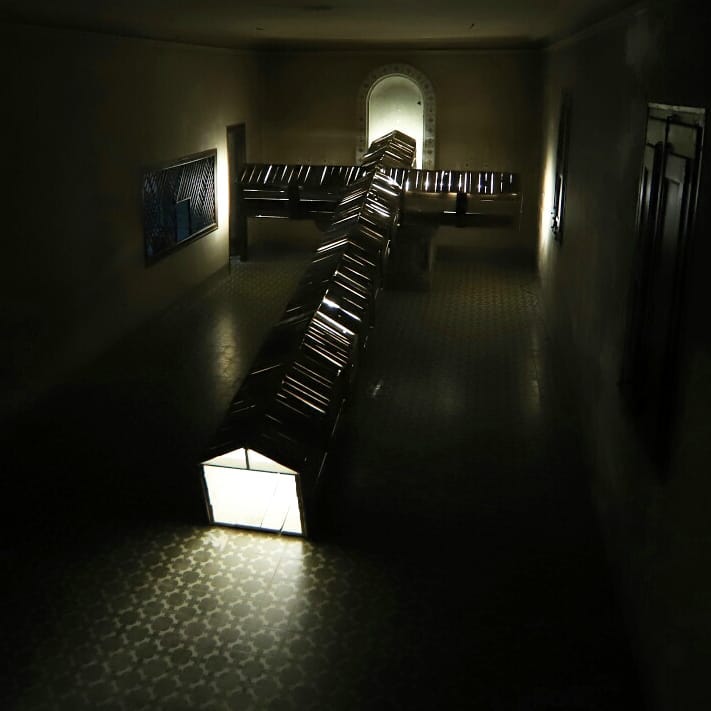
Site-specific installation by Jofre Oliveras and Stefan Krische, 2018, in Konvent, Cal Rosal, Catalonia, Spain.
+++
CURRENT EXHIBITION: “Wrestling the Angel: A Century of Artists Reckoning with Religion,” Bechtler Museum of Modern Art, Charlotte, North Carolina: Through October 28, the Bechtler is showing 219 pieces of religious-themed art spread out across its large fourth floor, including works by Dalí, Rouault, Chagall, Warhol, Manessier, Bearden, and other modern greats. I visited last weekend, and while I feel that the theme was treated too loosely and therefore the exhibition lacked the full impact it could have had, I thoroughly enjoyed individual portions, and I appreciate the Bechtler, and in particular curator Jen Edwards, for bringing together these diverse works that speak in some way to religion, spirituality, or morality.
This was the first time I’ve seen Rouault’s entire Miserere (“Have Mercy”) series—all fifty-eight aquatints!—in one space, and it was stunning. Its display alongside Charlotte artist Gina Gilmour’s Break Your Guns and Stacy Lynn Waddell’s Untitled (Mike Brown’s Battle at Normandy) reinforces the theme of lament for violence and suffering inherent in all three. In the same room the set of small bronze crucifixes by Elizabeth Turk, which in their original gallery installation in 2002–03 contained lit candles in the hollows of the heads, invite further reflection on death, subtly connecting (through strategic placement) Christ’s crucifixion with the “crucifixions” of those slain in the past century through acts of war, gun violence, and police brutality.
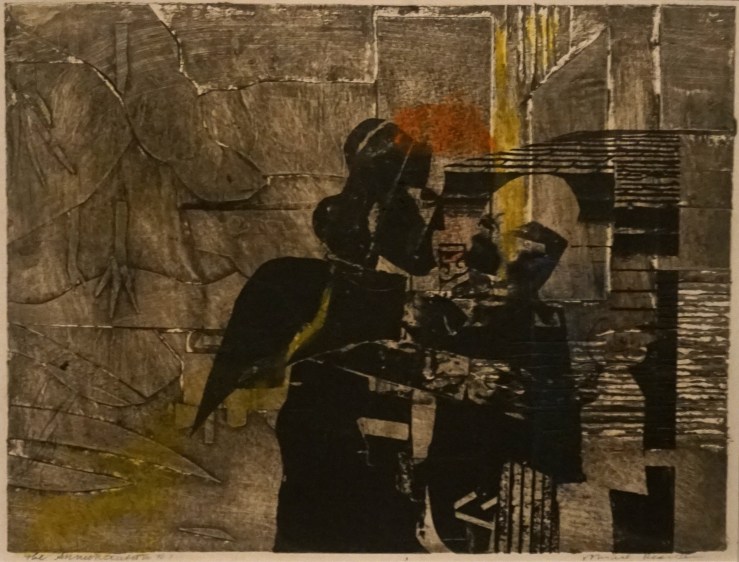
Installation view: “Wrestling the Angel,” Bechtler Museum of Modern Art, Charlotte, North Carolina, 2018. Left: Prints from Georges Rouault’s Miserere series, 1927. Right: Break Your Guns by Gina Gilmour, 1980. Photo: Victoria Emily Jones.Elizabeth R. Turk (American, 1961–), untitled bronzes from Poppyfields, 2002–03. Installation view: “Wrestling the Angel,” Bechtler Museum of Modern Art, Charlotte, North Carolina, 2018. Photo: Victoria Emily Jones.Romare Bearden (American, 1911–1988), The Annunciation, ca. 1967. Collograph, 11 3/4 × 15 1/2 in. (29.6 × 39.4 cm). Courtesy of Jerald and Mary Melberg. Photo: Victoria Emily Jones.
For other reviews of this exhibition, see those by Andy Smith and Barbara Schreiber. And word to the wise: avoid the last day, because it’s a Carolina Panthers NFL home game, and the stadium is right across the street from the museum. (I wish I had thought to check the schedule before I made the cumbersome trek last Sunday!)
PUBLIC ART CONTROVERSY: Olu Oguibe’s Monument to Strangers and Refugees, commissioned for last year’s major quinquennial art exhibition Documenta, was removed on October 3 by order of the Kassel City Council after, it is presumed, mounting pressure from Germany’s anti-immigrant Alternative for Germany (AfD) party. Designed as a site-specific work for Königsplatz (King’s Square), a pedestrian zone in the city center, where it had stood since June 2017, the fifty-three-foot concrete obelisk prominently features an excerpt of Jesus’s words from Matthew 25:35—“I was a stranger and you took me in”—inscribed in gold letters in German, English, Arabic, and Turkish. This quote reflects Jesus’s revolutionary ethic of love at the expense of personal comfort, of disadvantaging the self for others, so it’s no surprise that even today, it still offends. (Later in the passage, Jesus issues a sobering warning for those who fail to heed his command to welcome strangers.)
Olu Oguibe (Nigerian American, 1964–), Monument to Strangers and Refugees, 2017. Concrete, about 53 ft. tall (3 × 3 × 16.3 m). Installation in King’s Square, Kassel, Germany.Olu Oguibe’s Monument to Strangers and Refugees was dismantled early on October 3 following orders by the city of Kassel. Photo: Regina Oesterling.
Germany has become increasingly polarized since 2015, when Chancellor Angela Merkel initiated an open-door immigration policy, leading to an influx of over one million refugees and asylum seekers at the height of the European refugee crisis. The city council had raised funds to purchase Oguibe’s monument for permanent display, and negotiations with the artist were in motion, but on September 24 they changed course, voting to remove the monument instead. According to Councilman Thomas Materner, a member of the AfD party, the obelisk is “ideologically polarizing, disfigured art.”
[Update, 10/12/18: The city and the artist have agreed on a new public location for the monument: Treppenstrasse, a nearby pedestrian area (via). 4/18/19: The monument was installed today at its new location (via).]
+++
CONFERENCES
“The Saddleback Visual Arts / CreativeChurch Arts Conference is a unique, full three-day conference and retreat October 18–20, 2018 at the beautiful Saddleback Rancho Capistrano Retreat Center. Creative leaders, arts ministry practitioners, and renowned artists will share visionary ideas and practical applications during sessions, workshops, creative and interactive performances and experiences. Attendees will explore applications for the arts and creativity in the local church, discover creative inspiration, experience refreshing and empowering ministry, connect with their creative tribe, and have the opportunity for personal or team retreat time in a beautiful setting. . . . For more information, and to register, please visit the CreativeChurch Arts website, here.”
[Update, 10/26/18: Below is a short video debrief of the conference.]
Another conference taking place that same weekend, October 19–20, 2018, is “Visual Theology I: Transformative Looking Between the Visual Arts and Christian Doctrine (1850–Now).” The inaugural conference of the Visual Theology Symposia, it’s being held in Chichester, England, and it may sound familiar to you, since I publicized the call for papers back in April. One of my favorite writers and thinkers in the field, Jonathan A. Anderson, will be speaking there, along with others. The focus will be scholarly, whereas Saddleback’s conference will be more practical, hands-on, and ministry-focused.
+++
LECTURE: “Cathedrals from the Outside: Questions of Art, Engagement, Commemoration and Celebration” by Sandy Nairne: At the National Cathedrals Conference in Manchester last month, Nairne, who served as director of London’s National Portrait Gallery from 2002 to 2015, spoke on the spiritual in art—in public spaces, galleries, and cathedrals. His starting questions: “How does contemporary art function in museums in ways that are of interest to cathedrals? And are there new ways in which art is playing a part in cathedrals that is important to the cultural world as a whole?” Click on the link to read the transcript.
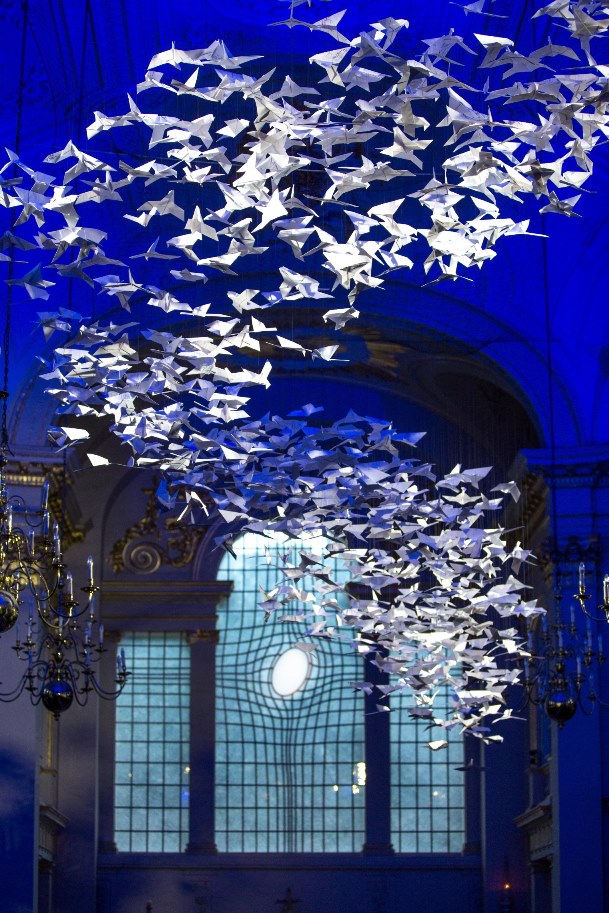
Michael Pendry (German, 1974–), Les Colombes – The White Doves, 2017. 2,000 white paper doves, 49 ft. (15 m). Pentecost installation at St. Martin-in-the-Fields, London. (Shirazeh Houshiary’s East Window is in the background.) Photo: Marc Gascoigne.
+++
NEW ICON:Christ Breaking the Bonds of Animal Suffering: Iconographer Aidan Hart writes, “Sometimes I am commissioned to paint an icon of a saint for whom nothing yet exists, or at least no satisfactory icon. This is usually a pre-schism Western saint. But more rarely, the subject is a new theme, a new emphasis or combination. This was the case when Dr Christine Nellist approached me to create an icon that embodied some of the Orthodox Church’s teaching about our relationship with animals. The icon was to be used as flagship for her newly founded organisation Pan-Orthodox Concern for Animals and to illustrate her pending book on the subject. This article tells the story of its genesis and explains its design.” Fascinating!
Aidan Hart (British, 1957–), Breaking the Bonds of Animal Suffering, 2018. Tempera on wood.
+++
BOOK REVIEWS
The Hymnal: A Reading History by Christopher N. Phillips, reviewed by Leland Ryken: Who knew hymnals didn’t take the form of a songbook until the 1870s! Before then, says Phillips, they were essentially volumes of poetry, used in family and private devotions. “The focus [of this book] . . . is an exploration of the hymnbooks that preceded our familiar hymnal. These were books containing the texts of the hymns without accompanying music. . . . [The author] doesn’t deal with the history of hymn-singing in church services but with the private reading of hymns as poems. I can’t imagine a more original approach to hymns for our generation.” Definitely adding this one to my to-read list.
Everything Tells Us about Godby Katherine Bolger Hyde, with illustrations by Livia Coloji, reviewed by Amanda McGill: This children’s book from Ancient Faith Publishing begins, “The world is like a giant puzzle God made to tell us about Himself—the Father, the Son, and the Holy Spirit. Every piece whispers one of His secrets—all we need to do is listen.” “I love the message of the book,” writes McGill: “finding God in the ordinary elements of creation. I think it affirms what children already suspect: that the world is meaningful, personal and infused with specialness. One of the first things I was thankful for was the inclusion of baptism and the Eucharist at the beginning of the book. It situates the sacraments within the normal experiences of life.”
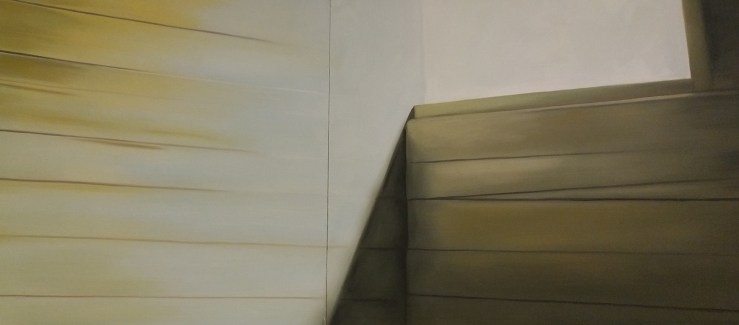
James Rosenquist (American, 1933–2017), Industrial Cottage (upper right detail), 1977. Oil on canvas, 80 × 182 in. (203.2 × 462.3 cm). Smithsonian American Art Museum, Washington, DC. Photo: Victoria Emily Jones.
I cannot ope mine eyes,
But thou art ready there to catch
My morning-soul and sacrifice:
Then we must needs for that day make a match.
My God, what is a heart?
Silver, or gold, or precious stone,
Or star, or rainbow, or a part
Of all these things, or all of them in one?
My God, what is a heart,
That thou shouldst it so eye, and woo,
Pouring upon it all thy art,
As if that thou hadst nothing else to do?
Indeed man’s whole estate
Amounts (and richly) to serve thee:
He did not heav’n and earth create,
Yet studies them, not him by whom they be.
Teach me thy love to know;
That this new light, which now I see,
May both the work and workman show:
Then by a sunbeam I will climb to thee.













 Art & Theology